 Flora of Ceará: Siparunaceae
Abstract
The present work deals with the family Siparunaceae in the state of Ceará, Brazil. The family comprises 53 species in two genera, Siparuna of Neotropical distribution and Glossocalyx (monotypic) occurring in Western Africa. In Brazil, Siparunaceae is represented by the genus Siparuna with 20 species, with the Amazon as its center of diversity with 19 species, followed by the Atlantic Forest with seven species, and Cerrado with six. In Ceará, two species are mentioned in the Flora of Brazil 2020, namely, Siparuna guianensis and Siparuna reginae. This work was based on the examination of physical and virtual herbarium material, types, and bibliographies. Two species of Siparuna were recorded for the state of Ceará, S. guianensis and S. brasiliensis, the second being a new occurrence for the state. A geographic distribution map of the species, an identification key, photographs, taxonomic descriptions, and taxonomic comments are provided.
Key words:
Atlantic Forest; Negramina; Sparuna brasiliensis; Siparuna guianensis; Siparuna reginae
Resumo
O presente trabalho trata da família Siparunaceae no estado do Ceará, Brasil. A família compreende 53 espécies distribuídas em dois gêneros, Siparuna de distribuição Neotropical e Glossocalyx (monotípico) com ocorrência na África ocidental. No Brasil, Siparunaceae é representada pelo gênero Siparuna em 20 espécies, seu centro de diversidade está na Amazônia com 19 espécies, seguido pela Mata Atlântica com sete espécies e Cerrado com seis. No Ceará são citadas duas espécies na Flora do Brasil 2020, Siparuna guianensis e Siparuna reginae. Este trabalho foi baseado em herbários físicos e virtuais, coleções tipo e bibliografias. Foram registradas duas espécies de Siparuna para o estado do Ceará, S. guianensis e Siparuna brasiliensis, com destaque para a segunda, que se trata de uma nova ocorrência para o estado. Além disso, é fornecido mapa de distribuição geográfica das espécies, chave de identificação, fotografias, descrições taxonômicas e comentários taxonômicos.
Palavras-chave:
Mata Atlântica; Negramina; Sparuna brasiliensis; Siparuna guianensis; Siparuna reginae
Introduction
Siparunaceae (Laurales) comprises 53 species distributed in two genera, Siparuna Aubl., with Neotropical distribution, and Glossocalyx Benth (monotypic), found in West Africa (Renner & Hausner 2005). Siparuna and Glossocalyx were formerly the members of a subfamily in Monimiaceae, however, morphology and molecular biology studies confirmed the polyphyleticism of Monimiaceae and the need to dismember Siparunoideae into Siparunaceae (Schodde 1970; Renner & Hausner 1997).
Siparunaceae can be recognized by its simple and opposite leaves with smooth or toothed margins and frequent presence of trichomes. The flowers are unisexual and monochlamydeous, with well-developed hypanthium. The fruit is composite, usually globose, purple, yellow, or red when mature, and with irregular dehiscence, exhibiting drupelets, which may have a stylar aril (Renner & Hausner 2005; Peixoto et al. 2023)
In Brazil, Siparunaceae is represented by Siparuna with 20 species, being the Amazon its center of diversity with 19 species, followed by the Atlantic Forest with seven species, and Cerrado with six (Peixoto et al. 2023). Siparuna guianensis Aubl. is the most widely distributed species, occurring in all biomes in Brazil (Peixoto et al. 2023). Siparuna guianensis and Siparuna reginae (Tul.) A.DC. are the only species that occur in the state of Ceará to date, according to the literature (Peixoto et al. 2023).
Siparuna species have demonstrated potential for medicinal use, primarily among native peoples throughout Central and South America. It is known that plants of the genus are often used in Brazilian folk medicine and religious rituals. Traditional healers use Siparuna to treat malaria and as a febrifuge (Gupta et al. 1979, 1993; Lescure et al. 1987; Iglesias 1987; Zamora-Martinez & Pola 1992; Balée 1994; Schultes & Raffauf 1994; Milliken 1997; Renner & Hausner 2005). They also use plasters made from Siparuna leaves or bark to treat snakebites and small wounds (Renner & Hausner 2005). In a study with the species Siparuna thecaphora (Poepp. & Endl. A. DC.), Otero et al. (2000) observed a moderate neutralizing ability against the hemorrhagic effects of Bothrops atrox venom. Siparuna brasiliensis (Spreng.) A.DC. is included in the first pharmacopoeia of Brazil (Dias da Silva 1926), which recommends leaf extracts as tea or tincture (in alcohol). In addition, a recent study has revealed that S. guianensis, which occurs in the Atlantic Forest, has the potential to inhibit bacteria and fungi such as Streptococcus mutans (ATCC 3440) and Candida albicans (ATCC 10231) (Valentini et al. 2010; Brunassi et al. 2022). In Ecuador, leafy branches are shaken over children’s cradles to protect them from “el frio”, “mal viento” or “mal aire”, terms that refer to a series of spiritual and physical ailments, especially when the person has a fever (Davis & Yost 1983a, 1983b; Renner & Hausner 2005).
The present work, which follows the pattern of the “Flora of Ceará”, aimed to survey the species of Siparunaceae and their geographical distribution in the state of Ceará, contributing to a greater knowledge of the local flora and of the botanical group under study.
Material and Methods
The analyzed material comes from the virtual herbariums and online databases Jabot v.3 (2017), Reflora (2023), SpeciesLink (CRIA 2023), GBIF (2023), and Natural History Museum (2014), as well as physical herbariums (HUEFS, ALCB, MBML, SPF and CVRD), and photographs of Siparunaceae specimens from the state of Ceará provided by herbariums (CEN, EAC, FCAB, HCDAL, HST, HVASF, ICN, IPA, NY, RB, RBR, UB, UFG and UFMT) (acronyms according to Thiers, continuously updated).
The material was identified using identification keys, specialized literature (Renner & Hausner 2005; Peixoto et al. 2023), and by comparing the specimens with type materials and photographs (digital images) available in virtual databases. The general morphology terminology follows Harris & Harris (2001) and the specific terminology for Siparunaceae follows Renner & Hausner (2005) and Peixoto et al. (2020).
Maps were prepared with QGIS (QGIS Development Team 2023) and were based on the analyzed specimens. For georeferencing of species with incorrect coordinates, the coordinates of the locality were obtained through Google Earth (2009).
Results and Discussion
Siparunaceae in Ceará is represented by two species of Siparuna: S. brasiliensis and S. guianensis. There is a record of the occurrence of S. reginae in Ceará (Peixoto et al. 2023), but no material of this species was found in the present survey. On the other hand, S. brasiliensis is being reported here for the first time to the state.
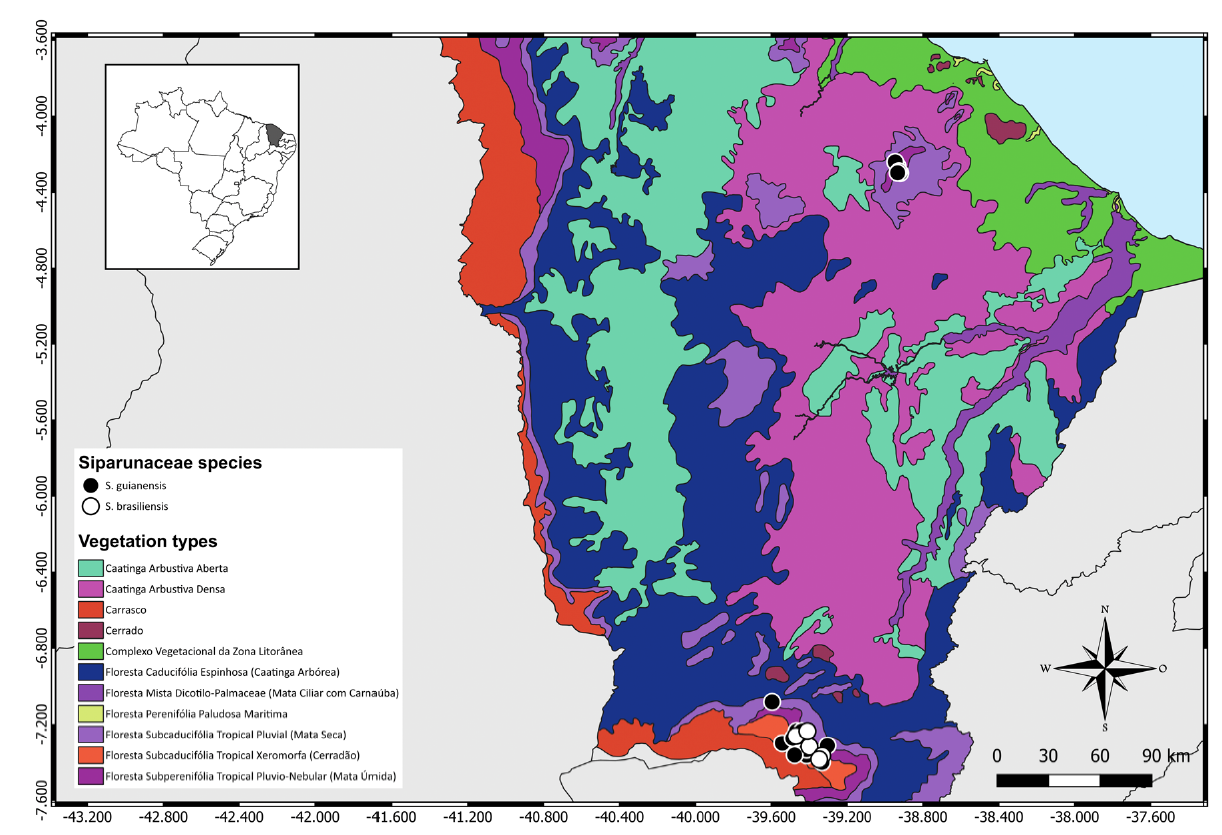
The distribution of individuals in phytoecological units is shown in Figure 1. There was a higher number of samples collected in Crato, followed by Barbalha and Guaramiranga. Crato and Barbalha are located in the south of the state and Guaramiranga in the north. Both species occur in the southern portion of the state. This region is surrounded by the Araripe-Apodi National Forest, with well-preserved vegetation, possibly because it is a protected area. Tropical Subdeciduous Xeromorphic Forest (Cerradão), Tropical Subdeciduous Pluvial Forest (Dry forest), Tropical Subevergreen Rain-Cloud Forest (Humid Forest) and Carrasco prevail in the region. Siparuna guianensis is also found in the north of the state.
Siparuna guianensis is mentioned in the Flora of Baturité (Souza & Oliveira 2006; Silveira et al. 2020). The Serra de Baturité is a residual relief with an extension of 800 km2 and a maximum altitude of 1,115 m located in the north of the state. Caatinga is the predominant vegetation type in this location, gradually replaced by forest vegetation along the altitudinal range, with interspersed areas of Submontane Semideciduous Seasonal Forest, Evergreen Montane Seasonal Forest, Submontane Deciduous Seasonal Forest, and Montane Deciduous Forest (Silveira et al. 2020). Siparuna guianensis is also mentioned in the Flora of Chapada do Araripe (Loiola et al. 2015). The vegetation of Chapada do Araripe is dominated by Savanna (Cerrado), Steppe Savanna (Carrasco), and Evergreen Seasonal Forest (Humid Forest) (Loiola et al. 2020) and has a maximum altitude at its summit of 1,004 m and an extension of 174 km in the east-west direction (Lima 2014).
Identification key for Siparuna species (Siparunaceae) occurring in Ceará
1. Leaves denticulate, serrate or crenate; staminate flowers with trichomes in tufts; floral roof conical, glabrous; floral cup globose; stylar aril present 1.1. Siparuna brasiliensis
1’. Leaves entire, staminate flowers with stellate-lepidote trichomes; floral roof infundibuliform, tomentose; floral cup cupuliform; stylar aril absent 1.2. Siparuna guianensis
Taxonomic treatment
Siparunaceae.
1. Siparuna Aublet, Hist. Pl. Guiane: 864. 1775. Type species: Siparuna guianensis Aublet.
Trees or treelets, occasionally decumbent, 1-20(-40) meters high, strongly odoriferous, glabrous or densely hairy with simple, stellate, lepidote, or scale-shaped trichomes. Leaves opposite, occasionally whorled, petiolate, membranous, cartaceous or leathery, entire, serrate, denticulate or crenate. Inflorescence cymose, axillary or cauliflower, with bracts generally small, deciduous or absent. Flowers radial, small, green, yellowish, white or reddish. Floral cup subglobose to cupuliform, enclosing the carpels and stamens. Tepals 4-8, generally persistent, free or united in a ring, rarely forming a calyptra. Floral roof covering the central part of the floral cup. Staminate flowers with 1 to 10(-70) free stamens, rarely fused laterally. Filament flattened, anther with valvate dehiscence, apical. Pistillate flowers with 1 to 35 carpels separated by septa, ovule anatropous. Fruit multiple, cupuliform, globose, subglobose, pyriform or ovoid, with a smooth, warty or tuberculate surface; when mature, purplish, reddish or yellowish, often crowned by tepals and traces of the floral roof, with drupelets enclosed until maturity, or more rarely, the receptacle does not open. Drupelets (usually called “seeds” by non-specialists) elliptical to globose, with a thin, transparent, shiny epicarp, fleshy, whitish-gray, bluish, yellowish or pinkish exo- and mesocarp, and hard, endocarp verrucular, sometimes with a red or yellow stylar aril (superaryl), single seed (Renner & Hausner 2005; Peixoto et al. 2020; Brunassi et al. 2022).
1.1. Siparuna brasiliensis (Spreng.) A.DC., Prodr. 16(2): 656. 1868.
Citriosma brasiliensis Spreng., Neue Entdeckungen 2: 113, 1821. Type: Brazil. Minas Gerais: without precise locality, Otto s.n. = Sellow s.n./B.598 (Lectotype K; isolectotypes B, destroyed, F photo neg. 13483, GH frag. ex B [2 sheets, label as Sellow L492.B.598], LISU label as 598).
Shrubs or treelets, dioecious, 2-3 meters high, diameter at breast height up to 7 cm, unbranched or branched from the base. Young branchlets terete, covered with yellowish to rusty trichomes. Leaves chartaceous, petiole 0.6-1 cm, terete, lamina obovate, obovate-oblong or rarely elliptical, 9-16 × 5-8 cm, base cordate, auriculate, rounded, obtuse or acute, apex obtuse to acuminate, the tip up to 1 cm long. Margin denticulate, serrate or crenate, drying brownish-green to blackish, pubescent on both surfaces or sparsely pubescent on the adaxial surface, secondary veins 7-9 pairs, flat on the adaxial surface and slightly prominent or protruding on the abaxial surface. Cymes 1-2, axillary, 1.5 cm long, pendent, more or less densely covered with tufted trichomes. Peduncle 3-6 mm, bracts triangular, 0.5 mm long, flowers 12-30, greenish-yellow. Staminate flowers with pedicels measuring 2-4 mm, floral cup subglobose to urceolate, 1-2 × 1.2-2.4 mm, more or less densely covered with tufted trichomes, tepals triangular, free, 0.8-1.2 mm long, with few to many tufted trichomes on the adaxial surface, floral roof conical, glabrous, more or less raised and often forming an upright rim around the floral pore, stamens 1-12. Pistillate flowers with pedicels measuring 1.3-3.2 mm, floral cup subglobose, 1.9-3.2 × 2-3.2 mm, more or less densely covered with tufted trichomes, tepals triangular, floral roof raised, at anthesis exceeding the floral cup, separated by a groove from a central tube surrounding the styles, floral roof double, the first fold conical and fleshy, at anthesis forming an elongated ring around the stigmas, the second fold cylindrical and membranous, glabrous, carpels 10-15. Fruiting receptacle subglobose, 1.4-1.6 cm in diameter, sparsely hairy or glabrescent, crowned by persistent tepals. Fresh fruit with red dots when immature, purple with light dots when mature, internally pink, with a strong odor; when dry, blackish with the drupelets somewhat protruding. Drupelets 6-9, fresh drupelets bluish-gray, shiny, with red stylar aril arranged in the upper-lateral portion.
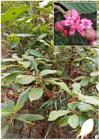
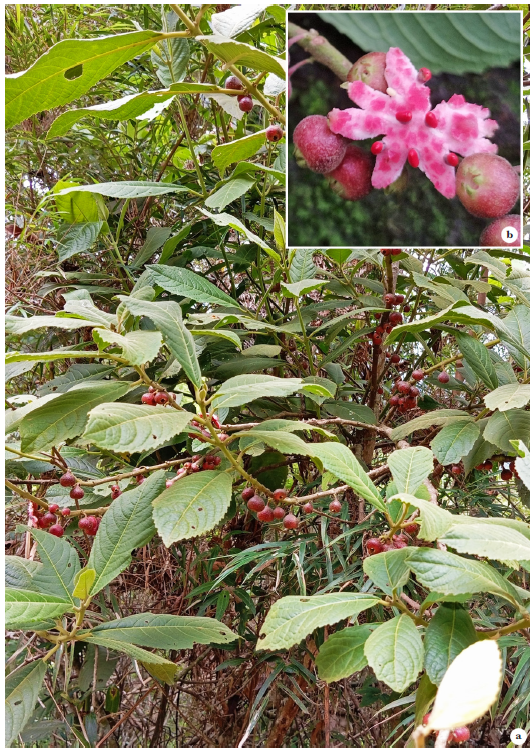
a-b. Siparuna brasiliensis - a. photo of a branch with mature fruits; b. photo of the fruit in detail, showing the internal structures. Photos: a. Liu Idárraga Orozco; b. Michel Ribeiro.
Material examined: Barbalha, Chapada do Araripe, 28.IV.2009, fr., J.R. Maciel et al. 1045 (HVASF); Sítio Santa Rita, 30.III.2000, fr., E.B. Souza et al. 490 (ASE, EAC). Crato, tent, check left side, 22.III.2007, fr., E.N.C. Seixas et al. (HCDAL 3218); Chapada do Araripe, 26.VII.1997, fl., V.L. Gomes-Klein et al. 3256 (RBR, UFG); Carrasco, Planalto do Ibiapaba, 10.IX.1996, fl., F.A.S. Clemente (EAC 25112); Chapada do Araripe, 24.VIII.2010, fl., L.P. Félix (EAC 18982); 6.XI.1985, fl., A. Fernandes et al. (EAC 13957).
Siparuna brasiliensis, a species endemic to Brazil, can be found in Semideciduous Seasonal Forests and Ombrophilous Forests. It is recorded in several regions of Brazil, including the Midwest (Federal District and Goiás), Southeast (Espírito Santo, Minas Gerais, Rio de Janeiro, and São Paulo), Northeast (Bahia and now with new records from Ceará) (Peixoto et al. 2023). This species is characterized by obovate or obovate-oblong leaves with denticulate margins, and a more or less densely hairy surface, consisting of tufted trichomes. It also has short, pendant cymes and triangular tepals. In Ceará, it occurs in Tropical Subdeciduous Rain Forest (Mata Seca), Tropical Subdeciduous Xeromorphic Forest (Cerradão) and Tropical Subevergreen Rain-Cloud Forest (Mata Úmida), and was collected with flowers and fruits from June to November and with fruits in months of March and April (Fig. 2). The species is popularly known as "capim-limão" or "limoeiro-bravo".
1.2. Siparuna guianensis Aublet, Hist. pl. Guiane: 865, t. 333. 1775. Citriosma guianensis (Aublet) Tul., Arch. Mus. Hist. Nat. 8: 361. 1855. Type: French Guiana: near Cayenne, between 1762 and 1764, Aublet s.n. (holotype, BM 30814; NY photo neg. 739).
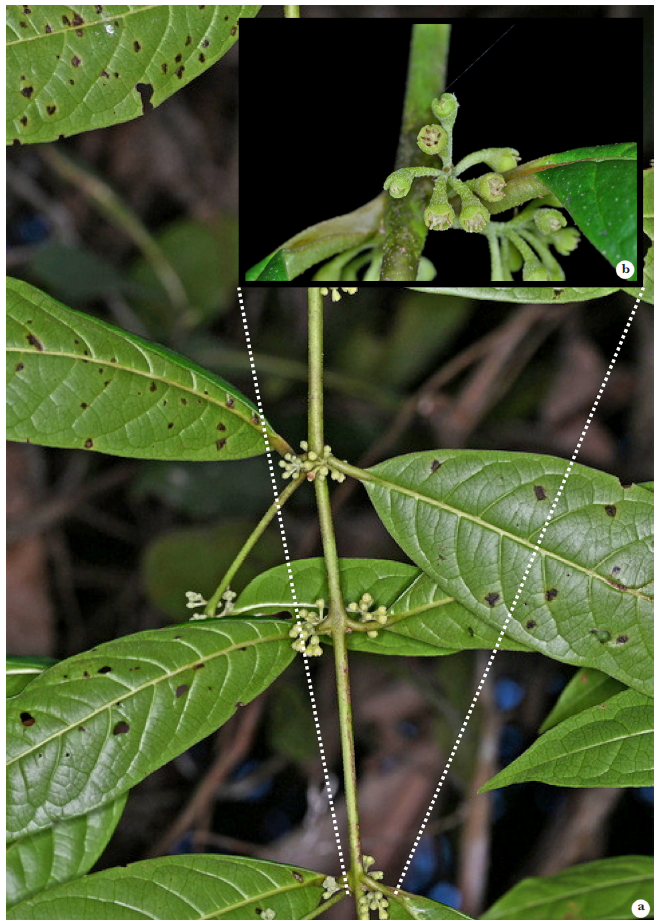
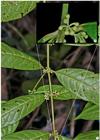
Shrub or tree, monoecious, 1.5-8.5 m high, diameter at breast height 3-8(-15) cm, wood pale yellow, soft, bark brown or green with brown spots; young branchlets terete, more or less flattened at the nodes, the youngest with stellate or stellate-lepidote trichomes (not scale-shaped), very small, later glabrous. Leaves membranous, petiole 0.2-1 cm long, pubescent, then glabrous, canaliculate; lamina oblong, elliptical, rarely lanceolate to ovate-lanceolate, 8-16 × 4-8 cm, base rounded to cuneate, apex obtuse, acute or acuminate, the tip, if present, 0.5-1.2 cm long in the central part, margins entire, slightly stellate-lepidote on both surfaces when young and later glabrescent, rarely with a few simple trichomes on the basal part of the abaxial face when adult; secondary veins 8-14 pairs, barely visible on the adaxial surface and prominent on the abaxial surface, tertiary veins reticulate. Cymes axillary or sub-terminal, in pairs, rarely semi-scorpioid, unisexual or sometimes bisexual, 0.7-1.5 cm long, in bisexual inflorescences, pistillate flowers less numerous than staminate flowers and arranged at the base of the inflorescence, white to greenish-yellow. Staminate flowers with pedicels measuring ca. 2 mm long, floral cup 1.5-2.5 × 1.5-3 mm, wide opening, tomentose, with stellate-lepidote trichomes, tepals 4-6, minute, obtuse, sometimes semi-orbicular to wide-triangular, 0.2-0.3(-0.6) mm long, floral roof barely developed or not developed, stamens 10-19, unequal, 0.5-1.2 mm long, exerted at anthesis, membranaceous, ca. 0.5 mm wide, stamens with valvate dehiscence 2, more or less connate, cordiform. Pistillate flowers stellate-tomentose, pedicel measuring ca. 2 mm, floral cup ovoid, ca. 2 × 2.5 mm, tepals 4-6, triangular to rounded, 0.5 × 1 mm long, floral roof infundibuliform, 0.3 mm, tomentose, orifice ca. 0.1 mm, carpels (3-)6-12(-17), styles conniving, exerted ca. 0.8 mm long. Fruiting receptacle subglobose, 1-1.5 cm in diameter, smooth, tepals obsolete, more or less densely covered with stellate trichomes. Fruit green, turning dark red to vinaceous when mature, breaking laterally exposing the yellow-orange interior, with a strong astringent lemon odor; peduncle ca. 1 cm long, pedicel ca. 0.6 cm long. Drupelets 4-14, without stylar aril, exocarp and mesocarp fleshy, whitish, grayish or orange, becoming slimy, endocarp stony.
Material examined: Barbalha, Arajara, Serra do Araripe, 2.VIII.1997, fl. and fr., A.L. Peixoto et al. 4262 (RBR). Belmonte, road to guard’s house, 26.X.2010, fl., M. Mata et al. 2244 (HUEFS). Crato, Chapada do Araripe, 31.III.1985, fr., A. Fernandes et al. (EAC 13115); 14.III.2012, fr., E.N.A. Seixas et al. (HCDAL 8198); Lameiro, 8.I.1987, fl. and fr., A.L. Peixoto et al. 4512 (RBR); close to the source, 12.XII.1986, fl. and fr., A.L. Peixoto et al. 3647 (RBR); Granjeiro, Sítio Caiana, 21.I.2014, fr., C.E.B. Proença et al. 4646 (RBR, CEN, UB, RB); Guaribas, Floresta Nacional do Araripe, 14.I.1999, fr., A.M. Miranda 3141 (IPA, FCAB, EAC, HUEFS, HST); 18.VIII.1838, fl., G. Gardner 1843 (NY). 1836-1841, fl., G. Gardner 1842 (NY).
Siparuna guianensis is among the first species to develop in secondary areas but can also be found in well-preserved forests. Its identification is facilitated by the combination of elliptical leaves with entire margins, glabrous or glabrescent surfaces, short cymes, and small flowers measuring 0.6-2.5 × 1.5-3 mm.
The species is found in different types of vegetation, such as Riparian or Gallery Forest, Terra Firme Forest, Semideciduous Seasonal Forest, and Ombrophilous Forest. Its geographic distribution includes the Amazon, Caatinga, Cerrado, Atlantic Forest and Pantanal. The species occurs throughout Brazil, except in Rio Grande do Sul and Santa Catarina Peixoto et al. (2020). In Ceará, the species occurs in Tropical Sub-deciduous Rain Forests (Dry Forest), Tropical Sub-deciduous Xeromorphic Forests (Cerradão) and Tropical Subevergreen Rain-Cloud Forests (Humid Forest). It was collected in the flowering phase in the month of October and with flowers and fruits from January to March and from August to December (Fig. 3). Some specimens analyzed exhibited a great quantity of trichomes (Gardner, N. 1842 and 1843; Mata, N. 2244), however, the inflorescence and shape of the leaves match S. guianensis. Three exsiccates with records in databases were requested for analysis, however, the material was not found in the herbarium P (P00053034, P00053035 and P00053261). The species is popularly known as "negramina".
Acknowledgements
We would like to thank the curators and teams of the herbaria visited and who provided the images of the specimens. We also would like to thank Dr. Joelcio Freitas, for his assistance in preparing the map. This study was financed in part by the Coordination for the Improvement of Higher Education Personnel - Brazil (CAPES) - Financial Code 001.
Data availability statement
In accordance with Open Science communication practices, the authors inform that all data are available within the manuscript.
References
- Balée WL (1994) Footprints of the forest. Ka’apor ethnobotany- the historical ecology of plant utilization by an Amazonian people. Columbia University Press, New York. Pp. xxiii+-396.
-
Brunassi GR, Zavatin DA, Pauli M, Peixoto AL & Lírio EJ (2022) Flora da Serra do Cipó, Minas Gerais: Siparunaceae. Boletim de Botânica 39: 59-66. DOI: 10.11606/issn.2316-9052.v39p59-66
» https://doi.org/10.11606/issn.2316-9052.v39p59-66 -
Candolle A (1868) Monimiaceae. In: Candolle A (ed.) Prodromus systematis naturalis regni vegetabilis. Vol. 16. Victoris Masson et Filii, Paris. Pp. 640-676 and 685. DOI: 10.5962/bhl.title.286
» https://doi.org/10.5962/bhl.title.286 -
CRIA (2023) Centro de Referência em Informação Ambiental. Specieslink - dados e ferramentas - busca centralizada. Available at <Available at http://splink.cria.org.br > Access on 28 November 2023.
» http://splink.cria.org.br -
Davis EW & Yost J (1983a) The ethnobotany of the Waorani of eastern Ecuador. Botanical Museum leaflets, Harvard University 29: 159-217. DOI: 10.5962/p.168660
» https://doi.org/10.5962/p.168660 -
Davis EW & Yost J (1983b) Ethnomedicine of the Waorani of Amazonian Ecuador. J. Ethnopharmacology 9: 273-297. DOI: 10.1016/0378-8741(83)90036-3
» https://doi.org/10.1016/0378-8741(83)90036-3 - Dias da Silva RA (1926) Farmacopeia dos Estados Unidos do Brasil. Editoria Nacional, São Paulo. 554p.
-
GBIF (2023) GBIF Home Page. Available at <Available at https://www.gbif.org > Access on 24 November 2023.
» https://www.gbif.org -
Google (2009) Google Earth website. Available at <Available at http://earth.google.com/ >. Access on 21 February 2024.
» http://earth.google.com/ -
Gupta MP, Arias TD, Correa AMD & Lamba SS (1979) Ethnopharmacognostic observations on Panamanian medicinal plants. Part I. Quarterly Journal of Crude Drug Research 17: 115-130. DOI: 10.3109/13880207909065163
» https://doi.org/10.3109/13880207909065163 -
Gupta MP, Correa AMD, Solis PN, Jones AC, Galdames C & Guionneau-Sinclair FJ (1993) Medicinal Plant Inventory of Kuna Indians. Part I. Journal of Ethnopharmacology 40: 77-109. DOI: 10.1016/0378-8741(93)90054-9
» https://doi.org/10.1016/0378-8741(93)90054-9 - Harris JG & Harris MW (2001) Plant identification terminology: an illustrated glossary. 2nd ed. (No. QK9 H37 2001). Spring Lake Publishing, Spring Lake. 216p.
- Iglesias G (1987) Hierbas medicinales de los Quichuas del Napo. Ediciones Abya-Yala, Quito. 208p.
- Lescure JP, Balslev H & Alarcón R (1987) Plantas utiles de la Amazonia Ecuatoriana. ORSTOM, Quito. 408p.
- Lima GG (2014) Análise comparativa de metodologia de mapeamento geomorfológico na bacia do Rio Salamanca, Cariri Cearense. Dissertação de Mestrado. Universidade Federal de Pernambuco, Recife. 120p.
- Loiola MIB, Araújo FS, Lima-Verde LW, Souza SSG, Matias LQ, Menezes MOT, Soares Neto RL, Silva MAP, Souza MMA, Mendonça AM, Macêdo MS, Oliveira SF, Sousa RS, Balcázar AL, Crepaldi CG, Campos LZO, Nascimento LGS, Cavalcanti MCBT, Oliveira RD, Silva TC & Albuquerque UP (2015) Flora da Chapada do Araripe. In: Albuquerque UP & Meiado MV (eds.) Sociobiodiversidade na Chapada do Araripe. Vol. 1. NUPEEA, Recife. Pp. 103-148.
-
Loiola MIB, Ribeiro RTM, Sampaio VS & Souza EB (2020) Diversidade de angiospermas do Ceará. Edições HUVA, Sobral. 257p. Available at <Available at https://www.fundacaosintaf.org.br/arquivos/files/publicacoes/Ebook%20-%20Diversidade%20de%20Angiospermas%20do%20Ceara.pdf >. Access on 15 April 2024.
» https://www.fundacaosintaf.org.br/arquivos/files/publicacoes/Ebook%20-%20Diversidade%20de%20Angiospermas%20do%20Ceara.pdf - Milliken W (1997) Plants for malaria, plants for fever. Medicinal species in Latin America- a bibliographic survey. Royal Botanic Gardens, Kew. 88p.
-
Natural History Museum (2014) Collection specimens [Data set]. Natural History Museum. Available at DOI: 10.5519/0002965
» https://doi.org/10.5519/0002965 -
Otero R, Nunez V, Barona J, Fonnegra R, Jimenez SL, Osorio RG, Saldarriaga M & Diaz A (2000) Snakebites and ethnobotany in the northwest region of Colombia. Part III: neutralization of the haemorrhagic effect of Bothrops atrox venom. Journal of Ethnopharmacology 73: 233-241. DOI: 10.1016/s0378-8741(00)00321-4
» https://doi.org/10.1016/s0378-8741(00)00321-4 -
Peixoto AL, Lírio EJ & Pignal M (2023) Siparunaceae in Flora e Funga do Brasil 2020 (continuously updated). Jardim Botânico do Rio de Janeiro. Available at <Available at https://floradobrasil.jbrj.gov.br/FB14543 >. Access on 19 December 2023.
» https://floradobrasil.jbrj.gov.br/FB14543 - Perkins JR (1901) Beitrage zur Kenntnis der Monimiaceae. III. Monographie der Gattung Siparuna Botanische Jahrbücher fur Systematik 28: 660-705, pl. 12-14.
- Philipson WR (1993) Monimiaceae. In: Kubitzki K, Rohwer JG & Bittrich V (eds.) The families and genera of vascular plants. Vol. 2. Springer Verlag, Berlin. Pp. 426-437.
-
QGIS Development Team (2023) QGIS geographic information system. QGIS Association. Available at <Available at https://www.qgis.org/en/site/ >. Access on 1 December 2023.
» https://www.qgis.org/en/site/ -
Reflora (2023) Reflora - Herbário Virtual. Available at <Available at https://floradobrasil.jbrj.gov.br/reflora/herbarioVirtual/ >. Access on 15 November 2023.
» https://floradobrasil.jbrj.gov.br/reflora/herbarioVirtual/ -
Renner SS, Scwarzbach AE & Lohmann L (1997) Phylogenetic position and floral function of Siparuna (Siparunaceae: laurales). International Journal of Plant Sciences 158: 89-98. DOI: 10.1086/297509
» https://doi.org/10.1086/297509 -
Renner SS (1999) Phylogenetic affinities of Monimiaceae based on cpDNA gene and spacer sequences. Perspectives in Plant Ecology Evolution and Systematics 1: 61-77. DOI: 10.1078/1433-8319-00052
» https://doi.org/10.1078/1433-8319-00052 -
Renner SS & Won H (2001) Repeated evolution of dioecy from monoecy in Siparunaceae (Laurales). Systematic Biology 50: 700-712. DOI: 10.1080/106351501753328820
» https://doi.org/10.1080/106351501753328820 - Renner SS & Hausner G (2005) Flora Neotropica Monograph Siparunaceae (Vol. 95). New York Botanical Garden Press, New York. 247p.
-
Schultes RE & Faffauf RF (1994) De plantis toxicariis e mundo novo tropicale commentationes XXXIX. Febrífugas of northwest Amazonia. Harvard Papers in Botany 5: 52-68. DOI: 10.1016/0378-8741(85)90082-0
» https://doi.org/10.1016/0378-8741(85)90082-0 -
Silva LAE, Fraga CN, Almeida TMH, Gonzalez M, Lima RO, Rocha MS, Bellon E, Ribeiro RS, Oliveira FA, Clemente LS, Magdalena UR, Medeiros E von S & Forzza RC (2016) Jabot - Sistema de Gerenciamento de Coleções Botânicas: a experiência de uma década de desenvolvimento e avanços. Rodriguésia 68: 391-410. DOI: 10.1590/2175-7860201768208
» https://doi.org/10.1590/2175-7860201768208 -
Silveira AP, Loiola MIB, Gomes VS, Lima-Verde LW, Oliveira TS, Silva EF, Otutumi AT, Ribeiro KA, Xavier FAS, Bruno MMA, Souza SSG & Araújo FS (2020) Flora of Baturité, Ceará: a wet island in the Brazilian Semiarid. Floresta e Ambiente 27: e20180320. DOI: 10.1590/2179-8087.032018
» https://doi.org/10.1590/2179-8087.032018 -
Schodde R (1970) Two new suprageneric taxa in the Monimiaceae alliance (Laurales). Taxon 19: 324-328. DOI: 10.2307/1219055
» https://doi.org/10.2307/1219055 -
Souza MJN & Oliveira VPV (2006) Os enclaves úmidos e sub-úmidos do semi-árido do nordeste brasilieiro. Revista Mercator 5: 85-102. DOI: 10.4215/RM0000.0000.0000
» https://doi.org/10.4215/RM0000.0000.0000 -
Thiers B (continuously updated) Index Herbariorum: a global directory of public herbaria and associated staff. New York Botanical Garden’s Virtual Herbarium. Available at <Available at http://sweetgum.nybg.org/science/ih/ >. Access on 4 September 2024.
» http://sweetgum.nybg.org/science/ih/ - Thorne RF (1992) Classification and geography of the flowering plants. The Botanical Review 58: 225-348.
-
Thorne RF (2000) The classification and geography of the flowering plants: Dicotyledons of the class Angiospermae. The Botanical Review 66: 441-647. DOI: 10.1007/BF02869011
» https://doi.org/10.1007/BF02869011 -
Valentini CMA, Rodríguez-Ortíz CE & Coelho MFB (2010) Siparuna guianensis Aublet (negramina): uma revisão. Revista Brasileira de Plantas Medicinais 12: 96-104. DOI: 10.1590/S1516-05722010000100014
» https://doi.org/10.1590/S1516-05722010000100014 -
Zamora-Martínez MC & Pola CNP (1992) Medicinal plants used in some rural populations of Oaxaca, Puebla and Veracruz, Mexico. Journal of Ethnopharmacology 35: 229-257. DOI: 10.1016/0378-8741(92)90021-i
» https://doi.org/10.1016/0378-8741(92)90021-i