 Collection biases in aquatic macrophytes in Brazil: a case study with duckweed (Lemnoideae, Araceae)
Abstract
Lemnoideae species (duckweed) are the smallest angiosperms in the world and typically associated with lentic environments. The challenges in collecting this group and the limited number of studies on this family result in a low number of Lemnoideae records. In this study, we summarize the studies published in Brazil on Lemnoideae to understand the gaps and advances in the research of this group. Information on herbarium records in online databases were gathered in a single matrix to analyze the collection gaps of this group in Brazil. In total, 1,019 records of Lemnoideae were obtained, coming from 22 states, five regions, and six biomes. The largest number of records was found in the Center-West and Northeast regions, areas with a greater sampling effort and higher number of specialists in the group. In contrast, the North Region had a low number of records. This is a reflection of a lack of funding in some regions as well as of botanical blindness that limit the knowledge about the ecological potential of this group and hinder its identification. Thus, there is a clear distribution gap in the knowledge and collections of duckweed in Brazil, underscoring the need to intensify the collection efforts in under sampled areas in order to achieve a more accurate mapping of this group’s diversity in the country.
Key words:
Aquatic plants; Amazon; Plant awareness disparity; Gaps of biodiversity; Neotropical flora
Resumo
As espécies de Lemnoideae (lentilha-d'água) representam as menores angiospermas do mundo, tipicamente associadas a ambientes lênticos. Os desafios na coleta deste grupo e o número limitado de estudos sobre esta família resulta em um baixo nível de registros de Lemnoideae. Neste estudo, resumimos os estudos publicados no Brasil sobre Lemnoideae para entender as lacunas e avanços relacionados a este grupo. Informações sobre os registros de herbário em bases de dados online foram reunidas em uma única matriz para analisar as lacunas na coleta deste grupo no Brasil. No total, foram obtidos 1.019 registros de Lemnoideae, provenientes de 22 estados, cinco regiões e seis biomas. O maior número de registros está concentrado nas regiões Centro-Oeste e Nordeste, áreas com maior esforço amostral e número de especialistas no grupo. Em contraste, a região Norte apresentou um número reduzido de registros. Isso reflete a falta de financiamento em algumas regiões, juntamente com a cegueira botânica, o que limita o conhecimento sobre o potencial ecológico deste grupo e dificulta a identificação. Dessa forma, há uma clara lacuna na distribuição do conhecimento das coleções de lentilha-d'água no Brasil, o que reforça a necessidade de intensificar os esforços de coleta em áreas subamostradas para que se possa obter um mapeamento mais preciso da diversidade desse grupo no país.
Palavras-chave:
Plantas aquáticas; Amazônia; Impercepção botânica; Lacunas de biodiversidade; Flora Neotropical
Aquatic macrophytes play an essential role in ecosystem functions and services, including biomass production and nutrient cycling, besides serving as indicators of water quality (Solimini et al. 2006; Thomaz 2021). Their development is influenced by biotic and abiotic factors such as climate, temperature, rainfall, hydrology, pH, light incidence, and availability of nutrients like phosphorus and nitrogen (Pompêo 2017). However, despite the importance and wide distribution of aquatic macrophytes, collections and studies on this group of plants , especially on very small species, are limited in Brazil (Carvalho et al. 2023; Shen et al. 2024). Among aquatic macrophytes, duckweed (Lemnoideae, Araceae) stands out for being the smallest angiosperms in the world (Daubs 1965; Bog et al. 2013). These plants have a free-living form and floating or slightly submerged habit and grow in the water surface of lentic environments (Pott 2002).
Studies on duckweed around the world have mostly focused on sequencing their chloroplast genome (Wang & Messing 2011; Ding et al. 2017; Park et al. 2024), elucidating the phylogeny and taxonomy of the group (Bog et al. 2020a; Tippery & Les 2020), and investigating their use in effluent treatment (Ceschin et al. 2020). The group has a cosmopolitan distribution, regularly occurring in small water bodies, fish tanks, ditches, and ponds (Vymazal 2008). Duckweeds generally form dense green mats, covering nearly the entire water surface and preventing light from entering the environment, thereby reducing competition with other plants (Garcia et al. 2017). Their morphology consists of a small thalloid body called a frond which, due to its drastic reduction in size, has a mixed origin (i.e., a combination of stem and leaves) (Pott & Cervi 1999; Ziegler et al. 2023). Initially, these plants were classified as a separate family, Lemnaceae. Later, DNA sequencing studies identified this group as part of the family Araceae, reclassifying it as the subfamily Lemnoideae (Cabrera et al. 2008). Lemnoideae currently comprises around 36 species distributed across five genera: Lemna L., Landoltia Les & D.J.Crawford, Spirodela Schleid., Wolffia Horkel ex Schleid, and Wolffiella Hegelm (Bog et al. 2020b; Tippery & Les 2020).
In 1984, Haynes pointed out the habitat where aquatic macrophytes are found as a barrier to collecting and processing the material (Heynes 1984). In deeper waters, besides rakes, it is necessary to use boats to collect samples. Some structures, such as flowers, generally do not remain intact for analysis and identification has to be made through other characteristics. Since they are delicate plants, more care must be taken in the process of drying and pressing the samples compared to terrestrial plants (Ceska & Ceska 1986). In the case of Lemnoideae, the small size and low anatomical complexity of the plants make it difficult to identify them through macromorphology (Ferreira et al. 2019). This process is carried out only by a few specialists who are mainly aided by data relating to their distribution. Accurate identification of these taxa is often achieved only through molecular analysis (Bog et al. 2019). Furthermore, usually more than one taxon occurs in a single sample, indicating that several species occur in sympatry (Lourenço & Bove 2019). And finally, in Brazil, only a handful of studies have addressed the identification of duckweed, including some studies carried out in Mato Grosso do Sul and Mato Grosso (Pantanal) (Pott & Cervi 1999), Rio de Janeiro (Lourenço & Bove 2019), Paraná (Pereira et al. 2016), and Maranhão (Ferreira et al. 2019). All the above factors contribute to the apparent lack of interest in collecting and studying Lemnoideae in Brazil.
The lack of collection initiatives directly impacts the accuracy of data on duckweed in Brazil. Thus, the present study seeks to answer the following questions: 1) What are the main collection biases that affect aquatic macrophytes, especially duckweed, in Brazil?; 2) What is the profile of the main Lemnoideae collectors in Brazil?; 3) What are the main gaps in the collection/distribution of Lemnoideae in Brazil?; and 4) What is the effect of botanical blindness and how does it influence the knowledge about this group?
This study sought to test the following hypotheses: 1) The regions of Brazil where the majority of collections are concentrated are the Southeast, Central-West, and Northeast, and this is influenced by the diversity (number) of states that make up these regions and the variety of biomes represented in them; 2) Pantanal and Atlantic Forest are the biomes with the highest number of records due to the high collection effort of duckweed specialists in these biomes and also due to the presence of many environments favorable for the emergence of macrophytes in these biomes (Pantanal is mostly a large seasonally flooded savanna, an environment favorable to the occurrence of macrophytes; the Atlantic Forest, in turn, is present in a high number of Brazilian states and has one of the highest biodiversity on the planet, with a humid tropical climate, high temperatures and extensive periods of abundant rainfall); and 3) Mato Grosso do Sul and Mato Grosso are the states with the highest number of records because of the high number of collections made by Pott V. J. and collaborators in addition to the fact that a large part of their areas is home to the Pantanal biome, which, as previously stated, has environments conducive to the development of Lemnoideae.
For this study, virtual databases such as speciesLink (<www.specieslink.net>), GBIF - Global Biodiversity Information Facility (<www.gbif.org/species>), Reflora Virtual Herbarium (<https://reflora.jbrj.gov.br/reflora/herbarioVirtual/>), JSTOR (<https://jstor.org/>), and iNaturalist (<https://www.inaturalist.org>) were used to obtain the number of records and the distribution of aquatic macrophytes recorded in Brazil since 1837 (first record), as of April 2024. Furthermore, we used taxonomic and floristic works that include Lemnoideae to ensure the inclusion of records omitted from virtual collections but present in the literature. The obtained data underwent a nomenclatural update following Bog et al. (2020b).
All distribution and georeferenced data, especially records that had an inaccurate location or no information on location at all, were reviewed and updated. When necessary, geographic coordinates were manually corrected. This correction was made using the speciesLink GeoLoc tool (<https://splink.cria.org.br/geoloc>) based on the data available on the collection labels. GeoLoc provides a broad and reliable database of geographic coordinates for numerous locations in Brazil based on the accumulated data from specimens correctly georeferenced in the speciesLink database. In addition, manual corrections and standardization of the names of the main collectors were carried out. Furthermore, records with the same collector and collection number, with incorrect species names or incorrect location of collection sites were excluded to avoid duplication of records or identification errors.
Species richness and density record maps were created in the R program (R Development Core Team 2021). A matrix containing the total number of herbarium and photographic records was prepared for each municipality and inserted into the R program using the geobr (Pereira & Gonçalves 2024), dplyr (Wickham et al. 2023), ggplot2 (Wickham 2016), and cowplot (Wilke 2024) packages. The results obtained were discussed based on specialized literature addressing sampling biases in plant collections/distribution (Sastre & Lobo 2009; Freitas & Matias 2010; Moro et al. 2014; Colli-Silva et al. 2020; Oliveira et al. 2021).
In total, we obtained 1,019 records of specimens of Lemnoideae identified at the subfamily level in Brazil, from collections conducted from 1837 to 2024 in 22 states, five regions, six biomes, and 209 municipalities of Brazil. We obtained 1,005 (Tab. 1) and 937 (Tab. 2) records identified at the genus and species level, respectively. Most of the records (401) were concentrated in the Central-West region. The Northeast, South, Southeast, and North regions had 290, 152, 133, and 29 records, respectively (Tab. 1). The most collected species in Brazil were Lemna aequinoctialis Welw. (280), Lemna valdiviana Phil. (125), Wolffia brasiliensis Wedd. (104), Wolffiella lingulata (Hegelm.) Hegelm. (99), and Wolffia columbiana Karsten (72) (Tab. 2).
Total record of Lemnoideae identified at the genus level distributed across 5 regions of Brazil.
Total records of Lemnoideae identified at species level distributed across 5 regions of Brazil.
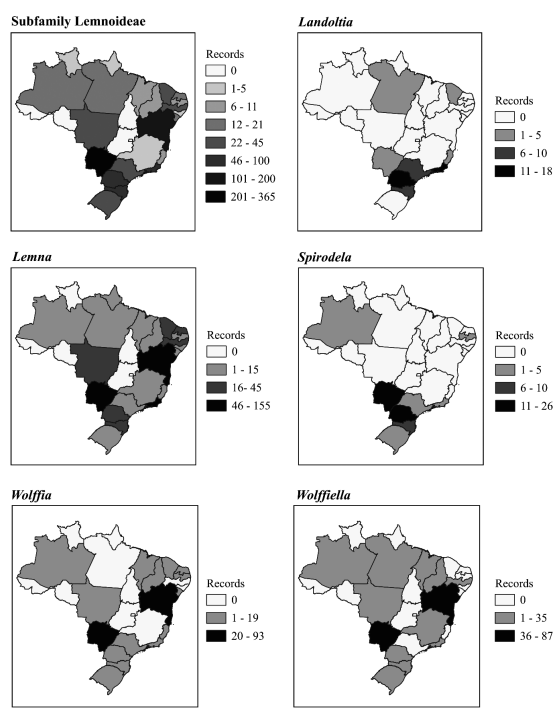
We found more records in Mato Grosso do Sul (365) and Bahia (181), where the main genera recorded were Lemna, Wolffia and Wolffiella. In contrast, the lowest number of records was found in Amapá (2), Alagoas (2), and Roraima (1), and no records were found in the states of Acre, Goiás, Rondônia, Tocantins, and Distrito Federal (Fig. 1a-f). Collections were distributed across 209 municipalities, 12 of which are capital cities and 197 inland towns. Corumbá (281), Anguera (87), and Feira de Santana (52) stood out as the most collected municipalities.
a-f. Occurrence records of the subfamily Lemnoideae in Brazil - a. general occurrence of Lemnoideae; b. records of the genus Landoltia; c. records of the genus Lemna; d. records of the genus Spirodela; e. records of the genus Wolffia; f. records of the genus Wolffiella.
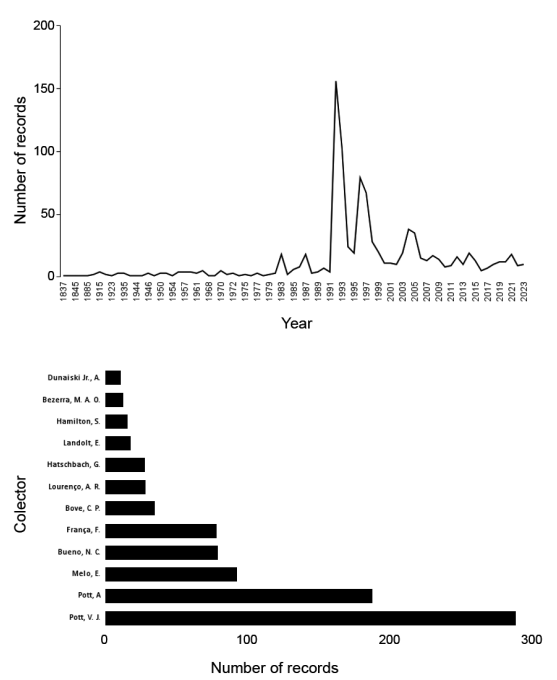
Collection records maintained a low trend until 1991. From the 1990s onwards, there was a considerable increase in collections. The years with the highest number of records were 1992 and 1993, with 156 and 103 records, respectively (Fig. 2a). The collectors with the highest total number of records were Pott, V. J. (288) and Pott, A. (188) (Fig. 2b); they were the main ones responsible for records in the Central-West region, more specifically, in Mato Grosso do Sul (Fig. 2b).
a-b. Collection records of Lemnoideae in Brazil until 2024 (a) and collectors with the highest number of occurrence records of Lemnoideae in Brazil (b).
Our three hypotheses were mostly corroborated. The analysis of collection data of Lemnoideae in Brazil showed a divergence in the number of records in relation to locations and number of species collected. The records were concentrated in the Central-West, Northeast, South, and Southeast regions (regions where the Pantanal, Caatinga, and Atlantic Forest biomes are well represented). The Central-West region corresponds to 18% of the Brazilian territory and has the largest wetland area in the world and great biodiversity, particularly of plant species. Furthermore, 69% of the Pantanal biome in Mato Grosso do Sul is found in the municipality of Corumbá (Viganó et al. 2018) and this leads to in a dense concentration of records in this municipality. Ahrends et al. (2011) show that the availability of resources for taxonomy and professional training impacts the quality of biodiversity data. Furthermore, collection efforts tend to be concentrated around scientific institutions and qualified researchers, resulting in a collection bias in certain geographic areas (Daru et al. 2018).
The lowest number of records was found in the North region. The difficulty of accessing many areas in this region (some areas can only be accessed by long boat trips) and the increasing threat of habitat fragmentation and deforestation are factors that contribute to the low number of records in this region (Carvalho et al. 2023). In a study of plant richness gradients in Brazil, Oliveira et al. (2021) pointed out that areas in the Caatinga and the Amazon are comparatively less accessible and have fewer research institutions compared to the coastal regions, where the Atlantic Forest dominates. Stegmann et al. (2024) also highlight that financial incentives and federal grants are unevenly distributed across Brazilian regions, with the North region receiving the lowest number of grants and support per km2. The authors also point out that the current federal budget is insufficient for large-scale research in the Amazon. Thus, most taxonomists tend to carry out work in the same regions and locations (Sastre & Lobo 2009). These factors may help explain the fewer records of Lemnoideae in the Northern region. Despite having the largest forest in the world, less than 10% of the records in this study were found in this region, a result that highlights the need for more investigations in this region.
We stress that research in the North region is paramount because not only might the diversity of Lemnoideae be underestimated, but also biomes such as the Amazon are in the early stages of invasion by many organisms, especially aquatic plants (Albert et al. 2023). For example, our group recently recorded for the first time the occurrence of Landoltia punctata (G.Mey.) Les & D.J.Crawford (which is considered invasive in Brazil) in the Amazon, in Belém (capital of the state of Pará) (Cabral et al. 2024). The species was found in an urban area, thus in locations that were easy to access, and the determination of the species was difficult because of its close resemblance to other species native to the region (such as Lemna spp.).
There were divergent results also in the distribution of species records, mainly of species of the genera Lemna and Wolffia. These genera are widely distributed in the Brazilian territory (Pott 2002), but they have species that account for the majority of the collection records, influencing the group’s richness. There is usually a positive relationship between the number of sampling units and the estimated species richness, and a larger sampling effort often leads to higher richness (Moro et al. 2014) .
Data produced from 1995 onwards significantly increased the information on the distribution of Lemnoideae species (Colli-Silva et al. 2020). The greater sampling effort is seen in the number of records: the number of records did not exceed 18 until 1992. This sudden growth observed in the 1990s reflects the greater collection effort resulting from the emergence of researchers specialized in the group. In fact, the largest collections are concentrated mainly in the regions explored by Pott and collaborators. Pott is a specialist who carried out taxonomic works on duckweed in the Pantanal region and the states of São Paulo and Paraná (Pott & Cervi 1999; Pott 2002; Pereira et al. 2016).
Our results showed that the gaps and biases regarding the distribution of the subfamily Lemnoideae were mainly influenced by the presence (and absence) of access routes to the sites, the distribution of research centers (and, indirectly, funding for field trips), and oversampling in areas that have been monitored for longer periods, in line with shortfalls that have been discussed in the literature for quite some time (see Oliveira et al. 2016), as well as the unequal distribution of financial incentives and federal grants and the low federal budget for large-scale research in the Amazon. The debate is far from over, as many groups are still under sampled for these reasons.
We are nowhere near a consensus on the development of strategies needed to reduce collection biases, especially in countries like Brazil, where investment in science is much lower than in other emerging countries. In Brazil, investment in projects aimed at health and technological development is prioritized to the detriment of investment in ecology and biodiversity research. This hinders the gathering of information about various taxa, what is worrying in view of the constant degradation of Brazilian biomes.
Thus, the main result of this study was that Lemnoideae collections are biased, with records concentrated in areas where more intensive sampling effort, primarily of specialists in the group, has been made and for a longer period of time. The botanical blindness related to this group is reflected in the irregular and reduced distribution of records found in databases and the literature, hindering the knowledge about the importance of the species in Brazil and the ecological potential of the group. Additionally, the difficult taxonomic distinction of Lemnoideae species makes the identification of invasive species at early stages more challenging. Therefore, we need more studies focusing on this Lemnoideae, especially in less accessible and little explored regions, in order to realistically map the richness and distribution of duckweed in Brazil.
Acknowledgements
We thank Antônio Augusto Souza Costa and Raimundo Luiz Morais de Sousa, for their assistance in the analysis process; the reviewers and especially the editor Paulo José Fernandes Guimarães, for their contributions, which significantly improved our work. This work was supported by CAPES, “Estudos integrados da biodiversidade vegetal para conservação e manejo da Amazônia” (Processo 88881.510208/2020-01 - PDPG - Amazônia Legal) and by Conselho Nacional de Desenvolvimento Científico e Tecnológico - CNPq (processes: 137273/2021-5) and INCT - SinBiAm (process: 406767/2022-0). FBS and GSC thank Norsk Hydro, through BRC and CAPES-Finance Code 001, for their master’s and doctoral scholarships in Brazil. TSM thanks CNPq, for the productivity grants (processes: 311835/2023-6); and MOOP thanks CAPES, for his postdoctoral scholarship. ALBF thanks CNPq (process: 433125/2018-7), for the provision of a doctoral scholarship; and Norsk Hydro, through BRC, for provision of a postdoctoral scholarship.
References
- Ahrends A, Rahbek C, Bulling MT, Burgess ND, Platts PJ, Lovett JC, Kindemba VW, Owen N, Sallu AN, Marshall AR, Mhoro BE, Fanning E & Marchant R (2011) Conservation and the botanist effect. Biological Conservation 144: 131-140.
-
Albert JS, Carnaval AC, Flantua SGA, Lohmann LG, Ribas CC, Riff D, Carrillo J, Fan Y, Figueiredo JJP, Guayasamin JM, Hoorn C, Melo GH, Nascimento N, Quesada CA, Ulloa CU, Val P, Arieira J, Encalada AC & Nobre CA (2023) Human impacts outpace natural processes in the Amazon. Science 379: eabo5003. DOI: 10.1126/science.abo5003
» https://doi.org/10.1126/science.abo5003 - Bog M, Schneider P, Hellwig F, Sachse S, Kochieva EZ, Martyrosian E, Landolt E & Appenroth KJ (2013) Genetic characterization and barcoding of taxa in the genus Wolffia Horkel ex Schleid. (Lemnaceae) as revealed by two plastidic markers and amplified fragment length polymorphism (AFLP). Planta 237: 1-13.
-
Bog M, Appenroth KJ & Sree KS (2019) Duckweed (Lemnaceae): its molecular taxonomy. Frontiers in Sustainable Food Systems 3: 117. DOI: 10.3389/fsufs.2019.00117
» https://doi.org/10.3389/fsufs.2019.00117 - Bog M, Sree KS, Fuchs J, Hoang PT, Schubert I, Kuever J, Rabenstein A, Paolacci S, Jansen MA & Appenroth KJ (2020a) A taxonomic revision of Lemna sect. Uninerves (Lemnaceae). Taxon 69: 56-66.
- Bog M, Appenroth KJ & Sree KS (2020b) Key to the determination of taxa of Lemnaceae: an update. Nordic Journal of Botany 38: 1-8.
-
Cabral GS, Sousa RLM, Costa AAS, Louback-Franco N, Fares ALB, Carmo RS, Jesus AM, Pott VJ & Michelan TS (2024) First record of Landoltia punctata (Araceae, Lemnoidae) in Amazonia. Acta Amazônica 54: e54bc23302. DOI: 10.1590/1809-4392202303020
» https://doi.org/10.1590/1809-4392202303020 - Cabrera LI, Salazar GA, Chase MW, Mayo SJ, Bogner J & Dávila P (2008) Phylogenetic relationships of aroids and duckweeds (Araceae) inferred from coding and noncoding plastid DNA. American Journal of Botany 95: 1153-1165.
-
Carvalho RL, Resende AF, Barlow J, França FM, Moura MR, Maciel R, Alves-Martins F, Shutt J, Nunes CA, Elias F, Silveira JM, Stegmann L, Baccaro FB, Juen L, Schietti J, Aragão L, Berenguer E, Castello L, Costa FRC, The Synergize Consortium & Ferreira J (2023) Pervasive gaps in Amazonian ecological research. Current Biology 33: 3495-3504. DOI: 10.1016/j.cub.2023.06.077
» https://doi.org/10.1016/j.cub.2023.06.077 - Ceschin S, Crescenzi M & Iannelli MA (2020) Phytoremediation potential of the duckweeds Lemna minuta and Lemna minor to remove nutrients from treated waters. Environmental Science and Pollution Research 27: 15806-15814.
- Ceska A & Ceska O (1986) More on the techniques for collecting aquatic and marsh plants. Annals of the Missouri Botanical Garden 73: 825-827.
- Colli-Silva M, Reginato M, Cabral A, Forzza RC, Pirani JR & Vasconcelos TNC (2020) Evaluating shortfalls and spatial accuracy of biodiversity documentation in the Atlantic Forest, the most diverse and threatened Brazilian phytogeographic domain. Taxon 69: 567-577.
- Daru BH, Park DS, Primack RB, Willis CG, Barrington DS, Whitfeld TJ, Seidler TG, Sweeney PW, Foster DR, Ellison AM & Davis CC (2018) Widespread sampling biases in herbaria revealed from large-scale digitization. New Phytologist 217: 939-955.
- Daubs EH (1965) A monograph of Lemnaceae. Illinois Biological Monographs. The University of Illinois Press, Urbana. 118p.
-
Ding Y, Fang Y, Guo L, Li Z, He K, Zhao Y & Zhao H (2017) Phylogenic study of Lemnoideae (duckweeds) through complete chloroplast genomes for eight accessions. PeerJ 5: e4186. DOI: 10.7717/peerj.4186
» https://doi.org/10.7717/peerj.4186 - Ferreira AWC, Oliveira MS, Silva Jr. WR, Andrade IM, Coelho MAN, Oliveira HC & Mayo SJ (2019) New occurrences of small aquatic duckweeds (Araceae, Lemnoideae) in Maranhão state, northeastern Brazil. Check List 15: 1153-1160.
- Freitas RCA & Matias LQ (2010) Situação amostral e riqueza de espécies das angiospermas do estado do Ceará, Brasil. Acta Botanica Brasilica 24: 964-971.
- Garcia DCO, Albertin LL & Matsumoto T (2017) Use of a duckweed pond for the domestic wastewater polishing in Ilha Solteira, SP, Brazil. Management of Environmental Quality 28: 477-489.
- Haynes RR (1984) Techniques for collecting aquatic and marsh plants. Annals of the Missouri Botanical Garden 71: 229-231.
-
Lourenço AR & Bove CP (2019) Flora do Rio de Janeiro: Lemnoideae (Araceae). Rodriguésia 70: e02312016. DOI: 10.1590/2175-7860201970042
» https://doi.org/10.1590/2175-7860201970042 - Moro MF, Sousa DJL & Matias LQ (2014) Rarefaction, richness estimation and extrapolation methods in the evaluation of unseen plant diversity in aquatic ecosystems. Aquatic Botany 117: 48-55.
- Oliveira EVS, Alves DMC, Landim MF & Gouveia SF (2021) Sampling effort and the drivers of plant species richness in the Brazilian coastal regions. Oecologia 195: 163-171.
-
Oliveira U, Paglia AP, Brescovit AD, Carvalho CJB, Silva DP, Rezende DT, Leite FSF, Batista JAN, Barbosa JPPP, Stehmann JR, Ascher JS, Vasconcelos MF, De Marco P, Löwenberg-Neto P, Dias PG, Ferro VG & Santos AJ (2016) The strong influence of collection bias on biodiversity knowledge shortfalls of Brazilian terrestrial biodiversity. Diversity and Distributions 22: 1232-1244. DOI: 10.1111/ddi.12489
» https://doi.org/10.1111/ddi.12489 -
Park H, Park JH & Kang YJ (2024) Characterization of the complete chloroplast genome of Wolffia arrhiza and comparative genomic analysis with relative Wolffia species. Scientific Reports 14: 5873. DOI: 10.1038/s41598-024-56394-7
» https://doi.org/10.1038/s41598-024-56394-7 -
Pereira R & Gonçalves C (2024) geobr: download official spatial data sets of Brazil. R package version 1.9.0. Available at <https://CRAN.R-project.org/package=geobr>. Access on 14 December 2024.
» https://CRAN.R-project.org/package=geobr - Pereira SF, Pott VJ & Temponi LG (2016) Lemnoideae (Araceae) no estado do Paraná, Brasil. Rodriguésia 67: 839-848.
- Pompêo M (2017) Monitoramento e manejo de macrófitas aquáticas em reservatórios tropicais brasileiros. Instituto de Biociências da USP, São Paulo. 138p.
- Pott VJ (2002) Lemnaceae. In: Wanderley MGL, Shepherd GJ, Giulietti AM, Melhem TS, Bittrich V & Kameyama C (eds.) Flora fanerogâmica do estado de São Paulo. Instituto de Botânica, São Paulo. Vol. 2, pp. 135-140.
- Pott VJ & Cervi AC (1999) A família Lemnaceae Gray no Pantanal (Mato Grosso e Mato Grosso do Sul), Brasil. Brazilian Journal of Botany 22: 153-174.
-
R Development Core Team (2021) R: a language and environment for statistical computing. R Foundation for Statistical Computing, Vienna. Availible at <https://www.R-project.org/>. Access on 14 December 2024.
» https://www.R-project.org/ - Sastre P & Lobo JM (2009) Taxonomist survey biases and the unveiling of biodiversity patterns. Biological Conservation 142: 462-467.
-
Shen M, Klink R, Sagouis A, Petsch DK, Abong'o BA, Alahuhta J, Al-Shami SA, Armendáriz LC, Bae M, Begot TO, Belliard J, Benstead JP, Bomfim FF, Bredenhand E, Budnick WR, Callisto M, Calvão LB, Camacho-Rozo CP, Cañedo-Argüelles M, Carvalho FG, Chapman J, Chapman L, Chen Q, Chernoff B, Cibils-Martina L, Closs GP, Corbi JJ, Cunha EJ, Cunico AM, Rios-Escalante P, Dolédec S, Dunck B, Edegbene AO, Engman AC, Erős T, Esteves KE, Faquim RCP, Faria APJ, Ferreira CM, Ferreira MC, Fierro P, Freitas PV, Fugère V, Garcia TD, Giam X, Gonino GMR, González-Trujillo JD, Gubiani EA, Hamada N, Haro RJ, Hepp LU, Herrera-R GA, Hill MJ, Huda AN, Iniguez-Armijos C, Jamoneau A, Jonsson M, Juen L, Kadye WT, Kahirun K, Kasangaki A, Larson CA, Pereira AL, Leboucher T, Leite GFM, Li D, Luiza-Andrade A, Luke SH, Lundquist MJ, Lupi D, Machuca-Sepúlveda J, Macuiane MA, Mancera-Rodriguez NJ, Márquez JA, Martins RT, Masese FO, Meixler MS, Michelan TS, Monge-Salazar MJ, Mruzek JL, Mugni HD, Ndagurwa HGT, Niba A, Nimptsch J, Novelo-Gutiérrez R, Ochieng H, Pacheco-Díaz R, Park Y, Passy SI, Pearson RG, Peressim A, Périco E, Pires MM, Poulos H, Principe RE, Prudente BS, Ríos-Touma B, Ruaro R, Schmitter-Soto JJ, Schneck F, Schulz UH, Selvakumar C, Sharma CM, Siqueira T, Solis ML, Sousa RGC, Stanley EH, Stenger-Kovács C, Tales E, Teresa FB, Thornhill I, Tison-Rosebery J, Vieira TB, Villada-Bedoya S, White JC, Wood PJ, Xie Z, Yule CM, Zequi JAC & Chase JM (2024) FreshLanDiv: a global database of freshwater biodiversity across different land uses. Global Ecology and Biogeography 33: e13917. DOI: 10.1111/geb.13917
» https://doi.org/10.1111/geb.13917 - Solimini AG, Cardoso AC & Heiskanen AS (2006) Indicators and methods for the ecological status assessment under the Water Framework Directive. Linkages between chemical and biological quality of surface waters. Joint Research Centre, European Commission, Luxemburg. 262p.
- Stegmann LF, Franca FM, Carvalho RL, Barlow J, Berenguer E, Castello L, Juen L, Baccaro FB, Vieira ICG, Nunes CA, Oliveira R, Venticinque EM, Schietti J & Ferreira J (2024) Brazilian public funding for biodiversity research in the Amazon. Perspectives in Ecology and Conservation 22: 1-7.
- Thomaz SM (2021) Ecosystem services provided by freshwater macrophytes. Hydrobiologia 850: 2757-2777.
- Tippery NP & Les DH (2020) Tiny plants with enormous potential: phylogeny and evolution of duckweeds. In: Cao X, Fourounjian P, Wang W (eds) The duckweed genomes. Compendium of Plant Genomes. Vol. 1. Springer, Cham. Pp. 19-38.
- Viganó HHDG, Souza CCD, Cristaldo MF, Reis Neto JFD & Jesus LD (2018) Incêndios no Pantanal de Corumbá, MS: modelagem e previsão a partir das técnicas de análise multivariada. Revista Ambiente & Água 13: 1-14.
- Vymazal J (2008) Constructed wetlands, subsurface flow. In: Jørgensen S & Fath B (eds.) Encyclopedia of ecology. Elsevier, Amsterdam. Pp. 748-764.
-
Wang W & Messing J (2011) High-throughput sequencing of three Lemnoideae (duckweeds) chloroplast genomes from total DNA. PloS one 6: e24670. DOI: 10.1371/journal.pone.0024670
» https://doi.org/10.1371/journal.pone.0024670 - Wickham H (2016) ggplot2: elegant graphics for data analysis. Springer-Verlag, New York. 260p
-
Wickham H, François R, Henry L, Müller K & Vaughan D (2023) dplyr: a grammar of data manipulation. R package version 1.1.4. Available at <https://CRAN.R-project.org/package=dplyr>. Access on 14 December 2024.
» https://CRAN.R-project.org/package=dplyr -
Wilke C (2024) Cowplot: streamlined plot theme and plot annotations for “ggplot2”. R package version 1.1.3. Available at <https://CRAN.R-project.org/package=cowplot>. Access on 14 December 2024.
» https://CRAN.R-project.org/package=cowplot - Ziegler P, Appenroth KJ & Sree KS (2023) Survival strategies of duckweeds, the world’s smallest angiosperms. Plants 12: 2215.
-
This work was supported by CAPES, “Estudos integrados da biodiversidade vegetal para conservação e manejo da Amazônia” (Processo 88881.510208/2020-01 - PDPG - Amazônia Legal) and by Conselho Nacional de Desenvolvimento Científico e Tecnológico - CNPq (processes: 137273/2021-5) and INCT - SinBiAm (process: 406767/2022-0); CAPES-Finance Code 001; CNPq, for the productivity grants (processes: 311835/2023-6); CNPq (process: 433125/2018-7)