 Flora of Rio de Janeiro: the genus Luehea (Malvaceae: Grewioideae)
Abstract
We present a taxonomic revision of Luehea from the state of Rio de Janeiro, an important area of the phytogeographic domain Brazilian Atlantic Forest in the Southeast region. Here, eight taxa that occur in submontane or montane ombrophilous forests are recognized, including restinga vegetation and/or riparian or gallery forests: L. candicans var. candicans, L. candicans var. gracilis, L. conwentzii, L. divaricata, L. macrophylla, L. ochrophylla, L. paniculata, and L. speciosa. For each species, description, synonymy, distribution and habitat, comments on morphology, illustration with field photos, illustration with morphological characters, and distribution map are provided. An identification key with these species for state of Rio de Janeiro is also presented.
Key words:
Açoita-cavalo; Atlantic Forest; Conservation; Morphology; Neotropical
Resumo
Apresentamos a revisão taxonômica de Luehea para o estado do Rio de janeiro, uma importante área do domínio fitogeográfico Brasileiro Mata Atlântica na região sudeste. Aqui, oito táxons são reconhecidos, ocorrendo em floresta ombrófila submontana ou montana, vegetação de restinga, e/ou em floresta marginal ou de galeria: L. candicans var. candicans, L. candicans var. gracilis, L. conwentzii, L. divaricata, L. macrophylla, L. ochrophylla, L. paniculata e L. speciosa. Para cada espécie, são fornecidos a descrição, sinonímias, distribuição e habitat, comentários sobre a morfologia, ilustração com fotos de campo, ilustração com caracteres morfológicos, e um mapa de distribuição. Também é apresentada uma chave de identificação com essas espécies para o estado do Rio de Janeiro.
Palavras-chave:
Açoita-cavalo; Mata Atlântica; Conservação; Morfologia; Neotropical
Introduction
Luehea (Malvaceae; Grewioideae) is a genus with wide distribution in the Neotropical region, ranging from southern Mexico to northern Argentina and Uruguay. This genus was described by Willdenow (1801) for Luehea speciosaWilldenow (1801: 401), which was recently proposed and accepted as conserved name by Rijckevorsel (2005). Nowadays, Luehea includes 39 described names, but only 21 species and three varieties are currently accepted (Bayer et al. 1999; Bayer & Kubitzki 2003; Gerace et al. 2022). Based on molecular phylogenetic analysis of Malvaceae, Luehea belongs to the clade Grewia, the second major and strongly supported clade of the subfamily Grewioideae. This genus belongs to the subclade Microcos, together with Colona, Microcos, Goethalsia, and Lueheopsis (Brunken & Muellner 2012).
Luehea is characterized by both arboreal and shrub habit, unarmed, with simple, trinervate leaves; flowers pentamerous, epicalyx with free bracteoles; the fruit is a woody capsule dehiscent, and seeds are winged and samaroid (Bayer & Kubitzki 2003). In Brazil, 15 taxa (14 species and one variety) occur in all six mains Brazilian phytogeographic domains. The Atlantic Forest shows the highest number of species, and Luehea candicans var. gracilis (Schumann 1886: 153) Cunha (1982: 83), Luehea conwentzii Schumann (1886: 156), and Luehea ochrophyllaMartius (1841: 50) are endemic to this phytogeographic domain (Gerace & Bovini 2020). In her taxonomic study of the genus, Cunha (1985) cited six species and one variety for Rio de Janeiro. In the Brazilian Southeast region, six species and one variety are reported for the state of Rio de Janeiro (Bovini 2014), but with little data on their distribution. However, Gerace & Bovini (2020) cite eight species and one variety. In this study, we document the occurrence in this area of seven species and one variety. This is also supported by the morphometric study of Gerace (2021) who circumscribed each species more effectively and recognized the most diagnostic characters to identify them, especially their fruit. Previously, fruits had never been treated as a diagnostic character in Luehea studies, as for example in Cunha (1985) the characteristics of the fruit were not included in the identification key. Instead, detailed analysis of the fruit provided a more critical view of the species circumscription, as in the reestablishment of the species Luehea macrophylla Pohl (1833: 127) (Gerace et al. 2024). Here, we are the first to provide very detailed capsule descriptions for each species.
The present work is part of an ongoing study of the Luehea (Gerace & Bovini 2020). Here, through a detailed morphological analysis, we aim to provide a review of Luehea taxonomy in the state of Rio de Janeiro, an important area of the phytogeographic domain Brazilian Atlantic Forest. Accordingly, we provide diagnostic descriptions, a key to identify the accepted species, geographical distribution, taxonomic comments, illustrations, and distribution maps.
Materials and Methods
The study area is entirely included in the phytogeographic domain Atlantic Forest, more specifically. This area covers almost 44,000 km2 at elevations that range from sea level to more than 2,700 m.
For this study, the most important herbarium collections were traced through the databases Index Herbariorum (<http://sweetgum.nybg.org/science/ih/>), JABOT (<http://jabot.jbrj.gov.br/v3/consulta.php>) and SpecieLink (<https://specieslink.net/>). The herbaria consulted in person were HB, HUENF, R, RB, and RBR for a total of more than 250 specimens. The number of herbaria has been limited by the onset of the COVID-19 pandemic, restricting visits to institutions in the state of Rio de Janeiro only. Additionally, material was collected in the living collections of the Rio de Janeiro Botanical Garden (RBv) and in field expeditions. The collection sites were based on information contained in the labels of herbarium material. Samples were collected following Mori et al. (1989), and some flowers were stored in ethyl alcohol 70% for subsequent morphological analyses.
Species are listed in alphabetical order. The terminology used for vegetative and reproductive morphology follows Harris & Harris (2001) and Hickey & King (2002). Only one specimen per municipality was selected for inclusion in the examined and listed material. Other specimens analyzed are listed in the Specimens List at the end of this paper. Vegetation types follow the IBGE (2012).
For the distribution map, we used the QGIS v.3.16.10 program (QGIS 2022). To analyze material, we used a stereoscope (Olympus) for magnification and a calliper to measure the structures.
Results and Discussion
In the state of Rio de Janeiro there are seven species and one variety of Luehea: L. candicans Mart. var. candicans, L. candicans var. gracilis (K.Schum.) M.C.S.Cunha, L. conwentzii K.Schum., L. divaricata Mart., L. macrophylla Pohl, L. ochrophylla Mart., L. paniculata Mart., and L. speciosa Willd. These species were found mainly in more open vegetation with high luminosity, with the exception of L. conwentzii which occurs in ombrophilous forests. Furthermore, all species have at least one occurrence in a conservation unit in the state of Rio de Janeiro, except for L. macrophylla which has no records.
Taxonomic treatment
Luehea Willd., Neue Schriften Ges. Naturf. Freunde Berlin 3: 409. 1801.
= Alegria Moc. & Sessé ex DC, Prodr. [A. P. de Candolle] 1: 516. 1824.
= Brotera Vell., Fl. Flumin.: 322. 1829.
Shrubs to trees; branches cylindrical, glabrous, with white longitudinal streaks, young twigs and petioles densely tomentose with brown stellate trichomes; stipules caducous, lanceolate. Leaves simple, alternate, petiolate; leaf blades membranaceous to coriaceous, elliptic, ovate, oblong, obovate or lanceolate, base cuneate, rounded or subcordate, apex acute, margin serrate, trinervate, basal nerves extending two-thirds to three-fourths length of the blade; adaxial surface green, with sparse or dense stellate trichomes to glabrescent, abaxial surface white, with arachnoid trichomes and sparsely or densely stellate trichomes. Inflorescences many flowered, rare single flower, terminal to axillary, compound panicles; branches tomentose with stellate trichomes; pedicel tomentose, usually with two bracts caducous. Epicalyx with 6-12 bracteoles, linear, lanceolate, ovate or narrow-lanceolate, free, brownish, both surfaces tomentose, trichomes stellate. Sepals 5, lanceolate to ovate, usually revolute, abaxial surface with trichomes stellate, adaxial glabrous. Petals 5, white, yellow or pinkish, linear, obovate, orbicular, oblong or elliptic, margin entire or repand, with thickened basal nail, glabrous, base with appressed white trichomes. Androecium with five phalanges free or connate in a basal ring; staminodes in the external whorl, numerous, attached at the base of stamen phalange, connate or free, usually shorter than the stamens, sometimes equal or much longer, white villose at base; stamens numerous, free or connate, forming a tube around the style, villose at base; anthers dorsifixed, bilocular, thecae parallel, oblong, longitudinal dehiscence. Ovary 5-locular, superior, ovate, oblong, elliptic or globose, tomentose, transversal section angular, pentagonal or circular; style terete, completely or partially pubescent or glabrous; stigma capitate, glabrous. Fruit capsule loculicidal, ferruginous, brownish to blackish when adult, villose or tomentose, oblong, elliptic, narrow-elliptic, ovate, obovate, rhomboid or globose, apex cuspidate, cuneate, obtuse, acute, rounded or truncate, base acute, cuneate, rounded or truncate, glabrescent, 5-locular, partly dehiscent, dorsal surface valves convex, plane or sulcate, with central relief or not, valve margins plane or acute, crests-like or not. Seeds many, samaroid, glabrous, brown.
Key to the species of Luehea from the state of Rio de Janeiro
1. Single flower; staminodes much longer than the stamens; capsule with valve margins deeply acute, crest-like 2
1’. Inflorescence with 2 or more flowers; staminodes shorter or the same length as the stamens; capsule with valve margins plane, not crest-like 3
2. Leaf blade 6-14.5 cm long; flower with diameter ≥ 6 cm, petals (3-5 cm long) longer than the sepals (2-3 cm long) and epicalyx bracteoles (1.5-3.7 cm long); capsule 3-4.5 cm long 1. Luehea candicans var. candicans
2’. Leaf blade 1.8-5 cm long; flower with diameter ≤ 4 cm, petals, sepals, and epicalyx bracteoles of the same length (ca. 1.6 cm long); capsule ca. 2.5 cm long 1a. Luehea candicans var. gracilis
3. Petals entirely pinkish or with the base yellow; style 1/3-basal or 2/3-basal pubescent 4
3’. Petals entirely white or yellow; style 1/2-basal or completely pubescent 5
4. Petals obovate; innermost stamens connate into a tube around the style; capsule ovate 3. Luehea divaricata
4’. Petals orbicular; stamens completely free; capsule elliptic, sometimes clavate 6. Luehea paniculata
5. Flowers with diameter > 4.5 cm; epicalyx bracteoles ≥ 1.6 cm long; petals ≥ 2.4 cm long; capsule on average longer 6
5’. Flowers with a diameter ≤ 4 cm; epicalyx bracteoles ≤ 1.5 cm long; petals ≤ 1.7 cm long; capsule on average shorter 7
6. Epicalyx bracteoles with base cuneate; ovary ovate to globular, circular to pentagonal in transversal section; capsule tomentose, with dorsal surface valve convex to plane 7. Luehea speciosa
6’. Epicalyx bracteoles with base cordate to rounded; ovary oblong to elliptic, angular in transversal section; capsule villose, with dorsal surface valve deeply sulcate 4. Luehea macrophylla
7. Epicalyx bracteoles 1.1-1.5 cm long; petals yellow, obovate; style 1/2-basal pubescent or glabrous; capsule 1.8-2.5 cm long, obovate, tomentose, dorsal surface valve deeply sulcate without central relief 5. Luehea ochrophylla
7’. Epicalyx bracteoles 0.35-0.6 cm long; petals white, linear; style completely pubescent; capsule 1.2-1.7 cm long, elliptic to ovate, villose, dorsal surface valve deeply sulcate with central relief 2. Luehea conwentzii
1. Luehea candicans Mart. var. candicans , Nov. Gen. Sp. Pl. 1(4): 102. 1826.
= Luehea villosa Mart., Nov. Gen. Sp. Pl. 1(4): 102. 1826.
= Luehea uniflora A.St.-Hil., Fl. Bras. Merid. 1: 290. tab. 57. 1828.
= Luehea microphylla Pohl, Pl. Bras. Icon. Descr. 2: 129. tab. 187. 1833. Figs. 1; 2a-b
Shrubs to trees, 2-12 m hight. Petiole 0.3-0.8 cm long. Leaves 6-14.5 × 3-8.4 cm, ovate to elliptic, membranous to coriaceous, base rounded to subcordate, adaxial surface green, glabrous or sparse stellate trichomes, abaxial surface white, with densely arachnoid trichomes or sparse stellate trichomes. Single flower, terminal; pedicel 0.4-1.1 cm long. Epicalyx with 8-11 bracteoles, 1.5-3.7 × 0.25-0.6 cm, linear to lanceolate. Sepals 2-3 × 0.4-0.8 cm, lanceolate, plane. Petals 3-5 × 0.3-0.4 cm, white, linear, margin entire. Androecium grouped in 5 phalanges, free; staminodes 2.4-3 cm long; stamens 1-2 cm long. Ovary 0.35-0.5 × 0.35-0.5 cm, globular to elliptic, angular in transversal section; style 1.4-1.8 cm long, completely pubescent; stigma 0.25-0.55 cm wide, 0.1-0.2 cm long. Capsule 3-4.5 × 1.5-2.5 cm, rhomboid, base acute to cuneate, apex cuneate to obtuse, dehiscence for 2/3-apical, villose, valve with dorsal surface convex or plane, angular cross section, margins deeply acute, crest-like. Seeds 1.1-1.3 × 0.3-0.5 cm.
Selected examined material: Petrópolis, Fazenda Itaipava, 22.XII.2005, fl., G. Siqueira & O. Gracff 97 (RB). Rio Claro, Lidice, Fazenda Torres, 4.XII.2001, fl. and fr., F.B. Pereira 20/132 (RB). Rio de Janeiro, Morro do Leme, XI.1966, fl., D. Sucre 1337 (RB). São José do Vale do Rio Preto, Sitio Beira Mar, 5.XI.2000, fl., F.M.B. Pereira 33/49 (RB). Santa Maria Madalena, Serra do Bicalho, XI.1938, fl., S. Lima 406 (RB).
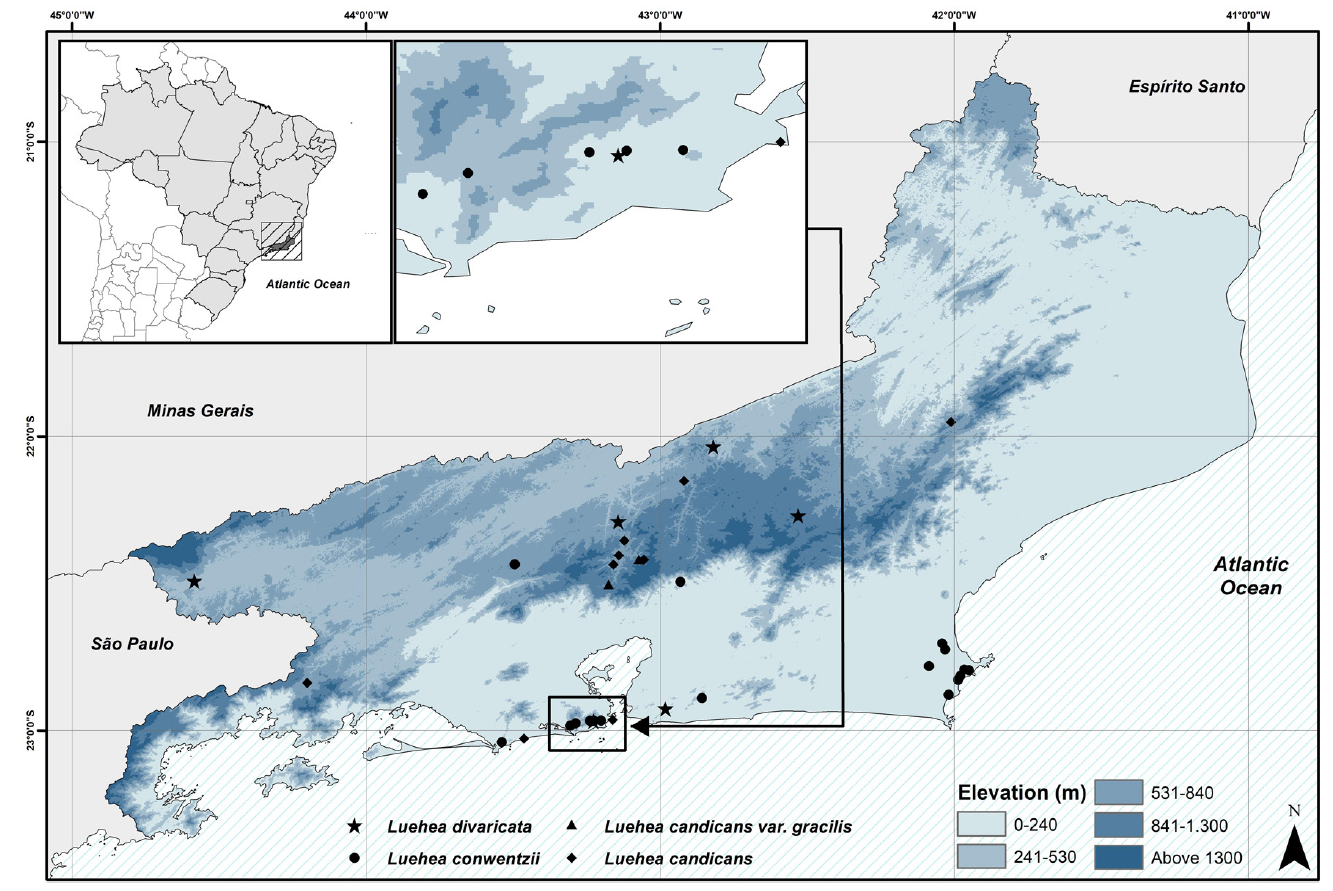
Luehea candicans has a wide distribution, ranging from southern Peru, Bolivia, and northeastern Brazil to Paraguay and northern Argentina (Souza & Esteves 2002). In Brazil, it is widespread, particularly in the phytogeographic domains Atlantic Forest, Cerrado, and Caatinga. In the state of Rio de Janeiro, Luehea candicans occurs at elevations from 10 to 1,000 m, in sandbank vegetation, along roadsides and in riparian or gallery forests, showing a preference for areas with high brightness and clayey/sandy soil (Fig. 1). This species occurs in the following conservation units: the Parque Municipal Paisagem Carioca (Rio de Janeiro), and the Parque Estadual do Desengano (Santa Maria Madalena). Flowering was recorded from October to February, and fruiting from November to April.

Geographical distributions of Luehea candicans var. candicans, L. candicans var. gracilis, L. conwentzii and L. divaricata in the state of Rio de Janeiro.
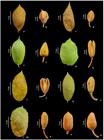
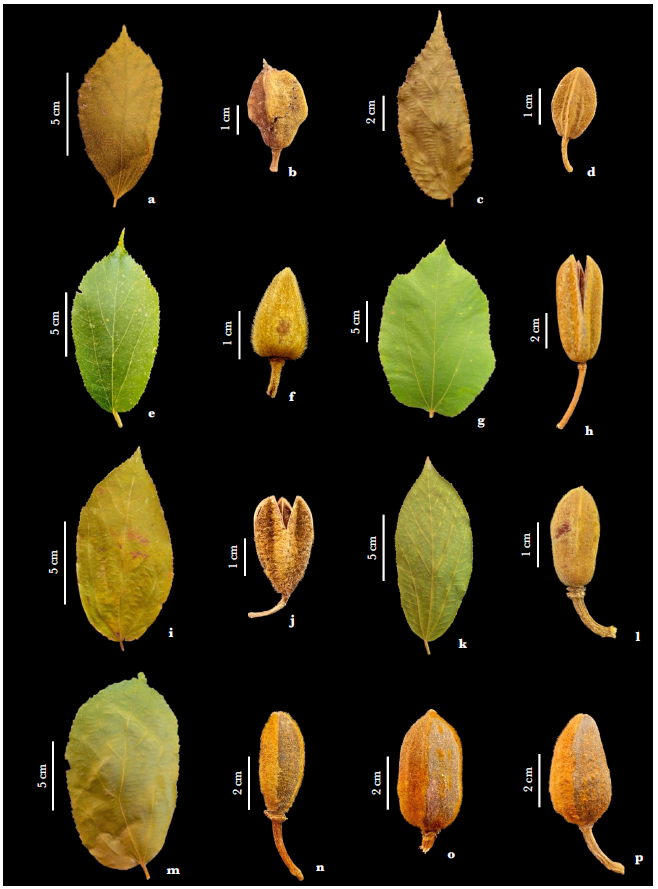
a-b. Luehea candicans - a. leaf; b. capsule. c-d. L. conwentzii - c. leaf; d. capsule. e-f. L. divaricata - e. leaf; f. capsule. g-h. L. macrophylla - g. leaf; h. capsule. i-j. L. ochrophylla - i. leaf; j. capsule. k-l. L. paniculata - k. leaf; l. capsule. m-p. L. speciosa - m. leaf; n-p. capsules. (a-b. S. Lima 406; c-d. C. Farney et al. 3578; e-f. J.F.A. Baumgratz et al. 1724; g-h. S. Gerace 128; i-j. T.M. Scarponi; k-l. D.N.S. Machado & L.A. Ribas 285; m-o. G.A. de Queiroz 408; n. B.N. Riguetti 18; p. D. Costantino). Photos by Samuele Gerace.
Luehea candicans is the only species in the Brazilian southeast showing inflorescences reduced to a single flower. This feature is found in four other species with different ranges: L. candida (Moc. & Sessé ex DC.) Mart. (native to Central America), L. burretii M.C.S.Cunha (endemic to the Brazilian states Ceará and Piauí), L. fiebrigii Burret (native to Bolivia and northwest Argentina), and L. herzogiana R.E.Fr. (endemic to Bolivia). Luehea candicans and L. burretii are the only species showing staminodes much longer than stamens and linear petals reaching 5-6 cm in length, making it easy to identify them in the field. Moreover, the fruit stands out for its valve margins deeply acute, creating crest-like structures along the capsule (Fig. 2b). It is the only Brazilian species showing this feature.
1a. Luehea candicans var.gracilis (K.Schum.) M.C.S.Cunha, Bradea 3(11): 83. 1980.
≡ Luehea uniflora var. gracilis K.Schum., in Martius, Fl. bras. 12(3): 153. 1886.
Leaves 1.8-5 × 1.2-2.5 cm. Epicalyx with bracteoles ca. 1.6 × 0.3 cm. Sepals and petals ca. 1.6 cm long. Capsule ca. 2.5 × 1.5 cm.
Selected examined material: Petrópolis. estrada Petrópolis-Teresópolis, 28.IV.1977, fr., G. Martinelli et al. 1787 (RB).
Luehea candicans var. gracilis is endemic to the Southeast region of Brazil, occurring in the states of Minas Gerais, Bahia, São Paulo, and Rio de Janeiro (Cunha 1980). In the state of Rio de Janeiro, it is only reported in the municipality of Petrópolis occurring at elevations from 300 to 600 m, along roadsides and in riparian or gallery forests (Fig. 1). Flowering was recorded from January to March, and fruiting from February to May.
In general, Luehea candicans var. gracilis is quite rare in Rio de Janeiro state, having only been encountered in four locations. It is distinguished from L. candicans var. candicans for the small size of its vegetative and reproductive structures, significantly below the species range. Another feature that distinguishes this variety is the size of some flower structures. In L. candicans var. candicans, the petals are much longer than sepals and epicalyx bracteoles, whereas these structures are equal in size in L. candicans var. gracilis.
2. Luehea conwentzii K.Schum., in Martius, Fl. bras. 12(3): 154. tab. 31. 1886.
= Luehea eichleri K.Schum. in Martius, Fl. bras. 12(3): 158. 1886. Figs. 1; 2c-d; 3a
Trees, 5-22 m hight. Petiole 0.55-1.3 cm long. Leaves 5.7-13.1 × 2.2-5.8 cm, semi-coriaceous, elliptic to lanceolate, base cuneate to rounded, adaxial surface green, the younger with stellate trichomes, the adults glabrous, abaxial surface white, with densely arachnoid trichomes and sparse stellate trichomes. Inflorescence 10-40 flowers, 3.5-13.5 cm long, terminal and axillary; pedicel 0.4-1.1 cm long. Flowers 2-4 cm wide. Epicalyx with 7-9 bracteoles, 0.35-0.6 × 0.1-0.15 cm, linear. Sepals 0.85-1.2 × 0.15-0.3 cm, lanceolate to ovate, plane. Petals 0.9-1.7 × 0.2-0.34 cm, white, linear, margin entire. Androecium grouped in 5 phalanges, free; staminodes 0.35-0.75 cm long; stamens 0.5-0.8 cm long. Ovary 0.2-0.3 × 0.2-0.3 cm, globular to elliptic, angular in transversal section; style 0.38-0.6 cm long, completely pubescent, stigma 0.13-0.22 cm diam., 0.03-0.1 cm long. Capsule 1.2-1.7 × 0.6-1.1 cm, elliptic to ovate, base rounded to cuneate, apex acute to obtuse, villose, valve with dorsal surface deeply sulcate with central relief, angular cross section, margins plane, not crest-like. Seeds 0.75-1.14 × 0.25-0.4 cm.
Selected examined material: Armação dos Búzios, mata da Fazenda José Gonçalves, 27.II.1997, fl., P.R. Farag 348 (RB). Cabo Frio, Campos Novos, 10.VII.1997, fr., C. Farney et al. 3578 (RB). Guapimirim, Estaçao Ecológica Estadual de Paraiso, 18.II.1992, fl., H.C. de Lima et al. 4367 (RB). Maricà, Serra do Camburi, 17.IV.2016, fr., G.A. de Quieroz et al. 363 (RB). Miguel Pereira, Governador Portela, Monte Sinai, 21.VII.1932, fl. and fr., G.M. Nunes 195 (R). Rio de Janeiro, Jardim Botanico Rio de Janeiro, canteiro 26D, 23.III.2016, fl. and fr., J.R. Mattos et al. 339 (RB). São Pedro da Aldeia, São Mateus, estrada para Macaé, 30.VII.1987, fr., H.C. de Lima & J. Caruzo 3093 (RB).
Luehea conwentzii is endemic to the phytogeographic domain Atlantic Forest of the Brazilian Southeast and South, restricted to the states of Rio de Janeiro, Espírito Santo, São Paulo, and Paraná (Souza & Esteves 2002; Gerace & Bovini 2020). In Rio de Janeiro state, Luehea conwentzii occurs at elevations that range from 30 to 700 m in submontane to montane ombrophilous forests and dense ombrophilous forests, rarely along roadsides (Fig. 1). This species is found in the following conservation units: Área de Proteção Ambiental Bairro de Grumari (Rio de Janeiro), Parque Nacional da Tijuca (Rio de Janeiro), and Estação Ecológica Estadual de Paraíso (Guapimirim). Flowering was recorded from February to July, and fruiting from March to August.
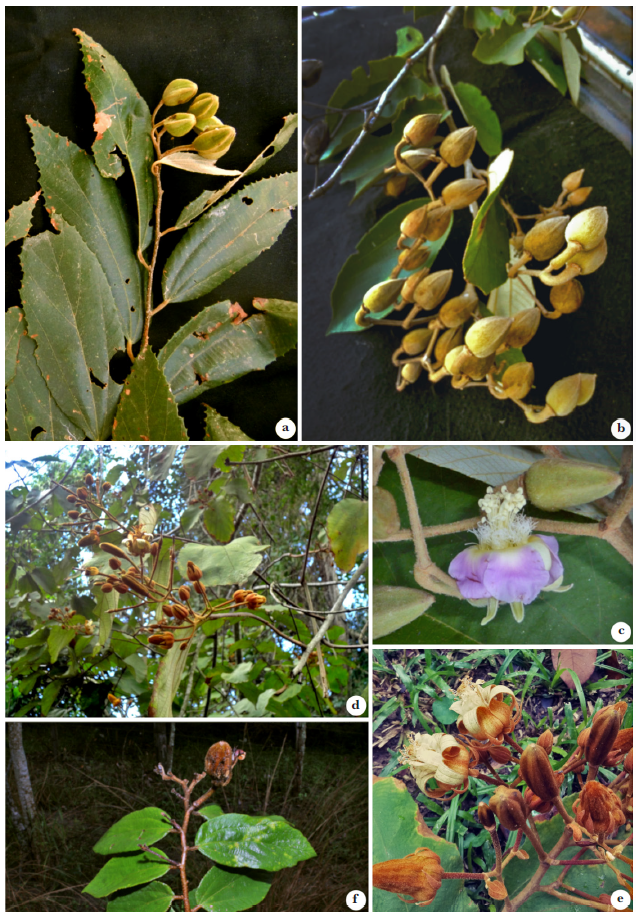
Luehea conwentzii shows the smallest flowers and leaves among the studied species. Furthermore, with a height that can exceed 20 m, this species is one of the few in the genus to prefer more closed and humid environments. This feature is also observed in L. cymulosa Spruce ex Benth., an Amazonian species. Luehea conwentzii can be easily identified both for the flower, much smaller than the other species, with linear petals and staminodes as long as the stamens, and for the fruits with reduced size and dorsal surface valves deeply sulcate with central relief (Figs. 2d; 3a). These characteristics of the fruit are typical of this species.
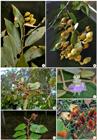
a. Luehea conwentzii - fruiting branchlet. b-c. L. divaricata - b. fruiting branchlet; c. flower. d-e. L. macrophylla - d. fertile branchlet; e. detail of the fertile branchlet. f. L. speciosa - fruiting branchlet. Photos: a. Massimo Bovini; b-c. Marcus Coelho; d-e. Samuele Gerace; f. Carlos Ferreira.
3. Luehea divaricata Mart., Nov. Gen. Sp. Pl. 1(4): 101. tab. 63. 1826. Figs. 1; 2e-f; 3b-c
Shrubs to trees, 2-15 m hight. Petiole 0.5-1.5 cm long. Leaves 7.5-14 × 3.5-6.5 cm, membranaceous, elliptic, base rounded, adaxial surface green, with sparse stellate trichomes to glabrous, abaxial surface white, with only dense arachnoid trichomes or also sparse stellate trichomes. Inflorescence with 10-20 flowers, ca. 10 cm long, terminal; pedicel 0.6-1 cm long. Flowers 4-6 cm wide. Epicalyx with 7-8 bracteoles, 1.1-1.9 × 0.3-0.4 cm, lanceolate to narrow-lanceolate. Sepals 1.9-2.6 × 0.5-0.8 cm, ovate, 1/2-basal revolute. Petals 1.9-2.3 × 0.9-1.3 cm, pinkish with base yellow, obovate, margin repand. Androecium with phalanges connate in a basal ring; staminodes 0.6-1.1 cm long; stamens 1.3-1.8 cm long, the innermost connate almost to the apex forming a tube around the style. Ovary 0.3-0.5 × 0.25-0.35 cm, ovate, circular in transversal section; style 1-1.5 cm long, 2/3-basal pubescent, stigma 0.09-0.18 cm wide, 0.03-0.1 cm long. Capsule 1.7-2.2 × 0.9-1.2 cm, ovate, base rounded to truncate, apex acute, villose, valve with dorsal surface slightly convex, circular cross section, margins plane, not crest-like. Seeds 0.7-0.8 × 0.25-0.3 cm.
Selected examined material: Areal, condomínio Fazenda das Roseiras, 22.IV.2019, fr., M.G. Bovini & K. De Toni 4497 (RB). Italva, localidade Boa Sorte, estrada RJ-204, bem próximo a BR-356, 24.V.2022, fl. and fr., J.F.A. Baumgratz et al. 1724 (RB). Itatiaia, Passa Quatro, 9.VI.1941, fr., W.D. Barros 296 (RB). Maricá, Parque Estadual da Serra da Tiririca, Morro da Serrinha, 28.IV.2014, fl., D.N.S. Machado et al. 427 (RB). Nova Friburgo, Lumiar, Flor das Andorinhas, 20.III.2001, fl. and fr., A. Quinet (RB00437055). Rio de Janeiro, Jardim Botanico Rio de Janeiro, canteiro 8D, 14.I.2015, fl., M. Nadruz 2938 (RB). Sapucaia, Fazenda Pilatos, 20.IX.2000, fr., F.M.B. Pereira (RB00437056).
Luehea divaricata is widely distributed from Brazil, Uruguay, and Paraguay to northern Argentina (Souza & Esteves 2002). In Brazil, it is widespread, particularly in the phytogeographic domains Atlantic Forest, Cerrado, Pampa and Caatinga. In Rio de Janeiro state, Luehea divaricata occurs at elevations that range from 50 to 700 m in submontane to montane ombrophilous forests and in riparian or gallery forests, showing a preference for areas with high brightness (Fig. 1). This species is only present in the Parque Estadual da Serra da Tiririca (Maricá). Flowering was recorded from January to May, and fruiting from April to July.
Luehea divaricata is the only species showing the innermost stamens connate almost to the apex, forming a tubular structure around the style. This species can be easily recognized by its inflorescences with numerous flowers and pink petals, with yellow base (Fig. 3c). However, a pink corolla is also observed in L. paniculata Mart., a species morphologically similar to L. divaricata and easily confused, especially when no fruit is available. The fruit is, indeed, the main diagnostic feature that separates these two species, showing ovate shape and circular cross section in L. divaricata (Figs. 2f; 3b), but elliptic shape and pentagonal cross section in L. paniculata (Fig. 2l). These two species can be distinguished by other morphological features, in particular obovate petals and connate stamens in L. divaricata vs. orbicular petals and free stamens in L. paniculata.
4. Luehea macrophylla Pohl, Pl. Bras. Icon. Descr. 2(4): 127. tab. 186. 1833.
= Luehea platypetala A.Rich., Hist. Phys. Cuba, Pl. Vasc. 6: 212. tab. 23. 1841.
= Luehea crispa Krapov., Bol. Soc. Argent. Bot. 16(1-2): 89. 1974. Figs. 2g-h; 3d-e; 4
Shrubs to trees, 1-30 m hight. Petiole 0.5-1.2 cm long. Leaves 7.8-28 × 4.5-19.7 cm, membranaceous, elliptic, orbicular or oblong, base rounded to subcordate, adaxial surface green, glabrous, abaxial surface white, with densely trichomes arachnoid and stellate. Inflorescence with 10-15 flowers, 7-20 cm long, terminal. Flowers 5-9 cm wide; pedicel 1-3.7 cm long. Epicalyx with 8-11 bracteoles, 2-3.4 × 0.25-1.2 cm, often ovate, sometimes narrow-lanceolate, base cordate to rounded. Sepals 1.6-4.3 × 0.5-1.6 cm, lanceolate, 1/2-basal revolute. Petals 2.5-4.3 × 0.9-1.9 cm, white, ovate-elliptic, margin entire. Androecium grouped in 5 phalanges, free; staminodes 0.5-1.2 cm long; stamens 1.1-2.7 cm long. Ovary 0.5-0.9 × 0.3-0.5 cm, oblong to elliptic, angular in transversal section; style 1.3-2.6 cm long, 1/2-basal pubescent; stigma 0.3-0.4 cm wide, 0.1-0.15 cm long. Capsule (2.3-3.4)3.5-5.3 × 1-2 cm, oblong, base rounded to cuneate, apex truncate to acute, villose, valve with dorsal surface deeply sulcate, angular cross section, margin plane, not crest-like. Seeds 0.9-1.2 × 0.3-0.5 cm.
Selected examined material: Araruama, 12.VI.2002, fl. and fr., S.M. Souto & P.A.B. Sà 495 (RBR). Magé, Barão de Iriri, 16.XII.1978, fl., P. Laclette 589 (R). Rio Bonito, Estrada Braçanã, Fazenda Cachoeiras, 21.IV.1979, fl. and fr., P. Laclette 606 (R). Rio de Janeiro, Jardim Botânico do Rio de Janeiro, canteiro 37A, I.1976, fr., P.J. Fontella & G.M. Barroso (RB00436843). São Fidélis, zona de amortecimento do Parque Estadual do Desengano, 20.VI.2017, fl., M. Nadruz et al. 3186 (RB).
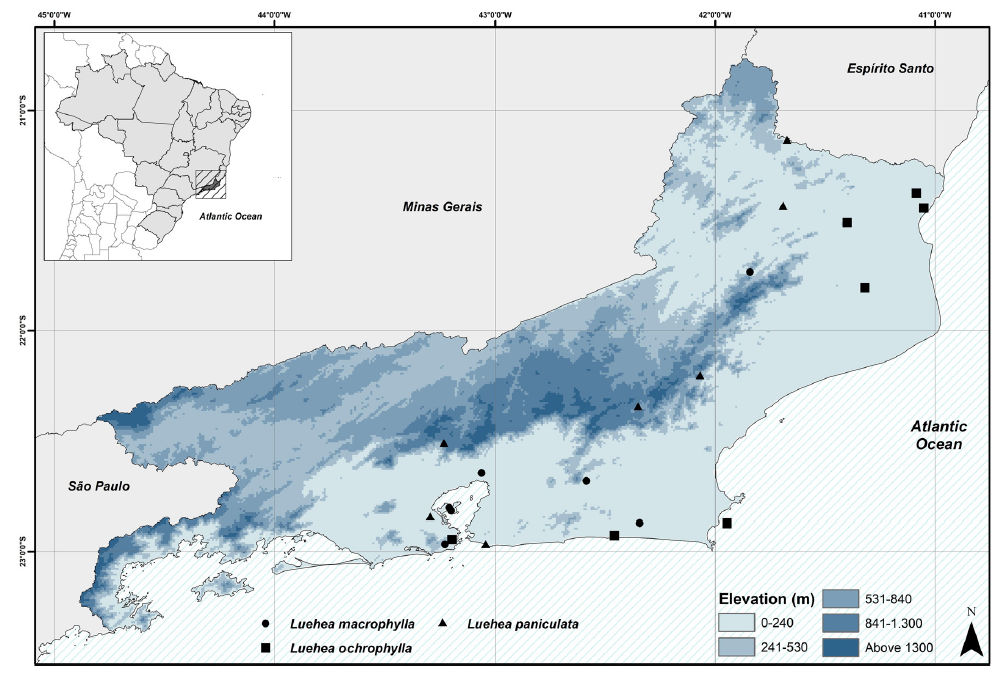
Luehea macrophylla is widespread from southern Mexico and Cuba to northern Perú and central and southeast Brazil (Gerace et al. 2024). In Brazil, it occurs only in the phytogeographic domains Atlantic Forest and Cerrado. In the state of Rio de Janeiro, Luehea macrophylla occurs at elevations extending from 20 to 1,200 m along roadsides, at the edges of forests, and in riparian or gallery forests, showing preference for areas with high brightness and anthropogenic impact (Fig. 4); it has no record in any conservation unit. Flowering was recorded from December to June, and fruiting from April to July.
Luehea macrophylla is similar to L. speciosa Willd., but it shows several distinctive character states, especially its fruit. The capsule is oblong, often exceeding 3.5 cm in length, and the dorsal surface valve is deeply sulcate (Figs. 2h; 3e-d), unlike the fruit of L. speciosa, which is plane or convex (Fig. 2n-p). Other special features of this species are ovary angular in transversal section and bracteoles of the epicalyx, often broadly ovate with base cordate. Luehea macrophylla was confused with L. rufescens A.St.-Hil. and L. grandiflora Mart., but Gerace et al. (2024) re-established its use after identifying key characters to distinguish these species.
5. Luehea ochrophylla Mart., Flora 24 (2, Beibl.): 50. 1841. Figs. 2i-j; 4
Trees, 4-18 m hight. Petiole 0.4-1.1 cm long. Leaves 6.4-13.7 × 3.1-8.7 cm, membranaceous, elliptic to obovate, base rounded to cuneate, adaxial surface green, with stellate trichomes, abaxial surface white, with densely trichomes arachnoid and stellate. Inflorescence with 4-10 flowers, 4.5-7 cm long, terminal. Flowers 2.4-3 cm wide; pedicel 0.8-1.2 cm long. Epicalyx with 8-9 bracteoles, 1.1-1.5 × 0.3-0.45 cm, linear. Sepals 1.2-1.6 × 0.4-0.5 cm, lanceolate, 1/2-basal revolute. Petals 1-1.5 × 0.7-0.9 cm, yellow, obovate, margin entire. Androecium grouped in 5 phalanges, free; staminodes 0.45-0.55 cm long; stamens 0.8-0.9 cm long. Ovary 0.3-0.5 × 0.3-0.5 cm, globular, angular in transversal section; style 0.6-0.7 cm long, 1/2-basal pubescent or glabrous; stigma 0.025-0.037 cm wide, 0.1-0.12 cm long. Capsule 1.8-2.5 × 0.9-1.7 cm, obovate, base acute to cuneate, apex truncate, tomentose, valve with dorsal surface deeply sulcate, without central relief, angular cross section, margins plane, not crest-like. Seeds 0.95-1.05 × 0.35-0.5 cm.
Selected examined material: Cabo Frio, Ilha de Cabo Frio, 22.XI.2001, fl. and fr., C. Farney et al. 4414 (RB). Campos dos Goytacazes, Mata do Mergulhão, 27.III.1996, fr., M.T. Nascimento et al. 12 (HUENF). Rio de Janeiro, Morro Santa Marta, 15.VIII.1990, fr., M. Hudson (RB00438648). São Francisco de Itabapoana, Estaçao Ecológica de Guaxindiba, Mata do Carvao, 3.VI.2014, fr., T.M. Scarponi (RB00906956). Saquarema, Reserva Ecológica Estadual de Jacarepiá [Parque Estadual da Costa do Sol], 20.VIII.1990, C. Farney et al. 3251 (RB).
Luehea ochrophylla is endemic to the phytogeographic domain Atlantic Forest, occurring in the state of Rio Grande do Norte through the state of Rio de Janeiro (Gerace & Bovini 2020). The state of Rio de Janeiro represents the southern distribution limit of this species, but it is more concentrated in the northern region, occurring from 10 to 80 m in altitude in restinga forests, lowlands and riparian or gallery forests, showing a preference for coastal locations with high brightness (Fig. 4). This species occurs in the following conservation units: Reserva Ecológica Estadual de Jacarepiá (actually Parque Estadual da Costa do Sol), municipality of Saquarema, and Estação Ecológica de Guaxindiba, municipality of São Francisco de Itabapoana. Flowering and fruiting were recorded throughout the year.
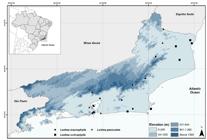
Geographical distributionsof Luehea macrophylla, L. ochrophylla and L. paniculate in the state of Rio de Janeiro.
Luehea ochrophylla is the only species showing a completely yellow corolla. It is also one of the few species with equal size of epicalyx, calyx and corolla, similar to L. candicans var. gracilis. The fruit is distinctive, having typical obovate shape with dorsal surface valve deeply sulcate and tomentose indumentum (Fig. 2j), allowing its identification, even in the absence of flowers. This species shows a unique preference for restinga environments along the east coast of Brazil, making it very vulnerable to the intense anthropic pressure in these areas (Carvalho et al. 2018).
6. Luehea paniculata Mart., Nov. Gen. Sp. Pl. 1(4): 100. tab. 62. 1826.
= Luehea parvifolia Huber, Bol. Mus. Paraense Hist. Nat. Ethnogr. 2: 507. 1898. Figs. 2k-l; 4
Trees, 4-18 m hight. Petiole 0.6-1.4 cm long. Leaves 7-15.5 × 4.5-9 cm, membranaceous, ovate to elliptic, base rounded to subcordate, adaxial surface green, glabrescent, the younger with stellate trichomes, caducous, abaxial surface white, with densely arachnoid trichomes and sparse stellate trichomes. Inflorescence with 3-10 flowers, 6-12 cm long, terminal and axillary. Flowers 2.2-5 cm wide; pedicel 0.3-1.6 cm long. Epicalyx with 7-9 bracteoles, 0.7-1.2 × 0.15-0.4 cm, lanceolate. Sepals 1.1-2.4 × 0.3-0.7 cm, lanceolate, 1/2-basal revolute. Petals 1.1-2.4 × 0.9-1.6 cm, pinkish, orbicular, margin entire. Androecium grouped in 5 phalanges, free; staminodes 0.5-1.3 cm long; stamens 0.8-1.9 cm long. Ovary 0.28-0.4 × 0.2-0.3 cm, elliptic, pentagonal in transversal section; style 0.5-1.4 cm long, 1/3-basal pubescent; stigma 0.09-0.19 cm wide, 0.03-0.07 cm long. Capsule 1.7-3 × 0.9-1.2 cm, elliptic, sometimes clavate, apex cuneate, base rounded to acute, villose, dorsal surface valve plane to convex, pentagonal cross section, margins plane, not crest-like. Seeds 0.7-1 × 0.3-0.5 cm.
Selected examined material: Bom Jesus de Itabapoana, 1.III.1965, fl., E. Pereira 9885 (HB). Italva, localidade Boa Sorte, 27.I.2014, fl., I.G. Costa 344 (RB). Macaé, Pico do Frade, 6.II.1985, fl., C. Farney et al. 560 (RB). Niterói, Itaipú, Parque Estadual da Serra da Tiririca, Morro das Andorinhas, 28.V.2013, fr., D.N.S. Machado & L.A. Ribas 285 (RB). Nova Friburgo, Lumiar, Sítio Arco Iris, 20.V.2001, fl., A. Quinet 39/94 (RB). Petrópolis, Mata do Judeo, 25.I.1969, fl., D. Sucre & P.I.S. Braga 4499 (RB). Rio de Janeiro, Grotão, 16.X.1992, fl., R. Marquete et al. 699 (RB).
Luehea paniculata is widespread from Bolivia, Perú, Brazil, and Paraguay to northern Argentina (Setser 1977). In Brazil, it occurs in all phytogeographic domains. In the state of Rio de Janeiro, L. paniculata occurs at elevations ranging from 30 to 800 m in submontane and montane ombrophilous forests, and secondary forest, showing a preference for areas with high brightness (Fig. 4). This species only occurs in the Parque Estadual da Serra da Tiririca (Niterói). Flowering was recorded from October to May, and fruiting from January to June.
Luehea paniculata is morphologically very similar to L. divaricata, but it can be recognized by its much wider and orbicular petals, stamens completely free and elliptic ovary vs. obovate petals, stamens connate around the style and ovate ovary. In addition, the fruit is crucial for reliable identification by showing an elliptic shape with plane margin valves (Fig. 2l). Luehea paniculata can also be easily recognized by the pinkish color of the corolla, another characteristic in common only with L. divaricata.
7. Luehea speciosa Willd., Neue Schriften Ges. Naturf. Freunde Berlin 3: 410. tab.5. 1801.
= Luehea densiflora A.St.-Hill., Fl. Bras. Merid. 1: 294. 1828.
= Luehea laxiflora A.St.-Hill., Fl. Bras. Merid. 1: 293. 1828.
= Luehea ferruginea Turcz., Bull. Soc. Imp. Naturalistes Moscou 31(1): 224. 1858.
= Luehea alternifolia (Mill.) Mabb., Gard. Bull. Singapore 54(2): 254. 2002. Figs. 2m-p; 3f; 5
Shrubs to trees, 2-20 m hight. Petiole 0.6-1.5 cm long. Leaves 6.8-24 × 5-13.8 cm, membranaceous, elliptic, ovate or oblong, base subcordate to rounded, adaxial surface green, with trichomes stellate, abaxial surface white, with densely trichomes arachnoid and stellate. Inflorescence with 2-20 flower, 3.3-16 cm long, terminal and axillary. Flowers 4.8-9 cm wide; pedicel 0.9-3.5 cm long. Epicalyx with 7-10 bracteoles 1.6-3.2 × 0.25-0.7 cm, lanceolate to narrow-lanceolate, base cuneate. Sepals 2.1-5.2 × 0.7-1.5 cm, lanceolate, 1/2-basal revolute. Petals 2.4-4.3 × 0.7-1.9 cm, white, obovate to oblong, margin repand. Androecium grouped in 5 phalanges, free; staminodes 0.5-1.4 cm long; stamens 1.4-2.8 cm long. Ovary 4-9 × 4-8 mm, ovate to globular, circular to pentagonal in transversal section; style 1.1-2.1 cm long, 1/2-basal pubescent; stigma 3-5.5 mm wide, 1-2 mm long. Capsule 1.9-4.8 × 1.25-2.4 cm, oblong, ovate, elliptic, narrow-elliptic or globular, apex rounded, truncate, acute or cuneate, base rounded, acute, cuneate or truncate, tomentose, valve with dorsal surface convex to plane, sometimes with central relief, pentagonal or circular cross section, margins planes, not crest-like. Seeds 0.6-1.8 × 0.2-0.5 cm.
Selected examined material: Araruama, estrada do morro grande, 1.XI.2015, fr., B.N. Riguetti 18 (RB). Barra do Piraí, Dorândia, 23.IX.2015, fr., L. Silva 655 (RB). Barra Mansa, Fazenda Boa Esperança, 8.V.2013, fl., M.G. Bovini et al. 3825 (RB). Cambuci, BR-116, 9.I.2017, fr., M.G. Bovini et al. 4267 (RB). Campos dos Goytacazes, Sossêgo do Imbé, Rio Sossêgo, 16.V.1989, fl., G. Martinelli et al. 13318 (RB). Cardoso Moreira, 10.VI.2014, fr., J.O. Mendonça-Junior (RB00906223). Casimiro de Abreu, BR-101, 30.V.1987, fl., C. Atorge & F.M. Pena 1646 (R). Duque de Caxias, Reserva da Petrobras, trilha ao redor do lago da barragem, 5.VIII.1997, fr., J.M.A. Braga et al. 4320 (RB). Itaboraí, Serra de Itaitindiba, Alto da Gaia, 16.VI.2017, fl., D.N.S. Machado et al. 2143 (RB). Itaguaì, Serra Arapucaia, 14.VII.1927, fr., Pessoal Horto Florestal (RB00436801). Itatiaia, Rodovia Presidente Dutra, proximo confino estado do Rio de Janeiro, 26.V.1951, fl., H. Monteiro 3084 (RBR). Macaé, estrada para Glicério, 28.VI.2016, fl. and fr., M.G. Bovini & J.M.A. Braga 4243 (RB). Mangaratiba, Reserva Particular do Patrimônio Nacional de Rio das Pedras, 23.XI.2001, M.G. Bovini et al. 2095 (RB). Maricá, Inoã, Serra do Cassorotiba, 11.IV.2015, fl., D.N.S. Machado & G.A. de Quieroz 501 (RB); Miracema, 25.VII.2001, fl., S.M. Souto & J.M. Lima 150 (RBR). Niterói, Morro da Detenção, Parque das Águas, 9.VI.2011, fl. and fr., G.C. Lessa et al. 06 (RB). Nova Friburgo, Flor das Andorinhas, 16.III.2001, fr., A. Quinet (RB00436791). Petrópolis, Itaipava, 30.IV.2006, fl., G. Siqueira & O. Gracff 109 (RB). Piraí, Represa de Ribeirao das Lages, 24.IV.1991, fl., G.V. Somner & M.V.L. Pereira 626 (RBR). Quatis, estrada para o distrito de Fumaça, 9.V.2013, fl., M.G. Bovini et al. 3832 (RB). Resende, Parque Estadual da Pedra Selada, 4.V.2015, fl., L.J.T. Cardoso et al. 1415 (RB). Rio Bonito, Serra do Sambê, Estrada Velha de Lavras, 3.VII.2016, fl., G.A. de Quieroz & D.N.S. Machado 368 (RB). Rio das Ostras, Fazenda Itapebussus, 1.VII.2004, fr., A. Oliveira & D. Oliveira 866 (RB). Rio de Janeiro, Parque Nacional da Tijuca, estrada da Vista Chinesa, 27.VII.1960, fl., H.F. Martins 131 (RB). Santa Maria Madalena, área de amortecimento do Parque Estadual de Desengano, 8.VI.2016, fl., J.F.A. Baumgratz et al. 1496 (RB). São Gonçalo, Morro de Itaoca, 12.VII.1997, fr., R.N. Damasceno 565 (RB). Sapucaia, Fazenda Ouro e Sal, 13.IX.2003, fl., L.F.T. Menezes et al. 1042 (RBR). Saquarema, Morro dos Pregos, 10.VI.1982, fl., D. Neto & C. Farney 33 (RB). Silva Jardim, Reserva Biológica Poço das Antas, 6.VIII.1981, fr., E.F. Guimarães et al. 1171 (RB). Teresópolis, dist. Campo Limpo, 28.V.1977, fl., L.A.F. de Carvalho 518 (RB). Volta Redonda, Fazenda Santa Cecilia do Ingà, 14.III.2005, fl., R. Oliveira et al. (RBR14403).
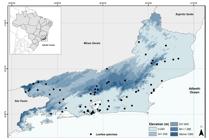
Geographical distribution and habitat: Luehea speciosa is widespread from southern Mexico to Paraguay and northern Argentina (Setser 1977). In Brazil, it occurs in all phytogeographic domains, except the Pampa Biome. Luehea speciosa is the most frequent species in the State of Rio de Janeiro, occurring in thirty-one municipalities from elevations between 20 and 1,050 m in submontane to altomontane ombrophilous forests and in riparian or gallery forests, showing a preference for areas with high brightness and anthropocenic impact (Fig. 5). This species is present in the following conservation units: Parque Nacional de Itatiaia (Itatiaia), Reserva Particular do Patrimônio Nacional de Rio das Pedras (Mangaratiba), Parque Estadual da Pedra Selada (Resende), Parque Nacional da Tijuca, Parque Natural Municipal da Serra do Mendanha (Rio de Janeiro), Parque Estadual do Desengano (Santa Maria Madalena), and Reserva Biológica Poço das Antas (Silva Jardim). Flowering and fruiting were recorded throughout the year.
Luehea speciosa is the type species of the genus, and it is morphologically very similar to L. macrophylla since both have flowers and fruits larger than most Brazilian species. It is distinguished from L. macrophylla for its lanceolate to narrow-lanceolate bracteoles of the epicalyx (vs. ovate), ovary circular to pentagonal in transversal section (vs. angular), and valves of the capsule with dorsal surface convex or plane (Figs. 2n-p; 3f; vs. deeply sulcate, see Figs. 2h and 3e).
For the state of Rio de Janeiro, several specimens were identified as L. grandiflora and some as L. speciosa. These materials showed considerable overlapping in the morphometric analysis (Gerace 2021), resulting in the failure to make any distinction. Given consistency with the protologue and the priority in publication, all these specimens were herein identified as L. speciosa. Furthermore, this complex of species is currently being assessed in a broader and more in-depth way using molecular analyses to clarify the relationships among taxa (Gerace, in preparation).
Acknowledgements
We thank the directors, curators, and staff of HB, HUENF, R, RB and RBR herbaria, for assistance. We thank the University of Pisa, for support in this research; and Rafael Ribeiro (Rio de Janeiro Botanical Garden), for making the maps for this work. We extend gratitude to the Fundação Carlos Chagas Filho de Amparo à Pesquisa do Estado do Rio de Janeiro (FAPERJ) (Doutorado Nota 10, E-26/202.478/2024); to the Coordenação de Aperfeiçoamento de Pessoal de Nível Superior - Brasil (CAPES) - Finance Code 001 (88881.980741/2024-01); and the International Association of Plant Taxonomy (IAPT), for their financial support to the first author (S.G.); and to the National Council for Scientific and Technological Development (CNPq), Brazil, for the Productivity Fellowship (Process nº 307068/2021-8) to the last author (J.F.A.B.).
Data availability statement
In accordance with Open Science communication practices, the authors inform that all data are available within the manuscript.
References
-
Bayer C, Fay MF, Bruijn AY, Savolainen V, Morton CM, Kubitzki K, Alverson WS & Chase MW (1999) Support for an expanded family concept of Malvaceae within a circumscribed Order Malvales: a combined analysis of Plastid atpB and rbcL DNA sequences. Botanical Journal of the Linnean Society 129: 267-303. DOI: 10.1111/j.1095-8339.1999.tb00505.x
» https://doi.org/10.1111/j.1095-8339.1999.tb00505.x -
Bayer C & Kubitzki K (2003) Malvaceae. In: Kubitzki K & Bayer C (eds.) Flowering plants - Dicotyledons. The families and genera of vascular plants. Vol. 5. Springer, Berlin, Heidelberg. Pp. 225-311. DOI: 10.1007/978-3-662-07255-4_28
» https://doi.org/10.1007/978-3-662-07255-4_28 -
Bovini MG (2014) Malvaceae. Catálogo das espécies de plantas vasculares e briófitas do estado do Rio de Janeiro. Instituto de Pesquisas Jardim Botânico do Rio de Janeiro, Rio de Janeiro. Available at <Available at http://florariojaneiro.jbrj.gov.br >. Access on March 2024.
» http://florariojaneiro.jbrj.gov.br -
Brunken U & Muellner AN (2012) A new tribal classification of Grewioideae (Malvaceae) based on morphological and molecular phylogenetic evidence. Systematic Botany 37: 699-711. DOI: 10.1600/036364412X648670
» https://doi.org/10.1600/036364412X648670 - Carvalho ASR, Andrade ACS, Sà CFC, Araujo DSD, Tierno LR & Fonseca-Kruel VS (2018) Restinga de Massambaba: vegetação, flora, propagação e usos. Instituto de Pesquisas Jardim Botânico do Rio de Janeiro, Rio de Janeiro . 289p.
- Cunha MCS (1980) Consideraçoes sobre Luehea candicans Mart. (Tiliaceae), uma nova combinaçao - Luehea candicans var. gracilis (Schum.) M.C.S.Cunha. Bradea 3: 83-84.
- Cunha MCS (1985) Revisão das espécies do gênero Luehea Willd. (Tiliaceae), ocorrentes no estado do Rio de Janeiro. Sellowia 37: 5-41.
- Gerace S (2021) Revisione tassonomica delle specie appartenenti al genere Luehea (Malvaceae) presenti in un frammento del bioma Foresta Atlantica nel sud-est brasiliano. Tesi di Laurea Magistrale. Università di Pisa, Pisa. 63p.
-
Gerace S & Bovini MG (2020) Luehea in Flora e Funga do Brasil (continuously updated). Jardim Botânico do Rio de Janeiro, Rio de Janeiro. Available at <Available at http://floradobrasil.jbrj.gov.br/reflora/floradobrasil/FB9091 >. Access on March 2024.
» http://floradobrasil.jbrj.gov.br/reflora/floradobrasil/FB9091 -
Gerace S, Bovini MG, Peruzzi L & Baumgratz JFA (2022) Typification of names in the neotropical genus Luehea (Malvaceae: Grewioideae). Phytotaxa 542: 180-188. DOI: 10.11646/phytotaxa.542.2.5
» https://doi.org/10.11646/phytotaxa.542.2.5 -
Gerace S, Baumgratz JFA & Bovini MG (2024) The re-establishment of Luehea macrophylla (Malvaceae, Grewioideae). Phytotaxa 637: 261-268. DOI: 10.11646/phytotaxa.637.3.4
» https://doi.org/10.11646/phytotaxa.637.3.4 - Harris JG & Harris MW (2001) Plant identification terminology: an illustrated glossary. 2ª ed. Spring Lake Publishing, Payson. 216p.
- Hickey M & King C (2002) The Cambridge illustrated glossary of botanical terms. 2ª ed. Cambridge University Press, Cambridge. 207p.
- IBGE (2012) Manual técnico da vegetação brasileira: sistema fitogeográfico, inventário das formações florestais e campestres, técnicas e manejo de coleções botânicas, procedimentos para mapeamentos. 2a ed. IBGE, Rio de Janeiro. 276p.
- Martius CFPV (1826) XXXII Luhea Willd. Nova genera et species plantarum: quas in itinere per Brasiliam MDCCCXVII-MDCCCXX 1: 98-102.
- Martius CFPV (1841) Beiblatter zur Flora oder Botanische Zeitung. Flora oder Botanische Zeitung: welche Recensionen, Abhandlungen, Aufsätze, Neuigkeiten und Nachrichten, die Botanik betreffend, enthält 24(2, Beiblatt II): 1-112.
- Mori SA, Silva LAM, Lisboa G & Coradin L (1989) Manual de manejo do herbário fanerogâmico. Centro de Pesquisas do Cacau, Ilhéus. 64p.
-
QGIS (2022) QGIS Geographic Information System version 3.16.10. Open-Source Geospatial Foundation Project. Available at <Available at http://www.qgis.org/ >. Access in March 2024.
» http://www.qgis.org/ - Rijckevorsel Pvan (2005) (1699) Proposal to reject the name Cedrus alternifolia (Tiliaceae). Taxon 54: 557.
- Saint-Hilaire A (1828) LXVI Luhea Willd. Flora Brasiliae Meridionalis 1: 289-295.
- Schumann K (1886) Tilliaceae. In: Martius CFP & Urban I (eds.) Flora brasiliensis Fleicher, Liepizig. Vol. 12, pars 3, pp. 117-200.
- Setser HL (1977) A revision of neotropical Tiliaceae: Apeiba, Luehea and Lueheopsis Doctoral Thesis. University of Kentucky, Lexington. 418p.
- Souza BM & Esteves GL (2002) Tiliaceae. In: Wanderley MGL (ed.) Flora fanerogâmica do estado de São Paulo. Instituto de Botânica, São Paulo. Vol.2, pp. 331-341.
- Willdenow CL (1801) XXIV Drei Neue Pflanzen-Gattungen. Neue Schriften, Gesellschaft Naturforschender Freunde zu Berlin 3: 403-412.
Specimens List - The numbers in parentheses correspond to taxa sequentially numbered in the taxonomic treatment.
Andrade S 26 (7). Andrade AC (RB00489355) (7). Armando 19 (4). Armond N 71 (7). Barbosa MR (RBR27299) (7). Barbosa-Silva RG 506 (7). Barros AAM 5025 (7). Baumgratz JFA 1725 (3). Bovini MG 216 (7), 2275 (2), 4266 (7). Braga HN 1276 (7). Braga JMA & Pacheco MV 5922 (5). Carauta JPP 2831 (7), 5842 (7). Cardoso J 101 (2), 102 (2). Carvalho IR & Costa RC (RB00436775) (4). Christo AG 385 (7), 407 (7). Conde MMS & Pereira-Moura MVL 451 (4). Costantino D (RB00436842) (7), 15282 (2). Cunha MCS 543 (7). Damasceno RN 2409 (7). Duarte W 269 (7). Duarte AP 5434 (7). Duarte AP & Pereira E 4641 (2), 4756 (7). Ducke A & Kulhmann JG 15878 (2). Equipe Horto Florestal 618 (2), 658 (2). Evaristo VT 175 (7). Faitanin MA et al. 44 (5). Farney C 780 (7). Farney C & Nedry M 2402 (7). Fernandes J & Silva JG (R) (4), (R) (7). Fontella PJ 504 (3). Gaus TD 436 (2). Gerace S 114 (7), 115 (7), 116 (7), 117 (7), 118 (7), 119 (7), 120 (7), 121 (7), 122 (7), 125 (2), 126 (6), 127 (4), 128 (4), 129 (7), 130 (7), 131 (7), 132 (7), 133 (7), 134 (7), 135 (7), 145 (3), 146 (3), 150 (7), 205 (7), 206 (7), 251 (6), 256 (7), 327 (7). Giordano LC & Amado EF 817 (4). Giordano LC & Pereira VL 734 (7). Goes OC 555 (7), 962 (7), 1022 (7), 1114 (1b). Gomes R & Gomes R (RB00494439) (4). Gonçalves C (RBR27260) (4). Guizi AC 428 (5). Hoehne FC (HB34384) (2). Kulhmann JG (RB00436836) (7), 15752 (7). Lactete P 541 (7), 607 (7), 721 (7), 722 (7). Lanna JP & Castellanos 635 (7). Lima WG 9 (7). Lima HC 3070 (7), 4555 (7), 5169 (2), 6832 (1a). Lima JP 96 (6). Luchiari C 58 (7), 192 (7). Machado DNS 980 (7). Marquete R 580 (7). Martinelli G 2861 (7). Martins LDS 106 (7). Mattos JR 85 (4), 340 (2), 411 (2), 812 (2), 816 (2). Mello C (RB00436835) (7). Mendonça-Junior JO (RB00906612) (7). Monteiro H 1821 (7). Monteiro J 132 (7). Moreno MR & Nascimento MT (HUEFS00007294) (7). Nadruz M 3194 (7). Nascimento MT 149 (5), 218 (5), 219 (5), 236 (5), (HUENF00000311) (5), (HUENF00000312) (5), (HUENF00005959) (5). Nascimento MT & Silva GC 144 (5), 156 (5). Nunes GM (RB00436774) (2). Nunes R (RB00436831) (7). Pabst GFJ 10322 (1a). Paula CHR 643 (7), 756 (7). Pereira E 4051 (7), 10517 (2), 10654 (1a). Pessoa SVA 715 (7). Pessoal Horto Florestal (RB00473659) (7). Platais GH & Menandro M (RB00437114) (4). Queiroz GA 386 (7), 408 (7). Queiroz GA & Machado DNS 404 (7). Quinet A 12/79 (7), 21/79 (3), 85 (7), 368 (7). Reis RCC 385 (2). Rente JA 470 (7). Resende GSZ 50 (2). Riedel L 107 (2). Riguetti BN 15 (7), 16 (7), 19 (7). Rodrigues IA 177 (7). Santos MCF 1835 (7). Scarponi TM 44 (7). Schwacke P 1006 (7). Silva OA (R136091) (2). Siqueira G & Gracff O 24 (7). Soares TC 6 (7). Souto SM & Gomes RC 87 (7), 102 (7). Souza A (R202598) (1a). Spannagel C (RB00652129) (7). Sucre D 1441 (2), 6541 (2), 7603 (7), 9914 (2). Verdi M 7428 (7).