 Flora of Ceará, Brazil: Gesneriaceae
Abstract
The present study sought to better understand the floristic diversity and species distributions of the Gesneriaceae family in Ceará state, Brazil, as part of the project “Flora do Ceará: know to conserve”. The research was based on the analysis of morphological characters of specimens collected in the field and/or those available in collections deposited in 15 national and international herbaria. Additionally, the specialized literature, protologues, and images of standard collections available on digital platforms were consulted. The Gesneriaceae family in Ceará is represented by five genera and seven species: Columnea sanguinea, Columnea ulei, Diastema racemiferum, Drymonia serrulata, Sinningia incarnata, Sinningia nordestina, and Sphaerorrhiza sarmentiana. Diastema racemiferum represents a new record for the state of Ceará, extending the species known distribution in the northeastern region of Brazil. Species of the genus are primarily confined to Cristalino Moist Forest and Sedimentary Moist Forest. Three species were recorded in Conservation Units. This study provides identification keys, morphological supervision, comments on distribution, ecology, phenology and uses, as well as maps and illustrations of the species in question.
Key words:
diversity; floristics; Lamiales; Sinningia; Taxonomy
Resumo
O presente estudo objetiva conhecer a diversidade florística e a distribuição de espécies da família Gesneriaceae no estado do Ceará, Brasil, como parte do projeto “Flora do Ceará: conhecer para conservar”. A pesquisa fundamenta-se na análise de caracteres morfológicos de amostras coletadas em campo e em coleções depositadas em 15 herbários nacionais e internacionais. Literaturas especializadas, protólogos e imagens de coleções-tipo disponíveis em plataformas digitais também foram consultadas. No Ceará, Gesneriaceae é representada por cinco gêneros e sete espécies: Columnea sanguinea, Columnea ulei, Diastema racemiferum, Drymonia serrulata, Sinningia incarnata, Sinningia nordestina e Sphaerorrhiza sarmentiana. Diastema racemiferum representa um novo registro para o estado para o estado do Ceará, ampliando a distribuição já conhecida da espécie na Região Nordeste do Brasil. As espécies do gênero concentram-se em Mata Úmida do Cristalino e Mata Úmida do Sedimentar. Três espécies foram registradas em Unidades de Conservação. O estudo inclui chave de identificação, descrições morfológicas, comentários sobre distribuição, ecologia, fenologia e usos, além de mapas e ilustrações das espécies.
Palavras-chave:
diversidade; florística; Lamiales; Sinningia; Taxonomia
Introduction
The family Gesneriaceae comprises approximately 149 genera and 3,715 species with predominantly tropical distributions (Moller & Clark 2013; Weber et al. 2020). Sixty genera and 1,300 species have been documented in the Neotropical region, with their center of diversity being in northeastern South America (Burtt & Wiehler 1995; Smith et al. 1997; Chautems & Matsuoka 2003).
Gesneriaceae is represented by perennial herbs, vines, sub shrubs, shrubs, and epiphytes, rupicolous or terrestrial, with rhizomatous or tuberose stems, opposite or rosulate leaves, without stipules, inflorescences in cymes (unifloral or multiple flowers), flowers showy, calyx gamosepalous or dialysepalous, corolla gamopetalous, zygomorphic, rarely actinomorphic, stamens epipetalous, anthers united, or rarely free, ovary superior to semi-inferior, bicarpelar, unilocular, ovules numerous, placentation parietal, fruit a loculicidal capsule or berry [Weber 2004; Flora e Funga do Brasil 2025 (continuously updated)].
Some species of Gesneriaceae are popularly known as gloxínia, flor-batom, or African violets (Souza & Lorenzi 2019) and used as ornamental houseplants, being widely cultivated due to their easy vegetative multiplication and growth from seeds (Chautems & Matsuoka 2003). Native species of the genera Codonanthe, Episcia (including the widely cultivated “tapete de rainha”, Episcia cupreata (Hooker 1847: 73) Hanstein (1865: 340), Nematanthus, Seemannia, and Sinningia are widely used for decorative purposes, which also exhibit cytotoxic, antibacterial, antioxidant, and astringent properties and are traditionally employed to treat kidney problems (Hinoshita et al. 2018; Serain et al. 2021; Chen et al. 2023; Lorenzi 2013). Some species of the genera Sea, Chrysothemis, Drymonia, and Kohleria, display showy features with their red corollas or leaf undersides and are used by traditional indigenous communities to treat blood related health conditions like snakebites; other species have astringent properties and are used to treat kidney problems (Wiehler 1983; Weber 2004; Lorenzi & Souza 2008).
A study by Wiehler (1983) shed new insights in the circumscription of the Gesneriaceae family and generic delimitation in the Neotropical region, recognizing 2,500 species. Later taxonomic revisions of the genera Besleria (Morton 1939), Nematanthus (Chautems 1988), Sinningia (Chautems et al. 2010) and Sphaerorrhiza (Araujo et al. 2016) were prepared for the American continent.
In Brazil, 32 genera and 232 species of Gesneriaceae are recorded, of which 155 are endemic, occurring in all of the Brazilian states, although most are concentrated in the Atlantic Forest domain (Flora e Funga do Brasil 2025, continuously updated). The genus Sinningia comprises the greatest number of species (78) in Brazil (Araújo et al. 2024). The family is represented by 14 genera and 36 species in the northeastern region of that country (Flora e Funga do Brasil 2025, continuously updated).
The most detailed study of the family in Brazil was published by Hanstein (1864) in the Flora brasiliensis, recognizing 103 species belonging to 17 genera. More recently, species of Gesneriaceae have been documented in floristic studies undertaken in different Brazilian states, including Bahia state (Chautems 1991), the Federal District (Chautems 2003), São Paulo (Chautems & Matsuoka 2003), Acre (Daly & Silveira 2008), Alagoas (Lemos et al. 2010), and Paraná (Hinoshita et al. 2018). Representatives of Gesneriaceae have likewise been recorded in various local floras, including of the Cadeia do Espinhaço (Minas Gerais) (Araújo et al. 2005); Santa Teresa (Espírito Santo) (Rossini 2010); the Ibitipoca State Park (Minas Gerais) (Blaser et al. 2011); Serra Negra (Minas Gerais) (Blaser et al. 2012); Serra do Papagaio (Minas Gerais) (Pereira et al. 2013); Serra do Mar (São Paulo) (Affonso et al. 2014); Serra dos Carajás (Pará) (Chautems et al. 2018); Usina São José, Igarassu (Pernambuco) (Macedo et al. 2020), and Serra do Relógio (Minas Gerais) (Pereira et al. 2021).
Species of Gesneriaceae in Ceará have been cited only in floristic lists, such as the inventory of angiosperms in that state (Loiola et al. 2020) and in the Ubajara National Park (Silveira et al. 2020). The reduced number of studies of Gesneriaceae undertaken in Ceará reflect our incomplete knowledge of its diversity and distribution in the state, although records of species occurrences are indispensable for developing conservation strategies and habitat protection.
This study, part of the “Flora do Ceará: Conhecer para Conservar” project, was designed to prepare a floristic/taxonomic inventory of representatives of the Gesneriaceae family and contribute to the amplification of knowledge concerning the diversity and geographic distribution is species in Ceará state.
Material and Methods
The state of Ceará, with a total area of 148,825.6 km² and 184 municipalities, is located in the Northeastern region of Brazil, intervals of 02° to 08° South latitude and 37° to 42° West longitude (Governo do Ceará 2020). It borders the Atlantic Ocean to the North; to the South with Pernambuco; to the East with the states of Rio Grande do Norte and Paraíba and to the West with Piauí (Governo do Ceará 2020). In Ceará, a Hot Tropical Semi-Arid climate regime predominates (Nimer 1972), with an average annual temperature varying between 24 °C and 26 °C. The predominant soils are Neosols and Argisols, covering 36% and 25% of the state’s area, respectively (Governo do Ceará 2022).
Two large geological domains are recognized for Ceará (Moro et al. 2015): one of sedimentary origin divided into five relief units called Coastal Plain, Fluvial Plain, Chapada do Araripe, Chapada do Apodi, and Serra da Ibiapaba; and another of crystalline origin divided into two relief units known as Depression Sertaneja (planed surfaces) and Massif Residual. The distribution of species in the phytoecological units of Ceará followed the classification of Moro et al. (2015).
Among these, the Caatinga predominates (with its various physiognomic variations, from shrubby to arboreal), occupying the broad areas of the sertaneja depression that are distributed across most of the state. In the sedimentary plateaus that surround Ceará, Carrasco and patches of Cerrado and Cerradão predominate (Costa et al. 2004; Ribeiro-Silva et al. 2012). In the coastal region, a complex of vegetation formations mixes, ranging from pioneer species on the beachfront to patches of coastal savannas and other savanna formations (Moro et al. 2011; Castro et al. 2012). In the mountains that occur close to the coast (for example, the Baturité and Maranguape mountains), orographic rains result in higher precipitation and patches of humid and sub-humid forests occur on the windward side, while dry forests are located on the leeward side of the same mountains (Oliveira & Araújo 2007).
The present study focused on the analysis of specimens obtained during field expeditions undertaken between 2012 and 2024 and the analysis of collections deposited in the CEPEC, EAC, ESA, HCDAL, HDELTA, HUEFS, HUFABC, HUVA, K, INPA, MO, R, UB, UNA and US herbaria (acronyms according to Thiers, continuously updated).
The collections and herborization of the specimens were undertaken employing traditional taxonomic procedures (Mori et al. 1989), and they were deposited in the EAC herbarium at the Federal University of Ceará state. Specimen identifications were made by consulting the specialized literature (Wiehler 1983; Chautems 1991; Weber 2004; Weber et al. 2013; Araújo et al. 2016) and were confirmed by comparisons with type-collection images available on online platforms (CRIA 2025a; Flora e Funga do Brasil 2025, continuously updated). The names of the species and their protologues are in accordance with IPNI (2025).
Morphological descriptions were standardized following Harris & Harris (2001). Additional specimens from other Brazilian states were included to complement the descriptions for some taxa when samples collected in Ceará were incomplete with respect to their floral or fruit features. Specific terminologies and description patterns were adopted for each genus and their respective taxa. Information concerning species occurrences, popular names, as well as flowering and fruiting periods were obtained from specimen labels and/or field observations. Freehand ink drawings were made and digitized to prepare the illustration using an image editing program. The Canva platform was used to create the photographic plate.
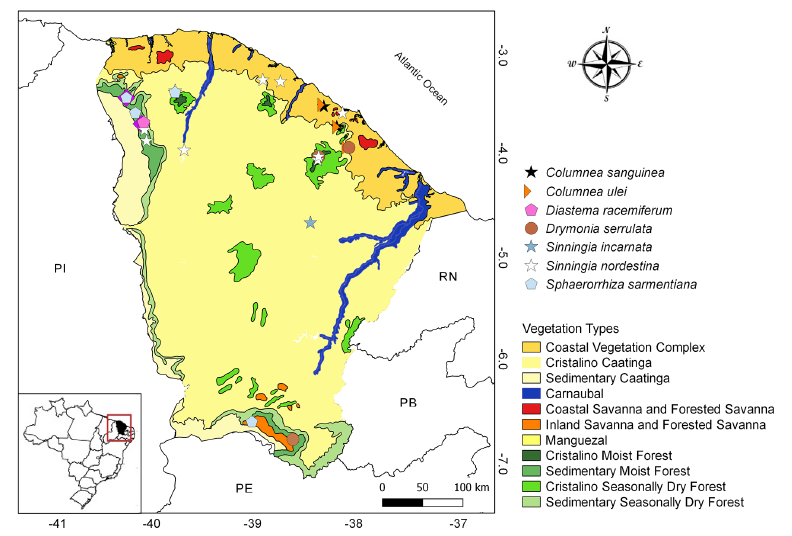
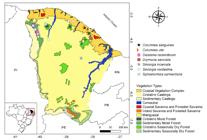
Geographic distribution data for the world and for Brazil were obtained, respectively, from the specialized literature (Wiehler 1983; Chautems 1991; Burtt & Wiehler 1995) and the Flora e Funga do Brasil (2025) site. The geographic distribution maps were prepared using ArcGIS software, version 7.4, based on records providing geographic coordinates (Fig. 1). Records that had not been geo-referenced were determined using the “geoLoc” tool (CRIA 2025b) based on the coordinates of the municipality where the collections were made.
Results and Discussion
A total of seven species of Gesneriaceae, representing five genera, were identified for Ceará state: Columnea sanguinea (Persoon 1807 [1806]: 165) Hanst. (1865: 384), Columnea uleiMansfeld (1935: 26), Diastema racemiferumBentham (1844: 132), Drymonia serrulata (Jacquin 1798: 21) Martius (1829: 59), Sinningia incarnata (Aublet 1775: 635) D.L. Denham (1974: 126), Sinningia nordestinaChautems, Baracho & Siqueira-Filho (2000: 50), and Sphaerorrhiza sarmentiana (Gardner ex Hook. 1841: 378) Roalson & Boggan (2005: 236). Although Gloxinia perennis (Linnaeus 1753: 618) Fritsch (1894: 174) is indicated for Ceará in Flora e Funga do Brasil (Araújo 2024), we found that the ESA 078303 collection was updated by specialist Allain Chautems on August 24/2024 for S. sarmentiana. Therefore, the genus Gloxinia has no representatives in Ceará.
Columnea ulei, S. nordestina, and S. sarmentiana are endemic to Brazil. The taxon with the greatest number of collection records S. nordestina, which occurred in eight municipalities. Those seven species were recorded in a number of different phytophysiognomies, but preferentially occurred in Cristalino Moist Forest and Sedimentary Moist Forest.
Four species were recorded, restricted to this protected area, Ubajara National Park: Diastema racemiferum, D. serrulata, S. nordestina, and S. sarmentiana. In terms of their conservation status, C. sanguinea is classified as Data Deficient (DD), D. serrulata and S. sarmentiana as of Least Concern (LC), while C. ulei, D. racemiferum, S. incarnata, and S. nordestina were classified as species not assessed for threat (NE), according to CNCFlora (2013) criteria.
Taxonomic treatment
Gesneriaceae Rich. & Juss. ex DC., Essai Prop. Méd. Pl. 2: 192. 1816.
Subshrubs, herbs or vines; rupicolous, epiphytes or terrestrial. Stem pubescent, glabrescent, or glabrous. Leaves isophyllous or anisophyllous, opposite, decussate, without stipules. Flowers bisexual, zygomorphic, showy, solitary or arranged in cymose inflorescences, bracteate or foliose. Calyx dialysepalous or sepals connate at base. Corolla gamopetalous, with 5 equal to subequal lobes, unequal or bilabiate; stamens 4, enclosed, didynamous; filament bases fused to the corolla tube; anthers coherent, rimose or poricidal; nectary adpressed to the ovary; ovary superior to semi-inferior, style enclosed or exerted; stigma bilobate or stomatomorphic. Fruit succulent or dry capsules, or berries.
Key to the species of Gesneriaceae from Ceará
-
1. Abaxial leaf face glabrous; flowers solitary; corolla purple with white spots ………………………………………………………………………………………… 5. Sphaerorrhiza sarmentiana
-
1’. Abaxial face pubescent or puberulous; inflorescence cymose; corolla white, cream-colored, yellow, orangish, or red.
- 2. Corolla with unequal lobes.
3. Vine; leaf margin serrate; corolla white to cream-colored, with red streaks; anthers poricidal ………………………………………………………………………………….. 3. Drymonia serrulata
3’. Herb; leaf margin crenate; corolla red; anthers rimose …………………. 4.1. Sinningia incarnata
- 2’. Corolla with equal or subequal lobes.
- 4. Leaves isophyllous, apex acute; corolla red to orangish or red, subequal lobes.
5. Herb; leaves ovate, base cordate, leaf margins dentate; corolla red to orangish, lobes with numerous red dots ……………………………………………………… 4.2. Sinningia nordestina
5’. Subshrub; leaves elliptic; base cuneiform, leaf margins entire; corolla red, lobes without dots …………………………………………………………………………………… 1.2. Columnea ulei
- 4’. Leaves anisophyllous, apex obtuse or acuminate; corolla yellow or white, equal lobes.
6. Herb; leaves ovate, apex obtuse, base rounded, margins serrate; corolla white, with a lilac spot on the lobes ………………………………………………………… 2. Diastema racemiferum
6’. Subshrub; leaves oblanceolate, apex acuminate, base oblique, margins dentate; corolla yellow, lobes without spots …………………………………………….. 1.1. Columnea sanguinea
1. Columnea L., Sp. Pl. 2: 938. 1753.
Subshrub or herb, epiphyte or rupicolous. Stem pubescent or glabrescent, succulent. Leaves isophyllous or anisophyllous, decussate, pubescent or pilose, succulent, petiolate. Inflorescence a cyme, bracts 2, linear. Flowers solitary; calyx connate at base, lobes lanceolate, pubescent or pilose; corolla tubular, wide or narrow tube, pubescent, or pilose, yellow, red, or orangish; filaments glabrous, anthers rimose; ovary superior, style enclosed, stigma stomatomorphic. Berry globoid.
Representatives of the genus Columnea can be recognized by having succulent stems, leaves pubescent or pilose, succulent, corolla tubular, yellow, red, or orangish. The genus comprises 210 species in the Neotropical region (Clark et al. 2020). Six species of Columnea are found to Brazil, two of which occur in Ceará state, Columnea sanguinea and C. ulei (Rossini et al. 2024).
1.1. Columnea sanguinea (Pers.) Hanst., Linnaea 34(3): 384. 1865. Figs. 2a-c; 3a-c
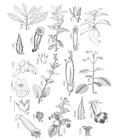
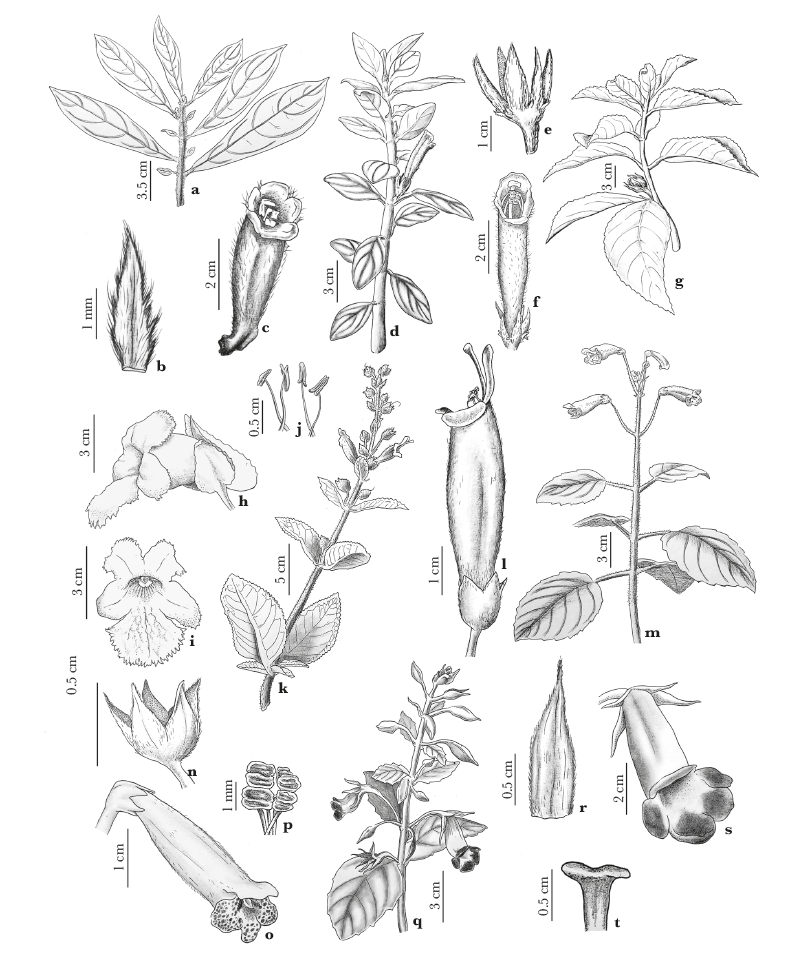
a-c. Columnea sanguinea - a. branch with flowers, with anisophyllous leaves with serrated margins; b. calyx lobe with a serrated margin; c. pubescent flower with tubular corolla. d-f. Columnea ulei - d. branch with flowers, and leaves with entire margins; e. calyx with entire margin lobes; f. pilose flower with tubular corolla. g-j. Drymonia serrulata - g. branch with immature fruits; h. flower with labiate corolla and bracts; i. flower, frontal view; j. stamens and anthers. k-l. Sinningia incarnata - k. branch with flowers, and leaves with crenate margins; l. flower with bilabiate corolla, side view. m-p. Sinningia nordestina - m. branch with flowers, and leaves with dentate margins; n. calyx; o. flower, side view; p. anthers, ventral view. q-t. Sphaerorrhiza sarmentiana - q. branch with flowers; r. detail of calyx lobe; s. flower, side view; t. bilobate stigma. [a-c. M.E.S. Barros et al. 21 (EAC); d-f. M.E.S. Barros et al. 22 (EAC); g-j. M.I.B. Loiola et al. 2921 (EAC); k-l. L.W. Lima-Verde & R.F. Oliveira 43 (EAC); m-p. M.I.B. Loiola et al. 1812 (EAC); q-t. M.I.B. Loiola et al. 1508 (EAC)].
Subshrub 0.5-1.5 m tall, rupicolous. Stem pubescent; internodes 2-3.5 cm long. Leaves anisophyllous; petiole 0.8-2 cm long; leaf blades large 13-23.5 × 3.5-7 cm or small 1.8-6 × 0.5-2 cm, oblanceolate, apex acuminate, base oblique, margins dentate with red trichomes, discolorous, adaxial face glabrous, abaxial face with vinaceous spots, pubescent. Flowers with pedicels ca. 2.5 mm long; bracts 7-9 mm long; calyx 1-1.5 cm long, lobes 0.8-1.5 cm long, apex acuminate, margins dentate with red trichomes; corolla 1.5-3 cm long, yellow, lobes ca. 3 × 2 mm, external face pubescent, internal face glabrous, margins dentate with red trichomes; filaments ca. 13 mm long; anthers ca. 1 mm long; ovary 1-2 mm long, pubescent, white; style 10-14 mm long, glabrous, white. Berry 6-12 mm long, glabrous, green to vinaceous.
Material examined: Maranguape, Serra de Maranguape, 14.IX.1908, A. Ducke 1689 (UB); 15.XI.2004, fl., F.J.S. Monteiro 20 (EAC); 10.X.2004, fr., F.J.S. Monteiro 18 (EAC); trilha Pedra da Rajada, 27.VI.2024, fl., M.E.S. Barros et al. 21 (EAC); V.1861, F.F. Allemão & M. Cysneiros 912 (R); 14.IX.1908, A. Ducke (INPA 12109).
Columnea sanguinea differs from C. ulei, its closest species, by having leaves anisophyllous (vs. isophyllous), oblanceolate (vs. elliptic), margins dentate (vs. entire), abaxial face with vinaceous spots (vs. abaxial face green), pubescent (vs. pilose), and corolla yellow (vs. red), corolla lobes equal (vs. subequal). The species is widely distributed in the Neotropical region, with records from Mexico, Costa Rica, Cuba, Haiti, Trinidad and Tobago, the Dominican Republic, French Guiana, Suriname, Ecuador, Bolivia, Peru, Colombia, and Venezuela (Chautems 1991). The species shows a disjunct distribution in Brazil, with occurrences in the northern region of that country (in the states of Amazonas, Rondônia, Roraima), in the northeastern region (in the states of Alagoas, Ceará, Bahia, and probably Pernambuco), and the southeastern region (Espírito Santo state), in the Amazon, Cerrado, and Atlantic Forest phytogeographic domains (Rossini et al. 2024). In Ceará state, the species has been recorded in only one municipality, in Cristalino Moist Forest. The species is collected with flowers from June through November, and with fruits in October. There is no registered use for this species. There is no registered vernacular name for this species.
1.2. Columnea ulei Mansf. Repert. Spec. Nov. Regni Veg. 38: 26. 1935. Figs. 2d-f; 3d-f
Subshrub 25-50 cm tall, epiphyte. Stem glabrescent; internodes 1.5-3 cm long. Leaves isophyllous; petiole 0.5-1 cm long; leaf blades 2.8-4 × 1-4 cm, elliptic, apex acute, base cuneiform, margins entire, concolorous, abaxial and adaxial faces pilose, green. Flowers with pedicel 3-5 mm long; bracts 4-5 mm long; calyx 1-1.5 cm long, lobes 0.7-0.9 cm long, apex acute, external and internal faces compressed, pilose, trichomes transparent, margins entire at the apex and dentate at the base; corolla 2-3.5 cm long, red, lobes ca. 2.5 × 2 mm, external face pilose with red trichomes, internal face glabrous; filaments ca. 25 mm long; anthers ca. 1 mm long; ovary 1.5-2 mm long, pilose, red; style 22-30 mm long, glabrous, red. Berry 8-9 mm long, pilose, white.
Material examined: Baturité, Serra de Baturité, 17.VIII.1908, fl., A. Ducke (INPA 12110); IX.1910, fl., E.H. Ule 9109 (US). Guaramiranga, Pico Alto, 04°12’25”S, 38°58’08”W, 11.VIII.2023, fl., M.I.B. Loiola et al. 2931 (EAC). Itapajé, Serra dos Coquinhos, 03°64’33”S, 39°57’98”W, 23.XI.2024, fl., I.B.M. Farias 40 (EAC). Maranguape, Serra de Maranguape, 14.IX.1908, A. Ducke 1689 (UB); 15.XI.2004, fl., F.J.S. Monteiro 20 (EAC); 10.X.2004, fr., F.J.S. Monteiro 18 (EAC); trilha da Pirapora, próximo ao castelinho, 27.IX.2014, fl., M.I.B. Loiola et al. 2468 (EAC); trilha Pedra da Rajada, 27.VI.2024, fl., M.E.S. Barros et al. 22 (EAC). Pacoti, Serra de Baturité, 17.III.2002, fl., V.C. Souza et al. 28677 (ESA).
Columnea ulei differs from C. sanguinea by having isophyllous leaves (vs. anisophyllous), elliptic (vs. oblanceolate), with entire margins (vs. serrated), abaxial face green (vs. abaxial face with vinaceous spots), pilose (vs. pubescent), and corolla red (vs. yellow), corolla lobes subequal (vs. equal). The species is endemic to Ceará state and only occurs in the Caatinga phytogeographic domain (Rossini et al. 2024). Columnea ulei was recorded in five municipalities in Ceará, in Cristalino Moist Forest. Its limited distribution, combined with a very disjunct occurrence from its closest relatives in the Andes, provides strong reasons to reconsider its current CNCFlora status as an unthreatened taxon. Although Schulte et al. (2015) considered synonymizing C. ulei with C. angustata, this taxonomic treatment was not adopted due to the highly disjunct distribution of C. ulei. The species is collected with flowers from March through November, and with fruits in October. There is no registered use for this species. The vernacular name for this species is cipó.
2. Diastema racemiferum Benth., Bot. Voy. Sulphur 132.1844. Fig. 3g-i
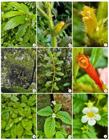
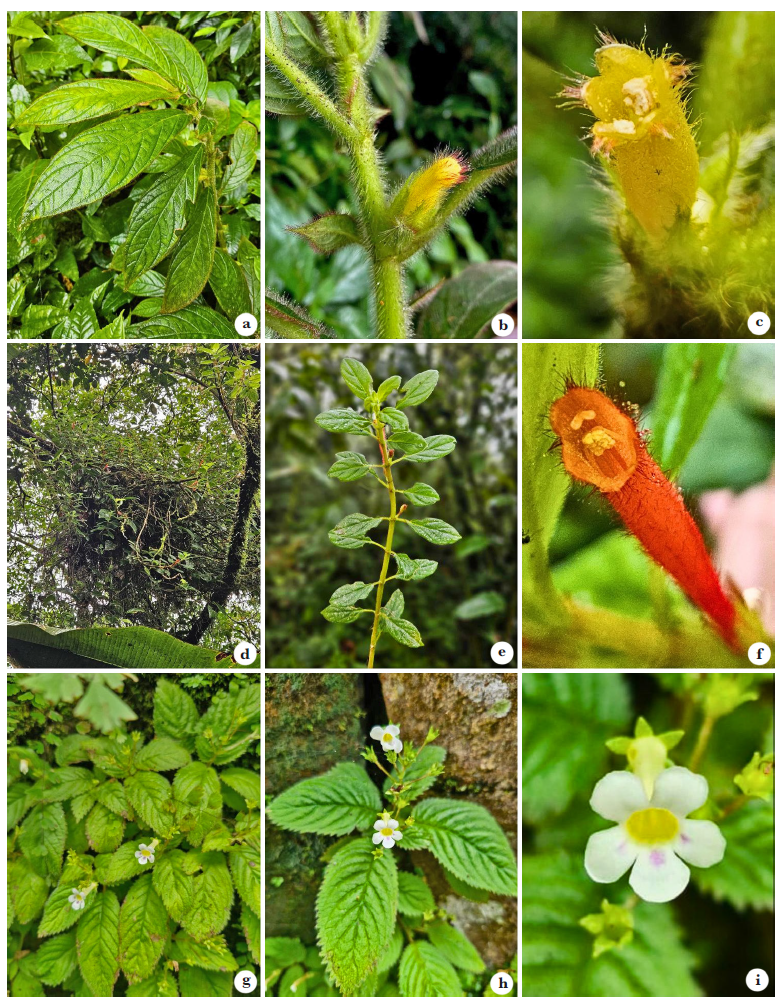
a-c. Columnea sanguinea - a. branch; b. detail of the internode, and axillary flower; c. flower, side view. d-f. Columnea ulei - d. habit; e. branch; f. flower, front view. g-i. Diastema racemiferum - g. habit; h. leaves with serrate margins and inflorescence; i. flower, front view. (photos: a-b, d-e. L.G.A. Melo; c, f. M.E.S. Barros; g-i. M.I.B. Loiola).
Herb 7-8 cm tall, rupicolous. Stem pubescent; internodes 2-4 cm long. Leaves anisophyllous; petiole 0.5-1cm long; leaf blades large 4-5.5 × 2-3.5 cm or small 1.5-3.5 × 1-1.7 cm, ovate, apex obtuse, base rounded, margins serrate, uniformly green, abaxial face with tector trichomes concentrated on the veins, adaxial face with sparse tector trichomes and glabrous veins. Cyme axillar with 1-5 flowers; pedicel 1.5-2 cm long; bracts 4-6 mm, ovate; calyx 0.5-0.7 cm long, lobes 3-4 mm long, apex acute, tector trichomes concentrated at the base; corolla 1.6-1.9 cm long, narrowly tubular, white, lobes ca. 0.3 × 0.4 cm, external face rosaceous, internal face cream with a lilac spot at the base of each lobe, sparse tector trichomes, throat yellow with vinaceous dotted lines, throat yellow with vinaceous dotted lines; filaments 0.8 cm long, anthers ca. 1.5 mm, rimose; nectary composed of 5 equal glands; ovary 2-2.5 mm long, semi-inferior, pubescent, yellowish, style 1 cm long, enclosed, pubescent, yellow. Fruit not oseen.
Material examined: Ubajara, Parque Nacional de Ubajara, 03°50’26”S, 40°53’48”W, 18.IV.2025, fl., M.I.B. Loiola & M.A. Loiola 3129 (EAC).
Additional material: ECUADOR. EL ORO: Pinãs, Parroquia, Reserva Biológica Buenaventura (Fundação de Conservação Jocotoco), 03°39’48”S, 79°44’24”W, 28.V.2011, fl., J.L. Clark 12307 (UNA, US). PERU. PIURA: Huancabamba, Chorro Blanco, 5.IV.1939, fl., H.E. Stork 11409 (K). VENEZUELA. GUÁRICO: Guatopo, Parque Nacional Guatopo, 15.X.2005, fl., W.B. Boulton & Centro Excurs Caracas 12086 (US). TÁCHIRA: entre Santo Domingo e San Cristóbal, Estação Quinimari, 27.VIII.1966, fl., J.A. Steyermark & M. Rabe (US 2652714).
Diastema racemiferum differs from Columnea ulei by having rupicolous habit (vs. epiphytic), anisophyllous leaves (vs. isophyllous), ovate blades with serrate margins (vs. elliptic with entire margins), white corolla with rosaceous external face (vs. red), lobes corolla equal (vs. subequal), and a semi-inferior ovary (vs. superior). The species is widely distributed across Mexico, Peru, and Venezuela (Skog & Boggan 2007). The species shows distribution in Brazil, with occurrences in the northern region of that country (in the states of Acre and Rondônia). In the northeastern region, the species represents a new occurrence, with a record in Ceará restricted to a single municipality, collected in the Ubajara National Park, in Sedimentary Moist Forest. The species is collected with flowers from April through October. There is no registered use for this species. There is no registered vernacular name for this species.
3. Drymonia serrulata (Jacq.) Mart., Nov. Gen. Sp. Pl. 3(1): 59. 1829. Figs. 2g-j; 4a-c
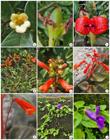
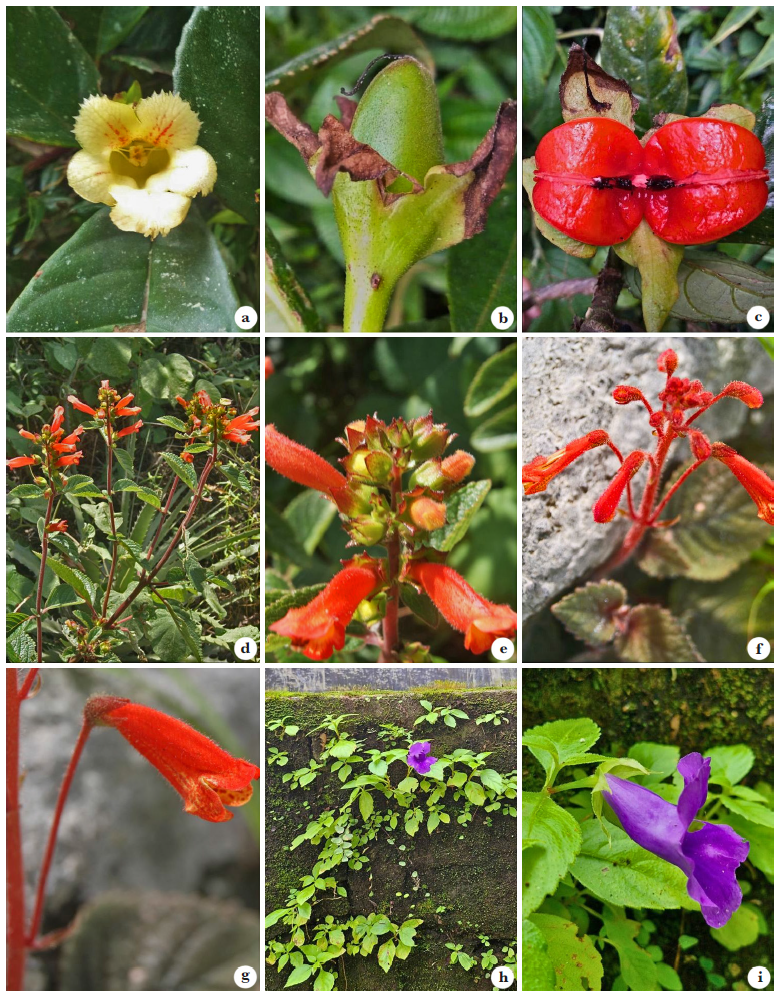
a-c. Drymonia serrulata - a. flower, frontal view; b. immature fruit; c. mature fruit. d,e. Sinningia incarnata - d. habit; e. inflorescence. f,g. Sinningia nordestina - f. inflorescence; g. flower, side view. h,i. Sphaerorrhiza sarmentiana - h. habit; i. flower, side view. (photos: a. N.C. Rebouças; b-c, h-i. M.I.B. Loiola; d-g. F.D.S. Santos).
Vine 30-80 cm tall, rupicolous. Stem glabrous; internodes 7-8 cm long. Leaves isophyllous, opposite; petiole 1.3-5 cm long; leaf blades 4.5-9 × 2.5-7.5 cm, oblanceolate to elliptic, apex acute to acuminate, base oblique, margins serrate, concolorous, abaxial face pubescent, adaxial face glabrous, prominent nerves on the adaxial face. Cyme axillar; pedicel 5-10 mm long; bracteoles 2 (3.5-6 cm long); calyx 1-3 cm long, sepals connate at base, foliar, lobes 0.8-2 cm long, apex acute, external and internal faces glabrous, with to margins dentate; corolla 3-5 cm long, campanulate and labiate, white to cream-colored, with red lines, lobes unequal ca. 3 × 2 cm, external and internal faces glabrous; filaments ca. 15 mm long, pubescent; anthers ca. 5 mm long, poricidal; ovary 1.5-2.5 mm long, superior, pubescent, cream-colored; style 20-25 mm long, enclosed, pubescent, yellow. Capsule 25-30 mm long, globose to oval, succulent, 2-valvar, red inside.
Material examined: Crato, Chapada Araripe, 07°41’13”S, 39°21’26”W, 25.XI.2015, fl., K.V. Linhares (HUFABC 000337). Guaramiranga, Pico Alto, 04°12’42”S, 38°51’58”W, 6.II.2003, fl., V.F. Mansano et al. (MO 100196380); 04°12’29”S, 38°58’23”W, 28.III.2015, fl. and fr., M.I.B. Loiola et al. 2500 (EAC); 04°12’25”S, 38°58’08”W, 10.VII.2023, fr., M.I.B. Loiola et al. 2921 (EAC). Pacoti, Sítio Olho d’Água dos Tangarás, V.1993, fl., L.W. Lima-Verde (EAC 20869); Serra de Baturité, 17.III.2002, fr., V.C. Souza 28678 (ESA). Ubajara, Parque Nacional de Ubajara, 6.IV.1996, fl., A.S.F. Castro (EAC 24892).
Drymonia serrulata is a well-defined species with marked characteristics, including leaf blades with prominent nerves on the adaxial face, bracteoles 2 (3.5-6 cm long), corolla campanulate and labiate, white to cream-colored, with red lines, anthers poricidal, and capsule succulent. The species is widely distributed from Mexico through Panama, to Bolivia northern Columbia, Guiana, French Guiana, the Lesser Antilles, and Brazil (Wiehler 1977). It occurs in the northern, northeastern, central-western, and southeastern regions of Brazil in the Amazon, Caatinga, Cerrado, and Atlantic Forest phytogeographic domains (Araújo et al. 2024). The species has been recorded in five municipalities in Ceará in Cristalino Moist Forest and Inland Savanna and Forested Savanna. The species is collected with flowers from February to November, and with fruits in March and July. Drymonia serrulata is used by Guaymi Amerindians in Costa Rica by presenting analgesic and anti-inflammatory activities (Espósito et al. 1993). There is no registered vernacular name for this species.
4. Sinningia Nees., Ann. Sci. Nat. (Paris) 6: 297. 1825.
Rupicolous herb. Stem annual with perennial tuberous base. Leaves isophyllous or anisophyllous, decussate or verticillate, membranaceous, or coriaceous. Inflorescence cymose, flowers in the axils of the leaves or bracts; calyx with sepals connate at their base, lobes subequal or unequal, linear, margins entire, green; corolla tubular, red or yellow, with numerous red spots; anthers rimose; ovary superior to semi-inferior, style exerted, stigma stomatomorphic. Capsule dry, glabrous and green.
The species of Sinningia can be recognized by the presence of cymose inflorescences, corolla tubular or bilabiate, ovary superior to semi-inferior and a tuberous base in most species. The largest occurrences of the genus are found in the Neotropical region, with 75 species (Skog & Boggan 2007; Perret et al. 2013; Clark et al. 2020). In Brazil, 78 species of Sinningia have been recorded, with 67 being endemic (Araújo et al. 2024). The center of diversity of this genus is in southeastern Brazil (Wiehler 1983; Chautems et al. 2010; Perret et al. 2013).
4.1. Sinningia incarnata (Aubl.) D.L. Denham, Baileya 19: 126. 1974 . Figs. 2k-l; 4d,e
Herb 20-40 cm tall, rupicolous, tuber well developped. Stem not aromatic; internodes ca. 10 cm long. Leaves equal or slightly anisophyllous, opposite, often with new shoots in the leaf axils; petiole 1.5-2 cm long; large leaf blades 3.5-7 × 2-3 cm, small 1.6-3 × 0.5-1.2, oblong, apex acute, base attenuate, margins crenate, villous or hirsute, coriaceous, abaxial and adaxial faces pubescent. Inflorescence with pedicel 1-1.3 cm long; bracts 0.8-1.5 × 0.2-1 cm; calyx 1-1.5 cm long, lobes unequal 0.4-0.7 cm long, apex acute, pilose; corolla 3-4 cm long, bilabiate, red, the 2 dorsal lobes connate forming the upper lip, ca. 10 × 10 mm, the lateral and ventral lobes shorter, 2-3 mm x 3-6 mm, face externa hirsute, internal face glabrous; filaments 20-30 mm long, glabrous to pubescent; anthers 1.5-2 mm long; ovary 2-3 mm long, superior, pubescent, green; style 18-26 mm long, pilose, white to yellow. Fruit not seen.
Material examined: Meruoca, Sítio Santo Inácio, 11.V.2015, fl., F.D. Santos 240 (HUVA). Quixadá, Sítio Santa Luzia, 16.III.2000, fl., L.W. Lima-Verde 43 (CEPEC, EAC).
Sinningia incarnata is similar to S. nordestina as both have axillary cymes and tubular corolla. They differ, however, as S. incarnata has oblong leaves (vs. ovate) with crenate margins (vs. dentate), coriaceous (vs. membranaceous), corolla lobes with internal face red (vs. yellow with red dots), lobes unequal (vs. subequal), and a superior ovary (vs. semi-inferior). Sinningia incarnata occurs in savannas, in pastures or on steep slopes, and in rocky areas from southern Mexico to northeastern Brazil (Chautems 1990, 1995). The species has been recorded in northern (Amazonas, Amapá, Roraima, Tocantins) and northeastern (Maranhão, Ceará, Pernambuco, and Rio Grande do Norte) Brazil in the Amazon, Caatinga, and Atlantic Forest phytogeographic domains (Araújo et al. 2024). The species was encountered in only two municipalities in Ceará, in Cristalino Seasonally Dry Forest and Cristalino Caatinga. The species is collected with flowers in March and May. There is no registered use for this species. There is no registered vernacular name for this species.
4.2. Sinningia nordestina Chautems, Baracho & Siqueira-Filho, Brittonia 52(1): 50. 2000 . Figs. 2m-p; 4f,g
Herb 15-70 cm tall, rupicolous, tuber vestigial. Stem aromatic; internodes 4-6 cm long. Leaves isophyllous, decussate; petiole 2-5 cm long; leaf blades 3-7 × 2-4 cm, ovate, apex acute, base cordate, margins dentate, membranaceous, abaxial face puberulous, adaxial face glabrescent. Inflorescence with pedicel 0.8-2.5 cm long, pubescent; bracts 0.6-1.3 × 0.1-1 cm; calyx 0.5-1.2 cm long, lobes 0.1-0.6 cm long, apex acute, glandular to pubescent; corolla 2-2.8 cm long, tubular, red to orangish, lobes subequal ca. 4 × 2 mm, striated laterally toward the base, external face puberulous, internal face puberulous, yellow, with red spots; filaments 18-27 mm long, glabrous; anthers 1.5-2 mm long; ovary ca. 2 mm long, semi-inferior, pubescent, yellow; style 16-20 mm long, puberulous, red to orangish. Capsule 9-10 mm long, conical.
Material examined: Caucaia, margem do Riacho Corrente, 27.IV.2008, fl., A.S.F. Castro 2016 (EAC). Guaramiranga, estrada do Pico Alto, 24.IV.2000, fl., L.W. Lima-Verde (EAC 31514). Ibiapina, Serra de Ibiapina, 9.IX.2001, fl., A.S.F. Castro 1061 (EAC). Ipu, Sítio Coqueiros, 04°15’18”S, 40°44’00”W, 26.VI.2021, fl. and fr., J.B.S. Nascimento et al. (HDELTA 8496). Itapajé, Serra dos Coquinhos, 03°37’86”S, 39°35’33”W, 18.V.2012, fl., E.B. Souza et al. 2606 (EAC). Pacoti, Serra de Baturité, Serrinha, 4.VI.1983, fl., A. Fernandes & P. Bezerra (EAC 12053). São Benedito, Fazenda Penha, 22.III.2000, fl., E.B. Sousa 400 (EAC). Ubajara, Parque Nacional de Ubajara, 03°50’27”S, 40°54’56”W, 5.VI.2012, fl., M.I.B. Loiola et al. 1812 (EAC). Uruburetama, Retiro, 03°36’14”S, 39°55’22”W, 26.V.2005, fl., F.J.S. Monteiro 27 (EAC). VI.1854, fl., F.F. Allemão & M. Cysneiros 911 (R).
Sinningia nordestina differs from S. incarnata by having ovate leaves (vs. oblong) with dentate margins (vs. crenate), membranaceous (vs. coriaceous), corolla with internal face yellow with red dots (vs. red), lobes subequal (vs. unequal), ovary semi-inferior (vs. superior). Sinningia nordestina is endemic to northeastern Brazil, with records from the states of Alagoas, Bahia, Ceará, Paraíba, Pernambuco, and Sergipe, in the Caatinga and Atlantic Forest phytogeographic domains (Araújo et al. 2024). It occurs in nine municipalities in Ceará, in Cristalino Moist Forest, Sedimentar Moist Forest and Coastal Vegetation Complex. Sinningia nordestina was collected in the Ubajara National Park. The species is collected with flowers from March to September, and with fruits in June. There is no registered use for this species. There is no registered vernacular name for this species.
5. Sphaerorrhiza sarmentiana (Gardner ex Hook.) Roalson & Boggan., Selbyana 25(2): 236. 2005 . Figs. 2q-t; 4h,i
Herb 10-30 cm tall, rupicolous. Stem glabrous, with an underground system composed of small moniliform tubers; internodes 0.8-10 cm long. Leaves opposite; petioles 2.8-4 cm long, glabrous, green. Leaf blades 4.5-1 × 2-7 cm, ovate to elliptic, apex acuminate, base attenuate to cuneiform, with dentate margins, membranaceous, abaxial and adaxial faces glabrous. Flowers solitary; pedicel 1-1.5 cm long, glabrous; bracts absent; calyx 1.5-3 cm long, dialysepalous, lobes 1-2 cm long, apex acute, external and internal faces pilose, ciliated, margins entire; corolla 2-4.5 cm long, campanulate, lobes ca. 11 × 4 mm, equal, external face and internal face glabrous, purple with white spots; filaments 12-20 mm long, glabrous; anthers rimose, ca. 1 mm long; ovary ca. 3 mm long, inferior, white, glabrous; style ca. 20 mm long, enclosed, glabrous, white; stigma bilobate. Capsule ca. 12 mm long, dry, fusiform, pubescent, green.
Material examined: Santana do Cariri, Vale dos Buritis, 07°21’58”S, 39°67’55”W, 1.XI.2021, fl. and fr., C.T.B. Silva (HCDAL 15261). Tianguá, Cachoeira do Frade, 30.IV.1987, fl., A. Fernandes & Matos (EAC 15124). Ubajara, Serra de Ubajara, 5.VI.2012, fl., L.Q. Matias & D. Leone 653 (EAC); Parque Nacional de Ubajara, 03°50’21”S, 40°54’23”W, 8.IV.2016, fl., E.B. Souza et. al 3997 (EAC, HUEFS). Viçosa do Ceará, Sítio Beija-Flor, 25.V.2000, fl., A.S.F. Castro 848 (EAC); Tacaranha, 13.III.2016, fl., A.S.F. Castro 2932 (EAC).
Sphaerorrhiza sarmentiana can be easily differentiated from the other species occurring in Ceará state by having leaf blades with entire margins, calyx pilose, corolla campanulate, with external face purple and internal face white with purple spots, stigma bilobate, and capsule fusiform and pubescent. It has an underground caulinar system composed of small moniliform tubers, a feature common in the genus and relevant for differentiation within Gesneriaceae. The species is endemic to Brazil and occurs in the northern, northeastern, central-western, and southeastern regions of that country in the Amazon, Caatinga, and Cerrado phytogeographic domains (Araújo et al. 2024). It has only been recorded in four municipalities in Sedimentar Moist Forest and Cristalino Caatinga. Sphaerorrhiza sarmentiana occurs in the Ubajara National Park. The species is collected with flowers from March through November, and with fruits in November. There is no registered use for this species. There is no registered vernacular name for this species.
Acknowledgements
The authors would like to thank CNPq, for the grant awarded to the first author. LMS is grateful to CAPES (Coordenação de Aperfeiçoamento de Pessoal de Nível Superior), for the schorlaship (Financial Code 001). FDSS is grateful to FUNCAP, for the schorlaship (Edital FUNCAP/CNPq nº 03/2022 - Programa de Apoio à Fixação de Jovens Doutores no Brasil - Process FC3-00198-00091.01.00/22). MIBL to CNPq, for the research productivity scholarship (Process 306723/2023-9) and FUNCAP (Edital nº 01/2022 - Mulheres na Ciência - Process MLC-0191-00147.01.00/22).
References
-
Affonso P, Takeuchi C & Nakano RK (2014) Levantamento de Gesneriaceae Rich. & Juss. no Núcleo Curucutu, Parque Estadual da Serra do Mar, São Paulo, SP, Brasil. Hoehnea 41: 563-572. DOI: 10.1590/2236-8906-16/2013
» https://doi.org/10.1590/2236-8906-16/2013 -
Araújo AO, Souza VC & Chautems A (2005) Gesneriaceae da Cadeia do Espinhaço de Minas Gerais, Brasil. Revista Brasileira de Botânica 28: 109-135. DOI: 10.1590/S0100-84042005000100010
» https://doi.org/10.1590/S0100-84042005000100010 -
Araújo AO, Chautems A, Cardoso-Gustavson P, Souza VC & Perret M (2016) Taxonomic revision and phylogenetic position of the Brazilian endemic genus Sphaerorrhiza (Sphaerorrhizinae, Gesneriaceae) including two new species. Systematic Botany 41: 651-664. DOI: 10.1600/036364416X692352
» https://doi.org/10.1600/036364416X692352 -
Araújo AO, Chautems A & Rossini J (2024) Sinningia in Flora e Funga do Brasil (continuously updated). Jardim Botânico do Rio de Janeiro. Available at <https://floradobrasil.jbrj.gov.br/FB7879>. Access on 13 August 2024.
» https://floradobrasil.jbrj.gov.br/FB7879 - Aublet JBCF (1775) Histoire des plantes de la Guiane Françoise. Vol. 2. Pierre-François Didot, Paris. Pp. 635-636.
- Bentham G (1844) The Botany of the Voyage of H.M.S. Sulphur. Vol. 1. Smith, Elder and Co., London. 132p.
-
Blaser JG, Eiterer M, Salimena FRG & Chautems A (2011) Gesneriaceae do Parque Estadual do Ibitipoca, Minas Gerais, Brasil. Boletim de Botânica da Universidade de São Paulo 29: 1-12. DOI: 10.11606/issn.2316-9052.v29i1p1-12
» https://doi.org/10.11606/issn.2316-9052.v29i1p1-12 -
Blaser JG, Salimena FRG & Chautems A (2012) Gesneriaceae na Serra Negra, Minas Gerais, Brasil. Rodriguésia 63: 705-714. DOI: 10.1590/S2175-78602012000300015
» https://doi.org/10.1590/S2175-78602012000300015 - Burtt BL & Wiehler H (1995) Classification of the family Gesneriaceae. Gesneriana 1: 1-4.
-
Castro ASF, Moro MF & Menezes MOT (2012) O complexo vegetacional da zona litorânea no Ceará: Pecém, São Gonçalo do Amarante. Acta Botanica Brasilica 26: 108-124. DOI: 10.1590/S0102-33062012000100013
» https://doi.org/10.1590/S0102-33062012000100013 - Chautems A (1988) Révision taxonomique et possibilités d’hybridations de Nematanthus Schrader (Gesneriaceae), genre endémique de la forêt côtière brésilienne. Dissertationes Botanicae 112: 1-226.
- Chautems A (1990) Taxonomic revision of Sinningia Nees: nomenclatural changes and new synonymies. Candollea 45: 381-388.
- Chautems A (1991) A família Gesneriaceae na região cacaueira da Bahia, Brasil. Revista Brasileira de Botânica 14: 51-59.
- Chautems A (1995) Taxonomic revision of Sinningia Nees (Gesncriaceae) III: new species from Brazil and new combinations. Gesneriana 1: 8-14.
- Chautems A (2003) Gesneriaceae. In: Cavalcanti TB & Ramos AE (orgs.) Flora Distrito Federal, Brasil. Vol. 3. Embrapa Recursos Genéticos e Biotecnologia, Brasília. Pp. 185-197.
-
Chautems A, Baracho GS & Siqueira Filho JA (2000) A new species of Sinningia (Gesneriaceae) from northeastern Brazil. Brittonia 52: 49-53. DOI: 10.2307/2666493
» https://doi.org/10.2307/2666493 - Chautems A & Matsuoka CYK (2003) Gesneriaceae. In: Wanderley MGL, Sheferd GJ, Melhem TS, Giulietti AM & Kirizawa M (eds.) Flora fanerogâmica do estado de São Paulo. Instituto de Botânica, São Paulo. Vol. 3, pp. 75-103.
-
Chautems A, Lopes TCC, Peixoto M & Rossini J (2010) Taxonomic revision of Sinningia Nees (Gesneriaceae) IV: six new species from Brazil and a long overlooked taxon. Candollea 65: 241-266. DOI: 10.15553/c2010v652a6
» https://doi.org/10.15553/c2010v652a6 -
Chautems A, Araujo AO & Maia IC (2018) Flora das cangas da Serra dos Carajás, Pará, Brasil: Gesneriaceae. Rodriguésia 69: 1135-1141. DOI: 10.1590/2175-7860201869321
» https://doi.org/10.1590/2175-7860201869321 -
Chen PJ, Lin ES, Su HH & Huang CY (2023) Cytotoxic, antibacterial, and antioxidant activities of the leaf extract of Sinningia bullata Plants 12: 859. DOI: 10.3390/plants12040859
» https://doi.org/10.3390/plants12040859 -
Clark JL, Skog LE, Boggan JK & Ginzbarg S (2020) Index to names of New World members of the Gesneriaceae (subfamilies Sanangoideae and Gesnerioideae). Rheedea 30: 190-256. DOI: 10.22244/rheedea.2020.30.01.14
» https://doi.org/10.22244/rheedea.2020.30.01.14 -
CNCFlora - Centro Nacional de Conservação da Flora (2013) Gesneriaceae in Lista Vermelha da flora brasileira versão 2012.2. Available at <http://www.cncflora.jbrj.gov.br/portal/pt-br/listavermelha/GESNERIACEAE>. Access on 20 March 2025.
» http://www.cncflora.jbrj.gov.br/portal/pt-br/listavermelha/GESNERIACEAE -
Costa IR, Araújo FS & Lima-Verde LW (2004) Flora e aspectos auto-ecológicos de um encrave de cerrado na chapada do Araripe, nordeste do Brasil. Acta Botanica Brasilica 18: 759-770. DOI: 10.1590/S0102-33062004000400006
» https://doi.org/10.1590/S0102-33062004000400006 -
CRIA - Centro de Referência em Informação Ambiental (2025a) speciesLink. Available at <https://specieslink.net/search/>. Access on 2 January 2025.
» https://specieslink.net/search -
CRIA - Centro de Referência em Informação Ambiental (2025b) Geoloc. Available at <http://splink.cria.org.br/geoloc?criaLANG=pt>. Access on 8 January 2025.
» http://splink.cria.org.br/geoloc?criaLANG=pt - Daly DC & Silveira M (2008) Primeiro catálogo da flora do Acre, Brasil. Ed. Edufac, Rio Branco. 219p.
- Denham DL (1974) Miscellaneous notes [Gesneriaceae]. Baileya 19: 125-127.
- Espósito AM, Gupta MP, Calderón A, Zamora VO & Buitrago de Tello R (1993) Efectos analgésicos y antiinflamatorios de Drymonia serrulata (Jacq.) Mart. Revista Médica de Panamá 18: 211-216.
-
Flora e Funga do Brasil 2025 (continuously updated) Gesneriaceae in Jardim Botânico do Rio de Janeiro. Available at <https://floradobrasil.jbrj.gov.br/FB119>. Access on 13 January 2025.
» https://floradobrasil.jbrj.gov.br/FB119 - Fritsch K (1894) Die naturlichen Pflanzenfamilien. Vol. 4. Engler A & Prantl K, Leipzig. Pp. 145-185.
-
Governo do Ceará (2020) Ceará em números 2020. Fortaleza, Instituto de Pesquisa e Estratégia Econômica do Ceará. Available at <https://www.ceara.gov.br/2010/03/13/ceara-em-numeros/#:~:text=Das%20mais%20de%208%20>. Access on 20 May 2024.
» https://www.ceara.gov.br/2010/03/13/ceara-em-numeros/#:~:text=Das%20mais%20de%208%20 -
Governo do Ceará (2022) Ceará em números 2022. Fortaleza, Instituto de Pesquisa e Estratégia Econômica do Ceará. Available at <https://www.ipece.ce.gov.br/wp-content/uploads/sites/45/2023/12/Ceara_em_Numeros_2022.pdf>. Access on 20 May 2024.
» https://www.ipece.ce.gov.br/wp-content/uploads/sites/45/2023/12/Ceara_em_Numeros_2022.pdf - Hanstein JLER (1864) Gesneriaceae. In: Martius CFP & Urban I (eds.) Flora brasiliensis Fleischer, Liepizig. Vol. 8. pars 1, pp. 342-428, t. 58-68.
- Hanstein JLER (1865) Ein Journal für die Botanik in ihrem ganzen Umfange. Linnaea 34: 340-341.
- Hanstein JLER (1865) Journal fur die Botanik, Pflanzenkunde. Linnaea 34: 384-385.
- Harris JG & Harris MV (2001) Plant identification terminology: an illustrated glossary. 2nd ed. Spring Lake Publishing, Utah. 216p.
-
Hinoshita LKR, Araújo AO & Goldenberg R (2018) Os gêneros Besleria, Codonanthe, Gloxinia, Napeanthus, Nematanthus e Seemannia (Gesneriaceae) no estado do Paraná. Rodriguésia 69: 631-647. DOI: 10.1590/2175-7860201869226
» https://doi.org/10.1590/2175-7860201869226 - Hooker WJ (1841) Icones Plantarum; ou figuras, com breves caracteres descritivos e observações sobre plantas novas ou raras. Vol. 4. Longman, Orme, Brown, Green, and Longmans, Londres. 378p.
- Hooker WJ (1847) Curtis’s Botanical Magazine. Benham & Reeve 73: 4312.
- IBGE - Instituto Brasileiro de Geografia e Estatística (2012) Manual técnico da vegetação brasileira. 2ª ed. Available at <ftp://geoftp.ibge.gov.br/documentos/recursos _naturais/manuais_tecnicos/manual_tecnic_vegetacao_brasileira.pdf>. Access on 18 January 2024.
-
IPNI - International Plant Names Index (2025) International Plant Names Index. Available at <http://www.ipni.org>. Access on 13 January 2025.
» http://www.ipni.org - Jacquin NJ (1798) Plantarum Rariorum Horti Caesarei Schoenbrunnensi. Vol. 3. C.F. Wappler, Viena. Pp. 21-22.
- Lemos RPL, Mota MCS, Chagas ECO & Silva FC (2010) Checklist Flora de Alagoas: Angiospermas. Instituto do Meio Ambiente de Alagoas, Maceió. 47p.
- Linnaeus C (1753) Species Plantarum, exhibentes plantas tite cognitas, ad genera relatas. Vol. 2. Laurent Salvii, Stockholm. Pp. 618-938.
-
Loiola MIB, Ribeiro RTM, Sampaio VS & Souza EB (2020) Diversidade de angiospermas do Ceará. Edições HUVA, Sobral. 257p. Available at <https://centrodeciencias.ufc.br/wp-content/uploads/2021/10/livro-17.pdf>. Access on 4 September 2023.
» https://centrodeciencias.ufc.br/wp-content/uploads/2021/10/livro-17.pdf - Lorenzi H & Souza HM (2008) Plantas ornamentais no Brasil: arbustivas, herbáceas e trepadeiras. Instituto Plantarum, São Paulo. Pp. 624-626.
- Lorenzi H (2013) Plantas para jardim no Brasil: herbáceas, arbustivas e trepadeiras. Instituto Plantarum, São Paulo. 651p.
-
Macedo A, Alcantara C, Pessoa E & Alves M (2020) Flora da Usina São José, Igarassu, estado de Pernambuco, Brasil: Acanthaceae, Gesneriaceae e Loganiaceae. Hoehnea 47: e252019. DOI: 10.1590/2236-8906-25/2019
» https://doi.org/10.1590/2236-8906-25/2019 - Mansfeld R (1935) Gesneriaceae novae-americanae. II. Repertorium Specierum Novarum Regni Vegetabilis 38: 26.
- Martius CFP (1829) Nova Genera et Species Plantarum Brasiliensium. Vol. 3. Instituto Scientiarum Gallico, Saint Louis. Pp 58-59.
- Moller M & Clark JL (2013) The state of molecular studies in the family Gesneriaceae: a review. Selbyana 31: 95-125.
- Mori SA, Silva LAM, Lisboa G & Coradin L (1989) Manual de Manejo do Herbário Fanerogâmico. Centro de Pesquisas do Cacau, Itabuna. 97p.
-
Moro MF, Castro ASF & Araújo FS (2011) Composição florística e estrutura de um fragmento de vegetação savânica sobre os tabuleiros pré-litorâneos na zona urbana de Fortaleza, Ceará. Rodriguésia 62: 407-423. DOI: 10.1590/2175-7860201162214
» https://doi.org/10.1590/2175-7860201162214 -
Moro MF, Macedo MB, Moura-Fé MM, Castro ASF & Costa RC (2015) Vegetação, unidades fitoecológicas e diversidade paisagística do estado do Ceará. Rodriguésia 66: 717-743. DOI: 10.1590/2175-7860201566305
» https://doi.org/10.1590/2175-7860201566305 - Morton CV (1939) A revision of Besleria Contributions from the United States National Herbarium 26: 395-474.
- Nees von Esenbeck CGD (1825) Annales des Sciences Naturelles. Vol. 6. Ed. Libraire de L’Academie Royale de Medecine, Paris. 297p.
- Nimer E (1972) Climatologia da Região Nordeste do Brasil: subsídios à geografia regional do Brasil. Revista Brasileira de Geografia 34: 5-51.
- Oliveira TS & Araújo FS (2007) Diversidade e conservação da biota na Serra de Baturité, Ceará. Editora da Universidade Federal do Ceará, COELCE, Fortaleza. 465p.
-
Pereira LC, Chautems A, Mello RM & Neto LM (2013) Gesneriaceae no Parque Estadual da Serra do Papagaio, Minas Gerais, Brasil. Boletim de Botânica da Universidade de São Paulo 31: 1-12. DOI: 10.11606/issn.2316-9052.v31i1p1-12
» https://doi.org/10.11606/issn.2316-9052.v31i1p1-12 -
Pereira LC, Barbosa DEF, Chautems AP & Menini Neto L (2021) Gesneriaceae da Serra do Relógio, Descoberto, estado de Minas Gerais, Brasil. Hoehnea 48: e832019. DOI: 10.1590/2236-8906-83/2019
» https://doi.org/10.1590/2236-8906-83/2019 -
Perret M, Chautems A, Araujo AO & Salamin N (2013) Temporal and spatial origin of the Gesneriaceae in the New World inferred from plastid DNA sequences. Botanical Journal of the Linnean Society 171: 61-79. DOI: 10.1111/j.1095-8339.2012.01303.x
» https://doi.org/10.1111/j.1095-8339.2012.01303.x - Persoon CH (1807) Synopsis Plantarum, seu Enchiridium Botanicum. Vol. 2. Bibliopolas Treuttel et Wurte, Paris. 165p.
-
Ribeiro-Silva S, Medeiros MB, Gomes BM, Naiana E, Seixas C & Silva MAP (2012) Angiosperms from the Araripe National Forest, Ceará, Brazil. Check List 8: 744-751. DOI: 10.15560/8.4.744
» https://doi.org/10.15560/8.4.744 - Ricardo LCM, Jussieu AL & Candolle AP (1816) Essai sur les Propriétés Médicales des Plantes. Vol. 1. Ed. Crochard, Paris. 192p.
- Roalson EH, Boggan JK & Skog LE (2005) Reorganization of tribal and generic boundaries in the Gloxinieae (Gesneriaceae: Gesnerioideae) and the description of a new tribe in the Gesnerioideae, Sphaerorrhizeae. Selbyana 25: 225-238.
- Rossini J (2010) Levantamento Florístico das Gesneriaceae do município de Santa Teresa, Espírito Santo, Brasil. Dissertação de Mestrado. Universidade Federal de Viçosa, Viçosa. 66p.
-
Rossini J, Chautems A & Araujo A O (2024) Columnea in Flora e Funga do Brasil (continuously updated). Jardim Botânico do Rio de Janeiro. Available at <https://floradobrasil.jbrj.gov.br/FB7834>. Access on 29 October 2024.
» https://floradobrasil.jbrj.gov.br/FB7834 -
Schulte LJ, Clark JL, Novak SJ, Jeffries SK & Smith JF (2015) Speciation within Columnea section Angustiflora (Gesneriaceae): islands, pollinators and climate. Molecular Phylogenetics and Evolution 84: 125-144. DOI: 10.1016/j.ympev.2014.12.008
» https://doi.org/10.1016/j.ympev.2014.12.008 -
Serain AF, Silvério SEB, De Lourenço CC, Nunes VK, Corrêa WR, Stefanello MEA & Salvador MJ (2021) Development of Sinningia magnifica (Otto & A. Dietr.) Wiehler (Gesneriaceae) tissue culture for in vitro production of quinones and bioactive molecules. Elsevier 159: 113046. DOI: 10.1016/j.indcrop.2020.113046
» https://doi.org/10.1016/j.indcrop.2020.113046 -
Silveira AP, Menezes BS, Loiola MIB, Lima-Verde LW, Zanina DN, Carvalho ECD, Souza BC, Costa RC, Mantovani W, Menezes MOT, Flores LMA, Nogueira FCB, Matias LQ, Barbosa LS, Gomes FM, Cordeiro LS, Sampaio VS, Batista MEP, Soares Neto RL, Silva MAP, Campos NB, Oliveira AA & Araújo FS (2020) Flora and annual distribution of flowers and fruits in the Ubajara National Park, Ceará, Brazil. Floresta e Ambiente 27: e20190058. DOI: 10.1590/2179-8087.005819
» https://doi.org/10.1590/2179-8087.005819 -
Skog LE & Boggan JK (2007) World checklist of Gesneriaceae. Smithsonian Institution, Washington, DC. Available at <http://botany.si.edu/Gesneriaceae/Checklist.L>. Access on 1 March 2024.
» http://botany.si.edu/Gesneriaceae/Checklist.L -
Smith JF, Wolfram JC, Brown KD, Carrol CL & Denton DS (1997) Tribal relationships in the Gesneriaceae: evidence from DNA sequences from the chloroplast ndhF. Annals of the Missouri Botanical Garden 84: 50-66. DOI: 10.2307/2399953
» https://doi.org/10.2307/2399953 - Souza VC & Lorenzi H (2019) Botânica Sistemática: guia ilustrado para identificação das famílias de fanerógamas nativas e exóticas no Brasil, baseado em APG IV. 4ª ed. Jardim Botânico Plantarum, Nova Odessa. Pp. 626-631.
-
Thiers B (continuously updated) Index Herbariorum: a global directory of public herbaria and associated staff. New York Botanical Garden’s Virtual Herbarium. Available at <http://sweetgum.nybg.org/science/ih/>. Access on 23 March 2025.
» http://sweetgum.nybg.org/science/ih - Weber A (2004) Gesneriaceae. In: Kubitzki K & Kadereit JW (eds.) The families and genera of vascular plants. Vol. 7. Springer Verlag, Berlin. Pp. 63-158.
- Weber A, Clark JL & Moller M (2013) A new formal classification of Gesneriaceae. Selbyana 31: 68-94.
-
Weber A, Middleton DJ, Clark JL & Moller M (2020) Keys to the infrafamilial taxa and genera of Gesneriaceae. Rheedea 30: 5-47. DOI: 10.22244/rheedea.2020.30.01.02
» https://doi.org/10.22244/rheedea.2020.30.01.02 - Wiehler H (1977) New genera and species of Gesneriaceae from the neotropics. Selbyana 2: 67-132.
- Wiehler H (1983) A synopsis of neotropical Gesneriaceae. Selbyana 6: 1-219.
-
Data availability statement
In accordance with Open Science communication practices, the authors inform that there is no data sharing of this manuscript.
-
Cite as:
Barros MES, Sousa LM, Santos FDS & Loiola MIB (2026) Flora of Ceará, Brazil: Gesneriaceae. Rodriguésia 77: e00062025. DOI: 10.1590/2175-7860202677016
In accordance with Open Science communication practices, the authors inform that there is no data sharing of this manuscript.