
 Flora of Espírito Santo: Lacistemataceae
Abstract
Lacistemataceae can be found throughout the humid forests of Brazil. The most relevant characters for the identification of this family are the alternate leaves, presence of stipules, axillary inflorescences, flowers that are minute without sepals and only one stamen attached to a nectariferous disk. This study was carried out in the context of the ongoing “Flora do Espírito Santo” project, which aims to publish monographs of botanical families occurring in the Brazilian state of Espírito Santo. Herein, we provide updated morphological descriptions for the two species of Lacistemataceae occurring in the state: Lacistema robustum and L. serrulatum, the latter being a new record for the state. We also provide illustrations, a map of occurrence records and an identification key.
Key words:
Atlantic Forest; Lacistema; Malpighiales
Resumo
Lacistemataceae pode ser encontrada ao longo das florestas úmidas do Brasil. Os caracteres mais relevantes para a identificação da família são as folhas alternas, presença de estípulas, inflorescências axilares, flores diminutas sem sépalas e apenas um estame aderido a um disco nectarífero. Este estudo foi realizado no contexto do projeto em andamento “Flora do Espírito Santo”, que visa publicar monografias de famílias botânicas que ocorrem no estado brasileiro do Espírito Santo. Aqui, fornecemos descrições morfológicas atualizadas para as duas espécies de Lacistemataceae que ocorrem no estado: Lacistema robustum e L. serrulatum, sendo esta última uma nova ocorrência para o estado. Também, fornecemos ilustrações, um mapa de registros de ocorrência e uma chave de identificação.
Palavras-chave:
Floresta Atlântica; Lacistema; Malpighiales
Introduction
Lacistemataceae is included in the order Malpighiales (APG II 2003). The family currently comprises 18 species organized in two genera: Lozania Mutis exCaldas (1810: 20), with five species (Neill & Asanza 2012) and LacistemaSwartz (1788: 1), containing 13 species (Marinho et al. 2021; Vélez-Puerta & Marinho 2025). Lacistemataceae species can be found in Central and South America, stretching from Mexico to Argentina (Sleumer 1980). The family is associated with areas of humid forests, where it normally occupies the edges of fragments, ridges or slopes (Neill & Asanza 2012); or at high altitudes for Andean species (Agostini 1973; Neill & Asanza 2012). In Brazil, where 12 species are documented [one belonging to Lozania and 11 to Lacistema, according to Flora e Funga do Brasil 2025 (continuously updated)], it has been recorded frequently in areas of slopes (e.g., Andrade et al. 2022) or near to watercourses (e.g., Marquete 2001; Marinho et al. 2021). In the state of Espírito Santo, the family is represented only by Lacistema.
The knowledge of Lacistema is limited by the low representation of specimens in herbarium collections due to its minute inflorescences, which are barely visible in the field (Marinho & Amorim 2016). Typically, the species contain spikes that reach approximately one centimeter in size with 1-staminate flowers and a bract surrounding the floral structures. The most relevant characters for species identification are the aspects of the leaf margin, the presence or absence of indumentum on the leaves, stamens and gynoecium, in addition to the length of the filaments and styles.
This study was carried out in the context of the ongoing “Flora do Espírito Santo” project (Dutra et al. 2022), which aims to publish monographs of botanical families occurring in the Brazilian state of Espírito Santo. Herein, we provide updated morphological descriptions for the two species of Lacistemataceae occurring in the state: Lacistema robustum and L. serrulatum, the latter being a new record for the state. We also provide illustrations, a map of occurrence records and an identification key.
Materials and Methods
Initially, loans and duplicates were requested from the herbaria of Espírito Santo. In this sense, all the specimens cited for the MAR herbarium are duplicates. We analyzed specimens from the SAMES and VIES herbaria, digital specimens from CVRD and, additionally, we request stereomicroscopic images of relevant specimens housed at CAP, MBML and RB herbaria (acronyms follow Thiers, continuously updated). Materials that were analyzed only by images are flagged in the specimens list with an asterisk (*). Species identifications were made based on morphological features, through comparative analysis of sheets and photos of type collections, in addition to consulting the Flora Neotropica (Sleumer 1980), the main reference for the family. Description of the family and genus are based on literature (i.e., Sleumer 1980; Torres & Ramos 2005; Andrade et al. 2022), species descriptions are based on Espírito Santo specimens. Descriptions follow Gonçalves & Lorenzi (2011). Information on the habitat and height of the specimens was obtained from specimen labels. For L. robustum, only one specimen per municipality is listed in the material examined. In contrast, all known specimens of L. serrulatum are listed, as fewer than three have been collected in the state. The map was produced using the QGIS (version 2.18.12) software (QGIS Development Team 2025) plus the shapefiles, which were provided by Saiter (2019) and were based on one coordinate per municipality. Phenological aspects were obtained from data from the sheets.
Taxonomic treatment
Lacistemataceae Mart.
Trees to shrubs without thorns or exudate; leaves alternate with stipules and secondary veins evident and usually ascending towards the margin and apex of the blade, margins entire or serrate. Inflorescences axillary in spikes or racemes bearing monochlamydeous and bisexual flowers that are surrounded by a basal bract. Bracteoles and sepals 1-6, 1-stamen per flower above a carnose nectary. Gynoecium superior with a short or evident style, tripartite in three stigmas with an acute apex. Fruits capsules 3-valvar at the apex, bearing seeds with a coriaceous testa.
Lacistemataceae can be recognized by the axillary inflorescences with basal bracts involving the flower, besides the diminute and monochlamydeous flowers with one stamen. The family once belonged to Flacourtiaceae (= Salicaceae), from which it can be easily differentiated by the flowers arranged in spikes or racemes (vs. umbels, fascicles or panicles in Salicaceae). In the state of Espírito Santo, there are two species: Lacistema robustumSchnizlein (1857: 281) and L. serrulatumMartius (1824: 156).
1. Lacistema Sw., Prodr. 1, 12. 1788.
Trees, treelets or shrubs; branches glabrous or with indument. Stipules triangular, terminal and axillar, the terminal one persistent, the lateral ones early caducous. Leaves alternate, leaf blades membranaceous to coriaceous, margins entire, sinuous or serrate; secondary veins notably ascending near the margin blade. Inflorescences in spikes, 1 to numerous grouped in the axil of the leaf, rachis glabrous or pubescent; basal bract navicular involving 1-flower; bracteoles 2-6. Flowers bisexual, monochlamydeous; sepals 2-6; 1-stamen per flower inserted in the nectary, anthers extrorse, connective, wide; nectary 5-lobed usually not evident, carnose; style short (subsessile) or long, trifid; stigma subcapitate. Frutis in capsules orbicular to obovoid. Seeds one or two per capsule, arillate, aril white.
Lacistema has a Neotropical distribution with 13 species and higher diversity in humid forests (Vélez-Puerta & Marinho 2025). Eleven species can be found in Brazil, though not occurring in just a few states in the northeastern region and the states of Rio Grande do Sul and Santa Catarina (Flora e Funga do Brasil 2025, continuously updated). Lacistema is a poorly studied genus, particularly due to its low diversity. The most relevant characters for species identification are the presence or absence of indumentum on the leaves, stamens and gynoecium, in addition to the length of the filaments and styles.
Taxonomic key to the Lacistemataceae species in Espírito Santo
1. Leaves laxly distributed along the branches; leaf margin entire, secondary veins glabrous.......................................................................................................................................................................................................................................................................1.1. Lacistema robustum
1’. Leaves congested along the branches; margin sinuous to serrate, secondary veins with trichomes...................................................................................................................................................................................................................................................................1.2. Lacistema serrulatum
1.1. Lacistema robustum Schnizl., Fl. bras. 4(1): 281; pl. 77. 1857. Figs. 1; 2a-g; 3
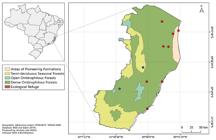
Distribution map of Lacistema robustum (red circles) and L. serrulatum (blue circles) in the state of Espírito Santo, Brazil.
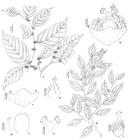
a-g. Lacistema robustum - a. branch with inflorescences; b. basal bract and flower in front view in front view; c. basal bract; d. bracteole; e. sepal; f. stamen; g. gynoecium. h-i. Lacistema serrulatum - h. branch with inflorescences; i. gynoecium. Drawing by R.M.M. Almeida.
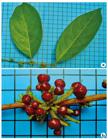
a-b. Lacistema robustum - a. branch with inflorescences and leaves in adaxial view; b. detail of the inflorescences and mature fruits. Photos by Geovane Siqueira.
Trees or treelets up to 8 m tall; branches nut-brown, glabrous; terminal stipule 0.6−1.2 cm long, glabrous; axillar stipules early caducous, not seen. Leaves petiolate, laxly distributed along the branches; petioles 0.3−1.7 cm long, glabrous; leaf blade 2.7−21.8 × 0.8−6.5 cm, discolorous, dark-green on the adaxial surface, light-green on the abaxial surface, subcoriaceous, glabrous, oblong to lanceolate, the base cuneate to rounded, the apex acuminate to cuspidate, cusp/acumen 0.5−2.7 cm long, margin entire; venation camptodromous, secondary veins, 4−7 pairs, glabrous on both surfaces. Spikes 0.3−1.5 cm long, rachis glabrous; basal bract 0.8−1.3 mm width, glabrous; bracteoles 0.4−0.6 mm long, lanceolate to linear; sepals 0.4−1.1 mm long, ovate to lanceolate; stamen 0.3−1 mm long, filament 0.2−0.7 mm long, glabrous or with sparse and simple trichomes, anthers 0.1−0.4 mm long; gynoecium 0.7−1.2 mm long, ovary 0.2−0.7 mm long, orbicular, trichomes at the apex, simple, sparse, style evident, 0.1−0.6 mm long, glabrous, stigmas 0.1−0.3 mm long, glabrous. Capsules 0.5−0.7 cm long, orbicular to obovoid, dark-red. Seeds not seen.
Specimens selected: Aracruz, Estação Ecológica Marinha Augusto Ruschi, 19°58’7”S, 40°08’41”W, 10.IX.2021, fl. and fr., A.M. Assis et al. 5137 (MAR, VIES). Conceição da Barra, Floresta Alta de Tabuleiro, km 5 a 6 da estrada interna, 25.IX.2010, fl., I.R. Oliveira et al. 92 (MAR, SAMES, VIES). Guarapari, Rodovia do Sol - 24 km, oeste, 4.XI.1991, fl., P.C. Vinha 1373a (MAR, VIES). Linhares, Comboios, 28.IX.1993, fl., O.J. Pereira et al. 4999 (MAR, VIES). Pinheiros, Reserva Biológica do Córrego do Veado, estrada a esquerda da sede da Reserva, 18.XI.2010, fl., I.R. Oliveira et al. 66 (SAMES, VIES). Santa Teresa, Estação Biológica de Santa Lúcia, 21.X.1993, fl., L.D. Thomaz 1616 (MAR, VIES). São Mateus, Bairro Quadrado, estrada de terra a 10 km atrás do campus CEUNES, 28.VIII.2009, fl. and fr., M. Ribeiro et al. 24 (MAR, VIES). Sooretama, Reserva Biológica de Sooretama, 19°00’67”S, 40°06’51”W, 26.VIII.2012, fl. and fr., T.B. Flores & G.O. Romão 1169 (CVRD image!).
Lacistema robustum is recorded in Espírito Santo (southeastern Brazil) and in the northeaster region, in the states of Bahia and Pernambuco (Marinho & Amorim 2015; Gomes-Silva et al. 2018; Flora e Funga do Brasil 2025, continuously updated). In Espírito Santo, the species is distributed throughout the humid areas of dense ombrophilous forest in the east of the state (Fig. 1) and usually associated with the slopes of forest fragments. Lacistema robustum has confirmed occurrence in five conservation units: Córrego do Veado Biological Reserve, Santa Lúcia Biological Station and Sooretama Biological Reserve, in addition to the Rio Preto National Forest (Alves-Araújo et al. 2022) and the Córrego Grande Biological Reserve (Carvalho-Neta et al. 2025). Lacistema robustum was assessed by Torres (1998) and classed as Least Concern (LC); however, this status has been updated by CNCFlora (2025a) to Near Threatened (NT) due to having an area of occupancy of less than 600 km² and suffering threats like deforestation, urban expansion, agriculture, livestock farming and invasion by exotic species.
Lacistema robustum is similar to L. lucidumSchnizlein (1857: 282), which occurs in São Paulo and Paraná (Flora e Funga do Brasil 2025, continuously updated). The species share glabrous branches and a distinct style (Sleumer 1980). Both can be differentiated by the subcoriaceous and glabrous leaves in L. rosbustum (vs. chartaceous with sparse trichomes, especially on the midrib in L. lucidum). In Espírito Santo, the species can be easily recognized by the glabrous leaves with entire margins. The species flowers in the second half of the year between August and December, with fruiting beginning in September.
1.2. Lacistema serrulatum Mart., Nov. Gen. Sp. Pl. 1: 156, pl. 95. 1824. Figs. 1; 2h-i
Trees or treelets up to 7,5 m tall; branches nut-brown, glabrous; terminal stipule 0.9−1.2 cm long, glabrous; axillar stipules early caducous, not seen. Leaves petiolate, congested along the branches; petioles 0.5−0.7 cm long, glabrous; leaf blade 2.6−6.4 × 1.2−3.2 cm, discolorous, dark-green on the adaxial surface, light-green on the abaxial surface, subcoriaceous, glabrous, lanceolate, the base cuneate to rounded, the apex cuspidate, cusp 0.3−0.5 cm long, margin serrate to sinuous; venation camptodromous, secondary veins, 4−5 pairs, trichomes simple, sparse, present on both surfaces. Spikes ca. 0.8 cm long, rachis glabrous; basal bract 1−1.4 mm wide, glabrous; bracteoles 0.5−0.7 mm long, lanceolate to linear; sepals 0.7−0.9 mm long, ovate to lanceolate; stamen 0.7−0.9 mm long, filament 0.5−0.7 mm long, glabrous, anthers ca. 0.2 mm long; gynoecium 0.8−1.1 mm long, ovary 0.4−0.5 mm long, orbicular, trichomes at the apex, simple, numerous, style evident, 0.3−0.4 mm long, glabrous, stigmas 0.1−0.3 mm long, glabrous. Capsules and seeds not seen.
Specimens examined: Afonso Cláudio, Cong. 82, Sub. 1, Subp. 10, Na. 10, 20°09’36”S, 41°13’12” W, 7.XI.2014, fl., D. Julkoski 170 (MAR, VIES). Santa Teresa, morro da Estação Repetidora de TV, 9.V.1985, fl., H.Q. Boudet Fernandes 1128 (MBML image!); entrada para Vargem Grande, 19°35’12”S, 40°37’36”W, 2.VIII.2006, fl., M.G. Bovini & C.M. Mynssen 2573 (RB image!).
Lacistema serrulatum was previously recorded in all southeastern Brazilian states except Espírito Santo (Flora e Funga do Brasil 2025, continuously updated). This study provides its first record for the state. The species was recorded in the west of the state, in areas of dense ombrophilous and semi-deciduous seasonal forest associated with regenerating forests, relatively far from the locations where L. robustum occurs. Lacistema serrulatum was assessed and classified as Least Concern by CNCFlora (2025b) due to its wide distribution.
The species can be distinguished from L. robustum by the leaves that are relatively small with serrate margins and secondary veins with simple trichomes. Only one of the analyzed specimens bear open flowers. The remaining specimens bear only flower buds, but they match L. serrulatum in the combination of small leaves with serrate margins that are congested along the branches, plus secondary veins with simple trichomes. The only specimen examined with flowers was collected in November.
Acknowledgements
The authors thank the curators of the SAMES and VIES herbaria, for the donation of the specimens; Geovane Siqueira (CVRD herbarium) and Lucas Vargas (CAP herbarium), for the photographs; Marcus Nadruz (RB) and Thiago Mouzinho (INPA), for the stereomicroscopic images of relevant specimens in the RB and MBML herbaria, respectively; Antônio Leal (UFMA), for the preparation of the map; Augusto Palhano (UFMA), for his help and company during the execution of this work; and Álvaro Nepomuceno and Thiago Fernandes, for the relevant suggestions to the manuscript.
References
- Agostini G (1973) El genero Lozania Mutis (Lacistemataceae). Acta Botanica Venezuelica 8: 167-175.
-
Alves-Araújo A, Moreira MM, Carrijo TT, Lohmann LG, Lobão AQ, Scheidegger AF, Firmino AD, Melo Silva AV, Nepomuceno Á, Tuler AC, Amorim AM, Moreira AL, Cosenza BA, Sossai BG, Silva C, Lopes CR, Monteiro D, Couto DR, Lima DF, Dalcin EC, Ramos E, Lírio EJ, Salimena F, Oliveira FA, Fraga FR, Torres-Leite F, Antar GM, Shimizu GH, Lima HC, Medeiros H, Luber J, Christ JA, Lanna J, Zorzanelli JPF, Freitas J, Pastore JF, Melo JI, Paula-Souza J, Oliveira JR, Pederneiras LC, Freitas L, Giacomin LL, Meireles LD, Silva LA, Pinto LJ, Menini Neto L, Trovó M, Garbin ML, Morim MP, Ribeiro M, Pena NT, Labiak PH, Cardoso PH, Viana PL, Moraes PL, Moraes QS, Zorzanelli RF, Amaral RN, Asprino RC, Goldenberg R, Magnago R, Couto RS, Dutra SC, Hoyos-Gómez SE, Vieira TA, Flores TB, Dutra VF, Miranda VS, Manhães VC & Forzza RC (2022) Floristic survey of vascular plants of a poorly known area in the Brazilian Atlantic Forest (Flona do Rio Preto, Espírito Santo). Biodiversity Data Journal 10: e75910. DOI: 10.3897/BDJ.10.e75910
» https://doi.org/10.3897/BDJ.10.e75910 -
Andrade MFB, Marinho LC, Costa MSS & Almeida RBP (2022) Flora da Serra do Cipó: Lacistemataceae. Boletim de Botânica da Universidade de São Paulo 9: 15-18. DOI: 10.11606/issn.2316-9052.v39p15-18
» https://doi.org/10.11606/issn.2316-9052.v39p15-18 -
APG II - Angiosperm Phylogeny Group (2003) An update of the Angiosperm Phylogeny Group classification for the orders and families of flowering plants: APG II. Botanical Journal of the Linnean Society 141: 399-436. DOI: 10.1046/j.1095-8339.2003.t01-1-00158.x
» https://doi.org/10.1046/j.1095-8339.2003.t01-1-00158.x - Caldas FJ (1810) Semanario del Nuevo Reyno de Granada. Sobre el modo de cultivar la cochinilla. Vol. 3. Imprensa Real de Santafé, Bogotá. 30p.
-
Carvalho-Neta MS, Ribeiro M, Menezes LFT, Antar GM, Giaretta A, Morim MP, Lima HC, Souza MC, Nunes-Freitas AF, Rezende GF, Scheidegger AFA, Felix AS, Moreira ABL, Mezzonato-Pires AC, Alves-Araújo A, Gil ASB, Peixoto AL, Lobão AQ, Chateau A, Bruniera CP, Toledo CAP, Caires CS, Nunes CS, Sá CFC, Couto DR, Gonzaga DR, Leal ES, Melo E, Ramos E, Lírio EJ, Lopes FS, Leite FT, Nepomuceno FAA, Queiroz GA, Siqueira GS, Heiden G, Shimizu GH, Fiorini JF, Costa-Lima JL, Zorzanelli JPF, Freitas J, Baumgratz JFA, Paula-Souza J, Alves KNL, Sylvestre LS, Deccache LSJ, Schneider LJC, Pederneiras LC, Giacomin LL, Biral L, Calazans LSB, Marinho LC, Brotto ML, Saka MN, Colli-Silva M, Araújo MDF, Roque N, Luna NKM, Bigio NC, Santos NB, Pena NTL, Pereira OJ, Silva OLM, Fiaschi P, Andrade RC, Nichio-Amaral R, Goldenberg R, Ricardo RS, Couto RS, Valadares RT, Carrijo TT, Faria TM, Meneguzzo TEC, Dutra VF, Cardoso WC, Rodrigues PHL, Paes LS, Nunes PM, Ferrarezi MD, Roncheti MP, Oliveira-Silva T, Cruz A, Farias AR, Andrelino JS, Pestana DPA, Carmo JR, Neres RJ, Ferreira JA & Santos KA (2025) Lista de espécies de plantas vasculares da Reserva Biológica do Córrego Grande. In: Catálogo de plantas das Unidades de Conservação do Brasil (org.) Instituto de Pesquisas Jardim Botânico do Rio de Janeiro. Available at <https://catalogo-ucs-brasil.jbrj.gov.br/descr_areas.php?area=CorregoGrande>. Access on 23 May 2025.
» https://catalogo-ucs-brasil.jbrj.gov.br/descr_areas.php?area=CorregoGrande -
CNCFlora (2025a) Lacistema robustum Schnizl. In: Painel de Dados do Centro Nacional de Conservação da Flora (org.) Available at <https://cncflora.jbrj.gov.br/ficha/17847>. Access on 18 June 2025.
» https://cncflora.jbrj.gov.br/ficha/17847 -
CNCFlora (2025b) Lacistema serrulatum Mart. In: Painel de Dados do Centro Nacional de Conservação da Flora (org.) Available at <https://cncflora.jbrj.gov.br/ficha/8101>. Access on 18 June 2025.
» https://cncflora.jbrj.gov.br/ficha/8101 -
Dutra VF, Carrijo TT & Alves-Araújo A (2022) Projeto Flora do Espírito Santo: revelando a flora capixaba. Rodriguésia 73: e730002022. DOI: 10.1590/2175-7860202273000
» https://doi.org/10.1590/2175-7860202273000 -
Flora e Funga do Brasil 2025 (continuously updated) Jardim Botânico do Rio de Janeiro. Available at <https://reflora.jbrj.gov.br/reflora/>. Access on 28 May 2025.
» https://reflora.jbrj.gov.br/reflora/ -
Gomes-Silva F, Macedo A, Pessoa E & Alves M (2018) Flora da Usina São José, Igarassu, Pernambuco: Chrysobalanaceae, Humiriaceae, Lacistemataceae e Trigoniaceae. Rodriguésia 69: 1799-1811. DOI: 10.1590/2175-7860201869419
» https://doi.org/10.1590/2175-7860201869419 - Gonçalves EG & Lorenzi H (2011) Morfologia vegetal: organografia e dicionário ilustrado de morfologia das plantas vasculares. 2a ed. Plantarum, São Paulo. 512p.
-
Marinho LC & Amorim AM (2015) Flora da Bahia: Lacistemataceae. Sitientibus série Ciências Biológicas 15: 1-6. DOI: 10.13102/scb478
» https://doi.org/10.13102/scb478 -
Marinho LC & Amorim AM (2016) Flora das cangas da Serra dos Carajás, Pará, Brasil: Lacistemataceae. Rodriguésia 67: 1377-1380. DOI: 10.1590/2175-7860201667535
» https://doi.org/10.1590/2175-7860201667535 -
Marinho LC, Pimenta KM, Oliveira DC, Alves RF & Amorim AM (2021) Lacistema ligiae (Lacistemataceae), a new species from Chapada Diamantina, Bahia, Brazil, with notes on micromorphology. Phytotaxa 514: 140-148. DOI: 10.11646/phytotaxa.514.2.5
» https://doi.org/10.11646/phytotaxa.514.2.5 -
Marquete R (2001) Reserva Ecológica do IBGE (Brasília - DF): Flacourtiaceae. Rodriguésia 52: 5-16. DOI: 10.1590/2175-78602001528001
» https://doi.org/10.1590/2175-78602001528001 - Martius CFP (1824) Nova Genera et Species Plantarum, Volumen Primum. Typis Lindaueri, Munich. 158p.
-
Neill DA & Asanza M (2012) Lozania nunkui (Lacistemataceae), a new species from the sandstone plateaus of the Cordillera del Cóndor in Ecuador and Peru. Novon 22: 207-211. DOI: 10.3417/2009021
» https://doi.org/10.3417/2009021 -
QGIS Development Team (2025) QGIS Geographic Information System. Open-Source Geospatial Foundation Project. Available at <http://qgis.osgeo.org>. Access on 28 May 2025.
» http://qgis.osgeo.org -
Saiter F (2019) Shapefiles do mapa de vegetação do Espírito Santo. DOI: 10.6084/m9.figshare.7565333.v1
» https://doi.org/10.6084/m9.figshare.7565333.v1 - Schnizlein ACFHC (1857) Lacistemataceae. In: Martius CFP (ed.) Flora brasiliensis Frid. Fleischer, Leipzig. Vol. 4, pars 1, pp. 278-288.
- Sleumer HO (1980) Flacourtiaceae. In: Flora Neotropica Monographs. Vol. 22. The New York Botanical Garden, New York. 499p.
- Swartz O (1788) Nova genera & species plantarum, seu, Prodromus descriptionum vegetabilium. Bibliopoliis Acad. M. Swederi., Holmiae, Upsaliae & Aboae. 158p.
-
Thiers B (continuously updated) Index Herbariorum: a global directory of public herbaria and associated staff. New York Botanical Garden’s Virtual Herbarium. Available at <http://sweetgum.nybg.org/science/ih/>. Access on 23 May 2025.
» http://sweetgum.nybg.org/science/ih/ -
Torres RB (1998) Lacistema robustum The IUCN Red List of Threatened Species 1998: e.T35581A9936300. DOI: 10.2305/IUCN.UK.1998.RLTS.T35581A9936300.en
» https://doi.org/10.2305/IUCN.UK.1998.RLTS.T35581A9936300.en - Torres RB & Ramos E (2005) Lacistemataceae. In: Wanderley MGL, Shepherd GJ, Melhem T & Giulietti AM (eds.) Flora fanerogâmica do estado de São Paulo. Instituto de Botânica, São Paulo. Vol. 4, pp. 231-237.
-
Vélez-Puerta JM & Marinho LC (2025) Lacistema morrocoensis, a new Colombian species of Lacistemataceae, and the extension of L. macbridei distribution to the country. Phytotaxa 700: 279-287. DOI: 10.11646/phytotaxa.700.3.4
» https://doi.org/10.11646/phytotaxa.700.3.4
Data availability statement
In accordance with Open Science communication practices, the authors inform that there is no data sharing of this manuscript.
Specimens List
Assis AM 5137 (1.1). Bovini MG 2573 (1.2*). Boudet Fernandes HW 1128 (1.2*). Engels ME 9462 (1.1*). Flores TB 1169 (1.1*). Folli DA 5665 (1.1*), 5764 (1.1*). Gomes JML 2208 (1.1). Julkoski D 170 (1.2). Lopes FS 9 (1.1). Menezes LFT 1854 (1.1), 2341b (1.1). Moraes QS 28 (1.1). Nichio-Amaral R 1107 (1.1). Oliveira IR 66 (1.1), 92 (1.1). Pereira OJ 3815 (1.1), 3884 (1.1), 4999 (1.1), 6990 (1.1), 6991 (1.1), 7661 (1.1). Peres ALSS 419 (1.1). Ribeiro M 24 (1.1), 606 (1.1). Rodrigues MR 28 (1.1). Rodrigues OK 71 (1.1). Santos MGP 06 (1.1). Scheidegger AFA 284 (1.1), 285 (1.1), 354 (1.1). Siqueira GS 445 (1.1*). Thomaz LD 1615 (1.1), 1616 (1.1), 1618 (1.1), 1620 (1.1). Vinha PC 1373a (1.1).


