 New records to the genus Hypoxylon (Hypoxylaceae, Ascomycota) from Bahia, Brazil
Abstract
The genus Hypoxylon is the most diverse of the family Hypoxylaceae, distributed through nine Brazilian states, with most species known from southern region due to the studies of Johannes Rick. Field samples in Southern Bahia, resulted in interesting collections of Hypoxylon. Here we present H. rectangulosporum for the first time from Brazil, H. aeruginosum, H. investiens for the Northeast and H. perforatum for Bahia.
Key words:
Brazilian Funga; Diversity; Taxonomy; Xylariaceous fungi
Resumo
O gênero Hypoxylon é o mais diverso da família Hypoxylaceae, ocorrendo em 9 estados brasileiros, a maioria das espécies na Região Sul, devido aos estudos de Johannes Rick. Coletas de campo realizadas no sul da Bahia, resultaram em dados interessantes de Hypoxylon. O presente trabalho traz o primeiro relato de H. rectangulosporum para o Brasil, H. aeruginosum e H. investiens para o nordeste e H. perforatum para a Bahia.
Palavras-chave:
Funga Brasileira; Diversidade; Taxonomia; Fungos xylariáceos
The genus Hypoxylon Bull. is the most diverse within Hypoxylaceae, a family newly split from the Xylariaceae based on polyphasic taxonomy (Wendt et al. 2018; Daranagama et al. 2018). The species of Hypoxylon are mostly saprophytes and endophytes, with some known as producers of organic extracts with biocontrol potential (Mueller et al. 2004; Sánchez-Fernández et al. 2020; Jin et al. 2022).
More than 30 species of Hypoxylon are recorded in Brazil, with numbers varying from 32 to 69 spp. (Pereira 2015; Specieslink 2024), although this is not updated, which indicates specimens are deposited with older names, which might currently belong to different genera such as Hypomontagnella Sir. L. Wendt & C. Lamb., Pyrenopolyporus Lloyd and Annulohypoxylon Y.M. Ju, J.D. Rogers & H.M. Hsieh (see Flora e Funga do Brasil and Specieslink databases), as well as invalid names.
The aim of the present work is to report four species of Hypoxylon species collected in Southern Bahia and deposited in the TFB-UESC Fungarium, with at least two, apparently, rare, or poorly documented, showing the genus as not well comprehended in this State and certainly has a wider distribution throughout the country.
Specimens were collected on the municipalities of Ilhéus, Una and Wenceslau Guimarães, Southern Bahia, and taken to Nematology and Phytopathology Laboratory on Universidade Estadual de Santa Cruz for dehydration, morphological analysis and deposited at the TFB/UESC Fungarium. Species were identified based on the main literature for the Hypoxylaceae and Xylariaceae, properly cited along this study. The colors of stromata and pigments in 10% KOH was based on Rayner’s Mycological Chart (Rayner 1970). Macrophotographs were taken with a smartphone directly on the eyepiece of a Leica® EZ4 stereomicroscope and microphotographs on a Leica® DM500 coupled with a camera ICC50 HD and processed on LAS EZ application suite. For microscopical analyses, hand-free sections were made by using a razor blade or scalpel after rehydration with distilled water. For the asci, we considered, whenever possible, length × width of spore bearing part and stipe length; amyloid reaction and shape and dimensions (height × width) of apical plug were evaluated by using lugol (I+). At least 20 ascospores were measured. Asci, apical apparatus and ascospores measurements were performed with Piximètre 5.10 (<http://ach.log.free.fr/Piximetre/>).
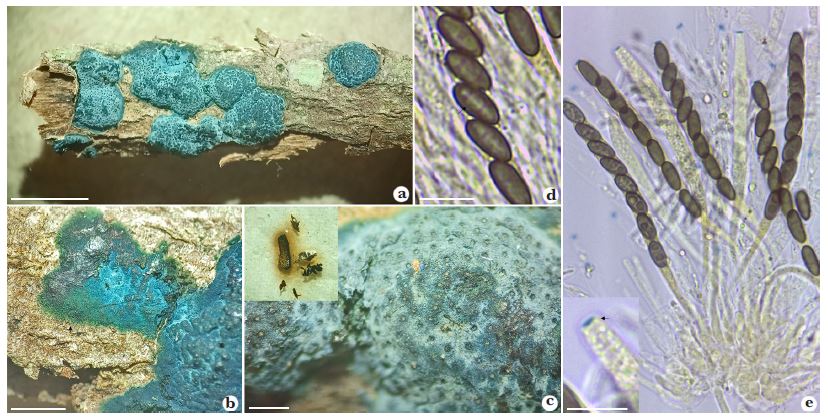
Hypoxylon aeruginosum J.H. Mill., Mycologia, 25(4): 321 (1933). Fig. 1
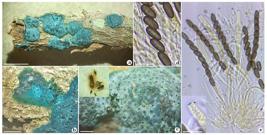
a-e. Hypoxylon aeruginosum - a. stromata on substrate; b. young stromata with greenish-yellow margins; c. close-up on stromatal surface evidencing ostioles (detail: KOH-extractable pigments); d. ascospores (arrow = germ slit); e. mature and immature asci (detail: apical apparatus bluing in lugol). Bars: a = 5 mm; b = 3 mm; c = 1 mm; d = 10 µm.
Stromata: broadly ellipsoid to elongate, often coalescent, conspicuous to inconspicuous perithecial mounds, surface cyan blue (26 to 27), young stromata with greenish to yellow villose margin; tissue under surface carbonaceous, black, subperithecial tissue thick; 10% KOH-extractable pigments dilute to pale vinaceous (85), fading after a few minutes; ostioles: umbilicate; perithecia: obovoid to tubular, 0.3-0.4 × 0.15-0.2 mm; asci: cylindrical with eight obliquely uniseriate ascospores, spore-bearing parts 58-62 × 6-6.2 µm, stipes 31-38.6 µm, with discoid apical apparatus bluing in lugol, 0.6-0.7 × (1-)1.6-2.4(-2.6) µm; ascospores: ellipsoid-equilateral, olivaceous brown, (7.8-)8.3-9.7(-9.9) × (3.8-)3.9-4.5(-4.7) µm, broadly round ends, straight germ slit less than spore-length.
Examined material: Una, Ecoparque de Una, 15°09’50”S, 39°03’14”W, 17.IV.2008, on fallen branch, coll. M.E.S. Cáceres, det. C. Silva (TFB1303); Reserva Biológica de Una, 15°10’37.02”S, 39°06’19.81”W, 2.X.2023, on fallen branches, coll. C. Silva, det. C. Silva & Jad. Pereira (TFB1445).
Hypoxylon aeruginosum was previously collected by G.J. Samuels in Amazonas (see Rogers & Samuels 1985) and by Cruz (2021) in Acre. A specimen identified as Hypoxylon (FLOR0063613), with pictures evidencing the typical cyan blue stromata with umbilicate ostioles, was found in Specieslink database, which was collected in Mato Grosso. Herein we report it anew for the Northeast, supporting a wide distribution to this species. The striking cyan blue stromatal surface color seems to be rare within the genus Hypoxylon and the xylariaceous fungi. H. aeruginosum was previously collected in Ecuador, French Guiana, Guadeloupe, Guyana, Mexico, Russia and Uganda (Fournier et al. 2015).
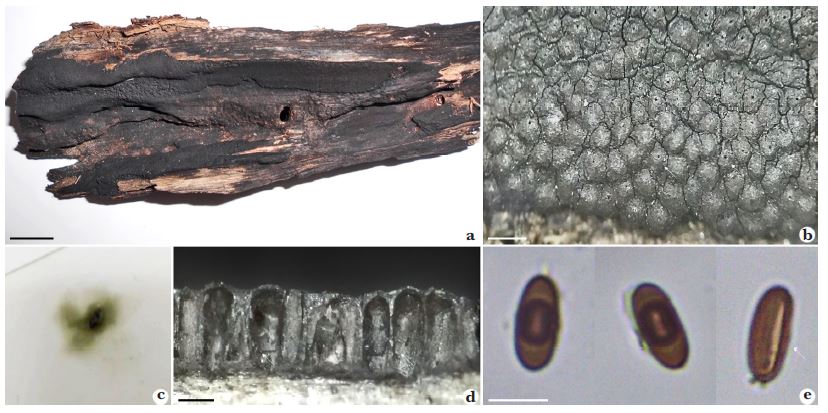
Hypoxylon investiens (Schwein.) M.A. Curtis., Geol. Nat. Hist. Surv. North Carolina, III: 140 (1867). Fig. 2
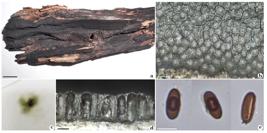
a-e. Hypoxylon investiens - a. stromata on substrate; b. close-up on stromatal surface evidencing ostioles (arrows); c. KOH-extractable pigments; d. longitudinal section evidencing perithecia (arrows); e. ascospores (arrow = germ slit). Bars: a = 2 cm; b = 1 mm; d = 0.3 mm; e = 5 µm.
Stromata: effused-pulvinate to elongate, surface blackish, 5 × 1 cm, perithecial contours inconspicuous to conspicuous, 10% KOH-extractable pigments dull green (70), tissue below perithecial layer inconspicuous to 0.2 mm thick; ostioles: umbilicate; perithecia: tubular, 0.4-0.9 × 0.3-0.4 mm; asci: damaged; ascospores: light brown to brown, narrowly ellipsoid-equilateral to oblong, broadly rounded ends, 7-9 × 3-4 μm, with a faint germ slit, perispore indehiscent in 10% KOH.
Examined material: Ilhéus, Comissão Executiva do Plano da Lavoura Cacaueira - CEPLAC, 14°46’25”S, 39°13’23”W 39°13’23.35”W, 13.XII.18, on rotten branch, coll. and det. C. Silva & J. Pereira (TFB1442).
Hypoxylon investiens is similar to H. pulicicidum J. Fourn., Polishook & Bills and H. dussii J. Fourn. & Lechat, distinguished by the dull green vs. yellowish olivaceous KOH-extractable pigments and smaller narrowly ellipsoid-equilateral vs. broadly ellipsoid, respectively (see Bills et al. 2012; Fournier et al. 2015a). The specimen collected presented blackish stromatal surface, typical of old stromata, differing from the brown-vinaceous stromatal surface observed on young stromata [Ju & Rogers (1996) and Fournier et al. (2015)]. According to Specieslink database (2024), H. investiens was recorded previously in Acre, Amazonas, Mato Grosso, Rio Grande do Sul, Roraima, São Paulo.
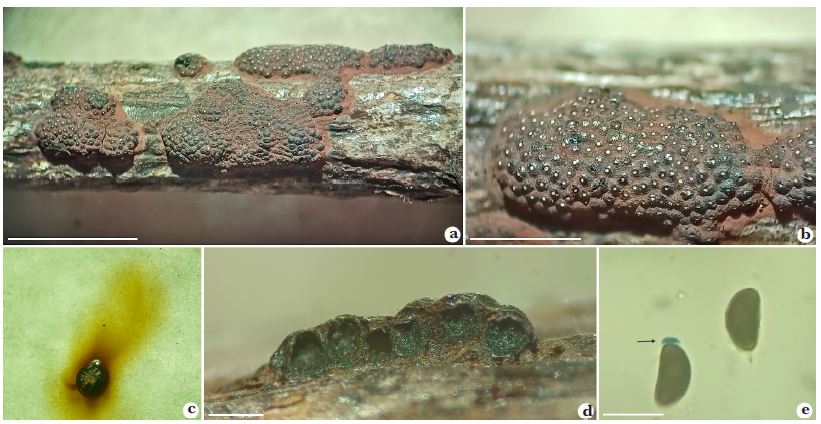
Hypoxylon perforatum (Schwein.) Fr. Summa veg. Scand., Section Post. (Stockholm): 384 (1849). Fig. 3
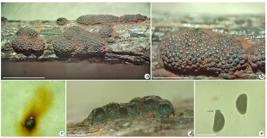
a-e. Hypoxylon perforatum - a. stromata on substrate; b. close-up of stroma evidencing ostioles covered with white substance; c. KOH-extractable pigments; d. longitudinal section evidencing perithecia; e. ascospores (arrow: apical apparatus). Bars: a = 5 mm; b = 1 mm; d = 0.5 mm; e = 10 µm.
Stromata: pulvinate to effused-pulvinate, with inconspicuous to conspicuous perithecial mounds, 5.1-20 mm long × 4.8-12 mm broad, surface brown-vinaceous (84), dark brown to blackish granules beneath surface and between perithecia, 10% KOH-extractable amber (47) to citrine (13); ostioles: lower than stromatal surface, mainly covered with white substance; perithecia: obovoid, 0.2-0.5 × 0.2-0.3 mm; asci: damaged, apical apparatus bluing in lugol, discoid, 0.5-1.78 (-1.8) × 2-2.6 µm; ascospores: brown to dark brown, ellipsoid-inequilateral with narrowly rounded ends, (8.4-)9.8-11.3(-11.9) × (4.6-)5-6(-6.9) µm, straight to slightly sigmoid germ-slit almost to spore-length on the dorsal side, perispore dehiscent in 10% KOH, surface smooth.
Examined material: Ilhéus: Universidade Estadual de Santa Cruz, 14°79’67”S, 39°17’32”W, 23.XI.2016, on fallen branch, coll. and det. C. Silva & Jad. Pereira (TFB989).
Cruz (2021) presented the first report of Hypoxylon perforatum from Northern Brazil. The specimen herein is the first reported from Bahia, with another single specimen known from Northeastern region collected in Pernambuco. Despite of its similarity with other species of the H. rubiginosum complex, the general description conforms with the general concept of H. perforatum from Ju and Rogers (1996) and can be distinguished by the white substance on the ostioles and the citrine KOH-extractable pigments.
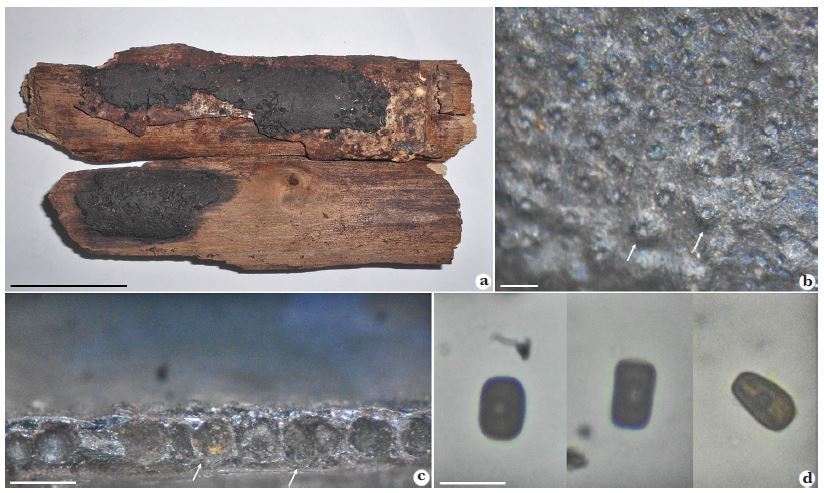
Hypoxylon rectangulosporum Y.M. Ju, J.D. Rogers & Samuels, in Rogers, Yu & Hemmes, Mycologia 84(2): 166 (1992). Fig. 4
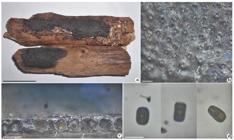
a-d. Hypoxylon rectangulosporum - a. stromata on substrate; b. close-up on stromatal surface evidencing ostioles (arrows); c. longitudinal section evidencing perithecia (arrows); d. ascospores. Bars: a = 5 mm; b,c = 0.5 mm; d = 10 µm.
Stromata: effused-applanate, with inconspicuous to conspicuous perithecial contours, surface dark brown on overly mature stromata, brownish yellow granules beneath surface and between perithecia, 10% KOH-extractable dilute ochreous (44); ostioles: lower than stromatal surface, perithecia: spherical to obovoid, 0.3-0.4 mm diam; asci: damaged; ascospores: rectangular to oblong, brown, (6.5-)8-9 × 4-5 μm, surface ornamented with parallel ridges, germ slit inconspicuous.
Examined material: Wenceslau Guimarães, Estação Ecológica de Wenceslau Guimarães, 13°35’43”S, 39°43’12”W, 14.VIII.2008, on rotten branches, coll. J. Pereira, det. C. Silva & J. Pereira (TFB673).
Hypoxylon rectangulosporum presents unusual ascospores, feature observed as well in H. rhombisporum (Fournier & Lechat 2015b), although the former presents ascospores conspicuously rectangular to barrel-shaped and the latter oblong to rhomboid. Moreover, H. rectangulosporum presents pale stromatal color × dark brown vinaceous from H. rhombisporum, although the specimen presented here has dark stromatal surface probably due to its mature state when collected. Except for the stromatal color, the specimen morphological traits match with the description of Rogers et al. (1992).
The genus Hypoxylon is, as other genera of the Hypoxylaceae, easily found throughout the year in Brazil, since several species seem to tolerate variation of temperature and humidity rates, occurring from the Amazon and Atlantic Rainforest to Cerrado and Caatinga Biomes. Despite more than 30 species recorded in Brazil, there are currently few, yet accurate contributions on Hypoxylon from the Amazon (Cruz 2021), Paraná (Cruz & Cortez 2015) and Northeast (Pereira 2011; Lacerda 2014), which should be mentioned.
Silva et al. (2020) presented new reports of Hypoxylon from Bahia, bringing as well other species within the Hypoxylaceae. The present study brings two species with unusual features for Hypoxylon: H. aeruginosum, with a distinctive cyan blue stromatal surface, and H. rectangulosporum, with rectangular to barrel-shaped ascospores, both previously unreported from Northeast and Brazil, respectively. Cruz (2021) presented H. rhombisporum from the Amazon, a species only recorded from French Guiana (Fournier & Lechat 2015). The specimen here presents striking similarities with the specimen obtained by Cruz, although the ascospores follow the description from Rogers et al. (1992), and yielded a dilute to pale ochreous KOH-extractable pigment, differing from the livid vinaceous mentioned by Cruz and Fournier & Lechat in previous studies. These rare specimens found throughout the Amazon and Atlantic Rainforest indicating Hypoxylon, and other genera within Hypoxylaceae, remain poorly comprehended in Brazil and these areas probably hide a huge fungal diversity yet to be discovered.
Acknowledgements
The authors thank FAPESB (BOL0215/2020), for granting financial support during the execution of this study; UESC, for technical support; and Instituto Chico Mendes de Conservação da Biodiversidade (ICMBio), for authorizing field collections.
Data availability statement
In accordance with Open Science communication practices, the authors inform that there is no data sharing of this manuscript.
References
-
Bills GF, González-Menéndez V, Martin J, Platas G, Fournier J, Peršoh D & Stadler M (2012) Hypoxylon Pulicicidum sp. nov. (Ascomycota, Xylariales), a Pantropical insecticide-producing endophyte. Plos One 7: E46687. DOI: 10.1371/Journal.Pone0046687
» https://doi.org/10.1371/Journal.Pone0046687 - Cruz KS (2021) Hypoxylaceae (Ascomycota, Xylariales) na Amazônia ocidental brasileira: taxonomia e bioprospecção de compostos bioativos. 2021. Tese de Doutorado. INPA, Manaus. 137p.
-
Cruz KS & Cortez VG (2015) Hypoxylon (Xylariaceae, Ascomycota) from western Paraná, Brazil. Brazilian Journal of Botany 38: 889-901. DOI: 10.1007/s40415-015-0189-z
» https://doi.org/10.1007/s40415-015-0189-z -
Daranagama DA, Hyde KD, Sir EB, Thambugala KM, Tian Q, Samarakoon MC, McKenzie EH, Jaiasiri SC, Tibpromma S, Bhat JD, Liu X & Stadler M (2018) Towards a natural classification and backbone tree for Graphostromataceae, Hypoxylaceae, Lopadostomataceae and Xylariaceae. Fungal Diversity 88: 1-165. DOI: 10.1007/s13225-017-0388-y
» https://doi.org/10.1007/s13225-017-0388-y -
Fournier J, Lechat C & Courtecuisse R (2015) The genus Hypoxylon (Xylariaceae) from Guadeloupe and Martinique (French West Indies). Ascomycete.org 7: 145-212. DOI: 10.25664/art-0140
» https://doi.org/10.25664/art-0140 -
Fournier J & Lechat C (2015) New, rarely and unsettled species of Hypoxylon (Xylariaceae) from French Guiana. Ascomycete.org 7: 63-96. DOI: 10.25664/art-0130
» https://doi.org/10.25664/art-0130 -
Jin QY, Peng HZ, Zhu TJ & Ye HL (2022) Isolation and functional characteristics of the fungus Hypoxylon spp. Sj18 with biocontrol potential. Fungal Biology 126: 174-184. DOI: 10.1016/j.funbio.2021.12.001
» https://doi.org/10.1016/j.funbio.2021.12.001 - Ju YM & Rogers JD (1996) A revision of the genus Hypoxylon Mycologia Memoir, n. 20. APS Press, St. Paul. 365p.
- Lacerda LT (2014) Fungos Xylariaceae (Ascomycota) associados a plantas em áreas de na Mata Atlântica na Bahia, Ceará e Paraíba. 2014. Dissertação de Mestrado. Universidade Estadual de Santa Cruz, Ilhéus. 121p.
- Mueller GM, Bills GF & Foster MS (2004) Biodiversity of fungi: inventorying and monitoring methods. Elsevier Academic Press, Londres. 777p.
- Pereira J (2011) Xylariaceae (Ascomycota) em áreas de Mata Atlântica nordestina e em herbários brasileiros. 2011. Tese de Doutorado. Universidade Federal de Recife, Recife. 220p.
-
Pereira J (2015) Xylariales in Lista de Espécies da Flora do Brasil. Jardim Botânico do Rio de Janeiro. Available at <https://floradobrasil.jbrj.gov.br/FB121078>. Access on July 2024.
» https://floradobrasil.jbrj.gov.br/FB121078 - Rayner RW (1970) A mycological colour chart.Commonwealth Mycological Institute, Kew and British Mycological Society. 34 p. + charts I & II.
- Rogers JD & Samuels GJ (1985) New taxa of Hypoxylon Mycotaxon 23: 367-373.
- Rogers JD, Ju YM & Hemmes DE (1992) Hypoxylon rectangulosporum sp. nov., Xylaria psidii sp. nov., and comments on taxa of Podosordaria and Stromatoneurospora Mycologia 84: 166-172.
-
Sánchez-Fernández RE, Sánchez-Fuentes R, Rangel-Sánchez H, Hernández-Ortega S, López-Cortés JG & Macías-Rubalcava ML (2020) Antifungal and antioomycete activities and modes of action of isobenzofuranones isolated from the endophytic fungus Hypoxylon anthochroum strain Gseg1. Pesticide Biochemistry and Physiology 169: 104670. DOI: 10.1016/j.pestbp.2020.104670
» https://doi.org/10.1016/j.pestbp.2020.104670 -
Silva CS, Pereira MB & Pereira J (2020) New accounts on Hypoxylaceae and Xylariaceae from Brazil. Rodriguésia 71: e03012018. DOI: 10.1590/2175-7860202071146
» https://doi.org/10.1590/2175-7860202071146 -
Specieslink (2024) Simple search. Available at <http://www.splink.org.br/index>. Access in July 2024.
» http://www.splink.org.br/index -
Wendt L, Sir EB, Kuhnert E, Heitkämper S, Lambert C, Hladki AI, Romero AI, Luanga-ard JJ, Srikitikulchai P, Peršoh D & Stadler Marc (2018) Resurrection and emendation of the Hypoxylaceae, recognized from a multigene phylogeny of the Xylariales. Mycol Progress 17: 115-154. DOI: 10.1007/s11557-017-1311-3
» https://doi.org/10.1007/s11557-017-1311-3