 Carnivorous Flora of Ceará, Brazil: Droseraceae
Abstract
Droseraceae is a family of carnivorous plants with a cosmopolitan distribution, including the genus Drosera, which is present across all continents except Antarctica. In Brazil, Drosera comprises 32 species, 20 of which are endemic. This study focuses on the taxonomic treatment of Drosera species in the state of Ceará, where Drosera sessilifolia is the only recorded species. The research includes morphological descriptions, distribution across vegetation types, phenological data, conservation notes, and threats. D. sessilifolia predominantly occurs in the Coastal Vegetation Complex ecotone, thriving in sandy soils near bodies of water and wetlands. Although widely distributed across South America and classified as Least Concern (LC), the species faces threats from habitat loss, urbanization, and pollution. The study aims to enhance understanding of the species’ distribution and highlights the need for conservation efforts to protect this unique coastal flora of Ceará, which includes floristic elements from the Caatinga, Cerrado, and coastal vegetation.
Key words:
conservation; distribution; Drosera; Northeast; taxonomy
Resumo
Droseraceae é uma família de plantas carnívoras com distribuição cosmopolita, incluindo o gênero Drosera, que está presente em todos os continentes, exceto na Antártida. No Brasil, Drosera compreende 32 espécies, das quais 20 são endêmicas. Este estudo apresenta o tratamento taxonômico das espécies de Drosera no estado do Ceará, onde Drosera sessilifolia é a única espécie registrada. A pesquisa inclui descrições morfológicas, distribuição nos tipos de vegetação, dados fenológicos e notas de conservação e ameaças. D. sessilifolia ocorre predominantemente no ecótono do Complexo de Vegetação Costeira, prosperando em solos arenosos próximos a corpos d’água e áreas alagadas. Embora amplamente distribuída na América do Sul e classificada como Pouco Preocupante (LC), a espécie enfrenta ameaças devido à perda de habitat, urbanização e poluição. O estudo contribui para o entendimento da distribuição da espécie e destaca a necessidade de esforços de conservação para proteger essa flora singular da costa do Ceará, que inclui elementos florísticos da Caatinga, Cerrado e vegetação costeira.
Palavras-chave:
conservação; distribuição; Drosera; nordeste; taxonomia
Introduction
Droseraceae, a family of carnivorous herbs in the non-core Caryophyllales (APG IV 2016), has a cosmopolitan distribution and comprises three genera Aldrovanda, Dionaea, and Drosera (Fleischmann et al. 2018). The genus Drosera occurs on all continents except Antarctica, with Australia being the most diverse region for Drosera species worldwide (Fleischmann et al. 2018). In Brazil, the genus comprises 32 species, 20 of which are endemic (Gonella 2025). These species are distributed across the country’s phytogeographic domains as follows: 10 species in the Amazon, 21 in the Cerrado, 13 in the Atlantic Forest, four in the Caatinga, two in the Pampa, and two in the Pantanal (Gonella 2025).
In Brazil, studies of Droseraceae diversity began with Auguste de Saint-Hilaire, who recorded 12 species and two varieties of Drosera (Saint-Hilaire 1824, 1826). Later, the family was revised by Eichler (1872) in Flora brasiliensis. Since then, several studies have been conducted, culminating recently in the most recent taxonomic revision of Drosera in Brazil by Gonella et al. (2022). Taxonomic studies in the Northeast region of Brazil remain limited. To date, investigations have been conducted in Bahia (Silva 2007), Maranhão (Guarçoni et al. 2025), Pernambuco (Andrade-Lima & Lima 1968), and Sergipe (Carregosa et al. 2015). Additionally, there are occurrence records from the Chapada das Mesas National Park (Oliveira et al. 2018).
In Ceará, Drosera has been recorded in floristic surveys along the coastal region (Huber 1908) and in floristic studies of savanna vegetation (Nepomuceno et al. 2021). However, no recent research has specifically focused on Droseraceae, despite it being one of only two carnivorous plant families in the state. In contrast, the other carnivorous plant family, Lentibulariaceae, was thoroughly studied by Guedes & Matias (2020).
Species of Drosera typically occur in oligotrophic, acidic, and nutrient-poor soils, thriving in environments such as wetlands, flooded areas, and sandy soils in quartzitic formations. These challenging conditions, although harsh, provide favorable habitats for the genus (Fleischmann et al. 2018). In addition to their ornamental appeal, Drosera species possess pharmacological properties, including antioxidant, anticancer, and anti-inflammatory activities (Asirvatham et al. 2013; Ghate et al. 2015).
This study aims to provide a taxonomic treatment of Droseraceae in the state of Ceará. Although represented by only one species, carnivorous plants play a vital role in local ecosystems as functional components of oligotrophic environments and may serve as bioindicators of environmental health, given their sensitivity to habitat degradation and their influence on ecosystem stability (Cross et al. 2020). The research includes a morphological analysis of the Drosera species occurring in the state, based on herbarium specimens, and evaluates its distribution, contributing to the understanding of Ceará’s flora.
Material and Methods
This study was conducted in the state of Ceará, located in the Northeast region of Brazil, covering a total area of 148,894.4 km² and bordered by Piauí to the west, Rio Grande do Norte and Paraíba to the east, Pernambuco to the south, and the Atlantic Ocean to the north (IPECE 2024).
A comparative analysis was performed using samples preserved in the herbaria ASE, EAC, HUEFS, IPA, MBM, MO, NY, and R, accessed through the SpeciesLink platform (CRIA 2025) and following the standards established by Thiers (continuously updated). Information on habit, habitat, and phenological data was obtained from the descriptions provided by collectors on herbarium specimen labels.
The identification and morphological description of the species was based on terminology from the specialized literature (Kuprianova 1973; Gonella et al. 2022; Rivadavia et al. 2014; Silva & Giulietti 1997). The name of the author and species nomenclature is in conformity with the International Plant Names Index - IPNI (2024), and the taxonomic classification follows the Angiosperm Phylogeny Group (APG IV 2016).
Exsiccates deposited in the Prisco Bezerra Herbarium (EAC) were used for the morphological analysis of the species using a Nikon SMZ 1500 stereomicroscope. A floral bud was also collected from exsiccate EAC0049799 for pollen slide preparation. For this process, the floral bud underwent acetolysis to allow for pollen visualization. After 24 hours in acetic acid, a solution of acetic anhydride and sulfuric acid was added and heated for 3 minutes. The residue was then washed, placed in 50% glycerin, and the pollen was mounted on a slide and sealed with paraffin (Kaiser 1880; Erdtman 1960). The slide was subsequently photographed using a Physis optical microscope with an attached digital camera.
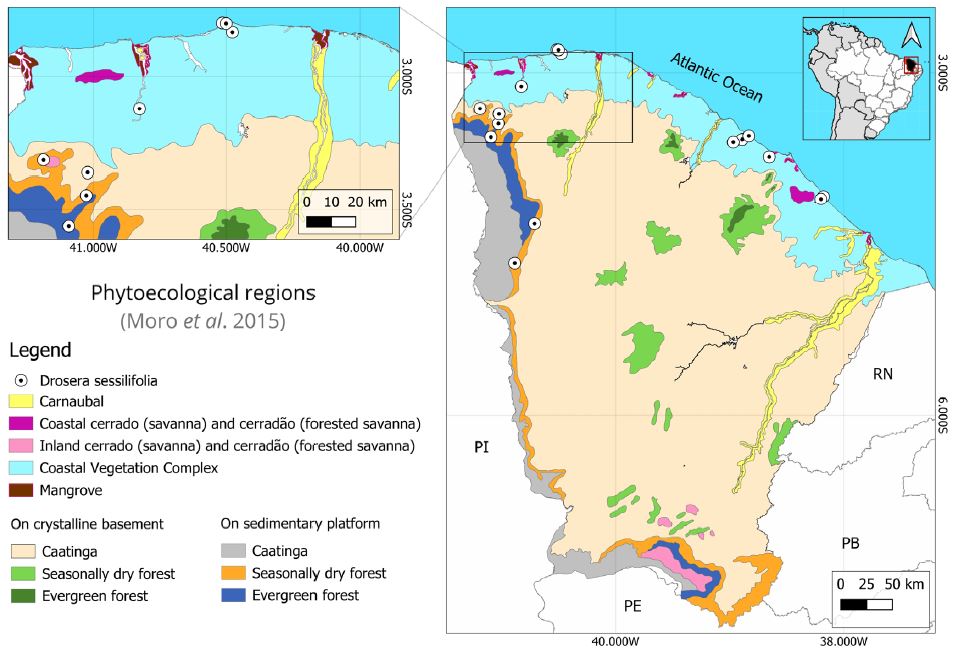
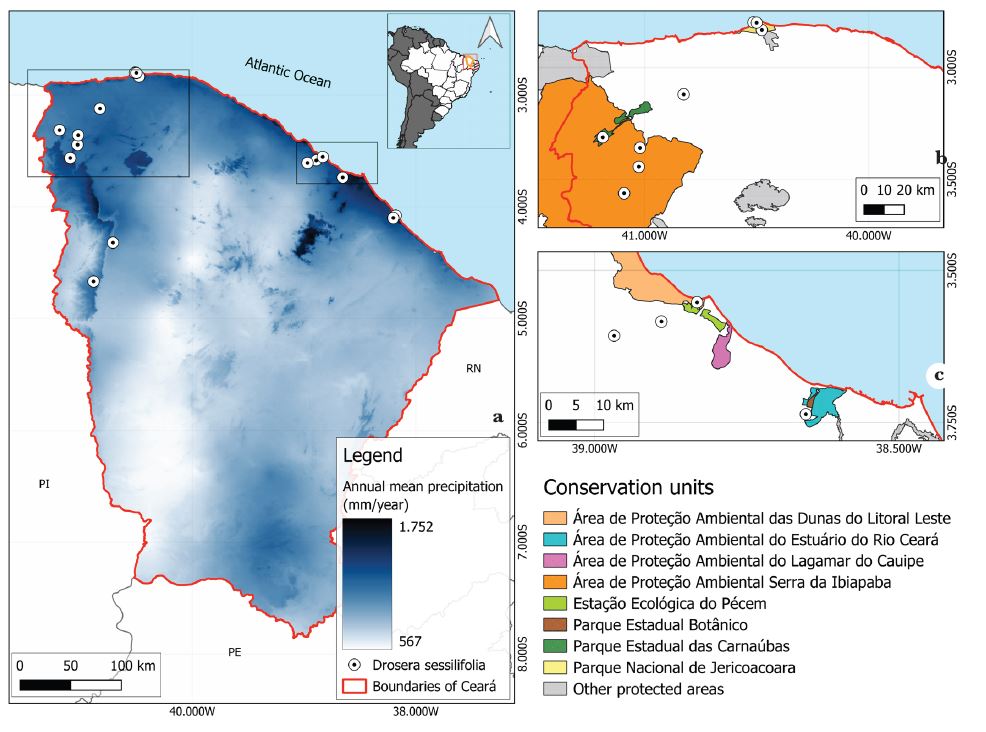
The geographic distribution of the population was mapped using geographic coordinates obtained from herbarium collection data available on SpeciesLink platform (CRIA 2025) and observations from the iNaturalist platform (iNaturalist 2025). The distribution of the species across different phytoecological regions (Fig. 1) followed the classification defined by Moro et al. (2015) for the state of Ceará. The precipitation map (Fig. 2a) was created using annual mean precipitation data from the WorldClim 2 database (Fick & Hijmans 2017). The figures were generated in QGIS version 3.36.6 (QGIS Development Team 2025).

Distribution of Drosera sessilifolia in the state of Ceará. Observations from the iNaturalist platform (2020-2024, updated in May 2025) and herbarium records.
a-c. Occurrence of Drosera sessilifolia in relation to precipitation and Conservation Units in Ceará - a. map showing the annual mean precipitation (mm) in the state of Ceará, based on WorldClim data from 1970 to 2000; b-c. detail of the region highlighting the Conservation Units.
Results and Discussion
In the state of Ceará, Drosera sessilifolia A.St.-Hil. is the only recorded species. Although some previously collected specimens had been identified as Drosera montana A.St.-Hil., this was due to misidentification. This error, as noted by Rivadavia et al. (2014), can be attributed to the morphological complexity of the genus Drosera and the long history of taxonomic synonyms.
Drosera sessilifolia is found in South America, specifically in Brazil, Guyana, Venezuela, Colombia, and Bolivia (Gonella et al. 2022). In Brazil, it occurs in all regions except the South, being found in the North (Amazonas, Pará, Roraima, and Tocantins), Northeast (Alagoas, Bahia, Ceará, Maranhão, Paraíba, Pernambuco, Piauí, Rio Grande do Norte, and Sergipe), Central-West (Goiás, Mato Grosso, and Mato Grosso do Sul), and Southeast (Minas Gerais) (Gonella 2025).
Taxonomic treatment
1. Drosera sessilifolia A.St.-Hil., Hist. Pl. Remarq. Bresil 259. t. 25. 1826. Figs. 1; 2a-c; 3a-i
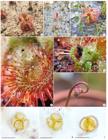
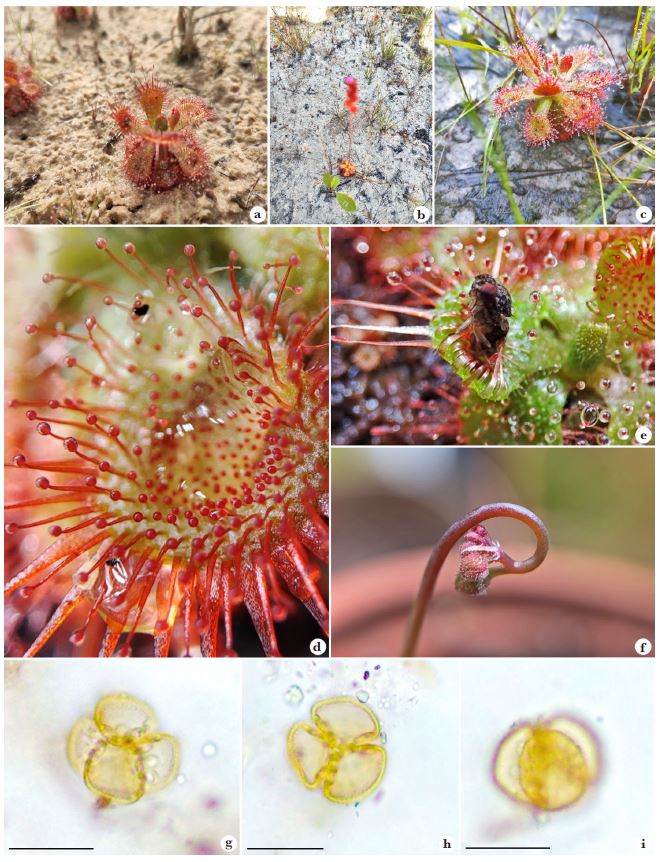
a-i. Drosera sessilifolia - a-c. habitat in sandy soil with water availability; d. close-up of the leaf apex with tentacles; e. fly captured by the trap; f. peduncle with a developing inflorescence; g. pollen in tetrad form, polar view; h. pollen in tetrad form, equatorial view; i. pollen in tetrad form, lateral view. (a-c. O. Monteiro; d-e. J.M.). Scale bars = 50 µm.
Terrestrial herbs, 7.9-22.5 cm long flowering, annual. Stems short, 0.47-2.12 cm long. Leaves simple 8.1-21.38 × 3.3-9.9 mm, spatulate, apex rounded, base attenuate, green; abaxial surface with glandular trichomes; adaxial surface with several red tentacles on the apical region, 0.7-4.5 mm long; entire-involute vernation; petiolate; stipules rectangular. Inflorescence a scorpioid cyme, simple with 2-12 actinomorphic flowers; peduncle 5.9-16.6 cm long, 1-4 per plant, glabrous; rachis glabrous; pedicels ca. 0.4 mm long, glabrous; bracts ca. 1.9 mm, linear, pilose. Sepals 5, oblong, 2.5-4.8 mm long, united at the base, glandular-pilose; petals 5, 4-5.2 mm long, obovate, pink. Stamens 5, ca. 2.5 mm long, filaments ca. 2 mm long; anthers ca. 0.5 cm long, with longitudinal dehiscence. Pollen yellow, tetrad, heteropolar, triporate, triangular, suboblate, with baculate exine ornamentation, ca. 70 × 70 μm, polar and equatorial diameters, respectively. Ovary superior, subglobose, glabrous, 5-carpellate; styles 5, undivided; stigma 5, papillose. Fruits 5-valvar, globose; seeds ellipsoid with reticulate testa.
Examined material: Caucaia, 4 km. north of Soure (Caucaia), 03º44’10’’S, 38º39’11’’W, VII.1945, fr., H.C. Cutler 8388 (MO, NY). Granja, Serra das Flores, 03º07’13’’S, 40º49’34’’W, 26.VIII.1977, fr., A. Fernandes 3468 (EAC); Serra de Ubatuba, descida para a mata ombrófila em direção à Pirapora, margem do riacho, 03º07’30’’S, 41º11’15’’W, 28.IV.2012, E.B. Souza 2537 (EAC); distrito de Santa Terezinha, localidade de São Miguel, Cachoeira de São Miguel, 03º12’48’’S, 41º00’42’’W, 3.VI.2016, fr., E.B. Souza 4160 (HUEFS). Ipu, Várzea do Jiló, 04º32’22’’S, 40º71’08’’W, 19.VI.2022, fr., N.C. Rebouças 136 (EAC). Ipueiras, Serra da Ibiapaba, 04º40’00’’S, 40º53’00’’W, 21.IX.1979, fr., C.A. Miranda 325 (ASE, MBM). Jijoca de Jericoacoara, Parque Nacional de Jericoacoara, próximo à Lagoa da Tatajuba, 02º83’88’’S, 40º52’66’’W, 22.VIII.2024, fr., S.T. Rabelo 421 (EAC). São Gonçalo do Amarante, Parada, próximo ao Jardim Botânico de São Gonçalo, substrato arenoso, 03º36’26’’S, 38º58’06’’W, 4.IX.2011, fr., A.S.F. Castro 2545 (EAC). Viçosa do Ceará, Serra das Flores, 03º56’22’’S, 41º09’22’’W, 3.VIII.2005, fr., L.W. Lima-Verde (EAC 50601). 1859, fr., F. Freire Allemão & M. Cysneiros 68 (R).
Drosera sessilifolia is the only American representative of Drosera sect. Thelocalyx, which also includes Drosera burmanni Vahl, a species restricted to Asia and Oceania, and both are mainly characterized by a 5-carpellate gynoecium (Planchon 1848). In addition to their morphological similarities, these two species form a sister group, as supported by phylogenetic analyses (Rivadavia et al. 2003).
In Brazil, D. sessilifolia can be distinguished from other species of the genus primarily by its key taxonomic features: a pentamerous gynoecium with five undivided styles that are free at the tips, and leaves with entirely involute vernation. In contrast, all other species in the country have a trimerous gynoecium with three bifurcated styles at the base, resulting in six stigmatic tips, and exhibit different patterns of leaf vernation (Gonella et al. 2022).
In Ceará, Drosera sessilifolia is found in the Coastal Vegetation Complex, with records in the municipalities of Jijoca de Jericoacoara, Granja, São Gonçalo do Amarante, Caucaia, and Cascavel (Fig. 1). These Drosera populations are typically found in sandy soils near bodies of water, such as temporary lagoons. Further inland, the species has been recorded in Granja, Viçosa do Ceará, Ipu, and Ipueiras. In Granja, it occurs within a savanna (Cerrado) enclave, near waterfalls and streams on sandy-clayey to rocky soils with quartzite outcrops, especially in the Serra de Ubatuba and Serra das Flores. On the Ibiapaba Plateau, which lies on a sedimentary platform, it is found in distinct environments within Viçosa do Ceará, including evergreen forest and seasonally dry forest. Further south, it also occurs in the seasonally dry forests of Ipu and Ipueiras.
The species primarily occurs in well-lit, humid, and seasonally wet environments, typically in areas with open vegetation (Gonella et al. 2022). In Ceará, populations of Drosera are distributed along the coast from west to east and extend inland to the Ibiapaba Plateau. These regions receive higher mean annual precipitation than the rest of the state (Fig. 2a), mainly due to the influence of humid Atlantic air masses, sea breezes, and orographic effects associated with the Ibiapaba Plateau and coastal topography (Uvo & Berndtsson 1996). The combination of this greater rainfall, the prevalence for sandy soils, and proximity to bodies of water or wetlands creates favorable conditions for the species’ establishment and persistence in the state.
The flowering period of D. sessilifolia extends over several months, with herbarium specimens documenting flowering between June and September. In Ceará, the rainy season typically occurs from January to May (Silva et al. 2023), however, the collection of flowering specimens during the dry season suggests that the species primarily blooms during this period.
Regarding its conservation status, D. sessilifolia is not currently listed on the IUCN Red List of Threatened Species (IUCN, 2025); however, Gonella et al. (2022) suggest its classification as Least Concern (LC). In Ceará, the species occurs within the Área de Proteção Ambiental Serra da Ibiapaba, Parque Estadual das Carnaúbas, and Parque Nacional de Jericoacoara (Fig. 2b). On the eastern coast, records of D. sessilifolia are found near conservation units (Fig. 2c), suggesting that populations may also be present within these protected areas.
When suitable conditions for the establishment and persistence of Drosera populations are present, D. sessilifolia may have a broader distribution along the Ceará coastline than currently documented, as the region remains insufficiently surveyed, with few records, collections, or observations of the species. However, carnivorous plants face growing threats from various human activities, including habitat loss due to urban expansion and agriculture, illegal collection, pollution, the spread of invasive species, and climate change (Cross et al. 2020; Jennings & Rohr 2011). These factors severely impact specialized species that struggle to adapt to changing environmental conditions (Cross et al. 2020).
Given that most populations of D. sessilifolia occur primarily along the coast, the expansion of urban and industrial complexes, along with the resulting pollution, poses a major threat to their habitats. These environmental changes not only endanger Drosera populations but also contribute to broader biodiversity loss and shifts in plant communities, favoring species tolerant of disturbance (Ruas et al. 2022). Conservation measures are therefore crucial to ensure the protection of the unique coastal flora found in Ceará.
Acknowledgements
The authors sincerely thank all contributors to the iNaturalist platform, whose efforts are essential in advancing the understanding of species distribution. We also extend our gratitude to the Prisco Bezerra Herbarium (EAC) for generously providing the materials used in the morphological analyses conducted in this study. Additionally, we thank Carlos Eduardo de Carvalho for his assistance in creating the distribution maps.
Data availability statement
In accordance with Open Science communication practices, the authors inform that all data are available within the manuscript.
References
- Andrade-Lima D & Lima AMB (1968) Droseraceae. In: Flora de Pernambuco - Angiospermae II. Anais da Sociedade Botânica do Brasil, XIX Congresso Nacional de Botânica 49, Fortaleza. 1968. 293p.
- APG IV - Angiosperm Phylogeny Group (2016) An update of the Angiosperm Phylogeny Group classification for the orders and families of flowering plants: APG IV. Botanical Journal of the Linnean Society 181: 1-20.
-
Asirvatham R, Christina AJM & Murali A (2013) In vitro antioxidant and anticancer activity studies on Drosera Indica L. (Droseraceae). Advanced Pharmaceutical Bulletin 3: 115-120. DOI: 10.5681/apb.2013.019
» https://doi.org/10.5681/apb.2013.019 - Carregosa T, Menezes AB & Farinaccio MA (2015) Droseraceae. In: Prata APN, Farias MCV & Landim MF (eds.) Flora de Sergipe. Vol. 2. Editora Criação, Aracaju. Pp. 178-181.
-
CRIA - Centro de Referência e Informação Ambiental (2025) Specieslink - simple search. Available at <https://specieslink.net/>. Access on 7 May 2025.
» https://specieslink.net/ -
Cross AT, Krueger TA, Gonella PM, Robinson AS & Fleischmann AS (2020) Conservation of carnivorous plants in the age of extinction. Global Ecology and Conservation 24: eo1272. DOI: 10.1016/j.gecco.2020.e01272
» https://doi.org/10.1016/j.gecco.2020.e01272 - Eichler AW (1872) Droseraceae. In: Martius CFP von, Eichler AW & Urban I (eds.) Flora brasiliensis Fleischer, Leipzig. Vol. 14, pars 2, pp 385-398, t.90-91.
- Erdtman G (1960) The Acetolysis Method - a revised description. Svensk Botanisk Tidskrift 54: 561-564.
-
Fick SE & Hijmans RJ (2017) WorldClim 2: new 1 km spatial resolution climate surfaces for global land areas. International Journal of Climatology 37: 4302-4315. DOI: 10.1002/joc.5086
» https://doi.org/10.1002/joc.5086 - Fleischmann A, Cross AT, Gibson R, Gonella PM & Dixon KW (2018) Systematics and evolution of Droseraceae. In: Ellison A & Adamec L (eds.) Carnivorous plants: physiology, ecology and evolution. Oxford University Press, Oxford. Pp. 45-57. DOI: 9780198779841.001.0001
-
Ghate NB, Chaudhuri D, Das A, Panja S & Mandal N (2015) An antioxidant extract of the insectivorous plant Drosera burmannii Vahl. alleviates iron-induced oxidative stress and hepatic injury in mice. PLoS ONE 10: e0128221. DOI: 10.1371/journal.pone.0128221
» https://doi.org/10.1371/journal.pone.0128221 -
Gonella PM (2025) Droseraceae in Flora e Funga do Brasil 2025 (continuously updated). Jardim Botânico do Rio de Janeiro. Available at <https://floradobrasil.jbrj.gov.br/FB7420>. Access on 8 September 2024.
» https://floradobrasil.jbrj.gov.br/FB7420 -
Gonella PM, Sano PT, Rivadavia F & Fleischmann A (2022) A synopsis of the genus Drosera (Droseraceae) in Brazil. Phytotaxa 553: 001-076. DOI: 10.11646/phytotaxa.553.1.1
» https://doi.org/10.11646/phytotaxa.553.1.1 -
Guarçoni EAE, Gonella PM, Ferreira AWC & Sousa JDS (2025) Flora of Maranhão, Northeastern Brazil: Droseraceae. Revista Brasileira de Geografia Física 18: 3255-3268. DOI: 10.26848/rbgf.v18.4.p3255-3268
» https://doi.org/10.26848/rbgf.v18.4.p3255-3268 -
Guedes FM & Matias LQ (2020) Flora do Ceará, Brasil: Lentibulariaceae. Rodriguésia 70: e01892018. DOI: 10.1590/2175-7860202071140
» https://doi.org/10.1590/2175-7860202071140 - Huber J (1908) Plantas do Ceará: lista de plantas vasculares colhidas no estado do Ceará (Brasil) nos meses de setembro e outubro de 1897. Revista do Instituto do Ceará 22: 164-192.
-
iNaturalist (2025) A Community for Naturalists · iNaturalist. Available at <https://www.inaturalist.org/observations?place_id=13329&taxon_id=566566>. Access on 13 March 2025.
» https://www.inaturalist.org/observations?place_id=13329&taxon_id=566566 -
IPECE (2024) Ceará em números 2023. Instituto de Pesquisa e Estratégia Econômica do Ceará, Fortaleza. Available at <http://www2.ipece.ce.gov.br/publicacoes/ceara_em_numeros/2023/>. Access on 20 March 2025.
» http://www2.ipece.ce.gov.br/publicacoes/ceara_em_numeros/2023/ -
IPNI (2024) The International Plant Names Index. Available at <https://www.ipni.org/>. Access on 13 November 2024.
» https://www.ipni.org/ -
IUCN (2025) The IUCN red list of threatened species. Version 2022-2. Available at <https://www.iucnredlist.org>. Access on 13 March 2025.
» https://www.iucnredlist.org -
Jennings DE & Rohr JR (2011) A review of the conservation threats to carnivorous plants. Biological Conservation 144: 1356-1363. DOI: 10.1016/j.biocon.2011.03.013
» https://doi.org/10.1016/j.biocon.2011.03.013 - Kaiser E (1880) Verfahren zur herstellung einer tadellosen glyceringelatine. Botanisches Zentralblatt 180: 25-26.
-
Kuprianova LA (1973) Pollen Morphology within the Genus Drosera Grana 13: 103-107. DOI: 10.1080/00173137309429884
» https://doi.org/10.1080/00173137309429884 -
Moro MF, Macedo MB, Moura-Fé MM, Castro ASF & Costa RC (2015) Vegetação, unidades fitoecológicas e diversidade paisagística do estado do Ceará. Rodriguésia 66: 717-743. DOI: 10.1590/2175-7860201566305
» https://doi.org/10.1590/2175-7860201566305 -
Nepomuceno IV, Souza EB, Zappi DC, Moreira MC, Nepomuceno FAA & Moro MF (2021) Savannas of the Brazilian semiarid region: what do we learn from floristics? Acta Botanica Brasilica 35: 361-380. DOI: 10.1590/0102-33062020abb0259
» https://doi.org/10.1590/0102-33062020abb0259 -
Oliveira RR, Silva GS, Santos-Silva DL, Martins PRP & Conceição GM (2018) Primeiro registro da planta carnívora Drosera sessilifolia A. St.-Hil. (Droseraceae) no Parque Nacional Chapada das Mesas, Maranhão, Brasil. Biota Amazônia 8: 60-62. DOI: 10.18561/2179-5746/biotaamazonia.v8n2p60-62
» https://doi.org/10.18561/2179-5746/biotaamazonia.v8n2p60-62 - Planchon JE (1848) Sur la famille des Droseracées. Annales des Sciences Naturelles; Botanique 3: 79-98.
-
QGIS Development Team (2025) QGIS Geographic Information System. Ver. 3.36.6. Open Source Geospatial Foundation Project. Available at <https://www.qgis.org/>. Access on 18 November 2024.
» https://www.qgis.org/ -
Rivadavia F, Gonella PM, Sano PT & Fleischmann A (2014) Elucidating the controversial Drosera montana complex (Droseraceae): a taxonomic revision. Phytotaxa 172: 141-175. DOI: https://doi.org/10.11646/phytotaxa.172.3.1
» https://doi.org/10.11646/phytotaxa.172.3.1 -
Rivadavia F, Kondo K, Kato M & Hasebe M (2003) Phylogeny of the sundews, Drosera (Droseraceae), based on chloroplast rbcL and nuclear 18S ribosomal DNA sequences. American Journal of Botany 90: 123-130. <https://doi.org/10.3732/ajb.90.1.123>.
» https://doi.org/10.3732/ajb.90.1.123 -
Ruas RB, Costa LMS & Bered F (2022) Urbanization driving changes in plant species and communities - a global view. Global Ecology and Conservation 38: e02243. DOI: 10.1016/j.gecco.2022.e02243
» https://doi.org/10.1016/j.gecco.2022.e02243 - Saint-Hilaire AFCP (1824) Plantes usuelles des Brasiliens Vol. 3. Grimbert, Paris. Pp. XV, 1-5.
- Saint-Hilaire AFCP (1826) Histoire des plantes les plus remarquables du Brésil et du Paraguay: comprenant leur description, et des dissertations sur leurs rapports, leurs usages, etc., avec des planches, en partie coloriées. Tome 1. A. Belin, Paris. Pp. 253-271.
-
Silva MDPB, Alcócer JCA, Silva ML, Sandi NPM, Alfaro E, Hidalgo H, Pessoa PRS & Pinto ORO (2023) Climate variability of precipitation in Ceará region, Northeast of Brazil. Brazilian Journal of Climatology 33: 491-512. DOI: 10.55761/abclima.v33i19.17154
» https://doi.org/10.55761/abclima.v33i19.17154 - Silva TRS (2007) Flora da Bahia - Droseraceae Salisb. Sitientibus série Ciências Biológicas 7: 393-397.
- Silva TRS & Giulietti AM (1997) Levantamento das Droseraceae do Brasil. Boletim de Botânica da Universidade de São Paulo 16: 75-105.
-
Thiers B (continuously updated) Index Herbariorum: a global directory of public herbaria and associated staff. New York Botanical Garden’s Virtual Herbarium. Available at <http://sweetgum.nybg.org/science/ih/>. Access on 2 January 2025.
» http://sweetgum.nybg.org/science/ih/ -
Uvo C & Berndtsson R (1996) Regionalization and spatial properties of Ceará state rainfall in northeast Brazil. Journal of Geophysical Research: Atmospheres 1: 4221 - 4233. DOI: 10.1029/95JD03235
» https://doi.org/10.1029/95JD03235