 Flora of Ceará state, Brazil Distimake (Convolvulaceae)
Abstract
We present a floristic study of Distimake in the state of Ceará, as part of the project “Flora of Ceará: Knowing to conserve”. The study was based on morphological analysis of specimens deposited in herbaria collection or obtained in the field. Specialized bibliography, typus collections available on-lin were consultede. We found five species of the genus occurring in Ceará: D. aegyptius, D. cissoides, D. digitatus, D. macrocalyx and D. ternifoliolus. Three of them occur in protected areas. The species were recorded mainly in the vegetation complex of the coastal zone, semidecidous seasonal forest, steppic savanna and savanna. We present an identification key, morphological descriptions, geographic distribution, taxonomic and ecological comments, flowering and fruiting period, besides illustrations of the diagnostic characters.
Key words:
Brazilian flora; climbing plants; conservation; floristic; Solanales
Resumo
Apresentamos o estudo florístico de Distimake no estado do Ceará, como parte do projeto “Flora do Ceará: conhecer para conservar”. O estudo foi baseado na análise morfológica de espécimes depositados em herbários e obtidos em expedições de campo. Foram consultadas bibliografias especializadas e coleções tipos disponíveis em plataformas on-line. Foram registradas cinco espécies na área de estudo: D. aegyptius, D. cissoides, D. digitatus, D. macrocalyx and D. ternifoliolus. Dentre essas, três ocorrem em áreas protegidas. As espécies foram registradas principalmente no Complexo Vegetacional da Zona Costeira, Floresta Estacional Semidecidual, Savana Estépica e Savana. Apresentamos chave de identificação, descrições morfológicas, distribuição geográfica, comentários taxonômicos e ecológicos, período de floração e frutificação, e ilustrações de caracteres diagnósticos.
Palavras-chave:
Flora do Brasil; plantas trepadeiras; conservação; florística; Solanales
Introduction
Distimake Raf. comprises about 46 species widespread in tropical America and tropical Africa with disjunct species in Asia and northern Australia (Simões & Staples 2017). In Brazil, 18 species are found (nine endemic), with representatives distributed in all regions and phytogeographic domains, in forest edges, grassland formations and in anthropized areas (Petrongari & Simões 2024). The highest species richness for this genus is found in the Cerrado, with 14 species. In the Northeast region, 11 species of the genus are recorded, representing 61% of species recorded in Brazil (Petrongari & Simões 2024).
Distimake is characterized by having herbaceous climbers, rarely lianas or erect subshrubs; calyx mostly with flat sepals (not convex) appressed to the base of corolla tube, accrescent in fruit, corolla entirely glabrous, anthers spirally dehiscing, pollen trizonocolpate (12-zonocolpate in D. tuberosus e D. quinatus), fruit usually a four-valved capsule, calyx greatly accrescent in fruit and seeds glabrous (Simões & Staples 2017).
Distimake is the name adopted for American species previously circumscribed under Merremia (Simões & Staples 2017). In many herbaria, the collections of this genus have not yet been updated, and it is important to highlight that the American specimens identified as Merremia belong to Distimake or to Camonea Raf.
Some species of this genus have been explored for various uses. Certain species are notable for their ornamental value (Souza & Lorenzi 2012), while others possess medicinal and culinary potential, such as Distimake dissectus (Jacq.) Simões & Staples (Austin 2007). Conversely, some species, like D. aegyptius (L.) A.R. Simões & Staples, are considered invasive in agricultural settings (Kissmann & Groth 2000; Souza & Lorenzi 2012).
In Brazil, Distimake has been studied in regional floristic surveys, such as Ferreira & Miotto (2013) who cited 13 species for the Southern region of the country, and in local floras that addresses the diversity of Convolvulaceae, especially in northeastern Brazil (Buril & Alves 2011; Buril et al. 2013; Delgado-Junior et al. 2014; Nepomuceno et al. 2016). Among the Distimake studies in the Northeast region, we can mention those carried out in the states of Bahia (Leite 2001) and Pernambuco (Belo et al. 2020). In Ceará state, Distimake species were cited in studies that address the diversity of Convolvulaceae (Santos et al. 2020, 2021). However, a taxonomic study focused on Distimake for Ceará has not yet been carried out.
Therefore, the present study, part of the “Flora do Ceará: to know to conserve” Project, aims to present the floristic-taxonomic study of Distimake, promoting knowledge about its diversity and distribution in the flora of Ceará. Furthermore, the present study provides data to aid in the recognition of Distimake species.
Material and Methods
Study area
The state of Ceará is situated in northeastern Brazil, covering an area of 148,886.3 km2, which accounts for 1.75% of the country’s total territory (IPECE 2013). It is composed of 184 municipalities, of which 93% are located in the northeastern semi-arid region, characterized by irregular rainfall, with an average of 3-4 months of rain per year (IPECE 2013). The predominant climate is Tropical Hot Semi-arid, with an annual average temperature variation between 24 and 26 ºC and an annual average precipitation that does not exceed 1.000 mm (Nimer 1972; Lima et al. 2000).
This study was based on the comparative analysis of the morphological vegetative and reproductive structures of specimens collected in the field - January/2018 to August/2022 - and specimens deposited in the ALCB, CEN, EAC, HCDAL, HST (Herbarium Sergio Tavares), HDELTA, HRSN, HUEFS, HUVA, HVASF, IPA, MBM, MOSS, P, PEUFR, SPF, SP, and UEC herbaria (acronyms according to Thiers, continuously updated). Specialized literature (O’Donell 1941; Ferreira & Miotto 2013; Simões & Staples 2017), protologues, images of samples and type collections available on online platforms were also consulted (JSTOR 2023; CRIA 2023; Petrongari & Simões 2024).
The samples were processed according to the usual taxonomy techniques (Mori et al. 1989) and incorporated into the HUVA herbaria, with duplicates sent to the EAC and HUEFS herbaria. Identifications were made based on specialized bibliography (O’Donell 1941; Simões & Staples 2017) and comparison with images of standard collections available on online database (JSTOR 2023). The binomials are according to the IPNI (2024). The morphological descriptions were standardized according to Harris & Harris (2001). Data regarding the type of habit, flowering and fruiting period were obtained from exsiccate labels and/or from the field observations. The description of the genus was based on the species from the study area.
Data on global and Brazilian geographic distribution were obtained from specialized literature (O’Donell 1941) and from the Flora e Funga do Brazil website (Petrongari & Simões 2024), respectively. Distribution maps were prepared using QGIS software, version 2.18.28 (Development Team 2023), based mainly on the records with original geographic coordinates. For records lacking associated collection site coordinates, the coordinates of another species collected at the same location were used via the geoLoc tool (CRIA 2023). The terminology for vegetation types was based on Moro et al. (2015) adapted to Figueiredo (1997) and the Technical Manual of Brazilian Vegetation (IBGE 2012): vegetation complex of the coastal zone, semideciduous seasonal forest, dense ombrophilous forest, stepic savanna, savanna, forest savanna and vegetation under fluvial and/or lacustrine influence.
Results and Discussion
In Ceará state, Distimake is represented by five species: D. aegyptius, D. cissoides (Lam.) A.R. Simões & Staples, D. digitatus (Spreng.) A.R. Simões & Staples, D. macrocalyx (Ruiz & Pav.) A.R. Simões & Staples, and D. ternifoliolus (Pittier) A.R. Simões & Staples. Of these D. aegyptius and D. macrocalyx are widely distributed in Ceará state. Among the phytoecological units in Ceará, Floresta Seasonal Semidecidual and the Savana Stepic present the highest species diversity for Distimake (three), representing 60% of the total species in the state (Tab. 1). Distimake ternifoliolus was registered recently in the Brazil where it is restricted in the Ceará state in Dense Ombrophilous Forest (Rodrigues et al. 2024).
Distribution of Distimake species in the phytoecological units of Ceará. Abbreviation: VCZ = Vegetation Complex of the Coastal Zone; SSF = Semideciduous Seasonal Forest; DOF = Dense Ombrophilous Forest; SSA = Stepic Savanna; SAV = Savanna; FSV = Forest Savanna; VFL = Vegetation under Fluvial and/or Lacustrine Influence.
The morphological characters used to distinguish the Distimake species are: number of leaflets, leaflet margin shape, type of leaf trichomes and capsule shape. Three species were registered in Protected Area: Ceará Botanical Park (Distimake cissoides), National Forest of Araripe-Apodi (D. aegyptius and D. macrocalyx) and Serra das Almas Private Natural Heritage Reserve - RPPN in Portuguese (D. aegyptius).
Taxonomic treatment
Distimake Raf. Fl. Tellur 4: 82. 1838.
Climbing plants, stems and branches tomentose, pilose, hispid, trichomes simple and glandular. Leaves palmatilobed or with 3-5-leaflets, elliptical, linear, oblanceolate, lanceolate, base cuneate, atenuate, apex acute, acuminate or mucronate, margin entire or serrate, hirsute, pilose to glabrescent or glabrous on both surfaces, discolorous, flat, papyraceous. Dichasial or monochasial cyme; bracteoles triangular and lanceolate, linear, glabrous, tomentose, hispid. Calyx with oblong, lanceolate, ovate, glabrous, hirsute, pilose sepals. Corolla funnel-shaped, lobed, entire, plicate area glabrous, cream or white with the tube vinaceous, white or yellow; filaments filiform, oblong anthers and spirally dehiscent; pollen trizonocolpate (12-zonocolpate in D. tuberosus and D. quinatus) ovoid and glabrous ovary; 1 style, biglobose stigmas. Capsule ovoid to cuboid, glabrous, persistent sepals in fruit; 3-4 seeds blackish or brown, pubescent to glabrescent, glabrous.
Identification key for Distimake species occurring in Ceará state
1. Leaf blade with stellate trichomes...............3. Distimake digitatus
1’. Leaf blade with simple trichomes or glabrous................................2
2. Leaf 3-foliolate...............................5. Distimake ternifoliolus
2’. Leaf 5-foliolate.......................................................................3
3. Leaflet with margins serrate and with glandular trichomes..................................................2. Distimake cissoides
3’. Leaflet with margins entire and glandular trichomes absent................................................................................4
4. Branches and leaves glabrous; capsule cuboid.......4. Distimake macrocalyx
4’. Branches and leaves hispid; capsule ovoid 1. Distimake aegyptius
1. Distimake aegyptius (L.) A.R.Simões & Staples, Bot. J. Linn. Soc. 183(4): 573. 2017.
≡ Merremia aegyptia (L.) Urb. Symb. Antill. 4(3): 505. 1911.
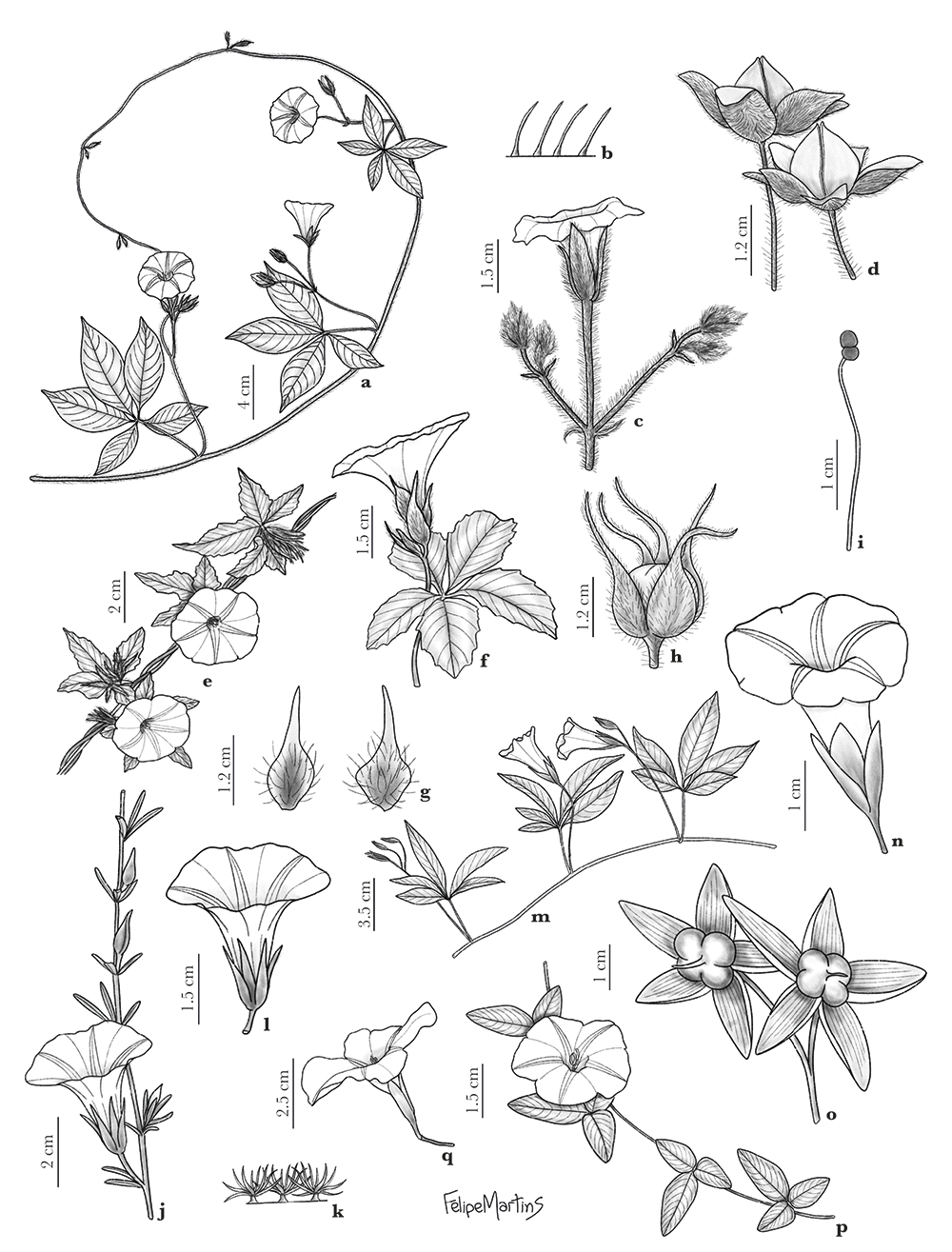
≡ Ipomoea aegyptia L. Sp. Pl. 162. 1753. Fig. 1a-d
a-d. Distimake aegyptius - a. fertile branch; b. simple trichome; c. flowers in dichasium with funnel-shaped corolla; d. fruit. e-i. D. cissoides - e. fertile branch; f. leaf margin serrate; g. pilose and lanceolate sepals; h. fruit; i. style with biglobose stigma. j-l. D. digitatus - j. fertile branch; k. stellate trichome; l. calyx and funnel-shaped corolla. m-o. D. macrocalyx - m. fertile branch; n. calyx and funnel-shaped corolla; o. cuboid capsule. p-q. D. ternifoliolus - p. fertile branch; q. calyx and funnel-shaped corolla. (a-d. F.J. Chamorro 435; e-i. H.P. Nascimento 20; j-l. F. Allemão & Cysneiro 1067; m-p. F.D. Santos 160; L.S. Rodrigues 200). Drawn by Felipe Martins.
Stem and branches hispid, simple trichomes, golden when dry; internodes 13-22 cm long. Leaves 4-5-foliolate, leaflet 3-11 × 2-9 cm, elliptical, cuneate base, acute to acuminate apex, entire margin, hirsute with trichomes simples on both surface; petiole 4.5-11 cm long, hispid. Flowers in dichasium, 3 to 12 multi-flowers; peduncle 4-13 cm long, hispid; pedicel 1-3 cm long, hispid; bracteole ca. 2 × 1 mm, linear, hispid. Outer sepals 1-1.2 × 0.4 cm, ovate to oblong-lanceolate, rounded base, acuminate apex, hispid; inner sepals ca. 7 × 0.4 mm, ovate, rounded base, acute apex, glabrous. Corolla 2-3.5 cm long, totally white. Capsule ca. 1.4 × 1 cm, ovoid. Seeds ca. 4 × 4 mm, brown, glabrous.
Material examined: Aiuaba, 4.VI.1997, fl., E.O. Barros 48 (SP). Baturité, 26.VI.1908, fl., A. Ducke 1186 (PEUFR). Brejo Santo, Lagoa do Mato, margem da BR-116, 27.IV.2009, fl., J.R. Maciel 1006 (HVASF); 12.V.2009, fl., M. Oliveira 4082 (HVASF). Boa Vista, Jardim, 11.VI.1996, fl., M.A.P. Silva (EAC 24112). Canindé, BR-020, 11.IV.1998, fl. and fr., E.B. Souza (EAC 26401). Caucaia, Praia de Tabuba, Setor 2, 6.IV.2019, fl., V.S. Sampaio & G.F. Mendes 745 (EAC). Crato, Floresta Nacional do Araripe, 23.V.1999, fl., A.M. Miranda & D. Lima 3349 (HST). Crateús, Grajaú, Serra das Almas, 10.VII.2004, fl., K.M.E. Linhares 08 (EAC); Centro Ecológico RPPN Serra das Almas, 9.V.2017, fl., H.M. Meneses 190 (EAC). Fortaleza, Campus do Itaperi da Universidade Estadual do Ceará, 8.VIII.2018, fl. and fr., V.S. Sampaio et al. 337 (EAC). General Sampaio, Faz. Natália, 27.V.2007, fl., M.F. Moro et al. 205 (EAC). Graça, Sítio Santa Clara, 30.V.2016, fl., F.F. Araújo 35 (HDELTA). Independência, Escola Família Agrícola Dom Fragoso, 7.V.2014, fl., A.C. Cavalcante 175 (CEN). Itaiçaba, 30.V.1987, fl., A. Fernandes & A. Nunes (EAC 15274). Itapagé, 13.VI.1979, fl., L. Coradin 1915 (SP). Jati, Riacho Jardim, ASV do canal que liga o Reservatório Jati ao Reservatório Atalho, 10.IV.2013, fl., D.G. Oliveira 998 (HVASF); VPR Ipê, 30.X.2014, fl. and fr., A.P. Fontana & J.R. Silva 8743 (HRSN). Limoeiro do Norte, Chapada do Apodi, área de cultivo, 20.V.2008, fl. and fr., L.W. Lima-Verde 3461 (ALCB). Milagres, Taboca, 1.VII.2013, fl. and fr., A.C.P. Oliveira 2695 (HVASF). Orós, Cinco Barras, 9.VII.1984, fl., F.C.F. Silva 203 (ALCB). Parambu, 22.V.1982, fl. and fr., E. Nunes (SPF 76863). Quixadá, Monumento natural dos monólitos, 4.IX.2017, fl., E.D. Lozano et al. 3777 (MBM). Quixeramobim, Assentamento Vista Alegre, 22.III.2014, fl. and fr., L.B. Oliveira 158 (CEN). Quixeré, Chapada do Apodi, Manga do Cedro, Fazenda Mato Alto, 17.VI.1997, fl., L.W. Lima-Verde 818 (MOSS). Santa Quitéria, 29.IV.2012, fl. and fr., J. Paula-Souza et al. 11127 (EAC). São Gonçalo do Amarante, 8.VIII.1989, fl., I.R.S. Costa 224 (CEN). São Benedito, Sítio Penha, 6.VII.2010, fl. and fr., E.M. Marreira & E.B. Souza 101 (EAC). Sobral, Fazenda Crioula, 1.I.2013, fl., M. Mikael 08 (CEN). Tianguá, Queimadas, 19.V.2017, fl. and fr., E.B. Souza et al. 4583 (EAC). Tururu, Triângulo da estrada para Uruburetama, 8.IX.2013, fl. and fr., M.I.B. Loiola et al. 2135 (EAC).
This species can be identified by its hirsute leaves, golden when dried, and ovoid capsules. It is similar to D. digitatus in having an ovoid capsule but differs by its branches and leaf blades with simple trichomes (vc. stellate trichomes).
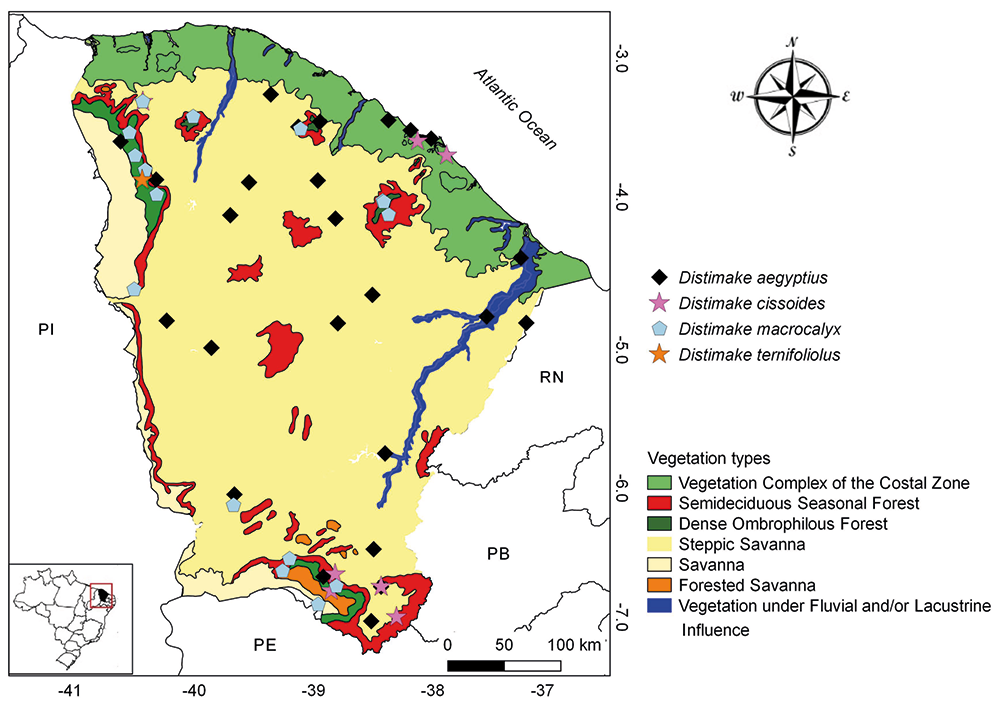
Distimake aegyptius is widely distributed in Central and South America (O’Donell 1941). In Brazil, it is found in nearly all regions, except the South, within the phytogeographic domains of Caatinga, Cerrado, and Atlantic Forest (Petrongari & Simões 2024). In Ceará, this species is recorded in the Vegetation Complex of the Coastal Zone, Savanna Stepic, Savanna, Semideciduous Seasonal Forest and Vegetation under Fluvial and/or Lake Influence, being widely distributed in the Savanna Stepic (Fig. 2). It is often found in environments with human influence. This species was found in the FLONA (National Forest) of Araripe and Serra das Almas Private Natural Heritage Reserve (RPPN in Portuguese).
Geographic distribution of the Distimake species by phytoecological unit in Ceará state. Abbreviations of the other states: PB = Paraiba state; PE = Pernambuco state; PI = Piaui state; RN = Rio Grande do Norte state.
This species was observed with flowers from March to September, and with fruits between March and October.
2. Distimake cissoides (Lam.) Simões & Staples, Bot. J. Linn. Soc. 183(4): 574. 2017.
≡ Convolvulus cissoides Lam. Tabl. Encycl. 1: 462. 1793.
≡ Merremia cissoides (L.) Urb. Fig. 1e-i
Stem and branches tomentose to glabrescent, glandular trichomes, maintaining color when dry; internodes 1-3 cm long. Leaves 5-6-foliolate, leaflet 2-4 × 0.5-2 cm, elliptical, serrate margin, attenuate to cuneate base, acute to mucronate apex, with glandular trichomes on both surface; petiole 0.6-2.3 cm long, pilose. Flowers in monochasium, 2-5-flora; peduncle 1.5-2.3 cm long, pilose to glabrescent; pedicel 0.2-0.8 cm long, pilose; bracteole 0.6-1 × 1.5 mm, lanceolate, tomentose. Calyx with outer sepals 1.3-1.7 × 0.1-0.5 cm, lanceolate, cuneate base, caudate apex, pilose; inner sepals ca. 1.5 × 0.5 mm, lanceolate, cuneate base, attenuate apex, pilose, glandular trichomes. Corolla 3-3.5 cm long, white, vinaceous or white inside the tube. Capsule ca. 1.2 × 1 cm, ovoid. Seeds ca. 4 × 4 mm, blackish, pubescent to glabrescent.
Material examined: Brejo Santo, margens da rodovia BR-116, 12.V.2009, fl. and fr., M. Oliveira 4083 (HVASF); 14.V.2009, fl., M.T. Buril 317 (HVASF). Caucaia, Parque Botânico do Ceará, 25.III.1998, fl. and fr., E. Nunes & F.S. Cavalcanti (EAC 26252). Eusébio, Ucaba, 4.VII.2004, fl. and fr., A.S.F. Castro 1492 (EAC). Graça, 10.VI.2016, fl., F.F. Araújo 66 (HDELTA). Granja, 25.VI.2015, fl., E.B. Souza 3632 (SP, SPSF). Juazeiro do Norte, Bairro São José, Loteamento Crajubar Ville IV, 9.IV.2022, fl., A.C.B. Santos 325 (HUEFS). Milagres, 9.X.2013, fl., J.R. Andrade et al. 167 (PEUFR). Missão Velha, Cachoeira da Missão Velha, 2.VI.2022, fl., M.I.S. Melo & M.F. Cruz 24 (HCDAL). São Gonçalo do Amarante, Pecém, Varjota, 12.IX.2010, fl. and fr., Castro, A.S.F. 2400 (EAC). Entre Várzea Alegre e Farias Brito, 17.V.1985, fl. and fr., A. Fernandes et al. (EAC 13164).
Distimake cissoides is distinguished from other species occurring in Ceará due to its stems and branches with simple, and glandular trichomes, leaflets with serrated margins and outer sepals with a caudate apex.
This species is distributed from Mexico to Argentina (O’Donell 1941). In Brazil, it is registered in all states, except Santa Catarina, in all phytogeographic domains (Petrongari & Simões 2024). In Ceará, it occurs in the Vegetation Complex of the Coastal Zone, Semideciduous Seasonal Forest and in Vegetation under River and/or Lake influence. This species was collected in the Ceará Botanical Park (Fig. 2).
This species was found with flowers from March to October and with fruits in March, May, July and September.
3. Distimake digitatus (Spreng.) A.R.Simões & Staples, Bot. J. Linn. Soc. 183(4): 574. 2017.
≡ Merremia digitata (Spreng.) Hallier f.
≡ Gerardia digitata Spreng., Syst. Veg. 2: 808. 1825. Fig. 1j-l
Stem and branches tomentose, stellate trichome, maintaining color when dried; internodes 1-3 cm long. Leaves 3-5-foliolate, leaflet 1-5 × 0.1-0.5 cm, elliptical, linear, oblanceolate or lanceolate, cuneate base, acute or obtuse apex, entire margin, sparsely pilose with trichomes simples to glabrous on both surface; petiole 0.1-0.2 cm long, sparsely pilose. Flowers in dichasium, 1-3 flowers; peduncle 1-4 cm long, pilose to glabrescent; pedicel 1-1.5 cm long, pilose; bracteole 0.1-0.3 × 1.5 mm, linear to lanceolate, tomentose. Outer sepals 1-1.2 × 0.3-0.4 cm, ovate, base cuneate, apex acute, acuminate, mucronate, glabrous; inner 1.4-1.5 × 0.3-0.4 cm, ovate, rounded base, acute, acuminate apex, glabrous. Corolla 2.5-3.5 cm long, totally white. Capsule ca. 1.2 × 1 cm, ovoid. Seeds not seen.
Material examined: fl., F. Freire Allemão & F. Cysneiro 1067 (R).
Additional material examined: Bahia, Rio de Contas, Rio da Caixa, fl. and fr., Cavalcanti, T.B. 313 (CEN).
Distimake digitatus is easily recognized, as it is the only species in the study area that has branches and leaves with stellate trichomes. In Ceará, this species is represented by a single specimen, deposited in R, collected by Freire Allemão 1067 and Cysneiro.
This species occurs in Guyana and Brazil (O’Donell 1941). In Brazil, it is widely distributed in the Cerrado domains (Petrongari & Simões 2024). In Ceará state, the collection does not inform the specific location and date on which the representative was collected, making its mapping unfeasible.
The collected material consists solely of flowers and lacks a recorded collection date.
4. Distimake macrocalyx (Ruiz & Pav.) Simões & Staples, Bot. J. Linn. Soc. 183(4): 574. 2017.
≡ Merremia macrocalyx (Ruiz & Pav.) O’Donell
≡ Convolvulus macrocalyx Ruiz & Pav., Fl. Peruv. 2: 10. 1799. Fig. 1m-o
Climbing; stem and branches, glabrous, maintaining color when dry; internodes 12-20 cm long. Leaves 5-foliolate, leaflet 3.5-13 × 2.2-8.3 cm, elliptical, entire margin, cuneate base, acute to acuminate apex, glabrous on both surface; petiole 4-12 cm long, glabrous. Flowers dichasium, 3 to multi-flowers; peduncle 4.5-14 cm long, glabrous; pedicel 1.2-3.2 cm long, glabrous; bracteole ca. 2 × 1.1 mm, lanceolate, glabrous. Calyx with outer sepals 1.5-2.5 × 0.7-1 cm, ovate to oblong, rounded base, acute, obtuse, mucronate apex, glabrous; inner 2.3-2.8 × 0.8-1.1 cm, ovate to oblong, obtuse to rounded base, acute to obtuse apex, glabrous. Corolla 2.8-4.3 cm long, white with slightly yellowish tube. Capsule ca. 1.2 × 1.1 cm, cuboid. Seeds ca. 4 × 4 mm, brown, glabrous.
Material examined: Aratuba, 17.X.1978, fl. and fr., A. Fernandes (SPF 76890). Barbalha, Malhada Bonita, E. Melo 9785 (PEUFR). Baturité, entre Mulungú e Baturité, 19.X.1979, fl. and fr., A. Fernandes 4138 (EAC). Crato, Floresta Nacional do Araripe, FLONA, 8.VI.2000, fl., L.W. Lima-Verde 2171 (UEC). Granja, 11.V.2015, fl., F.D.S. Santos 336 (SP). Guaraciaba do Norte, 24.XII.1980, fl., P. Martins (EAC 9553). Guaramiranga, Pico Alto, estrada das torres, 20.X.2008, fl., L.W. Lima-Verde 3532 (EAC). Ibiapina, Localidade Betânia, 26.IV.2012, fl., M.I.B. Loiola et al. 1580 (EAC). Itapajé, Maciço de Uruburetama, topo da Serra dos Coquinhos, 27.VIII.2010, fl., E.M. Merreira 106 (HUEFS). Meruoca, estrada para o Sítio das Almas, 2.X.2015, fl., E.B. Bezerra & F.A.A. Nepomuceno 3724 (EAC, HUVA). Nova Olinda, estrada Nova Olinda, 19.IX.1996, fl. and fr., M.A.P. Silva 2043 (HCDAL). Pacoti, Vale das Flores, 13.V.1993, fl., R. Azevedo (EAC); Sítio Madalena, 25.VII.1996, fl., A.S.F. Castro 215 (EAC). São Benedito, Buriti - Apua, 11.X.1997, fl., M. Aparecida (EAC 25798). Santana do Cariri, Cancelão, 24.V.2011, fl., E. Melo 9813 (HUEFS). Tianguá, estrada entre Tianguá e Ubajara, 7.VI.2012, fl., M.I.B. Loiola et al. 1914 (EAC). Ubajara, perto do Riacho Cafundó, 2.XI.1978, fl., A. Fernandes et al. (EAC 5085). Viçosa do Ceará, Ibiapaba, 27.X.1975, fl. and fr., A. Fernandes (EAC 2619).
Distimake macrocalyx is a well-defined species due to the branches and leaves glabrous, and cuboid capsule.
It occurs in Peru, Bolivia, Paraguay, Argentina and Brazil (O’Donell 1941). In Brazil, it is broadly distributed across nearly the entire territory and its phytogeographical domains. (Petrongari & Simões 2024). In Ceará, it is found in edge areas of the Vegetation Complex of the Coastal Zone, Semi Deciduous Seasonal Forest, Dense Ombrophylous Forest, Savanna Steppic and Savannah (Fig. 2). Populations of this species were recorded in the Araripe-Apodi National Forest.
It was found with flowers from May to November and with fruits in September and October.
5. Distimake ternifoliolus (Pittier) A.R.Simões & Staples, Bot. J. Linn. Soc. 183(4): 574. 2017.
≡ Merremia ternifoliola Pittier, Bol. Soc. Venez. Ci. Nat. 8: 142. 1943. Fig. 1p-q
Stem and branches hirsute to glabrescent, non-glandular trichomes, maintaining color when dry; internodes 12-20 cm long. Leaves 3-foliolate, lateral leaflet 1.8-3.1 × 0.6-1.8 cm, smaller than central leaflet, lanceolate, ovate, elliptical, obtuse base, obtuse, acute, cuspidate apex, entire margin, hirsute with trichomes simples on both surface; central leaflet 1.8-5 cm long, lanceolate, elliptical, obtuse base, obtuse, acute apex, margin entire, flat, hirsute on both surface; petiole 0.8-2.5 cm long, hirsute to glabrescent. Flowers in cyme or monochasium 3 to multi-flowers; peduncle 4-5.3 cm long, hirsute to glabrescent; pedicel 0.4-0.7 cm long, hirsute to glabrescent; bracteoles 1.2-2.1 mm long, triangular, glabrous. Calyx with outer sepals smaller than inner 0.5-0.6 cm long, oblong to ovate, truncate base, acute apex, sparsely hirsute to glabrescent; inner 9-10 mm long, obovate, truncate base, rounded to obtuse apex, sparsely hirsute to glabrescent. Corolla 2.3-3.7 long, cream, white fauce. Capsule not seen.
Material examined: São Benedito, 22.XII.2022, fl., L.S. Rodrigues 200 (EAC).
Distimake ternifoliolus is characterized by the presence of trifoliate leaves, bracteoles ovate and simple trichomes. Among the brazilian species of the genus, it is morphologically similar to D. hoehnei (Petrongari & Sim.-Bianch.) Petrongari & Sim.-Bianch. and D. maragniensis (Choisy) Petrongari & Sim.-Bianch as they share trifoliate leaves. However, it can be distinguished from the first by the entire leaf margin (vs. serrated) and ovate bracteoles (vs. linear). This species differs from the second due to its simple (vs. stellate) trichomes and lanceolate (vs. ovate) bracteoles. IIn Ceará, Distimake ternifoliolus is distinguished from others by its trifoliate leaves, which feature lanceolate, ovate, and elliptical leaflets.
This species is registered in South America with disjunct distribution between the savannas of Venezuela/Guianas and the savanna enclaves in the middle of the Caatinga in Brazil, where it is registered only in the state of Ceará (Rodrigues et al. 2024). In this state, it occurs in the municipality of São Benedito, Planalto da Ibiapaba, and is represented by a large population close to water bodies at 899m alt in dense ombrophilous forest (Fig. 2).
It was found with flowers in December.
Acknowledgements
We are grateful for the funding grant awarded by FUNCAP, for the schorlaship (Edital Funcap/CNPq nº 03/2022 - Programa de Apoio à Fixação de Jovens Doutores no Brasil - Proc: FC3-0198-00091.01.00/22). LMS is grateful to CAPES (Cooordenação de Aperfeiçoamento de Pessoal de Nível Superior), for the scholarship (Financial Code 001. MIBL to CNPq, for the research productivity scholarship granted (Process 308685/2020-2) and FUNCAP (Edital Mulheres na Ciência - Process MLC-0191-00147.01.00/22).
References
- Austin DF (2007) Merremia dissecta (Convolvulaceae): condiment, medicine, ornamental and weed - a review. Economic Botany 61: 109-120.
- Belo DP, Nepomuceno SC, Lourenço JAAM & Buril MT (2020) Convolvulaceae de Pernambuco, Brasil I: Camonea, Daustinia, Distimake e Operculina Rodriguésia 71: e02582018.
- Buril MT & Alves M (2011) Flora da Usina São José, Igarassu, Pernambuco: Convolvulaceae. Rodriguésia 62: 93-105.
- Buril MT, Delgado-Junior GC, Barbosa MRV & Alves M (2013) Convolvulaceae da região do Cariri Paraibano, PB, Brasil. Revista Nordestina de Biologia 21: 3-26.
-
CRIA (2023) Geoloc. Available at <http://splink.cria.org.br/>. Access on 23 August 2023.
» http://splink.cria.org.br/ - Delgado-Junior GC, Buril MT & Alves M (2014) Convolvulaceae do Parque Nacional do Catimbau, Pernambuco, Brasil. Rodriguésia 65: 261-278.
-
Development Team (2023) QGIS Geographic information system installation guide: Open Source Geospatial Foundation Project. Available at <http://qgis.osgeo.org>. Access on 6 January 2024.
» http://qgis.osgeo.org - Ferreira PPA & Miotto TS (2013) O gênero Merremia na Região Sul do Brasil. Rodriguésia 64: 635-646.
- Figueiredo MA (1997) A cobertura vegetal do Ceará (unidades fitoecológicas): atlas do Ceará. Governo do Estado do Ceará, IPLANCE, Fortaleza. 65p.
- Harris JG & Harris MW (2001) Plant identification terminology: an illustrated glossary. 2nd ed. Spring Lake Publishing, Spring Lake. 216p.
-
IBGE - Instituto Brasileiro de Geografia e Estatística (2012) Manual técnico da vegetação brasileira. 2a ed. Available at <ftp://geoftp.ibge.gov.br/documentos/recursos_naturais/manuais_tecnicos/manual_tecnico_vegetacao_brasileira.pdf>. Access on December 2023.
» ftp://geoftp.ibge.gov.br/documentos/recursos_naturais/manuais_tecnicos/manual_tecnico_vegetacao_brasileira.pdf -
IPECE - Instituto de Pesquisa e Estratégia Econômica do Ceará (2013) Ceará em números. Available at <http://www2.ipece.ce.gov.br/publicacoes/ceara_em_numeros/2013/index.htm>. Access on 2 July 2023.
» http://www2.ipece.ce.gov.br/publicacoes/ceara_em_numeros/2013/index.htm -
IPNI (2024) The International Plant Names Index. The Royal Botanic Gardens, Kew. Available at <http://www.ipni.org>. Access on 22 July 2023.
» http://www.ipni.org -
JSTOR - Global Plants (2023) Distimake Available at <https://plants.jstor.org/>. Access on 2 September 2023.
» https://plants.jstor.org/ - Kissmann KG & Groth D (2000) Plantas infestantes e nocivas. 2a ed. BASF, São Paulo. 726p, tomo III.
- Leite KRB (2001) Aspectos micromorfológicos das espécies do gênero Merremia Dennst. (Convolvulaceae) nativas no estado da Bahia, Brasil. 2001 Dissertação de Mestrado. UEFS, Feira de Santana. 92p.
- Lima LC, Souza MJN & Moraes JO (2000) Compartimentação territorial e gestão regional do Ceará. FUNECE, Fortaleza. 268p.
- Mori AS, Silva LAM, Lisboa G & Coradin L (1989) Manual de manejo do herbário fanerogâmico. 2a ed. Centro de Pesquisas do Cacau, Itabuna. 97p.
- Moro MF, Macedo MB, Moura-Fé MM, Castro ASF & Costa RC (2015) Vegetação, unidades fitoecológicas e diversidade e paisagística do estado do Ceará. Rodriguésia 66: 717-743.
- Nepomuceno SC, Athie-Souza SM & Buril MT (2016) Convolvulaceae da microrregião do Alto Capibaribe, PE, Brasil. Hoehnea 43: 371-386.
- Nimer E (1972) Climatologia da Região Nordeste do Brasil: subsídios à geografia regional do Brasil. Revista Brasileira de Geografia 34: 5-51.
- O’Donell CA (1941) Revisión de las especies americanas de Merremia Lilloa 6: 467-554.
-
Petrongari FS & Simões AR (2024) Flora do Brazil. Jardim Botânico do Rio de Janeiro. Available at <http://floradobrasil.jbrj.gov.br>. Access on 17 January 2024.
» http://floradobrasil.jbrj.gov.br - Rodrigues LS, Sousa IC, Figueiredo MF & Santos FDS (2024) New record of Distimake ternifoliolus (Pittier) A.R. Simões & Staples (Convolvulaceae Juss.) from the Brazilian savanna reveals its disjunct distribution pattern. Check List 20: 570-576.
- Santos D, Texeira MCP, Souza EB & Buril MT (2020) Flora do município de Massapê, estado do Ceará, Brasil: Convolvulaceae Juss. Rodriguesia 72: e602019.
- Santos D, Figueiredo MF, Buril MT & Souza EB (2021) Diversity of Convolvulaceae from Meruoca Massiff, Ceará, Brazil. Rodriguésia 72: e01522020.
- Simões AR & Staples G (2017) Dissolution of Convolvulaceae tribe Merremieae and a new classification the constituent genera. Botanical Journal of the Linnean Society 183: 561-586.
- Souza V & Lorenzi H (2012) Botânica sistemática. Guia ilustrado para identificação das famílias de fanerógamas nativas e exóticas no Brasil. 3a ed. Instituto Plantarum de Estudos da Flora, Nova Odessa, São Paulo. 223p.
-
Thiers B (continuously updated) Index Herbariorum: a global directory of public herbaria and associated staff. New York Botanical Garden’s Virtual Herbarium. Available at <http://sweetgum.nybg.org/science/ih/>. Access on 2 January 2024.
» http://sweetgum.nybg.org/science/ih/
Data availability statement
In accordance with Open Science communication practices, the authors inform that there is no data sharing of this manuscript.