
 Aedes aegypti var. queenslandensis: the pale phenotype of Aedes aegypti L. has landed in Amapá
ABSTRACT
Background: Aedes aegypti var. queenslandensis, a pale form of Aedes aegypti, is widespread in Asia and adapted to urbanized and warm environments.
Methods: Two BG-Sentinel traps with BG-Lure were deployed in an urban forest fragment between December 19 and 24, 2024, to monitor mosquito vectors.
Results: A total of 191 specimens of Ae. aegypti var. queenslandensis were collected, marking the first record of this variety in Macapá, Amapá.
Conclusions: This finding suggests that the population was introduced via maritime transport and highlights the need to strengthen entomological surveillance and assess potential insecticide resistance in vector control efforts in Macapá.
Keywords:
Aedes surveillance; Phenotypic diversity in mosquitoes; Invasive mosquito species
Aedes aegypti(Linnaeus, 1762) is the primary vector of several medically important arboviruses worldwide, including dengue, Zika, chikungunya, and yellow fever1. These vector-borne diseases present serious public health challenges, particularly in tropical and subtropical regions2. The rapid expansion of the geographic distribution ofAe. aegypti, driven by urban growth and climate change, has further exacerbated the global burden of these infections3.
In Macapá, in the state of Amapá (Brazil), dengue cases have risen sharply in recent years, increasing from 620 cases in 2023 to 5,701 cases in 2024. This situation is worsened by the simultaneous circulation of three dengue virus serotypes (DENV1, DENV2, and DENV3), which increases the likelihood of severe manifestations of the disease, such as dengue hemorrhagic fever4. In this context, a comprehensive understanding of the genetic and phenotypic diversity of Ae. aegypti is essential to assess possible changes in vector fitness and resistance to insecticides commonly used in local control programs. The introduction of exotic phenotypes poses an additional risk, as these variants often exhibit greater adaptability to urban environments and elevated temperatures5.
The three main forms of Aedes aegypti display striking morphological differences: Ae. aegypti aegypti (dark brown), Ae. aegypti formosus (black), and Ae. aegypti var. queenslandensis (pale white)6,7. The brown-colored Ae. aegypti aegypti, the type form, is the most widely recognized subspecies and the primary urban vector of arboviruses, characterized by light scales restricted to the first abdominal tergite. By contrast, Ae. aegypti formosus, black in coloration, is a sylvatic subspecies found in African forests. Meanwhile, Ae. aegypti var. queenslandensis, although genetically indistinguishable from Ae. aegypti aegypti8 and not considered a separate subspecies, can be distinguished by its pale white pattern or gradient of white scales covering the abdominal tergites, and it is typically associated with urban environments and warm climates9.
Although Ae. aegypti var. queenslandensis is described as a variety rather than a subspecies, its phenotype has been reported in urban areas of Australia, Indonesia, and Mediterranean regions, standing out for its remarkable adaptation to anthropogenic environments. In Brazil, its presence was recently documented in Taubaté, São Paulo10. Here, we report its occurrence in Amapá, further expanding its known distribution (Figure 1).

Geographic location of the Aedes aegypti var. queenslandensis collection site in Macapá, Amapá, Brazil. The maps show: (i) the national context with collection records in Macapá (white circle) and Taubaté (yellow circle); (ii) the regional location of Macapá municipality (in brown); and (iii) a high-resolution satellite image of the Bioparque (green polygon), where BG-Sentinel traps were deployed. The white circle marks the exact collection site within the park, located near forest-edge and peri-urban transition zones.
In the state of Amapá, Ae. aegypti var. queenslandensis was recorded during an entomological monitoring survey at one of the anthropized edges of the Amazon Biopark (0° 2'27.00" S; 051° 5'46.33" W), located along the Josmar Chaves Pinto Highway in Jardim Marco Zero, Macapá. A total of 191 female Ae. aegypti specimens displaying distinct phenotypic variations from the type form were collected (Figure 2). Sampling was carried out using two BG-Sentinel (BGS) traps baited with BG-Lure (BGL) [Trap 01: 0° 2'17.38" S; 51° 5'39.32" W; Trap 02: 0° 2'18.78" S; 051° 5'37.28" W]. The traps were inspected daily at 10:00 a.m. for five consecutive days (December 19-24, 2024). Among the collected samples, five specimens exhibited completely white abdomens, corresponding to Ae. aegypti var. queenslandensis form F. The remaining 186 specimens displayed varying degrees of abdominal white scaling, classified on a gradient from A-E according to McClelland7, indicating intermediate phenotypes (Table 1). All voucher specimens were deposited in the entomological collection of the Instituto de Pesquisas Científicas e Tecnológicas do Amapá (IEPA) under voucher numbers #12127 - #12134.
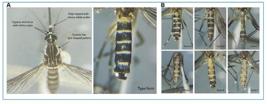
Abdominal scale pattern variation in Aedes aegypti var. queenslandensis females collected in December 2024 in Macapá, Amapá, Brazil, using BG-Sentinel traps with BG-Lure. The images illustrate distinct abdominal morphotypes based on the distribution of pale scales on the first tergites, corresponding to the forms described by McClelland (1974). The “queenslandensis” form shows extensive pale scaling extending laterally and posteriorly, whereas darker forms exhibit restricted or fragmented pale scale patches. These morphological variations reflect intraspecific diversity within Ae. aegypti and may aid in field identification.
Number of specimens collected by species and phenotype in BGS traps with BGL at the edge of an anthropized area in Macapá, Amapá, during the study period from December 19 to 24, 2024.
The phenotype of Ae. aegypti var. queenslandensis is controlled by quantitative inheritance, with at least three QTLs (Quantitative Trait Loci) mapped to chromosomes 1, 2, and 3, the QTL on chromosome 2 being the primary determinant of the light scale pattern9. The phenotypic gradient observed in the Macapá population may result from genetic recombination between distant phenotypic forms or environmental influences on scale pattern expression5. This variability suggests the coexistence of different genotypes in the region and the potential intercrossing of Ae. aegypti var. queenslandensis with the local-type form.
Similar patterns have been reported in previous population genetics studies of Ae. aegypti across different Brazilian regions, where the greatest genetic differences were observed among populations from Macapá, Belém, and Santarém compared to other areas of the country11,12. Belém, a major port city located approximately 100 km upriver from the Atlantic Ocean, serves as a key gateway to the Amazon River and facilitates the introduction of new genetic groups of Ae. aegypti. Similarly, Macapá lies along the northern channel of the Amazon River, close to the Atlantic Ocean, and shares borders with Suriname and French Guiana. These cities and their surrounding areas may therefore represent important entry points for novel genetic variants of this vector. Maitra et al.13 also observed the highest number of private alleles in the Ae. aegypti population from Macapá, suggesting the existence of a distinct genetic subgroup separate from other Brazilian populations.
The presence of Ae. aegypti var. queenslandensis in Macapá may indicate an introduction through the port of Santana (9.5 km from the collection site), a major entry point for large international vessels. This hypothesis is further supported by previous records of another invasive species, Aedes albopictus (Skuse, 1894), which was first detected near the port in 201914, and is now widespread in Macapá15. Historical data show that Ae. aegypti var. queenslandensis occurs in Australia, Southeast Asia, the Mediterranean, and São Paulo, Brazil, suggesting that its introduction into Macapá may have originated from one of these regions3.
Given this scenario, it is essential to strengthen entomological surveillance at the port of Santana and other ports in the state, given their strategic role as potential entry points for invasive species. This measure is critical not only for monitoring the spread of Ae. aegypti var. queenslandensis but also for mitigating its potential impact on arbovirus transmission in Amapá, considering the possible introduction of new populations and phenotypes better adapted to urban environments. Implementing robust preventive strategies will enable a more effective response to the challenges posed by the genetic diversity of Aedes aegypti2, particularly with regard to its vectorial capacity and resistance to insecticides used in local control programs. Future research should prioritize genetic characterization and expanded surveillance in key ports to track further introductions and strengthen public health interventions.
ACKNOWLEDGMENTS
We thank the Instituto de Pesquisas Científicas e Tecnológicas do Estado do Amapá (IEPA) for providing the infrastructure to examine the specimens and the CNPq for financial support through scientific initiation scholarships to students FGA and BLVN.
REFERENCES
- 1 Wold Health Organization (WHO). Global Strategy for Dengue Prevention and Control, 2021-2030. Geneva: WHO. 2019;16p.
- 2 Gubler DJ. Dengue, Urbanization and Globalization: The Unholy Trinity of the 21st Century. Trop Med Health. 2011;3-11.
- 3 Kraemer MU, Reiner Jr RC, Brady OJ, Messina JP, Gilbert M, Pigott DM, et al. Past and future spread of the arbovirus vectors Aedes aegypti and Aedes albopictus Nat Microbiol. 2019;4(5),854-63.
-
4 Ministério da Saúde (MS). Atualização de Casos de Arboviroses [Internet]. Brasília: Secretaria de Vigilância em Saúde; 2025 [update 2025 January 30; cited 2025 Feb]. Available from: Available from: https://www.gov.br/saude/pt-br/assuntos/saude-de-a-a-z/a/aedes-aegypti/monitoramento-das-arboviroses/
» https://www.gov.br/saude/pt-br/assuntos/saude-de-a-a-z/a/aedes-aegypti/monitoramento-das-arboviroses/ - 5 Couper LI, Dodge TO, Hemker JA, Kim BY, Exposito-Alonso M, Brem RB, et al. Evolutionary adaptation under climate change: Aedes sp. demonstrates potential to adapt to warming. Proc. Natl. Acad. Sci. U.S.A. 2025;122(2),e241819912.
- 6 Mattingly PF. Genetical aspects of the Aedes aegypti problem: I.-taxonomy and bionomics. Ann Trop Med Parasitol. 1957;51(4),392-408.
- 7 McBride CS, Baier F, Omondi AB, Spitzer SA, Lutomiah J, Sang R, et al. Evolution of mosquito preference for humans linked to an odorant receptor. Nature. 2014;515(7526),222-27.
- 8 Rašić G, Filipović I, Callahan AG, Stanford D, Chan A, Lam-Phua SG, et al. The queenslandensis and the type form of the dengue fever mosquito (Aedes aegypti L.) are genomically indistinguishable. PLoS Negl Trop Dis. 2016;10(11),e0005096.
- 9 McClelland GAH. A worldwide survey of variation in scale pattern of the abdominal tergum ofAedes aegypti(L.) (Diptera: Culicidae). Trans R Ent Soc Lond. 1974;126:239-59.
- 10 Santos GVD, Arduino MDB, Serpa LLN. Aedes aegypti queenslandensis: first geographic occurrence in Brazil and epidemiological implications. Rev Bras Entomol. 2022;66,e20210112.
- 11 Kotsakiozi P, Gloria-Soria A, Caccone A, Evans B, Schama R, Martins AJ, Powell JR. Tracking the return of Aedes aegypti to Brazil, the major vector of the dengue, chikungunya and Zika viruses. PLoS Negl Trop Dis. 2017;11(7),e0005653.
- 12 Monteiro FA, Shama R, Martins AJ, Gloria-Soria A, Brown JE, Powell JR. Genetic diversity of brazilian Aedes aegypti: patterns following an eradication program. PLoS Negl Trop Dis. 2014;8,1-10.
- 13 Maitra A, Cunha-Machado AS, Leandro AS, Costa FM, Scarpassa VM. Exploring deeper genetic structures: Aedes aegypti in Brazil. Acta Trop. 2019;195,68-77.
- 14 Saraiva JF, Maitra A, Galardo AKR, & Scarpassa VM. First record of Aedes (Stegomyia) albopictus in the state of Amapá, northern Brazil. Acta Amazon. 2019;49,71-74.
- 15 Muller JN, Galardo AKR, Santos WM, Ferro EP, Dias LS, Corrêa APS, et al. Expansion of Aedes (Stegomyia) albopictus (Skuse, 1894) in northern Brazil: new records and distribution in urban areas of Macapa city. Check List. 2021;17(3),911-15.
Edited by
-
Editor-in-Chief:
Prof. Dalmo Correia Filho. Orcid: https://orcid.org/0000-0002-2174-5058
Data-in-article.


