 Clinical and epidemiological profiles of confirmed malaria cases in the state of Pernambuco, Brazil, from 2001 to 2022
ABSTRACT
Background: Imported malaria is regularly detected in Pernambuco, a nonendemic area, highlighting the need for surveillance by healthcare professionals.
Methods: We performed a descriptive observational study of malaria cases reported in Pernambuco during 2001-2022.
Results: Most of the 350 patients were men (75.1%) and Mixed-race individuals (51.1%), with a median age of 32 years. Most patients resided in urban areas (81.1%), and 32% had primary education. Travel- and construction-related activities were the primary sources of exposure, with most infections originating in Brazil (52%) or Angola (33%). The median interval from symptom onset to testing was 10 days for Indigenous individuals, 5 days for Black individuals, and 4 days for Mixed race and White individuals. The delay was also longer for those with lower educational levels (6.5 days for primary education vs. 3 days for higher education). However, multivariate analysis showed that ethnicity, educational level, and geographic displacement were not statistically significant predictors of diagnostic delay. The cases showed a significant seasonal pattern, with a higher incidence during the first half of the year (p=0.0382). Although the annual incidence showed a slightly declining trend, this was not statistically significant (p=0.138). Plasmodium vivax and P. falciparum were the predominant species, accounting for 49.7% and 47.5% of cases, respectively.
Conclusions: Although disparities in median diagnostic times exist, multivariate analysis indicated that other complex factors are responsible for delayed diagnosis. Strengthening awareness among clinicians in nonendemic settings and ensuring timely testing are crucial for preventing severe outcomes and reducing malaria-related morbidity and mortality.
Keywords:
Malaria; Brazil; Extra-Amazon region; Epidemiological study
INTRODUCTION
Malaria mainly affects tropical and subtropical regions and is considered one of the most prevalent and deadly infectious diseases in the world. The World Health Organization estimates that malaria affected approximately 263 million people and caused approximately 597,000 deaths worldwide in 20231.
Malaria is endemic to some regions of Brazil, particularly the Amazon. According to the Brazilian Ministry of Health, 131,224 and 139,884 malaria cases were reported in Brazil in 2022 and 2023, respectively2,3, representing an increase of 6.6%. Therefore, malaria remains a public health challenge in Brazil that requires continuous efforts for its prevention, diagnosis, and treatment.
In 2019, an epidemiological alert was issued following the detection of two autochthonous cases in the municipality of Conde, Paraíba, a state neighboring Pernambuco4,5. Although Pernambuco is not considered an endemic area of malaria, it is naturally inhabited by Anopheles spp.6,7, including An. aquasalis and An. darlingi5,8. Cases of malaria were also reported in the border states of Pernambuco, Bahia, and Piauí9.
In Pernambuco, malaria cases were exclusively imported. As it is not an endemic area, the diagnosis may be delayed, thereby increasing the risk of a worse prognosis. We aimed to evaluate and analyze the clinical and epidemiological profiles of individuals diagnosed with malaria in Pernambuco between 2001 and 2022. Furthermore, we sought to evaluate the response time between symptoms and treatment, in addition to the parasitological profiles of the cases.
METHODS
This observational descriptive study was performed using data from malaria cases reported in the State of Pernambuco from 2001 to 2022. Epidemiological and clinical data were obtained from the Notifiable Diseases Information System (SINAN), as provided by the Pernambuco State Health Department. In Brazil, all malaria cases must be reported.
The following data were analyzed: sex, age, ethnicity, educational level, main activity in the last 15 days, municipality and area of residence, symptoms and date of symptom onset, place of probable infection, date of malaria diagnosis, Plasmodium spp. identified, parasitic load, and therapeutic regimen for malaria. Ethnicity was categorized into five groups based on the official Brazilian Institute of Geography and Statistics classification system as follows: White, Black, Pardo (Mixed race), Asian, and Indigenous.
Categorical variables were expressed as n (%) with 95% confidence intervals (CIs). Categorical variables were compared using the chi-square test (p<0.05). Continuous variables were tested for normality using the Shapiro-Wilk test and compared using the Mann-Whitney U test when the distribution was non-normal. To evaluate the association among delayed diagnosis, patient characteristics, and potential confounding factors, a multivariate linear regression model was used, which included ethnicity, educational level, and geographical displacement. The temporal and spatial distributions of malaria cases were illustrated using R software (version 4.5.1; R Core Team, 2025). A linear regression model was applied to assess the long-term trend in annual case counts, and the Mann-Whitney U test was used to evaluate seasonal patterns. All the statistical analyses were performed using Stata version 14 (StataCorp, College Station, TX, USA). This study was approved by the Research Ethics Committee of the Oswaldo Cruz University Hospital of the University of Pernambuco (CAAE 72890823.2.0000.5192).
RESULTS
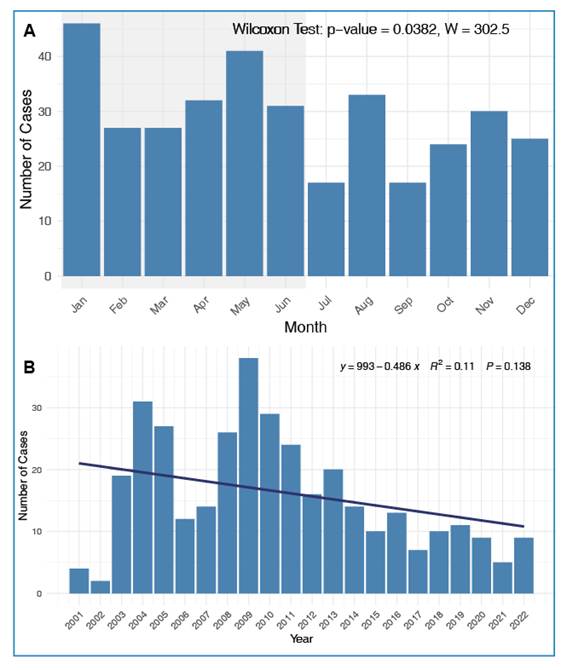
Between 2001 and 2022, 350 confirmed malaria cases were reported in Pernambuco, averaging 15.9 cases annually. The years 2009 and 2004 had the highest number of cases (38 and 31 cases, respectively). The temporal distribution demonstrated a statistically significant seasonal pattern, with a higher incidence during the first half of the year (p = 0.0382). Analysis of annual incidence showed a slight but not statistically significant declining trend (R2 = 0.11; p = 0.138) (Figures 1A and 1B).

Temporal analysis of confirmed malaria cases reported in Pernambuco from 2001 to 2022. A: Distribution of malaria cases by month of notification. B: Temporal trend of malaria cases per year.
Most cases occurred in men (n = 263, 75.1%) and Mixed-race individuals (n = 179, 51.1%). The median patient age was 32 years (interquartile range [IQR], 26-40 years), ranging 0-80 years. A notable proportion had 1-8 years of schooling (112, 32%), followed by those with ≥12 years (65, 18.6%) (Table 1). Most patients resided in Brazil (345, 98.6%), with 92.2% living in Pernambuco and 85.8% living in urban areas.
Three cases occurred in children aged <1 year of age in 2004, 2007, and 2009. All patients were symptomatic with low parasitemia from P. falciparum. The patients included two females and one male, representing Indigenous, White, and unknown ethnicities. The time from symptom onset to testing ranged 7-9 days. In one case, the probable location of the infection was documented as Amapá, Brazil.
In 2004, Pernambuco reported 31 malaria cases (18 male and 13 female) with a median age of 30 years (IQR 22-44). Of these, 14 (48.3%) were Indigenous and 6 (20.7%) were Mixed-race. The three cases in individuals aged <18 years were exclusively among Indigenous people (aged 1, 3, and 15 years). The species was confirmed in 24 cases; P. falciparum was the most common (17, 71%), followed by P. vivax (6, 25%), and one mixed infection (P. falciparum and P. vivax). Of the 14 Indigenous people, 11 had a confirmed cause (all caused by P. falciparum). Six P. vivax cases were treated with chloroquine and primaquine, whereas P. falciparum and mixed infections were treated with mefloquine and primaquine. The treatment regimen was not specified in either case.
Thirty-eight cases were reported in 2009. Most patients were male (84%) and of Mixed race (60.5%), with a median age of 31 years (IQR 26-36). The probable location of infection was specified in 11 cases, with 10 originating from the Amazon region. The most common cause was P. falciparum (26, 70.3%), followed by P. vivax (10, 27%), and one (2.7%) mixed infection. While most P. vivax cases were treated with chloroquine and primaquine, most P. falciparum cases had their treatment listed as “other regimen” without specific drugs.
The most common activities reported 15 days before infection were travel (46 cases, 18.1%) and road or dam construction (19 cases, 7.5%). Notably, 13 cases (5.1%) were specifically categorized as “tourism” (Table 1). This suggests that a substantial proportion of travel cases were for other purposes, such as employment or business, even if they were not explicitly stated in the notification form.
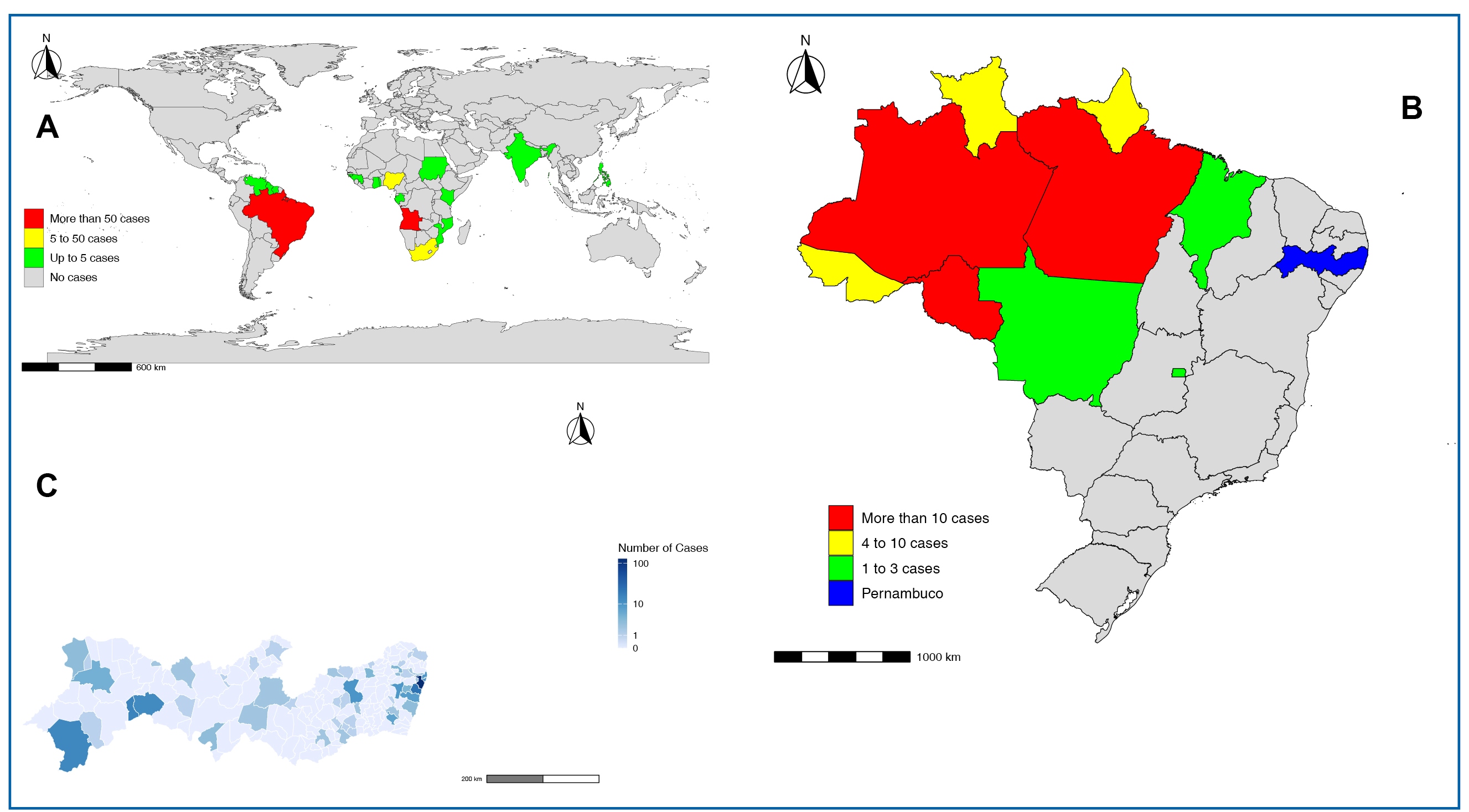
The majority of cases originated in Brazil (152, 51.7%), followed by Angola (98, 33.3%) and South Africa (10, 3.4%) (Figure 2A). In Brazil, most infections occurred in Amazonas (39, 25.1%), Rondônia (37, 23.9%), and Pará (34, 21.9%) (Figure 2B). Notably, 17 (11%) cases were reported to originate in Pernambuco, which likely represents a data entry error, given the state’s nonendemic status and the lack of autochthonous cases. The distribution of malaria cases by the municipality of residence in Pernambuco, Brazil, is shown in Figure 2C.

Geographic distribution of confirmed malaria cases reported in Pernambuco from 2001 to 2022. 2A: Probable country of infection. 2B: Probable Brazilian state of infection. 2C: Distribution of confirmed cases by municipality of residence in the state of Pernambuco.
Approximately 94% of the patients presented with symptoms at the time of notification. However, the notification form included only descriptive symptom information until 2006. In the subset of cases with this information, most patients presented with fever (96.7%), chills (86.8%), and sweats (65.9%) (Table 2). After 2006, the forms only recorded the presence or absence of symptoms, with symptomatic individuals accounting for 239 (94.1%) cases from 2007 to 2022.
The median time from symptom onset to malaria testing was 4 days (IQR 2-9 days), with case notifications occurring a median of 5 days (IQR 2-10 days) after symptom onset. However, no delay was noted between the test and treatment, as the therapy was initiated on the same day the diagnosis was confirmed.
Stratification of the median time from symptom onset to malaria testing by ethnicity revealed a significant difference (p = 0.0035). A post-hoc analysis showed that the diagnostic time for Indigenous individuals (median of 10 days, IQR 8-12) was significantly longer than that for White (padj = 0.0047), Mixed-race (padj = 0.0178), and Asian (padj = 0.0053) individuals. No statistically significant differences were observed between the other groups. For Black individuals, the median was 5 days (IQR 3-10 days), Mixed-race individuals had a median of 4 days (IQR 2-9 days), White individuals had a median of 4 days (IQR 2-7 days), and Asian individuals had a median of 1 day (IQR 1-4 days).
The median time from symptom onset to testing differed significantly across educational levels (p < 0.001). A Dunn's test revealed that individuals with ≥12 years of study had a significantly shorter diagnostic time (3 days, IQR 1-5) compared to those with 1-8 years (6.5 days, IQR 3-12.5; padj < 0.001) and 9-11 years (5 days, IQR 3-10; padj = 0.0003). In contrast, no significant differences in diagnostic time were observed according to sex (p = 0.293) or age (p = 0.202).
We conducted a linear regression model that included ethnicity, educational level, and displacement (discrepancy between the municipality of notification and residence). After adjusting for displacement, ethnicity and educational level did not maintain a statistically significant association with delayed diagnosis. Additionally, geographic displacement was not a significant predictor of delayed diagnosis (p = 0.479).
Most infections were caused by P. vivax (n = 162, 49.7%) or P. falciparum (n = 155, 47.5%). Mixed infections of both species accounted for eight cases (2.4%), whereas a single case (0.3%) was attributed to P. ovale (Table 2). This P. ovale case, identified in 2022, was of a 21-year-old Black man who had recently arrived from Gabon. The diagnosis was made 4 days after symptom onset, and the patient, with a parasite load of two crosses (2-20 parasites per field or 501-10,000 parasites per cubic millimeter), was treated with chloroquine and primaquine.
Regarding the parasite load, most cases were classified as having two crosses (Table 2). Most P. vivax cases had two crosses, whereas P. falciparum cases were more frequently classified as having three crosses (10,001-100,000 parasites per cubic millimeter). This observation was confirmed statistically, with the highest parasite loads (three or four crosses) being significantly more frequent in P. falciparum infections (p = 0.001) (Table 3).
DISCUSSION
Between 2001 and 2022, 350 malaria cases were confirmed in Pernambuco, averaging 15.9 cases per year, with case spikes in 2004 and 2009. The significant seasonal pattern with cases concentrated in the first half of the year may be associated with travel patterns. We hypothesized that travelers visiting endemic areas during the end-of-year holidays (December and January) return to Pernambuco and develop symptoms shortly thereafter. This finding underscores the importance of maintaining a high index of clinical suspicion among healthcare professionals in nonendemic regions, especially during holidays.
Temporal analysis of annual malaria incidence showed no statistically significant trends. This finding suggests that annual fluctuations in case numbers are influenced more by factors other than the simple passage of time. Although a slight decrease was visually observable, the lack of statistical significance indicates that the variations are more likely to be driven by episodic events or by specific environmental, social, and public health determinants that warrant further investigation.
Our observation of a case spike in Pernambuco in 2004 aligned with a national increase in malaria cases across 16 extra-Amazonian states during the same period. This increase was also seen in Piauí (from 26 to 144 cases) and Espírito Santo (from 87 to 173 cases)10. This surge in the extra-Amazonian regions, along with an increasing trend in the Amazon11, suggests a plausible link with the movement of workers. Residents from nonendemic areas such as Pernambuco frequently travel for temporary work in malaria-endemic areas, which could be a key factor in our findings.
Although the overall number of cases in the extra-Amazonian region decreased in 2009, case numbers rose in São Paulo and Paraná12. The simultaneous increase observed in Pernambuco in the present study cannot be directly explained by a single factor. However, the introduction of the Laboratory Environment Manager system in 2009, a computerized system that optimized and improved the diagnostic quality of the public health system, may have led to an improvement in case notifications13. This suggests that our observed increase may reflect improved data capture rather than a pure increase in the number of cases.
In our study, all cases were classified as imported, that is, an infection acquired outside the area where it was diagnosed14, a finding consistent with Pernambuco's nonendemic status. Consistent with other Brazilian studies, our results underscore travel as the main activity associated with infection15,16, highlighting the critical need for clinicians to consider malaria in patients with relevant travel histories, to ensure prompt diagnosis and management17-20.
The epidemiological profile of cases in Pernambuco aligns with a recent report by the Brazilian Ministry of Health on malaria cases in extra-Amazonian areas15, with most cases occurring in adults, males, and individuals of Black or Mixed-race ethnicity. Consistent with the same report, our findings confirmed Angola as the primary country of origin for imported malaria cases in Brazil. This epidemiological link is strongly supported by the historical relationship and the significant migratory flow between the two countries21,22.
In nonendemic areas, rapid diagnostic tests (RDTs) are recommended because they are easy to use and do not require specialized personnel to interpret slides. However, clinicians must be aware of their limitations such as the potential for false-negative results. This is particularly relevant for P. falciparum infections, which can lead to severe outcomes23-25. Consequently, in the presence of a strong epidemiological link, such as recent travel to an endemic area, malaria should be suspected even after a negative RDT result. In these cases, a confirmatory parasitological examination using a thick smear is crucial. Moreover, as patients may not always realize the importance of this information, actively inquiring about their recent travels is crucial. This aspect of anamnesis is often overlooked during training of health professionals and students in areas where malaria is not endemic.
The high proportion of parasitemia observed was associated with P. falciparum infection, which is consistent with the established findings26. This is especially important in nonendemic settings, such as Pernambuco, where the population lacks acquired immunity and is vulnerable to severe outcomes, for which high parasitemia is a strong predictor16,26,27. However, it is crucial to contextualize the parasite load within the biology of each species. P. falciparum has the unique ability to infect blood cells of all ages, resulting in exponential replication and a high parasitic load. This capability is in contrast with the biology of P. vivax, which has a preferential tropism for reticulocytes28. This highlights the critical need for a timely and correct diagnosis, followed by fast and suitable therapy.
Malaria and dengue are the main vector-borne diseases, and both are endemic to tropical areas such as Africa29 and Brazil30. Similar initial symptoms can delay diagnosis20,29,31. A study in the Amazon found that among 1,578 patients with febrile syndrome, 11% had malaria and 37% had dengue. In addition, 2.8% of patients had malaria-dengue coinfection32. Therefore, during dengue epidemics, which are frequent events in Pernambuco, considering malaria in the differential diagnosis is crucial to improve patient prognosis33-35.
The data from the notification forms did not include information on patient outcomes, such as hospitalization, death, or recovery. This information is particularly important considering that individuals affected by these diseases in nonendemic regions tend to have a worse prognosis. A comparison of malaria lethality in 2019 between the Amazon and extra-Amazon regions of Brazil revealed striking differences. The lethality rate in the extra-Amazon region was 123 times higher, which may be attributed to delays in diagnosis and treatment7. Furthermore, the population in nonendemic areas lacks the acquired clinical immunity common in endemic regions36,37, making them more vulnerable to severe disease and death.
We also found inconsistencies in the notification of prescribed treatments, which limited our analysis. From 2001 to 2006, forms included a field for “other schemes;” however, the specific regimens were seldom documented. A standardized, single-entry treatment field implemented from 2007 onwards facilitated the analysis. Despite this improvement, the quality of prescribed treatment notifications remained limited throughout the study period.
For cases caused by P. vivax, most treatments (71%) adhered to standard protocols. In contrast, for P. falciparum infections, only 22% of the records described a regimen that included an active drug (mefloquine), whereas 57% were categorized as an unspecified “other scheme.” Of particular concern, contrary to treatment recommendations, the chloroquine plus primaquine regimen was prescribed for seven cases of P. falciparum and two mixed (P. vivax and P. falciparum) infections. This noncompliance, which has also been observed in endemic regions of Brazil7, suggests a persistent lack of knowledge among healthcare professionals regarding malaria management.
A key finding in this nonendemic setting was the prompt initiation of treatment, which began on the same day that the diagnosis was confirmed. This is crucial to prevent disease progression and reduce the risk of further transmission. However, while our results showed a rapid diagnostic and treatment pathway, they also revealed a significant delay in access to care for Indigenous and Black patients, which is a critical limitation of the local health system.
Historically, Black, Mixed-race, and Indigenous populations in Brazil have had limited access to healthcare services. The recent coronavirus disease 2019 (COVID-19) pandemic has led to this issue38. While our initial analyses revealed significant associations between ethnicity, educational level, and diagnostic delay, multivariate analysis did not support this conclusion. This suggests that these associations were mediated by confounding factors, as the complexity of healthcare access was not fully captured by our variables. The fact that travel between municipalities was not a significant predictor of delay contrasts with the common belief that geographical distance is the main barrier. This may indicate that other factors such as socioeconomic and cultural barriers or local transportation logistics underlie this disparity. Therefore, the reasons for these inequalities are multifaceted and require further investigation using more detailed data.
The persistent threat of imported malaria cases in nonendemic areas such as Pernambuco underscores its susceptibility to disease reintroduction. The 2019 outbreak in the neighboring state of Paraíba5, in a municipality 100 km from Recife, the capital of Pernambuco illustrates this risk. The combination of imported cases, high population mobility, and the presence of competent vectors creates a scenario involving both vulnerability and receptivity. These factors highlight the urgent need for a robust surveillance vector control program to prevent the re-establishment of local transmission. Maintaining a high index of clinical suspicion and ensuring prompt diagnostic testing are crucial for patient management and broader public health goal of preventing disease re-establishment in previously eliminated areas. Framing these actions within a one-health perspective reinforces the need for integrated approaches that consider human mobility, environmental changes, and vector ecology as interconnected drivers of malaria risk39.
ACKNOWLEDGMENTS
We are grateful to the Pernambuco State Department of Health for providing notification data.
REFERENCES
- 1 World Health Organization (WHO). World malaria report 2024: addressing inequity in the global malaria response. Geneva: WHO; 2024. 320 p.
- 2 Ministério da Saúde (MS). Secretaria de Vigilância em Saúde e Ambiente. Boletim Epidemiológico 55 Nº 1. Brasília: MS; 2024. 15 p.
- 3 Ministério da Saúde (MS). Secretaria de Vigilância em Saúde e Ambiente. Boletim Epidemiológico 55 Nº 14. Brasília: MS ; 2024. 14 p.
- 4 Secretaria de Saúde do Estado de Pernambuco (SES-PE). Secretaria Executiva de Vigilância em Saúde. Nota informativa nº 04/2019. Recife: SES-PE; 2019. 2 p.
- 5 Gomes EC de S, Cruz DL da, Santos MAVM, Souza RMC, Oliveira CMF de, Ayres CFJ, et al. Outbreak of autochthonous cases of malaria in coastal regions of Northeast Brazil: the diversity and spatial distribution of species of Anopheles. Parasit Vectors. 2020;13(1):621.
- 6 Buery JC, de Alencar FEC de, Duarte AMR de C, Loss AC, Vicente CR, Ferreira LM, et al. Atlantic forest malaria: a review of more than 20 years of epidemiological investigation. Microorganisms. 2021;9(1):132-45.
- 7 Ministério da Saúde (MS). Secretaria de Vigilância em Saúde. Boletim Epidemiológico Malária 2020. Brasília: MS ; 2020. 118 p.
- 8 Aragão NC, Müller GA, Balbino VQ, Costa Junior CRL, Figueirêdo Júnior CS, Alencar J, et al. A list of mosquito species of the Brazilian State of Pernambuco, including the first report of Haemagogus janthinomys (Diptera: Culicidae), yellow fever vector and 14 other species (Diptera: Culicidae). Rev Soc Bras Med Trop. 2010;43(4):458-9.
- 9 Ministério da Saúde (MS). Secretaria de Vigilância em Saúde. Boletim Epidemiológico 53 Nº 17. Brasília: MS ; 2022. 29 p.
-
10 Ministério da Saúde (MS). Secretaria de Vigilância em Saúde. Sistema de Informação de Agravos de Notificação. Casos confirmados por Ano 1o Sintoma(s) segundo UF de notificação Período: 2001-2006 [Internet]. Brasília; 2025. [cited 2025 Aug 12]. Available from: Available from: https://datasus.saude.gov.br/
» https://datasus.saude.gov.br/ - 11 Ministério da Saúde (MS). Secretaria de Vigilância em Saúde. Boletim Epidemiológico 44 Nº 1. Brasília: MS ; 2013. 16 p.
-
12 Ministério da Saúde (MS). Secretaria de Vigilância em Saúde. Sistema de Informação de Agravos de Notificação. Casos confirmados por Ano 1o Sintoma(s) segundo UF de notificação Período: 2007-2022 [Internet]. Brasília; 2025. [cited 2025 Aug 12]. Available from: Available from: https://datasus.saude.gov.br/
» https://datasus.saude.gov.br/ - 13 de Jesus R, Paim Guimarães R, Bergamo R, Carlos Ferreira dos Santos L, Sander Duarte da Matta A, José de Paula Júnior F. Sistema Gerenciador de Ambiente Laboratorial: relato de experiência de uma ferramenta transformadora para a gestão laboratorial e vigilância em saúde. Epidemiol Serv Saúde. 2013;22(3):525-9.
- 14 World Health Organization (WHO). WHO malaria terminology 2021. Geneva: WHO ; 2021. 42 p.
- 15 Garcia KKS, Abrahão AA, Oliveira AF de M, Henriques KM de D, de Pina-Costa A, Siqueira AM, et al. Malaria time series in the extra-Amazon region of Brazil: epidemiological scenario and a two-year prediction model. Malar J. 2022;21(1):157-68.
- 16 Ministério da Saúde (MS). Secretaria de Vigilância em Saúde. Boletim epidemiológico volume 53 nº 30. Brasília: MS ; 2022. 35 p.
- 17 Pina-Costa A de, Brasil P, Santi SMDi, Araujo MPde, Suárez-Mutis MC, Santelli ACFeS, et al. Malaria in Brazil: what happens outside the Amazonian endemic region. Mem Inst Oswaldo Cruz. 2014;109(5):618-33.
- 18 McCarthy AE, Morgan C, Prematunge C, Geduld J. Severe malaria in Canada, 2001-2013. Malar J. 2015;14(1):151-9.
- 19 Calderaro A, Piccolo G, Montecchini S, Buttrini M, Rossi S, Dell’Anna ML, et al. High prevalence of malaria in a non-endemic setting: comparison of diagnostic tools and patient outcome during a four-year survey (2013-2017). Malar J. 2018;17(1):63-72.
- 20 Goldman-Yassen AE, Mony VK, Arguin PM, Daily JP. Higher rates of misdiagnosis in pediatric patients versus adults hospitalized with imported malaria. Pediatr Emerg Care. 2016;32(4):227-31.
-
21 Morosini F, Ratton Sanchez Badin M. Special dossier about relations between Brazil and Angola. Austral. 2016;5(9)9-10. Available from: https://doi.org/10.22456/2238-6912.69084
» https://doi.org/10.22456/2238-6912.69084 - 22 Jose Sanchez L, Bendet I, Grogl M, Lima JBP, Lorrin Pang W, Guimaraes R, et al. Malaria in Brazilian military personnel deployed to Angola. J Travel Med. 2000;7(5):275-82.
- 23 Santos L, Pereira NR, Andrade P, Dias PF, Alves CL, Abreu C, et al. Prozone-like phenomenon in travellers with fatal malaria: report of two cases. J Infect Dev Ctries. 2015;9(3):321-4.
- 24 Góes L, Chamma-Siqueira N, Peres JM, Nascimento JM, Valle S, Arcanjo AR, et al. Evaluation of histidine-rich proteins 2 and 3 gene deletions in Plasmodium falciparum in endemic areas of the Brazilian Amazon. Int J Environ Res Public Health. 2020;18(1):1-9.
- 25 Olivera MJ, Guerra AP, Cortés LJ, Suárez-Jurado AG, Ade M de la P, Cárdenas IM. Prevalence of pfhrp2/pfhrp3 gene deletions among patients with Plasmodium falciparum malaria with false-negative in the HRP2-based rapid diagnostic test in Colombia. Mem Inst Oswaldo Cruz. 2025;120:e240134.
- 26 Padilla-Rodríguez JC, Olivera MJ, Guevara-García BD. Parasite density in severe malaria in Colombia. PLoS One. 2020;15(6):e0235119.
- 27 Phillips A, Bassett P, Zeki S, Newman S, Pasvol G. Risk factors for severe disease in adults with falciparum malaria. Clin Infect Dis. 2009;48(7):871-8.
- 28 Habtamu K, Petros B, Yan G. Plasmodium vivax: the potential obstacles it presents to malaria elimination and eradication. Trop Dis Travel Med Vaccines. 2022;8(1):27.
- 29 Sow A, Loucoubar C, Diallo D, Faye O, Ndiaye Y, Senghor CS, et al. Concurrent malaria and arbovirus infections in Kedougou, southeastern Senegal. Malar J. 2016;15(1):47-54.
- 30 Ferreira AF, Heukelbach J, Costa CHN, de Souza EA, Maciel AMS, Correia D, et al. Scientometric review of research on neglected tropical diseases: a 31-year perspective from the Journal of the Brazilian Society of Tropical Medicine. Rev Soc Bras Med Trop. 2023;56:e0403-2022.
- 31 Ayorinde AF, Oyeyiga AM, Nosegbe NO, Folarin OA. A survey of malaria and some arboviral infections among suspected febrile patients visiting a health centre in Simawa, Ogun State, Nigeria. J Infect Public Health. 2016;9(1):52-9.
- 32 Magalhães BML, Siqueira AM, Alexandre MAA, Souza MS, Gimaque JB, Bastos MS, et al. P. vivax malaria and dengue fever co-infection: a cross-sectional study in the Brazilian Amazon. PLoS Negl Trop Dis. 2014;8(10):e3239.
- 33 Silva FD, Santos AM dos, Corrêa R da GCF, Caldas A de JM. Temporal relationship between rainfall, temperature and occurrence of dengue cases in São Luís, Maranhão, Brazil. Cien Saude Colet. 2016;21(2):641-6.
- 34 Costa IMP, Calado DC, Costa IMP, Calado DC. Incidência dos casos de dengue (2007-2013) e distribuição sazonal de culicídeos (2012-2013) em Barreiras, Bahia. Epidemiol Serv Saude. 2016;25(4):735-44.
- 35 do Nascimento IDS, Pastor AF, Lopes TRR, Farias PCS, Gonçales JP, do Carmo RF, et al. Retrospective cross-sectional observational study on the epidemiological profile of dengue cases in Pernambuco state, Brazil, between 2015 and 2017. BMC Public Health. 2020;20(1):923-32.
- 36 Mischlinger J, Rönnberg C, Álvarez-Martínez MJ, Bühler S, Paul M, Schlagenhauf P, et al. Imported malaria in countries where malaria is not endemic: a comparison of semi-immune and nonimmune travelers. Clin Microbiol Rev. 2020;33(2):e00104-19.
- 37 Griffin JT, Déirdre Hollingsworth T, Reyburn H, Drakeley CJ, Riley EM, Ghani AC. Gradual acquisition of immunity to severe malaria with increasing exposure. Proc Biol Sci. 2015;282(1801):20142657.
- 38 Cardoso FS, Gomes DCK, Silva AS da. Desigualdade racial na assistência à saúde do adulto internado por COVID-19. Cad Saude Publica. 2023;39(10):e00215222.
- 39 Destoumieux-Garzón D, Mavingui P, Boetsch G, Boissier J, Darriet F, Duboz P, et al. The one health concept: 10 years old and a long road ahead. Front Vet Sci. 2018;5:306018.
-
Data Availability Statement:
Research data is only available upon request.
-
Financial Support:
This study had no financial support. HMRG, MCPP, MRNS, and EVOA were supported by undergraduate research scholarships from the PIBIC Program of the National Council for Scientific and Technological Development (CNPq), and MCGP was supported by an undergraduate research scholarship from the Scientific Initiation Program of the Foundation for the Support of Science and Technology of Pernambuco (FACEPE).
Edited by
-
Editor-in-Chief:
Prof. Dalmo Correia Filho. Orcid: https://orcid.org/0000-0002-2174-5058
Research data is only available upon request.