
 Legislation and Racial Issue: analysis of bills of law in Brazil (1946-2012)
Abstract
This research is an in-depth qualitative study of the governance of the racial issue in Brazil, focusing on legislative production concerning race, more specifically the Black population (População Negra) between 1946 and 2012. Grounded in the theoretical framework of Assimilationist, Accommodationist, and Integrationist approaches to segregated societies, it seeks to answer the question: “How does the Brazilian state address a racially segregated society?”. The analysis is based on 183 race-related bills of law (Machado and Monteiro, 2020), examined through content analysis and contextualized by presidential terms, taking into account their degrees of authoritarianism or democracy. Rather than a comparative design, the study adopts a qualitative documentary approach, treating the Brazilian state’s legislative production as a privileged lens for understanding its strategies toward racial segregation. The findings reveal that the Accommodationist approach predominated during the period, accompanied by a significant presence of Integrationist initiatives, as well as many hybrid categorizations.
Keywords:
inequality; black population; legislative; bills of law; Brazil
Resumo
Esta pesquisa é um estudo qualitativo aprofundado sobre a governança da questão racial no Brasil, com foco na produção legislativa referente à raça, mais especificamente à população negra, entre 1946 e 2012. Fundamentada no arcabouço teórico das abordagens Assimilacionista, Acomodacionista e Integracionista aplicadas a sociedades segregadas, busca responder à seguinte questão: “Como o Estado brasileiro lida com uma sociedade racialmente segregada?”. A análise baseia-se em 183 projetos de lei relacionados à questão racial (Machado and Monteiro, 2020), examinados através de análise de conteúdo e contextualizados de acordo com os mandatos presidenciais, levando em consideração períodos autoritários ou democráticos. O estudo adota uma abordagem qualitativa documental que trata a produção legislativa do Estado brasileiro como uma lente privilegiada para compreender suas estratégias diante da segregação racial. Os achados revelam que a abordagem Acomodacionista predominou durante o período, acompanhada por uma presença significativa de iniciativas Integracionistas, bem como híbridas.
Palavras-chave:
desigualdade; população negra; legislativo; projetos de lei; Brasil
Introduction1
This work presents part of the results of a research conducted in 2016, for my master’s dissertation “The Political Governance of the Brazilian Racial Issue: Observing Brazil’s legislative production on race through the Assimilation, Integration and Accommodation lenses” (Monteiro, 2016). The study sought to provide insights to answer the question “How does the Brazilian Government handle a racially segregated society?”. As evidence, this study draws on an existing database (Machado and Monteiro, 2020), which compiles all the bills of law2 that targeted racial themes regarding the Brazilian Black Population, presented in the legislative arena in Brazil, from January 1946 until June 2012, which is aligned with previous similar works (Santos, 2022; Souza, 2009).
For the methodology, I conducted content analysis of the bills of law presented in the database by connecting them to three theoretical approaches for segregated societies: Accommodation, Assimilation, and Integration3. Each bill of law was coded into one category or as a hybrid composed of two approaches, according to its content. These theoretical lenses are some of the possibilities traditionally used to comprehend plural societies as we will see further. They are concerned with actions and tools that can be used in public policy to promote a harmonious environment in public and private spheres and prevent general conflict, ensuring balance in diversity.
A more recent version of the database used here can be found in the work published by (Machado and Monteiro, 2020), which includes the bills of law from the period from 2013 to 2018. However, they were not analyzed within the theoretical lenses proposed in the present work.
This article is divided into two parts. In the first part, I propose to present the above-mentioned theoretical lenses within the Brazilian context of racial segregation of the black population. In the second part, I present how I classified each bill of law in the methodology, followed by the Analysis, where I offer key results of how the analysis was conducted and draw some parallels highlighting notable bills of law, the most active parliamentarians, the most represented regions and the bills that ultimately were enacted into law.
The theoretical lenses: Assimilation, Accommodation, and Integration and the Brazilian Context
Scholars have made many attempts to theorize about segregated societies and develop forms of integration. In this research, I chose three mainstream theoretical lenses to better understand contexts of segregation - whether racial, ethnic, religious, cultural, or other types of discrimination, along with the strategies used by each approach to address issues generated by the lack of integration.
An Assimilationist approach, for instance, emphasizes the construction of a common identity across both private and public spheres. This approach seeks the elimination of differences, either through a “fusion” of identities - where a “spontaneous” and “harmonious” union of original identities produces a new one - or through an acculturation process, in which a dominant culture suppresses others. In both forms, coercion is present, whether through the forced transformation of minority groups into something else or the complete erasure of “weaker” or subordinated identities. Assimilation thus involves coercive or voluntary socialization processes that diminish minority languages, religions, or identities in the public sphere (McGarry et al., 2008, pp. 3, 4). More broadly, Assimilation refers to the fusion of cultures, typically with one group more profoundly affected than the other. It is the process by which individuals or groups adopt the cultural norms, values, and social practices of a host society, often leading to a reduction of cultural differences (Gordon, 1964, pp. 68–69).
According to McGarry et al. (2008), when it comes to Accommodationist and Integrationist approaches, direct coercion is not the main strategy of tackling segregation. While Integration will privilege more “spontaneous” fusions or adaptations that might occur in societies to benefit a plural environment, Accommodation accepts some spontaneous shifts and transformations, even though it is not the primary goal to stimulate them (McGarry et al., 2008).
For an Integrationist framework, a common public space with institutions that transcend difference is believed to fuel harmony among plural individuals. Difference can exist, but it should be restricted to the private sphere. This arrangement is thought to ensure equality among people and a common identity that magnetically attracts people with their differences, which is often based on nationalist ideals. In Integration, it is believed that conflict is something that only spreads when difference and politics are mixed, therefore, ethnic political parties or difference-oriented public institutions are very discouraged or, many times, even forbidden (McGarry et al., 2008). It also refers to the process by which individuals or groups become accepted as equal participants in the social, economic, and political life of the host society without necessarily losing their distinct cultural identities. Integration emphasizes the removal of barriers such as prejudice, discrimination, and segregation, aiming at full participation and equal opportunity at the same time that it seeks a “neutral” public sphere (Gordon, 1964). By suppressing differences in the public sphere, Integration can be problematic, as its attempt to “neutralize” public life often entails the suppression of identities and the co-optation of cultural expressions under a nationalist umbrella, even if not as explicitly as in the Assimilationist approach.
Alternatively, Accommodation advocates for, and fosters the recognition of diverse societal identities in both public and private realms. It prioritizes equality within society, and it advocates for the provision of space for each group in the public sphere, potentially leading to the formation of political parties based on identity, difference and/or ethnicity, and the implementation of quota systems to ensure fair political representation. Equality can only be achieved through the recognition of difference. By recognizing multiple public identities, it supports the public and institutional expression of differences, advocating for equality with institutional respect for group differences, highlighting autonomy, power-sharing, and territorial pluralism. For Accommodationists, ethnic, religious or linguistic identities are resilient and political arrangements must allow for their expression and protection to prevent tyranny from a political majority or an economically or politically dominant group, for instance. It ranges from power-sharing, the protection of cultural groups, and the autonomy for territorially concentrated groups, targeting the prevention of conflict and the adaptation of the public sphere to groups’ needs (McGarry et al., 2008).
From an Assimilationist perspective, difference must be eliminated and absorbed into the dominant culture. In Brazil, a classic example is the “whitening” policies that followed the abolition of slavery in the late nineteenth and early twentieth centuries. State policies at the time encouraged European immigration to replace Black labor in agriculture, while also promoting miscegenation as a strategy to “dilute” the Black presence in society (Fernandes, 2008). This project, which sustained the myth of racial democracy, has been strongly criticized by scholars and activists such as Abdias do Nascimento, who described it as a form of genocide of the Black Brazilian population, disguised as a project of national integration (Nascimento, 1978). Similar initiatives in other Latin American contexts likewise sought to “whiten” populations through coerced or incentivized intermixing, reinforcing racial hierarchies while denying cultural difference.
As seen previously, Integrationist approaches do not necessarily seek the total erasure of difference, but rather its restriction to the private sphere. The public sphere is expected to prioritize shared institutions and the creation of a common national identity. In Brazil, this logic can also be associated with the myth of a racial democracy, which provided Brazilians a “common identity” and the construction of the modern republican state, which, at least in principle, claims to treat all citizens as equals regardless of race, religion, or ethnicity. However, this supposed universality often serves to mask deep social inequalities. For instance, while the principle that all people are equal before the law is constitutionally ensured, the historical exclusion of Black and Indigenous populations from spaces of political and economic power persists. In practice, the separation between public neutrality and private difference collapses, as racial and cultural inequalities inevitably shape access to public life. Thus, Integration in Brazil often results in the discouragement of public difference in the name of unity, while inequality remains a structural part of society.
Accommodationist frameworks move in the opposite direction, advocating for the explicit recognition of difference in both public and private spheres and for the institutional protection of minority rights. In Brazil, Accommodation can be exemplified by policies of land demarcation for Indigenous and quilombola4 communities, present in Articles 231 and 68 in the Brazilian Constitution (Brasil, 1988), respectively, which, at least in principle, would guarantee autonomy, collective identity, and territorial rights to historically marginalized groups. Similarly, affirmative action policies, such as racial quotas in universities and civil service positions, reflect an effort to institutionalize difference as a criterion for achieving substantive equality. While these measures are often contested and inconsistently implemented, they embody an Accommodationist logic by recognizing that formal equality is insufficient without the public and institutional recognition of difference.
Despite their theoretical distinctions, these three models share important limitations in the Brazilian context. Both Assimilation and Integration rely, to varying degrees, on coercion: Assimilation through the active erasure of cultural and racial difference, and Integration through the imposition of a supposedly “neutral” public sphere that suppresses difference under the guise of equality. Accommodation has had some achievements in terms of emphasizing difference to create social inclusion. Nevertheless, while more inclusive, it faces resistance in political and social arenas and often remains incomplete in practice, particularly regarding the implementation of land rights and affirmative action. Moreover, the Brazilian reality challenges the neat division between private and public spheres assumed by these frameworks: in practice, the private is always already political, and difference cannot easily be confined to one domain. As a result, the Brazilian experience demonstrates the complexity and hybridity of Integration strategies, which rarely fit neatly into one theoretical model.
Racial Segregation in Brazil: the myth of a “racial democracy” and contextual hypotheses
Before deepening the discussion, it is important to characterize the social and historical meanings of the so-called racial democracy in Brazilian politics and society. Even though the expression is often attributed to Gilberto Freyre, it is not found in his most important works and he only started to use it in the 1960s (Guimarães, 2001, p. 153). To Antonio Sérgio Alfredo Guimarães(2001), the notion of a racial democracy can be understood in three ways, the ideal, the pact, and the myth. As an ideal, “racial democracy” represented a society free of prejudice or racial discrimination, where race was not considered a factor because harmony was presumed to prevail. Since the 19th century, Brazil’s international image was built upon this construction, often justified by the notion that slavery in Brazil had been milder than in other contexts, thus fostering the idea of a “society without a ‘color line’— a society without legal barriers preventing people of color from rising to official positions and positions of wealth or prestige” (Guimarães, 2001, p. 148). The author further argues that Brazil was often perceived as a country free from racial prejudice or discrimination. In the 1950s, the Teatro Experimental do Negro - one of the institutions founded by the intellectual Abdias do Nascimento - contributed to disseminating, at least in part, a discourse rooted in the idea of Brazil as a “racial democracy” (Guimarães, 2001, p. 151).
Freyre’s “lusotropicalist” ideals - developed in defense of Portuguese colonialism and in opposition to the “négritude” of Senghor, Césaire, and Fanon - claimed that Portuguese colonialism was distinct and more cordial, as the Portuguese were supposedly different from other Europeans. These ideas served as the basis for disseminating the myth of racial democracy in Brazil. Between 1945 and 1964, racial democracy functioned as a pact that nominally included Black people. From that point onward, however, Black organizations began to mobilize against both lusotropicalism and the very notion of racial democracy. As theorized by Abdias do Nascimento, democracy should encompass all spheres - economic, social, and cultural - revealing that Brazil’s so-called racial democracy was, in fact, a myth (Guimarães, 2001; Nascimento, 1978).
As previously mentioned, in the aftermath of slavery, Brazilian society was marked by state policies that promoted miscegenation and the whitening of the population. The construction of the “Brazilian people” as a national identity was grounded in a foundational myth: the belief that the mixing of all ethnic groups would resolve the so-called “race problem” by dissolving differences into a single collective identity. This narrative, shaped by colonial racial hierarchies, rested on the idea of merging the “main” identities of Indigenous peoples, enslaved Africans and their descendants, and European colonizers (Skidmore, 1976). Such a vision closely aligns with the Assimilationist approach and was reinforced by government policies throughout the late nineteenth and early twentieth century. As Domingues (2008, p. 117) notes, even the early Black Movement in Brazil - in its initial phase between 1889 and 1937 - adopted Assimilation as a strategy of inclusion, drawing on nationalist discourses and the influence of right-wing forces in the 1930s.
This fusion of identities was further spread as a society that was characterized as a “racial democracy”, a notion fueled by artists in literary production and in social sciences, based on the works of (Freyre, 2003; Holanda, 1956). The racial democracy was strengthened during Getúlio Vargas’s authoritarian government, Estado Novo, from 1937 to 1945, a period that provided formal equality to the Brazilian population through ensuring various social rights, but reduced civil rights and blocked political rights (Carvalho, 2009). Vargas’ promotion of social rights, might have had an impact in promoting equality and somewhat inclusion of blacks in society through class, but working on policies to solve racial inequality was not in Vargas’ government plans (Guimarães, 2001; Reis, 2009).
As in the Estado Novo, many other governmental approaches, in Brazil, would target the whitening of population and culture to “solve” racial segregation. This, along with persecution of Afro-Brazilian religions and cultural manifestations, would result in an ethnic genocide, a cultural Assimilation based on thoughts of inferiority of blacks (Nascimento, 1978). The period cannot be purely classified as Assimilationist or Integrationist (Monteiro, 2019), though. There were policies, based on a nationalist unified country with a common public space that was not influenced by difference. At the same time, there was targeting of the private sphere, in the form of the persecution of religious and artistic expressions, and the creation of organized black movements, such as Frente Negra Brasileira - FNB (Domingues, 2008; Vianna, 1995).
In the 1940s, the Teatro Experimental do Negro (TEN) was founded under the leadership of Abdias do Nascimento, becoming a key space of Black intellectual and cultural life. This organization played a pioneering role in challenging the dominant narrative of racial democracy and in affirming the importance of preserving both African and Afro-Brazilian heritage (Domingues, 2007). Nevertheless, as Domingues (2007) observes, the Black movement between 1945 and 1964 was more broadly characterized by an Integrationist orientation, rooted in nationalist ideals and aligned with center- and left-wing political forces. This orientation was reinforced by the way Brazil was perceived internationally: Black intellectuals from the United States often viewed the country as an exceptional case of racial equality, a perception shaped by Brazil’s self-promotion as a “racial democracy” (Guimarães, 2001, p. 149). This dissonance between Brazil’s international reputation and its internal dynamics was evident in 1951, when the Afonso Arinos Law was enacted as the country’s first legal measure against racial discrimination, but without tangible impact on entrenched social practices (Nascimento, 1978).
Between the 1970s and 1980s, different articulations of Black movements took place, even under the constraints of the Military Dictatorship. In 1978, the Movimento Unificado contra a Discriminação Racial5 was founded, marking a milestone in the history of the Black movement in Brazil and representing a refinement of ideas from earlier movements (Guimarães, 2001, p. 156). This organization - later renamed Movimento Negro Unificado contra a Discriminação Racial and eventually known simply as Movimento Negro Unificado - joined a broader network of organizations that, in the following years, denounced the myth of racial democracy in Brazil (Ramos, 2024). At the same time, the authoritarian government, rooted in a nationalist ideal and aligned with Integrationist approaches, persecuted these movements, framing them as products of the extreme left that had “co-opted” the discourse on racial inequality for subversive purposes (Monteiro, 2023).
Following the country’s redemocratization in the 1980s and the consolidation of democracy in the 1990s, the Brazilian Black Movement adopted a more decisive stance in the early 2000s, particularly after the 2001 World Conference against Racism, Racial Discrimination, Xenophobia, and Related Intolerance, held in Durban. At this stage, strategies were grounded in a “differentialist” orientation, or an “equality in difference,” inspired by internationalism and the defense of left-wing and Marxist perspectives (Domingues, 2007, p. 117; Trapp, 2014), which appear to resonate with Accommodationist strategies. By contrast, the 1930s notion of racial democracy, which co-opted religious and cultural practices of African origin into the construction of a national culture (Guimarães, 2001), is more closely aligned with Integrationist approaches, as it sought to build a “public identity” grounded in nationalism. At the same time, it also resonates with Assimilationist logics, since the narrative of Brazil through the ideal of miscegenation implied a whitening project, contributing to the erasure of non-white populations and cultures.
The 1988 Brazilian Constitution marked the beginning of a new democratic era and was very influenced by various social movements and civil society, where the Brazilian Black Movement was crucial to promote change in policy (Santos, 2015). In the 1990s and 2000s, Brazilian society has witnessed a shift in policy production highlighted by Laws 10.639/2003 and Law 12.711/2012, for the mandatory teaching of African and African Brazilian history in the school curriculums, and ensuring quota systems for black people for accessing public higher education and positions in public institutions, respectively (Brasil, 2003, 2012). Still, overcoming racial inequality and ensuring full equality of opportunities, while simultaneously addressing the persistence of racism, remain major challenges in Brazilian society.
Since the 2000s, we have observed the creation of specific public and political spaces for debating antiracist strategies such as the creation of Secretaria de Políticas de Promoção da Igualdade Racial, in 2003 (Gomes, 2011), and, most recently, in 2023, the Ministério de Igualdade Racial, both organs created under President Lula’s first and third administration, respectively.
Another crucial aspect to consider is the geographic concentration of black (pretos) and mixed-race (pardos) populations across Brazil’s main regions. In Brazil, pretos and pardos are grouped under the category of população negra (Black population)6.
The country’s 27 federative units are grouped into five macro-regions: North, Northeast, South, Southeast, and Center-West. According to the most recent national census, conducted in 2022, the Northeast has the highest share of the black population (população preta), at 13.04%, followed by the Southeast (10.61%) and the Center-West (8.82%). With regard to the mixed-race population (população parda), the North ranks first with 67.15%, followed by the Northeast with 59.57%, and the Center-West with 52.4%. By contrast, the South has the highest concentration of whites, accounting for 72.58% of its population, followed by the Southeast with 49.88%.
The maps below, retrieved from IBGE’s 2022 national census (Instituto Brasileiro de Geografia e Estatística, 2022) present the information on the racial distribution of black (pretos) and mixed-race (pardos) people:

Black population (população preta) — Great Regions (Grandes regiões) — 2022. Retrieved from: Instituto Brasileiro de Geografia e Estatística (2022).

Mixed-race/Brown population (pardos) - Great Regions (Grandes Regiões) — 2022. Retrieved from: Instituto Brasileiro de Geografia e Estatística (2022).
Considering the historical context and the demographic distribution across regions, a few hypotheses emerge regarding the findings to be presented in the third section.
First, during authoritarian periods such as the Military Dictatorship - characterized by strong nationalist ideals, the discourse of racial democracy, and the suppression of difference in the public sphere - it is expected that a higher number of Assimilationist and Integrationist bills of law would have been introduced. By contrast, in democratic periods, especially from 1985 onwards, the expected tendency would be toward a greater presence of Accommodationist proposals.
Second, considering the ideological orientation of political parties, left-wing parties would be more likely to introduce Accommodationist bills of law, while centrist and right-wing parties tend to favor Integrationist and Assimilationist initiatives. The ideological definition of political parties, in terms of characterizing them as leaning more to the right or to the left, was established in 20147, when the database was created. More information on this process can be found in Raça e Eleições no Brasil (Machado and Monteiro, 2020) as well as in the first presentation of the database, published at ANPOCS in 2015, with both references included here and in a footnote to the article. Admittedly, ideological classification is a complex issue8, particularly in the present context. Nonetheless, the content analysis and the construction of the tables sought to employ more objective terms in order to make the analyses feasible (Machado and Monteiro, 2015; Machado and Monteiro, 2020).
Finally, with respect to Brazil’s regions and the concentration of black and mixed-race populations (população de pretos e pardos) in each, it is hypothesized that regions with a larger share of these groups would have parliamentarians presenting bills of law more closely aligned with Accommodation, while regions with lower concentrations would lean more toward Integrationist and Assimilationist approaches.
We now proceed to examine the methodological approach utilized to explore these hypotheses, through the content analysis of the bills of law.
Methodology and Analysis
Methodology: database and coding methods
The research presents an in-depth qualitative study based on content analysis. To conduct the analysis, 183 bills of law, retrieved from a database that targeted all bills of law that mentioned race and related themes from January 1946 to June 2012 (Machado and Monteiro, 2015)9. The original source material contained 195 bills, but some were considered not relevant for this analysis because they focused on issues abroad, therefore, they were removed from this analysis.
It is also important to note that this analysis was conducted in 2016, using a database originally compiled in 2013. More than ten years have since passed, and there remains considerable room for research on the period after 2012. This would encompass recent political developments such as the controversial 2016 impeachment of Dilma Rousseff, Michel Temer’s administration, and Bolsonaro’s government (2018–2022), in contrast with the first year and a half of Lula’s third term, marked by a more conservative parliament than in his previous administrations. A revised version of the database was published in 2020 (Machado and Monteiro, 2020) with bills until 2018.
Nevertheless, the content analysis is still relevant, because it portrays almost seven decades of governance through different parliamentarian compositions and how the Legislative and, more indirectly, the Executive, handled a racially segregated society, where the black population was excluded.
For the classification of each proposal, I developed guiding questions for each approach, based on their theoretical framework. For Integration, for example, the questions were:
Was the aim of this bill of law to celebrate the past and keep memory?
Is it concerned with past negative discrimination?
Although Integrationist strategies aim to promote a common public space, they do not necessarily seek to suppress all identities that fall outside a shared—often nationalist—ideal. In this sense, Integration requires that past history and memory be presented as a way of uniting society (McGarry et al., 2008). Therefore, bills of law that tackle these themes were coded as Integration.
For Accommodation, the following questions were used:
Was the aim of this proposition to preserve ethnicity and culture in the present or future due to a past situation?
Does it involve positive discrimination?
In this approach, the aim is to preserve difference in all spheres (McGarry et al., 2008, p. 200). By “positive” discrimination, I refer to quota systems and affirmative action policies intended to address inequality and past violations.
Finally, for the Assimilationist perspective, associated with the fusion or suppression of difference:
Does it try to celebrate the existence of a new identity or the ‘founding identities’?
Does it deny or ignore the existence of racial identity in society?
The first question relates to the founding myths that are often embedded in nationalist projects seeking to suppress identity, while the second addresses the broader denial of the racial system created by coloniality. Each bill was also analyzed according to its status in 2016 and categorized as Approved, Not Accepted, Archived, or Waiting, with the Approved ones becoming Ordinary Laws. The analysis presented here was conducted using Microsoft Excel.
Analysis: general outline of propositions, classifications, and statuses
Table 1 shows us the first table generated, presents the general information of the 183 bills of law that were framed under the three theoretical lenses: Accommodation, Assimilation, Integration, and the hybrids. It also presents information regarding their statuses in the moment of the analysis, in 2016, Approved, Not Accepted, Archived, and Waiting.
General Distribution of the Bills of Law according to their coding. General outline (Monteiro, 2016, p. 36).
The “total”, presented for the lenses and their statuses, portrays the bills of law under each status, showing both the percentage they represent, and the absolute numbers analyzed. As represented in the last two categories within the theoretical framework, there was the need for the creation of hybrid categories: Integration and Accommodation; and Integration and Assimilation, since it was not possible to categorize these bills as purely one approach or the other, according to the questions developed in the methodology for the analysis.
As for the results, we can observe that 63% of the bills of law were classified as purely Accommodationist, while, if we include the hybrids, that number goes up to 80%. The purely Integrationist bills of law represent 19% of the total bills, and added to the hybrids, that number goes up to 37%.
Another notable result of this analysis is that only one bill of law was classified as Assimilationist and, including the hybrid Assimilation and Integration, the number goes up to 2 bills of law, representing 1% of the total bills presented in Parliament that tackled race in Brazil.
Below, the graph Figure 3 allows for a better look according to the statuses of each bill of law.
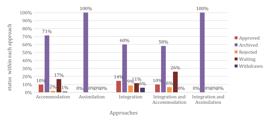
Some important points in Figure 3 suggest that within the 115 bills of law coded as Accommodation, in 2016, 10% became Ordinary Laws, 71% were archived and 17% were still waiting to be assessed. There were only two bills coded under the Assimilation lens, and they were both archived, meaning 100% of the bills had been dismissed.
In Integration, we found 35 proposals, where 14% became Ordinary Laws, 60% were archived, and 11% were still waiting for appreciation, in 2016. The 31 bills of law coded as Integration and Accommodation had 10% approved, becoming Ordinary laws, 26% were still waiting and 60% were archived.
Proportionally, Integrationist bills of law were slightly more approved than Accommodationist ones, even though Accommodationist ones had more bills of law, in absolute numbers.
Status: Approved
Figure 4 shows us only the approved bills of law, which account for 19 bills out of 183, in 2016. As we can see, there were no Assimilationist bills of law turned into Ordinary Laws, which might indicate that Assimilation strategies were only weakly present in the legislative arena, and Assimilation was not a strong characteristic of how the Brazilian Parliament managed racial segregation in the period analyzed.

There were mostly purely Accommodationist bills of law, accounting for 58% of the total approved ones. Followed by 26% that are purely Integrationist, and 16% that were coded as Integration and Accommodation.
Status: Not Accepted
Here, we observe the merging of rejected and withdrawn bills of law, where 28% were coded as Accommodationist; 43% as Integrationist and 29% as the hybrid Integration and Accommodation. Interestingly, the Integrationist propositions form the proportional majority, despite Accommodation comprising most of the total observations.

Not Accepted bills of law: bills that were rejected or withdrawn by the author (Monteiro, 2016, p. 41).
Status: Archived
Among the Archived proposals, 67% were coded as Accommodation, 17% were Integrationist, 14% as the hybrid Integration and Accommodation, and this is the only place we observe the 1% Assimilation and its hybrid with Integration. These two are represented by PL 2102/1989 and PL 278/1971, where the first one seeks to institute a date to celebrate the three “founding races”, aligned with the racial democracy discourse; and the second one sought to forbid the mentioning of skin color in the national census, a common practice in Assimilationist strategies (Brasil, 1971, 1989).
Nevertheless, the Assimilationist approach, either purely or associated with integration, was likely not revisited by their authors.

Status: Waiting
These comprise the bills of law awaiting consideration at various stages of the legislative process, whether in a committee, in plenary, or in the Senate or the Chamber of Deputies. Here, we observed, in 2016, 31 bills of law, where 61% was coded as Accommodation, 26% as Integration and Accommodation, and 13% as purely Integration. Maybe, here, we observe more evidence that the legislative power was more inclined toward Accommodationist and hybrid Integration-Accommodation bills of law.

A deeper look: democracy and authoritarianism, authors, political parties, and geographic region
In this section, I take a closer look at the data by cross-analyzing the bills of law in light of several factors: the president in office during each period, given the frequent interplay between legislative and executive powers; whether the government was democratic or authoritarian; and the authors of the proposals, together with their regional and political affiliations.
Democratic and Authoritarian periods
The period between 1946 and 1964 is historically comprehended as a democratic one, where free and direct elections occurred and it started right after the “Estado Novo”, a period, when Getúlio Vargas, former Brazilian president, led an authoritarian government with the dissolution of National Congress, the elimination of political parties, including the Frente Negra Brasileira, and an overall control over various governmental institutions.
Hence, the period from 1946 to 1963, right before the Military coup, is referred to as “Democracy 1”. On March 31st, 1964, Brazil’s democratically elected government was overthrown by the military, and the military dictatorship started. That authoritarian period lasted for around 20 years, until 1984, when there was a slow process towards direct elections and democracy again. The period from 1964 to 1985 is classified, in this study, as the “Dictatorship”. The last military president left office in 1984 and, from that year, until 2012, the last period covered by the database, it was classified as “Democracy 2”.
The table below offers us an overview of the bills of law according to the above-mentioned periods:
All Bills of Law distributed according to the type of government (Machado and Monteiro, 2015, p. 44).
As shown in Table 2 most bills of law were coded as Accommodation across all periods, and in Democracy 2 they represented more than half of all bills. This trend becomes clearer in the graph below, where the combined total of purely and hybrid Accommodationist bills of law accounts for 60% of the proposals.

Proportional distribution of all Bills of Law according to the type of government: democratic or authoritarian (Monteiro, 2016, p. 45).
I now turn to a closer examination of each period, beginning with Democracy 1. In this period, represented in Table 3, with the reopening of the Brazilian Parliament, we had 13 bills of law presented with the approval of two Accommodationist bills and an Integrationist one, totaling three.
All Bills of Law presented in Democracy 1 by Status and Approach. All bills of law presented in the first democratic period (Monteiro, 2016, p. 46).
Table 4 highlights an interesting finding: during the military dictatorship, most bills of law were Accommodationist, contrary to the initial hypothesis that more Integrationist proposals would be expected, given the government’s nationalist project and its reliance on the myth of racial democracy. Nevertheless, of the 32 bills of law introduced during this authoritarian period, only one was approved, and it was classified as purely Integrationist (as shown in Table 4). The others were either archived or rejected.
In other words, although a larger number of Accommodationist bills of law were presented, the approved ones carry greater weight, since they became actual laws—indicating that the nationalist project was ultimately more closely aligned with Integration.
All Bills of Law presented in the Dictatorship by status and approach. All bills of law in the dictatorship by status and approach. Source: Adapted by the author from Machado and Monteiro (2015).
Table 5 presents the data on the second democratic period, Democracy 2. Overall, there is a general tendency towards the increase in legislative production of the theme, something that was pointed out by Machado and Monteiro (2020). Regarding the approaches, Accommodationist ones became more prominent. This trend might be explained by the pressures made by the Brazilian Black movement and the creation of tools and strategies to fight racism and racial inequality in the political sphere, strengthening these pressures. It also reflects the expansion of freedom of speech following the authoritarian period. In this period, 15 propositions were approved, accounting for 79% of all approved bills in the dataset —and they were classified either as Accommodation or as a combination of Accommodation and Integration.
Table 6 shows that, proportionally, Democracy 1 approved more bills than any other period. However, in absolute terms, Democracy 2 accounted for the largest number of approved bills —15 out of 19—, and the legislative production of the period accounts for 75% of the total bills.
Who were the main proponents of these race-related bills of law?
Figure 9 displays the ten authors who introduced the largest number of bills of law. Senator Paulo Paim stands out as the most active, representing the southern state of Rio Grande do Sul—a region, as noted earlier, with a smaller black population. He authored 18 bills of law in total: 12 Accommodationist, 4 combining Integrationist and Accommodationist approaches, and 2 Integrationist.

Following Paim, former Federal Deputy, Benedita da Silva, representing the state of Rio de Janeiro, in the Southeast region, presented 9 bills of law, eight Accommodationist and one Integrationist–Accommodationist.
In third place is Luiz Alberto Silva Santos, a prominent figure in the Black Movement who passed away in 2023. He represented Bahia, in the Northeast, the region with the largest black population in the country. He introduced eight bills of law: five Accommodationist and three Integrationist. Across all authors, the predominance was of Accommodationist proposals. There were also two bills of law from the Executive branch, coded as Integrationist and Accommodationist.
Paim and Santos presented the most Integrationist propositions in comparison to the others, with three and two bills, respectively. In fact, both are from the Worker’s Party (Partido dos Trabalhadores, PT). This is contrary to our first belief, given that normally, and in line with what has been discussed so far in this research, Accommodationist propositions were thought to be more aligned with Left-wing parties.
Another perspective on the authors of the bills, shown in Figure 10, focuses on those whose proposals were approved. Most authors had only one bill of law approved, with the exception of Serys Slhessarenko, Senator for Mato Grosso from 2003 to 2011, who had two Accommodationist bills approved.

Paulo Paim and Benedita da Silva are the only parliamentarians who appear in both Figure 9 and Figure 10. Despite having introduced many bills of law, each had only one approved, both classified as Accommodationist.
Political Parties and Ideological Agenda
As discussed previously, ideological orientation is a complex field, and each political party carries layers that make it difficult to categorize neatly as left-, right-, or center-oriented, especially when context and historical period are taken into account. Nevertheless, for the purposes of this analysis, I adopt the classification proposed in (Machado and Monteiro, 2015), while emphasizing that it reflects the political context of its time. For instance, MDB and PMDB are essentially the same party: during the military dictatorship, MDB functioned as the opposition, but in the subsequent democratic years it became increasingly aligned with a center-right or right-wing orientation. Based on this, the parties were grouped as follows: left-wing—PT, PDT, PCdoB, PV, MDB, PSB, PCB, PMN, PSOL, and PPS; center—right-wing— UDN, DEM, PDC, PP, PPB, PR, PRN, PSC, and PSP.10 It is also important to note that some parties were either dissolved or not identified, and that some bills of law originated from the Executive branch. Figure 17 below presents all bills of law by political party.

Partido dos Trabalhadores - PT, presented most of the bills of law on race. With 25% Accommodationist, 7% Integration–Accommodation, and 5% Integrationist. Below, according to the ideological orientation of the political party (Figure 12).

Figure 12 presents that, overall, Left and Right-wing parties produced more bills of law, and they were mostly Accommodationist. Parties more aligned in the Center presented 7% Accommodation and Integration. This is another interesting result, since Right-wing parties were expected to produce more Integrationist and/or Assimilationist ones.

Again, we see Partido dos Trabalhadores with the highest approval, 8 proposals out of 19, 6 Accommodationist, one Integration and one Integration-Accommodation. Meanwhile, the center approved two propositions, one coded as Accommodation and one Integration and Accommodation. Finally, right-wing parties approved three bills of law, one Accommodation, one Integration and one Integration and Accommodation. Within the Executive branch, none were purely Accommodationist, only Integration and Accommodation or Integration
Geographic region
As we saw before, each geographic region has a different racial composition. Figure 14 shows us the distribution of the analyzed bills of law according to the region their authors represented and the approach.

On the same line, Table 7 presents the bills of law and their proportional distribution.
Proportionally, the Southeast region proposed the largest number of race-related bills of law. This is partly explained by its greater representation in the Chamber of Deputies, where São Paulo and Rio de Janeiro hold 70 and 46 seats respectively, out of a total of 513. Most bills from this region were coded as Accommodationist (30%), followed by Integrationist (7%). The South ranks second, with 16% of all bills of law, a result consistent with the prominence of Senator Paulo Paim, who represents Rio Grande do Sul. In this region, most bills were Accommodationist (8%), followed by Integrationist (5%). Finally, the Northeast accounted for 15% of all bills of law, 12% of which were Accommodationist.
The next section examines the approved bills of law by region.
Within the bills of law that turned into Ordinary Laws, the Southeast region is the one with the most approved proposals, with 6 bills of law out of 19. From them, 5 were aligned with an Accommodationist approach. Most regions approved more Accommodationist propositions, aside from the South, which approved two Accommodationist and two Integration–Accommodation bills; and the North, which approved one proposal that was coded as Integration.
Conclusion
In conclusion, analyzing how the Brazilian government handles a segregated society unveils intriguing insights into the interplay between political ideology, historical context, and regional demographics. Contrary to the initial expectation, the military dictatorship era, steeped in nationalist rhetoric and the myth of racial democracy, predominantly favored Accommodationist bills of law, though with no success in implementation, having only one Integrationist bill approved in this period. This underscores the nuanced dynamics at play during authoritarian periods.
Moreover, the alignment of political parties with certain legislative approaches adds another layer of complexity. While Left-wing and Right-wing parties tended towards Accommodationist policies, Center counterparts often leaned towards Integrationist agendas. This finding is particularly intriguing, given the anticipation that Right-wing parties were initially thought to be more inclined towards Integrationist and/or Assimilationist policies.
Regional disparities further shape legislative priorities, with areas of higher black and mixed-race (pretos and pardos) populations more inclined towards Accommodationist measures, while others prioritize Integrationist and Assimilationist initiatives.
The regional analysis showed that bills of law that tackled race were not necessarily restricted to where there was a higher concentration of black and mixed-race (pretos and pardos) people. In fact, the production was more concentrated in the regions with the highest number of representatives, like the Southeast region, with the highest production and most of the approved bills of law. The regional analysis also pointed out that all regions were more aligned with Accommodationist bills of law.
These findings not only shed light on historical trends but also raise questions about the efficacy of legislative efforts in addressing societal segregation. Looking ahead, there is a compelling case for extending this analysis to encompass more recent administrations, particularly those of Temer and Bolsonaro, known for their right and far-right alignments, respectively. Exploring legislative trends over the past decade could offer valuable insights into evolving approaches to societal integration and equity and help develop better strategies for a real racial inclusion.
Therefore, by examining nearly seven decades of legislative production, this study contributes to the understanding of how racial inequality has been historically governed in Brazil, while also pointing to the challenges that remain for future democratic consolidation and racial inclusion.
References
- BRASIL. Projeto de Lei 278 Brasília: Congresso Nacional, 1971.
- ___. Constituição da República Federativa do Brasil Brasília: Congresso Nacional, 1988.
- ___. Projeto de Lei 2102 Brasília: Congresso Nacional, 1989.
- ___. Lei n. 10.639, de 9 de janeiro de 2003 Brasília: Congresso Nacional, 2003.
- ___. Lei n. 12.711, de 29 de agosto de 2012 Brasília: Congresso Nacional, 2012.
-
CARVALHO, J. M. Cidadania no Brasil: o longo caminho. Rio de Janeiro: Civilização Brasileira, 2009.
» https://doi.org/10.35699/2525-8036.2020.15391 -
DOMINGUES, P. The Brazilian Black movement: Some historical notes. Tempo, v. 12, n. 23, p. 100–122, 2007. DOI: 10.1590/s1413-77042007000200007
» https://doi.org/10.1590/s1413-77042007000200007 - ___. Movimento negro brasileiro: história, tendências e dilemas contemporâneos. Revista de História da UFES, n. 21, 2008.
- FERNANDES, F. A integração do negro na sociedade de classes 5. ed. São Paulo: Globo, 2008. v. 1
-
FREYRE, G. Casa-Grande & Senzala: Formação da família brasileira sob o regime da economia patriarcal São Paulo: Global, 2003.
» https://doi.org/10.2307/40076717 -
GOMES, N. L. O movimento negro no Brasil: ausências, emergências e a produção dos saberes. Política & Sociedade, v. 10, n. 18, p. 133–154, 2011. DOI: 10.5007/2175-7984.2011v10n18p133
» https://doi.org/10.5007/2175-7984.2011v10n18p133 - GORDON, M. M. Assimilation in American Life. New York: Oxford University Press, 1964. v. 1
- GUIMARÃES, A. S. A. Democracia racial: o ideal, o pacto e o mito. Novos Estudos Cebrap, v. 20, p. 147–162, 2001.
- HOLANDA, S. BUARQUE. Raízes do Brasil Rio de Janeiro: Livraria José Olympio Editôra, 1956.
- INSTITUTO BRASILEIRO DE GEOGRAFIA E ESTATÍSTICA. Censo IBGE 2022. Disponível em: https://censo2022.ibge.gov.br/panorama/mapas.html?localidade=&recorte=N2 Acesso em: 18 apr. 2024.
- MACHADO, C.; MONTEIRO, A. J. F. Tramitação legislativa e a questão racial no Brasil (1946-2014)39 Encontro Anual da ANPOCS. Anais..Caxambu: 2015.
- MACHADO, C.; MONTEIRO, A. J. F. Ação Legislativa. In: MACHADO, C.; CAMPOS, L. A. (Eds.). Raça e Eleições no Brasil Porto Alegre: Editora Zouk, 2020.
-
MCGARRY, J. et al. Integration or accommodation? The enduring debate in conflict regulation In: CHOUDHRY, S. (Ed.). Constitutional Design for Divided Societies: Integration or Accommodation? Oxford: Choudhry, Sujit, 2008. p. 41–88.
» https://doi.org/10.1093/oso/9780199535415.003.0002 - MONTEIRO, A. J. F. The Political Governance of the Brazilian Racial Issue Observing Brazil's legislative production on race through the Assimilation, Integration and Accommodation lenses 2016. University of Antwerp, Antuérpia, 2016.
- ___. Questão racial em Foco: desafios na produção legislativa do Brasil In: JACINTHO, R. (Ed.). Iberografias 36 - Cooperação e Desenvolvimento Territorial Guarda; Lisboa: Centro de Estudos Ibéricos; Âncora Editora, 2019. p. 43–54.
- ___. Black articulations in military dictatorships : Peru and Brazil (1968-1982) 2023. 256 f. Universidade de Coimbra; Universidade Federal do Rio de Janeiro, Coimbra, 2023.
- NASCIMENTO, A. DO. O Genocídio do Negro Brasileiro: Processo de um Racismo Mascarado Rio de Janeiro: Paz e Terra, 1978.
- RAMOS, P. C. Gramática negra contra a violência de Estado: da discriminação racial ao genocídio negro (1978-2018) São Paulo: elefante, 2024.
-
REIS, F. W. Mercado e Utopia Rio de Janeiro: Centro Edelstein de Pesquisas Sociais, 2009.
» https://doi.org/10.7476/9788599662793 -
SANTOS, N. N. D. S. Lei, direito e raça no Brasil : um estudo das matérias legislativas do Congresso Nacional entre 1946 e 2018 2022. Universidade de São Paulo, São Paulo, 2022. Disponível em: https://www.teses.usp.br/teses/disponiveis/2/2140/tde-28092022-113101/ Acesso em: 23 sep. 2025.
» https://doi.org/10.11606/T.2.2022.tde-28092022-113101 - SANTOS, N. N. DA S. A voz e a palavra do Movimento Negro na Assembleia Nacional Constituinte (1987/1988) 2015. Fundação Getúlio Vargas, São Paulo, 2015.
- SKIDMORE, T. Preto no Branco: raça e nacionalidade no pensamento brasileiro. Rio de Janeiro: Paz e Terra, 1976.
- SOUZA, M. F. Representação racial da Câmara dos Deputados: análise de discursos parlamentares da 49a e 50a Legislaturas (1991-1999)” 2009. Universidade de Brasília, Brasília, 2009.
- TRAPP, R. P. A conferência de Durban e o antirracismo no Brasil (1978-2001). Cadernos do CEOM, v. 24, n. 35, 2014.
- VIANNA, H. O Mistério Do Samba. Rio de Janeiro: Zahar, 1995.
-
Funding:
This article is the result of research carried out with funding from the Vlaamse Interuniversitaire Raad/Universitaire Ontwikkelingssamenwerking (VLIR-UOS), as part of the Master’s program in Governance and Development at the Institute of Development Policy, University of Antwerp (IOB-UAntwerpen). The author is currently a Conhecimento Brasil (BCB 1) fellow of the National Council for Scientific and Technological Development (CNPq/Brazil).
-
2
In Portuguese, Bill of Law is Projeto de Lei, commonly abbreviated as PL, in Portuguese.
-
3
A more descriptive approach to the study’s theoretical framework and historical context can be found in the article “Questão racial em foco: desafios na produção legislativa do Brasil” (Monteiro, 2019).
-
4
Traditional communities in Brazil formed by the descendants of enslaved people who escaped captivity and established autonomous settlements known as quilombos. The quilombola communities are recognized by their culture, tradition, territory, and resistance to slavery.
-
5
First, in 1978, the organization was named Unified Movement Against Racial Discrimination, later becoming the Unified Black Movement against racial discrimination and, finally, Unified Black Movement.
-
6
In Brazilian society, the term População Negra is directly translated as "Black population." However, due to the specificities of Brazil’s racial composition and historical construction of race, População Negra encompasses both Pretos (black) and Pardos (brown/mixed-race). This categorization does not always translate neatly into English, which can lead to misinterpretation of the term. Moreover, the Pardos category also refers to people of indigenous descent, making the Brazilian racial composition more complex. With this in mind, and for the purposes of this article, I opted to translate população Negra into "Black population" (capitalized) and the reader should bear in mind its meaning in Portuguese. The same is valid, for Pretos and Pardos (lowercase), translated into “black” and “mixed-race,” respectively.
-
7
The classification of parties into left, center, and right follows the scheme adopted in Machado and Monteiro (2015); Machado and Monteiro (2020): Left-wing: PT, PDT, PCdoB, PV, MDB, PSB, PCB, PMN, PSOL, PPS; Center-wing: PMDB, PSDB, PSD; and Right-wing: ARENA, PTB, PFL, PDS, PL, UDN, DEM, PDC, PP, PPB, PR, PSC, PRN, PSP.
-
8
It should be noted that, ideological orientation in Brazil is historically contingent and often fluid, with parties shifting positions over time — as in the case of MDB, which acted as an opposition party during the dictatorship but later moved toward a centrist or even center-right stance, before reclaiming its original name in recent years. Thus, this categorization should be understood less as a fixed ideological labeling and more as an operational tool to make the analysis feasible, considering the periods in which each party was active.
-
9
To better understand the making of the database, see (Machado and Monteiro, 2015; Machado and Monteiro, 2020).
-
10
Acronyms:Left-wing:Partido dos Trabalhadores, Partido Democrático Trabalhista, Partido Verde, Movimento Democrático Brasileiro, Partido Socialista Brasileiro, Partido Comunista Brasileiro, Partido da Mobilização Nacional, Partido Socialismo e Liberdade, Partido Popular Socialista.Center:Partido Movimento Democrático Brasileiro, Partido Social-Democracia Brasileira. Right-wing:Aliança Renovadora Nacional, Partido Trabalhista Brasileiro, Partido da Frente Liberal, Partido Democrático Social, Partido Liberal, União Democrática Nacional, Democratas, Partido Democrata Cristão, Partido Progressista, Partido do Povo Brasileiro, Partido Republicano, Partido da Reconstrução Nacional, Partido Social Cristão, Partido Social Progressista.
-
Editoria:
Eduardo Dimitrov
The survey data are presented in the body of the document. If you need access to the original data, they can be consulted at the Documentation and Information Center of the Chamber of Deputies. The database built from my analyses is available upon request.


