 Stabilization of a clayey soil from Mosul City with waste glass powder
Abstract
Annually, large quantities of waste glass are being produced throughout the world; some of which are partially recycled, while most of which are conventionally disposed of in landfills. This situation necessitated the development of sustainable solutions for managing waste glass. Recently, extensive studies have investigated the use of waste glass as a sustainable additive to modify various soil types. This study presents the viability of utilizing waste glass powder (WGP) as a sustainable material tBo improve the physical and engineering properties of a low plasticity clay from Mosul City, Iraq, to moderate the cost of improvement and to offer a replacement for waste disposal, which creates an environmental problem in the solid waste disposal areas in Iraq. Initially, waste glass bottles were crushed, ground, and sieved through a #200 sieve, after which they were mixed with clay soil in different proportions. A series of physical and mechanical tests was done on the stabilized soil, including consistency, compaction characteristics, swelling potential, consolidation coefficients, and strength parameters. Results indicate that inclusion of WGP leads to a significant improvement in the maximum dry density, a reduction in the soil's tendency to swell-shrink, and an enhancement in the strength and consolidation parameters of the clay. Moreover, the optimal WGP percentage for improving this type of clay was approximately 10%.
Keywords:
Waste glass powder; Soil stabilization; Sustainable materials
1. Introduction
Clayey soils are classified as problematic soils due to detrimental characteristics, including swelling-shrinkage potential that causes volume change, high plasticity, limited bearing capacity, and high compressibility. These properties jeopardize the performance and durability of existing infrastructure, such as road pavements and construction projects (Alzaidy, 2019). Such soils are typical worldwide, and the annual losses they cause are estimated at billions of dollars. Therefore, it is appropriate to treat such soil to use it as a subgrade material (Perera et al., 2022). Clayey soil modification can be achieved by using one of the following methods: chemical or mechanical treatment. Chemical treatment is achieved using binders such as lime, cement, fly ash, and polymers, which induce chemical transformations that alter the consolidation behavior of clayey soils. Mechanical treatment involves incorporating foreign admixtures, such as fibers, glass, plastic, and rubber, with appropriate physical properties into the treated clay, thereby improving its troublesome properties. This type of modification is considered more eco-friendly than the chemical one because the chemical treatment process can generate soils containing toxic materials due to reactions between soil components and chemical additives, which is the main reason this study used mechanical modification to treat clayey soil.
Waste glass accounts for the largest share of solid waste in landfills, as a huge amount is generated worldwide each year from various human and industrial activities. There are many efforts to recycle and reuse it, but most of it is ultimately disposed of in landfills, thereby increasing pollution worldwide. This issue underscores the need for sustainable solutions and efforts to address the identified waste management challenges. Islam et al. (2017) reported that the amount of waste glass produced worldwide was about 90 million tons in 2005, and 130 million tons in 2007 (Gol & Toufigh, 2019). The Environmental Protection Agency listed that the United States alone produced around 12.5 million tons of waste glass annually (Khan et al., 2018). The Australian National Waste Report states that 1.2 million tons of waste glass were disposed of in Australia in 2018, with only 50% recycled (Pickin et al., 2018). The disposal of waste glass in landfills is considered an environmentally unfriendly option because glass is a non-biodegradable material, taking about 450 years to degrade, leading to permanent accumulation and posing a substantial threat to the environment. Although waste glass is a non-biodegradable material, which is an undesired feature in disposal, it is considered one of the most important characteristics when used in construction as a supplementary material (Džigita & Kestutis, 2021). The option of recycling waste glass is attracting attention worldwide, driven by the many economic and environmental impacts associated with landfills. The inclusion of waste glass is one of the most desirable ways to reuse it as a supplementary additive in clayey soil. Furthermore, it has been found that crushed glass is a high-permeability material with a lower potential to absorb water, a relatively low strain stiffness and lightweight nature, high crushing resistance, and durability. As a result, waste glass is considered an ideal additive material for civil engineering applications (Javed & Chakraborty, 2020). Recycling glass containers can produce about 27% in energy savings and reduce about 37% in global warming gas emissions (Vossberg et al., 2014). Keep in mind that producing new materials from waste glass is a sophisticated process, since this type of waste contains a variety of components, including chemicals, different types of glass with a range of colors and origins, and other types of waste. Moreover, the variety of chemical materials found in different types of waste glass makes the recycling process challenging and uneconomical. These Complications limit the production of new glasses to only about 10-30% of the overall recycled glass, ignoring enormous amounts for other alternatives (Rivera et al., 2018).
In recent years, various studies have examined waste glass, which can be recycled and used with clay to enhance its engineering properties, resulting in significant improvements (Bakht et al., 2021). The influence of glass powder on the consistency and strength of a clay soil has been investigated by Canakci et al. (2016). Glass powder with particle sizes less than 75 μm has been introduced. They found that glass powder has a positive effect on the maximum dry density (MDD) and optimum moisture content (OMC). The swelling potential of the clayey soil decreased with increasing glass powder content. An increase in unconfined compressive strength and California bearing ratio was observed with increasing glass powder content, up to 12%, the highest proportion used in the research. The same findings were obtained for the UCS, CBR, and compaction characteristics, as described by Fauzi et al. (2016), in which a combined addition of plastic high-density polyethylene (HDPE) waste and glass waste was added to the clay soil. Shear strength parameters (c and φ) also improved with increasing the aforementioned combination additives. Nuruzzaman & Hossain (2014) investigated the inclusion of soda-lime glass powder with particle sizes less than 300 μm to enhance soil properties. They found that clayey soil properties improved with the inclusion of glass powder and concluded that the maximum dry density (MDD) increased with increasing glass powder content, while the optimum moisture content (OMC), Atterberg limits, consolidation characteristics (compression index, Cc, and swelling index, Cs), and UCS decreased with increasing glass powder content. Khan et al. (2018) studied the effects of pulverized glass on the geotechnical properties of loose subsoils. They found that recycled glass powder can be used effectively in soil treatment to modify strength parameters, acting as a pozzolanic material when mixed with clay soil particles, thereby providing additional strength. Atterberg limits values decrease with the inclusion of glass powder. MDD increases due to the glass powder's higher density relative to soil, and OMC decreases due to the glass powder's low absorption capacity. They indicated that the optimal amount of glass powder to enhance soil properties was 8%. However, there are limited studies on the use of waste glass to treat clayey soils and alter their engineering properties. In this study, a comprehensive set of mechanical tests has been conducted on clayey soil samples stabilized with waste glass powder at proportions up to 12%, focusing on strength characteristics and consolidation parameters.
2. Materials and experimental program
2.1 Materials
2.1.1 Soil
The low-plasticity clayey soil used in this study was collected from the eastern area of Mosul City, Iraq. It was obtained at a depth of (2.0) m below the ground surface in a disturbed state. The coordinates of the spot used in this study were specified as (36°18′13.8′′ N and 43°12′55.0′′ E), and located at (Latitude 36.303842 and longitude 43.215278). The soil was air-dried, crushed into pieces, and dried in an oven at (105±5°C) for 24 hours to ensure thoroughly dried specimens. The particle-size distribution curve for the soil is shown in Figure 1. According to the Unified Soil Classification System, the soil is low plasticity clay (CL). The indices and physical properties are exhibited in Table 1. according to ASTM standards.

2.1.2 Waste glass powder (WGP)
The other material used in this study was waste glass obtained from the local crushed glass and bottles. The indices and physical properties of glass powder are exhibited in Table 1. It was cleaned initially, then dried in an oven at (105±5°C) for 24 hours to ensure a thoroughly dried material, then ground and subsequently milled with a ball mill to reduce its particle size and obtain a fine powder called cullet, and then sieved the pulverized materials to the specified particle size through a #200 (75 μm) sieve. The particle-size distribution curve is shown in Figure 1. The glass powder material after preparation is shown in Figure 2a.

The chemical composition of WGP varies depending on the source of the glass product used. However, the major constituents are silicon, sodium, and calcium oxides. The chemical composition of the glass is listed in Table 2. This composition demonstrates that the glass is soda-lime. Microstructural investigations have also shown that the glass powder exhibits irregular, flaky shapes, as shown in Figure 2b.
2.2 Sample preparation
In this study, the clayey soil and WGP were thoroughly dried in a (105±5) °C oven for 24 hours first. Different proportions of waste glass powder (0%, 2%, 5%, 8%, and 12% by dry weight of soil) were mixed with the soil. Atterberg limits for the WGP-stabilized soil specimens are shown in Figure 3. The standard compaction test was performed to investigate the compaction characteristics, as represented by MDD and OMC, for different mixture designs, as shown by the compaction curves in Figure 4. All specimens were prepared with a static compaction procedure (Strain-controlled). A strain rate of 0.05 in/min (1.27 mm/min) was used for all tests. In each test, three samples were conducted, and the arithmetic average was adopted for the results. Table 3. shows the preparation of specimens for each test.


Compaction characteristics of WGP stabilized soil specimens: (a) compaction curve, (b) OMC, and (c) MDD.
3. Results and discussion
3.1 Effect of WGP on Atterberg limits
The evolution of the Atterberg limits (LL, PL, and PI) as a function of WGP content, ranging from 0% to 12%, has been investigated. The results are exhibited in Figure 3. and Table 4. As WGP content increases, both LL and PL exhibit a consistent downward trend. LL reduces from 49.00% to 41.90%, while PL reduces from 31.88% to 28.40%. Consequently, the Plasticity Index decreases significantly, from 17.12% to 13.50%, representing a reduction of about 21%, while the linear shrinkage decreases from 10.1% to 5.35%, representing a reduction of about 47%, indicating that the material becomes less plastic as WGP incorporation increases. This behaviour is consistent with conventional soil stabilization using cement or lime, where PI typically decreases due to flocculation and aggregation. Herein, this behaviour is attributed to the WGP particles, which behave as an inner material due to a notable silica content of 72.1%. In contrast, the ability of waste glass particles to absorb water is less than that of clay particles (Blayi et al., 2020; Ikara et al., 2015).
3.2 Effect of WGP on compaction characteristics
Figure 4a presents the standard compaction characteristics, as represented by MDD and OMC, of the clayey soil stabilized with varying WGP contents. The curves exhibit a conventional bell-shaped profile, indicating that the material reaches its maximum density at an intermediate moisture level, beyond which additional water leads to pore saturation and reduced interparticle friction, thereby decreasing dry density. The compaction characteristics of natural clayey soil are described in Table 1; however, Figures 4b and 4c demonstrate the influence of WGP content on OMC and MDD, respectively. At higher WGP proportions, the optimum moisture requirement tends to decrease due to their lower specific surface area relative to natural clayey soils and their ability to form denser microstructures. As well, less water is absorbed by WGP than by clay particles (Blayi et al., 2020; Bilgen, 2020). In contrast, the Inclusion of WGP in the clayey soil increased MDD due to the higher density of the glass powder compared with the natural specimens. However, increasing the glass proportion from 0% to 9% resulted in a slight increase in MDD from 1.63 g/cm3 to 1.71 g/cm3 (with an increase of about 4.9%), indicating improved performance. The plot shows that after reaching the maximum compaction at 9% WGP, the curve declines. This behaviour can be attributed to the low specific gravity of WGP, which substitutes for the clay soil grains. Also, the addition of excessive WGP ratios to the clay soil increased the voids in the soil structure, thereby reducing MDD. Notably, the inclusion of 9% WGP in the clay soil resulted in the highest density (1.71 g/cm3), compared with other proportions; therefore, this ratio can be considered an optimal ratio for improving compaction characteristics of such clay soil. Similar behaviour was reported by Jalal et al. (2022).
3.3 Effect of WGP on unconfined compressive strength
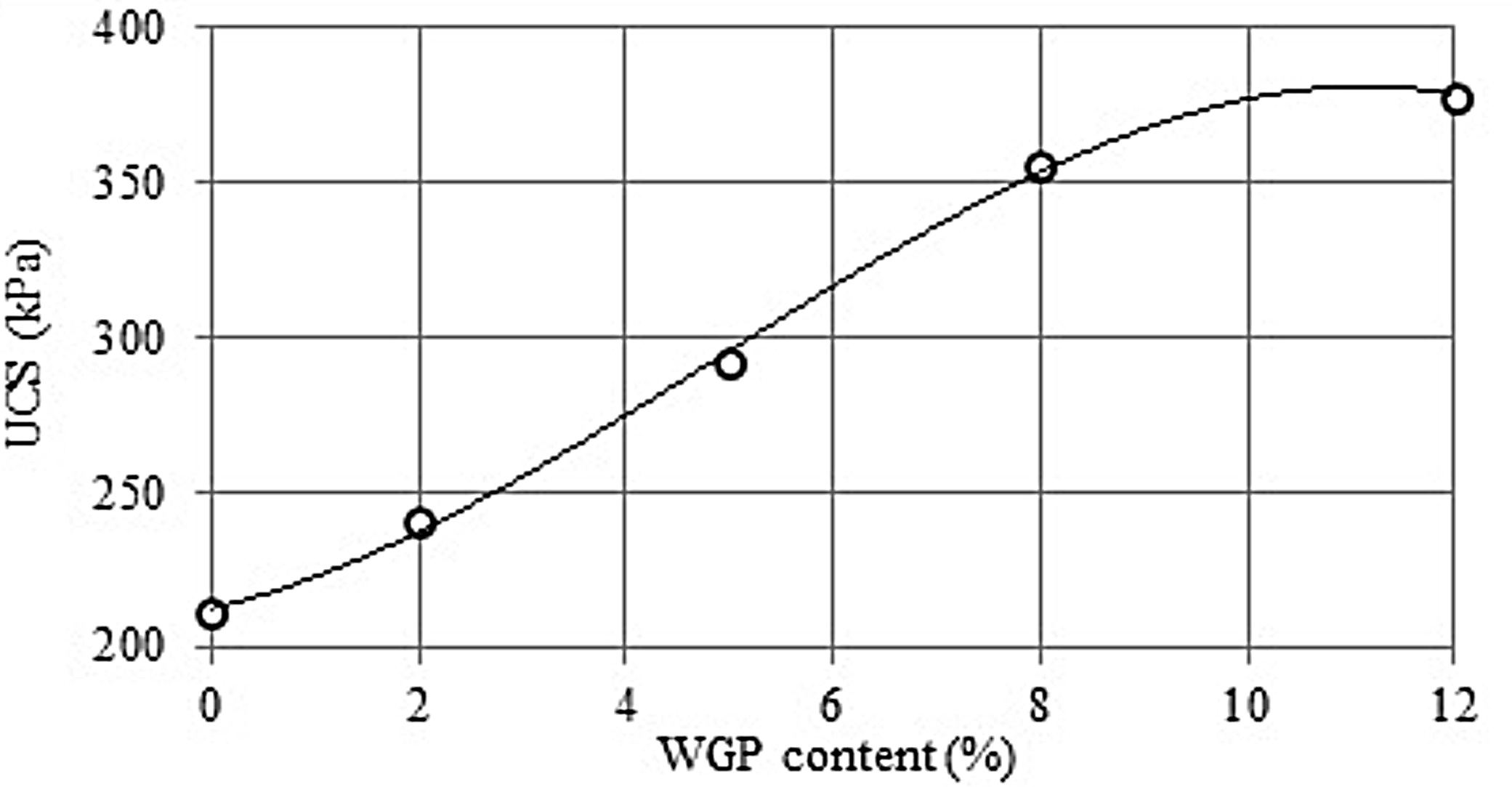
The UCS response of clayey soil stabilized with WGP exhibits a clear dependence, as illustrated in Table 4. Furthermore, Figures 5 and 6 show the axial stress-strain curves and the variation in UCS values of soil specimens with different WGP proportions, respectively. Notably, the UCS increases significantly with WGP content: while natural clayey soil achieves only 211 kPa at 4.0% axial strain, specimens containing 11% WGP attain a peak UCS of 380 kPa at 4.5% axial strain, which represents 1.8 times that of natural soil. This increase may be explained by the fact that more contact surfaces between soil grains and glass powder increase friction and interlocking between clay soil particles and glass powder. In other words, adding 10% glass powder will increase dispersion within the soil structure and increase surface area. This requires additional strength to overcome surface contact resistance within the shearing plane, thereby increasing the unconfined compressive strength. Higher glass powder ratios, however, have enhanced the clay soil composition and the general performance of the specimens, which are governed mainly by the glass powder particles and lack the ability to adhere.


3.4 Effect of WGP on consolidation characteristics
The one-dimensional consolidation characteristics of stabilized soil specimens with different WGP proportions were evaluated using oedometer tests. The plot of void ratio versus effective stress is exhibited in Figure 7. Subsequently, the swell potential, the coefficient of compression (Cc), and the coefficient of swelling (Cs) were determined and listed in Table 5. As shown in the table, adding glass powder to the clay decreased the soil swelling potential. The swelling potential of the natural clay was 40 kPa; when 12% of WGP was added, the lowest swelling potential was 15 kPa. The substitution of glass powder, which is considered insensitive to moisture and an inert silica-based material, with clay soil particles might be the cause of the decrease in swelling potential. This would result in a decrease in particles capable of swelling, as reported also by Jalal et al. (2022) and Nuruzzaman & Hossain (2014).

Furthermore, Figure 7. shows that the variance in the void ratio decreased as the WGP increased with increasing applied effective stress. This may be explained by the samples being prepared at MDD, and the void ratio decreasing as the dry unit weight increased. The coefficient of compression (Cc) decreased from 0.180 m2/kN for natural soil clay to 0.086 m2/kN at 12% WGP content. The coefficient of swelling (Cs) parameter showed a similar pattern, which may be related to the decline in void ratio with increasing load increments. However, due to the cohesionless nature of glass powder, the Cc and Cs decrease as WGP increases, which is a positive indicator of improved clay soil properties. It is obvious that the variation in the reduction in the coefficients begins to gradually decrease as the percentage of WGP increases, until it nearly disappears after reaching a WGP percentage of 10%, which can be considered the optimal percentage for addition.
3.5 Effect of WGP on shear strength parameters
Direct shear test results for stabilized clayey soil specimens with varying proportions of WGP, ranging from 0% to 12%, are illustrated in Figures 8. and 9. Figure 8. shows the relationship between shear strength and effective normal stress for each WGP content. The slope and intercept of these lines correspond to the effective friction angle (φ) and cohesion (c) are shown in Figure 9. It is clear that the inclusion of WGP in the clayey soil significantly affects shear strength parameters; as WGP increases, cohesion decreases from 78 kPa to 20 kPa. This reduction is due to the glass powder's cohesionless nature, resulting from its high silica content. In contrast, the angle of internal friction increases from 22.4º to 29.7º. The observed enhancement in shear strength parameters can be attributed to increased interlocking and interparticle bonding between the roughened surfaces of the glass powder and the clayey soil grains. The substantial increase in friction angle (from 22.4° to 29.7°) is particularly noteworthy, as it suggests that WGP not only binds particles but also enhances the granular structure toward a more angular, interlocked configuration.


4. Conclusions
This study demonstrates the viability of using WGP as a stabilizer for low-plasticity clayey soil to achieve two benefits: reducing waste glass disposal in landfills and using an eco-friendly additive in soil modification. The study findings led to the following conclusions:
-
Due to the low water absorption tendency of WGP, the OMC of the stabilized clay reduced with the increase of WGP, while the MDD increased, which is because of the higher density of the glass powder. However, a reduction in MDD was observed as the glass powder percentage increased from 9% to 12%, which may be due to an increase in pore space within the soil texture. It can be seen that the optimal WGP ratio to achieve the highest compaction characteristics is 9%.
-
Inclusion of WGP up to 11% improved the unconfined compressive strength (UCS) to upper limits due to the improvement in the contact resistance (friction and interlocking) between soil particles and glass grains. After this proportion, the UCS curve tends to decrease slightly due to an increase in pore space resulting from clustering of the glass powder within the soil structure.
-
Swelling-shrinkage values of the clayey soil were reduced when the soil was mixed with WGP, which is related to the fact that glass grains have less tendency to swell-shrink compared to soil particles. The angularity of grains enhanced mechanical interlock within the soil texture, thereby reducing overall swelling-shrinkage behavior.
-
Inclusion of WGP up to 12% led to a reduction in the coefficient of compression (Cc) and the coefficient of swelling (Cs) by about 50%. The amount of variation in the reduction that occurs in the coefficients begins to gradually decrease as the percentage of WGP increases until it begins to approximately disappear after reaching a glass percentage of 10%, which can be considered the optimal percentage for addition
-
Inclusion of WGP into the clayey soil had a significant influence on the shear strength parameters (c and φ). An increase in the WGP leads to a decrease in cohesion, due to the high silica content and the resulting cohesionless WGP. The angle of internal friction increases due to enhanced interlocking between angular glass-powder grains and clay soil particles.
-
Although WGP in this study was used to stabilize soil from Mosul City, Iraq, it is still considered a new approach to be used locally, specifically because in many projects, when clayey soil is encountered at the site, in most cases, the choice is to replace it with other types of soil with more suitable engineering properties without modifying it. Selecting WGP enables the use of a low-cost, sustainable material to stabilize and improve this type of soil. Further studies are needed to investigate the impact of the WGP on the engineering properties of other soil types and to conduct larger-scale tests with more samples.
List of symbols and abbreviations
eo: Initial void ratio
c: Cohesion
c': Effective cohesion
wL: Liquid limit
wP: Plastic limit
CBR: California Bearing Ratio
Cc: Compression index
CL: Low plasticity clay
Cs: Swelling index
HDPE: high-density polyethylene
IP: Plasticity index
ML: Low plasticity silt
OMC: Optimum moisture content
SEM: Scanning electron microscope
UCS: Unconfined Compressive Strength
WGP: Waste glass powder
γd max, MDD: Maximum dry density
φ: Angle of internal friction
φ': Effective angle of internal friction
Acknowledgements
The authors would like to acknowledge all the staff of the geotechnical engineering laboratory at the College of Engineering, University of Mosul, for their assistance, support, and provision of facilities during the experiments for this research.
Data availability
All data produced or examined in the course of the current study are included in this article.
Declaration of use of generative artificial intelligence
References
- Alzaidy, M.N.J. (2019). Experimental study for stabilizing clayey soil with eggshell powder and plastic wastes. Materials Science and Engineering, 518, 22008.
- ASTM D2166. (2016). Standard test method for unconfined compressive strength of cohesive soil ASTM International, West Conshohocken, PA.
- ASTM D2487. (2017a). Standard practice for classification of soils for engineering purposes (unified soil classification system) ASTM International, West Conshohocken, PA.
- ASTM D4318. (2017b). Standard test methods for liquid limit, plastic limit, and plasticity index of soils ASTM International, West Conshohocken, PA.
- ASTM D6528. (2017c). Standard test method for consolidated undrained direct simple shear testing of fine grain soils ASTM International, West Conshohocken, PA.
- ASTM D6913. (2017d). Standard test methods for particle-size distribution (gradation) of soils using sieve analysis ASTM International, West Conshohocken, PA.
- ASTM D4546. (2014a). Standard test methods for one-dimensional swell or collapse of soils ASTM International, West Conshohocken, PA.
- ASTM D559. (2014b). Standard test methods for specific gravity of soil solids by water pycnometer ASTM International, West Conshohocken, PA.
- ASTM D698. (2014c). Standard test methods for laboratory compaction characteristics of soil using standard effort ASTM International, West Conshohocken, PA.
- Bakht, Z., Asim, F., & Beenish, J. (2021). Effect of waste glass powder on the swelling and strength characteristic of karak expansive clay. Sir Syed University Research Journal of Engineering & Technology, 11(2), 1-8.
- Bilgen, G. (2020). Utilization of powdered glass as an additive in clayey soils. Geotechnical and Geological Engineering, 38, 3163-3173.
- Blayi, R.A., Sherwani, A.F.H., Ibrahim, H.H., Faraj, R.H., & Daraei, A. (2020). Strength improvement of expansive soil by utilizing waste glass powder. Case Studies in Construction Materials, 13, e00427.
- BS 1377-2. (1990). Methods of test for soils for civil engineering purposes, part 2: classification test British Standards Institution, London.
- Canakci, H., AL-Kaki, A., & Celik, F. (2016). Stabilization of clay with waste soda lime glass powder. Procedia Engineering, 161, 600-605.
- Džigita, N., & Kestutis, B. (2021). Utilization of waste glass powder in cement mortar. Environmental Sciences Proceedings, 9(25), 1-4.
- Fauzi, A., Djauhari, Z., & Fauzi, U.J. (2016). Soil engineering properties improvement by utilization of cut waste plastic and crushed waste glass as additive. ACSIT International Journal of Engineering and Technology, 8(1), 15-18.
- Gol, M.S., & Toufigh, V. (2019). Feasibility study of sandy soil stabilization with glass powder and natural pozzolan based geopolymer. Amirkabir Journal of Civil Engineering, 51(1), 57-60.
- Ikara, I., Kundiri, A., & Mohammed, A. (2015). Effects of waste glass (WG) on the strength characteristics of cement stabilized expansive soil. American Journal of Engineering Research, 4, 33-41.
- Islam, G.M., Rahman, M.H., & Kazi, N. (2017). Waste glass powder as partial replacement of cement for sustainable concrete practice. International Journal of Sustainable Built Environment, 6(1), 37-44.
- Jalal, F.E., Zahid, A., Iqbal, M., Naseem, A., & Nabil, M. (2022). Sustainable use of soda lime glass powder (SLGP) in expansive soil stabilization. Case Studies in Construction Materials, 17, e01559.
- Khan, M.S., Tufail, M., & Mateeullah, M. (2018). Effects of waste glass powder on the geotechnical properties of loose subsoils. Civil Engineering Journal, 4(9), 2044-2051.
- Nuruzzaman, D., & Hossain, M.A. (2014). Effect of soda lime glass dust on the properties of clayey soil. Global Journal of Researches in Engineering, 14(5), 210-219.
- Perera, S.T., Saberian, M., Zhu, J., Roychand, R., & Li, J. (2022). Effect of crushed glass on the mechanical and microstructural behavior of highly expansive clay subgrade. Case Studies in Construction Materials, 17, e01244.
-
Pickin, J., Randell, P., Trinh, J., & Grant, B. (2018). National waste report 2018 Retrieved in July 16, 2026, from https://www.environment.gov.au/system/files/resources/7381c1de-31d0–429b-912c-91a6dbc83af7/files/national-waste-report-2018.pdf
» https://www.environment.gov.au/system/files/resources/7381c1de-31d0–429b-912c-91a6dbc83af7/files/national-waste-report-2018.pdf - Rivera, J.F., Cuarán, Z.I., Bonilla, N.V., & Gutiérrez, R.M. (2018). Novel use of waste glass powder: production of geopolymeric tiles. Advanced Powder Technology, 29(12), 3448-3454.
- Javed, S.A., & Chakraborty, S. (2020). Effects of waste glass powder on subgrade soil improvement. World Scientific News, 144, 30-42.
- Vafaei, M., & Allahverdi, A. (2017). High strength geopolymer binder based on waste-glass powder. Advanced Powder Technology, 28(1), 215-222.
- Vossberg, C., Mason-Jones, K., & Cohen, B. (2014). An energetic life cycle assessment of C&D waste and container glass recycling in Cape Town, South Africa. Resources, Conservation and Recycling, 88, 39-49.
#
Corresponding author. E-mail address: mohammed.kamil@uomosul.edu.iqEditor:
Declaration of interest