 A data-driven approach linking the credible failure modes for tailings storage facilities risk assessment supported by decision tree assessment
Abstract
This study proposes a methodology to evaluate correlations between credible failure modes and risk controls for Tailings Storage Facilities (TSFs), considering its characteristics and similarity. Additionally, this research proposes a decision tree framework developed to serve as a reference for analyzing credible failure modes during the risk assessment of a TSF. A dataset of 66 collapsed TSFs with known failure modes was analyzed. Variables included processed ore type, construction material and method, height, volume, seismic risk, and climate. The dataset was assessed for representativeness and to identify potential correlations for predicting structure behavior related to failure modes. Results showed that 21% of dams failing due to seismic liquefaction were in very high seismic risk zones, with 18% located in temperate climates. Upstream construction methods exhibited significant associations with static liquefaction (21%), seismic liquefaction (19%), and overtopping (12%). Regarding dam material, 15% of failures due to seismic liquefaction involved specific materials. Height and volume had minimal influence on failure modes within the analyzed dataset. These findings demonstrate the influence of structural characteristics on failure modes, enabling the correlation of applicable risk controls with TSF management and governance.
Keywords
Tailings storage facility; Credible failure mode; Risk assessment
1. Introduction
Risk assessment is fundamental to the management of Tailings Storage Facilities (TSFs), as it directly influences the understanding of potential failure mechanisms. According to ICMM (2021), identifying credible failure modes is the first step in implementing effective risk management measures and mitigating consequences. Huang et al. (2020) define failure mode analysis as a systematic method for identifying how and why a system might fail.
Among the most recurrent failure modes in TSFs are liquefaction (both static and seismic), structural failures, piping, and overtopping. Simms (2021) discusses the mechanics of unsaturated soils and the role of drying in the stability of tailings stacks, highlighting how matric suction directly affects the strength and liquefaction potential of these structures.
D’Hyppolito et al. (2024) propose a simplified method for evaluating the probability of liquefaction in TSFs by combining limit equilibrium analysis (Spencer, 1967) with FOSM probabilistic techniques. Their risk estimates reached approximately 36% for the Fundão Dam (Mariana) and 47% for the Feijão Dam (Brumadinho), values significantly above commonly accepted safety thresholds.
The Global Tailings Review (GTR, 2020) introduces the concept of credible failure modes throughout a TSF’s lifecycle, emphasizing how factors such as foundation materials, geometry, drainage, and water management shape these mechanisms. It is acknowledged that such modes may evolve as operational conditions change, and the term “credible” does not necessarily imply high probability or structural unsafety.
Despite the predominance of deterministic approaches, recent studies such as Schatz et al. (2023) underscore the need to incorporate probabilistic techniques and advanced numerical analyses that address geotechnical variability and design uncertainties.
Although several contributions have advanced the understanding of credible failure modes, much of the literature remains anchored in deterministic approaches that focus on limit equilibrium analyses or prescriptive safety factors. This has been increasingly criticized for not capturing the inherent variability of geotechnical conditions or the uncertainty in tailings dam performance. Recent studies have emphasized the importance of probabilistic methods and reliability-based frameworks (Schatz et al., 2023; D’Hyppolito et al., 2024), arguing that they provide a more realistic representation of risk. In this context, the present study positions itself within this ongoing debate by proposing a methodology that combines statistical correlation analysis and a K-Nearest Neighbors (KNN) algorithm to explore predictive patterns, complemented by a logical Decision Tree Assessment (DTA) to translate these insights into practical risk management tools. This integration seeks to overcome the limitations of purely deterministic approaches while maintaining transparency and applicability in dam governance.
These contributions demonstrate that, although the identification of credible failure modes is essential, a deeper understanding of mechanisms related to liquefaction, drying, and probabilistic modeling provides a more robust and informed basis for risk assessment. This study proposes a methodology based on data from 66 collapsed TSFs, exploring the relationships between structural characteristics and failure modes, supported by an analytical framework (DTA) aligned with current technical literature.
This work differs from previous studies in three main aspects: (i) the use of the dataset processed by Matos (2023), which selected 66 tailings dams with consistent information, overcoming the limitations of databases such as WISE, ICOLD, and CSP2; (ii) the integration of different methodological approaches, combining statistical analysis, machine learning through KNN, and logical evaluation by means of Decision Tree Assessment (DTA); and (iii) the focus on structural variables of the dams (such as construction method and materials), which proved to be decisive in the characterization of credible failure modes and in the guidance of risk controls. Thus, this study advances the state of the art by providing a robust analytical framework that connects the physical characteristics of the structures to practical risk management strategies.
1.1 Credible failure mode
Accurately identifying failure modes is crucial for pinpointing controls that can reduce the likelihood of failure occurrence. ICMM (2021) defines a credible failure mode as one where the associated mechanism triggers an event that leads to the resulting failure. TSFs face several common failure modes, as outlined below:
-
Liquefaction: As highlighted by Robertson & Fear (1997), liquefaction is a significant concern for TSFs built on sandy soils. This phenomenon involves sudden loss of strength in loose sands, causing them to flow like a slurry when disturbed. It can be triggered by applied stress, a rapid change in stress conditions (static liquefaction), or earthquakes (seismic liquefaction). The Fundão Dam failure, which occurred in 2015 in Brazil, and the Brumadinho Dam failure, which occurred in 2019, also in Brazil, are examples of this type of failure. Both structures, built using the upstream method (CSP2, 2024), utilized sandy soils.
-
Structural failure: This occurs due to weaknesses in the TSF itself, its foundation, or its abutments. ICMM (2021) mentions factors like brittle materials or excessive settlement in soft zones as potential causes. This failure mode is more common in facilities with poor foundation permeability, leading to increased pore pressure and reduced strength. The 2014 Mount Polley dam failure in Canada is considered a structural failure caused by a foundation defect. The dam was constructed using the centerline method (CSP2, 2024).
-
Piping: ICOLD (2017) defines piping as the erosion of internal soil particles within a dam or its foundation due to seepage flow. This failure often occurs during initial filling as weaknesses are exposed by rising water levels. ICMM (2021) emphasizes the importance of considering both physical and chemical aspects of TSFs throughout their lifecycle to prevent piping failures. The failure of the Ajka Alumina Dam in 2010 in Hungary, constructed using the downstream method (CSP2, 2024), represents a classic case of piping failure.
-
Overtopping: This typically results from extreme storms or landslides within the impoundment. ICMM (2021) stresses the importance of adequate freeboard and considering all design, construction, operation water management, and closure criteria uncertainties to ensure safety against overtopping failure. The Merriespruit Dam (Africa), built in 1978, experienced a breach in its dam wall following heavy rain in 1994 (CSP2, 2024).
Risk controls for these failure modes need to be tailored to each specific scenario, considering various conditions that indicate potential failure. This research aims to support the identification of credible failure modes as a reference for establishing minimum and specific risk controls required for each mode, considering key structural characteristics and the Tailings Governance Structure. To understand dam failure and enhance the understanding of the relationship between TSF characteristics and failure modes, various databases were consulted, as described in the following section.
1.2 Tailings dataset
Analysis of tailings dam (TSF) failure data from databases like ICOLD (2019), WISE (2024), and CSP2 (2024) confirms dam failure as a credible failure mode. This research aims to identify characteristic differences between failed and non-failed TSFs recorded in these databases. This will help establish representative features to improve our understanding of TSF risks and inform the implementation of appropriate risk controls for enhanced safety.
Several databases were consulted for this study:
-
WISE (2024): Established in 1961, WISE provides detailed incident reports for 157 tailings dam failures. It includes information on ore type, incident type, tailings release, and associated impacts. However, WISE lacks in-depth data on failed dam characteristics and is not optimized for statistical analysis.
-
ICOLD Bulletin 99 (ICOLD, 2019): This update by ICOLD offers a valuable approach using statistical analysis of dam failures. However, the database includes not only TSFs but also other dam types, encompassing 322 failure cases from 1884 to 2018. For this research, the relevant aspects are the incident context and registered failure modes (foundation failure (17%), internal erosion (25%), overtopping (24%), structural failure (27%), and unknown (7%)).
-
CSP2 (2024): This database is a comprehensive record of tailings dam failures globally, with 368 cases documented from 1915 to 2022. It includes dam failures resulting in over 3,241 fatalities and the release of more than 250 million cubic meters of contaminated material downstream. Notably, CSP2 (2024) data indicates a significant increase in failures after 2000 (113 dams).
The Matos (2023) database was ultimately chosen for this research due to data quality concerns in other sources. Matos (2023) rigorously treated data from the CSP database, addressing issues of incomplete information and missing data for many dams. This resulted in a focused dataset of 66 tailings dams.
The Matos (2023) database includes the following information for each TSF: type of ore processed, dam construction material and method, dam height, stored tailings volume, and failure mode. Additionally, Matos (2023) incorporated two key variables: seismic risk level (classified as very low to very high) and prevailing climate conditions (based on the widely used Koppen classification system). Seismic risk data was obtained from the Socioeconomic Data and Applications Center (SEDAC), a NASA resource, while climate data was categorized according to the Koppen classification, as outlined by Rolim et al. (2007).
1.3 Risk controls
ICMM (2021) defines risk controls as a series of measures implemented to either prevent unwanted events (like dam failures) from occurring or to minimize their negative consequences if they do happen. Critical controls, as per ICMM (2021), are those essential for preventing undesirable events or significantly reducing their impact. Even with other controls in place, the absence or failure of critical controls can dramatically increase the risk.
The effectiveness of implemented controls significantly influences whether a credible failure mode translates into a catastrophic failure. ICMM (2021) associates catastrophic failure with flow failures, which lead to severe consequences upon occurrence.
Silva & Meguet (2021) emphasizes, using examples like Fundão and Brumadinho dam failures, that conventional TSF failures can have far-reaching spatial, temporal, and territorial consequences that are not easily resolved. Given the severity of impacts, the complexity of problems, and potential conflicts arising from dam and disaster risks, geographical and socio-environmental studies offer a valuable opportunity for interdisciplinary exploration.
Credible failures can differ significantly between conventional dam-like TSFs and non-conventional TSFs, as shown by Machado (2017). Retro analyses of the Fundão Dam failure by these researchers revealed discrepancies in peak flow results due to differing breach widths used in each analysis. However, they reached agreement on the wave propagation distance and maximum wave height.
Silva & Meguet (2021) investigated credible failure scenarios for a “Stack Break” facility, simulating a complete collapse. They observed limited potential for mobilized material movement after the initial rupture. This resulted in the rapid filling of the downstream valley, followed by a quick stop in a new stable configuration. This case study provides valuable insights for developing appropriate Emergency Preparedness and Response Plans (EPRPs) that consider the magnitude of potential impact scenarios.
Identifying credible failure modes for a Tailings Storage Facility (TSF) is extremely important to allow the selection of appropriate controls to mitigate failure risks during tailings management and the establishment of governance practices aligned with the company’s organizational structure.
The credible failure modes assessment of Tailings Storage Facilities (TSFs) can be supported by a Decision Trees Assessment (DTA) to help visualize the sequence of events that could lead to failure, incorporating both technical and operational controls. This method enhances transparency and consistency in the evaluation process by breaking down the system into discrete decision points and outcomes. Each branch of the tree represents a potential pathway, allowing practitioners to assess the likelihood and consequences of various failure modes, such as liquefaction, structural failure, overtopping or piping.
The use of decision trees in TSF risk assessment aligns with best practices in risk-informed decision-making, as recommended by ICMM (2021). These frameworks emphasize the importance of identifying credible failure modes and understanding their triggers, which decision trees facilitate by integrating expert judgment, historical data, and site-specific conditions.
Moreover, decision trees can serve to establish a flow for communication among stakeholders, including engineers, regulators, and community representatives, by clearly illustrating how different factors contribute to overall risk. Their adaptability also allows for integration with Failure Mode and Effects Analysis (FMEA), further strengthening the robustness of TSF risk assessments.
2. Materials and methods
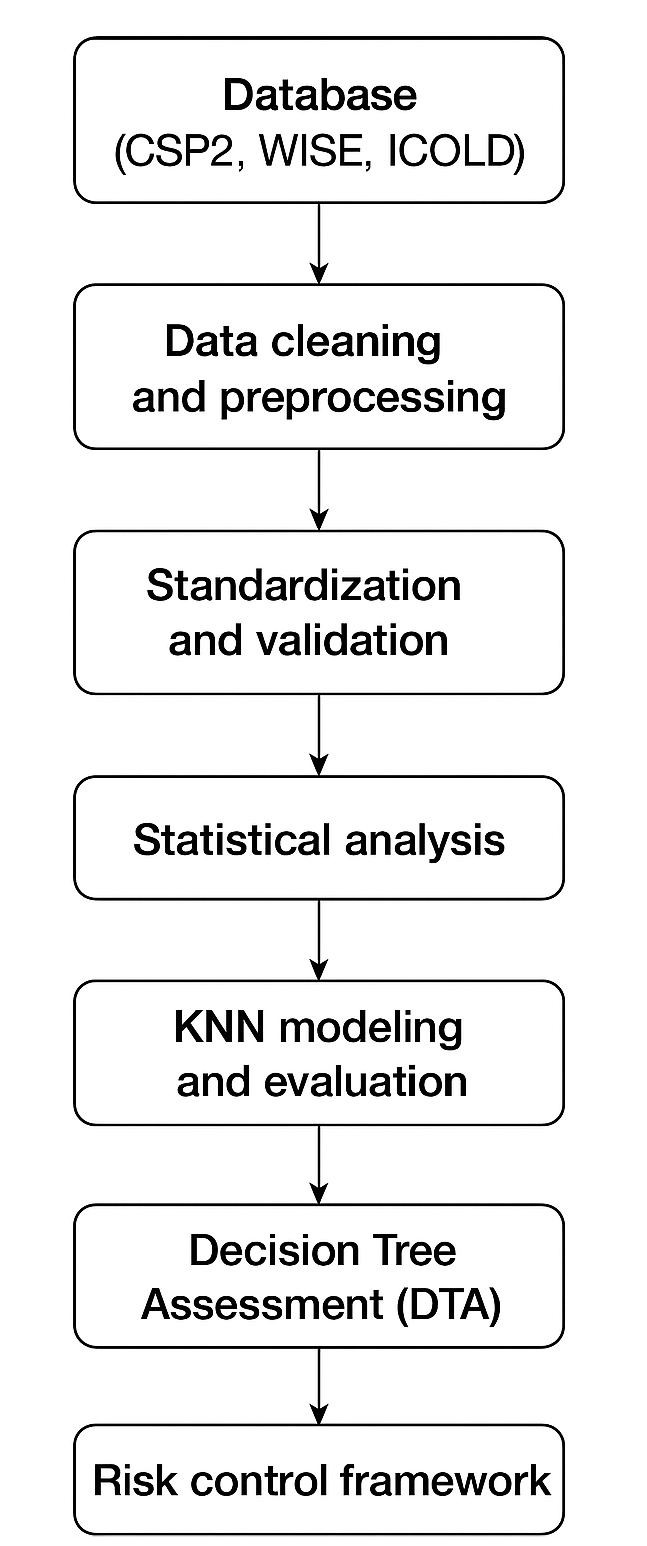
This section provides a detailed description of the methodology employed to identify plausible failure modes in a tailings storage facility (TSF) database, using the methodological approach proposed by Matos (2023). The flowchart in Figure 1 sequentially illustrates the methodological steps adopted in this study. The main objective of this analysis is to evaluate the effectiveness of risk controls implemented in tailings management and governance, aiming to contribute to operational safety and risk minimization associated with these structures.
2.1 Data collection and processing
The initial stage consisted of the systematic collection of data from multiple public sources (WISE, 2024; ICOLD, 2019; CSP2, 2024), resulting in a preliminary dataset of 28 Tailings Storage Facilities (TSFs) with complete and consistent information. This initial dataset served as the foundation for developing standardization protocols and data cleaning procedures.
However, for the main analysis of this study, the consolidated database by Matos (2023) was adopted, comprising 66 collapsed TSFs that underwent rigorous treatment from the CSP2 source. This comprehensive database included detailed information on:
-
The type of ore stored,
-
Materials and methods used in dam construction,
-
Height and volume of the structures,
-
Seismic risk assessment related to the locations,
-
Regional climatic characteristics,
-
Historical records of failure modes.
The data underwent a rigorous cleaning and preprocessing procedure, which included:
-
Eliminating or correcting inconsistencies,
-
Handling missing data through appropriate techniques,
-
Normalizing and standardizing variables to ensure compatibility across different datasets.
This enhanced dataset ensured greater representativeness and reliability for subsequent analyses, enabling the application of advanced modeling techniques such as machine learning algorithms and statistical models that rely on data quality and consistency to produce reliable predictions of failure modes.
2.2 Model selection and evaluation
The methodology adopted by Matos (2023) was based on a database developed from CSP2 (2024), which compiles information on 368 dam failures worldwide since 1915. Due to incomplete or inconsistent data, the final analysis focused on 66 dams with adequate information for modeling.
Various combinations of variables were tested as inputs to train predictive models using the K-Nearest Neighbors (KNN) algorithm implemented in Python. This method evaluates the proximity between data points to classify new instances based on their closest neighbors.
The models were rigorously assessed using the accuracy metric, representing the proportion of correct classifications made by the model. The most effective model, which excluded the volume variable and used three neighbors for classification, achieved an accuracy rate of 71%.
In parallel, an evaluation of risk controls implemented in non-failed TSFs was carried out, considering their capacity to mitigate identified risks and enhance facility resilience. This analysis considered both the likelihood of occurrence and the potential consequences of failure, segmented by TSF type, and served to guide the definition of more targeted and effective controls.
To ensure methodological cohesion, the analyses followed a sequential logic. First, statistical methods were applied to reveal associations between structural variables of the dams and the observed failure modes, establishing the empirical basis of the study. Next, the KNN algorithm was used to test the predictive consistency of these associations, verifying their potential to classify new cases. Finally, the Decision Tree Assessment (DTA) was applied not to the outputs of KNN but directly to the treated dataset and the correlations identified in the previous steps. In this way, the three approaches are complementary: statistical analysis identifies patterns, machine learning validates their predictive potential, and DTA consolidates the results into a logical framework for mapping triggers and associated controls, strengthening support for risk-informed decision-making.
2.3 Failure mode framework for risk assessment
This study proposes the use of the Decision Tree Assessment (DTA) methodology as a reference framework for the systematic identification of failure modes. A table called Failure Mode Framework (Appendix 1) was developed, presenting the general triggers responsible for activating failure mechanisms that may lead to a failure event, considering different levels of risk assessment.
DTA is a logical tool that facilitates decision-making by sequentially mapping possible events and their outcomes in a tree-like structure. In the context of TSFs, this methodology allows for a systematic evaluation of plausible failure modes, identification of initiating events or triggers, as well as determination of associated preventive or mitigative controls at each step of the process (Vick, 2002; ICMM, 2021).
The framework developed in this study aligns with international best practices for tailings management, as established in the Global Industry Standard on Tailings Management (GTR, 2020). It provides a robust reference for practical application and strengthens the risk management process by promoting greater transparency and consistency in failure mode analysis.
Moreover, the use of DTA enables multidisciplinary teams to clearly visualize the progression from initiating events to potential failure occurrence, facilitating the identification of critical control points and consequently reinforcing risk mitigation strategies.
3. Analysis and results
3.1 Dam failure database
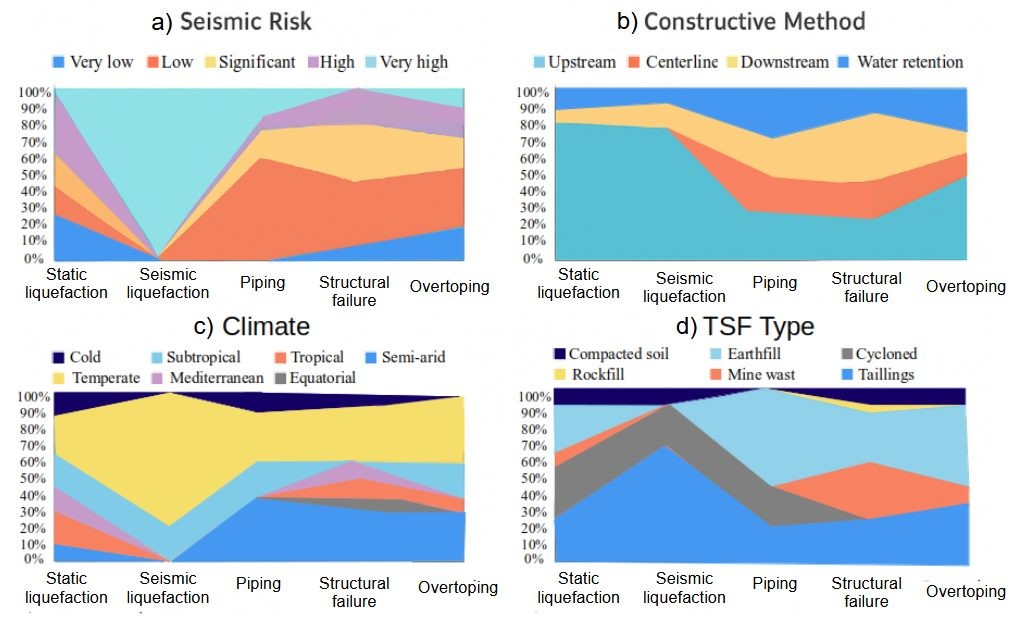
The analysis of the dam failure database demonstrated its representativeness of real-world conditions and enabled the identification of potential correlations useful for predicting structural behaviors associated with various failure modes. Notably, 21% of the dam failures attributed to seismic liquefaction occurred in regions classified as having very high seismic risk, emphasizing the critical impact of seismic hazards on dam stability. Additionally, 18% of failures were recorded in temperate climate zones, suggesting climatic factors may influence failure patterns.
A detailed examination of construction methods revealed a significant association between the use of upstream construction techniques and certain failure modes. Specifically, upstream construction methods accounted for 21% of static liquefaction failures, 19% of seismic liquefaction failures, and 12% of overtopping failures, highlighting the vulnerability of this construction style under different stressors.
In terms of dam materials, 15% of failures related to seismic liquefaction involved specific materials, indicating material choice as a relevant factor. However, dam height and volume were found to have no statistically significant influence on failure modes within the analyzed dataset, suggesting that other factors may play a more decisive role.
Figure 2 provides a visual representation of the interrelationships among seismic risk levels, construction methods, climatic influences, and types of Tailings Storage Facilities (TSFs), facilitating the understanding of how these variables interact in the context of dam failures.
Graphic analysis for key features of TSF on dam failure database, including: (a) seismic risk; (b) constructive method; (c) climate; (d) TSF type.
While statistical associations highlight relevant patterns, a deeper interpretation is necessary to understand their implications. The greater susceptibility of upstream-raised dams to liquefaction is related to their construction method, which relies on previously deposited tailings as the foundation for new raises, often creating weak and saturated layers that are more prone to sudden strength loss under static or seismic loading.
Similarly, climatic conditions can influence phreatic levels and pore water pressures, affecting the likelihood of overtopping or internal erosion. Beyond physical parameters, governance and operational practices play a decisive role: inadequate monitoring of water levels, insufficient implementation of critical controls, or delays in maintenance can intensify the vulnerabilities created by structural characteristics. Therefore, credible failure modes emerge not only from inherent geotechnical features but also from the interaction between engineering design and governance structures.
3.2 Database of TSFs analyzed
Table 1 summarizes the main characteristics of the 30 analyzed TSFs alongside the credible failure modes identified through statistical analyses of historical data. These analyses were conducted following the methodology proposed by Matos (2023) for predicting credible failure modes.
TSFs dataset and credible failure modes based on statistical analyses of historical data (Matos, 2023).
The results underscore “Structural failure” as the most prevalent credible failure mode across the dataset, emphasizing the necessity for targeted investigation and development of effective risk controls addressing structural integrity.
It is important to note that the quality and completeness of data substantially influence the reliability of the findings. Consequently, this study highlights the critical need for enhancing data collection and management practices related to TSFs, which will enable more accurate and representative assessments in future research efforts.
3.3 Decision Tree Assessment (DTA) framework for identifying triggers and controls
While statistical analyses of historical failure data are highly effective for assessing and predicting failure modes, they have limitations in pinpointing the specific triggers that initiate failure events. To address this gap, the Decision Tree Assessment (DTA) methodology is employed as a systematic and logical framework to identify initiating events, or “triggers,” and associated control measures.
The DTA approach organizes possible sequences of events and their outcomes in a tree-like structure, providing clarity and rigor in failure mode analysis. Within the TSF context, DTA enables multidisciplinary teams to systematically evaluate plausible failure modes, recognize critical initiating triggers, and determine appropriate preventive or mitigative controls to manage risks effectively (Vick, 2002; ICMM, 2021).
Appendix 1 presents the Failure Mode Framework developed to support the DTA process. This framework serves as a comprehensive reference to guide risk identification and assessment, addressing the main credible failure mode scenarios discussed herein.
4. Conclusions
This study analyzed a database of tailings dam failures and identified promising results for predicting the behavior of these structures in relation to credible failure modes. The analysis revealed significant correlations between various factors and specific types of failure. For instance, seismic liquefaction failures were more prevalent in areas of very high seismic risk, accounting for 21% of the cases, with 18% occurring in temperate climates, suggesting a direct relationship between geographic conditions and liquefaction risk. The construction method also showed relevance, particularly upstream raising, which was associated with 21% of static liquefaction cases, 19% of seismic liquefaction, and 12% of overtopping failures, highlighting the vulnerability of this method under different loading scenarios. Although less pronounced, the type of construction material was present in 15% of seismic liquefaction cases, indicating an additional risk linked to certain compositions.
Conversely, dam height and volume did not show a statistically significant influence on the analyzed failure modes. Structural failure emerged as the predominant mode of failure, reinforcing the need for robust controls focused on structural integrity. Furthermore, the study emphasizes the importance of data quality and management, highlighting that improvements in the collection of information on TSFs are essential to enable more representative predictions, especially when supported by tools such as Decision Tree Assessment (DTA).
The study's results also have relevant practical implications. For operators, it is recommended to prioritize monitoring and maintenance programs focused on the most critical structural variables, such as construction method and material type, identified as key factors in liquefaction and overtopping failures, while keeping databases continuously updated to strengthen predictive risk capacity. For regulators, it is suggested to incorporate probabilistic methodologies and data-driven tools, such as KNN and DTA, into regulations and guidelines, enhancing transparency and reproducibility of risk assessments and overcoming the limitations of purely deterministic methods. For engineers, it is recommended to use decision tree structures as a complement to Failure Modes and Effects Analysis (FMEA), allowing systematic identification of triggers and controls, which strengthens the robustness of designs, operational plans, and closure procedures.
In summary, by translating analytical results into concrete recommendations, this study contributes not only to advancing academic knowledge on TSF risk assessment but also to strengthening governance and operational safety. Broader adoption of data-driven methodologies and logical decision-making frameworks can increase the resilience of tailings dams, reduce the likelihood of catastrophic failures, and promote safer and more efficient practices in the sector.
List of symbols and abbreviations
CL Center line
CS Compacted soil
D Downstream
DS Dry stack
EPRP Emergency Preparedness and Response Plan
FMEA Failure Modes and Effects Analysis
GTR Global Tailings Review
H High
ICMM International Council on Mining and Metals
ICOLD International Commission on Large Dams
IP In Pit
KNN K-Nearest Neighbors
L Low
LS Seismic liquefaction
P Piping
R Rock
SEDAC Socioeconomic Data and Applications Center
SI Slope instability
SF Structural failure
T Tailings
TSF Tailings storage facilities
U Upstream
VL Very low
W Wast
Appendix 1 Failure mode framework.
| Credible Failure Mode | Failure Mechanism | Trigger | |
|---|---|---|---|
| Liquefaction | Static liquefaction | Inadequate material characterisation | |
| Inadequate liquefaction screening assessment | |||
| Insufficient stability under post liquefaction strength | |||
| Increase in phreatic level | |||
| Rapid loading | |||
| Removal of material triggering liquefaction | |||
| Incorrect saturation state assumed | |||
| Incorrect phreatic surface in limit equilibrium analyses | |||
| Inadequate characterisation as non-contractive | |||
| High phreatic level causing contraction | |||
| Seismic liquefaction | Inadequate characterisation as contractive | ||
| Blasting | |||
| Inadequate material characterisation | |||
| Inadequate liquefaction screening assessment | |||
| Inadequate deformation analysis | |||
| Insufficient stability under post liquefaction | |||
| Incorrect saturation state assumed | |||
| Incorrect phreatic surface in limit equilibrium analyses | |||
| Inadequate foundation characterisation | |||
| Inadequate or unconservative seismic hazard assessment | |||
| Inadequate or absent site response analysis | |||
| Undetected or mischaracterised active faults | |||
| Credible Failure Mode | Failure Mechanism | Trigger | |
| Structural failure | Inappropriate geometry | Over steepened geometry | |
| Poor design | |||
| Fail to construct to design | |||
| Incorrect survey of embankment | |||
| Accelerated raise schedule | |||
| Excavation at toe | |||
| Inappropriate material strength assumptions | |||
| Weak layer within embankment | Poor QA/QC | ||
| Overestimated strength | |||
| Assigning incorrect loading | |||
| Liner through embankment | |||
| Materials that aren't geochemically stable in embankment | |||
| High piezometric level | Flood loading | ||
| Loading from construction placement | |||
| Undrained shear of embankment | |||
| Blocked drain | |||
| Rapid drawdown of level in TSF | |||
| Design capacity of drain inadequate | |||
| Failure of underdrain system | |||
| Poor pond management | |||
| Failure of pumps for pumped dewatering | |||
| Failure of low permeability element | Poor QA/QC | ||
| Cracking due to settlement | |||
| Cracking due to seismic effects | |||
| Inadequate foundation grouting | |||
| Cracking due to changes in moisture content | |||
| Embankment erosion | Streamflow erosion at toe | ||
| Chemical weathering of embankment materials | |||
| Inadequate surface water management design on crest and embankment | |||
| Drop structure capacity incorrect | |||
| Spigot dropper arrangement leads to embankment erosion | |||
| Dissolution of embankment materials | |||
| Abutments assessment | Undetected layer in abutment | ||
| Change in properties due to geochemical influences | |||
| Assigning incorrect loading | |||
| Dissolution of materials in abutment | |||
| Geological features and discontinuities | Joints | ||
| Fracture zones | |||
| Intrusion contacts | |||
| Faults | |||
| Shear zones | |||
| Bedding foliation | |||
| Regional landslide beside or bellow of embankment | |||
| Karsts and cave systems | |||
| Potentially reactive or dispersive material | |||
| Buried channels | |||
| Settlement and deformation | Differential settlement due to different material properties | ||
| Construction induced settlement | |||
| Inadequate deformation analysis | |||
| Cracking | |||
| Deep cracking at stiffness discontinuity | |||
| Upstream failure during construction not considered | |||
| Incorrect stability assessment | Model doesn't represent critical section | ||
| Model geometry and layers not representative | |||
| Uncertainty about embankment layers | |||
| Phreatic level incorrect | |||
| Incorrect or uncertain base survey | |||
| Lack of sensitivity assessment | |||
| Credible Failure Mode | Failure Mechanism | Trigger | |
| Piping | Seepage | Seepage into groundwater | |
| Seepage through embankment | |||
| Seepage affecting vegetation | |||
| Piping through abutment or foundation | Alluvial gravels | ||
| Low strength of foundation material | |||
| Fault or shear zone | |||
| Seismically induced cracks | |||
| Dissolution of foundation materials | |||
| Piping through embankment | Flow higher than expected exit gradients | ||
| Inadequate drain compatibility | |||
| Cracked drain: Settlement | |||
| Drain blocked by geochemical | |||
| Drain blocked by microbial | |||
| Dissolution of embankment material | |||
| Failure of impermeabilization | |||
| Piping around a pipe placed through embankment | |||
| Transition material strain incompatibility | |||
| Credible Failure Mode | Failure Mechanism | Trigger | |
| Overtopping | Excess water or loss of storage volume | Incorrect water balance predictions | |
| Poor operational practices | |||
| Extreme rainfall event | |||
| Vegetation in the reservoir | |||
| Change in process of tailings | |||
| Unable to remove water off | |||
| Poor water quality prediction | |||
| Inadequate geochemical characterisation | |||
| Inadequate treatment and management | |||
| Loss of storage volume | Incorrect tailings density | ||
| Incorrect assumptions | |||
| Incorrect tailings beach slope | |||
| Natural sedimentation over time | |||
| Sediment from upstream catchment due to construction | |||
| Life of mine incorrect | |||
| Incorrect survey of impoundment volume | |||
| Poor operational practices | |||
| Failed or blocked spillway | Diversion channel failure | ||
| Spillway channel failure | |||
| Erosion makes channel inoperable | |||
| Erosion undercuts embankment | |||
| Poor maintenance of spillway | |||
| Vegetation on spillway | |||
| Erosion or Failure of slope above spillway | |||
| Flood exceeding design | Inappropriate design flood | ||
| Precipitation exceeding prediction | |||
| Change to catchment conditions | |||
| No consideration of climate change conditions | |||
| Incorrect water balance | |||
| Wave action | Geohazard and weather generated waves | ||
| Material without resistance to wave erosion | |||
| Loss of freeboard | Poor deposition planning and control | ||
| Beach not as specified | |||
| Settlement of embankment | |||
| Raise construction behind schedule | |||
| Poor tailings beach management | |||
-
Discussion open until on August 31, 2026.
-
Data availability
The datasets generated analyzed in the course of the current study are available from the corresponding author upon request.
-
Declaration of use of generative artificial intelligence
This work was prepared with the assistance of generative artificial intelligence (GenAI) ChatGPT, with the aim of improving writing to ensure proper English grammar. The entire process of using this tool was supervised, reviewed, and, when necessary, edited by the authors. The authors assume full responsibility for the content of the publication that involved the aid of GenAI.
References
- CSP2. (2024). Tailings dam failures 1915-2016. Bozeman, MT: Center for Science in Public Participation.
-
D’Hyppolito, L.C.S., Sayão, A.J., & Nunes, A.L.L. (2024). A simple method for assessing the probability of liquefaction of tailings dams. Soil and Rocks, 47(4), e2024000924. https://doi.org/10.28927/SR.2024.000924
» https://doi.org/10.28927/SR.2024.000924 -
GTR. (2020). Global Industry on Tailings Management (GISTM). Global Tailings Review. Retrieved in March 16, 2025, from https://wedocs.unep.org/20.500.11822/36139
» https://wedocs.unep.org/20.500.11822/36139 -
Huang, J., You, J.-X., Liu, H.-C., & Song, M.S. (2020). Failure mode and effect analysis improvement: A systematic literature review and future research agenda. Reliability Engineering & System Safety, 199(July), 106885. https://doi.org/10.1016/j.ress.2020.106885
» https://doi.org/10.1016/j.ress.2020.106885 - ICMM. (2021). Tailings management: good practice guide. Global Industry Standard on Tailings Management.
- ICOLD. (2017). Internal erosion of existing dams, levees and dikes, and their foundations. Paris: International Commission on Large Dams.
- ICOLD. (2019). ICOLD incident database bulletin 99 update: statistical analysis of dam failures. Paris: International Commission on Large Dams.
- Machado, N.C. (2017). Retroanálise da propagação decorrente da ruptura da barragem do fundão com diferentes modelos numéricos e hipóteses de simulação [Master’s dissertation]. Federal University of Minas Gerais (in Portuguese).
- Matos, J.M.V. (2023). Modo de falha crível em barragens de rejeito de mineração: uma análise das variáveis condicionantes e proposição de um modelo preditor [Final course work]. Federal University of Ouro Preto (in Portuguese).
- Robertson, P.K., & Fear, C.E. (1997). Liquefaction of sands and its evaluation. In K. Ishihara (Ed.), Earthquake geotechnical engineering. Rotterdam: Balkema.
-
Rolim, G.D.S., Camargo, M.B.P.D., Lania, D.G., & Moraes, J.F.L. (2007). Classificação climática de Köppen e de Thornthwaite e sua aplicabilidade na determinação de zonas agroclimáticas para o estado de São Paulo. Bragantia, 66(4), 711-720. https://doi.org/10.1590/S0006-87052007000400022
» https://doi.org/10.1590/S0006-87052007000400022 - Schatz, B., Peña Olarte, A.A.P., Ribera, A.P., Schorr, J., Cudmani, R., & Papaioannou, I. (2023). Reliability-based analysis of tailings storage facilities. A case study: Cadia NTSF embankment failure. In Proceedings of the 1st Internacional Conference on Geotechnics of Tailings and Mine Waste, Ouro Preto, MG, Brazil.
- Silva, R.R.P., & Meguet, E. (2021). Estudo de ruptura hipotética de uma pilha compartilhada de estéril e rejeito: estudo de caso. In Anais do XXIV Simpósio Brasileiro de Recursos Hídricos. ABRH.
-
Simms, P. (2021). The role of unsaturated soil mechanics in unconventional tailings deposition. Soils and Rocks, 44(3), 1-11. https://doi.org/10.28927/SR.2021.066721
» https://doi.org/10.28927/SR.2021.066721 -
Spencer, E. (1967). A method of analysis of the stability of embankments assuming parallel interslice forces. Geotechnique, 17(1), 11-26. https://doi.org/10.1680/geot.1967.17.1.11
» https://doi.org/10.1680/geot.1967.17.1.11 - Vick, S.G. (2002). Degrees of belief: subjective probability and engineering judgment. Reston: ASCE Press.
-
WISE. (2024). Chronology of major tailings dam failures. Uranium Project. Retrieved in March 16, 2025, from https://www.wise-uranium.org/mdaf.html
» https://www.wise-uranium.org/mdaf.html
Edited by
-
Editor:
Renato P. Cunha https://orcid.org/0000-0002-2264-9711
The datasets generated analyzed in the course of the current study are available from the corresponding author upon request.