
 STANDARDIZATION OF ANTIMICROBIAL DOSAGE CALCULATION IN PEDIATRICS: ELEMENTS FOR CARE-EDUCATIONAL TECHNOLOGY
ABSTRACT
Objective: to identify limitations in pediatric patient safety during the preparation and administration of antimicrobials by the nursing staff, and to participatively validate the need for and essential elements of a care-educational technology aimed at standardizing the calculation of antimicrobial dosages in pediatrics.
Method: this is an exploratory study with a qualitative approach based on the Knowledge Translation Conceptual Model, developed from July to December 2024 in a Child and Adolescent Unit of a teaching hospital in Southern Brazil. The data were produced through 126 hours of participant observation and three focus group sessions with the nursing staff. The data were then subjected to thematic content analysis.
Results: participant observation revealed a lack of standardization in the calculation of antimicrobial dosages and multifactorial challenges related to interruptions in workflow and processes, as well as the unavailability of adequate materials for standardizing calculations. The need for technology to facilitate care and ensure accurate antimicrobial dosage calculations was validated in the focus group, and the essential elements for its development were listed.
Conclusion: the qualitative evidence obtained through participant observation served as the basis for planning the focus group sessions. In this context, the need for a care-educational technology in the form of a mobile application aimed at standardizing antimicrobial dosage calculations in pediatrics was identified, and the essential elements for its composition were listed.
DESCRIPTORS:
Patient safety; Medication errors; Medication dosage calculation; Technology; Pediatric nursing
RESUMO
Objetivo: Identificar limitações na segurança do paciente pediátrico durante o preparo e administração de antimicrobianos pela equipe de enfermagem, e validar, de forma participativa, a necessidade e os elementos essenciais de uma tecnologia cuidativo-educacional voltada à padronização do cálculo das dosagens de antimicrobianos em pediatria.
Método: Estudo exploratório com abordagem qualitativa, fundamentado no Modelo Conceitual de Tradução do Conhecimento em Ação (Knowledge Translation), desenvolvido de julho a dezembro de 2024 em uma Unidade da Criança e do Adolescente de um hospital de ensino do Sul do Brasil. A produção de dados foi realizada mediante 126 horas de observação participante e três sessões de grupo focal com a equipe de enfermagem. Os dados foram submetidos à análise de conteúdo temática.
Resultados: A observação participante revelou a falta de padronização nos cálculos das dosagens dos antimicrobianos e desafios multifatoriais relativos a interrupções no fluxo e processo de trabalho; e a indisponibilidade de materiais adequados para padronização dos cálculos. No grupo focal, foi validada a necessidade de uma tecnologia, como facilitadora do cuidado, para precisão dos cálculos de antimicrobianos e elencados os elementos essenciais para a sua construção.
Conclusão: As evidências qualitativas obtidas pela observação participante serviram de base para o planejamento das sessões de grupo focal. Nesse contexto, identificou-se a necessidade de uma tecnologia cuidativo-educacional, no formato de aplicativo móvel, voltada à padronização dos cálculos de dosagem de antimicrobianos em pediatria, bem como foram elencados os elementos essenciais para sua composição.
DESCRITORES:
Segurança do paciente; Erros de medicação; Cálculo da dosagem de medicamento; Tecnologia; Enfermagem pediátrica
RESUMEN
Objetivo: identificar las limitaciones en la seguridad del paciente pediátrico durante la preparación y administración de antimicrobianos por parte del personal de enfermería, y validar, de forma participativa, la necesidad y los elementos esenciales de una tecnología asistencial-educativa destinada a estandarizar el cálculo de las dosis de antimicrobianos en pediatría.
Método: estudio exploratorio con enfoque cualitativo, basado en el Modelo Conceptual de Traducción del Conocimiento (Knowledge Translation), desarrollado de julio a diciembre de 2024 en una Unidad de Niños y Adolescentes de un hospital universitario del sur de Brasil. La producción de datos se llevó a cabo mediante 126 horas de observación participante y tres sesiones de grupo focal con el personal de enfermería. Los datos se sometieron a un análisis de contenido temático.
Resultados: la observación participante reveló una falta de estandarización en el cálculo de las dosis de antimicrobianos y desafíos multifactoriales relacionados con las interrupciones en el flujo de trabajo y los procesos, así como la falta de materiales adecuados para estandarizar los cálculos. En el grupo focal, se validó la necesidad de tecnología para facilitar la atención y garantizar la precisión en el cálculo de las dosis de antimicrobianos, y se enumeraron los elementos esenciales para su desarrollo.
Conclusión: la evidencia cualitativa obtenida mediante la observación participante sirvió de base para la planificación de las sesiones de grupos focales. En este contexto, se identificó la necesidad de una tecnología asistencial-educativa, en forma de aplicación móvil, destinada a estandarizar el cálculo de las dosis de antimicrobianos en pediatría, y se enumeraron los elementos esenciales para su composición.
DESCRIPTORES:
Seguridad del paciente; Errores de medicación; Cálculo de la dosis de medicación; Tecnología; Enfermería pediátrica
INTRODUCTION
Incidents involving medication administration to children via various routes occur frequently. They especially tend to occur with intravenous administration during the preparation and administration stages, where dosage errors exceeding the recommended limits for this age group can result in harm, and occurs about three times more often in children than in adults1.
Given the above, health organizations face numerous challenges in improving work processes and implementing strategies to minimize the occurrence of antimicrobial-related incidents in the pediatric population. This is because pediatric patients are exposed to a heightened risk due to the anatomical and physiological conditions resulting from constant growth and, depending on their age, do not have the full capacity to express the signs and symptoms resulting from incidents and/or adverse events (AEs)2.
Furthermore, achieving correct and safe dosages in preparation and administration of antimicrobials in pediatrics requires a variety of mathematical calculations in the various medication preparation and administration phases due to different body weight proportions and physiological limitations related to age3. This complex activity is part of the nurses’ work process and requires mathematical calculation skills, such as unit equivalence, total dose, dose with unit conversion, fractionated doses, dilution, and infusion rate4,5.
Therefore, it is assumed that accurate calculations in medication administration constitute an essential part of Patient Safety (PS). A study with nurses at a hospital in Peru identified that dosage errors during the preparation and administration of medications in pediatrics accounted for 67.5% of the errors observed6. When affected by adverse events, the consequences for children can range from worsening and/or instability of the clinical picture to death, requiring intensive care support7.
In addition, it is noteworthy that the theme of World Patient Safety Day in 2025 was “Safe care for every newborn and every child”, emphasizing the urgency of acting early and consistently to prevent harm throughout childhood and generate benefits throughout life8. The specific needs of children, families, and caregivers stand out among the campaign’s objectives, as well as the implementation of sustainable safe care strategies in pediatrics and the strengthening of patient safety research in this area9.
Therefore, given the concern with improving care outcomes nationwide, the theme of this study aligns with the Ministry of Health’s (MS) research priority agenda, the Sustainable Development Goals (SDGs), and the Global Action Plan for Patient Safety (PS) 2021-203010.
However, although safe and harm-free practice is a global goal10, there is still a need for investment in systems and practices to prevent errors and improve drug therapy. Therefore, the development of Care-Educational Technologies (CETs) has proven relevant, positively impacting PS and optimizing care practice11.
In view of the above, the research questions approached in this study are: Is there a need to develop Care-Educational Technology to assist in the accuracy of calculations in the preparation of antimicrobials in pediatrics? What are the essential elements that should be incorporated into it? Thus, the objective of the study was to identify limitations in the safety of pediatric patients during the preparation and administration of antimicrobials by the nursing staff, and to participatively validate the need for and essential elements of a care-educational technology aimed at standardizing the calculation of antimicrobial dosages in pediatrics.
METHOD
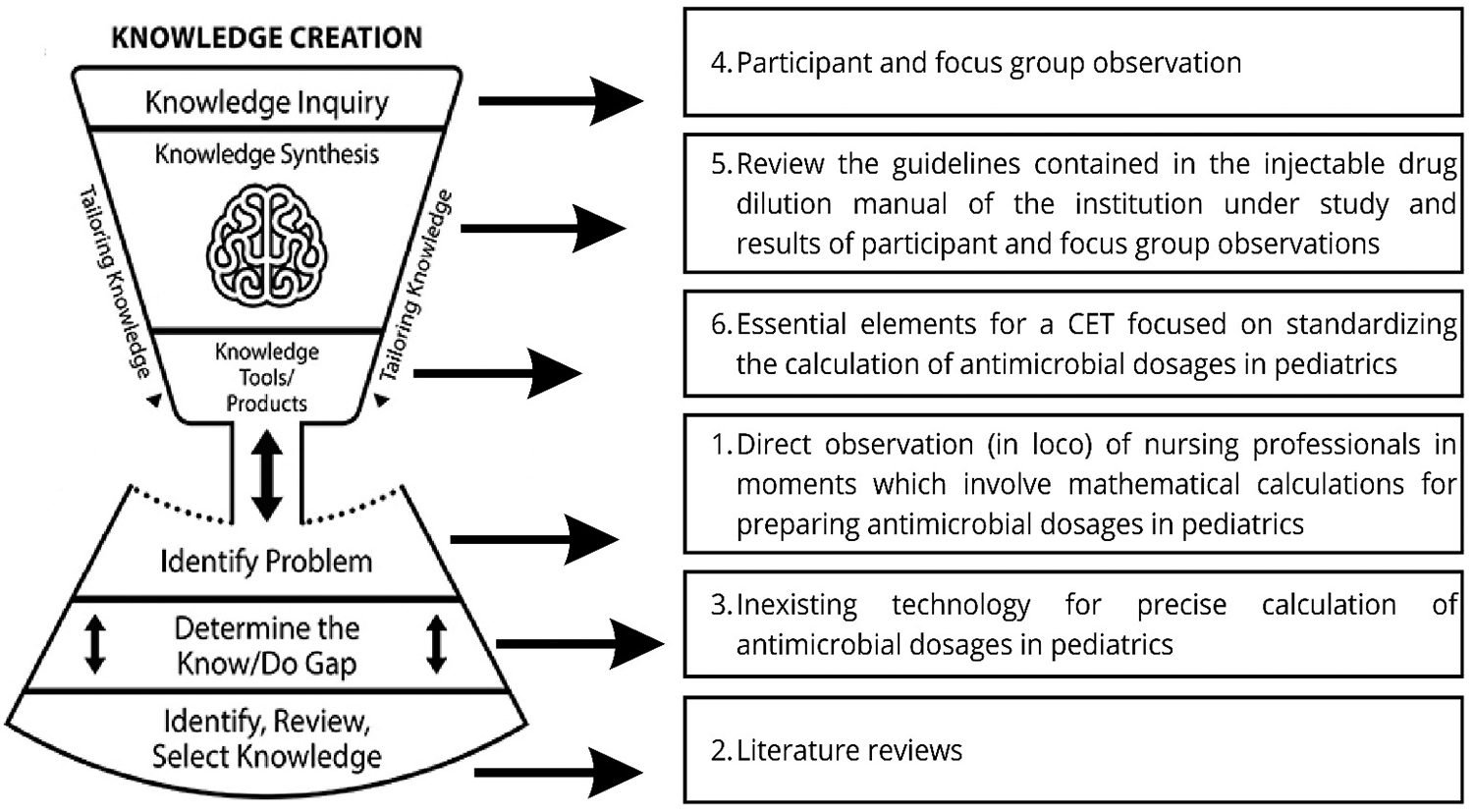
This is an exploratory study with a qualitative approach. The guidelines of the Consolidated Criteria for Reporting Qualitative Research (COREQ) were used12. The phases of the structure creation cycle were developed based on the conceptual model of Knowledge Translation (Figure 1).

The study was conducted at a public teaching hospital in the central region of Rio Grande do Sul, in the Child and Adolescent Unit (Unidade da Criança e do Adolescente - UCA). The unit serves as a state reference center for pediatric care, exclusively through the Unified Health System (Sistema Único de Saúde - SUS), with 20 beds and an average occupancy rate of 95% for the hospitalization of children and adolescents between 0 and 14 years, 11 months, and 29 days. Medications in pediatric hospital practice are provided by the pharmacy in quantities corresponding to a 24-hour treatment period, and are not available in fractional unit doses.
The sample for the observation phase was intentional and based on convenience15. The inclusion criteria were: being a Nurse or Nursing Technician (NT) with at least three months of experience in the UCA. Professionals who were absent due to vacation, leave, or medical certificate during the data collection period were excluded.
There were 36 observation sessions in the morning (n=8), afternoon (n=14), and evening (n=14) shifts, with an average duration of 3 hours and 30 minutes per shift, totaling 126 hours, between June and August 2024. A semi-structured script was used during the scheduling of medical prescriptions, dosage calculation, and preparation of prescribed antimicrobials.
Data saturation occurred when no new elements associated with the object of study were identified16. Next, three focus group (FG) sessions were held from September to December 2024 to validate the need for a CET and define its essential elements using a pre-established script. Participant selection was based on convenience, according to the possibility of time off from work. The inclusion criterion consisted of direct involvement with the calculation of antimicrobial dosages, and the same exclusion criteria as for observation were adopted.
In turn, nine NTs and three nurses participated in the first session of the focus group; then, 10 NTs in the second, and six NTs and two nurses in the third session. Each session lasted an average of one hour and involved discussions mediated by the researcher, with the support of three data collectors who assisted in observation, note-taking, and audio recording. The testimonies were recorded on electronic audio devices (cell phones and iPads) and fully transcribed, along with the field diary entries, into Microsoft Office Word®. The Turbe Scribe artificial intelligence tool (free version) was used for audio transcription during this stage. After using this tool, the authors reviewed and edited the content in accordance with the scientific method and assume full responsibility for the content of the publication.
A thematic content analysis was subsequently conducted in three stages: pre-analysis, material exploration, and interpretation17. The data were organized in the pre-analysis stage after reading the records obtained from the Observation Script and the testimonies in the FG sessions, selecting the evidence relevant to the study object17.
This study complied with the ethical aspects involving human beings expressed in Resolution No. 466/12 of the National Health Council and was approved by the Research Ethics Committee of the institution. The research participants were informed about the objectives and methodology, and signed the Informed Consent Form (ICF). The FG participants’ identities were replaced by the letters N, to identify Nurses, and NT for Nursing Technicians, followed by sequential numbers in order to guarantee their anonymity.
The participant observation notes were identified by increasing numbers, preceded by the code ON, referring to the observation note. Regarding the FG notes, the code NFG was used, followed by the number corresponding to the session (1, 2 or 3), the day/month/year of occurrence and the shift.
RESULTS
The results are presented according to the sequential and interrelated steps: participant observation and focus group, with analysis through data triangulation. A total of 36 participant observations were conducted with 18 nursing professionals, predominantly nursing technicians (72.3%) and nurses (27.7%), all female (100%) and with 7 to 9 years of experience in the nursing care unit (50%). Five central thematic categories (I to V) emerged, presented in ascending order in Chart 1. It is important to note that the percentage values presented refer to the relative frequency of observations made during the data collection period.
Observations in category I revealed frequent difficulties related to the accuracy of antimicrobial dosage calculations, such as the lack of specific standardization for pediatric patients, and the lack of institutional tools and protocols. Professionals faced discrepancies in calculations compared to the institutional dilution manual, which generated uncertainties and potential errors.
There were also doubts in calculating the conversion between different units (mg to ml), increasing the risk of incidents with antimicrobials. Therefore, inadequate rounding of dosage calculation values, which involve reconstitutions and dilutions, can result in underdosing or overdosing, compromising patient safety. Furthermore, when an error was identified, collaboration between nurses and nursing technicians was observed to correct the discrepancies before administering the antimicrobial, which can contribute to reducing the risk of adverse events.
In category II, it became evident that interruptions in scheduling and preparation occurred due to demands external to the primary activity originating from different sources, whether from colleagues, the medical team, multidisciplinary teams, or patients’ family members.
Of the total of 21 interruptions observed (100%), 14 affected the NTs (66.7%) and seven affected the ICU Nurses (33.3%). These interruptions directly impacted the concentration and accuracy of the calculations, with the aggravating factor that doses in pediatrics are individually adjusted based on the patient’s weight and clinical condition. In addition, they affected the execution time of the primary activity, such as dilution of the antimicrobial, as it was necessary to pause the activity to attend to external demands.
Regarding category III, nursing professionals used some tools (dilution charts and calculators, both pocket-sized and mobile applications) to assist in calculating antimicrobial dosages in 50% of the instances, standing out as quick and practical resources for consultation in preparing and scheduling antimicrobials. Therefore, the absence of a tool or technology for standardizing antimicrobial dosage calculations resulted in varied approaches by professionals from different shifts, placing a significant burden on nursing professionals, who need to perform mathematical calculations relying on manual calculations or calculators, increasing the risk of errors and consequently incidents and adverse events.
In turn, the recurring issue of unavailability of essential materials for the preparation of antimicrobials was identified in category IV. These included self-adhesive labels used externally on syringes for medication identification, and discrepancies in the use of infusion pumps by tubing and syringe.
Despite the challenges observed, category V indicates that there are positive practices in confronting the problem. These included collaboration among professionals to solve problems, with moments of collective learning and exchange of technical knowledge about calculations and preparations, highlighting the importance of learning from experienced colleagues, especially in case of doubt. Furthermore, there was division of scheduling medical prescriptions among nurses, reflecting a strategy to optimize workflow and avoid individual overload, and support for new team members.
In the FG stage, the UCA nursing team broadly validated the need for a CET aimed at supporting the calculation of antimicrobials, listing the essential elements that should be included in the technology.
[...] for a work tool that will greatly facilitate [...] if it works, it can also be used in other units [referring to a technology] (NT1, NFG2, 11/24/2024).
[...] I think there has to be an app where we paste the name of the medicine, the patient, their weight. Before giving the result, it should give an alert, look again to see if everything is correct [...] (NT4, NFG1, 09/24/2024).
The suggestions for functionalities, such as alerts to verify the accuracy of calculations, personalized reminders, and notifications of drug incompatibilities, highlight the professionals’ concern in ensuring that the application is robust, intuitive, and adapted to practical needs:
[...] it could launch more personalized reminders according to the patient [...] (NT6, NFG1, 09/24/2024).
[...] the incompatibility would also serve as a warning, if there are two medications, not to administer them at the same time [...] (NT7, NFG1, 09/24/2024).
[...] the nursing professional will be required to perform the calculation in the application, to use the application. And it will be a safer thing (NT11, NFG1, 09/24/2024).
The data reflect the positive perception and expectations of healthcare professionals regarding the development and implementation of a CET for optimizing the processes of calculating and administering antimicrobials in the form of a mobile application. This is especially relevant in contexts such as the UCA, where the workflow requires quick and accurate responses.
The team recognized the need for adequate training, collective engagement, and technological inclusion in order to make this possible, considering professionals with little familiarity with applications. Furthermore, interactive elements and active teaching-learning methodologies were suggested to make the educational process dynamic and to reinforce acquired knowledge, illustrating this innovative approach, aligned with trends in health education:
[...] When building a technology, you have to have training. Everyone tests and sees if it’s what you're looking for [...] (NT2, NFG1, 09/24/2024).
[...] and who doesn’t know? We know that colleagues... and I don’t really know much about these things with mobile applications [...] (NT1, NFG1, 09/24/2024).
[...] what you can do if you want interactivity and education, for example, every so many accesses we have, there could be a quiz or game to test what you’ve learned [...] (NT4, NFG1, 09/24/2024).
Suggestions from the target audience regarding the essential elements for building a mobile application were considered during the FG sessions, as shown in Chart 2. Images were selected via the free online platform Freepik, which were made available to nursing professionals as a source of inspiration for creating the visual elements of the CET.
The data suggests that the participatory development of a Knowledge Translation (KT) tool in the form of a mobile application, grounded in Knowledge Translation, has “care-educational” potential, and could therefore directly contribute to standardize practices in the daily routine of the nursing team.
Essential elements from the perception of the target audience for the collective construction of a Care-Educational Technology for standardizing antimicrobial calculation in pediatric nursing. Santa Maria/RS, Brazil, 2024.
DISCUSSION
The identification of discrepancies in calculating antimicrobial dosages during the preparation and scheduling of antimicrobial dosages demonstrated that the causes of errors in this process are multifactorial, stemming from challenges in performing the calculations, weaknesses in standardization in pediatrics, interruptions, and the absence of tools to aid in the calculation accuracy. Medication errors are multifaceted, and studies indicate that errors can occur at rates ranging from 1% to 58% at different times in the medication process in pediatrics18-19.
The administration phase is prevalent in the occurrence of incidents in pediatrics (61.8%), mainly dosage errors (33.5%)20. Inaccurate or incorrect calculations during dosages, as well as in the conversion of measurement units also increase the risks of harm in the pediatric population21. Furthermore, pediatric incidents are most frequently related to intravenous medications and fluids (25.1%), especially chemotherapeutic agents, sedatives, diuretics, antifungals (65.1%), followed by antimicrobials (15.8%)20.
The results indicated that the UCA team is composed of two different training levels, which allows us to infer that not all professionals have the same theoretical and technical knowledge or experience in dosage calculation, which may lead to inconsistencies in medication administration. A need for standardization in preparing and administering antimicrobials was observed. It was noted that the team primarily used a display panel in the unit showing the reconstitutions and dilutions of the main medications taken from the injectable medication dilution manual, which does not directly address the needs of the pediatric population.
However, studies unanimously recommend the use of standardized concentrations to simplify reconstitution and redilution calculations, thereby reducing the risk of incidents, with or without harm21. A systematic review of harm caused by intravenous drug preparation errors showed incorrect doses ranging from 0% to 99.6%, incorrect concentrations from 0.3% to 88.6%, and incorrect diluent volumes from 0.06% to 49.0%22.
Interruptions hindered the accurate calculation of antimicrobials in the ICU, constituting risk factors for the occurrence of adverse events. Although they are considered unavoidable under specific circumstances, they require mitigation strategies to preserve patient safety and care effectiveness. These include: establishing uninterrupted work periods for preparing and scheduling medications, with clear signage to avoid distractions; improving interprofessional communication, such as establishing workflows for delivering prescriptions and therapeutic changes; and implementing technologies and support systems which reduce dependence on direct interactions during critical tasks. Therefore, recognizing and managing interruptions is essential to ensure quality of care and reduce the risks associated with errors in pediatric care23.
The implementation of sophisticated digital technologies can offer accurate and up-to-date information, capable of complementing the resources available in the UCA for calculating antimicrobial dosages. It is recommended to combine digital and traditional healthcare services. Through this interaction, professionals can become familiar with technological innovations, integrating them into their daily practices. In addition, digital tools also build new knowledge and skills for the healthcare context, which is increasingly driven by digital solutions24.
The lack of materials negatively impacted the accuracy of antimicrobial calculations in pediatrics, with the unavailability of self-adhesive labels being crucial to this outcome. This shortage led the nursing staff to improvise manually using other tapes which, in addition to not adhering to the syringe and risking peeling off before administration, did not contain important data about the patient and medications, predisposing them to incidents in the medication process. In line with this, a study reiterates the importance (from the perception of 11 pediatric nurses) of printing self-adhesive labels containing patient identifiers, as well as data related to the medication (name, dose, time)25.
The observed logistical limitations point to structural and operational challenges in the clinical environment with the need for the availability of appropriate technologies and the training of teams to manage these situations. In addition, they highlight the importance of communication among the multidisciplinary team to mitigate the risks associated with administering medications under inadequate conditions. Ultimately, the insufficiency of technological resources can harm both patient safety and the effectiveness of prescribed treatments, making it essential to improve management practices and acquire equipment in health institutions26.
Nursing professionals revealed the need for continuous training and capacity building as a possible strategy to address the problem. The study suggested topics to be addressed in these collective spaces, such as the practical applicability of PS protocols, the need to overcome the taboo surrounding discussions about medication errors, seeking to alleviate feelings of fear and individual guilt25.
Validating the need to build a mobile application in the FG could contribute to advancing dose calculation (currently performed in the conventional way, which could lead to incidents), leading towards a technological system which can minimize the risk of errors and make the process safer with conduct standardization among nursing professionals. This advancement has been accompanied by scientific studies which indicate that the use of technologies in the health field positively contributes to PS, especially when directed towards safe practices in higher-risk population groups, such as children and adolescents2.
The use of health-related mobile applications in general is easily widespread on global platforms, totaling approximately 350,000, but without scientific studies to support their implementation and prove their effectiveness and quality. Given this reality, it becomes imperative that mobile applications be regulated, built with methodological rigor, and have their effectiveness verified in order to avoid providing inappropriate information to users26.
A limitation of this study is the inclusion of only one pediatric unit of the public teaching hospital used as the research setting, which does not allow for a broader understanding of other institutional and contextual realities that could influence the perceptions of nurses.
CONCLUSION
The observations supported the hypothesis that there is a divergence in the calculations of antimicrobial dosages, as well as providing relevant data for development of the study, suggesting the need to develop a Care-Educational Technology to strengthen safety in the medication process in pediatrics. The use of technological resources and collaboration among the team were positive elements which can be enhanced to ensure greater safety and standardization in preparing and administering medications.
Therefore, the use of a technology in the form of an application in pediatric clinical practice has the potential to innovate the manual and conventional process of dose calculation into a technological system which enables safe and standardized calculations of antimicrobial dosages in the study setting. This digital tool tends to positively contribute to making the calculation of antimicrobial dosages safe and accurate, standardizing it and minimizing variability in observed practices, and consequently the risk of incidents (with or without harm) in a pediatric inpatient unit, ensuring quality care for patients.
The study fulfilled its purpose of translating knowledge related to antimicrobial dosage calculation, focusing on the safety of pediatric patients. Therefore, it can be used as a strategy to facilitate nursing professionals’ access to standardized dosage calculations at different medication management stages, from presentation and reconstitution to dilution and infusion time.
REFERENCES
-
1. Custódio IL, Lima FET, Pascoal LM, Barbosa LP, Pinheiro PN da C, Barbosa IV, et al. Nursing training on the administration of medication in pediatrics: An assessment of observed and self-reported behavior. Rev Bras Enferm [Internet]. 2021 [cited 2025 Jun 5];74(4):e20201188. Available from: https://doi.org/10.1590/0034-7167-2020-1188
» https://doi.org/10.1590/0034-7167-2020-1188 -
2. Rappaport LD, Markowitz G, Hulac S, Roosevelt G. Errores de medicación en pacientes pediátricos después de la implementación de una guía de campo con dosificación basada en volumen. Prehosp Emerg Care [Internet]. 2023 [cited 2025 May 21];27(2):213-20. Available from: https://doi.org/10.1080/10903127.2022.2025962
» https://doi.org/10.1080/10903127.2022.2025962 -
3. Otero MJ, Marrodan BR, Santos NP, et al. Recommendations for the safe use of high-risk medications in pediatrics. An Pediatr (Engl Ed) [Internet]. 2025 [cited 2025 Oct 07];103(1):503815. Available from: https://doi.org/10.1016/j.anpede.2025.503815
» https://doi.org/10.1016/j.anpede.2025.503815 -
4. Wennberg-Capellades L, García-Mayor S, Guillaumet-Palau A, et al. Where do nursing students make mistakes when calculating drug doses? A retrospective study. BMC Nurs [Internet]. 2022 [cited 2025 Oct 07];21(1):309. Available from: https://doi.org/10.1186/s12912-022-01085-9
» https://doi.org/10.1186/s12912-022-01085-9 -
5. D’Errico S, Pavone P, Colosimo C, et al. Medication errors in pediatrics: proposals to improve the quality and safety of care through clinical risk management. Front Med (Lausanne) [Internet]. 2022 [cited 2025 Oct 07];8:814100. Available from: https://doi.org/10.3389/fmed.2021.814100
» https://doi.org/10.3389/fmed.2021.814100 -
6. Sandoval LJS, de Souza KV, Oliveira JLC, et al. Professional performance in the administration of medicines in pediatrics: a cross-sectional observational study. Rev Bras Enferm [Internet]. 2022 [cited 2025 Oct 07];75(3):e20200299. Available from: https://doi.org/10.1590/0034-7167-2020-0299
» https://doi.org/10.1590/0034-7167-2020-0299 -
7. Fernández-Quintero ML, Smazynski J, Mathes T, et al. Structural determinants of voltage properties in calcium channels. eLife [Internet]. 2021 [cited 2025 Oct 07];10:e64087. Available from: https://doi.org/10.7554/eLife.64087
» https://doi.org/10.7554/eLife.64087 -
8. World Health Organization. World Patient Safety Day, 17 September 2025: “Safe care for every newborn and every child” [Internet]. 2025 [cited 2025 Oct 08]. Available from: https://www.who.int/news-room/events/detail/2025/09/17/default-calendar/world-patient-safety-day--17-september-2025--patient-safety-from-the-start
» https://www.who.int/news-room/events/detail/2025/09/17/default-calendar/world-patient-safety-day--17-september-2025--patient-safety-from-the-start -
9. Organização Pan-Americana da Saúde. Dia Mundial da Segurança do Paciente 2025 [Internet]. 2025 [cited 2025 Oct 08]. Available from: https://www.paho.org/pt/campanhas/dia-mundial-da-seguranca-do-paciente-2025
» https://www.paho.org/pt/campanhas/dia-mundial-da-seguranca-do-paciente-2025 -
10. World Health Organization. Plano de ação global para a segurança do paciente 2021-2030: em busca da eliminação dos danos evitáveis nos cuidados de saúde [Internet]. 2021 [cited 2025 May 09]. Available from: https://www.who.int/teams/integrated-health-services/patient-safety/policy/global-patient-safety-action-plan
» https://www.who.int/teams/integrated-health-services/patient-safety/policy/global-patient-safety-action-plan -
11. Salbego C, Ramos FRS, Beck CLC, Camponogara S, Badke MR, Simon BS, et al. Tecnologias cuidativo-educacionais: um conceito emergente da práxis de enfermeiros em contexto hospitalar. Rev Bras Enferm [Internet]. 2018 [cited 2025 Jun 22];71(6):2825-33. Available from: https://doi.org/10.5902/217976923591
» https://doi.org/10.5902/217976923591 -
12. Souza VRS, Marziale MHP, Silva GT, Nascimento PL, Silva CMB, Monteiro CFS, et al. Tradução e validação para a língua portuguesa e avaliação do guia COREQ. Acta Paul Enferm [Internet]. 2021 [cited 2025 Jun 5];34:e2021AO02631. Available from: https://doi.org/10.37689/acta-ape/2021AO02631
» https://doi.org/10.37689/acta-ape/2021AO02631 - 13. Straus SE, Tetroe J, Graham ID. Knowledge translation in health care: Moving from evidence to practice. 3rd ed. Oxford: Wiley-Blackwell; 2013.
- 14. Cabral IE, Silva RMCRA, Souza AIJ, Santos RM. Knowledge Translation - Uma possibilidade para traduzir resultados de pesquisa em prática de saúde e enfermagem. In: Teixeira E, editor. Desenvolvimento de tecnologias cuidativo-educacionais. Porto Alegre: Moriá Editora; 2017. p. 241-262.
-
15. Campos CJG, Saidel MGB. Amostragem em investigações qualitativas: conceitos e aplicações ao campo da saúde. Rev Pesqui Qualit [Internet]. 2022 [cited 2025 Jun 1];10(25):404-24. Available from: https://editora.sepq.org.br/rpq/article/view/545
» https://editora.sepq.org.br/rpq/article/view/545 -
16. Fontanella BJB, Ricas J, Turato ER. Amostragem em pesquisas qualitativas: proposta de procedimentos para constatar saturação teórica. Cad Saúde Pública [Internet]. 2011 [cited 2025 May 5];27(2):289-94. Available from: https://doi.org/10.1590/S0102-311X2011000200020
» https://doi.org/10.1590/S0102-311X2011000200020 - 17. Minayo MCS. O desafio do conhecimento: metodologia de pesquisa social (qualitativa) em saúde. 14th ed. São Paulo/Rio de Janeiro: Hucitec/Abrasco; 2014.
-
18. Marufu TC, Madden C, Mcewan D, Marland G, Mcbride M, Mcconnell W. Nursing interventions to reduce medication errors in paediatrics and neonates: Systematic review and meta-analysis. J Pediatr Nurs [Internet]. 2022 [cited 2025 Apr 15];62:139-47. Available from: https://pubmed.ncbi.nlm.nih.gov/34507851/
» https://pubmed.ncbi.nlm.nih.gov/34507851/ -
19. Valencia-Quintero AF, Rojas-Quintero J, Muñoz-Arbeláez CE, Camargo-Muñoz JS, González-Cano DM. Errores de medicación en pediatría. Andes Pediatr [Internet]. 2021 [cited 2025 Apr 5];92(2):288-97. Available from: https://doi.org/10.32641/andespediatr.v92i2.1357
» https://doi.org/10.32641/andespediatr.v92i2.1357 -
20. Dornfeld D, Corrêa AR, Maziero ECS, Magnago TSBS, Urbanetto JS, Andrade SR. Overview of safety incidents involving pediatric patients at a university hospital. Cogitare Enferm [Internet]. 2024 [cited 2025 Apr 12];29:e91995. Available from: https://doi.org/10.1590/ce.v29i0.93832
» https://doi.org/10.1590/ce.v29i0.93832 -
21. Howlett MM, O’Hara S, Fernandez CV, Moore DL, Matlow A, Wang EEL. The impact of technology on prescribing errors in pediatric intensive care: A before and after study. Appl Clin Inform [Internet]. 2020 [cited 2025 Feb 2];11(2):323-35. Available from: https://doi.org/10.1055/s-0040-1709508
» https://doi.org/10.1055/s-0040-1709508 -
22. Hedlund N, Beer I, Hoppe-Tichy T, Trbovich P. Systematic evidence review of rates and burden of harm of intravenous admixture drug preparation errors in healthcare settings. BMJ Open [Internet]. 2017 [cited 2025 Feb 12];7(12):e015912. Available from: https://doi.org/10.1136/bmjopen-2017-015912
» https://doi.org/10.1136/bmjopen-2017-015912 -
23. Sassaki RL, Cuculo DF, Perroca MG. Interruptions and nursing workload during medication administration process. Rev Bras Enferm [Internet]. 2019 [cited 2025 May 18];72(4):1001-6. Available from: https://doi.org/10.1590/0034-7167-2018-0680
» https://doi.org/10.1590/0034-7167-2018-0680 -
24. Jarva E, Oikarinen A, Itkonen M, Meriläinen M, Haavisto E. Healthcare professionals’ perceptions of digital health competence: A qualitative descriptive study. Nurs Open [Internet]. 2022 [cited 2025 May 12];9(2):1379-93. Available from: https://doi.org/10.1002/nop2.1184
» https://doi.org/10.1002/nop2.1184 -
25. Moraes JAS, Oliveira AM, Castro VC, Melo GS, Barbosa SFF, Torres GV. Meanings and actions inferred by nurses for minimizing medication errors in pediatrics. Rev Rene [Internet]. 2022 [cited 2025 Mar 21];23:e78524. Available from: https://doi.org/10.15253/2175-6783.20222378524
» https://doi.org/10.15253/2175-6783.20222378524 -
26. Moreno-Llanos AH, Silva PB, Oliveira SND, Paz EPA, Dalmolin A, Anders JC. Cálculo de medicamentos em neonatos e pediatria: desenvolvimento e validação de aplicativo móvel. Texto Contexto Enferm [Internet]. 2024 [cited 2025 May 14];33:e20240048. Available from: https://doi.org/10.1590/1980-265X-TCE-2024-0048pt
» https://doi.org/10.1590/1980-265X-TCE-2024-0048pt
NOTES
-
ORIGIN OF THE ARTICLE
Extracted from the dissertation - “Segurança do paciente pediátrico: tecnologia cuidativo-educacional para padronização no cálculo da dosagem dos antimicrobianos”, presented to the Post-graduate Program in Nursing of the Universidade Federal de Santa Maria, in 2025.
-
FUNDING INFORMATION
Coordenação de Aperfeiçoamento de Pessoal de Nível Superior - Brasil (CAPES) - Finance Code 001, for assistance in the development of this study.
-
APPROVAL OF ETHICS COMMITTEE IN RESEARCH
Approved by the Research Ethics Committee of the Federal University of Santa Maria, opinion no. 6.702.587/2024, Certificate of Presentation for Ethical Review 39368820.1.1001.5346.
-
TRANSLATED BY
Christopher J. Quinn.
-
DATA AVAILABILITY
Access to the data for this study can be requested directly from the corresponding author.
Edited by
Access to the data for this study can be requested directly from the corresponding author.

 Source: Adapted from
