 Does a lifestyle-based intervention improve sleep quality in individuals with major depressive disorder? A randomized controlled trial
Abstract
Objective: Major depressive disorder (MDD) is a leading cause of global disability, contributing to substantial individual, social, and economic burdens. While antidepressant therapy remains the cornerstone of treatment, complementary lifestyle-based interventions, such as multimodal exercise and mindfulness, have shown promise in alleviating mood symptoms. However, their specific impact on sleep quality, a critical therapeutic target in MDD, remains underexplored.
Methods: In a 12-week randomized controlled trial, 88 patients with MDD were assigned to three groups: pharmacotherapy alone (control group – CG), pharmacotherapy plus home-based multimodal exercise (exercise group – EG), or pharmacotherapy plus home-based mindfulness training (mindfulness group – MF). Sleep quality was evaluated using the Pittsburgh Sleep Quality Index (PSQI) at baseline, week 5, and week 12.
Results: A linear mixed-model (LMM) was performed, and significant group-by-time interactions were observed. At baseline, the EG exhibited lower PSQI scores compared to the MF (p = 0.002, d = 0.75) and CG (p = 0.001, d = 0.83). At week 5, the EG continued to show superior sleep quality relative to mindfulness (p = 0.018, d = 0.64) and CG (p = 0.001, d = 0.89). At week 12, the MF also demonstrated better sleep quality than the CG (p = 0.002, d = 0.80). All groups improved over time, with exercise yielding rapid benefits and MF showing progressive, sustained improvements.
Conclusion: Lifestyle-based interventions enhance sleep quality in MDD when combined with antidepressant therapy. Multimodal exercise offers immediate improvements, while mindfulness provides gradual, long-term benefits. These findings underscore the value of adjunctive lifestyle interventions in MDD management and highlight the need for further research into their long-term efficacy and potential synergistic effects.
Clinical trial registration: Brazilian Registry of Clinical Trials, RBR-4pgd3ct, date of registration: 10/19/2023.
Keywords:
Major depression; mindfulness; physical exercise; adjunct therapy
Introduction
Major depressive disorder (MDD) is a multifaceted condition characterized by the interplay of biological and psychosocial mechanisms that disrupt affective and cognitive functioning.1 MDD is the second leading cause of the global burden of disability, contributing not only to individual suffering but also to significant social and economic harms by reducing the workforce participation of a substantial portion of the population.2
Antidepressants, particularly selective serotonin reuptake inhibitors (SSRIs) remain the first line of treatment for MDD.3 While pharmacotherapy plays a crucial role in alleviating depressive symptoms, its clinical effectiveness is often hindered by side effects, delayed response and this can lead to poor treatment adherence, thereby affecting overall symptom remission.3 These limitations have prompted increasing interesting in the exploration of complementary and integrative treatment approaches, particularly lifestyle-based interventions such as mindfulness training and physical exercise.4–7 Lifestyle-based interventions can either be used as a monotherapy in mild to moderate cases or as an adjunct intervention to improve the pharmacotherapy clinical response.4–7 In recent years, they have gained considerable attention for their ability to reduce depressive symptoms, mitigate ruminative thinking, and support emotion regulation.4,7–12 Their clinical application lies on targeting both emotional and physiological regulatory processes critical for MDD treatment.13,14
Sleep disturbances are among the most common and debilitating symptoms associated with MDD, and they serve as reliable predictors both for the onset and recurrence of depressive episodes.15 Individuals with MDD often reports difficulties in initiating or maintaining sleep, with insomnia representing the most prevalent complaint.16 A growing body of research highlights a strong association between sleep disorders and heightened depressive symptoms severity.17–19 This relationship may be partly explained by dysregulation of stress-response systems, such as the hypothalamic-pituitary-adrenal (HPA) axis, which are often disrupted in MDD.20,21
A robust body of evidence highlights the importance of exercise in the treatment of MDD, consistently demonstrating its positive impact on sleep quality.22,23 Notably, existing reviews focus primarily on aerobic or resistance training modalities. However, the potential benefits of combined or multimodal exercises programs, those targeting multiple components of physical fitness such as cardiovascular endurance, muscular strength, flexibility, and mobility, remain underexplored in the context of sleep disturbances among individuals with MDD.24,25 Emerging research has introduced tailored multimodal training protocols designed specifically for individuals with MDD, incorporating strategies to increase enjoyment and sustain moderate perceived effort. These interventions have shown promise in reducing depressive and ruminative symptoms, as well as exerting anti-inflammatory effects.7,11,26 This is particularly important given that MDD is characterized by anhedonia – a diminished capacity for pleasure and enjoyment inherent to the disorder.27
Mindfulness-based interventions have also demonstrated significant promise in the treatment of MDD.10 These practices engage core attentional, emotional, and interoceptive mechanisms,28 including promoting cognitive reappraisal,29 reducing emotional reactivity and stress response,30 improving measures of wellbeing,31 interoception32 and mitigating rumination.7,33 These processes foster self-regulation, which can, in turn, improve sleep quality.34 Recent systematic reviews and meta-analyses provide strong evidence that mindfulness is effective in managing sleep disorders, particularly when they occur as comorbidities in MDD and other mental health conditions.35,36
Given the aforementioned context, the present study aimed to investigate the effects of two supervised, online, home-based, group lifestyle interventions (affect-based guided multimodal exercise and mindfulness practice- each delivered alongside antidepressant medication, compared to pharmacological therapy alone) on self-reported sleep quality in individuals with MDD. The goal was to better understand how these lifestyle-based interventions may contribute to improvements in sleep among individuals suffering from MDD. Findings from this study are intended to better inform the integration of lifestyle-based strategies into comprehensive depression treatment plans.
Methods
This randomized controlled trial follows the CONSORT 2010 guidelines,37 the Declaration of Helsinki standards, and was approved by the local ethics committee (40046320.9.0000.5537, amendment 5.442.945) and the Brazilian Registry of Clinical Trials (ReBEC: RBR-4pgd3ct). Participants included students and staff of Universidade Federal do Rio Grande do Norte (UFRN) both sexes, aged 18 to 50 years, diagnosed with MDD. Recruitment was carried out through multiple channels, including posters, social media, as well as the UFRN's electronic bulletin, and academic systems.
Inclusion and exclusion criteria
All participants met the following prior inclusion and exclusion criteria, which were applied prior to randomization: Inclusion criteria: a) current diagnosis of MDD as determined by a psychiatrist; b) employee or student at UFRN; c) aged 18 to 50 years; and d) having a smartphone or computer with internet access. Exclusion criteria: a) current or past presence of mania or other mental disorders besides MDD; b) pregnancy and/or lactation; c) history of treatment failure with escitalopram; d) any physical disabilities that impair attending the complementary therapies. This study is a secondary analysis of a larger clinical trial ‘Sadness Coping Program’, which investigated distinct therapeutic approaches for the treatment of participants with major depressive disorder, with clinical response and remission as the primary outcomes.
Study design
Participants were first screened through the "Coping with Sadness Program" application, exclusive to the Brazilian Google Play Store and part of the Brazilian telemedicine platform UpSaúde (upsaudeapp.com), which included questions regarding medication use and the presence of comorbidities. As part of this screening process, the Patient Health Questionnaire-2 (PHQ-2) was used to investigate depressive symptoms. Participants who met the initial criteria were referred for medical evaluation with psychiatrists to confirm the diagnosis and severity of MDD, as well as a comprehensive assessment of inclusion criteria, conducted via the UpSaúde app. The diagnosis of MDD was confirmed through The Mini International Neuropsychiatric Interview (MINI) and The Montgomery-Åsberg Depression Rating Scale (MADRS), with a minimum threshold of 7 points.38 Following patient inclusion, in the pre-treatment phase, participants were randomly assigned to one of three 12 weeks treatment groups: 1) control group of exclusive pharmacotherapy (CG, n = 33) or 2) exercise group treated by pharmacotherapy plus exercise (EG, n = 26) or 3) mindfulness group treated by pharmacotherapy plus mindfulness (MF, n = 29). Group randomization was conducted in blocks of participants (up to 15) by the project coordinator, ensuring blinding to other team members and participants. Following patient enrollment, both the research team and the participants were informed of group allocation. Sleep quality was assessed by the Pittsburgh Sleep Quality Index (PSQI), and depressive symptoms was assessed by MADRS. Both measures were evaluated at three time points: baseline, week 5, and week 12.
Measurement of sleep quality
PSQI is a self-report tool designed to assess an individual's subjective perception of sleep quality, assessing key aspects of sleep disorders and their clinical, cognitive, and behavioral components. PSQI global score ranges from 0 to 21 points and can be classified as good sleep quality (0-4), bad sleep quality (5-10), and presence of sleep disorder (> 10). It evaluates seven subdomains (components): perceived sleep quality, sleep latency, sleep duration, habitual sleep efficiency, sleep disturbances, use of sleep medication, and daytime dysfunction.39 The PSQI has demonstrated strong reliability and validity in assessing sleep disturbances and related factors.40
Treatments
Control group
Participants in the control group were treated with escitalopram, a selective serotonin reuptake inhibitor (SSRI). A titration protocol was followed, starting with an initial dose of 10 mg/day. If no significant clinical improvement was observed by week 5 (defined as a 50% or greater reduction in MADRS scores) the dosage was increased to 15 mg/day. The medication was provided free of charge to all participants.
Multimodal exercise group
The multimodal exercise group received escitalopram following the same protocol as the pharmacological treatment group but with the addition of a home-based, supervised, and multimodal exercise program. The program, delivered by a certified exercise professional, consisted of 30-minute sessions held four times per week over a 12-week period, totaling two hours of exercise per week, one hour of live online group classes and one hour of pre-recorded video sessions. The exercise sessions were guided by the Rating of Perceived Exertion (RPE) and the Feeling Scale (FS) to enhance enjoyment and improve adherence to the intervention.41,42 The program was designed with a progressive structure, focusing on different aspects of physical fitness each week. During the first week, participants were introduced to the concepts of "getting to know my body," "feeling my breath," "feeling the heart," and "feeling the muscles." In the second week, the focus shifted to cardiorespiratory endurance and flexibility, while the fourth week targeted balance and strength. In the fifth and sixth weeks, flexibility and balance, followed by strength and cardiorespiratory endurance, were emphasized, respectively. This pattern continued in subsequent weeks, alternating between combinations of flexibility, strength, balance, and cardiorespiratory endurance. Full details of this exercise protocol can be found in.8
Mindfulness group
Participants in the mindfulness group followed the same escitalopram treatment scheme as the control group, with the addition of a home-based, supervised, online mindfulness program, adapted from the mindfulness-based cognitive therapy (MBCT) program43 and delivered by certified instructors. Over the course of the 12-week period, participants attended weekly 60-minute live virtual group sessions, which included guided meditation followed by an integration period where participants could share their subjective experiences. In addition, participants received a pre-recorded 20-minute audio meditation each week and were encouraged to practice three times throughout the week. This schedule provided a total of two hours of intervention per week, mirroring the structure of the physical exercise group. The program followed a structured fortnightly progression: Weeks 1-2: "Automatic pilot" – practiced through the body scan meditation; Weeks 3-4: "Living in our heads" – practiced with body scan and breath meditations; Weeks 5-6: "Modes of being (doing vs. being)" – practiced via sitting meditation; Weeks 7-8: "Recognizing aversion" – practiced with the "working with difficulties" meditation; Weeks 9-10: "Allowing and letting be" – practiced with mindful stretching and body scan; Weeks 11-12: "Thoughts are not facts" – practiced through mindful movement and sitting meditation.
Statistical analysis
Participants’ characteristics are described as means and standard errors (SE) for continuous variables, and frequency and percentages for categorical variables. To examine the effect of groups (exercise, mindfulness, and control) and time on the PSQI global score at baseline (t0), week 5 (t1), and week 12 (t2), linear mixed-effects models (LMM) were applied. When interactions were significant, we followed the main analyses with Bonferroni-adjusted post-hoc tests. Robust estimators were used for the fixed effects for cases of small sample sizes and for models with violated distribution assumptions. The LMM models used the Poisson distribution and were based on the log-likelihood, used to compare models. Analyses followed an intention-to-treat (ITT) protocol (EG n = 26; CG n = 33; MF n = 29). LMM can capture information from incomplete cases through a probabilistic technique, allowing us to analyze incomplete data without imputation. The PSQI global score model included age (continuous), dose of medication in milligrams (continuous), and sex (categorical) as covariates. Covariates were used based on log-likelihood to adjust the models, where smaller information criterion values indicate a better fit.44 Statistical significance was defined as p < 0.05. Statistical analyses were conducted using the Statistical Package for the Social Sciences (SPSS® version 27.0; SPSS Inc., Chicago, IL, USA).
Results
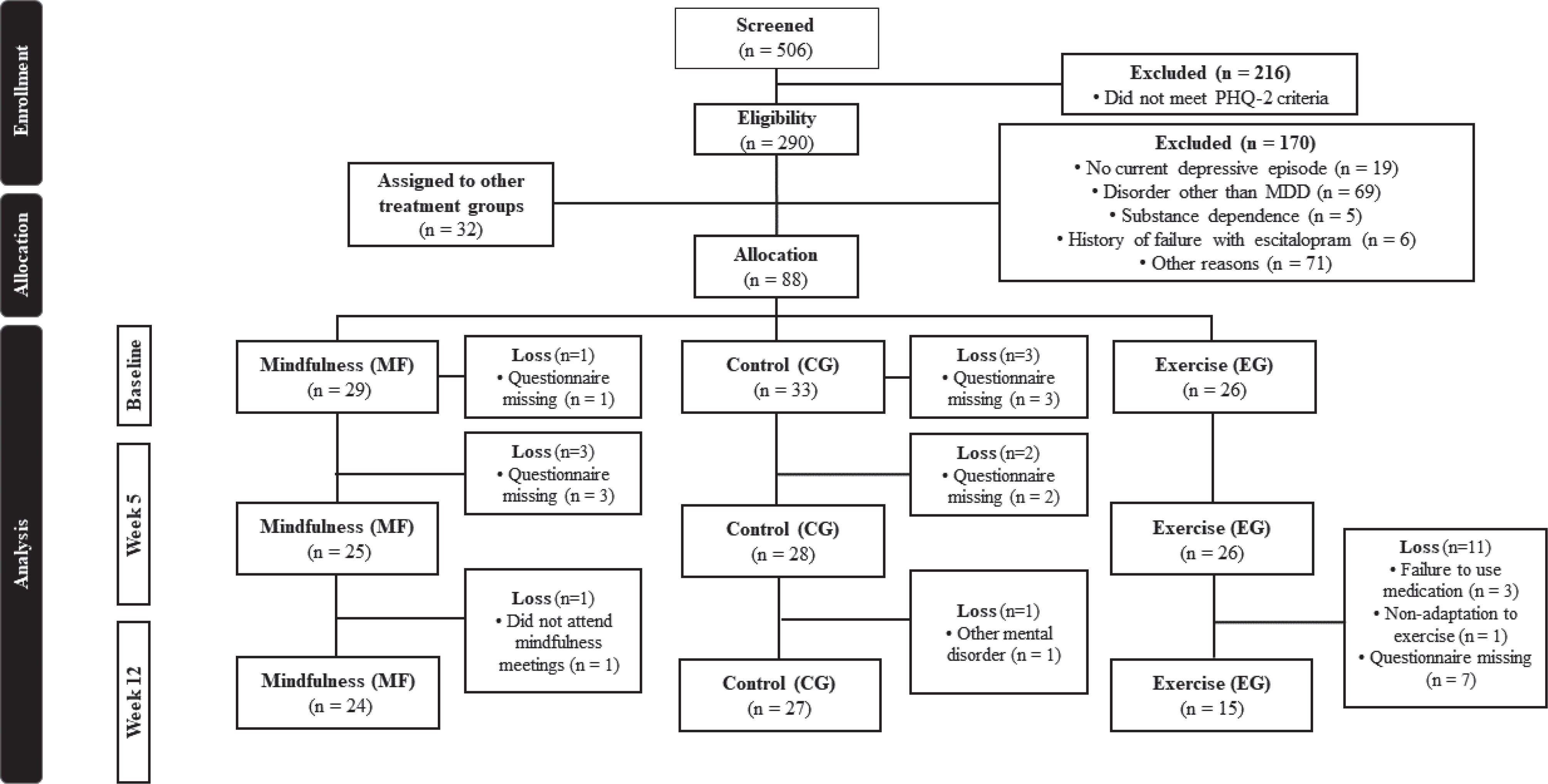
In total, 290 participants were screened for eligibility, of which 170 were excluded, and 32 participants were allocated to another treatment group that is not part of this study (Figure 1). A total of 88 participants were allocated to distinct treatment groups; however, only 84 were included in the analyses, as the remaining participants were excluded for not completing the baseline questionnaires (further details are provided below). The treatment groups were: 1) pharmacotherapy alone (CG, n = 30), or 2) pharmacotherapy combined with multimodal exercise (EG, n = 26) or 3) pharmacotherapy combined with mindfulness (MF, n = 28) (Figure 1). Baseline participant's clinical and sociodemographic characteristics stratified by treatment group are detailed in Table 1.
In the EG group, four participants discontinued treatment between week 5 and week 12, three participants were excluded for non-compliance with medication, and one participant withdrew due to difficulty adapting to the prescribed exercise routine, as reported by Tavares et al.41 In addition, seven participants did not answer the PSQI and they were excluded from the analysis of the present study. Within the CG group, three did not complete the baseline questionnaires, and were all later diagnosed with other mental disorders at the end of the study. Additionally, two participants were excluded between baseline and week 5 due to missing questionnaire data. These two were later excluded for medication non-adherence at the end of the study. For the MF group, one participant was excluded for not answering the PSQI. In addition, three participants were excluded for not answering the PSQI at week 5, and one was excluded for not answering the PSQI at week 12 (Figure 1).
On average, participants in the CG (mean = 10.60, SE = 0.51), 46.7% had a sleep disorder, 53.3% had bad sleep, and similarly, none were classified as having good sleep. Participants in MF (mean = 11.02, SE = 0.47), 59.3% were classified as having a sleep disorder, 40.7% as having bad sleep quality, and none were classified as having good sleep. In contrast, participants in the EG (mean = 8.35, SE = 0.45) showed a more favorable distribution: 7.7% were classified as having good sleep, 69.2% as bad sleep, and only 23.1% as having a sleep disorder.
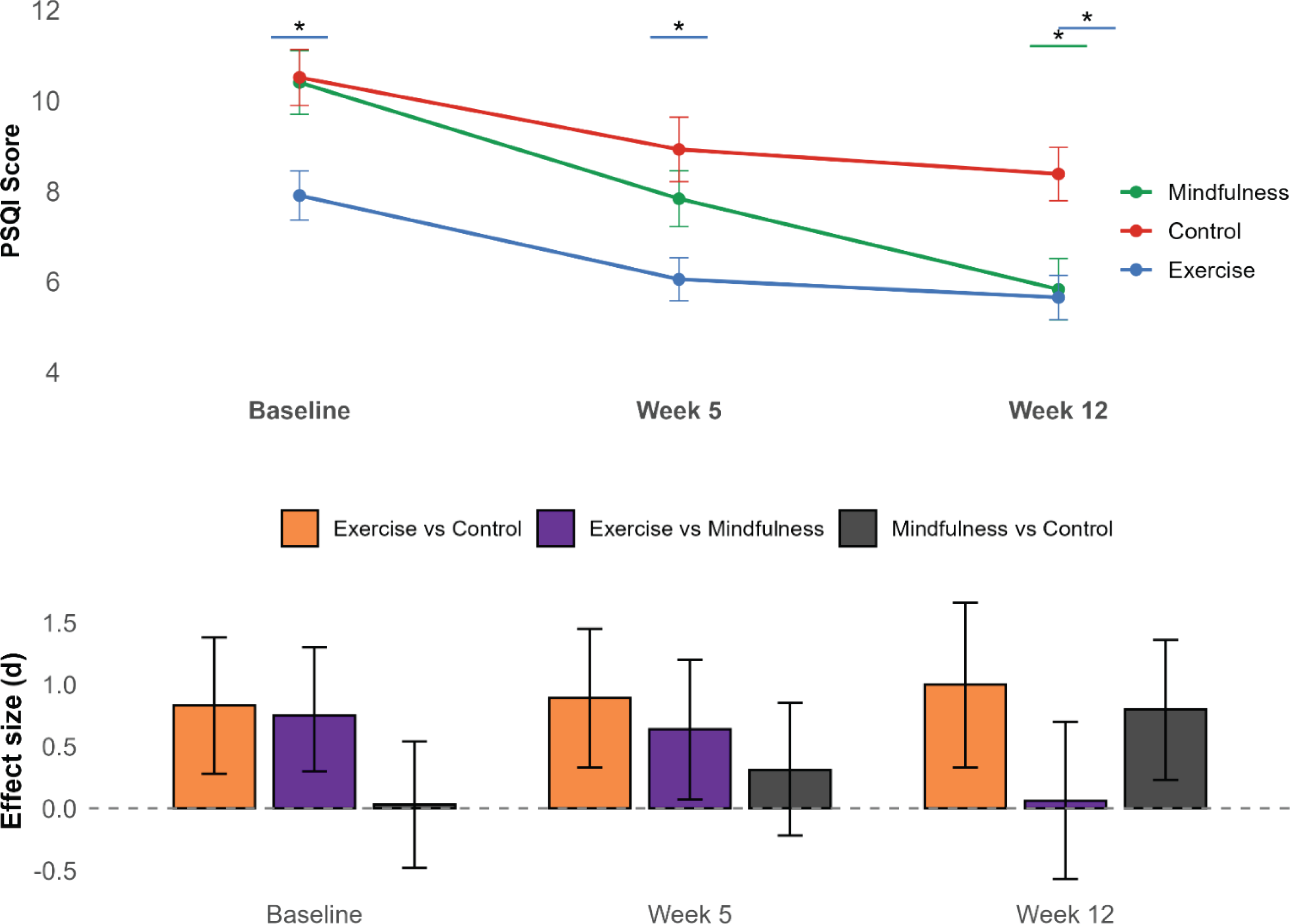
Significant improvements in PSQI total scores across all groups when comparing baseline to subsequent time points [time*group F(4;213) = 2.958, p = 0.021] (Figure 2). At baseline (t0), most participants exhibited poor sleep quality (52.2%; CG = 16, MF = 12, EG = 18), and participants classified with a sleep disorder accounted for 39% of the total sample (CG = 14, MF = 15, EG = 6). The exercise group (EG) demonstrated significantly better sleep quality compared to both the mindfulness group (MF) [p = 0.002; d = 0.75 (95% CI 0.20, 1.30)] and control group (CG) [p = 0.001; d = 0.83 (95% CI 0.28, 1.38)], while no significant differences were found between MF and CG [p = 0.887; d = 0.03 (95% CI −0.48, 0.54)]. Then, MF demonstrated significant improvements in sleep quality by the reduction PSQI from t0 to t1 [p = 0.002; d = 0.74 (95% CI 0.14, 1.27)] and from t0 to t2 [p <0.0001; d = 1.29 (95% CI 0.68, 1.88)] with the highest effect size (Figure 2). The EG also reduced PSQI from t0 to t1 [p = 0.002; d = 0.71 (95% CI 0.14, 1.27)] and from t0 to t2 [p = 0.002; d = 0.90 (95% CI 0.23, 1.56)] with a large effect size. CG also showed significant, though modest, improvements in sleep quality from t0 to t1 [p = 0.017; d = 0.44 (95% CI −0.07, 0.96)] and from t0 to t2 [p = 0.017; d = 0.65 (95% CI 0.12, 1.19)] (Figure 2).
Changes in PSQI scores over time by intervention group. All groups decreased PSQI scores over time. * Indicates significant between-group differences at each time point. The blue line means a difference between the exercise group and both control and mindfulness groups (at baseline and week 5). The blue and green lines at week 12 indicate that both exercise and mindfulness groups differed from control, respectively.
At week 5 (t1), the exercise group maintain significantly better sleep quality compared to both the MF [p = 0.018; d = 0.64 (95% CI 0.07, 1.20)] and control group (CG) [p = 0.001; d = 0.89 (95% CI 0.33, 1.45)], while no significant differences were found between MF and CG [p = 0.189; d = 0.31 (95% CI −0.22, 0.85)]. As a result of these improvements, by week 12 (t2), MF showed similar levels of sleep quality to EG [p = 0.800; d = 0.06 (95% CI −0.57, 0.70)], and lower levels than the CG [p = 0.002; d = 0.80 (95% CI 0.23, 1.36)], while the EG's PSQI levels maintained significantly lower than the CG [p < 0.0001; d = 1.00 (95% CI 0.33, 1.66)] (Figure 2).
In addition, there was a 60% reduction in the total number of participants classified as having a sleep disorder (15%; CG = 9, MF = 5, EG = 0), and an 11% decrease in those with poor sleep quality (46%; CG = 17, MF = 14, EG = 10), indicating an overall improvement in sleep quality. For all statistical values, see Supplementary Tables S1 and S2. After treatment, EG participants were still classified as having bad sleep quality (mean = 5.64), while both MF (mean = 5.82) and CG (mean = 8.37) dropped from sleep disorder to bad sleep quality – although MF was closer to the good sleep quality edge, whilst the CG was closer to the sleep disorder edge.
Discussion
This 12-week trial implemented clinically feasible practices to evaluate the adjunctive benefits of structured lifestyle-based interventions in group, online-delivered, supervised, and home-based on sleep quality in participants with MDD. Analysis revealed significant effects in sleep quality over time across all treatment conditions. Notably, the mindfulness group (MF) exhibited superior power in promoting sleep quality improvements, followed by the exercise group (EG) and exclusive pharmacotherapy (CG). These findings provide compelling evidence that both mindfulness and multimodal exercise interventions, when implemented as adjuncts to standard pharmacotherapy, yield superior improvements in sleep quality parameters compared to medication alone, though with distinct temporal trajectories of therapeutic effect.
Selective serotonin reuptake inhibitors (SSRIs) are known by their sedative properties and have been shown to improve sleep quality in MDD45,46; however, data are still conflicting. For example, a recent meta-analysis observed that some of the most common antidepressants (i.e., escitalopram and citalopram) cause high levels of insomnia, consequently decreasing sleep quality.47 Considering that sleep appears to play a significant role in modulating the stress system and the low-grade inflammation that is prejudicial to MDD recovery,48 there is a clear rationale for including the improve of sleep as a treatment goal. In our study, the CG group, which received only pharmacological treatment, showed a reduction in global sleep quality score by the end of the treatment, indicating an improvement in sleep quality relative to baseline. However, the magnitude of this improvement was not greater than that observed in either of the other lifestyle-based intervention groups. Therefore, given the conflicting evidence regarding the effects of SSRIs on sleep quality and considering the importance of good sleep for clinical response and remission in participants with MDD,47 it is essential to explore interventions that can support the management of sleep quality and promote improvements in this fundamental physiological function.
A substantial body of evidence on the effects of exercise on sleep quality has been reported, indicating a strong positive impact of physical activity on the improvement of sleep quality.22,23 Based on expert recommendations in the field of mental health, it is crucial to explore different types of exercise with a focus on adherence, as the MDD population exhibits high levels of physical inactivity and, consequently, a high dropout rate.27 Our multimodal exercise program, specifically designed for individuals with MDD and combined with antidepressant medication, in addition to demonstrating a significant adjunctive effect in reducing depressive symptoms and improving anti-inflammatory response,8,11 also induced greater improvements in sleep quality compared to medication alone. However, the multimodal exercise group did not outperform the mindfulness intervention. In general, the potential benefits of multimodal exercise may be linked to the reduction of depressive symptoms, which, in turn, influence mechanisms related to emotional regulation,8 thereby improving sleep quality.22 Therefore, incorporating multimodal exercise to enhance sleep quality, with an emphasis on enjoyment and pleasure during physical activity, could be a viable strategy to reduce dropout rates.8,49 This approach may also offer long-term health benefits to the MDD population by promoting sustained engagement in physical activity.13
In this study, participants who participated in the mindfulness training in combination with an SSRI showed the greatest improvement in sleep quality over the course of the intervention, highlighting the potential of mindfulness as an adjunct to antidepressant medication and showing benefits beyond the use of medication alone. Mindfulness has gained prominence as a treatment focused on emotional regulation and self-awareness.50 A recent study investigated the effect of an online mindfulness program as a monotherapy for individuals experiencing depressive and anxiety symptoms alongside with severe insomnia. The 8 week-intervention resulted in improvements across both mental health and sleep-related outcomes, including significant reductions in fatigue and daytime sleepiness.51 In contrast, our study was innovative in implementing long-term online protocols, incorporating group practices, and positioned mindfulness as an adjunct to usual pharmacotherapy. Supporting these findings, a recent review of 18 studies involving 1,654 adult participants with clinically significant sleep disorders demonstrated that mindfulness-based interventions are effective in improving sleep quality.52
Additionally, participants’ mindfulness group demonstrated significant improvements in both depressive symptoms and rumination, emphasizing the potential of this approach for broader mental health promotion.7 The program was designed to emphasized attentional training, meta-awareness and self-compassion, guiding participants to observe their thoughts, bodily sensations, and emotions.53,54 Within the mindfulness-based therapy framework, components such as awareness, and core attitudes, as acceptance, openness, and non-judgmental relationship with the phenomena have been emphasized as central mechanisms of change.55–57 These elements may contribute to improvements in sleep quality by reducing cognitive hyperarousal and reactivity, promoting better nervous system autonomic balance, positioning mindfulness-based interventions as a potentially valuable form of mental training tool for individuals with MDD.58,59 Training these skills is often associated with improved sleep quality,55 likely due to the acceptance- and awareness-induced reduction of psychological distress and the shift in participants’ relationship with ruminative and repetitive thoughts, particularly during insomnia episodes.58,59 Nonetheless, further research is needed to elucidate the underlying biological and cognitive mechanisms in clinical samples, as well as to strengthen the clinical applicability of these interventions.
The findings of this study indicate that lifestyle-based adjunctive interventions, whether through mindfulness or multimodal exercise, delivered in a home-based format may offer valuable therapeutic benefits for individuals with MDD. These results support the growing recognition of lifestyle-based strategies as effective complements to conventional first-line treatments, which are primarily pharmacological in nature.60 Furthermore, considering the multidisciplinary concern to minimize the symptoms of comorbidities in MDD, such as insomnia, these interventions may be particularly beneficial for individuals with depression who also experience poor sleep quality.
Despite its contributions, this study has some methodological limitations. Sleep disorders are a frequent comorbidity to MDD, representing a significant marker of disease severity.17 Sleep quality can be assessed through various methods, including subjective measures (i.e., self-reported questionnaires) and objective approaches (i.e., polysomnography). Although objective instruments are considered robust and the gold standard for measurement, they often incorporate a subjective element, as they require expert interpretation of the data.61 First, we did not include objective sleep assessment measures such as polysomnography or actigraphy, which could have provided physiological validation of the self-reported measures. In this study, sleep quality was evaluated using the PSQI, a self-reported instrument that shows a reliable, valid, and standardized measure of sleep quality.39 On the other hand, self-reported questionnaires are important for the clinical assessment of participants (e.g., self-perceived quality), as they provide valuable insights with easy-to-interpret results for both clinicians and participants regarding their health.62 Therefore, to better understand the patient's perspective or perception of their sleep quality, it is crucial to include self-reported measures.21
However, the use of standardized psychometric instruments offers valuable insights into participants’ perceived sleep quality, a clinically relevant outcome that captures subjective dimensions often missed by physiological measurements alone. Second, the absence of a non-clinical control group limited our ability to compare intervention effects against normative patterns, restricting the generalizability of our findings. Finally, the differential attrition rate observed in the exercise group, including a number of participants not completing the final PSQI assessment, potentially introduces bias that warrants cautious interpretation of longitudinal outcomes.
Conversely, this study presents several notable strengths, particularly regarding clinical applicability and ecological validity. By implementing interventions under real-world conditions, accounting for typical clinical constraints and resources, our findings are more readily generalizable to standard psychiatric practice. Furthermore, the protocol's successful delivery of professionally supervised multimodal exercise and mindfulness-based interventions in online format highlights their feasibility and effectiveness in diverse geographical contexts, including rural settings and underserved areas. These interventions require only basic technological infrastructure (i.e., internet access and a smartphone), underscoring their potential to expand access to care in regions where specialized mental health services are often limited or unavailable.
Conclusion
Our findings demonstrated that supervised, online, home-based lifestyle interventions, when combined with a standard antidepressant medication, are more effective in improving sleep quality than pharmacotherapy alone. The distinct temporal patterns observed in response, with exercise exhibiting early benefits and mindfulness showing more sustained effects, suggest different underlying mechanisms of improvement, which may be useful to inform a personalized treatment approach. The demonstration of the effectiveness of these online-delivered interventions not only supports their integration into routine clinical practice but also as feasible in real-world clinical practice and helps to address critical barriers of access to care, including geographical limitations and healthcare resource inequalities. Future research should incorporate objective sleep measures, assess longer-term outcomes, and investigate patient-level characteristics predicting optimal response to specific interventions. Furthermore, a larger sample size will be essential to validate and extend these findings and to further establish lifestyle-based interventions as a viable and scalable effective treatment for MDD.
Acknowledgements
This study was financed in part by Coordenação de Aperfeiçoamento de Pessoal de Nível Superior – Brasil (CAPES; Finance Code 001). Vagner Deuel de O. Tavares, Geissy Lainny de Lima-Araujo, and Geovan Menezes De Sousa were supported by CAPES (88887.597821/2021-00, 88887.892816/2023-00, 88887.597821/2021-00; grant 88887.597821/2021-00). Brendon Stubbs holds an NIHR Advanced fellowship (NIHR301206).
The authors are thankful for the participants who volunteered and for Universidade Federal do Rio Grande do Norte for the institutional support.
Data availability statement
The data that support this study are available from the authors upon request.
References
- 1 de Menezes Galvão AC, Almeida RN, de Sousa GM, Leocadio-Miguel MA, Palhano-Fontes F, de Araujo DB, et al. Pathophysiology of major depression by clinical stages. Front Psychol. 2021;12:641779.
- 2 Yan G, Zhang Y, Wang S, Yan Y, Liu M, Tian M, et al. Global, regional, and national temporal trend in burden of major depressive disorder from 1990 to 2019: an analysis of the global burden of disease study. Psychiatry Res. 2024;337:115958.
-
3 National Institute for Health and Care Excellence (NICE). Depression in adults: treatment and management [Internet]. 2022. www.nice.org.uk/guidance/ng222
» www.nice.org.uk/guidance/ng222 - 4 Seshadri A, Orth SS, Adaji A, Singh B, Clark MM, Frye MA, et al. Mindfulness-based cognitive therapy, acceptance and commitment therapy, and positive psychotherapy for major depression. Am J Psychother. 2021;74:4-12.
- 5 Heissel A, Heinen D, Brokmeier LL, Skarabis N, Kangas M, Vancampfort D, et al. Exercise as medicine for depressive symptoms? A systematic review and meta-analysis with meta-regression. Br J Sports Med. 2023;57:1049-57.
- 6 Firth J, Solmi M, Wootton RE, Vancampfort D, Schuch FB, Hoare E, et al. A meta-review of "lifestyle psychiatry": the role of exercise, smoking, diet and sleep in the prevention and treatment of mental disorders. World Psychiatry. 2020;19:360-80.
- 7 Tinôco HGB de M, Menezes de Sousa G, Araújo Ribeiro EB, Eduarda de Mendonça Maciel J, Tavares VD de O, Luiza de Morais M, et al. Comparative effectiveness of mindfulness and physical exercise on rumination in patients with major depression: an integrated evaluation of an open label randomized trial. Ment Health Phys Act. 2025;100679.
- 8 Tavares VD de O, Schuch FB, de Sousa GM, Hallgren M, Oliveira Neto L, Cabral DAR, et al. Effectiveness of an affect-adjusted, supervised, multimodal, online and home-based exercise group protocol for major depression: a randomized controlled trial. Psychol Sport Exerc. 2025;76:102729.
- 9 Tavares VD de O, de Sousa GM, Schuch FB, Campanelli S, Meyer J, de Almeida RN, et al. Self-reported mood and lifestyle-related physical activity of young adults with major depressive disorder. Percept Mot Skills. 2024;131:489-513.
- 10 Linardon J, Messer M, Goldberg SB, Fuller-Tyszkiewicz M. The efficacy of mindfulness apps on symptoms of depression and anxiety: an updated meta-analysis of randomized controlled trials. Clin Psychol Rev. 2024;107:102370.
- 11 Tavares VD de O, Schuch FB, de Sousa GM, Hallgren M, Teychenne M, de Almeida RN, et al. Does multimodal exercise reduce C-reactive protein levels in major depressive disorder? Preliminary results from a randomized controlled trial. J Psychiatr Res. 2025;183:252-9.
- 12 Marx W, Manger SH, Blencowe M, Murray G, Ho FYY, Lawn S, et al. Clinical guidelines for the use of lifestyle-based mental health care in major depressive disorder: World Federation of Societies for Biological Psychiatry (WFSBP) and Australasian Society of Lifestyle Medicine (ASLM) taskforce. World J Biol Psychiatry. 2023;24:333-86.
- 13 Ross RE, VanDerwerker CJ, Saladin ME, Gregory CM. The role of exercise in the treatment of depression: biological underpinnings and clinical outcomes. Vol. 28, molecular psychiatry. Berlim: Springer Nature; 2023. p. 298-328.
- 14 Goldberg SB, Tucker RP, Greene PA, Davidson RJ, Wampold BE, Kearney DJ, et al. Mindfulness-based interventions for psychiatric disorders: a systematic review and meta-analysis. Clin Psychol Rev. 2018;59:52-60.
- 15 Lederman O, Ward PB, Firth J, Maloney C, Carney R, Vancampfort D, et al. Does exercise improve sleep quality in individuals with mental illness? A systematic review and meta-analysis. J Psychiatr Res. 2019;109:96-106.
- 16 Riemann D, Krone LB, Wulff K, Nissen C. Sleep, insomnia, and depression. Neuropsychopharmacology. 2020;45:74-89.
- 17 De Menezes Galvão AC, Almeida RN, De Sousa Junior GM, Leocadio-Miguel MA, Palhano-Fontes F, De Araujo DB, et al. Potential biomarkers of major depression diagnosis and chronicity. PLoS One. 2021;16:e0257251.
- 18 Santiago GTP, de Menezes Galvão AC, de Almeida RN, Mota-Rolim SA, Palhano-Fontes F, Maia-de-Oliveira JP, et al. Changes in cortisol but not in brain-derived neurotrophic factor modulate the association between sleep disturbances and major depression. Front Behav Neurosci. 2020;14:44.
- 19 Xu G, Li X, Xu C, Xie G, Liang J. Effect of insomnia in the major depressive disorder. BMC Neurol. 2022;22:341.
- 20 Jiang Y, Jiang T, Xu LT, Ding L. Relationship of depression and sleep quality, diseases and general characteristics. World J Psychiatry. 2022;12:722-38.
- 21 Torres LHSF, Medeiros YKM, de Sousa GM, Vargas HQ, de Menezes Galvão AC, de Almeida RN, et al. Use of sleep quality questionary and cortisol awakening response as complementary tools for the evaluation of major depression progression. Curr Psychol. 2024;43:19820-9.
- 22 Brupbacher G, Gerger H, Zander-Schellenberg T, Straus D, Porschke H, Gerber M, et al. The effects of exercise on sleep in unipolar depression: a systematic review and network meta-analysis. Sleep Med Rev. 2021;59:101452.
- 23 Lederman O, Ward PB, Firth J, Maloney C, Carney R, Vancampfort D, et al. Does exercise improve sleep quality in individuals with mental illness? A systematic review and meta-analysis. J Psychiatr Res. 2019;109:96-106.
- 24 Vancampfort D, Stubbs B, Van Damme T, Smith L, Hallgren M, Schuch F, et al. The efficacy of meditation-based mind-body interventions for mental disorders: a meta-review of 17 meta-analyses of randomized controlled trials. J Psychiatr Res. 2021;134:181-91.
- 25 Brinsley J, Schuch F, Lederman O, Girard D, Smout M, Immink MA, et al. Effects of yoga on depressive symptoms in people with mental disorders: a systematic review and meta-analysis. Br J Sports Med. 2021;55:992-1000.
- 26 Tavares VD de O, Schuch FB, de Sousa GM, Hallgren M, Oliveira Neto L, Cabral DAR, et al. Effectiveness of an affect-adjusted, supervised, multimodal, online and home-based exercise group protocol for major depression: a randomized controlled trial. Psychol Sport Exerc. 2025;76:102729.
- 27 Firth J, Siddiqi N, Koyanagi A, Siskind D, Rosenbaum S, Galletly C, et al. The Lancet Psychiatry Commission: a blueprint for protecting physical health in people with mental illness. Lancet Psychiatry. 2019;6:675-712.
- 28 Tang YY, Hölzel BK, Posner MI. The neuroscience of mindfulness meditation. Nat Rev Neurosci. 2015;16:213-25.
- 29 Garland EL, Hanley A, Farb NA, Froeliger B. State mindfulness during meditation predicts enhanced cognitive reappraisal. Mindfulness (N Y). 2015;6:234-42.
- 30 Brown KW, Berry D, Eichel K, Beloborodova P, Rahrig H, Britton WB. Comparing impacts of meditation training in focused attention, open monitoring, and mindfulness-based cognitive therapy on emotion reactivity and regulation: neural and subjective evidence from a dismantling study. Psychophysiology. 2022;59:E14024.
- 31 Sousa GM de, Lima-Araújo GL de, Araújo DB de, Sousa MBC de. Brief mindfulness-based training and mindfulness trait attenuate psychological stress in university students: a randomized controlled trial. BMC Psychol. 2021;9:21.
- 32 Lima-Araujo GL de, de Sousa Júnior GM, Mendes T, Demarzo M, Farb N, Barros de Araujo D, et al. The impact of a brief mindfulness training on interoception: a randomized controlled trial. PLoS One. 2022;17:e0273864.
- 33 Perestelo-Perez L, Barraca J, Peñate W, Rivero-Santana A, Alvarez-Perez Y. Mindfulness-based interventions for the treatment of depressive rumination: systematic review and meta-analysis. Int J Clin Health Psychol. 2017;17:282-95.
- 34 Rusch HL, Rosario M, Levison LM, Olivera A, Livingston WS, Wu T, et al. The effect of mindfulness meditation on sleep quality: a systematic review and meta-analysis of randomized controlled trials. Ann N Y Acad Sci. 2019;1445:5-16.
- 35 Chan SHW, Lui D, Chan H, Sum K, Cheung A, Yip H, et al. Effects of mindfulness-based intervention programs on sleep among people with common mental disorders: a systematic review and meta-analysis. World J Psychiatry. 2022;12:636-50.
- 36 Chen TL, Chang SC, Hsieh HF, Huang CY, Chuang JH, Wang HH. Effects of mindfulness-based stress reduction on sleep quality and mental health for insomnia patients: a meta-analysis. J Psychosom Res. 2020;135:110144.
- 37 Schulz KF, Altman DG, Moher D. CONSORT 2010 Statement: updated guidelines for reporting parallel group randomised trials. BMJ. 2010;340:c332.
- 38 Montgomery SA, Åsberg M. A new depression scale designed to be sensitive to change. Br J Psychiatry. 1979;134:382-9.
- 39 Buysse DJ, Reynolds CF, Monk TH, Berman SR, Kupfer DJ. The Pittsburgh Sleep Quality Index: a new instrument for psychiatric practice and research. Psychiatry Res. 1989;28:193-213.
- 40 Mollayeva T, Thurairajah P, Burton K, Mollayeva S, Shapiro CM, Colantonio A. The Pittsburgh sleep quality index as a screening tool for sleep dysfunction in clinical and non-clinical samples: a systematic review and meta-analysis. Sleep Med Rev. 2016;25:52-73.
- 41 Tavares VD de O, Schuch FB, de Sousa GM, Hallgren M, Oliveira Neto L, Cabral DAR, et al. Effectiveness of an affect-adjusted, supervised, multimodal, online and home-based exercise group protocol for major depression: a randomized controlled trial. Psychol Sport Exerc. 2025;76:102729.
- 42 Tavares VD de O, Schuch FB, Tempest G, Parfitt G, Oliveira Neto L, Galvão-Coelho NL, et al. Exercisers’ affective and enjoyment responses: a meta-analytic and meta-regression review. Percept Mot Skills. 2021;128:2211-36.
- 43 Segal Z V, Williams JMG, Teasdale JD. Mindfulness-based cognitive therapy for depression. 2nd ed. New York: Guilford Press; 2013.
-
44 Nguyen M. A guide on data analysis [Internet]. 2020. bookdown.org/mike/data_analysis/
» bookdown.org/mike/data_analysis/ - 45 Oberndorfer S, Saletu-Zyhlarz G, Saletu B. Effects of selective serotonin reuptake inhibitors on objective and subjective sleep quality. Neuropsychobiology. 2000;42:69-81.
- 46 Aarts N, Zuurbier LA, Noordam R, Hofman A, Tiemeier H, Stricker BH, et al. Use of selective serotonin reuptake inhibitors and sleep quality: a population-based study. J Clin Sleep Med. 2016;12:989-95.
- 47 Zhou S, Li P, Lv X, Lai X, Liu Z, Zhou J, et al. Adverse effects of 21 antidepressants on sleep during acute-phase treatment in major depressive disorder: a systemic review and dose-effect network meta-analysis. Sleep. 2023;46:zsad177.
- 48 Dantzer R, O’Connor JC, Freund GG, Johnson RW, Kelley KW. From inflammation to sickness and depression: when the immune system subjugates the brain. Nat Rev Neurosci. 2008;9:46-56.
- 49 Tavares VD de O, Schuch FB, Tempest G, Parfitt G, Oliveira Neto L, Galvão-Coelho NL, et al. Exercisers’ affective and enjoyment responses: a meta-analytic and meta-regression review. Percept Mot Skills. 2021;128:2211-36.
- 50 Kabat-Zinn J, Lipworth L, Burney Robert. The clinical use of mindfulness meditation for the self-regulation of chronic pain. J Behav Med. 1985;8:163-90.
- 51 Huberty JL, Green J, Puzia ME, Larkey L, Laird B, Vranceanu AM, et al. Testing a mindfulness meditation mobile app for the treatment of sleep-related symptoms in adults with sleep disturbance: a randomized controlled trial. PLoS One. 2021;16:e0244717.
- 52 Rusch HL, Rosario M, Levison LM, Olivera A, Livingston WS, Wu T, et al. The effect of mindfulness meditation on sleep quality: a systematic review and meta-analysis of randomized controlled trials. Ann N Y Acad Sci. 2019;1445:5-16.
- 53 Hölzel BK, Lazar SW, Gard T, Schuman-Olivier Z, Vago DR, Ott U. How does mindfulness meditation work? Proposing mechanisms of action from a conceptual and neural perspective. Perspectives on Psychological Science. 2011;6:537-59.
- 54 Kabat-Zinn J. Full catastrophe living: using the wisdom of your body and mind to face stress, pain, and illness. New York: Bantam Books; 1990.
- 55 Kabat-Zinn J. Full catastrophe living: using the wisdom of your body and mind to face stress, pain, and illness. New York: Bantam Books; 2013.
- 56 Segal Z, Williams M, Teasdale J. Mindfulness-based cognitive therapy for depression. New York: Guilford Press; 2012.
- 57 van der Velden AM, Kuyken W, Wattar U, Crane C, Pallesen KJ, Dahlgaard J, et al. A systematic review of mechanisms of change in mindfulness-based cognitive therapy in the treatment of recurrent major depressive disorder. Clin Psychol Rev. 2015;37:26-39.
- 58 Kim HG. Effects and mechanisms of a mindfulness-based intervention on insomnia. Yeungnam Univ J Med. 2021;38:282-8.
- 59 Lau WKW, Leung MK, Wing YK, Lee TMC. Potential mechanisms of mindfulness in improving sleep and distress. Mindfulness (N Y). 2018;9:547-55.
- 60 Marx W, Manger SH, Blencowe M, Murray G, Ho FYY, Lawn S, et al. Clinical guidelines for the use of lifestyle-based mental health care in major depressive disorder: World Federation of Societies for Biological Psychiatry (WFSBP) and Australasian Society of Lifestyle Medicine (ASLM) taskforce. World J Biol Psychiatry. 2023;24:333-86.
- 61 Patrick DL, Burke LB, Powers JH, Scott JA, Rock EP, Dawisha S, et al. Patient-reported outcomes to support medical product labeling claims: FDA perspective. Value in Health. 2007;10:S125-37.
- 62 Quatrano LA, Cruz TH. Future of outcomes measurement: impact on research in medical rehabilitation and neurologic populations. Arch Phys Med Rehabil. 2011;92:S7-11.
Edited by
-
Handling Editor:
Adriane Rosa