 Aleppo, Mari and the aleppine-mariyanum dinastic project in the ancient Syria
ABSTRACT
This research aims to present aspects of diplomatic relations in the ancient Near East during the Proto-Babylonian period, focusing on the territorial state of Yamḫad, located in the northwestern Levant, and the expansionist project of Mari, situated in the Middle Euphrates. By establishing an agreement between their respective kingdoms, Yarīm-līm and Zimrī-līm conveyed an ambition to control the northwestern Levant. War policies and commercial interests were set against the backdrop of the dynastic marriage between Zimrī-līm and Shibtu, daughter of Yarīm-līm, which is why this alliance became the foundation for the union of two dynastic lineages of the same Amorite origin. Our hypothesis is that, from a Levantine perspective, Yamḫad became the center of Semitic civilization at the same time that Zimrī-līm ascended the throne of Mari with political and military ambitions aimed at territorial expansion and participation in the trade networks controlled by Yamḫad, through which it would reach connections with the eastern Mediterranean. However, Yarīm-līm, as the highest regional authority, allowed neither political nor religious parity. This research seeks to historicize, through contextual intersections, the alliances and environments – perhaps culturally conflicting, yet also capable of fostering affections – through which two dynastic houses may have integrated various ethnic groups from semi-autonomous spheres while maintaining dynamic borders.
Keywords
Amorite Yamhad kingdom; Syro-Mesopotamian civilization; alliances in the Ancient World
RESUMO
Esta pesquisa tem por objetivo apresentar aspectos das relações diplomáticas do antigo Oriente Próximo no período protobabilônico, focando sobre o Estado territorial de Yamḫad, no noroeste do Levante, e o projeto expansionista de Mari, localizado no Médio Eufrates. Ao pactuarem seus respectivos reinos, Yarīm-līm e Zimrī-līm demonstram aspiração em controlar o noroeste do Levante. As políticas de guerra e os interesses comerciais ficaram sob o plano de fundo do casamento dinástico entre Zimrī-līm e Shibtu, filha de Yarīm-līm, motivo pelo qual essa aliança se tornou o fundamento da união entre as duas linhagens dinásticas de mesma origem amorrita. Nossa hipótese é que, na perspectiva levantina, Yamḫad se tornou o centro da civilização semita na mesma época em que Zimrī-līm subiu ao trono em Mari com pretensões político-militares que visavam à expansão territorial e à participação nas redes comerciais controladas por Yamḫad, pelas quais alcançaria as conexões com o Mediterrâneo oriental. No entanto, Yarīm-līm, como maior autoridade regional, não permitia paridade nem política nem religiosa. Esta pesquisa pretende historizar por meio de interseções contextuais as alianças e os ambientes – talvez culturalmente conflitantes, mas também capazes de gerar afecções – por meio dos quais duas casas dinásticas poderiam ter integrado vários grupos étnicos de universos semiautônomos, mantendo bordas dinâmicas.
Palavras-chave
Reino amorrita de Yamhad; civilização Siro-Mesopotâmia; alianças no mundo antigo
In this research, I will focus on presenting the political processes of a dynasty construction in the northwest region of the Levant from a historiographical perspective, specifically from Aleppo [ḫa-la-abki; Ḫalab] – kingdom of the land of Yamhad [Yamḫad] –, within the framework of diplomatic relations. Sometimes, in an oxymoronic classification, the interest in the fortunate material cultures of Mari [ma-riki] – a city that has often been disassociated from ancient Syria, especially due to its location on the Middle Euphrates and its East-Semitic linguistic relationship – and Ugarit [ug-ga-ra-atki; KURú-ga-ri-it], along with the territorialization processes involving the Arpad/Bit-Agusi [mgu-u-si KUR ia-ḫa-a-nu; Bīt-Agūsi] kingdom, has peripherally linked so many cultures and political entities originating in the Northern Levant.1 These entities are subordinated on scales that overlap those large index producers.
This has been the case with Aleppo. An ancient Amorite tribal and pastoral structure [MAR.TU; KUR a-mur-ri; Amurrû], Aleppo emerged as the capital at a time when it was ruled by the sharrum Yarim-lim [ia-ri-im-li-im; Yarīm-līm]2 (c. 1780-1765)3; designated in the Archives Royales de Mari (ARM)4 as king of Aleppo and the Yamhad land, son and successor of Sumu-Epuh (Sūmû-Epuḫ, ?-1780), the “beloved of Haddu”, [n]a-ra-[am dIŠKUR].
It is important to initially highlight, with historical agents, the notion of geography. Aleppo and its surroundings:
The eastern plateau consists of the steppes surrounding Aleppo (ancient Ḫalab), watered by the Kuweik River, and the areas south until Jabal Abū Rujmayn and Jabal Bishrī (ancient Bashar […]). The Kuweit, which flows past Aleppo, is fed by sources north of the Kurt Dağ and is a western parallel to the Euphrates. In fact, Aleppo stands roughly midpoint for travel between the Euphrates and the Orontes (Suriano, 2014, p. 12).
The northern edges of the Levant, however, are not on simple scales: Hamat [URU.ḫa-ma-ti; Ḫamat, Ḥama], in the Orontes valley, with contacts from the Phoenician city-states and their north-south Mediterranean connections; in the Syrian limits from Sam’al Sam’al [sa-am-al-la; Šam’al], Karkamish [gar-ga-miš-a-a; Karkamiš] and the Aleppo plateau to the Middle Euphrates, with socio-ethnic greatness that participated in Mesopotamians systems such as the Amorite groups of in Jezirah (the ancient tribes KUR. lab-du-du, Tu’mūna and KUR. ḫa-ṭa-lu), Mari and Babylon [KUR. kár-dun-ia-áš; Bāb- ilī], advancing between the sacred river Balih [Balīḫ] and the river Habur [Ḫābūr].
By the end of the third millennium, urbanization had led to the development of several cities. Hamat, Qatna [Qa-ta-nimki; Qaṭna], Ebla [‘Īblā], Karkamish, Mari, and Aleppo were among the most important in the north and northwest of the Levant. In the early First-Babylonian period (c. 1800-1595/1792-1592), these cities, except Mari, became part of Yamhad’s territory. With an innovative policy, structurally temple-palace, Aleppo became the religious center of the Haddu god [iladad be-el ḫa-la-abki, “god Adad, lord of Aleppo”] and exerted a strong influence on the Syria-Mesopotamia. As soon as he came to power in Mari, Zimri-lim [zi-im-ri-li-im; Zimrī-līm] (c. 1774-1762), the last king of independent Mari, built diplomatic bridges on the borders with northwestern Syria and the Upper Euphrates, establishing a strong alliance with Aleppo. In fact, Zimri-lim’s accession occurred amidst great opposition over his illegitimate blood affiliation to the dynasty founded by Amorite Yaggid-lim [Yaggīd-līm] (c. 1820), despite both belonging to the same Simalite lineage [banū Sim’al]. In this context, the support offered by Eshnunna [èš-nun-naki; Ešnunna], an independent kingdom located in the Diyala valley, with pretensions in Upper Mesopotamia and governed by Ibal-pi’El II [Ibāl-pī’El] (c. 1779-1766), proved to be insufficient for stability around the city. These are the reasons for the complaints in letters by the king of Mari and his request for help to Yarim-lim.5
Tribal revolts along both banks of the Euphrates River forced agreements between threatened cities. Zimri-lim sent ambassadors to Aleppo with the intention of arranging a meeting to establish territorial security agreements, which resulted in the dynastic marriage with Shibtu [šibtu], daughter of Yarim-lim. The terms of the alliance forged the great diplomatic event that would strengthen the two Syrian kingdoms with the consanguineous singularity capable of building a dynastic lineage.6 Definitely, with this marriage, there is a testimony of conjunctural construction, in which the aim was to seek conditions for coexistence between urban politicians and pastoralists, sedentary and nomadic social grandeurs.
Through a letter, loyalty agreements were strengthened when Zimri-lim explained the reasons why he rejected a peace pact with the kingdom of Eshnunna. He wrote to the king of Aleppo, whom he addressed as his “lord” [be-lum] and “father” [abīya], communicating that he had refused to talk to ambassadors from Eshnunna for three times because they arrived “without the consent of Yarim-Lim” (cf. Durand, 1997, p. 441-442). The act of distinction, considering the non-existence of an oath of loyalty at the time, was strategically aimed at accessing new commercial markets: Participating in the control of northwestern Levantine routes and receiving garrisons to contain the advance of Hammurabi’s Babylon in the Mesopotamian south [ḫa-am-mu-ra-pí; Ḫammu-rāpi] (1792-1750) towards the Upper Euphrates.
Reigning at a time when the largest territorial states had great kings – Hammurabi in Babylon, Shamshi-Addu I [Šamšī-Addu] (c. 1807-1775) in Assyria [KUR da-šur; ’aššur] and his son Yasmah-Addu (c. 1795-1776) in Mari,7 succeeded by Zimri-lim –, Yarim-lim was considered the most powerful king in the region (Whiting, 1995, p. 1237). By the end of the Amorite period (c. 1974-1795), Aleppo, Mari, Karkemish, Tell Leilan [šeḫnâ, renamed šubat-enlil], Ekallatum [é-kál-la-tim], Babylon, and Assyria constituted important kingdoms for the control of cities in the valleys (Figure 1). Yarim-lim was responsible of transforming a local political entity or tribal kingdom into a reference kingdom in the “land of Yamhad”. The conception of temple-palace power8 was driven by the logic of expansion through political influence, but those responsible for territorial control and mainly administrative evolution were the military alliances. With them, the transition process between tribalism (chiefdom), tribal kingdom, city-state, and territorial state accelerated in the region9. In the territorial State, the structural forms of power reflected the cultures of the conquered lands, especially the urban ways of life that needed internal defense supports to control the borders [pāṭum].
Therefore, the political influence of the city of Aleppo surpassed Yamhad’s territory in the context of regional integration and was supported by the worship of Haddu, the storm god. This occurred with the influence of the Yaminites [banū yamina], in the conflictive politics of Mari, and in the midst of assassinations of Yaminite kings, around 177210, according to the chronological indication of the ARM. In this new connective context between Syrian kingdoms, Yarim-lim and Zimri-lim established the marriage alliance that contributed to the increase in the Aleppian leadership on the Euphrates routes. Undertaken as a northwestern expansion strategy aimed at reaching the Mediterranean, the marriage with Shibtu made Zimri-lim a protected king of the Aleppian king. This becomes evident in the extradition of refugees, important to contain the internal conflicts caused by the socio-ethnic groups of Amorite origin that occupied Syrian and Mesopotamian cities since the end of the third millennium.
Above the expectations due to the conjuncture of incidents involving those seminomadic populations that were counting on the support of Emar city-state, on the Upper Euphrates, the apparently victimized Zimri-lim sent caravans of precious objects to the city of Hazor [tell hāṣōr], in the Orontes valley. Given the geographical distance, perhaps this is another political move aimed at the Mediterranean, but it could also be, according to the inscription on Tablet Hazor 10,11 a diplomatic action for dowries received from Hazor on the occasion of a dynastic marriage with a mariyanum princess. At the time, Hazor was “a center of literature and diplomacy” (Greenberg, 2019, p. 232). With the crisis involving prisoners, generating conflict between vassal rulers, the murder of people and, therefore, damaging inter-regional trade between the Middle Euphrates and Yamhad – notably with the important cities of Qatna, Aleppo, Emar, and Karkamesh –, Mediterranean markets became the alternatives.
DYNASTIC CONSTRUCTION IN MAPOGRAPHY
Northern Levant was transformed into a mosaic of structurally state-owned independent cities. The city pattern – division of social work ordered by the ruling elite, costs of private property, defense outsourcing, consumption of goods granted by purchase and sale, taxation of goods, state religion –, at an initial stage, attracted large contingents of villagers and affected small towns in the surrounding areas, in which rural lifestyles were preserved. The environmental landscape transformation occurred through the implementation of the idea of territorial distinction through the construction of walls and border towers, even in the steppes. The first fortified cities were identified on the Levant coast, in Yavneh-Yam, 30 kilometers from Ashqelon, and in Tel Burga, in the Karmel region. In these sites, according to the identification by Raphael Greenberg (2019, p. 214-15), uninhabited land was maintained for the cultivation of vegetable gardens and animal pens.
At a time when kings from the northwest made alliances in order to increase control over vassal rulers and annex locations within their limits of influence, two city-states unbalanced the geopolitical bloc formation: Qatna and Aleppo. Correspondence from the ARM attests to the political power of Syrian cities in the formation of blocs.
The city of Mari was located upstream of Babylonia on the Euphrates, just below where the Ḫabur flows into it from the hills to the north. Through several decades and two separate political administrations, the Mari kingdom bridged the eastern Mesopotamian powers and the great Syrian centers of Aleppo and Qatna (Fleming, 2009, p. 228).
The accession of kings and vassal rulers from the region to Aleppo demonstrated the power recognition of a city that now had the same influence as a territorial state. The metaphorical significance of this adherence, qaran ṣubāt, “grasping the hem of his clothing”, testified to the search for protection from the great king Yarim-lim, responsible for building the monarchical structure of Yamhad (Lauinger, 2015, p. 4-5; Mieroop, 2020, p. 126-27). On the other hand, other state powers tried to advance towards the Levantine northwest and participate in decisions in the military and economic spheres emerging in the north. Burke (2023, p. 357) alludes to the fact that disputes over productive land in the steppe involving Yamhad, Mari and Assyria have been attested since the end of the 20th century. This was the case with Ibal-pi’El II of Eshnunna and Hammurabi of Babylon. Hammurabi sent diplomats to the kingdom of Yamhad with the aim of establishing strategic alliances in northwestern Syria with Aleppo and in central Syria with Qatna (Charpin, 2019, p. 61).
Akkadian sources (Silva Castillo, 2007, p. 146-147) indicate that several nomadic social groups maintained settlements in the northwest at the beginning of the second millennium. Two Amorite groups, Yaminite and Simalite, formed the so-called kingdom of mobile pastoralists of Hana [hana], or Hananite of the steppes [nawūm] (Porter, 2009, p. 203). Zimri-lim presented himself, from the beginning, as the son of Yahdun-lim [ia-aḫ-du-ul-li-im; Yaḫdun-līm] (c. 1810-1794) and designated himself as “the king of Mari and māt Ḫana”, while his reign lasted about thirteen years and three months.12 The strategy success did not isolate the city from conflicts on the borders, mainly caused by the expansionist policies of Eshnunna and Babylon. On the contrary, it aroused the admiration of kings, as from the king of Ugarit city-state, who, in an unsigned letter sent to King Hammurabi I (c. 1765-1760), Yarim-lim’s successor in Aleppo, asked for the approval to visit the palace of Mari: “Show me the palace of Zimri-Lim! I wish to see him” (Gates, 2011, p. 62, 158).
Despite the technological evolution of Mari, the great regional power continued to be from Aleppo, whose expansion had made it “strategically located on the commercial route from the Euphrates valley to the Mediterranean Sea” (Mieroop, 2020, p. 148). At that time, many individuals from the ruling classes held the title of “factors” of merchants, who, far from their cities, could act as a “corporation” [AB13: tamkārū, kārū]. This broad domain for the Euphrates valley began after several conflicts in central Syria involving city-states supported by the Assyrians, in which the control of territories in Upper Mesopotamia occurred after the death of Shamshi-Addu I. The regional authority of Yarim-lim noted in the report sent by Zimri-lim to his commissioner in Aleppo, which I mentioned above:
Tell my lord: (says) his servant Yatar-Kabkab.
My lord told me this about Eshnunna: “During your journey up the river, when you find yourself in the presence of Yarim-Lim, you will speak to him like this about Eshnunna: ‘(The king of) Eshnunna does not cease to send me messages for a non-aggression pact. The first time, he sent me a messenger; I sent him back to his own border. He sent me a second time, and I sent him back to his own border. And afterwards an ambassador [râkib imêrim] came and I sent him back to his own border, saying: How, without the consent of Yarim-Lim, would there be a pact of peace with Eshnunna(?)’”.14
Political affiliations among pastoralists at the beginning of the second millennium were fluid, a consequence of constant environmental changes, while city relations were based on the crystallization of same-group identities. In both, the “awareness of historical location” culture is preserved, to use an expression by Anne Porter (2013, p. 319), which plays a background role in Zimri-lim’s response to Eshnunna’s representatives – a kingdom that was a great explorer of minerals, starting in the 20th century, and that advanced into Assyria and Upper Mesopotamia when governed by king Naram-Sin [Narām-Sîn] (c. 1794-1785).
At various times, diplomatic relations between Aleppo and Mari presented concepts associated with kinship lineage, not exactly international dealings. Perhaps this happened because the new dynasty that came to power in the Middle Euphrates in the mid-19th century had the same Amorite origin as the Aleppian kings. Shibtu’s influence as queen and administrator with royal autonomy can be gauged from the many letters exchanged between Zimri-lim and her. Part of this documentation found in the ARM was sent when the king was on military campaigns and diplomatic trips (Melville, 2007, p. 238). He informs her about his activities, and she transmits the information to the palace officials [šarāḫu], ordering them tasks that go beyond the city limits. With this dynastic marriage, in addition to the establishment of diplomatic relations and the legitimization of the king who came to power through a kinship line not recognized by his subjects, there was the beginning of a dynasty construction involving two powerful Amorite states, in which the military protection exchange alliance evolved into a dynasty, with loyalty to the great Aleppian king for identity of time and territorial dominance.
THE DYNASTY IMAGE CARVED INTO THE CORRESPONDENCE
The correspondence between Yarim-lim and his son and successor Hammurabi I proves the existence of a highly qualified diplomatic nucleus in Aleppo, capable of shortening great geographical distances and ethnic distinctions. The territorialization of the ancient Near East in the First-Babylonian period maintained recognized borders built by territorial states, whose political hierarchy was based on the military power of royal authority. Given this, politics between Yarim-lim and Zimri-lim was directly associated with state projects in which local kingdoms, by maintaining their borders, proposed new forms of expansion through diplomacy. The expansion of Mari occurred in a succession of events that allows it to be designated, according to Fleming (2009, p. 235-36), as “the construction of the Zimri-Lim kingdom”. The designative statement is possible, in my opinion, because the kingdom of Yamhad already had its structures in operation, and Aleppo presented itself as a potential regional adversary. The diplomatic strategy I refer to allow an amalgam of socio-ethnicities from mobile cultures to settle on the right [banū yamina] and left [banū sim’al] of the Euphrates River and rule urbanized centers associated with the ancient kingdom of Hana.
The stability of Yamhad became a kind of parameter for the organization of districts whose rulers should act as representatives of the king or vassal kings, combining pastoral nomadism with city dwellers and sedentary farmers. The circumstances were more than propitious for a meeting between the two most important Syro-Mesopotamian kingdoms. Although “good words” were established through letters exchanged at various stages, the alliance between the two kings has not been classified as having been concluded at a distance. Asqudum’s diplomatic legitimacy allowed him to take oaths in Aleppo before the Aleppian king and immolate a colt [hayaram qaṭâlum], as it usually happened during an Amorite festival dedicated to the Haddu god.15
The construction of the .Aleppine-Mariyanum alliance made two complementary strategies viable: In favor of Aleppo, in addition to the already mentioned leadership on the Euphrates routes, it guaranteed a safe commercial route with Euphratenic cities and maintained contact with the Levantine coast, channels for the diffusion of the temple-palace power. In favor of Mari, it functioned as a diplomatic horizon of protection against conflicts that could reach it from the Upper Euphrates, because the regional powers agreed to secure the internal borders and landmarks on the coastal routes.16 As proposed by Porter (2013, p. 26), the pastoralist Zimri-lim did not simply adopt the palace life, he appropriated the sedentary world. By taking the initiative for the integration of two worlds, the mobility and transhumance of the steppes and the state structure, the Mariyanum king operated an economic symbiosis. The process of iconographic representation and verbal images involves three aspects: (1) diplomatic marriage, (2) worship of Haddu, the tutelary god of Aleppo, and (3) external political-military support. However, the alliance was concluded by the king of greater power and age:
Regarding the oath by the gods, about which you wrote to me, let us establish the modalities of the oath by the gods! I am willing to be your ally (tillatum) and you, be my ally! When there are signs of fire in Yamhad, come and put them out! And when there are signs of fire in (the kingdom of) Mari, I am willing to come and extinguish them.17
The letter lacked the Amorite expression ṣimdatam ṣamâdum, “advance coupled”. Charpin (2019, p. 49-50) remembers that it was Zimri-lim who asked for the alliance conclusion, certain that it would be up to the older king to do so; but this is evident in the correspondences by the fact that Yarim-lim is addressed as “father” and, therefore, the alliance is a hierarchical level event.
The wedding
In Yamhad’s most important set of events, Shibtu’s marriage gained prominence because of Mari’s diplomatic service18, as well as Shibtu’s political-administrative ability, later made public. Jean-Marie Durand19 states that Shibtu is the woman who most appears in the ARM, highlighting her presence in the cuneiform tradition, which includes the Hittite queens. Zimri-lim had already been married several times and was no longer young; furthermore, it made marriage alliances a successful palace policy. In fact, the projects are particularly different, they aim at opposite sides of the ancient Near East: Expansion through the control of Euphratenic cities with autonomous local systems in parallel with the formation of a multi-social commercial bloc in the Mediterranean,20 with Ugarit being the starting point of Amorite integration.
The event became a mission for Asqudum, official mariyanum correspondent, who was concerned about the dangers of the Syro-Euphrathenian routes in view of the varied discouraging testimonies: The king of Terqa [Ter-qa] said that the time would be inappropriate for the queen to proceed to Mari, the ruler of Saggarātum recalled the security apparatus he had to prepare for a commercial convoy, and even Emar, the closest city to Aleppo for access to the Euphrates, was included in the security measures.21 On the other hand, still at the beginning of his reign, Zimri-lim needed to guarantee the solidity of the throne:
Zimri-Lim did not marry Shibtu before returning to the ancestral throne. Married to other women of still unknown origin, mothers of the princesses he gave as wives to his main vassals, it was only after having his power relatively asserted in his own kingdom that he concluded the dynastic alliance with the great western monarchy (Durand, 1988, p. 95).22
With “great Western dynasty”, as far as Western Semites are concerned, Jean-Marie Durand (1988, p. 95) refers to Yamhad. The beginning of the agreements between the ambassadors and the king of Mari must be dated to month 10 [Bêlet bīrī, “September 15-October 15”], the time when Asqudum traveled to Aleppo.23 Regarding care, it is about guaranteeing Shibtu the necessary security on the transregional journey and in the palace. Although the lunar calendar involves atmospheric accidents and continuous physical displacements, Durand (1988, p. 97) states “believing that the departure should be placed between December 15th and January 15th of our calendar; therefore, at a relatively favorable moment: It is before the extreme cold, and the arrival of the flood makes the river navigable”,24 with the currents still weak.
Zimri-lim traveled to Aleppo to propose to Shibtu in late 1774; after agreements with the Aleppian king, he returned to Mari. However, before the marriage, the king signed international agreements in Mari, guided ministers and priests, and even intervened in conflicts involving Karānatum, the then palatial maestro, and Rīšiya [rîšiya; ri-ši-ia], maestro of the predecessor king, Yahdun-lim. Rishiya can be considered the artistic promoter of the palace, having transformed her house into a conservatory for the training of musicians and the production of musical instruments (Podany, 2022, p. 254). He returned to Aleppo hurriedly at the beginning of 1773, with the intention of ensuring that the wedding took place in time to find alive the queen mother Sūmūn-na-Abī [su-um-un-na-a-bi], wife of the king Sumu-Epuh, father and predecessor of Yarim-lim. He would then promote the replacement of Shimrum [šimrum], the dead commissioner, amid marriage negotiations, with the new commissioner Tab-balati [ṭāb-balāṭī] (Durand, 1988, p. 96-97).
The wedding was the founding event for future times involving the two kingdoms, and everything followed the strict chronological and financial planning, both by local officials and the Mari ambassadors. Notably, Šimrum had demanded his payment several times in the deal. Asqudum, the commissioner of Zimri-lim, sided with Yarim-lim when he requested his biblum, “dowry” [mu-tù, em Mari; šūbultum or šūrubtum, in Aleppo], and when he inquired whether he had been sent the shipment containing four necklaces, pearl and gold threads, crockery, many clothes and leather objects (shoes and others), bulls, hundreds of cows and thousands of sheep (Durand, 1988, p. 101-102). Michèle Casanova (2014, p. 419) alludes to the dowry as being just a set of “four necklaces of lapis lazuli beads and gold clasps, medallions, and a fibula inlaid with lapis lazuli”25, which does not reflect the distinction of the dynastic marriage involving powerful kingdoms. Regarding marriage:
The very sanction of marriage, or the symbolic conduct that proves that it really took place, is, on the other hand, the young girl’s taking of the veil. The veil is placed on the bride’s head by the king of Mari’s messengers, not by her father. Once the biblum was brought and accepted, the woman, therefore, left the paternal home and became part of another social group. All of these indications are extremely valuable. Another very interesting peculiarity of the marriage of Šibtu and Zimri-Lim is, on the other hand, the fact that the presence of the groom is not necessary. It is enough for him to have constituents. In a sense, Šibtu’s marriage can be considered the oldest example of “marriage by proxy.” We can therefore assume that, during the ceremony in the presence of the husband, it was the latter who performed the handing over of the veil to his wife.26
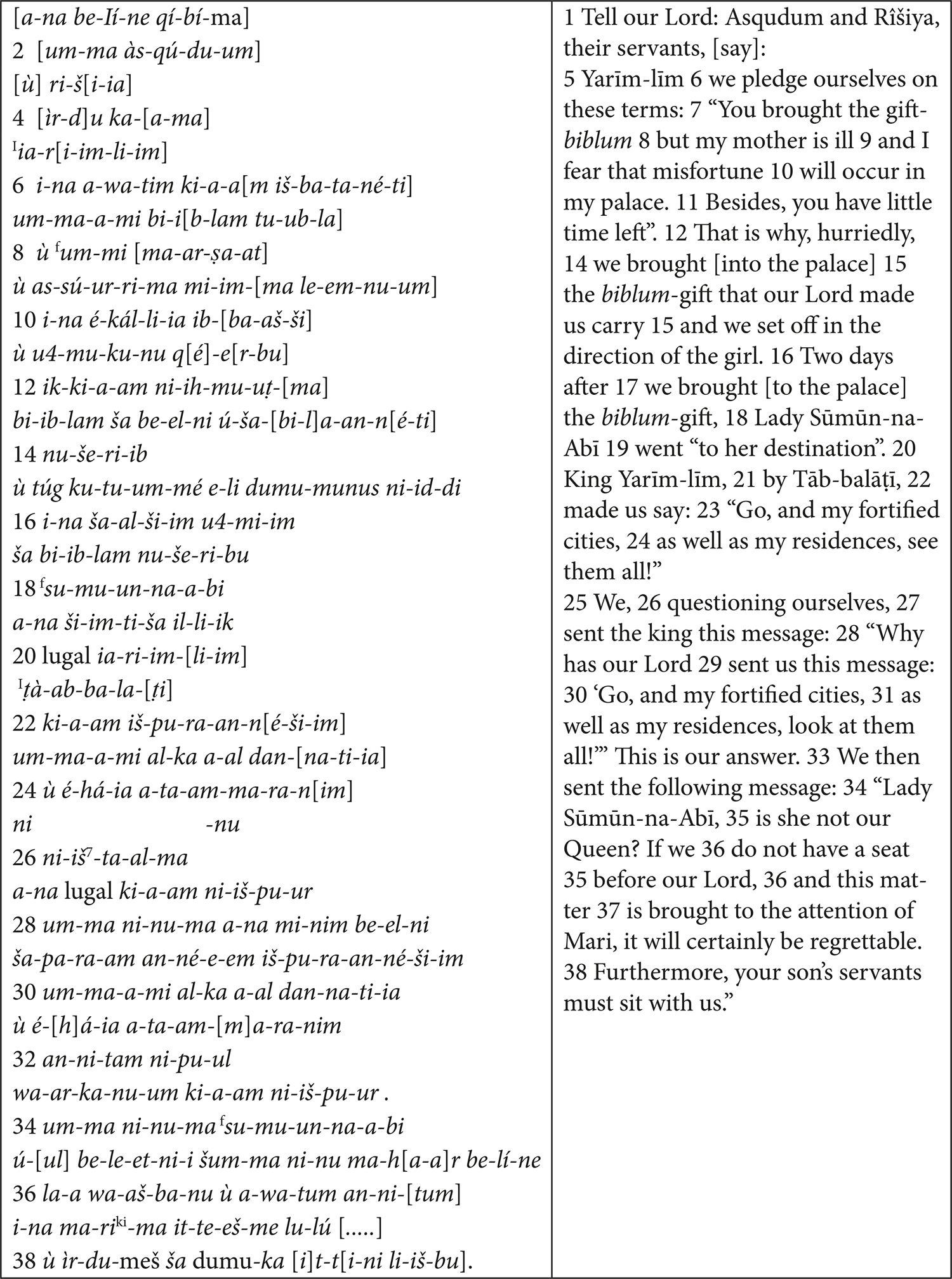
What the literary source27 of the alliance concluded with Shibtu’s marriage states:

According to the document, amid the intense preparations for the wedding, mariyanum officials came to consider themselves subjects or “sons” of Yarim-lim and desired to sit next to the queen mother at the wedding ceremony. Chronologically, the marriage took place the year after preparations began, in the third year of Zimri-lim’s reign, about 1773. Then, Queen Shibtu followed in a convoy, on a journey of almost a month, to Mari in the month of Hibirtum – the month of May in the eponymous dating –, corresponding to the month of May in the eponymous dating used in Mari, after the time of the floods on the Euphrates River.
In addition to the trip, the residence intended for Shibtu worried Yarim-lim. Here is Zimri-lim’s account:
Yarim-Lim approached me with these words: “I have often heard that the gods are powerful in the palace. Where are my daughter’s belongings going?” I replied, “Your daughter’s palace is wonderful”. He said: “Let my daughter’s belongings be kept in her residence, (but) let my daughter reside with her husband but let her leave (the palace) every 5 or 6 days and let her take care of her residence”.28
The letter sequence demonstrates a certain impersonality, as if the scribe had written away from the king’s presence. However, the sending of palace officials from Aleppo to serve Shibtu shows that the father wished to ensure that his daughter was kept away from the shrines and cultic paraphernalia, i.e., free from the functions and risks of religious phenomena common in Mari, as well as guaranteeing their social freedom in the new city.
Assuming more and more royal power in the face of her husband’s frequent external activities, Shibtu became a great queen, as her grand personal documentation attests: She managed the internal affairs of the palace; negotiated the acquisition of utensils; led diplomatic negotiations involving Terqa, Eshnunna, Ida-Maraş, Elam, Babylon; debated with Ishme-Dagan about sending garrisons from Zimri-lim to war; presided over cultic activities; communicated the structural status of real buildings; took care of her children; took care of epidemics in the palace; arbitrated conflicts involving Hammu-rabi I, his father’s successor in Aleppo; was at the center of resolving military conflicts over rebellions started by Yaminite warriors.29
One aspect that still needs to be more widely researched concerns the musical environment of Mari during the reign of Zimri-lim, a context that must have led to the formation of a social stratum around the music conservatory – the “House of the Tigum Instrument” –, with an organizational function in palace ceremonies. For the kingdom full of novelties in which the construction of what I call the Aleppine- -Mariyanum dynasty took place, historian Amanda Podany (2022) highlights in her fascinating work the agency of young women as musicians and others as teachers, scribes, servants, cooks and nannies. Many of them were members of the royal family who lived in the palace and are included in official documentary records. According to Podany (2022, p. 251-252), the sources’ fortune is “probably because many of them lived in a suite of more than sixty rooms grouped around courtyards in the area of the royal quarters, just beyond the palm tree court and the king’s throne room.” Among them were young princesses, captive and enslaved women, members of local elite families, etc., living in this female residential complex called tubqum, which guaranteed them some protection in a society marked by male forms of power and dietary restrictions.
In the history of the politician, it is worth mentioning the authority of Queen Shibtu, because this social affection appears in the sources as a way of transmitting paternal and ethnomonarchical power, whether through the demand for a private palace or through religious freedom, but above all because, by transforming the landscape of the kingdom, it ends up characterizing the culture. In a letter, Zimri-lim asks Shibtu to select women with musical potential from among those captured and to take care of their feeding (Podany, 2022, p. 254-255). It is precisely because of the assured authority that Shibtu’s royalty – part of the dynastic marriage agreements that maintained her sociopolitical status as queen – guaranteed in a certain way some privileges for women, including health care for female employees and even intellectual activity for those in a situation of slavery inserted in the palace.
Cultic activity directed at Haddu, tutelary god of Aleppo
Even before his marriage to Shibtu, Zimri-lim had committed to the worship of the god Haddu, whose great temple is located in Aleppo. The tutelary divine image of the union of the two dynasties and at the head of several pantheons will be that of the Storm god Haddu, and the homage to the Levantine god Li’m was restricted to some ruling elites, because sacred spaces dedicated to Haddu predominated, always accompanied by his bull [būru].
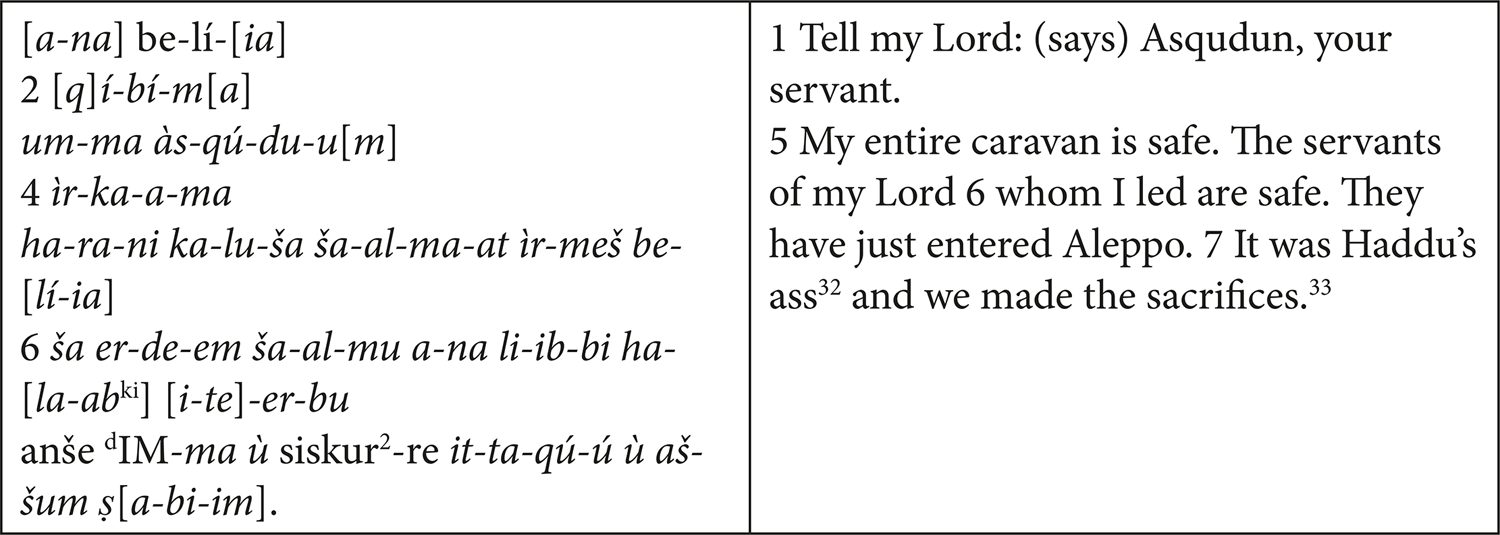
While the king did not resume his diplomatic travels, Asqudum undertook a tour within the kingdom of Yamhad for fifteen days and, therefore, officially represent the king at the sacrificial festival of hi’ārum [siskur2-re hi-ia-ri-im] – a five-day celebration of royalty. For this, Asqudum traveled to Aleppo taking an ālum,30 perhaps a musical instrument, as Zimri-lim’s votive object to the god Haddu of Aleppo [hddḥ lb]. Dimensioning the votive object size, eight men would only be able to move it, but would not carry it at a medium distance, around 240 kilos or 8 talents of bronze with leather protection (Dossin, 1938, p. 109; Durand, 1988, p. 119):
Zimri-Lim demonstrated his worship for the god of Aleppo by dedicating his statue to him, as evidenced by the name of one of his regnal years: MU Zi-im-ri-li-im | ṣalam-šu a-na ilAdad | Ḫa-la abki | ú-še-lu-[ú], “The year when Zimri-Lim dedicated his statue to the god Adad of Aleppo”31 (Dossin, 1938, p. 115).
Many votive goods, animals, and luxury objects were sent from Mari to Aleppo for the worship of Haddu. Upon arriving in Aleppo and after fulfilling the second most important deal, Asqudum wrote to Zimri-lim informing that he had participated in the religious festival. The letter included complaints against the rulers of cities on the trip’s itinerary for not helping with transportation, the delegation fatigue, the need for supplies and the request for fifty sheep. It is important to emphasize that, in the context, disagreements between cultures unfold intellectually, but the initial inscriptions show that the reason for the letter was to inform about adherence to the tutelary god Haddu. The initial statement is significant:

Frequently, Mari diplomats conflicted with each other. In a letter dated year 3 of the reign (c. 1773, ZL 1’), Yasim-Sumu [yasīm-sūmū] appears as an agent of internal conflict with the palace administrator Sammētar, of the province of Ashnakkum [ašnakkum], because he wished to interfere with the administrative matters while the king was absent from the city and decisions were under the responsibility of Asqudum:
the two very important characters who are Sammētar, the šâpiṭum [judge or district governor, or even “head of the palace”] and Yasīm-Sūmū, the butler, came into an open conflict. Asqudum sided with Yasīm-Sūmū, against someone who belonged to one of Terqa’s leading families (Durand, 1988, p. 75).34
Asqudum took a stand against those who fought the Yaminite, and, as a result, the political parties of agents from the Mari palace became prominent.35
External political-military support
Here I return to the initially historical question regarding the support of the Mari expansionist project put into practice while it had tribes against the State on its borders, to the right and left of the Euphrates River. At the time that he demonstrated the political strategy of obtaining support from the kings of Yamhad, Zimri-lim struggled to understand the need to contain the incursions of the garrisons of Eshnunna. In this sense, Asqudum interpreted the plan correctly. Between years 3 and 5 (ZL 1’-3’) of his reign, the king presided over at least two enthronement ceremonies for several princes, “members of a royal family”, on the occasion of the annual festival dedicated to the goddess Ishtar [ištar, equal to the goddess inanna of Sumer].36
One can attest to the transmission of legitimacy by Ishtar, consort of the god Tammuz, in the tempera mural painting on clay in the Amorite palace of Mari (18th century): The main staging takes place in the upper central panel – the temple cella –, where the goddess has a lion as her pedestal and officiates the royal investiture of Zimri-Lim, handing him the symbols of power – the circle and the staff.37 With administrative acts of loyalty performed before the goddess, it was pragmatically desired to convey warning of power to Eshnunna, in view of the increase in the number of its satellite cities and advance into Upper Mesopotamia. In fact, the characteristic activities in Mari project a context in which families from the borders and groups of stateless people have become welcome in the kingdom.
The idea of loyalty value maintained a guideline that benefited refugees, the non-extradition agreement has its origins in oral tradition, a mental law, and the crossing of ethnicities was part of the constitution of both the ancient kingdom of Hana, now integrated into Mari, as of the kingdom of Yamhad. After a regional conflict, Zimri-lim wrote a letter to Yarim-lim in which he proposed a deal to resolve the problem. The proposal indicates that the law in force regarding extradition should be reformed. It appears, evidently, that the city-state of Hazor participated in the broad commercial system that was being affected by the conflict, thus it is up to Yarim-lim to intervene. Here are the statements:
5] You have written the following about a smith ‘This man has taken from Hazor silver, gold, and a fine (precious) stone and has headed toward you. The people of Hazor are holding back the donkeys and personnel that are on a trade mission, saying, ‘The smith has taken silver, gold, and a fine (precious) stone and has gone toward Zimri-Lim.’ This is what you wrote me.
15] This man has not brought anything at all toward me, be it silver, gold, or a fine (precious) stone. This man was seized and humiliated in Emar. They relieved him of all that was transported and even took away from him the document (proving) that this man paid for what he purchased. [Or: ‘even took away from him the seal that this man had bought’ [(Durand); kunukkam ša ana kaspim awīlum šū išāmu itbalūšu.] In fact, it was to save his life that this man ran toward me.
26] My father has written me about this man, about returning a man who, like a trembling bird ahead of a falcon, had come to me. Is this a man I should release? If I release this man, afterwards anyone who hears will he seek shelter as if with an interceding deity?
35] If it pleases my father, my father should not request this man. This man’s possession, whatever he took away from Hazor, is now kept in Emar. My father should write to Emar for the man’s belonging to be taken to the [disposal?] of my father.38
A diplomatic problem between states was being resolved in a tribal manner, which gave rise to the presumption of a peace agreement. The event involved the city-states of Emar and Hazor. This is the question: The blacksmith accused of stealing a shipment of luxury objects fled to Mari, and the solution to the conflict fell to the great regional king Yarim-lim.39 He demanded the blacksmith’s extradition. Zimri-lim respectfully reversed the accusation when he stated that the blacksmith was, in fact, a victim and tried to preserve this refugee’s life. Thus, the Mariyanum king intended to prevent Mari from being seen as a kingdom without authority to decide on legal issues involving people in its territory, so he tried to establish an administrative principle in diplomacy with the kingdom of Yamhad.40 The respectful requests for the extradition of prisoners reveal to be, above all, as requests for military support, in the name of the god Haddu, as a possible solution to contain the invasions of the Yaminite and other rival forces.41 The letter sent by Yarim-lim shows who leads the region: “Has Zimri-Lim forgotten Addu’s command? Indeed, I fear that Zimri-Lim does not know that in the Land of Addu a refugee cannot be extradited!”.42 A response that seems theologically rhetorical, leaving little evidence regarding a subsequent decision, but with a strong legal basis.
Within the limits of preserved documentation of broad historical representation, the alliance between the kingdoms of Yamhad and Mari demonstrated to be strategically an evolution in the political history of the ancient Near East. Yarim-lim extended his influence as far as the Euphrates, and as the cities led by Aleppo restricted the movement of Yaminite nomads, Zimri-lim began stationing garrisons on the edges of Eshnunna and Babylon. There were the Elamites, but then Mariyanum king supported Hammu-rabi in order to maintain peace in his borders.43
CONCLUSION
The great political project between the two most important kingdoms of the Levant was abruptly interrupted about eight years after it began with the death of Yarim-lim, which was greatly felt by Zimri-lim. In Jack M. Sasson’s interpretation (1984, p. 251):
A terse account tells us that Zimri-Lim ordered the dispatch of gifts for Yarim-Lim’s tomb on the fifteenth day of the eighth month, within two weeks of entertaining the Babylonian officers. The new king of Khalab (unfortunately for us also named Hammurabi) succeeded his father and began a rule that seems, if not overtly hostile to Zimri-Lim, certainly warmer to his namesake in Babylon. We now know that less than a decade later this direct relationship between the two Hammurabis led to Babylon’s aggression against Mari.
Sasson (1984) enunciates an aporia, and, contrary to his interpretation, I understand that the rules initially practiced by Hammu-rabbi I of Aleppo preserved the old alliances. As for homage or distinction, the practice was common and was intended to maintain an alliance or enter into a circumstantial treaty. Charpin (2019, p. 208) presents a text44 found in Mari, which states that the king of Terqa sent “a precious object on the occasion of the death of the Aleppo’s king Yarim-lim”, literally, “1 silver katappum weapon”. Zimri-lim’s tribute on the occasion of Yarim-Lim’s death was “1 solar disk of fine gold, weighing 48 shekels”.45
Despite dedicating himself for almost a decade to actions aimed at a type of Syrian subalternization that would reach the Levant coast and Upper Mesopotamia – a region from where he “received numerous messages” and “where he commanded his vassals or governors”46 with his cities (Dossin, 1938, p. 115) –, Zimri-lim did not achieve his objective by allying himself with the kingdom of Yamhad, despite gaining access to the Levantine coast. We can confirm this based on research into the sources and their contextual subtext from an Aleppian perspective. I agree with Sarah C. Melville (2007, p. 240): “marrying Shibtu, the daughter of the powerful State of Yamhad ruler, Zimri-Lim acquired sufficient military support to regain the Mari throne and implement his lifelong effort, however ultimately unsuccessful in extending their territories”.
After the death of Yarim-lim, the ideals of the territorial states superimposed the old physical borders and Amorite cultural traditions, strongly indicating the invalidity of the third treaty that aimed at building the dynasty: The military support and commercial policy of Yamhad to Mari. Even though Mari had the power of Lower Mesopotamia at its gates, Zimri-lim accepted to make an agreement with Hammu-rabi against the kingdom of Elam. There may have been a great deal of confidence between the parties in Hammu-rabi’s statement: “From the beginning, the city of Mari and Babylon (are) but one House and but one finger!”.47 On the other hand, taking advantage of the crucial moment, Elam tried to obtain the support of the new king of Aleppo, but the newly crowned Hammurabbi I preferred to “retake his father’s alliances”48 (Charpin, 2019, p. 87), in an honorable decision.
Finally, an epitaph to the great king: Awakened, all Amorite kings and queens could protect themselves in the abīya Yarim-lim of Yamhad – qaran ṣubāt –, the one who lived under the command of the god Haddu (ṭēm Addu)!
References
- BARREYRA FRACAROLI, Diego A. The Chronology of Zimri-Lim's Reign: A Report. Aula Orientalis, v. 29, n. 2, p. 185-198, 2011.
- BUCCELLATI, Giorgio. The Origin of the Tribe and the "Industrial" Agropastoralism in Syro-Mesopotamia. In: BARNARD, Hans; WENDRICH, Willeke (ed.). The Archaeology of Mobility: Old World and New World Nomadism. Los Angeles: Cotsen Institute of Archaeology Press, 2008. p. 141-159.
- BURKE, Aaron A. The Amorites and the Bronze Age Near East: The Making of a Regional Identity. Cambridge: Cambridge University Press, 2023.
- CASANOVA, Michèle. Les bijoux. In: BORDREUIL, Pierre; BRIQUEL-CHATONNET, Françoise; MICHEL, Cécile (dir.). Les Débuts de l'Histoire: Civilisations et cultures du Proche-Orient Ancien. Nouvelle édition revue et augmentée. Paris: Khéops, 2014. p. 415-419.
- CHARPIN, Dominique. "Tu es de mon sang": Les alliances dans le Proche--Orient ancien. Paris: Collège de France; Les Belles Lettres, 2019.
- DOSSIN, Georges. Les archives épistolaires du palais de Mari. Syria: Revue d'art oriental et d'archéologie, v. 19, n. 2, p. 105-126, 1938.
- DURAND, Jean-Marie. Archives épistolaires de Mari I/1. ARM XXVI. Paris: Recherche sur les Civilisations, 1988.
- DURAND, Jean-Marie. Les documents épistolaires du palais de Mari. T. I. Paris: Cerf, 1997.
- DURAND, Jean-Marie. Les documents épistolaires du palais de Mari. T. III. Paris: Cerf, 2000.
- FLEMING, Daniel E. Kingship of City and Tribe Conjoined: Zimri-Lim at Mari. In: SZUCHMAN, Jeffrey (ed.). Nomads, Tribes, and the State in the Ancient Near East: Cross-Disciplinary Perspectives. Chicago: University of Chicago Press, 2009. p. 227-240.
- FRAYNE, Douglas R. Old Babylonian Period (2003-1595 BC): The Royal Inscriptions of Mesopotamia Early Periods. V. 4. Toronto: University of Toronto Press, 1990.
- FRAYNE, Douglas R.; STUCKEY, Johanna H. A Handbook of Gods and Goddesses of the Ancient Near East: Three Thousand Deities of Anatolia, Syria, Israel, Sumer, Babylonia, Assyria, and Elam. University Park: Eisenbrauns, 2021.
- GATES, Charles. Ancient Cities: The Archaeology of Urban Life in the Ancient Near East and Egypt, Greece, and Rome Londres: Routledge, 2011.
- GRAYSON, A. Kirk. Assyrian Rulers of the Early First Millennium BC, I (1114-859 BC): The Royal Inscriptions of Mesopotamia Early Periods. V. 2. Toronto: University of Toronto Press, 2002.
- GREENBERG, Raphael. The Archaeology of the Bronze Age Levant: From Urban Origins to the Demise of City-States, 3700-1000 BCE. Cambridge: Cambridge University Press, 2019.
- LACAMBRE, Denis. Études sur le règne de Zimrî-Lîm de Mari. Revue d'Assyriologie et d'Archéologie Orientale, v. 95, n. 1, p. 1-21, 2002.
- LAUINGER, Jacob. Following the Man of Yamhad: Settlement and Territory at Old Babylonian Alalah. Leiden: Brill, 2015.
- LIVERANI, Mario. Historical Overview. In: SNELL, Daniel C. (ed.). A Companion to the Ancient Near East. Malden: Blackwell, 2007. p. 3-19.
- LIVERANI, Mario. Antigo Oriente: História, sociedade e economia. São Paulo: Edusp, 2016.
- MELVILLE, Sarah C. Royal Women and the Exercise of Power in the Ancient Near East. In: SNELL, Daniel C. (ed.). A Companion to the Ancient Near East. Malden: Blackwell, 2007. p. 235-244.
- MIEROOP, Marc van de. Historia del Próximo Oriente Antiguo: ca. 3000-323 A.E.C. Madrid: Trotta, 2020.
- OPPENHEIM, A. Leo. Letters from Mesopotamia: Official, Business, and Private Letters on Clay Tablets from Two Millennia. Chicago: University of Chicago Press, 1967.
- PODANY, Amanda H. Weavers, Scribes, and Kings: A New History of the Ancient Near East. Oxford: Oxford University Press, 2022.
- PORTER, Anne. Beyond Dimorphism: Ideologies and Materialities of Kinship as Time-Space Distanciation. In: SZUCHMAN, Jeffrey (ed.). Nomads, Tribes, and the State in the Ancient Near East: Cross-Disciplinary Perspectives. Chicago: University of Chicago Press, 2009. p. 201-225.
- PORTER, Anne. Mobile Pastoralism and the Formation of Near Eastern Civilizations: Weaving together Society. Cambridge: Cambridge University Press, 2013.
- RECULEAU, Hervé. Claiming Land and People: Conceptions of Power in Syria and Upper Mesopotamia during the 2 nd Millennium BCE. In: SCHMIDT-HOFNER, Sebastian; AMBOS, Claus; EICH, Peter (ed.). Raum-Ordnung: Raum und soziopolitische Ordnungen im Altertum. Heidelberg: Universitätsverlag Winter, 2016. p. 175-213.
- SANTOS, João Batista Ribeiro. A difusão iconográfica da religião: Historiografia de políticas de guerra e representações visuais na Antiguidade Oriental. São Paulo: Alameda, 2024.
- SASSON, Jack M. Zimri-Lim Takes the Grand Tour. Biblical Archaeologist, v. 47, n. 4, p. 246-251, 1984.
- SASSON, Jack M. "Year: Zimri-Lim Dedicated his statue to Addu of Halab": Locating one Year in Zimri-Lim's Reign. Mari: Annales de Recherches Interdisciplinaires, v. 5, p. 577-589, 1987.
- SASSON, Jack M. The King and I: A Mari King in Changing Perceptions. Journal of the American Oriental Society, v. 118, n. 4, p. 453-470, Oct./Dec. 1998.
- SASSON, Jack M. Scruples: Extradition in the Mari archives. Wiener Zeitschrift für die Kunde des Morgenlandes, v. 97, p. 453-473, 2007.
- SASSON, Jack M. Texts, Trade, and Travelers. In: ARUZ, Joan; BENZEL, Kim; EVANS, Jean (ed.). Beyond Babylonia: Art, Trade, and Diplomacy in the Second Millennium B.C. Nova York: Metropolitan Museum of Art; New Haven: Yale University Press, 2008. p. 95-100.
- SASSON, Jack M. Casus belli in the Mari archives. In: 52e RENCONTRE ASSYRIOLOGIQUE INTERNATIONALE. INTERNATIONAL CONGRESS ASSYRIOLOGY AND NEAR EASTERN ARCHAEOLOGY, 2006, Münster. NEUMANN, Hans et al. (org.). Krieg und Frieden im Alten Vorderasien. Münster: Ugarit-Verlag, 2014. p. 673-690.
- SILVA CASTILLO, Jorge. Nomadism through the Ages. In: SNELL, D. C. (ed.). A Companion to the Ancient Near East. Malden: Blackwell, 2007. p. 142-156.
- STÖKL, Jonathan. Divination as Warfare: The Use of Divination across Borders. In: LENZI, Alan; STÖKL, Jonathan (ed.). Divination, Politics, and Ancient Near Eastern Empires. Atlanta: SBL Press, 2014. p. 49-63.
- SURIANO, Matthew J. Historical Geography of the Ancient Levant. In: STEINER, Margreet L.; KILLEBREW, Ann E. (ed.). The Oxford Handbook of the Archaeology of the Levant: c. 8000-332 BCE. Oxford: Oxford University Press, 2014. p. 9-23.
- WHITING, Robert M. Amorite Tribes and Nations of Second-Millennium Western Asia. In: SASSON, Jack M. (ed.). Civilizations of the Ancient Near East. V. II - History and Culture. Nova York: Scribner, 1995. p. 1231-1242.

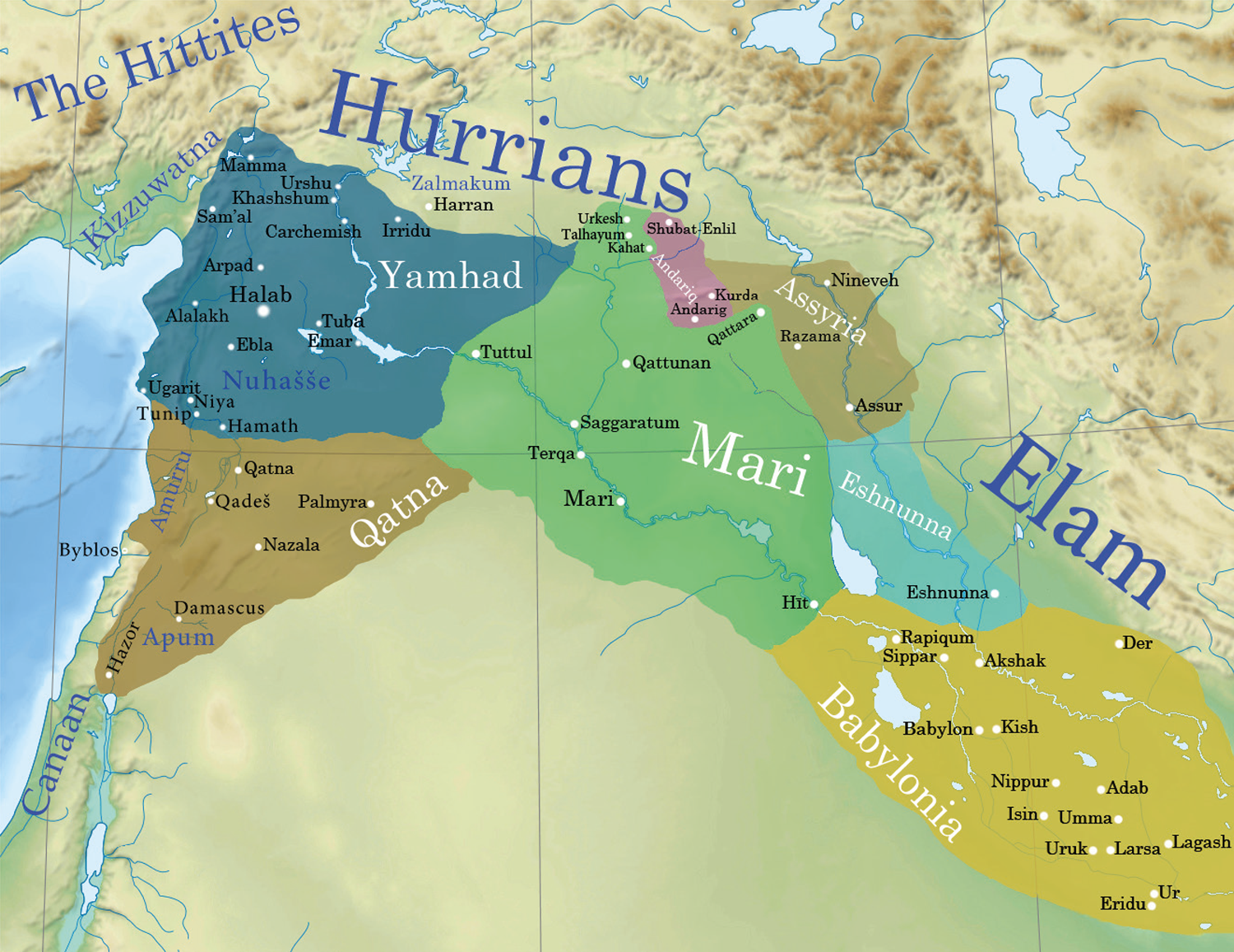 Source: Image edited and translated by the author from a map available on the Wikimedia Commons platform: https://commons.wikimedia.org/wiki/File:Yamhad_and_Vassals.png. Accessed on: April 24, 2023.