
 “The good and brave NORDESTE” A Cultural Magazine in the Post-War Period (Recife, 1945-65)
ABSTRACT
This paper aims to present the Nordeste magazine and analyse its emergence in 1945, shortly after the end of the Estado Novo and the Second World War, as well as some aspects of its first phase, between 1945 and 1955. It begins by examining this historical context and reflecting on some of its main artistic and intellectual demands. It then seeks to analyse the economic conditions that made the creation of this cultural periodical possible, particularly its relationship with the Recife daily Jornal do Commercio. Finally, the text discusses the typology of Nordeste, which was initially launched as a monthly cultural periodical. It had characteristics like those of a newspaper or literary supplement, yet it considered itself a cultural magazine, as evidenced by its reception. It should be emphasised that, although the focus here is not solely on the content of this editorial project, attention is given to the conditions that facilitated the actual realisation of this magazine.
KEYWORDS:
Nordeste magazine; Aderbal Jurema; Jornal do Commercio
RESUMO
O objetivo deste trabalho é apresentar a revista Nordeste e analisar seu surgimento em 1945, logo após o fim do Estado Novo e da Segunda Guerra Mundial, assim como alguns aspectos de sua primeira fase, entre 1945 e 1955. Inicia-se pela aproximação à respectiva conjuntura e a reflexão sobre algumas das principais demandas artísticas e intelectuais. Em seguida, busca-se analisar as condições econômicas que possibilitaram a criação desse periódico cultural, ou seja, as relações com o diário recifense Jornal do Commercio. Por fim, discute-se a tipologia da Nordeste, que inicialmente se lançou como um mensário de cultura, e que de fato tinha características próximas a um jornal ou suplemento literário, mas que, no entanto, se entendia como uma revista de cultura, algo corroborado pela respectiva recepção. Destaca-se que, embora a dimensão relativa ao conteúdo desse projeto editorial não seja ignorada aqui, o foco se voltou para as condições de possibilidade que levaram à materialização dessa revista.
PALAVRAS-CHAVE:
revista Nordeste; Aderbal Jurema; Jornal do Commercio
INTRODUCTION
In this article, we aim to introduce readers to the cultural magazine Nordeste. Launched in Recife in late 1945, the journal’s content is key to understanding its editorial stance. We primarily explore the subject through its possibilities rather than solely its intellectual and artistic foundations, although these do inform the magazine. First, it is important to consider the issues that contributed to its realisation. The analysis begins with the context surrounding Nordeste’s emergence, highlighting factors that help explain the launch of a cultural periodical and the associated intellectual and artistic needs. The economic conditions supporting it will also be examined, particularly its relationship with the Jornal do Commercio (Recife, 1919). While important questions about the magazine’s intellectual direction are acknowledged, the focus remains chiefly on aspects related to its material foundations. This will serve as a basis for future analyses of Nordeste’s1internal content characteristics.
If the significance of periodicals has been a major issue in historiography for decades, it is closely connected to how these artefacts are seen as intellectual, cultural, artistic, and political endeavours. Chartier (2005) highlighted this as one of Donald Francis McKenzie’s principal contributions to printed matter research, which involves analysing both form and meaning as interconnected aspects of the same issue.
According to Tania Regina de Luca (2008), from the 1970s onwards, the emergence of New Cultural History introduced new considerations regarding periodicals, suggesting that the press should no longer be viewed solely as a source but as a legitimate and justifiable subject of study. As Velloso (2006, p. 316) states: “I propose to consider magazines in their dual dimension: source and object of analysis. Chartier’s analysis is the guiding thread of this reflection, allowing us to perceive magazines in their complex historicity and specific articulations that they establish in relation to the modern.” Thus, approaching magazines as both sources and objects aligns with a method that considers not just content but also form.
Although periodicals are created to be read, both the content and the medium are significant, as newspapers and magazines circulate and are absorbed by the public. Therefore, the final product results from several specific conditions and embodies a cultural vector. However, it is not necessarily homogeneous or unanimous, and acts within its contemporaneity alongside political, intellectual, and artistic orientations. Primarily, periodicals expressed this through their printed format. For this reason, analysing the materiality becomes more relevant, as the physical aspects (format, paper, print quality, cover, illustrations, advertising, etc.) are linked to the potential audience and their reception, as well as the objectives of the periodical (Luca, 2008, p. 138).
The “good and brave NORDESTE”, as Gilberto Freyre called it, existed for twenty years, from 1945 to 1965.2 A contemporaneous publication of the brief republic promulgated by the 1946 Constitution, it was the longest-running cultural magazine of the period in Recife, then the epicentre of regional attraction for several reasons, such as the concentration of artists and intellectuals. The century-old Faculty of Law was one of the main centres of attraction, and it was no coincidence that many contributors to Nordeste came from there, including its editor-in-chief.
These assumptions outline the general methodological guidelines for this article, which aims to present and analyse the materiality of the Nordeste magazine. Instead, the elements that shaped it are understood here as conditions of possibility, as Le Goff (1990) suggests for approaching sources as “monuments.” In the future, the aim is to establish a basis for analysing the political and intellectual ideas and projects that resonated in/from its pages; in other words, what can be called the “intellectual project”.
The materiality analysis necessitates reflecting on the context that shaped the magazine’s overall aspects, such as its nature and genre. Certain international, national, and regional issues are essential for understanding the post-1945 context, the magazine’s launch, and its involvement in cultural, artistic, and intellectual debates. It is assumed here that matters concerning the materiality of the periodical must be considered within the context to facilitate a study of the editorial project carried out by Nordeste.
Therefore, before this materiality can be analysed, it is necessary to understand some issues that troubled its contemporary aspects and that were directly linked to the forms of action and engagement of intellectuals and artists. Starting in 1945, the year the Nordeste monthly culture newspaper supplement was launched, this situation necessitated reconfigurations of the historical categories that Koselleck (2006) refers to as the space of experience and the horizon of expectation. The end of the Second World War and its consequences inevitably raised questions about the legacies of the period that was coming to an end. There were increasingly clear signs of what came to be known as the Cold War, with profound implications for Brazil, which was undergoing a new democratic experience. This scenario shaped artistic and intellectual engagement and, consequently, the launch of periodicals such as Nordeste.
A NEW SCENARIO: THE PLACE OF INTELLECTUALS AND ARTISTS
After 1945, the cultural scene in Brazil was highly productive, especially with the end of the Estado Novo and censorship, which opened up opportunities and encouraged people to think more broadly, a trend that intensified after World War II.3 Worldwide intellectuals sought out or were called upon to engage with the most pressing contemporary issues, concerning both the horrors experienced and ways to prevent further disasters, as well as projections for the new era. In early October 1945, Sartre, Beauvoir, Merleau-Ponty, and other intellectuals published the first edition of the magazine Les Temps Modernes. From liberated Paris, they launched what would become a paradigmatic magazine, demanding that intellectuals confront the problems of the post-war period. The obligation to engage became inseparable from the magazine’s name and Sartre’s own, establishing a serious philosophical approach to the most pressing demands (Bouffartigue, 2009, pp. 1337-1338).
In line with this desire, emerging from the cultural centre of the Western world, there were cultural, literary, and artistic periodicals across various regions of Brazil, both regional and national in scope. The Joaquim (Curitiba, 1946), Branca (Rio de Janeiro, 1948), Sul (Florianópolis, 1948), and Anhembi (São Paulo, 1950) magazines, for example, attracted artists and intellectuals of all ages, who saw the current situation as an opportunity for progress.
Alceu Amoroso Lima, in his remarks on poetry, regarded this period as characterised by a decline in modernist iconoclasm.
From 45 onwards, things happen quietly, without big bosses, with no manifestos, no battle cries, no the “sus” to the infidels, and without the crusading spirit that, 35 years ago, marked the emergence of the new barbarians of São Paulo and Rio, with magazines that invoked “anthropophagy to frighten the quiet people of the Parnassian and Symbolist camps.” (Lima quoted by Pierucci et al., 2007, p. 534).
Meanwhile, the national political scene was marked by new pacts, negotiations, and concessions, resulting in the multi-party system outlined in the 1946 Constitution. This system even allowed for the legalisation of the PCB, which was banned the following year due to the intensification of the Cold War.
According to Velloso (2006, pp. 313-314), since the beginning of the 20th century, a significant portion of the Brazilian intelligentsia has become involved in the publishing market, given the strategic role of newspapers, magazines, bookstores, and publishing houses in disseminating ideas. However, this new situation suggests an expansion of the cultural field as a whole, opening up various paths for intellectuals to follow. Pontes (1998) analysed a paradigmatic case study, examining how the existence of Revista Clima magazine between 1941 and 1944 was fundamental to the intellectual careers of a group that included, among others, the young Antônio Candido.
It should be noted that this was a period of transition within the Brazilian intellectual scene, with the increasing professionalisation and specialisation of roles such as literary criticism, partly due to the consolidation of universities and the broader range of courses available. Previously, intellectual growth mainly occurred through medical and law schools, a pattern that shifted in the 1930s and 1940s, exemplified by the establishment of the University of São Paulo (USP). Alongside the cultural industry, universities expanded significantly from the 1940s onwards, characterised by the ‘federalisation’ of many institutions, which created new opportunities for intellectual activity.
In 1946, the University of Recife was established, consolidating several institutions in the capital of Pernambuco, notably the Faculty of Law. This not only expanded the educational structure but also spawned new spaces for intellectuals and artists to meet and exchange ideas. One example was the Teatro do Estudante [Student Theatre], which had existed at the Faculty of Law since 1940 and was directed by Hermilo Borba Filho in 1945, when the group gained momentum and prominence, with Ariano Suassuna undoubtedly being its most successful name. These two events, with very different repercussions, show that this period was marked in Recife as a moment of cultural renewal.
The Nordeste’s launch was in line with the need to consider the contemporary world, especially since it occurred about a month after Vargas’s overthrow. Recife’s cultural effervescence is assured by the creation of many cultural periodicals, with the official launch of Nordeste and the monthly cultural magazine Região in November 1945. This movement continued in the following years, with the publication of Contraponto, Estudantes e Letras Pernambucanas (1946), Revista de Cultura (1947), and Resenha Literária, Presença e Verdade e Vida (1948).4 Among all of them, the Nordeste monthly culture newspaper supplement, launched by editor-in-chief Aderbal Jurema (1912-1986), had the longest life, indicating that it achieved a return, whether economic, political or symbolic. The Recife-based periodical was reprinted in several newspapers and magazines across Brazil, especially in those where representatives from the Nordeste were present. Some examples include Correio da Manhã, based in Rio de Janeiro, which featured contributions from José Condé (1917-1971), and Joaquim, based in Curitiba and led by Dalton Trevisan (1925-2024).
Surprisingly, the emergence of numerous cultural periodicals in Recife during this period has not prompted research, which is even more striking in relation to the Nordeste, given that it was the longest-running (1945-1965). Only in 1959 was there no issue published at all, suggesting a certain degree of public acceptance and relative success, at least at the regional level, with repercussions in other Brazilian sites.5 Although Nordeste has been used in several studies on the cultural scene in Recife, such as those by Dimitrov (2013) and Teixeira (2016), no research has been found that uses it as a privileged object, either as a whole or in relation to specific issues. In fact, the history of this effervescence of cultural, artistic, and scientific periodicals that marked the cultural scene in Pernambuco at that time has yet to be written. In this regard, focusing on this magazine, apparently the most successful publishing project in Recife, is a step in that direction.
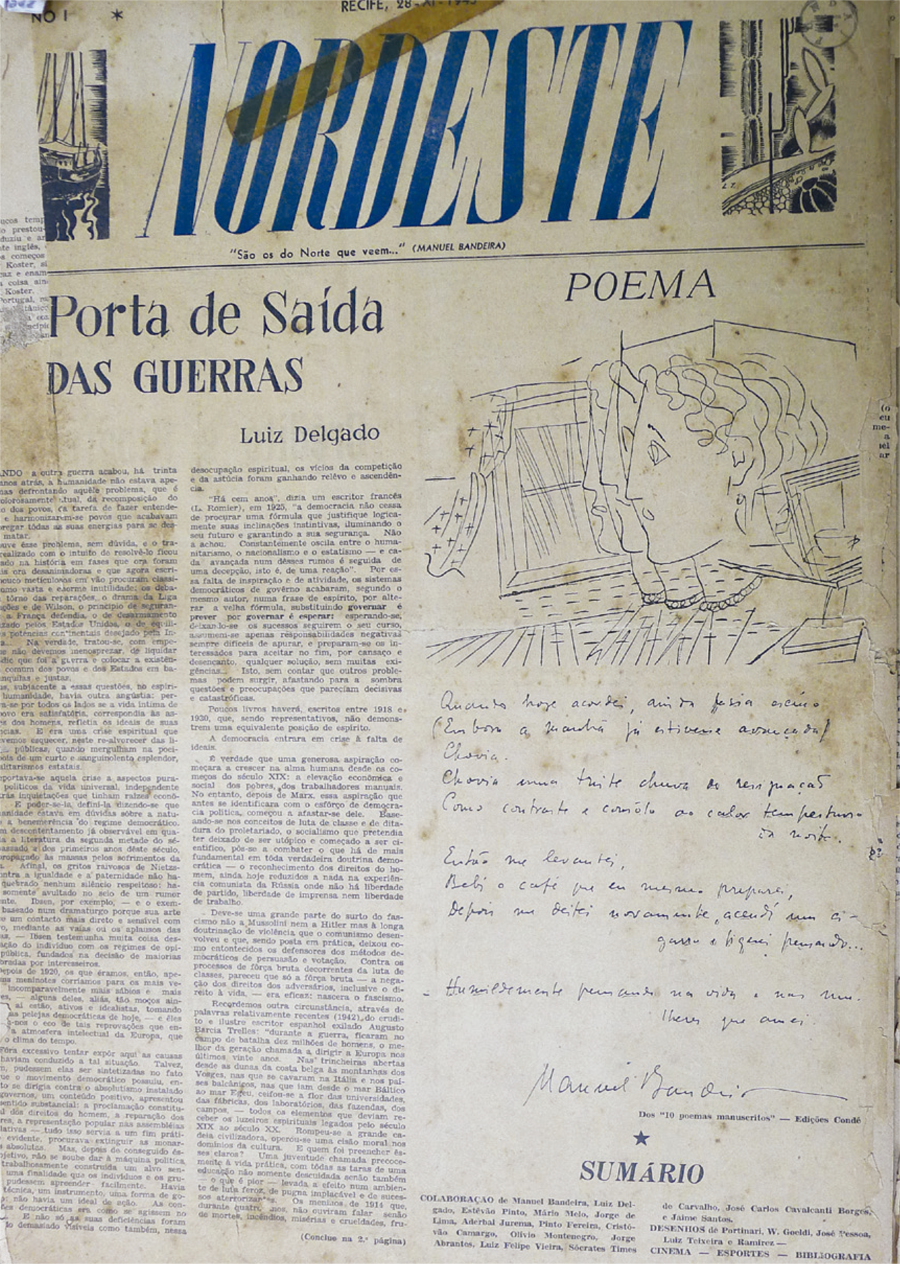
Unlike similar projects, which mainly presented their proposals in the inaugural editorial or manifesto, the periodical led by editor-in-chief Aderbal Jurema featured an opening article on the cover that emphasised its concern with the international situation. Drawn to global issues, Nordeste launched itself with Na Porta de Saída das Guerras (At the Exit Door of Wars), written by Luiz Delgado, a professor at Recife Law School. It was a periodical specialising in culture, engaged in debates about intellectualism and the post-war era, an issue that was unavoidable at the time.
The magazine actually used colours, which do not appear in this scan (Figure 1). The use of colours was less common at the beginning, appearing only in the title or in some images. Over time, a more diverse colour palette began to be used, as can be seen especially in the editions from the 1950s. The improved paper quality can be attributed to the requirements for colour printing. Between 1954 and 1956, Jornal do Commercio modernised its machinery, acquiring printers that allowed the use of more colours (Lopes, 1985, pp. 106-108).
Issue 2, still in 1945, and issue 3, in early 1946, featured the survey ‘The Intellectual and the Post-War,’ formulated by Odilon Nestor, a professor at the Recife Law School, and Viana Moog, of the Academia Brasileira de Letras [Brazilian Academy of Letters]. The questions from the “Inquérito da Nordeste” [Northeast Survey] are as follows: ‘A) What should be the position of intellectuals in a democratic nation? B) What is your conception of art in relation to politics? C) What relations should exist between intellectuals and the people? D) What are the most pressing problems that need to be solved? E) What were the main political trends in the post-war period? These questions highlighted the need for intellectuals to engage with the problems and demands of the new global situation.
Although it was not an editorial, the cover text of the first issue ultimately took its place. Luiz Delgado (1906-1974) analysed the context from 1919 until World War II, presenting the post-1945 scenario as experiencing the same problems as the previous situation. Concern about the future appears to be central to the reconstruction of the post-World War II period, along with the dilemmas of the potential Cold War: ‘the problems of the future worry us even more than they did yesterday.’ (Delgado, 1945, p. 02). It can be observed how Nordeste considered it urgent to reflect on the legacies of the past and projections for the future, that is, the reconfiguration of the space of experience and the horizon of expectation, according to Koselleck’s categories (2006). Whether in Paris or Recife, there was a need to engage in these debates to launch oneself into the cultural field. Bourdieu’s (2005) discussions about the literary and artistic field suggest that this demand for engagement was a kind of rule at that juncture.
Regardless, Na Porta de Saída das Guerras was the first intellectual identity that Nordeste showed to the public, highlighting urgent topics. The first issue also featured articles dealing with regional, national, and international themes. This justified both its launch and the centrality of the intellectual figure. Unlike the approach we might call internationalist in Delgado’s text, issue 2 featured a cover text by Gilberto Freyre (1900-1987), which indicates what we might call the magazine’s regionalist stance: Povo, província, estudante e arte (People, province, student and art).
Critically, Antônio Candido pointed out that the regionalist trend was gaining prominence at that time, in a 1946 text that highlights Guimarães Rosa as an author who attempted to overcome regionalism with his work Sagarana: “now the fashion is to be parochial, and the most authoritative spokesperson for this trend is Mr. Gilberto Freyre, father of the current vogue for the word “province”.” (2002, p. 184). This tendency, criticised by Cândido, was important to the Nordeste, which gave ample coverage to regional issues, i.e. it had a certain regionalist stance.
However, the cover or front page of the first edition also featured a poem by the renowned Recife modernist Manuel Bandeira (1886-1968), printed from the manuscript and accompanied by an illustration by Portinari. The text was entitled “Poema só para Jaime Ovalle [Poem just for Jaime Ovalle],” although this is omitted in Nordeste, and it was originally published in this same format in the Edições Condé book entitled 10 poemas manuscritos e ilustrados [10 handwritten and illustrated poems, in 1945]. The work featured several authors, both in terms of the texts and the illustrations. It was from there that Nordeste extracted the poet’s manuscript and Portinari’s illustration, giving both due credit in its summary, which presented Bandeira as a contributor. The following is a transcription of the poem:
When I woke up this morning, it was still dark
- even though it was already day-
and it was raining.
Raining a sad rain of resignation
As if in contrast to and solace for the night’s tempestuous heat.
Then I got up,
and drank the coffee I myself prepared,
lay down again, lit up a cigarette and began to think...
— humbly to think about life and the women I have loved.7
Regardless of the poet’s original intention, Nordeste’s use of the poem alongside a text discussing the post-war world indicates an analogy between before and after, open to various interpretations, such as the post-war and post-‘Estado Novo’. While Delgado’s text used the ‘door’ as a metaphor, the poem’s illustration featured a window. Both representations of access, entrances and exits appear as landmarks between the tragically lived past and the anxiously and distressingly awaited future.
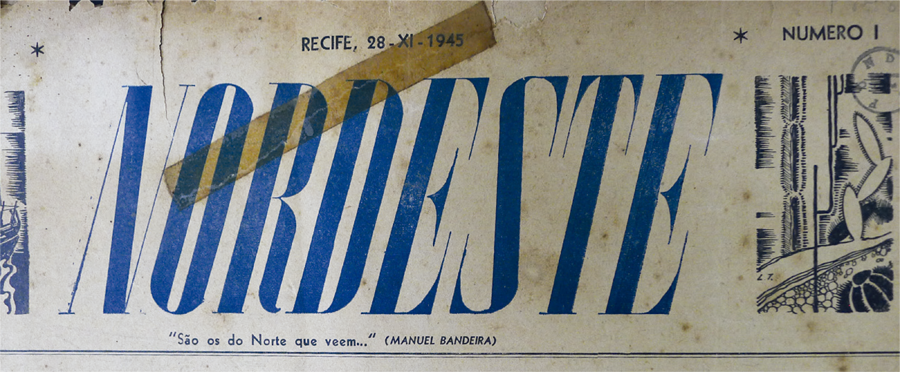
Although this article does not analyse in-depth these early editorial lines of Nordeste, because it is more focused on its materiality, it is necessary to consider these issues when reflecting on the emergence of this magazine. So, the magazine made its first impression on readers through this first page, which discussed the post-war world through a text and a poem that seemed to address a similar issue. These are signs of an implicit programme: to talk about art and culture, to publicise works and artists, but without forgetting the contemporary obligations of the intellectual community. The inclusion in this issue of the articles “Democracia e Planificação [Democracy and Planning]” by editor-in-chief Aderbal Jurema and “A Democracia Socialista [Socialist Democracy]” by contributor Pinto Ferreira highlights the interest of the newly launched monthly culture newspaper supplement in articulating debates on old and new political, economic and social paradigms. As in the surveys in subsequent issues, we outline the main themes that concerned the Nordeste: the positions and relationships between intellectuals, democracy, art, politics, the people, ideologies, and contemporary issues. The layout of the cover or front page, whose visual identity established initial contact with the readership, remained unchanged for years, differing only in the use of colours. This was one of the main characteristics of the first phase from 1945 to 1955, under the intellectual leadership of Aderbal Jurema. Without a bulkhead cover, there was an identity that became familiar to the reader, as well as its format, size, and number of pages. The name, centred in capital letters above the page and flanked by images reminiscent of the coast and the hinterland, indicates its regional insertion. With its provocative tone, the epigraph allows for a more complex reading: “It is those from the North who see...”
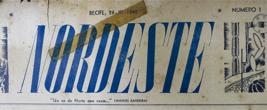
This layout remained unchanged even in the early years after Ladjane Bandeira became an important figure at the magazine, starting in 1956. The first subtle change appeared in the second issue of that year, with the reversal of the placement of images of the coast and the hinterland, a change that remained until issue 5 of 1957, the last issue with this layout. For more than twelve years, this was the unchanging front page. The magazine, which sought to materialise the Northeast culturally, with Recife as its epicentre, was situated between the sea and the hinterland, as a place that promised redemption for these heirs of the old north, now forged into the northeast (Albuquerque Júnior, 2011, pp. 57-77). Not necessarily just as victimising discourse, as Albuquerque Júnior considers, but also as a promise for the future. A future for a region built on an image associated with decay, misery and drought, but which, there, between the hinterland and the coast, believed it could see and follow a path to better destinations.
São os do Norte que veem (It is those from the North who see), the motto of Nordeste was on the front page until early 1958, when it gave way to the changes that the magazine was undergoing since the transition represented by the departure of Aderbal Jurema and the rise of Ladjane Bandeira between 1955 and 1956. This epigraph is an excerpt from Tobias Barreto, used in Manuel Bandeira’s poem “Voluntários do Norte” [Volunteers from the North]. It should be remembered that this author was a central figure of modernism, with his poem Os Sapos [The Toads] even recited at the Modern Art Week of 1922 by Ronald de Carvalho. Therefore, he was a renowned figure in Brazilian literature whose authority was mobilised by the magazine.
In an interview with Província de São Pedro magazine in 1949, Bandeira stated that Voluntários do Norte [Volunteers from the North] had been written as a joke about the “supposed rivalry between writers from the south and writers from the north”(Bandeira; Campos, 1986, p. 135). Below is the full text of the poem, originally published in the 1936 book Estrela da Manhã [Morning Star]:
São os do Norte que vêm!
Tobias Barreto
Quando o menino de engenho
Chegou exclamando: — “Eu tenho,
Ó Sul, talento também!”,
Faria, gesticulando,
Saiu à rua gritando:
— “São os do Norte que vêm!”
Era um tumulto horroroso!
— “Que foi?” indagou Cardoso
- Desembarcando de um trem.
E inteirou-se. Senão quando,
Os dois saíram gritando:
— “Ê vêm os do Norte! Ê vêm!…”
Aos dois juntou-se o Vinícius
De Morais, flor dos Vinícius
E Melo Morais também!
— “Que foi?” as gentes falavam…
E os três amigos bradavam:
— “São os do Norte que vêm!”
Nisso aparece em cabelo
O novelista Rebelo,
Que é Dias da Cruz também!
Mais uma voz para o coro!
E foi um tremendo choro:
— “Ê vêm os do Norte! É vêm!…”
E o clamor ia engrossando
Num retumbar formidando
Pelas cidades além…
— “Que foi?” as gentes falavam,
E eles pálidos bradavam:
— “São os do Norte que vêm!” (Bandeira, 2012, p. 41-42).8
Unlike the well-known Revista do Norte, which promoted debates on regionalism and modernism in Recife during the 1920s, it is clear that Nordeste embodied a similar yet discursively new region, according to Durval Muniz Albuquerque Júnior)9 (2011). Unlike a generic Província, a newspaper for which Gilberto Freyre was editor in 1929, the choice of name and its graphic identity, alongside with its intellectual, poetic, and imagery choices, launched a regionalist periodical — one of the main ones at that time — but with a global outlook, beginning from that culturally significant centre: Recife.
NORDESTE AND THE JORNAL DO COMMERCIO COMPANY
It is impossible to discuss the Nordeste without mentioning Jornal do Commercio (JC), a company linked to the Pessoa de Queiroz family, one of the most influential in the region, whose morning newspaper is still circulated in Recife. The magazine was founded by intellectuals involved in the company, which prompted us to introduce the group that was, at that very moment, on its way to becoming a major communications conglomerate. Between 1945 and 1946, the issues of Nordeste only listed the address of its editorial office and management, 346 Imperador Street, the building of the Recife newspaper. The first issue of 1947, without changing the address, stated that the cultural magazine was “published by Empresa Jornal do Commercio S. A” (Nordeste, 1947, no. 7, p. 02).
In 1919, the newspaper A Ordem was acquired and transformed into Jornal do Commercio by João Pessoa de Queiroz (1880–1962) (Nascimento, 1967, p. 145). It is interesting to note that A Ordem had opposed the Pessoa de Queiroz family due to regional political feuds, in defence of the governor of Pernambuco, Manuel Borba (Lopes, 1985, p. 40). The new morning newspaper evolved into a large communications group over the following decades, bringing together other newspapers, radio stations, and television stations. João and José’s company passed to the management of their third brother, Francisco (often referred to as F), in 1921, when he was a congressman. According to Alcides Lopes, the newspaper was operating at a loss, which was covered by the profits the brothers made from a giblets store at the same address. In 1927, fearing that his brothers would close the newspaper, F. Pessoa de Queiroz purchased it on credit (Lopes, 1985, pp. 66-67), a decisive step that would later establish him as a key communications entrepreneur in the Northeast region.
In 1919, the new newspaper was launched with an editorial representing itself as the voice of conservative classes. It aimed to support the presidential bid of Epitácio Pessoa, uncle of the Pessoa de Queiroz brothers (Barros, 2009, pp. 51-52). In fact, the newspaper began circulation on 3 April, a few days before the presidential election that resulted in Epitácio’s victory. It was very active in regional and national political disputes during the 1920s and 1930s, which even resulted in being jammed in 1930 after Francisco used the newspaper to support Júlio Prestes (Lopes, 1985). This caused several people involved with the newspaper, including Francisco himself, to flee the country. As a result, JC was only circulated again in 1934 as an “independent news outlet” (Nascimento, 1967, p. 172). In this new phase, the Jornal do Commércio became one of the most prominent in the Northeast, with extensive circulation not only in Pernambuco but also in Paraíba, Alagoas and Rio Grande do Norte (Lopes, 1985, p. 86).
This shows a troubled relationship between the Pessoa de Queiroz group and the Vargas government, at least initially. Nevertheless, after reopening, JC experienced significant growth from the second half of the 1940s onwards, with the creation of Radiopress and Diário da Noite in 1945 and 1946, respectively. According to Lopes (1985), the agency was established to meet the needs of the press in the Northeast region, which was underrepresented by the national press at the time. Radiopress also began to provide news to other newspapers in the North and Northeast regions.
According to Barros (2009, p. 65), the head of the communications group had established a friendship with President Dutra, which even led to the granting of radio station licences. Alcides Lopes (1912-2004) transcribed, without specifying dates or further details, an excerpt from his own publication in JC, in the Special Section dedicated to F. Pessoa de Queiroz. In this excerpt, he highlights that the radio station’s slogan as “Brazil’s most powerful voice”, “became established and confirmed nationwide when President Eurico Gaspar Dutra wanted to broadcast a programme abroad, or more precisely, to North America, and had to use the short waves of the Jornal do Commercio radio station, as they were the only ones in the country capable of achieving the desired objective” (Lopes, 1985, p. 138).
The Jornal do Commercio radio station was launched in 1948, followed by four more stations in the ensuing years, to compete with Rádio Clube. The inauguration ceremony in Recife was attended by President Dutra, as well as the governors of Pernambuco, Alagoas, Paraíba and Rio Grande do Norte (Lopes, 1985, p. 94).10
Nordeste published articles that covered federal government projects, reporting, for example, on inaugurations carried out by the president between 1947 and 1949. The third issue of 1949 even included a photo of Dutra’s entourage visiting President Truman, according to the caption:
Among the Brazilian journalists who accompanied President Eurico Dutra, and who were received at the White House by President Truman, were our colleague Esmaragdo Marroquim, director of NORDESTE and director-secretary of Empresa Jornal do Commercio S. A., and Aníbal Fernandes, director of “Diário de Pernambuco” (Nordeste, 1949, no. 3, p. 04).
As Barros (2009, p. 54) points out, the local communications market was polarised between two groups: the Jornal do Commercio, owned by the Pessoa de Queiroz family, and the Diário de Pernambuco, owned by Assis Chateaubriand’s Diários Associados. Both needed good relations with the government, especially the exemption from paper import taxes, which strengthened the Jornal do Commercio group and, consequently, led to the first period of greater editorial momentum at Nordeste.
In an interview published in Diário de Pernambuco in 1949 (issue 60, supplement), Eduardo Campos identified three intellectual groups in Recife at the time: one centred around Diário de Pernambuco and its Cultural Supplement; another with the “staff” of Nordeste and Região magazines, together with the JC supplement; and a third linked to Resenha Literária magazine. Aderbal Jurema, in the 1949 issue that reported on Dutra’s entourage, responded to Campos by denying the existence of these groups (Jurema, 1949, pp. 9- 18).
Articles relating to government (federal, state and municipal) regularly filled the pages of every issue of Nordeste between 1945 and 1955 and can be characterised as interested and/or commissioned texts. This somewhat vague classification stems from the impossibility of categorically stating that this material was disguised advertising and therefore commissioned. These contents addressed both the private (companies, industries, individuals, etc.) and public sectors.
According to Barros (2009, pp. 60–61), Pessoa de Queiroz’s family was involved in various branches of industry and commerce, which made the group one of the newspaper’s main advertisers):
Despite the advertisements […], Jornal do Commercio survived on investments from its owners or family resources, as the newspaper filled page after page with ads for Overland automobiles. The factory’s representative in Recife was Antônio Pessoa de Queiroz, brother of the factory’s owner, Pessoa de Queiroz.
According to the author, in his speeches, F. Pessoa de Queiroz attempted to distance himself from his family’s origins in sugar milling, denying any influence on JC due to the interests of local and national economic groups.
The Nordeste was no exception to this dynamic: many of the relevant texts, possibly commissioned (i.e., disguised advertisements), originated from companies, groups, and associations linked to the family. The Cooperativa dos Usineiros de Pernambuco (Pernambuco Mill Owners’ Cooperative), chaired for years by José Pessoa de Queiroz, is one of the most notorious examples. In the launch edition, the first such article was entitled ‘‘Os grandes problemas econômicos, políticos e sociais da hora que passa: Ideia e sugestões de um grande industrial pernambucano [The major economic, political and social problems of the moment: Ideas and suggestions from a leading Pernambuco industrialist]’’. It’s a paradigm of some of the magazine’s practices: the publication of an interesting text transcribed from JC, by the author José Pessoa de Queiroz.
The regionalist stance of the Nordeste mentioned earlier aligned with the media group’s shift at that time, as reflected in the slogan of the Jornal do Commercio radio station: “Pernambuco falando para o mundo” [Pernambuco speaking to the world]. The defence of regionalism can be viewed as an opportunity to expand nationally or internationally. Therefore, Recife and Pernambuco were portrayed as gateways to Brazil and the world by the media outlets of the Jornal do Commercio company.
Therefore, Nordeste was founded at a time when Jornal do Commercio was expanding, marked by its rivalry with Diário de Pernambuco. Diários Associados secured a dominant position in the northeastern press through this newspaper, the regional branch of the largest national communications conglomerate. Meanwhile, the Pessoa de Queiroz group aimed to expand beyond Recife and Pernambuco from 1940 to 1960. In fact, the magazine can be seen as an investment in symbolic assets, through which the group sought to establish its reputation with some of its leading intellectual figures, particularly the team that brought this project to life. According to Barros (2009, p. 61), it is worth noting that the Jornal do Commercio company published serials and other literary materials, which drew collectors as a strategy to forge social and cultural ties with society, often proving more important than the financial sustainability of the product.
The group’s expansion continued strongly until the 1960s, considered its peak, when it founded a telecommunications station, a few days after the inauguration of the Rádio Clube channel (linked to TV Tupi and Diários Associados), which kept the rivalry alive. As Lopes (1985, p. 109) points out, the new broadcaster strengthened and expanded the reach of Empresa Jornal do Commercio in the Northeast region: “reaching Maceió and João Pessoa and being received in vast regions of the states of Ceará, Rio Grande do Norte, Alagoas, Paraíba and Bahia, without any transmission towers”. However, for Barros (2009, p. 73), the company’s crisis is linked to attempts to expand TV, especially to Salvador.11
The texts of Nordeste shared some characteristics with the communications group’s activities, which often influenced the editorial or reporting style. In fact, during the magazine’s first phase, many articles provided the public with information about both the industrial and commercial sectors, including the public and private sectors. It can be argued that these articles clearly highlighted the links between the region’s economic, political and intellectual elites. According to Barros (2009, p. 70), this type of “clientelism” contributed to the group’s crisis: “The Jornal do Commercio company expanded without a business plan, relying mainly on alliances with politicians as the key to its development”. It is no coincidence that municipal, regional, and federal administrations were honoured with various texts, with the Partido Social Democrático [Social Democratic Party] (PSD), to which Aderbal Jurema had belonged since 1946, being responsible for some publications.
Although discreetly, compared to the potential reach of radio and television stations, Nordeste participated in this period of expansion and diversification for the Jornal do Comércio group. However, the symbolic value of a literary or cultural magazine should not be underestimated, especially for a group that was originally regional in scope and sought national recognition.
The group also acted as a publisher, but unfortunately, there is very little information about this. The first book it appears to have published is Democracia e Planificação [Democracy and Planning], by Aderbal Jurema, in 1946. Although it released a few more works in the 1940s, most of its publications appear to date from the first half of the 1950s; the publishing house cannot be ignored, as it is also part of JC’s expansion project. Furthermore, it can be seen as a way of amplifying the voice of the Nordeste and its collaborators, another means of achieving impact and success.
It is not possible to state outright that the intention was to launch the magazine to consolidate a publishing house in Recife, but this is a plausible consideration, given the Pessoa de Queiroz group’s plans for national expansion. However, upon analysing what was actually published, it seems that Editora Nordeste did not achieve regional prominence; on the contrary, everything indicates that the magazine had a greater impact and repercussions. According to Teixeira (2016), for decades, there had been demands for a larger publishing house in Recife that could meet the expectations of intellectuals with little chance of national recognition. This is even a recurring theme in the magazine: the difficulties that the provincial intellectuals, as they are usually identified there, faced in achieving recognition.
Therefore, there was an economic, political and cultural tripod that was responsible for the creation of Nordeste. It was inevitably linked to regional and national political groups, as well as the financial interests of the communications company and other economic areas within the Pessoa de Queiroz group, particularly the sugar mills, which occupied a significant portion of its pages. While Jornal do Commercio sought to expand its audience by creating newspapers, radio stations and television channels, it also attempted to qualitatively enhance its product portfolio with a cultural periodical that required a different type of readership. As the abovementioned magazine Presença, whose headquarters were also located in the company’s building and run by Nordeste contributors, reveals, this strategy was not exclusive to the magazine led by Aderbal Jurema.
The magazine’s director, Esmaragdo Marroquim, is an intriguing character. Considering his importance in the Recife press and intellectual circles at the time, there is a surprising lack of records and testimonies about his life in general, as well as his specific trajectory within these cultural spaces. There is a lot of fragmentary or insufficient information about him; Marroquim’s biography has not been found.
The scattered information on the Internet, along with a few texts that mention him in passing, allows us to establish a quick profile. Born in Alagoas on 4 November 1912 and passed away on 16 December 1987. There are reports that he was responsible for the editorials of the Jornal do Commercio newspaper in the 1950s, as well as for the Cultural Supplement of the Diário de Pernambuco newspaper between 1986 and 1987. In an interview with Tribuna da Imprensa (RJ / Tribuna Bis) published in issue no. 28-29, July 1990, Ariano Suassuna said that his first poem, published in 1945, was published through Tadeu Rocha and Esmaragdo Marroquim.12 Research in the Biblioteca Nacional’s Digital Newspaper Library also yielded some fragmented information, but nothing as comprehensive as an obituary was found, for example.
There is more information about his career at JC, especially through the impressive research of Luiz do Nascimento and his extensive work on “História da Imprensa em Pernambuco [History of the Press in Pernambuco]”, published in 14 books.13 According to Lopes (1985, p. 84), Marroquim joined the editorial staff in 1938 as editor-secretary, becoming managing editor around 1940. Nascimento’s information extends to 1954, when we find him still in the same position:
In 1938, Waldemar Lopes decided to accept the persistent invitation he had been receiving for six months to take up a senior position at the newly established IBGE in Rio de Janeiro. Approved by Dr Pessoa de Queiroz, he invited Esmaragdo Marroquim, then editor of Diário da Manhã, whose renowned professional skills enabled him to maintain the newspaper’s calm and impartial tone, while also giving it a modern feel that significantly transformed its old graphic and editorial style. Overcoming Dr Pessoa’s resistance, he even managed to change the traditional layout of the front page and introduce photography into the newspaper. Previously, no photographs were published unless they were for advertising purposes, i.e., “paid content”.
During the first phase of Nordeste, Esmaragdo Marroquim was part of the Jornal do Comércio Company’s support team, alongside the general director and the commercial director of radio and television (Barros, 2009, p. 73). Relationships with the magazine’s contributors, if not originated, were certainly strengthened there. One example is Luiz Delgado, the leader writer of JC when Marroquim became secretary of the editorial board in 1940.
As for Aderbal Jurema, there is much more information available, especially about his political activity from 1958 onwards.14 The editor-in-chief of Nordeste worked in several areas, including journalism, politics, literature, teaching, and public administration. Born in Paraíba in 1912, in what was then the city of Paraíba (later João Pessoa), Jurema graduated from the Faculdade de Direito do Recife [Recife Law School] in 1935. He then worked as a teacher until 1944, when he joined the faculty of the same college where he graduated.
A professional and intellectual in the Recife society for just over 30 years, Jurema emerged as the main leader of the new periodical when it was launched in 1945. In the first two editions, Esmaragdo Marroquim was not listed among the contributors and only appeared in the credits from the third edition onwards, in 1946. Jurema was so involved in the cultural world that he soon joined the PSD. This had a major impact on his career.
The two trajectories are quite similar in practice but also notably different. Marroquim was a key figure in the JC newsroom for decades, which allowed him to serve as the magazine’s director, although he was not officially involved in politics. In terms of intellectual leadership and projects, his influence appears limited. The lack of information restricts speculation, but all evidence suggests he was a kind of éminence grise—present in many areas but with little prominence as an intellectual. Jurema, on the other hand, does not seem to have appeared in the Jornal do Commercio group before Nordeste was established. Luiz do Nascimento only mentions his presence around 1948/49 as the person responsible for literary footnotes in the weekly supplement. His brother, Abelardo Jurema, had been involved with JC since 1938 (Nascimento, 1967, p. 190). Maranhão (1990, p. 17) states that Jurema signed the texts in this section between 1949 and 1954, which reinforces his official departure from Nordeste in 1956.
Aderbal Jurema was the editor-in-chief and main decision-maker for Nordeste’s editorial lines, playing a pivotal role in identifying and understanding the magazine’s first phase, from 1945 to 1955. Although Esmaragdo Marroquim held an important position at the magazine until 1965, he was much less influential in terms of editorial decisions and intellectual projects. This is true not only in relation to the first phase, but also from 1956 onwards, when Ladjane Bandeira’s leadership radically changed Nordeste’s visual identity, which was evident in the 1960s editions.
Jurema was unquestionably the person who contributed most to the magazine during the first phase, as no texts by Marroquim were found. Furthermore, a letter from Gilberto Freyre dated 1950, published in Nordeste, in which he requested that the magazine not publish an edition in honour of his fiftieth birthday, reinforces this, as it was addressed to Jurema.15
The emergence of this periodical coincided with a proliferation of cultural, artistic and literary publications in various urban centres in Brazil. In the September 1947 edition of Joaquim, published in Curitiba, Wilson Martins addressed the subject in his article As novas gerações e as revoluções literárias [The new generations and literary revolutions], arguing that it was time for the metropolis to bow to the productions of the provinces, including those from the Nordeste:
This diffuse revolution is documented in the “Suplemento” of the “Folha do Norte” newspaper in Belém; “José” and Edições Clã in Ceará; “Nordeste” in Recife; “Agora” in Goiás; “Edifício” and its editions, in Minas Gerais; “Magog”, “Fonte”, “A Época”, the future “Orfeu” and the literary supplements of newspapers in the Federal District; “Paralelos” in São Paulo, as well as the unforgettable “Clima”, pioneer of this renewal and therefore a name we cannot forget; “Joaquim” in Paraná; “Uirapuru” in Santa Catarina; the incomparable “Província de S. Pedro” in Rio Grande do Sul; and who knows how many others exist unknown to this provincial critic (Joaquim, no. 13, pp. 6, 1947).
During its existence (1946-48), Joaquim published several articles about Nordeste, mainly highlighting the release of new issues. From the April/July 1948 edition onwards, Dalton Trevisan, one of the directors of the Curitiba magazine, was listed in Nordeste’s masthead as its representative in Paraná.
The first issue of Nordeste in 1949 also underscored this regionalisation, evidenced by the proliferation of periodicals. Its Bibliography page included, among its small sections, ‘‘Revistas Literárias do Brasil [Brazilian Literary Magazines]”. The anonymous text highlighted how the rise in the number of these periodicals demonstrated the creative vitality of various cultural centres: “A true decentralisation of culture is taking place, and today writers from the provinces no longer need to resort to the organs of the metropolis to become known” (Nordeste, no. 1, p. 10, 1949). Therefore, the emphasised point on the situation of provincial writers suggested they had presumably overcome an obstacle in the context of periodicals.
Originally presented as a “monthly culture newspaper supplement”, the periodical retained this name until the end of 1948; the following year, it began to present itself as a “revista de cultura [cultural magazine]”, an identity it preserved until the last issue found, from 1958.16 After a one-year hiatus, it returned to circulation in 1960 with a new format and without a subtitle. Nordeste remained a monthly publication for a short time, until its fourth issue in February 1946, since the next edition was not published until April. The first major gap occurred between issues 7 and 8, with almost a year elapsing between their releases, in July 1946 and June 1947. From then on, its regularity became very variable.
According to Martins (2001, p. 46), it is difficult to define a periodical as a magazine, considering the potential confusion with a newspaper, especially when it comes to folio prints: “What often distinguishes them is the existence of a cover on the magazine, a finish that does not occur in newspapers; more than that, it is the formulation of its magazine programme, disclosed in the feature article that clarifies the purpose and characteristics of the publication.”
Although Nordeste did not feature an editorial, this may be related to the trends of 1945, as Alceu Amoroso Lima pointed out; it might also be due to its eclectic stance, symbolised by its broad understanding of the notion of “culture” and the publication of diverse political and ideological positions. This calls into question its typology as a magazine, since it lacked a cover as a pre-textual element and instead featured a front page like a newspaper, in most cases with images and texts.
Nordeste only featured a cover with illustrations, no text, in 1958, when it was still in a format similar to a newspaper, measuring 32 cm in width by 47 cm in height. Then, a new format with a radically different size and paper was introduced in early 1960, and it reappeared with a presentation that could be more traditionally classified as a magazine.
Reflection on its typology goes beyond simple classification; it helps to understand its self-image, dissemination, and how the public received it. Was it a specialised periodical with a limited readership? Or was it a kind of supplement to JC, reaching a broader audience?
According to Velloso’s typology (2006, pp. 312-331), Nordeste can be considered a middle ground, as it possessed both elements of modernity in everyday life (such as familiarity with new modernist coordinates) and engaged in modernity discussions within the philosophical/conceptual universe through general and specific cultural debates. In fact, the presence of other themes, such as sports and a women’s page in the first issues, suggests that the magazine was not strictly literary or artistic in nature. Its nickname of culture embodies a broad, non-specialised notion, inspired largely by Freyre, a key figure in understanding its editorial lines, even though there is no space here for this analysis.
Until the end of 1958, Nordeste circulated in folio format, presenting, as a newspaper, the most noteworthy material on its front page. It was only in 1960 that it appeared in booklet form. There is no record of any issues in 1959, suggesting that it was an editorial hiatus, albeit without guarantee. Even without the elements listed by Martins, it can still be understood as a magazine, even though the initial issues referred to it as a ‘monthly cultural periodical’. The producers understood the Recife publication as a magazine, with the name “revista de cultura” [culture magazine] becoming official in 1949. It should be noted that when Nordeste celebrated its second anniversary, it referred to itself as a magazine in the Tópicos [Topics] section, in an issue where the masthead still listed it as a monthly cultural periodical.
Other aforementioned periodicals reinforce this image, such as Correio da Manhã and the magazines Cruzeiro and Joaquim, as they reported the launch of new issues of what they called a magazine. Other contemporary cultural magazines in Recife, such as Região and Resenha Literária, also called themselves monthly periodicals. From another period and in different dimensions, acclaimed modernist magazines from São Paulo, such as Terra Roxa e Outras Terras (1926) and Revista de Antropofagia (1928), appeared in the 1920s in a format similar to that of a newspaper, without a cover as a pre-textual element. Therefore, the use of the term mensário [monthly] in the early years of Nordeste seems to be much more related to the pursuit of monthly periodicity than to the periodical’s nature, even though these two aspects are ultimately related.
The format, paper, and connection with JC initially suggest that it was a cultural or literary newspaper supplement. However, its Sunday supplements, which focused on culture, fashion, cinema, arts, and so on, as well as Nordeste’s separate sale displayed in its masthead, indicate its relative independence. The reason for this was that both its main team and several contributors were regularly involved, to a greater or lesser extent, in the morning daily. Nevertheless, although it was a company product, there was at least a formal distinction between this cultural periodical and the group’s newspapers. It is possible that Nordeste was eventually distributed with the newspaper; however, the magazine as a material medium remained independent, which prevents us from categorising it as a supplement. It should be noted again that the first issues made no direct reference to the company, except for the address where the magazine was based.
CONCLUSION
This article aims to examine the rise of Nordeste magazine during the 1945 conjuncture, following the end of World War II and the Estado Novo regime. The primary focus is on the first phase (1945-55), during which the magazine was launched and guided intellectually by Aderbal Jurema. Throughout this period, Jurema was absent from the editorial leadership only in issues 5 and 6, when he publicly took a position in Rio de Janeiro with the Ministry of Agriculture; even then, he continued to contribute to the magazine. Jurema’s long-term involvement is a key feature of the magazine’s initial phase, and it is reasonable to see his departure in 1956 as a pivotal moment for the magazine in subsequent years. Since then, Nordeste has evolved in its material constitution and graphic identity.
Ladjane Bandeira (1927–1999) made an increasingly significant shift towards the visual arts, an element that was not so central in the early phase. Although changes in visual identity had been gradually evident since 1956, the launch of Nordeste Artístico as a kind of supplement to the magazine itself revealed the transformation in the last issue of 1958. In addition to the traditional twenty pages, Nordeste presented an unprecedented initiative, featuring a section ‘directed and edited by Ladjane,’ with notes and works by approximately thirty artists from the Recife scene, spanning its eight pages. When the cultural magazine reappeared in 1960, the impression was that it was a distinct publication, even though it retained the same name and sequence of years. Until 1965, this format and pattern were maintained, likely during the last six years of the magazine’s existence.
Aderbal Jurema was undoubtedly the intellectual leader who guided Nordeste in its early stages, as evidenced by the large volume of texts he authored, as well as the pages without rubrics that were under his responsibility. All the evidence suggests that he used the magazine as part of a strategy of intellectual projection. His election in 1948 as president of the Pernambuco section of the Associação Brasileira de Escritores [Brazilian Writers’ Association] is a prime example of this. His work on the magazine even shows a division between two moments in this first phase: a significant number of publications (on average more than four issues per year) between 1945 and 1949, and many texts signed by Jurema; and the period between 1950-55 (an average of just over two issues per year), with few texts featuring the editor-in-chief’s name.17
Jurema’s estrangement from Nordeste became official in 1956, when his name was not only removed from the magazine’s masthead but also ceased to appear on its pages. However, signs of this process had been evident since the beginning of the decade, coinciding with the involvement of Paraiba-born intellectuals in politics. Therefore, it can be observed that, for Aderbal Jurema, the cultural magazine Nordeste contributed - apparently very efficiently - to publicising the intellectual and public figure who was on his way to becoming a political leader.
References
-
ADERBA, A. J. In: FGV. Dicionário Histórico-Biográfico Brasileiro. Disponível em: https://www18.fgv.br/CPDOC/acervo/dicionarios/verbete-biografico/aderbal-de-araujo-jurema Acesso em: 20 jan. 2025.
» https://www18.fgv.br/CPDOC/acervo/dicionarios/verbete-biografico/aderbal-de-araujo-jurema - ALBUQUERQUE JÚNIOR, D. M. de. A invenção do Nordeste e outras artes. 5. ed. São Paulo: Cortez, 2011.
- BANDEIRA, M. Estrela da Manhã. São Paulo: Global, 2012.
- BANDEIRA, M.; CAMPOS, P. M. Manuel Bandeira fala de sua obra. Travessia, v. 5, n. 13, p. 124-140, 1986.
- BARROS, R. de P. M. de. Das relações políticas à racionalização das indústrias culturais: A trajetória do sistema Jornal do Comercio de comunicação. Dissertação (Mestrado em Comunicação) - Universidade Federal de Pernambuco (UFPE), Recife, 2009.
- BOUFFARTIGUE, D. Temps Moderns (Les). In: JULLIARD, J.; WINOCK, M. Dictionnaire des intellectuels français: Les personnes, les lieux, les moments. Nouvelle Edition. Paris: Seuil, 2009. p. 1337-1338.
- BOURDIEU, P. As regras da arte: Gênese e estrutura do campo literário. São Paulo: Companhia das Letras, 2005.
- CANDIDO, A. Textos de Intervenção. São Paulo: Editora 34/Duas Cidades, 2002.
- CHARTIER, R. Prólogo. Un humanista entre dos mundos: Don Mckenzie. In: MCKENZIE, D. F. Bibliografía y Sociología de los textos. Madrid: Akal, 2005. p. 05-18.
- DELGADO, L. de A. N. Partidos políticos e frentes parlamentares: projetos, desafios e conflitos na democracia. In: FERREIRA, J.; DELGADO, L. de A. N. O Brasil Republicano: O tempo da experiência democrática (da democratização de 1945 ao golpe civil-militar de 1964). Rio de Janeiro: Civilização Brasileira, 2008. p. 127-158.
- DELGADO, L. Na Porta de Saída das Guerras. Nordeste, Recife, n. 1, p. 01, nov. 1945.
- DIMITROV, E. Regional como opção, regional como prisão: Trajetórias artísticas no modernismo pernambucano. Tese (Doutorado em Antropologia) - Universidade de São Paulo (USP), São Paulo, 2013.
- JUREMA, A. Província Literária. Nordeste, Recife, n. 3, 1949.
- KOSELLECK, R. Futuro passado: Contribuição à semântica dos tempos históricos. Rio de Janeiro: Contraponto; PUC-Rio, 2006.
- LE GOFF, J. Documento/monumento. In: LE GOFF, J. História e memória. Campinas: Editora da UNICAMP, 1990. p. 535-549.
- LOPES, A. F. Pessoa de Queiroz: vida e ação. Recife: FUNDARPE, 1985.
- LUCA, T. R. de. História dos, nos e por meio dos periódicos. In: PINSKY, C. B. (org.). Fontes Históricas. 2. ed. v. 1. São Paulo: Contexto, 2008. p. 111-153.
- MARANHÃO, J. Aderbal Jurema: Político, educador, homem de letras. Recife: FCCR; CEPE, 1990.
- MARTINS, A. L. Revistas em revista: Imprensa e práticas culturais em tempos de República. São Paulo: Edusp/Fapesp, 2001.
- NASCIMENTO, L. do. História da Imprensa de Pernambuco (1821-1954). v. 3. Recife: Imprensa Universitária/UFPE, 1967.
- NASCIMENTO, L. do. História da Imprensa de Pernambuco (1821-1954). v. 10. Recife: Ed. Universitária da UFPE, 1997.
- NORDESTE. Jornal do Commercio, Recife, 1945-65.
- PIERUCCI, A. F. de O. et al. O Brasil republicano. Economia e cultura (1930-64). v. 11. 4. ed. Rio de Janeiro: Bertrand Brasil, 2007.
- PONTES, H. Destinos mistos: Os críticos do Grupo Clima em São Paulo (1940-68). São Paulo: Companhia das Letras, 1998.
- TEIXEIRA, F. W. O movimento e a linha: Presença do Teatro do Estudante e d'O Gráfico Amador no Recife (1946-64). 2. ed. Recife: Ed. UFPE, 2016.
- VELLOSO, M. P. Percepções do Moderno: As Revistas do Rio de Janeiro. In: NEVES, Lúcia Maria Bastos P.; MOREL, Marco; FERREIRA, Tania Maria Bessone da C. História e Imprensa: Representações culturais e práticas de poder. Rio de Janeiro: DP&A; Faperj, 2006. p. 313-331.
-
DATA AVAILABILITY STATEMENT:
The entire dataset supporting the results of this study has been published in the article itself.
-
1
This work is the result of postdoctoral research conducted between 2023 and 2024 at UNESP, Assis campus, under the guidance of PhD Tania Regina de Luca, whose main focus was research on the Nordeste magazine. This article will be part of the first chapter of a book about the Recife-based periodical.
-
2
Gilberto Freyre quote, in a letter published by Nordeste in its second edition of 1950.
-
3
The weakening of censorship was already noticeable in 1943, with the Manifesto dos Mineiros (“Manifesto of the Minas Gerais Writers”), and especially in 1945, with the First Congress of Brazilian Writers and José Américo de Almeida’s interview criticising the Vargas regime (Delgado, 2008, p. 136).
-
4
According to Nascimento (1997), Contraponto, Resenha Literária and Presença were printed by Jornal do Commercio. Presença had its editorial office in the same place as Nordeste, and its manager, Fernando de Barros Lima, worked in both periodicals.
-
5
It is also possible to find references to the Nordeste in newspapers and magazines such as Cruzeiro, which is a nationwide publication. Another indication of its impact is the number of its representatives in other cities, as shown in its press masthead.
-
6
Available at https://www.gov.br/fundaj/pt-br/composicao/dimeca/biblioteca/acervos/ publicacoes-digitalizadas/nordeste-pdf/a1_n1_1945.pdf. Accessed on: 9 June 2025. The image is available in PDF format on the website of Fundaj, a Federal Government institution, and is in the public domain. The original magazines used several colours. In the first issue, the title was in blue, but the scan was in black and white.
-
7
Translator’s note: original poem translated by Professor Candace Slater. Berkeley: University of California Press, 1989. 168 pp. Manuel Bandeira (1886–1968).
-
BANDEIRA, M., & SLATER, C. (1989). This Earth, That Sky: Poems by Manuel Bandeira (1st ed., Vol. 1). University of California Press. https://doi.org/10.2307/jj.16430742.
-
8
Translator’s note: There is no English version of this poem.
-
9
Revista do Norte was founded in the late 19th century and went through several phases until the 1950s. Available at: https://antigo.fundaj.gov.br/index.php/publicacoes-digitalizadas/10034-revista-do-norte. Accessed on: 9 June 2025.
-
10
Diários Associados, owners of Recife’s other major newspaper and the Diário de Pernambuco, had been attempting to acquire Rádio Clube since 1944; however, it was not until 1952 that Chateaubriand’s conglomerate took over the station.
-
11
According to Barros, the attempt to establish a national telecommunications network, with branches in Rio de Janeiro and Salvador, ultimately failed. After refusing to be taken over by Globo, the TV channel joined Bandeirantes and, finally, SBT.
-
12
Available at: https://memoria.bn.gov.br/DocReader/DocReader.aspx?bib=154083_05&pesq=%22esmaragdo%20marroquim%22&pasta=ano%20199&hf=memoria.bn.gov.br&pagfis=3182. Accessed on: 9 June 2025.
-
13
Nascimento’s work is available at: https://www.gov.br/fundaj/pt-br/composicao/dimeca-1/biblioteca/acervos/publicacoes-digitalizadas/historia-da-imprensa-de-pernambuco-3. Accessed on: 9 June 2025.9 jun. 2025.
-
14
Most of the information about Jurema was taken from Maranhão (1990) and from the Dicionário Histórico-Biográfico Brasileiro [Brazilian Historical-Biographical Dictionary], available at: https://www18.fgv.br/CPDOC/acervo/dicionarios/verbete-biografico/aderbal-de-araujo- jurema. Access on: 20 Jan. 2025.
-
15
Fundação Gilberto Freyre [Gilberto Freyre Foundation] keeps the correspondence with Aderbal Jurema. The letters indicate that the editor-in-chief was responsible for negotiating the magazine’s editorial direction, in this case, subservient to Freyre, who decided not to publish the tribute.
-
16
The magazine’s notion of “culture” was quite broad and eclectic, even covering football in its early issues, a topic that later disappeared from the Nordeste pages. In general terms, the magazine devoted considerable space to traditional genres such as literature as well as to topics that could be described as regional culture, including articles on fishing and hunting in the hinterland. Gilberto Freyre’s position reveals a direct relationship between the sociologist and the notion of culture adopted by the periodical.
-
17
It should be noted that the magazine appeared only in November 1945 and published another issue that year, reinforcing the contrast between the two moments. Likewise, the magazine published five issues throughout 1955, something that had not occurred since 1949. There were only one or two issues per year between 1950 and 1954, suggesting that a change was already underway behind the scenes.
-
Editor-in-Charge:
Ely Bergo de Carvalho
The entire dataset supporting the results of this study has been published in the article itself.

 Source: Digital Collection of the Fundação Joaquim Nabuco (FUNDAJ).
 Source: Digital Collection of the Fundação Joaquim Nabuco – FUNDAJ.