 Corruption in Carolingian Courts from Theodulf of Orléans’ Contra Iudices (Gaul, Late 8th Century). Just a moral Problem?
ABSTRACT
From Contra Iudices, a poem composed by Theodulf of Orleães at the end of the 8th century, this text proposes to: i) map the practices considered corrupt denounced by Teodulfo, also taking into account the subjects involved, since we talk about corruptors and corrupted ones; ii) underline the vocabulary used to describe this corruption; and iii) bearing in mind issues of authorship, documentary genre and target audience, answer why Teodulfo wrote his poem at that time. It seems to me that only the association of Christian values with the action of public agents, as pointed out by part of the historiography about the performance of Carolingian rulers, is insufficient to describe the concern of the Bishop of Orléans with the correct application of justice. It is possible to imagine that the condemnation of corruption, due to the factors brought by the poem, also unfolds in other issues, such as economic and political ones.
Theodulf of Orléans; corruption; Contra Iudices
RESUMO
A partir do Contra Iudices, poema composto por Teodulfo de Orleães no fim do século VIII, este texto se propõe a: i) mapear as práticas consideradas corruptas denunciadas por Teodulfo, levando em consideração também os sujeitos envolvidos, uma vez que falamos de corruptores e corrompidos; ii) levantar o vocabulário empregado para descrever esta corrupção; e iii) tendo em mente questões de autoria, gênero documental e público-alvo, levantar hipóteses dos motivos que levaram Teodulfo a redigir seu poema naquele momento. Parece-me que somente a associação dos valores cristãos à ação dos agentes públicos, como apontada por parte da historiografia, é insuficiente para descrever a preocupação do bispo de Orleães com a correta aplicação da justiça. É possível imaginar que a condenação da corrupção, pelos argumentos trazidos pelo poema, desdobra-se também em outras questões, como a econômica e a política.
Teodulfo de Orleães; corrupção; Contra Iudices
Theodulf (d. c. 821), bishop of Orléans, was sent by Charles I (r. 768-814, known as Charlemagne), the Carolingian king at the time, to southern Gaul with a particular mission in mind. He was to act as the voice and ear of the court in the tribunals. It is believed that this experience resulted in Contra Iudices, a long poem composed by Theodulf in which he recounts the difficulties of the judges’ role in promoting justice. It is usually seen by historiography as a moral appeal for correct behaviour in the courts, but the writing of the bishop of Orléans presents itself as a possible testimony to the practices involved in trials, including the venality of rulings. With this in mind, this paper sets out to identify the corrupt practices denounced by Theodulf, also taking into account the subjects involved, such as the corruptors and the corrupted, ii) analyse the vocabulary that was used to describe this corruption, and iii) bearing in mind questions of authorship, documental genre and target audience, hypothesise the motives that led Theodulf to write his poem at that time. It seems to me that only the association of Christian values with the actions of public officials, as pointed out by part of the historiography on the actions of Carolingian rulers, is insufficient to describe the Bishop of Orléans’ concern with the correct application of justice.
Due to the aspects of the poem, it is possible to imagine that the condemnation of corruption also extends to other issues, such as economics and politics. As a member of Charlemagne I’s court, Theodulf was aware of the political disputes in which the king was involved - in the second half of the 790s CE, the war against the Avars, quelling uprisings in Saxony and the foray into Italy on behalf of Leo III, which culminated in the royal coronation of Charles I in 800 C.E. From an economic point of view, whose events are also covered above, it is known that Charlemagne was concerned about the financial stability of the kingdom and his subjects, as exemplified by the price regulation of wheat in the Capitulary of Frankfurt in 794 C.E. Therefore, it is possible to think that Theodulf’s writings condemning the bribery of judges refer to the logic of the kingdom’s good organisation, including the smoothing of political disputes and the predictability of taxation.
Bishop, abbot, biblical exegete, lecturer, scholar, poet, trustee, politician. Hardly anyone symbolises the Carolingian period so much, especially in the picture painted by some in historiography as the ‘Carolingian Renaissance’.”1 – as Theodulf (lat. T[h]e[o]/[u]dulfus). Indeed, perhaps only Alcuinus of York (b. 804 C.E.) was more prominent among the intellectuals recognised for having attended Charlemagne’s court (including Paulinus of Aquileia, Paul the Deacon, Moduinus and Rábanus Mauro). For this reason, it seems so surprising to find so little biographical information about him. No hagiography has ever been written about him, and the information about his life is generally obtained from his own testimonies, transcribed in his works or inferred by third parties. Despite this difficulty, I believe that in order to better comprehend the issues to be explored in this paper, it is important to consider some points from Theodulf’s biography, especially his ‘cursus honorum.’
Theodulf was born in the Emirate of Córdoba, probably in Zaragoza, and may have been part of the influx of migrants who moved to the Septimania region in the 780s C.E. (Freeman, 1992). Theodulf was knowledgeable in patristics and classical studies and was recognised by the royal court2and at Charles I’s request, composed the Opus Caroli regis contra synodum - also known as the Libri Carolini - between 791 and 793.3 This work4 brought him prestige among the Palatine intellectual circle5 and with the king, who ended up ‘rewarding’ him with the appointment as bishop of Orléans and abbot of Fleury, probably in 797 or 798 C.E. (Freeman; Meyvaert, 2001).6
Although Theodulf’s life lasted until around 821 C.E.,7 we are interested in 798 because it was in this year that he was appointed by Charles I8 as one of the leaders of the missatica that would operate in the southern part of Gaul.9 Theodulf and Leidrad (lat. L[e]/[a]idradus, or Leidrat), probably largely taking their cues from Agrippa and Domitia10 travelled to cities such as Lyon, Vienne, Valence, Nimes, Béziers, Narbonne, Carcassona, Arles, Marseille, Aix-en-Provence and Cavaillon before his consecration as bishop of Lyon. The objective was that as missi, or ‘royal envoys’, Theodulf and Leidrad had to control and inspect the territories (which made up the missatica) under Carolingian rule, carrying out a variety of tasks, from settling legal disputes to issuing royal decrees, and even inspecting the markets.11 Perhaps, by convening the missatica, Charles I aimed to inspect the newly created kingdom of Aquitaine, thereby marking the presence of his authority in a region known for its identity disputes (Bayard, 2014).
Although there was no definitive rule on the choice of missi, it can certainly be said that the missatica were made up of two characters, usually a layman and an ecclesiastic.12 In this mission of 797-798 C.E., Theodulf would have been an ‘extraordinary’ missus, according to the historiographical classification (Werner, 1980), i.e. a royal envoy acting outside the circumscription of his authority13 – note that Orléans is at least 630 kilometres from Narbonne, one of the cities that Theodulf passed through. Indeed, this is a characteristic of the missatica of the period of Charles I, which resorted to external agents to act in the peripheral areas of his domain. From the second third of the ninth century onwards, the recruitment of missi dominici by Carolingian authority would increasingly take place among local elites (Grunin, 2019).
Shortly after his role as missus,14 Theodulf composed a poem inspired by this experience. In the 1881 edition of the Monumenta Germaniae Historica (MGH), it was entitled Contra Iudices (‘Against the judges’),15 Theodulf’s 956 verses - the longest of the 70 or so poems composed by the Visigoth16 – reveal a man enthusiastic about justice and the defence of the miserable.
Although the question of authorship in the Middle Ages is a hotly debated topic among experts on the period,17 it is reasonable to say that Poem 28 originated from the pen of Theodulf (Schaller, 1962). His writings have survived in 22 manuscripts, divided into thirteen families. Poem 28 appears in four of these manuscripts (H2, L1, M and P1). The oldest, manuscript M (Codex Mediol. Ambros. C 74), from Milan, dates from the middle of the 10th century..18 There is evidence that these poetic texts, especially those of Theodulf, circulated around the court and were recited at public events (Godman, 1985).
As Anthony Musson (2009) rightly points out , historically analysing a lyrical text such as poems presents major challenges. You have to be careful not to take them literally and be aware of the rhetorical constructions and demands of the genre. Theodulf’s case and Poem 28 are very particular. Not only because of his Christian culture, of which the bishop of Orléans makes extensive use,19 but also for his mastery of classical pagan texts in the Latin language. Paraphrases or interpolations alluding to Virgil or Ovid, or even both, are common!20
Nevertheless, despite these observations, Theodulf’s Poem 28 should not be treated as a simple narrative construction, detached from any real experience. Precisely because we believe that it was from the Bishop of Orléans’ experience as a missus that he felt the need to record his experiences and thoughts in writing. Furthermore, Enimie Rouquette (2019) has shown how Theodulf’s poems are, in fact, a testimony to his time. More than a methodological finding, this is also a documentary check: the detailed descriptions of objects made by the Visigoth in Poem 28 - which Monod (1887) categorised as an ‘archaeological document’ - were not the result of the bishop’s on-site work?
Addressing the judges in a moralistic tone, Theodulf listed practices that he considered inconsistent with the fulfilment of justice. Bearing in mind his own experience in the courts, fulfilling the role of missus appointed by the Carolingian court, it can be said that the bishop of Orléans witnessed and was even potentially the target of some of these practices.21
However, some clarifications are necessary. Firstly, the representation of the ‘judges’ , regardless of the title chosen22 in Theodulf’s poem. The judges to whom the Visigoth refers are not usually mentioned in Carolingian documentation, especially in the capitularies and annal writings. Furthermore, it is not possible to make any connection with the public office hierarchy in the Carolingian period. However, if we consider the list of officials responsible for judgements in Carolingian society, we realise that it was headed by bishops and counts (Ganshof, 1968) - both of whom do not appear nominally in the poem by the bishop of Orléans - and also included other officials, such as the centanarii and the scabini,23 once known as rachimburgii, who had similar functions to the iudices (Davis, 2015). I believe that Theodulf does not confine his verses to a specific royal agent but encompasses them all in the category of ‘iudices,’ hence his choice to use the word censor to refer to these characters as well.24 ,
So, what’s wrong with this abstract approach? In principle, it makes it difficult to identify who these officials were, categorising them as ranging from the upper aristocracy (counts and bishops) to local landowners. This would put the ‘judges’ in an unenviable conflict with corruption: highly dependent on local elites, the power of the courts did not seem to be independent of their immediate context.
Thus, the outcomes of legal disputes could be seen as conditioned by the social status and relationships of the parties involved, as demonstrated by Marios Costambeys (2007) when he analysed legal disputes in Lombard and Carolingian Italy. The battle against corruption, as described by Theodulf, is more like a plea than a prescription, especially if we consider how the poem ends: in a clamour for respect for the poor and miserable.
But analysing corruption in Contra Iudices is not as simple as it seems. The practices that we consider corrupt - i.e. those dishonest or illegal acts carried out in exchange for money, goods or services for personal gain - are described by Theodulf, but the vocabulary used for this is far from what immediately comes to mind when thinking about the subject today.25
Despite the fact that the term that gave rise to the word in Portuguese, the Latin corruptio, corruptionis, does not appear at all in Poem 28.26 Considering that the word has few occurrences in the biblical text itself - elementary reading in Carolingian literacy centres, the Vulgate being a universal vocabulary reference (Riché, 1999) - this absence is not surprising.
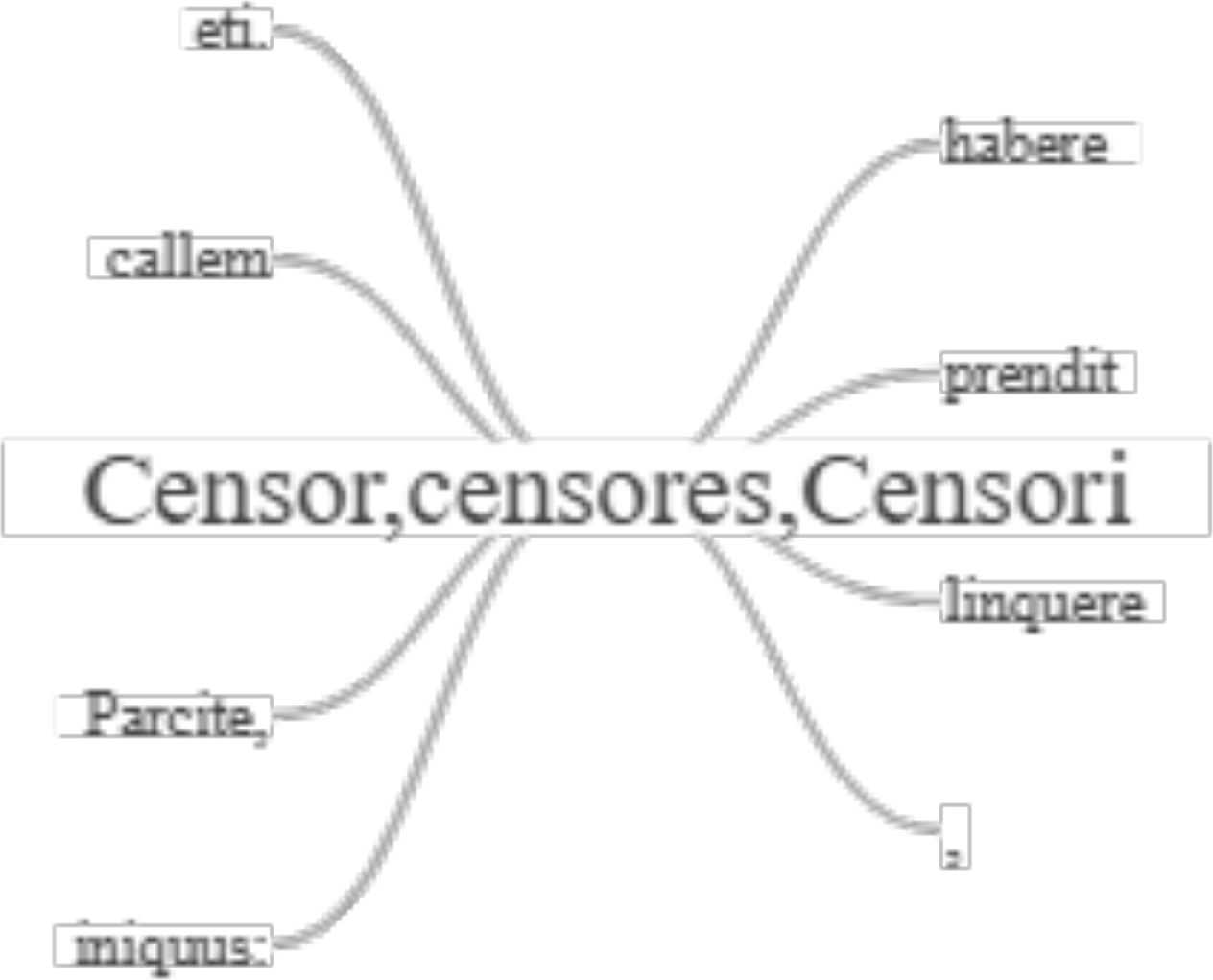
Therefore, to ascertain the words associated with the practice of corruption in Contra Iudices, we must pay attention to Theodulf’s descriptions of what he meant by this. A first step is to check the terms most associated with ‘judges’ in the text:27
Indeed, it can be seen that for both the term iudex (and its declension derivations as shown in Figure 1) and the term censor (and its declension derivations as shown in Figure 2), a term used by Theodulf to also mention judges, there are almost no words that explicitly mention corruption. However, the exception is iniquus, in the case of the occurrences of censor, which can be translated into modern Portuguese as something close to ‘unjust.’ In this context, the figure who upheld justice in the Carolingian courts at the end of the 8th century had the idea of injustice attached to him. Now, if there are almost no direct mentions of corruption in Poem 28, how can we analyse this problem in the text? To do this, we need to go back to the document.


The Visigoth’s concern was already evident in the opening verses. By advising the judges to take the path of just judgement,28 he declared that ‘let piety be given in the courts, and zeal to piety / so that cruel gifts have no place’.”.29 The courts‘ good order would be achieved by the judges’ correct action in demonstrating not only kindness and a sense of duty in the conduct of judgements,30 but also in the diligence of the judges in not accepting gifts (munera) considered inappropriate.
In my opinion, this last point is the great semantic key to understanding corruption in Poem 28. Theodulf was concerned about what could obstruct the correct application of justice, and the venality of sentences occupies a special place in his discourse. To this end, in several passages he used the words munus, muneris (plural munera) and donum, doni (plural dona).
Despite their polysemic meanings (Niermeyer, 2002), they can also be translated as ‘gift’ - thus reinforcing what Janet Nelson (2010b) emphasised about the plurality of the semantics of ‘gift’ at the time of Charles I. It was in this sense that Theodulf based his fears about the corruption of judges. The word munus (and its declension derivations), for example, appears ten times in Contra Iudices, making it the 69th most frequent in the text, tied with the words o, ipse, pia and qua - by way of comparison, the term ‘Deus, -i’ appears thirteen times (the 46th most frequent); ‘iudex, -icis’, seven times, as well as ‘censor, -is’ (both placed between the 96th and 121st most cited).31
So, throughout the poetic discourse, the ‘gifts’ issue captured Theodulf’s attention. Perhaps this was due to the bishop’s own experience?
When describing his activities as missus, including his presence at trials, he pointed out his encounters with litigants in this way:
A large crowd continually visited us, you could say all ages and genders.
The little one, the old man, the young man, the father, the single woman, the single man, the older man, the teenager, the old woman, the husband, the wife, the children.
Why do I hesitate? The plebs eagerly offered gifts (munera), thinking that if they gave, what they wanted would be done.32
We can see from Theodulf’s narrative that the attempt to bribe the judges came from litigants of all ages and genders. Later on, he lets us know that they also came from different social backgrounds:
Just as the big offer big things, the small offer small things, because they think that’s how they’ll get what they want. [...]
A rich man quickly clouds the judge’s mind with a gift [munera], and because the poor man can’t bring a [similar gift], he comes trembling.33
Whether poor or rich, those who came to court brought gifts with the intention of obtaining favourable sentences for themselves. But what were these ‘gifts’? In this regard, Theodulf’s text is quite peculiar and describes the potential gifts that would be made to the judges in astonishing detail.
Around verse 170, for example, the author mentions that ‘crystals and gemstones’ from the East would be offered, fine gold coins minted in Arabic characters, or silver coins printed with the Roman seal.34 However, one of the most impressive descriptions is that of the Hellenic mythology-themed vase with Hercules defeating Cacus, son of Hephaestus (Vulcan in the poem), and paintings of his twelve labours.35 Theodulf thoroughly reports its pattern, composition and size, suggesting that it wasn’t something commonly seen. These munera were joined by others, such as multicoloured carpets sent by ‘Arabs,’ jewellery, gold chalices and furs from Córdoba.36 The possession of these objects would require another study - after all, how did they get to Gaul? Who could have bought them? How did they operate in this circuit of luxury goods? That’s a research project to be carried out.37
As the aforementioned, not only the wealthy gave gifts. People from lower financial backgrounds also gave gifts, depending on their income. These included woollen garments such as hoods, socks and gloves, handkerchiefs or wax tablets.38 Therefore, the gift-giving came from different social strata. But this practice raises the question: was receiving gifts so frowned upon in Carolingian society?
Not really. Receiving gifts was even commonplace and a requirement for various practices of the period. The exchange of gifts was part of the political circuit of the 8th and 9th centuries, mainly because of its public nature (Curta, 2006).39 Charles I himself was part of this circuit: after quelling the revolt of his son Pepin the Hunchback (m. 811) in 793 C.E., he summoned an assembly in Ratisbon (present-day Germany), which was probably the epicentre of the revolt, according to Janet Nelson (2010b), and distributed gifts of gold, silver and silk to those who had not joined the rebellion. Similarly, the Carolingian king distributed to his magnates and courtiers part of the treasure taken from the Avars in the campaign against them in 796 CE.
These exchanges of gifts, especially those from Carolingian authority, were so important because the political system of this society was not based on a territorial reality, with a bureaucratic and hierarchical organisation similar to that of the Roman Empire, rather than on the personal relationships between the rulers and the people who surrounded them (Devroey, 2003). Thus, the loyalty bond between these figures was also cemented by the exchange of gifts and benefits (of various kinds) between them.
Therefore, in my opinion, Theodulf’s condemnation of bribery takes on a broader character than that linked only to the moral field, as historiography has traditionally pointed out (Nelson, 2010a). A gift given to a judge would not only corrupt justice, a highly Christianised concept at the time (Close, 2011; Le Jan, 2001; Lauwers, 2004), but could also unbalance the game of political relations involved, as it would create both a system of dependencies parallel to that imagined by the Carolingian central authority and remove from the circuit of gift exchanges goods that could be destined for the royal treasury itself or that would compete with its relevance. The royal treasury was, at the time, a symbol of the sovereign’s prestige and an element of the system of government. The Royal Treasury itself was a munus,as Jean Pierre Devroey (2003)has pointed out.
It is also worth paying attention to what Theodulf has ‘forbidden’: the bishop of Orléans does not condemn gifts per se, but rather ‘bad’ gifts, i.e. those that would dull the judges’ decisions and make them eager to receive them: “I have seen judges who are slow to pass judgement, / But, I admit, they are prompt to accept gifts”.40 Theodulf also points out that the acceptance of gifts might not be made by the judge himself, but by those who were part of his closest circle. Therefore, the judge had to be attentive to the words of his servants and even his own wife, if they showed any intention of influencing his decisions .41
The payment of munera to judges seems to have been a generalised concern during the reign of Charles I. By means of a capitular in 782, the then Carolingian king condemned judicial venality, including the ousting of any count who accepted any munera. This was repeated, in more or less elaborate form, in the Capitularia Admonitio Generalis (789), the Capitularia missorum item speciale (802) and the Capitulare ecclesiasticum Caroli magni (805-813) (Mordek; Schmitz, 1987). The year 802 of the Annals of Lorsch corroborates these decisions. In this record, the Carolingian emperor at the time decided that the choice of archbishops, bishops, abbots, dukes and counts should not be made from among the poorest of his vassals, as they would be tempted by munera or the need to receive them at the expense of the innocent.42
However, other figures also dealt with the subject. In a letter addressed to Arno, bishop of Salzburg, and dated 799 CE, Alcuin described how the munera blinded the hearts of the most prudent and perverted the word of the just.43 In a way, thinking about receiving gifts seemed to be a constant preoccupation at the court of Charles I, who ruled between 768 and 814 CE.
To take up a point mentioned above, although he generally condemns the gifts he receives, Theodulf stands out from the other criticisms of the munera by listing gifts that could be accepted, even by himself:
Bearing this in mind, I gladly take the little things, not by a cruel hand, but by an affectionate one: namely, a green garden’s fruit trees, eggs, wine, bread and feed for the horses.
I also take young chickens and small birds, because, although their bodies are small, they are suitable for feeding.44
Theodulf establishes two levels for the munera: the harmless and the pernicious. This approach is in line with that set out in the Capitulare de Villis, probably written a few years before the Bishop of Orléans’ poem.45 Charlemagne I established limits and qualities for the dona forbidding animals such as horses, cows, pigs, rams and oxen, and allowing only bottles, garden vegetables, apples, chickens and eggs.46 This means that it was forbidden to give goods or high-value-added items as gifts, especially in a mostly rural society that depended on the agricultural economy, bringing clear benefits to their recipients.
This interplay between the corruption of the judges described in Theodulf’s Poem 28 and the Capitulars decisions demonstrates not only a possible form of circulation of these royal regulations, a thorny issue in the study of this documentation (Ribeiro da Silva, 2020), although the Contra Iudices was a poem that circulated in the royal court, and was also intended as a political weapon by reinforcing the normative discourse of Carolingian authority, as Peter Godman (1985) has shown.
These observations are somewhat under-analysed by historiography and give a new shape to Theodulf’s discourse against the bribery of judges. While for some authors, such as Nelson (2010a), the condemnation of the venality of sentences is exclusively part of the moral reform of Carolingian society as led by Charles I, I believe that we must also take into account that these goods, withdrawn from public circulation and placed in the hands of a few characters as result of the practice of corruption, would harm the royal treasury itself, insofar as it benefited directly from the ‘moral economy’ in the period.47
There are also other nuances to be observed. The ‘taxation’ of wealth and its payment took various forms during the Carolingian period, from plundering to the distribution of gifts, as Timothy Reuter (1985) has pointed out. We can therefore see Theodulf’s mission, as described in his poem, also as a task to ensure that these goods did not escape from the Carolingian royal treasury (Magnou-Nortier, 1994).48 It becomes all the more meaningful when we look at the motives behind the corruptors seeking to corrupt the judges as described by Theodulf: trying to favour themselves in the cases in question.
The munera are offered in exchange for benefits in court decisions according to the Contra Iudices. For example, the crystals and gems of the East were offered in exchange for the possession of another person’s fields.49 Meanwhile, the multicoloured carpet would be a guarantee of ownership of a disputed portion of cattle.50 Furthermore, the Hellenic-themed vase was given in exchange for falsifying slave manumission documents. It can be seen that the corrupting practices are linked to ‘’ordinary‘’ cases, in which property passed from one person to another without the correct observation of justice and, consequently, of Carolingian authority.
Indeed, where judges are not paid directly by the court, but also by court fees (in addition to their own income, usually from land), the correct transaction would guarantee stability in the amounts collected by the tax authorities (Le Jan, 2001; Nelson, 1986).
Maybe the call for judges to be anti-corrupt was part of the moral restructuring of the Carolingian kingdom at the end of the 8th century. But it also had its political and administrative elements. Its importance goes beyond the ideals of justice propagated by Charles I and his entourage, of which Theodulf was certainly a part, but also because of the material importance of the process. After all, the warnings to the judges about the perils of corruption given by the bishop of Orléans in Contra Iudices are aimed at protecting the poorest, to whom the final part of Poem 28 is even addressed (from line 893 onwards, stating ‘Namque inopum curam recinat pars ultima habendam’).51 This concern had broader contours than just the religious piety of Carolingian authority, and was also based on the administrative structure of the empire itself: as shown in the Army Summons of 807, various social strata, including the paupers, were obliged to contribute with military service.52 Therefore, usurping the goods of these ‘poor’ through corrupt acts was not only morally reprehensible, but also jeopardised the very structure of Carolingian power, economically and politically speaking. This is yet another indication that politics, economics and morality should not be thought of strictly separately when analysing Carolingian society in the late 8th and early 9th centuries.53
References
- ALEXANDRENKO, Nikolai A. The Poetry of Theodulf of Orleans: A Translation and Critical Study. Tese (Doutorado em Literatura) - Tulane University, Nova Orléans, 1970.
- BAYARD, Adrien. De la Regio au Regnum. L'improbable « nation des Aquitains » au premier Moyen Âge. Revue de l'IFHA. Revue de l'Institut français d'histoire en Allemagne, n. 6, 31 dez. 2014.
- CAMPBELL, Darry. The Capitulare de Villis, the Brevium exempla, and the Carolingian court at Aachen. Early Medieval Europe, v. 18, n. 3, p. 243-264, 2010.
- CÂNDIDO DA SILVA, Marcelo. L'« économie morale » carolingienne (fin viiie-début ixe siècle). Médiévales. Langues, Textes, Histoire, v. 66, n. 66, p. 159-178, jun. 2014.
- CHEVALIER-ROYET, Caroline. Les révisions bibliques de Théodulf d'Orléans et la question de leur utilisation par l'exégèse carolingienne. In: SHIMAHARA, S. (Ed.). Études d'exégèse carolingienne: Autour d'Haymon d?Auxerre. Haut Moyen Âge. Turnhout: Brepols Publishers, 2007, p. 237-256.
- CLOSE, Florence. Uniformiser la foi pour unifier l'Empire: Contribution à l'histoire de la pensée politico-théologique de Charlemagne. Bruxelles: Académie Royale de Belgique, 2011.
- COSTAMBEYS, Mario. Disputes and courts in Lombard and Carolingian central Italy. Early Medieval Europe, v. 15, n. 3, p. 265-289, 2007.
- CURTA, Florin. Merovingian and Carolingian Gift Giving. Speculum, v. 81, n. 3, p. 671-699, 2006.
- DAVIS, Jennifer R. Charlemagne's Practice of Empire Cambridge: Cambridge University Press, 2015.
- DEPREUX, Philippe. Ambitions et limites des réformes culturelles à l'époque carolingienne. Revue Historique, v. 623, n. 3, p. 721-753, 2002.
- DEVROEY, Jean-Pierre. Économie rurale et société dans l'Europe franque (VIe-IXe siècles): Fondements matériels, échanges et lien social. Paris: Belin, 2003.
- DEVROEY, Jean-Pierre. Le Marché Carolingien Est-Il Moral? In: SABATÉ, Flocel; PEDRO, Maite (Ed.). El mercat: Un món de contactes i intercanvis Lleida: Pagès Editors, 2014, p. 17-42.
- DURLIAT, Jean. Les finances publiques de Diocletien aux Carolingiens ( 284-889 ). Sigmaringen: Thorbecke, 1990.
- ESTEY, Francis N. The Scabini and the Local Courts. Speculum, v. 26, n. 1, p. 119-129, 1951.
- FREEMAN, Ann. Theodulf of Orleans: A Visigoth at Charlemagne's Court. In: FONTAINE, J.; PELLISTRANDI, C. (Ed.). L'Europe héritière de l'Espagne wisigothique Madrid: Casa de Velázquez, 1992, p. 185-194.
- FREEMAN, Ann. Theodulf of Orléans: Charlemagne's Spokesman Against the Second Council of Nicaea. Farnham: Ashgate/Variorum, 2003.
- FREEMAN, Ann; MEYVAERT, Paul. The Meaning of Theodulf's Apse Mosaic at Germigny-des-Prés. Gesta, v. 40, n. 2, p. 125-139, 2001.
- GAFFIOT, Félix. Le grand Gaffiot: Dictionnaire latin-français. Paris: Hachette, 2000.
- GANSHOF, François-Louis. Frankish Institutions Under Charlemagne Providence: Brown University Press, 1968.
- GODMAN, Peter. Poetry of the Carolingian Renaissance Londres: Duckworth, 1985.
- GRAVEL, Martin. Du rôle des missi impériaux dans la supervision de la vie chrétienne. Témoignage d'une collection de capitulaires du début du ixe siècle. Memini. Travaux et documents, n. 11, p. 99-130, jun. 2007.
- GRUNIN, Andrey. Réseau politique des agents du pouvoir central: l'exemple des missi dominici. Journal of Interdisciplinary Methodologies and Issues in Science, p. 4, 2019.
- GUÉRARD, Benjamin. Explication du Capitulaire De Villis. Mémoires de l'Institut de France, v. 21, n. 1, p. 165-309, 1857.
- HAMMER, Carl I. Huosiland: A Small Country in Carolingian Europe. Oxford: Archaeopress Publishing Limited, 2018.
- HANNIG, Jürgen. Zur Funktion der karolingischen „missi dominici" in Bayern und in den südöstlichen Grenzgebieten. Zeitschrift der Savigny-Stiftung für Rechtsgeschichte: Germanistische Abteilung, v. 101, n. 1, p. 256-300, 1 ago. 1984.
- HICKLIN, Alice. The Scabini in Historiographical Perspective. History Compass, v. 18, n. 10, p. e12624, 2020.
- JÉGOU, Laurent. Les déplacements des missi dominici dans l'Empire carolingien (fin VIIIE-fin IXE siècle). In: SOCIÉTÉ DES HISTORIENS MÉDIÉVISTES DE L'ENSEIGNEMENT SUPÉRIEUR PUBLIC. Des sociétés en mouvement: Migrations et mobilité au Moyen Âge. Paris: Éditions de la Sorbonne, 2010, p. 223-235.
- LAUWERS, Michel. Le glaive et la parole. Charlemagne, Alcuin et le modèle du rex praedicator: notes d'ecclésiologie carolingienne. Annales de Bretagne et des Pays de l'Ouest, n. 111-3, p. 221-244, set. 2004.
- LE JAN, Regine. Justice royale et pratiques sociales dans le royaume franc au IXe siècle. Les Medievistes Francais, p. 149-170, 2001.
- LE JAN, Regine. Identifier les parents: le mode de dénomination. In: LE JAN, Regine. Famille et pouvoir dans le monde franc (VIIe-Xe siècle): Essai d'anthropologie sociale. Paris: Éditions de la Sorbonne, 2003, p. 179-223.
- MAGNOU-NORTIER, Elisabeth. La mission financière de Théodulf en Gaule méridionale d'après le Contra iudices. In: LORCIN, Marie-Thérèse et al. (Ed.). Papauté, monachisme et théories politiques. V. I - Le pouvoir et l'institution ecclésiale. Collection d'histoire et d'archéologie médiévales. Lyon: Presses Universitaires de Lyon, 1994, p. 89-110.
- MAGNOU-NORTIER, Elisabeth. Capitulaire « De Villis et curtis imperialibus » (vers 810-813). Revue Historique, v. 300, n. 3 (607), p. 643-689, 1998.
- MARIGLIANO, Enzo. Il Capitulare de villis: Vita quotidiana di una realtà agraria al tempo di Carlo I. Udine: Gaspari, 2013.
- MCKITTERICK, Rosamond. Charlemagne's Missi and Their Books. In: BAXTER, Stephen et al. (Ed.). Early Medieval Studies in Memory of Patrick Wormald Abingdon: Routledge, 2009, p. 253-268.
- MONOD, Gabriel. Les moeurs judiciaires au VIIIe siècle d'aprés la "Paraenesis ad judices" de Théodulf. Revue Historique, v. 35, n. 1, p. 1-20, 1887.
- MORDEK, Hubert; SCHMITZ, Gerhard. Neue Kapitularien und Kapitulariensammlungen. Deutsches Archiv für Erforschung des Mittelalters, v. 43, p. 361-439, 1987.
- MUSSON, Anthony. Crime, Law and Society in the Later Middle Ages Manchester: Manchester University Press, 2009.
- NELSON, Janet L. Dispute Settlement In Carolingian West Francia. In: FOURACRE, Paul; DAVIES, Wendy (Ed.). The Settlement of Disputes in Early Medieval Europe. Cambridge: Cambridge University Press, 1986, p. 45-64.
- NELSON, Janet L. Aachen as a Place of Power. In: DE JONG, Mayke; THEUWS, Frans (Ed.). Topographies of Power in the Early Middle Ages. Leiden: Brill, 2001, p. 217-242.
- NELSON, Janet L. Munera. In: DEVROEY, Jean-Pierre; FELLER, Laurent; LE JAN, Régine (Ed.). Les élites et la richesse au Haut Moyen Âge. Haut Moyen Âge: Brepols Publishers, 2010a, p. 383-401.
- NELSON, Janet L. The Settings of the Gift in the Reign of Charlemagne. In: DAVIES, Wendy; FOURACRE, Paul (Ed.). The Languages of Gift in the Early Middle Ages. Cambridge: Cambridge University Press, 2010b, p. 116-148.
- NIERMEYER, Jan Frederick. Mediae Latinitatis lexicon minus. Leiden: Brill, 2002.
- NOBLE, Thomas F. X. Some Observations of the Deposition of Archbishop Theodulf of Orleans in 817. Journal of the Rocky Mountain Medieval and Renaissance Association, v. 2, p. 29-40, 1981.
- NOVA Vulgata Bibliorum Sacrorum Editio. Vaticano: Libreria Editrice Vaticana, 1986.
- RANKOVIC, Slavica; BUDAL, Ingvil B. Modes of Authorship in the Middle Ages Toronto: Pontifical Institute of Mediaeval Studies, 2012.
- REUTER, Timothy. Plunder and Tribute in the Carolingian Empire. Transactions of the Royal Historical Society, v. 35, p. 75-94, 1985.
- RIBEIRO DA SILVA, Thiago J. Os capitulares reais, séculos VI a IX: Produção, codificação, transmissão e recepção. SIGNUM, v. 21, n. 1, p. 45-63, out. 2020.
- RICHÉ, Pierre. Ecoles et enseignement dans le haut moyen âge: fin du Ve siècle-milieu du XIe siècle Paris: Picard, 1999.
- RICHÉ, Pierre; LOBRICHON, Guy. Le Moyen Age et la Bible Paris: Editions Beauchesne, 1984.
- ROUQUETTE, Enimie. Les poèmes de Théodulf, témoins de leur époque? Bulletin du centre d'études médiévales d'Auxerre | BUCEMA, Hors-série, n. 11, abr. 2019.
- SCHALLER, Dieter. Philologische Untersuchungen zu den Gedichten Theodulfs von Orléans. Deutsches Archiv für Erforschung des Mittelalters, v. 18, p. 13-91, 1962.
- SUOLAHTI, Jaakko. The Roman Censors: A Study on Social Structure. Helsinki: Suomalainen Tiedakatemia, 1963.
- THEODULFUS AURELIANENSIS. Sollemnia anniversaria conditae Universitatis et munus auspicantis novi rectoris: Insunt Theodulfi episcopi Aurelianensis de iudicibus versus. Bern: Universität Bern, 1882.
- TIGNOLET, Claire. Théodulf et Orléans. Bulletin du Centre D'études Médiévales d'Auxerre | BUCEMA, Hors-série, n. 11, abr. 2019.
- TIGNOLET, Claire. Théodulf d'Orléans (vers 760-821): Histoire et mémoire d'un évêque carolingien. Turnhout: Brepols, 2023.
- TSUDA, Takurô. On the so Called Capitulary of Frankfurt and Communication Between Charlemagne and Bavaria at the End of the 8th Century. Spicilegium: Online Journal of Japan Society for Medieval European Studies, v. 3, p. 3-14, 2019.
- VOCINO, Giorgio; WEST, Charles. "On the Life and Continence of Judges": The Production and Transmission of Imperial Legislation in late Ottonian Italy. Mélanges de l'École Française de Rome - Moyen Âge, n. 131-1, jan. 2019.
- WERNER, Karl F. Missus - Marchio - Comes: Entre l'administration centrale et l'administration locale de l'Empie carolingien. In: XIVe COLLOQUE HISTORIQUE FRANCO-ALLEMAND, 1977, Paris. Actes... Histoire comparée de l'administration (IVe-XVIIIe siècles) Paris: Artemis, 1980, p. 191-239.
- WICKHAM, Christopher. Framing the Early Middle Ages: Europe and the Mediterranean, 400-800. Oxford: Oxford University Press, 2005.
-
1
For a historiographical and conceptual overview of the term ‘Carolingian Renaissance’, see Depreux (2002).
-
2
The way in which Theodulf appeared at the court of Charles I is uncertain. Nikolai Alexandrenko (1970) points out that perhaps Theodulf was the leader of Charles I’s supporters in Al-Andalus, and after the defeat of 778 CE, he and his family had to flee there. This idea would justify the fact that Theodulf suddenly appeared so close to Charles I’s throne and in such high regard.
-
3
THEODULFUS AURELIANENSIS. Opus Caroli Regis contra synodum (Libri Carolini). Monumenta Germaniae Historica (MGH), Concilia 2, Supplementa 1, 1998.
-
4
On the adversities that beset the Libri Carolini, including its non-publication, see Freeman (2003).
-
5
Although construction continued even after the death of Charles I in 814, it is known that the Palace of Aquisgrana (ale. Aachen) had already completed a large part of its construction in 798. See Nelson (2002).
-
6
There is no record of the exact date of Theodulf’s appointment as bishop and abbot. It is only known that i) it did not take place before 794, since he does not appear on the list of those present at the Council of Frankfurt in 794, like Paulinus of Aquileia - for this document, see Tsuda (2019); ii) it could not have taken place after 798, since Alcuinus, in a letter dated that year and addressed to Charles I, appoints Theodulf as ‘episcopis doctoribus et magistris’ (Tignolet, 2019; 2023). Perhaps Charles I had appointed Theodulf as bishop of Orléans when he had also appointed Alcuinus, abbot of Marmoutier, in Tours in 796 CE.
-
7
Theodulf was ousted from his ecclesiastical office and exiled in 817 C.E. for allegedly supporting the uprising of Bernard of Italy (m. 817) against his uncle and emperor, Louis I (m. 840), which took place that same year. See Noble (1981)about the ousting of Theodulf.
-
8
Author’s free translation: ‘Nulli vi studiisque piis armisque secundus / Rex dedit hanc Carolus, primus ad omne bonum’ (DÜMMLER, Ernst. Antiquitates, Poetae 1. In: Monumenta Germaniae Historica ( MGH), Carm. 28, ll. 101-102, 1881)
-
9
Author’s free translation:: “Praefectura mihi fuerat peragenda tributa / Resque actu grandes officiumque potens” (DÜMMLER, Ernst. Antiquitates, Poetae 1. In: MGH, Carm. 28, ll. 99-100, 1881).
-
10
The Omnes Viae website (https://omnesviae.org/) is a useful resource for visualising possible travel routes that made use of Roman roads, particularly for the pre-Modern period.
-
11
The bibliography on the missi dominici is very extensive. In a non-exhaustive list, indications that should not be missed include the following names: Werner (1980); Hannig, (1984); Gravel (2007); Mckitterick (2009); Jégou (2010); Vocino; West (2019); Grunin (2019).
-
12
This would reinforce the idea that Theodulf was already bishop at the time of this mission, being the ecclesiastical character, and Leidrad, the secular one.
-
13
The geographical contours of the missatica raise several questions. While some texts mention them explicitly (as is the case with the poem by Theodulphus that will be analysed below), others provide only sparse information about the places where the missi dominici worked. Recent studies show that a large proportion of the agents carried out their activities within a radius of 100 to 125 kilometres from the places where they exercised authority (Grunin, 2019). One point of research for the future, which has not yet been adequately explored by experts, is to discern whether there are intersections between these areas where the missi worked and, for example, their family properties,.
-
14
The dating of the poem is uncertain, precisely because of the vagueness of the date of the mission to which Theodulf was entrusted. However, it is known that it was composed not long after its realisation. This is because Poem 32, Ad regem (‘To the king’), addressed to Charles I, was written before the latter’s imperial coronation at Christmas 800 CE - precisely because of the use of the name ‘rex’ to refer to the Carolingian monarch. See DÜMMLER, Ernst. Antiquitates, Poetae 1. In: MGH, Carm. 32, 1881..
-
15
The name of Poem 28 is controversial. Ernst Dümmler, editor of Theodulf’s poems in the MGH in 1881, called it ‘Contra Iudices’ because this was the title found in one of the document’s manuscripts (P1, Codex Paris. Lat. 18557, dating from the 10th century. Available at: https://gallica.bnf.fr/ark:/12148/btv1b100352148). However, its first known edition, made by Pierre Daniel in 1598, names it Paraenesis ad iudices (which can be translated as something close to ‘Advice/Exhortation to the judges’, especially if we consider the Greek root of the word paraenesis, usually used in a moral or religious sense). This tradition continued in Jacques Sirmond’s edition (Theodulfi Aurelianensis Episcopi Opera. Paris, 1646), republished in Jacques-Paul Migne’s Patrologia Latina (PL 105, 191-376). In an article from 1887, Gabriel Monod (1887, p. X) justifies his preference for the old title by saying. Author’s free translation: ‘car le poème est une exhortation et non une invective’. Peter Godman (1985), in his book from the 1980s, even advocates a new title for the poem: De iustitia, arguing that its message was not limited to the end of the 8th century, but was a timeless treatise on the subject. Having said that, although I personally prefer to give Poem 28 the title De iudicibus (‘On Judges’) to Poem 28 - as Hagen had done in a parallel edition published in 1882 (Theodulfus Aurelianensis; Hagen, 1882) - for the sake of practicality and clarity, when referring to Poem 28 in this text, I will use the version consecrated by the MGH edition: Contra Iudices.
-
16
The decision to use the term Visigoth for Theodulf comes not only from his history linked to the Iberian Peninsula and his name - made up of the particles Teo, as in Teodorico, a common name for Visigoth authorities throughout the 5th and 6th centuries; and Ulfus, whose meaning refers to a wolf and is also common in names from the region, such as Ataulfo; on the anthroponymy of the post-Roman kingdoms, see Le Jan (2003) - but also because of the way Theodulf calls himself. In verses 137 to 140, when narrating his arrival in Narbonne, he comments: ‘We soon arrived at his abode, the beautiful city of Narbonne, where a happy crowd met me, a remnant of the Gothic people [Getici populi], and also a crowd of Hispanics [Hespera], who were happy that I, an officer, was of their blood [Me consaguineo fit duce laeta sibi].’ (DÜMMLER, Ernst. Antiquitates, Poetae 1. In: MGH, Carm. 28, ll. 137-140, 1881, emphasis added.).
-
17
In this regard, see Ranković; Budal (2012).
-
18
DÜMMLER, Ernst. Antiquitates, Poetae 1. In: MGH, 1881.
-
19
For example, in verses 18-86, Theodulf sets out a model for how judges should act based on the scriptures, quoting Moses, Samuel and Josiah (DÜMMLER, Ernst. Antiquitates, Poetae 1. In: MGH, 1881).
-
20
The term censor and its derivations, whose origin goes back to the Roman officialdom abolished in 22 B.C., was probably used by Theodulf under this “classical” influence to analogise to the Carolingian iudex. Jaakko Suolahti (1963) says that censors had the duty to guarantee ‘public morality’, among other responsibilities. The term iudex itself shared space in the vocabulary of Carolingian positions with comes, with the former gradually being replaced by the latter (Hammer, 2018).
-
21
On several occasions, Theodulf questions whether he would succumb to the temptations that the judges went through, as in ‘Often, when I rebuke the unjust in such matters, they secretly tell themselves that I too am of the same kind. Often, although I am not like that, they suspect that I am. Although I may have many faults, I am free of them.”. (DÜMMLER, Ernst. Antiquitates, Poetae 1. In: MGH, Carm. 28, ll. 93-98, 1881).
-
22
Seer note 15, supra.
-
23
About the scabini, see Estey (1951); Hicklin (2020).
-
24
See note 21, supra.
-
25
Searching for corruption trends in Brazil on Google shows that most of them are linked to politics. See: https://trends.google.com.br/trends/explore?date=all&geo=BR&q=corrup%C3%A7%C3%A3o.
-
26
In fact, there is only one variation: the adjective corruptus. But it is used to describe the bad weather conditions on Theodulf’s journey as missus. Author’s free translation: ‘Aequoris insani fera quas vicinia laedunt / Aere corrupto et tabidus efflat odor.’ (DÜMMLER, Ernst. Antiquitates, Poetae 1. In: MGH, Carm. 28, ll. 155-156, 1881, emphasis added). Word occurrences were calculated using the Online Text Analysis Tool, available at : https://www.online-utility.org/text/analyzer.jsp.
-
27
The graphs below along with the statistics on the occurrence, distribution and context of the words that make up Poem 28 by Theodulf of Orléans were made using the Voyant Tools tool (https://voyant-tools.org/), a text reading and analysis environment developed by Stéfan Sinclair and Geoffrey Rockwell.
-
28
Author’s free translation: “Iudicii callem censores prendit iusti” (DÜMMLER, Ernst. Antiquitates, Poetae 1. In: MGH, Carm. 28, l. 1, 1881).
-
29
DÜMMLER, Ernst. Antiquitates, Poetae 1. In: MGH, Carm. 28, ll. 15-16, 1881. Author’s free translation, based on Alexandrenko’s proposal (1970): “Iudicio pietas, pietati industria detur / quo teneant nullum munera saeva locum”.
-
30
Although the Latin word pietas, -atis gave rise to the word piedade in Portuguese, and in Medieval Latin it was loaded with religious meanings (which still persist today), we can’t forget its use in Classical Latin, where it had a meaning linked to ‘the feeling of fulfilling duties related to the family, the homeland and the gods’, hence it was even a synonym for patriotism (Gaffiot, 2000). Given Theodulf’s background, already discussed above, it seems to me that it was precisely because it had this double civic-religious meaning that the Visigoth chose to use it.
-
31
In its 956 verses, Poem 28 totals 6,407 words.
-
32
DÜMMLER, Ernst. Antiquitates, Poetae 1. In: MGH, Carm. 28, ll. 163-168, 1881. Author’s free translation: “Magna catervatim nos contio saepe frequentat /Aetas quod dicat sexus et omnis habet / Parvulus, annosus, iuvenis, pater, innuba, celebs / Maior, ephoebus, anus, masque, marita, minor. /Quid moror? instanter promittit munera plebes, / Quodque cupit factum, si dabit, esse putat”. See also Alexandrenko (1970).
-
33
DÜMMLER, Ernst. Antiquitates, Poetae 1. In: MGH, Carm. ll. 243-244; 313-314, 1881. Author’s free translation: “Magna ut maiores, sic promunt parva minores, / Dum fore quae cupiunt hac sibi sorte putant”; “Iudicis ingenium cito turbat munere dives, / Hoc qui ferre nequit, it tremebundus inops”. See also Alexandrenko (1970).
-
34
Author’s free translation: “Hic et cristallum et gemmas promittit Eoas, / Si faciam, alterius ut potiatur agris. / Iste gravi numero nummos fert divitis auri, / Quos Arabum sermo sive caracter arat, / Aut quos argent Latius stilus inprimit albo” (DÜMMLER, Ernst. Antiquitates, Poetae 1. In: MGH, Carm. 28, ll. 171-175, 1881).
-
35
Author’s free translation: “‘Est mihi vas aliquod signis insigne vetustis, / Cui pura et vena et non leve pondus inest, / Quo caelata patent scelerum vestigia Caci, / Tabo et stipitibus ora soluta virum; / Ferrati scopoli variae seu signa rapinae, / Humano et pecudum sanquine tactus ager. / Quo furor Herculeus Vulcanidis ossa retundit, / Ille fero patrios ructat ab ore focos / Quove genu stomachum seu calcibus illia rumpit, / Fumifluum clava guttur et ora quatit. / Illic rupe cava videas procedere tauros, / Et pavitare iterum post sua terga trahi. / Hoc in parte cava planus cui circulus ore est, / Nec nimium latus signa minuta gerens, Perculit ut geminos infans Tirintius angues, / Ordine sunt etiam gesta notata decem. / At pars exterior crebro usu rasa politur / Effigiesque perit adtenuata vetus, / Quo Alcides, Calidonque amnis, Nessusque biformis / Certant pro specie, Deianira, tua. / Inlita Nesseo feralis sanguine vestis / Cernitur et miseri fata pavenda Lichae. / Perdit et Anteus dura inter brachia vitam, / Qui solito sterni more vetatur humo” (DÜMMLER, Ernst. Antiquitates, Poetae 1. In: MGH, Carm. 28, ll. 179-202, 1881).
-
36
Theodulf’s detailed descriptions of the artefacts that were probably offered as bribes to judges in the courts makes us wonder not if he actually saw them, but when. Considering that many of these items are linked to the ‘Arab’ world, such as the gold coins with Arabic characters, the jewellery from the East, the carpets and the furs from Cordoba, which was then under Muslim rule, allows us to question whether these aren’t souvenirs reminiscent of a time when the Visigoths lived in Al-Andalus. And whether, if they could be, would invalidate the bishop of Orléans’ reports on the Carolingian courts. I believe not. In this instance, the artefacts would reinforce Theodulf’s argument. At the same time, the author also mentions other items with a lower added value, as you’ll see below.
-
37
Is the long-distance circuit of luxury objects in the high-medieval West as irrelevant as Chris Wickham (2005)has argued ? It’s a good thought. Obviously, the poem doesn’t give us the range of transactions involving these items - whether they are more recurrent than other objects, for example, since Theodulf’s argument takes place in a qualitative dimension.
-
38
Author’s free translation: “Linea quit potis est, qui non, fert lanea dona, / Tengmen et hic capitis, hic pedis, ille manus. / Quo facies humore levi palmasque solemus / Tergere, quis dandum textile munus habet. / Scrinia danda parant alii, nec defuit ille, / Caereolas rotulas qui dare vellet ovans” (DÜMMLER, Ernst. Antiquitates, Poetae 1. In: MGH, Carm. 28, ll. 247-252, 1881).
-
39
Although for Curta (2006) it did not necessarily form a gift economy (or its opposite) according to the models proposed by Bronislaw Malinowski and Marcel Mauss.
-
40
DÜMMLER, Ernst. Antiquitates, Poetae 1. In: MGH, Carm. 28, ll. 389-390, 1881. Author’s free translation: “Vidi ego censores ad iuris munia tardos, / Munera, nam fateor, ad capienda citos”.
-
41
On the care of servants. Author’s free translation: ‘Nec minor in propriis cura est adhibenda ministris, / Quis comitatus ines, sunt prope quique tibi: / Ne fera pestis eos, illi tua pectora laedant, / Et tua conmaculent intima tabe sua. / Qui ut capias, ut possint sumere sumas, / Cogent, si poterint, tu vigil esse stude’ (DÜMMLER, Ernst. Antiquitates, Poetae 1. In: MGH, Carm. 28, ll. 715-720, 1881). On caring for one’s wife: Author’s free translation: ‘Esto et sollicitus propriae de parte iugalis, / Ne mentem maculet inliciendo tuam. / Oscula quae genibus, manibus, colloque, genisque / Blanda dabit, miscet lenia verba quibus, / Sueta preces tali proprias armare veneno, / Armat ut architenens inpigra tela suo’. (DÜMMLER, Ernst. Antiquitates, Poetae 1. In: MGH, Carm. 28, ll. 691-696, 1881).
-
42
Author’s free translation: “802. Eo anno demoravit domnus Caesar Carolus apud Aquis palatium quietus cum Francis sine hoste; sed recordatus misericordiae suae de pauperibus, qui in regno suo erant et iustitias suas pleniter abere non poterant, noluit de infra palatio pauperiores vassos suos transmittere ad iustitias faciendum propter munera, sed elegit in regno suo archiepiscopos et reliquos episcopos et abbates cum ducibus et comitibus, qui iam opus non abebant super innocentes munera accipere, et ipsos misit per universum regnum suum, ut ecclesiis, viduis et orfanis et pauperibus et cuncto populo iustitiam facerent” (PERTZ, Georg H. Scriptores (SS) 16, Annales aevi Suevici. In: Monumenta Germaniae Historica (MGH), Annales Laureshamenses, a. 802 (XXXV), 1925).
-
43
Author’s free translation: “Munera excecant corda prudentum, et subvertunt verba iustorum” (DÜMMLER, Ernst. Epistolae Karolini aevi II, 4. In: Monumenta Germaniae Historica, Epistolae (MGH), Ep. 186, 1925).
-
44
DÜMMLER, Ernst. Antiquitates, Poetae 1. In: MGH, Carm. 28, ll. 283-288, 1881. Author’s free translation: “Haec ego pertractans sumebam parva libenter, / Quae non saeva manus, cara sed illa dabat: / Scilicet arboreos fructus hortique virentis, / Ova, merum, panes, cornipedumque cibos./ Sumpsimus et teneros pullos, modicasque volucres, Corpora sunt quarum parva, sed apta cibis”. Ver também Alexandrenko, 1970.
-
45
O Capitulare de Villis ( BORETIUS, Alfred; KRAUSE, Victor. Capitularia regum Francorum. In: MGH, 1883) is a text devoted to the administration of royal estates probably published between 792 and 800 C.E. There is extensive literature on the nature of this document and the problems it evokes, among which we can mention: Campbell (2010); Guérard (1857); Iu-Nortier (1998); Marigliano (2013).
-
46
Author’s free translation: “Ut non praesumat iudices nostram familiam in eorum servitium ponere, non corvadas non materia cedere nec aliud opus sibi facere cogant, et neque ulla dona ab ipsis accipiant, non caballum non bovem non vaccam non porcum non berbicem non porcellum non agnellum bem aliam causam, nisi buticulas et ortum, poma, pullos et ova” (BORETIUS, Alfred; KRAUSE, Victor. Capitularia regum Francorum. In: MGH, Capit. I, n. 32, c. 3, 1883). Although Theodulf was already present at the court of Charles I in the 790s C.E., there is no evidence that he participated in the drafting of the Capitulare de Villis. This idea deserves further investigation in the future.
-
47
When referring to the circuit of goods given as gifts, the ‘moral economy’ is understood here in its simplest and most direct form: gift-giving as the founding act of a moral debt. In accordance with the anthropological observations of Marcel Mauss, Devroey (2003) observed that giving a gift is not only a way of sharing what you have, but also of instrumentalising this possession. Within the elite, this system of giving and receiving in return would have engendered a relationship of domination, since it is not always possible for a person to reciprocate the gift received, leaving them dependent on the benefactor.
-
48
It is not a question of thinking of a tax system in the proportions established by Jean Durliat (1990). However, it is undeniable that, even for the authors most favourable to the thesis of peasant autonomy, such as Wickham (2005), the advent of the Carolingians transformed (or revitalised, depending on the interpretation) the royal treasury. It is possible that this process took place in conjunction with the transformation of land exploitation itself, whose measures found in the polyptychs are exemplary testimonies. These detailed inventories of the land assets of a large landowner, whether secular or ecclesiastical, and whose oldest example (dating back to the year 800) is precisely the description of the properties of the bishopric of Salzburg and the abbey of Wissembourg (Devroey, 2003), appear precisely in the Carolingian period. In other words, it is possible to surmise a transformation of the Carolingian countryside, in which the development of the latifundii (ale. Grundherrschaft, fr. grand domaine, ingl. great estate) is one of the characteristics of the period.
-
49
Author’s free translation: “Si tamen adquirat predia, rura, domos” (DÜMMLER, Ernst. Antiquitates, Poetae 1. In: MGH, Carm. 28, l. 176, 1881).
-
50
Author’s free translation: “Pro quibus ista paro congrua dona dare. / Pro vitulis vitulum, pro tauris offero taurum, / Pro vacca vaccam, pro bove dono bovem” (DÜMMLER, Ernst. Antiquitates, Poetae 1. In: MGH, Carm. 28, ll. 218-220, 1881).
-
51
DÜMMLER, Ernst. Antiquitates, Poetae 1. In: MGH, Carm. 28, ll. 893, 1881. Trad. livre do autor: Pois a última parte canta que se deve ter cuidado com os necessitados.
-
52
BORETIUS, Alfred; KRAUSE, Victor. Capitularia regum Francorum. In: MGH, 1883.
-
53
Minha reflexão se apoia naquelas desenvolvidas por Marcelo Cândido da Silva (2014) e Jean Pierre Devroey (2014), cada um, a seu modo, também se ocupou em pensar como a economia carolíngia estaria “imbricada” de valores externos aqueles comumente associados ao mercado em sentido moderno, entre eles a moral cristã.
-
Responsible editor:
Mariana de Moraes Silveira