 Probing of MEP1A gene to identify biomarkers associated with post-partum anestrus in buffalo
Abstract
Post parturition period during which female animal does not exhibit estrus behavior and is unable to get successfully fertilized and conceive is known as post-partum anestrus. It causes buffalo reproduction failure, restricts the full exploitation of buffalo for milk and meat and down turning of the national economy of agricultural countries. Post-partum anestrus is one of the most ignored factors influenced by farm environmental conditions and genetic complement of animal. In the present study, we have tried to get an insight into genetic predisposition of anestrus by characterization of MEPA1 gene which decreases serum Igf-1 concentration during port partum stage. Sequences of MEPA1 gene retrieved from Ensembl database were analyzed by EXPASY, GeneMANIA, SIFT, I-Mutant, PROTPARAM, CELLO2GO, HOPE server, PHYRE2, SOPMA and SOSUI. SNPs reported in cases 19-23 were found to alter localization of protein. SNPs documented in cases 3, 4, 10, 14, 16, 19 and 23 affected topology. Variants in cases 4, 8-10 and 15 changed 3D structure. Hence, SNPs rs470711084, rs464074496, rs109405018, rs473528825, rs470711084, rs519229329, rs474419241, rs464074496, rs517701562, rs467425367, rs451973288, rs462968442, rs133043096, rs433804044, rs4442522640, rs464074496, rs444252640, rs443365364 and rs443365364 might assist in selection of animals with least susceptibility for post-partum anestrus at the time of selective breeding.
Key words
post-partum anestrus; single nucleotide polymorphisms; metalloprotease; negative energy balance; database; physicochemical
INTRODUCTION
Buffalo is an important livestock in agrarian countries of Asia including Pakistan, India, Bangladesh and China (Yang et al. 2007, Samad 2020, Bilal et al. 2006, Sun et al. 2020). Asian buffalo constitutes 97% of world’s buffalo population. It is renowned for its contribution to milk, meat and drought energy in agriculture and leather production (Cruz 2010). Due to these qualities, buffalo occupies a significant place in economical set up of Asian countries (Pasha & Hayat 2012). However, due to poor reproductive performance of buffalo, we are unable to exploit it for strengthening of economy. This is need of the hour to deal with the major issues leading to reproduction failure in buffalo (Kumar et al. 2020). Among the large number of reproductive issues in buffalo, anestrus is the most prominent innate problem which needs to be resolved for profitable performance of this livestock (Gautam 2020).
Anestrus is the post-calving duration in which animal is reproductively incompetent. Female individuals become passive towards sexual behavior of males. Under normal conditions, post-partum anestrus caused by physiological reasons is an unavoidable and useful event which enables uterus in returning to pre-pregnancy state. However, anestrus caused by pathological reasons, higher prolactin levels in lactating animals and hereditary factors leads to infertility in buffaloes (Kumar et al. 2014). Due to this lengthy post-partum anestrus period buffaloes are known as bad breeders as compared to cattle. Frequency of postpartum anestrus has been reported to be 33.4% in buffalo (Kaurav et al. 2019). Resumption of estrus cycle occurs by 30-90 days and 15-45 days postpartum in buffalo and cattle, respectively (Forde et al. 2011, Perera 2011, Ambrose 2021). However, in some regions of Asia, anestrus stage is prolonged for 150 days (El-Wishy 2007).
Reported non-genetic factors that contribute to anestrus include frequency of feeding per day, suckling, oxytocin treatment for ease in reales of milk from udder during feeding, frequency and amount of feeding in early post-partum, male proximity, cleanliness of shelter, variables of body condition score (BCS) including girth and pelvic girdle score, heat and cold stress, infections caused by parasites, periparturient diseases and parity (Kumar et al. 2014, 2020). However, it has been observed that the animals with post-partum anestrus are mostly found alongwith normal individuals under the same environmental conditions. This fact suggests that genetic factors are also among the underlying factors contributing to post-partum anestrus.
So far, large number of genes have been reported to be linked with post-partum anestrus trait in bovine. These include LEP, PIT-1, LHR, CYP19A1, MEP1A, GHR, GH, IGF1, PRLR, ALDH1A2, SLCO1C1, SLITRK6, AB13BP, ACBD6, ACCN1, ADAMTS20, ADH6, ALDH1A2, ARHGAP21, CA12, CASP1, CLN6, COPS8, CPM, CSRP1, CTNNA2, DCAF12, EFNA6, EML1, ESR1, FOXA1, GBX2, GTPBP8, HECTD2, HIVEP1, HS2ST1,ITFG1, KITLG, LAMA4, LIGI, MAPK10, MATN2, MPP7, MYO5B, MYOM3, NFATC2, NUP188, ZWINT, WIF1, WBSCR17, VIT, TRPA1, SYT4, SYT1, STAC, SP140, SLC44A1, SGCA, SERPIN12, RARB, PTK2, PSTPIP1, PRKCA, PRDM10, PLEKHH1, PLEKHF1, PLA2G2D1, PITRM1, PDE6B, PCDH7, PAX8 and OCA2 (El-Bayomi et al. 2018, Kumar et al. 2022, Cañizares-Martínez et al. 2021, Fortes et al. 2014, El-Komy et al. 2020, 2021, El-Magd et al. 2017, 2021).
Various studies have been reported in literature which involved association analysis of many reproduction associated genes with different fertility traits. Like single nucleotide polymorphisms (SNPs) rs41857027, rs109137982, rs43745234, rs109443582, rs109830880, rs110789098, rs41256848, rs109629628, rs43321188, rs41912290, rs110660625, rs133674837, rs110217852, rs137601357, rs109621328, rs133747802, rs109443582, rs109137982, rs41893756, rs109262355, rs109830880, rs110828053, rs111015912, rs134264563, rs109813896, rs109629628 have been identified in genes CFDP2, FCER1G, FSHR, CSPP1, GCNT3, IBSP, LHCGR, PMM2, SERPINE2, SREBF1, TBC1D24, BDH2, BSP3, CAST, CD14, CD2, CSPP1, FCER1G, FUT1, FYB, GCNT3, HSD17B7, LDB3, OCLN, PCCB and PMM2, respectively. Several SNPs associated with calving-conception interval or days open have been reported. These might help in identification of animals with no PPA. The SNPs include rs132789482, rs110660625, rs133729105, rs109629628, rs109813896, rs134264563, rs109383758, rs110789098, rs110828053, rs109262355, rs41893756, rs109137982, rs109443582, rs133747802, rs109621328, rs137601357, rs110217852, rs133674837 and rs109669573 in TSHB, TBC1D24, RABEP2, PMM2, PCCB, OCLN, NLRP9, IBSP, HSD17B7, FYB, FUT1, FCER1G, CSPP1, CD2, CD14, CAST, BSP3, BDH2 and BCAS1 genes (Ortega et al. 2017).
Meprin A subunit alpha (Mep1A) gene encodes for a metalloprotease enzyme that causes hydrolysis of variety of proteins like transforming growth factor alpha (TGF-α), vascular endothelial growth factor A (VEGF-A), interleukin-1β, interleukin-18 and insulin like growth factor-1 binding protein (Igfbp3) (Sterchi et al. 2008, Herzog et al. 2009, Banerjee & Bond 2008, Bergin et al. 2008, Schütte et al. 2010, Kumar et al. 2022).
Early in post-partum period, due to high production cows exhibit negative energy balance (NEB). This state is characterized by high growth hormone (GH) and low insulin growth factor-1 (Igf-1) (Beam & Butler 1999, Lucy et al. 2001). In buffaloes the state of postpartum anestrus is prolonged as compared to cattle which reduces their fertility (Dobson & Kamonpatana 1986). One of the underlying mechanism that might be responsible for low concentration of Igf-1 is absence of MEP1A gene encoded enzyme. Under normal conditions, this enzyme hydrolyzes Igfbp3 into Igf-1 resulting in high level of Igf-1 in serum. However, if due to any reason MEP1A encoded enzyme is absent then Igfbp3 remains intact and serum level of Igf-1 is decreased (Gobikrushanth et al. 2018, Velazquez et al. 2008). Therefore, MEP1A is a candidate gene for postpartum anestrus behavior in buffaloes. In literature, a SNP g.37219977A>G has been documented in the 3’-UTR region of MEP1A gene suggesting its strong association with anestrus trait (Kumar et al. 2022). However, the data on polymorphic sites of MEP1A gene related with anestrus is not plenty in literature. The genetic architecture study of fertility associated traits can play magnificent role in selection of animals with good reproduction potentials. Keeping in view this fact and the strong functional relation of MEP1A gene with post-partum anestrus, we initiated present project to find out the SNPs with prominent effects on structure, functions, properties and interactions of encoded protein. These polymorphisms can be suggested as powerful tools for biomarkers aided selective breeding of cows and buffaloes.
MATERIALS AND METHODS
Present study involves the mining of MEP1A gene based on multiple bioinformatics tools. Ethics Committee was notified about the present project. A scheme describing the layout of methodology is given in Figure 1.

In present project, we focused on the characterization of transcript of MEP1A gene i.e. MEP1A-201 (ENSBTAT00000005686.6). Coding sequence (CDS) of gene was retrieved from ENSEMBL database (https://asia.ensembl.org/index.hotmail, accessed on May 3, 2022).
Retrieve SNPs from ENSEMBL
To retrieve the SNPs reported in bovine MEP1A gene EMSEMBL database was explored. SNPs selected were arranged in the form of table alongwith the detailed information of consequence type, amino acid and nucleic acid change involved and position of codon (Table I). All the SNPs, one each time, were incorporated in normal CDS sequence to design cases of mutations. All the cases designed (Figure 2) were subjected to different tools for assessment of SNPs effect on physicochemical parameters, sub-cellular localization, 2D and 3D structures, protein stability and topology.

EXPASY tool for translation of CDS
The CDS of normal gene and those obtained for all the SNPs documented in present study were translated into amino acid sequence using EXPASY tool (https://web.expasy.org/translate, accessed on 23 May 2022). Hence, mutated protein sequences were obtained.
GeneMANIA for interaction study of MEP1A gene
To study the interaction of MEP1A gene encoded protein with other proteins, CDS of normal gene was analyzed using GeneMANIA tool (https://genemania.org, accessed on 25 May 2022).
SIFT tool
To explore the deleterious or benign nature of individual SNPs, SIFT (https://sift.bii.a-star.edu.sg, accessed on May 23, 2022) was used.
I-Mutant tool for assessment of mutant proteins stability
To predict the change in stability of mutant proteins induced by SNPs, I-Mutant tool (gpcr2.biocomp.unibo.it/cgi/predictors/I-Mutant3.0/I-Mutant3.0.cgi, accessed on May 27, 2022) was employed.
PROTPARAM for assessment of physicochemical parameters
PROTPARAM tool (https://web.expasy.org/protparam/, accessed on May 24, 2022) was used to analyze the effect of variations on different physical and chemical properties of mutated proteins. The properties are molecular weight, number of amino acid sequences, theoretical pI, extinction coefficient, instability index, aliphatic index, half-life and number of positively and negatively charged residues.
CELLO2GO for sub-cellular localization prediction
To evaluate any change in sub-cellular localization of mutated proteins CELLO2GO tool (accessed on May 28, 2022) was used (Tirosh et al. 2009).
HOPE server and PHYRE2 tools
To figure out the position of missense SNPs and the possible effects on internal bonding in 3D structure of mutated proteins HOPE server (www3.cmbi.umcn.nl/hope/, accessed on May 28, 2022) was used. To assess the 3D configuration changes induced by frame-shift, stop-gained and missense mutations, the analysis was carried out by PHYRE2 tool (http://www.sbg.bio.ic.ac.uk/~phyre2/html/page.cgi?id=index, accessed on May 27, 2022).
SOPMA tool for secondary structure analysis
To determine the effect of SNPs on secondary structure of proteins, SOPMA tool (https://npsa-prabi.ibcp.fr/cgi-bin/npsa_automat.pl?page=npsa%20_sopma.html, accessed on May 23, 2022) was used. It helped us to highlight various attributes of 2D structure like percentage of alpha helix, 310 helix, pi helix, beta-bridge, beta-bridge, extended strand, beta turn, random coil and disordered areas. To further confirm the alterations in secondary structure.
SOSUI tool for topology determination
Trans-membrane topology of normal as well as mutated proteins was interpreted using SOSUI tool (https://harrier.nagahama-i-bio.ac.jp/sosui/mobile/, accessed on May 28, 2022).
RESULTS
Interaction of MEP1A with other proteins
Protein interaction analysis of MEP1A via GeneMANIA tool revealed its association with meprin A subunit beta (MEP1B), neuropeptide Y (NPY), gonadotropin releasing hormone (GNRH1), neurotensin (NTS), matrix metallopeptidase 9 (MMP9), astacin like metalloendopeptidase (ASTL), calreticulin (CALR), calnexin (CANX), myosin 1A (MYO1A), caudal type homeobox 1 (CDX1), cadherin 17 (CDH17), defensin alpha 6 (DEFA6), carcinoembryonic antigen (CEACAM5), vasoactive intestinal peptide (VIP), butyrophilin like 8 (BTNL8), apolipoprotein B mRNA editing enzyme catalytic subunit 1 (APOBEC1), dehydrogenase-reductase 11 (DHRS11), villin 1 (VIL1), serine peptidase inhibitor kazal type 4 (SPINK4), cadherin 17 (CDH17) and solute carrier family 26 member 3 (SLC26A3) genes (Figure 3).

Assessment of SNPs effect: deleterious or benign
According to finding of SIFT tool, among nineteen missense mutations six SNPs i.e. rs720295090, rs465782291, rs797672919, rs443365364, rs479645850, rs433203476 were found to be deleterious. Remaining thirteen including rs381004478, rs473528825, rs519229329, rs434822763, rs109405018, rs474419241, rs440496700, rs480205485, rs442496282, rs797064603, rs463301879, rs449188511 and rs517017357 were tolerated.
Prediction of SNPs effect on protein stability
Among nineteen missense mutations, only two rs434822763 and rs440496700 had increasing effect on stability of mutated proteins. On the other hand, all other SNPs caused reduction in protein stability (Table II).
Effect of SNPs on physicochemical parameters of mutated proteins
Twelve out of thirty SNPs documented in present study were found to alter the number of amino acids and molecular weight of mutated proteins. SNPs rs470711084, rs720295090, rs464074496, rs467425367, rs471456189, rs451973288, rs517701562, rs444252640, rs462968442, rs133043096, rs433804044 and rs443365364 reduced the number of amino acids from 717 (Mol wt. 81400.33) for normal to 83 (Mol wt. 9474.02), 288 (Mol wt. 33150.02), 439 ( Mol wt. 50385.57), 553 (63156.86), 561 (Mol wt. 81453.37), 577 (65984.99), 581 (66467.68), 624 (71168.68), 641 (73168.80), 656 (74811.64), 664 (75626.59) and 666 (75885.92), respectively. All other SNPs had no effect on these two attributes of mutant proteins.
Two variations rs720295090 and rs470711084 altered isoelectric point of mutated proteins i.e. 4.71 and 6.01, respectively from the normal value (5.56). All other SNPs have small effects. Not a single SNP caused variation in half-life of mutated proteins. As far as, the extinction coefficient is concerned, the mutations rs720295090, rs470711084 and rs464074496 caused marked alteration i.e. 50350, 10095 and 75915, respectively form the normal value of 112855.
In case of instability index, five variations rs720295090, rs470711084, rs464074496, rs517701562 and rs451973288 caused high degree change in the normal value i.e. 40.80, 41.60, 42.60, 41.76 and 42.70, respectively. SNP rs470711084 caused highest deviation in aliphatic index i.e. 110.36 from normal 76.78 (Table SI – Supplementary Material).
Assessment of sub-cellular localization of mutant proteins
The sub-cellular localization of normal protein is restricted to plasma membrane as well as the extracellular space (Table SII). However, five out of thirty SNPs documented in present project i.e. rs444252640, rs462968442, rs133043096, rs433804044 and rs443365364 caused change in localization from extracellular and plasma membrane to extracellular, plasma membrane and nucleus.
Analysis of effect of mutations on 3D structure
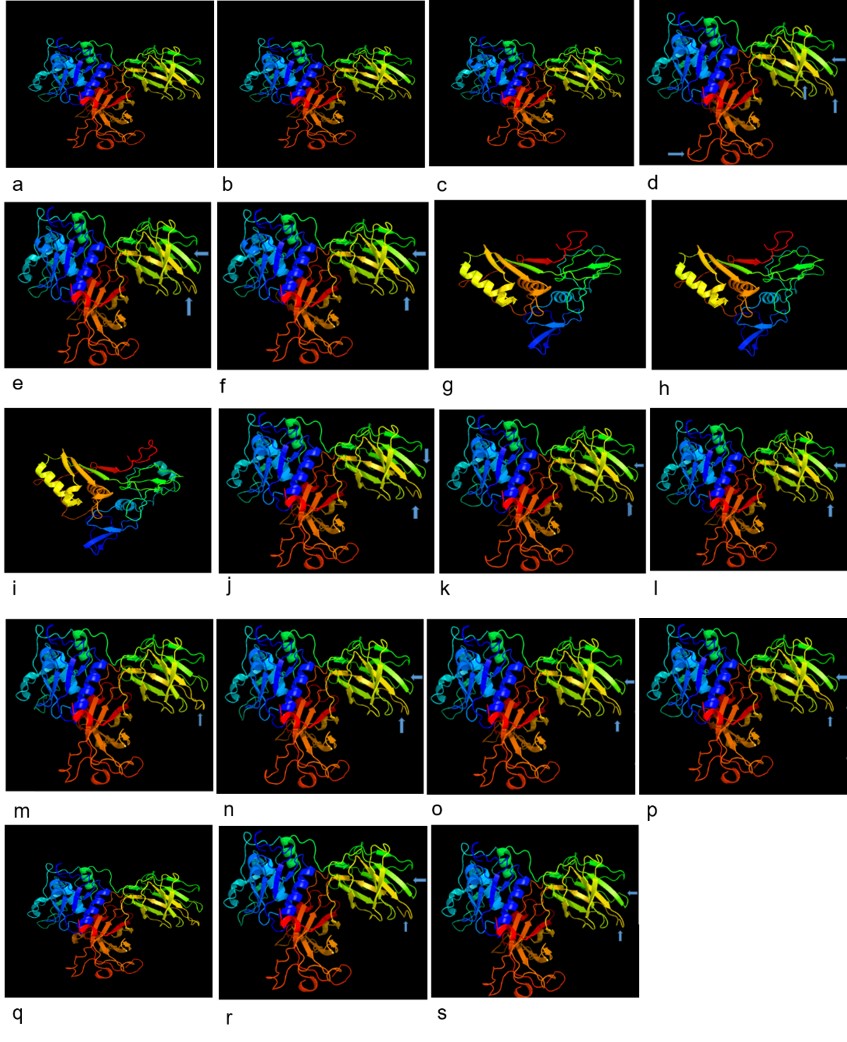
Change in 3D structure of protein induced by frame shift, stop gained and missense mutations was evaluated using PHYRE2 tool. Stop gained mutation case 4 (rs470711084) effected the structure to a great extent. SNPs documented in case 10 (rs464074496) and case 15 (rs467425367) also caused change in configuration. However, other stop gained and frame shift mutations only had small impact on 3D structure (Figure 2). Missense mutations reported in cases 1, 2, 3, 18 and 28 did not alter the overall 3D structure of protein. However, those documented in cases 8, 9 and 11 considerably changed the configuration of proteins. SNPs included in cases 5, 6, 7, 12, 13, 17, 24, 25, 27, 29 and 30 slightly changed the structure (Figure 4 and 5).

Alteration in 3D structure of protein induced by missense SNPs documented in present study. Slight deviations are marked with arrow. (a) case 1, (b) case 2, (c) case 3, (d) case 5, (e) case 6, (f) case 7, (g) case 8, (h) case 9, (i) case 11, (j) case 12, (k) case 13, (l) case 17, (m) case 18, (n) case 24, (o) case 25, (p) case 27, (q) case 28, (r) case 29, (s) case 30.
Prediction of effect of missense mutations on nature of amino acids, interactions and 3D structure
The effect of missense mutations on the 3D structure and location of mutation are shown in detail in Figure 5. In case 1, SNP addressed caused change of threonine into methionine at position 4. Methionine is larger in size with more hydrophobicity as compared to threonine. Location of wild-type residue is found in a β-strand according to Reprof software. The mutant amino acid is localized in secondary structure so will cause slight destabilization of protein at this site. In case 2, tyrosine is changed into phenylalanine at position 33. The mutant residue is smaller so might lead to loss of interactions. In case 3, a proline is mutated into a leucine at position 47. Prolines are known to be very rigid and therefore induce a special backbone conformation which might be required at this position. This mutation can disturb this special conformation. In case 5, an arginine is changing into a glutamine at position 183. Arginine is bigger with positive charge than the mutant which is neutral. The arginine forms a hydrogen bond with glutamine at position 59. Due to the size difference between wild-type and mutant amino acid, the new residue is not in the correct position to make the same hydrogen bond as the original wild-type residue did. Arginine also forms a salt bridge with aspartic acid at position 61. The difference in charge will disturb the ionic interaction made by the original, wild-type residue. In cases 3, 5 and 6, mutations are located within a domain, annotated in UniProt as Peptidase M12A.

HOPE server based prediction of positions of missense SNPs documented in cases 5-9 & 11-13 in 3D structure of mutated proteins in a1, b1, c1, d1, e1, f1, g1 and h1, protein structure is shown in grey color. Side chain of the mutated amino acid is represented in magenta color in the form of small balls. Closer view of the mutations is shown in a2, b2, c2, c3, d2, e2, f2, g2 and h2. The protein is coloured grey, the side chains of both the wild-type and the mutant residue are shown and coloured green and red, respectively. (a1 & a2) case 5; (b1 & b2) case 6; (c1, c2 & c3) case 7; (d1 & d2) case 8; (e1 & e2) case 9; (f1 & f2) case 11; (g1 & g2) case 12; (h1 & h2) case 13.
In case 6, SNP is changing arginine into a serine at position 220. Arginine is bigger and positively charged as compared to the mutant residue which is more hydrophobic and neutral. Wild-type amino acid forms hydrogen bond with threonine (position 172) and glutamic acid (position 134). Difference in size between wild-type and mutant amino acid deviate the mutant one from hydrogen bonding. The difference in hydrophobicity will affect hydrogen bond formation. Additionally, arginine forms a salt bridge with glutamic acid (position 134 and 219) and aspartic acid (position 175 and 217). Due to charge difference, ionic bonding of arginine will be disturbed. In case 7, mutation discussed causes change of phenylalanine into tyrosine at position 282. The wild-type was involved in a metal-ion contact. The mutant residue is bigger than the wild-type residue. This size difference between the wild-type and mutant residue disturbs the interaction with the metal-ion. In case 8, methionine is changing into a leucine at position 318. In case 9, glutamine is changing into lysine at position 349. There is a difference in charge between the wild-type and mutant amino acid. Wild type is neutral and mutant residue is positively charged. This mutation introduces a charge at this position, this can cause repulsion between the mutant and neighboring residues. The wild-type and mutant amino acids differ in size i.e. mutant residue is bigger than the wild-type. The residue is located on the surface of the protein, mutation of this residue can disturb interactions with other molecules or other parts of the protein. In cases 7, 8 and 9, the mutations are found in Mam domain IPR000998 as annotated in UniProt.
In case 11, leucine is changing into a proline at position 468. In cases 11 and 12, mutations are found in Math/Traf Domain IPR002083 as per annotation by UniProt. In case 12, serine residue is changing serine into a tyrosine at position 494. Tyrosine is bigger than serine. Serine is buried in the core of protein. As mutant residue is bigger so might not get fit into this site. In case 13, valine is mutated into alanine at position 520. The mutant residue is smaller than the wild-type residue. This will cause a possible loss of external interactions. In cases 7, 8, 9, 11, 12 and 13 mutant amino acids are present in domain which is involved in binding with different molecules. These mutations might disturb these interactions.
In case 17, threonine is changing into serine at position 583. In case 18, serine is mutated into a leucine at position 601. In cases 1, 2 and 18, mutant residues are more hydrophobic so can diminish the hydrogen bonds thus leading to improper folding. In case 24, a cysteine residue is changing into a arginine at position 667. Larger size of serine might cause bumps. Hydrophobicity of threonine and serine also varies. So, hydrophobic bonding on the surface or core of protein will be lost. In case 25, histidine is changing into arginine at position 671. In cases 25 and 26, mutant residue being bigger in size might cause bumps in structure. The wild type amino acid is neutral and mutant is positively charged. This mutation introduces a charge which can cause repulsion of ligands or other residues with the same charge. In case 27, the cysteine residue is mutated into a phenylalanine at position 680. In cases 24, 25, 26 and 27, mutations are located within a domain, annotated in UniProt as Egf-Like Domain IPR000742. This domain is important for binding of other molecules so these mutations might disturb this function. In case 28, valine is mutated into a glycine at position 685. Mutant amino acid in cases 1, 2, 17, 18 and 28 are found to be located in Meprin Alpha/Beta Subunit IPR008294 that is vital for interactions with other molecules. So, these mutations might disturb this function.
In case 29, valine is changing into a glycine at position 689. The residue is located in a region annotated in the UniProt database as a transmembrane domain. The mutant residue is smaller than the wild-type residue. This size difference can affect the contacts with the lipid-membrane. Also the wild-type residue is more hydrophobic than the mutant residue due to which hydrophobic interactions with the membrane lipids might be disturbed. In cases 28 and 29, glycine being flexible amino acid might distort the protein rigidity. In case 30, valine is mutated into isoleucine at position 701. This residue is also located in trans-membrane domain. Mutant is bigger so can interfere with interactions with lipid membrane.
Prediction of SNPs effect on secondary structure
Different parameters of secondary structure have been computed using SOPMA tool. It was found that SNPs documented in case 4 and 20 altered the alpha helix proportion significantly i.e. 30.12 % and 17.94 %, respectively as compared to normal value of 19.67 %. As far as, the extended strand proportion was concerned, the highest deviation from the normal value (25.10%) was observed in case 4 i.e. 32.53. Other mutations had only a slight impact. In case of beta-turn, three SNPs belonging to cases 4, 10 and 15 caused major deviation from normal value of 5.44%. The deviation observed was 1.20%, 3.19% and 3.96%, respectively. The percentage of random coil was found to be significantly altered from normal value of 49.75% by the mutation reported in case 20 i.e. 54.13%. Rest of the SNPs caused only slight modifications in beta turn and random coil percentage (Table SIII).
Determination of topology of mutated proteins
For normal protein, two trans-membrane helices were predicted. One in the region consisting of 7-29 amino acids and second in 688-710 amino acids with the sequences ACIIPFILFFAHIAAVSVSRVLL and SVLGLLIGGVAGVVFLTFTVISI, respectively. Deviation from this normal topology was observed in cases 3, 4, 10, 14-16 and 19-23. SNP rs473528825 documented in case 3 caused formation of three trans-membrane helices in mutated protein in regions 7-29, 32-53 and 688-710 with sequences ACIIPFILFFAHIAAVSVSRVLL, VYRNINSTRLITIFSLLLTVYD and SVLGLLIGGVAGVVFLTFTVISI, respectively. While in cases 4, 10, 14-16 and 19-23, one trans-membrane helix was found in mutated proteins i.e. in region of 7-29 amino acids. All other mutations did not affect trans-membrane topology of mutant proteins.
DISCUSSION
In bovine, post-partum anestrus is accompanied by negative energy balance (NEB). During this phase, buffalo needs high energy for milk production and restoration of uterus. Consequently, a gap creates between intake and demand of energy which is referred to as NEB. This NEB influences hormones level and fertility during post-calving time. At this stage, all the genes associated with NEB might impact the post-partum anestrus (Huismann 2020, Singh et al. 2019). In literature, Mep1A gene is reported to have association with NEB and is down-regulated at this stage leading to longer post-partum anestrus (Figure S1 – Supplementary Material). As it is unavailable for hydrolysis of precursor of Igf-1 (Jefferson et al. 2013, Arnold et al. 2017). It lowers serum Igf-1 concentration which induces the post-partum anestrus (Falkenberg et al. 2008, Gobikrushanth et al. 2018, El-Magd et al. 2017).
Analysis of interactions of MEP1A with other proteins in present study has also revealed its link with other reproduction associated proteins like MEP1B, neuropeptide Y (NPY), gonadotropin releasing hormone (GNRH1) and matrix metalloproteinases (MMP9). This interaction study has further strengthened the fertility associated role of Mep1A gene. Hypothalamus and anterior pituitary are targeted by NPY. This neuropeptide induces secretion of luteinizing hormone releasing hormone (LHRH) from hypothalamus in the presence of estrogen (Cardoso et al. 2020). GNRH1 controls production and secretion of gonadotropins from pituitary gland. These gonadotropins regulate production of steroid hormones and gametes (De Souza Scarpa 2018). MMP9 secretion in granulosa cells of bovine is under the control of FSH and Igf-1. MMP9 is inhibited during development of follicles and enhanced at the time of follicular atresia (Portela et al. 2009). Hence, MEP1A is a potential candidate gene for study of fertility traits in bovine.
A study conducted on Brahman and Tropical cattles reported 8424 and 426 SNPs, respectively in total number of chromosomes, to be associated with post-partum anestrus interval (Fortes et al. 2014). According to bovine HapMap study of SNPs, MEP1A is a highly polymorphic gene (Gibbs et al. 2009). Keeping in view the strong relation of Mep1A gene with NEB and Igf-1 level plasma level, a study targeted this gene for variation analysis by focusing on 3’-UTR and the exons located in middle and end of the gene. Association analysis of mutations in Mep1A gene with Igf-1 plasma level revealed strong impact of SNP g.37219977A>G on post-partum anestrus in Murrah buffaloes with p-value of 0.0083. For genotyping this SNP, allele-specific PCR was performed. Genotyping study revealed that selection of buffaloes with G at this polymorphic site at the time of artificial breeding will be successful to avoid animals with longer post-partum anestrus (Kumar et al. 2022).
Although association studies of MEP1A gene with post-partum anestrus in bovine is scarce in literature. However, being responsible for hormonal disturbance during post-partum anestrus and a highly polymorphic gene, MEP1A must be targeted for mutational analysis in buffaloes for fertility improvement (Figure S1). In present study, SNPs rs720295090, rs470711084, rs464074496, rs517701562, rs467425367 and rs451973288 reported in cases 1, 4, 10, 14, 15 and 16, respectively have been found to alter the physicochemical properties of protein. Mutations rs444252640, rs462968442, rs133043096, rs433804044 and rs443365364 documented in cases 19, 20, 21, 22, 23 were found to have marked effect on sub-cellular organization of mutated proteins. Polymorphisms rs470711084, rs519229329, rs465782291, rs474419241, rs464074496 and rs467425367 in cases 4, 5, 6, 9, 10 and 15, respectively have been observed to cause change in 3D configuration of proteins. While SNPs rs470711084, rs519229329, rs467425367 and rs462968442 reported in cases 4, 5, 15 and 20 also changed the secondary structure considerably. As far as the topology is concerned, mutations rs473528825, rs470711084, rs464074496, rs517701562, rs467425367, rs451973288, rs444252640, rs462968442, rs133043096, rs433804044 and rs443365364 documented in cases 3, 4, 10, 14, 15, 16, 19, 20, 21, 22 and 23 significantly altered the topology of proteins. Use of these mutations in markers aided selection of buffalo may lead to positive effect on overall reproduction performance of dairy herds. For these purpose, blood of buffaloes selected for breeding should be processed for DNA extraction followed by amplification and sequencing of MEP1A gene. The sequencing results should be analyzed for the SNPs, documented in present study with considerable effect on encoded enzyme. Animals exhibiting these mutations should not be selected for breeding purpose because they might have silent estrus problem.
Variants with strong association with silent estrus found in this study can be verified via experimental project. Sample size that would be considered for the experiment will comprise of twenty animals in each of the control and the experimental groups. The selection criteria for the buffalo with silent estrus will include frequency of expression of standing to be mounted, chin resting, sniffing or licking, micturition, restlessness, aggression, mucous discharge, bellowing and tumefaction of vulva during (Table III).
CONCLUSIONS
It is recommended to authenticate the link of SNPs, explored in present study, with anestrus behavior before its implementation as selectable biomarker. To validate these mutations, control and experimental groups comprising of animals with normal postpartum period and prolonged postpartum stage, respectively should be designed. Characterization at the level of MEP1A gene will enable us to compare the SNPs in two groups. SNPs documented in present study can also be identified in buffaloes with poor fertility. This will verify the association of SNPs with the trait in question and might provide the potential biomarkers for artificial selection of good fertility buffaloes.
SUPPLEMENTARY MATERIAL
REFERENCES
- AMBROSE DJ. 2021. Postpartum anestrus and its management in dairy cattle. In: BOVINE REPRODUCTION, p. 408-430.
- ARNOLD P, OTTE A & BECKER-PAULY C. 2017. Meprin metalloproteases: molecular regulation and function in inflammation and fibrosis. Biochim Biophys Acta - Mol Cell Resh 1864: 2096-2104.
- BANERJEE S & BOND JS. 2008. Prointerleukin-18 is activated by meprin β in vitro and in vivo in intestinal inflammation. J Biol Chem 283: 31371-31377.
- BEAM SW & BUTLER WR. 1999. Effects of energy balance on follicular development and first ovulation in postpartum. Reprod Fertil Suppl 54: 411-424.
- BERGIN DA, GREENE CM, STERCHI EE, KENNA C, GERAGHTY P, BELAAOUAJ A, TAGGART CC, O’NEILL SJ & MCELVANEY NG. 2008. Activation of the epidermal growth factor receptor (EGFR) by a novel metalloprotease pathway. J Biol Chem 283: 31736-31744.
- BILAL MQ, SULEMAN M & RAZIQ A. 2006. Buffalo: black gold of Pakistan. Livest Res Rural Dev 18: 140-151.
- CAÑIZARES-MARTÍNEZ MA, PARRA-BRACAMONTE GM, SEGURA-CORREA JC & MAGAÑA-MONFORTE JG. 2021. Effect of leptin, pituitary transcription factor and luteinizing hormone receptor genes polymorphisms on reproductive traits and milk yield in Holstein cattle. Braz Arch Biol Technol 64: e21190643.
- CARDOSO RC, WEST SM, MAIA TS, ALVES BRC & WILLIAMS GL. 2020. Nutritional control of puberty in the bovine female: prenatal and early postnatal regulation of the neuroendocrine system. Domest Anim Endocrinol 73: 106434.
- CRUZ LC. 2010. Recent Developments in the Buffalo Industry of Asia. Revista Veterinaria, vol. 21.
- DE SOUZA SCARPA JO. 2018. Comparison of Follicular and Luteal Dynamics in Protocols Developed for Synchronization of Ovulation in Bos indicus-Influenced Beef Cows: The Role of Gonadotropin-Releasing Hormone at Treatment Onset. Master’s Thesis, Texas A&M University. (Unpublished).
- DOBSON H & KAMONPATANA M. 1986. A review of female cattle reproduction with special reference to a comparison between buffaloes, cows and zebu. Reprod 77: 1-36.
- EL-BAYOMI KM, SALEH AA, AWAD A, EL-TARABANY MS, EL-QALIOUBY HS, AFIFI M, EL-KOMY S, ESSAWI WM, ALMADALY EA & EL-MAGD MA. 2018. Association of CYP19A1 gene polymorphisms with anoestrus in water buffaloes. Reprod Fertil Deve 30: 487-497.
- EL-KOMY SM, SALEH AA, ABD EL-AZIZ RM & EL-MAGD MA. 2021. Association of GH polymorphisms with growth traits in buffaloes. Domest Anim Endocrinol 74: 106541.
- EL-KOMY SM, SALEH AA, ABDEL-HAMID TM & EL-MAGD MA. 2020. Association of ghr polymorphisms with milk production in buffaloes. Animals 10: 1203.
- EL-MAGD MA, FATHY A, KAHILO KA, SALEH AA, EL SHEIKH AI, AL-SHAMI S & EL-KOMY SM. 2021. Polymorphisms of the PRLR gene and their association with milk production traits in Egyptian Buffaloes. Animals 11: 1237.
- EL-MAGD MA, SALEH AA, NAFEAA AA, EL-KOMY SM & AFIFI MA. 2017. Polymorphisms of the IGF1 gene and their association with growth traits, serum concentration and expression rate of IGF1 and IGF1R in buffalo. J Zhejiang Univ Sci B 18: 1064-1074.
- EL-WISHY AB. 2007. The postpartum buffalo: II. Acyclicity and anestrus. Anim Reprod Sci 97: 216-236.
- FALKENBERG U, HAERTEL J, ROTTER K, IWERSEN M, ARNDT G & HEUWIESER W. 2008. Relationships between the concentration of insulin-like growth factor-1 in serum in dairy cows in early lactation and reproductive performance and milk yield. J Dairy Sci 91: 3862-3868.
- FORDE N, BELTMAN ME, LONERGAN P, DISKIN M, ROCHE JF & CROWE MA. 2011. Oestrous cycles in Bos taurus cattle. Anim Reprod Sci 124: 163-169.
- FORTES MRS, SUHAIMI AHMS, PORTO-NETO LR, MCWILLIAM SM, FLATSCHER-BADER T, MOORE SS, MICHAEL JD, MEIRA CT, THOMAS MG & SNELLING WM. 2014. Post-partum anoestrus in tropical beef cattle: A systems approach combining gene expression and genome-wide association results. Livest Sci 166: 158-166.
- GAUTAM G. 2020. Anestrus in buffalo. The Blue Cross 16: 36-43.
- GIBBS RA, TAYLOR JF, VAN TASSELL CP, BARENDSE W, EVERSOLE KA, GILL CA, GREEN RD, HAMERNIK DL & KAPPES SM. 2009. Genome-wide survey of SNP variation uncovers the genetic structure of cattle breeds. Sci 324: 528-532.
- GOBIKRUSHANTH M, PURFIELD DC, COLAZO MG, WANG Z, BUTLER ST & AMBROSE DJ. 2018. The relationship between serum insulin-like growth factor-1 (IGF-1) concentration and reproductive performance, and genome-wide associations for serum IGF-1 in Holstein cows. J Dairy Sci 101: 9154-9167.
- HERZOG C, HAUN RS, KAUSHAL V, MAYEUX PR, SHAH SV & KAUSHAL GP. 2009. Meprin A and meprin α generate biologically functional IL-1β from pro-IL-1β. Biochem Biophys Res Commun 379: 904-908.
- HUISMANN K. 2020. Effects of metabolic stress on corpus luteum function in dairy cows. Master’s Thesis, Utrecht University, 54 p. (Unpublished).
- JEFFERSON T, BELLAC C, METZ VV, BRODER C, HEDRICH J, OHLER A, MAIER W, MAGDOLEN V, STERCHI E & BOND JS. 2013. The substrate degradome of meprin metalloproteases reveals an unexpected proteolytic link between meprin β and ADAM10. Cell Mol Life Sci 70: 309-333.
- KAURAV PS, SHUKLA SP, BAJAJ NK, MANJHI VK & THAKUR RK. 2019. Incidence of postpartum anoestrus and oestrus behavior and gynecological symptoms in hormonal treated postpartum anoestrus buffaloes. J Anim Res 9: 153-157.
- KUMAR PR, SINGH SK, KHARCHE SD, GOVINDARAJU CS, BEHERA BK, SHUKLA SN, KUMAR H & AGARWAL SK. 2014. Anestrus in cattle and buffalo: Indian perspective. Adv Anim Vet Sci 2: 124-138.
- KUMAR TVC, SHARMA D, SURLA GN, VEDAMURTHY GV, SINGH D & ONTERU SK. 2020. Body condition score, parity, shelter cleanliness and male proximity: highly associated non-genetic factors with post-partum anestrus in Murrah buffalo in field conditions. Anim Reprod Sci 214: 106282.
- KUMAR TVC, VERMA SK, SHARMA D, KUMAR LK, VEERAPPA VG, SINGH D & ONTERU SK. 2022. Meprin A1 subunit beta gene polymorphism is associated with the length of post-partum anestrus interval in Murrah buffaloes. Gene 827: 146456.
- LUCY MC, JIANG H & KOBAYASHI Y. 2001. Changes in the somatotrophic axis associated with the initiation of lactation. J Dairy Sci 84: E113-E119.
- ORTEGA MS, DENICOL AC, COLE JB, NULL DJ, TAYLOR JF, SCHNABEL RD & HANSEN PJ. 2017. Association of single nucleotide polymorphisms in candidate genes previously related to genetic variation in fertility with phenotypic measurements of reproductive function in Holstein cows. J Dairy Sci 100: 3725-3734.
- PASHA TN & HAYAT Z. 2012. Present situation and future perspective of buffalo production in Asia. J Anim Plant Sci 22: 250-256.
- PERERA BMAO. 2011. Reproductive cycles of buffalo. Anim Reprod Sci 124: 194-199.
- PORTELA VM, VEIGA A & PRICE CA. 2009. Regulation of MMP2 and MMP9 metalloproteinases by FSH and growth factors in bovine granulosa cells. Genet Mol Biol 32: 516-520.
- SAMAD MA. 2020. A systematic review of research findings on buffalo health and production published during the last six decades in Bangladesh. J Vet Med OH Res 2: 1-62.
- SCHÜTTE A, HEDRICH J, STÖCKER W & BECKER-PAULY C. 2010. Let it flow: Morpholino knockdown in zebrafish embryos reveals a pro-angiogenic effect of the metalloprotease meprin α2. PLoS ONE 5: e8835.
- SINGH S, GOLLA N, SHARMA D, SINGH D & ONTERU SK. 2019. Buffalo liver transcriptome analysis suggests immune tolerance as its key adaptive mechanism during early postpartum negative energy balance. Funct Integr Genomics 19: 759-773.
- STERCHI EE, STÖCKER W & BOND JS. 2008. Meprins, membrane-bound and secreted astacin metalloproteinases. Mol Aspects Med 29: 309-328.
- SUN T, WANG S, CHANTHAKHOUN V, DANG R, HUANG Y, CHEN H & LEI C. 2020. Multiple domestication of swamp buffalo in China and South East Asia. J Anim Breed Genet 137: 331-340.
- TIROSH I, BARKAI N & VERSTREPEN KJ. 2009. Promoter architecture and the evolvability of gene expression. J Biol 8: 1-6.
- VELAZQUEZ MA, SPICER LJ & WATHES DC. 2008. The role of endocrine insulin-like growth factor-I (IGF-I) in female bovine reproduction. Domest Anim Endocrinol 35: 325-342.
- YANG B, ZENG XLQ, QIN J & YANG C. 2007. Dairy buffalo breeding in countryside of China. Ital J Anim Sci 6: 25-29.