 Marsh beetles (Coleoptera: Scirtidae) of the Amazon biome: integrative collecting techniques, information of immatures’ habitats, and a rearing method under laboratory conditions, along with new species records
Abstract
Scirtidae are beetles whose larvae are aquatic and can be found in various habitats. The objectives of this study were to explore several aquatic habitats in the Amazon biome in search of Scirtidae using different methods for collecting larvae and adults, to propose a new reproduction method, and to report new records. Eight aquatic habitats were sampled: temporary ponds, streams, lakes, rivers, and four types of phytotelmata, including bromeliads, wild banana trees (Strelitziaceae), bracts, and palm sheaths (Arecaceae). These surveys were conducted across six states of the Brazilian Amazon: Acre, Amapá, Amazonas, Pará, Rondônia, and Roraima. A total of 1,125 larvae were collected, of which 423 successfully developed into adults through laboratory rearing. In addition, 503 adult specimens were collected by sweeping vegetation and using traps. We also developed a laboratory rearing method capable of monitoring several larvae simultaneously to obtain adult specimens and biological information on immatures. As a result, four genera were recorded: Contacyphon, Ora, Scirtes and a new unnamed genus. The genus Contacyphon and the species Ora atroapicalis Pic, O. bivittata Pic, and O. depressa (Fabricius) were recorded for the first time in the Brazilian Amazon. Rearing allowed us to observe four different types of pupation.
Key words
Aquatic insects; Biological notes; Life cycle; Pupation in froth; Saproxylic larva; Tropical forest
INTRODUCTION
Scirtidae larvae play a vital role in aquatic ecosystems, contributing significantly to the decomposition of organic plant matter and nutrient cycling (Daugherty & Juliano 2003). As they feed, Scirtidae larvae produce fine organic particles that serve as a food source for other aquatic organisms, such as filter feeders (Daugherty & Juliano 2003, Pelz-Stelinski et al. 2011, Watts 2014). Additionally, some species are recognized as bioindicators of water quality due to their sensitivity to certain environmental conditions (Winterbourn 1998, Muñoz-Riveaux et al. 2003). The larvae are easily recognized by their multi-segmented antennae, a unique characteristic among Coleoptera (Watts 2014, Lawrence 2016). Scirtidae larvae inhabit a wide variety of aquatic environment, including temporary forest puddles, lowland ditches, marshes, streams (both lentic and lotic environments associated with leaves and roots), lakes, and rivers (associated with aquatic macrophytes) (Lawrence 2016, Libonatti et al. 2018, Jorge et al. 2019). They are also found in phytotelmata, such as bromeliads, bamboo stems, and tree holes, as well as in groundwater, moist soil, and decomposing logs (Lawrence 2016). For each habitat, different collection methods are used (Zwick & Hecht 2008, Zwick & Zwick 2008, Watts 2014, Lawrence 2016, Iannuzzi et al. 2020).
Rearing Scirtidae from larval stage to adulthood in laboratory conditions is a well-established and effective approach for a reliably associating different life stages of a species (Zwick & Zwick 2008). This method facilitates accurate descriptions of immature stages and the discovery of new taxa (e.g., Libonatti 2017). Although several rearing methods have already been described for the scirtid fauna of North America, Germany, and Australia (Beerbower 1943, Stribling & Young 1990, Zwick & Hecht 2008, Zwick & Zwick 2008, Watts 2014), the particularly high abundance of Scirtidae larvae in our study area led us to develop a method optimized for maintaining numerous larvae simultaneously in minimal space under laboratory conditions.
Scirtidae pupation typically occurs on land, where larvae construct cells using locally available materials or pupate within decaying moist leaves or sheets of drying algae (Watts & Zwick 2019). However, some species have aquatic pupae with morphological adaptations that allow them to develop underwater pupation -often associated with the aerenchyma of aquatic macrophytes - or at the water surface, using siphons for respiration (Zwick & Zwick 2008, Libonatti et al. 2018, Jorge et al. 2019). The adults are terrestrial and are generally found in riparian vegetation (Lawrence 2016). The adult of the family is characterized by their oval to elongate bodies, 11-segmented antennae, a 5-5-5 tarsal formula with the fourth tarsomere bilobed, and, in some species, enlarged metafemora adapted for jumping (Yoshitomi 2005, Lawrence 2016). Currently, Scirtidae is divided into three subfamilies: Nipponocyphoninae, Scirtinae, and Stenocyphoninae, comprising 93 genera, over 1,900 species, and a wide geographical distribution, being found in various locations across the globe (Lawrence 2005, Ruta et al. 2018, Ruta 2019, Bradford et al. 2022). The Neotropical region hosts two of these subfamilies (Scirtinae and Stenocyphoninae), with more than 200 species, in 14 genera. In Brazil, 53 species and 3 subspecies have been recorded, distributed among 5 genera: Calvariopsis Ruta, 2019, and Contacyphon Gozis, 1886, with 5 species each, Prionocyphon Redtenbacher, 1858, with 6 species, Ora Clark, 1865, with 14 species, and Scirtes Illiger, 1807, with 23 species and 3 subspecies (Benetti & Jorge 2025, Ruta 2019).
Despite the increased attention to South American scirtids in the first two decades of the 21st century, which led to the discovery of seven new genera and numerous new species (e.g., Lawrence 2001, Ruta 2011, 2016, 2019, 2020, 2021, 2023, Klausnitzer 2012, Libonatti & Ruta 2013, Libonatti 2014, 2015, 2017, Ruta & Libonatti 2016), information on their preimaginal stages remains notably scarce (Libonatti et al. 2018, Ruta et al. 2018, Jorge et al. 2019). Furthermore, there is still a significant gap in understanding the specific microhabitats these beetles occupy in South America (Ruta 2021, 2023), including the Amazon biome. Aquatic environments are abundant in the Amazon biome, driven by the region’s high rainfall, which fosters the development of diverse habitats (Ferreira et al. 2001, Neiss et al. 2008, Torreias et al. 2008). These various aquatic environments are inhabited by diverse insect fauna, including the beetle family Scirtidae, usually known as marsh beetles (Ferreira-Jr et al. 2019).
In response to these gaps, this study represents the first comprehensive investigation of Scirtidae in South America to document their habitats and microhabitats, as well as the first laboratory-rearing study of Amazonian larvae. The goals of this study were: 1) to describe the collecting methods of larvae and adults of Scirtidae in different aquatic habitats sampled in the Brazilian Amazon, 2) to present a low-cost method for rearing large numbers of Scirtidae larvae simultaneously under laboratory conditions, and 3) to provide biological information on the observed taxon.
MATERIALS AND METHODS
Study area
Specimens of Scirtidae were collected across six states of the Brazilian Amazon: Acre, Amapá, Amazonas, Pará, Rondônia, and Roraima (Figure 1), during surveys conducted between 2016 and 2020. The climate in the Amazon biome is tropical, hot, and humid, with an average annual rainfall of over 2,000 mm (Sioli 1991, Parolin 2001). The collections were made mainly in preserved locations, however, some sampled locations suffer from human disturbance.

Collecting sites of Scirtidae (Coleoptera) in the Brazilian Amazon (highlighted in green on the map).
The vegetation primarily consists of dense rainforest, ranging from ‘terra firme’ forests to seasonally or permanently flooded areas commonly known as “várzeas” and “igapós”. The ‘terra firme’ forest is a term used to designate the ‘Dense Ombrophilous Forest’, which represents about 80% of the vegetation in the Amazon region, composed of plateaus with tall trees, closed canopies, high precipitation and without inundation areas (Veloso et al. 1991, ICMBIO 2016). These forests also exhibit distinct physiognomies, such as slopes and lowlands that include especialized ecosystems such as campina and campinarana (Prance et al. 1976, Bispo et al. 2009). The Amazon region experiences two main seasons: the rainy and the dry seasons. The seasons regulate the flood pulse, a seasonal phenomenon marked by fluctuations in river water levels (Junk et al. 1989). The average annual air temperature is about 25 °C, with relative humidity rarely dropping below 80%. In contrast, the Amazon savanna region, particularly in the state of Roraima, has a lower average humidity of 70%, annual precipitation of about 1,100 mm, and is characterized by savanna vegetation (Barbosa 1997, Araújo et al. 2001, Conserva & Piedade 2001).
Sampled habitats
Eight aquatic habitats in the Brazilian Amazon were explored for Scirtidae larvae, including: temporary puddles, streams, lakes, rivers, and four types of phytotelmata: bromeliads, wild banana trees (Strelitziaceae: Phenakospermum guyannense (L. C. Rich) Endl.), bracts (capembas) (Arecaceae: Oenocarpus bacaba Mart.), and leaf sheaths of palms (Arecaceae: Mauritia flexuosa Linn.). A key focus of this study is to describe the habitats and microhabitats of the Amazon and the methods for locating Scirtidae larvae within them. In the following section, each environment and its associated larval collection techniques will be detailed.
Adults specimens were collected from the riparian vegetation surrounding the aquatic habitats where the larvae were found, using the collection techniques described in Oliveira & Pes (2019) and Nessimian et al. (2024) for capturing winged insects. These methods include an entomological net, Malaise trap, emergency trap, Pennsylvania light trap, lamp over a bucket, and illuminated sheet (a lamp hanging on a white sheet) and aspirator. To power the lamp (white and black LED) used in all light traps we used a 12-Watt battery (Figure 2a-g).

Scirtidae adult collection techniques. (a) entomological net; (b) Malaise trap; (c) emergency trap; (d) pennsylvania light trap; (e) lamp over bucket; (f) light in white sheet; (g) aspirator.
Some of the collected larvae were immediately fixed in 80% ethanol, while others were reared into adults in the laboratory. For rearing, the larvae were placed in 80-mL plastic containers with lids, each containing a thin layer of water and fragments of deciduous leaves from the habitat where they were collected. These containers were then transported to the Laboratório de Citotaxonomia e Insetos Aquáticos (LACIA) at the Instituto Nacional de Pesquisas da Amazônia (INPA) in Manaus, Amazonas, Brazil, in a thermal bag to minimize stress and avoid high temperatures.
Taxonomic identification
Scirtidae adults were identified to genus level using the key proposed by Epler (2010) and Ruta (2021) and to species level using the key by Libonatti (2015).
Illustration of specimens and geographic distribution maps
Photographs of the specimens were taken using a DFC420 camera attached to a Leica M165C stereomicroscope with a Planapo 1.0x objective and an LED lighting dome to ensure uniform light reflection on the specimens (Kawada & Buffington 2016). Multi-layer photographs were compiled using the software Helicon Focus® (6.7.1 Pro). The specimens were placed in a Petri dish with alcohol gel and 80% ethanol for photography. Photographs of the habitats and the rearing process in the laboratory were photographed with a Samsung Galaxy S7 mobile phone camera. Distribution maps were generated in QGIS v.3.18 software. All images were processed using the Adobe Photoshop® program.
RESULTS & DISCUSSION
Habitats of Scirtidae and their associated collecting techniques
Scirtidae were found in all eight habitats studied, including both lentic (temporary puddles, lakes, and various types of phytotelmata) and lotic habitats (streams, rivers). This study provides the first documented records of Scirtidae in three specific habitats: wild banana trees (P. guyannense), palm bracts (capembas) (O. bacaba), and palm leaf sheaths (M. flexuosa).
Temporary forest puddle
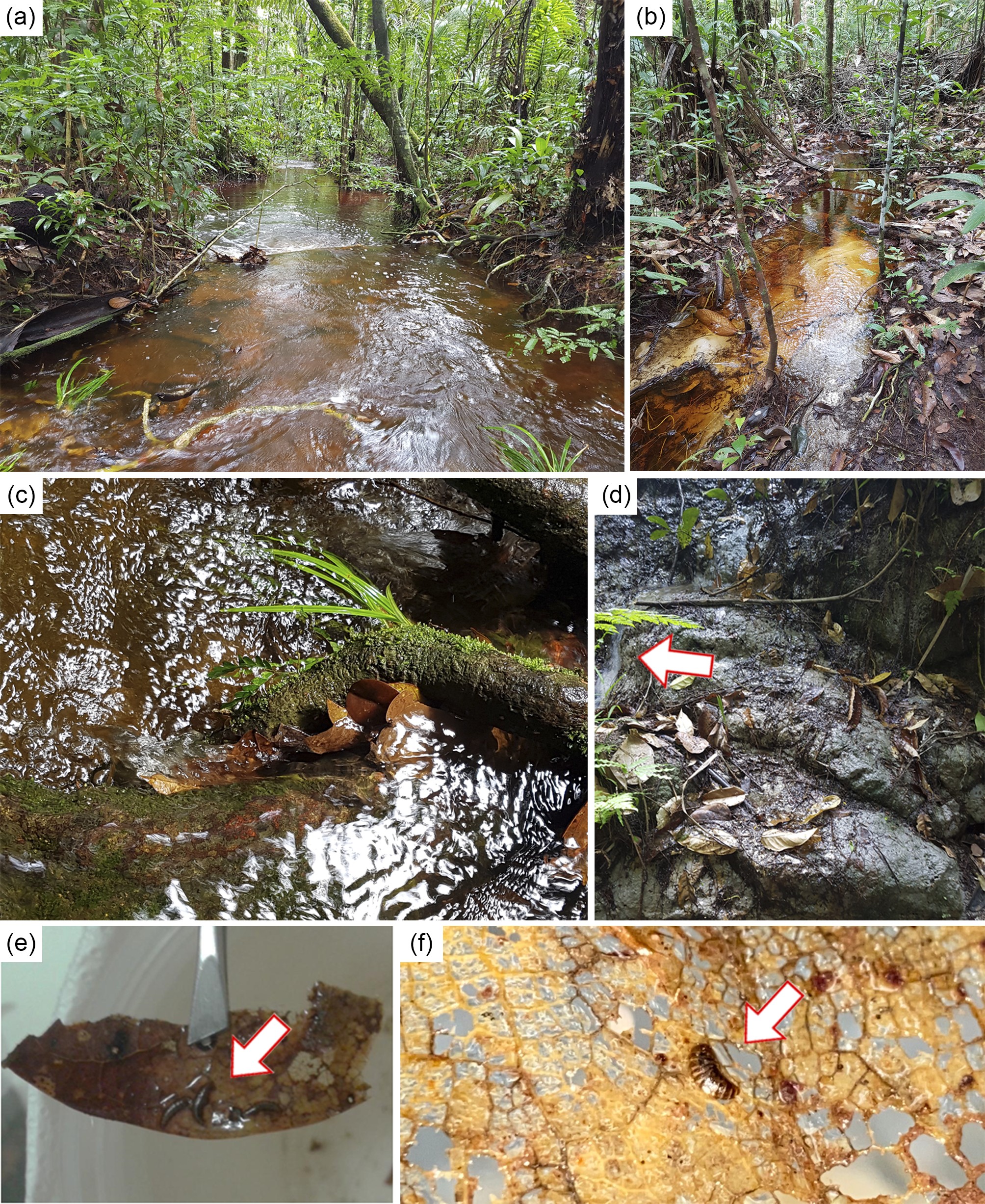
Scirtidae larvae in habiting this type of waterbody are associated with leaf litter accumulated at the puddle bottom (Figure 3a). In this habitat, two collecting methods were used: a more traditional one, which involved dipping an aquatic entomological net (D shaped, mesh size: 30 cm long, 15 cm wide, 25 cm deep, and metal rod: 50 cm long) into the water to collect the substrates; and a novel method, which involved walking over the substrate in repeated movements for a brief period (a couple of minutes) (Figure 3b). This action dislodged the larvae from the substrate, causing them to float on the water’s surface and then collecting larvae drifting on the surface with the net. The main advantage of the latter method is that it enables the collection of the larvae without the need to sort them from the substrate.

Habitat and collection of Scirtidae in the Amazon. a: temporary puddle; b: marching method; c: stream; d: leaf litter in the roots; e: larva feeding on the leaf.
Streams
In this habitat (Figure 3c), larvae are also associated with leaf banks (Figure 3d-e), in two microhabitats: lentic (backwater) and lotic (rapids), where leaves usually accumulate by becoming trapped in the roots, fallen tree trunks, or branches. Larvae from the backwater were collected using the aquatic entomological net. Those from the rapids were collected manually, removing part of the leaf bank and sorting it in a dry white plastic tray, where the larvae were found walking across the tray.
Lakes and rivers
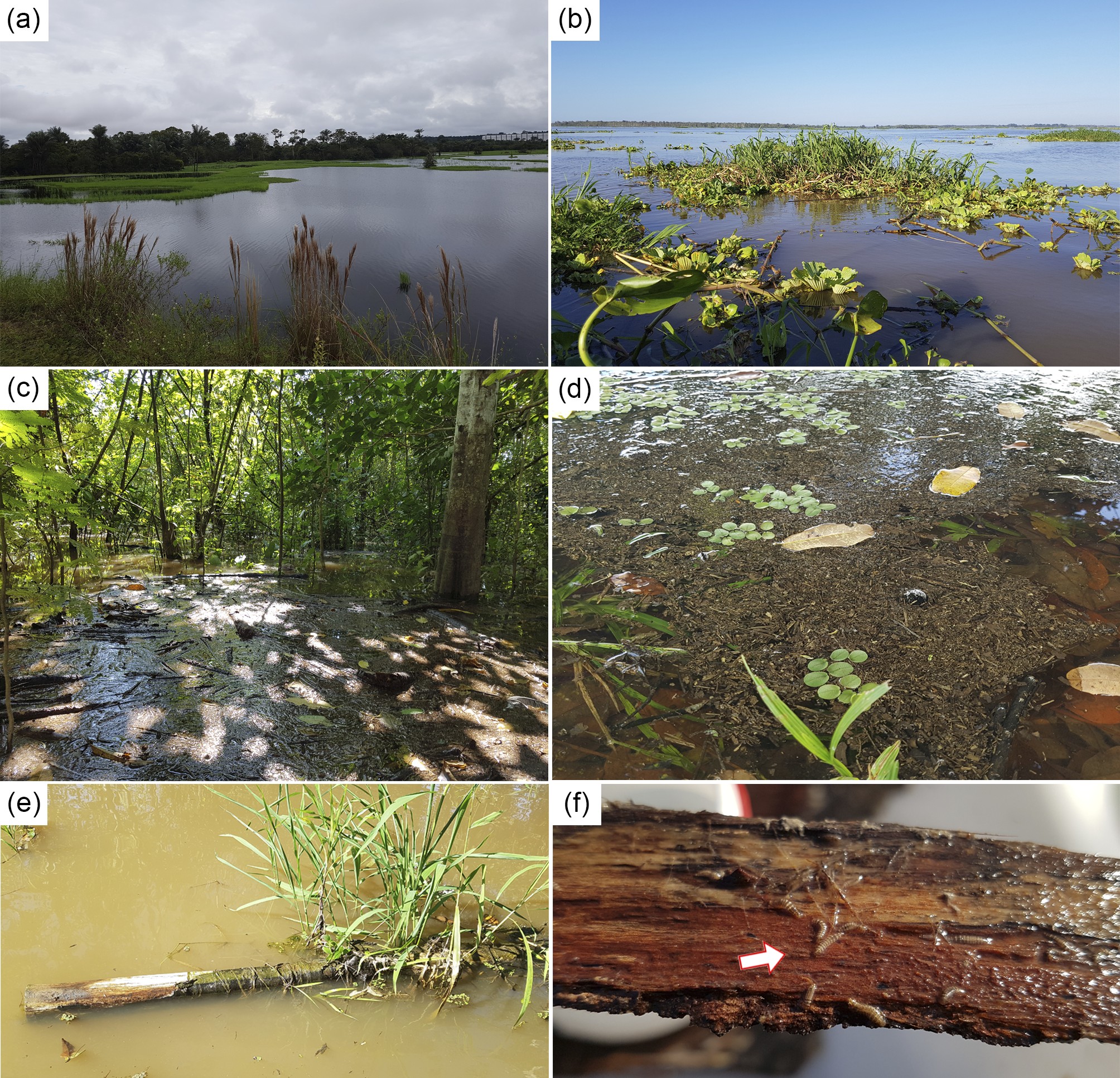
In Amazonian lakes and rivers, larvae were collected from three microhabitats: macrophytemats, kinal, and semi-submerged decaying logs. Larvae found in macrophytes are associated with submerged roots, particularly in Salvinia auriculata Aubl. (Salviniales: Salviniaceae) (Figure 4a-b), and within the internal, spongy tissues of the stem of Marsilea sp. (Salviniales: Marsileaceae) (Figure 4c-d). Kinal (Figure 4f), a floating mat composed of animal and plant fragments (e.g., branches, leaves, flowers, fruits, roots, pollen, seeds) (Fittkau 1977), harbors larvae that are usually associated with these floating substrates in shaded and sun-exposed locations. In decomposing semi-submerged logs (Figure 4g), larvae create galleries within the wood (Figure 4h), where they feed on the decaying wood, classifying them as saproxylic (Ruta et al. 2018).

Habitat and collection of Scirtidae larvae in the Amazon. a: Salvinia auriculata Aubl. (Salviniales: Salviniaceae), view of the leaves on the water surface; b: larvae in the root of Salvinia auriculata; c: Marsilea sp. (Salviniales: Marsileaceae), view of the leaves above the water surface; d: larva in spongy stem of Marsilea sp.; e: aquatic entomological net to collect substrate; f: kinal; g: decaying log in water; h: larvae inside the trunk after removing the bark.
Sampling in macrophytes and kinal was conducted similarly; the material was removed from the water with the aquatic entomological net (Figure 4e) and placed in a white plastic tray with a thin layer of water. Sampling in logs was performed by removing the bark and collecting the larvae from the galleries using a soft-bristled brush.
Bromeliad phytotelmata
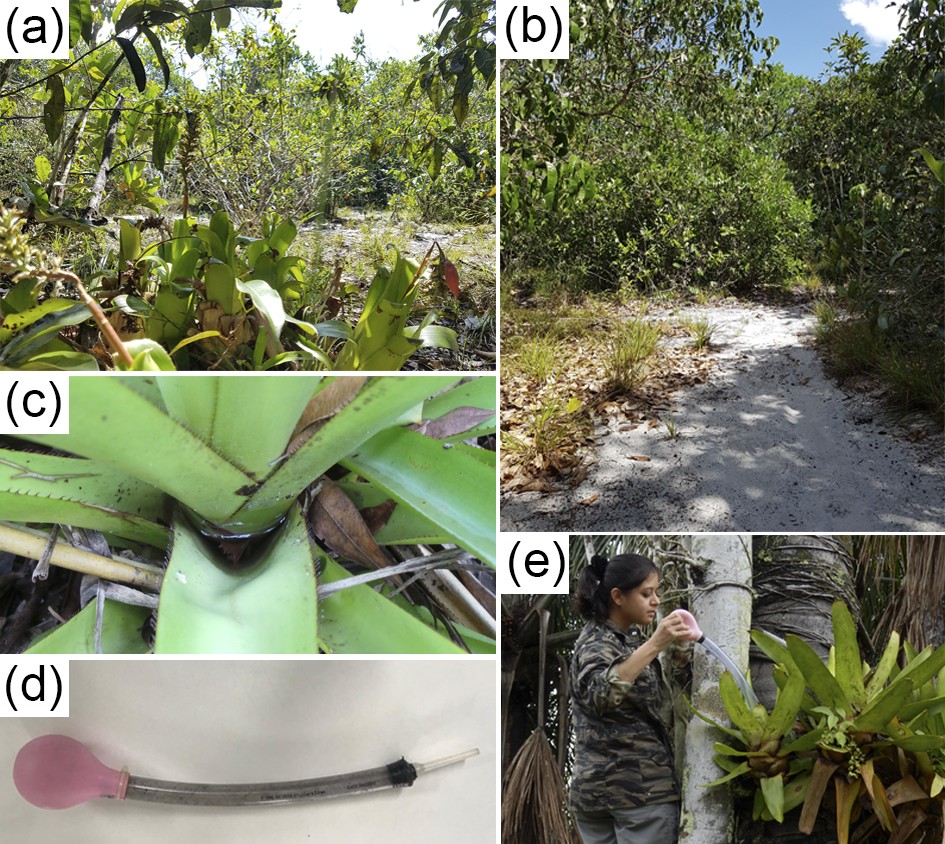
Larvae in bromeliads are associated with organic matter accumulated in the rainwater reservoirs formed in the leaf axils (Figure 5a). Four bromeliad species were studied: Aechmea beeriana Smith & Spencer (Figure 5d), Aechmea mertensii (G. Mey) Schult. & Schult. f. (Figure 5e), Aechmea setigera Mart. ex Schult. & Schult. f. (Figure 5f), and Tillandsia adpressiflora Mez (Figure 5g), found in campina and campinarana areas. To collect the larvae, a modified pipette resembling a turkey baster (300mL) was used. This pipette consisted of a rubber bulb attached to a crystal hose tube (55 cm long and 15 mm in diameter), secured with a nylon clamp (Figure 5b-c).

Habitat and collection of Scirtidae larvae in the Amazon. a: water in bromeliad axilla; b: collection in bromeliads with an adapted pipette; c: adapted pipette to Scirtidae sampling. Bromeliads species: d: Aechmea beeriana Smith & Spencer; e: Aechmea mertensii (G. Mey) Schult. & Schult. f.; f: Aechmea setigera Mart. ex Schult. & Schult. f.; g: Tillandsia adpressiflora Mez.
The water and sediment in the bromeliad tanks were extracted using this pipette and placed in a tray to collect the larvae. After sorting the specimens, the water was returned to the plant. During sampling, additional water was added to the tanks to wash out any remaining insects.
Wild banana tree phytotelmata
Larvae inhabit a gelatinous substance produced by wild banana trees P. guyannense (Figure 6a), which accumulates between the leaf sheaths. For collection, transverse cuts were made in the plant pseudostem using a machete, approximately 30 cm above the ground, at the base of the sheath union. The gelatinous substance was then poured into a white plastic tray (Figure 6b, d), after which the leaf sheaths were separated one by one and washed with water to detach any larvae (Figure 6d). Since this method involves cutting the foliage while leaving the root intact, the plant experiences mininal damage, allowing new leaves to sprout (Figure 6c).

Habitat and collection of Scirtidae larvae in the Amazon. a: Phenakospermum guyanense (L. C. Rich) Endl.; b: gelatinous sap in the cut plant, where larvae inhabit; c: new wild banana leaves sprouting after cutting; d: larvae in wild banana; e: capemba of Oenocarpus bacaba Mart.; f: sheath of Mauritia flexuosa L.f.; g: brush collection; h: larva on capemba floor.
Palm bract (“capembas”) and leaf phytotelmata
This habitat is formed by the accumulation of rainwater either in a ‘capemba’ (Figure 6e) - a boat-shaped bract that protects the palm fruit of (Beltrão & Oliveira 2007) - or in a palm tree leaf (Arecaceae) (Figure 6f), which has fallen to the ground with its concave side facing upward. Larvae were collected in two plant species: in a ‘capemba’ of O. bacaba and a leaf of M. flexuosa using a plastic pipette (3 mL) and a soft-bristled brush (Figure 6g-h).
Some of the collection methods used in this study has been previously applied in other regions. In Australia, larvae were collected from tree holes, crustacean burrows in drying swamps, streams, and temporary marsh puddles using aquatic entomological nets and ‘turkey baster’ pipettes (Watts 2014). In contrast, the stream collection technique employed in Germany using a modified Berlese funnel (Zwick & Hecht 2008, Zwick & Zwick 2008) was not used in this study, although it could be tested on Amazonian species in future research. These methodological differences highlight the need to adapt techniques according to habitat characteristics and the target species in each region.
A relevant point raised by Lawrence (2016) is the potential habitat specificity of larvae, where genera such as Elodes are typically found in small streams, while Exochomoscirtes, Sacodes, and some Prionocyphon occur exclusively in phytotelmata. Although such specificity may exist at the genus or species levels, our results did not indicate a similar relationship for the Scirtes studied. The lack of detailied information on Neotropical Scirtidae, due to taxonomic impediments, limits the scope of our conclusions.
Future phylogenetic studies are essential to review these patterns and accurately attributing biological information to each taxon.
Diversity of Amazonian Scirtidae
A total of 1,125 larvae were collected and kept alive for rearing in the laboratory; from this, 423 were successfully reared to the adult stage, and 44 pupaefixed or dead. In addition, 503 adults were collected and fixed (Table I). Four genera were collected: Contacyphon, Ora, Scirtes, and a new unnamed genus (Figure 7d-g). Four species of Ora were identified: O. atroapicalis Pic, O. bivittata Pic, O. depressa (Fabricius), and O. semibrunnea Pic. The adults of Contacyphon, Scirtes, and the unnamed genus were identified as morphotypes (three of Contacyphon, more than 40 of Scirtes, and two of the unpublished genus). Larvae, pupae (Figure 7a-c), and adults of all genera were collected/reared, except Contacyphon, for which, despite our efforts to find larvae, only adults were collected.
Genera of Scirtidae collected in the states of the Brazilian Amazon, in different types of habitats and traps.

Scirtidae. a: larva; b: pupa; c: larva and pupa exúvia; d: Contacyphon; e: Ora; f: Scirtes; g: new unnamed genus. Scales: (a) 0.05 mm, (c–d, f–g) 1.0 mm; (b, e) 2.0 mm.
Rearing method under laboratory conditions
Collected larvae were placed individually in 80 mL plastic containers, each with 20 mL of water along with some debris and leaves from the site where larvae were collected to provide food and shelter (Figure 8a). Moss collected from trunks near streams was also added to each plastic container to act as a natural bactericide and fungicide, as well as to protect the larvae and maintain humidity inside the vial (Ferreira & Rafael 2006). A 5–6 cm long leaf from the stream was placed inside each vial, with half of its length submerged in the water to assist the larvae in pupating, should they be terrestrial pupae (Figure 8b). The water in the vials was changed every 3 days, the moss was replaced when it lost its green color, and the leaves were replaced with new ones when they were almost completely consumed.

Method for breeding Scirtidae in the laboratory. a: plastic container with substrate and water; b: pupa attached to a leaf; c: styrofoam support; d: newly emerged adult; e: adult captured with a silk tulle ‘thread’; f: pupa on the wall of the plastic container; g: pupa on the lid of the plastic container.
To organize and facilitate the rearing process of many specimens simultaneously, each plastic container with a larva was inserted into a hole (5.5 cm in diameter) excavated in a 7 cm thick Styrofoam board, with several holes made on the board (Figure 8c). An additional hole with 1 cm diameter was made to hold a 1.5 mL plastic microtubule containing 80% alcohol to store all the exuviae of the reared larva whenever possible, including the last instar of the corresponding pupa and emerged adult. The rearing was carried out in a room maintained at 21 °C, and the specimens were observed daily so that notes on their development could be made.
When the terrestrial pupa was found fixed in the leaf (Figure 8b), the water in the plastic container was removed to prevent the newly emerged adult from falling into the water before full sclerotization. For some larvae collected in streams, moist sand was offered as a substrate for pupation when they left the water in search of a suitable place to settle.
The adult was kept alive for 2 or 3 days to allow for hardening and the development of its final pigmentation (Figure 8d). After this period, the adult was captured with a silk tulle ‘thread’ fabric (Figure 8e), transferred to a killing jar containing cotton moistened with ethyl acetate, then preserved in 80% alcohol in 2.0 mL microtubules with exuviae from previous stages.
Rearing Scirtidae larvae under laboratory conditions is relatively simple due to certain aspects of their biology. The larvae feed on decomposing leaves and do not require live prey, as they are obligate scrapers (Watts 2014). This trait makes their maintenance easier, as they also breathe atmospheric air by capturing it on the water’s surface and holding it as an air bubble, which is connected to the pair of functional spiracles on the eighth abdominal segment. This air bubble is regulated by the spiracle apparatus and maintained in position by semi-hydrofuge abdominal setae (Zwick & Zwick 2008, Lawrence 2016).
Scirtidae larvae have been reared using different methods worldwide. In the United States, Stribling & Young (1990) used 4–6-dram glass, stoppered vials, and Zwick & Zwick (2008) in Germany used 15 ml glass vials containing 5–7 ml of water and decomposing plant material, and larvae were reared in an aquarium with water and light aeration, when necessary. In Australia, larvae were reared in glass Petri dishes with a little water and deciduous leaves, with sand being provided as a substrate for pupation (Watts 2014).
The method developed in this study, which uses individual plastic containers organized on a Styrofoam support, enables the simultaneous rearing of multiple larvae in a more practical and accessible manner. The choice of container material is also important, as rearing in plastic containers may be preferable for specimens in the pupa stage, which, if they do not accept the substrate offered, are unable to attach themselves to the wall of the glass container (Stribling & Young 1990).
Regarding the number of larval instars of Scirtidae, it had previously been estimated to be five, primarily based on the increasing number of flagellar segments, and for a long time, this information was extrapolated to the family (Benick 1924, 1925, Beier 1949, Klausnitzer 1968, 1996). However, recent studies have indicated that the number may be higher. Zwick & Hecht (2008) observed 9 to 12 instars in Elodes minuta (Linné, 1758), a finding that was later reaffirmed by subsequent studies, where the number of stages was estimated between 9 and 12 (Zwick & Zwick 2008, 2010). Our results suggests that the minimum number of instars in Amazonian Scirtidae larvae is six, consistent with these findings. Nevertheless, since our larvae were not young, the total number of instars is likely even greater. Some larvae survived in the laboratory for over a year, and although we lack precise data on their total lifespan, we can estimate that the cycle lasts more than a year (Beier 1949, Lawrence 2016).
New records and biological data of Amazonian Scirtidae
Contacyphon is recorded for the first time from the Brazilian Amazon, and three species of Ora, O. atroapicalis, O. bivittata and O. depressa, are cited for the first time in the Amazonas state. Most specimens in this study remain unidentified at the species level due to taxonomic impediments associated with the Neotropical Scirtidae fauna, particularly the lack of taxonomic revisions of Contacyphon and Scirtes, as well as difficulties in accessing the type material.
Scirtidae larvae are recorded for the first time in three habitats: wild banana trees (P. guyannense), bracts (capembas) (O. bacaba), and leaf sheath of palms (M. flexuosa). Although the collections were not standardized, we noticed a certain habitat specificity in the species/morphotypes, as the same species was not found in more than one type of habitat.
Ora larvae were collected in lakes and rivers, typically in very sunny and open habitats, and were associated with aquatic macrophytes. All pupae of Ora obtained through rearing, developed under water, with the pupal stage lasting about 2 days. Scirtes larvae were collected in a broader range diverse habitats compared to Ora, with species of this genus found in all habitats recorded in this study, except for wild banana trees. All Scirtes pupae obtained by rearing were terrestrial, always pupating outside the water on leaves, moist sand, or in a plastic container. The pupal stage for Scirtes individuals lasted 4 to 5 days.
Larvae of the new unpublished genus were only collected from phytotelmata (bromeliads and wild banana trees), and after rearing in the laboratory, the pupa, developed in a froth chamber for 4–5 days. Further details of this particular form of pupation will be provided in a forthcoming publication currently in preparation.
Since Scirtidae eggs were not collected, we lack information on the total number of instars of a species/morphotype. However, the minimum number of instars can be estimated by counting larval exuviae until pupation, with up to six larval instars observed in larvae from bromeliads. Due to the absence of eggs, it was also not possible to estimate the duration of the larval stage for any of the species/morphotypes. However, it was possible to observe the duration of the larvae between collection and pupation. Some larvae collected in temporary forest puddles, streams, lakes, and rivers pupated within 2‒3 days after collection, and others took around 3 months to emerge. Larvae collected from phytotelmata, when compared to larvae from other habitats, took longer to pupate, between 6 months and more than 1 year.
Pupation of Scirtidae
Four different ways of pupation were observed under laboratory conditions: (a) exposed pupa attached to the substrate out of the water, (b) pupa buried in sand, (c) pupa in a chamber surrounded by froth, and (d) pupa submerged, but attached to the water surface. Larvae that pupate outside the water show restless behavior until they find a suitable place to pupate; they leave the water quickly and avoid returning to it.
Pupae that develop in a moist sand chamber excavated a few millimeters into the moist sand (Figure 9a) were only observed in some larvae collected in streams. Other larvae collected in streams (different species from the ones that pupate in moist sand), in temporary forest puddles, leaf bracts, and in some bromeliads use leaves available outside the water to attach themselves with their mandibles and tarsal claws to pupate (Figure 9b), while some larvae also fixed themselves on the wall or lid of the plastic container (Figure 8f-g). Aquatic pupae are connected to the water surface by hydrophobic setae present in a pair of pronotal respiratory siphons, and the air-filled exuviae of the last instar remain attached to the terminal region of the abdomen, aiding in buoyancy (Figure 9c). Larvae of species found in the axils of bromeliad leaves and in the petiole of wild banana tree leaves pupate peculiarly. The larva produces several bubbles forming a “froth” and a chamber in the center where it pupates (Figure 9d-e); this type of pupation was also observed in the field (Figure 9f-g).

Pupation of Scirtidae. a: pupa in moist sand; b: pupa on deciduous leaf; c: aquatic pupa attached to the water’s surface; d, e: pupa in a froth chamber; f: froth in bromeliad; g: froth in a wild banana tree.
In terms of pupation strategies, the observations from this study are consistent with those reported for European and Asian species (Yoshitomi 2005, Zwick & Zwick 2008, Watts 2014). Most pupae of Australian species build chambers in moists and under artificial conditions, digging a hole and placing grains of sand until it completely covers and closes the chamber (Watts 2014). We observed similar behaviors in some larvae collected from streams with abundant riparian sand. However, this was not the most common pupation behavior in our study, where terrestrial larvae more frequently preferred moist leaves outside the water for pupation.
All the Amazonian Scirtes species we observed pupated terrestrially, suggesting that this may be the typical pupation strategy for the genus. However, the pupa of Scirtes haemisphaericus (Linné), the type species of the genus and a common species in Europe, is aquatic, fully pupating submerged in water, in association with the roots or leaves of macrophytes, utilizing the aerenchyma of plants to breathe (Zwick & Zwick 2008).
Besides S. haemisphaericus, other aquatic pupae have been observed in Scirtidae, including Hydrocyphon deflexicollis Muller, which attaches under rocks and breathes through a plastron (Klausnitzer 2009). The only two species of Ora from South America whose pupae had been previously described, O. depressa and O. semibrunnea, also have aquatic pupae, but differ from those of Scirtes haemisphaericus and Hydrocyphon deflexicollis, as they are free in the water and breathe atmospheric air. These pupae feature lateral pronotal extensions with hydrophobic setae that act as siphons or snorkels for air-breathing. They also utilize the last instar exuviae, which are filled with air, as a “float” to remain at the water’s surface in deeper waters (Libonatti et al. 2018, Jorge et al. 2019). Our findings provide additional support for this aquatic pupation strategy in South American Ora, as O. atroapicalis and O. bivittata exhibit the same behavior observed in the other two known species. In contrast, other species in the genus, such as those from Japan, have terrestrial pupae (Yoshitomi 2005). Froth chamber pupation has previously been documented in a species of Scirtidae inhabiting bromeliads, Scirtes championi, in Costa Rica (Picado 1913). The process by which mature larvae construct these froth chambers, as well as the ecological and biological reasons behind this behavior, represent promising subjects for future studies.
Compared to Scirtidae rearing in other regions of the world, an important consideration for rearing this family in tropical American regions is the limited knowledge of the biology of the species inhabiting these areas. Given this, it is essential to provide different pupation substrates to accommodate the potential diversity of pupation strategies. This approach ensures that larvae with different requirements can complete their development successfully, especially since some species may rely on specific environmental conditions that are not yet well understood.
CONCLUSIONS
Given the substantial gaps in taxonomic and biological data on Neotropical Scirtidae, this study represents an important contribution by providing new and unpublished information that can serve as a foundation for future research on this family, particularly in the Amazon region. The new records, encompassing both species and habitats, suggest that the Scirtidae family holds strong potential for new discoveries. Furthermore, the diversity of morphotypes indicates the possibility of previously undescribed species. Moreover, it offers valuable insights into the rearing of aquatic insects in the laboratory, a fundamental technique for understanding their biology.
Acknowledgements
This study was financed in part by the project “Insetos aquáticos na América do Sul: taxonomia integrativa, biologia e ecologia”, Conselho Nacional de Desenvolvimento Científico e Tecnológico (CNPq: 308970/2019-5), CNPq/PROTAX (440616/2015-8); CNPq/MCTI/FAP/PROTAX-FAPEAM (Fundação de Amparo à Pesquisado Estado do Amazonas), and FAPEAM-POSGRAD; “Sistemática de Insetos Aquáticos na América do Sul” CNPq (307849/2014-7); “Universal” CNPq (403758/2021-1); “AquaInvert-Amazônia” (400700/2024-7); INCT ADAPTA II funded by CNPq (465540/2014-7), FAPEAM (062.1187/2017), PROTAX CNPq/ FAPEAM - Process: 445795/2024-7, Chamada: CHAMADA 24/2024. This study was financed in part by the Coordenação de Aperfeiçoamento de Pessoal de Nível Superior - Brasil (CAPES) – Finance Code 001 and Programa de Apoio à Pós-Graduação (PROAP) da CAPES. Gabrielle Jorge thanks CNPq for the M. Sc. fellowship and CAPES PHD fellowship; FAPEAM for the resources granted to INPA’s PPG Entomology; CNPq Special International Cooperation Program/PECI project for providing the scholarship, Sandwich Doctorate Abroad modality – SWE, process number: 200569/2022-8 and to the project “Superando as barreiras do impedimento taxonômico em estudos sobre Coleoptera aquático (Dytiscidae, Hydraenidae, Hydrophilidae e Scirtidae): diversidade e sistemática”, process number: 401866/2022-0; and project Ernst Mayr Grant from the Museum of Comparative Zoology, Harvard University, for financial support to visit Scientific Collections and contribution to taxonomic studies of neglected groups, and project for providing the Jr. Postdoctoral scholarship, “Táxons negligenciados de insetos aquáticos na região Neotropical: superando as barreiras do impedimentotaxonômico em estudos sobre a biodiversidade”, process number: 157735/2025-0. Cesar J. Benetti thanks CNPq and FAPEAM for a post-doctoral fellowship (processes 302031/2015-4 and 160666/2019-8) and Spain Ministry of Universities and Next Generation EU (María Zambrano Program). Thanks to Andrew Short for carrying out and financing part of the collections. We thank Jeferson Oliveira, Jailson Vidal, Isis Sá, Jeane Nascimento, Gizelle Amora, Larissa Santana, Bruna Carvalho, Daniel de Paula, Gabriele Matos, Irene Marques, Janderson Alencar, Josué Souza, Pedro Tavares, and Raul Garcia for their collaboration.
References
- ARAÚJO WF, ANDRADE-JR AS, MEDEIROS RD & SAMPAIO RA. 2001. Precipitação pluviométrica mensal provável em Boa Vista, Estado de Roraima, Brasil. Rev Bras Eng Agríc Ambient 5(3): 563-567.
- BARBOSA RI. 1997. Distribuição das chuvas em Roraima. In: Barbosa RI, Ferreira EJG & Castellón EG (Eds), Homem, Ambiente e Ecologia no Estado de Roraima. Instituto Nacional de Pesquisas da Amazônia, Manaus, Amazonas, p. 267-293.
- BEERBOWER FV. 1943. Life history of Scirtes orbiculatus Fabius (Coleoptera: Helodidae). Ann Entomol Soc Am 36: 672-680.
- BEIER M. 1949. Körperbau und Lebensweise der Larve von Helodeshausmanni Gredler (Col. Helodidae). EOS 25: 49-100.
-
BELTRÃO NEM & OLIVEIRA MIP. 2007. Oleaginosas Potenciais do Nordeste para a Produção de Biodiesel. Embrapa, Campina Grande, Paraíba. Available at: https://www.infoteca.cnptia.embrapa.br/bitstream/doc/277417/1/DOC177.pdf
» https://www.infoteca.cnptia.embrapa.br/bitstream/doc/277417/1/DOC177.pdf -
BENETTI CJ & JORGE G. 2025. Scirtidae in Catálogo Taxonômico da Fauna do Brasil. PNUD. Available at: http://fauna.jbrj.gov.br/fauna/faunadobrasil/128349 Accessed on: 25/06/2025.
» http://fauna.jbrj.gov.br/fauna/faunadobrasil/128349 - BENICK L. 1924. Zur Biologie der Käfer familie Helodidae. Mitteilungen der Geographischen Gesellschaft Lübeck 29: 47-75.
- BENICK L. 1925. Beiträge zur Kenntnis der Tierwelt norddeutscher Quellgebiete. Entbl 21: 164-173.
- BISPO PC, VALERIANO MM & KUPLICH TM. 2009. Variáveis geomorfométricas locais e sua relação com a vegetação da região do interflúvio Madeira-Purus (AM-RO). Acta Amazônica 39(1): 81-90.
- BRADFORD TM, RUTA R, COOPER SJB, LIBONATTI ML & WATTS CHS. 2022. Evolutionary history of the Australasian Scirtinae (Scirtidae; Coleoptera) inferred from ultraconserved elements. Invertebr Syst 36(4): 291-305.
- CLARK H. 1865. An examination of the Halticidae of South America. J Entomol 2: 375-412.
- CONSERVA AC & PIEDADE MTF. 2001. Ciclo de vida e ecologia de Paspalum fasciculatum Willd. ex. fluege (Poaceae) na várzea da Amazônia central. Acta Amazonica 31(2): 205-220.
- DAUGHERTY MP & JULIANO SA. 2003. Leaf scraping beetle feces are a food resource for tree hole mosquito larvae. Am Midl Nat 150(1): 181-184.
-
EPLER JH. 2010. The water beetles of Florida an identification manual for the families Chrysomelidae, Curculionidae, Dryopidae, Dytiscidae, Elmidae, Gyrinidae, Haliplidae, Helophoridae, Hydraenidae, Hydrochidae, Hydrophilidae, Noteridae, Psephenidae, Ptilodactylidae and Scirtidae. Department of Environmental Protection, Division of Environmental Assessment and Restoration. Available at: https://johnepler.com/FLWB2010.pdf
» https://johnepler.com/FLWB2010.pdf -
FABRICIUS JC. 1801. Systema eleutheratorum secundum ordines, genera, species, adiectis synonymis, locis, observationibus, descriptionibus. Impensis Bibliopolii Academici Novi, Kiel. Available at: https://www.biodiversitylibrary.org/item/332656#page/7/mode/1up
» https://www.biodiversitylibrary.org/item/332656#page/7/mode/1up - FERREIRA-JR N, SAMPAIO BHL, FERNADES AS, CLARKSON B, BRAGA RB, PASSOS MIS & SANTOS AD. 2019. Ordem Coleoptera. In: Hamada N, Nessimian JL & Querino RB (Eds), Insetosaquáticosna Amazônia brasileira: taxonomia, biologia e ecologia. Instituto Nacional de Pesquisas da Amazônia, Manaus, AM, p. 367.
- FERREIRA RLM, OLIVEIRA AF, PEREIRA ES & HAMADA N. 2001. Occurrence of Larval Culicidae (Diptera) in Water Retained in Aquascypha hydrophora (Fungus: Stereaceae) in Central Amazônia, Brazil. Mem Inst Oswaldo Cruz 96(1): 123-134.
- FERREIRA RLM & RAFAEL JA. 2006. Criação de Imaturos de Mutuca (Tabanidae: Diptera) utilizando Briófitas e Areia como substrato. Neotrop Entomol 35(1): 141-144.
- FITTKAU EJ. 1977. Kinal and kinon, habitat and coenosis of the surfaces drift as seen in Amazonian running Waters’. J Trop Ecol 1(1): 9-20.
-
GOZIS MP. 1886. Recherche de l’espèce typique de quelques ancien genres. Rectification synonymiques et notes diverses. Imprimerie Herbin, Montluçon. Available at: https://ia800107.us.archive.org/22/items/recherchedelespc00desg/recherchedelespc00desg.pdf
» https://ia800107.us.archive.org/22/items/recherchedelespc00desg/recherchedelespc00desg.pdf - IANNUZZI L ET AL. 2020. Sampling Methods for Beetles (Coleoptera). In: Santos JC & Fernandes GW (Eds), Measuring Arthropod Biodiversity. Springer Nature, Suíça, AG, p. 600.
- ICMBIO - INSTITUTO CHICO MENDES DE CONSERVAÇÃO DA BIODIVERSIDADE. 2016. Sumário Executivo do Plano de Ação Nacional para a Conservação das Aves da Amazônia. ICMBIO, Brasília, Distrito Federal, p. 8.
- ILLIGER JKW. 1807. Nachlesezu den Bemerkungen, Berichtigungen und Zusätzenzu Fabricii Systema Eleutheratorum. MBI 6: 296-317.
- JORGE G, LIBONATTI ML, BENETTI CJ & HAMADA N. 2019. Description of the mature larva and pupa of Ora semibrunnea Pic (Coleoptera: Scirtidae) with notes on its biology. Zootaxa 4551: 053-066.
- JUNK WJ, BAYLEY PB & SPARKS RE. 1989. The flood pulse concept in river-floodplain systems. FS41-31 106: 110-127.
-
KAWADA M & BUFFINGTON ML. 2016. A Scalable and Modular Dome Illumination System for Scientific Microphotography on a Budget. PLoS ONE 11(5): e0153426. Available at: https://doi.org/10.1371/journal.pone.0153426
» https://doi.org/10.1371/journal.pone.0153426 - KLAUSNITZER B. 1968. Zur Biologie Einheimischer Käfer familien: 1. Helodidae. Entomologische Berichte 1: 3-13.
- KLAUSNITZER B. 1996. Käferim und am Wasser. 2. Überarbeitete Auflage. - Die Neue Brehm-Bücherei, Magdeburg 567: 200 p.
-
KLAUSNITZER B. 2009. Insecta: Coleoptera: Scirtidae. Suwasser fauna von Mitteleuropa. Spektrum Akademischer Verlag, Heidelberg. https://doi.org/10.1007/978-3-8274-2187-6
» https://doi.org/10.1007/978-3-8274-2187-6 - KLAUSNITZER B. 2012. Zur Kenntnis der Gattung Prionocyphon L. Redtenbacher 1858 sensu lato (Coleoptera, Scirtidae) aus Südamerika (181. Beitragzur Kenntnis der Scirtidae). Linzer Biol Beitr 44: 1177-1194.
- LAWRENCE JF. 2001. A new genus of Valdivian Scirtidae (Coleoptera) with comments on Scirtoidea and the beetles suborders. Special Publication of the Japan Coleopterological Society 1: 351-361.
- LAWRENCE JF. 2005. 15.4. Scirtidae Fleming, 1821. In: Beutel RG & Leschen RAB (Eds), Handbook of Zoology, Vol. 4(38), Coleoptera, Beetles, Vol. 1: Morphology and Systematics (Archostemata, Myxophag, Polyphaga partim), Walter de Gruyter, Berlín, p. 443-450.
- LAWRENCE JF. 2016. 10.4 Scirtidae Fleming, 1821. In: Beutel RG & Leschen RAB (Eds), Handbook of Zoology, Coleoptera, Beetles. Institute of Zoological Systematics and Evolutionary Biology, Jena, Germany, p. 213-223.
- LIBONATTI ML. 2014. A revision of the genus Ora Clark, 1865 (Coleoptera: Scirtidae) in Argentina (part I) – descriptions of news species. Zootaxa 3884 (1): 027-044.
- LIBONATTI ML. 2015. A revision of the genus Ora Clark, 1865 (Coleoptera: Scirtidae) in Argentina (part II) – redescriptions, updated distribuition and a key to species. Zootaxa 3985(1): 069-097.
- LIBONATTI ML. 2017. Notes on some South American species of Scirtes Illiger, 1807 (Coleoptera: Scirtidae). Annales Zoologici 67(2): 349-368.
- LIBONATTI ML, JORGE G, ARCHANGELSKY M & MICHAT MC. 2018. The last instar larva and pupa of Ora depressa (Coleoptera: Scirtidae), a marshbeetle with underwater pupation. AEMNP 58(2): 441-455.
- LIBONATTI ML & RUTA R. 2013. Review of the Argentinean species of Pseudomicrocara Armstrong (Coleoptera: Scirtidae). Zootaxa 3718: 137-157.
-
LINNÉ CV. 1758. Systemanaturae per regna tria naturae: secundum classes, ordines, genera, species, cum characteribus, differentiis, synonymis, locis. Laurentii Salvii, Estocolmo. Available at: https://www.biodiversitylibrary.org/item/10325#page/2/mode/1up
» https://www.biodiversitylibrary.org/item/10325#page/2/mode/1up - MÜLLER PWJ. 1821. Neue Insekten, beschreiben von Ph. W. J. Müller. Entomol Z 4: 223-225.
- MUÑOZ-RIVEAUX S, NARANJO-LÓPEZ C, GARCÉS-GONZÁLEZ G, GONZÁLEZ LAZO DD, MUSLE-CORDERO Y & RODRÍGUEZ-MONTOYA L. 2003. Evaluación de la calidad del agua utilizando los macroinvertebrados bentónicos como bioindicadores. Rev Chapingo Ser Cienc For Ambiente 9(2): 147-153.
- NEISS UG, LENCIONI FAA, HAMADA N & GERREIRA-KEPPLER RL. 2008. Larval redescription of Microstigma maculatum Hagen in Selys, 1860 (Odonata: Pseudostigmatidae) from Manaus, Amazonas, Brasil. Zootaxa 1696: 57-62.
- NESSIMIAN JL, SANTOS APM, SAMPAIO BHL, DUMAS LL, PES AM & FERREIRA JR N. 2024. The Collapsible Light Trap: a portable Pennsylvania Light Trap for collecting aquatic insects. An Acad Bras Cienc 96: e20230784. DOI 10.1590/0001-3765202420230784.
- OLIVEIRA VC & PES AMO. 2019. Inventário da fauna de insetosaquáticos: coleta, preservação e criação. In: Hamada N, Nessimian JL & Querino RB (Eds), Insetos aquáticos na Amazônia brasileira: taxonomia, biologia e ecologia. Instituto Nacional de Pesquisas da Amazônia, Manaus, AM, p. 151-167.
- PAROLIN P. 2001. Morphological and physiological adjustments to water logging and drought in seedlings of Amazonian floodplain trees. Oecologia 128: 326-335.
- PELZ-STELINSKI K, KAUFMAN MG & WALKER ED. 2011. Beetle (Coleoptera: Scirtidae) facilitation of larval mosquito growth in tree hole habitats is linked to multitrophic microbial interactions. Microb Ecol 62: 690-703.
- PIC M. 1922. Nouveautés diverses. Mélanges exotico-entomologiques 37: 1-32.
- PIC M. 1928. Notes et descriptions. Mélanges exotico-entomologiques 51: 1-36.
- PICADO C. 1913. Les broméliacées epiphytes considerées comme milieu biologique. Bulletin des Sciences de la France et de la Belgique 47: 215-360.
- PRANCE GT, RODRIGUES WA & SILVA MF. 1976. Inventário florestal de um hectare de mata de terra firme km 30 da Estrada Manaus – Itacoatiara. Acta Amazônica 6(1): 9-35.
- REDTENBACHER L. 1858. Fauna germânica: Die Kaferdes Deutschen Reiches. 1 da Ed. KG Lutz Verlag, Stuttgart, Germania, 286 p.
- RUTA R. 2011. Chilarboreus gen. nov., a new genus of Chilean Scirtidae (Coleoptera: Scirtoidea), with descriptions of three new species. J Nat Hist 45(27): 1689-1713.
- RUTA R. 2016. Anticyphon gen. nov., a new genus of Scirtidae (Coleoptera: Scirtoidea) inhabiting high altitude Andean cloud forests and páramo formation. Zootaxa 4175: 301-318.
- RUTA R. 2019. Calvariopsis gen. nov., a new genus of Neotropical Scirtidae (Coleoptera: Scirtoidea). Zootaxa 4604(1): 1-41.
- RUTA R. 2020. An overview of Scirtidae (Coleoptera) described by Antoine Joseph Jean Solier (1792-1851). Zootaxa 4767(4): 563-577.
- RUTA R. 2021. Three new genera of large marshbeetles (Coleoptera: Scirtidae) from Valdivian temperate rain forests of southern South America. Zootaxa 5048(4): 451-485.
- RUTA R. 2023. Revision of Neotropical Prionocyphon Redtenbacher (Coleoptera: Scirtidae: Scirtinae). Ann Zool 73(3): 535-567.
- RUTA R, KLAUSNITZER B & PROKIN A. 2018. South American terrestrial larva of Scirtidae (Coleoptera: Scirtoidea): the adaptation of Scirtidae larvae to saproxylic habitat is more common than expected. Austral Entomol 57: 50-61.
- RUTA R & LIBONATTI ML. 2016. Redescriptions of Scirtidae (Coleoptera: Scirtoidea) described by Carl Henrik Boheman (1796-1868) with notes on Scirtes adustus diversenotatus Pic, 1930. Zootaxa 4072(2): 203-216.
-
SIOLI A. 1991. Amazônia: Fundamentos da ecologia da maior região de florestas tropicais. Vozes, Rio de Janeiro, p. 72. Available at: https://minerva.ufrj.br/F/?func=direct&doc_number=000043177&local_base=UFR01.
» https://minerva.ufrj.br/F/?func=direct&doc_number=000043177&local_base=UFR01 - STRIBLING JB & YOUNG DK. 1990. Description of the larva and pupa of Flavohelodes thoracica (Guérin-Meneville) with notes on a phytotelma association (Coleoptera: Scirtidae). Proc Entomol Soc Wash 92(4): 765-770.
- TORREIAS SRS, NEISS UG, HAMADA N, FERREIRA-KEPPLER RL & LENCIONI FAA. 2008. Description of the larvae of Bromelia grionrehni (Odonata:Coenagrionidae) with bionomic notes concerning its phytotelmic habitat in central Amazonas, Brazil. Zoologia 25: 479-486.
- VELOSO HP, RANGEL-FILHO ALR & LIMA JCA. 1991. Classificação da vegetação brasileira, adaptadaa um sistema universal. IBGE, Departamento de Recursos Naturais e Estudos Ambientais, Rio de Janeiro, 123 p.
- WATTS CHS. 2014. The larvae of some Australian Scirtidae (Coleoptera) with a key to known genera. Trans R Soc S Aust 138(1): 1-91.
- WATTS CHS & ZWICK P. 2019. 15. Scirtidae Fleming, 1821. In: Slipinski A & Lawrence JF (Eds), Australian Beetles. Vol. 2. Publicação CSIRO, Clayton South, Victoria, p. 221-248.
- WINTERBOURN MJ. 1998. Insect faunas of acidic coal mine drainages in Westland, New Zealand. NZ Entomol 21: 65-72.
- YOSHITOMI H. 2005. Systematic revision of the family Scirtidae of Japan, with phylogeny, morphology and bionomics (Insecta: Coleoptera, Scirtoidea). J-STAGE 3: 1-212.
- ZWICK P & HECHT M. 2008. Life history and instar number of Elodes minuta, with notes on additional species (Coleoptera: Scirtidae). Lauterbornia 62: 79-88.
- ZWICK P & ZWICK H. 2008. Scirtes haemisphaericus uses macrophyte snorkels to pupate under water. With notes on pupae of additional European genera of Scirtidae (Coleoptera). Aquat Insects 30: 83-95.
- ZWICK P & ZWICK H. 2010. The number of larval instars in some Central European marshbeetles (Coleoptera Scirtidae). Entomologische Blatter 106: 431-441.