
 Artificial intelligence in predictive modeling for autism spectrum disorder diagnosis: a systematic review
ABSTRACT
Objective: This study aims to evaluate the performance of predictive models based on supervised learning techniques in supporting the diagnosis of Autism Spectrum Disorder (ASD), with emphasis on early detection, differential diagnosis, and identification of comorbidities.
Method: We conducted a systematic review registered on the PROSPERO platform (ID: CRD42024522431) and followed the Preferred Reporting Items for Systematic Reviews and Meta-Analyses (2020) criteria. We performed searches in the following databases: Web of Science, Scopus, PubMed/MEDLINE, Latin American and Caribbean Literature on Health Sciences (LILACS), and Scientific Electronic Library Online (SciELO). We included original articles published between 2018 and 2023.
Results: A total of 364 studies were identified, of which 58 met the eligibility criteria, resulting in a final sample of 11607 individuals with ASD. Artificial intelligence (AI) demonstrated high potential for accurately identifying ASD and its variations, primarily using Machine Learning to analyze clinical, genetic, behavioral, and neuroimaging data. This promising approach enables early, differential diagnoses and identification of comorbidities, facilitating more targeted interventions.
Conclusion: Supervised learning models show strong potential to support ASD diagnosis, enabling earlier and more accurate identification of clinical subtypes and comorbidities, and contributing to more individualized and effective care strategies.
KEYWORDS
Autism Spectrum Disorder; Artificial intelligence; Early diagnosis; Differential diagnosis; Dual psychiatry diagnosis
RESUMO
Objetivo: Este estudo tem como objetivo avaliar o desempenho de modelos preditivos baseados em técnicas de aprendizagem supervisionada no apoio ao diagnóstico do Transtorno do Espectro Autista (TEA), com ênfase na detecção precoce, no diagnóstico diferencial e na identificação de comorbidades.
Método: Realizamos uma revisão sistemática registrada na plataforma PROSPERO (ID: CRD42024522431) e seguimos os critérios do Preferred Reporting Items for Systematic Reviews and Meta-Analyses (2020). Conduzimos buscas nas bases de dados: Web of Science, Scopus, PubMed/MEDLINE, Literatura Latino-Americana e do Caribe em Ciências da Saúde (LILACS) e Scientific Electronic Library Online (SciELO). Incluímos artigos originais publicados entre 2018 e 2023.
Resultados: Foram localizados 364 estudos, dos quais selecionamos 58 que atendiam aos critérios de elegibilidade, resultando em uma amostra final de 11607 indivíduos com TEA. A inteligência artificial (IA) demonstrou alto potencial na identificação precisa do TEA e suas variações, utilizando principalmente Machine Learning, para analisar dados clínicos, genéticos, comportamentais e de neuroimagem. Essa abordagem promissora permite diagnósticos precoces, diferenciais e identificação de comorbidades, viabilizando intervenções mais direcionadas.
Conclusão: Modelos de aprendizagem supervisionada demonstram forte potencial para apoiar o diagnóstico do TEA, permitindo a identificação mais precoce e precisa de subtipos clínicos e comorbidades, e contribuindo para estratégias de cuidado mais individualizadas e eficazes.
PALAVRAS-CHAVE
Transtorno do Espectro Autista; Inteligência artificial; Diagnóstico precoce; Diagnóstico diferencial; Diagnóstico psiquiátrico duplo
INTRODUCTION
Autism spectrum disorder (ASD) is characterized by persistent deficits in social communication and the ability to initiate and maintain reciprocal social interaction, as well as a range of restricted, repetitive, and inflexible patterns of behavior, interests, or activities. The onset of the disorder occurs during the developmental period, typically in early childhood, but symptoms may not fully manifest until later, when social demands exceed limited capacities. The deficits are severe enough to cause impairments in personal, family, social, educational, occupational, or other important areas of functioning and are generally a pervasive characteristic of the individual's functioning, observable in all contexts, although they may vary according to social, educational, or other contexts. Individuals across the spectrum exhibit wide variations in intellectual functioning and language skills.2,3
Several factors negatively impact the diagnosis of ASD, delaying or hindering it. Public ignorance regarding the signs and symptoms of the disorder, largely due to a gap in dialogue between public authorities and society, is a significant obstacle to early diagnosis; additionally, aspects related to the training and guidance of evaluators can influence the diagnosis.4,5 Other impacting factors include the presence of a denialist view in some cases, which leads to a tendency to mask symptoms by family members, poor financial conditions, and inadequate healthcare services.6,7
Early diagnosis of ASD is of fundamental importance as it allows for intervention when the individual has greater neural plasticity and, consequently, a greater capacity to acquire social and communication skills.8 Early intervention, in turn, would prevent numerous future impairments for the individual with ASD, provided it is carried out appropriately. Correct differential diagnosis is also crucial, as diagnostic errors harm early intervention and consequently reduce its benefits.9
Artificial intelligence (AI) is a branch of computer science that aims to simulate human intelligence in performing tasks such as data analysis, decision-making, and problem-solving. Unlike traditional models that use fixed, predefined algorithms, AI, particularly through machine learning (ML), can learn from data, adapt its performance, and improve over time (self-learning). This enables AI systems to generate increasingly accurate diagnostic hypotheses. Computerized clinical decision support systems that leverage AI techniques have demonstrated high levels of diagnostic accuracy. For instance, DeepMind, in a study involving dermatological images for melanoma detection, outperformed medical specialists (76% vs. 70.5%), with a specificity of 62% compared to 59%, and a sensitivity of 82%.10,11
Despite the existence of studies on the contributions of various types and approaches of AI to several issues related to ASD,12-16 the literature lacks a review that systematizes the contributions of AI to the diagnosis of ASD. Furthermore, this study focuses more on early, differential, and comorbidity diagnoses, aspects that have not been prioritized by other literature reviews and deserve comprehensive analysis.17-20
Correct diagnosis, especially in the early stages of life, is fundamental in improving the prognosis and quality of life of individuals with ASD, and yet, it remains a significant challenge. Therefore, the use of AI can assist health professionals in performing ASD diagnoses more accurately, quickly, and efficiently. In this review, the term AI is used in a broad sense, encompassing both recent self-learning techniques—such as deep neural networks—and classical supervised learning methods, including Support Vector Machine (SVM) and XGBoost, which, although not self-learning in the strict sense, are widely recognized as AI tools. Accordingly, this review aims to evaluate the performance of predictive models based on supervised learning techniques in supporting the diagnosis of ASD, with emphasis on early detection, differential diagnosis, and identification of comorbidities.
METHOD
This is a systematic review, registered on the PROSPERO platform,21 ID: CRD42024522431, with the aim of ensuring the integrity and quality of research;22 and guided by the research question: "How effective are supervised learning-based predictive models (I) in assisting early, differential, and comorbidity diagnoses (Co) in individuals with ASD (P)?", according to the PICo strategy (Population, Interest/phenomenon of interest, and Context).23 For its development, the criteria of the Preferred Reporting Items for Systematic Reviews and Meta-Analyses (PRISMA, 2020) were followed.24
Original articles published between 2018 and 2023 were included. The eligibility criteria comprised empirical studies, with observational or experimental designs, that applied supervised learning-based artificial intelligence techniques - such as ML, SVM, Deep Learning (DL), CNN, Random Forest (RF), and Ensemble Models (e.g., XGBoost) - to support the diagnosis of ASD. Studies had to include human participants of any age, with a confirmed clinical diagnosis of ASD based on standardized diagnostic criteria (e.g., DSM-5, ICD-10) or validated tools. Articles addressing early diagnosis, differential diagnosis, or identification of comorbidities were prioritized. There were no restrictions regarding the stage of ASD or participant gender.
Studies were excluded if they were duplicates; incomplete; animal-based; not original articles (e.g., reviews, editorials, conference abstracts); or if they failed to describe AI contributions to ASD diagnosis. The 2018–2023 timeframe was defined to focus the analysis on recent evidence aligned with the latest advances in the application of predictive models to ASD diagnosis. Language was not an exclusion criterion. Articles not available in full were accessed through the authors’ institutional subscriptions or directly requested from the original authors.
The databases Web of Science, Scopus, Pubmed/medline, Latin American and Caribbean Health Sciences Literature (LILACS), and Scientific Electronic Library Online (SciELO) were used for searches in March 2024. These were conducted using Health Sciences Descriptors combined in three search strategies with the boolean operator AND: 1. (Artificial Intelligence) AND (Early Diagnosis) AND (Autism Spectrum Disorder); 2. (Artificial Intelligence) AND (Differential Diagnosis) AND (Autism Spectrum Disorder); 3. (Artificial Intelligence) AND (Dual Psychiatry Diagnosis) AND (Autism Spectrum Disorder).
The free software Rayyan was used to manage the studies. Initially, articles were screened by reading titles and abstracts, and then full texts were read when eligible. This evaluation was carried out by two independent and anonymized researchers (GGCL and GZAG), and disagreements were resolved by consensus. Microsoft Excel was used for extracting and analyzing the following data: author and year of publication, study design and location, sample, and main results.
The quality analysis of observational studies was carried out using the criteria of the Newcastle-Ottawa Scale (NOS).25 Studies were standardized to be classified as: "Low quality" (<5/10 points), "Intermediate quality" (5-6/10 points), or "High quality" (>6/10 points). For experimental studies on diagnostic accuracy, quality was assessed using the QUADAS-2 tool, which evaluates four domains: patient selection, index test, reference standard, and flow and timing. Each domain was rated as having low, high, or unclear risk of bias, and the first three also for applicability concerns. Ratings followed predefined signaling questions: all "yes" answers indicated low risk; any "no" indicated high risk; and insufficient information led to an "unclear" rating. The overall study quality was based on the combination of these domain ratings.26
The quantitative information from the research was presented based on descriptive statistics, in absolute numbers and percentages, and the qualitative information through an individual synthesis chart of the studies and a synthesis figure of the results of this review.
RESULTS
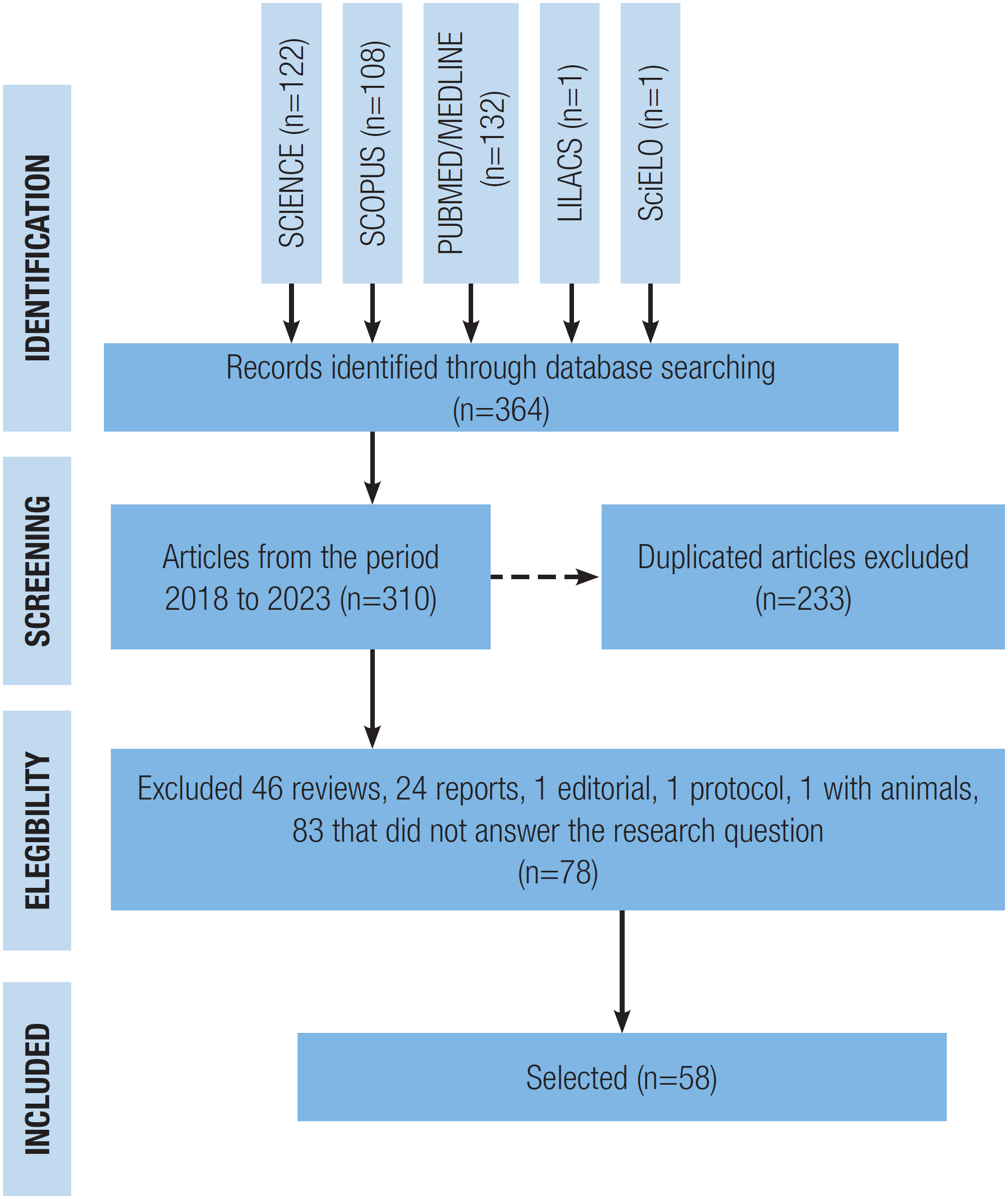
A total of 364 studies were located, and according to the eligibility criteria, 58 were selected to compose the bibliographic sample of this review. The screening process is summarized in Figure 1.

The analysis of the 58 selected articles revealed a significant distribution in both the study designs adopted and the countries of origin of the research. Among the examined studies, it was found that 39.7% (23 articles) had an observational design, while 58.6% (34 articles) had experimental designs. Additionally, one article (1.7%) presented a hybrid approach, combining elements of observational and experimental studies.
Regarding the origin of the research, a variety of contributing countries were observed. China stood out, concentrating 25.86% of the total studies, and the United States (12.07%). Other countries with multiple articles include Turkey (3.45%), Italy (5.17%), Saudi Arabia (3.45%), Australia (3.45%), and Pakistan (3.45%). Furthermore, some studies resulted from collaborations between nations, exemplified by articles from Israel and the USA, China and the USA, as well as Saudi Arabia, Yemen, and India. As for the language, 56 articles were published in English and two in Chinese.
The total sample of this research comprised approximately 11607 subjects with ASD, of which 113 had Attention Deficit Hyperactivity Disorder (ADHD) as a comorbidity, in addition to approximately 9,459 subjects with typical development. Studies involving the differential diagnosis of ASD with other disorders were identified, comprising a population of 1,437 non-autistic individuals: 603 people exclusively with ADHD, 50 with speech and language conditions (SLC), 455 with global developmental disorder (GDD), 194 with conduct disorder (CD), 122 with anxiety-related disorders (ANX), and 13 with multisystem developmental disorder (MSDD).
Regarding age, a wide range of participants was observed in the total sample, with participants up to 64 years old, but most being under 12 years old. Concerning gender, 11 studies were specific, including: 4,122 males (80.49%) and 999 females (24.23%). Of the 58 selected studies, only one specified the ethnic-racial composition.27Table 1 presents the individual characterization of the included studies.
The methods present in the selected articles pointed out different approaches to improving the understanding and diagnosis of ASD, using technological and computational tools that tend to reveal the diversity and limitations of the approaches. Among the tools analyzed, the use of ML was highlighted in 18 articles, SVM in 14 articles, CNN in 7 articles, DL in 7 articles, and XGBoost in 2 articles. These approaches were applied to different types of samples, with variation in the number of participants and the quality of the collected data. In the reviewed studies, the accuracy and precision of the models for diagnosing Autism Spectrum Disorder (ASD) ranged from 70% to 99%, depending on the methodology, sample, and data used.
The models with higher precision, set above 90%, were found in studies that used more complex approaches and hybrid models, such as Deep Neural Networks, which combined multiple data sources. This strategy is seen in the works of Hossain et al. (2021) and Ahmed et al. (2022), who achieved up to 100% accuracy using Multi-Layer Perceptron (MLP) and Convolutional Neural Networks CNNs + SVM, respectively. This level of precision can be extremely positive for direct clinical applications, especially when seeking quick and accurate identification of individuals with ASD.
Based on the selected studies, notable advancements in the diagnosis of ASD using AI were identified. The VG method achieved an average accuracy of 83.33% in detecting ASD and 85% in identifying neurotypical individuals,27 while strategies like the ASD Diagnosis (DASD) combined with EKNN demonstrated high accuracy in detecting ASD, outperforming conventional methods.28 Techniques involving facial features and AI algorithms also achieved high accuracy rates in detecting ASD, reaching up to 99%.39
In the context of early diagnosis, the use of AI allowed for excellent performance in discriminating between ASD and other disorders, such as Attention Deficit Hyperactivity Disorder (ADHD) and typical neurodevelopment (ND).29 ML classifiers showed high accuracy regarding key attributes, highlighting the effectiveness of these methods in early diagnosis. Neuroimaging analysis and blood proteins also contributed significantly to the accurate identification of ASD.32
In another scenario, hybrid and multimodal models, such as those using the Deep Multimodal Neuroimaging Framework (DeepMNF) who used DeepMNF,65 also achieved high results, with about 87.09% accuracy, indicating that combining different data sources, such as clinical images, behavioral information, and cognitive tests, can increase diagnostic accuracy compared to models based on a single modality.
CNNs and other less complex approaches, when compared to multimodal ones, such as SVM, RF, Kernel SVM, and K-Nearest Neighbors (KNN), showed more moderate performance when used alone or in combination with other less complex methods, with accuracy ranging from 70% to 80%. The associated results suggest that CNN-based models, although promising, may require adjustments to improve generalization and avoid overfitting, especially in heterogeneous samples.43,56,60,61,63,68,71,75,78
Regarding the sample sizes and the age ranges involved, there is a noticeable influence on the obtained results. A large portion of the studies, 58.6%, were developed with a child-age group, while another portion, 43.1%, investigated adolescents and adults, with samples ranging from tens to hundreds of participants. It is important to highlight that there is overlap between these statistical values, as a set of studies worked with different age groups, and this statistical analysis favors an understanding of a greater focus on the early identification of Autism Spectrum Disorder in children.
From another perspective, regarding differential diagnoses that sometimes tend to delay the correct identification of an individual with ASD, such as Attention Deficit Hyperactivity Disorder (ADHD), Language Disorders, and Anxiety Disorders, it is pointed out that DL also stand out. CNNs prove effective for analyzing image data, such as functional magnetic resonance imaging (fMRI) and electroencephalograms (EEG); Recurrent Neural Networks (RNNs) and Long Short-Term Memory (LSTMs) are notable for analyzing sequential or temporal data, such as behavioral patterns over time.41,71,76,79
Furthermore, other methods also present interesting positive points, such as RF, which accurately examines heterogeneous data, such as clinical and behavioral data, and is resistant to overfitting compared to isolated decision trees; SVM appear ideal for smaller datasets and high-dimensionality problems, using psychometric and neurophysiological measures to improve accuracy and kernel tools to non-linearly separate data in complex spaces; Ensemble Algorithms (XGBoost or LightGBM) combine tree-based models to improve accuracy and robustness, being good at handling imbalanced data and identifying differential diagnoses based on multiple data sources, along with identifying specific patterns in subgroups within ASD.38,39,45,46,78
Thus, it is noted that DL methods have shown greater potential for complex differential diagnoses due to their ability to handle multiple types of data (images, biomarkers, behavior). However, techniques like RF and SVM continue to be valuable in clinical settings due to their simplicity and effectiveness in smaller samples. These results highlight the importance of multivariate approaches and the potential of AI in capturing subtle behavioral nuances associated with ASD.
In the NOS quality assessment of the 23 observational studies and 1 mixed-design study, 54.2% of the articles were classified as "good quality," 41.7% as "fair quality," and 4.2% as "poor quality." These figures reflect a satisfactory level of reliability for the analysis conducted in this review. Regarding the 34 experimental studies, which were evaluated using the QUADAS-2 method, the assessment considered the balance between "high risk of bias" and "low risk of bias." Consequently, 41.2% were rated as high quality, 32.4% as moderate quality, and 26.5% as low quality.
Discussion
For the establishment of predictive modeling techniques based on AI as a diagnostic tool for ASD, it is necessary to have clinical and intrinsic patient factors detectable by the machine. The diagnosis of autism spectrum currently includes clinical-medical evaluation, combined with complementary tests such as genetic profiling, electroencephalogram (EEG), and neuroimaging exams, which are addressed in most of the reviewed studies.

The advancement of AI for the more precise development of clinical and complementary methods in medicine is notable. Algorithms can recognize patterns and learn from them to establish diagnoses, therapies, and procedures. This applies to the analysis of history and clinical examination, interpretation of images, and laboratory tests. In psychiatry and psychology, where nosologies require appropriate clinical attention and diagnosis is often complicated by overlapping disorders, AI is an ally to medical practice, as it is sensitive and specific in identifying and excluding conditions according to the clinical presentation. The performance of this tool over the past decade will help better define psychological disorders and achieve improved and faster diagnoses.85
The vital importance of AI in advancing the diagnosis of Autism Spectrum Disorder (ASD) is evident, an area that has seen significant progress thanks to the application of various AI methodologies. In this context, early and differential diagnosis emerges as a key component, enabling timely interventions that can significantly alter the prognosis for individuals affected by ASD. AI, through techniques such as ML, offers a new perspective for the accurate and early identification of ASD, often surpassing traditional methods in terms of accuracy and reliability. However, it is important to recognize that not all AI-based techniques offer the same capabilities. Techniques such as SVM and XGBoost require re-training to incorporate new data, lacking continuous learning capabilities. While both have demonstrated high accuracy in ASD classification tasks, their application in dynamic clinical environments must consider the need for ongoing updates and model versioning.
The learning logic with which these interfaces were built, with methods exemplified in the results, requires pre-test processing, as well as multiple stages of training and testing, validating the instrument as a diagnostic tool. Among the studied samples, many articles conducted data processing for algorithm training and subsequent final evaluations for data consolidation.33,39,40,59,86,87 Accuracy, sensitivity, specificity, and likelihood ratio were then compared to established tools considered the gold standard for ASD diagnosis.
Applications of ML in ASD diagnosis stand out for their ability to process and analyze large volumes of data, identifying subtle patterns and correlations that may not be evident with conventional diagnostic methods. Studies have demonstrated the effectiveness of ML, with techniques such as RF and AdaBoost achieving high accuracy rates in distinguishing between ASD and typical neurodevelopment, reinforcing ML's potential as a valuable tool in early ASD diagnosis.88
A systematic review analyzed the role of ML techniques in the diagnosis of ASD. The study demonstrated that algorithms such as SVM and CNNs achieved accuracy rates ranging from 80% to 97%, depending on validated features such as neuroimaging, EEG, and behavioral clinical signs. Comparing this with current data, it is clear that this accuracy range remains a benchmark, as newer reviews continue to report similar gains, but with greater robustness in larger samples and improvements in DL methodologies. This suggests that while the advancements are notable, optimizing these methods is still a growing field.89
On the other hand, CNNs have shown particularly strong performance in analyzing neuroimaging data, such as magnetic resonance imaging (MRI), enabling the identification of neurobiological markers of ASD. Their architecture supports deep feature extraction and hierarchical representation learning, making them highly effective in detecting subtle image-based anomalies. The precision of these algorithms in detecting and classifying pediatric ASD highlights AI's revolutionary potential in revealing new insights about the disorder.90 Nonetheless, CNNs demand large, high-quality datasets and considerable computational resources—factors that limit their clinical scalability, especially in under-resourced settings.
The DL technique, also linked to ML, with its ability to learn data representations in a hierarchical manner, allows for a deep and detailed analysis of ASD characteristics. This has led to significant advances in diagnostic accuracy, offering new pathways for understanding and treating ASD. Additionally, the genetic analysis and identification of ASD genetic markers, enhanced by AI capabilities, provide a window into the disorder's underlying genetic mechanisms. This approach not only facilitates differential diagnosis but also opens possibilities for developing new therapeutic strategies.91
A 2021 review focused on DL techniques applied to the early diagnosis of ASD. The study predicted high accuracy in CNNs applied to neuroimaging data, such as fMRI, with accuracy surpassing 95% in some reviewed studies. Comparing these findings with more recent data, the new results reinforce the effectiveness of AI in combination with complementary exams like EEG and neuroimaging, which continue to be the primary methods for early ASD detection, especially in scenarios where symptom overlap complicates traditional clinical diagnosis.92
The combination of these AI technologies and methodologies represents a significant advancement in ASD diagnosis, marking the beginning of a new era where faster, more accurate, and individualized diagnoses become possible. This transformation benefits not only individuals affected by ASD and their families but also broadens our understanding of the disorder's multifaceted nature, leading to a more holistic and integrated approach to its treatment and management.
Recent studies have more broadly integrated genetic profiles and biomarkers with AI algorithms, highlighting that genetic analysis may also be a promising area for the early diagnosis of ASD. AI has been able to identify genetic mutations associated with the disorder more efficiently than conventional clinical diagnosis, in addition to recognizing patterns in large volumes of DNA data that may go unnoticed by manual analysis methods.93 Nevertheless, the interpretability and clinical integration of these findings remain limited due to heterogeneity and complexity in genetic expression.
The impact of complementary exams, such as EEG, also remains a strong point in AI use. A reviewed study revealed that the analysis of electroencephalographic patterns in children at risk for ASD showed that neural networks trained with EEG data could detect the disorder with high sensitivity and specificity, often before clinical symptoms were clearly observable. These results are consistent with more recent reviews and suggest that the combined use of AI techniques, neuroimaging, and EEG could be a promising approach for the earlier diagnosis of ASD.94
Therefore, the incorporation of AI in ASD diagnosis not only improves clinical outcomes for patients but also represents a qualitative leap in our ability to understand and intervene in ASD in previously unimaginable ways. As this research area continues to evolve, it is expected that new discoveries and emerging technologies will further contribute to the refinement and effectiveness of ASD diagnoses and interventions, opening new horizons for personalized and targeted treatments. Nevertheless, several challenges can be highlighted in the development of AI as a diagnostic tool. Among these, improving the accuracy of the method, ensuring data quality, addressing the need for clinical decision-making, and enhancing accessibility to AI are important steps to consolidate these programs as a medical instrument.95
The NOS quality analysis mainly highlights the methodological quality in participant selection and sample applicability. Most articles have pertinent results, but they failed to describe some important points regarding the process of avoiding selection biases. Studies using neuroimaging techniques faced challenges in generalizing results due to limited accessibility and the disorder's heterogeneity.32,96 Additionally, the small sample size in some studies increased the risk of overfitting the ML models.33,36,37,42,74,79 The lack of validation in independent datasets and the challenging interpretation of EEG were also obstacles85. Other limitations included unaddressed ethical issues, lack of result generalization, and reliance on manual feature extraction methods.40,68 These limitations underscore the importance of robust and high-quality research to advance ASD diagnosis. A predictive modeling approach based on AI methodologies should be viewed as a complement to clinical expertise, not as a replacement.
CONCLUSION
The increasing application of artificial intelligence techniques in the analysis and identification of data associated with ASD has been accompanied by important advances in the field of personalized medicine and psychiatry. These methodologies not only enable more precise and early diagnosis of ASD but also contribute to the identification of its variants and comorbidities, strengthening the foundation for more specific therapeutic interventions. Ultimately, progress in the field of artificial intelligence is charting a path towards a more effective and comprehensive approach to the diagnosis and treatment of ASD, which can significantly improve the quality of life for individuals and their families.
DATA AVAILABILITY STATEMENT
The data that support this study are available in the body of the paper and/or supplementary materials.
REFERENCES
- 1 American Psychiatric Association (APA). DSM-5: Manual Diagnóstico e Estatístico de Transtornos Mentais. Artmed Editora; 2014. 992 p.
- 2 American Psychiatric Association. Diagnostic and Statistical Manual of Mental Disorders: DSM-5-TR. 2022. 1120 p.
-
3 ICD-11 for Mortality and Morbidity Statistics [Internet]. [cited 2024 Mar 7]. Available from: https://icd.who.int/browse/2024-01/mms/en#437815624
» https://icd.who.int/browse/2024-01/mms/en#437815624 - 4 da Silva AV, Gomes ML. Os desafios do diagnóstico psicológico precoce do transtorno do espectro autista (TEA). RCC. 2023 May 3;14(1):e31093–e31093.
- 5 Souza RA, dos Santos J de A, da Silva J, Soares SA. Uma reflexão sobre as políticas de atendimento para as pessoas com Transtorno do Espectro Autista. CadUniFOA. 2019 Aug 1;14(40):95–105.
- 6 Romeira GM, Schreiner LB, Bosa CA. Avaliação Psicológica de Crianças com Suspeita de TEA: Perfil Interativo dos Avaliadores. Aval psicol. 2021;20(1):43–51.
-
7 Laguna GGC, Rodrigues IB, Neves SES, Libarino DS, Maciel FBM, Pessoa AG, et al. Autism Spectrum Disorder in adults: an integrative review about strategies for promotion and maintenance of quality of life. Sao paulo medical journal. 2025;143(5). https://doi.org/10.1590/1516-3180.2024.0324.R1.14042025
» https://doi.org/10.1590/1516-3180.2024.0324.R1.14042025 -
8 Laguna GGC, Gusmão ABF, Marques BO, Bragas NBS, Rodrigues IB, Melo RS, Azevedo KRM. Neuroplasticity in autism spectrum disorder: a systematic review. Dement. neuropsychol. 2025;19. https://doi.org/10.1590/1980-5764-DN-2024-0182
» https://doi.org/10.1590/1980-5764-DN-2024-0182 - 9 Reis ST, Lenza N. A Importância de um diagnóstico precoce do autismo para um tratamento mais eficaz: uma revisão da literatura. ah. 2020;2(1):1–7.
- 10 Lobo LC. Inteligência artificial, o Futuro da Medicina e a Educação Médica. Rev Bras Educ Med. 2018;42(3):3–8.
- 11 Lobo LC. Inteligência Artificial e Medicina. Rev Bras Educ Med. 2017;41(2):185–93.
-
12 Xu M, Calhoun V, Jiang R, Yan W, Sui J. Brain imaging-based machine learning in autism spectrum disorder: methods and applications. J Neurosci Methods [Internet]. 2021 Sep 1 [cited 2024 Mar 19];361. Available from: https://pubmed.ncbi.nlm.nih.gov/34174282/
» https://pubmed.ncbi.nlm.nih.gov/34174282/ -
13 Alcañiz M, Ia CG, Sirera M, Minissi E, Abad L. [Autism spectrum disorder biomarkers based on biosignals, virtual reality and artificial intelligence]. Medicina [Internet]. 2020 [cited 2024 Mar 19];80 Suppl 2. Available from: https://pubmed.ncbi.nlm.nih.gov/32150710/
» https://pubmed.ncbi.nlm.nih.gov/32150710/ -
14 Pandya S, Jain S, Verma J. A comprehensive analysis towards exploring the promises of AI-related approaches in autism research. Comput Biol Med [Internet]. 2024 Jan [cited 2024 Mar 19];168. Available from: https://pubmed.ncbi.nlm.nih.gov/38064848/
» https://pubmed.ncbi.nlm.nih.gov/38064848/ - 15 Pagnozzi AM, Conti E, Calderoni S, Fripp J, Rose SE. A systematic review of structural MRI biomarkers in autism spectrum disorder: A machine learning perspective. Int J Dev Neurosci. 2018 Dec;71:68–82.
- 16 Joudar SS, Albahri AS, Hamid RA, Zahid IA, Alqaysi ME, Albahri OS, et al. Artificial intelligence-based approaches for improving the diagnosis, triage, and prioritization of autism spectrum disorder: a systematic review of current trends and open issues. Artif Intell Rev. 2023 Oct;56(S1):53–117.
-
17 Sun J, Dong QX, Wang SW, Zheng YB, Liu XX, Lu TS, et al. Artificial intelligence in psychiatry research, diagnosis, and therapy. Asian J Psychiatr [Internet]. 2023 Sep [cited 2024 Mar 19];87. Available from: https://pubmed.ncbi.nlm.nih.gov/37506575/
» https://pubmed.ncbi.nlm.nih.gov/37506575/ -
18 Moridian P, Ghassemi N, Jafari M, Salloum-Asfar S, Sadeghi D, Khodatars M, et al. Automatic autism spectrum disorder detection using artificial intelligence methods with MRI neuroimaging: A review. Front Mol Neurosci [Internet]. 2022 Oct 4 [cited 2024 Mar 19];15. Available from: https://pubmed.ncbi.nlm.nih.gov/36267703/
» https://pubmed.ncbi.nlm.nih.gov/36267703/ -
19 Valizadeh A, Moassefi M, Nakhostin-Ansari A, Heidari SS, Hosseini-Asl H, Saghab TM, et al. Automated diagnosis of autism with artificial intelligence: State of the art. Rev Neurosci [Internet]. 2023 Sep 8 [cited 2024 Mar 19];35(2). Available from: https://pubmed.ncbi.nlm.nih.gov/37678819/
» https://pubmed.ncbi.nlm.nih.gov/37678819/ - 20 Rahman S, Ahmed SF, Shahid O, Arrafi MA, Ahad MAR. Automated detection approaches to autism spectrum disorder based on human activity analysis: A review. Cognit Comput. 2022 Sep;14(5):1773–800.
-
21 PROSPERO [Internet]. [cited 2024 Mar 7]. Available from: https://www.crd.york.ac.uk/prospero/
» https://www.crd.york.ac.uk/prospero/ -
22 Laguna GG de C, Alves CO, Correia AP, dos Santos RS de J, Reis ASL da S, Borges GF. Registro de revisões sistemáticas: o que é e para que serve?. Saúde Redes [internet]. 2024 [cited 2024 nov 7];10(3):4550. Available from: http://revista.redeunida.org.br/ojs/index.php/rede-unida/article/view/4550
» http://revista.redeunida.org.br/ojs/index.php/rede-unida/article/view/4550 - 23 Cardoso V, Trevisan I, Cicolella D de A, Waterkemper R. SYSTEMATIC REVIEW OF MIXED METHODS: METHOD OF RESEARCH FOR THE INCORPORATION OF EVIDENCE IN NURSING. Texto contexto - enferm. 2019 Apr 8;28:e20170279.
-
24 Page MJ, McKenzie JE, Bossuyt PM, Boutron I, Hoffmann TC, Mulrow CD, et al. A declaração PRISMA 2020: diretriz atualizada para relatar revisões sistemáticas. Rev Panam Salud Publica [Internet]. 2022 [cited 2024 Mar 7];46. Available from: https://www.ncbi.nlm.nih.gov/pmc/articles/PMC9798848/
» https://www.ncbi.nlm.nih.gov/pmc/articles/PMC9798848/ -
25 SeTIC-UFSC. RISCO DE VIÉS EM REVISÕES SISTEMÁTICAS: GUIA PRÁTICO (COBE/UFSC) [Internet]. [cited 2024 Mar 24]. Available from: https://guiariscodeviescobe.paginas.ufsc.br/capitulo-10-analise-da-qualidade-metodologica-de-estudos-observacionais-coorte-e-caso-controle-com-a-ferramenta-newcastle-ottawa-scale-nos/
» https://guiariscodeviescobe.paginas.ufsc.br/capitulo-10-analise-da-qualidade-metodologica-de-estudos-observacionais-coorte-e-caso-controle-com-a-ferramenta-newcastle-ottawa-scale-nos/ -
26 Whiting PF, Rutjes AW, Westwood ME, Mallett S, Deeks JJ, Reitsma JB, Leeflang MM, Sterne JA, Bossuyt PM; QUADAS-2 Group. QUADAS-2: a revised tool for the quality assessment of diagnostic accuracy studies. Ann Intern Med. 2011 Oct 18;155(8):529-36. doi: 10.7326/0003-4819-155-8-201110180-00009. PMID: 22007046.
» https://doi.org/10.7326/0003-4819-155-8-201110180-00009 -
27 Dawson G, Campbell K, Hashemi J, Lippmann SJ, Smith V, Carpenter K, et al. Atypical postural control can be detected via computer vision analysis in toddlers with autism spectrum disorder. Sci Rep [Internet]. 2018 [cited 2024 Mar 28];8. Available from: https://www.ncbi.nlm.nih.gov/pmc/articles/PMC6242931/
» https://www.ncbi.nlm.nih.gov/pmc/articles/PMC6242931/ - 28 Diagnosis of autism spectrum disorder based on complex network features. Comput Methods Programs Biomed. 2019 Aug 1;177:277–83.
-
29 Rabie AH, Saleh AI. A new diagnostic autism spectrum disorder (DASD) strategy using ensemble diagnosis methodology based on blood tests. Health Information Science and Systems [Internet]. 2023 Dec [cited 2024 Mar 27];11(1). Available from: https://www.ncbi.nlm.nih.gov/pmc/articles/PMC10425316/
» https://www.ncbi.nlm.nih.gov/pmc/articles/PMC10425316/ - 30 Early identification of autism spectrum disorder by multi-instrument fusion: A clinically applicable machine learning approach. Psychiatry Res. 2023 Feb 1;320:115050.
-
31 Voinsky I, Fridland OY, Aran A, Frye RE, Gurwitz D. Machine Learning-Based Blood RNA Signature for Diagnosis of Autism Spectrum Disorder. Int J Mol Sci [Internet]. 2023 Feb [cited 2024 Mar 27];24(3). Available from: https://www.ncbi.nlm.nih.gov/pmc/articles/PMC9916487/
» https://www.ncbi.nlm.nih.gov/pmc/articles/PMC9916487/ -
32 Chen T, Chen Y, Yuan M, Gerstein M, Li T, Liang H, et al. The Development of a Practical Artificial Intelligence Tool for Diagnosing and Evaluating Autism Spectrum Disorder: Multicenter Study. JMIR Medical Informatics [Internet]. 2020 May [cited 2024 Mar 27];8(5). Available from: https://www.ncbi.nlm.nih.gov/pmc/articles/PMC7244998/
» https://www.ncbi.nlm.nih.gov/pmc/articles/PMC7244998/ -
33 Hewitson L, Mathews JA, Devlin M, Schutte C, Lee J, German DC. Blood biomarker discovery for autism spectrum disorder: A proteomic analysis. PLoS One [Internet]. 2021 [cited 2024 Mar 27];16(2). Available from: https://www.ncbi.nlm.nih.gov/pmc/articles/PMC7904196/
» https://www.ncbi.nlm.nih.gov/pmc/articles/PMC7904196/ - 34 Ghoreishi N, Goshvarpour A, Zare-Molekabad S, Khorshidi N, Baratzade S. Classification of autistic children using polar-based lagged state-space indices of EEG signals. J VLSI Signal Process Syst Signal Image Video Technol. 2021 May 12;15(8):1805–12.
- 35 Identifying individuals with autism spectrum disorder based on the principal components of whole-brain phase synchrony. Neurosci Lett. 2021 Jan 18;742:135519.
- 36 赵杰., 丁萌., 佟祯., 韩俊霞, 李小俚, 康健楠. 基于熵算法的孤独症 谱系障碍儿童脑电特征提取与分类. Sheng Wu Yi Xue Gong Cheng Xue Za Zhi. 2019 Apr;36(2):183.
-
37 Liao M, Duan H, Wang G. Application of Machine Learning Techniques to Detect the Children with Autism Spectrum Disorder. J Healthc Eng [Internet]. 2022 [cited 2024 Mar 27];2022. Available from: https://www.ncbi.nlm.nih.gov/pmc/articles/PMC8975630/
» https://www.ncbi.nlm.nih.gov/pmc/articles/PMC8975630/ - 38 Ghafouri-Fard S, Taheri M, Omrani MD, Daaee A, Mohammad-Rahimi H, Kazazi H. Application of Single-Nucleotide Polymorphisms in the Diagnosis of Autism Spectrum Disorders: A Preliminary Study with Artificial Neural Networks. J Mol Neurosci. 2019 Aug;68(4):515–21.
-
39 Li G, Lee O, Rabitz H. High efficiency classification of children with autism spectrum disorder. PLoS One [Internet]. 2018 [cited 2024 Mar 27];13(2). Available from: https://www.ncbi.nlm.nih.gov/pmc/articles/PMC5814015/
» https://www.ncbi.nlm.nih.gov/pmc/articles/PMC5814015/ -
40 Awaji B, Senan EM, Olayah F, Alshari EA, Alsulami M, Abosaq HA, et al. Hybrid Techniques of Facial Feature Image Analysis for Early Detection of Autism Spectrum Disorder Based on Combined CNN Features. Diagnostics [Internet]. 2023 Sep [cited 2024 Mar 27];13(18). Available from: https://www.ncbi.nlm.nih.gov/pmc/articles/PMC10527645/
» https://www.ncbi.nlm.nih.gov/pmc/articles/PMC10527645/ -
41 Nabil MA, Akram A, Fathalla KM. Applying machine learning on home videos for remote autism diagnosis: Further study and analysis. Health Informatics J [Internet]. 2021 Feb 14 [cited 2024 Mar 27]; Available from: https://journals.sagepub.com/doi/10.1177/1460458221991882?url_ver=Z39.88-2003𝔯_id=ori%3Arid%3Acrossref.org𝔯_dat=cr_pub++0pubmed
» https://journals.sagepub.com/doi/10.1177/1460458221991882?url_ver=Z39.88-2003𝔯_id=ori%3Arid%3Acrossref.org𝔯_dat=cr_pub++0pubmed -
42 Ko C, Lim JH, Hong J, Hong SB, Park YR. Development and Validation of a Joint Attention–Based Deep Learning System for Detection and Symptom Severity Assessment of Autism Spectrum Disorder. JAMA Network Open [Internet]. 2023 May [cited 2024 Mar 27];6(5). Available from: https://www.ncbi.nlm.nih.gov/pmc/articles/PMC10214037/
» https://www.ncbi.nlm.nih.gov/pmc/articles/PMC10214037/ -
43 ElNakieb Y, Ali MT, Elnakib A, Shalaby A, Soliman A, Mahmoud A, et al. The Role of Diffusion Tensor MR Imaging (DTI) of the Brain in Diagnosing Autism Spectrum Disorder: Promising Results. Sensors [Internet]. 2021 Dec [cited 2024 Mar 27];21(24). Available from: https://www.ncbi.nlm.nih.gov/pmc/articles/PMC8703859/
» https://www.ncbi.nlm.nih.gov/pmc/articles/PMC8703859/ - 44 Aghdam MA, Sharifi A, Pedram MM. Diagnosis of Autism Spectrum Disorders in Young Children Based on Resting-State Functional Magnetic Resonance Imaging Data Using Convolutional Neural Networks. J Digit Imaging. 2019 Dec;32(6):899.
-
45 Rakhimberdina Z, Liu X, Murata T. Population Graph-Based Multi-Model Ensemble Method for Diagnosing Autism Spectrum Disorder. Sensors [Internet]. 2020 Nov [cited 2024 Mar 27];20(21). Available from: https://www.ncbi.nlm.nih.gov/pmc/articles/PMC7660214/
» https://www.ncbi.nlm.nih.gov/pmc/articles/PMC7660214/ - 46 Aghdam MA, Sharifi A, Pedram MM. Combination of rs-fMRI and sMRI Data to Discriminate Autism Spectrum Disorders in Young Children Using Deep Belief Network. J Digit Imaging. 2018 Dec;31(6):895.
-
47 Tariq Q, Fleming SL, Schwartz JN, Dunlap K, Corbin C, Washington P, et al. Detecting Developmental Delay and Autism Through Machine Learning Models Using Home Videos of Bangladeshi Children: Development and Validation Study. J Med Internet Res [Internet]. 2019 Apr [cited 2024 Mar 27];21(4). Available from: https://www.ncbi.nlm.nih.gov/pmc/articles/PMC6505375/
» https://www.ncbi.nlm.nih.gov/pmc/articles/PMC6505375/ - 48 Young children with autism show atypical prefrontal cortical responses to humanoid robots: An fNIRS study. Int J Psychophysiol. 2022 Nov 1;181:23–32.
-
49 Jacob SG, Sulaiman MMB, Bennet B. Feature Signature Discovery for Autism Detection: An Automated Machine Learning Based Feature Ranking Framework. Comput Intell Neurosci [Internet]. 2023 [cited 2024 Mar 27];2023. Available from: https://www.ncbi.nlm.nih.gov/pmc/articles/PMC9833925/
» https://www.ncbi.nlm.nih.gov/pmc/articles/PMC9833925/ -
50 Tariq Q, Daniels J, Schwartz JN, Washington P, Kalantarian H, Wall DP. Mobile detection of autism through machine learning on home video: A development and prospective validation study. PLoS Med [Internet]. 2018 Nov [cited 2024 Mar 27];15(11). Available from: https://www.ncbi.nlm.nih.gov/pmc/articles/PMC6258501/
» https://www.ncbi.nlm.nih.gov/pmc/articles/PMC6258501/ - 51 Bussu G, Jones EJH, Charman T, Johnson MH, Buitelaar JK. Prediction of Autism at 3 Years from Behavioural and Developmental Measures in High-Risk Infants: A Longitudinal Cross-Domain Classifier Analysis. J Autism Dev Disord. 2018;48(7):2418.
- 52 Grossi E, Valbusa G, Buscema M. Detection of an Autism EEG Signature From Only Two EEG Channels Through Features Extraction and Advanced Machine Learning Analysis. Clin EEG Neurosci. 2021 Sep;52(5):330–7.
-
53 Leblanc E, Washington P, Varma M, Dunlap K, Penev Y, Kline A, et al. Feature replacement methods enable reliable home video analysis for machine learning detection of autism. Sci Rep [Internet]. 2020 [cited 2024 Mar 27];10. Available from: https://www.ncbi.nlm.nih.gov/pmc/articles/PMC7719177/
» https://www.ncbi.nlm.nih.gov/pmc/articles/PMC7719177/ -
54 Caly H, Rabiei H, Coste-Mazeau P, Hantz S, Alain S, Eyraud JL, et al. Machine learning analysis of pregnancy data enables early identification of a subpopulation of newborns with ASD. Sci Rep [Internet]. 2021 [cited 2024 Mar 27];11. Available from: https://www.ncbi.nlm.nih.gov/pmc/articles/PMC7994821/
» https://www.ncbi.nlm.nih.gov/pmc/articles/PMC7994821/ -
55 Wolff N, Kohls G, Mack JT, Vahid A, Elster EM, Stroth S, et al. A data driven machine learning approach to differentiate between autism spectrum disorder and attention-deficit/hyperactivity disorder based on the best-practice diagnostic instruments for autism. Sci Rep [Internet]. 2022 [cited 2024 Mar 27];12. Available from: https://www.ncbi.nlm.nih.gov/pmc/articles/PMC9637125/
» https://www.ncbi.nlm.nih.gov/pmc/articles/PMC9637125/ - 56 Zhu Y, Nakatani H, Yassin W, Maikusa N, Okada N, Kunimatsu A, et al. Application of a Machine Learning Algorithm for Structural Brain Images in Chronic Schizophrenia to Earlier Clinical Stages of Psychosis and Autism Spectrum Disorder: A Multiprotocol Imaging Dataset Study. Schizophr Bull. 2022 May;48(3):563.
- 57 刚周., 晓斌张., 行达曲., 美芳罗., 琼玲彭., 丽亚马., et al. 基于机器学习和儿童神经心理行为检查量表鉴别孤独症谱系障碍和全面发 育迟缓儿童的研究. Zhongguo Dang Dai Er Ke Za Zhi. 2023 Oct 10;25(10):1028.
- 58 Schulte-Rüther M, Kulvicius T, Stroth S, Wolff N, Roessner V, Marschik PB, et al. Using machine learning to improve diagnostic assessment of ASD in the light of specific differential and co-occurring diagnoses. J Child Psychol Psychiatry. 2023 Jan 1;64(1):16–26.
- 59 Farooq MS, Tehseen R, Sabir M, Atal Z. Detection of autism spectrum disorder (ASD) in children and adults using machine learning. Sci Rep. 2023 Jun 13;13(1):1–13.
- 60 Megerian JT, Dey S, Melmed RD, Coury DL, Lerner M, Nicholls CJ, et al. Evaluation of an artificial intelligence-based medical device for diagnosis of autism spectrum disorder. npj Digital Medicine. 2022 May 5;5(1):1–11.
- 61 Feng M, Xu J. Detection of ASD Children through Deep-Learning Application of fMRI. Children. 2023 Oct 5;10(10):1654.
-
62 Ashraf A, Zhao Q, Bangyal WH, Iqbal M. Analysis of Brain Imaging Data for the Detection of Early Age Autism Spectrum Disorder Using Transfer Learning Approaches for Internet of Things [Internet]. [cited 2024 Mar 28]. Available from: http://dx.doi.org/10.1109/TCE.2023.3328479
» http://dx.doi.org/10.1109/TCE.2023.3328479 -
63 Hossain MD, Kabir MA, Anwar A, Islam MZ. Detecting autism spectrum disorder using machine learning techniques: An experimental analysis on toddler, child, adolescent and adult datasets. Health Information Science and Systems [Internet]. 2021 Dec [cited 2024 Mar 28];9(1). Available from: https://www.ncbi.nlm.nih.gov/pmc/articles/PMC8024224/
» https://www.ncbi.nlm.nih.gov/pmc/articles/PMC8024224/ - 64 Negin F, Ozyer B, Agahian S, Kacdioglu S, Ozyer GT. Vision-assisted recognition of stereotype behaviors for early diagnosis of Autism Spectrum Disorders. Neurocomputing. 2021 Jul 25;446:145–55.
- 65 Ahmed IA, Senan EM, Rassem TH, Ali MAH, Shatnawi HSA, Alwazer SM, et al. Eye Tracking-Based Diagnosis and Early Detection of Autism Spectrum Disorder Using Machine Learning and Deep Learning Techniques. Electronics. 2022 Feb 10;11(4):530.
- 66 Abbas SQ, Chi L, Chen YP. DeepMNF: Deep Multimodal Neuroimaging Framework for Diagnosing Autism Spectrum Disorder. Artif Intell Med. 2023 Feb 1;136:102475.
- 67 Albahri AS, Hamid RA, Zaidan AA, Albahri OS. Early automated prediction model for the diagnosis and detection of children with autism spectrum disorders based on effective sociodemographic and family characteristic features. Neural Comput Appl. 2022 Sep 24;35(1):921–47.
-
68 Kaur A, Choudhary A. Artificial intelligence: A comprehensive perspective. Complex Intell Syst. 2021;7:2399-2413. Available from: http://dx.doi.org/10.1007/s40747-021-00408-8
» http://dx.doi.org/10.1007/s40747-021-00408-8 -
69 Gao J, Chen M, Li Y, Gao Y, Li Y, Cai S, et al. Multisite Autism Spectrum Disorder Classification Using Convolutional Neural Network Classifier and Individual Morphological Brain Networks. Front Neurosci [Internet]. 2020 [cited 2024 Mar 28];14. Available from: https://www.ncbi.nlm.nih.gov/pmc/articles/PMC7877487/
» https://www.ncbi.nlm.nih.gov/pmc/articles/PMC7877487/ - 70 Mazumdar P, Arru G, Battisti F. Early detection of children with Autism Spectrum Disorder based on visual exploration of images. Signal Processing: Image Communication. 2021 May 1;94:116184.
- 71 Hendr A, Ozgunalp U, Erbilek Kaya M. Diagnosis of Autism Spectrum Disorder Using Convolutional Neural Networks. Electronics. 2023 Jan 26;12(3):612.
- 72 Wei W, Liu Z, Huang L, Wang Z, Chen W, Zhang T, Wang J, Xu L. Identify autism spectrum disorder via dynamic filter and deep spatiotemporal feature extraction. Signal Processing: Image Communication. 2021 May 1;94:116195.
- 73 Wang M, Doenyas C, Wan J, Zeng S, Cai C, Zhou J, et al. Virulence factor-related gut microbiota genes and immunoglobulin A levels as novel markers for machine learning-based classification of autism spectrum disorder. Comput Struct Biotechnol J. 2021;19:545.
- 74 An optimized Kernel Extreme Learning Machine for the classification of the autism spectrum disorder by using gaze tracking images. Appl Soft Comput. 2022 May 1;120:108654.
-
75 Almuqhim F, Saeed F. ASD-SAENet: A Sparse Autoencoder, and Deep-Neural Network Model for Detecting Autism Spectrum Disorder (ASD) Using fMRI Data. Front Comput Neurosci [Internet]. 2021 [cited 2024 Mar 28];15. Available from: https://www.ncbi.nlm.nih.gov/pmc/articles/PMC8060560/
» https://www.ncbi.nlm.nih.gov/pmc/articles/PMC8060560/ -
76 Jiang W, Liu S, Zhang H, Sun X, Wang SH, Zhao J, et al. CNNG: A Convolutional Neural Networks With Gated Recurrent Units for Autism Spectrum Disorder Classification. Front Aging Neurosci [Internet]. 2022 [cited 2024 Mar 28];14. Available from: https://www.ncbi.nlm.nih.gov/pmc/articles/PMC9294312/
» https://www.ncbi.nlm.nih.gov/pmc/articles/PMC9294312/ - 77 Li J, Chen Z, Li G, Ouyang G, Li X. Automatic classification of ASD children using appearance-based features from videos. Neurocomputing. 2022 Jan 22;470:40–50.
-
78 Briguglio M, Turriziani L, Currò A, Gagliano A, Di Rosa G, Caccamo D, et al. A Machine Learning Approach to the Diagnosis of Autism Spectrum Disorder and Multi-Systemic Developmental Disorder Based on Retrospective Data and ADOS-2 Score. Brain Sciences [Internet]. 2023 Jun [cited 2024 Mar 28];13(6). Available from: https://www.ncbi.nlm.nih.gov/pmc/articles/PMC10295931/
» https://www.ncbi.nlm.nih.gov/pmc/articles/PMC10295931/ -
79 Song C, Jiang ZQ, Hu LF, Li WH, Liu XL, Wang YY, et al. A machine learning-based diagnostic model for children with autism spectrum disorders complicated with intellectual disability. Front Psychiatry [Internet]. 2022 [cited 2024 Mar 28];13. Available from: https://www.ncbi.nlm.nih.gov/pmc/articles/PMC9533131/
» https://www.ncbi.nlm.nih.gov/pmc/articles/PMC9533131/ -
80 Wang Z, Peng D, Shang Y, Gao J. Autistic Spectrum Disorder Detection and Structural Biomarker Identification Using Self-Attention Model and Individual-Level Morphological Covariance Brain Networks. Front Neurosci [Internet]. 2021 [cited 2024 Mar 28];15. Available from: https://www.ncbi.nlm.nih.gov/pmc/articles/PMC8547518/
» https://www.ncbi.nlm.nih.gov/pmc/articles/PMC8547518/ -
81 Ke F, Liu H, Zhou M, Yang R, Cao HM. Diagnostic Biomarker Exploration of Autistic Patients With Different Ages and Different Verbal Intelligence Quotients Based on Random Forest Model [Internet]. [cited 2024 Mar 28]. Available from: http://dx.doi.org/10.1109/ACCESS.2021.3071118
» http://dx.doi.org/10.1109/ACCESS.2021.3071118 - 82 Baygin M, Dogan S, Tuncer T, Barua PD, Faust O, Arunkumar N, Abdulhay EW, Palmer EE, Acharya UR. Automated ASD detection using hybrid deep lightweight features extracted from EEG signals. Comput Biol Med. 2021 Jul 1;134:104548.
- 83 Khorasani M, Kahani M, Yazdi SAA, Hajiaghaei-Keshteli M. Towards finding the lost generation of autistic adults: A deep and multi-view learning approach on social media. Knowledge-Based Systems. 2023 Sep 27;276:110724.
- 84 Chen C, Gau SS, Lee C. Toward differential diagnosis of autism spectrum disorder using multimodal behavior descriptors and executive functions. Comput Speech Lang. 2019 Jul 1;56:17–35.
-
85 Lin E, Lin CH, Lane HY. Precision Psychiatry Applications with Pharmacogenomics: Artificial Intelligence and Machine Learning Approaches. Int J Mol Sci [Internet]. 2020 Feb 1;21(3). Available from: http://dx.doi.org/10.3390/ijms21030969
» http://dx.doi.org/10.3390/ijms21030969 - 86 Zhang F, Wei Y, Liu J, Wang Y, Xi W, Pan Y. Identification of Autism spectrum disorder based on a novel feature selection method and Variational Autoencoder. Comput Biol Med. 2022 Sep;148:105854.
- 87 Bosl WJ, Tager-Flusberg H, Nelson CA. EEG Analytics for Early Detection of Autism Spectrum Disorder: A data-driven approach. Sci Rep. 2018 May 1;8(1):6828.
-
88 Rodrigues ID. Identificação de Regiões do Cérebro para Classificação de Severidade do TEA Utilizando Machine Learning e fMRI. Itajubá, Universidade Federal de Itajubá, 2022. Available from: https://repositorio.unifei.edu.br/jspui/bitstream/123456789/2350/3/Disserta%c3%a7%c3%a3o_2021071.pdf
» https://repositorio.unifei.edu.br/jspui/bitstream/123456789/2350/3/Disserta%c3%a7%c3%a3o_2021071.pdf -
89 Thabtah F. Machine learning in autistic spectrum disorder behavioral research: A review and ways forward. Informatics for Health and Social Care [Internet]. 2019. Available from: https://www.tandfonline.com/doi/abs/10.1080/17538157.2017.1399132
» https://www.tandfonline.com/doi/abs/10.1080/17538157.2017.1399132 -
90 Alves Rodrigues JN, Teixeira Aires KR, Branco Soares AC, Machado VP, de Melo Souza Veras R. Classification of facial images using deep learning models to support ASD identification. In: 2023 XLIX Latin American Computer Conference (CLEI) [Internet]. IEEE; 2023. Available from: https://ieeexplore.ieee.org/document/10346154/
» https://ieeexplore.ieee.org/document/10346154/ - 91 Artoni AA, Barbosa C, Morandini M. Autism Spectrum Disorder Diagnosis Assistance using Machine Learning. Res Initiat Treat Action. 2022 Dec 28;29(3):36–53.
-
92 Bayram MA, Özer İ, Temurtaş F. Deep learning methods for Autism spectrum disorder diagnosis based on fMRI images. Sakarya University Journal of Computer and Information Sciences [Internet]. 2021;4(1):142–55. Available from: http://dergipark.org.tr/en/doi/10.35377/saucis.04.01.879735
» http://dergipark.org.tr/en/doi/10.35377/saucis.04.01.879735 -
93 Nogay HS, Adeli H. Machine learning (ML) for the diagnosis of autism spectrum disorder (ASD) using brain imaging. Rev Neurosci [Internet]. 2020;31(8):825–41. Available from: https://www.degruyter.com/document/doi/10.1515/revneuro-2020-0043/html
» https://www.degruyter.com/document/doi/10.1515/revneuro-2020-0043/html -
94 Bosl WJ, Tager-Flusberg H, Nelson CA. EEG Analytics for Early Detection of Autism Spectrum Disorder: A data-driven approach. Scientific Reports [Internet]. 2018;8(1):1–20. Available from: https://www.nature.com/articles/s41598-018-24318-x
» https://www.nature.com/articles/s41598-018-24318-x - 95 Song D, Kim SY, Bong G, Kim JM, Yoo HJ. The Use of Artificial Intelligence in Screening and Diagnosis of Autism Spectrum Disorder: A Literature Review. J Korean Acad Child Adolesc Psychiatry. 2019 Oct 1;30(4):145-52.
-
96 Helmy E, Elnakib A, ElNakieb Y, Khudri M, Abdelrahim M, Yousaf J, et al. Role of Artificial Intelligence for Autism Diagnosis Using DTI and fMRI: A Survey. Biomedicines [Internet]. 2023 Jun 29;11(7). Available from: http://dx.doi.org/10.3390/biomedicines11071858
» http://dx.doi.org/10.3390/biomedicines11071858
Edited by
-
Handling Editor:
Laiana Quagliato

 Source: Prepared by the authors (2025).
 Source: Prepared by the authors (2025).