
 What medicine teaches when it’s not teaching medicine: hidden curriculum and moral formation
ABSTRACT
Introduction: This theoretical essay analyzes the role of the hidden curriculum in the training of medical students, with emphasis on its effects on their moral and subjective constitution as future professionals. Widely discussed in recent decades in medical education, the hidden curriculum refers to implicit, non-formalized teachings that often contradict the official discourse of training.
Development: Based on national and international literature, the essay explores how the daily life of medical schools conveys values, attitudes, and beliefs that shape students’ behavior and ethics. It discusses the tension between the formal curriculum—which frequently values holistic care and empathy, and the hidden curriculum, which may foster hierarchy, dehumanization, and competitiveness. Examples are drawn from academic reports.
Conclusion: The essay argues that recognizing and problematizing the hidden curriculum is essential for a more ethical, critical, and equity-oriented medical education. Reflecting on what is taught without being explicitly taught is, in itself, a pedagogical and political gesture that can open paths toward more humane and transformative practice.
Keywords:
Hidden curriculum; Curriculum; Ethics; Subjectivity; Medical education
RESUMO
Introdução: O presente ensaio teórico analisa o papel do currículo oculto na formação de estudantes de Medicina, com ênfase em seus efeitos sobre a constituição moral e subjetiva do futuro profissional. O conceito de currículo oculto, amplamente discutido nas últimas décadas na educação médica, aponta para os ensinamentos implícitos, não formalizados e, muitas vezes, contraditórios ao discurso oficial da formação.
Desenvolvimento: A partir da literatura nacional e internacional, o ensaio aborda como o cotidiano das escolas médicas ensina valores, atitudes e crenças que moldam o comportamento e a ética dos estudantes. Discute-se a tensão entre o currículo formal, que frequentemente valoriza o cuidado integral e a empatia, e o currículo oculto, que pode promover a naturalização da hierarquia, da desumanização e da competição. Exemplos são extraídos de relatos acadêmicos.
Conclusão: Argumenta-se que reconhecer e problematizar o currículo oculto é essencial para uma formação médica mais ética, crítica e comprometida com a equidade. A reflexão sobre o que se ensina sem ser ensinado é, em si, um gesto pedagógico e político que pode abrir caminhos para uma prática mais humanizada e transformadora.
Palavras-chave:
Currículo Oculto; Currículo; Ética; Subjetividade; Educação Médica
INTRODUCTION
At the center of medical education, far beyond the disciplines, protocols and curricular guidelines, is what is learned in the corridors, in the wards, on shifts and in daily relationships. The “hidden curriculum” is the name given to this set of messages, implicit norms, values and attitudes that, although not formally provided for in the teaching programs, have a profound impact on the way students become professionals. This concept, developed and widely debated in recent decades1, has become an essential tool to understand how medical education not only transmits technical knowledge, but also shapes subjectivities and practices.
This theoretical essay proposes to reflect on what medicine teaches when it is not officially teaching medicine. It starts from the understanding that all professional education is also a moral, social and political education2. Medical training, in particular, carries considerable symbolic and institutional weight, with concrete consequences on the modes of care and on the relationship between professionals and the population. Questioning what is taught without being taught is also a way of questioning the values that sustain contemporary medical practice.
We will discuss the origins and developments of the concept of hidden curriculum, its effects on the subjective formation of students and its ethical and pedagogical implications. From the literature and experiences of daily formative life, both symbolic violence and the possibilities of resistance and reorientation of training towards a more humanized, reflective and transformative practice will be explored.
DEVELOPMENT
Hidden curriculum: concepts and origins
The literature on medical education distinguishes different curricular dimensions3. The school curriculum comprises both the formal curriculum — consisting of the systematized activities and officially provided for by the educational institutions, such as subjects, contents, and assessments — and the informal curriculum, which encompasses formative experiences lived in the institutional routine, outside the didactic structure. The parallel curriculum, on the other hand, refers to extracurricular experiences sought by students, such as internships and leagues. The hidden curriculum, on the other hand, is transversal, encompassing unintentional learning, linked to values, attitudes and institutional practices.
The term “hidden curriculum” has been widely used to designate the elements of the educational experience that, although not explicitly provided for in formal curricula, exert a significant influence on the students’ education. According to Hafferty¹, the hidden curriculum refers to the organizational structures, institutional cultures, and implicit practices that, often invisibly, shape professional attitudes, values, and behaviors.
The hidden curriculum operates between the lines of educational practices. It is transmitted in power relations, in silences, omissions and contradictions between what is preached and what is practiced. It is a silent but powerful pedagogy, whose influence can be more lasting and profound than that of contents that are openly taught.
The criticism of the hidden curriculum, especially in the context of medical education, emerges from the observation that many of the undesirable behaviors and dehumanized attitudes observed in clinical practice are not explained only by gaps in the formal curriculum, but by the implicit messages that students internalize throughout the course1. It is at this point that the hidden curriculum reveals itself as an important object of ethical and pedagogical analysis.

The hidden curriculum in practice: formative experiences and contradictions
Several qualitative studies show that medical students are confronted, from the first years of the course, with situations in which the values taught in the classroom conflict with the practices observed in clinical environments4. Empathy, active listening, and respect for patient autonomy, often advocated in medical ethics disciplines, become difficult to sustain in the face of overloaded routines, a culture of productivity, and hierarchical rigidity that characterize many practice scenarios.
The research by Lempp and Seale5, for example, identified that medical students often feel discouraged from asking questions, demonstrating vulnerability or expressing doubts in front of teachers and residents, at the risk of appearing weak or poorly prepared. Situations of humiliation, invisibility, and symbolic violence are naturalized as part of the process of “hardening” necessary for medical practice.
Similarly, student reports indicate that jokes about patients, moral judgments, and discriminatory attitudes are often tolerated or reproduced by authority figures, silently shaping the behavior of future professionals. As De Luca6 points out, these socialization processes can deform students’ ethical sensitivity, promoting conformity and uncritical adaptation to models of action that are far from comprehensive health care.
Moral training and professional socialization
Medical education is not only a transmission of technical knowledge, but also a profound process of socialization, in which students internalize what it means to “be a doctor” — in terms of language, posture, affectivity, positioning in front of the other. In this sense, the hidden curriculum acts as a formative matrix of professional morality. This process can also be understood in the light of Pierre Bourdieu’s concept of habitus, as an incorporation of dispositions, practices, and postures that naturalize the dominant medical ethos7.
As discussed by Rego8, the hidden curriculum teaches, for instance, that one should not cry in front of patients, that showing emotion is a sign of weakness, that hierarchy is incontestable, and that efficiency matters more than empathy. This tacit morality has profound implications for the constitution of medical identity, shaping professionals who often reproduce models of action that are distant from listening, doubt, and shared care.
It is a process that is intertwined with social expectations, discourses of power and idealizations about the figure of the physician, consolidating a professional habit that does not always correspond to the ideals of humanized education proposed by the national curriculum guidelines.
Ethical and subjective consequences of the hidden curriculum
The hidden curriculum also acts as a vector for the reproduction of structural inequalities, silently perpetuating stigmas and exclusions based on gender, race, sexual orientation and disability9),(10),(11. Women, black, LGBTQIA+, and disabled students report recurrent experiences of invisibility, microaggressions, and implicit prejudices throughout medical education. Studies indicate that these intersectional social markers influence the way they are perceived by teachers, colleagues, and patients, affecting their professional self-esteem and their academic career9),(10. Ableism, in particular, is revealed in the absence of accessibility and in the naturalization of the exclusion of students with disabilities, signaling that certain bodies are not welcome in medicine10.
The effects of the hidden curriculum are not limited to the collective moral dimension: they directly impact students’ mental health, motivation, and sense of belonging. The Brazilian literature has documented high rates of psychological distress among undergraduate students, especially in medical school, including symptoms of anxiety, depression, and suicidal ideation12, aggravated by an institutional culture marked by moral harassment, as evidenced by Tokeshi et al13.
These situations are often aggravated by the culture of competition, the absence of spaces for listening, and the naturalization of institutional violence. When students are faced with inconsistencies between the values taught and the practices lived, without critical mediation, a process of moral cynicism is installed that compromises the engagement with care and social transformation.
In this context, it is urgent that medical schools recognize the hidden curriculum as an object of pedagogical and institutional intervention, and not as an inevitable side effect.
Resistance, reflexivity and pedagogical transformation
Despite its power of reproduction, the hidden curriculum is not an immutable structure. There are, in the formative spaces, multiple gaps for resistance, criticism and resignification. Initiatives such as conversation circles, peer tutoring, ethical reflection groups, and popular education activities have shown potential to open spaces for subjective elaboration and political questioning8),(14.
As proposed by Van der Vleuten et al.15, formative assessments, structured feedback and dialogic supervision can contribute to the construction of a pedagogical culture that is more open to listening and ethical development. Moreover, institutional policies that include reporting and embracement channels, permanent listening groups, strengthening of student ethics committees, and continuing teacher education based on critical pedagogy are possible ways to confront the hidden curriculum9),(15. It is also necessary to invest in the pedagogical training of the teaching staff, recognizing the role of the teacher as a symbolic and political agent of training.
The construction of a critical and humanizing medical education therefore involves the ability to recognize the hidden curriculum, problematize it and collectively produce other ways of teaching and learning. Making the invisible visible is, in this case, a fundamental ethical and political task.
FINAL CONSIDERATIONS
The hidden curriculum is a structuring dimension of medical education, whose effects cross the plane of ethics, subjectivity and institutional politics. Far from being mere noise or deviation, it is an integral part of the training process and needs to be understood, discussed and faced.
This essay sought to shed light on the quiet, symbolic ways in which medicine is taught—and learned—beyond formal curricula. By addressing its moral and affective consequences, as well as the possibilities of resistance, it seeks to contribute to the construction of a more conscious, fair, and transformative medical pedagogy.
To train doctors, after all, is to train people capable of caring. And this requires not only technical competence, but also ethical sensitivity, political commitment and reflective disposition. The medical education that is desired for the future needs to be one that continuously questions itself about what it teaches when it is not officially teaching.
References
- 1 Hafferty FW. Beyond curriculum reform: confronting medicine’s hidden curriculum. Acad Med. 1998;73(4):403-7.
- 2 Freire P. Pedagogia do oprimido. 60a ed. Rio de Janeiro: Paz e Terra; 2021.
-
3 Tavares CHF, Maia JA, Muniz MCH, Malta MV, Magalhães BR da C, Thomaz ACP. O currículo paralelo dos estudantes da terceira série do curso médico da Universidade Federal de Alagoas. Rev bras educ med. 2007;31(3):245-53. doi: https://doi.org/10.1590/S0100-55022007000300007.
» https://doi.org/https://doi.org/10.1590/S0100-55022007000300007 - 4 Lawrence K, Mhlaba T, Stewart KA, Moletsane R, Gaede B, Moshabela M. The hidden curriculum: a scoping review. Acad Med. 2018;93(4):648-56.
- 5 Lempp H, Seale C. The hidden curriculum in undergraduate medical education: qualitative study of medical students’ perceptions of teaching. BMJ. 2004;329(7469):770-3.
- 6 De Luca TAC. Forças que reluzem nas sombras: o poder de deformação profissional do currículo oculto [trabalho de conclusão de curso]. Florianópolis: Universidade Federal de Santa Catarina; 2016. 78 p.
- 7 Bourdieu P. A reprodução: elementos para uma teoria do sistema de ensino. 2a ed. Rio de Janeiro: Vozes; 2007.
- 8 Rego S. A formação ética dos médicos: saindo da adolescência com a vida (dos outros) nas mãos. Rio de Janeiro: Fiocruz; 2003.
- 9 Beagan BL. “Is this worth getting into a big fuss over?” Everyday racism in medical school. Med Educ. 2001;35(3):270-80.
- 10 Loue S. Sexual orientation, gender identity, and health disparities: the role of the hidden curriculum. AMA J Ethics. 2018;20(2):182-7.
- 11 Bonet H, Guerra R, Lima G, Mendes M, Oliveira P. O capacitismo na educação médica: exclusão e invisibilidade de estudantes com deficiência. Rev bras educ med. 2020;44(1):e049.
- 12 Lima JKA, Brito APA. Desgaste e sofrimento psíquico em estudantes de medicina: uma revisão sistemática. Semin Estud Prod Acad. 2018;17.
-
13 Tokeshi AB, Vieira JE, Oliveira WA, Sampaio E, Koifman L. Moral harassment and mental health in medical residents: a longitudinal study. Braz J Psychiatry. 2025;47. doi: https://doi.org/10.47626/1516-4446-2024-3579.
» https://doi.org/https://doi.org/10.47626/1516-4446-2024-3579 - 14 Rego S. Currículo paralelo em Medicina, experiência clínica e PBL: uma luz no fim do túnel? Interface (Botucatu). 1998;2(3):35-48.
- 15 Van der Vleuten CPM, Schuwirth LWT, Driessen EW, et al. A model for programmatic assessment fit for purpose. Med Teach. 2012;34(3):205-14.
Research data are available in the body of the document.

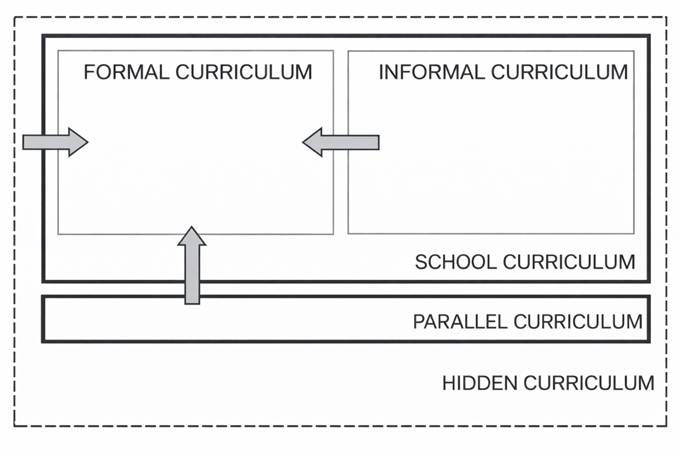 Source: reproduced from Tavares et al