
 MAPPING KNOWLEDGE IN SCOPING REVIEWS: A GUIDE FOR NURSING RESEARCHERS AND ACADEMICS
ABSTRACT
Objective: to provide nursing researchers with a comprehensive framework for conducting high-quality scoping reviews and enhance the process of evidence-based care.
Method: Drawing upon existing literature, this paper synthesizes insights from existing guidance with a focus in adapting the information for the nursing community. Furthermore, it introduces a proposed 10-step framework for conducting scoping reviews, specific for nursing researchers, amalgamating guidance from reputable healthcare research organizations such as the Joanna Briggs Institute (JBI) and the Preferred Reporting Items for Systematic Reviews and Meta-Analysis (PRISMA) extension for Scoping Reviews.
Results: In an era marked by the information deluge, nursing researchers hold a pivotal role in conducting scoping reviews to navigate the burgeoning scientific landscape. The paper emphasizes the significance of a systematic 10-step approach, providing a framework that ensures reliability, rigor, and transparency.
Conclusion: By adhering to robust protocols and reporting guidelines, nursing researchers can effectively contribute to evidence-based healthcare practices, guide policymakers, and inspire future research, ultimately closing the knowledge translation gap.
DESCRIPTORS:
Review; Nursing; Evidence-based nursing; Evidence-based practice; Review literature as topic
RESUMO
Objetivo: fornecer aos pesquisadores de enfermagem um quadro abrangente para a realização de revisões de escopo de alta qualidade e aprimorar o processo de cuidado baseado em evidências.
Método: Com base na literatura existente, este artigo sintetiza as orientações existentes com foco na adaptação das informações para a comunidade de enfermagem. Além disso, apresenta uma proposta de um quadro de 10 etapas para a realização de revisões de escopo, específico para pesquisadores de enfermagem, amalgamando orientações de organizações renomadas de pesquisa em saúde, como o Instituto Joanna Briggs (JBI) e a extensão do PRISMA (Preferred Reporting Items for Systematic Reviews and Meta-Analysis) para Revisões de Escopo.
Resultados: Em uma era marcada pelo dilúvio de informações, os pesquisadores de enfermagem desempenham um papel fundamental na condução de revisões de escopo para navegar pelo crescente cenário científico. O artigo enfatiza a importância de uma abordagem sistemática em 10 etapas, fornecendo uma estrutura que assegura confiabilidade, rigor e transparência.
Conclusão: Ao aderir a protocolos robustos e diretrizes de relato, os pesquisadores de enfermagem podem contribuir efetivamente para práticas de saúde baseadas em evidências, orientar os formuladores de políticas e inspirar futuras pesquisas, fechando, em última análise, a lacuna na tradução do conhecimento.
DESCRITORES:
Revisão; Enfermagem; Enfermagem baseada em evidências; Prática baseada em evidências; Revisão da literatura como tópico
RESUMEN
Objetivo: proporcionar a los investigadores de enfermería un marco integral para llevar a cabo revisiones de alcance de alta calidad y mejorar el proceso de atención basado en evidencia.
Método: Basado en la literatura existente, este artículo sintetiza las guías actuales con un enfoque en la adaptación de la información para la comunidad de enfermería. Además, presenta una propuesta de un marco de 10 pasos para la realización de revisiones de alcance, amalgamando orientaciones de organizaciones de investigación en salud reconocidas, como el Instituto Joanna Briggs (JBI) y la extensión PRISMA (Preferred Reporting Items for Systematic Reviews and Meta-Analysis) para Revisiones de Alcance.
Resultados: En una era marcada por el diluvio de información, los investigadores de enfermería desempeñan un papel crucial en la conducción de revisiones de alcance para navegar por el creciente panorama científico. El artículo enfatiza la importancia de un enfoque sistemático en 10 pasos, proporcionando una estructura que asegura confiabilidad, rigor y transparencia.
Conclusión: Al adherirse a protocolos sólidos y guías de informes, los investigadores de enfermería pueden contribuir efectivamente a prácticas de salud basadas en evidencia, orientar a los formuladores de políticas e inspirar futuras investigaciones, cerrando, en última instancia, la brecha en la traducción del conocimiento.
DESCRIPTORES:
Revisión; Enfermería; Enfermería basada en evidencia; Práctica basada en la evidencia
INTRODUCTION
Advances in research development and increased funding opportunities are contributing to a continuous rise in the volume of health-related scientific publications1. As a consequence, there is an overwhelming surplus of information in the realm of scientific literature, with millions of articles being published annually in peer-reviewed scientific journals1. Despite this surge in publication indicate progress in scientific exploration, it also often leaves practitioners and policy developers inundated with a vast amount of available information that may or may not be of high-quality. The overwhelming number of publications, along with other structural aspects, hampers the incorporation of evidence-based care into clinical settings, and it is estimated that the knowledge translation gap (from publishing certain evidence to having it incorporated into practice) is about 17 years or even more2-3.
To aid scholars and educators to have access to comprehensive information and reduce the knowledge translation gap, various types of literature review have been crafted to systematically and comprehensively select, compile, and summarize the existing research, rendering the amassed evidence more meaningful and accessible4-6. The primary purpose of conducting a review is to pinpoint gaps in knowledge, define an issue, and elucidate concepts pertinent to a specific question5. These reviews are tailored to address distinct research inquiries and can be distinguished by the rigor of their methodological considerations. Most recently, scoping review methodology has gained popularity and added complexity to the typology of reviews.
Scoping reviews, also known as mapping reviews, have their roots in the social sciences, and possess the capability to amalgamate evidence derived from diverse methodological approaches7. Authors8 conducted a review to explore the conduct and reporting of scoping reviews in the realm of human health. Findings from that study indicated a notable surge in the popularity of scoping reviews in recent years; and that this methodology is primarily employed to guide future research and identify implications for both practice and policy8. With the increasing popularity of scoping review, numerous guidance documents have emerged in various scholarly journals to assist scholars and researchers in the process of conducting this type of review9-11. However, there is still compelling evidence indicating that the quality and reporting of published scoping reviews often fall short in terms of rigor and effective execution.
Authors12 conducted a scoping review to provide an overview of published scoping reviews, and their findings indicated that given the differences in how those reviews were carried out, there is a current need for establishing standardized methodologies to ensure the effectiveness and robustness of the evidence scoping reviews can provide12. Additionally, other authors8 conducted a scoping review to investigate the conduction and report of published scoping reviews13, and similarly to findings from another study8, their results indicated that additional research concerning scoping review methodologies is justified, with a specific emphasis on the development of reporting guidelines to establish a standardized approach.
Collectively, those findings from the literature12-14, highlight that despite the increasing number of scoping review beings conducted in different fields, there is an evident need for improvements in the way that scoping reviews are being conducted and reported. Compounding this issue, is the lack of guidance that are specific to nursing scholars and researchers, particularly in the Brazilian context. Therefore, in this paper we aim to contribute to existing knowledge by providing a comprehensive description of the core attributes of scoping reviews and guidance on the process conducting and reporting of findings. Furthermore, this essay aims to provide clarity regarding its contribution to the existing theoretical documentation analysis framework, particularly within the context of nursing research, by introducing a proposed 10-step framework for conducting scoping reviews and synthesizing insights from reputable healthcare research organizations.
SCOPING REVIEW DEFINING CHARACTERISTICS
Scoping reviews stand out as a relatively recent addition to the family of review methods, setting them apart from more traditional review types15. They are also referred to as "scoping studies" or "mapping reviews," reflecting their unique ability to explore broader yet well-defined research questions16. The primary purpose of scoping reviews is to elucidate essential concepts, address knowledge gaps, offer a comprehensive overview of a particular subject, or offer guidance for forthcoming research endeavors7,16.
It should be noted that in 2020, the Methodology Group for Scope Reviews at the Joanna Briggs Institute (JBI) began discussing the need for a formal definition for scope reviews, reaching a consensus that they are a type of evidence synthesis that aims to systematically identify and map the breadth of available evidence on a given topic, field, concept or issue, often regardless of the source (e.g., primary research, reviews, non-empirical evidence) within or in specific contexts17-19.
Scoping reviews embrace a comprehensive overview on a given subject, permitting researchers to encompass a wide array of literature sources, including opinion pieces, peer-reviewed journal articles, and grey literature to help addressing their research questions7. Types of gray literature can include academic papers, including theses and dissertations, research and committee reports, government reports, conference papers, and ongoing research, among others. As a result of its wide range of formats and scopes, gray literature is often a rich source of evidence used in systematic reviews and meta-analysis20-21. In addition to their versatility, scoping reviews are particularly valuable in emerging fields, where the existing body of literature may be relatively unexplored or in need of more extensive examination15. In that sense, scoping reviews are widely used to map the existing evidence through broad lens and provide implications to practice and guidance to future research.
PHILOSOPHICAL UNDERPINNINGS
While researchers have the flexibility to adapt their epistemological and ontological orientations to match the specific nature of their study, it is crucial that these orientations are clearly defined before commencing the review process7. Failure to do so significantly increases the risk of yielding low-quality results or drawing inappropriate conclusions7. Even though reviews do not inherently possess an exclusive philosophical foundation, there are discernible patterns worth noting. Typically, scoping review leans toward a subjectivist epistemology, embracing a research paradigm rooted in post-positivism, and aligns ontologically with contextual relativism to provide an interpretative framework for understanding the knowledge related to a given subject4,7.
A subjectivist epistemology rejects the notion of a singular, objective, and universally measurable truth waiting to be uncovered. Instead, it contends that our understanding of reality is constructed through individuals' interactions with their environment and with one another4,7. Furthermore, as researchers, our interpretations are inevitably influenced by our own lived experiences, which are invariably reflected in the knowledge we generate, whether derived from participants or existing studies7. Consequently, the findings of scoping reviews are typically crafted through the interplay between researchers, the phenomena under investigation, and the contextual backdrop of the study. This results in a subjective interpretation of the knowledge surrounding the subject, rather than a single, objectivist construct.
METHODOLOGICAL APPROACHES
While scoping reviews offer a comprehensive and broad exploration of a subject and enable researchers to encompass a diverse array of literature, including peer-reviewed journal articles and grey literature7, it is essential that researchers adhere to a methodical sequence of steps to ensure both reliability and rigor4. In that sense, various evidence-based, healthcare research organizations exist that provide guidelines for evidence synthesis. In the context of scoping reviews, the JBI, or Collaboration JBI, provides extensive guidance for the conduction of scoping reviews6. While JBI provides all the elements necessary to carry out this method, from the protocol to the presentation of the final manuscript, the Preferred Reporting Items for Systematic Reviews and Meta-Analysis (PRISMA) - extension for Scoping Reviews provides extensive description, as well as a checklist, to support authors in the reporting of their scoping review. Table 1 presents a list of existing guidance to support scholars while conducting scoping reviews.
PROPOSED FRAMEWORK
Existing guidance (Table 1) present similar directions to researchers, yet variations in the proposed methods and steps followed occur. The fragmented manner in which the essential steps for conducting a high-quality scoping review are typically presented can often result in confusion among nursing scholars and researchers, potentially leading to overlooked or omitted stages in the process of conduction of those reviews.
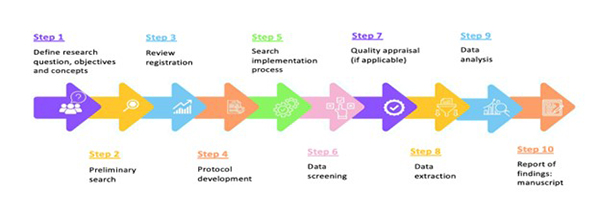
Thus, in this paper, we have carefully analyzed the existing methodologies available for scoping reviews and summarized the main steps for nursing researchers in a comprehensive framework. Throughout this paper we offer an overview of the proposed framework with the consensus across existing methodologies and best-practices in the conduction of scoping reviews using a 10 steps process (Figure 1).

Step 1. Define team, research question, objectives and concepts
To develop a scoping review, it is essential to determine a review team that is capable of carrying out the work effectively and rigorously. The minimum team size may vary according to the complexity of the topic and the extent of the review, but generally involves at least three researchers. The ideal team should include members of different skill sets and knowledge. This may include experts on the topic in question, reviewers with experience in review methodology, professionals with experience searching for literature, statisticians for data analysis (if applicable), and so on. The diversity of skills ensures that all stages of the review are carried out competently31.
Sometimes scoping reviews involve a large amount of literature to be tracked, reviewed and summarized. A larger team can better manage this workload, ensuring nothing is overlooked. Having two or more independent reviewers evaluate studies and make inclusion/exclusion decisions in each study helps reduce bias and interpretation errors and it is highly recommended for scoping reviews22. Furthermore, conflicts can be resolved through discussion between team members30. It is essential to emphasize that the team must maintain regular communication throughout the entire review process, ranging from data removal to analysis and presentation of results. Carrying out periodic checks as a team, whether through face-to-face meetings or email communications, during the removal and analysis stages, is extremely important. This allows you to discuss the progress of the process, address potential challenges encountered when deleting data, consider possible modifications to the tools used to guide data restriction (such as exclusion forms or tables), and address any other issues and findings related to the review31.
After the team is stablished, scoping reviews should be driven and guided by a well-defined research question and objective. To support the development of research questions, the PCC (Population, Concept, Content) framework is usually used, although the PICo (Population, phenomena of Interest, Context) format may also be accepted4. A sample on how the PCC format should be applied to define the concepts and research question can be found on Figure 2.

Additionally, JBI recommends the use of sub-questions as a strategy to more precisely direct the scoping review22. These sub-questions, especially when applied in the context of the data extraction form, aim to deepen the investigation and guide the review process29. As an example, for the aforementioned PCC, the following sub-questions stand out:
-
What are the main symptoms of burnout and compassion fatigue reported by organ and tissue donation coordinators?
-
What are the risk and protective factors identified in the literature regarding the development of burnout and compassion fatigue among organ and tissue donation coordinators?
-
What strategies and approaches are mentioned in the literature for addressing burnout and compassion fatigue among organ and tissue donation coordinators, and what are the outcomes associated with these strategies?
These sub-questions play a crucial role in structuring the scoping review, allowing the research team to thoroughly explore each aspect of the topic under analysis. This, in turn, facilitates the identification of possible gaps and contributes to a more comprehensive and careful analysis of the results29,31.
Step 2. Preliminary search
Once the research team has defined the main objectives, research questions and concepts of their review, a preliminary search should be conducted to investigate the extent of other similar works. Researchers are advised to conduct a preliminary search in relevant sources to seek identify current or underway reviews on the topic defined. Examples of relevant sources to conduct the preliminary searches are: MEDLINE, Prospero, Epistemonikos, the Cochrane Database of Systematic Reviews and JBI Evidence Synthesis (the selection of sources may vary according to the topic being investigate). Once the preliminary search is conducted, there will be 3 potential outcomes: 1) no current or underway reviews on the topic were identified: in that case the researcher can proceed with the investigation; 2) current reviews on the topic were identified: the researcher need to access the existing review and investigate how similar or different to their proposed review the existing publication is and if there is a need for a new review in the topic (e.g., to update the timeframe to include more recent discoveries); 3) underway reviews on the topic were identified: if underway reviews are identified, the lead researcher should connect with the authors to further understand the concepts being explored, seek collaboration or adapt their review to avoid the conduction of duplicated works. Regardless the outcome, findings from the preliminary search and decision-making process must be indicated in the scoping review protocol and final manuscript (ideally in the last paragraph of the introduction).
Step 3. Review registration
Once researchers have ensured that the contribution from their proposed scoping review is unique, the title of the review should be registered to avoid the conduction of future duplicated work. Registration of the underway review allow for other authors to gain access of undergoing works, seek collaboration and avoid duplicated efforts. Scoping review registrations, currently, can take place in two formats and ideally both registrations should be performed: 1) JBI: Title of scoping reviews should be registered at JBI Evidence Synthesis using the JBI Systematic Review Title Registration Form (a version of the PCC form for scoping reviews can be requested by e-mail, and this register needs to be made by people within affiliated centres); 2) OSF: Scoping reviews should also be registered at Open Science Framework using their registration template. Please note this registration process is related to the title of the review, which differs from the protocol publication that is stated in the upcoming sections. Both registration processes are free of charge. Lastly, currently, scoping reviews cannot be registered at PROSPERO platform.
Step 4. Protocol development
To align with the purposes of the scoping reviews, and keep the rigor in the process, a protocol should be developed as the initial step for the conduction of the scoping review. The protocol should include, in a detailed manner, all relevant aspects for the conduction of the scoping review. Templates to help the protocol development exist (e.g., JBI), but the main components of a scoping review protocol can be found below:
-
Introduction: providing extensive coverage to the extent of the problem, main concepts of interest, justification of existing gaps and review need, justification of the choice of methodology, and preliminary search process description (step 2).
-
Objectives and research questions: the protocol should provide an alignment between objectives and research questions, and a list of specific research questions covering the main aspects of the investigation.
-
Eligibility criteria: there must be a clear definition of the inclusion and exclusion criteria based on the main concepts of interest in the review. For instance, if the PCC format was used to define the research question, the same format should be used when identifying inclusion and exclusion criteria (including the types of sources). Therefore, it is essential to establish inclusion and exclusion criteria related to the population, concept and context22. Furthermore, many authors include the elimination of duplicate studies as an exclusion criterion, which is not recommended, since the exclusion of duplicate studies is part of the standard procedure in any review method.
-
Methodology: It is essential to state the choice of framework for the conduction of the scoping review, such as the JBI framework to conduct the review and the PRISMA-ScR for reporting the findings; but other options may be used and justified accordingly. Although the JBI framework originated in 200510, due to the lack of clarity for the development of each stage, it was updated in 201025 and refined by JBI in 201533, 201734 e 202017.
-
Information sources and draft search strategy: at this stage authors have to define what information sources, for both published and unpublished literature, are going to be used during the search process. There is no minimum number of information sources, but at least three sources are usually indicated to provide extensive coverage of finding; and the selection will depend on the topic being investigated. A draft of the search strategy should also be provided in the protocol, so it can be appraised to ensure a search that is both specific and sensitive. JBI recommends that the development and implementation of the evidence search should follow a well-defined three-step process. The first step consists of carrying out an initial search in two relevant databases, such as PubMed and CINAHL, in order to identify articles relevant to the topic in question. At this stage, the keywords present in the titles and abstracts of relevant articles are identified, as well as the indexed terms (MeSH/CINAHL Headings) used to describe the articles. This is essential for developing a complete search strategy10. To construct this search strategy, it is recommended that reviewers combine all the elements listed in the PCC strategy. Next, it is advisable that reviewers carry out a pilot test of the final search in two databases (for example, such as PubMed and LILACS). This step allows you to evaluate the effectiveness of the implemented strategy and identify possible new terms related to the PCC. Once the protocol has been validated, a definitive search in the databases selected for the study can be conducted. Furthermore, it is recommended that the reference lists of articles that will be included in the review are also checked by two independent reviewers. This aims to identify additional literature related to the topic under study. Ideally, the process of selecting information sources and developing the search strategy should rely on the guidance of an information specialist in health sciences, such as a librarian. This professional can provide specialized support in building the search strategy, making it more accurate and comprehensive.
-
Data screening, extraction, and analysis plan: In that stage, authors should have a comprehensive plan for how the sources will be screened, selected, extracted and analyzed. All citations found during the search process should be evaluated by at least two independent reviewers both at title and abstract screening as well as full text screening. This process should be facilitated by a software to manage, screen, extract and analyze the references (e.g., Convidence, SUMARI). Alternatively, free options such as Rayyan are available on the market, but they are limited by not performing data extraction and analysis. For data extraction, a standardized data extraction form and guidance for the form must be developed, which describes each point that will be extracted. Development of the initial data extraction form is guided by the review questions and generally includes population, concept, and context. This data extraction form needs to be included in the protocol as an appendix so it can be critically appraised. Furthermore, a detailed data analysis plan, both quantitative and qualitative, must be provided along with proposed mechanisms for preparing and presenting results31.
-
Publication: To allow for critical appraisal of the scoping review protocol and methods proposed, the protocol should be submitted for consideration to publication in a peer-reviewed process. Journals that currently accept scoping review protocol vary according to the topic being investigated and individual contact with editors about their potential interest may be needed to define the best option of journal for each specific study. To help improving adherence to the quality of reviews and rigor in the process, hopefully more journals will consider receiving protocols in the near future. Additionally, the JBI evidence synthesis currently accepts protocol, as well as protocols can be made available through OSF and have a DOI number attributed to them (but in the latter, there is no review process involved in the publication of the protocol). The protocol publication process is different than the registration process, which has been described above (e.g., protocols can be registered and available within OSF, but in that manner they are not appraised), and both should be performed by authors to ensure rigor in the methods proposed.
Step 5. Search implementation process
After the protocol has been critically appraised through a peer-reviewed process, and proposed changes from reviewers were addressed, the draft search strategy should be adapted for the different sources of information and the search process should be implemented by, or with the support of, an information specialist in medical science. The search terms may include keywords that are indexed (e.g., decs and mesh terms) or not. Once the search process is finalized, all citations can be imported to a bibliographic reference manager from researchers’ preference (e.g., Endnote, Zotero, Mendeley) where duplicated can be removed and then be imported to a software for literature analysis and synthesis to support knowledge synthesis methods (e.g., Covidence, JBI Sumari, Rayyan, among others) where the screening process can be performed; some of those software are available for free, while others have a paid subscription. Additionally, as an additionally source of information, authors may opt to review the reference list of all included papers (after the screening process is finished) for other potentially relevant references. The databases should be selected according to the relevance considering the scope of the review, and current guidance suggests that more than two databases should be included and that the search should have been implemented no longer than 12 months before the submission of the paper, and updates in the search should be considered6,34.
Step 6. Data screening
The data screening process should be conducted individually by two independent evaluators, who will carry out a preliminary evaluation of the titles and abstracts, following previously defined inclusion criteria. Subsequently, the full texts of studies that present potential relevance will be thoroughly examined, also by two independent evaluators, based on the stipulated inclusion criteria. Any reasons for exclusion regarding studies that do not comply with the inclusion criteria will be documented and presented in detail in the final scoping review. If disagreements occur between the evaluators at any stage of the study selection process, these will be resolved through discussion or, if necessary, with the mediation of a third evaluator. Reviewers should only screen references in the language they are fluent and regardless the size of the team, and each reference should be included by at least two independent reviewers. A pilot test in the screening process to help aligning the team of reviewers may be beneficial and therefore should be considered. In the selection process, records will initially be screened based on title and abstract (first selection phase). Then, the records included in this stage will undergo a second selection after analyzing the full texts. It is essential that the reasons that led to the deletion of records are recorded and documented during the full text review. This information should be included in the final scoping review manuscript, following the guidelines recommended by PRISMA-ScR24.
Step 7. Quality appraisal (if applicable)
Quality appraisal is not a mandatory part of scoping review, but if relevant for the concepts being investigated, they can be included and justified. The process of quality appraisal entails a comprehensive evaluation of the methodological robustness and reliability of the studies incorporated within the review10. This assessment is crucial to ascertain the trustworthiness of the review's findings. Various sources of critical appraisal exist (e.g., CASP and JBI) and authors should select the tool to be used according to the types of studies being included and purpose of the review. As scoping reviews can include a wide range of literature, it is important to select tools that allow to appraise the different methodologies included in the review. Quality appraisal methods can help enhancing the credibility and validity of reviews by ensuring that the included studies contribute effectively to the research question, and by identifying any potential limitations or biases that may influence the outcomes and interpretations of the review.
Step 8. Data extraction
Once the data screening process is finished and the relevant papers for the purposes of the scoping review have been selected, authors should perform the data extraction process. The data extraction process will be based on the data extraction tool that has been drafted for the scoping review protocol, and it can be adapted based on any changes throughout the process. The form should be pilot tested to allow reviewers to assess its relevance and provide feedback to improve the information extraction process. It is advisable to pilot test at least one copy of each type of evidence source, covering original research, reviews, editorial articles, opinion pieces and gray literature. During pilot testing, reviewers should consider whether the extraction form contains omissions, redundancies, or lack of clarity, as well as the efficiency of the extraction process. This information assists in allocating additional time, if necessary31. As scoping reviews are an iterative process, modifications and adaptations can be made as long as those are reported and justified. Ideally, the data extraction process will be made by two independent reviewers and triangulated to ensure consistency in the extraction process. Any disagreements between reviewers can be resolved through discussion or, when necessary, with the input of an impartial third reviewer. However, when resources are not available, authors can justify the single data extraction process; still, peer-checking process and pilot test of the tool is strongly recommended in those cases. Lastly, data source authors can be contacted to request missing or additional information if necessary.
Step 9. Data analysis
The data analysis in scoping reviews encompasses both quantitative and qualitative approaches. Quantitative analysis primarily involves straightforward numerical counting to characterize the collective attributes of the studies. Conversely, qualitative analysis serves to furnish a narrative account of the key discoveries. It's worth noting that authors may choose to employ a more comprehensive qualitative analysis methodology. However, in line with established guidelines, the content analysis approach is the sole accepted qualitative analysis method for scoping reviews, as it aligns most closely with the objectives of scoping review studies.
Extracted data must be analyzed and presented using appropriate methods to address the research question. A common challenge observed in systematic reviews is ensuring that the same data set is not duplicated across multiple studies. In scoping reviews, this challenge can arise due to several reasons, such as the inclusion of both the review study and the primary articles, which can result in potential data overlap. Although there are no specific formal guidelines for addressing this issue in scoping reviews, authors should be aware of this risk and take steps to avoid repeatedly counting the same datasets from different sources31.
In certain cases, authors may choose to include evidence synthesis in their scoping reviews, with the aim of mapping available evidence and reporting the number of mapped evidence syntheses. In this context, the guidelines established for systematic reviews and umbrella reviews can be applied. However, it is critical that scoping review authors provide a clear description in the final report, specifying what other sources of primary evidence were incorporated into the evidence synthesis. The final scoping review report should transparently explain how different types of evidence syntheses were handled throughout the review and what data were extracted from them, in addition to clarifying the approach to primary studies, when applicable31.
Step 10. Report of findings: Manuscript
Following the conduction of the data extraction and analysis, the last step will be to chart the data and provide a summary of reports in a manuscript format. The manuscript of the scoping review will include all categories previous explored in the scoping review protocol (step 4); still, a section to describe the results, discussion, limitation and conclusions will be added. The final manuscript should report, if applicable, any changes and deviations from the scoping review protocol, along with a justification for that. The description of the results from the scoping review should include the process of selection of sources (e.g., PRISMA-ScR), characteristic of the included literature, overall description of the included sources, and review findings. The presentation of results in a scoping review should be strategic, tailored to the review's objectives. This can involve organizing the findings logically through tables, charts, or descriptive formats, each customized to the nature of the research. Tables and charts can display data, such as source distribution by publication year, country of origin, intervention areas, and research methods. Results can be summarized into maps or frameworks, or conveyed narratively, depending on the most effective method for communicating the findings. It is essential to summarize the key discoveries and relate them back to the original review questions and objectives. Moreover, aligning the overall findings with the information needs of relevant stakeholders, including policymakers, healthcare providers, and patients or consumers, is crucial. Lastly, supplemental material can be used to include a table with the reason for exclusion of references in the full-text screening.
CONCLUSION
In the ever-expanding landscape of health-related scientific publications, the role of nursing researchers in conducting high-quality scoping reviews cannot be overstated. The continuous surge in scientific literature signifies progress in scientific exploration but also poses challenges. Knowledge users, including clinicians, policymakers, and stakeholders, are often overwhelmed by the sheer volume of available information. The daunting gap between evidence generation and its incorporation into clinical practices can persist for years. To bridge this gap, nursing researchers play a pivotal role in conducting scoping reviews as valuable tools to inform research agendas and guide policy and practice.
Scoping reviews have gained credibility and popularity among healthcare researchers, especially in emerging fields. They typically adopt a subjectivist epistemology to comprehensively map the existing literature on a specific subject. Nevertheless, it is imperative to employ a robust methodological framework to guarantee the reliability, rigor, transparency, replicability, and overall quality of the scoping review. Nursing researchers play a pivotal role in conducting high-quality scoping reviews, which are essential tools for navigating the wealth of available information and closing the knowledge translation gap. By following rigorous protocols and reporting guidelines, nursing researchers can contribute significantly to informing clinical practices, guiding policymakers, engaging stakeholders, and inspiring future researchers in the pursuit of evidence-based healthcare. This study emphasizes the importance of a systematic and rigorous approach, highlighting the need to follow a 10-step process as proposed for conducting scoping reviews.
This framework provides clarity and guidance to nursing researchers, ranging from formulating research questions to analyzing and presenting results. In an ever-evolving healthcare landscape, the relevance and impact of scoping reviews cannot be understated, making it a critical responsibility for nursing researchers to ensure their quality and effectiveness in advancing evidence-based care. In addition to providing practical guidance for conducting scoping reviews, this manuscript underscores the broader implications of its findings. By fostering transparency, reliability, and adherence to reporting guidelines, it not only enhances evidence-based nursing practice but also facilitates knowledge translation and informs future research directions, ultimately enriching the discourse surrounding scoping review methodologies in nursing research.
REFERENCES
-
1. Ware M, Mabe M. The STM Report: An overview of scientific and scholarly journal publishing [Internet]. 2015 [cited 2024 Sep 10]. Available from: https://digitalcommons.unl.edu/scholcom/9/
» https://digitalcommons.unl.edu/scholcom/9/ -
2. Morris ZS, Wooding S, Grant J. The answer is 17 years, what is the question: Understanding time lags in translational research. J R Soc Med [Internet]. 2011 [cited 2024 Sep 10];104(12):510-20. Available from: https://doi.org/10.1258/jrsm.2011.110180
» https://doi.org/10.1258/jrsm.2011.110180 -
3. Hanney SR, Castle-Clarke S, Grant J, Guthrie S, Henshall C, Mestre-Ferrandiz J, et al. How long does biomedical research take? Studying the time taken between biomedical and health research and its translation into products, policy, and practice. Health Res Policy Syst [Internet]. 2015 [cited 2024 Sep 10];13(1):1-18. Available from: https://doi.org/10.1186/1478-4505-13-1
» https://doi.org/10.1186/1478-4505-13-1 -
4. Silva AR, Padilha MI, Petry S, Silva SE, Woo K, Galica J, et al. Reviews of literature in nursing research: Methodological considerations and defining characteristics. ANS Adv Nurs Sci [Internet]. 2022 [cited 2024 Sep 10];45(3):197-208. Available from: https://doi.org/10.1097/ANS.0000000000000418
» https://doi.org/10.1097/ANS.0000000000000418 -
5. Snyder H. Literature review as a research methodology: An overview and guidelines. J Bus Res [Internet]. 2019 [cited 2024 Sep 10];104:333-9. Available from: https://doi.org/10.1016/j.jbusres.2019.07.039
» https://doi.org/10.1016/j.jbusres.2019.07.039 -
6. Aromataris E, Munn Z, editors. JBI manual for evidence synthesis. Adelaide: The Joanna Briggs Institute; 2020 [cited 2024 Sep 10]. Available from: https://doi.org/10.46658/JBIMES-20-01
» https://doi.org/10.46658/JBIMES-20-01 -
7. Thomas A, Lubarsky S, Varpio L, Durning S, Young M. Scoping reviews in health professions education: Challenges, considerations and lessons learned about epistemology and methodology. J Adv Med Educ Prof [Internet]. 2020 [cited 2024 Sep 10];25(4):989-1002. Available from: https://doi.org/10.1007/s10459-019-09932-2
» https://doi.org/10.1007/s10459-019-09932-2 -
8. Tricco A, Lillie E, Zarin W, O'Brien K, Colquhoun H, Kastner M, et al. A scoping review on the conduct and reporting of scoping reviews. BMC Med Res Methodol [Internet]. 2016 [cited 2024 Sep 10];16:15. Available from: https://doi.org/10.1186/s12874-016-0116-4
» https://doi.org/10.1186/s12874-016-0116-4 -
9. Levac D, Colquhoun H, O'Brien KK. Scoping studies: Advancing the methodology. Implement Sci [Internet]. 2010 [cited 2024 Sep 10];5:1-9. Available from: https://doi.org/10.1186/1748-5908-5-69
» https://doi.org/10.1186/1748-5908-5-69 -
10. Arksey H, O'Malley L. Scoping studies: Towards a methodological framework. Int J Soc Res Methodol [Internet]. 2005 [cited 2024 Sep 10];8(1):19-32. Available from: https://doi.org/10.1080/1364557032000119616
» https://doi.org/10.1080/1364557032000119616 -
11. Peters MD, Marnie C, Tricco AC, Pollock D, Munn Z, Alexander L, et al. Updated methodological guidance for the conduct of scoping reviews. JBI Evid Synth [Internet]. 2020 [cited 2024 Sep 10];18(10):2119-26. Available from: https://doi.org/10.11124/JBIES-20-00167
» https://doi.org/10.11124/JBIES-20-00167 -
12. Pham MT, Rajić A, Greig JD, Sargeant JM, Papadopoulos A, McEwen SA. A scoping review of scoping reviews: Advancing the approach and enhancing the consistency. Res Synth Methods [Internet]. 2014 [cited 2024 Sep 10];5(4):371-85. Available from: https://doi.org/10.1002/jrsm.1123
» https://doi.org/10.1002/jrsm.1123 -
13. Tricco AC, Lillie E, Zarin W, O’brien K, Colquhoun H, Kastner M, et al. A scoping review on the conduct and reporting of scoping reviews. BMC Med Res Methodol [Internet]. 2016 [cited 2024 Sep 10];16:1-10. Available from: https://doi.org/10.1186/s12874-016-0116-4
» https://doi.org/10.1186/s12874-016-0116-4 -
14. O’Brien KK, Colquhoun H, Levac D, Baxter L, Tricco AC, Straus S, et al. Advancing scoping study methodology: A web-based survey and consultation of perceptions on terminology, definition and methodological steps. BMC Health Serv Res [Internet]. 2016 [cited 2024 Sep 10];16:305. Available from: https://doi.org/10.1186/s12913-016-1579-z
» https://doi.org/10.1186/s12913-016-1579-z -
15. Munn Z, Peters M, Stern C, Tufanaru C, McArthur A, Aromataris E. Systematic review or scoping review? Guidance for authors when choosing between a systematic or scoping review approach. BMC Med Res Methodol [Internet]. 2018 [cited 2024 Sep 10];18(1):143. Available from: https://doi.org/10.1186/s12874-018-0611-x
» https://doi.org/10.1186/s12874-018-0611-x - 16. Peters M, Godfrey C, McInerney P, Baldini Soares C, Khalil H. Chapter 11: Scoping Reviews. In: Aromataris E, Munn Z, editors. Joanna Briggs Institute Reviewer’s Manual. Adelaide, (AUS): Joanna Briggs Institute; 2017. p. 1-42.
-
17. Peters MDJ, Marnie C, Tricco AC, Pollock D, Munn Z, Alexander L, et al. Updated methodological guidance for the conduct of scoping reviews. JBI Evid Synth [Internet]. 2020 [cited 2024 Sep 10];18(10):2119-26. Available from: https://doi.org/10.11124/JBIES-20-00167
» https://doi.org/10.11124/JBIES-20-00167 -
18. Peters MDJ, Marnie C, Colquhoun H, Garritty CM, Hempel S, Horsley T, et al. Scoping reviews: Reinforcing and advancing the methodology and application. Syst Rev [Internet]. 2021 [cited 2024 Sep 10];10(1):263. Available from: https://doi.org/10.1186/s13643-021-01821-3
» https://doi.org/10.1186/s13643-021-01821-3 -
19. Munn Z, Pollock D, Khalil H, Alexander L, McLnerney P, Godfrey CM, et al. What are scoping reviews? Providing a formal definition of scoping reviews as a type of evidence synthesis. JBI Evid Synth [Internet]. 2022 [cited 2024 Sep 10];20(4):950-2. Available from: https://doi.org/10.11124/JBIES-21-00483
» https://doi.org/10.11124/JBIES-21-00483 -
20. Paez A. Gray literature: An important resource in systematic reviews. J Evidence‐Based Med [Internet]. 2017 Aug [cited 2024 Sep 10];10(3):233-40. Available from: https://doi.org/10.1111/jebm.12266
» https://doi.org/10.1111/jebm.12266 -
21. Nih Library. Literature Search: Databases and Gray Literature [Internet]. 2023 [cited 2024 Sep 10]. Available from: https://www.nihlibrary.nih.gov/services/systematic-review-service/literature-search-databases-and-gray-literature
» https://www.nihlibrary.nih.gov/services/systematic-review-service/literature-search-databases-and-gray-literature -
22. Peters MDJ, Godfrey C, McInerney P, Munn Z, Tricco AC, Khalil H. Chapter 11: Scoping Reviews (2020 version). In: Aromataris E, Munn Z, editors. JBI Manual for Evidence Synthesis [Internet]. Adelaide, (AUS): JBI Collaboration; 2020 [cited 2024 Sep 10]. Available from: https://synthesismanual.jbi.global
» https://synthesismanual.jbi.global -
23. Peters MDJ, Godfrey C, McInerney P, Khalil H, Larsen P, Marnie C, et al. Best practice guidance and reporting items for the development of scoping review protocols. JBI Evid Synth [Internet]. 2022 [cited 2024 Sep 10];20(4):953-68. Available from: https://doi.org/10.11124/JBIES-21-00242
» https://doi.org/10.11124/JBIES-21-00242 -
24. Tricco AC, Lillie E, Zarin W, O'Brien KK, Colquhoun H, Levac D, et al. PRISMA Extension for Scoping Reviews (PRISMA-ScR): Checklist and Explanation. Ann Intern Med [Internet]. 2018 [cited 2024 Sep 10];169(7):467-73. Available from: https://doi.org/10.7326/M18-0850
» https://doi.org/10.7326/M18-0850 -
25. Levac D, Colquhoun H, O'Brien KK. Scoping studies: Advancing the methodology. Implement Sci [Internet]. 2010 [cited 2024 Sep 10];5:69. Available from: https://doi.org/10.1186/1748-5908-5-69
» https://doi.org/10.1186/1748-5908-5-69 -
26. Colquhoun HL, Levac D, O'Brien KK, Straus S, Tricco AC, Perrier L, et al. Scoping reviews: Time for clarity in definition, methods, and reporting. J Clin Epidemiol [Internet]. 2014 [cited 2024 Sep 10];67(12):1291-4. Available from: https://doi.org/10.1016/j.jclinepi.2014.03.013
» https://doi.org/10.1016/j.jclinepi.2014.03.013 -
27. Lockwood C, Dos Santos KB, Pap R. Practical Guidance for Knowledge Synthesis: Scoping Review Methods. Asian Nurs Res (Korean Soc Nurs Sci) [Internet]. 2019 [cited 2024 Sep 10];13(5):287-94. Available from: https://doi.org/10.1016/j.anr.2019.11.002
» https://doi.org/10.1016/j.anr.2019.11.002 -
28. Peters MDJ, Marnie C, Tricco AC, Pollock D, Munn Z, Alexander L, et al. Updated methodological guidance for the conduct of scoping reviews. JBI Evid Implement [Internet]. 2021 [cited 2024 Sep 10];19(1):3-10. Available from: https://doi.org/10.1097/XEB.0000000000000277/
» https://doi.org/10.1097/XEB.0000000000000277/ -
29. Pollock D, Davies EL, Peters MDJ, Tricco AC, Alexander L, McInerney P, et al. Undertaking a scoping review: A practical guide for nursing and midwifery students, clinicians, researchers, and academics. J Adv Nurs [Internet]. 2021 [cited 2024 Sep 10];77(4):2102-13. Available from: https://doi.org/10.1111/jan.14743
» https://doi.org/10.1111/jan.14743 -
30. Pollock D, Alexander L, Munn Z, Peters MDJ, Khalil H, Godfrey CM, et al. Moving from consultation to co-creation with knowledge users in scoping reviews: Guidance from the JBI Scoping Review Methodology Group. JBI Evid Synth [Internet]. 2022 [cited 2024 Sep 10];20(4):969-79. Available from: https://doi.org/10.11124/JBIES-21-00416
» https://doi.org/10.11124/JBIES-21-00416 -
31. Pollock D, Peters MDJ, Khalil H, McInerney P, Alexander L, Tricco AC, et al. Recommendations for the extraction, analysis, and presentation of results in scoping reviews. JBI Evid Synth [Internet]. 2023 [cited 2024 Sep 10];21(3):520-32. Available from: https://doi.org/10.11124/JBIES-22-00123
» https://doi.org/10.11124/JBIES-22-00123 -
32. Campbell F, Tricco AC, Munn Z, Pollock D, Saran A, Sutton A, et al. Mapping reviews, scoping reviews, and evidence and gap maps (EGMs): The same but different- the "Big Picture" review family. Syst Rev [Internet]. 2023 [cited 2024 Sep 10];12(1):45. Available from: https://doi.org/10.1186/s13643-023-02178-5
» https://doi.org/10.1186/s13643-023-02178-5 -
33. Peters MD, Godfrey CM, Khalil H, McInerney P, Parker D, Soares CB. Guidance for conducting systematic scoping reviews. Int J Evid Based Healthc [Internet]. 2015 [cited 2024 Sep 10];13(3):141-6. Available from: https://doi.org/10.1097/XEB.0000000000000050
» https://doi.org/10.1097/XEB.0000000000000050 -
34. Hong QN, Pluye P, Fàbregues S, Bartlett G, Boardman F, Cargo M, et al. Improving the content validity of the mixed methods appraisal tool: A modified e-Delphi study. J Clin Epidemiol [Internet]. 2019 [cited 2024 Sep 10];111:49-59. Available from: https://doi.org/10.1016/j.jclinepi.2019.03.008
» https://doi.org/10.1016/j.jclinepi.2019.03.008

 * Adapted