 Antimicrobial efficacy of natural-based endodontic solutions: a systematic review with a network meta-analysis
Abstract
This systematic review aims to provide preclinical evidence of the antimicrobial efficacy of natural endodontic solutions (NES) compared to sodium hypochlorite (NaOCl) and chlorhexidine (CHX) against Enterococcus faecalis. The study followed the PRISMA guidelines and had a registered protocol (PROSPERO – CRD42021224022). The inclusion criteria comprised ex vivo studies simulating root canal irrigation to assess the standardized mean difference of colony-forming units (CFUs). Records were systematically identified in PubMed, Scopus, EMBASE, SciELO, Web of Science, LILACS, DANS Easy, and BDTD databases in January 2024. The RoBDEMAT tool helped determine the risk of bias. As for the network meta-analysis, CFU data were collected pre- and post-irrigation protocols as an effect measure. Thirty-five studies met the eligibility criteria and were included in the qualitative analysis, and seven studies were eligible for the network meta-analysis. The total sample consisted of 1,504 root canals. Among the tested solutions, apple cider vinegar combined with 2.5% NaOCl showed the highest probability of reducing CFUs after root canal irrigation (95%CI: -0.76–0.20), followed by 2% CHX and NaOCl (considering the different concentrations [95%CI: -0.32–0.17]). The bias assessment revealed significant omissions in reporting, particularly regarding sample size calculation, sample randomization, and operator blinding. The obtained evidence demonstrated that, even though NES did not overcome NaOCl, they have antimicrobial potential against Enterococcus faecalis.
Endodontics; Plant extracts; Root canal irrigants
Introduction
Root canal anatomy represents a challenge for root canal system (RCS) disinfection due to persistent microorganisms.1,2 They can lodge in areas of difficult access, such as isthmus and dentinal tubules,3,4 also interfering with the chemical-mechanical disinfection of the RCS.4 Enterococcus faecalis, a gram-positive bacteria, is the main microorganism in primary endodontic treatment failure.5 E. faecalis can survive the effects of root canal treatment as a single or main constituent of bacterial flora.6-8
Several irrigation solutions may disinfect root canals, the most common being sodium hypochlorite (NaOCl) and chlorhexidine (CHX).9-11NaOCl is the gold standard due to its tissue dissolution and antimicrobial activity.9 However, NaOCl shows drawbacks such as the reduction in dentin flexural strength and mainly cytotoxicity surrounding tissues when in higher concentrations.10-13 Considering its broad-spectrum antimicrobial activity and substantivity, CHX may represent an alternative to NaOCl; however, it cannot dissolve necrotic tissue remnants compared to NaOCl.9,11,12
Recently, natural extract use as endodontic irrigation solutions has increased mainly because of their widely known medicinal properties, such as anti-inflammatory effect,14-16promising antimicrobial properties, safety, and availability.17,18 In vitro and ex vivo studies have evaluated the antifungal and antibacterial effects of natural endodontic solutions (NES), showing promising results compared to conventional chemical solutions (CCS).19-24 Some of these studies suggested that the antimicrobial efficacy of NES is superior to CCS,25-28 while others found higher microbial reduction using NaOCl or CHX.21,23,29-31
Despite the higher number of studies comparing the antimicrobial activities of NES and CCS, convincing evidence to support NES use as an alternative to NaOCl or CHX remains unclear. Thus, this systematic review aims to provide preclinical evidence of the antimicrobial efficacy of NES compared to NaOCl and CHX against Enterococcus faecalis. The null hypothesis is that the antimicrobial efficacy of NES is similar to CCS.
METHODS
Protocol and registration
The protocol was created according to the Preferred Reporting Items for Systematic Review and Meta-Analysis Protocols (PRISMA-P)32 and recorded at the International Prospective Register of Systematic Reviews (PROSPERO) database under number CRD42021224022 (http://www.crd.york.ac.uk/PROSPERO). This systematic review was reported following the Preferred Reporting Items for Systematic Reviews and Meta-Analyses (PRISMA)33 and conducted according to the Joanna Briggs Institute (JBI) Manual.34 There was a deviation from the proposed initial protocol by substituting the risk of bias assessment tool.
Study design and eligibility criteria
The formulation of the guiding question of this review was based on the PVO (Population, Variable, and Outcome) strategy: Do natural solutions for root canal irrigation or their association with conventional chemical solutions (variable) have better antimicrobial efficacy against Enterococcus faecalis (outcome) than conventional chemical solutions alone (variable) in human permanent teeth (population)?
The inclusion criteria comprised ex vivo studies simulating root canal irrigation to obtain the standardized mean difference of colony-forming units (CFUs) of E. faecalis between natural endodontic solutions (NES) or their association with conventional chemical solutions (CCS) and conventional chemical solutions alone (NaOCl and CHX). The search had no restriction of publication year and language. The exclusion criteria were studies using dentin blocks or teeth sections immersed in antimicrobial solutions, studies on primary teeth, review articles, and clinical studies.
Sources of information, search, and study selection
Electronic searches were performed in MEDLINE (via PubMed), LILACS, SciELO, EMBASE, Scopus, and Web of Science as primary study sources. Data Archiving and Networked Services (DANS Easy) and the Brazilian Digital Library of Theses and Dissertations (BDTD) databases partially captured the “grey literature.”
The MeSH (Medical Subject Headings), DeCS (Health Sciences Descriptors), and Emtree (Emtree Subject Headings) resources aided search descriptor selection. The Boolean operators “AND” and “OR” provided several combinations between descriptors according to the syntax rules of each database. The bibliographic research occurred in February 2023, and Table 1 describes all the details. The search was updated in January 2024 to gather additional eligible studies.
The results were exported to EndNote X9 (Thomson Reuters, Toronto, Canada) software, automatically excluding duplicates. The duplicates undetected by the software were manually deleted. All data were exported to Rayyan QCRI (Qatar Computing Research Institute, Doha, Qatar)35 for study selection. Simultaneously, the grey literature was analyzed manually using Microsoft Word™ 2019 (Microsoft™ Ltd., Washington, USA). Two experienced reviewers (DCF and APM) underwent a calibration exercise by discussing the eligibility criteria until obtaining an adequate level of agreement (Kappa ≥ 0.81), then independently performed all study selection phases.
The two reviewers also independently analyzed the titles and abstracts of studies systematically. The excluded studies were outside the scope and did not meet the eligibility criteria. The articles whose titles agreed with the objectives of this review but did not have abstracts available were fully assessed. Any selection conflict was solved by consulting a third reviewer (FSM) for a final decision. Lastly, the two reviewers obtained and evaluated the full texts of preliminary eligible studies to verify whether they fulfilled the eligibility criteria. The third reviewer was consulted to make a final decision. The rejected articles were registered separately with the reasons for exclusion. All references from the selected studies were thoroughly assessed during the citation search stage to identify any potential eligibility.
Data collection
Two reviewers (DCF and APM) independently extracted the data. The complete assessment of eligible studies allowed the collection of the following: study identification (author, year, study design, funding sources, and country), sample characteristics (types of teeth and sample size), intervention characteristics (natural and chemical solutions and irrigation volume and time), and specific results (evaluation method, bacterial reduction values, and data processing characteristics). Studies obtained in non-English languages were translated.
Risk of bias assessment
The risk of bias assessment used the RoBDEMAT, a recent tool for critically appraising preclinical dental materials research studies.36 This tool provides different bias analysis domains related to planning and allocation (D1), specimen preparation (D2), outcome assessment (D3), and data treatment and outcome reporting (D4). The answer options for each question were “sufficiently reported/adequate,” “insufficiently reported,” “not reported/ inadequate,” or “not applicable.” The two reviewers independently performed all procedures. Any conflict was solved through discussions, and when both evaluators disagreed, they referred to a third reviewer for a final decision. An overall summary risk of bias score was not provided because the tool functions solely as a checklist.
Summary measures and syntheses of results
The present study calculated the difference between the number of CFUs of E. faecalis before and after irrigation with natural and chemical solutions (NaOCl and CHX). Considering that some studies provided raw CFU values and others provided logged CFUs, all raw CFU estimates were log-transformed before calculating the difference so they would be comparable to other estimates. The CFU difference before and after irrigation was included in the network meta-analysis as the effect measure. Studies reporting only the CFU percentage decrease after treatment were excluded.
Three main assumptions of the network meta-analysis were assessed: heterogeneity, consistency, and transitivity. Studies were similar regarding their interventions, clinical characteristics of participants, comparison treatments, and outcome measures. Overall and local consistency were tested. The Walt test statistically tested overall consistency, which was insignificant at a 5% significance level. A local test on loop consistency was also performed using a node-splitting model by Dias et al. (2010),37 and only three of 38 (7.8%) comparisons showed statistically significant results (p < 0.05). Thus, we assumed a consistency model to fit the network meta-analysis, considering that transitivity was present in our study.
Figure 1 depicts the geometry of the network meta-analysis, with each circle representing a different natural or chemical solution. Linked circles represent solutions that were compared. The thickness of each link represents the number of comparisons between the linked NES or CCS. The NaOCl solution, represented by the light blue circle, was the control solution in the network meta-analysis. Although the studies analyzed different NaOCl concentrations, they were grouped and considered a single control group.

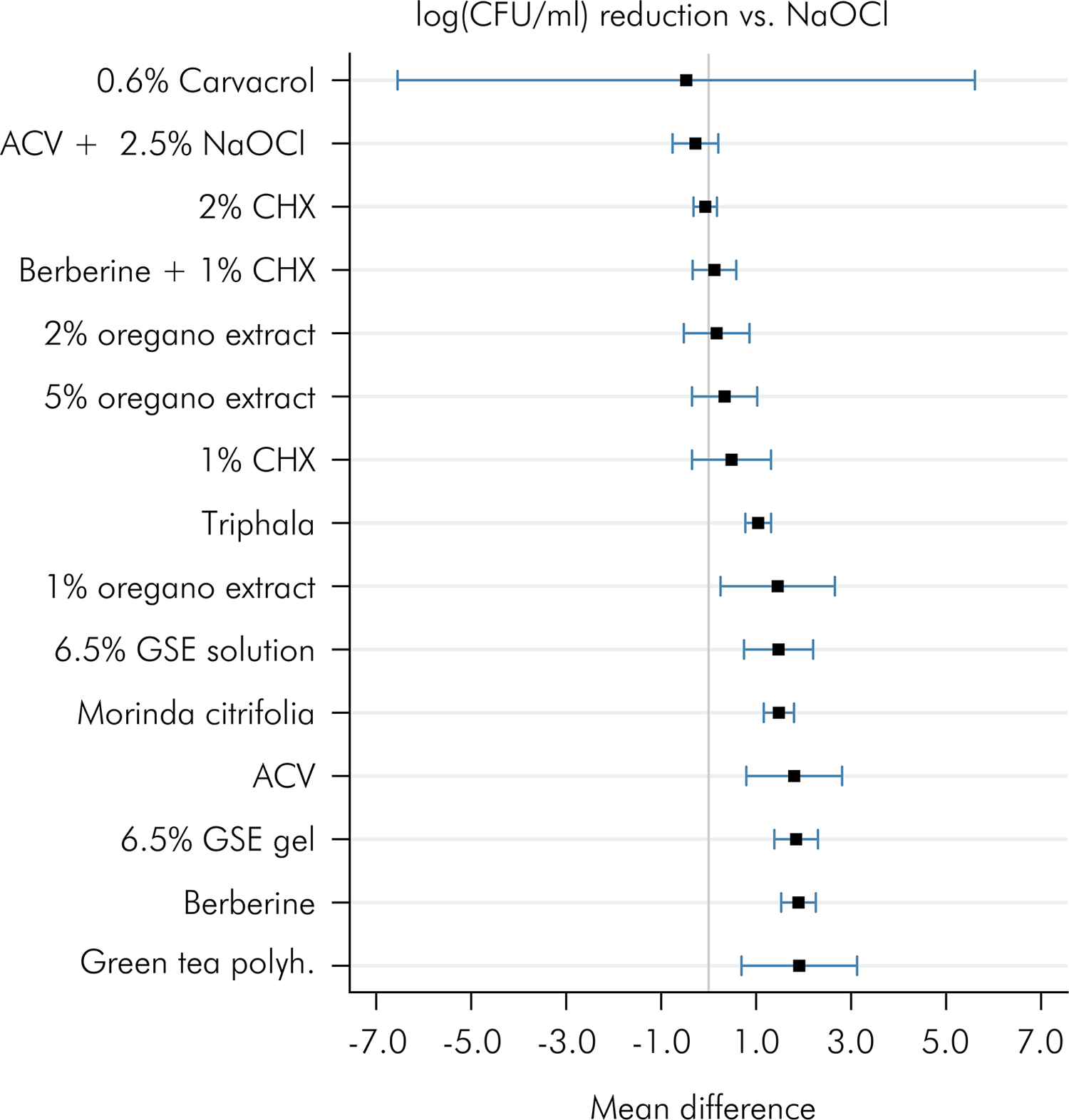
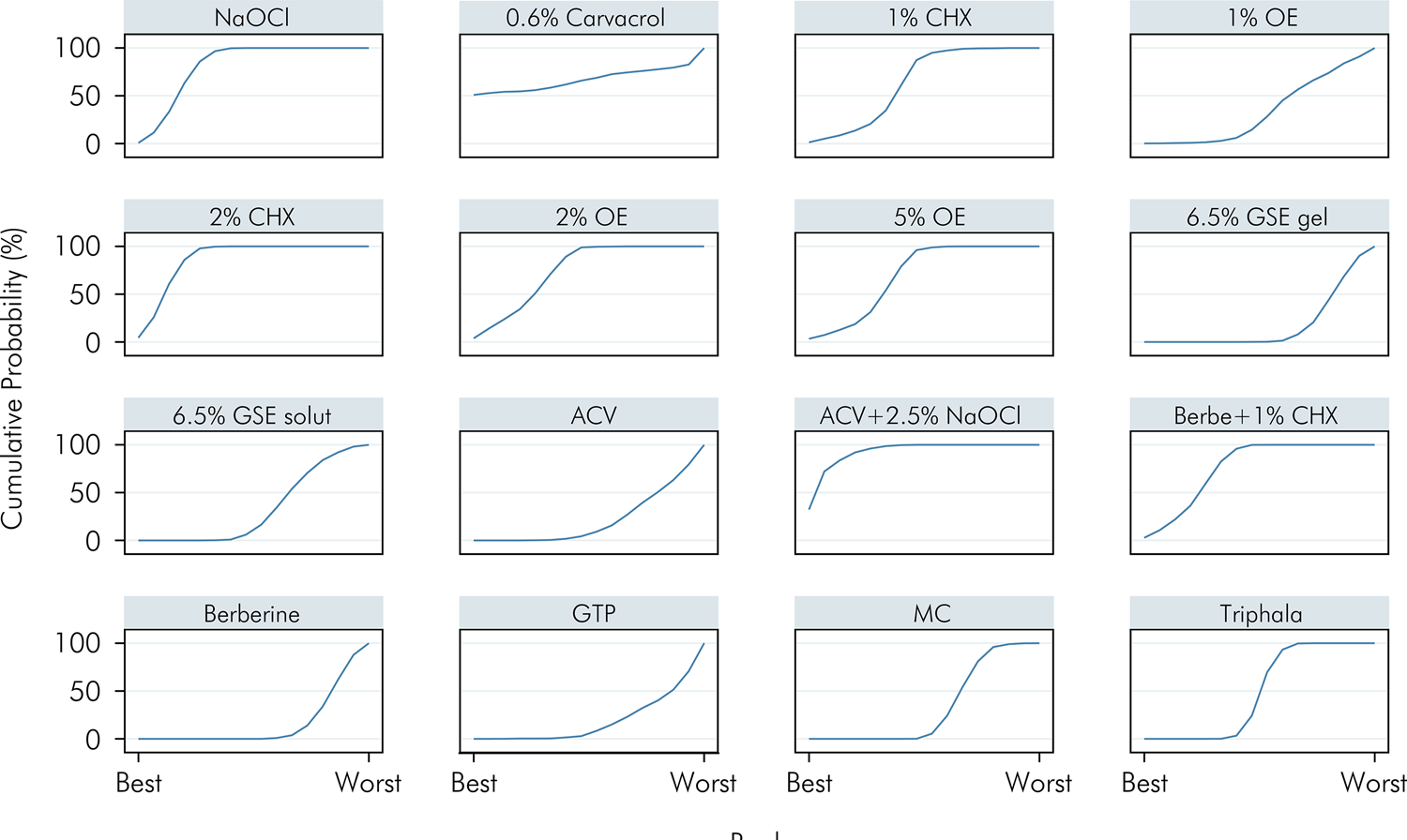
In the network meta-analysis, the CFU reduction of each NES and CCS was compared to the same reduction of the NaOCl solution. Thus, negative values indicate that the solution reduced more CFUs than NaOCl (control group). Considering that all studies included in the network meta-analysis had similar scales, we presented a simple mean difference combining direct and indirect comparisons with respective 95% confidence intervals. Among the advantages of fitting a network meta-analysis is the ability to estimate a comparison between two treatments if directly compared (even though the studies included in the meta-analysis did not formally compare them). Direct and indirect comparisons were organized into a forest plot for better reference. The network meta-analysis also helped estimate the cumulative probability of each natural or chemical solution being the best to reduce the number of CFUs.
All analyses used Stata 17.0 software (StataCorp LLC, College Station, USA).
Results
Study selection
The initial study selection found 16,188 studies, and 8,177 were eliminated after identifying the duplicates. The eligibility criteria were applied, retrieving 35 studies for a full-text assessment. Three studies were excluded after the full-text reading: two assessed antimicrobial activity in sectioned teeth,38,39 and one focused on antimicrobial activity in primary teeth.40 Thirty-two studies14,15,25-54 remained for the qualitative synthesis. The citation search identification method found 38 additional studies. However, three articles55-57 were selected for the qualitative synthesis, totaling 35 studies for this systematic review. Considering that 28 studies14,15,25-29,34-45,48-55,57 did not provide the means and standard deviations of the mean percentage (%) of CFU reduction for the irrigation solutions, only seven30-33,46,47,56 were included in the quantitative synthesis. Figure 2 describes all the details.

Study characteristics
Table 2 shows the main characteristics of the 35 included studies published between 2009 and 2023 and reported from 10 countries, mainly India15,30,32,34,35,37,38,44,45,51,52,54,55 and Brazil.27,29,31,33,39,50,53,57 The result analysis showed 1,504 teeth/roots exclusively considering the groups used in this review. All eligible studies used single-rooted permanent teeth. Also, all studies used NaOCl in different concentrations as CCS, and 20 used CHX.14,28-31,33-37,39,42,45,47,49,52,53,55-57 Forty-three natural solutions were detected during data assessment and detailed in Table 2 with respective concentrations. The most prevalent natural solutions were based on Aloe vera,34,48,53,54 Azadirachta indica,15,25,54 grape seed extract,29,31,50 Triphala,30,32,51 and oregano.43,47,52
Table 3 summarizes the main intervention characteristics of the included studies. All irrigating procedures were performed manually without ultrasonic activating protocols. The irrigation volume varied between 1 and 30 mL, most often 5 mL.15,25,27,30,36,46,50 The irrigation time was between 30 seconds and 20 minutes, most often five28,46,49 and 2015,30,54 minutes.
Risk of bias assessment
Table 4 demonstrates the critical appraisal of the studies included in this systematic review. Regarding the planning and allocation domain, six of the 35 studies reported a sample size calculation,26,30,40,42,44,54 and no study described sample randomization for experimental procedures. Furthermore, four articles did not sufficiently report the inclusion of a control.15,40,51,52 Two studies showed biases related to sample standardization.40,56 None of the included articles reported operator blinding. Moreover, relevant information was missing in the data treatment and outcome domain in a high prevalence of studies regarding statistical analysis14,15,25,27,32,34,38,43,45,46,48,51,53-55 and correct outcome reporting.37,40,46,48,49,51,52
Specific study results
Table 3 summarizes the parameters and specific results collected from the included studies. Overall, 21 studies did not present a significant difference in bacterial reduction between NES and CCS.15,28,29,31,32,34,39-41,43,45-47,49-51,53-57 NES (oregano, grape seed extract, and Andrographis Paniculata) had better antimicrobial activity against NaOCl in four studies.29,47,52,55 Two studies showed higher antimicrobial efficacy for curcumin45 and propolis35 compared to CHX. When comparing CCS, NaOCl had better antimicrobial activity than CHX in three studies.31,37,45 Meanwhile, CHX was more satisfactory than NaOCl in five studies.29,34,47,53,55 Overall, eight studies showed no difference in effectiveness between NaOCl and CHX.14,28,33,36,42,49,53,56
Network meta-analysis
Only seven studies provided sufficient information for inclusion in the network meta-analysis, jointly comparing directly and indirectly 16 types of NES or CCS. The thickness of the lines evidenced that most studies compared 2% CHX with NaOCl (Figure 1). There was no indication of inconsistency in the analyzed mapping.
Eight of the 15 NES or CCS compared to NaOCl were significantly less effective than the control solution – presenting positive mean difference values. CFUs increased from 1.04 (95%CI: 0.77–1.31) for Triphala to 1.91 (95%CI: 0.69–3.14) for green tea polyphenols compared to NaOCl. The remaining seven NES or CCS had statistically similar CFU reductions to NaOCl, as these included the null value in their 95% confidence intervals (Figure 3). The highest CFU reduction compared to NaOCl occurred with 0.6% carvacrol (mean difference = -0.47) but without evidence of a statistically significant difference compared to the reference group (95%CI:-6.55–5.61). Table 5 provides a detailed description of the mean differences between each solution and the reference treatment.

Based on the cumulative probability plot in Figure 4, apple cider vinegar combined with 2.5% NaOCl (ACV + 2.5% NaOCl) was the fastest to reach 100%, presenting the highest probability of being the best solution to reduce CFUs after irrigation. The second-best solution was 2% CHX, followed by NaOCl (control).

Discussion
This systematic review assessed the antimicrobial efficacy of natural endodontic solutions (NES) and conventional chemical solutions (CCS) against Enterococcus faecalis because that is the most prevalent microorganism in persistent root canal infections.37 The null hypothesis of this review was partially accepted, as carvacrol and oregano extracts had statistically similar CFU reductions to sodium hypochlorite (NaOCl). Likewise, apple cider vinegar and berberine showed equivalent results to NaOCl when associated with CCS. Nevertheless, other NES assessed in this study were less effective than NaOCl.30-33,46,47,56 Although not comprising the primary outcome of this systematic review, the authors suggest that combining NES with CCS might be beneficial as a complementary solution for eliminating E. faecalis.
Several NaOCl concentrations have been used for root canal irrigation. The most used concentration is 2.5% NaOCl because it achieves an adequate bacterial effect while cytotoxicity remains low.28 However, considering that volume and frequency of irrigation influence the antimicrobial efficacy of NaOCl more than its concentration,58,59 this review considered in the meta-analysis all NaOCl concentrations as a single control solution, although higher NaOCl concentrations might increase cytotoxicity.28 Chlorhexidine (CHX) has represented an alternative endodontic solution due to drawbacks from NaOCl. The advantage of CHX is the substantivity that ensures a durable effect even if the solution concentration decreases in the oral environment.28,53 CHX concentrations of 0.2%-2% show antimicrobial effects but cannot dissolve the organic tissue.28,29,53,58 This systematic review corroborates the literature data on NaOCl and CHX being the preferred solutions for root canal disinfection.58
Natural extracts have been extensively used in endodontics due to their antibacterial and antifungal properties.60 Studies have demonstrated that some of these extracts are effective against microorganisms commonly found in the oral cavity, including E. faecalis.60,61 Their action mechanism is based on their lipophilic components, which inhibit ATPase bacterial activity and increase the non-selective permeability of the bacterial cell membrane. Besides inhibiting bacterial colonization, this mechanism makes bacteria more sensitive to antimicrobial agents. Moreover, NES may disrupt the lipidic membrane, causing the death of microorganisms.46,62
Among all natural solutions included in this review, 0.6% carvacrol and 2% and 5% oregano extracts were the NES with similar or superior antimicrobial potential to NaOCl when evaluated without association with CCS.46,47 Carvacrol has a broad spectrum of antibacterial activity and inhibits ATPase activity, favoring permeability to microbial agents.46 It also shows anti-inflammatory effects by suppressing prostaglandin production and inhibiting neutrophilic elastase enzyme due to a hydroxyl group in its chemical composition, representing the most bioactive molecule to inhibit this enzyme activity.46,63 However, 0.6% carvacrol should not be considered similar to NaOCl due to the uncertainty of data from the study included in the meta-analysis,46 showing a high standard deviation. The literature describes that carvacrol is the main constituent of oregano essential oil, corresponding to 68% of its composition.64 However, it is impossible to assure that the similar antibacterial efficacy of oregano with NaOCl is due to carvacrol in its composition because the authors did not describe the extract vehicle.47 Otherwise, the qualitative analysis of this review demonstrated superior or similar results for oregano essential oil based on carvacrol compared to NaOCl and CHX.43,52
The meta-analysis showed that apple cider vinegar + 2.5% NaOCl and berberine + 1% CHX were the NES with similar or higher CFU count reduction than NaOCl. Apple cider vinegar is an acid solution that potentially removes the smear layer and improves immunologic response. Maleic acid (C4H6O5) is the main constituent of apple cider vinegar and may enhance the immune system by being present in the Krebs cycle.65 Berberine is an alkaloid extracted from medicinal plants, and it possesses a broad antimicrobial spectrum against bacteria, fungi, and viruses with low toxicity.56 However, the antimicrobial effect of apple cider vinegar + 2.5% NaOCl and berberine + 1% CHX as root canal irrigants may be due to the association of these extracts with NaOCl or CHX. When evaluated without an association, those natural solutions did not show similar antimicrobial efficacy to CCS in both studies. Even isolated berberine and apple cider vinegar showed the potential to induce cell death by reducing CFU count and were significantly less effective than other solutions (Figure 3).
Associating NaOCl with acidic solutions is not necessarily beneficial due to the need for high NaOCl concentrations to reach a neutral pH solution.33 However, the quantitative analysis of this review showed that apple cider vinegar combined with 2.5% NaOCl (ACV + 2.5% NaOCl) was the fastest solution to achieve a 100% probability of CFU count reduction. Considering that apple cider vinegar has adequate properties for root canal cleaning, such as smear layer removal and antibacterial potential, the authors encourage further studies to use this substance, possibly associating apple cider vinegar with a solution used for endodontic treatment. Conversely, apple cider vinegar alone showed some of the worst probability of reaching total microorganism elimination.
Curcumin showed similar antimicrobial efficacy to NaOCl and superior to CHX in young biofilms. In mature biofilms, curcumin exhibited higher bacterial elimination than CHX.45 This enhanced efficacy may stem from curcumin’s ability to penetrate and dismantle the extracellular polysaccharide matrix and bacteria akin to NaOCl. This matrix is a nutrient source and conducive surface for increased cell growth, crucial for bacterial biofilm maintenance.66,67 Although apple cider vinegar, berberine, and curcumin have demonstrated similar or even superior antimicrobial activity, it is worth noting that these compounds may not necessarily have an intervention effect comparable to NaOCl or CHX. Despite significant differences, their relevance regarding antimicrobial effects may not be conclusive and requires a more consistent evaluation.
The limitation of this review process stems from the assessment of preclinical studies. As NaOCl and CHX are extensively used and established as standard irrigant solutions in the literature,59 clinical studies evaluating the antimicrobial effect of natural solutions as endodontic irrigants are scarce. This information allows us to consider natural-based irrigant solutions as complementary agents instead of substitutes in combating endodontic microbiota. The present review reinforces this perspective, as the combination of apple cider vinegar + 2.5% NaOCl exhibited superior efficacy against E. faecalis compared to 2.5% NaOCl alone.
The results obtained in this network meta-analysis should be interpreted with caution, primarily due to the limitations of the gathered evidence. Although RoBDEMAT is designed for assessing bias in preclinical studies, it should be used carefully. This tool combines bias assessment with reporting issues, potentially hindering the distinction between study limitations from reporting deficiencies and related to study design biases. This integration might create confusion in decision-making. Information such as sample size calculation, operator and assessment blinding, allocation concealment, and sample randomization might introduce biases. The risk of bias assessment demonstrated a lack of reporting, mostly of sample size calculation, sample randomization, and operator blinding. The latter may be limited in this study type mainly due to the odor and color of irrigating solutions, such as NaOCl and root canal irrigants based on alcoholic vehicles.15 Editors, peer-reviewers, and authors of research articles must endorse these limitations, collaboratively aiming at adherence to reporting guides.
Additionally, individual biases make it challenging to reach a definitive conclusion regarding the antimicrobial efficacy of natural endodontic irrigants. This systematic review only examined monospecies biofilms, thus failing to capture the complexities of diverse microbiomes and intricate interactions associated with endodontic infections. Consequently, extrapolating the findings to clinical practice is limited. However, our results encourage the formulation of new studies, including randomized clinical trials, to confirm our findings regarding CFU bacterial count after irrigation with NES and provide reliable data for clinical application.
Conclusion
The obtained evidence shows that, although natural endodontic solutions (NES) did not overcome NaOCl, they have antimicrobial potential against Enterococcus faecalis. Although the evidence was based on ex vivo studies, this review provides the preclinical antibacterial efficacy of NES. All studies exhibited reporting flaws regarding bias analysis, so further standardized studies must be conducted to confirm or refute our findings.
Acknowledgments
This study was financed in part by the Coordenação de Aperfeiçoamento de Pessoal de Nível Superior - Brazil (CAPES) - Finance Code 001. We are thankful for the support of Conselho Nacional de Desenvolvimento Científico e Tecnológico - Brazil (CNPq) and of Fundação de Amparo à Pesquisa do Estado de Minas Gerais - Brazil (FAPEMIG).
References
- 1 Siqueira Junior JF, Rocas IDN, Marceliano-Alves MF, Perez AR, Ricucci D. Unprepared root canal surface areas: causes, clinical implications, and therapeutic strategies. Braz Oral Res. 2018;32(suppl 1):e65.
- 2 Villalta-Briones N, Baca P, Bravo M, Solana C, Aguado-Perez B, Ruiz-Linares M, et al. A laboratory study of root canal and isthmus disinfection in extracted teeth using various activation methods with a mixture of sodium hypochlorite and etidronic acid. Int Endod J. 2021;54(2):268-78.
- 3 Ricucci D, Loghin S, Siqueira JF, Jr. Exuberant Biofilm infection in a lateral canal as the cause of short-term endodontic treatment failure: report of a case. J Endod. 2013;39(5):712-8.
- 4 Pereira TC, Dijkstra RJB, Petridis X, Sharma PK, van de Meer WJ, van der Sluis LWM, et al. Chemical and mechanical influence of root canal irrigation on biofilm removal from lateral morphological features of simulated root canals, dentine discs and dentinal tubules. Int Endod J. 2021;54(1):112-29.
- 5 Stuart CH, Schwartz SA, Beeson TJ, Owatz CB. Enterococcus faecalis: its role in root canal treatment failure and current concepts in retreatment. J Endod. 2006;32(2):93-8.
- 6 Love RM. Enterococcus faecalis--a mechanism for its role in endodontic failure. Int Endod J. 2001;34(5):399-405.
- 7 Prada I, Mico-Munoz P, Giner-Lluesma T, Mico-Martinez P, Collado-Castellano N, Manzano-Saiz A. Influence of microbiology on endodontic failure. Literature review. Med Oral Patol Oral Cir Bucal. 2019;24(3):e364-e72.
- 8 Sakamoto M, Siqueira JF, Jr., Rocas IN, Benno Y. Molecular analysis of the root canal microbiota associated with endodontic treatment failures. Oral Microbiol Immunol. 2008;23(4):275-81.
- 9 Zehnder M. Root canal irrigants. J Endod. 2006;32(5):389-98.
- 10 Demenech LS, de Freitas JV, Tomazinho FSF, Baratto-Filho F, Gabardo MCL. Postoperative Pain after Endodontic Treatment under Irrigation with 8.25% Sodium Hypochlorite and Other Solutions: A Randomized Clinical Trial. J Endod. 2021;47(5):696-704.
- 11 Demenech LS, Tomazinho FSF, Baratto-Filho F, Brancher JA, Pereira LF, Gabardo MCL. Biocompatibility of the 8.25% sodium hypochlorite irrigant solution in endodontics: An in vivo study. Microsc Res Tech. 2021.
- 12 Karkehabadi H, Yousefifakhr H, Zadsirjan S. Cytotoxicity of Endodontic Irrigants on Human Periodontal Ligament Cells. Iran Endod J. 2018;13(3):390-4.
- 13 Kleier DJ, Averbach RE, Mehdipour O. The sodium hypochlorite accident: experience of diplomates of the American Board of Endodontics. J Endod. 2008;34(11):1346-50.
- 14 Nourzadeh M, Amini A, Fakoor F, Raoof M, Sharififar F. Comparative Antimicrobial Efficacy of Eucalyptus Galbie and Myrtus Communis L. Extracts, Chlorhexidine and Sodium Hypochlorite against Enterococcus Faecalis. Iran Endod J. 2017;12(2):205-10.
- 15 Panchal V, Gurunathan D, Muralidharan N. Comparison of antibacterial efficacy of cinnamon extract, neem extract as irrigant and sodium hypochlorite against Enterococcus fecalis: An in vitro study. Indian J Dent Res. 2020;31(1):124-8.
- 16 Shamseer L, Moher D, Clarke M, Ghersi D, Liberati A, Petticrew M, et al. Preferred reporting items for systematic review and meta-analysis protocols (PRISMA-P) 2015: elaboration and explanation. BMJ. 2015;349:g7647.
- 17 Page MJ, McKenzie JE, Bossuyt PM, Boutron I, Hoffmann TC, Mulrow CD, et al. The PRISMA 2020 statement: An updated guideline for reporting systematic reviews. PLoS Med. 2021;18(3):e1003583.
-
18 Aromataris E, Lockwood C, Porritt K, Pilla B, Jordan Z, editors. JBI Manual for evidence synthesis. JBI; 2024 [cited 2024 Apr 23] Available from: https://synthesismanual.jbi.global https://doi.org/10.46658/JBIMES-24-0119
» https://synthesismanual.jbi.global» https://doi.org/10.46658/JBIMES-24-0119 - 19 Ouzzani M, Hammady H, Fedorowicz Z, Elmagarmid A. Rayyan-a web and mobile app for systematic reviews. Syst Rev. 2016;5(1):210.
- 20 Delgado AH, Sauro S, Lima AF, Loguercio AD, Della Bona A, Mazzoni A, et al. RoBDEMAT: A risk of bias tool and guideline to support reporting of pre-clinical dental materials research and assessment of systematic reviews. J Dent. 2022;127:104350.
- 21 Dias S, Welton NJ, Caldwell DM, Ades AE. Checking consistency in mixed treatment comparison meta-analysis. Stat Med. 2010;29(7-8):932-44.
- 22 Haripriya S, Ajitha P. Comparitive evaluation of dentinal tubule disinfection using propolis, morinda citrifolia, aloevera. J Pharm Sci. 2017;9:2042-4
- 23 Gunasekaran G, Geetha RV, Thangavelu L. Evaluation of the effect of Glycyrrhiza glabra as root canal disinfectant - An in vitro study. Drug Invention Today. 2019;12:1326-30.
- 24 Afshan T, Parwez A, Prasanna PL, Bhargav MVG, Balaji K, Hussain T. Comparison of antimicrobial efficacy of herbal root canal irrigants (Azadirachta indica, Morinda citrifolia) against Enterococcus faecalis. World J Dent. 2020;11:206-10.
- 25 Al Qarni FM, ElFasakhany FM, Fathy M, Kenawi LM, Moustafa AM. Antimicrobial Activity Of Azadirachta Indica (Neem) and Salvadora Persica (Miswak) Extracts as Endodontic Irrigants. ENDO. 2019;13(3):237-45.
- 26 Alharbi AM, Alharbi TM, Alqahtani MS, Elfasakhany FM, Afifi IK, Rajeh MT, et al. A Comparative Evaluation of Antibacterial Efficacy of Moringa oleifera Leaf Extract, Octenidine Dihydrochloride, and Sodium Hypochlorite as Intracanal Irrigants against Enterococcus faecalis: An In Vitro Study. Int J Dent. 2023;2023:7690497.
- 27 Alves FR, Neves MA, Silva MG, Rôças IN, Siqueira JFJ. Antibiofilm and antibacterial activities of farnesol and xylitol as potential endodontic irrigants. Braz Dent J. 2013;24(3):224-9.
- 28 Camacho-Alonso F, Salmerón-Lozano P, Martínez-Beneyto Y. Effects of photodynamic therapy, 2 % chlorhexidine, triantibiotic mixture, propolis and ozone on root canals experimentally infected with Enterococcus faecalis: an in vitro study. Odontology. 2017;105(3):338-46.
- 29 Cecchin D, Farina AP, Souza MA, Albarello LL, Schneider AP, Vidal CM, et al. Evaluation of antimicrobial effectiveness and dentine mechanical properties after use of chemical and natural auxiliary irrigants. J Dent. 2015;43(6):695-702.
- 30 Choudhary E, Indushekar K, Saraf B, Sheoran N, Sardana D, Shekhar A. Exploring the role of Morinda citrifolia and Triphala juice in root canal irrigation: An ex vivo study. J Conserv Dent. 2018;21(4):443-9.
- 31 D'Aviz F S, Lodi E, Souza MA, Farina AP, Cecchin D. Antibacterial Efficacy of the Grape Seed Extract as an Irrigant for Root Canal Preparation. Eur Endod J. 2020;20;5(1):35-9.
- 32 Divia AR, Nair MG, Varughese JM, Kurien S. A comparative evaluation of Morinda citrifolia, green tea polyphenols, and Triphala with 5% sodium hypochlorite as an endodontic irrigant against Enterococcus faecalis: An in vitro study. Dent Res J (Isfahan). 2018;15(2):117-22.
- 33 Dornelles-Morgental R, Guerreiro-Tanomaru JM, de Faria-Júnior NB, A. H-DM, C. KM, Tanomaru-Filho M. Antibacterial efficacy of endodontic irrigating solutions and their combinations in root canals contaminated with Enterococcus faecalis. Oral Surg Oral Med Oral Pathol Oral Radiol. 2011;112(3):396-400.
- 34 Goud S, Aravelli S, Dronamraju S, Cherukuri G, Morishetty P. Comparative Evaluation of the Antibacterial Efficacy of Aloe Vera, 3% Sodium Hypochlorite, and 2% Chlorhexidine Gluconate Against Enterococcus faecalis: An In Vitro Study. Cureus. 2018;10(10):e3480.
- 35 Gulati RK, Jain N, Singh A, Jain A, Jindal A, Kumawat MK, et al. Comparative Evaluation of the Antimicrobial Efficacy of Chemical and Phytomedicinal Agents When Used As Intracanal Irrigants: An In Vitro Study. Cureus. 2023;15(11):e48754.
- 36 Guneser MB, B. AM, Eldeniz AU. Antibacterial effect of chlorhexidine-cetrimide combination, Salvia officinalis plant extract and octenidine in comparison with conventional endodontic irrigants. Dent Mater J. 2016;35(5):736-41.
- 37 Gupta SS, Thosar N, Rathi N, Baliga SM, Thakkar Y, Deulkar P. Evaluation of Antibacterial Efficacy of Vitex negundo Linn. extract as Root Canal Irrigant against Enterococcus faecalis and its penetration into Root Dentin: An in-vitro study. Int J Ayurvedic Med. 2020;11(2):193-9.
- 38 Gupta-Wadhwa A, Wadhwa J, Duhan J. Comparative evaluation of antimicrobial efficacy of three herbal irrigants in reducing intracanal E. faecalis populations: An in vitro study. J Clin Exp Dent. 2016;8(3):e230-5.
- 39 Herrera DR, Durand-Ramirez JE, Falcao A, Silva EJ, Santos EB, Gomes BP. Antimicrobial activity and substantivity of Uncaria tomentosa in infected root canal dentin. Braz Oral Res. 2016;30(1):e61.
- 40 Ibrahim RO, Salama RA, Amin AM. Can Ethanolic Leaf Extract of Olive or Black Mulberry Substitute Sodium Hypochlorite as a Root Canal Irrigant? An In Vitro Study. J Contemp Dent Pract. 2021;22(10):1123-9.
- 41 Kim SW, Shin DH. Antibacterial effect of urushiol on E. faecalis as a root canal irrigant. Restor Dent Endod. 2017;42(1):54-9.
- 42 Mokhtari H, Eskandarinezhad M, Barhaghi MS, Asnaashari S, Sefidan FY, Abedi A, et al. Comparative antibacterial effects of ginger and marjoram extract versus conventional irrigants on mature Enterococcus faecalis biofilms: An in vitro study. J Clin Exp Dent. 2023;15(4):e304-e10.
- 43 Nagy-Bota MC, Man AD, Santacroce L, Brinzaniuc K, Pap Z, Pacurar M, et al. Essential Oils as Alternatives for Root-Canal Treatment and Infection Control against Enterococcus faecalis-A Preliminary Study. Appl Sci (Basel). 2021;11(4).
- 44 Navayath M, Ramesh SR, Kalaiselvam R, Ashok R, Rajendran MR, Balaji L. Evaluation of Nanomagnesium Oxide in Combination with Garlic Extract as an Endodontic Irrigant: An In Vitro Study. J Contemp Dent Pract. 2023;24(7):459-66.
- 45 Neelakantan P, Subbarao C, Sharma S, Subbarao CV, Garcia-Godoy F, Gutmann JL. Effectiveness of curcumin against Enterococcus faecalis biofilm. Acta Odontol Scand. 2013;71(6):1453-7.
- 46 Nosrat A, Bolhari B, Sharifian MR, Aligholi M, Mortazavi MS. The effect of Carvacrol on Enterococcus faecalis as a final irrigant. Iran Endod J. 2009;4(3):96-100.
- 47 Ok E, Adanir N, Ozturk T. Antibacterial and smear layer removal capability of oregano extract solution. Eur J Dent. 2015;9(1):20-4.
- 48 Sahebi S, Khosravifar N, Sedighshamsi M, Motamedifar M. Comparison of the antibacterial effect of sodium hypochlorite and aloe vera solutions as root canal irrigants in human extracted teeth contaminated with enterococcus faecalis. J Dent (Shiraz). 2014;15(1):39-43.
- 49 Samadi N, Zaree R, Bakhtiar H, Salehnia A, Azimi S. Comparative antibacterial efficacy of endemic satureja khuzistanica jamzad essential oil, sodium hypochlorite and chlorhexidine gluconate solutions as root canal irrigations. Dent Res J (Isfahan). 2011;8(1):28-32.
- 50 Soligo LT, Lodi E, Farina AP, Souza MA, Vidal CMP, Cecchin D. Antibacterial Efficacy of Synthetic and Natural-Derived Novel Endodontic Irrigant Solutions. Braz Dent J. 2018;29(5):459-64.
- 51 Somayaji SK, Ballal V, Shobha KL, Rao M. Comparison of antimicrobial efficacy of triphala, Withania somnifera and sodium hypochlorite against Enterococcus faecalis biofilm An in vitro study. Int J Pharm Pharm Sci. 2014;6:808-11.
- 52 Teja K, Janani K, Vasundhara K, Krishnamachari H. Comparative antimicrobial efficacy of oregano oil, chlorhexidine and sodium hypochlorite against Enterococcus faecalis - an in vitro study. Endodontology. 2021;33(2):97-101.
- 53 Valera MC, L.E. M, de Oliveira LD, Jorge AO, Shygei É, Carvalho CA. In vitro antimicrobial activity of auxiliary chemical substances and natural extracts on Candida albicans and Enterococcus faecalis in root canals. J Appl Oral Sci. 2013;21(2):118-23.
- 54 Vinothkumar T, Rubin M, Balaji L, Kandaswamy D. In vitro evaluation of five different herbal extracts as an antimicrobial endodontic irrigant using real time quantitative polymerase chain reaction. J Conserv Dent. 2013;16(2):167-70.
- 55 Varman CR, Thillainayagam S, Dinesh DS, Jaisenthil A, Bharath NB, Karthikeyan S. A comparative evaluation of the efficacy of andrographis paniculata, 2% chlorhexidine and 5.25% sodium hypochlorite against enterococcus faecalis - an invitro study. Int J Curr Res Rev. 2017;9(2):9-13.
- 56 Xie Q, Johnson BR, Wenckus CS, Fayad MI, Wu CD. Efficacy of berberine, an antimicrobial plant alkaloid, as an endodontic irrigant against a mixed-culture biofilm in an in vitro tooth model. J Endod. 2012;38(8):1114-7.
- 57 Zamin C. Application of essential oils as irrigating solution in root canals and dentinal tubules infected with Enterococcus faecalis and Candida albicans [translated]. Online resource (141 p.) Thesis (PhD). State University of Campinas, Faculty of Dentistry of Piracicaba, Piracicaba, SP. 2017.
- 58 Gonçalves LS, Rodrigues RC, Andrade Junior CV, Soares RG, Vettore MV. The Effect of Sodium Hypochlorite and Chlorhexidine as Irrigant Solutions for Root Canal Disinfection: A Systematic Review of Clinical Trials. J Endod. 2016;42(4):527-32.
- 59 Ruksakiet K, Hanak L, Farkas N, Hegyi P, Sadaeng W, Czumbel LM, et al. Antimicrobial Efficacy of Chlorhexidine and Sodium Hypochlorite in Root Canal Disinfection: A Systematic Review and Meta-analysis of Randomized Controlled Trials. J Endod. 2020;46(8):1032-41 e7.
- 60 Kowalczyk A, Przychodna M, Sopata S, Bodalska A, Fecka I. Thymol and Thyme Essential Oil-New Insights into Selected Therapeutic Applications. Molecules. 2020;25(18).
- 61 Aires A, Barreto AS, Semedo-Lemsaddek T. Antimicrobial Effects of Essential Oils on Oral Microbiota Biofilms: The Toothbrush In Vitro Model. Antibiotics (Basel). 2020;10(1).
- 62 Perez AP, Perez N, Lozano CMS, Altube MJ, de Farias MA, Portugal RV, et al. The anti MRSA biofilm activity of Thymus vulgaris essential oil in nanovesicles. Phytomedicine. 2019;57:339-51.
- 63 Kacem R, Meraihi Z. Effects of essential oil extracted from Nigella sativa (L.) seeds and its main components on human neutrophil elastase activity. Yakugaku Zasshi. 2006;126(4):301-5.
- 64 Dadalioglu I, Evrendilek GA. Chemical compositions and antibacterial effects of essential oils of Turkish oregano (Origanum minutiflorum), bay laurel (Laurus nobilis), Spanish lavender (Lavandula stoechas L.), and fennel (Foeniculum vulgare) on common foodborne pathogens. J Agric Food Chem. 2004;52(26):8255-60.
- 65 Estrela C, Holland R, Bernabe PF, de Souza V, Estrela CR. Antimicrobial potential of medicaments used in healing process in dogs' teeth with apical periodontitis. Braz Dent J. 2004;15(3):181-5.
- 66 Giardino L, Ambu E, Savoldi E, Rimondini R, Cassanelli C, Debbia EA. Comparative evaluation of antimicrobial efficacy of sodium hypochlorite, MTAD, and Tetraclean against Enterococcus faecalis biofilm. J Endod. 2007;33(7):852-5.
- 67 Seal GJ, Ng YL, Spratt D, Bhatti M, Gulabivala K. An in vitro comparison of the bactericidal efficacy of lethal photosensitization or sodium hyphochlorite irrigation on Streptococcus intermedius biofilms in root canals. Int Endod J. 2002;35(3):268-74