 Geographic accessibility to childbirth care: spatial analysis of the displacement network, Pernambuco, 2023
Abstract
Objective: To analyze geographic accessibility to childbirth care in health macroregion I of Pernambuco, Brazil, in 2023, considering low-risk and high-risk deliveries performed within the Brazilian Unified Health System (Sistema Único de Saúde, SUS).
Methods: A spatial analysis was conducted using delivery records from the Hospital Information System of the Brazilian Unified Health System (Sistema de Informação Hospitalar do Sistema Único de Saúde, SIH/SUS). All hospital deliveries among residents in macroregion I were included, with distances and travel times analyzed between the municipality of residence and the place of delivery. Absolute and relative frequencies were calculated, and Pearson’s chi-square test was applied, adopting a significance level of 5%.
Results: A total of 41,354 deliveries were analyzed, of which 35.6% were classified as high risk. It was observed that 56.1% of pregnant women needed to travel from their municipality of residence for hospitalization. Most displacements occurred within the same macroregion, with a strong concentration in Recife. Among high-risk pregnant women, 30.8% traveled distances greater than 60 km, and 38.0% had to travel at least 60 minutes.
Conclusion: A high need for displacement among pregnant women in macroregion I of Pernambuco was observed, especially in high-risk cases, with strong centralization of services in health region I and in Recife. Greater distances and travel times were significantly associated with high-risk deliveries, highlighting barriers to geographic accessibility. The findings indicate weaknesses in the regionalization of the obstetric care network and the need to reorganize service delivery to reduce inequities in access to childbirth care.
Keywords:
Maternal Health Services; Health Services Accessibility; Parturition; Health Equity; Spatial Analysis
Resumo
Objetivo: Analisar a acessibilidade geográfica ao parto na macrorregião de saúde I de Pernambuco, em 2023, considerando partos de risco habitual e de alto risco realizados no Sistema Único de Saúde.
Métodos: Realizou-se uma análise espacial a partir de registros de partos do Sistema de Informação Hospitalar do Sistema Único de Saúde (SUS). Foram incluídos todos os partos hospitalares de residentes na macrorregião I, analisando-se distâncias e tempos de deslocamento entre o município de residência e o local de ocorrência do parto. Foram calculadas frequências absolutas e relativas e aplicado o teste Qui-quadrado de Pearson, adotando-se nível de significância de 5%.
Resultados: Foram analisados 41.354 partos, dos quais 35,6% foram classificados como de alto risco. Observou-se que 56,1% das gestantes necessitaram deslocar-se do município de residência para a internação. A maioria dos deslocamentos ocorreu dentro da própria macrorregião, com forte centralização em Recife. Entre as gestantes de alto risco, 30,8% percorreram distâncias superiores a 60 km e 38,0% tiveram ao menos 60 minutos de tempo de deslocamento.
Conclusão: Observou-se elevada necessidade de deslocamento das gestantes na macrorregião I de Pernambuco, especialmente nos casos de alto risco, com forte centralização dos serviços na Região de Saúde I e em Recife. Distâncias e tempos de deslocamento mais elevados associaram-se significativamente aos partos de alto risco, evidenciando barreiras de acessibilidade geográfica. Os achados indicam fragilidades na regionalização da rede obstétrica e a necessidade de reorganizar a oferta de serviços para reduzir iniquidades no acesso ao parto.
Palavras-chave:
Serviços de Saúde Materna; Acesso aos serviços de saúde; Parto; Equidade em saúde; Análise espacial
Resumen
Objetivo: Analizar la accesibilidad geográfica al parto en la macrorregión de salud I de Pernambuco en 2023, considerando los partos de riesgo habitual y de alto riesgo realizados en el Sistema Único de Salud (Sistema Único de Saúde, SUS).
Métodos: Se realizó un análisis espacial a partir de registros de partos del Sistema de Información Hospitalaria del Sistema Único de Salud (Sistema de Informação Hospitalar do Sistema Único de Saúde, SIH/SUS). Se incluyeron todos los partos hospitalarios de residentes en la macrorregión I, y se analizaron las distancias y los tiempos de desplazamiento entre el municipio de residencia y el lugar de ocurrencia del parto. Se calcularon las frecuencias absolutas y relativas y se aplicó la prueba de chi-cuadrado de Pearson, adoptándose un nivel de significación del 5%.
Resultados: Se analizaron 41.354 partos, de los cuales el 35,6% fueron clasificados como de alto riesgo. Se observó que el 56,1% de las gestantes necesitó desplazarse desde su municipio de residencia para la hospitalización. La mayoría de los desplazamientos ocurrió dentro de la propia macrorregión, con una fuerte centralización en Recife. Entre las gestantes de alto riesgo, el 30,8% recorrió distancias superiores a 60 km y el 38,0% tuvo un desplazamiento de al menos 60 minutos.
Conclusión: Se observó una elevada necesidad de desplazamiento de las gestantes en la macrorregión I de Pernambuco, especialmente en los casos de alto riesgo, con una fuerte centralización de los servicios en la Región de Salud I y en Recife. Distancias y tiempos de desplazamiento más elevados se asociaron de manera significativa con los partos de alto riesgo, lo que evidencia barreras de accesibilidad geográfica. Los hallazgos indican fragilidades en la regionalización de la red obstétrica y la necesidad de reorganizar la oferta de servicios para reducir las inequidades en el acceso al parto.
Palabras clave:
Servicios de Salud Materna; Accesibilidad a los Servicios de Salud; Parto; Equidad en Salud; Análisis Espacial
This research respected the ethical principles, having obtained the following approval data:
Research Ethics Committee Universidade de Pernambuco
Opinion number 6,865,305
Approval date 4/6/2024
Certificate of Submission for Ethical Appraisal 79014524.7.0000.0128
Registration informed consent Exempt.
Introduction
Timely access to hospitalization for childbirth is an essential element for the safety and quality of maternal and neonatal care. However, the unequal distribution of obstetric services across Brazil reveals significant gaps in the provision of care within the Brazilian Unified Health System (Sistema Único de Saúde, SUS), forcing many pregnant women to travel to other municipalities to seek care 1.
This displacement, far from being an isolated event, constitutes a persistent and, in some regions, increasing phenomenon, revealing profound inequalities in access to obstetric care. In Brazil, the proportion of women who left their municipality of residence for childbirth increased from 24% in 2010-2011 to 27% in 2018-2019. In the same periods (2010-2011 and 2018-2019), the mean distance traveled increased from 54 km to 70.8 km, and travel time increased from 63.1 to 84.3 minutes. The North and Central-West regions had the longest distances and travel times. Regional inequalities that directly affect maternal and neonatal safety are evident 2.
Organizing services into networks is essential to address this scenario, as it enables planning the distribution and articulation of points of care, thereby avoiding disorganized flows of pregnant women and the so-called care-seeking peregrination, characterized by the need to seek multiple health services until admission 3. Between 2011 and 2012, 16% of pregnant women experienced care-seeking peregrination in search of childbirth care. This condition was more frequent among residents of the Northeast region (25%), non-White women (88%), adolescents (42%), and those with lower educational levels (39%), indicating social inequalities in access to obstetric care 4. Intermunicipal displacement for childbirth was associated with increased infant mortality (β 0.001; 95%CI 0.000; 0.002; p-value 0.004), indicating that geographic barriers may compromise perinatal outcomes and increase health vulnerabilities 5.
From a conceptual perspective, accessibility is distinguished into two dimensions: socio-organizational, which refers to how service provision is influenced by users’ ability to utilize services; and geographic, which relates to space and may be measured by distance and travel time between residence and the health service 6. The interaction between these dimensions determines the effective use of services and is directly linked to population characteristics. This study adopts the perspective of geographic accessibility, defined as the physical distance and travel time between the pregnant woman’s residence and the health facility where childbirth occurs 7.
In Pernambuco, in 2011, the policy of regionalization, decentralization, and organization of the health service network structured the territory into 12 health regions grouped into four macroregions 8. In this configuration, each health region should be able to meet the demand for low-risk deliveries internally, while the macroregions assume responsibility for high-risk deliveries. Therefore, comprehensive access to obstetric health actions and services is ensured.
The prior linkage of pregnant women to a referral maternity hospital aims precisely to reduce displacement. Although the SUS adopts regionalization and decentralization of services as guiding principles, significant failures are observed in the provision and distribution of obstetric services 9)-(10.
This study aimed to analyze geographic accessibility to low-risk and high-risk childbirth care services in health macroregion I of Pernambuco, Brazil, in 2023, by examining the distance and travel time that pregnant women had to travel to healthcare facilities.
Methods
Study design
This was an exploratory spatial analysis study. All hospital deliveries recorded in the Hospital Information System of the Brazilian Unified Health System (Sistema de Informação Hospitalar do Sistema Único de Saúde, SIH/SUS) of residents in macroregion I of Pernambuco in 2023 were analyzed.
Context and setting
In Pernambuco, the Master Plan for Regionalization classifies 12 health regions into four macroregions 8.
Health macroregion I, called the Metropolitan Region, comprises health regions I, II, III, and XII. Region I comprises 19 municipalities and the State District of Fernando de Noronha, with a population of 4,259,679 inhabitants 11. It concentrates six state referral maternity hospitals for high-risk pregnant women. Region II includes 20 municipalities and 605,406 inhabitants and has two regional maternity hospitals dedicated to low-risk deliveries. Region III comprises 22 municipalities with a total population of 628,399 inhabitants. It has a regional hospital with obstetric beds for low-risk care. Region XII comprises 10 municipalities with a total population of 316,160. It also has a regional hospital with obstetric beds for low-risk care.
Participants
The study population consisted of pregnant women residing in health macroregion I of Pernambuco who gave birth within SUS in 2023.
Variables
The variables considered in this study included: delivery risk (low risk and high risk); place of residence of the pregnant woman (health regions I, II, III, and IV and macroregion I); and place of occurrence of delivery (within the Health Region of residence, outside the health region of residence but within macroregion I, and outside macroregion I).
For the analysis of geographic accessibility, women’s displacements were evaluated based on the distance traveled in search of low-risk and high-risk obstetric childbirth care, expressed in kilometers (<30; ≥30 and <60; ≥60 and <90; ≥90 and <120; ≥120), and on travel time between the municipality of residence and the municipality where delivery occurred, in minutes (<30; ≥30 and <60; ≥60 and <90; ≥90 and <120; ≥120).
Data extraction, sources, and measurement
The study included all deliveries among pregnant women residing in macroregion I of Pernambuco that occurred in 2023, accounting for 64.9% of births in the state when deliveries from the private network were also considered. Information on hospital deliveries was obtained from the SIH/SUS using hospital admission authorizations.
Data were extracted from the Brazilian Unified Health System Information Technology Department (Departamento de Informação e Informática do Sistema Único de Saúde, DATASUS) through TabNet 12. The analytical database was structured in Python language, considering the following criteria: geographic scope, year of hospitalization, macroregion, health region, municipality of residence, municipality where delivery occurred, and obstetric procedures. Procedures recorded in the Management System for the SUS Table of Procedures, Medications, Orthotics, Prosthetics and Special Materials (Tabela de Procedimentos, Medicamentos e Órteses, Próteses e Materiais Especiais do SUS, SIGTAP) 13 were included, classified as low risk (vaginal delivery in a birthing center; cesarean delivery; cesarean delivery with tubal ligation for sterilization) and high risk (vaginal delivery in high-risk pregnancy and/or with eclampsia; cesarean delivery in high-risk pregnancy). The number of hospital admission authorizations was used as a proxy for the number of pregnant women, yielding an estimate of 41,354 hospital deliveries in 2023.
Road distances and estimated travel times between the municipality of residence and the municipality where delivery occurred were obtained through Google Maps 14. Displacements within the same municipality were not considered. Zero distance was assigned to deliveries occurring in the municipality of residence 5.
To construct flow maps, databases were converted to .csv format and imported into QGIS. Based on origin and destination coordinates, vector layers representing intermunicipal delivery flows in macroregion I were generated. The maps highlight the spatial distribution and displacement of pregnant women in the analyzed territory.
Study size
The study included all records of deliveries of residents in macroregion I of Pernambuco in 2023 available in the SIH/SUS, totaling 41,354 events.
Statistical methods
Descriptive statistics were computed using the Stata program, version 14. Cesarean section and vaginal delivery rates were calculated. Absolute and relative frequency measures were calculated for the categories of low-risk and high-risk deliveries, place of delivery, distance, and travel time to assess accessibility to childbirth care.
To identify associations between variables, Pearson’s chi-square test was applied, adopting a significance level of 5%. In cases where any cell had fewer than five observations, the p-value was estimated using a Monte Carlo simulation with 10,000 replications. In some analyses, structurally unfeasible combinations occurred due to the absence of high-risk obstetric childbirth care services in certain health regions (II, III, and XII). These cells were marked with a hyphen (-), and the corresponding rows were excluded from the test calculation because they represented operational impossibility rather than absence of occurrence. This procedure did not alter the inclusion of deliveries in the analyzed database; however, it may influence test inference, possibly leading to underestimation of association in strata directly conditioned by structural limitations of the network, since the absence of service provision implies mandatory displacement.
Results
In the health macroregion I of Pernambuco, 41,354 hospital deliveries were analyzed, of which 64.4% were classified as low risk and 35.6% as high risk (Table 1). Health region III had the highest proportion of low-risk deliveries (73.9%), while health region I had the lowest (61.4%), followed by health regions II (68.5%) and XII (69.8%). Pearson’s chi-square test indicated a statistically significant association between health region of residence and type of delivery risk (p-value<0.001). A higher proportion of high-risk deliveries was observed among pregnant women residing in health region I (38.5%) (Table 1).
More than half of pregnant women residing in macroregion I (56.1%) had to travel from their municipality of residence to give birth. Proportionally, displacement was more frequent in high-risk deliveries (71.8%) than in low-risk deliveries (47.4%). Pearson’s chi-square test showed a statistically significant association between place of occurrence of delivery (within/outside municipality of residence) and type of delivery risk (low risk/high risk) (Table 2).
The proportions of low-risk deliveries occurring outside the health region of residence (within macroregion I or outside it) were 60.3% in health region XII, 18.8% in health region III, 14.7% in health region II, and 1.4% in health region I. In health regions II, III, and XII, there were no records of high-risk deliveries performed within the respective health region of residence (Table 3).
In health region I, a statistically significant association was observed between the place of delivery and risk classification (p-value<0.001). In the overall macroregion I, a statistically significant association between variables was also identified (p-value<0.001). In health regions II (p-value 1.000), III (p-value 0.452), and XII (p-value 0.310), no statistically significant association was observed (Table 3).
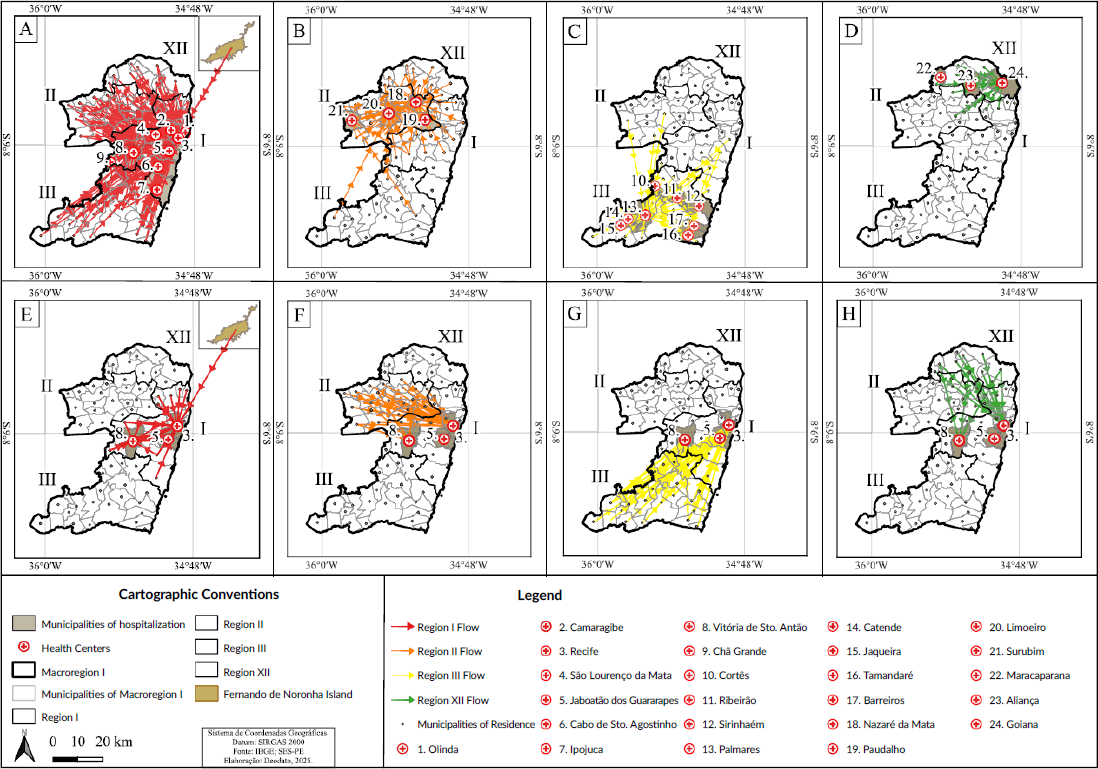
The displacement flows of pregnant women residing in health macroregion I of Pernambuco for low-risk and high-risk deliveries, according to health regions of residence, in 2023, are presented (Figure 1). For low-risk deliveries (Figures 1A-1D), there was predominance of displacements occurring within the pregnant women’s own health region of residence. Regarding high-risk deliveries (Figures 1E-1H), displacement flows were concentrated mainly in municipalities of the macroregion, especially Recife, Vitória de Santo Antão, and Jaboatão dos Guararapes. In Recife, 93.0% of these deliveries occurred.
Flow of pregnant women seeking low-risk childbirth care in health regions I (A), II (B), III (C), and XII (D), and high-risk childbirth care in health regions I (E), II (F), III (G), and XII (H), within health macroregion I. Pernambuco, 2023 (n=23,199)
Among low-risk deliveries, 59.9% occurred after displacements of less than 30 km, whereas among high-risk deliveries, this proportion was 51.0%. At distances between 30 and 60 km, 25.0% of low-risk deliveries and 18.2% of high-risk deliveries were observed. From 60 km onward, the proportion of high-risk deliveries exceeded that of low-risk deliveries: between 60 and 90 km, 15.7% and 11.6%; between 90 and 120 km, 10.2% and 2.5%; and at distances equal to or greater than 120 km, 4.9% and 0.9%. There was a statistically significant association between distance traveled and type of delivery (p-value<0.001) (Table 4).
Regarding travel time, 39.1% of pregnant women with low-risk deliveries traveled less than 30 minutes, and 54.5% between 30 and 90 minutes. Among high-risk deliveries, 25.2% occurred after travel times of up to 30 minutes, whereas 38.0% required 60 minutes or more to reach the municipality where delivery occurred. Travel time was also statistically significantly associated with the type of delivery (p-value<0.001). In travel times of up to 60 minutes, a lower proportion of high-risk deliveries was observed. In displacements equal to or greater than 90 minutes, the proportion of high-risk deliveries was higher than that of low-risk deliveries, especially in the intervals from 90 to 120 minutes and above 120 minutes. In the 60- to 90-minute range, no significant differences were observed in the proportion of deliveries by risk type.
Discussion
The results of this study reveal important inequalities in access to hospital services for childbirth care in health macroregion I of Pernambuco. A predominance of deliveries classified as low risk was observed, although more than one-third (36%) were high risk, with variations across health regions, including a higher proportion (38%) among pregnant women residing in health region I. More than half of pregnant women (56%) needed to travel from their municipality of residence for childbirth. This displacement was proportionally more frequent (72%) among high-risk deliveries. The results also indicated differences in the place of delivery across regions, with no records of high-risk deliveries performed within the health region of residence in Regions II, III, and XII. In addition, displacement flows showed a concentration of high-risk deliveries in Recife (93%). Finally, an association was observed between gestational risk type, place of occurrence of delivery, and the need for displacement, highlighting inequalities in geographic accessibility to obstetric services.
Among the study limitations, those inherent to the use of SIH/SUS data stand out, including underreporting, inconsistencies, and potential inaccuracies in the classification of gestational risk. Estimating distance and travel time based on municipal centroids, rather than pregnant women’s residential addresses, may have led to over- or underestimation of geographic accessibility, especially in municipalities with large territorial extent or heterogeneous population distribution. Furthermore, the analysis was restricted to the geographic dimension of access and did not encompass factors such as costs, availability, or transportation type. Exclusion of deliveries performed in the private sector limits the assessment of the health system as a whole; on the other hand, it strengthens the internal validity of the analysis by reducing potential confounding related to health insurance coverage and socioeconomic inequalities.
The proportion of deliveries classified as high risk was higher than that observed in health macroregion II of Pernambuco in 2018 (22%) 15 and in the Northeast region as a whole (25%) from 2011 to 2012 16. The occurrence of high gestational risk is associated with extremes of maternal age and unfavorable obstetric history 16, factors that may influence demand for specialized services and intensify the need for displacement to higher-complexity units.
The concentration of high-risk deliveries in health region I, especially in Recife, indicates marked dependence on high-complexity services. Although centralization is expected in specialized care, the magnitude of this concentration suggests insufficiency of intermediate services and weaknesses in regionalization. This pattern exacerbates the overload on referral services and may compromise timely responses to cases requiring greater care complexity.
In macroregion I, an intense network of displacement of pregnant women between municipalities and health regions (56%) was observed. Although predominant among high-risk deliveries, these flows also occurred to a substantial extent among low-risk deliveries. Analysis of hospital structure and healthcare demand is essential for improving network organization, reducing unnecessary displacement, and expanding geographic accessibility.
Between the periods 2010-2011 and 2018-2019, 35% of women in the Northeast region needed to travel for childbirth, while residents of the North region faced the greatest distances traveled (97 km to 133 km) and the longest travel times for access to hospital childbirth care (1,012 to 1,850 minutes) 2. In addition, pregnant women who experienced adverse outcomes traveled significantly greater distances. High-risk pregnancies, naturally associated with a greater likelihood of complications, were precisely those in which displacement was longest, especially among residents in areas farther from the capital 17.
In Pernambuco, there is a strong concentration of obstetric services in health region I. In this context, the implementation of Freestanding Birth Centers (Centros de Parto Normal, CPN), intended for low-risk pregnancies and grounded in the principles of humanization and women’s protagonism in the childbirth process 18, represents a relevant strategy to expand access, reduce long displacements, and promote equity.
In 2012, the same macroregion already demonstrated the need for a low-risk maternity hospital in Igarassu 19. In the present study, 23% of deliveries in Recife involved pregnant women from neighboring municipalities. The lack of equitable distribution of obstetric services across the region reinforces the centralization of obstetric care in Recife, indicating weaknesses in the organization and regionalization of the care network. This pattern suggests that the obstetric network in these municipalities has been insufficient to absorb local demand, resulting in significant displacement and overloading referral services in Recife.
The concentration of demand in the capital implies the overlap of functions in higher-complexity maternity hospitals, which also take on responsibility for low-risk deliveries. Such a scenario may reduce the capacity to respond to high-risk cases, as noted in a previous study in the region 19.
In addition to the absence of adequate obstetric services, displacements may also be intensified by structural weaknesses in regional and municipal hospitals, including shift closures due to insufficient staff and supplies. In 2018, in macroregion II of Pernambuco, the referral maternity hospital for high-risk care presented closed shifts in a relevant proportion (30% daytime and 39% nighttime) due to difficulty maintaining complete teams 15. Such conditions may reduce the problem-solving capacity of local services and favor the search for care in more distant facilities.
This situation is aggravated by the difficulty of prior linkage of pregnant women to maternity hospitals during prenatal care, a strategy that could reduce care-seeking peregrination. In Brazil, in the period from 2011 to 2012, 55% of pregnant women were effectively linked to a maternity hospital during prenatal care 20. Care-seeking peregrination for childbirth care was more frequent in the Northeast region, affecting 33% of women 20. Similar results were observed in the period 2020-2021 in a referral maternity hospital in Ceará, where a frequency of pregnancy-related travel for childbirth care prior to delivery of greater than one-third of postpartum women (34%) was identified, mainly associated with lack of guidance regarding the referral maternity hospital and the distance between place of residence and childbirth service 21. These findings reinforce that weaknesses in the linkage of pregnant women during prenatal care and in the regional organization of obstetric care contribute to additional displacement and difficulties in timely access to childbirth care.
Furthermore, the structure of maternal care units presents significant limitations regarding distance and travel time, thereby increasing the likelihood of high-risk deliveries. Travel time to the maternity hospital is considered a crucial factor for timely care, helping prevent unfavorable outcomes 22. In South Korea, in 2013, it was identified that pregnant women residing outside the ideal hospital access time presented a higher risk of severe obstetric complications. Travel times longer than 30 minutes were associated with increased risk of preterm birth (OR 2.2; 95%CI 1.96; 2.47), intensive care unit admission (OR 1.42; 95%CI 1.02; 1.98), uterine artery embolization (OR 1.54; 95%CI 1.05; 1.83), and cesarean hysterectomy (OR 2.69; 95%CI 1.09; 6.65) 23. In this context, the high rate of displacement for childbirth, associated with structural weaknesses of the network, may represent an additional risk for the occurrence of complications and for the persistence of maternal and neonatal mortality 24.
It is concluded that the organization of childbirth care in health macroregion I of Pernambuco reveals territorial concentration of high-risk deliveries, especially in Recife, as well as relevant intermunicipal flows for childbirth care, associated with greater distances and travel times. Although the analysis focused on the geographic dimension of access, the findings support planning and evaluation of the regionalization of the obstetric network to improve the distribution and articulation of services across the territory.
Data availability
The dataset and analysis codes used in this study are available at https://doi.org/10.17605/OSF.IO/X5NWG 12.
References
-
1 Bittencourt SDA, Reis LGC, Ramos MM, Rattner D, Rodrigues PL, Neves DCO, et al. Estrutura das maternidades: aspectos relevantes para a qualidade da atenção ao parto e nascimento. Cad Saude Publica [Internet]. 2014;30(13):208-19 [cited 2025 Oct 8]. Available from: Available from: https://cadernos.ensp.fiocruz.br/ojs/index.php/csp/article/view/5486/11337
» https://cadernos.ensp.fiocruz.br/ojs/index.php/csp/article/view/5486/11337 -
2 Albuquerque PC, Felipe LL, Lopes JF, Tassinari WS, Zicker F, Fonseca BP. Geographic accessibility to hospital childbirths in Brazil (2010-2011 and 2018-2019): a cross-sectional study. Lancet Reg Health Am [Internet]. 2025;42:100976 [cited 2025 Oct 11]. Available from: Available from: https://doi.org/10.1016/j.lana.2024.100976
» https://doi.org/10.1016/j.lana.2024.100976 -
3 Brasil. Ministério da Saúde. Portaria nº 1.459, de 24 de junho de 2011. Institui no âmbito do Sistema Único de Saúde - SUS - a Rede Cegonha [Internet] Brasília: Ministério da Saúde; 2011 [cited 2025 Sep 8]; Available from: Available from: https://bvsms.saude.gov.br/bvs/saudelegis/gm/2011/prt1459_24_06_2011.html
» https://bvsms.saude.gov.br/bvs/saudelegis/gm/2011/prt1459_24_06_2011.html -
4 Lansky S, Friche AAL, Silva AAM, Campos D, Bittencourt SDA, Carvalho ML, et al. Pesquisa Nascer no Brasil: perfil da mortalidade neonatal e avaliação da assistência à gestante e ao recém-nascido. Cad Saude Publica [Internet]. 2014;30(Suppl 1):S192-207 [cited 2025 Sep 24]. Available from: Available from: https://www.scielo.br/j/csp/a/Ss5zQXrmrGrGJvcVMKmJdqR/?format=pdf⟨=pt
» https://www.scielo.br/j/csp/a/Ss5zQXrmrGrGJvcVMKmJdqR/?format=pdf⟨=pt -
5 Almeida WS, Szwarcwald CL. Mortalidade infantil e acesso geográfico ao parto nos municípios brasileiros. Rev de Saude Publica [Internet]. 2012; 46(1):68-76 [cited 2025 Oct 8]. Available from: Available from: https://www.scielo.br/j/rsp/a/DbLcqFDtVMQ9GCZQWGRRx3M/?format=pdf⟨=pt
» https://www.scielo.br/j/rsp/a/DbLcqFDtVMQ9GCZQWGRRx3M/?format=pdf⟨=pt - 6 Donabedian A. Aspects of medical care administration: specifying requirements for health care. 1st ed. Cambridge (MA): Harvard University Press; 1973.
-
7 Peters DH, Garg A, Bloom G, Walker DG, Brieger WR, Rahman MH. Poverty and access to health care in developing countries. Ann NY Acad Sci [Internet]. 2008;1136(1):161-71[cited 2025 Oct 1]. Available from: Available from: https://nyaspubs.onlinelibrary.wiley.com/doi/10.1196/annals.1425.011
» https://nyaspubs.onlinelibrary.wiley.com/doi/10.1196/annals.1425.011 -
8 Secretaria de Saúde do Estado de Pernambuco. Plano Diretor de Regionalização 2011 [Internet]. Recife (PE): Secretaria de Saúde do Estado de Pernambuco; 2011 [cited 2025 Oct 1]. Available from: Available from: https://www.novaconcursos.com.br/blog/pdf/plano-diretor-regionalizacao-saude-pernambuco.pdf?srsltid=AfmBOorlqK20ICIfFUdgKnVMA6KZPy1s4Aw2Joi33TrtomSfBgNZRjl8
» https://www.novaconcursos.com.br/blog/pdf/plano-diretor-regionalizacao-saude-pernambuco.pdf?srsltid=AfmBOorlqK20ICIfFUdgKnVMA6KZPy1s4Aw2Joi33TrtomSfBgNZRjl8 -
9 Rohr LK. Assistência ao parto em Pernambuco: desigualdades na disponibilidade e distribuição dos serviços de cuidados obstétricos e da mortalidade materna e perinatal [dissertation on the Internet]. Recife: Universidade Federal de Pernambuco; 2014 [cited 2025 Oct 8]. Available from: Available from: https://repositorio.ufpe.br/bitstream/123456789/26265/1/DISSERTA%C3%87%C3%83O%20Lucia%20Katharina%20R%C3%B6hr.pdf
» https://repositorio.ufpe.br/bitstream/123456789/26265/1/DISSERTA%C3%87%C3%83O%20Lucia%20Katharina%20R%C3%B6hr.pdf -
10 Albuquerque PC, Felipe LL, Lopes JF, Tassinari WS, Zicker F, Fonseca BP. Geographic accessibility to hospital childbirths in Brazil (2010-2011 and 2018-2019): a cross-sectional study. Lancet Reg Health Am [Internet]. 2025; 42:100976 [cited 2025 Oct 8]. Available from: Available from: https://www.thelancet.com/journals/lanam/article/PIIS2667-193X(24)00303-X/fulltext
» https://www.thelancet.com/journals/lanam/article/PIIS2667-193X(24)00303-X/fulltext -
11 Instituto Brasileiro de Geografia e Estatística (IBGE). Estimativas da população residente para os municípios e para as Unidades da Federação brasileiros com data de referência em 1º de julho de 2021 [Internet]. Rio de Janeiro: IBGE; 2021 [cited 2025 Oct 8]. Available from: Available from: https://www.ibge.gov.br/estatisticas/sociais/populacao/9103-estimativas-de-populacao.html
» https://www.ibge.gov.br/estatisticas/sociais/populacao/9103-estimativas-de-populacao.html -
12 Leite RMB, de Azevedo TAG, da Cruz KDF, de Oliveira AMW, Simões AJVG, de Barros Amorim EV, et al. Dados de replicação para: Acessibilidade geográfica ao parto em Pernambuco: análise espacial da rede de deslocamento, 2023. OSF; 2023. doi: 10.17605/OSF.IO/X5NWG.
» https://doi.org/10.17605/OSF.IO/X5NWG -
13 Brasil. Ministério da Saúde. DATASUS. Sistema de gerenciamento da tabela de procedimentos, medicamentos e OPM do SUS [Internet]. 2022 [cited 2025 Jan 6]. Available from: Available from: http://sigtap.datasus.gov.br/tabela-unificada
» http://sigtap.datasus.gov.br/tabela-unificada -
14 Google Developers. Visão geral da API Distance Matrix [Internet]. [cited 2025 Aug 20]. Available from: Available from: https://developers.google.com/maps/documentation/distance-matrix/overview?hl=pt-br
» https://developers.google.com/maps/documentation/distance-matrix/overview?hl=pt-br -
15 Leite RMB, Araújo TVB, Ferreira-da-Silva MR, Mendes ACG, Albuquerque MSV. Acesso aos serviços de atenção ao parto no interior de Pernambuco, Nordeste do Brasil. Rev Saude Publica [Internet]. 2023;57-7 [cited 2025 Oct 11]. Available from: Available from: https://www.scielo.br/j/rsp/a/TRMNQ6BKdJZZ6BCn5CRp3gD/?format=pdf⟨=pt
» https://www.scielo.br/j/rsp/a/TRMNQ6BKdJZZ6BCn5CRp3gD/?format=pdf⟨=pt -
16 Viellas EF, Domingues RMSM, Dias MAB, Gama SGN, Theme Filha MM, Costa JV, et al. Assistência pré-natal no Brasil. Cad Saude Publica [Internet]. 2014;30( Suppl 1):S85-100 [cited 2025 Oct 11]. Available from: Available from: https://www.scielo.br/j/csp/a/CGMbDPr4FL5qYQCpPKSVQpC/?format=html⟨=pt
» https://www.scielo.br/j/csp/a/CGMbDPr4FL5qYQCpPKSVQpC/?format=html⟨=pt -
17 Pacagnella R, Cecatti JG, Parpinelli MA, Sousa MH, Haddad SM, Costa ML, et al. Maternal mortality in Brazil: proposals and strategies for its reduction. Rev Bras Ginecol Obstet [Internet]. 2018;40(9):501-6 [cited 2025 Oct 11]. Available from: Available from: https://www.thieme-connect.com/products/ejournals/abstract/10.1055/s-0038-1672181
» https://www.thieme-connect.com/products/ejournals/abstract/10.1055/s-0038-1672181 -
18 Brasil. Ministério da Saúde. Portaria nº 11, de 7 de janeiro de 2015. Redefine as diretrizes para implantação e habilitação de Centro de Parto Normal (CPN) [Internet]. Brasília: Ministério da Saúde ; 2015 [cited 2025 Oct 11]. Available from: Available from: https://bvsms.saude.gov.br/bvs/saudelegis/gm/2015/prt0011_07_01_2015.html
» https://bvsms.saude.gov.br/bvs/saudelegis/gm/2015/prt0011_07_01_2015.html -
19 Rohr LK, Valongueiro S, Araújo TVB. Delivery care and the inadequacy of the obstetric care network in Pernambuco. Rev Bras Saude Mater Infant [Internet]. 2016;16(4):447-55 [cited 2025 Oct 11]. Available from: Available from: https://www.scielo.br/j/rbsmi/a/mbwHSsbKkTbZ9bWDMDjcjyN/?lang=pt
» https://www.scielo.br/j/rbsmi/a/mbwHSsbKkTbZ9bWDMDjcjyN/?lang=pt -
20 Leal MC, Gama SGN, Pereira APE, Dias MAB, Theme-Filha MM, Costa JSD, et al. Prenatal care in the Brazilian public health services. Rev Saude Publica [Internet]. 2020;54:(8): 1-12 [cited 2025 Oct 11]. Available from: Available from: https://revistas.usp.br/rsp/article/view/165868/158747
» https://revistas.usp.br/rsp/article/view/165868/158747 -
21 Mesquita AL, Rodrigues HBV, Ferreira UR, Domingos MAF, Oliveira BLCA, Cardoso AMR, et al. Fatores associados à peregrinação anteparto em maternidade de referência no Ceará. Rev. Esc. Enferm. USP [Internet]. 2024;58:e20230012 [cited 2026 Mar 13]. Available from: Available from: https://www.scielo.br/j/reeusp/a/CbQhTMJ9mgxjd6hd33B9xXH/?format=pdf⟨=pt
» https://www.scielo.br/j/reeusp/a/CbQhTMJ9mgxjd6hd33B9xXH/?format=pdf⟨=pt -
22 Rodrigues IR, Maia RC, Amorim MHC, Santos LM, Melo GA, Souza DT, et al. Impact on pregnant/parturient women’s health resulting from displacement between residence and health service. Rev Rene [Internet]. 2021;22:e61115 [cited 2025 Oct 11]. Available from: Available from: https://pesquisa.bvsalud.org/portal/resource/fr/biblio-1155282
» https://pesquisa.bvsalud.org/portal/resource/fr/biblio-1155282 -
23 Kwak MY, Kim YH, Kim EH, Kim JM, Lee JH, Choi SJ, et al. How far is too far? A nationwide cross-sectional study for establishing optimal hospital access time for Korean pregnant women. BMJ Open. 2019;9(9):e031882. doi: 10.1136/bmjopen-2019-031882.
» https://doi.org/10.1136/bmjopen-2019-031882 -
24 Santos L. Região de saúde e suas redes de atenção: modelo organizativo-sistêmico do SUS. Cien Saude Colet [Internet]. 2017;22(4):1281-9 [cited 2025 Oct 11]. Available from: Available from: https://www.scielo.br/j/csc/a/7M3PKSBdctVSpkvJTYy5Rdz/abstract/?lang=pt
» https://www.scielo.br/j/csc/a/7M3PKSBdctVSpkvJTYy5Rdz/abstract/?lang=pt
-
Peer Review Administrator:
Izabela Fulone https://orcid.org/0000-0002-3211-6951
-
Use of generative artificial intelligence
The writing of this document, including the choice of terms and wording, was supported by ChatGPT (https://chatgpt.com/). The ideas, conceptualization, and analytical content are the responsibility of the authors of the manuscript.
Edited by
-
Editor-in-Chief:
Jorge Otávio Maia Barreto https://orcid.org/0000-0002-7648-0472
-
Scientific Editor:
Everton Nunes da Silva https://orcid.org/0000-0001-8747-4185
-
Associate Editor:
Ana Sara Semeão de Souza https://orcid.org/0000-0002-4554-1551
Data citations
Brasil. Ministério da Saúde. DATASUS. Sistema de gerenciamento da tabela de procedimentos, medicamentos e OPM do SUS [Internet]. 2022 [cited 2025 Jan 6]. Available from: Available from: http://sigtap.datasus.gov.br/tabela-unificada