 Litter properties in a secondary tropical forest 14 years after litterfall removal and irrigation
Abstract
The functioning of tropical secondary forests is strongly influenced by the availability of water and nutrients, which regulate litter production, decomposition, and nutrient cycling. In Amazonian landscapes subjected to shifting cultivation, repeated disturbance and resource depletion may generate long-lasting legacy effects on ecosystem processes. Here, we evaluate whether such legacy effects persist in a secondary forest 14 years after the end of a large-scale field study that manipulated nutrient availability (via litter removal) and water supply (via irrigation) over eight years (1999-2007) in northeastern Brazilian Amazonia. We evaluated the enduring effects of water and nutrient management on litterfall, litter stock, and water holding capacity (WHC) 14 years after the conclusion of the experiment (2021), as well as the influence of meteorological variables on litterfall. Data collection took place monthly throughout 2021, and litter stock and WHC were measured during the months with the highest and lowest precipitation according to climatological averages. The total litterfall over year ranged from 10.48 ± 0.31 Mg ha-1 to 11.61 ± 0.29 Mg ha-1, with the highest litter stock observed in the dry season and the lowest WHC in the rainy season. Meteorological variables and treatments were not significant predictors of litterfall or litter stock variation, indicating weak direct climatic control over litter dynamics at this successional stage. The results suggest that secondary forests in Amazonia exhibit resilience after a prolonged stress (litterfall removal) and the ability to optimize resources following shifting cultivation in subsistence agriculture.
Keywords:
family farming; successional ecosystem; ecological restoration
Resumo
O funcionamento das florestas secundárias tropicais é fortemente influenciado pela disponibilidade de água e nutrientes, que regulam a produção de serapilheira, a decomposição e a ciclagem de nutrientes. Em paisagens amazônicas sujeitas à agricultura itinerante, perturbações repetidas e o esgotamento de recursos podem gerar efeitos residuais de longa duração nos processos ecossistêmicos. Neste estudo, avaliamos se tais efeitos residuais persistem em uma floresta secundária 14 anos após o término de um estudo de campo em larga escala que manipulou a disponibilidade de nutrientes (por meio da remoção de serapilheira) e o suprimento de água (por meio da irrigação) ao longo de oito anos (1999-2007) na Amazônia do nordeste brasileiro. Analisamos os efeitos duradouros do manejo da água e dos nutrientes na queda de folhagem, estoque de folhagem e Capacidade de Retenção Hídrica (CRH) 14 anos após a conclusão do experimento. Além disso, exploramos a influência de variáveis meteorológicas na queda de liteira. A coleta de dados ocorreu ao longo de 2021 de forma mensal, e as avaliações de estoque e CRH foram realizadas nos meses com maior e menor precipitação, seguindo as médias climatológicas. A queda total de liteira variou de 10,48 ± 0,31 Mg ha-1 a 11,61 ± 0,29 Mg ha-1. O maior estoque de liteira foi observado na estação seca e a menor CRH na estação chuvosa. As variáveis meteorológicas e os tratamentos experimentais não foram preditores significativos da variação na queda ou acúmulo de serapilheira, indicando um fraco controle climático direto sobre a dinâmica da serapilheira neste estágio sucessional. As florestas secundárias na Amazônia apresentam resiliência e a capacidade de otimizar recursos após a agricultura de subsistência.
Palavras-chave:
agricultura familiar; ecossistema sucessional; restauração ecológica
INTRODUCTION
Amazonia hosts the largest diversity of tree species in the world and is an extremely important biome that affects regional and global processes such as CO2 storage and rainfall patterns (Barlow et al. 2018). However, some regional economic activities have contributed to degrade its forests (Guerra et al. 2020). One of the most common processes involves shifting cultivation after a few slash-and-burn cycles, when the land is usually abandoned due to reduced productivity as a consequence of fire use, forcing farmers to seek new areas for cultivation (Arroyo-Kalin 2012; Villa et al. 2018). This process results in the considerable expansion of secondary forests in Amazonia (Jakovac et al. 2017) and the consequent loss of natural forests and their biodiversity, and the considerable loss of carbon stored in large trees, intensifying greenhouse gas emissions and climate change (Gomes and Luizão 2012, Jakovac et al. 2017). Nevertheless, secondary forests have been shown to be important in mitigating climate change (Chazdon and Guariguata 2016, Lindenmayer 2019, Poorter et al. 2015), as the rapid growth of trees in the early stages of succession increases the carbon demand, which is assimilated by photosynthesis and stored in plant structures. Natural resources, such as water and nutrients, are indispensable to guarantee the development success of secondary vegetation, as water plays a fundamental role in the physiological and morphological cycles responsible for the translocation of nutrients within the plant, which need to be diluted in an aqueous solution (Asari et al. 2017). In the initial succession stage of forest ecosystems, this functionality is indispensable, due to the greater openness of the canopy, that causes higher light incidence inside the forest, soil drying and significant reduction in the rates of litter decomposition (Peixoto et al. 2018).
Litter, a layer of forest residues of plant and/or animal origin that accumulates in the the forest floor, is the main entry route for nutrients into the soil (Robertson and Paul 2000, Andrade et al. 2008). Therefore, its removal can interrupt biogeochemical cycles that are vital for Amazonian ecosystems, which in some regions have low natural soil fertility (Rodrigues et al. 2025a). Both litterfall and its stock can be influenced by environmental changes (Martins et al. 2018, Silva et al. 2018) such as increases in temperature and changes in rainfall regimes (Hawes and Peres 2016, Linger et al. 2020, Williams-Linera et al. 2021). In this context, the MANFLORA project (Manipulation of Water and Nutrients in Secondary Forests in eastern Amazonia) consisted in an experiment carried out continuously for eight years (1999-2007) in a secondary forest that tested the effect of periodical subtraction of nutrients through litter removal and of adding water during the dry season, to understand the impacts of managing these resources on forest dynamics. This study aimed to evaluate the water holding capacity (WHC), litter stock and litterfall during the 14th year after and the end of the MANFLORA nutrient and water manipulation.
Nutrient and water limitations are expected to directly influence litter dynamics and associated physical properties in tropical forests. In nutrient-poor Amazonian soils, reductions in nutrient availability can constrain plant productivity, leading to lower litter production and changes in litter quality, which in turn affect decomposition rates and nutrient return to the soil (Flores et al. 2020; Thomaz et al. 2020; Rocha et al. 2023). Poor management practices in Amazonian systems, particularly those involving repeated slash-and-burn cycles, further exacerbate nutrient losses through volatilization and disruption of ecosystem functions, contributing to long-term reductions in soil fertility and system resilience (Thomaz et al. 2020). Similarly, water availability regulates key physiological processes such as stomatal conductance, photosynthesis, and leaf senescence, thereby controlling litterfall dynamics, especially in seasonal environments with marked dry periods. Alterations in rainfall regimes can also affect soil physical and chemical properties and interfere with nutrient fluxes mediated by litter inputs (Linger et al. 2020; Rocha et al. 2023). In addition, soil moisture conditions influence litter decomposition and the capacity of the litter layer to retain water, making water holding capacity (WHC) a sensitive indicator of ecosystem functioning. Together, these processes link water and nutrient availability to litter stock accumulation, litterfall fluxes, and litter physical properties, which are key components of nutrient cycling and carbon dynamics in secondary forests undergoing succession (Charles et al. 2020; Jhariya et al. 2024).
The present study was conducted 14 years after the end of the MANFLORA experiment, based on the following questions: 1) Do experimental treatments and seasonal variation affect litter physical properties? and 2) what are the meteorological variables that most influence litterfall at this stage of the successional ecosystem? We hypothesized that (a) the legacy effects of nutrient subtraction via litter removal would still influence litterfall, litter stock, and litter water holding capacity (WHC) 14 years after the end of the experiment; and that (b) seasonal variation would significantly affect litter dynamics and physical properties; and (c) temperature is the main abiotic factor to interfere in litterfall through leaf abscission mechanisms.
MATERIAL AND METHODS
Study area
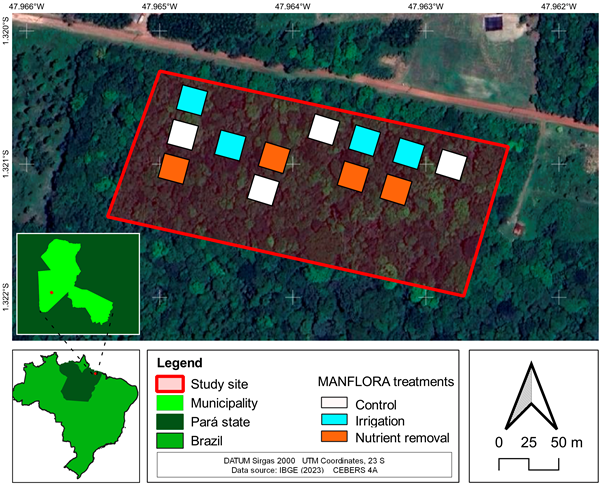
The experimental plots of the MANFLORA project (1°19’16”S, 47°57’50”W) are located at the Castanhal School Farm, belonging to the Federal Rural University of Amazonia (Universidade Federal Rural da Amazônia - UFRA), in the Castanhal municipality, Pará state, in eastern Bazilian Amazonia (Figure 1). The region’s relief is slightly undulated with yellow ferralsols. These soils have low natural fertility and high toxic Fe and Al oxides (Tenório et al. 1999, Schad et al. 2015). The climate, according to the Köppen-Geiger classification, is of the Af3 type, with average annual rainfall from 2,000 to 2,500 mm (Alvares et al. 2013). The rainy season lasts from December to May, while the dry season lasts from June to November (Martorano et al. 1993, Rangel-Vasconcelos et al. 2005).
Schematic representation of the experimental plots of the MANFLORA project (1999-2007) located in a secondary forest in the municipality of Castanhal, Pará state, in the eastern Brazilian Amazon.
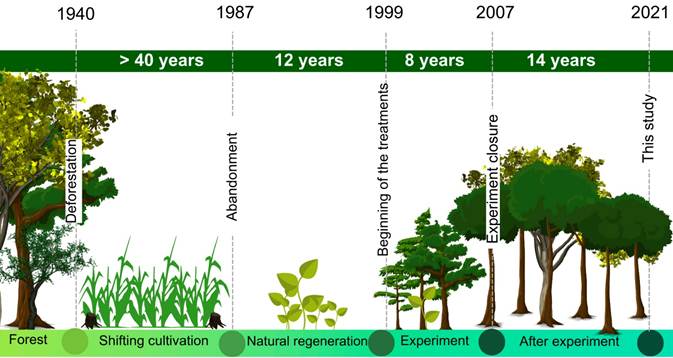
Prior to the establishment of the MANFLORA experiment in 1999, the site had undergone multiple cycles of slash-and-burn agriculture for 47 years (1940-1987) following the conversion of primary forest, leaving the area in an early-to-mid successional stage characterized by sparse tree cover and dominance of pioneer species. At the start of the MANFLORA experiment, the forest had 12 years of natural regrowth (secondary succession), and by the time of the present study in 2021, the forest had reached 34 years of age (Figure 2). The surrounding landscape matrix consists of secondary forest fragments, typical of the region. Currently, the species with the highest importance value index (IVI) present in all plots are Lacistema pubescens Mart, Annona exsucca DC and Ocotea guianensis Aubl (Santos Junior et al. 2021).
Experimental Design
The MANFLORA experiment consisted of two treatments (i) complete litter removal (REM); (ii) irrigation (IRR), and a control (CTL), as described by Lima et al. (2010), Vasconcelos et al. (2008, 2012), and Almeida et al. (2019). The experiment lasted eight years (from 1999 to 2007). Each treatment and the control were assigned to four permanent plots of 400 m2 (20 m x 20 m), at least 10 meters apart from each other, with random distribution (Figure 1). In the REM treatment, the litter was completely removed every fortnight using plastic rakes. In IRR, 5 mm day-1 of water were poured for 30 minutes through tapes with micro holes. No direct human interference occurred in the control. The present study was carried out in 2021, 14 years after the end of the experiment (Figure 2), when the forest was 34-year-old.
Field and laboratory procedures
For periodical litterfall sampling, we installed three 1-m2 (1 m x 1 m) wooden collectors with shading mesh in each plot, making a total of 12 collectors per treatment and control. The collectors were installed approximately 20 cm above the soil surface and were randomly distributed within each plot. Collections were carried out every 30 days for 12 months (from January to December 2021). The litter stock was collected in March and September, the months with the higher and lower rainfall according to climatological normals (1961 - 2010) (INMET, 2022), denominated as rainy and dry season, respectively, in this study. The litter stock was collected with a metallic hollow sampler of 0.25 m2 (0.5 m x 0.5 m), with five repetitions (randomly distributed) per season (dry and rainy) in each plot.
After collection, we sent the samples to the Laboratório de Manejo de Ecossistemas e Bacias Hidrográficas (LABECOS), at UFRA (Belém, Brazil). In the laboratory, all samples were sorted into three fractions: leafy, woody, and reproductive material. Non-identifiable material was rarely encountered; when present, it was carefully examined (eg., leaf fragments or bark pieces) to ensure correct classification. Then, the sorted fraction was dried in an oven with forced air circulation at 65ºC for 48 h to obtain the dry mass (DM) using an analytical balance with precision of 0.01 g. The data were transformed into Mg ha-1 by dividing the dry mass in Mg by the collector area in hectares.
The water holding capacity (WHC) was determined for the litter stock samples following Blow’s methodology (Blow 1955). After collection, and before drying, the samples were distributed in plastic trays and submerged in water for 90 minutes. After this time, the trays were tilted for 30 minutes to allow excess water to drain from the sample surface. Then, the wet mass (WM) was obtained with an analytical balance with precision of 0.01 g. Subsequently, the samples were separated into fractions, oven-dried and weighed as described above. The WHC was calculated as described by Hillman and Golding (1981) by subtracting DM from WM, dividing the subtraction by DM, and multiplying by 100 to obtain the WHC in percentage.
Monthly precipitation, average temperature, average relative humidity, and wind speed data for 2021 were obtained from the manual meteorological station of the National Institute of Meteorology (INMET). The station is located 1.8 km from the study area.
Data analysis
All statistical analyses and graphs were performed in R software, version 4.0.5 (R Development Core Team 2021). To evaluate whether experimental treatments and seasonal variation affected litter physical properties (Question 1), litter stock and water holding capacity (WHC) were first checked for normality and homoscedasticity using the Shapiro-Wilk and Bartlett tests, respectively. When assumptions were met, differences among treatments (control, irrigation, and nutrient removal via litter exclusion) and seasonal periods (dry and rainy seasons) were assessed using parametric tests. Seasonal differences were tested using Student’s t-test (agricolae package; Mendiburu 2013). Temporal variation in litterfall was analyzed using a two-way repeated-measures ANOVA, followed by Tukey post-hoc comparisons with Bonferroni correction (rstatix package; Kassambara 2019). Sphericity was evaluated using Mauchly’s test.
To address the second question, which examined the influence of meteorological drivers on litterfall, a generalized least squares (GLS) regression model was fitted using monthly litterfall as the response variable. Precipitation, temperature, humidity, and wind speed were included as fixed effects, together with experimental treatment. A first-order autoregressive (AR1) correlation structure was incorporated to account for temporal autocorrelation in the monthly time series. Multicollinearity among predictors was assessed using variance inflation factors (VIF), all of which were below the threshold of concern (VIF < 5). Model parameters were estimated using restricted maximum likelihood (REML), and significance was evaluated using F-tests at a 5% significance level.
RESULTS
Residual effect of the experimental treatments
The total annual litterfall for 2021 ranged from 10.48 ± 0.31 Mg ha-1 to 11.61 ± 0.29 Mg ha-1 for CTL and REM, respectively, but no differences between treatments were observed (F2;33 = 0.522; p = 0.60) (Figure 3). There was no significant difference among months in REM (F11;36 = 9.08; p = 0.064). In the control, litterfall was significantly lower in February than in July and May (F11;36 = 4.98; P = 0.0001), while in IRR, it was significantly higher in August than in January, February, March, October, and December (F11;36 = 5.45; p < 0.001) (Figure 3).
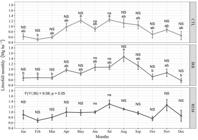
Monthly litterfall from January to December 2021 in twelve experimental plots in a successional forest in the eastern Brazilian Amazon 14 years after being subjected to eight years (1999-2007) of treatments of litter removal (REM) and irrigation (IRR). CTL = control. Circles are the mean and bars the standard deviation of four plots. Different lowercase and capital letters indicate statistical differences, respectively, among months within treatments and control, and in the same month among treatments and control according to post-hoc Tukey tests.
The litter stock average ranged from 1.17 ± 0.27 Mg ha-1 to 1.16 ± 0.11 Mg ha-1 in IRR and REM during the rainy season (Figure 4a), respectively. In the dry season, this variation ranged from 5.36 ± 1.25 Mg ha-1 to 7.22 ± 1.33 Mg ha-1 in REM and CTL, respectively (Figure 4a). Differences in the residual effect of treatments on litter stock were statistically non-significant in the rainy (F2;9 = 0.624; p = 0.558) or in the dry season (F2;9 = 4.054; p = 0.06). In the rainy season, WHC was significantly higher in REM than in IRR (F2;9 = 5.077; p = 0.03), with averages of 266.48 ± 19.92% and 231.72 ± 9.94%, respectively (Appendix, Table A1). There were no significant differences in WHC among treatments and control in the dry season (F2;9 = 0.215; p = 0.811) (Figure 4b).
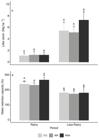
Litter stock (A) and water holding capacity (B) of litter in 2021 in a successional forest of 34 years in the eastern Brazilian Amazon subjected to water and nutrient management treatments during eight years in 1999-2007. Columns indicate the mean and bars the standard deviation of four replicates. Different capital letters indicate statistical differences between the same treatment or control between periods according to the Student t-test , and different lowercase letters indicate statistical differences among treatments and control within the period according to Tukey test.
Meteorological variation does not drive litter properties in the late succession
The generalized least squares (GLS) model indicated that neither meteorological variables nor experimental treatments had a significant effect on litterfall dynamics during the study period (Table 1). Based on F-tests of fixed effects, neither precipitation (p = 0.496), nor temperature (p = 0.319), moisture (p = 0.442), or wind speed (p = 0.588) were significant predictors of litterfall variation. Similarly, no residual effects of the experimental treatments were detected 14 years after the end of the MANFLORA experiment (p = 0.836). The AR1 correlation structure indicated moderate temporal dependence in litterfall among consecutive months (φ = 0.60).
Parameter estimates from the generalized least squares (GLS) model for litterfall variation in a 34-year-old secondary forest in eastern Brazilian Amazonia, including meteorological variables and experimental treatments. Estimates, standard errors, t-values, and p-values are shown.
DISCUSSION
The hypothesis of a residual effect of litter removal on litterfall and litter stock after 14 years was refuted. Regarding the influence of climatic variables, the hypothesis that temperature would have the highest influence on litterfall was not supported, as none of the tested meteorological variables showed significant effects on litterfall dynamics. It was expected that the negative effects of litter removal (reduction of soil gravimetric moisture, microbial biomass, and root biomass) would still be evident due to the interruption of the biogeochemical cycle during eight years in the REM treatment in 1999-2007, as observed by Lima et al. (2010). Furthermore, litter properties were affected during MANFLORA, limiting soil mechanical protection and soil gas fluxes (Vasconcelos et al. 2008). However, our results suggest that the impact of resource limitation may be reversible in the long-term.
It is important to acknowledge some limitations of this study before interpreting the results. Litterfall and litter stock are indicators that can be influenced by species composition and interannual climatic variability. In addition, the one-year sampling period may not capture year-to-year fluctuations in productivity, which are strongly driven by climate. Other ecosystem components, such as soil fertility, soil water content, and key nutrients in litter (e.g. N and P), were not assessed here, although these factors were evaluated in previous studies at the same site (Rodrigues et al. 2025a; Rodrigues et al. 2025b). For future studies, complementary measures, such as the decomposition constant (K), could also provide a more detailed understanding of litter dynamics.
Effect of resource management
Many tropical tree species, including those from the Amazon, have efficient root systems and functional traits that enhance uptake (Cattanio 2017). In our study site, vegetation surveys showed high similarity in floristic composition and structure between CTL and IRR, while REM had some long-term species losses while aboveground biomass was maintained (Rodrigues et al. 2025b). Despite this recovery, residual effects of resource manipulation are still detectable in soil fertility and nutrient dynamics, such as lower pH and reduced Ca, Mg, and P cycling in REM plots (Rodrigues et al. 2025a). Here we have shown that litter production and accumulation in the soil surface were no longer different among the experimental treatments. This suggests that aboveground indicators of ecosystem health, such as litterfall, recovered faster than belowground processes. The close proximity between plots (<25 m between contiguous plots) may explain the similarity in litter stock and litterfall among the treatments and the control, due to the ease of seed dispersal among the treatments and control (Araújo et al. 2021), which is reflected in the similar floristic composition in the forest fragment where the plots are located (Santos Junior et al. 2021). This may have allowed the recovery of the vegetation structure and therefore of its leaf production.
In the present study, 14 years after the end of the MANFLORA manipulations, neither the REM nor the IRR plots differed significantly from the control, indicating that the ecosystem no longer shows detectable responses to these past treatments. During the execution of MANFLORA, irrigation increased aboveground net primary productivity one year following the dry season Vasconcelos et al. (2010). This result suggests that productivity does not respond immediately to precipitation, but exhibits a lag effect, meaning that the influence of water availability on productivity becomes apparent only after a certain period. The absence of effects can also be related to a gradual recovery in the expression of ecosystem function, as aboveground net primary productivity tends to stabilize between 20 and 40 years of natural regeneration (Becknell et al., 2021; Villa et al., 2018). In general, the study region’s secondary forests are characterized by high resilience, given the rapid increase in species richness in the first 20 years of succession after slash-and-burn agriculture and pasture use (Barros et al. 2020), which may result in litter productivity superior to that in primary forests (Rozendaal et al. 2019). In the Amazon, decomposition rates are also recovered in the first 15 years of post-disturbance succession (Cole et al. 2020), especially in ecosystems altered by shifting agriculture, as long as adjacent forest fragments and propagule sources are generally conserved (Poorter et al. 2024).
Meteorological variation does not drive litter dynamics
Although wind and climatic variability are commonly associated with litterfall dynamics in tropical forests, these potential drivers were not strongly supported in the present system - in this short-term evaluation. Wind-driven processes have been linked to leaf abscission in forests with simpler vertical structure and greater canopy exposure, where air circulation can facilitate mechanical litter removal (Almeida et al. 2015; Silva et al. 2018). However, in more structurally developed secondary forests, these effects may be attenuated due to increasing canopy complexity and reduced wind penetration.
Similarly, physiological processes such as temperature-induced photoinhibition and drought-related leaf senescence are often invoked as mechanisms controlling litter production in seasonal tropical environments (Ramos-Montaño et al. 2020). Nevertheless, in mid-successional forests, these responses may be buffered by canopy closure and improved microclimatic stability, reducing direct climatic control over litterfall dynamics.
In moist tropical forests, rainfall is frequently associated with tree growth rather than litter production, and weak relationships between precipitation and litter dynamics have been reported due to efficient stomatal regulation and water-use strategies (Becknell et al. 2021; Garcia et al. 2021). This reinforces the idea that litterfall in established secondary forests is not necessarily tightly coupled to short-term rainfall variability, but may instead reflect longer-term structural and physiological stabilization of the vegetation.
CONCLUSIONS
We found no long-term effects of eight years of litter-removal and irrigation treatments on the amount and water holding capacity of litterfall and litter stock in plots of successional forest 14 years after the end of the experiment. Our results suggest that Amazonian secondary forests are resilient to positive and negative environmental interventions, possibly reflecting an ability to optimize resources, and that natural regeneration promotes the recovery of ecosystem functions altered by shifting cultivation.
ACKNOWLEDGMENTS
We are grateful to Coordenação de Aperfeicoamento de Pessoal de Nível Superior (CAPES) for granting a master’s ENT#091;# 88887.716287/2022-00ENT#093; and doctoral ENT#091;# 88887.644953/2021-00ENT#093; scholarship to JIMR and VPO, respectively. We also thank all colaborators of Universidade Federal Rural da Amazonia, especially Mrs. Raimundo Nonato, Daercio Paixão and Benedito Cabral, for logistic support.
REFERENCES
- Almeida, A.M. de S.D.; Oliveira, F. de A.; Vasconcelos, S.S.; Guimarães, J.R. da S.; Tostes, L. de C.L.; Costa, J.V.T.A. 2019. Litter flux in a successional forest ecosystem under nutrient manipulation in Eastern Amazon. Brazilian Journal of Development 5: 30623-30641.
- Almeida, E.J.; Luizão, F.; Rodrigues, D. de J. 2015. Litterfall production in intact and selectively logged forests in southern of Amazonia as a function of basal area of vegetation and plant density. Acta Amazonica 45: 157-166.
- Alvares, C.A.; Stape, J.L.; Sentelhas, P.C.; De Moraes Gonçalves, J.L.; Sparovek, G. 2013. Köppen’s climate classification map for Brazil. Meteorologische Zeitschrift 22: 711-728.
- Andrade, R.L. de; Souto, J.S.; Souto, P.C.; Bezerra, D.M. 2008. Deposição de serrapilheira em área de Caatinga na RPPN “Fazenda Tamanduá”, Santa Terezinha - PB. Revista Caatinga 21: 223-230.
- Araújo, E.A.A.; Rodrigues, J.I. de M.; Martins, W.B.R.; Santos Junior, H.B. dos; Rangel-Vasconcelos, L.G.T.; Oliveira, F. de A. 2021. Densidade e composição do banco de sementes do solo em ecossistema sucessional de floresta na Amazônia Oriental, Brasil. Research, Society and Development 10: e23610615318.
- Arroyo-Kalin, M. 2012. Slash-burn-and-churn: Landscape history and crop cultivation in pre-Columbian Amazonia. Quaternary International 249: 4-18.
- Asari, S.; Tarkowská, D.; Rolčík, J.; Novák, O.; Palmero, D.V.; Bejai, S.; et al. 2017. Analysis of plant growth-promoting properties of Bacillus amyloliquefaciens UCMB5113 using Arabidopsis thaliana as host plant. Planta 245: 15-30.
- Barlow, J.; França, F.; Gardner, T.A.; Hicks, C.C.; Lennox, G.D.; Berenguer, E.; et al. 2018. The future of hyperdiverse tropical ecosystems. Nature 559: 517-526.
- Barros, T.C.; Elias, F.; Romano, L.L.; Ferreira, J. 2020. Natural recovery of plant species diversity in secondary forests in Eastern Amazonia: contributions to passive forest restoration. Revista Brasileira de Botanica 43: 165-175.
- Becknell, J.M.; Vargas G., G.; Pérez-Aviles, D.; Medvigy, D.; Powers, J.S. 2021. Above-ground net primary productivity in regenerating seasonally dry tropical forest: Contributions of rainfall, forest age and soil. Journal of Ecology 109: 3903-3915.
- Blow, F.E. 1955. Quantity and hydrologic characteristics of litter upland oak forest in Eastern Tennessee. Journal of Forestry 53: 190-195.
- Cattanio, J.H. 2017. Leaf area index and root biomass variation at different secondary forest ages in the eastern Amazon. Forest Ecology and Management 400: 1-11.
- Charles, M.; Ziv, G.; Bohrer, G.; Bakshi, BR. (2020) Connecting air quality regulating ecosystem services with beneficiaries through quantitative serviceshed analysis. Ecosystem Services 41.
- Chazdon, R.L.; Guariguata, M.R. 2016. Natural regeneration as a tool for large-scale forest restoration in the tropics: prospects and challenges. Biotropica 48: 716-730.
- Cole, R.J.; Selmants, P.; Khan, S.; Chazdon, R. 2020. Litter dynamics recover faster than arthropod biodiversity during tropical forest succession. Biotropica 52: 22-33.
- Flores, B.M.; Staal, A.; Jakovac, C.C.; et al. (2020) Soil erosion as a resilience drain in disturbed tropical forests. Plant Soil 450:11-25.
- Garcia, M.N.; Ferreira, M.J.; Ivanov, V.; dos Santos, V.A.H.F.; Ceron, J.V.; Guedes, A.V.; et al. 2021. Importance of hydraulic strategy trade-offs in structuring response of canopy trees to extreme drought in central Amazon. Oecologia 197: 13-24.
- Gomes, A.C.S.; Luizão, F.J. 2012. Leaf and soil nutrients in a chronosequence of second-growth forest in central Amazonia: Implications for restoration of abandoned lands. Restoration Ecology 20: 339-345.
- Guerra, A.; Reis, L.K.; Borges, F.L.G.; Ojeda, P.T.A.; Pineda, D.A.M.; Miranda, C.O.; et al. 2020. Ecological restoration in Brazilian biomes: Identifying advances and gaps. Forest Ecology and Management 458: 117802.
- Hawes, J.E.; Peres, C.A. 2016. Patterns of plant phenology in Amazonian seasonally flooded and unflooded forests. Biotropica 48: 465-475.
-
Hillman, G.R.; Golding, D.L. 1981. Forest floor characteristics of Marmot and Streeter experimental watersheds, Alberta Information Report NOR-X-234, Northern Forest Research Centre, Canada, 22p. (https://ostr-backend-prod.azure.cloud.nrcan-rncan.gc.ca/server/api/core/bitstreams/ddb2362c-a07a-4018-a245-059e6c21ac2e/content).
» https://ostr-backend-prod.azure.cloud.nrcan-rncan.gc.ca/server/api/core/bitstreams/ddb2362c-a07a-4018-a245-059e6c21ac2e/content -
INMET. 2022. Instituto Nacional de Meteorologia, Estação: Castanhal A2020. ( (https://tempo.inmet.gov.br/TabelaEstacoes/A001 ). Accessed on 06 Jan 2022.
» https://tempo.inmet.gov.br/TabelaEstacoes/A001 - Jakovac, C.C.; Dutrieux, L.P.; Siti, L.; Peña-Claros, M.; Bongers, F. 2017. Spatial and temporal dynamics of shifting cultivation in the middle-Amazonas river: Expansion and intensification. PLOS ONE 12: e0181092.
- Jhariya, M.K.; Singh, L.; Toppo, S. (2024) Wildfires and carbon budget of certain seasonally dry forests in India. Land Degradation and Development 35:3771-3789.
-
Kassambara, A. 2019. rstatix: Pipe-friendly framework for basic statistical tests. R package version 0.7.2. ( (https://CRAN.R-project.org/package=rstatix ). Acessed on 15 Jan. 2025
» https://CRAN.R-project.org/package=rstatix - Lima, T.T.S.; Miranda, I.S.; Vasconcelos, S.S. 2010. Effects of water and nutrient availability on fine root growth in eastern Amazonian forest regrowth, Brazil. New Phytologist 187: 622-630.
- Lindenmayer, D.B. 2019. Integrating forest biodiversity conservation and restoration ecology principles to recover natural forest ecosystems. New Forests 50: 169-181.
- Linger, E.; Hogan, J.A.; Cao, M.; Zhang, W.F.; Yang, X.F.; Hu, Y.H. 2020. Precipitation influences on the net primary productivity of a tropical seasonal rainforest in Southwest China: A 9-year case study. Forest Ecology and Management 467: 118153.
- Martins, W.B.R.; Ferreira, G.C.; Souza, F.P.; Dionísio, L.F.S.; Oliveira, F. de A. 2018. Deposição de serapilheira e nutrientes em áreas de mineração submetidas a métodos de restauração florestal em Paragominas, Pará. Floresta 48: 37-38.
- Martorano, L.G.; Nechet, D.; Pereira, L.C. 1993. Tipologia climática do Estado do Pará: adaptação do método de Köppen. Boletim de Geografia Teorética 23: 45-46.
-
Mendiburu, F. 2013. agricolae: Statistical Procedures for Agricultural Research. R package version 1.3-7. ( (https://cran.r-project.org/web/packages/agricolae/index.html ). Acessed on 15 Jan. 2025.
» https://cran.r-project.org/web/packages/agricolae/index.html - Peixoto, K. da S.; Marimon-Junior, B.H.; Cavalheiro, K.A.; Silva, N.A.; das Neves, E.C.; Freitag, R.; et al. 2018. Assessing the effects of rainfall reduction on litterfall and the litter layer in phytophysiognomies of the Amazonia-Cerrado transition. Brazilian Journal of Botany 41: 589-600.
- Poorter, L.; van der Sande, M.T.; Thompson, J.; Arets, E.J.M.M.; Alarcón, A.; Álvarez-Sánchez, J.; et al. 2015. Diversity enhances carbon storage in tropical forests. Global Ecology and Biogeography 24: 1314-1328.
- Poorter, L.; van der Sande, M.T.; Amissah, L.; Bongers, F.; Hordijk, I.; Kok, J.; Laurance, S.G.W. et al. 2024. A Comprehensive Framework for Vegetation Succession. Ecosphere 15: e4794.
- R Development Core Team. 2021. R: A Language and Environment for Statistical Computing. R Foundation for Statistical Computing. : v. 4.0.5.
- Ramos-Montaño, C.; Vanegas-Cano, L.J.; Cárdenas-Avella, N.M.; Pulido-Herrera, K.L.; Buitrago-Puentes, S.P. 2020. Diurnal physiological behavior of seedlings in the Amazon: generalist versus specialist species of shade and sun. Universitas Scientiarum 25: 489-516.
- Rangel-Vasconcelos, L.G.T.; Zarin, D.J.; Carvalho, C.J.R.; Santos, M.M.L.S.; Vasconcelos, S.S.; Oliveira, F.A. 2005. Carbono, nitrogênio e atividade da biomassa microbiana de um solo sob vegetação secundária de diferentes idades na Amazônia oriental. Revista de Ciências Agrárias 44: 49-63.
- Robertson, G.P.; Paul, E.A. 2000. Decomposition and soil organic matter dynamics. In: Sala, O.E.; Jackson, R.B.; Mooney, H.A.; Howarth, R.W. (Eds). Methods in Ecosystem Science, Springer New York, New York, p. 104-116.
- Rocha, F.I.; da Jesus, E.C.; Teixeira, W.G. et al. (2023) Soil type determines the magnitude of soil fertility changes by forest-to-pasture conversion in Western Amazonia. Science of the Total Environment 856.
- Rodrigues, J.I., Martins, W.B.R., Oliveira, V.P.; Dionísio, L.F.S.; Pacheco, H.F.C.; Nascimento Filho, M.A.V.; Paula, M.T.; Oliveira, F.A.; Schwartz, G. 2025a. Litter removal has long-lasting harmful effects on nutrient dynamics in a tropical secondary forest. Plant Soil 511: 1-16.
- Rodrigues, J.I.M.; Martins, W.B.R.; Oliveira, V.P.; Pacheco, H.F.C.; Silva, J.R.L.; Oliveira, F.A.; Schwartz, G. 2025b. Effects of water surplus over a secondary forest remain after 16 years in the Amazonia. iForest 18: 234-241.
- Rozendaal, D.M.A.; Bongers, F.; Aide, T.M.; Alvarez-Dávila, E.; Ascarrunz, N.; Balvanera, P.; et al. 2019. Biodiversity recovery of Neotropical secondary forests. Science Advances 5: eaau3114.
- Santos Junior, H.B. dos; Araújo, E.A.A.; Rodrigues, J.I. de M.; Martins, W.B.R.; Rangel-Vasconcelos, L.G.T.; Oliveira, F. de A. 2021. Fitossociologia e propriedades físicas da liteira em um ecossistema sucessional alterado pela agricultura itinerante na Amazônia oriental. Scientia Plena 17: 060202.
-
Schad, P.; van Huyssteen, C.; Michéli, E. 2015. World Reference Base for Soil Resources 2014: International Soil Classification System for Naming Soils and Creating Legends for Soil Maps World Soil Resources Report # 106. FAO, Rome, 203p. (https://www.fao.org/3/i3794en/I3794en.pdf).
» https://www.fao.org/3/i3794en/I3794en.pdf - Silva, W.B.; Périco, E.; Dalzochio, M.S.; Santos, M.; Cajaiba, R.L. 2018. Are litterfall and litter decomposition processes indicators of forest regeneration in the neotropics? Insights from a case study in the Brazilian Amazon. Forest Ecology and Management 429: 189-197.
-
Tenório, A.R.D.M.; Graça, J.J.D.C.; Góes, J.E.M.; Mendez, J.G.R.; Gama, J.R.M.F.; Silva, P.R.O.D.A.; et al. 1999. Mapeamento dos Solos da Estação de Piscicultura de Castanhal, PA FCAP Informe Técnico # 25, EDUFRA, Belém, 48p. (https://repositorio.ufra.edu.br/jspui/handle/123456789/625).
» https://repositorio.ufra.edu.br/jspui/handle/123456789/625 - Thomaz, E.L.; Nunes, D.D.; Watanabe, M. (2020) Effects of tropical forest conversion on soil and aquatic systems in southwestern Brazilian Amazonia: A synthesis. Environmental Research 183:1-11.
- Vasconcelos, S.S.; Zarin, D.J.; Araújo, M.M.; Miranda, I. de S. 2012. Aboveground net primary productivity in tropical forest regrowth increases following wetter dry-seasons. Forest Ecology and Management 276: 82-87.
- Vasconcelos, S.S.; Zarin, D.J.; Araújo, M.M.; Rangel-Vasconcelos, L.G.T.; De Carvalho, C.J.R.; Staudhammer, C.L.; et al. 2008. Effects of seasonality, litter removal and dry-season irrigation on litterfall quantity and quality in eastern Amazonian forest regrowth, Brazil. Journal of Tropical Ecology 24: 27-38.
- Villa, P.M.; Martins, S.V.; de Oliveira Neto, S.N.; Rodrigues, A.C.; Martorano, L.G.; Monsanto, L.D.; et al. 2018. Intensification of shifting cultivation reduces forest resilience in the northern Amazon. Forest Ecology and Management 430: 312-320.
- Williams-Linera, G.; Bonilla-Moheno, M.; López-Barrera, F.; Tolome, J. 2021. Litterfall, vegetation structure and tree composition as indicators of functional recovery in passive and active tropical cloud forest restoration. Forest Ecology and Management 493: 119260.
Data availability
The data that support the findings of this study are available, upon reasonable request, from the corresponding author, Julia Isabella de Matos Rodrigues.
Appendix
Rodrigues et al. Litter properties in a secondary tropical forest 14 years after litterfall removal and irrigation
Stock and water holding capacity (WHC) of litter in 2021 in a successional forest of 34 years in the eastern Brazilian Amazon 14 years after being subjected to eight years (1999-2007) of treatments of litter removal (REM) and irrigation (IRR). CTL = control. The values are the mean ± standard deviation of four replicates.