 Environmental filtering and network structure in ant-plant mutualisms across flooded and unflooded Amazonian forests
ABSTRACT
Environmental filtering associated with contrasting hydrological regimes may influence species persistence and the organization of network interactions in Amazonian forests. We evaluated how facultative (ant-extrafloral nectary) and obligate (ant-myrmecophyte) mutualisms differ between seasonally flooded igapó and unflooded terra-firme forests in Central Amazon. Across 14 plots, we recorded 446 interactions (273 facultative; 173 obligate) involving 72 plant and 72 ant species. Facultative interactions were richer and more frequent in terra-firme forests, forming significantly nested and modular networks, whereas igapó networks exhibited lower richness and no statistically significant network structure. In contrast, obligate interactions remained nested and modular in both forest types, despite substantial reductions in species richness in seasonally flooded igapó forests. The composition of ant-plant interaction pairs differed strongly between environments, mainly for obligate networks. Opportunistic ants nesting in myrmecophytes occurred almost exclusively in terra-firme and increased with myrmecophyte density. Overall, our results show that the structure and composition of ant-plant interactions differ markedly across flooded and unflooded Amazonian forests, with contrasting responses between facultative and obligate mutualisms. These findings reinforce the role of environmental heterogeneity in conserving ecological interactions in Amazonian forests.
Keywords:
ecological networks; extrafloral nectar; myrmecophyte plants; modularity; nestedness; opportunistic species
RESUMO
A filtragem ambiental associada a regimes hidrológicos contrastantes pode influenciar a persistência das espécies e a organização das redes de interações ecológicas em florestas amazônicas. Avaliamos como redes mutualísticas facultativas (formigas e nectários extraflorais) e obrigatórias (formigas e mirmecófitas) diferem entre florestas de igapó sazonalmente alagadas e florestas de terra-firme adjacentes. Registramos 446 interações (273 facultativas; 173 obrigatórias) envolvendo 72 espécies de plantas e 72 espécies de formigas. As interações facultativas foram mais frequentes em florestas de terra-firme, formando redes significativamente aninhadas e modulares, enquanto as redes de igapó apresentaram menor riqueza e não exibiram estrutura de rede estatisticamente significativa. Em contraste, as interações obrigatórias permaneceram aninhadas e modulares em ambos os tipos de floresta, apesar de reduções substanciais na riqueza de espécies em florestas de igapó sazonalmente alagadas. A composição das interações formiga-planta diferiu fortemente entre os ambientes, particularmente nas redes obrigatórias. Formigas oportunistas que nidificam em mirmecófitas ocorreram quase exclusivamente em florestas de terra-firme. De modo geral, nossos resultados mostram que a estrutura e a composição das interações formiga-planta diferem marcadamente entre florestas amazônicas alagáveis e não alagáveis, com respostas contrastantes entre mutualismos facultativos e obrigatórios. Os padrões encontrados reforçam a importância da heterogeneidade ambiental para a conservação das interações ecológicas em florestas amazônicas.
Palavras-chave:
redes ecológicas; néctario extrafloral; plantas mirmecófitas; modularidade; aninhamento; espécies oportunistas
INTRODUCTION
Ecological network approaches provide a complex framework for understanding how species interactions are organized within communities, revealing patterns of specialization, asymmetric dependencies, and the distribution of ecological roles (Jordano et al. 2003; Bascompte 2010). In mutualistic systems, network structure is often characterized by non-random patterns such as nestedness and modularity. Nestedness describes how interactions are distributed among generalist and specialist species, whereas modularity reflects the organization of interaction compartments within assemblages (Dáttilo and Rico-Gray 2018).
Environmental disturbances can influence both species composition and the organization of ecological networks by constraining species persistence and patterns of interaction. In tropical ecosystems, natural disturbances such as forest fires, severe droughts, and seasonal flooding play a key role in shaping species composition and ecological interactions (Laurance and Williamson 2001; Viljur et al. 2022; Rodrigues-Filho et al. 2024). Depending on their intensity and predictability, such disturbances may reduce or enhance diversity by modifying competitive dynamics and resource availability (Miller et al. 2011; Sévêque et al. 2020). However, while the effects of disturbances on species composition are well documented, their consequences for the structure of ecological interaction networks in Amazonian forests remain comparatively understudied (Emer et al. 2013; Miranda et al. 2025). Mutualistic interactions, in particular, may respond strongly to environmental filtering, as they depend on coordinated interactions between partner species whose persistence is shaped by habitat conditions.
Ant-plant interactions are a classic model for studying mutualisms, in which plants offer rewards such as extrafloral nectar, food bodies, domatia, or substrates for ant gardens in exchange for protection against herbivores (Heil and McKey 2003; Rico-Gray and Oliveira 2007; Mayer et al. 2014). These associations span a continuum from facultative and generalized associations to highly specialized and obligate partnerships, and ant-plant systems are particularly suitable for evaluating how environmental context shapes mutualistic network structure (Guimarães et al. 2006).
Plants bearing extrafloral nectaries (EFNs) engage in facultative interactions with a wide range of ant species attracted by accessible nectar rewards (Rosumek et al. 2009; Calixto et al. 2018). Such interactions often exhibit networks with nested patterns, in which specialist species interact with subsets of the partners used by generalists (Almeida-Neto et al. 2008; Bascompte 2010). In contrast, ant-myrmecophyte systems involve obligate interactions in which plants provide domatia as nesting sites for myrmecophilous ants, and, in turn, they defend host plants from herbivory (Benson 1985; Davidson and McKey 1993). These particular interactions are typically more specialized and frequently organized into modular networks, reflecting stronger partner fidelity and evolutionary history (Guimerà and Amaral 2005; Dáttilo et al. 2013; Cagnolo and Tavella 2015). However, in some cases myrmecophytes may also be occupied by opportunistic, non-specialized ants, which can alter interaction patterns and potentially affect network modularity (Giusto et al. 2001; Yu 2001; Emer et al. 2013).
The Amazon forest is shaped by distinct hydrological, topographical, and ecological factors that influence the distribution and composition of associated flora and fauna (Junk et al. 1989; Junk et al. 2011). Terra-firme forests represent approximately 80% of Amazonian forests, occupying elevated terrains that are unaffected by seasonal flooding. On the other hand, amazonian floodplain forests, such as igapó, account for approximately 8% of the basin and are characterized by seasonal black-water flooding during the rainy season, when low vegetation may remain completely submerged for up to six months (Melack and Hess 2010; Hess et al. 2015; Junk et al. 2015). The seasonal flood regime exerts a strong influence on forest structure and resource distribution, thereby acting as a long-term environmental filter for floodplain forests and their associated species. These hydrological differences are likely to influence ant species composition and interaction patterns, potentially leading to distinct network structures across forest types.
Here, we examine how habitat variation between seasonally flooded igapó forests and adjacent unflooded terra-firme forests affects the modularity, nestedness, and composition of ant-EFN and ant-myrmecophyte interactions in Central Amazonia, and whether the presence of opportunistic ants correlates with myrmecophyte density. We hypothesize that ant-EFN networks in terra-firme exhibit higher interaction frequency and nestedness due to the absence of seasonal flooding and differences in vegetation structure, which may increase spatial overlap among generalist ants and EFN-bearing plants. In contrast, we expect ant-myrmecophyte networks in igapó forests to be more modular and less nested, reflecting more specialized and compartmentalized associations. Accordingly, we predict stronger differences in the composition of obligate interactions between forest types, with opportunistic ants being more frequent in terra-firme forests, whereas igapó forests are dominated by specialist species adapted to seasonally flooded environments.
MATERIAL AND METHODS
Study area and sampling design
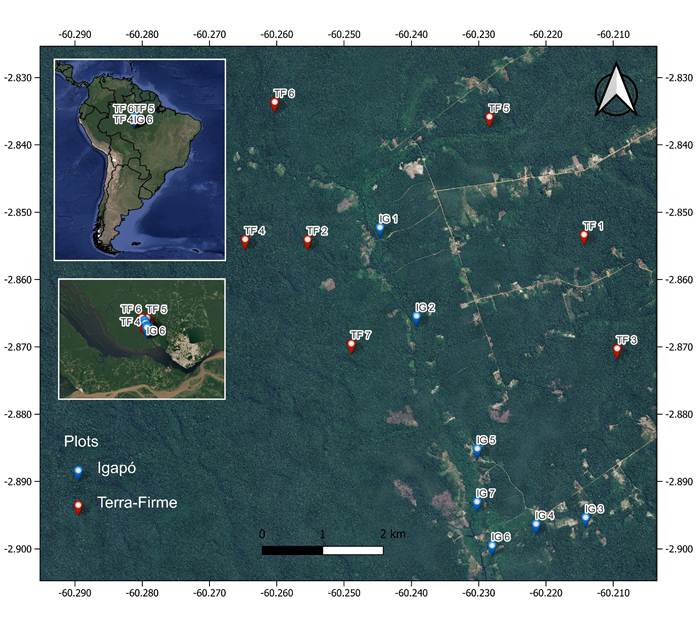
The study was conducted in the Tarumã-Mirim region, within the Negro River basin, Amazonas State, Brazil (60º 02’ 18.3’’ S, 20º 47’ 43.7’’ W) (Figure 1). The area experiences a flood season from November to May and a dry season from June to October (Ferreira and Parolin 2011). Currently, the area comprises a mosaic of forests seasonally flooded by black-waters (igapó), unflooded upland forests (terra-firme) and white-sand forests (campinaranas) (Rossetti et al. 2012; Figure 1). Terra-firme forests are situated on higher ground, represented by plateaus with well-drained clay soils, a canopy reaching 30 m, and high floristic diversity (Ribeiro et al. 1999). Igapó forests occur in low-elevation areas subject to seasonal river overflow and are characterized by prolonged inundation of the forest floor and lower vegetation strata. The flood phase typically lasts from December to early July, with receding water from late July to November (Ferreira and Parolin 2011).
Location of the study area and sampling points at Tarumã-Mirim, state of Amazonas, Brazil. Red dots = Terra-firme forest (TF) and blue dots = Igapó forest (IG).
We established 14 plots along the Tarumã-Mirim stream, with seven plots in igapó forests and seven in terra-firme forests. Each plot measured 180 x 30 m (0.54 ha), with a minimum distance of 1 km between them, resulting in a total sampling area of 75,600 m² (7.56 ha). Plots were established during the dry season, with igapó plots located at least 100 m away from the stream margin and terra-firme plots placed in plateau areas. Sampling was conducted in February, August, and September 2020 and in October 2021, due to restrictions imposed by the pandemic period.
Field observations and species sampling
Field observations were conducted during daytime in each plot, when extrafloral nectary activity is commonly higher (Anjos et al. 2017; Nogueira et al. 2020). All understory plants up to 5 m tall bearing active EFNs or colonized myrmecophytes were marked across both forest types. We recorded all active EFN-bearing plants, monitoring each individual for at least 5 minutes. The presence of foraging ants was investigated in stems, leaves and petioles, following standard morphological criteria (Díaz-Castelazo et al. 2004; Heil 2010). We primarily monitored young branches, a developmental stage at which plants tend to experience higher herbivory and, consequently, increased extrafloral nectar secretion (Chamberlain and Holland 2009; Heil 2010). When young branches were absent, we monitored mature branches bearing active extrafloral nectaries and recorded ant visitors associated.
For myrmecophyte plants, we monitored all colonized myrmecophytes, identified by the presence of ants patrolling domatia or stem cavities. Posteriorly, we collected approximately seven domatia that were dissected to confirm the presence of ant colonies. When possible, individuals from different castes (e.g., queens, major workers) were also collected, to ensure accurate species identification and to confirm which species were actively nesting and reproducing inside the domatia. In plants with more than ten domatia, at least three were sampled from the upper, middle, and lower portions of the plant, following the methodology applied by Bruna et al. (2005). After sampling and identification by authors, ant and plant vouchers were deposited in the Invertebrates Collection of Universidade Federal do Amazonas and Herbarium of the Instituto Nacional de Pesquisas da Amazônia (INPA), respectively.
Mutualistic and opportunistic ants
Ant species nesting in domatia-bearing plants were classified as mutualists or opportunists based on direct field observations and a review of behavioral myrmecology literature. Mutualists were defined as species that exhibited territorial behavior and actively defended the host plant, whereas opportunists were those occupying domatia without clear evidence of territoriality or host defense (Beattie 1985; Yu 2001). Opportunistic species typically encounter the plant incidentally, rather than through chemical cues involved in true myrmecophyte associations (Yu 2001; Blatrix and Mayer 2010). To distinguish these categories in the field, we recorded specific defensive and territorial behaviors. Mutualistic ants were identified when workers consistently patrolled the plant surface, responded rapidly to disturbances, recruited nestmates, or displayed aggressive interactions toward herbivores or intruders. Opportunistic ants, in contrast, showed no territorial patrolling, displayed slow or absent recruitment, and rarely defended the host plant, generally foraging individually and using the plant merely as a nesting substrate (Yu 2001; Giusto et al. 2001). For ant morphospecies (e.g., Azteca sp. 1), classification was based on a combination of observed behaviors and the ecological history of the genus associated with the respective host plant. For example, Azteca sp. 6 was classified as a specialist because it actively defended its host plants during fieldwork.
Data Analyses
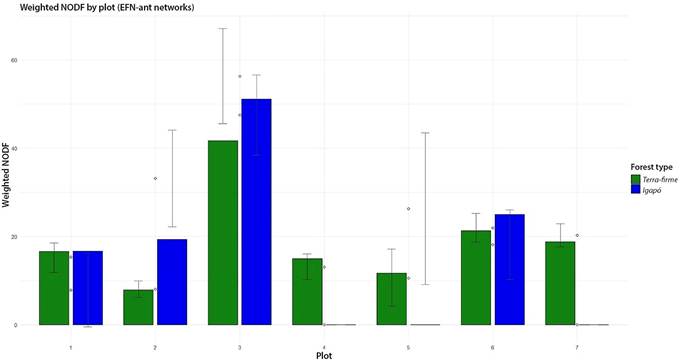
We represented ant-plant networks as quantitative m × n matrices, with m and n denoting plant and ant species, respectively. Cell values were weighted by interaction frequency, defined as the number of independent interaction events recorded for each ant-plant pair (Vázquez et al. 2009). Four networks were constructed: two for terra-firme and two for igapó forests, each representing one type of mutualism (facultative or obligate interactions). We opted to aggregate data at the forest-type level rather than constructing networks per plot, as our goal was to capture patterns in interaction structure across forest types. Additionally, plot-level analyses using the weighted NODF index yielded results highly consistent with those from the aggregated matrices, supporting our decision to focus on forest-level networks in the main analysis (see Table S1 and Figure S1). As expected, the number of interactions per plot was low - particularly in obligate ant-myrmecophyte networks, limiting the potential for finer-scale analyses.
To assess nestedness, we used the Weighted Nestedness based on the Overlap and Decreasing Fill (WNODF) metric, which accounts for both interaction frequency and partner overlap, and performs consistently across networks of varying size and shape (Almeida-Neto and Ulrich 2011). This index reflects how consistently less-connected species interact with subsets of partners used by more generalist species, revealing structural patterns associated with redundancy, hierarchy, and ecological stability (Almeida-Neto et al. 2008; Thebault and Fontaine 2010). WNODF was calculated using the network level function (bipartite R package), and each observed network was compared against 999 randomized matrices generated using the Patefield algorithm (r2dtable method), which preserves row and column totals (i.e., species richness and total interaction frequency).
We evaluated modular structure using QuanBiMo, a quantitative modularity index ranging from 0 (non-modular) to 1 (highly modular) (Dormann and Strauss 2014). This algorithm detects whether species form cohesive subgroups that interact more frequently among themselves than with other species in the network. To assess significance, we generated null models by randomly reallocating interactions across the matrix in 999 iterations. High modularity values (Q) indicate the formation of discrete compartments within the network (Olesen et al. 2007). Observed modularity was then compared to the distribution of simulated values.
We used Permutational Multivariate Analysis of Variance (PERMANOVA; Anderson 2017), based on the Bray-Curtis dissimilarity calculated from interaction matrices weighted by interaction frequency (i.e., relative abundance), to assess differences in the composition of ant-plant interactions between forest types. Matrices were constructed separately for facultative and obligate interactions, with sampling units defined at the plot level. The PERMANOVA was performed with 999 permutations. To visualize compositional patterns, we used a two-dimensional non-metric multidimensional scaling (NMDS) ordination, also based on the Bray-Curtis dissimilarity matrices.
We used analysis of covariance (ANCOVA) to test the hypothesis that the frequency of opportunistic ant species is lower in myrmecophyte plants of igapó forests, compared to terra-firme forests. Species diversity and abundance were dependent variables, the density of myrmecophytic plants and forest types were the covariates. All analyses were done in R (R Core Team 2025), using vegan, bipartite and ggplot2 packages.
RESULTS
Species diversity
We recorded a total of 72 plant species/morphospecies (not individuals) from 13 botanical families across 14 sampling plots. We documented 446 ant-plant interactions, of which 273 were facultative (61.2%) and 173 were obligate (38.8%). We identified 72 ant species or morphospecies nesting or foraging on plants, belonging to 20 genera and six subfamilies, totaling 10,645 specimens. Species richness was consistently higher in terra-firme forests for both plants and ants, regardless of interaction type (Table 1).
Network structure
Facultative interactions were more frequent in terra-firme forests (Table 1, Figure 2), with 36 ant species (vs. 30 in igapó) foraging in 50 EFN-bearing plant species (vs. 14 in igapó), involving an overall frequency of 196 associations (vs. 77 in igapó). Inga represented 56% of EFN-bearing plant species in terra-firme forests, with the most frequent interaction occurring between Inga glomeriflora and Crematogaster brasiliensis (28 interactions). Zygia latifolia showed the highest abundance and interaction frequency, being associated mainly with C. brasiliensis and C. tenuicula (7 interactions each).
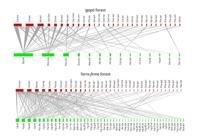
Facultative ant-plant networks at Tarumã-Mirim. Links represent interactions between ants and plants mediated by extrafloral nectaries. Green bars indicate plant species, while red bars indicate ant species, in Igapó (upper network) and terra-firme forests (lower network).
At the network level, associations between ants and EFN-bearing plants were highly nested in terra-firme forests (WNODFobs = 22.42; null mean = 26.57 ± 2.26; p < 0.001), whereas in igapó forests nestedness was low and only marginally non-significant (WNODFobs = 12.36; null mean = 16.12 ± 2.48; p = 0.060). The general topology showed a well-defined modular structure in terra-firme forests (Q = 0.30, Table 1), which was higher than expected under the null model (null mean = 0.20 ± 0.02; p < 0.001). Although modularity in igapó was relatively high (Q = 0.42), it did not differ from null expectations (null mean = 0.36 ± 0.06; p = 0.165).
Structural metrics of ant-plant mutualistic networks in terra-firme and igapó forests by interaction type (facultative = EFN-bearing plants; obligate = myrmecophytes). Metrics include the number of ant and plant species, total number of ant-plant interactions, weighted nestedness (WNODFObs) and modularity (Q). P-values indicate significance based on comparisons with null models. Statistically significant values are in bold
Obligate interactions were more frequent in terra-firme forests, where eight myrmecophyte species hosted 20 ant species, resulting in 139 quantitative interactions. The most frequent associations were between Allomerus octoarticulatus and Hirtella myrmecophila (55 occurrences), followed by Allomerus decemarticulatus on Pourouma myrmecophila (13) and Pseudomyrmex concolor on Tachigali plumbea (9). In Igapó forests, obligate interactions were less diverse, involving only three plant species and four associated ant species, totaling 39 quantitative interactions (Figure 3, Table S2). Azteca sp. 6 was exclusively recorded on Miconia tococoronata (new taxonomic combination for Tococa coronata), with 31 occurrences, and was considered a specialist species. Additionally, we found two occurrences of the specialized interaction between Hirtella myrmecophila and Allomerus octoarticulatus, and one between Miconia alternidomatia (new taxonomic combination for Maieta poeppigii) with its specialist ant, Pheidole minutula (Table S2).
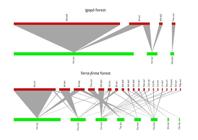
Obligatory ant-plant networks at Tarumã-Mirim. Links represent interactions between ants and plants mediated by domatia. Green bars indicate plant species, while red bars indicate ant species, in igapó (upper network) and terra-firme forests (lower network).
Obligate networks showed significantly non-random nestedness in both forest types (terra-firme: WNODFobs = 4.82; null mean = 35.31 ± 4.44; p < 0.001; igapó: WNODFobs = 33.33; null mean = 64.25 ± 16.91; p = 0.002; Table 1). Both networks were also significantly modular, with observed values exceeding null expectations in terra-firme (Q = 0.19; null mean = 0.18 ± 0.02; p < 0.001) and igapó (Q = 0.03; null mean = 0.05 ± 0.02; p < 0.001).
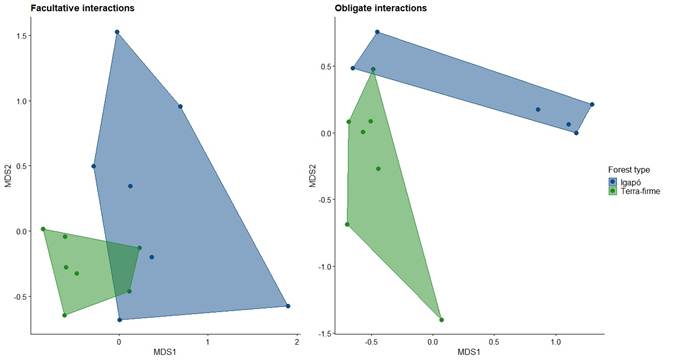
The composition of ant-plant associations differed between forest types for both facultative and obligate interactions (Figure 4). In facultative interactions involving EFN-bearing plants, species composition differed between terra-firme and igapó forests (PERMANOVA; r² = 0.12, p = 0.003). Similarly, obligate interactions between myrmecophytes and their resident ants also varied between forest types (PERMANOVA; r² = 0.32, p = 0.008). Obligatory networks exhibited clearer compositional separation between forest types, with minimal overlap between plots from different habitats (Figure 4). Facultative networks displayed greater within-habitat variability, particularly in igapó, indicating higher species turnover and more heterogeneous interaction patterns across plots.
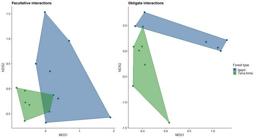
NMDS ordination representing the assemblage of facultative and obligatory interactions given the ant-plant distances (Bray-Curtis) at the network, for terra-firme (green dots) and igapó (blue dots) forests at Tarumã-Mirim.
We recorded 19 links by opportunistic ant species nesting in myrmecophytes, comprising 11 ant species across 10 plant species (Table S2). These associations were strongly biased toward terra-firme forests, where 18 of the 19 occurrences were recorded. In this forest type, Solenopsis bicolor was the most frequent opportunist, found nesting in four different myrmecophyte species, followed by Azteca sp. 2 and Neoponera unidentata. In contrast, a single ant-plant pair was registered in igapó forests, with Azteca sp. 2 found once on Hirtella myrmecophila. In terra-firme plots, myrmecophyte density was significantly associated with both opportunistic ant abundance (p = 0.002) and species richness (p < 0.001) compared to igapó forests, indicating that increased availability of domatia may facilitate colonization by non-specialist ants (Figure 5).
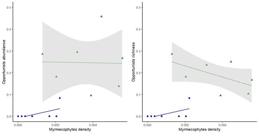
Comparison between the density of myrmecophytic plants and opportunistic ant species in terra-firme (green dots) and igapó (blue dots) forests at Tarumã-Mirim.
DISCUSSION
Our study shows that ant-plant mutualisms differ between seasonally flooded igapó forests and unflooded terra-firme forests, with contrasting patterns between facultative and obligate interactions. Facultative interactions involving EFN-bearing plants were more frequent and more strongly nested in terra-firme forests, where more stable conditions and complex vegetation structure are likely to enhance spatial overlap between generalist ants and plants. For obligate interactions, our results partially support our expectations, as ant-myrmecophyte networks were highly modular in both forest types, despite markedly lower ant and plant species richness and interaction frequency in igapó forests. Overall, these differences between forest types are consistent with the long-term influence of contrasting hydrological regimes on the structure and composition of ant-plant interaction networks.
Although species richness and interaction frequency declined abruptly in flooded forests, species composition showed a marked turnover between flooded and unflooded environments. As hypothesized, opportunistic ant species were almost entirely restricted to terra-firme forests, suggesting that seasonal flooding limits colonization by non-specialist ants and reinforces the role of environmental filtering in structuring specialized interactions. These results highlight how disturbance regimes can modulate the architecture and composition of mutualistic networks by filtering species according to their ecological strategies and habitat tolerance.
Facultative interactions between ants and EFN-bearing plants displayed a significantly nested structure in terra-firme forest, but not in igapós, emphasizing the role of generalist species in maintaining network stability and interaction persistence despite specialist loss (Bascompte et al. 2006). Nestedness enhances ecological resilience by increasing redundancy, which allows lost links to be replaced under fluctuating conditions (Emer et al. 2013). Nevertheless, we interpret these findings cautiously, as sampling effort and network size, particularly in networks with low interaction frequency, may inflate nestedness estimates. In igapó forests, although networks of facultative interactions did not exhibit significant nestedness, the presence of weakly nested patterns may reflect seasonal shifts in foraging behavior. Ant species that typically nest in soil, litter, or lower vegetation strata may increase their use of plants even during the dry season (Adis and Junk 2002; Guimarães et al. 2006; Rico-Gray et al. 2012). In these flood-prone environments, extrafloral nectaries likely serve as vital foraging resources throughout wet and dry seasons, supporting the continuity of ant-plant interactions despite environmental constraints.
Our findings suggest that the nested structure observed in facultative interactions may confer robustness to periodic environmental perturbations, as it is characterized by species forming a core-periphery pattern in which highly connected species interact with many others (Guimarães et al. 2017). In contrast, the modularity observed in obligate interactions indicates that these associations are organized into cohesive subgroups of ants and myrmecophyte plants that interact more frequently within modules than between them (Olesen et al. 2007). Such compartmentalization suggests a structured pattern of interaction in which specialized pairs are clustered into relatively discrete subsets within the network (Guimarães et al. 2017).
Once dominated by few species, the stability of obligate interactions in flooded environments depends on the persistence of key species within modular compartments, a pattern consistent with broader ecological theories on mutualistic network resilience (Guimarães et al. 2017). In our study, Miconia tococoronata was the most abundant myrmecophyte plant in the igapó forests. This species is known to have adaptive strategies for survival in flooded areas, investing in rapid growth during early ontogenetic stages through internode elongation to exceed the maximum flooding level (Izzo et al. 2018). Once the domatia are produced at a higher position, just above the flood line (Izzo et al. 2018), the disturbance does not interfere with the ants’ ability to colonize and survive on M. tococoronata. Plants lacking a similar strategy would likely experience nest relocation or displacement of their ant colonies during floods.
Terra-firme forests are not subject to environmental filtering provided by flood and therefore, do not experience seasonal mortality of myrmecophytic plants and their associated ant colonies, which likely promotes the lower species richness observed in igapó forest. Opportunistic ants, which typically nest in the soil or leaf litter, tend to find plants by chance, unlike specialist queens that locate plants using chemical signals after nuptial flights (Blatrix and Mayer 2010). However, once opportunists enter a plant, they can persist due to priority effects (Fukami 2015), which at least partially inhibit colonization by specialists. In contrast, seasonal colony mortality in environments subject to periodic disturbances will lead to lower density and richness of opportunists, as observed.
Our results suggest that obligate interactions may be more strongly rewired across ecosystems than facultative interactions, given the substantial shift in the composition of EFN-bearing plants between flooded and unflooded forests. The composition of obligatory interactions exhibited a more pronounced divergence between environments, reflecting the restricted distribution of myrmecophytic plants and specialized ants in flooded areas (Emer et al. 2013). This difference may be explained by the dependence of specialized ants on their host plants, as the lower availability of myrmecophytes directly limits ant colonization (Fonseca and Ganade 1996, Dáttilo et al. 2013). In contrast, facultative interactions were more diverse across environments, likely due to the greater ecological flexibility of generalist ants, which can utilize a wider range of plants as food sources (Nogueira et al. 2020; Nogueira 2025).
The reduced richness and interaction frequency observed in obligatory ant-plant networks in flooded forests likely reflect strong environmental constraints on species establishment. However, the persistence of modularity and nestedness in these networks suggests that specialized ant-plant associations may retain structural cohesion despite biodiversity loss. Rather than being replaced by opportunistic species, as might be expected under chronic disturbance, obligate interactions in igapó forests appear to be maintained by a limited set of adapted specialists. This pattern underscores the importance of species-specific traits in sustaining mutualistic networks under environmental stress.
CONCLUSIONS
The contrasting responses of facultative and obligate interactions indicate that interaction types differ between seasonally flooded igapó forests and unflooded terra-firme forests. The persistence of structured obligate networks despite reduced diversity suggests that specialized associations can be maintained in flooded forest environments, whereas facultative interactions appear more sensitive to differences between forest types. Together, these findings highlight the importance of considering interaction type when assessing variation in ecological network structure across Amazonian forest environments. Future studies should investigate how the loss or persistence of key specialist interactions influences broader ecosystem functions, particularly in the face of ongoing hydrological changes driven by climate and land-use transformation in the Amazon.
ACKNOWLEDGMENTS
This study was funded by Fundação de Amparo à Pesquisa do Estado do Amazonas through the Programa de Apoio à Pós-Graduação Stricto Sensu (POSGRAD 2019/2020, Resolution No. 003/2019, Project No. 062.00931/2013). TFS expresses gratitude to the families of the Tarumã-Mirim area, especially Sr. Aguiar and his son, Sra. Tê, Sr. Branco, Sra. Francisca, and Sr. João, for their hospitality during the sampling periods. We thank José Lopes, our field assistant, Vanessa Pontes, and Karoline Menezes, for their assistance with fieldwork. We also thank Janderson Alencar for the map construction, and Dr. Rodrigo Feitosa and Dr. Itanna Fernandes for their assistance with the taxonomic review of ant species.
REFERENCES
- Adis, J.; Junk, W.J. 2002. Terrestrial invertebrates inhabiting lowland river floodplains of Central Amazonia and Central Europe: a review. Freshwater Biology 47(4): 711-731.
- Almeida‐Neto, M.; Guimarães, P.; Guimarães Jr, P.R.; Loyola, R.D.; Ulrich, W. 2008. A consistent metric for nestedness analysis in ecological systems: reconciling concept and measurement. Oikos 117(8): 1227-1239.
- Almeida‐Neto, M.; Ulrich, W. 2011. A straightforward computational approach for measuring nestedness using quantitative matrices. Environmental Modelling & Software 26(2): 173-178.
- Anderson, M.J. 2017. Permutational multivariate analysis of variance (PERMANOVA). In: Kenett, R.S.; Longford, N.T.; Piegorsch, W.W.; Ruggeri, F. (Ed.). Wiley Statsref: Statistics Reference Online. Wiley, p.1-15.
- Anjos, D. V.; Caserio, B.; Rezende, F. T.; Ribeiro, S. P.; Del‐Claro, K.; Fagundes, R. 2017. Extrafloral‐nectaries and interspecific aggressiveness regulate day/night turnover of ant species foraging for nectar on Bionia coriacea. Austral Ecology 42(3): 317-328.
- Bascompte, J. 2010. Structure and dynamics of ecological networks. Science 329(5993): 765-766.
- Bascompte, J.; Jordano, P.; Olesen, J.M. 2006. Asymmetric coevolutionary networks facilitate biodiversity maintenance. Science 312(5772): 431-433.
- Blatrix, R.; Mayer, V. 2010. Communication in Ant-plant Symbioses. In: Baluška, F.; Ninkovic, V. (Ed.). Plant Communication from an Ecological Perspective. Signaling and Communication in Plants Springer, Berlin, p.127-158.
- Beattie, A.J. 1985. The evolutionary ecology of ant-plant mutualisms Cambridge University Press, Cambridge, 182p.
- Benson, W.W. 1985. Amazon ant-plants. In: Prance, G.T.; Lovejoy, T.E. (Ed.). Amazonia: key environment Pergamon Press, London, p.239-266.
- Bruna, E.M.; Vasconcelos, H.L.; Heredia, S. 2005. The effect of habitat fragmentation on communities of mutualists: Amazonian ants and their host plants. Biological Conservation 124(2): 209-216.
- Cagnolo, L.; Tavella, J. 2015. The network structure of myrmecophilic interactions. Ecological Entomology 40(5): 553-561.
- Calixto, E.S.; Lange, D.; Del-Claro, K. 2018. Protection mutualism: an overview of ant-plant interactions mediated by extrafloral nectaries. Oecologia Australis 22(4): 410-425.
- Chamberlain, S.A.; Holland, J.N. 2009. Quantitative synthesis of context dependency in Ant-plant protection mutualisms. Ecology 90(9): 2384-2392.
- Dáttilo, W.; Izzo, T.J.; Vasconcelos, H.L.; Rico-Gray, V. 2013b. Strength of the modular pattern in Amazonian symbiotic Ant-plant networks. Arthropod-Plant Interactions 7: 455-461.
- Dáttilo, W.; Rico-Gray, V. 2018. Ecological networks in the tropics: An Integrative Overview of Species Interactions from Some of the Most Species-Rich Habitats on Earth. Springer, Cham, Switzerland. 122p.
- Davidson, D.W.; McKey, D. 1993. Ant-plant symbiosis: stalking the Chuyachaqui. Trends in Ecology & Evolution 8(9): 326-332.
- Díaz-Castelazo, C.; Rico-Gray, V.; Oliveira, P.S.; Cuautle, M. 2004. Extrafloral nectary-mediated ant-plant interactions in the coastal vegetation of Veracruz, Mexico: Richness, occurrence, seasonality, and ant foraging patterns. Ecoscience 11(4): 472-481.
- Dormann, C.F.; Strauss, R. 2014. A method for detecting modules in quantitative bipartite networks. Methods in Ecology and Evolution 5(1): 90-98.
- Emer, C.; Venticinque, E.M.; Fonseca, C.R. 2013. Effects of dam‐induced landscape fragmentation on Amazonian Ant-plant mutualistic networks. Conservation Biology 27(4): 763-773.
- Ferreira, L.V.; Parolin, P. 2011. Effects of flooding duration on plant demography in a black-water floodplain forest in central Amazonia. Pesquisas Botânica 62: 323-332.
- Fonseca, C. R.; Ganade, G. 1996. Asymmetries, compartments and null interactions in an Amazonian ant-plant community.Journal of Animal Ecology 65(3): 339-347.
- Fukami, T. 2015. Historical contingency in community assembly: integrating niches, species pools, and priority effects. Annual Review of Ecology, Evolution, and Systematics 46: 1-23.
- Giusto, B.; Anstett, M.C.; Dounias, E.; McKey, D.B. 2001. Variation in the effectiveness of biotic defence: the case of an opportunistic ant-plant protection mutualism. Oecologia 129: 367-375.
- Guimarães, P.R.; Rico-Gray, V.; Furtado dos Reis, S.; Thompson, J.N. 2006. Asymmetries in specialization in Ant-plant mutualistic networks. Proceedings of the Royal Society B: Biological Sciences 273(1597): 2041-2047.
- Guimarães, P.R.; Pires, M.M.; Jordano, P.; Bascompte, J.; Thompson, J.N. 2017. Indirect effects drive coevolution in mutualistic networks. Nature 550(7677): 511-514.
- Guimerà, R.; Amaral, L.A.N. 2005. Cartography of complex networks: modules and universal roles. Journal of Statistical Mechanics: Theory and Experiment 2005(02): P02001.
- Heil, M. 2010. Ant-plant Mutualisms. In: Encyclopedia of Life Sciences (eLS) John Wiley & Sons, Ltd, Chichester, p.1-10.
- Heil, M.; McKey, D. 2003. Protective ant-plant interactions as model systems in ecological and evolutionary research. Annual Review of Ecology, Evolution, and Systematics 34(1): 425-553.
- Hess, L.L.; Melack, J.M.; Affonso, A.G.; Barbosa, C.; Gastil-Buhl, M.; Novo, E.M. 2015. Wetlands of the Lowland Amazon Basin: Extent, Vegetative Cover, and Dual-season Inundated Area as Mapped with JERS-1 Synthetic Aperture Radar. Wetlands 35: 745-756.
- Izzo, T.J.; Fernandez Piedade, M.T.; Dáttilo, W. 2018. Postponing the production of ant domatia as a strategy promoting an escape from flooding in an Amazonian myrmecophyte. Annals of Botany 122(6): 985-991.
- Jordano, P.; Bascompte, J.; Olesen, J. M. 2003. Invariant properties in coevolutionary networks of plant-animal interactions. Ecology letters 6(1): 69-81.
- Junk, W.J.; Bayley, P.B.; Sparks, R.E. 1989. The flood pulse concept in river-floodplain systems. In: Dodge, D.P. (Ed.). Proceedings of the International Large River Symposium (LARS). Canadian Special Publication of Fisheries and Aquatic Sciences, p.110-127.
- Junk, W.J.; Piedade, M.T.F.; Schöngart, J.; Cohn-Haft, M.; Adeney, J.M.; Wittmann, F. 2011. A classification of major naturally-occurring Amazonian lowland wetlands. Wetlands 31: 623-640.
- Junk, W.J.; Wittmann, F.; Schöngart, J.; Piedade, M.T. 2015. A classification of the major habitats of Amazonian black-water river floodplains and a comparison with their white-water counterparts. Wetlands Ecology and Management 23: 677-693.
- Laurance, W.F.; Williamson, G.B. 2001. Positive feedbacks among forest fragmentation, drought, and climate change in the Amazon. Conservation biology 15(6): 1529-1535.
- Mayer, V.E.; Frederickson, M.E.; McKey, D.; Blatrix, R. 2014. Current issues in the evolutionary ecology of Ant-plant symbioses. New Phytologist 202(3): 749-764.
- Melack, J.M.; Hess, L.L. 2010. Remote Sensing of the Distribution and Extent of Wetlands in the Amazon Basin. In: Junk, W.J.; Piedade, M.T.F.; Wittmann, F.; Schöngart, J.; Parolin, P. (Ed.). Amazonian Floodplain Forests Springer, Dordrecht, p.43-59.
- Miranda, P.N.; Ribeiro, J.E.L.S.; da Silva, I.B.; Delabie, J.H.C.; Lopes, J.; Dáttilo, W. 2025. The rainfall seasonality of Brazilian Amazon tropical rainforests influences on the organization of ant-plant interaction networks. Tropical Ecology 66(1): 168-179.
- Miller, A.D.; Roxburgh, S.H.; Shea, K. 2011. How frequency and intensity shape diversity-disturbance relationships. Proceedings of the National Academy of Sciences 108(14): 5643-5648.
- Nogueira, R. R. 2025. Mutualistic interactions between plants with extrafloral nectaries and ants: ecological impacts, ant sharing among neighboring plants, and the effects of environmental conditions. Community Ecology 1: 1-11.
- Nogueira, A.; Baccaro, F. B.; Leal, L. C.; Rey, P. J.; Lohmann, L. G.; Bronstein, J. L. 2020. Variation in the production of plant tissues bearing extrafloral nectaries explains temporal patterns of ant attendance in Amazonian understorey plants. Journal of Ecology 108(4): 1578-1591.
- Olesen, J.M.; Bascompte, J.; Dupont, Y.L.; Jordano, P. 2007. The modularity of pollination networks. Proceedings of the National Academy of Sciences 104(50): 19891-19896.
-
R Core Team. 2025. R: A language and environment for statistical computing. Version 4.5.1. R Foundation for Statistical Computing, Vienna, Austria. Available at: https://www.R-project.org
» https://www.R-project.org - Ribeiro, J.E.L.S.; Hopkins, M.J.G.; Vicentini, A.; Sothers, C.A.; Costa, M.A.S.; Brito, J.M.; et al 1999. Flora da Reserva Ducke. Guia de identificação das plantas vasculares de uma floresta de terra firme na Amazônia Central INPA-DFID, Manaus, 800p.
- Rico-Gray, V.; Oliveira, P.S. 2007. The Ecology and Evolution of Ant-Plant Interactions The University of Chicago Press, London, 320p.
- Rico-Gray, V.; Díaz-Castelazo, C.; Ramírez-Hernández, A.; Guimarães, P.R.; Nathaniel Holland, J. 2012. Abiotic factors shape temporal variation in the structure of an Ant-plant network. Arthropod-Plant Interactions 6: 289-295.
- Rodrigues‐Filho, C.A.; Costa, F.R.; Schietti, J.; Nogueira, A.; Leitão, R.P.; Menger, J.; et al 2024. Multi‐Taxa Responses to Climate Change in the Amazon Forest. Global Change Biology 30(11): e17598.
- Rosumek, F.B.; Silveira, F.A.O.; Neves, F.S.; Barbosa, N.P.U.; Diniz, L.; Oki, Y.; et al 2009. Ants on plants: a meta-analysis of the role of ants as plant biotic defenses. Ecology 90(9): 2187-2193.
- Rossetti, D.F.; Bertani, T.C.; Zani, H.; Cremon, E.H.; Hayakawa, E.H. 2012. Late Quaternary sedimentary dynamics in Western Amazonia: Implications for the origin of open vegetation/forest contrasts. Geomorphology 177: 74-92.
- Sévêque, A.; Gentle, L.K.; López‐Bao, J.V.; Yarnell, R.W.; Uzal, A. 2020. Human disturbance has contrasting effects on niche partitioning within carnivore communities. Biological Reviews 95(6): 1689-1705.
- Thebault, E.; Fontaine, C. 2010. Stability of ecological communities and the architecture of mutualistic and trophic networks. Science 329(5993): 853-856.
- Vázquez, D.P.; Blüthgen, N.; Cagnolo, L.; Chacoff, N.P. 2009. Uniting pattern and process in plant-animal mutualistic networks: A review. Annals of Botany 103(9): 1445-1457.
- Viljur, M.L.; Abella, S.R.; Adámek, M.; Alencar, J.B.R.; Barber, N.A.; Beudert, B.; et al 2022. The effect of natural disturbances on forest biodiversity: an ecological synthesis. Biological Reviews 97(5): 1930-1947.
- Yu, D.W. 2001. Parasites of mutualisms. Biological Journal of the Linnean Society 72(4): 529-546.
Data availability
The data that support the findings of this study are available, upon reasonable request, from the corresponding author, Talitha Ferreira dos Santos.
APPENDIX
Santos et al. Environmental filtering and network structure in ant-plant mutualisms across flooded and unflooded Amazonian forests
Summary of plot-level nestedness metrics (weighted NODF) for EFN-ant networks in terra-firme and igapó forests.

Observed weighted NODF values (bars) with null model means (dots) and standard deviations (error bars) for EFN-ant networks in each plot across terra-firme and igapó forests.
Edited by
-
ASSOCIATE EDITOR:
Paulo Estefano Bobrowiec https://orcid.org/0000-0002-8945-6105