 Abundance, biomass and variability of the demersal mesozooplankton during contrasting seasons on a shallow reef ecosystem
Abstract
This study investigated the structure, abundance, and biomass of the demersal zooplankton assemblage in the Tamandaré bay (Pernambuco, Brazil), a shallow coastal reef ecosystem, during dry and rainy seasons. We tested the hypothesis that a more productive scenario during the rainy season would sustain a more abundant and diverse community. Sampling was conducted using emergence traps on a fixed station over coral reefs. Contrary to our initial hypothesis, the dry season exhibited higher diversity and abundance, associated with increased temperature, salinity, chl-a concentrations, and moonlight intensity. However, community biomass did not differ between seasons, balanced by high Mysida biomass in the rainy season. A total of 68 taxa were identified, predominantly crustaceans (e.g., Copepoda such as Acartia lilljeborgi and Dioithona oculata, as well as Cumacea and Mysida). The results indicate that the assemblage structure is shaped by a mosaic of environmental (e.g., temperature, pluviometry, total suspended solids and moonlight intensity) and behavioral factors, with seasonal variability being a primary driver, favoring diversity and abundance in the dry season while maintaining consistent biomass between seasons.
Key words
Emergence fauna; Bentho-pelagic; Coral reef; Emergence traps; Vertical migration
INTRODUCTION
Coral reef ecosystems are one of the world’s most diverse and productive ecosystems, despite growing in relatively low-nutrient waters and covering about 0.09% of the earth’s surface (Connell 1978, Burke et al. 2011). They protect many low-lying beaches from erosion, maintain fisheries, nurture the leisure industry, and provide resources for building materials and the aquarium market (Neumann-Leitão et al. 2009, Ferrario et al. 2014, Reguero et al. 2018). They further act in biogeochemical reactions, showing high internal cycling of nutrients and carbon transfer efficiency (D’Elia & Wiebe 1990).
Zooplankton is a key player in the food web of coral reef ecosystems, serving as a trophic link between producers, particulate organic matter, and higher consumers (Alldredge & King 1977, Schnack-Schiel & Isla 2005). These assemblages are diverse and include both epibenthic and epipelagic taxa that reside near the substrate during the day and dwell in the water column at night, referred to as demersal zooplankton (Motoda 1940, Emery 1968, Alldredge & Hamner 1980). This behavior offers several ecological benefits for the demersal zooplankton, such as feeding on pelagic organisms, enabling reproduction and dispersion, and providing a means of escape from benthic and pelagic predators (Alldredge & King 1980, Tranter et al. 1981, Lampert 1989). Furthermore, vertical migration impacts benthic-pelagic fluxes and is critical for biogeochemical cycling and pelagic productivity (Baustian et al. 2014).
In reef ecosystems, the demersal zooplankton reaches up to 50% of the zooplankton biomass during the night (Vereshchaka 1995, Yahel et al. 2005, Alldredge & King 2009), and constitutes a prominent prey for reefs pelagic and benthic organisms, such as stingrays, jellyfishes, and reef planktivorous fishes (Robertson & Howard 1978, Heidelberg et al. 2004, Lesser 2006, Pitt et al. 2008, Couturier et al. 2013). The demersal zooplankton has complex migration patterns, which are influenced by daily and seasonal variabilities in environmental factors such as light penetration, temperature and currents velocity, taxa innate behavior, moonlight, and substrate preference (Porter & Porter 1977, Pacheco et al. 2014). These environmental and biological variables regulate both the time of emergence and reentry in the substrate and the vertical migration amplitude, i.e. depending on moonlight intensity amphipods may stay close to the substrate or even not migrate (Ríos-Jara 2005, Pacheco et al. 2014, Welicky et al. 2013). Therefore, the interplay between such variables influences the abundance and biomass structure of the migrating demersal zooplankton, changing their role in the pelagic reef trophic web (Alldredge & King 1980).
To this date, few works have been carried out on the Southwestern Tropical Atlantic reef ecosystems demersal community (Melo et al. 2010, Figueirêdo et al. 2017, Farias et al. 2020). Current studies focus on the emergent community abundance and distribution in shallow habitats (Melo et al. 2010), and new occurrences of demersal species in the South Atlantic (Figueirêdo et al. 2017, Farias et al. 2020). In Tamandaré Bay, although known members of the demersal zooplankton have been caught using regular plankton nets (Brito-Lolaia et al. 2020, 2022, Santos et al. 2017), focused studies on this community are scarce (Melo et al. 2010), and little is known about its ecology, including community structure variability. Previous studies have demonstrated that emerging and benthic boundary layer assemblages often display marked temporal variability in both abundance and taxonomic composition, associated with a mosaic of environmental and ontogenetic variables (Alldredge & King 1980, Jacoby & Greenwood 1989). In temperate shelf environments, differences between summer and winter have been linked to changes in hydrodynamic conditions as well as reproductive behavior (Thistle 2003). Coastal studies have also highlighted strong seasonal peaks in biomass and diversity, often associated with spring pulses of primary production and shifts in benthic–pelagic coupling (Vallet & Dauvin 1999). In addition, emerging invertebrate assemblages from sheltered soft-bottom habitats displayed pronounced seasonal fluctuations similar to those of pelagic zooplankton, primarily driven by seasonal oscillations in upwelling intensity that modulate food availability, oxygen conditions, and life-history processes (i.e.: reproduction, dispersal, predator avoidance) (Pacheco et al. 2015).
Therefore, we hypothesize that the structure of demersal zooplankton assemblages in Tamandaré Bay follows a seasonal pattern, with contrasting communities between the dry and rainy periods. We expect higher diversity, abundance, biomass, and more evenly distributed communities during the rainy season, driven by increased productivity. To address current gaps in knowledge, this study examines the variability of mesozooplankton assemblages, considering abundance, biomass, and community structure, across consecutive days under contrasting seasonal conditions, while also assessing the influence of environmental variables.
MATERIAL AND METHODS
Study area
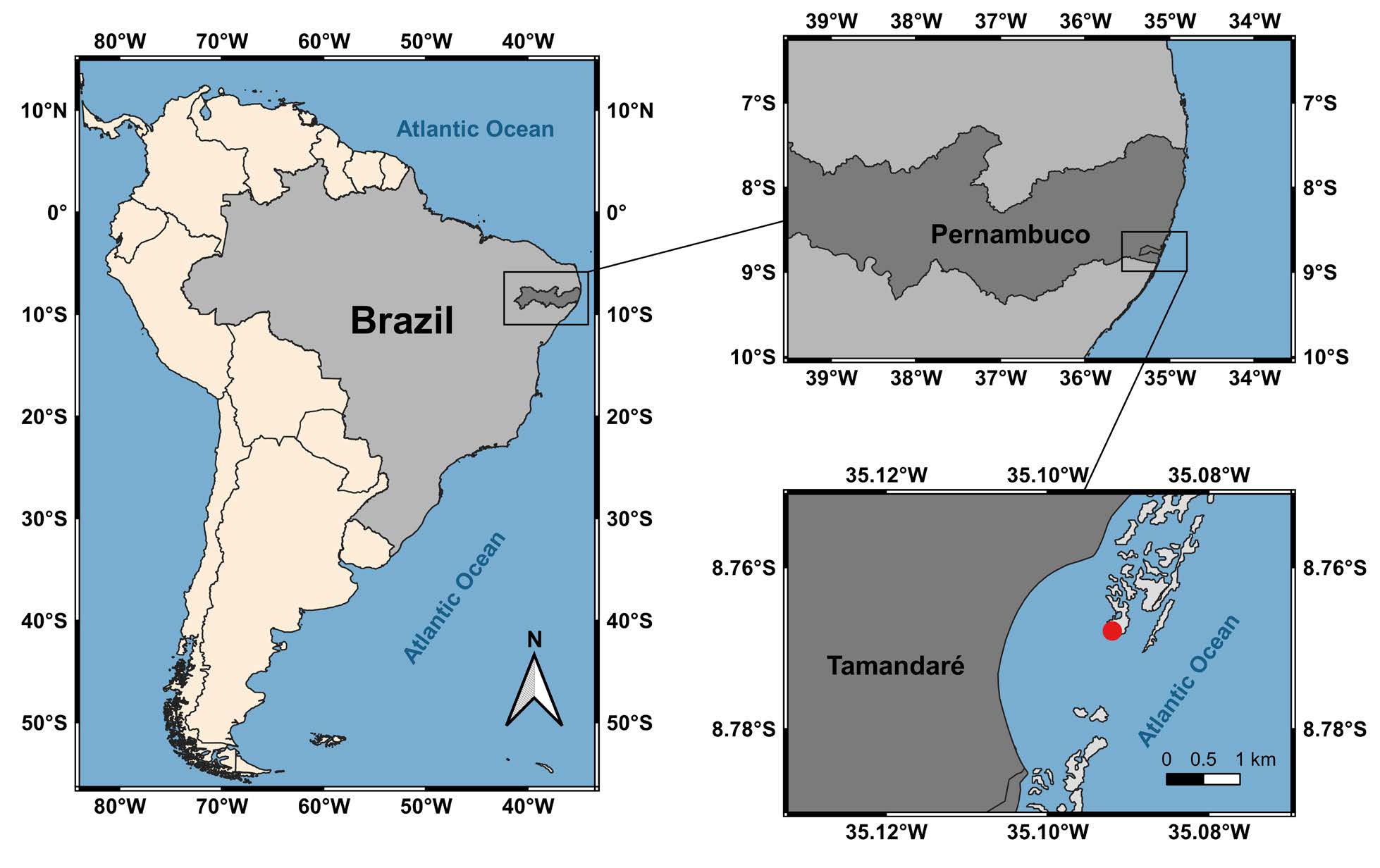
The Tamandaré Bay (8°46’07.5”S, 35°06’03.6”W) is located on the northeastern Brazilian shelf (Figure 1). The region has a tropical monsoon-type climate (AM), with two distinct seasons, a rainy season (April to August) and a dry season (September to March), with air temperature ranging from 25° to 30°C and cumulative monthly precipitation ranging from 60 mm in the dry season to 220 mm in the rainy season. (APAC 2025). Tamandaré bay is located within the Environmental Protection Area Costa dos Corais, the largest Marine Conservation Unit in Brazil. The bay has coral reef lines parallel to the coast, composed of beach rocks resembling fringing reefs. These reef formations form a barrier near the coast that is exhibited during the low tide (Maida & Ferreira 1997). The reef lagoon has an average depth of 7 m, and is dominated by macroalgae and zoanthids (Maida & Ferreira 1997, Leão & Dominguez 2000), with the bay substrate being composed mostly of terrigenous and biogenic carbonatic sediments.
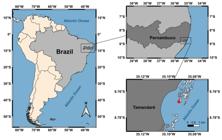
Demersal zooplankton sampling area at Tamandaré Bay, Pernambuco, Brazil, with the sampling location.
Field collection
The samplings were carried out in 2010 during a rainy (8 consecutive days in August) and a dry season (7 consecutive days in November). Samples were collected over a reef area approximately 7 m deep (Figure 1). The exact location where traps were set up was changed every day to avoid influencing the abundance of the sampled community. Rainy season samplings were carried out under a waning moon, whereas Dry season samplings took place under a waxing moon. Moonlight intensity differed between sampling days, reaching full moon (100% illumination during the dry season) and new moon (0% illumination during the rainy season) (Figure S1 - Supplementary Material). Surface moonlight intensity was further reduced on the rainy season due to cloud coverage.
Demersal zooplankton sampling was performed using emergence traps, consisting of a conical net with a 1 m diameter mouth and 1.5 m length (200 μm mesh size), with the net mouth attached to a square metal frame (1 m per side), resulting in a trap coverage area of 1 m². The traps ended in a catch chamber (200 mL volume) with a funnel to prevent organisms from escaping (Figure S2) (Melo et al. 2010). Traps were placed over, by SCUBA divers, on the reefs at dusk and removed at dawn. Two replicates were collected by sampling day, totalizing 30 samples. The samples were preserved with 4% formaldehyde buffered with sodium tetraborate (Harris et al. 2000).
Environmental variables were measured during trap deployment using a Horiba U52 multiparameter probe to record temperature and salinity. In addition, surface water samples were collected with a Niskin bottle at each station for chlorophyll-a (Chl-a) and total suspended solids (TSS) analyses (one sample per day, totaling 8 measurements in the rainy season and 7 in the dry season). Moonlight intensity was obtained from lunar calendars provided by the Brazilian Navy (Marinha do Brasil 2025), whereas pluviometry data was made available by the “Agência Pernambucana de Águas e Clima – APAC”, which have an observation station on Tamandaré (APAC 2025).
Sample analyses
The samples were analyzed in a Bogorov counting chamber under a stereomicroscope. Most samples were counted entirely, and the few samples that showed a large number of individuals were fractioned to a minimum of 300 individuals with a MOTODA splitter. Copepoda taxa were identified to the lowest possible taxonomic level using specific literature (Boltovskoy 1999, Boxshall & Halsey 2004, Dahms et al. 2006) while the other taxa were identified as general groups (Boltovskoy 1999). In each sample, 30 individuals of each taxon were measured to perform biomass estimations.
Statistical analysis
Abundance (ind. m-2), relative abundance (%), and frequency of occurrence (%) were calculated to describe the community structure. For the frequency of occurrence, the following scale was used: very frequent (>70%); frequent (70% Ⱶ 30%); infrequent (30% Ⱶ 10%) and rare (<10%). Shannon diversity (H’) (Shannon 1948) and Pielou’s evenness index (Pielou 1977) were applied to depict community diversity and evenness, and compare changes between rainy and dry seasons inside Tamandaré bay. Biomass (B, mgC m-2) was based on each taxa abundance (A, ind. m-2) and individual carbon weight (CW, mgC): B = A * CW. The CW was defined using length-weight regressions (Table I) available in the literature. For Appendicularia the CW was assumed to be 44.2% of the dry weight (Hirota 1986) and for the other taxa 40% (Bâmstedt 1986).
Length-weight regressions applied for biomass calculation of main mesozooplankton taxa. Length data inserted in μm, the * represents taxa that the length entry was in mm.
The Kolmogorov–Smirnov test was applied to assess normality, and Levene’s test to verify the homogeneity of variances, for abundance, biomass, ecological indices, and environmental data (pluviometry, temperature, salinity, chl-a, TSS, and moonlight intensity (%)). Prior to these analyses, data were log-transformed. Depending on the results of normalization, comparisons between groups were subsequently performed using either Student’s t-test or Mann-Whitneyin R base package v4.2.1. To graphically visualize the dissimilarity patterns in the data a non-metric multidimensional scaling (MDS) was used on the abundance data based on a Bray-Curtis matrix. Subsequently, Permutational analysis of variance (PERMANOVA) was performed to investigate changes in the community structure from the rainy to the dry season with the community abundance. PERMANOVA and MDS were calculated using the software Primer v6.0 with a Bray-Curtis dissimilarity matrix.
The relationship between taxonomic community composition and environmental variables was investigated using multivariate analyses through distance-based Redundancy Analysis (dbRDA), with the R package vegan. Initially, abundance data were filtered to include only taxa representing more than 10% of the community in at least one sample, in order to reduce noise in the results. Abundance data were Hellinger-transformed to reduce the influence of zeros and standardize values for a Bray-Curtis matrix. Continuous environmental variables were centered and standardized (z-score) prior to analysis, and categorical variables, such as season (dry/rainy), were excluded from the model to avoid confounding environmental and seasonal effects.
The dbRDA model was fitted considering all environmental variables: temperature, salinity, TSS, moonlight intensity, chl-a, and precipitation. The overall significance of the model, each canonical axis, and each explanatory variable was tested using permutation tests (9999 permutations). The variance explained by each axis was calculated from the model eigenvalues. Results were visualized in a biplot.
In addition, principal component analysis (PCA) with the normalized data was used to identify variables responsible for the total community biomass distribution among seasons, using temperature, salinity, TSS, chl-a, pluviometry and moonlight intensity (%). PCA analysis was performed using the R base package and ggplot2 (Wickham et al. 2016). To investigate the relationships between the selected variables and the response variable (community abundance), Generalized Additive Models (GAM) were employed using the mgcv package in R. The variables used in the models were determined based on the results of a Principal Component Analysis (PCA), which identified key predictors relevant to the study. The final models, which provided the best explanatory power for both dry and wet periods, were visualized using the mgcViz package.
RESULTS
Environmental Variables
All environmental variables were different between seasons, with significative higher moonlight intensity (29.3 ± 23.1 vs. 83.7 ± 13.2 %, W: 180, p <0.01; MW), temperature (25.6 ± 0.43 vs. 27.8 ± 0.40°C, W: 182, p <0.01; MW), salinity (36.9 ± 0.41 vs. 37.3 ± 0.46, W: 137, p <0.01; MW) and chl-a (0.88 ± 0.18 vs. 1.12 ± 0.07 mg L-1, W: 157, p <0.01; MW) during the dry season, and higher TSS (18.42 ± 2.46 vs. 7.94 ± 1.75 mg L-1, W: 0, p <0.01; MW) in the rainy season (Figure S2).
The sampling months distinguished themselves in the pluviometry with a cumulative rainfall of 221.5 mm³ in August and 1.7 mm³ in November. The sampling days were statistically different (t: -4.5, p: 0.002; t-test), with no rain observed in any of the November samplings, and a daily mean of 9 mm³ in August.
Demersal community diversity and abundance
A total of 68 taxa were recorded in both seasons, with different life stages for some groups (Table II). From these, 35 were Copepoda, distributed among the orders Calanoida, Cyclopoida and Harpacticoida (Table II). On the frequency of occurrence, 15 taxa were very abundant (Table II, in bold), of which Polychaeta, Acartia lilljeborgi, Paracalanus spp., Tisbe sp., Mysida and Gammaridae Amphipoda were presented in all samples, 20 taxa were frequent, 14 were infrequent and 17 were rare (Table II).
Abundance (mean, ind. m-2) with standard deviation, relative abundance (%) and frequency of occurrence (F.O., %) of the demersal mesozooplankton captured at Tamandaré Bay, PE, Brazil. Taxa with F.O. > 70% are in bold.
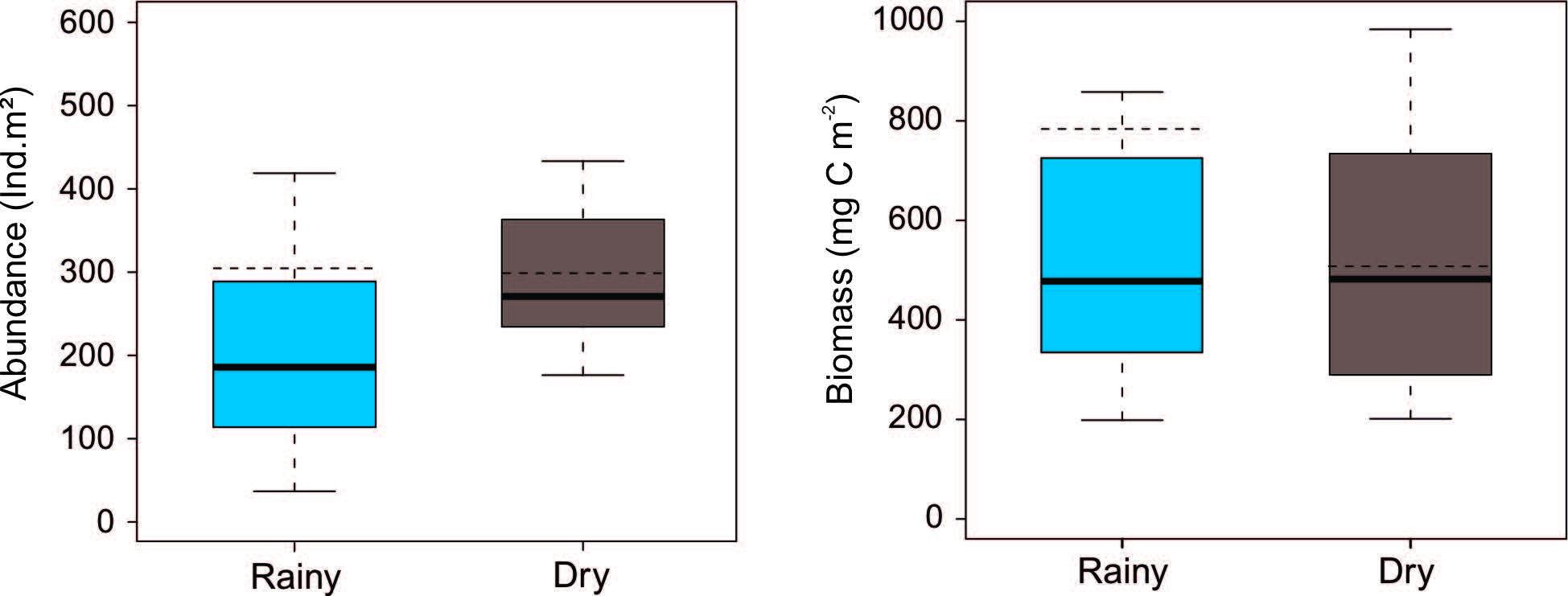
The species diversity and richness were statistically higher in the dry season (Mann-Whitney, p = 0.043; t-test, p = 0.008), with an average of 3.46 ± 0.34 bits ind-1 and 23.21 ± 4.21 taxa, respectively, in comparison with the 3.09 ± 0.52 bits ind-1 and 19 ± 4.21 in the rainy season (Figure 2). There was no difference between the season’s evenness (Mann-Whitney; p = 0.854), with an average evenness of 0.76 ± 0.05 in the dry season and 0.74 ± 0.12 in the rainy season (Figure S3).
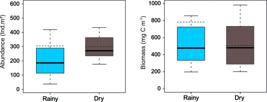
Abundance (ind. m-²) and Biomass (mg C m-2) of demersal mesozooplankton captured with emergence traps at Tamandaré Bay, Pernambuco, Brazil. *significant p values. The bold line indicates the median and the dashed line the mean.
Abundance and community structure
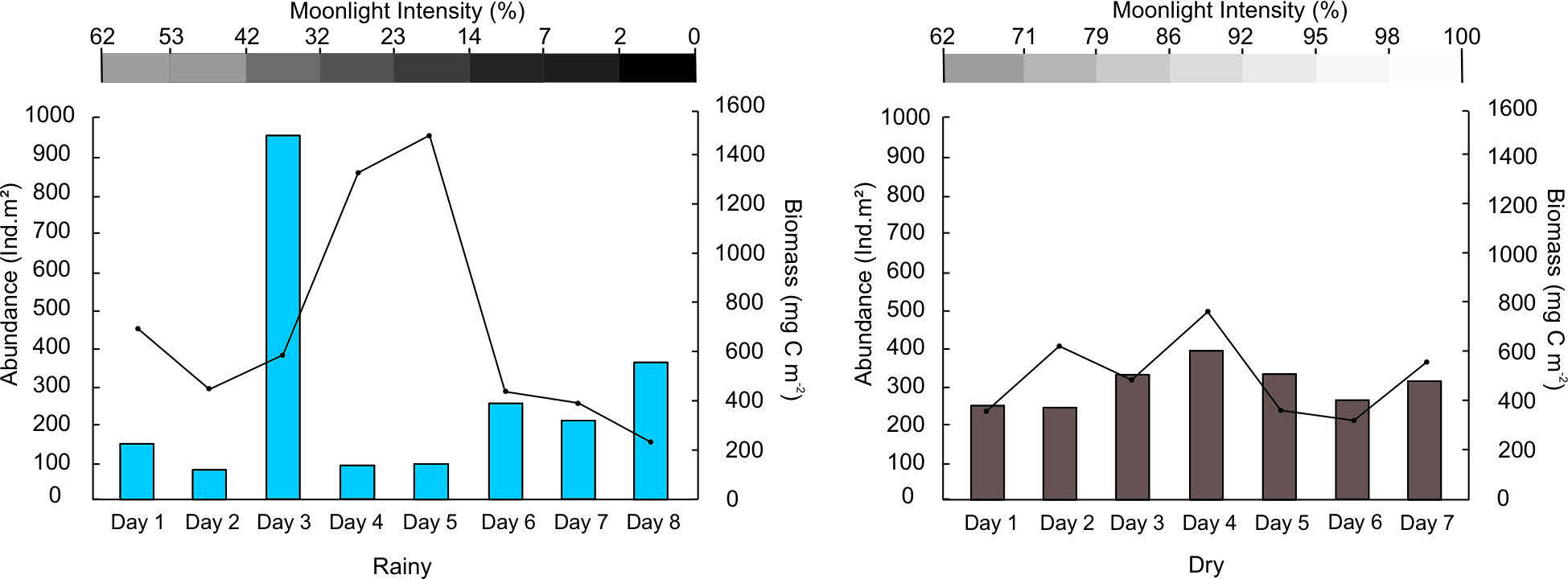
The abundance was statistically higher in the dry season (p = 0.019; MW), with a median of 270.70 ± 83 ind. m-² in comparison with the 187.26 ± 395 ind. m-² recorded in the rainy season (Figure 2). The higher standard deviation recorded in the rainy season was caused by a peak in Paracalanus and Dioithona oculata abundance on Day 3 (Figure 3), which composed 82% of the community abundance.
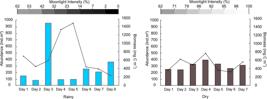
Daily abundance (bars) and biomass (lines) of demersal mesozooplankton captured with emergence traps at Tamandaré Bay, Pernambuco, Brazil.
Copepoda was the most abundant group in both seasons, attaining 43% of the community in the rainy and 54% in the dry season. Copepoda was mostly represented by Paracalanus spp., Pseudodiaptomus acutus, Calanopia americana, Acartia lilljeborgi, Dioithona oculata, Longipedia spp. and Thalestridae sp. 1 (Table II). Besides Copepoda the foraminifera Tretomphalus bulloides and other characteristically demersal groups like Amphipoda, Cumacea and Mysida also had a relevant contribution.
Biomass
The average of the total biomass was higher during the rainy season (789.8 ± 869.83 mg C m-2 vs. 502.62 ± 239.16 mg C m-2), however, no statistical difference was found between seasons (Mann-Whitney, p = 0.909) due to the presence of larger taxa, such as Mysida and Amphipoda, which can also be observed through the similar median (477.80 mg C m-2 vs. 493.63 mg C m-2 in the rainy and dry respectively) (Figure 2). Copepoda, which was the most representative group in terms of abundance, became negligible concerning biomass, comprising not more than 0.1% of the overall biomass. Daily for the dry season, we can see the same pattern seen in the abundance, with no great variability. In the rainy season, the peak abundance did not represent an increase in biomass with the higher biomass values observed on days 4 and 5 (Figure 3) that represented a growth in the Mysida contribution, which was responsible for almost 90% of the relative biomass in these two days. Some taxa displayed season preference (Table III). Ostracoda, Copopoda, Isopoda, Cumacea and Chaetognatha had higher biomass in the dry season, whereas Mysida was more representative in the rainy season.
Biomass (mean ± SD, mg C m-2) and relative biomass (%) of main taxonomic groups of the demersal mesozooplankton captured at Tamandaré Bay, Pernambuco, Brazil. In bold is highlighted the season in which the group presented significantly higher values.
Community structure and environmental variables
The MDS ordination plot suggest dissimilar assemblage structures between the sampling seasons. Accordingly, the PERMANOVA test detected significant differences between seasons (Pseudo-F = 8.331; p < 0.05;) (Figure S4a). The change in the community composition between seasons can be more clearly observed by the increase in the abundance of Amphipoda, Cumacea and Paraspadella nana in the dry season (Table II), whereas Mysida and Tretomphalus bulloides had higher abundance in the rainy season, representing 20% and 12% of the rainy abundance (Table II). On the Copepoda, Longipedia spp, Thalestridae sp. 1, Acartia lilljeborgi and Calanopia americana were characteristic of the dry season while Paracalanus spp., Pseudodiaptomus acutus and Dioithona oculata had higher biomass in the rainy season (Figure S5).
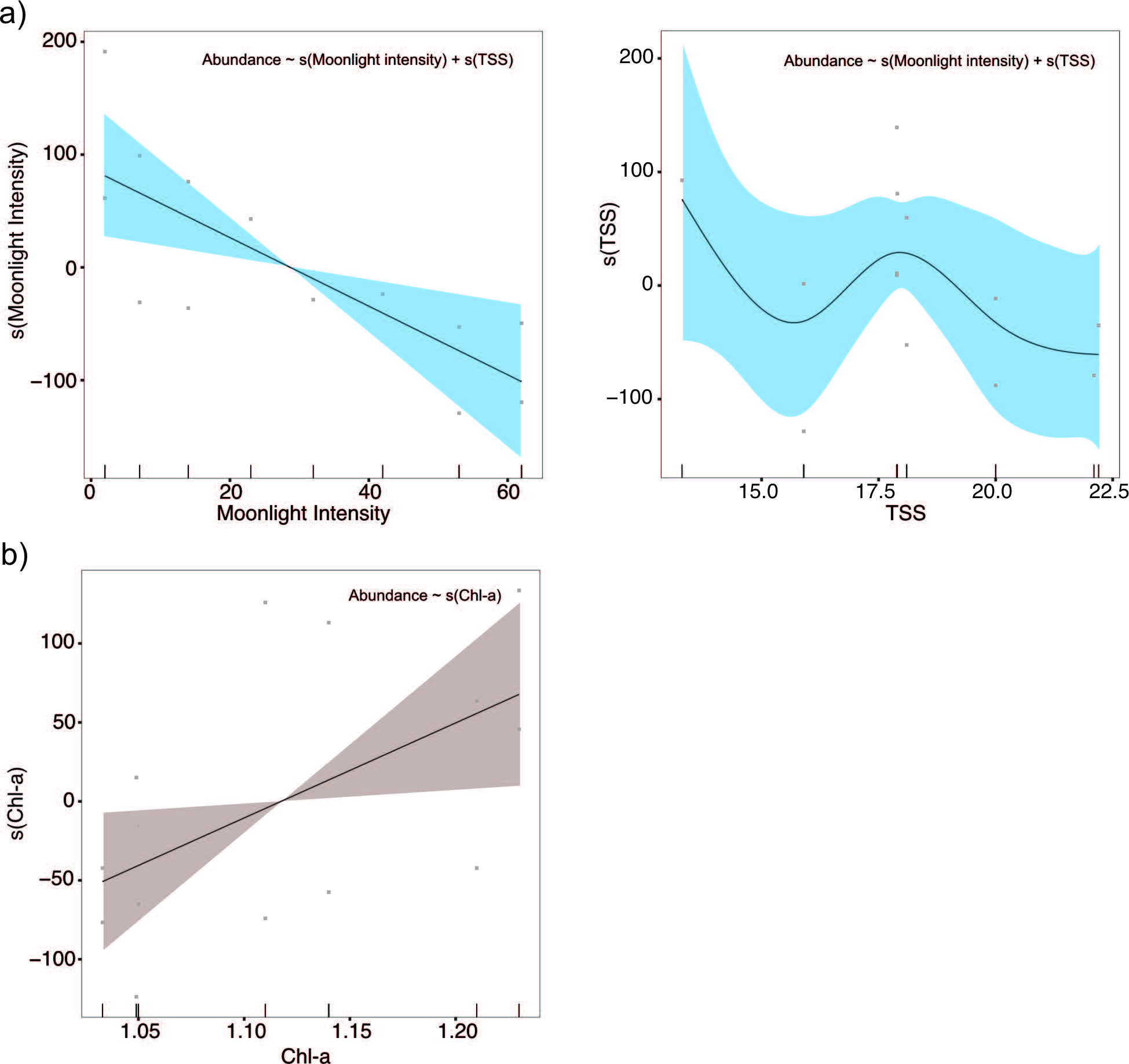
This clear separation of samples was also observed in the PCA, which explained 78.4% of the data variability (Figure S4b). PC1 (59.21%) was composed mainly of temperature and moonlight intensity in opposition to TSS, and PC2 (16.64%) was mainly associated with Chl-a in opposition to salinity (Table IV). The community biomass was more related to the Chl-a concentration, temperature, and moonlight. Two groups can be observed, with the rainy season samples close to the TSS axis and the dry season close to the other environmental variable. To better identify the variables responsible for the structure in each season, GAM models were used with all variables identified on the PCA. The final models explained 70.3% of the deviance in the rainy season and 30.4% during the dry season. During the rainy season, the community biomass had a negative correlation with moonlight intensity (Figure 4a) and higher biomass with average values of TSS. In the dry season, the abundance had a positive correlation with the Chl-a concentrations (Figure 4b).
Eigenvalues of the PCA first two component (PCA) based on zooplankton demersal biomass in Tamandaré Bay.
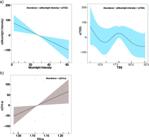
Generalized Additive Models (GAMs) results describing the main factors that influenced the demersal mesozooplankton for the rainy (a) and dry seasons (b). Solid lines represent smoothed mean relationships from GAM’s and shaded areas are 95% confidence intervals. TSS: total suspended solids.
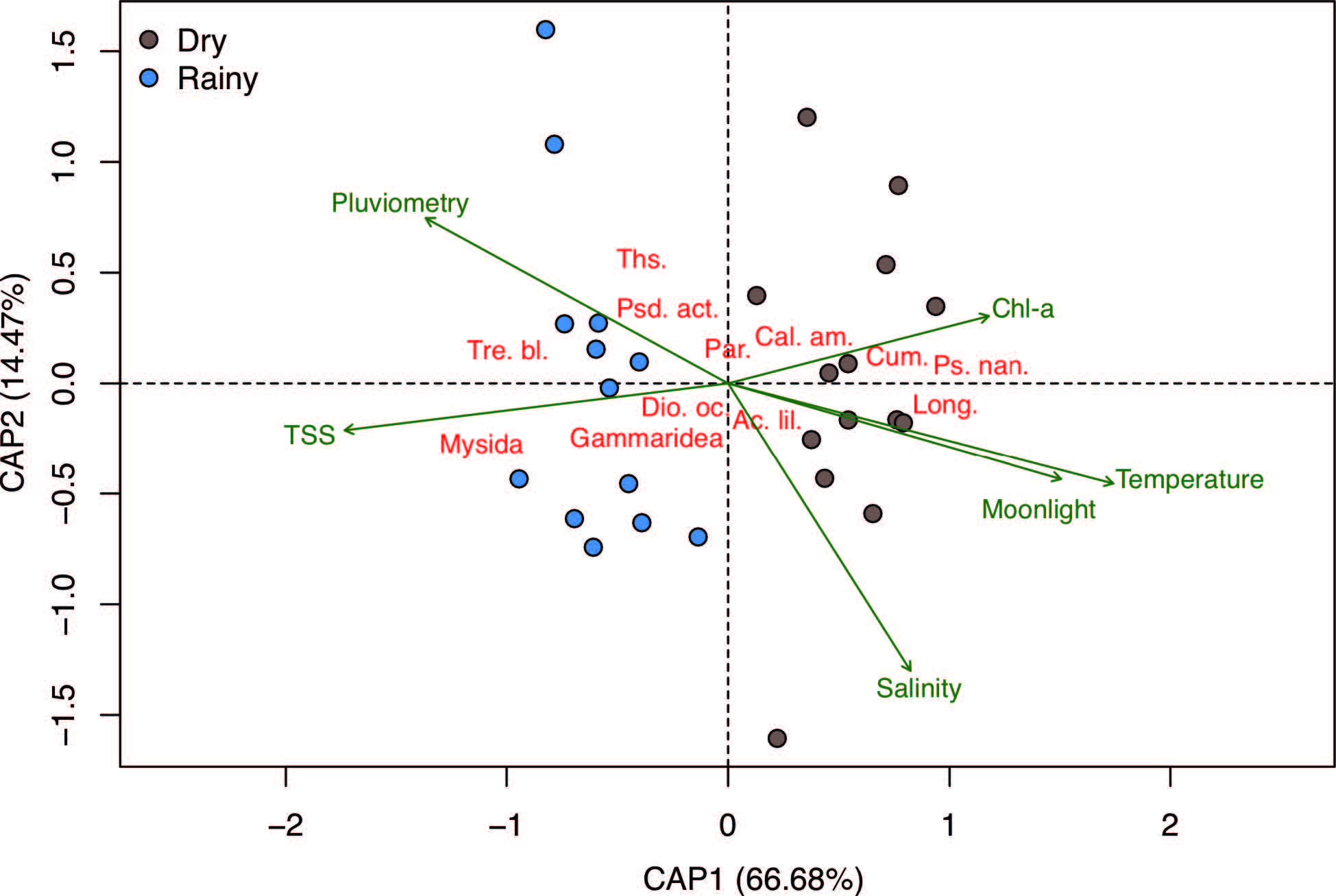
The dbRDA model revealed a similar pattern of samples distribution observed on the PCA, with taxonomic community composition was significantly related to the environmental variables (F = 2.54, p = 0.001). The dbRDA biplot showed a clear separation of samples according to season, with dry-season samples clustering toward higher temperature and moonlight values, while rainy-season samples were associated with higher precipitation and intermediate MPS. The first canonical axis (CAP1) explained 66.7% of the variance among samples and was statistically significant (F = 10.16, p = 0.001), while the remaining axes (CAP2–CAP6) were not significant. Among environmental variables, temperature was most strongly associated with community structure, followed by TSS and pluviometry. At the taxa level, an association of some taxa with environmental variables can be observed, with Mysida and Tretomphalus bulloides strongly linked to TSS and pluviometry, while most of the abundant Copepoda (Paracalanus spp., Thalestridae sp. 1, Calanopia americana, Pseudodiaptomus acutus, and Longipedia spp.) as well as the chaetognath Paraspadella nana were better explained by Chl-a concentration (Figure 5).
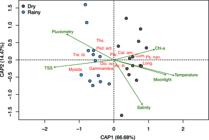
dbRDA biplot showing the relationship between demersal zooplankton composition and environmental variables in Tamandaré Bay. Only taxa representing more than 10% of the community were included. Taxa are indicated by the red abbreviations: Thalestridae (Ths.), Pseudodiaptomus acutus (Psd. act.), Tretomphalus bulloides (Tre. bl.), Calanopia americana (Cal. am.), Longipedia spp. (Lon.), Dioithona oculata (Dio. oc.), Cumacea (Cum.), Acartia lilljeborgi (Ac. lil.), and Paracalanus spp. (Par.). CAP1 and CAP2 explain 66.68% and 14.47% of the variability, respectively.
DISCUSSION
The present study describes patterns of the demersal community between a dry and rainy season in a coastal shallow reef ecosystem. On the seasonal scale, contrary to our hypothesis, higher diversity and abundance was observed in the dry season, together with increased temperatures, salinity, chl-a concentrations and moonlight intensity. Contrasting from the abundance and diversity, the community biomass not different among seasons, showing that although taxa diversity and relative contributions may change, their available biomass for predators remains the same between seasons.
Diversity of the demersal community
Sixty-eight taxa were recorded, predominantly represented by Crustacea, such as Copepoda, Cumacea, Mysida, Isopoda, and Gammaridae Amphipoda, which are pointed out as dominant in demersal zooplankton studies (Sale et al. 1976, Alldredge & King 1977, Porter & Porter 1977, Melo et al. 2010, Vu et al. 2017). The Copepoda, Acartia lilljeborgi, Calanopia americana, Pseudodiaptomus acutus, Dioithona oculata, and the genus Paracalanus were the main Calanoida. These taxa are all widespread and commonly found in coastal and reef environments (Emery 1968, Suárez-Morales & Gasca 2000, Figueirêdo et al. 2017). Paracalanus sp. and Dioithona oculata was further highly abundant in some sampling days. These two Copepoda are recognized as dominant in coastal tropical communities (McKinnon & Duggan 2014), forming swarms of millions of individuals near the reef tops during the day and dispersing to the water column at dusk (Emery 1968). In Tamandaré bay the paramount importance of Dioithona oculata on the pelagic zooplankton community has been perceived (Brito-Lolaia et al. 2020, 2022), with their potential role as prey for fish larvae and other planktivorous organisms established (Brito-Lolaia et al. 2022).
Nine Harpacticoida families were recorded in Tamandaré bay, with a higher frequency in the dry season and the presence of benthic and demersal individuals like Syngastes sp. and Laophontidae. In Tamandaré bay these Harpacticoida are identified as the main representatives of the “reef Copepoda” (Brito-Lolaia et al. 2020), organisms that are resident of the reef ecosystem, associated with the substrate. Among the recorded Harpacticoida, Longipedia sp. and Thalestridae sp. 1 were found in high abundance, especially in the dry season. The Thalestridae family dominates the community in some coastal ecosystems, composing up to 70% of the Harpacticoida assemblages in phytal systems (Hicks 1980), which can become a plague and dominate the community in some coastal environments (Ho & Hong 1988, Park et al. 1990, Shimono et al. 2004).
Environmental variability
The observed difference in environmental variables reflected both the seasonal (dry and rainy) and moon phase contrast in our sampling. In the dry season, higher temperatures and salinities were recorded as a reflection of the lower pluviometry regime, in contrast during the rainy season the intensified influence of the riverine plume over the bay enhanced TSS (Silva et al. 2020). In contrast to our initial expectation, we recorded higher chl-a during the dry season, which was also the main variable responsible for the community biomass, contrasting the expected results of increasing phytoplankton biomass during the rainy season due to estuarine inputs of nutrients (Medina-Gómez et al. 2020, Loganathan et al. 2021). It has been pointed out that the rainfall regime in the Tamandaré estuaries only influences silicate and the TSS concentration, not greatly changing nutrient inputs over the bay (Grego et al. 2009). In other areas of the Southwestern Tropical Atlantic shelf, higher chl-a concentrations during the dry season are commonly recorded, with studies indicating the deeper euphotic layer as the main cause of this pattern (Anjos & Passavante 2012, Otsuka et al. 2018), with the input of terrigenous materials having a negative effect on phytoplankton productivity (Eskinazi-Leça et al. 1997). However, given the short duration of our sampling, one rainy and one dry season, these patterns should be interpreted with caution, as they may not fully capture the temporal variability of the system.
In our study, the dry season showed greater diversity and abundance, although that was not reflected in the community biomass (mostly because of high Mysida biomass in the rainy season). In this coastal reef ecosystem, several works presented similar patterns, with a more diverse and abundant zooplankton community during the dry season (Fidelis 2014, Nascimento-Vieira et al. 2010). Fidelis (2014) suggests that excessive rain is a cause of reduction in light penetration and food availability for zooplankton. This can also be deduced from the GAM analysis for the rainy season, the pattern represented in the data indicates that both low and high TSS values negatively influence zooplankton abundance. Fischer & Visbeck (1993) on the Greenland Sea, also point out that lower light availability caused by cloud cover could negatively influence community migration. However, in both rainy and dry seasons, no clear pattern can be perceived in diversity and abundance between sampling days, following a considerable decrease (rainy season) and increase (dry season) of moonlight, suggesting that in Tamandaré bay demersal community, moon cycles and overall light intensity may have a secondary influence on migration patterns. This interpretation, however, should be viewed with caution, as it is based on a single lunar cycle and reflects the combined influence of a mosaic of environmental variables affecting both light availability and community structure. Nonetheless, although our results may suggest a primordial role of the season variability in the demersal community, our sampling strategy hinders our capability to define the main drivers of the mesozooplanktonic demersal community on Tamandaré bay.
Reproductive cycles could also be a driving factor in our observed demersal zooplankton community composition. Some works present a higher demersal zooplankton abundance during summer related to reproductive periods (Sale et al. 1976, McWilliam et al. 1981, Jacoby & Greenwood 1989). In the Tamandaré bay reef area, during the dry season when the temperature is elevated and winds, currents and turbidity are lower numerous, species breed influencing zooplankton dynamics (Fernandes et al. 2012, Ziadi et al. 2015, Santos et al. 2017). In the demersal zooplankton, this seasonal effect could influence the diversity and abundance of smaller taxa, such as the Copepoda diversity seen here. The higher biomass of Mysida during the rainy season, although linked with pluviometry, may also be related to reproductive cycles, as perceived for many Mysida species during and close after rainy seasons, when sexually mature individuals intensify breeding (Biju & Panampunnayil 2010, 2011).
Conclusive remarks
Despite the important role played by the demersal community as a carbon source for key reef ecosystem taxa (Robertson & Howard 1978, Heidelberg et al. 2004, Lesser 2006, Pitt et al. 2008, Couturier et al. 2013), many aspects of their ecology are still poorly understood, especially in coastal regions of the southern hemisphere such as the Tamandaré bay. In this study, we evaluated the abundance, biomass, and community structure of demersal zooplankton in a southwestern tropical Atlantic reef system. We observed a high diversity in the reef system and a clear seasonal variability in both environmental and biological variables. The results contrasted our predictions that a more abundant and diverse community would be seen during rainy season. On the contrary, the dry season showed higher abundance and diversity. However, due to the higher abundance of Mysida in the rainy season, no difference was observed in the biomass. Although our sampling design restrains our capability to define the main driving forces for this community. The community structure change seems to be related to a mosaic of environmental and behavioral variables, including chl-a concentrations, pluviometry, TSS and moonlight intensity.
Acknowledgements
We wish to express our thanks to the Conselho Nacional de Desenvolvimento Científico e Tecnológico (CNPq), who conceded the first author’s scholarship (grant number: 133957/2017), and to the PROPLANC Project, funded by the Fundação de Amparo à Ciência e Tecnologia de Pernambuco - FACEPE (APQ-1239-1.08/08). Pedro Augusto M.C. Melo acknowledges a research productivity fellowship from CNPq (grant 301712/2025-5).
References
- ALLDREDGE AL & HAMNER WM. 1980. Recurring aggregation of zooplankton by a tidal current. Estuar Coast Shelf Sci 10: 31-37.
- ALLDREDGE AL & KING JM. 1977. Distribution, abundance, and substrate preferences of demersal reef zooplankton at Lizard Island Lagoon, Great Barrier Reef. Mar Biol 41: 317-333.
- ALLDREDGE AL & KING JM. 1980. Effects of moonlight on the vertical migration patterns of demersal zooplankton. J Exp Mar Biol Ecol 44: 133-156.
- ALLDREDGE AL & KING JM. 2009. Near-surface enrichment of zooplankton over a shallow back reef: implications for coral reef food webs. Coral Reefs 28: 895-908.
- ANJOS DL & PASSAVANTE JZO. 2012. Biomassa fitoplanctônica correlacionada aos fatores hidrológicos no estuário do rio Capibaribe (Recife, Pernambuco, Brasil). Trop Oceanogr 40: 167-184.
-
APAC – AGÊNCIA PERNAMBUCANA DE ÁGUAS E CLIMA. 2025. Agência Pernambucana de Águas e Clima. Available at: https://www.apac.pe.gov.br/ Accessed on: Sep 17, 2025.
» https://www.apac.pe.gov.br/ - ARA K. 2001. Length-weight relationships and chemical content of the planktonic copepods in the Canan beta a Lagoon estuarine system, São Paulo, Brazil. Plankton Biol Ecol 48: 121-127.
- BÂMSTEDT U. 1986. Chemical composition and energy content. In: Corner EDS & O’Hara SCM (Eds), The Biological Chemistry of Marine Copepods, Oxford: Clarendon Press, p. 1-58.
- BAUSTIAN M, HANSEN GA, DE KLUIJVER A, ROBINSON K, HENRY E, KNOLL L, ROSE K & CAREY C. 2014. Linking the bottom to the top in aquatic ecosystems: mechanisms and stressors of benthic-pelagic coupling. In: Eco-DAS X Symposium Proceedings. Kemp PF (Ed), ASLO, p. 25-47.
- BIJU A & PANAMPUNNAYIL SU. 2010. Seasonality, reproductive biology and ecology of Mesopodopsis zeylanica (Crustacea: Mysida) from a tropical estuary (Cochin backwater) in India. Plankton Benthos Res 5: 49-55.
-
BIJU A & PANAMPUNNAYIL SU. 2011. Population structure and reproductive biology of Mesopodopsis orientalis (Crustacea: Mysida) in a tropical mangrove ecosystem in India. Mar Biodivers Rec 4: e43. doi: 10.1017/S1755267211000273.
» https://doi.org/10.1017/S1755267211000273 - BOLTOVSKOY D. 1999. South Atlantic Zooplankton. Leiden: Backhuys Publishers, p. 1706.
- BOXSHALL GA & HALSEY SH. 2004. An introduction to copepod diversity. Ray Society, University of Chicago, p. 966.
- BRITO-LOLAIA M, FIGUEIREDO GGAA, NEUMANN-LEITÃO S, YOGUI GT & SCHWAMBORN R. 2022. Can the stable isotope variability in a zooplankton time series be explained by its key species? Mar Environ Res 181: 105737.
-
BRITO-LOLAIA M, SANTOS GS, NEUMANN-LEITÃO S & SCHWAMBORN R. 2020. Micro- and mesozooplankton at the edges of coastal tropical reefs (Tamandaré, Brazil). Helgol Mar Res 74: 7. https://doi.org/10.1186/s10152-020-00539-4.
» https://doi.org/10.1186/s10152-020-00539-4 - BURKE L, REYTAR K, SPALDING M & PERRY A. 2011. Reefs at Risk Revisited. Washington, DC: World Resources Institute, p. 114.
- CHISHOLM LA & ROFF JC. 1990. Size-weight relationships and biomass of tropical neritic copepods off Kingston, Jamaica. Mar Biol 106: 71-77.
- CONNELL JH. 1978. Diversity in tropical rain forests and coral reefs. Science 199: 1302-1310.
-
COUTURIER LIE, ROHNER CA, RICHARDSON AJ, MARSHALL AD, JAINE FRA, BENNETT MB, TOWNSEND KA, WEEKS SJ & NICHOLS PD. 2013. Stable Isotope and Signature Fatty Acid Analyses Suggest Reef Manta Rays Feed on Demersal Zooplankton. PloS One 8(10): e77152. https://doi.org/10.1371/journal.pone.0077152.
» https://doi.org/10.1371/journal.pone.0077152 - DAHMS H-U, FORNSHELL JA & FORNSHELL BJ. 2006. Key for the identification of crustacean nauplii. Org Divers Evol 6: 47-56.
- D’ELIA CF & WIEBE WJ. 1990. Biogeochemical nutrient cycles in coral-reef ecosystems. Ecosys World 25: 49-74.
- EMERY AR. 1968. Preliminary observations on coral reef plankton. Limnol Oceanogr 13: 293-303.
-
ESKINAZI-LEÇA E, MARIA DA GLÓRIA G, KOENING ML, DE MACÊDO SJ & DA COSTA KMP. 1997. Variação Espacial e Temporal do Fitoplâncton na Plataforma Continental de Pernambuco-Brasil. Trop Oceanogr 25: 1-16. https://doi.org/10.5914/tropocean.v25i1.2724.
» https://doi.org/10.5914/tropocean.v25i1.2724 - FARIAS GB, LEITÃO SN, MELO PAMC, NOGUEIRA JÚNIOR M & TOSETTO EG. 2020. First in situ record of the medusa stage of Cladonema radiatum (Cnidaria: Anthoathecata) in the South Atlantic Ocean. Ocean Coast Res 68: 1-6.
- FERNANDES LDA, QUINTANILHA J, MONTEIRO-RIBAS W, GONZALEZ-RODRIGUEZ E & COUTINHO R. 2012. Seasonal and interannual coupling between sea surface temperature, phytoplankton and meroplankton in the subtropical south-western Atlantic Ocean. J Plankton Res 34: 236-244.
- FERRARIO F, BECK MW, STORLAZZI CD, MICHELI F, SHEPARD CC & AIROLDI L. 2014. The effectiveness of coral reefs for coastal hazard risk reduction and adaptation. Nat Commun 5: 3794.
- FIDELIS VTP. 2014. Estrutura da comunidade e produção dos copépodes pelágicos dos recifes da APA Costa dos Corais (Tamandaré, PE, Brasil). Tese de doutorado. Available at: https://repositorio.ufpe.br/bitstream/123456789/18852/1/PDF_Pessoa%2c%20V.T._Tese%20de%20doutorado%20%282%29.pdf.
- FIGUEIRÊDO LGP, MELO PAMC, BITTENCOURT GF, MELO JUNIOR M, DIAZ XG, MOURA RL & NEUMANN-LEITÃO S. 2017. A new perspective on the distribution of chaetognatha, spadellidae, Paraspadella nana owre, 1963: two new occurrences from the western tropical atlantic ocean. Boletim Técnico Científico do CEPNOR - TJFAS 17: 59-62.
- FISCHER J & VISBECK M. 1993. Seasonal variation of the daily zooplankton migration in the Greenland Sea. Deep Sea Research Part I. Oceanogr Res Pap 40: 1547-1557.
- GORSKY G & PALAZZOLI I. 1989. Aspects de la biologie de l’appendiculaire Oikopleura dioica Fol. 1872 (Chordata: tunicata). Oceanis 15: 39-49.
- GREGO CKS, FEITOSA FAN, SILVA MH, CUNHA MGGS & NASCIMENTO FILHO GA. 2009. Fitoplâncton do ecossistema estuarino do rio Ariquindá (Tamandaré, Pernambuco, Brasil): Variáveis ambientais, biomassa e produtividade primária. Atlântica 31: 183-198.
- HARRIS R ET AL. 2000. ICES zooplankton methodology manual. Academic Press, p. 684. DOI: 10.1016/B978-0-12-327645-2.X5000-2.
- HEIDELBERG KB, O’NEIL KL, BYTHELL JC & SEBENS KP. 2010. Vertical distribution and diel patterns of zooplankton abundance and biomass at Conch Reef, Florida Keys (USA). J Plankton Res 32: 75-91.
- HEIDELBERG KB, SEBENS KP & PURCELL JE. 2004. Composition and sources of near reef zooplankton on a Jamaican forereef along with implications for coral feeding. Coral Reefs 23: 263-276.
- HICKS GR. 1980. Structure of phytal harpacticoid copepod assemblages and the influence of habitat complexity and turbidity. J Exp Mar Biol Ecol 44: 157-192.
- HIROTA R. 1986. Zooplankton Investigations in the Setonaikai (Inland Sea of Japan), I. J Oceanogr Soc Jpn 24(5): 203-211.
- HO J-S & HONG J-S. 1988. Harpacticoid copepods (Thalestridae) infesting the cultivated Wakame (brown alga, Undaria pinnatifida) in Korea. J Nat Hist 22: 1623-1637.
- IMAO F. 2005. Zooplankton community structure and functional role in carbon cycle of the Oyashio region, western North Pacific. Master thesis, Hokkaido University (in Japanese). (Unpublished).
- JACOBY CA & GREENWOOD JG. 1989. Emergent zooplankton in Moreton Bay, Queensland, Australia: seasonal, lunar, and diel patterns in emergence and distribution with respect to substrata. Mar Ecol Prog Ser 51: 131-154.
- LAMPERT W. 1989. The adaptive significance of diel vertical migration of zooplankton. Funct Ecol 3: 21-27.
- LEÃO ZMAN & DOMINGUEZ JML. 2000. Tropical Coast of Brazil. Mar Pollut Bull 41: 112-122.
- LESSER MP. 2006. Benthic–pelagic coupling on coral reefs: feeding and growth of Caribbean sponges. J Exp Mar Biol Ecol 328: 277-288.
- LOGANATHAN J, NARASIMHA RD, JOSEPH I, PARAMBIL AM, RACHURI V, SWARNAPRAVA B & KALATHIL BK. 2021. Role of riverine inputs, low saline plume advection and mesoscale physical processes in structuring the Chlorophyll a distribution in the western Bay of Bengal during Fall Inter Monsoon. Oceanol 63: 403-419.
- MAIDA M & FERREIRA BP. 1997. Coral Reefs of Brazil: Overview and Field Guide. Proceedings of the 8th International Coral Reef Symposium, p. 263-274.
-
MARINHA DO BRASIL. 2025. Tábuas das Marés. Centro de hidrografia. Available at: https://www.marinha.mil.br/chm/tabuas-de-mare Accessed on: Sep 17, 2025.
» https://www.marinha.mil.br/chm/tabuas-de-mare - MATTHEWS JBL & HESTAD L. 1977. Ecological studies on the deep-water pelagic community of Korsfjorden, Western Norway: length/weight relationships for some macroplanktonic organisms. Sarsia 63: 57-63.
- MCKINNON AD & DUGGAN S. 2014. Community ecology of pelagic copepods in tropical coastal waters. In: Copepods: Diversity, Habitat and Behavior. Seuront L (Ed), Nova Science Publishers, p. 25-49.
- MCWILLIAM PS, SALE PF & ANDERSON DT. 1981. Seasonal changes in resident zooplankton sampled by emergence traps in One Tree Lagoon, Great Barrier Reef. J Exp Mar Biol Ecol 52: 185-203.
- MEDINA-GÓMEZ I, CAHUICH-LÓPEZ M, AGUILAR-TRUJILLO A, CRUZ-TREJO G, JUÁREZ M, MARIÑO-TAPIA I, HERRERA-SILVEIRA J & ENRIQUEZ C. 2020. Spatio-temporal patterns of Chlorophyll-a in a wide and low-relief shelf sea of the Gulf of Mexico: Insights of interannual climatic patterns on the phytoplankton biomass varying behavior. Cont Shelf Res 205: 104174.
- MELO PAMC, SILVA TA, NEUMANN-LEITÃO S, SCHWAMBORN R, GUSMÃO LM & PORTO NETO F. 2010. Demersal zooplankton communities from tropical habitats in the southwestern Atlantic. Mar Biol Res 6: 530-541.
- MICHAELS AF, CARON DA, SWANBERG NR, HOWSE FA & MICHAELS CM. 1995. Planktonic sarcodines (Acantharia, Radiolaria, Foraminifera) in surface waters near Bermuda: abundance, biomass and vertical flux. J Plankton Res 17: 131-163.
- MOTODA S. 1940. Comparison of the conditions of water in the bay, lagoon and open sea in Palao. Palao Trop Biol Sta Studies 2: 41-48.
- NAKAJIMA R, YAMAZAKI H, LEWIS LS, KHEN A, SMITH JE, NAKATOMI N & KURIHARA H. 2017. Planktonic trophic structure in a coral reef ecosystem–Grazing versus microbial food webs and the production of mesozooplankton. Prog Oceanogr 156: 104-120.
- NASCIMENTO-VIEIRA DA, FIGUEIREDO F & NETO P. 2010. Mesozooplâncton de área recifal do Atlântico sudoeste Tropical. Trop Oceanogr 38: 47-59.
- NEUMANN-LEITÃO S, FEITOSA FAN, MAYAL E, SCHWAMBORN R, SILVA-CUNHA MGG, SILVA TA & PORTO NETO FF. 2009. The Plankton From Maracajaú Reef Ecosystem (Brazil) - Offshore Coral Reefs Under Multiple Human Stressors. WIT Trans Ecol Environ 122: 173-182.
- OTSUKA AY, FEITOSA FAN, MONTES MJF, SILVA AC, OTSUKA AY, FEITOSA FAN, MONTES MJF & SILVA AC. 2018. Influence of fluvial discharge on the dynamics of Chlorophyll-α in the continental shelf adjacent to the Recife Port Basin (Pernambuco-Brazil). Braz J Oceanogr 66: 91-103.
-
PACHECO AS, GOMÉZ GE, SANTORO PA, MALEBRAN M, CORTÉS C & RIASCOS JM. 2014. Moon phase effects and timing of emerging macrobenthic assemblages in a sheltered soft-bottom sublittoral habitat. J Sea Res 86: 34-42. https://doi.org/10.1016/j.seares.2013.11.001.
» https://doi.org/10.1016/j.seares.2013.11.001 - PACHECO AS, GOMÉZ GE, SANTORO PA, MALEBRAN M, CORTÉS C & RIASCOS JM. 2015. Seasonal variability of emerging invertebrate assemblages in a sheltered soft-bottom sublittoral habitat. J Sea Res 103: 14-23.
- PARK T-S, RHO Y-G, GONG Y-G & LEE D-Y. 1990. A harpacticoid copepod parasitic in the cultivated brown alga Undaria pinnatifida in Korea. KFAS 23: 439-442.
- PIELOU EC. 1977. Mathematical ecology. New York: Wiley, p. 385.
- PITT KA, CLEMENT A-L, CONNOLLY RM & THIBAULT-BOTHA D. 2008. Predation by jellyfish on large and emergent zooplankton: Implications for benthic–pelagic coupling. Estuar Coast Shelf Sci 76: 827-833.
- PORTER JW & PORTER KG. 1977. Quantitative sampling of demersal plankton migrating from different coral reef substrates. Limnol Oceanogr 22: 553-556.
- REGUERO BG, BECK MW, AGOSTINI VN, KRAMER P & HANCOCK B. 2018. Coral reefs for coastal protection: A new methodological approach and engineering case study in Grenada. J Environ Manag 210: 146-161.
- RÍOS-JARA E. 2005. Effects of lunar cycle and substratum preference on zooplankton emergence in a tropical, shallow-water embayment, in southwestern Puerto Rico. Caribb J Sci 41: 108-123.
- ROBERTSON AI & HOWARD RK. 1978. Diel trophic interactions between vertically-migrating zooplankton and their fish predators in an eelgrass community. Mar Biol 48: 207-213.
- SALE PF, MCWILLIAM PS & ANDERSON DT. 1976. Composition of the near-reef zooplankton at Heron Reef, Great Barrier Reef. Mar Biol 34: 59-66.
- SANTOS GS, BRITO-LOLAIA M & SCHWAMBORN R. 2017. Two new methods for sampling zooplankton and larval assemblages in tropical reef ecosystems. J Exp Mar Biol Ecol 491: 27-37.
- SCHNACK-SCHIEL SB & ISLA E. 2005. The role of zooplankton in the pelagic-benthic coupling of the Southern Ocean. Sci Mar 69(2): 39-55.
- SHANNON CE. 1948. A Mathematical Theory of Communication. BSTJ 27: 379-423.
- SHIMONO T, IWASAKI N & KAWAI H. 2004. A new species of Dactylopusioides (Copepoda: Harpacticoida: Thalestridae) infesting a brown alga, Dictyota dichotoma in Japan. Hydrobiol 523: 9-15.
- SHMELEVA AA. 1965. Weight characteristics of the zooplankton of the Adriatic Sea. Bull Inst Océanogr 65: 11-24.
- SILVA AJ, MELO PAMC, NEUMANN-LEITÃO S & MELO JÚNIOR M. 2020. Non-predatory mortality of planktonic copepods in a reef area influenced by estuarine plume. Mar Environ Res 159: 105024.
- SUÁREZ-MORALES E & GASCA R. 2000. Epipelagic copepod assemblages in the western Caribbean Sea. Crustaceana 73: 1247-1257.
- THISTLE D. 2003. Harpacticoid copepod emergence at a shelf site in summer and winter: implications for hydrodynamic and mating hypotheses. Mar Ecol Prog Ser 248: 177-185.
- TRANTER DJ, BULLEID NC, CAMPBELL R, HIGGINS HW, ROWE F, TRANTER HA & SMITH DF. 1981. Nocturnal movements of phototactic zooplankton in shallow waters. Mar Biol 61: 317-326.
- UYE S. 1982. Length-weight relationships of important zooplankton from the Inland Sea of Japan. J Oceanogr Soc Jpn 38: 149-158.
- VALLET C & DAUVIN JC. 1999. Seasonal changes of macrozooplankton and Benthic Boundary Layer macrofauna from the Bay of Saint-Brieuc (Western English Channel). J Plankton Res 21: 35-49.
- VERESHCHAKA AL. 1995. Macroplankton in the near-bottom layer of continental slopes and seamounts. Deep-Sea Res I: Oceanogr Res Pap 42: 1639-1668.
-
VU HM, CASARETO BE, HAYASHIZAKI K, SANGSAWANG L, TOYODA K, TRAN LD & SUZUKI Y. 2017. Role of Demersal Zooplankton as a Food Source for Higher Trophic Levels at Fukido Estuary, Ishigaki Island, Okinawa, Japan. Int J Mar Sci 7(17): 161-175. DOI: 10.5376/ijms.2017.07.0017.
» https://doi.org/10.5376/ijms.2017.07.0017 - WEBBER MK & ROFF JC. 1995. Annual structure of the copepod community and its associated pelagic environment off Discovery Bay, Jamaica. Mar Biol 123: 467-479.
- WELICKY RL, CHENEY KL, COILE AM, MCCAMMON A & SIKKEL PC. 2013. The relationship between lunar periodicity and activity of fish-parasitic gnathiid isopods in the Caribbean. Mar Biol 160: 1607-1617.
-
WICKHAM H, CHANG W & WICKHAM MH. 2016. Package “ggplot2”. Create elegant data visualisations using the grammar of graphics Version 2. Available at: https://ggplot2.tidyverse.org/
» https://ggplot2.tidyverse.org/ - YAHEL R, YAHEL G & GENIN A. 2005. Near-bottom depletion of zooplankton over coral reefs: I: diurnal dynamics and size distribution. Coral Reefs 24: 75-85.
- ZIADI B, DHIB A, TURKI S & ALEYA L. 2015. Factors driving the seasonal distribution of zooplankton in a eutrophicated Mediterranean Lagoon. Mar Pollut Bull 97: 224-233.
Edited by
-
Handling editor
Alexander Kellner
Data will be available under request.