 Sampling bias in sex ratio and ovarian maturation of Calliphoridae and Mesembrinellidae (Diptera): influence of trap height and bait type in the Brazilian Amazon
Abstract
Calliphoridae and Mesembrinellidae flies play a key role in nutrient cycling and environmental sanitation. Their distribution is shaped by vertical resource availability and species-specific biological traits. Understanding the efficiency and selectivity of sampling methods is essential to reveal distribution patterns and corrected sampling biases, enabling more accurate estimates of population density and resource use. We assessed the abundance of calliphorids and mesembrinelids females and males in traps with two types of baits (bovine lung and fermented banana) exposed at two heights (0.6 m and 10 m) above the ground, as well as the ovarian development of females in each treatment. Statistically significant differences were observed in sex ratios and ovarian development. Females of Calliphoridae and Mesembrinellidae in vitellogenic stages were more abundant in the protein baits at 0.6m above the ground, while male calliphorids predominated in banana baits irrespective of height. Additionally, male mesembrinelids were more abundant in banana baits placed at 10m above the ground. The results of this study provide important insights into the biological patterns of the two families of sarcosaprophagous flies, revealing potential reproductive substrates, the efficiency of different sampling methods, and the importance of considering the interaction between sexual behavior, physiological state, and resource availability.
Key words
Blowflies; Mesembrinellids; Sampling methodologies; Sexual attractiveness; Tropical entomology; Vertical stratification
INTRODUCTION
Tropical forests maintain the highest biodiversity on the planet, partly due to the vertical distribution of resources, microclimatic preferences, and the biological characteristics of species, which create different strata for feeding, reproduction, and development (Stork & Grimbacher 2006, Ulyshen et al. 2010, Birtele & Hardersen 2012). Among dipterans, species found at ground level differ from those in the canopy, reflecting the differential availability and use of resources (Birtele & Hardersen 2012, Stireman et al. 2012). Some species exploit the forest floor, feeding on woody debris and decomposing organic matter, while others specialize in sap sources and phloem tissues beneath tree bark (Toda 1992, Tanabe 2002, Stork & Grimbacher 2006). Such resource partitioning affects not only species distribution but also the vertical segregation of males and females (Das & Dasgupta 1982, Archer & Elgar 2003).
Sex ratios in flies are influenced by ecological and behavioral factors as well as collection methods (Mendes 1991, Mulieri et al. 2015, Dufek et al. 2021). Although sexes are generally produced in equal numbers (Seger & Stubblefield 2002), many species show female-biased ratios due to their search for nutritional resources required for (Das & Dasgupta 1982, Avancini & Prado 1986). This is particularly relevant for flies Calliphoridae and Mesembrinellidae, whose larvae develop in decomposing organic matter (Brown et al. 2010, Olea et al. 2018). Olfactory baited traps installed up to 1.5 m above the ground capture males and females differently: protein-rich baits (e.g., decomposing meat or fish) primarily attract females for ovarian maturation (Luvchiev et al. 1981, Avancini & Prado 1986, Esposito et al. 2010, Birtele & Hardersen 2012, Mulieri et al. 2015, Façanha et al. 2022), whereas sugar-based baits (e.g., fruits or molasses) and traps at other forest strata tend to capture a more balanced sex ratio (Das & Dasgupta 1982, Archer & Elgar 2003). Despite their ecological, forensic, and conservation importance, information remains scarce on how bait type and vertical stratification influence sex-biased captures and ovarian development, which is essential for accurately interpreting potentially biased sampling data (Sousa et al. 2020, 2021, Mendes et al. 2021, Façanha et al. 2022, 2025, Cavalcante et al. 2023).
Calliphoridae are medium-sized oviparous flies known for their medical, veterinary, and sanitary significance, as well as their role in forensic entomology, aiding in postmortem interval (PMI) estimation (Borror & Delong 1969, Amendt et al. 2011, Carvalho et al. 2012, Linhares & Thyssen 2012, Lutz et al. 2025). In contrast, Mesembrinellidae are more robust and viviparous, and their biology remains poorly studied. While they have gained attention in forensic studies, they are widely recognized as environmental bioindicators due to their strong association with forested areas (Guimarães 1977, Vasconcelos et al. 2013, Sousa et al. 2014, 2020, Oliveira et al. 2016, Pamponet et al. 2019, Marchiori 2023). Adenotrophic viviparity of this family, in which larval development occurs within the maternal oviduct and larvae are only released into the environment shortly before pupation, is a distinctive trait that may influence their resource-searching strategies (Guimarães 1977, Brown et al. 2010).
The attractiveness of a resource is influenced not only by the ecological importance of the substrate for each species but also by the females’ physiological state (Mendes & Linhares 1993). Ovarian development, essential for reproduction, depends on nutrient availability—proteins for egg production and carbohydrates for metabolic energy and flight (Avancini & Prado 1986, Avancini & Linhares 1988, D’Almeida & Lima 1994, Kasper et al. 2015, Alqurashi et al. 2020). Environmental factors such as temperature, humidity, and light also affect reproductive potential by influencing ovarian maturation and oviposition capacity (Browne 2001, Hans et al. 2019), and vertical stratification may further modulate these effects since each forest layer provides distinct conditions (Birtele & Hardersen 2012). Females, however, show some flexibility and can adjust their reproduction according to resource availability (Hans et al. 2019). Blowflies, for instance, are mainly attracted to protein-rich baits, while mesembrinelids respond more efficiently to carbohydrate-rich substrates, such as fermenting fruits and sugarcane molasses (Guimarães 1977, Mendes & Linhares 1993). Although the ontogenetic development of mesembrinelids remains poorly understood, it likely follows a pattern similar to calliphorids, with ten cyclic stages of ovarian maturation (Guimarães 1977).
Thus, both the type of bait and its position within the forest vertical structure can influence the observed sex ratio, varying among families and species and directly affecting ovarian development, which may be either promoted or constrained. This reveals a knowledge gap regarding how feeding specificity, reproduction, and vertical stratification interact in the ecology of these flies. Understanding these patterns is essential to identify and correct female-biased sampling, improve methods that ensure a representative capture of both sexes, obtain more accurate and realistic population density estimates, and support ecologically sound management strategies in urban, agricultural, and forest environments (Mulieri et al. 2015, Luz et al. 2020, Moore et al. 2024).
Given this context, we evaluated how the attractiveness of two types of baits at two trap heights influenced the sexual ratio and ovarian development patterns of Calliphoridae and Mesembrinellidae. We tested two hypotheses: 1) Females will predominate in traps with protein bait and closer to the ground; 2) Females will be in the later stages of ovarian development in protein baits near the ground. Considering the contrasting reproductive strategies of these two families—oviparity in Calliphoridae and pseudoplacental viviparity in Mesembrinellidae—we expected differences in sex ratio, ovarian development, and resource attraction to reflect distinct reproductive demands. In particular, viviparous females may show reduced dependence on protein-rich baits and different spatial distributions, as they carry larvae in advanced developmental stages (Avancini & Prado 1986). The results will provide broader insights into sampling biases in calliphorids and mesembrinelids, with implications for ecological and forensic studies, while highlighting the importance of resource type and forest in shaping the biological patterns of these species.
MATERIALS AND METHODS
Study Area
The experiment was conducted in Mazagão, state of Amapá, Brazil (Figure S1 - Supplementary Material), in the Amazon Rainforest. The region has an average annual temperature of 27°C and an annual average rainfall of 2,410 mm. The December-April rainy season is followed by a May - November dry season (INMET 2020). The study area was in a floodplain forest, 800 m from Mazagão Velho, and 900 m from the Mutuacá River, which flows into the west bank of the Amazon River (Pinto et al. 2008).
Sampling Design and Fly collection
To maximize station independence, we collected along four trails >200 m apart and along each trail, we selected five trees, 200 m apart (Carvalho et al. 2017, Dufek et al. 2020), and >300 meters from the forest edge (Façanha et al. 2022). None of the selected trees were fruit-bearing or flowering (Luz et al. 2020), and two traps were placed on the same tree at each sampling point to ensure exposure to the same set of flies in both space and time. This also allowed us to control spatial and microenvironmental variation, ensuring that differences observed between heights reflected only the vertical gradient rather than heterogeneity among trees. Such a stratified design is widely adopted in ecological studies with Diptera and other insect groups (e.g., Stork & Grimbacher 2006, Ulyshen et al. 2010, Amorim et al. 2022, Rafael et al. 2025).
Sampling was conducted during three expeditions in January, April, and July 2019, using the same trees in each expedition. In each expedition, a total of 40 traps were installed simultaneously (20 in the canopy and 20 in the understory), with 10 traps per bait type at each height. Considering five trees across four trails and the three expeditions, the total sampling effort comprised 120 traps (5 trees × 4 trails × 3 expeditions × 2 heights) (Figure S1a).
Calliphorids and mesembrinellids were captured using adapted traps made from 2L plastic bottles (Ferreira 1978) (Figure S1b). Each tree was equipped with two traps: one at 0.6 m and one at 10 m above the ground (Figure S1c). The lower strata traps were suspended 0.6 m above the ground on the tree branches. The traps at higher strata were installed using a slingshot (Façanha et al. 2022). Two 50g baits were employed: bovine lung and fermented banana (D’Almeida & Lima 1994, Cabrini et al. 2013, Dufek et al. 2016, Façanha et al. 2022) (Figure S1c). Accordingly, two traps (low and high) were installed on the same tree, each containing only one type of bait (Figure S1a). To enhance their attractiveness to the flies, the baits were left at room temperature for 24 hours, protected from other insects, and the banana was mashed and mixed with beer to speed up the fermentation process. Each bait was exposed for 48 hours in the forest (Esposito et al. 2010, Sousa et al. 2021).
Calliphorids and mesembrinellids were carefully separated from other insects, sorted by sex and identified to species via keys (Guimarães 1977, Dear 1985, Carvalho & Ribeiro 2000, Mello 2003, Whitworth 2010, Kosmann et al. 2013, Whitworth & Yusseff-Vanegas 2019). Voucher specimens were deposited in the wet collections of the Zoological Collection at the Federal University of Pará, in the capital city of Belém, state of Pará, Brazil.
In this study, we used data previously collected and published by Façanha et al. (2022), expanding the original work through a more detailed population-level approach. Here, the data were reanalyzed to explore sex ratio and ovarian development patterns across different taxonomic levels.
Ovarian Development Analysis
For the analysis of ovarian development, up to 10 females of each species were randomly selected per treatment (i.e., high banana, low banana, high lung, and low lung; N=40). When fewer than 10 individuals were available in a treatment, all available females were dissected. Selection was conducted taking into account (i) the three separate expeditions, (ii) the different trees or traps within each expedition, and (iii) the number of females of each species available in each sample. Within each subgroup, individuals were numbered sequentially, and the final selection was performed using a random number generator. This approach ensured that all collected individuals had an equal probability of being included in the analysis, providing an unbiased and representative sampling of females across treatments and collections (see Table SI).
The abdomens were laterally cut, and the ovarioles from each ovary were removed and transferred to a slide with glycerin and coverslips (Mendes 1991).
Females that were not dissected within 72 hours were placed in 0.85% saline solution (10 parts glycerin, 25 parts 0.65% NaCl, and one part 3% formalin) (Mendes 1991) and refrigerated. The material was observed under a microscope to determine the degree of ovarian development, following (Avancini & Prado 1986). This classification consists of 10 stages based on morphological changes the follicle undergoes during its development (oogenesis). The stages can be distributed into four phases, according to the morphology and the individual’s needs during this period. The stages and developmental phases adopted were adapted from Avancini & Prado (1986) and D’Almeida & Lima (1994), as explained in the following table (Table I). All dissections and categorizations were performed by the same trained observer to ensure consistency and reduce subjectivity across samples.
Data analysis
We analyzed the variation in sex ratio and the rates of ovarian development phases for each family within the treatments (banana-high, banana-low, lung-high, lung-low) using the sum of all species presences. Analyses of sex ratio and ovarian development were conducted at two taxonomic levels (family and species) to provide a more comprehensive understanding of the patterns observed in the sampled community, considering that analyzing calliphorids and mesembrinelids together or separately can yield different results, not only due to ecological reasons but also because of differences in the number of individuals collected (Façanha et al. 2022). Family-level analyses allow the identification of general trends among related species, while species-level analyses capture deviations arising from the specific characteristics of each species. Individuals in poor condition, for whom sex or developmental stage could not be determined, were excluded from the analyses. Additionally, species with zero individuals in a given treatment were also excluded. All analyses were conducted using R software (R Core Team 2023) at a significance level of p<0.05. We used the ggmosaic (Jeppson et al. 2021), ggplot2 (Wickham 2016), and cowplot packages for constructing the figures.
The sex ratio was evaluated using the abundance of males and females for all specimens collected in the samples, and differences were tested using a Chi-square (χ²) test (Mendes 1991, D’Almeida & Lima 1994, Mulieri et al. 2015, Dufek et al. 2021). For comparisons exhibiting significant differences, we performed post hoc analyses with Bonferroni-corrected p values for the analysis of standardized residuals (Beasley & Schumacher 1995). We used the positive residual (↑) or negative residual (↓) to signify the direction of the finding compared to what was expected by chance. A 2×4 matrix (sex × treatment) was used in the ‘chisq.test’ function of the stats package (R Core Team 2023) and ‘chisq.posthoc.test’ function of the chisq.posthoc.test package (Ebbert 2019) for each analysis. For evaluating ovarian development, we also employed Chi-square tests followed by post-tests. Analyses were conducted using the abundances of individuals across the four strata (N=40), using for Calliphoridae a 4×4 table (phases 1 to 4 × treatment), and for Mesembrinellidae a 5×4 table (phases 1 to 5 × treatment). We employed the Chi-square test to ensure a straightforward and replicable statistical approach, facilitating the identification of significant differences in sex ratios. Additionally, we applied a post hoc analysis to refine our understanding of specific patterns, minimizing the risk of misinterpretation and providing a more nuanced insight into the data. This approach enhances the transparency and reproducibility of our findings, making them accessible for broader ecological and forensic applications. To ensure transparency and reproducibility, all datasets and analytical scripts used in this study are publicly accessible on GitHub: https://github.com/BrunaFacanha/Facanhaetal_SexRatio-OvarianDevelopment_Flies.
RESULTS
We collected 1,173 Calliphoridae and Mesembrinellidae individuals, comprised of 902 females and 271 males (Table II). Calliphoridae was represented by 962 individuals of 10 species. Lucilia eximia (Wiedemann, 1819) was the most abundant species, with 191 individuals. Mesembrinellidae was represented by 211 individuals of four species. Mesembrinella bellardiana (Aldrich, 1992) was the most abundant, with 90 specimens. In comparing treatments, females predominated in all treatments (females = 76.9%, 902 individuals; males = 23.1%, 271 individuals). The Lung-Low treatment had the highest abundance of females (34.78% in total and 90.9% within treatment, 408 specimens). A female-biased sex ratio was observed in all species collected, except Cochliomyia hominivorax (Coquerel, 1858), where only one male was identified. A total of 417 females were dissected for ovarian development analysis, distributed across 13 species: 296 from nine Calliphoridae species and 121 from four Mesembrinellidae species.
Diversity of flies Calliphoridae and Mesembrinellidae females (F) and males (M) collected using two baits (Lung and Banana) at two heights (Low and High).
Sex Ratio of flies in two baits and heights
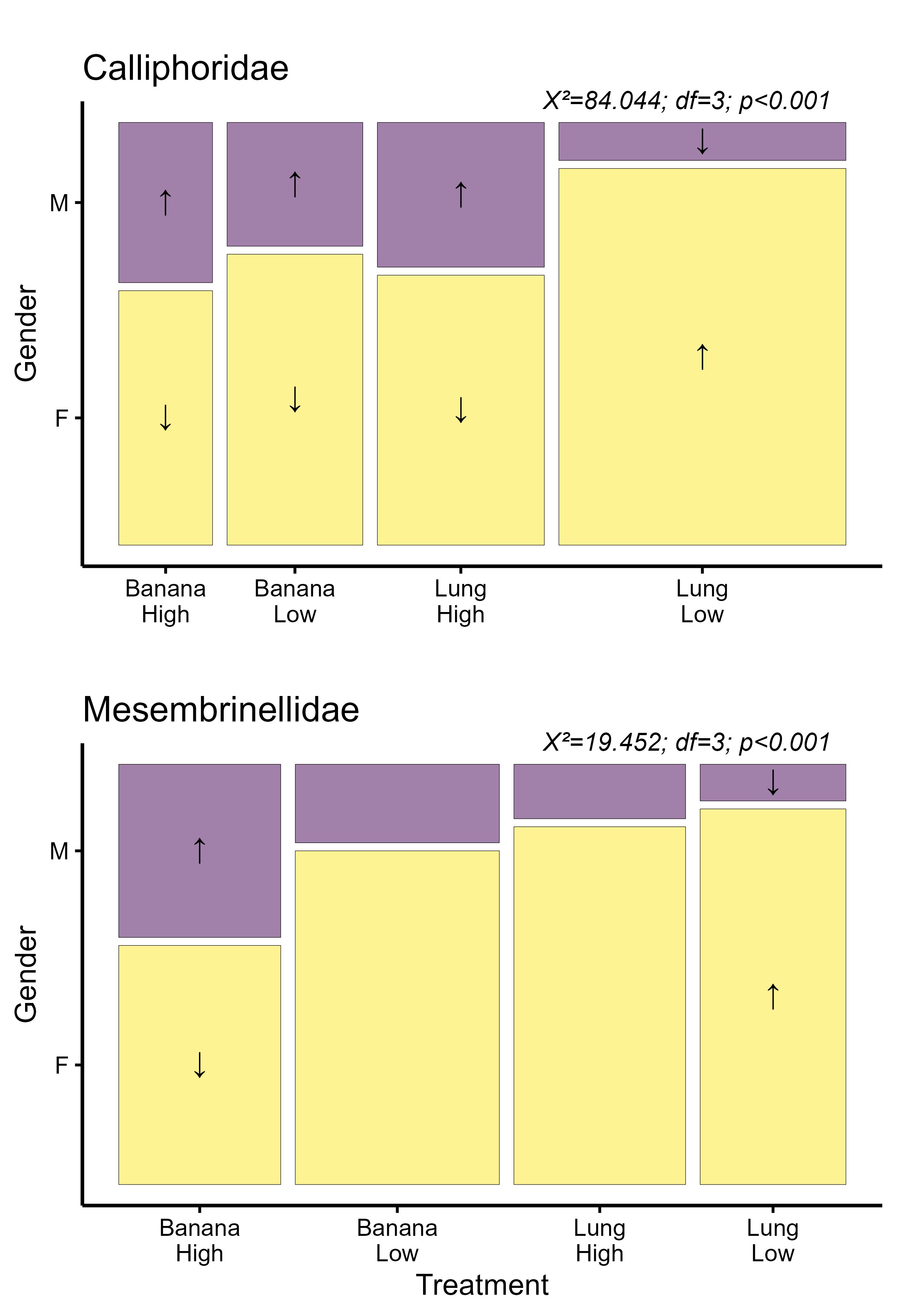
In comparing the total frequency of males and females, Calliphoridae females accounted for over 76% (735 individuals) of the specimens captured. In comparison, males represented no more than 24% (227 individuals) of the total collected in this experiment. For Mesembrinellidae, females accounted for over 79% (167 individuals), whereas males represented only 21% (44 individuals).
Sex ratio comparisons by treatment revealed a higher frequency of calliphorids females in the Lung-Low treatment (38.7%, 367 out of a total of 962 individuals) and a higher frequency of males in the Lung-High treatment (8.52%, 82 individuals; Figure 1). For mesembrinelids, the highest frequency of males was observed in the Banana-High treatment (9.95%, 21 individuals), whereas the highest frequency of females occurred in the Banana-Low treatment (24.17%, 51 individuals; Figure 1).
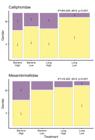
Relative abundances of female (F) and male (M) flies collected using two baits (Lung and Banana) at two heights (Low and High). The statistical values in the top right of each figure is for the overall model, and the arrows indicate significant post hoc values for abundances higher (↑) and lower (↓) than expected by chance (Statistical values in Table SII).
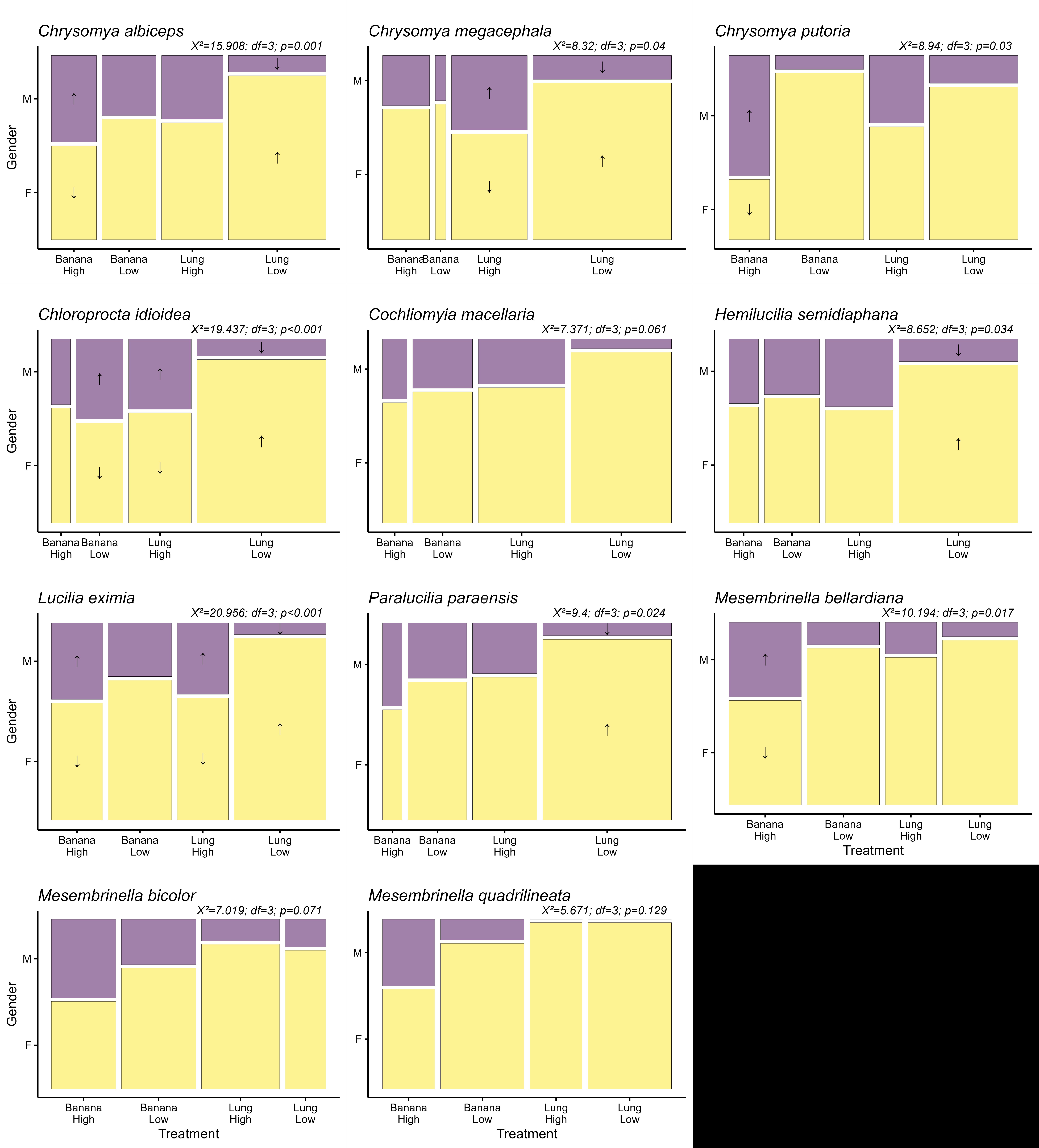
Among the eight Calliphoridae species analyzed, we observed significant differences in the sex ratio patterns in seven of them (Chr. albiceps, Chr. megacephala, Chr. putoria, Chl. idioidea, H. semidiaphana, L. eximia, and P. paraensis) (Figure 2). These species exhibited a higher observed frequency of females in the Lung-Low treatment (except Chr. putoria). In contrast, the frequencies of males were higher in Banana-High (Chr. albiceps, Chr. putoria, and L. eximia), Lung-Low (Chl. idioidea), and Lung-High (Chr. megacephala, Chl. idioidea, and L. eximia) (Figure 2). For the three analyzed Mesembrinellidae species, only M. bellardiana showed differences in its sex ratio, with a higher frequency of males in the Banana-High treatment (Figure 2).
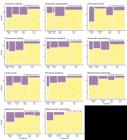
Relative abundances of female (F) and male (M) fly species collected using two baits (Lung and Banana) at two heights (Low and High). The statistical value in the top right corner of each figure is for the overall model, and the arrows indicate significant post hoc values for abundances higher (↑) and lower (↓) than expected by chance (Statistical values in Table SI). To identify the species excluded from the sex ratio analyses due to the absence of records for one of the sexes in the treatments, see Figure S2.
Ovarian development flies for two baits and heights
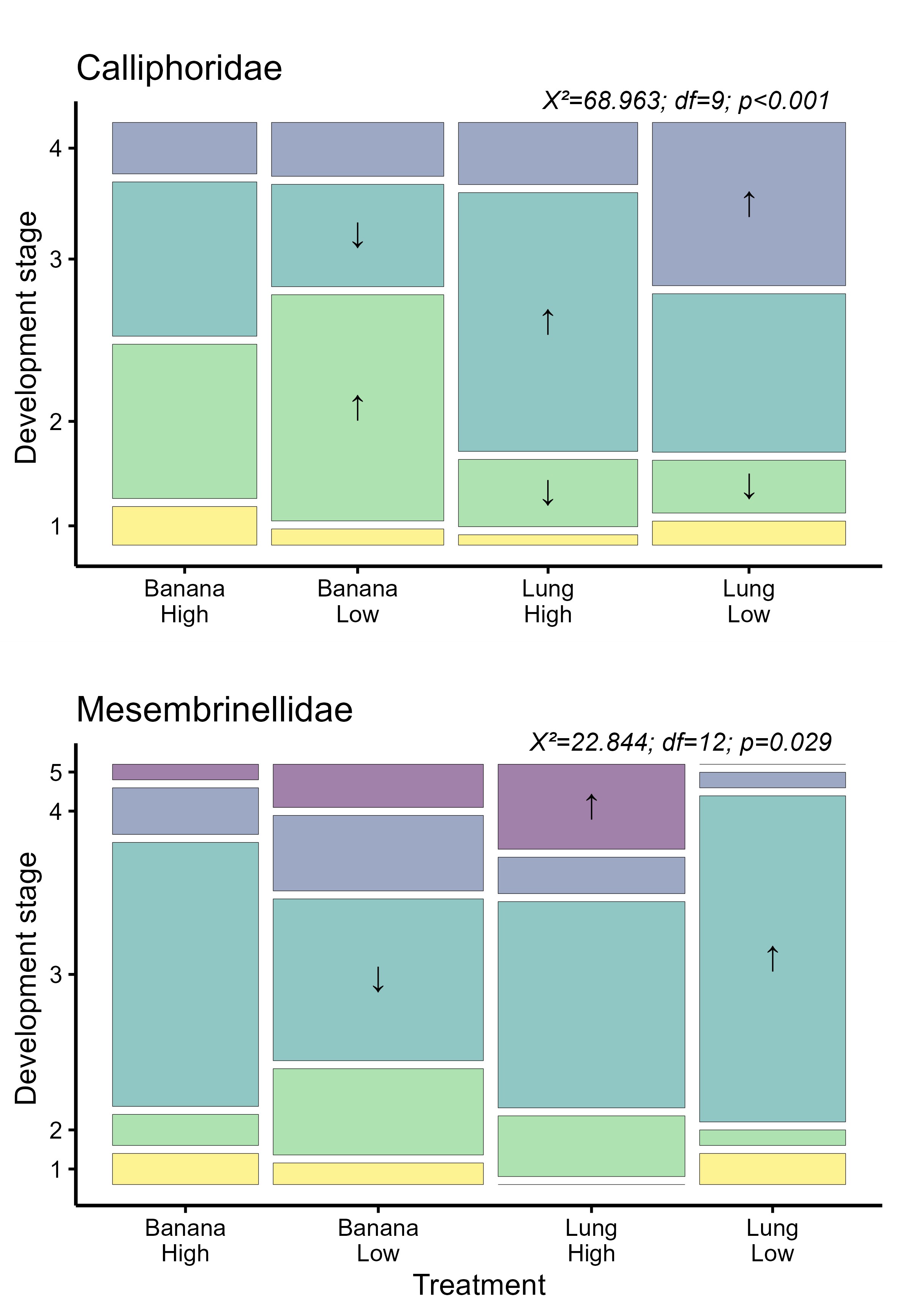
There was a treatment effect on different ovarian developmental phases. Calliphoridae flies in the initial vitellogenesis (phase 2) were more attracted to the Banana-Low treatment (14.2%); in the final vitellogenesis (phase 3) to the Lung-High treatment (16.8%); and in the complete vitellogenesis (phase 4) to the Lung-Low treatment (11.48%) (Figure 3). Mesembrinellidae females were more attracted only when they were in the final vitellogenesis phase (phase 3) to the Lung-Low treatment (17.8%) and in the gravid phase (phase 5) to Lung-High treatment (5.9%) (Figure 3).
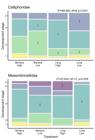
Relationship between ovarian developmental phases (1 - Pre-Vitellogenesis, 2 - Initial Vitellogenesis, 3 - Final Vitellogenesis, 4 - Complete Vitellogenesis, and 5 - Gravid) of female flies collected using two baits (Banana and Lung) and at two heights (Low and High). The size of each block corresponds to the abundance of individuals in each category; the statistical value in the upper right corner of each figure is for the general model, and the arrows indicate significant post hoc values for abundances greater (↑) or lower (↓) than expected by chance (Statistical values in Table SIII).
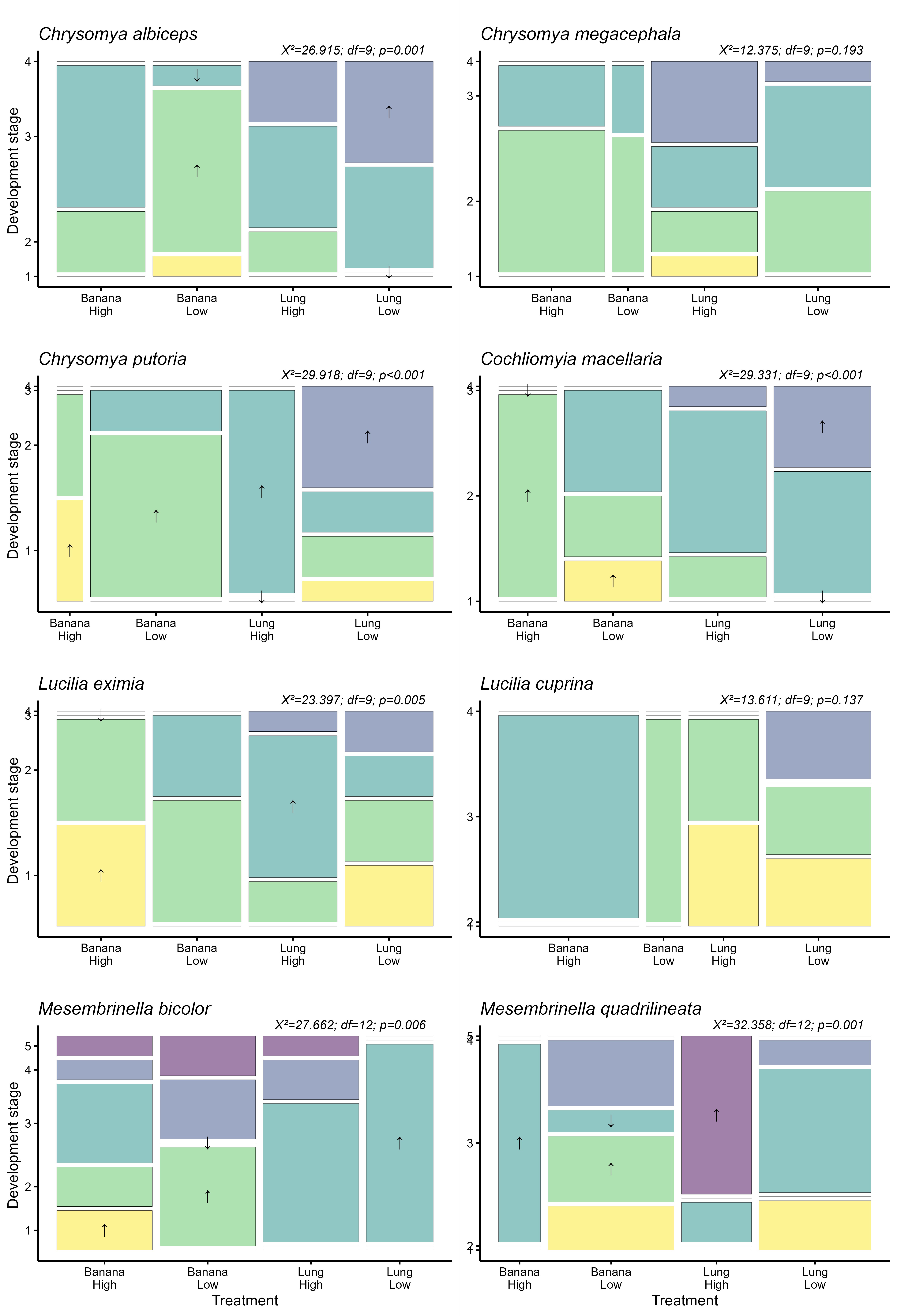
Regarding the effect of treatments on ovarian development patterns in the analyzed species separately, significant differences were identified in four of the six Calliphoridae species (Chr. albiceps, Chr. putoria, Co. macellaria, and L. eximia) (Figure 4). These species followed a pattern where females in the complete vitellogenesis phase (phase 4) were more abundant in the Lung-Low treatment (except L. eximia). Females in the final vitellogenesis phase (phase 3) were more frequent in the Lung-High treatment (Chr. putoria and L. eximia), in the initial vitellogenesis phase (phase 2) in the Banana-Low treatment (Chr. putoria), and in the pre-vitellogenesis phase (phase 1) in both Banana-High (Co. macellaria) and Banana-Low (Chr. putoria and L. eximia). The two Mesembrinellidae species analyzed showed significant differences in the effect of treatment on their ovarian development patterns (Figure 4). In the Gravid phase (phase 5), there was a higher frequency in the Lung-High treatment (M. quadrilineata); in the final vitellogenesis phase (phase 3), females were more frequent in the Banana-High treatment (M. quadrilineata), in the initial vitellogenesis phase (phase 2) in the Banana-Low treatment (M. bicolor and M. quadrilineata), and in the pre-vitellogenesis phase (phase 1) in the Banana-Low treatment (M. bicolor).
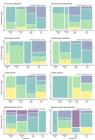
Relationship between ovarian development stages (1 - Pre-Vitellogenesis, 2 - Initial Vitellogenesis, 3 - Final Vitellogenesis, 4 - Complete Vitellogenesis, and 5 - Gravid) of fly species collected using two baits (banana and lung) and at two heights (low and high). The size of each block corresponds to the abundance of individuals in each category; the statistical value in the top right corner of each figure is for the overall model, and the arrows indicate significant post hoc values for abundances higher (↑) or lower (↓) than expected by chance (Statistical values in Table SII). To check the species not included in the analysis of ovarian development stages due to insufficient developmental stages in the treatments, see Figure S3.
DISCUSSION
This is the first study to jointly evaluate the attractiveness of different baits placed at different heights and to relate them to the sex ratio and ovarian development of Calliphoridae and Mesembrinellidae. Bait type and trap height influenced the sex ratio of attracted flies, revealing distinct reproductive foraging patterns between the two families and their species. The results of this local study offer insights into little-explored patterns in Calliphoridae and Mesembrinellidae, revealing potential sex- and stage-specific resource use strategies likely shaped by physiological demands and resource availability, and suggesting possible mechanisms to reduce intra- and interspecific competition. These findings underscore the need for future research to deepen our understanding of these patterns and their potential determinants.
Sex ratios of Calliphoridae and Mesembrinellidae
Sex ratios in Calliphoridae and Mesembrinellidae varied both among and within families, reflecting the ecological diversity and behavioral plasticity of these flies (Mulieri et al. 2015, 2018, Olea et al. 2018, Dufek et al. 2021). Mating systems, differences in reproductive investment, and sex-specific nutritional demands, especially the protein required for ovarian development, are key drivers of these variations (Mulieri et al. 2018).
The predominance of females in our samples, both in the canopy and the understory, likely reflects their greater dependence on protein-rich substrates for egg production, as females often feed and oviposit in animal tissues, suggesting that mating also occurs near these resources (Stoffolano et al. 1990, Chapman 2013). This pattern is well documented, with protein-based baits generally attracting more females (Mendes & Linhares 1993, Paraluppi & Castellón 1994, Sousa et al. 2010, Mulieri et al. 2015, Dufek et al. 2021). Although some studies have reported higher male abundance above 1.5 meters (Luvchiev et al. 1981), we found the opposite (female-biased captures across both strata and bait types) possibly because decomposing fruits or carcasses retained in the canopy also provide suitable resources (Façanha et al. 2022).
Males, in turn, have lower protein requirements and generally satisfy their nutritional needs through carbohydrates-rich sources, which provide the energy necessary for sustained mobility (D’Almeida & Lima 1994). Their reduced dependence on protein likely explains their underrepresentation in protein-baited traps, as reported in previous studies (Macleod & Donnelly 1957, Woodburn & Vogt 1982, Mendes & Linhares 1993, Martín-Vega & Baz 2013, Mulieri et al. 2015, Dufek et al. 2021). However, some males may approach protein baits not to feed but to locate sexually receptive females (Das & Dasgupta 1982, Mendes 1991, Dufek et al. 2021). Such strategies include “perching” near protein resources preferred by females (Thomas 1950, Land & Collett 1974, Downes-Jr 1994, Paquette et al. 2008, Mulieri et al. 2018) or positioning upwind of odor sources where females are likely to oviposit (Cook 1994). These ecological and behavioral patterns, including resource flexibility, trap avoidance, and perching behavior, can bias observed sex ratios, particularly when bait types differ (Olea et al. 2018, Mulieri et al. 2018). These strategies likely explain the higher proportion of males captured in banana-baited traps in our study. However, it is unlikely that their presence at these sites reflects active mate searching, since sexually receptive females are typically attracted to protein-rich substrates, which are more suitable for ovarian maturation and oviposition (Avancini & Prado 1986).
Mesembrinellidae were more abundant in banana-baited traps, indicating distinct physiological and behavioral strategies within the family. Although females predominated overall, males were slightly more common in the canopy—an unexpected pattern given that mesembrinellids are typically described as flying close to the forest floor (Guimarães 1977). While often associated with bird feces and rotting fruits, these flies are also collected using animal-based baits (Esposito et al. 2010, Sousa et al. 2010, 2021, Façanha et al. 2022), suggesting ecological plasticity in their use of food sources. Both protein- and carbohydrate-rich substrates likely play complementary roles in adult female physiology: proteins support ovarian maturation, whereas carbohydrates provide energy reserves required for pupal emergence and post-eclosion flight (Boggs 1981, 2009, Browne 2001, Brown et al. 2010). The group also exhibits interspecific variation in substrate use, although larval development sites remain poorly known. A notable example is Laneella nigripes (Guimarães, 1977), the only species experimentally reared, which develops in snail carcasses. Such ecological flexibility, combined with their viviparous reproduction, may reduce vulnerability to egg predators and enhance efficiency in locating suitable larval sites (Guimarães 1977). This diversity of substrates, as well as the lack of information on larviposition sites, may help explain the overall low abundance observed in our experiment. Nevertheless, our findings provide valuable insights into the sex ratio patterns of Mesembrinellidae, contributing essential data toward understanding the reproductive ecology of this still poorly studied group.
At the species level, most Calliphoridae also exhibited female-biased ratios in lung-baited traps near the ground, except for Chr. putoria, which was rare overall. In contrast, male-biased occurrences in banana baits, particularly for Chr. albiceps, Chr. putoria, L. eximia, Chl. idioidea, and M. bellardiana across the entire vertical gradient, likely reflect their broader feeding range and greater mobility between forest strata (D’Almeida & Lima 1994, Mulieri et al. 2015, Dufek et al. 2021). Therefore, for studies aiming to collect males, protein baits near the ground may be less effective for certain species of both families.
Ovarian development of Calliphoridae and Mesembrinellidae
The search for protein-rich resources by females reflects both nutritional demands and reproductive status, as they seek feeding and oviposition sites according to their physiological stage (Kasper et al. 2015). This was evident in our data: even when accounting for vertical resource availability, most females of Calliphoridae and Mesembrinellidae captured in bovine lung baits were in late vitellogenic stages.
Knowledge of bait attractiveness to Mesembrinellidae remains scarce, but our results confirm their attraction to both decomposing bovine lung and fermented banana, and their presence even in the canopy (10 m height). These individuals may be gravid while using bovine lung at this stratum and/or exploring it in the final stages of development while feeding on banana. Such behavior may reflect the adenotrophic viviparity typical of family, where females nourish larvae internally until advanced developmental stages (Guimarães 1977, Brown et al. 2010), allowing them to exploit less competitive resources and complete reproduction with reduced dependence on external protein sources and meeting the energetic demands of the adult, that will emerge either in that site or elsewhere (Boggs 1981, 2009, Muntzer et al. 2015, Brodie et al. 2016, Alqurashi et al. 2020).
Like Strangways-Dixon (1961), we confirmed that females at pre-vitellogenic and mature egg stages tended to use carbohydrates-rich baits, whereas vitellogenic stages were associated with protein sources, particularly among Calliphoridae (e.g., Chr. putoria and L. eximia). The higher abundance of vitellogenic females in protein baits placed at 0.6 m may also reflect the influence of microclimatic conditions at this height, such as increased humidity, moderate temperature, and reduced light exposure. These factors may create more favorable microhabitats for feeding and oviposition, especially for females in advanced reproductive stages (Stork & Grimbacher 2006, Ulyshen et al. 2010, Amorim et al. 2022, Rafael et al. 2025). In contrast, M. bicolor and M. quadrilineata deviated from the general pattern of Mesembrinellidae, being collected at intermediate or later vitellogenesis stages on banana baits. This suggests a degree of flexibility in nutrient acquisition and spatial foraging strategies. The latter species also exploited canopy-level resources while gravid, further highlighting the ecological versatility and adaptive potential of the group.
Unlike blowflies, which lay their eggs directly in the environment (Avancini & Prado 1986), Mesembrinellidae females produce a single large egg at a time, which hatches into a larva inside the uterus and is released at an advanced stage (Brown et al. 2010). During this “gestation” period, the larvae remain in the female’s abdomen, receiving nutrients from genital tract secretions (Guimarães 1977). This adenotrophic viviparity strategy likely confers advantages such as increased protection from predators and higher offspring survival, but it also limits opportunities for protein feeding prior larviposition, making females more vulnerable during foraging for themselves and their offspring. Moreover, this reproductive mode implies a shorter feeding window and lower protein requirements compared to oviparous Calliphoridae, which may influence the relative attractiveness of different bait types and, consequently, the patterns observed in our results. These potential adaptations and the interpretations arising from our findings highlights the need for further studies on these native dipterans, which may also serve as a significant model for research on the evolution of complex reproductive biology in the Diptera (Cabrini et al. 2013, Marinho et al. 2017).
Our results support previous evidence that substrate attractiveness varies with ovarian stage (Avancini & Prado 1986) and, to our knowledge, provide the first integrative assessment of ovarian development in Mesembrinellidae across different bait types and forest strata. The limited knowledge of this family’s reproductive behavior restricts broader comparisons, making our findings particularly valuable. Female use of vertical strata and food resources may reflect specific reproductive strategies that merit further investigation. These results represent an important first step toward understanding how bait type and vertical resource arrangement interact with reproductive physiology. Future studies could expand on this work by increasing bait variety and examining how seasonality or environmental gradients influence these traits, factors beyond the scope of our study. Such approaches would allow clearer differentiation between ecological and methodological effects on sex ratio patterns and ovarian development.
We emphasize that although our sampling period may appear relatively short and spatially restricted, these limitations resulted from logistical constraints and the difficulty of accessing the study area. Nevertheless, the data collected provide valuable baseline information on ovarian development and sex ratio variation in Calliphoridae and Mesembrinellidae under natural Amazonian forest conditions, in one of the most well-preserved states of the region, Amapá (MapBiomas 2024). This study offers an important foundation for future ecological and forensic entomology research in the Brazilian Amazon, particularly in a region identified as one of the largest biodiversity knowledge gaps in the Neotropics (Carvalho et al. 2023) and among the least funded for scientific research (Stegmann et al. 2024). Additionally, although sampling was conducted during different periods of the year, potential seasonal variation was not analyzed separately, as our main objective was to integrate data across expeditions to characterize general reproductive and sampling patterns under natural forest conditions. Treating each expedition independently would have reduced statistical power and increased zero inflation in the models, potentially obscuring broader ecological trends.
We conclude that resource type and availability along a vertical gradient were key factors shaping sex ratio patterns and ovarian development in Calliphoridae and Mesembrinellidae, both at the family and species levels. Protein-rich (decomposing bovine lung) and carbohydrate-rich (fermented banana) baits influenced flies captures differently: females were primarily attracted to protein, particularly in the understory, whereas males were more frequently captured in the canopy, favoring carbohydrates. This highlights how the observed patterns align with the distinct nutritional needs of males and females. Behavioral patterns associated with ovarian development were clear and structured in Calliphoridae, with some species (e.g. Chr. putoria and L. eximia) initially attracted to banana bait and later seeking bovine lung in the final stages of development across vertical strata. In contrast, Mesembrinellidae displayed a divergent pattern: oocyte development began in lung bait in the understory (M. bicolor) or in the banana in the canopy (M. quadrilineata) and finished their development in the canopy when gravid (M. quadrilineata). These findings reinforce the importance of considering the interplay between sexual behavior, physiological state, and resource availability when studying the attraction dynamics of these flies, as well as the value of integrating both family- and species-level analyses to achieve a more detailed understanding of patterns across taxonomic scales.
Acknowledgements
Bruna L.B. Façanha thanks Any Gomes, Camila Gama, Camila Mendes, Vivian Abreu and Josué Videira for their help with the field work, Solange Barbosa, Augusto Barbosa, and Cristiano Barreto for the field logistics. The authors also express their sincere gratitude to the late Bob Robert M. Hughes for his generous contribution in reviewing and editing the English text, and for his lifelong dedication to advancing ecological science. We thank the five anonymous reviewers for their contributions to the manuscript. We acknowledge funding provided by the Conselho Nacional de Desenvolvimento Científico e Tecnológico (CNPq), through the projects and networks INCT-SinBiAm (Instituto Nacional de Ciência e Tecnologia Síntese da Biodiversidade Amazônica; CNPq/MCTIC/INCT 406767/2022–0); PPBio-AmOr (Programa de Pesquisa em Biodiversidade da Amazônia Oriental; CNPq/MCTI/FNDCT 441257/2023–2); FlorAmOr (Rede de monitoramento da biodiversidade das FLOrestas e Riachos da Amazonia ORiental; CNPq/MCTI/FNDCT 443860/2024-6); CAPACREAM (Centro Avançado de Pesquisa-Ação da Conservação e Recuperação Ecossistêmica da AMazônia; CNPq/MCTI/FNDCT 444350/2024-1); and PELD-AmOr (Monitoramento dos Padrões sócioEcológicos em Longo prazo nos ecossistemas Da Amazônia Oriental; CNPq/PELD 445970/2024-3). BLBF was partially supported by a Master’s scholarship from Coordenação de Aperfeiçoamento de Pessoal de Nível Superior (CAPES) and subsequently by a SET-C Postdoctoral fellowship (351163/2025-5) under the CAPACREAM project (CNPq Proc. 444350/2024-1). RPSA thanks FAPESPA for the post-doctoral scholarship (Atração de Jovens Talentos - BJT; process: 2023/53239). Leandro Juen (process: 304710/2019-9) and Maria Cristina Esposito (process: 309090/2019-9) thank CNPq for productivity scholarships. JRPS (process: PQ-C-12658/25 - Technical Cooperation Agreement-CNPq-FAPEMA), thank CNPq and FAPEMA (Fundação de Amparo à Pesquisa e ao Desenvolvimento Científico e Tecnológico do Maranhão) for productivity scholarship.
References
- ALQURASHI S, ENGLISH S & WALL R. 2020. Nutritional requirements for reproduction and survival in the blowfly Lucilia sericata. Med Vet Entomol 34: 207-214.
- AMENDT J, RICHARDS CS, CAMPOBASSO CP, ZEHNER R & HALL MJR. 2011. Forensic entomology: Applications and limitations. Forensic Sci Med Pathol 7: 379-392.
- AMORIM DS ET AL. 2022. Vertical stratification of insect abundance and species richness in an Amazonian tropical forest. Sci Rep 12: 1-10.
- ARCHER MS & ELGAR MA. 2003. Effects of decomposition on carcass attendance in a guild of carrion-breeding flies. Med Vet Entomol 17: 263-271.
- AVANCINI RMP & LINHARES AX. 1988. Selective attractiveness of rodent-baited traps for female blowflies. Med Vet Entomol 2: 73-76.
- AVANCINI RMP & PRADO AP. 1986. Oogenesis in Chrysomya putoria (Wiedmann) (Diptera: Calliphoridae). J Insect Morphol Embryol 15: 375-384.
- BEASLEY TM & SCHUMACHER RE. 1995. Multiple regression approach to analyzing contingency tables: Post hoc and planned comparison procedures. J Exp Educ 64: 79-93.
- BIRTELE D & HARDERSEN S. 2012. Analysis of vertical stratification of Syrphidae (Diptera) in an oak-hornbeam forest in northern Italy. Ecol Res 27: 755-763.
- BOGGS CL. 1981. Nutritional and life-history determinants of resource allocation in holometabolous insects. Am Nat 117: 692-709.
- BOGGS CL. 2009. Understanding insect life histories and senescence through a resource allocation lens. Funct Ecol 23: 27-37.
- BORROR DJ & DELONG DM. 1969. Introdução ao estudo dos insetos. Programa de Publicações Didáticas, Agência Norte-Americana para o Desenvolvimento Internacional – USAID, p. 653.
- BRODIE BS, BABCOCK T, GRIES R, BENN A & GRIES G. 2016. Acquired Smell? Mature Females of the Common Green Bottle Fly Shift Semiochemical Preferences from Feces Feeding Sites to Carrion Oviposition Sites. J Chem Ecol 42: 40-50.
- BROWN B, BORKENT A, CUMMING J, WOOD D, WOODLEY N & ZUMBADO M. 2010. Manual of Central American Diptera, Ottawa: NRC Research Press, p. 728.
- BROWNE LB. 2001. Quantitative aspects of the regulation of ovarian development in selected anautogenous diptera: Integration of endocrinology and nutrition. Entomol Exp Appl 100: 137-149.
- CABRINI I, GRELLA MD, ANDRADE CFS & THYSSEN PJ. 2013. Richness and composition of Calliphoridae in an Atlantic Forest fragment: Implication for the use of dipteran species as bioindicators. Biodivers Conserv 22: 2635-2643.
- CARVALHO CJB, RAFAEL JA, COURI MS & SILVA VC. 2012. Diptera. In: Rafael JA et al. (Eds), Insetos do Brasil - Diversidade e Taxonomia, Ribeirão Preto: Holos Editora, p. 810.
- CARVALHO CJB & RIBEIRO PB. 2000. Chave de identificação das espécies de Calliphoridae (Diptera) do Sul do Brasil. RBPV 9: 169-173.
-
CARVALHO RL ET AL. 2023. Pervasive gaps in Amazonian ecological research. Curr Biol 33(16): 3495-3504. https://doi.org/10.1016/j.cub.2023.06.077.
» https://doi.org/10.1016/j.cub.2023.06.077 - CARVALHO RP, AZEVEDO WTA, FIGUEIREDO AL, LESSA CSS & AGUIAR VM. 2017. Dipterofauna Associated With Rat Carcasses in the Atlantic Forest, Southeastern Brazil. J Med Entomol 53: 1498-1509.
- CAVALCANTE K, PENICHE T, FAÇANHA BLB, ARAÚJO CM, LOBATO TAS & SOUTO RNP. 2023. Effect of diazinon (organophosphate) on the composition and succession of Calliphoridae assemblages in rabbit carcasses in the Eastern Amazon. Int J Legal Med 137: 1253-1261.
- CHAPMAN RF. 2013. The insects: structure and function. Simpson SJ & Douglas AE (Eds), 5th ed., New York, USA: Cambridge University Press, p. 929.
- COOK DF. 1994. Influence of Temperature on Copula Duration and Mating Propensity in Lucilia cuprina Wiedemann (Diptera: Calliphoridae). Aust J Entomol 33: 5-8.
- D’ALMEIDA JM & LIMA SF. 1994. Atratividade de diferentes iscas e sua relação com as fases de desenvolvimento ovariano em Calliphoridae e Sarcophagidae (Insecta, Diptera). Rev Bras Zool 11: 177-186.
- DAS SK & DASGUPTA B. 1982. Sex-ratio of blowflies in Calcutta. Orient Insects 16: 129-133.
- DEAR JP. 1985. A revision of the New World Chrysomyini (Diptera: Calliphoridae). Rev Bras Zool 3: 109-169.
- DOWNES JR WL. 1994. Perching behavior and coloration in temperate and tropical Sarcophagidae (Díptera). Rev Biol Trop 42: 195-201.
-
DUFEK MI, BATTÁN-HORENSTEIN M & MULIERI PR. 2021. Blow flies, synanthropy and sex ratio: Are the deviations in the sex proportion linked to human transformation of landscapes? Acta Trop 222: 106052. https://doi.org/10.1016/j.actatropica.2021.106052.
» https://doi.org/10.1016/j.actatropica.2021.106052 - DUFEK MI, OSCHEROV EB, DAMBORSKY MP & MULIERI PR. 2016. Assessment of the Abundance and Diversity of Calliphoridae and Sarcophagidae (Diptera) in Sites with Different Degrees of Human Impact in the Iberá Wetlands (Argentina). J Med Entomol 53: 827-835.
- DUFEK MI, OSCHEROV EB, DAMBORSKY MP & MULIERI PR. 2020. Calliphoridae (Diptera) in Human-Transformed and Wild Habitats: Diversity and Seasonal Fluctuations in the Humid Chaco Ecoregion of South America. J Med Entomol 56: 725-736.
-
EBBERT D. 2019. chisq.posthoc.test: A Post Hoc Analysis for Pearson’s Chi-Squared Test for Count Data. R package version 012. Available at: https://CRAN.R-project.org/package=chisq.posthoc.t
» https://CRAN.R-project.org/package=chisq.posthoc.t - ESPOSITO MC, SOUSA JRP & CARVALHO-FILHO FDS. 2010. Diversidade de Calliphoridae (Insecta: Diptera) na base de extração petrolífera da Bacia do Rio Urucu, na Amazônia brasileira. Acta Amazon 40: 579-583.
-
FAÇANHA BLB, ALMEIDA RPS, CAVALCANTE K, PENICHE T, LOBATO TAS, ARAÚJO CMCV & SOUTO RNP. 2025. Colonization of Blowflies (Diptera: Calliphoridae) and Association Time Between Adults and Immatures in Pig Carcass Decomposition: One Day to Change. Neotrop Entomol 54: 13. https://doi.org/10.1007/s13744-024-01231-9.
» https://doi.org/10.1007/s13744-024-01231-9 -
FAÇANHA BLB, ESPOSITO MC & JUEN L. 2022. Trap and bait efficiency for catching Calliphoridae and Mesembrinellidae (Insecta, Diptera) at different heights. An Acad Bras Cienc 94: e20210763. https://doi.org/10.1590/0001-3765202220210763.
» https://doi.org/10.1590/0001-3765202220210763 - FERREIRA MJM. 1978. Sinatropia de dípteros muscóideos de Curitiba, Paraná I. Calliphoridae. Rev Bras Biol 38: 445-454.
-
GUIMARÃES JH. 1977. A Systematic Revision of the Mesembrinellidae, Stat. Nov. (Diptera, Cyclorrhapha). Arq Zool 29: 1-109. https://doi.org/10.11606/issn.2176-7793.v29i1p1-109.
» https://doi.org/10.11606/issn.2176-7793.v29i1p1-109 - HANS KR, LEBOUTHILLIER R & VANLAERHOVEN SL. 2019. Effect of Temperature on Oviposition Behavior and Egg Load of Blow Flies (Diptera: Calliphoridae). J Med Entomol 56: 441-447.
-
INMET - INSTITUTO NACIONAL DE METEOROLOGIA. 2020. Climatologia anual. Available at: https://bdmep.inmet.gov.br/
» https://bdmep.inmet.gov.br/ -
JEPPSON H, HOFMANN H & COOK D. 2021. ggmosaic: Mosaic Plots in the “ggplot2” Framework. R package version 033. Available at: https://haleyjeppson.github.io/ggmosaic/, https://github.com/haleyjeppson/ggmosaic.
» https://haleyjeppson.github.io/ggmosaic/ - KASPER J, HARTLEY S, SCHATKOWSKI S & HOCH H. 2015. The Influence of the Physiological Stage of Lucilia Caesar (L.) (Diptera: Calliphoridae) Females on the Attraction of Carrion Odor. J Insect Behav 28: 183-201.
- KOSMANN C, MELLO RP, HARTERREITEN-SOUZA ÉS & PUJOL-LUZ JR. 2013. A List of Current Valid Blow Fly Names (Diptera: Calliphoridae) in the Americas South of Mexico with Key to the Brazilian Species. EntomoBrasilis 6: 74-85.
-
LAND MF & COLLETT TS. 1974. Chasing Behaviour of Houseflies (Fannia canicularis) A Description and Analysis. J Comp Physiol 89: 331-357. https://doi.org/10.1007/BF00695351.
» https://doi.org/10.1007/BF00695351 - LINHARES AX & THYSSEN PJ. 2012. Entomologia forense, miíases e terapia larval. In: Insetos do Brasil: diversidade e taxonomia, Ribeirão Preto: Holos, p. 152-163.
-
LUTZ L, AMENDT J & MOREAU G. 2025. Baited traps as flawed proxies for carcass colonization. Sci Rep 15: 6267. https://doi.org/10.1038/s41598-025-90522-1.
» https://doi.org/10.1038/s41598-025-90522-1 - LUVCHIEV V, ZHELYAZOVA M, TACHIROV T & MICHERVA M. 1981. On the altitude distribution of exophylous synantropic and coprophylous flies. Ecology 8: 29-33.
- LUZ RT, AZEVEDO WTA, SILVA AS, LESSA CSS, MAIA VC & AGUIAR VM. 2020. Population Fluctuation, Influence of Abiotic Factors and the Height of Traps on the Abundance and Richness of Calliphoridae and Mesembrinellidae. J Med Entomol XX: 1-10.
- MACLEOD J & DONNELLY J. 1957. Some Ecological Relationships of Natural Populations of Calliphorine Blowflies. J Anim Ecol 26: 135-170.
-
MAPBIOMAS. 2024. Destaques do mapeamento anual de cobertura e uso da terra - Bioma Amazônia - MapBiomas Brasil Coleção 9 (1985-2023). Available at: https://data.mapbiomas.org/dataset.xhtml?persistentId=doi:10.58053/MapBiomas/8CR1CW
» https://data.mapbiomas.org/dataset.xhtml?persistentId=doi:10.58053/MapBiomas/8CR1CW - MARCHIORI CH. 2023. Research of the family Mesembrinellidae (Insecta: Diptera). OARJST 8: 29-39.
- MARINHO MAT, WOLFF M, RAMOS-PASTRANA Y, DE AZEREDO-ESPIN AML & AMORIM DS. 2017. The first phylogenetic study of mesembrinellidae (Diptera: Oestroidea) based on molecular data: Clades and congruence with morphological characters. Cladistics 33: 134-152.
- MARTÍN-VEGA D & BAZ A. 2013. Sex-biased captures of sarcosaprophagous Diptera in carrion-baited traps. J Insect Sci 13: 1-12.
- MELLO RP. 2003. Chave para identificação das formas adultas das espécies da família Calliphoridae (Díptera, Brachycera, Cyclorrhapha) encontradas no Brasil. Entomol Vect 10: 255-268.
- MENDES J. 1991. Relação entre Atratividade por iscas e estágios de desenvolvimento ovariano em fêmeas de dípteros muscóideos sinantrópicos de Campinas, SP. (Tese de doutorado). Universidade Estadual de Campinas, p. 148.
- MENDES J & LINHARES AX. 1993. Atratividade por iscas e estágios de desenvolvimento ovariano em várias espécies sinantrópicas de Calliphoridae (Diptera). Rev Bras Entomol 37: 157-166.
- MENDES TP, ESPOSITO MC, CARVALHO-FILHO FDS, JUEN L, ALVARADO ST & SOUSA JRP. 2021. Necrophagous flies (Diptera: Calliphoridae and Sarcophagidae) as indicators of the conservation or anthropization of environments in eastern Amazonia, Brazil. J Insect Conserv 25: 719-732.
- MOORE K, BAGSBY K & HANS KR. 2024. The Influence of Substrates on Blow Fly (Diptera: Calliphoridae) Development. Forensic Sci 4: 409-416.
- MULIERI PR, OLEA MS, PATITUCCI LD & BATTÁN-HORENSTEIN M. 2018. Sex Ratio and Abundance Fluctuations of Sarcosaprophagous Calyptratae (Diptera): Field Evaluation of Two Sampling Techniques. J Med Entomol 55: 1210-1216.
- MULIERI PR, PATITUCCI LD & OLEA MS. 2015. Sex-biased patterns of saprophagous calyptratae (diptera) collected with different baits of animal origin. J Med Entomol 52: 386-393.
- MUNTZER A, MONTAGNE C, ELLSE L & WALL R. 2015. Temperature-dependent lipid metabolism in the blow fly Lucilia sericata. Med Vet Entomol 29: 305-313.
- OLEA MS, PATITUCCI LD, MARILUIS JC, ALDERETE M & MULIERI PR. 2018. Assessment of sampling methods for sarcosaprophagous species and other guilds of calyptratae (diptera) in temperate forests of Southern South America. J Med Entomol 54: 349-361.
- OLIVEIRA DL, SOARES TF & VASCONCELOS SD. 2016. Effect of bait decomposition on the attractiveness to species of Diptera of veterinary and forensic importance in a rainforest fragment in Brazil. Parasitol Res 115: 449-455.
- PAMPONET F, LOPES D, VÉRAS T, FONSECA P, VASCONCELOS S, TORRES M, GRISI B, OLIVEIRA F, THÉ T & OLIVEIRA-COSTA J. 2019. Análise temporal de Calliphoridae (Diptera: Cyclorrhapha) no processo de decomposição em carcaças de suínos (Sus scrofa Linnaeus) em Salvador, Bahia, Brasil. EntomoBrasilis 12: 63-69.
- PAQUETTE C, JOPLIN KH, SEIER E, PEYTON JT & MOORE D. 2008. Sex-specific differences in spatial behaviour in the flesh fly Sarcophaga crassipalpis. Physiol Entomol 33: 382-388.
- PARALUPPI ND & CASTELLÓN EG. 1994. Calliphoridae (Diptera) em Manaus: I. Pesquisa taxonômica e sazonalidade. Rev Bras Entomol 38: 661-668.
- PINTO A ET AL. 2008. Macrodiagnóstico do Estado do Amapá: primeira aproximação do Zoneamento Ecológico Econômico, 3a ed. Macapá, Amapá: Instituto de Pesquisas Científicas e Tecnológicas do Estado do Amapá, p. 142.
- R CORE TEAM. 2023. R: A language and environment for statistical computing. R Foundation for Statistical Computing. Version 4.0.0.
-
RAFAEL JA, LIMEIRA-DE-OLIVEIRA F, OLIVEIRA IB, LIMA SP, TÔRRES A, FERNANDES DRR & AMORIM DS. 2025. Cascade of flight interception traps for large scale exploration of the otherwise unreachable canopy insect fauna. Sci Rep 15: 36029. https://doi.org/10.1038/s41598-025-19981-w.
» https://doi.org/10.1038/s41598-025-19981-w - SEGER J & STUBBLEFIELD JW. 2002. Moldels of sex ratio evolution. In: Hardy ICW (Ed), Sex ratios. Concepts and research methods, Cambridge, United Kingdom: Cambridge University Press, p. 2-26.
- SOUSA JP, CARVALHO-FILHO FS, JUEN L & ESPOSITO MC. 2020. The effects of cattle ranching on the communities of necrophagous flies (Diptera: Calliphoridae, Mesembrinellidae and Sarcophagidae) in Northeastern Brazil. J Insect Conserv 24: 705-717.
- SOUSA JRP, ESPOSITO MC & CARVALHO-FILHO FS. 2010. Composição, abundância e riqueza de Calliphoridae (Diptera) das matas e clareiras com diferentes coberturas vegetais da Base de Extração Petrolífera, bacia do Rio Urucu, Coari, Amazonas. Rev Bras Entomol 54: 270-276.
-
SOUSA JRP, ESPOSITO MC, CARVALHO-FILHO FDS & JUEN L. 2014. The potential uses of sarcosaprophagous flesh flies and blowflies for the evaluation of the regeneration and conservation of forest clearings: A Case study in the Amazon forest. J Insect Sci 14: 215. https://doi.org/10.1093/JISESA/IEU077.
» https://doi.org/10.1093/JISESA/IEU077 - SOUSA JRP, MENDES TP, CARVALHO-FILHO FDS, JUEN L & ESPOSITO MC. 2021. Diversity of Necrophagous Flies (Diptera: Calliphoridae, Mesembrinellidae, and Sarcophagidae) in Anthropogenic and Preserved Environments of Five Different Phytophysiognomies in Northeastern Brazil. Neotrop Entomol 50: 537-550.
-
STEGMANN LF ET AL. 2024. Brazilian public funding for biodiversity research in the Amazon. Perspect Ecol Conserv 22: 1-7. https://doi.org/10.1016/j.pecon.2024.01.003.
» https://doi.org/10.1016/j.pecon.2024.01.003 - STIREMAN JO, CERRETTI P, WHITMORE D, HARDERSEN S & GIANELLE D. 2012. Composition and stratification of a tachinid (diptera: tachinidae) parasitoid community in a european temperate plain forest. Insect Conserv Divers 5: 346-357.
- STOFFOLANO JG, BARTLEY MM & YIN C-M. 1990. Male and Female Phormia regina (Diptera: Calliphoridae) Trapped at Two Different Baits in the Field. Ann Entomol Soc Am 83: 603-606.
- STORK NE & GRIMBACHER PS. 2006. Beetle assemblages from an Australian tropical rainforest show that the canopy and the ground strata contribute equally to biodiversity. Proc R Soc B: Biol Sci 273: 1969-1975.
- STRANGWAYS-DIXON J. 1961. The Relationship Between Nutrition, Hormones and Reproduction in the Blowfly Calliphora Erythrocephala (Meig.): I. Selective Feeding in Relation to the Reproductive Cycle, the Corpus Allatum Volume and Fertilization. J Exp Biol 38: 225-235.
- TANABE SI. 2002. Between-forest variation in vertical stratification of drosophilid populations. Ecol Entomol 27: 720-731.
- THOMAS HT. 1950. Field notes on the mating habits of Sarcophaga meigen (diptera). Proceedings of the Royal Entomological Society of London Series A. Entomol Gen 25: 93-98.
-
TODA MJ. 1992. Three-dimensional dispersion of drosophilid flies in a cool temperate forest of northern Japan. Ecol Res 7: 283-295. doi: 10.1007/BF02347097.
» https://doi.org/10.1007/BF02347097 - ULYSHEN MD, SOON V & HANULA JL. 2010. On the vertical distribution of bees in a temperate deciduous forest. Insect Conserv Divers 3: 222-228.
- VASCONCELOS SD, CRUZ TM, SALGADO RL & THYSSEN PJ. 2013. Dipterans associated with a decomposing animal carcass in a rainforest fragment in Brazil: Notes on the early arrival and colonization by necrophagous species. J Insect Sci 13: 1-11.
-
WHITWORTH T. 2010. Keys to the genera and species of blow flies (Diptera: Calliphoridae) of the West Indies and description of a new species of Lucilia Robineau-Desvoidy. Zootaxa 2663: 1-35. Doi: 10.11646/zootaxa.2663.1.1.
» https://doi.org/10.11646/zootaxa.2663.1.1 - WHITWORTH TL & YUSSEFF-VANEGAS S. 2019. A revision of the genera and species of the Neotropical family Mesembrinellidae (Diptera: Oestroidea). Zootaxa 4659: 1-146.
-
WICKHAM H. 2016. ggplot2: elegant graphics for data analysis. 2nd ed., New York. https://doi.org/10.1007/978-3-319-24277-4
» https://doi.org/10.1007/978-3-319-24277-4 - WOODBURN TL & VOGT WG. 1982. Attractiveness of Merino Sheep Before and After Death To Adults of Lucilia Cuprina (Wiedemann) (Diptera: Calliphoridae). Aust J Entomol 21: 131-134.
Edited by
-
Handling editor
Jamal Rafique
To ensure transparency and reproducibility, all datasets and analytical scripts used in this study are publicly accessible on GitHub: https://github.com/BrunaFacanha/Facanhaetal_SexRatio-OvarianDevelopment_Flies.