 A new ornithocheiran pterosaur from the Upper Cretaceous (Cenomanian) of Saratov, Russia
Abstract
Saratovia glickmani, gen. et sp. nov., is described based on a dentary symphysis fragment from the Upper Cretaceous (upper Cenomanian) Melovatka Formation at Saratov, Russia. This specimen was found by L.S. Glickman in late 1940s and was referred previously to Ornithocheirus, Anhanguera, or Coloborhynchus. S. glickmani is attributed to Targaryendraconia because of strongly scalloped and subparallel lateral margins of dentary symphysis, which is transversely narrow, with the interalveolar width subequal to the alveolar width. It differs from all known targaryendraconians by having a dentary crest. The new taxon differs from all toothed pterodactyloids by lack of median groove on dentary symphysis. Instead, it has a raised flat platform pierced by numerous relatively large nutrient foramina, which are connected by short canals with a median canal within this platform. S. glickmani is one of the latest toothed pterosaurs known in the fossil record.
Key words
Pterosauria; Ornithocheirae; Upper Cretaceous; Russia
INTRODUCTION
The Cenomanian sands with phosphorites are widely distributed in European Russia (Alekseev et al. 2005a, b). These are near shore deposits of a shallow epicontinental sea that covered most of Europe in mid-Cretaceous (Albian-Cenomanian). These deposits usually contain remains of a diverse assemblage of marine and coastal vertebrates, including pterosaurs. An exceptionally large collection of pterosaurs of this age was collected from the Cambridge Greensand of England during the large scale exploitation of this stratigraphic unit for the minerals during the Industrial Revolution in 1880s (Unwin 2001). This collection contains more than 2000 fragmentary, but three-dimensionally preserved pterosaur bones. In other parts of Europe, Cenomanian pterosaurs are much rarer, apparently, because these deposits were not mined on an industrial scale. In European Russia, the Cenomanian pterosaurs are represented mostly by isolated teeth, while postcranial bones are extremely rare (Averianov 2004, 2007, Averianov et al. 2005). The only cranial remain of a Cenomanian pterosaur known so far from Russia is a rostrum fragment ZIN PHT-S50-1 collected by L.S. Glickman in late 1940s, when he was a student of the Saratov State University (Glickman 1953). This important finding was to be studied by L.I. Khozatsky, who became Glickman’s scientific supervisor at the Leningrad State University (Popov & Glickman 2016).
ZIN PHT-S50-1 was provisionally referred to Ornithocheirus (Khozatsky & Yur’ev 1964), which was a waste-basket taxon for the large Cretaceous pterodactyloids that time (Wellnhofer 1978). The specimen was first described and illustrated in a postmortem paper by L.I. Khozatsky (Khozatsky 1995) prepared for publication by L.A. Nesov. In this paper, ZIN PHT-S50-1 was identified as an upper jaw fragment because of elevated interalveolar surface. The jaw slightly tapers towards the one end which was considered the anterior end in Khozatsky (1995) because of orientation of anteriorly inclined teeth. Noting the noticeable curvature of the jaw, which was not typical for pterosaurs known at that time, Khozatsky (1995) concluded that ZIN PHT-S50-1 apparently belongs to a new taxon. Interpretation of ZIN PHT-S50-1 was changed by Unwin & Bakhurina (2000), who considered that it is a mandibular symphysis fragment expanding anteriorly. Apparently, Unwin & Bakhurina (2000) have not seen the specimen itself, because their description of the occlusal surface with a pronounced midline channel flanked by well developed ridges is not correct. In ZIN PHT-S50-1 there is no median sulcus and the ridges are not pronounced. The surface between the “ridges” is flat, a condition very unusual for a pterosaur jaw. Rodrigues & Kellner (2013) also noted presence of a dentary dorsal groove in ZIN PHT-S50-1 based on the published illustration. Unwin & Bakhurina (2000) identified ZIN PHT-S50-1 as cf. Anhanguera because of curvature of the lower jaw.
Pêgas et al. (2021) noted a close similarity of ZIN PHT-S50-1 with members of the clade Targaryendraconia in strongly scalloped alveolar margins, subparallel lateral margins of the dentary symphysis in occlusal view, and total symphyseal width about three times alveolar width. However, in all taxa referred to that clade the mandibular symphysis has a pronounced median sulcus on dorsal surface, which is absent in ZIN PHT-S50-1.
In this report, I provide a detailed description of ZIN PHT-S50-1 based on computer microtomography and discuss its taxonomic attribution.
Institutional abbreviation. ZIN PHT, Paleoherpetological collection, Zoological Institute of the Russian Academy of Science, Saint Petersburg, Russia.
Zoobank link to article: LSID: urn:lsid:zoobank.org:pub:5A7168FA-EB7C-4A92-9819-4E6E4748711A.
MATERIALS AND METHODS
In the late 1940s there were several sand quarries in the area of Saratov. Glickman (1953) collected vertebrate fossils from all of them, but the most productive were quarries at Lysaya Gora, Proletarskiy township, and Uvek. According to Glickman (1953), ZIN PHT-S50-1 was found at Lysaya Gora (Fig. 1). The color and phosphatization of ZIN PHT-S50-1 corresponds to the fossils from the Middle Phosphorite Horizon of the upper part of Melovatka Formation (Upper Cretaceous, upper Cenomanian) (E.V. Popov, pers. comm.). This horizon is the layer 5 in Lysaya Gora 3 locality section published by Grigoriev et al. (2009) (Fig. 1). There is a large phosphorite concretion attached to ZIN PHT-S50-1 (Fig. 2a, b). Nesov (1990) indicated that ZIN PHT-S50-1 is actually coming from the Uvek Quarry, 13 km South of Saratov City on the right bank of Volga River, citing the personal communication from L.S. Glickman. However, in the Uvek section there are no phosphorite horizons within the Cenomanian sands of the Melovatka Formation (Seltser & Ivanov 2010: fig. 9). Therefore, I consider the origin of this specimen from the Uvek Quarry unlikely. According to E.V. Popov (pers. comm.), ZIN PHT-S50-1 is most likely coming from a sand quarry around Lysaya Gora (Fig. 1). The section of one of these quarries, Lysaya Gora 3 locality (Fig. 1c), is described in detail in Grigoriev et al. (2009). The Melovatka Formation within the Saratov City produce abundant remains of marine vertebrates, including chondrichthyan and osteichthyan fishes, ichthyosaurs, polycotylid elasmosaurid plesiosaurs, and mosasaurs (Biryukov 2024, Pervushov et al. 1999, Grigoriev et al. 2009, Popov & Lapkin 2000). The isolated bones of ornithocheird and lonchodectid pterosaurs were found in Melovatka Formation south to Saratov, in Volgograd Oblast (Averianov et al. 2005, Averianov & Kurochkin 2010).

Geographic and stratigraphic settings of Saratovia glickmani (ZIN PHT-S50-1, holotype). (a) Geographic position of Saratov Oblast (black) in Eastern Europe. (b) Geographic position of Lysaya Gora locality (asterisk) on map of Saratov. (c) Stratigraphic section of Lysaya Gora 3 locality (modified after Grigoriev et al. 2009). Designations: 1, marl; 2, sand; 3, ferric hydroxides; 4, mica; 5, phosphorites of different generations (a, simple sated phosphorites, b, simple unsated phosphorites, c, aggregates of sated phosphorites; 6, sponge (a, autochthonous and b, allochtonous burials; 7, bivalve shells; 8, remains of marine tetrapods; 9, teeth of chondrichtyan fishes (a, sclerophages and b, sharks; 10, pterosaur remains; 11, plates of chimaeras; 12, burrows of silt-eaters; and 13, most likely position of ZIN PHT-S50-1. (d) Photograph of Saratov in 1941, view of the Central railway station (in the center) and Lysaya Gora in the background. The sand quarry at the base of Lysaya Gora is the likely type locality for Saratovia glickmani.

Saratovia glickmani, ZIN PHT-S50-1, holotype, dentary symphysis fragment, in dorsal (a), left lateral (b), and right lateral (c) views. Saratov, Russia; Melovatka Formation, Upper Cretaceous (upper Cenomanian). Photographs. Abbreviation: ph, phosphorite concretion. Arrow points anteriorly. Scale bar equals 10 mm.
ZIN PHT-S50-1 was CT scanned at the Core Facilities Centre “Taxon” of the Zoological Institute of the Russian Academy of Sciences, Saint Petersburg, using the high resolution μCT scanner NeoScan N80. Scan parameters were set at 110 kV and 37 mA, generating a resolution of 14.5 μm isotropic voxel size and an output of 2576 × 2352 pixels per slice. The CT scan data were imported to the software Avizo Lite 2019.1 (FEIVSG Company), where the model was reconstructed and segmented. The dentary and dentition were segmented as separate materials. The illustrations were prepared from the virtual three-dimensional model of ZIN PHT-S50-1 using the programs MeshLab c2023.12 (Visual Computing Lab) and Avizo Lite 2019.1.
For the phylogenetic analysis I used the most comprehensive pterosaur phylogenetic matrix published so far (Pêgas 2024). With addition of new pterosaur taxon described herein, this matrix consists of 193 taxa and 520 characters. Codings for the new taxon from Saratov can be seen in the nexus file in Supplementary materials to this paper. The parsimony phylogenetic analysis was run using TNT 1.5 program (Goloboff et al. 2008) and followed the protocol described in Pêgas (2024). The analysis was done firstly using the New Technology Search with Sectorial Search, Ratchet, Drift and Tree fusing algorithms with default parameters and random seed = 0. Then the tree memory space set to maximum and a Traditional Search was performed using trees from RAM (using TBR, collapsing trees after search).
I follow Pêgas et al. (2021) in phylogenetic definitions of the following clades: Targaryendraconia is the most inclusive clade containing Targaryendraco wiedenrothi but not Anhanguera blittersdorffi. Cimoliopteridae is the most inclusive clade containing Cimoliopterus cuvieri but not Targaryendraco wiedenrothi. Targaryendracoidae is the most inclusive clade containing Targaryendraco wiedenrothi but not Cimoliopterus cuvieri. Pêgas et al. (2021) used the name “Targaryendraconidae” for the latter clade. However, as this name has the family-name ending (-idae) it is the subject of the International Code of Zoological Nomenclature (ICZN 1999). A family-group name is formed by adding to the stem of the name of the type genus, or to the entire name of the type genus (ICZN Article 29.2). The stem of the type genus is the same as the entire genus name Targaryendraco and the name of the family should be Targaryendracoidae.
Systematic paleontology
PTEROSAURIA Kaup, 1834
PTERODACTYLOIDEA Plieninger, 1901
ORNITHOCHEIRAE Seeley, 1870
TARGARYENDRACONIA Pêgas et al., 2021
Saratovia glickmani gen. et sp. nov.
LSID: urn:lsid:zoobank.org:act:DE271AD0-6308-4CC8-B421-C4A2DBFA88E6.
Figs 2-5.
Ornithocheirus(?) sp.: Khozatsky (1995: p. 115, fig. a-d).
Anhanguera sp. cf. A. cuvieri: Bakhurina & Unwin (1995: p. 203).
cf. Anhanguera sp.: Unwin & Bakhurina (2000: p. 425, fig. 21.5).
cf. Coloborhynchus sp.: Averianov (2007: p. 83).
Coloborhynchus sp.: Averianov (2008: p. 328, pl. 1, figs. 3, 4).
Etymology. The generic name is after Saratov City. The species name honors L.S. Glickman (1929-2000), who found the holotype.
Holotype. ZIN PHT-S50-1, fragmentary mandibular symphysis.
Type locality and horizon. An abandoned sand quarry near Lysaya Gora within the Saratov City, Saratov Oblast, Russia. Melovatka Formation, Upper Cretaceous (upper Cenomanian).
Diagnosis. Differs from all toothed pterodactyloids by having an elevated flat platform on dorsal side of the mandibular symphysis between the alveoli, which is pierced by numerous vascular foramina connected to a median channel within this platform. Differs from all members of Targaryendraconia for which dentary is known (Targaryendraco wiedenrothi, Ausiedraco molnari, Barbosania gracilirostris, and Aetodactylus halli) by having a dentary crest.
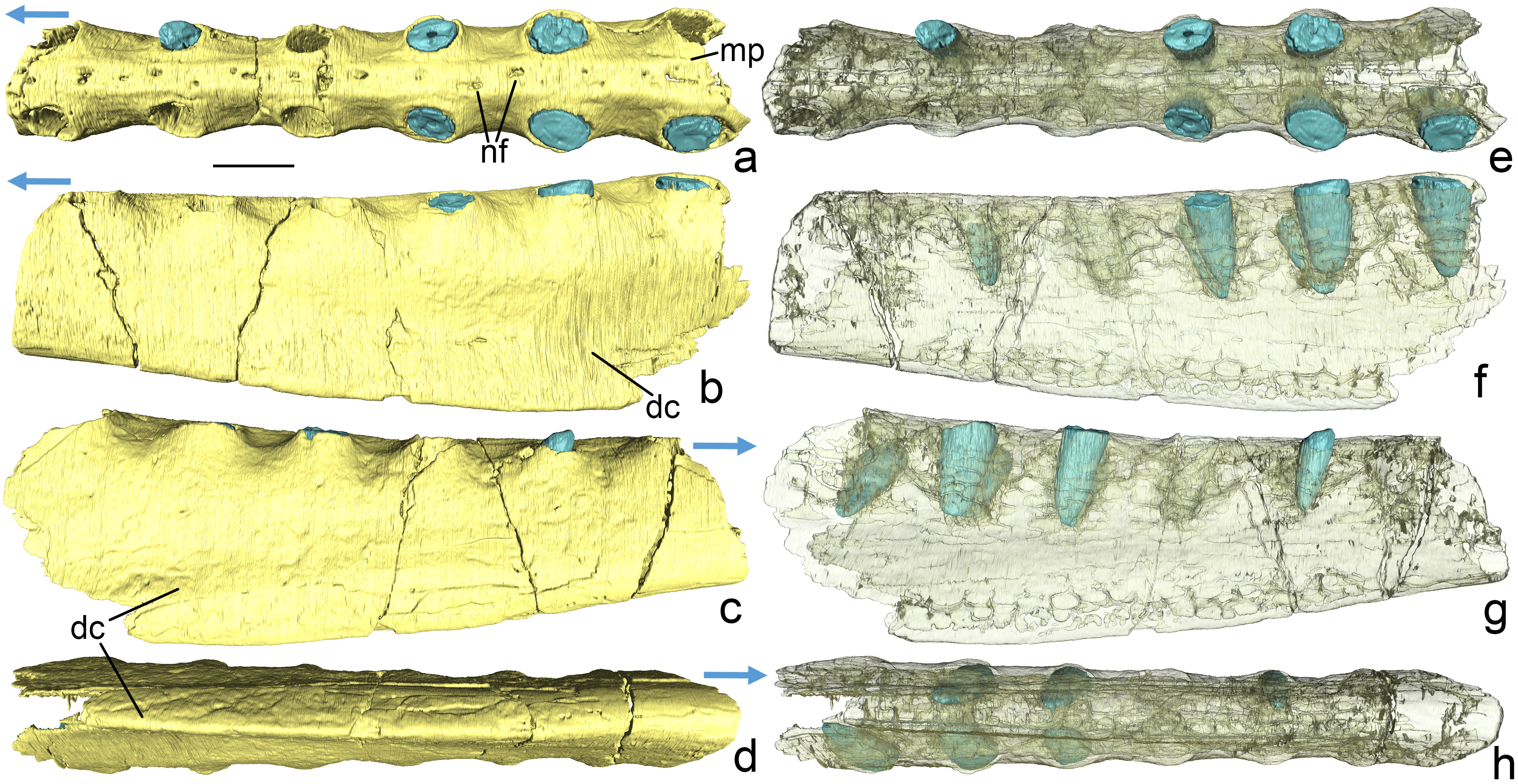
Description. ZIN PHT-S50-1 is a fragment of the dentary symphysis, which tapers slightly anteriorly. The preserved anterior end is 15% narrower than the preserved posterior end. The dentary symphysis is bent in lateral view, with slightly concave dorsal margin and convex ventral margin formed by the dentary crest. The ventral part of the dentary crest is bent to the left. Because of this curvature, the dentary crest is convex on the right side and concave on the left side. The dentary symphysis is narrow mediolaterally, about 3.5 times greater than the alveolar transverse width. The lateral margins of the dentary symphysis are strongly scalloped – concave between the alveoli that protrude laterally. The alveoli face dorsolaterally. The interalveolar space transverse width exceeds the transverse width of the alveolus. In contrast to the dentary symphysis in many toothed pterosaurs, there is no median groove on its dorsal side. Instead, this dorsal side form a flat platform about one alveolus is width throughout the entire preserved fragment. The lateral margins of this platform is formed by parallel ridges, which are not elevated above the platform. The platform is pierced by relatively large irregular nutrient foramina, which become smaller at the posterior end of the fragment, between fifth and sixth alveoli (Figs 3a, 4a). These foramina are connected by short canals with two parallel canals that extends along the entire preserved symphysis fragment and lie inside the elevated platform (Fig. 4e). Few smaller nutrient foramina are distributed irregularly on the lateral sides of the symphysis fragment. The bone surface is smooth on the entire preserved fragment. There is no rugose texture on the dentary crest, described for Anhanguera piscator (Kellner & Tomida 2000) and suggesting a horny covering.

Saratovia glickmani, ZIN PHT-S50-1, holotype, dentary symphysis fragment, in dorsal (a), anterior (b), left lateral (c), posterior (d), right lateral (e), and ventral (f) views. Saratov, Russia; Melovatka Formation, Upper Cretaceous (upper Cenomanian). Surface rendering based on high resolution CT scans. Abbreviations: dc, dentary crest; mp, median platform; nf, nutrient foramen. Arrow points anteriorly. Scale bar equals 10 mm.

Saratovia glickmani, ZIN PHT-S50-1, holotype, dentary symphysis fragment, in dorsal (a, e), left lateral (b, f), right lateral (c, g), and ventral (d, h) views. Saratov, Russia; Melovatka Formation, Upper Cretaceous (upper Cenomanian). (a-d) Segmented surface visualization of teeth (blue) and dentary (yellow). (e-h) Segmented surface visualization of teeth (blue) and dentary (translucent yellow). Abbreviations: dc, dentary crest; mp, median platform; nf, nutrient foramen. Arrow points anteriorly. Scale bar is 10 mm.
There are six paired tooth positions present in the fragment, numbered from 1 to 6 on Figs. 3 and 4. The teeth are preserved in left positions 4, 5, and 6 and in right positions 2, 4, and 5. The dentition is nearly isodont in the preserved fragment, with the teeth gradually decreasing in size anteriorly, and with an equal space between the teeth. All tooth crowns are broken above the alveoli. The teeth are oval in cross-section at the alveolar level. The long axis of the tooth cross-section is set obliquely to the longitudinal axis of the dentary symphysis. The teeth are slightly inclined anteriorly (procumbent) and their roots are directed ventromedially. There are no replacement teeth. The teeth of the fourth pair have the pulp cavity, which is larger than in other teeth. This may suggests that the teeth of the fourth pair were replaced more recently compared with other teeth. The teeth from the fifth and sixth positions have the basal part of the root narrowed compared with the rest of the tooth (Fig. 4f, g).
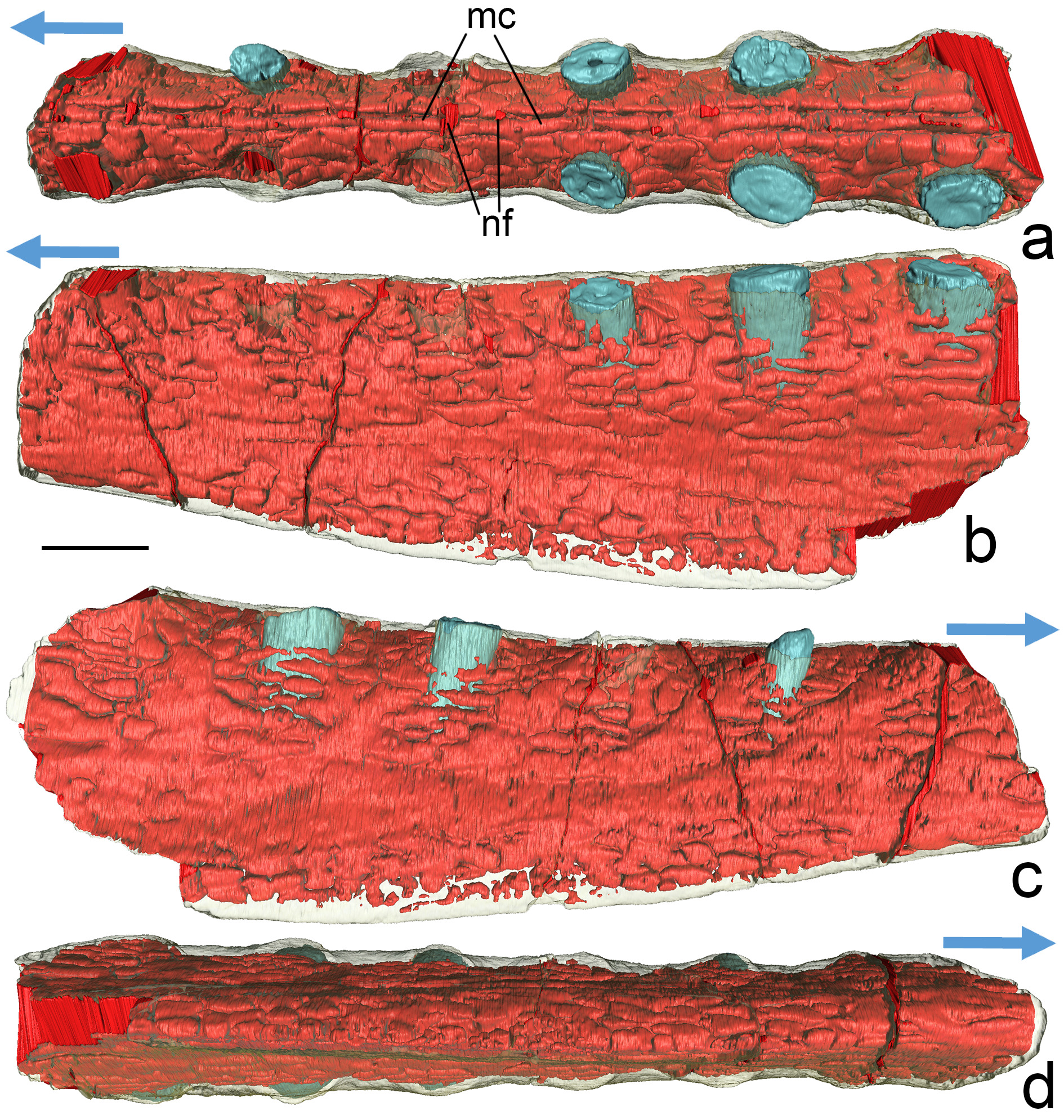
The dentary symphysis has a very thin bone cortex. The internal bone structure is camellate, with small pneumatic cavities separated by thin bony lamellae (= “honeycomb” structure). The camellate bone structure is found also in the jaws, cranial crest, and some postcranial bones of other pterodactyloids (Dalla Vecchia 1993, Buffetaut et al. 2003, Martill & Naish 2006, Averianov 2010, Headden & Campos 2015, Vremir et al. 2018, Martill et al. 2020, Buchmann et al. 2021). The camellate bone is confined around the alveoli and along the ventral keel, while most of the ventral crest is hollow (Fig. 5).

Saratovia glickmani, ZIN PHT-S50-1, holotype, dentary symphysis fragment, in dorsal (a), left lateral (b), right lateral (c), and ventral (d) views. Saratov, Russia; Melovatka Formation, Upper Cretaceous (upper Cenomanian). Segmented surface visualization of teeth (blue), dentary (translucent yellow), and internal cavity (red). Abbreviations: mc, median canal; nf, nutrient foramen. Arrow points anteriorly. Scale bar is 10 mm.
There is a median canal within the dorsal platform between the alveoli, which can be traced for the entire preserved dentary symphysis fragment (Fig. 5a). Nutrient foramina on the dorsal platform are connected with this canal by short vertical channels. There several additional canals ventral to the median canal, which vary in number and do not extent along the entire fragment.
Comments. ZIN PHT-S50-1 lacks either the median ridge (=palatal ridge) or median groove (=mandibular groove) and therefore its attribution to the upper or lower jaw is challenging. I interpret ZIN PHT-S50-1 as a dentary symphysis fragment because its crest is low and more similar with the dentary crests rather than with the high rostral crests of ornithocheirans. Furthermore, the upturned anterior dentary is much more common than downturned rostrum in pterosaurs.
Measurements. Fore measurements of dental alveoli see Table I.
Measurements (in mm) of dental alveoli in Saratovia glickmani, ZIN PHT-S50-1, holotype, dentary symphysis fragment. Saratov, Russia; Melovatka Formation, Upper Cretaceous (upper Cenomanian). The alveoli are numbered starting from the preserved anterior end. Measurements: L, maximum anteroposterior length; W, maximum transverse width.
Phylogenetic analysis
The phylogenetic analysis produced 75 Most Parsimonious Trees, with length of 2134 steps, consistency index of 0.30, and retention index of 0.77. Saratovia glickmani is placed in a polytomy with Targaryendracoidae and other targaryendraconians on the strict consensus tree (Fig. 5). Pêgas et al. (2021) distinguished two clades within Targaryendraconia: Cimoliopteridae and Targaryendracoidae. However, this distinction is likely affected by incompleteness of the included taxa. Cimoliopteridae is diagnosed by rostrum characters while Targaryendracoidae – by dentary characters (Pêgas et al. 2021). Cimoliopteridae consists of Cimoliopterus cuvieri, Cimoliopterus dunni, and Camposipterus nasutus, known from rostrum fragments, and Aetodactylus halli, known only from mandible. Targaryendracoidae consists of Targaryendraco wiedenrothi and Aussiedraco molnari, represented by dentary fragments, and Barbosania gracilirostris, represented by a skull with articulated jaws, which occlusal surface is inaccessible (Elgin & Frey 2011). Thus, it is not surprising that the clade Cimoliopteridae is not stable and not recognized in the current analysis (Fig. 6).

Fragment of the strict consensus tree of 75 most parsimonious trees of TNT analysis, showing interrelationships within Ornithocheirae and phylogenetic position of Saratovia glickmani.
Pêgas et al. (2021) separated Ornithocheirae into two main clades, Targaryendraconia and Anhangueria. In our analysis, Anhangueria is diagnosed by two unambiguous synapomorphies: expanded premaxillae, forming a rosette (49[1]) and supracondylar process of humerus prominent (403[0]). Among Targaryendraconia, the latter character is coded only for Barbosania gracilirostris, as having derived state (supracondylar crest not prominent; 403[1]). Anhangueridae is diagnosed by seven unambiguous synapomorphies, five cranial (78[0], 115[1], 118[1], 133[0], and 166[2]), one mandibular (188[2]), and one postcranial (360[0]). Among the cranial characters, only character 166 describing deltoid facet of palatal tip can be coded for several targaryendraconians. The state of the postcranial character 360, describing sternocoracoid articulation, is unknown for Targaryendraconia. The apomorphic condition of this character for Targaryendraconia is inferred from the position of Hamipterus tienshanensis as the sister taxon to Anhangueridae. H. tienshanensis is coded by Pêgas (2024) as having the derived state of this character (360[1], sternocoracoid articulation asymmetrical). However, the sternum is not described in original description of that taxon and its only published illustration (Wang et al. 2014) suggests that the sternocoracoid articulation is symmetrical (360[0]), as in other ornithocheirans.
DISCUSSION
According to Pêgas et al. (2021), one of the most conspicuous features of the Targaryendraconia is the slenderness of the jaws. The dentary symphysis is transversely narrow, with the interalveolar width subequal to the alveolar width. Those characters are present also in Saratovia glickmani, which was noted previously by Pêgas et al. (2021). Targaryendraconians also have the dentary symphysis with subparallel lateral margins and without a lateral expansion (a rosette) at its anterior end (Fig. 7a). In S. glickmani the lateral margins of the dentary symphysis are similarly parallel, but the absence of a terminal rosette cannot be demonstrated because ZIN PHT-S50-1 is incomplete anteriorly. The strongly scalloped alveolar margin is a common feature of targaryendraconians and anhanguerians (Pêgas et al. 2021). This feature is also well pronounced in S. glickmani.

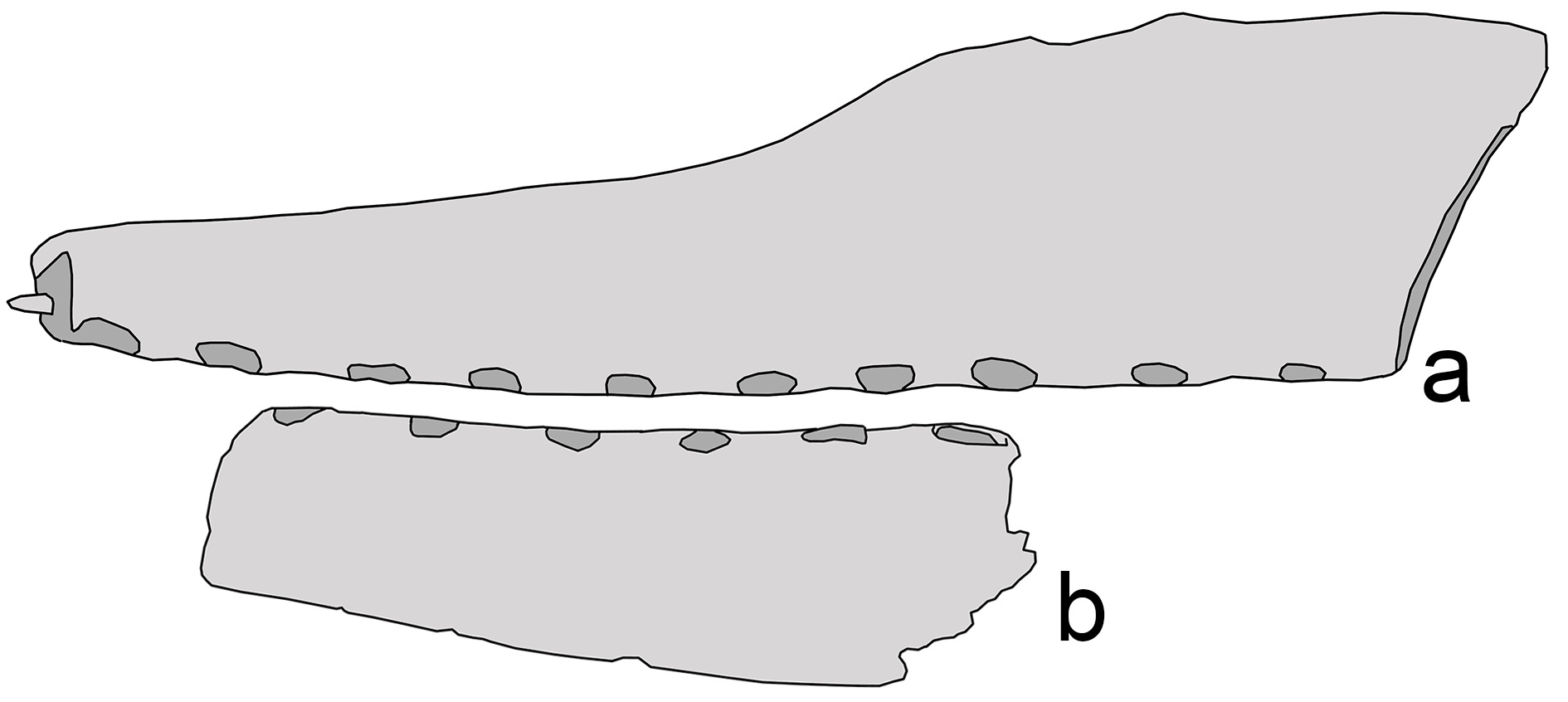
Comparative drawings of anterior dentary symphysis of selected ornithocheiran pterodactyloids in dorsal and lateral view (anterior end is to the left). (a) Aetodactylus halli from the Cenomanian of Texas, USA (after Myers 2010). (b) Saratovia glickmani from the Cenomanian of Saratov, Russia (this paper). (c) Anhanguera cf. piscator from the ?Albian-Cenomanian of Morocco (after Jacobs et al. 2020, image reversed). (d) Tropeognathus mesembrinus from the Albian of Brazil (after Wellnhofer 1987). (e) Thapunngaka shawi from the Albian of Australia (after Richards et al. 2021). Not to scale.
S. glickmani differs from all targaryendraconians for which the dentary symphysis is known by presence of a dentary crest. The dentary symphysis is strongly compressed dorsoventrally in Aetodactylus halli (Fig. 7a; Myers 2010) and keeled ventrally in Targaryendraco wiedenrothi and Aussiedraco molnari (Wild 1990, Kellner et al. 2011, Pêgas et al. 2021).
S. glickmani differs from all known toothed pterodactyloids in lack of median groove on the dentary symphysis. Instead of this groove, the interalveolar space is occupied by a flat raised platform, called here the median platform (Figs 3, 4). The dorsal surface of this platform is pierced by numerous relatively large nutrient foramina (Figs 3, 4) which are connected by short vertical canals, which are connected with a median canal within the median platform (Fig. 5). These structures have not been reported previously for any pterosaur. The foramination of jaws is characteristic for toothless pterodactyloids, which jaws were covered by keratinous sheath and the foramina transmitted blood vessels and nerves supplying this sheath. In the jaws of toothed pterosaurs the nutrient foramina are small and few in number, even on the crests that were apparently covered by a keratinous sheath. The only previously described ornithocheiran specimen showing some foramination is a dentary symphysis attributed to Anhanguera cf. piscator from the Albian-Cenomanian Ifezouane Formation of Moroco (Jacobs et al. 2020). But the foramination in that specimen is less pronounced than in Saratovia. The function of the fenestrated median platform on the dentary symphysis in S. glickmani is currently unknown.
The slightly anteriorly upturned lateral outline of dentary symphysis ZIN PHT-S50-1 well corresponds to the rostrum of Cimoliopterus cuvieri from the Cenomanian Grey Chalk Subgroup of England (Fig. 8). It is likely that the rostrum of Saratovia was similar in outline to that of Cimoliopterus. Both species of Cimoliopterus are known only from rostrum fragments (Bowerbank 1851, Myers 2015), but presence of a palatal ridge suggests that the mandibular symphysis had a median groove. ZIN PHT-S50-1 lacks the median groove and thus cannot be attributed to Cimoliopterus.

Lateral views of rostrum of Cimoliopterus cuvieri from the Cenomanian of England (a), after Bowerbank 1851, and dentary symphysis of Saratovia glickmani from the Cenomanian of Saratov, Russia (b), this paper. Not to scale.
The late Cenomanian S. glickmani is one of the latest toothed pterosaur known in the fossil record (Holgado & Pêgas 2020). Averianov (2014) linked disappearance of toothed pterosaurs with the Cenomanian-Turonian extinction event, caused by a fourfold increase in atmospheric carbon dioxide levels. This event led to extinction of certain marine invertebrates, some bony fishes, and all ichthyosaurs (Fischer et al. 2014).
Acknowledgements
I thank three anonymous reviewers for reading the paper and comments. I am grateful to E.V. Popov (Saratov State University) for discussion of Lysaya Gora stratigraphy. The specimen ZIN PHT-S50-1 was scanned at the Core Facilities Centre “Taxon” of the Zoological Institute of the Russian Academy of Sciences, Saint Petersburg. I thank D.A. Melnikov (Zoological Institute of the Russian Academy of Sciences, Saint Petersburg) for scanning the specimen. My work is supported by the Zoological Institute, Russian Academy of Sciences (project 125012800908-0).
References
- ALEKSEEV AS, KOPAEVICH LF, BARABOSHKIN EYE, BENIAMOVSKI VN, GABDULLIN RR, OLFERIEV AG & YAKOVISHINA EV. 2005a. Late Cretaceous palaeogeography of southern part of East-European platform and adjacent folded belts. 2. Palaeogeographic situation. Bull Mosk Ob Isp Prirody Otd Geol 80: 30-44.
- ALEKSEEV AS, KOPAEVICH LF, BARABOSHKIN EYE, GABDULLIN RR, OLFERIEV AG & YAKOVISHINA EV. 2005b. Late Cretaceous paleogeography of southern part of East-European Platform and adjacent folded belts. 1. Introduction and stratigraphical basis. Bull Mosk Ob Isp Prirody Otd Geol 80: 80-92.
- AVERIANOV AO. 2004. New data on Cretaceous flying reptiles (Pterosauria) from Russia, Kazakhstan, and Kyrgyzstan. Paleontol J 38: 426-436.
- AVERIANOV AO. 2007. Mid-Cretaceous ornithocheirids (Pterosauria, Ornithocheiridae) from Russia and Uzbekistan. Paleontol J 41: 79-86.
- AVERIANOV AO. 2008. Superorder Pterosauria. In: IVAKHNENKO MF & KUROCHKIN EN (Eds), Fossil Vertebrates of Russia and Adjacent Territories Fossil Reptiles and Birds Part 1, Moscow: GEOS, p. 319-342.
- AVERIANOV AO. 2010. The osteology of Azhdarcho lancicollis Nessov, 1984 (Pterosauria, Azhdarchidae) from the Late Cretaceous of Uzbekistan. Proc Zool Inst RAS 314: 264-317.
- AVERIANOV AO. 2014. Review of taxonomy, geographic distribution, and paleoenvironments of Azhdarchidae (Pterosauria). ZooKeys 432: 1-107.
- AVERIANOV AO & KUROCHKIN EN. 2010. A new pterosaurian record from the Cenomanian of the Volga region. Paleontol J 44: 695-697.
- AVERIANOV AO, KUROCHKIN EN, PERVUSHOV EM & IVANOV AV. 2005. Two bone fragments of ornithocheiroid pterosaurs from the Cenomanian of Volgograd Region, southern Russia. Acta Palaeontol Pol 50: 289-294.
- BAKHURINA NN & UNWIN DM. 1995. A survey of pterosaurs from the Jurassic and Cretaceous of the former Soviet Union and Mongolia. Hist Biol 10: 197-245.
- BIRYUKOV AV. 2024. Elasmobranchians of the Cenomanian of Volga Region: diversity, paleobiogeography and stratigraphic significance. PhD Thesis. Saratov: Saratov State University, 350 p.
- BOWERBANK JS. 1851. On the pterodactyles of the Chalk Formation. Proc Zool Soc Lond 19: 14-20.
- BUCHMANN R, HOLGADO B, SOBRAL G, DOS SANTOS AVILLA L & RODRIGUES T. 2021. Quantitative assessment of the vertebral pneumaticity in an anhanguerid pterosaur using micro‑CT scanning. Sci Rep 11: 18718.
- BUFFETAUT E, GRIGORESCU D & CSIKI Z. 2003. Giant azhdarchid pterosaurs from the terminal Cretaceous of Transylvania (western Romania). In: BUFFETAUT E & MAZIN J-M (Eds), Evolution and Palaeobiology of Pterosaurs. Geol Soc Lond Spec Publ 217: 91-104.
- DALLA VECCHIA FM. 1993. Cearadactylus? ligabuei, nov. sp., a new Early Cretaceous (Aptian) pterosaur from Chapada do Araripe (Northeastern Brazil). Boll Soc Paleontol Ital 32: 401-409.
- ELGIN RA & FREY E. 2011. A new ornithocheirid, Barbosania gracilirostris gen. et sp. nov. (Pterosauria, Pterodactyloidea) from the Santana Formation (Cretaceous) of NE Brazil. Swiss J Palaeontol 130: 259-275.
- FISCHER V, BARDET N, GUIOMAR M & GODEFROIT P. 2014. High diversity in Cretaceous ichthyosaurs from Europe prior to their extinction. PLoS ONE 9: e84709.
- GLICKMAN LS. 1953. Late Cretaceous vertebrates of environments of Saratov. Preliminary data. Uch Zap Saratov Gos Univ 38: 51-54.
- GOLOBOFF PA, FARRIS JS & NIXON KC. 2008. TNT (Tree analysis using New Technology) (BETA). Tucamán, Argentina: Published by the authors.
- GRIGORIEV DV, AVERIANOV AO, ARKHANGELSKY MS, PERVUSHOV EM & ZOZYREV NY. 2009. A mosasaur from the Cenomanian of Russia. Paleontol J 43: 311-317.
- HEADDEN JA & CAMPOS HBN. 2015. An unusual edentulous pterosaur from the Early Cretaceous Romualdo Formation of Brazil. Hist Biol 27: 815-826.
- HOLGADO B & PÊGAS RV. 2020. A taxonomic and phylogenetic review of the anhanguerid pterosaur group Coloborhynchinae and the new clade Tropeognathinae. Acta Palaeontol Pol 65: 743-761.
- ICZN. 1999. International Code of Zoological Nomenclature, Fourth Edition. London: International Trust for Zoological Nomenclature, c/o The Natural History Museum, 306 p.
- JACOBS ML, MARTILL DM, UNWIN DM, IBRAHIM N, ZOUHRI S & LONGRICH NR. 2020. New toothed pterosaurs (Pterosauria: Ornithocheiridae) from the middle Cretaceous Kem Kem beds of Morocco and implications for pterosaur palaeobiogeography and diversity. Cretac Res 110: 104413.
- KELLNER AWA, RODRIGUES T & COSTA FR. 2011. Short note on a pteranodontoid pterosaur (Pterodactyloidea) from western Queensland, Australia. An Acad Bras Cienc 83: 301-308. doi:10.1590/S0001-37652011000100018.
- KELLNER AWA & TOMIDA Y. 2000. Description of a new species of Anhangueridae (Pterodactyloidea) with comments on the pterosaur fauna from the Santana Formation (Aptian-Albian), northeastern Brazil. Natl Sci Mus Monographs 17: 1-135.
- KHOZATSKY LI. 1995. Pterosaur of the Cenomanian (Late Cretaceous) of Saratov. Vestn S-Peterb Univ Ser 3: 115-117.
- KHOZATSKY LI & YUR’EV KB. 1964. Superoder Pterosauria. Flying reptiles. In: ROZHDESTVENSKY AK & TATARINOV LP (Eds), Fundamentals of Paleontology Amphibians, Reptiles and Birds, Moscow: Nauka, p. 589-603.
- MARTILL DM & NAISH D. 2006. Cranial crest development in the azhdarchoid pterosaur Tupuxuara, with a review of the genus and tapejarid monophyly. Palaeontology 49: 925-941.
- MARTILL DM, SMITH R, UNWIN DM, KAO A, MCPHEE J & IBRAHIM N. 2020. A new tapejarid (Pterosauria, Azhdarchoidea) from the mid-Cretaceous Kem Kem beds of Takmout, southern Morocco. Cretac Res 112: 104424.
- MYERS TS. 2010. A new ornithocheirid pterosaur from the Upper Cretaceous (Cenomanian—Turonian) Eagle Ford Group of Texas. J Vertebr Paleontol 30: 280-287.
- MYERS TS. 2015. First North American occurrence of the toothed pteranodontoid pterosaur Cimoliopterus J Vertebr Paleontol 35: e1014904.
- NESOV LA. 1990. Flying reptiles of the Jurassic and Cretaceous of the USSR and significance of their remains for the paleogeographic environmental reconstruction. Vestn Leningr Univ Ser 7, Geol Geogr 4(28): 3-10.
- PÊGAS RV. 2024. A taxonomic note on the tapejarid pterosaurs from the Pterosaur Graveyard site (Caiuá Group, Early Cretaceous of Southern Brazil): evidence for the presence of two species. Historical Biology, 22 p.
- PÊGAS RV, HOLGADO B & LEAL MEDC. 2021. On Targaryendraco wiedenrothi gen. nov. (Pterodactyloidea, Pteranodontoidea, Lanceodontia) and recognition of a new cosmopolitan lineage of Cretaceous toothed pterodactyloids. Hist Biol 33: 1266-1280.
- PERVUSHOV EM, ARKHANGELSKY MS & IVANOV AV 1999. Catalogue of Sea Reptiles Remains Localities in the Jurassic and Cretaceous Deposits of the Lower Volga Region. Saratov: College, 230 p.
- POPOV EV & GLICKMAN EL. 2016. The life and scientific heritage of Leonid Sergeevich Glickman (1929-2000). Proc Zool Inst RAS 320: 4-24.
- POPOV EV & LAPKIN AV. 2000. A new shark species of the genus Galeorhinus (Chondrichthyes, Triakidae) from the Cenomanian of the Lower Volga River Basin. Paleontol J 34: 435-438.
- RICHARDS TM, STUMKAT PE & SALISBURY SW. 2021. A new species of crested pterosaur (Pterodactyloidea, Anhangueridae) from the Lower Cretaceous (upper Albian) of Richmond, North West Queensland, Australia. J Vertebr Paleontol 41: e1946068.
- RODRIGUES T & KELLNER AWA. 2013. Taxonomic review of the Ornithocheirus complex (Pterosauria) from the Cretaceous of England. ZooKeys 308: 1-112.
- SELTSER VB & IVANOV AV. 2010. Atlas of Late Cretaceous ammonites of the Saratov Volga Region. Moscow: Knizhnyi Dom Universitet, 152 p.
- UNWIN DM. 2001. An overview of the pterosaur assemblage from the Cambridge Greensand (Cretaceous) of Eastern England. Mitteil Mus Natkd Berl Geowiss Reihe 4: 189-221.
- UNWIN DM & BAKHURINA NN. 2000. Pterosaurs from Russia, Middle Asia and Mongolia. In: BENTON MJ ET AL. (Eds), The Age of Dinosaurs in Russia and Mongolia, Cambridge: Cambridge University Press, p. 420-433.
- VREMIR M, DYKE GJ, CSIKI-SAVA Z, GRIGORESCU D & BUFFETAUT E. 2018. Partial mandible of a giant pterosaur from the uppermost Cretaceous (Maastrichtian) of the Hațeg Basin, Romania. Lethaia 51: 493-503.
- WANG X ET AL. 2014. Sexually dimorphic tridimensionally preserved pterosaurs and their eggs from China. Current Biology 24: 1323-1330.
- WELLNHOFER P. 1978. Handbuch der Palaoherpetologie. Teil 19. Pterosauria., Stuttgart, New York: Gustav Fischer Verlag, 82 p.
- WELLNHOFER P. 1987. New crested pterosaurs from the lower Cretaceous of Brazil. Mitt Bayer Staatssamml Paläontol Hist Geol 27: 175-186.
- WILD R. 1990. Ein Flugsaurierrest (Reptilia, Pterosauria) aus der Unterkreide (Hauterive) von Hannover (Niedersachsen). N Jb Geol Paläontol Abh 181: 241-254.