 First report of pterosaur remains from the Lower Cretaceous Quiricó Formation, São Francisco Basin (Minas Gerais), Brazil
Abstract
The record of pterosaur fossils in Brazil is significant, however, it remains limited to a few sedimentary basins from the Cretaceous period. This study describes an isolated pterosaur tooth assigned to Ornithocheiriformes, collected from the Quiricó Formation, São Francisco Basin, Early Cretaceous (Aptian), of Minas Gerais State. The tooth was found in association with fossil plants and articulate gonorynchiform fishes. The tooth has a narrow elliptical cross-section, with marked mesial and distal carinae bearing no denticles. In lateral view, the tooth is triangular, being slightly curved lingually. The enamel is thin with no striations. These features, coupled with the Lower Cretaceous age of the deposits it was found, suggest the tooth belongs to an ornithocheiriform pterosaur. This finding represents the first report of pterosaur material from the São Francisco Basin and fills a geographical gap when previous records of ornithocheiriforms in Brazil are considered (Araripe, Bauru, Grajaú, and Recôncavo basins), suggesting a broader distribution of these flying archosaurs in Brazil. Also, this new ornithocheiriform record in the São Francisco Basin strengthen the similarity of its vertebrate fauna to the vertebrates found in Kem Kem Beds in Morocco.
Key words
pterosaur; Quiricó Formation; Lower Cretaceous; Aptian; Ornithocheiriformes; tooth
INTRODUCTION
Several studies have reported pterosaur findings in Brazil, which vary in terms of number of taxa, but remain concentrated to few sedimentary basins: the Araripe Basin (Ceará), the Caiuá Group (Bauru Basin from Paraná), the Recôncavo Basin (Bahia), and the São Luís-Grajaú Basin (Maranhão). All these occurrences are, so far, restricted to the Cretaceous period. Among the earliest known findings, the Araripe Basin stands out as the most significant due to the high number of taxa, number and quality of its record, as demonstrated by numerous studies conducted over the past decades (e.g. Price 1971, Campos & Kellner 1985, Leonardi & Borgomanero 1985, Dalla Vecchia & Ligabue 1988, Kellner & Campos 1988, Kellner 1989, 2013, Kellner & Tomida 2000, Veldmeijer 2003, Sayão & Kellner 2006, Veldmeijer et al. 2009, Martill 2011, Elgin & Campos 2012, Pinheiro & Schultz 2012, Kellner et al. 2013, Aires et al. 2014, Pinheiro & Rodrigues 2017, Bantim et al. 2014, Leal et al. 2018, Cerqueira et al. 2021, Duque et al. 2023). This basin is recognized as one of the regions with the highest diversity of pterosaurs in both Brazil and the world, highlighting its importance for the study of this group. Notably, the Romualdo Formation is renowned as one of the most significant fossil deposits of the upper Aptian, Early Cretaceous (Guzmán et al. 2023), and is globally recognized as a Konservat-Lagerstätte (Maisey 1991, Martill 2007, Kellner et al. 2002). The unit hosts a significant variety of fossils, including vertebrates, invertebrates, and plants (Castro et al. 2006). Additionally, it has produced numerous species of pterosaurs, assigned to various genera and clades, like Anhanguera piscator, Cearadactylus atrox, Maaradactylus kellneri, Tapejara wellnhoferi, Caupedactylus ybaka, Thalassodromeus sethi, Ludodactylus sibbicki, among other species (Kellner & Tomida 2000, Leonardi & Borgomanero 1985, Bantim et al. 2014, Elgin & Campos 2012, Kellner et al. 2013, 2002, Pinheiro & Schultz 2012, Frey et al. 2003a, b, Vila Nova et al. 2011, Pinheiro & Rodrigues 2017).
The São Luís-Grajaú Basin, located on the Brazilian equatorial margin, comprises Cretaceous deposits formed during the Aptian-Albian and Albian-Cenomanian intervals (Rossetti 2001, Rossetti et al. 2004). The Alcântara Formation is considered to be formed during the late Albian to the Cenomanian time interval (Rossetti & Truckenbrodt 1997, Rossetti 2001). During this time, the opening of the Atlantic Ocean led to the separation of South America and Africa and the formation of sedimentary basins along their respective coasts, within a context of transgressive coastal deposits (Aranha et al. 1990, Góes & Rossetti 2001, Haq 2014). In the Alcântara Formation, isolated pterosaur teeth attributed to Ornithocheiroidea have been identified (Elias et al. 2007, Lindoso et al. 2011). The first study described nine isolated teeth from the Lage do Coringa locality, in the State of Maranhão. The second one highlighted the paleoecological relevance of a few hundreds of teeth collected from conglomerates and siltstones of the Alcântara Formation. In such work, the authors reviewed, described, and classified the teeth into four distinct morphotypes within the Ornithocheiroidea (Lindoso et al. 2011).
The Recôncavo Basin, located in the State of Bahia, is notable for the record of two isolated teeth found in association with coelacanth remains of the species Mawsonia gigas (Mawson & Woodward 1907, Rodrigues & Kellner 2010). The Recôncavo Basin is predominantly composed of lacustrine and fluvial deposits considered as Lower Cretaceous in age (Da Silva et al. 2007). Rodrigues & Kellner (2010) attributed this material to Anhangueria based on several morphological features like an elongated, narrow, and uniformly curved crown, oval cross-section, absence of visible carina, and the presence of longitudinal striations. According to the authors, these characteristics are consistent with the teeth of other Anhangueridae.
More recently, pterosaur records have been found in the Caiuá Group, Bauru Basin, represented by many specimens of different ontogenetic stages of at least two distinct species (Manzig et al. 2014, Kellner et al. 2019). Manzig et al. (2014) identified the species Caiuajara dobruskii in Cruzeiro do Oeste, State of Paraná, Brazil, from deposits of the Goio-Erê Formation. Posteriorly, from the same locality, Kellner et al. (2019) described a second species, Keresdrakon vilsoni. A third species, Torukjara bandeirae, was described by Pêgas (2024). These three species were discovered in a rare bone bed, located in a deposit considered as a paleodesert. The age of the Goio-Erê Formation (and the Caiuá Group as a whole) is disputed, with proposals regarding an Aptian-Albian (Batezelli 2015) or a Turonian-Campanian (Basilici et al. 2012) interval to these deposits.
This work aims to describe an isolated pterosaur tooth found in papyraceous shales, associated with Gonorynchiformes fish fossils and plants from the lacustrine sequence of the Quiricó Formation. Therefore, this study adds a new occurrence to the Brazilian pterosaur localities, suggesting that these archosaurs were more common than previously thought, with a more homogeneous geographical distribution. This record represents the first pterosaur occurrence in the São Francisco Basin, adding a new clade to the list of paleontological discoveries in the region. In addition to the description of the tooth, a comprehensive review of pterosaur records in Brazilian basins during the Cretaceous was conducted, aiming to understand the distribution of these animals throughout the period and to highlight the group diversity in Brazilian sedimentary basins.
GEOLOGICAL SETTING
The São Francisco Basin is an intracratonic unit, comprising geological strata ranging from the Upper Proterozoic to the Cenozoic. In lithostratigraphic terms, the basin is divided into nine groups: Espinhaço, Araí, Macaúbas, Paranoá, Bambuí, Santa Fé, Areado, Urucuia, and Mata da Corda (Campos & Dardenne 1997, Zalán & Romeiro-Silva 2007). Among these units, the Areado Group (Cretaceous) stands out for its high fossil content. This group crops out throughout the basin and shows some lateral lithological variations, reflecting different depositional systems. It is composed of the Abaeté, Quiricó, and Três Barras formations (Campos & Dardenne 1997, Zalán & Romeiro-Silva 2007).
The Abaeté Formation is the basal unit of the Areado Group, attributed to the Lower Cretaceous, comprising high-energy and gravity-driven deposits. In the southern São Francisco Basin, the Abaeté Formation presents polymictic conglomerates dominated by metasiltstone clasts from the local basement, while in other areas of the basin, they are oligomictic and clast-supported. The Três Barras Formation (the uppermost unit of the São Francisco Basin) is characterized by the deposition of sediments from a fluvio-deltaic system. By the end of the Early Cretaceous, the region underwent arid conditions, culminating in the formation of eolian dunes and interdunes in the upper portion, which are represented by the Três Barras Formation (Fragoso et al. 2011, Leite et al. 2018). It overlies the Quiricó Formation and is distinguished by its lithological diversity and significant volume of rocks. These rocks were deposited by fluvial, fluvio-deltaic, and eolian systems, resulting in a heterogeneous composition of sandstones (Campos & Dardenne 1997, Campos & Do Carmo 2005, Leite et al. 2018).
The Quiricó Formation represents a lacustrine system, presenting a stratigraphic sequence composed of siltstones at the base, sandstones in the middle portion, and micritic limestones and shales at the top. Among the formations of the Areado Group, it is the only one that contains ostracod fossils (Leite et al. 2018) (Fig. 1). In the region of Presidente Olegário, where fossils of Dastilbe moraesi are found, the shales exhibit a grayish/black coloration interbedded with laminae of siltstones with quartz grains and carbonate cement.

Geological map of the study area and location of the sampling site, lithostratigraphic column of the Quiricó Formation, Areado Group, on the riverbanks of the São José River, municipality of Presidente Olegário, Minas Gerais, Brazil.
Sampling scheme adopted for the collection of water, sediment, and fish in ten streams in the Amazon region. a. The letters (a-k) represent the transects marked every 15 meters; the longitudinal sections refer to the segments between transects, indicating the locations where water, sediment, and fish samples were collected; b. illustrates the water collection process; c. represents sediment collection; d. shows fish collection.
The top of the sequence is rich in fossils of plants, ostracods, fish, and other vertebrates (Leite et al. 2018, 2024, Leite & Do Carmo 2021, Campos & Do Carmo 2005). It has a wide geographic distribution and elongated morphology from south to north, in addition to isolated depocenters with varying thicknesses, indicating multiple water bodies connected during wet periods and isolated during arid periods, rather than forming a single lake (Sgarbi et al. 2001). The thickness of this formation varies from up to 100 m in the center of the basin to just a few meters at the edges (Fig. 1).

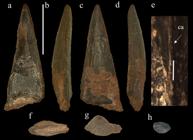
Isolated tooth (MAF 755), drawings. (a) lingual view, (b and d) mesial and distal views, (c) labial view, and (f) cross-section near the crown apex, scale bar = 1 cm. (e) detail of the carina, scale bar = 2 mm. Abbreviation: ca, carina

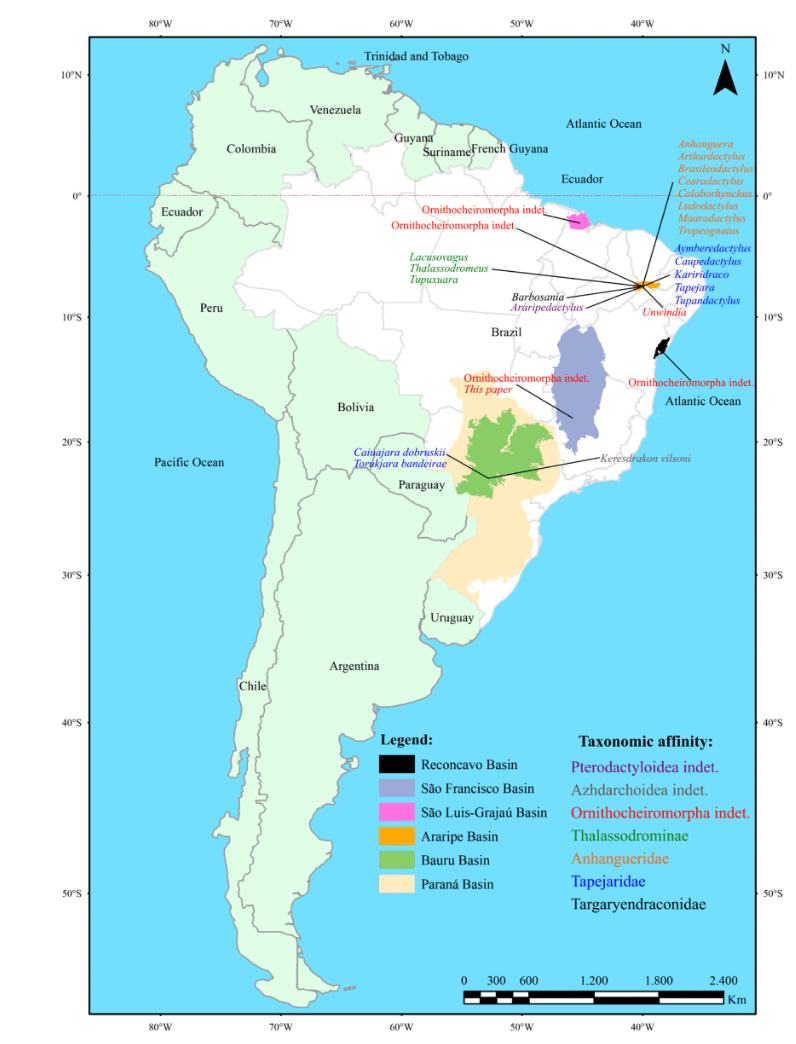
Geographic distribution map of pterosaur clades in Brazil with their respective geological units and taxonomic assignment. Taxonomic affinities based on: Anhanguera (Andres & Myers 2013), Araripedactylus (Wellnhofer 1977, Kellner & Tomida 2000), Arthurdactylus (Frey & Martill 1994), Aymberedactylus (Pêgas et al. 2016), Barbosania (Elgin & Frey 2011, Pêgas et al. 2019), Brasileodactylus (Veldmeijer et al. 2009), Caiuajara (Manzig et al. 2014), Caupedactylus (Kellner 2013), Cearadactylus (Holgado & Pêgas 2020), Coloborhynchus (Holgado & Pêgas 2020), Kariridraco (Cerqueira et al. 2021), Keresdrakon (Kellner et al. 2019), Lacusovagus (Wu et al. 2017), Ludodactylus (Holgado & Pêgas 2020), Maaradactylus (Holgado & Pêgas 2020), Tapejara (Campos & Kellner 1997), Thalassodromeus (Longrich et al. 2018), Torukjara (Pêgas 2024), Tropeognathus (Holgado & Pêgas 2020), Tupandactylus (Frey et al. 2003b, Andres et al. 2014), Tupuxuara (Kellner & Campos 1988), Unwindia (Martill 2011)

Paleogeographic reconstruction of two Cretaceous time intervals showing the occurrences of pterosaur taxa with their respective taxonomic affinities: a) Albian-Cenomanian; b) Barremian-Aptian. (paleogeographic reconstructions from Scotese 2014)
The lower contact commonly occurs with the Abaeté Formation or directly with the metasediments of the Bambuí Group, while the upper contact laterally interdigitates with the Três Barras Formation. Near the margins of the lacustrine system, evaporitic lithotypes and carbonate crusts are observed. Eolian influence is evident at several levels of laterally continuous sandstones, composed of eolian sand grains, coexisting with pelites and reworked dunes (Campos & Dardenne 1997, Leite et al. 2018, Leite & Do Carmo 2021).
Regarding the stratigraphic level where the material described here was found, it corresponds to the same level where fossil fish and leaves were previously reported and are considered to be Aptian in age (Arai et al. 1995, Leite & Do Carmo 2021, Leite et al. 2024). In the outcrop along the São José Stream, the deposits mainly represent a lacustrine sequence formed under more arid conditions, which is evidenced by the presence of evaporitic levels. The presence of shales indicates periods of lake flooding, leading to the deposition of fine sediments rich in organic matter. The presence of pelitic layers, shales, and well-preserved fish and leaf fossils suggests they underwent little transport (Leite et al. 2018). The pterosaur tooth was found at the stratigraphic level Am 3.6 meters, showing no signs of abrasion or transport (Fig. 1).
MATERIALS AND METHODS
The tooth described in this work (MAF 755) is housed in the macrofossil collection of the Geosciences Museum (MGEO) under the care of the Micropaleontology Laboratory (LabMicro) of the University of Brasília, Brasília, Brazil. The collection horizon is located in an outcrop of papyraceous shales from the Quiricó Formation, São José Farm, Municipality of Presidente Olegário, State of Minas Gerais (Fig. 1).
For imaging and morphological measurements, a DVM 6 digital microscope (LEICA®) with a high-magnification objective, maximum FOV of 12.55 mm, distance of 33 mm, and magnification range of 46x to 675x was used. These analyses were carried out at the National Institute of Criminalistics (INC) of the Federal Police in Brasília.
SYSTEMATIC PALEONTOLOGY
Pterosauria Kaup 1834
Pterodactyloidea Plieninger 1901
Pteranodontoidea Andres et al. 2014
Ornithocheiromorpha Andres et al. 2014
Material: An isolated tooth (MAF 755), represented by the complete crown lacking the root.
Locality: Papyraceous shales, banks of the Meloso River, São José Farm, Municipality of Presidente Olegário, Minas Gerais, Brazil. Other fossils are present in this locality, such as Gonorynchiformes fish and leaf impressions. Lower Cretaceous, Aptian (Arai et al. 1995, Leite & Do Carmo 2021, Leite et al. 2024).
Description: the tooth has a relatively well-preserved crown, with portions where the enamel is lacking (eroded). The dentin is black, and the enamel is grayish/beige in color and translucent. At the base of the crown, the dentin appears smoother and lacks striations, the aspect of the dentin surface, with some rugose areas, suggests it underwent some kind of dissolution. The total height of the crown is 22.6 mm. The dimensions at the base of the crown are 8.95 mm in mesio-distal length and 2.2 mm in width. The exact position of the tooth was not defined. However, based on its shape and comparisons with other Ornithocheiriformes, it likely belongs to the posterior portion of the skull or mandible, as these portions have a labio-lingually narrower cross-section. The tooth cross-section is more elongated mesiodistally and labio-lingually narrower, with an elliptical cross-section. A carina is present on both mesial and distal margins and slightly offset lingually at the top of the crown. The carinae are well-preserved and extend from the apex to the middle portion of the crown, displaying a slight undulation that does not form serrations (true denticles). In both labial and lingual views, the mesial and distal margins are symmetrical and straight, giving the tooth a symmetrical profile, assuming an acute triangle profile of approximately 21° at the crow apex. The labial and lingual sides differ, with the labial one being slightly convex while the lingual side is nearly flat. The crown shows a slight distal curvature. The enamel is smooth and lacks ornamentation or striations, with cracks due to diagenetic alteration. Longitudinal lines are present due to the cracking pattern of the enamel, with these filled by sediment. The enamel has an average thickness of 60 µm (Figs. 2 and 3).
DISCUSSION
Comparisons
The taxonomic assignment of isolated teeth can be challenging, especially when the material in question does not exhibit distinctive features unique to a specific group. To date, various vertebrate groups have been reported from the Quiricó Formation, including fish (Silva-Santos 1955, 1985, Carvalho 2002, Machado 2004, Cupello et al. 2016, Ribeiro et al. 2018, Fragoso et al. 2021, Carvalho & Santucci 2021, Ribeiro et al. 2022), sauropod dinosaurs (Titanosauriformes and Rebbachisauridae) and theropods (Carcharodontosauridae and Abelisauridae), as well as fragments of lizards such as Paramacellodidae and Borioteiioidea (Zaher et al. 2011, 2020, Carvalho & Santucci 2018, 2024, Bittencourt et al. 2020).
Regarding the fossil fish described for the Quiricó Formation, including groups such as Mawsoniidae (Carvalho 2002, Machado 2004), Hybodontidae (Cupello et al. 2016), Lepisosteidae (Carvalho & Santucci 2018, 2021, Fragoso et al. 2021), and Gonorynchiformes (Silva-Santos 1955, 1985, Ribeiro et al. 2018, 2022), it is important to highlight the significant morphological variation observed within these groups, both in size and shape. Specifically, Lepisosteidae teeth are small, styliform, and robust, with either flattened or rounded cusps. Hybodontidae teeth are also small, generally millimetric, with elevated crowns that are flattened labiolingually. In contrast, Gonorynchiformes lack teeth entirely. Mawsoniids, however, exhibit distinctly different dental plates. Due to these morphological differences, the tooth MAF 755 cannot be assigned to any fish group previously reported for the Quiricó Formation.
Among archosaurs, MAF 755 differs from the teeth of the sauropod groups found in the Quiricó Formation (Titanosauriformes and Rebbachisauridae) by being more laterally flattened, having a crown with a triangular apex, and relatively well-developed keels, which are not seen in the pencil- or spoon-like teeth typically found in these sauropods (Wilson & Sereno 1998, Wilson 2002, Upchurch et al. 2004, Zaher et al. 2011).
Regarding the teeth of Carcharodontosauridae, as described by Carvalho & Santucci (2018), they have an elliptical cross-section with denticles on the carinae. The mesial side is slightly curved, while enamel wrinkles are notable in the crown. These features differ significantly from tooth MAF 755. In comparison with Abelisauridae teeth, the main difference regards the shape of the crown, characterized by a mesial margin curved backward, while the distal portion is almost straight (Smith et al. 2005, Hendrickx & Mateus 2014, Carvalho & Santucci 2018), being different from MAF 755.
The tooth MAF 755, resembles the general morphology of some plesiosaur teeth—due to its triangular, symmetrical shape, apex of the crown exhibiting an acute angle, as well as its lingual curvature— for example, like Gronausaurus wegneri (Hampe 2013), Leptocleididae cf. Leptocleidus (Bunker et al. 2022), Scanisaurus (Kear et al. 2017) and Cryptoclididae (Weryński & Błażejowski 2023). However, plesiosaur teeth differ from MAF 755 by presenting a more circular cross-section, significantly thicker enamel (greater than 100 µm), and well-developed apicobasal ridges on the crown (e.g., Kear et al. 2017, Bunker et al. 2022, Weryński & Błażejowski 2023). Furthermore, plesiosaur occurrences in continental deposits are extremely rare and controversial (e.g., Bunker et al. 2022).
The clade Ornithocheiriformes encompasses various taxa that share similarities with specimen MAF 755, although unequivocal taxonomic identification based on dental characteristics is hindered by inter- and intraspecific heterodonty in this clade, as pointed by Ciaffi & Bellardini (2024). The absence of clear diagnostic features makes the taxonomy of isolated teeth, such as MAF 755, challenging. Nevertheless, the significance of this specimen in the context of the São Francisco Basin surpasses taxonomic limitations, representing the first record in the region. The morphological variability observed in the shape, cross-section, curvature, and size of the crowns in Ornithocheiriformes teeth from other Brazilian basins also tangles a proper identification and comparison.
However, features similar to pterosaur teeth of morphotype 2, described by Wellnhofer & Buffetaut (1999) in the Kem Kem Beds, including long, slender teeth with an elliptical and labiolingually narrow cross-section, and the presence of a developed mesial and distal carinae, show that MAF 755 is similar to Ornithocheiriformes pterosaur teeth from Morocco. Moreover, it is also quite similar in general morphology to species like Ludodactylus sibbicki (Frey et al. 2003a, Rodrigues & Kellner 2010) from the Araripe Basin.
Additionally, the enamel thickness and surface ornamentation of MAF 755 exhibit similarities with other Brazilian pterosaurs. Despite the morphological variation, certain features, such as the elliptical cross-section, elongated and slender teeth with slight distal curvature, and the presence of longitudinal ridges, not present in the tooth of the Quiricó Formation, are common among toothed pterosaurs from the Romualdo Formation (Kellner 2003, Rodrigues & Kellner 2010), allowing for the classification of MAF 755 within the clade Ornithocheiriformes.
Records of isolated pterosaur tooth from Lower Cretaceous deposits of Brazil are relatively rare. They are found in the Recôncavo Basin (Barrett et al. 2008, Rodrigues & Kellner 2010), the São Luís-Grajaú Basin (Elias et al. 2007), and the Araripe Basin (Wellnhofer 1985).
A notable example from the Crato Formation in the Araripe Basin is a complete and articulated skull of Ludodactylus sibbicki, an ornithocheiriform (Frey et al. 2003a, Rodrigues & Kellner 2010). The morphology of the teeth of Ludodactylus sibbicki and other ornithocheiriforms exhibit variation in both size and overall morphology. Posterior teeth are labiolingually narrow, with an elliptical cross-section, slender and elongated crowns, and a slight distal curvature. Additionally, like other Anhangueria, Ludodactylus has mesial and distal carina in posterior teeth like MAF 755 (Frey et al. 2003a, Sayão & Kellner 2006, Veldmeijer et al. 2009, Sweetman & Martill 2010, Lindoso et al. 2011, Martill et al. 2018). Some toothed anhanguerids species like Cearadactylus atrox and Guidraco venator also have similar posterior teeth (Leonardi & Borgomanero 1985, Kellner & Tomida 2000, Wang et al. 2012) however, they differ from MAF 755 in the cross-section, which is elliptical and has carinae on the mesial and distal margins. The presence of carinae appears to be a highly relevant feature within Ornithocheiriformes. Comparisons show a wide variation in the presence of this feature, being registered in species such as Anhanguera santanae (Wellnhofer 1985) and in Morphotype II mentioned by Wellnhofer & Buffetaut (1999) from Morocco. However, this feature is absent in Siroccopteryx moroccensis (Mader & Kellner 1999, Jacobs et al. 2020), and in Morphotype I of Wellnhofer & Buffetaut (1999). An isolated tooth from Australia assigned to Anhangueria lacks carinae, with both the mesial and distal surfaces being flat (Brougham et al. 2017).
The clade Ctenochasmatidae, a non-Ornithocheiroidea Pterodactyloidea, is characterized by needle-shaped, curved, and elongated teeth, like in Huanhepterus, Gegepterus, and Moganopterus (Dong 1982, Wang et al. 2007, Lü et al. 2012), for example. The teeth morphology of these genera is quite distinct from that observed in MAF 755.
During the Cretaceous, various pterosaur groups underwent significant diversification, with some lineages partially or completely losing their dentition. Among the clades exhibiting this feature are Azhdarchidae, Nyctosauridae, Pteranodontidae, Chaoyangopteridae, and Tapejaridae, which are excluded as possible candidates to which MAF 755 could be assigned. However, the clade Dsungaripteridae, an exception within Azhdarchoidea, retains teeth with short apicobasal ridges and rounded, pointed apices, restricted to the posterior portions of the upper and lower jaws (Young 1964, Unwin 2003, Brougham et al. 2017). The species Caiuajara dobruskii (Manzig et al. 2014) and Keresdrakon vilsoni (Kellner et al. 2019), from the Bauru Basin, belong to the clade Tapejaromorpha and are also edentulous pterosaurs.
The record of this pterosaur from the São Francisco Basin adds important information for understanding the geographic distribution of these flying reptiles in Brazilian sedimentary basins. Until now, most records were restricted to the Northeast region of Brazil (e.g. Price 1971, Campos & Kellner 1985, Dalla Vecchia & Ligabue 1988, Kellner & Tomida 2000, Veldmeijer 2003, Veldmeijer et al. 2009, Martill 2011, Pinheiro & Schultz 2012, Kellner 2013, Kellner et al. 2013, Aires et al. 2014, Bantim et al. 2014, Leal et al. 2018, Cerqueira et al. 2021, Duque et al. 2023, among others), with some occurrences in Paraná (Manzig et al. 2014, Kellner et al. 2019) and records of putative basal groups in southern Brazil (Bonaparte et al. 2010, Kellner et al. 2022). Thus, this discovery in the São Francisco Basin fills a significant gap between these regions, indicating that the distribution of Brazilian pterosaurs during the Cretaceous was broader and less local than previously thought. This discovery also opens new perspectives for future research on pterosaurs in the São Francisco Basin, since new findings could provide better information on its morphology and its phylogenetic relationships. Additionally, features such as the presence of mesial and distal carinae in MAF 755 are similar to those found in pterosaurs from the Kem Kem Beds in Morocco (Wellnhofer & Buffetaut 1999, Ibrahim et al. 2020) and some anhanguerids from the Araripe Basin (Frey et al. 2003a, Rodrigues & Kellner 2010). The similarity between the vertebrate faunas of the São Francisco Basin and African basins has already been highlighted in previous studies on sauropod dinosaurs (Carvalho & Santucci 2018) and Borioteiioidea lizards (Carvalho & Santucci 2024), reinforcing the idea that vertebrate faunas were remarkably similar between these continents.
Distribution and paleogeography
To highlight the distribution and diversity of Brazilian pterosaurs during the Early Cretaceous, a synthesis of the available records was conducted, as illustrated in Figs. 4 and 5. Based on a detailed review of the literature, this analysis aims to provide a comprehensive overview of these records, contributing to a deeper understanding of the presence and variety of these archosaurs in Brazilian territory during this period. The Araripe Basin stands out as the region with the greatest diversity and number of pterosaur species in Brazil. Ornithocheiriformes have been recorded in the Araripe, São Luís-Grajaú, Recôncavo, and São Francisco basins (this work).
The chronostratigraphic distribution of Ornithocheiriformes ranges from the Aptian to the Cenomanian. The tooth MAF 755, found in the Quiricó Formation, can be considered as one of the oldest records of this clade in Brazil, as this unit is considered to be Aptian in age (Arai et al. 1995, Campos & Dardenne 1997, Leite & Do Carmo 2021). This material is coeval to species like Arthurdactylus conandoylei (Sayão & Kellner 2006) and Ludodactylus sibbicki (Frey et al. 2003a) from the Crato Formation, as well as representatives of ornithocheiriforms in the Recôncavo Basin (Rodrigues & Kellner 2010).
Other records of Ornithocheiriformes, such as for the genus Anhanguera from the Romualdo Formation (Kellner & Tomida 2000, Fastnacht 2001), are Albian in age, being coeval with pterosaur fossils from the Kem Kem Beds in North Africa. The taxa from this region comprise genera such as Anhanguera, Ornithocheirus, and Coloborhynchus (Ibrahim et al. 2020). However, the age of the Santana Group has been a subject of recent debate, since new data on ostracods and foraminifera suggested that sedimentation occurred during the development of a transitional to marine environment throughout the Aptian (Guzmán et al. 2023).
Ibrahim et al. (2020) reported at least nine pterosaur taxa from the Kem Kem Beds, including five Ornithocheiriformes and four azhdarchids, suggesting the coexistence of toothed and edentulous pterosaurs in an environment with a wide diversity of food resources and suitable areas for breeding and nesting (Ibrahim et al. 2020, Jacobs et al. 2020). These records are crucial for understanding the distribution of Ornithocheiriformes in Brazil, Africa, and Europe as well as they provide insights into the dispersal of these pterosaurs over large distances (Barrett et al. 2008, Ibrahim et al. 2020, Martill & Smith 2024).
Additionally, it is important to highlight that the diversity of pterosaurs in Brazilian sedimentary basins is significantly greater than previously described in earlier reviews, especially in the context of the opening of the South Atlantic (Pentland & Poropat 2023, Martill & Smith 2024).
CONCLUSIONS
The tooth MAF 755 exhibits a set of characteristics that allow it to be assigned as an ornithocheiriform pterosaur, including an elliptical crown cross-section with mesial and distal carinae, a triangular crown in lateral view with slight labial curvature, a smooth surface without striations, and relatively thin enamel.
This specimen represents the first pterosaur record from the Quiricó Formation, São Francisco Basin, Aptian, Early Cretaceous. The occurrence of this fossil in low-energy lacustrine depositional systems, associated with gonorynchiform fish, suggests new avenues for research in the Quiricó Formation, addressing taxonomic, systematic, paleoecological, and behavioral aspects of pterosaurs. Moreover, this discovery adds to the existing data on pterosaurs in Brazilian sedimentary basins a new occurrence, the first for the Minas Gerais State, filling a geographical gap in the Lower Cretaceous pterosaur distribution in Brazil.
Acknowledgements
We thank the owners of Fazenda São José, in the municipality of Presidente Olegário-MG, for allowing us to conduct fossil collection on their property. We are in debt to Luísa Torres Madeira for her contributions to the scientific illustrations depicted in this work and to Manuel Pereira de Oliveira Júnior for his assistance in preparing the map of Figure 1. We also thank the AABC editors, Felipe Lima Pinheiro, and an anonymous reviewer whose comments greatly improved an earlier draft of this work. Felipe Lima Pinheiro is also thanked for sharing with us some images of Ludodactylus sibbicki. We thank the financial support provided by the Coordenação de Aperfeiçoamento de Pessoal de Nível Superior (CAPES), funding code 001, and the Decanato de Pesquisa e Inovação of the University of Brasília for supporting this research.
References
- AIRES AS, KELLNER AWA, MÜLLER RT, DA SILVA LR, PACHECO CP & DIAS-DA-SILVA S. 2014. New postcranial elements of the Thalassodrominae (Pterodactyloidea, Tapejaridae) from the Romualdo Formation (Aptian–Albian), Santana Group, Araripe Basin, Brazil. Pap Palaeontol 57: 343-355.
- ANDRES B, CLARK J & XU X. 2014. The earliest pterodactyloid and the origin of the group. Curr Biol 24: 1011-1016.
- ANDRES B & MYERS TS. 2013. Lone Star Pterosaurs. Earth Environ Sci Trans R Soc Edinb 103(3-4): 383-398.
- ARAI M, DINO R, MILHOMEM OS & SGARBI GNC. 1995. Micropaleontologia da Formação Areado, Cretáceo da Bacia Sanfranciscana: estudo dos ostracodes e palinologia. In: Congr Bras Paleontol Atas, Uberaba, SBP 14: 1-2.
- ARANHA LG, DE LIMA, HP, SOUZA JMP DE & MAKINO RK. 1990. Origem e evolução das bacias de Bragança-Viseu, São Luís e Ilha Nova. In: Gabaglia GPR & Milani EJ (Eds), Origem e Evolução de Bacias Sedimentares, Petrobrás, p. 221-233.
- BANTIM RA, SARAIVA AA, OLIVEIRA GR & SAYAO JM. 2014. A new toothed pterosaur (Pterodactyloidea: Anhangueridae) from the Early Cretaceous Romualdo Formation, NE Brazil. Zootaxa 3869: 201-223.
- BARRETT PM, BUTLER RJ, EDWARDS NP & MILNER AC. 2008. Pterosaur distribution in time and space: Zitteliana 28: 61-107.
- BASILICI G, SGARBI GN & DAL’BÓ PFF. 2012. A Sub-bacia Bauru: um sistema continental entre deserto e cerrado. In: Hasui Y, Carneiro CDR, Almeida FFM & Bartorelli A (Eds), Geol Bras, São Paulo: Beca, p. 520-543.
- BATEZELLI A. 2015. Continental systems tracts of the Brazilian Cretaceous Bauru Basin and their relationship with the tectonic and climatic evolution of South America. Basin Res 27: 1-25.
- BITTENCOURT JS, SIMÕES TR, CALDWELL MW & LANGER MC. 2020. Discovery of the oldest South American fossil lizard illustrates the cosmopolitanism of early South American squamates. Commun Biol 3: 201.
- BONAPARTE JF, SCHULTZ CL & SOARES MB. 2010. Pterosauria from the Late Triassic of southern Brazil. In: New Asp Mesoz Biodivers, p. 63-71.
- BROUGHAM T, SMITH ET & BELL PR. 2017. Isolated teeth of Anhangueria (Pterosauria: Pterodactyloidea) from the Lower Cretaceous of Lightning Ridge, New South Wales, Australia. PeerJ 5: e3256.
- BUNKER G, MARTILL DM, SMITH RE, ZOUHRI S & LONGRICH N. 2022. Plesiosaurs from the fluvial Kem Kem Group (mid-Cretaceous) of eastern Morocco and a review of non-marine plesiosaurs. Cretac Res 140: 105-310.
- CAMPOS DA & KELLNER AWA. 1985. Um novo exemplar de Anhanguera blittersdorffi (Reptilia, Pterosauria) da Formação Santana, Cretáceo Inferior do Nordeste do Brasil. In: Congresso Brasileiro de Paleontologia, Rio de Janeiro, Resumos, vol. 13.
- CAMPOS DA & KELLNER AWA. 1997. Short note on the first occurrence of Tapejaridae in the Crato Member (Aptian), Santana Formation, Araripe Basin, northeast Brazil. An Acad Bras Cienc 69: 83-88.
- CAMPOS JEG & DARDENNE MA. 1997. Estratigrafia e sedimentação da Bacia Sanfranciscana: uma revisão. Braz J Geol 27: 269-282.
- CAMPOS JEG & DO CARMO DA. 2005. Bacia Sanfranciscana. Phoenix 73: 1-5.
- CARVALHO MSS. 2002. O gênero Mawsonia (Sarcopterygii, Actinistia) no Cretáceo das bacias Sanfranciscana, Tucano, Araripe, Parnaíba e São Luiz. Tese de Doutorado, 208 p.
- CARVALHO JC & SANTUCCI RM. 2018. New dinosaur remains from the Quiricó Formation, Sanfranciscana Basin (Lower Cretaceous), Southwestern Brazil. Cretac Res 85: 20-27.
- CARVALHO JC & SANTUCCI RM. 2021. New fish remains from the Quiricó Formation (Lower Cretaceous, Sanfranciscana Basin), Minas Gerais, Brazil. J S Am Earth Sci 111: 103-430.
- CARVALHO JC & SANTUCCI RM. 2024. A new fossil Squamata from the Quiricó Formation (Lower Cretaceous), Sanfranciscana Basin, Minas Gerais, Brazil. Cretac Res 154: 105-717.
- CASTRO JC, VALENÇA LMM & NEUMANN VHDML. 2006. Ciclos e sequências deposicionais das formações Rio da Batateira e Santana (Andar Alagoas), Bacia do Araripe, Brasil. Geociênc 25: 289-296.
- CERQUEIRA GM, SANTOS MA, MARKS MF, SAYÃO JM & PINHEIRO FL. 2021. A new azhdarchid pterosaur from the Lower Cretaceous of Brazil and the paleobiogeography of the Tapejaridae. Acta Palaeontol Pol 66: 555-570.
- CIAFFI A & BELLARDINI F. 2024. Pterosaur teeth from the Southern Neuquén Basin (Patagonia, Argentina): New insights on the reconstruction of ornithocheiriform dental anatomy. Acta Palaeontol Pol 69: 73-86.
- CUPELLO C, BATISTA TA, FRAGOSO LG & BRITO PM. 2016. Mawsoniid remains (Sarcopterygii: Actinistia) from the lacustrine Missão Velha Formation (Lower Cretaceous) of the Araripe Basin, Northeast Brazil. Cretac Res 6: 315-321.
- DA SILVA OB, CAIXETA JM, DA SILVA MILHOMEM P & KOSIN MD. 2007. Bacia do Recôncavo. Bol Geociênc PETROBRAS 15: 423-431.
- DALLA VECCHIA FMD & LIGABUE G. 1988. On the presence of a giant pterosaur in the Lower Cretaceous (Aptian) of Chapada do Araripe (northeastern Brazil). Boll Soc Paleontol Ital Campos 32: 131-136.
- DONG Z. 1982. A new pterosaur (Huanhepterus quingyangensis gen. et sp. nov.) from Ordos, China. Vertebr PalAsiat 20: 115-121.
- DUQUE RR, PINHEIRO FL, COUTINHO DLC & BARRETO AMF. 2023. New pterosaur specimens with geographic and stratigraphic procedence from the Romualdo Formation (Lower Cretaceous, Araripe Basin, Brazil). J S Am Earth Sci 127: 104-408.
- ELGIN RA & CAMPOS HBN. 2012. A new specimen of the azhdarchoid pterosaur Tapejara wellnhoferi. Hist Biol 24: 586-591.
- ELGIN RA & FREY E. 2011. A new ornithocheirid, Barbosania gracilirostris gen. et sp. nov. (Pterosauria, Pterodactyloidea) from the Santana Formation (Cretaceous) of NE Brazil. Swiss J Palaeontol 130: 259-275.
- ELIAS FA, BERTINI RJ & MEDEIROS MAA. 2007. Pterosaur teeth from the Laje do Coringa, middle Cretaceous, São Luís-Grajaú Basin, Maranhão state, Northern-Northeastern Brazil. Braz J Geol 37: 668-676.
- FASTNACHT M. 2001. First record of Coloborhynchus (Pterosauria) from the Santana Formation (Lower Cretaceous) of the Chapada do Araripe, Brazil. PalZ 75: 23-36.
- FRAGOSO DGC, BITTENCOURT JS, MATEUS ALD, COZZUOL MA & RICHTER M. 2021. Shark (Chondrichthyes) microremains from the Lower Cretaceous Quiricó Formation, Sanfranciscana Basin, Southeast Brazil. Hist Biol 33: 1308-1316.
- FRAGOSO DGC, UHLEIN A, SANGLARD JCD, SUCKAU GL, GUERZONI HTG & FARIA PH. 2011. Geologia dos grupos Bambuí, Areado e Mata da Corda na folha Presidente Olegário (1: 100.000), MG: registro deposicional do Neoproterozóico ao Neocretáceo da Bacia do São Francisco. Geonomos 19: 28-38.
- FREY E & MARTILL DM. 1994. A new pterosaur from the Crato Formation (Lower Cretaceous, Aptian) of Brazil. Neues Jahrbuch für Geologie und Paläontologie-Abhandlungen 194: 379-412.
- FREY E, MARTILL DM & BUCHY MC. 2003a. A new crested ornithocheirid from the Lower Cretaceous of northeastern Brazil and the unusual death of an unusual pterosaur. Geol Soc Lond Spec Publ 217: 55-63.
- FREY E, MARTILL DM & BUCHY MC. 2003b. A new species of tapejarid pterosaur with soft-tissue head crest. Geol Soc Lond Spec Publ 217: 65-72.
- GÓES AM & ROSSETTI DF. 2001. Gênese da Bacia de São Luís Grajaú, meio norte do Brasil. In: Rossetti DF, Góes AM & Truckenbrodt W (Eds), O Cretáceo da Bacia de São Luís Grajaú. Belém, Col. Friedrich Katzer, Mus Para Emílio Goeldi, p. 15-31.
- GUZMÁN J, PIOVESAN EK, MELO RM, ALMEIDA-LIMA D, SOUSA EADJ & NEUMANN VH DML. 2023. Ostracoda and foraminifera biostratigraphy and palaeoenvironmental evolution of the Aptian Santana Group, post-rift of the Araripe Basin, Brazil. Gondwana Res 124: 18-38.
- HAMPE O. 2013. The forgotten remains of a leptocleidid plesiosaur (Sarcopterygii: Plesiosauroidea) from the Early Cretaceous of Gronau (Münsterland, Westphalia, Germany). Palaeontol Z 87: 473-491.
- HAQ BU. 2014. Cretaceous eustasy revisited. Glob Planet Change 113: 44-58.
- HENDRICKX C & MATEUS O. 2014. Abelisauridae (Dinosauria: Theropoda) from the Late Jurassic of Portugal and dentition-based phylogeny as a contribution for the identification of isolated theropod teeth. Zootaxa 3759: 1-74.
- HOLGADO B & PÊGAS RV. 2020. A taxonomic and phylogenetic review of the anhanguerid pterosaur group Coloborhynchinae and the new clade Tropeognathinae. Acta Palaeontol Pol 65(4): 743-761.
- IBRAHIM N, SERENO PC, VARRICCHIO DJ, MARTILL DM, DUTHEIL DB, UNWIN DM & KAOUKAYA A. 2020. Geology and paleontology of the Upper Cretaceous Kem Kem Group of eastern Morocco. ZooKeys 928: 1-216.
- JACOBS ML, MARTILL DM, UNWIN DM, IBRAHIM N, ZOUHRI S & LONGRICH NR. 2020. New toothed pterosaurs (Pterosauria: Ornithocheiridae) from the middle Cretaceous Kem Kem Beds of Morocco and implications for pterosaur Palaeobiogeography and diversity. Cretac Res 110: 104-413.
- KEAR BP, LARSSON D, LINDGREN J & KUNDRAT M. 2017. Exceptionally prolonged tooth formation in elasmosaurid plesiosaurians. PLoS ONE 12: e0172759.
- KELLNER AWA. 1989. A new edentate pterosaur of the Lower Cretaceous from the Araripe Basin, Northeast Brazil. An Acad Bras Cienc 61: 439-446.
- KELLNER AWA. 2003. Pterosaur phylogeny and comments on the evolutionary history of the group. Geol Soc Lond Spec Publ 217: 105-137.
- KELLNER AWA. 2013. A new unusual tapejarid (Pterosauria, Pterodactyloidea) from the Early Cretaceous Romualdo Formation, Araripe Basin, Brazil. Earth Environ Sci Trans R Soc Edinb 103: 409-421.
- KELLNER AWA & CAMPOS DA. 1988. Sobre um novo pterossauro com crista sagital da Bacia do Araripe, Cretáceo Inferior do nordeste do Brasil. An Acad Bras Cienc 60: 459-469.
- KELLNER AWA, CAMPOS DA, SAYAO JM, SARAIVA AA, RODRIGUES T, OLIVEIRA G & FERREIRA JS. 2013. The largest flying reptile from Gondwana: a new specimen of Tropeognathus cf. T. mesembrinus Wellnhofer 1987 (Pterodactyloidea, Anhangueridae) and other large pterosaurs from the Romualdo Formation, Lower Cretaceous, Brazil. An Acad Bras Cienc 85: 113-135.
- KELLNER AWA, HOLGADO B, GRILLO O, PRETTO FA, KERBER L, PINHEIRO FL & MÜLLER RT. 2022. Reassessment of Faxinalipterus minimus, a purported Triassic pterosaur from southern Brazil with the description of a new taxon. PeerJ 10: e13276.
- KELLNER AWA, SCHOBBENHAUS C, CAMPOS DA, QUEIROZ ET, WINGE M & BERBERT-BORN MLC. 2002. Membro Romualdo da Formação Santana, Chapada do Araripe, CE. Um dos mais importantes depósitos fossilíferos do Cretáceo brasileiro. Sítios Geol Paleontol Bras 1: 21-130.
- KELLNER AWA & TOMIDA Y. 2000. Description of a new species of Anhangueridae (Pterodactyloidea) with comments on the pterosaur fauna from the Santana Formation (Aptian-Albian), northeastern Brazil. Natl Sci Mus Monogr 17: 1-137.
- KELLNER AWA, WEINSCHÜTZ LC, HOLGADO B, BANTIM RA & SAYAO JM. 2019. A new toothless pterosaur (Pterodactyloidea) from Southern Brazil with insights into the paleoecology of a Cretaceous desert. An Acad Bras Cienc 91: e20190768. DOI 10.1590/0001-3765201920190768.
- LEAL ME, PÊGAS RV, BONDE N & KELLNER AWA. 2018. Cervical vertebrae of an enigmatic pterosaur from the Crato Formation (Lower Cretaceous, Araripe Basin, NE Brazil). Geol Soc Lond 455: 195-208.
- LEITE AM & DO CARMO DA. 2021. Description of the stratotype section and proposal of hypostratotype section of the Lower Cretaceous Quiricó Formation, São Francisco Basin, Brazil. An Acad Bras Cienc 93: e20201296. DOI 10.1590/0001-3765202120201296.
- LEITE AM, DO CARMO DA, GONÇALVES LR & XI D. 2024. Biostratigraphy of liminic Ostracoda (Crustacea) from the Quiricó Formation, Lower Cretaceous of the São Francisco Basin, Minas Gerais State, Brazil: An approach on paleozoogeographic evolution of Gondwana. Cretac Res 158: 1-26.
- LEITE AM, DO CARMO DA, RESS CB, PESSOA M, CAIXETA GM, DENEZINE M & ANTONIETTO LS. 2018. Taxonomy of limnic Ostracoda (Crustacea) from the Quiricó Formation, Lower Cretaceous, São Francisco Basin, Minas Gerais State, Southeast Brazil. J Paleontol 92: 661-680.
- LEONARDI G & BORGOMANERO G. 1985. Cearadactylus atrox nov. gen., nov. sp. novo Pterosauria (Pterodactyloidea) da Chapada do Araripe, Ceará, Brasil. Ser Geo Dep Prod Miner 27: 75-80.
- LINDOSO RM, ELIAS FA, MEDEIROS MA, BARROS SANTOS RA & PEREIRA AA. 2011. Pterosaur teeth from the Alcântara Formation, Cretaceous of Brazil. In Dinosaurios y Paleontología desde América Latina. Proc III Congr Latinoam Paleontol Vertebr Ediunc Univ Nac Cuyo 171-177.
- LONGRICH NR, MARTILL DM & ANDRES B. 2018. Late Maastrichtian pterosaurs from North Africa and mass extinction of Pterosauria at the Cretaceous- Paleogene boundary. PLoS Biol 16: e1002627.
- LÜ J, HANYONG PU, XU L, YANHUA WU & XUEFANG WEI. 2012. Largest toothed pterosaur skull from the Early Cretaceous Yixian Formation of Western Liaoning, China, with comments on the family Boreopteridae. Acta Geol Sin-Engl 86: 287-293.
- MACHADO MS. 2004. Análise da Paleobiota do Grupo Areado, Cretáceo da Bacia Sanfranciscana e sua correlação com outras bacias sedimentares, Tese de Mestrado, Universidade Estadual do Rio de Janeiro, 58 p. (Unpublished).
- MADER BJ & KELLNER AWA. 1999. A new anhanguerid pterosaur from the Cretaceous of Morocco. Museo Nacional. (Nova Série), Geologia 45: 1-11.
- MAISEY JG. 1991. Santana Fossils: an illustrated atlas. Neptune: TFH Publications Inc., 459 p.
- MANZIG PC, KELLNER AWA, WEINSCHÜTZ LC, FRAGOSO CE, VEGA CS, GUIMARÃES GB & MOURA CC. 2014. Discovery of a rare pterosaur bone bed in a Cretaceous desert with insights on ontogeny and behavior of flying reptiles. PLoS ONE 9: e100005.
- MARTILL DM. 2007. The age of the Cretaceous Santana Formation fossil Konservat Lagerstätten of northeast Brazil: a historical review and an appraisal of the biochronostratigraphic utility of its palaeobiota. Cretac Res 28: 895-920.
- MARTILL DM. 2011. A new pterodactyloid pterosaur from the Santana Formation (Cretaceous) of Brazil. Cretac Res 32: 236-243.
- MARTILL DM, IBRAHIM N & BOUAZIZ S. 2018. A giant pterosaur in the Early Cretaceous (Albian) of Tunisia. J Afr Earth Sci 147: 331-337.
- MARTILL DM & SMITH RE 2024. Cretaceous pterosaur history, diversity and extinction. Geol Soc Lond Spec Publ 544: 501-524.
- MAWSON J & WOODWARD AS. 1907. On the Cretaceous formation of Bahia (Brazil) and on vertebrate fossils collected therein. Q J Geol Soc 63: 1-128.
-
PÊGAS RV. 2024. A taxonomic note on the tapejarid pterosaurs from the Pterosaur Graveyard site (Caiuá Group, ?Early Cretaceous of Southern Brazil): evidence for the presence of two species. Hist Biol 37(5): 1277-1298.https://doi.org/10.1080/08912963.2024.2355664.
» https://doi.org/10.1080/08912963.2024.2355664 - PÊGAS RV, LEAL MEC & KELLNER AWA. 2016. A basal tapejarine (Pterosauria; Pterodactyloidea; Tapejaridae) from the Crato Formation, Early Cretaceous of Brazil. PLoS ONE 11: e0162692.
- PENTLAND AH & POROPAT SF. 2023. A review of the Jurassic and Cretaceous Gondwanan pterosaur record. Gondwana Res 119: 341-383.
- PINHEIRO FL & RODRIGUES T. 2017. Anhanguera taxonomy revisited: is our understanding of Santana Group pterosaur diversity biased by poor biological and stratigraphic control. PeerJ 5: e3285.
- PINHEIRO FL & SCHULTZ CL. 2012. An unusual pterosaur specimen (Pterodactyloidea, Azhdarchoidea) from the Early Cretaceous Romualdo Formation of Brazil, and the evolution of the pterodactyloid palate. PLoS ONE 7: e50088.
- PRICE LI. 1971. A presença de Pterosauria no Cretáceo Inferior da Chapada do Araripe, Brasil. An Acad Bras Cienc 43(Suppl.): 451-461.
- RIBEIRO AC, BOCKMANN FA & POYATO-ARIZA FJ. 2022. Francischanos, a replacement genus for Dastilbe moraesi Silva-Santos, 1955, from the Quirico Formation, Lower Cretaceous of the Sanfranciscana basin, Brazil (Ostariophysi: Gonorynchiformes). Cretac Res 135: 105-212.
- RIBEIRO AC, POYATO-ARIZA FJ, BOCKMANN FA & CARVALHO MRD. 2018. Phylogenetic relationships of Chanidae (Teleostei: Gonorynchiformes) as impacted by Dastilbe moraesi, from the Sanfranciscana basin, Early Cretaceous of Brazil. Neotrop Ichthyol 16: 1-12.
- RODRIGUES T & KELLNER AWA. 2010. Note on the pterosaur material described by Woodward from the Recôncavo Basin, Lower Cretaceous, Brazil. Rev Bras Paleontol 13: 159-164.
- ROSSETTI DF. 2001. Arquitetura deposicional da Bacia de São Luís-Grajaú. O Cretáceo na Bacia de São Luís-Grajaú, p. 31-46.
- ROSSETTI DF, PAZ-JACKSON DS & GÓES AM. 2004. Facies analysis of the Codó Formation (late Aptian) in the Grajaú area, Southern São Luís-Grajaú Basin. An Acad Bras Cienc 76: 791-806. DOI 10.1590/S0001-37652004000400012.
- ROSSETTI DF & TRUCKENBRODT W. 1997. Revisão estratigráfica para os depósitos do Albiano-Terciário Inferior (?) na bacia de São Luís, Maranhão. Bol Mus Para Emílio Goeldi, Sér Ciênc Terra 9: 29-41.
- SAYÃO JM & KELLNER AWA. 2006. Novo esqueleto parcial de pterossauro (Pterodactyloidea, Tapejaridae) do Membro Crato (Aptiano), Formação Santana, Bacia do Araripe, nordeste do Brasil. Estud Geol 16: 1-16.
- SCOTESE CR. 2014. Atlas of Early Cretaceous paleogeographic maps. Paleomap atlas for ArcGis 2: 23-31.
- SGARBI GNC, SGARBI PDA, CAMPOS JEG, DARDENNE MA & PENHA UC. 2001. Bacia Sanfranciscana: o registro Fanerozoico da Bacia do São Francisco. Bacia do São Francisco: Geol Rec Nat, Belo Horizonte, SBG/MG p. 93-138.
- SILVA-SANTOS R. 1955. Descrição dos peixes fósseis. Ocorrência de folhelho fossilífero cretácico no Município de Presidente Olegário, Minas Gerais. Bol Div Geol Miner, DNPM 155: 17-27.
- SILVA-SANTOS R. 1985. Laeliichthys ancestralis, novo gênero e espécie de Osteoglossiformes do Aptiano da Formação Areado, estado de Minas Gerais, Brasil. In: Campos DA, Ferreira CS, Brito IM & Viana CF (Eds), Paleontol Estratigr Colet Trab Paleontol Brasília DNPM 27: 161-167.
- SMITH JB, VANN DR & DODSON P. 2005. Dental morphology and variation in theropod dinosaurs: implications for the taxonomic identification of isolated teeth. The Anat Rec Part A 285: 699-736.
- SWEETMAN SC & MARTILL DM 2010. Pterosaurs of the Wessex Formation (Early Cretaceous, Barremian) of the Isle of Wight, southern England: a review with new data. J Iber Geol 36: 225-242.
- UNWIN DM. 2003. On the phylogeny and evolutionary history of pterosaurs. Geol Soc Lond Spec Publ 217: 139-190.
- UPCHURCH P, BARRETT PM & DODSON P. 2004. Sauropoda. In: Weishampel DB, Dodson P & Osmólska H (Eds), The Dinosauria, Berkeley and Los Angeles: Univ Calif Press, p. 259-322.
- VELDMEIJER AJ. 2003. Description of Coloborhynchus spielbergi sp. nov. (Pterodactyloidea) from the Albian (Lower Cretaceous) of Brazil. Scr Geol 125: 35-106.
- VELDMEIJER AJ, MEIJER JMH & SIGNORE M. 2009. Description of pterosaurian (Pterodactyloidea: Anhangueridae, Brasileodactylus) remains from the Lower Cretaceous of Brazil. Deinsea 13: 9-40.
- VILA NOVA BC, SARAIVA AA, MOREIRA JK & SAYAO JM. 2011. Controlled excavations in the Romualdo Formation Lagerstätte (Araripe basin, Brazil) and pterosaur diversity: Remarks based on new findings. Palaios 26: 173-179.
- WANG X, KELLNER AWA, JIANG S & CHENG X. 2012. New toothed flying reptile from Asia: close similarities between early Cretaceous pterosaur faunas from China and Brazil. Naturwissenschaften 99: 249-257.
- WANG X, KELLNER AWA, ZHOU Z & CAMPOS DA. 2007. A new pterosaur (Ctenochasmatidae, Archaeopterodactyloidea) from the lower Cretaceous Yixian Formation of China. Cretac Res 28: 245-260.
- WELLNHOFER P. 1977. Araripedactylus dehmi nov. gen., nov. sp., ein neuer Flugsaurier aus der Unterkreide von Brasilien: Mitteilungen der Bayerischen Staatssammlung für Paläontol. Hist Geol 17: 157-167.
- WELLNHOFER P. 1985. Neue Pterosaurier aus der Santana Formation (Apt.) der Chapada do Araripe, Brasilien. Palaeontogr Abt A 187: 105-182.
- WELLNHOFER P & BUFFETAUT E. 1999. Pterosaur remains from the Cretaceous of Morocco. Palaeontol Z 73: 133-142.
- WERYŃSKI Ł & BŁAŻEJOWSKI B. 2023. Late Jurassic teeth of plesiosauroid origin from the Owadów-Brzezinki Lägerstatte, Central Poland. PeerJ 11: e15628.
- WILSON JA. 2002. Sauropod dinosaur phylogeny: critique and cladistic analysis. Zool J Linn Soc 136: 215-275.
- WILSON JA & SERENO PC. 1998. Early evolution and higher-level phylogeny of sauropod dinosaurs. J Vertebr Paleontol 18: 1-79.
- WU WH, ZHOU CF & ANDRES B. 2017. The toothless pterosaur Jidapterus edentus (Pterodactyloidea: Azhdarchoidea) from the Early Cretaceous Jehol Biota and its paleoecological implications. PLoS ONE 12: e0185486.
- YOUNG CC. 1964. On a new pterosaurian from Sinkiang, China. Vertebr PalAsiat 8: 221-256.
- ZAHER H, POL D, CARVALHO AB, NASCIMENTO PM, RICCOMINI C, LARSON P & CAMPOS DA. 2011. A complete skull of an Early Cretaceous sauropod and the evolution of advanced titanosaurians. PLoS ONE 6: e16663.
- ZAHER H, POL D, NAVARRO BA, DELCOURT R & CARVALHO AB. 2020. An Early Cretaceous theropod dinosaur from Brazil sheds light on the cranial evolution of the Abelisauridae. Comptes Rendus Palevol 19: 101-115.
- ZALÁN PV & ROMEIRO-SILVA PC. 2007. Bacia do São Francisco. Bol Geociênc PETROBRÁS 15: 561-571.