 Plant dispersal strategies in post-mining restoration areas in the Eastern Amazon
Abstract
Mining activities in the Amazon result in significant environmental damage to mined areas. Natural regeneration through seed dispersal is a crucial process that aims to reintegrate those mined areas into the native vegetation nearby. In this study, our main objective was to compare seed and fruit dispersal strategies that occur in the vertical stratification in altered primary forest (APF) and natural regeneration (NR) areas after bauxite mining. The results indicate that zoochory was the most frequent dispersal syndrome in APF areas, with fleshy fruits being the most frequent. The NR areas exhibited greater variation in dispersal syndromes, with zoochory, anemochory, and autochory being the most representative, with a predominance of dry fruits. The differences in dispersal modes between APF and NR areas are within the patterns already expected and previously found in other studies on fruit dispersal. These findings emphasize that understanding how species composition and dispersal strategies are influenced by environmental and anthropogenic impacts is crucial for the restoration of these areas. This knowledge helps identify which dispersal mechanisms are best adapted to degraded areas, enabling more effective recovery strategies through planting species with similar dispersal mechanisms, particularly in regions impacted by mining.
Keywords:
dry fruits; dispersal patterns; fleshy fruits; mining; natural regeneration
Introduction
The dispersal of diaspores involves their removal, transport, and release at various distances from the mother tree (Beckman & Sullivan, 2023), and is considered effective when new adults are produced (Schupp et al., 2010; Howe, 2016; Beckman & Sullivan, 2023). Furthermore, diaspores dispersal plays an important role in ecosystems by assisting in the natural regeneration of degraded areas and maintaining populations and communities of plant species (Benedicto‐Royuela et al., 2024; Lussier et al., 2025).
Plants produce diaspores with adaptations in their morphology and nutritional content for protection and dispersal. Van der Pijl (1982) classified dispersal syndromes according to fruit types and associated them with dispersing agents, into: zoochory (including endochory and exochory/epizoochory); anemochory (by wind); hydrochory (by water); autochory (by the plant itself through explosive mechanisms); and barochory (due to the plant’s weight). More specific terminologies and subgroups were later used (Beckman & Sullivan, 2023).
In tropical mature forest ecosystems, zoochory predominates, where dominant plants produce larger, heavier, fleshy fruits with vibrant colors (Valenta & Nevo, 2020; Gonçalves et al., 2024). This pattern contrasts with that observed in degraded tropical forest ecosystems, where plants with lighter fruits and adaptations for wind dispersal, such as wings and fibers, increase their relative abundance (Correa et al., 2023; Benedicto‐Royuela et al., 2024; Gonçalves et al., 2024). Although this pattern is well documented (Galetti, 2013; Hawes et al., 2020), understanding how the functional characteristics of plants, especially reproductive characteristics such as fruit and seed types, and seed dispersal mode respond to environmental degradation is important for defining appropriate restoration strategies that consider all biodiversity.
Mining, as well as water pollution, soil erosion, and a decrease in air quality, is one of the main anthropogenic impacts that cause abrupt changes in mature ecosystems, consequently altering dispersion patterns and the way in which these areas will recover (Sengupta, 2021; Branco et al., 2022). The state of Pará hosts two of the largest mineral deposits in the Northern Region of Brazil: the Oriximiná deposit (bauxite mining) and the Serra dos Carajás deposit (mining of manganese, copper, bauxite, gold, nickel, tin, and iron, which is the largest amongst all mineral deposits), with bauxite accounting for up to US$ 276 million in the mineral export industry in Pará (Simineral, 2022). Excessive levels of toxic waste can negatively impact the local biota (Dey et al., 2023), affecting the establishment of populations and communities in regeneration areas (Crespo-Lopez et al., 2023). Restoring vegetation cover is one of the first steps to recover post-mining areas, and one of the essential aspects is the arrival of seeds from the surrounding areas, which often depends on the presence of animals (Howe & Miriti, 2004; Souza et al., 2006).
The Programa de Recuperação de Áreas Degradadas (PRAD, Program for the Recovery of Degraded Areas) is recognized as a fundamental public policy for mitigating the impacts of vegetation loss in the Amazon (Sampaio et al., 2021). It employs different approaches, including passive and assisted intervention methods (such as natural regeneration) and active methods (such as seedling planting and nucleation) (Restrepo-Carvajal et al., 2025). Assisted natural regeneration, which uses complementary techniques to control biotic and abiotic disturbance factors (such as weed spread, livestock grazing, and fire), has demonstrated greater success in ecological restoration than active approaches, especially for increasing biodiversity and vegetation structural complexity (Crouzeilles et al., 2017). Seed sources for regeneration can be present in the soil seed bank or can come from dispersal from neighboring plants (Chazdon & Guariguata, 2016). This source is highly influenced by the number and location of forest fragments and biological corridors around the restored area, as well as the abundance and diversity of seed dispersers (McAlpine et al., 2016). Thus, seed dispersal as an ecosystem service is a process that should be considered in the restoration programs for degraded areas, especially in post-mining regeneration areas (Krauss et al., 2024), where all vegetation and soil that support the seed bank are completely suppressed (Gastauer et al., 2019).
Our main objective was to compare seed and fruit dispersal strategies that occur in altered primary forest (APF) and natural regeneration (NR) areas after bauxite mining. We also aimed to (a) understand the role of plant richness and community structure in the functional groups (i.e., dispersal syndromes and zoochoric dispersal types) in both APF and NR environments; (b) evaluate whether dispersal syndromes differ between strata within each environment and between them; and (c) evaluate whether the distribution of species abundance varies according to the type of dispersal syndrome and the type of fruit. We hypothesize that autochoric/anemochoric species would predominate in NR areas, while zoochoric species would predominate in APF areas. Consequently, we expected that dry fruits (typically anemochorous or autochorous) would be more abundant in areas of natural regeneration, while fleshy fruits would predominate in areas of altered primary forest.
Material and Methods
Study area
The study was conducted in Paragominas, Pará state, Brazil (Fig. 1), on a private property of the mining company Norsk Hydro ASA, whose main economic activity is bauxite mining. The property is located in the Miltônia 3 plateau, with an approximate latitude of 02°59'45" S and longitude of 47°21'10" W (IBGE, 2015). The climate, according to the Köppen-Geiger classification, is predominantly hot and humid (Aw), with marked seasons (Alvares et al., 2013). The average annual temperature is 26.3°C, relative humidity of 81 %, and average annual precipitation of 1,800 mm, with the rainiest months from December to May and the driest from June to November (Pinto et al., 2009).

Location of the Hydro mining area (Paragominas, PA), with the sampling points in red representing the natural regeneration areas (NR1-NR9) and in blue the altered primary forest areas (APF1-APF9).
The region’s predominant soils are yellow latosol, yellow argisol, plinthosol, gleissol, and neossol, characterized by low concentrations of calcium, magnesium, phosphorus, nitrogen, and high aluminum saturation (Rodrigues et al., 2003). The original vegetation is represented mainly by dense ombrophilous forest physiognomy (low plateaus, dissected plateaus, and high plateaus) (Watrin & Rocha, 1992). The remaining forest areas within the project's influence area have been altered, either by fire, timber extraction, or mining (Hydro, 2003). A large part of these areas is in advanced successional stages, with a well-formed canopy, being classified as altered primary forest, according to Salomão et al. (2024). However, these areas have abundant tree vegetation and a well-structured canopy, with taxa typical of mature and stable forests, such as Lecythis, Eschweilera, and Neoptychocarpus (Cerqueira et al., 2021).
In the Forest Restoration Program (PRAD), three restoration techniques were implemented: nucleation, seedling planting, and natural regeneration. Only areas under natural regeneration were studied here, as NR presented a significant number of areas to establish at least nine plots. The technique consists of inducing natural regeneration (assisted) through the backfilling and grading of the terrain and the return of plant residues and topsoil previously removed during mining (Martins et al., 2018). The studied areas have been undergoing the NR process since 2014. These areas currently contain early successional species, with low floristic and structural diversity, an open canopy, and a predominance of herbaceous and shrub species (Cerqueira et al., 2022). The company conducts assessments and enrichment in areas undergoing restoration, in accordance with targets proposed by regulatory agencies. However, at the time of this study, only spontaneously regenerating native species remained alive. This is evidenced by the low species richness and dominance of certain species, like Croton matourensis Mart., Vismia guianensis (Aubl.) Choisy, Solanum crinitum Lam., and Cecropia spp. (see Cerqueira et al., 2021; 2022).
Data collection
The data analyzed were collected between 2018 and 2020 during a floristic inventory and phytosociological survey. For this study, we analyzed the data collected by Cerqueira et al. (2021), where canopy species (Layer 1) were sampled in plots measuring 250 m × 40 m, considering tree species with a DBH ≥ 10 cm. For understory species (Layer 2), we analyzed data obtained by Cerqueira et al. (2022), which included treelets and shrub species with a DBH between 10 cm and 3.0 cm, sampled in plots of 2 m × 20 m. Finally, for forest floor species (Layer 3), we considered species with a DBH ≤ 3.0 cm, sampled in 1 m × 10 m plots, notably shrubs and herbaceous species (unpublished data). In total, data from 18 sampling areas were analyzed, encompassing the three vertical strata characteristic of the studied environments: RN (n = 9) and APF (n = 9) (Fig. 1). Vouchers information is available in Cerqueira et al. (2021, 2022).
Characterization of plant species
Characteristics related to plant habit, taxonomic categories, dispersal syndromes, and fruit types were based on information obtained from the Flora and Funga do Brasil website (2022) and literature (Lorenzi, 1992; Judd et al., 2009). Dispersal syndromes were classified as biotic (zoochory - ZOO) and abiotic (anemochory - ANE, autochory - AUT, hydrochory - HYD, and barochory - BAR), as proposed by Van der Pijl (1982). Some species were classified by two types of dispersal syndromes when they exhibited both primary and secondary dispersal (e.g., barochory and zoochory - BAR_ZOO, respectively). Fruit types were classified as dry - DRY (non-succulent pericarp) or fleshy - FLE (thick and succulent pericarp) (Vidal & Vidal, 2003), according to the descriptions presented in Table 1, suggested by Judd (1985), Spjut (1994), Judd et al. (2009), and Souza et al. (2013).
Classification and description of the fruit types found in the study area according to the literature.
Data analysis
We used a Principal Coordinate Analysis (PCoA) based on a Bray-Curtis dissimilarity matrix computed from species abundance data to compare the species composition between both environments (APF and NR). First, species abundance was aggregated at the sampling areas (Fig. 1), resulting in a site-by-species matrix. The Bray-Curtis dissimilarity matrix was calculated using the vegan package. The absence of negative eigenvalues confirmed the suitability of the dissimilarity matrix for PCoA. A PCoA was then performed using the cmdscale() function, retaining the first two principal coordinate axes. Next, to confirm the pattern observed in the ordination, we performed a PERMANOVA (Permutational Multivariate Analysis of Variance) with 999 permutations using the same distance matrix. To verify the assumption of homogeneity of multivariate dispersion required by PERMANOVA, we applied the betadisper() function followed by an ANOVA on the distances to group centroids.
Additionally, to investigate patterns in species richness and the abundance of functional groups across sampling areas from the two environments, we constructed a summary dataset based on sampled point levels. For each sampled area, we summarized species richness and aggregated species abundances according to multiple biological classifications, including dispersal syndromes (abiotic, biotic, or both) and zoochory dispersal types (mammaliochory, ornithochory, chiropterochory, or not classified). These numeric summary variables were standardized to unit variance and centered before performing Principal Component Analysis (PCA), to account for differences in scale and units among variables. We selected the PCs with eigenvalues higher than 1 according to the Kaiser criterion. All the above-cited analyses were performed using the vegan package (Oksanen et al., 2020).
Next, to investigate whether species abundance and richness differed between environments for each dispersal syndrome type, we fitted separate generalized linear mixed models (GLMMs) for species classified as abiotic, biotic, or both. Models included the environment (NR and APF) and the vegetation layer as fixed effects, and sampled areas as a random effect to account for repeated sampling within the environment. For each model, abundance or richness was used as a response variable, and models were fitted using Poisson or negative binomial distributions, depending on the presence of overdispersion. Model diagnostics were assessed by calculating the overdispersion statistic using Pearson residuals, and model selection was based on the Akaike Information Criterion (AIC). When the estimated variance of a random effect was zero, indicating no contribution to the model, the random effect was removed, and the model was refitted using a GLM.
Since the environments in this study exhibit very distinct plant abundances, as previously described by Cerqueira et al. (2021; 2022), we evaluated the floristic composition in three vegetation strata based on the relative abundance of each dispersal syndrome and fruit type. To this end, we used GLMMs (with the sampled area attributed as a random factor) or GLMs, depending on the best fit of the model to the data, using betabinomial and quasibinomial distributions. Models were fitted using the proportion of individuals within each sampled area belonging to a given dispersal syndrome or fruit type as the response variable. The main predictor used in these models was a categorical variable named 'group', which represents the combination of environment (NR or APF) and syndrome or fruit type. This allowed us to compare relative abundances across all combinations of categories. Proportion data were used in the models to avoid false trends created by absolute values, aiming to compare the proportion of each dispersal syndrome and fruit type across the two environments. After fitting the models, we performed a pairwise comparison with Tukey adjustment using the emmeans package (Lenth, 2021) and the dabest package to plot the mean difference based on the 95 % confidence interval of the abundance proportion between the environments (Ho et al., 2019).
Additionally, for each environment, we evaluated whether the distribution of species abundance varied according to dispersal syndrome type and fruit type using GLMMs with a negative binomial distribution. Dispersal syndrome and fruit type were used as fixed factors in the models, while vegetation layer was included as a random effect to account for stratification in the sampling design. All selected models showed overdispersion values between 1 and lower than 1.3, indicating an acceptable fit. Model diagnostics were assessed using residual dispersion and inspection of residuals through the DHARMa package (Hartig, 2024). All statistical analyses were performed in R software version 4.2.2 (R Core Team, 2023).
Results
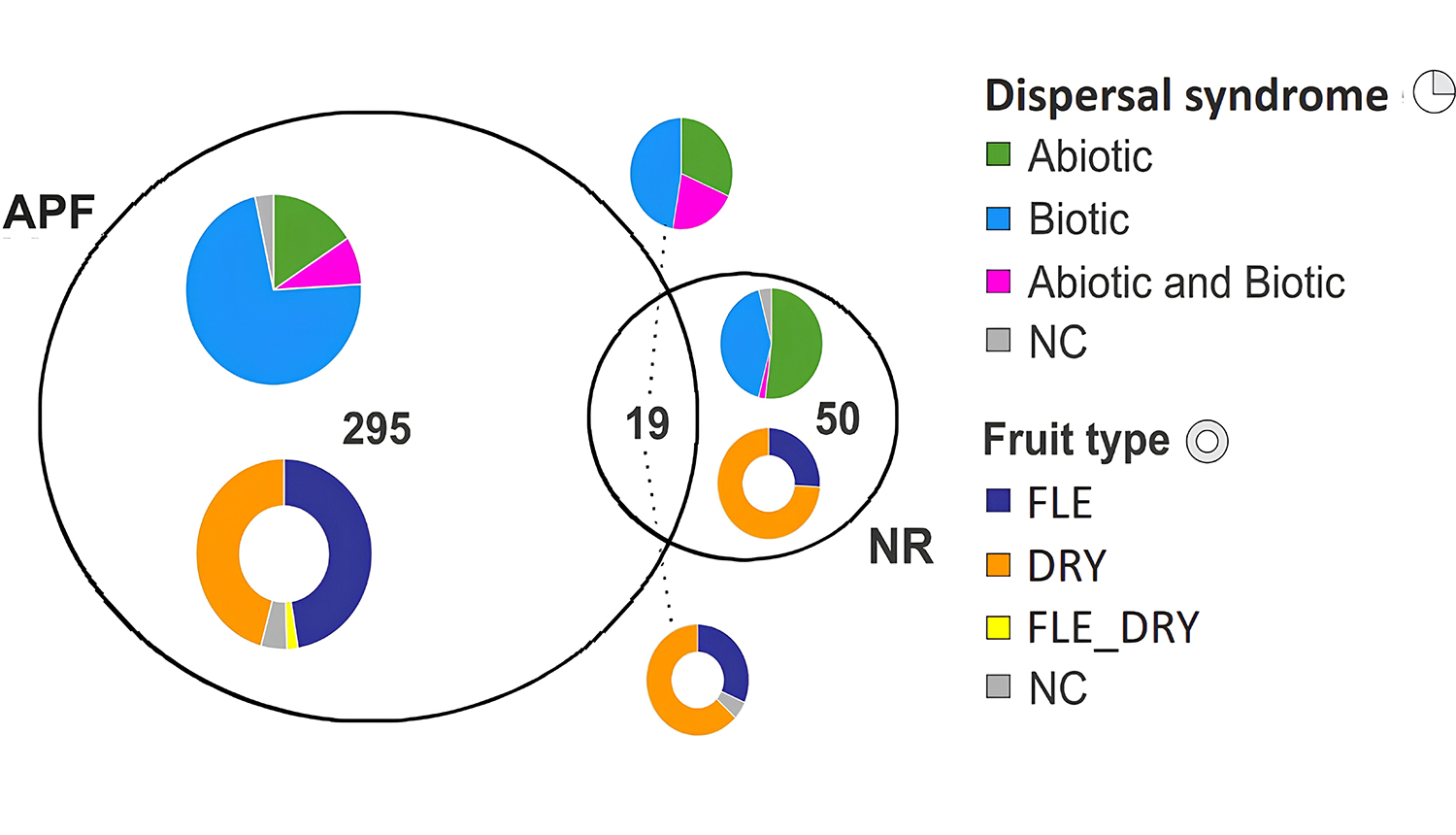
Among the 373 plant species sampled in this study, dispersal syndromes were classified for 295 species found in APF, 50 in NR, and 19 present in both environments (Fig. 2).

Number of plant species present in the studied environments and their respective proportions according to dispersal syndrome and type of fruit. NR = Natural Regeneration; APF = Altered Primary Forest; FLE = Fleshy fruit; DRY = Dry fruit; FLE_DRY = Fleshy and/or dry fruit; NC = Not classified.
The PCoA ordination based on species composition showed a clear distinction between APF and NR areas (Fig. 3A). The first two axes together accounted for 50.21 % of the variance in species abundance. This differentiation between environments was confirmed by PERMANOVA, which indicated that species composition differed significantly between APF and NR (F = 8.53, R² = 0.348, p = 0.001). However, multivariate dispersion also differed between the two environments (betadisper ANOVA: F = 33.14, p < 0.001), with NR exhibiting greater within-group variation. These results suggest that differences in community composition may be partially influenced by greater heterogeneity in species distribution within natural regeneration areas.
In addition, the PCA ordination based on summary-level variables per sampling area (i.e., species richness and the abundance of dispersal syndrome types) showed that APF areas had a higher abundance of species with biotic dispersal syndromes and were associated with higher species richness, whereas NR areas were predominantly associated with abiotic dispersal syndromes. The first principal component (PC1) captured 55.4 % of the total variance (eigenvalue = 4.99), while the second axis (PC2) accounted for 19.3 % (eigenvalue = 1.74), summing to 74.7 % of the total data variability (Fig. 3B). No overlap between the two environments was observed using centroid buffers in the PCA, suggesting distinct groupings according to the summary variables. The longest vectors in the biplot (R = richness, BIO, ABI_BIO, and ABI) indicated that the richness and abundance of species classified within each dispersal syndrome category were important variables to distinguish the two environments (Fig. 3B).

Spatial ordination of sampling areas across two environments, Altered Primary Forest (APF) and Natural Regeneration (NR). (A) Principal Coordinates Analysis (PCoA) based on Bray-Curtis dissimilarity of species abundance matrix. (B) Principal Component Analysis (PCA) biplot based on summary variables, including species richness and the abundance of different dispersal syndrome types per sampling area. The PCA was based on standardized (scaled) variables using scaling = 2. Points represent the sampled areas. Black arrows show the variables of dispersal syndrome. Gray arrows indicate the “zoochory dispersal”. BIO = Biotic; ABI = Abiotic; ABI_BIO = Abiotic and biotic; MAM = Mammaliocoria; ORN = ornithochory; CHI = Chiropterochory; NC = not classified; R = richness.
For species classified under abiotic dispersal syndromes, sampling areas from NR showed higher abundance compared to APF (estimate = 0.71, p = 0.047, Poisson-GLMM), but a 0.18-fold lower richness (estimate = -1,70, p < 0.001, Poisson-GLM). For species with biotic dispersal syndromes, abundance (estimate = -0.70; p < 0.001; Poisson GLMM) and richness (estimate = -3.03, p < 0.001, Negative binomial - GLMM) were lower in NR plots compared to APF. For species classified as both abiotic and biotic, no significant difference in abundance was found between environments (estimate = -0.34; p = 0.231; Negative Binomial GLMM). However, NR showed fewer species classified both as abiotic and biotic than APF (estimate = -1.91, p < 0.001, Poisson-GLM). Absolute values are available in Table S1.
Although the absolute abundance values differed between the two environments with respect to the dispersal syndrome, when we evaluated the proportion of individuals in each category, APF and NR had a similar proportion of individuals with ANE syndrome (p = 0.99, pairwise contrasts from a beta-binomial GLMM). Despite the lack of significance (p = 0.71 for ZOO and p = 0.41 for BAR_ZOO, pairwise contrasts from a beta-binomial GLMM), the effect analysis through the confidence interval showed that the proportion of ZOO and BAR_ZOO plants (biotic syndrome) in layer 1 of the NR areas was higher than the average proportion observed in the APF areas (Fig. 4A). A result contrary to that observed with the absolute abundance value (Fig. 3). A significant difference in the proportion of dispersal syndrome was observed in layer 3. The NR showed 30 % more specimens of autochoric syndrome than APF (p = 0.036), and on average, 20 % fewer plants of zoochoric syndrome (p < 0.001) (Fig. 4C).

Mean difference between the proportion of plants distributed in dispersal syndrome and fruit type between Altered Primary Forest and Natural Regeneration areas. The vertical black line represents the reference value for APF for each dispersal syndrome or fruit type. Values above the black line indicate higher proportions in NR, while values below indicate higher proportions in APF. Relative abundance of the most common dispersal syndrome in the following forest layers: (A) canopy; (B) understory; (C) forest floor. Relative abundance of fruit type in the following forest layers: (D) canopy; (E) understory; (F) forest floor. * p < 0.05. ANE = Anemochory; AUT = Autochory; BAR = Barochory; ZOO = Zoochory; FLE = Fleshy fruit; DRY = Dry fruit; NC = Not classified.
Considering the proportion of individuals classified by fruit type, on layer 1 (canopy), NR showed 10 % fewer plants with fleshy fruits (p = 0.02) and 20 % more plants with dry fruits than APF (p = 0.006) (Fig. 4D). On layer 2 (understory), the proportion of individuals with fleshy fruits (p = 0.55) and with dry fruits (p = 0.99) was similar between the two environments (Fig. 4E). The same trend observed in layer 1 (canopy) was observed in layer 3 (forest floor) (Fig. 4F).
The species abundance within APF plots was distributed differently according to the dispersal syndrome and fruit type (Fig. 5A). In terms of dispersal syndrome, ANE_ZOO, AUT_HYD, NC, and ZOO_AUT had lower abundance than the ANE dispersal syndrome (reference level), while BAR_ZOO and ZOO showed higher abundance. No difference in the abundance of species by fruit types FLE and DRY was observed in the APF. However, species with fruits classified as FLE_DRY and the NC showed lower abundance than the FLE fruits (reference level) and other fruit types. Differently, in the NR areas, the abundance of species with AUT, BAR_ZOO, and ZOO dispersal syndromes increased when compared with the abundance of species of ANE dispersal syndromes (Fig. 5B). Nonetheless, in NR areas, the abundance of DRY fruits increased compared to FLE fruits.

Incidence rate ratios from GLMMs showing the total abundance of species classified within each dispersal syndrome category and fruit type. Incidence Rate Ratios indicate the coefficient of reduction (red values) or increase (blue values) on abundance value using the abundance of anemochory syndrome as reference (vertical black line). (A) Altered Primary Forest; (B) Natural Regeneration. * p < 0.05; ** p < 0.01; *** p < 0.001. ANE = Anemochory; AUT = Autochory; BAR = Barochory; HYD = Hydrochory; ZOO = Zoochory; FLE = Fleshy fruit; DRY = Dry fruit; NC = Not classified.
Discussion
The study's results reveal significant insights into how different environments influence the composition and abundance of plant species, particularly regarding dispersal mechanisms. The clear distinction between APF and NR areas suggests that environmental changes, such as forest degradation, can affect not only the species present but also the strategies they use to disperse their propagules.
Although PERMANOVA detected compositional differences between environments that were statistically significant, the test for homogeneity of dispersion (betadisper) included in the analysis determined greater variation in the natural regeneration group. This result suggests that part of the compositional difference observed can be explained by greater heterogeneity in these sampling areas, possibly due to more variable successional processes or habitat conditions between regenerating forests. The NR areas, although they present the same restoration technique, have different distances from the forest matrix and, consequently, from a possible dispersing and pollinating fauna, which we suggest can be assisted as a facilitator in the regenerative process of the trained sites (Chazdon et al., 2009). Fenner (1985) also notes that areas with developed vegetation and greater complexity attract a diversity of birds, thus accelerating the entry of seeds from this source into the area.
The predominance of species with biotic (zoochoric) dispersal syndromes in APF areas indicates that these environments still maintain characteristics that favor interactions with dispersing animals, which may be crucial for maintaining local and regional diversity. Conversely, the greater abundance of species with abiotic syndromes in NR may reflect an adaptation to distinct regeneration conditions, where wind dispersal becomes more prevalent. The same trend was observed in the study of Carvalho (2010), who compared the proportions of dispersal syndromes of propagules between secondary and preserved ombrophilous forests, and concluded that the areas differed significantly in the richness and density of species with biotic dispersal. Hawes et al. (2020) classified the dispersal mode and seed size of material from regenerating secondary forests and disturbed primary forests affected by burning and selective extraction in Pará. These authors found that disturbance reduced species diversity, increased the number of tree species with small seeds, and those consumed by animals, while reducing those dispersed by other mechanisms, such as wind.
Species with fleshy fruits were more abundant in APF areas, mainly in the canopy and forest floor, while species with dry fruits predominated in NR areas, also in the canopy and forest floor. Animals are responsible for dispersing the vast majority of plants within communities, differing in the quantity and quality of dispersal, as well as in the form and distance over which the seeds can travel from the source (Brockelman et al., 2022). Zoochory plays a structuring role in tropical forests, allowing the movement of propagules away from conspecific adults and influencing the maintenance and richness of species in the seed bank (Valenta & Nevo, 2020). Furthermore, most trees in tropical forests produce fleshy fruits intended for consumption by animals (Sinnott-Armstrong et al., 2022). Thus, these factors likely contributed to the richness and abundance of fleshy fruits in altered primary forest areas. However, frequent disturbance environments, such as NR areas, generally present a greater dominance of ruderal plant species (R-strategy), as this ecological strategy facilitates the expansion of the distribution area of these species (Liao et al., 2021). Because they exhibit several traits that enhance their survival and rapid spread, these species are considered highly efficient seed producers and dispersers, with typically small and light seeds characteristic of dry fruits (Carvalho, 2013).
As expected, species with fleshy fruits exhibit zoochory as the primary dispersal mechanism. However, species with dry fruits also showed zoochory as the primary dispersal mechanism, with autochory and anemochory exhibiting similar but lower values. These results align with those found by Silva Júnior et al. (2020) when comparing dispersal syndrome patterns in three types of forests in the Amazon region, where 72 % of the species analyzed exhibited zoochoric dispersal syndrome and 14.5 % exhibited autocoric dispersal syndrome. Species with zoochoric dispersal, in theory, have fewer chances of having their diaspores dispersed randomly (Giehl et al., 2007), and zoochory is described as the primary dispersal syndrome found in various studies related to dispersal in the tropics (Carvalho, 2010; Beaune et al., 2013; Silva Júnior et al., 2020). This pattern may be related to the long distance reached by propagules dispersed by animals such as birds, mammals and invertebrates, whether through the digestive tract (i.e., being regurgitated or expelled through feces) or attached outside of the animal's body (i.e., exochory or epizoochory), which can reach up to 10 km (Roth, 1987; Corlett, 2009).
In NR areas, species with anemochory as their main dispersal syndrome were mostly related to dry fruits, while in APF areas, anemochory was not significantly related to dry fruits. Wind-dispersed species tend to produce small fruits and morphological appendages (wings, feathers, etc.) to facilitate the dispersal process (Seale & Nakayama, 2020). These species easily colonize disturbed habitats, as they do not depend on the presence of dispersers, but rather on the amount of wind and the efficiency of their dispersal appendages (Bacles et al., 2006). According to Vieira et al. (2002), anemochoric species are more important in open areas, which may influence the fact that NR areas have a higher number of species with this type of dispersal.
Species dispersed by two mechanisms were observed in both environments analyzed, especially in APF areas, mostly related to species in the Lecythidaceae family. More than one dispersal mechanism can operate simultaneously or sequentially for certain plant species (Howe, 2016), which is commonly observed in species with large fruits. Plants with large fruits tend to have barochory as the primary dispersal mechanism and zoochory as secondary (Santos et al., 2024). This is the case for some species in the Lecythidaceae family, where the fruits or seeds initially fall from the mother trees and are later carried and buried by small rodents in various locations in the forests, thus increasing the dispersal distance and allowing the development of these propagules (Vilela et al., 2012; Cerqueira et al., 2021).
Species with fruits of the berry, drupe, capsule, and legume types were the most commonly recorded in APF areas, while species with fruits of the capsule, berry, achene, and caryopsis types were the most commonly recorded in NR areas. The difference between the fruit types recorded in APF and NR areas is likely related to the particular characteristics of the sampled environments. Hawes et al. (2020) found that fruits of the berry, capsule, and drupe types differ significantly between the fragments studied at different successional stages in the northwest of Pará state. The authors found that in more disturbed areas (plots in disturbed forests), compound fruits (such as those from the Moraceae, Siparunaceae, and Urticaceae families) and syncarpous (such as those from the Annonaceae family) predominated, while in these environments, fruits of the berry and capsule types were reduced.
Among the 50 species recorded in NR areas, those from the Asteraceae, Urticaceae, and Poaceae families made up a representative fraction of the collected plants. These families are characterized by fruits of the achene and caryopsis types, commonly found in open environments with drier climates (Judd et al., 2009). Preserved areas are characterized by a closed canopy and shaded understory, providing a humid microclimate with lower temperatures, favorable to fleshy fruits due to high water availability (Jara-Guerrero et al., 2011). In contrast, degraded areas have a dry and hot climate due to reduced vegetation cover and increased solar incidence, accelerating the dehydration of dry fruits and the opening of their diaspores (Kuhlmann & Ribeiro, 2016). Furthermore, changes in land use (e.g., mining) lead to significant changes in the physical, chemical, and biological characteristics of the soil, influencing the quality and quantity of fruit resources (Carvalheiro et al., 2021), which may explain the different patterns of fruit types recorded between the NR and APF areas.
Zoochory was the most frequent dispersal syndrome, both in APF areas and in NR areas, with fleshy fruits (berry and drupe) being the most frequent in APF areas and dry fruits (capsule, achene, and caryopsis) in NR areas. These differences in dispersal modes between APF and NR areas are within the patterns already expected and previously found in other studies on fruit dispersal. Dry fruits exhibited zoochory, autochory, and anemochory as the main dispersal syndromes. Furthermore, NR areas contain a greater number of species with abiotic dispersal mechanisms (i.e., anemochory and autochory) and dry fruits. This type of vegetation formation exhibited a greater diversity of dispersal syndromes than altered primary forest areas. This suggests that species developing in disturbed areas have more strategies for their dispersal, whereas less disturbed areas favor the dispersal of fleshy fruits by animals, reinforcing the relative importance of these fruits in forest areas.
In conclusion, this work demonstrates the importance of understanding how species composition and dispersal strategies are influenced by environmental conditions and anthropogenic impacts to which they are subjected. Furthermore, the study allows us to assess which dispersal mechanisms are best adapted to degraded environments under strong anthropogenic pressure. This knowledge can enable more effective implementation of recovery strategies, for instance, by prioritizing the planting of species with similar dispersal mechanisms for the colonization and subsequent restoration of degraded areas, especially in areas impacted by mining.
Supplementary Material
The following online material is available for this article:
Table S1.
Acknowledgments
We thank Luiz C. Lobato, Ronaldo R.N. Reis, Roseno Martins, and Alexandre Botelho for technical field support. Geovana Oliveira for the map creation.
References
-
Alvares CA, Stape JL, Sentelhas PC, Gonçalves JDM, Sparovek G. 2013. Köppen’s climate classification map for Brazil. Meteorologische Zeitschrift 22: 711-728. doi: 10.1127/0941-2948/2013/0507
» https://doi.org/10.1127/0941-2948/2013/0507 -
Bacles CF, Lowe AJ, Ennos RA. 2006. Effective seed dispersal across a fragmented landscape. Science 311: 628-628. doi: 10.1126/science.1121543
» https://doi.org/10.1126/science.1121543 -
Beaune D, Bretagnolle F, Bollache L, Hohmann G, Surbeck M, Fruth B. 2013. Seed dispersal strategies and the threat of defaunation in a Congo forest. Biodiversity and Conservation 22: 225-238. doi: 10.1007/s10531-012-0416-x
» https://doi.org/10.1007/s10531-012-0416-x -
Beckman NG, Sullivan LL. 2023. The causes and consequences of seed dispersal. Annual Review of Ecology, Evolution, and Systematics 54: 403-427. doi: 10.1146/annurev-ecolsys-102320-104739
» https://doi.org/10.1146/annurev-ecolsys-102320-104739 -
Benedicto‐Royuela J, Costa JM, Heleno R et al 2024. What is the value of biotic seed dispersal in post‐fire forest regeneration? Conservation Letters 17: e12990. doi: 10.1111/conl.12990
» https://doi.org/10.1111/conl.12990 -
Branco AJK, Cordeiro J, Stefanello S, Zwiener VP. 2022. Seed rain in a degraded mining area: The role of bird perches and pioneer trees. Ciência e Natura 44: e29-e29. doi: 10.5902/2179460X68276
» https://doi.org/10.5902/2179460X68276 -
Brockelman WY, McConkey KR, Nathalang A, Somnnuk R, Santon J, Matmoon U. 2022. Dispersal success of a specialized tropical tree depends on complex interactions among diverse mammalian frugivores. Global Ecology and Conservation 40: e02312. doi: 10.1016/j.gecco.2022.e02312
» https://doi.org/10.1016/j.gecco.2022.e02312 -
Carvalheiro LG, Bartomeus I, Rollin O, Timóteo S, Tinoco CF. 2021. The role of soils on pollination and seed dispersal. Philosophical Transactions of the Royal Society B 376: 20200171. doi: 10.1098/rstb.2020.0171
» https://doi.org/10.1098/rstb.2020.0171 -
Carvalho FA. 2010. Síndromes de dispersão de espécies arbóreas de florestas ombrófilas submontanas do estado do Rio de Janeiro. Revista Árvore 34: 1017-1023. doi: 10.1590/S0100-67622010000600007
» https://doi.org/10.1590/S0100-67622010000600007 - Carvalho LB. 2013. Plantas Daninhas. Lages, Edição do Autor.
-
Cerqueira RM, Jardim MAG, Bitencourt MM, Martins MB. 2022. Fitossociologia do subosque de florestas nativas e PRAD sob influência da mineração, Paragominas, Pará, Brasil. Nature and Conservation 15: 1-19. doi: 10.6008/CBPC2318-2881.2022.002.0001
» https://doi.org/10.6008/CBPC2318-2881.2022.002.0001 -
Cerqueira RM, Jardim MAG, Júnior LLMS, Paixão LP, Martins MB. 2021. Fitossociologia do estrato arbóreo em floresta nativa e em áreas do programa de recuperação de áreas degradadas sob influência da mineração, Paragominas, Pará, Brasil. Nature and Conservation 14: 22-41. doi: 10.6008/CBPC2318-2881.2021.003.0002
» https://doi.org/10.6008/CBPC2318-2881.2021.003.0002 -
Chazdon RL, Peres CA, Dent D et al 2009. The potential for species conservation in tropical secondary forests. Conservation Biology 23: 1406-1417. doi: 10.1111/j.1523-1739.2009.01338.x
» https://doi.org/10.1111/j.1523-1739.2009.01338.x -
Chazdon RL, Guariguata MR. 2016. Regeneração natural como ferramenta para restauração florestal em larga escala nos trópicos: perspectivas e desafios. Biotropica 48: 716-730. doi: 10.1111/btp.12381
» https://doi.org/10.1111/btp.12381 -
Corlett RT. 2009. Seed dispersal distances and plant migration potential in tropical East Asia. Biotropica 41: 592-598. doi: 10.1111/j.1744-7429.2009.00503.x
» https://doi.org/10.1111/j.1744-7429.2009.00503.x -
Correa DF, Stevenson PR, Umaña MN et al 2023. Geographic patterns of tree dispersal modes in Amazonia and their ecological correlates. Global Ecology and Biogeography 32: 49-69. doi: 10.1111/geb.13596
» https://doi.org/10.1111/geb.13596 -
Crespo-Lopez ME, Arrifano GP, Augusto-Oliveira M et al 2023. Mercury in the Amazon: The danger of a single story. Ecotoxicology and Environmental Safety 256: 114895. doi: 10.1016/j.ecoenv.2023.114895
» https://doi.org/10.1016/j.ecoenv.2023.114895 -
Crouzeilles R, Ferreira MS, Chazdon RL et al 2017. Ecological restoration success is higher for natural regeneration than for active restoration in tropical forests. Science Advances 3: e1701345. doi: 10.1126/sciadv.170134
» https://doi.org/10.1126/sciadv.170134 -
Silva Júnior OS, Pires PVB, Maia LJR, Dias ACDAA, Cerqueira RM. 2020. Síndromes de dispersão e polinização em uma Unidade de Conservação na Amazônia. Revista Gestão & Sustentabilidade Ambiental 9: 765-782. doi: 10.19177/rgsa.v9e22020765-782
» https://doi.org/10.19177/rgsa.v9e22020765-782 - Souza PA, Venturin N, Griffith JJ, Martins SV. 2006. Avaliação do banco de sementes contido na serapilheira de um fragmento florestal visando recuperação de áreas degradadas. Cerne 12: 56-67.
-
Dey S, Tripathy B, Kumar MS, Das AP. 2023. Ecotoxicological consequences of manganese mining pollutants and their biological remediation. Environmental chemistry and ecotoxicology 5: 55-61. doi: 10.1016/j.enceco.2023.01.001
» https://doi.org/10.1016/j.enceco.2023.01.001 - Fenner MW. 1985. Seed ecology. London, Chapman and Hall.
-
Flora e Funga do Brasil. 2022. Jardim Botânico do Rio de Janeiro. http://floradobrasil.jbrj.gov.br/ 25 Mar. 2022.
» http://floradobrasil.jbrj.gov.br/ -
Galetti M. 2013. Functional extinction of birds drives rapid evolutionary changes in seed size. Science 342: 1316-1316. doi: 10.1126/science.1233774
» https://doi.org/10.1126/science.1233774 -
Gastauer M, Souza Filho PWM, Ramos SJ et al 2019. Mine land rehabilitation in Brazil: Goals and techniques in the context of legal requirements. Ambio 48: 74-88. doi: 10.1007/s13280-018-1053-8
» https://doi.org/10.1007/s13280-018-1053-8 -
Giehl ELH, Athayde EA, Budke JC, Gesing JPA, Einsiger SM, Canto-Dorow TSD. 2007. Espectro e distribuição vertical das estratégias de dispersão de diásporos do componente arbóreo em uma floresta estacional no sul do Brasil. Acta Botanica Brasilica 21: 137-145. doi: 10.1590/S0102-33062007000100013
» https://doi.org/10.1590/S0102-33062007000100013 -
Gonçalves RM, Grilo C, Edwards DP et al 2024. Seed‐dispersal mode and habitat connectivity underpin variation in carbon stocking between Brazilian biomes. Journal of Ecology 112: 1301-1312. doi: 10.1111/1365-2745.14301
» https://doi.org/10.1111/1365-2745.14301 -
Hartig F. 2024. _DHARMa: Residual Diagnostics for Hierarchical (Multi-Level / Mixed) Regression Models_. R package version 0.4.7. https://CRAN.R-project.org/package=DHARMa 25 Mar. 2022.
» https://CRAN.R-project.org/package=DHARMa -
Hawes JE, Vieira IC, Magnago LF et al 2020. A large‐scale assessment of plant dispersal mode and seed traits across human‐modified Amazonian forests. Journal of Ecology 108: 1373-1385. doi: 10.1111/1365-2745.13358
» https://doi.org/10.1111/1365-2745.13358 -
Ho J, Tumkaya T, Aryal S, Choi H, Claridge-Chang A. 2019. Moving beyond P values: Data analysis with estimation graphics. Nature Methods 16: 565-566. doi: 10.1038/s41592-019-0470-3
» https://doi.org/10.1038/s41592-019-0470-3 -
Howe HF. 2016. Making dispersal syndromes and networks useful in tropical conservation and restoration. Global Ecology and Conservation 6: 152-178. doi: 10.1016/j.gecco.2016.03.002
» https://doi.org/10.1016/j.gecco.2016.03.002 -
Howe HF, Miriti MN. 2004. When seed dispersal matters. BioScience 54: 651-660. doi: 10.1641/0006-3568(2004)054[0651:WSDM]2.0.CO;2
» https://doi.org/10.1641/0006-3568(2004)054[0651:WSDM]2.0.CO;2 - Hydro. 2003. Relatório de Impacto Ambiental: lavra e beneficiamento de bauxita. Paragominas, Mineração Vera Cruz S. A.
- IBGE. 2015. Manual técnico de pedologia. 3rd. edn. Rio de Janeiro, IBGE/Coordenação de Recursos Naturais e Estudos Ambientais.
-
Jara‐Guerrero A, De la Cruz M, Méndez M. 2011. Seed dispersal spectrum of woody species in south Ecuadorian dry forests: Environmental correlates and the effect of considering species abundance. Biotropica 43: 722-730. doi: 10.1111/j.1744-7429.2011.00754.x
» https://doi.org/10.1111/j.1744-7429.2011.00754.x - Judd WS. 1985. A revised traditional/descriptive classification of fruits for use in floristics and teaching. Phytologia 58: 232-242.
- Judd WS, Campbell CS, Kellogg EA, Stevens PF, Donoghue MJ. 2009. Sistemática Vegetal: Um Enfoque Filogenético. 3rd. edn. São Paulo, Artmed Editora.
-
Krauss S, Anthony J, Lapenzee S et al 2024. Equivalent mating system parameters in post‐mining and undisturbed native plant populations confirms restitution of bird‐pollinator function. Journal of Applied Ecology 61: 1599-1611. doi: 10.1111/1365-2664.14667
» https://doi.org/10.1111/1365-2664.14667 -
Kuhlmann M, Ribeiro JF. 2016. Evolution of seed dispersal in the Cerrado biome: Ecological and phylogenetic considerations. Acta Botanica Brasilica 30: 271-282. doi: 10.1590/0102-33062015abb0331
» https://doi.org/10.1590/0102-33062015abb0331 -
Lenth R. 2021. emmeans: Estimated Marginal Means, aka Least-Squares Means. R Packag. version 1.5.4. https://cran.r-project.org/web/packages/emmeans/index.html 25 Mar. 2022.
» https://cran.r-project.org/web/packages/emmeans/index.html -
Liao H, Li D, Zhou T et al 2021. The role of functional strategies in global plant distribution. Ecography 44: 493-503. doi: 10.1111/ecog.05476
» https://doi.org/10.1111/ecog.05476 - Lorenzi H. 1992. Árvores brasileiras: manual de identificação e cultivo de plantas arbóreas nativas do Brasil. 2nd. edn. Nova Odessa, Editora Plantarum.
-
Lussier NM, Crafford RE, Reid JL, Kwit C. 2025. Seeding success: Integrating seed dispersal networks in tropical forest restoration. Biotropica 57: e13347. doi: 10.1111/btp.13347
» https://doi.org/10.1111/btp.13347 -
Martins WBR, Ferreira GC, Souza FP, Dionísio LFS, Oliveira FA. 2018. Deposição de serapilheira e nutrientes em áreas de mineração submetidas a métodos de restauração florestal em Paragominas, Pará. Floresta 48: 37-48. doi: 10.5380/rf.v48 i1.49288
» https://doi.org/10.5380/rf.v48 i1.49288 -
McAlpine C, Catterall CP, Nally RM et al 2016. Integrating plant‐and animal‐based perspectives for more effective restoration of biodiversity. Frontiers in Ecology and the Environment 14: 37-45. doi: 10.1002/16-0108.1
» https://doi.org/10.1002/16-0108.1 -
Oksanen J, Blanchet FG, Friendly M et al 2020. vegan: Community Ecology Package. R package version 2.5-7. https://cran.r-project.org/web/packages/vegan/index.html 25 Mar. 2022.
» https://cran.r-project.org/web/packages/vegan/index.html - Pinto A, Amaral P, Souza JC et al 2009. Diagnóstico socioeconômico e florestal do município de Paragominas. Belém, Imazon.
-
R Core Team. 2023. R: A language and environment for statistical computing. R Foundation for Statistical Computing, Vienna. https://www.R-project.org 25 Mar. 2022.
» https://www.R-project.org -
Restrepo-Carvajal IC, Clerici N, Alvarado ST. 2025. Assessing restoration strategies for the recovery of Colombian Moist Forests: a meta-analysis. Restoration Ecology: e70085. doi: 10.1111/rec.70085
» https://doi.org/10.1111/rec.70085 - Rodrigues TE, Silva RDC, Da Silva JML et al 2003. Documentos n. 162/Caracterização e classificação dos solos do município de Paragominas, Estado do Pará. Belém, Embrapa Amazônia Oriental.
- Roth I. 1987. Stratification of a tropical forest as seen in dispersal types. Dordrecht, Dr W. Junk Publishers.
- Salomão R, Brienza Junior S, Vieira I, Amaral D. 2024. Manual técnico de classificação dos estágios sucessionais de floresta secundária: sistema capoeira classe (CapClasse), Belém, Embrapa Amazônia Oriental .
- Sampaio AB, Ribeiro KT, Vieira DM, Silva DCB. 2021. Guia de restauração ecológica para gestores de unidades de conservação. Brasília, Instituto Chico Mendes.
-
Santos GC, Sousa Júnior JR, Nascimento ALB et al 2024. People socialize ecological information about the environment but may forget their own experiences: A case study of local ecological knowledge about seed-dispersing animals. Ethnobiology and Conservation 13: 1-15. doi: 10.15451/ec2024-07-13.19-1-15
» https://doi.org/10.15451/ec2024-07-13.19-1-15 -
Seale M, Nakayama N. 2020. From passive to informed: Mechanical mechanisms of seed dispersal. New Phytologist 225: 653-658. doi: 10.1111/nph.16110
» https://doi.org/10.1111/nph.16110 - Sengupta M. 2021. Environmental impacts of mining: Monitoring, restoration, and control. 2nd. edn. Boca Raton, CRC Press.
-
Schupp EW, Jordano P, Gómez J.M. 2010. Seed dispersal effectiveness revisited: A conceptual review. New Phytologist 188: 333-353. doi: 10.1111/j.1469-8137.2010.03402.x
» https://doi.org/10.1111/j.1469-8137.2010.03402.x -
Sinnott-Armstrong MA, Donoghue MJ, Jetz W. 2022. Dispersers and environment drive global variation in fruit colour syndromes. Ecology Letters 25: 570-570. doi: 10.1111/ele.13753
» https://doi.org/10.1111/ele.13753 -
Simineral. 2022. Sindicato das Indústrias Minerais do Estado do Pará (SIMINERAL). https://simineral.org.br/quem-somos 8 Jun. 2022.
» https://simineral.org.br/quem-somos - Souza VC, Flores TB, Lorenzi H. 2013. Introdução à botânica: morfologia. Nova Odessa/Piracicaba, Instituto Plantarum de Estudos da Flora/Universidade de São Paulo.
- Spjut RW. 1994. A systematic treatment of fruit types. 3rd. edn. New York, Memoirs of the New York Botanical Garden.
-
Valenta K, Nevo O. 2020. The dispersal syndrome hypothesis: How animals shaped fruit traits, and how they did not. Functional Ecology 34: 1158-1169. doi: 10.1111/1365-2435.13564
» https://doi.org/10.1111/1365-2435.13564 - Van der Pijl L. 1982. Principles of dispersal in higher plants. 3rd. edn. Berlin, Springer Verlag.
- Vidal WN, Vidal MRR. 2003. Botânica - organografia: quadros sinóticos ilustrados de fanerógamos. 4th. edn. Viçosa, Editora UFV.
-
Vieira DL, Aquino FG, Brito MA, Fernandes-Bulhão C, Henriques RP. 2002. Síndromes de dispersão de espécies arbustivo-arbóreas em cerrado sensu stricto do Brasil Central e savanas amazônicas. Brazilian Journal of Botany 25: 215-220. doi: 10.1590/S0100-84042002000200009
» https://doi.org/10.1590/S0100-84042002000200009 -
Vilela FS, Flesher KM, Ramalho M. 2012. Dispersal and predation of Eschweilera ovata seeds in the Atlantic Forest of Southern Bahia, Brazil. Journal of Tropical Ecology 28: 223-226. doi: 10.1017/S0266467411000514
» https://doi.org/10.1017/S0266467411000514 - Watrin OS, Rocha AMA. 1992. Levantamento da vegetação natural e do uso da terra no município de Paragominas (PA) utilizando imagens TM/LANDSAT. Boletim de Pesquisa 124. Belém, Embrapa-CPATU.
-
Data Availability
Datasets related to this article will be available upon request to the corresponding author.
-
Funding information
The Brazil-Norway Biodiversity Research Consortium (BRC) for the financial support to the project "How ecological interactions are influenced by mining activities and environmental restoration efforts in post-mined areas," and Hydro Mineração Paragominas for logistical support.
Datasets related to this article will be available upon request to the corresponding author.