 Voriconazole-induced lentiginosis in a child: a phototoxicity warning sign
Dear Editor,
Voriconazole, a triazole antifungal, is widely used in chil-dren with invasive fungal infections, especially in the context of hematologic malignancies and transplantation. Despite its efficacy, long-term therapy has been increas-ingly associated with phototoxic reactions, lentiginosis, and accelerated Non-melanoma Skin Cancer (NMSC) and melanoma.1-3 Because the skin is one of the main target organs for the adverse effects of this drug, we present a case that illustrates one of these manifestations and illustrates the importance of early recognition.
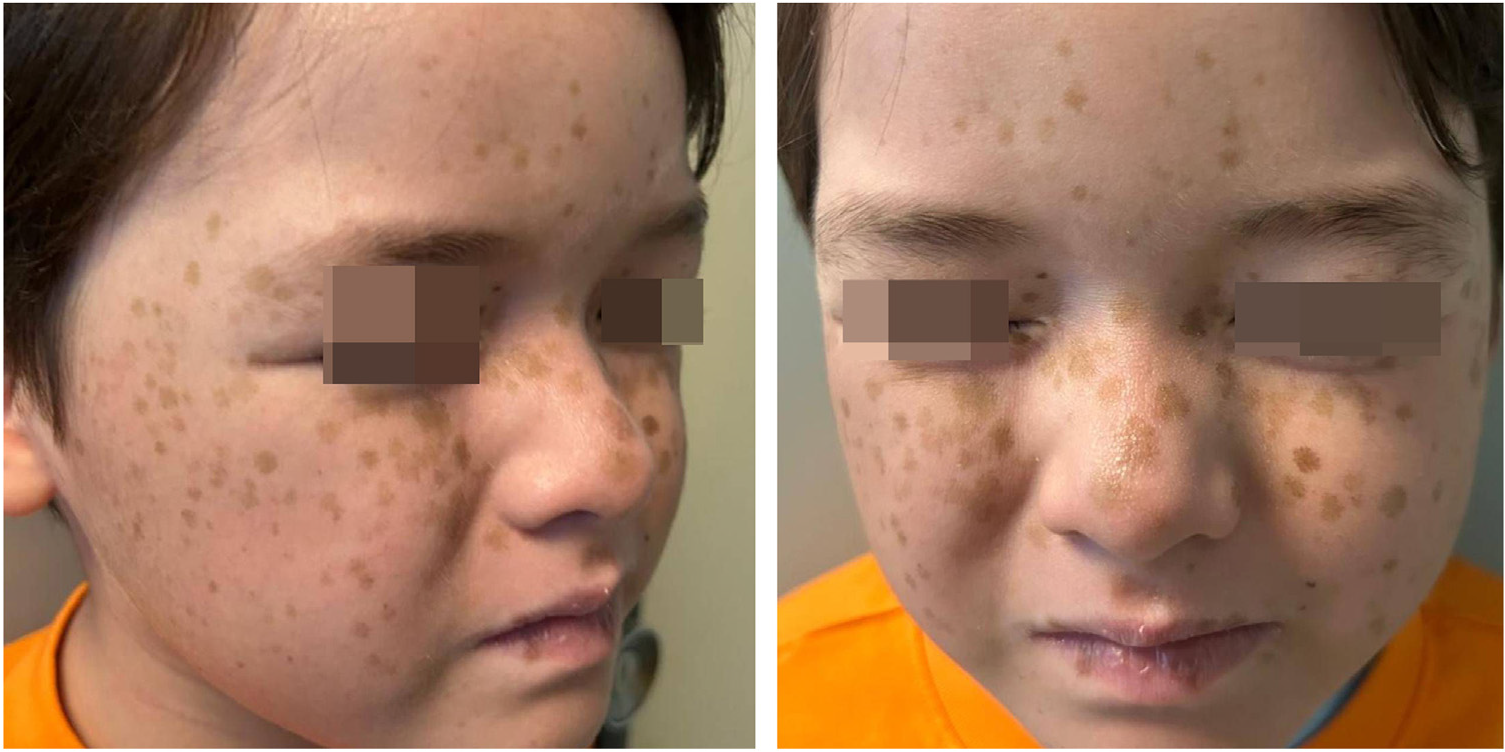
A 7-year-old boy with acute lymphoblastic leukemia, atopic dermatitis, and autism spectrum disorder was started on oral voriconazole in August 2023 for an angioinvasive fun-gal infection. After several months of therapy, he developed multiple, asymptomatic, well-demarcated hyperpigmented macules (2-5 mm) symmetrically distributed on the cheeks, nasal dorsum, and frontal region (Figs. 1A-B). No mucosal, palmar, or plantar involvement was present. There was no family history of lentiginosis or syndromic associations. A diagnosis of chronic voriconazole-induced phototoxic-ity was made. Because antifungal substitution was not feasible, strict photoprotection (SPF 50+, hat, protective clothing) was recommended. At the 6-month follow-up, the lesions persisted without progression or development of new lesions.
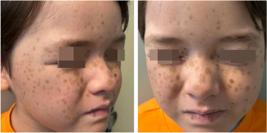
(A and B) 7-year-old boy with multiple well-demarcated hyperpigmented macules symmetrically distributed on the cheeks, nasal dorsum, and frontal region.
Voriconazole-induced phototoxicity occurs in 17%-36% of children, particularly with cumulative exposure or long-term use.1,2 Manifestations range from erythema and lentiginosis to premalignant lesions and aggressive Squamous Cell Car-cinoma (SCC).3 The persistence of lentiginous macules, as in this case, is a marker of chronic UV-induced damage and may represent a potential precursor to malignant transfor-mation. It’s also important to make an adequate differential diagnosis of lentigines localized on the head, neck, and acral to exclude conditions such as Peutz-Jeghers syndrome, Laugier-Hunziker syndrome, Cowden syndrome, centrofacial lentigines, and inherited patterned lentigines (Table 1).4,5
Pathogenesis remains incompletely understood. Pro-posed mechanisms include the UVA-absorbing properties of voriconazole’s N-oxide metabolite, generating reactive oxy-gen species that induce oxidative DNA injury.6 Additionally, a retinoid-like effect mediated by disrupted retinoic acid metabolism has been hypothesized to contribute to both phototoxicity and keratinocyte changes.6
Children represent a particularly vulnerable population due to their prolonged life expectancy, frequent expo-sure to immunosuppressive regimens, and the need for extended antifungal prophylaxis. Several reports have docu-mented the rapid development of SCC in pediatric transplant recipients under chronic voriconazole therapy.3,7 Recent pharmacovigilance analyses by regulatory agencies reaf-firmed the importance of phototoxicity surveillance in children treated with voriconazole.8
Management includes early dermatologic evaluation, patient and caregiver counseling on rigorous photoprotec-tion, and long-term cutaneous follow-up. Substitution with alternative antifungals such as posaconazole or isavucona-zole may be considered in cases of recurrent or severe toxicity, although clinical circumstances may limit this option.
Voriconazole can induce chronic phototoxicity and lentig-inosis in children receiving prolonged therapy. It is important for the dermatologist to be familiar with the adverse effect profile of this drug in order to make an adequate differen-tial diagnosis and establish appropriate management, which should include photoprotection and follow-up to identify potential skin neoplasms early.
-
Financial supportNone declared.
Research data availability
Does not apply.
References
- 1 Sheu J, Hawryluk EB, Guo D, London WB, Huang JT. Voricona-zole phototoxicity in children: a retrospective review. J Am Acad Dermatol. 2015;72:314-20.
- 2 Bernhard S, Lang KK, Ammann RA, Lüer S, Leibundgut K, Diepold M, et al. Voriconazole-induced phototoxicity in children. Pediatr Infect Dis J. 2012;31:769-71.
- 3 Cowen EW, Nguyen JC, Miller DD, McShane D, Arron ST, Prose NS, et al. Chronic phototoxicity and aggressive squamous cell carci-noma in children and adults during treatment with voriconazole. J Am Acad Dermatol. 2010;62:31-7.
- 4 Lodish MB, Stratakis CA. The differential diagnosis of familial lentiginosis syndromes. Fam Cancer. 2011;10: 481-90.
- 5 Schmidt JM. Lentiginosis mucocutáneas. Piel. 2008;23:356-66.
- 6 Goyal RK. Voriconazole-associated phototoxicity and skin cancer. Expert Rev Anti Infect Ther. 2015;13:1537-46.
- 7 Abdel-Haq N, Surapaneni V, Seth D, Pansare M, Asmar BI. Voriconazole-induced photosensitivity in children: a case report and literature review. Glob Pediatr Health. 2014;1, 2333794X14554321.
-
8 European Medicines Agency (EMA). Risk management plan: voriconazole phototoxicity data. EMA [Internet]. 2023 [cited 2025 Aug 20]. Available from: https://www.ema.europa.eu/en/medicines/human/EPAR/vfend
» https://www.ema.europa.eu/en/medicines/human/EPAR/vfend
Edited by
-
Editor
Hiram Larangeira de Almeida Jr.