 Replacement or nestedness: what drives short-scale temporal variation in Amazonian macroinvertebrate assemblage structure?
Abstract
Aim Short-term variations in macroinvertebrate assemblage structure are often unusual due to the complexity of detecting comprehensive patterns at a fine temporal scale, leading to uncertainties in the dynamics of species composition. Here, we used artificial substrates to test whether five days of exposure is sufficient to reveal significant changes in macroinvertebrate composition in a floodplain lake in Central Amazonia.
Methods Differences in macroinvertebrate composition among treatments were assessed through a multivariate generalized linear model, taxa replacement and nestedness magnitude were assessed through abundance-based additive partitioning of beta diversity.
Results Our results showed that taxa composition significantly differed among times of exposure. Replacement contributed relatively more than nestedness to taxa dissimilarity along the exposure time gradient.
Conclusions Here, we provide evidence of day-scale macroinvertebrate turnover in artificial substrates, adding information on the distribution of aquatic assemblages in Amazonian systems.
Keywords:
temporal scale; artificial substrate; macroinvertebrate colonization; exposure time; turnover
Resumo
Objetivo Variações de curta escala na estrutura da assembleia de macroinvertebrados são geralmente incomuns devido à complexidade de detectar padrões abrangentes em uma escala temporal refinada. Aqui, usamos substratos artificiais para testar se cinco dias de exposição são suficientes para revelar mudanças importantes na composição de macroinvertebrados em um lago de várzea na Amazônia Central.
Métodos Diferenças na composição de macroinvertebrados entre os tratamentos foram acessadas através de um modelo linear generalizado multivariado e a magnitude de substituição de táxons e de aninhamento foi acessada através de partição aditiva da beta diversidade baseada em abundância.
Resultados Nossos resultados mostraram que a composição dos táxons diferiu significativamente entre os tempos de exposição. Substituição contribuiu mais que aninhamento para a dissimilaridade dos táxons ao longo do gradiente de tempo de exposição.
Conclusões Aqui, fornecemos evidências de substituição de táxons de macroinvertebrados em uma escala diária usando substratos artificiais para adicionar informações sobre a distribuição de assembleias aquáticas em sistemas amazônicos.
Palavras-chave:
escala temporal; substrato artificial; colonização de macroinvertebrados; tempo de exposição; substituição de táxons
1. Introduction
Temporal variability affects the structure of aquatic assemblage dynamics, determining the rate of colonization by organisms (Hepp et al., 2021; Castro et al., 2025). This variation is scale dependent and may be manifested in a matter of days, weeks, months, seasons and years (Melo & Froehlich, 2001; Monk et al., 2008; Korhonen et al., 2010). Therefore, the sufficient time to visualize significant patterns in macroinvertebrates composition is still uncertain. For example, in seasonal-temporal scales, variations in assemblage demographic aspects can be influenced by hydrological pulses throughout the year, as proposed by the Flood Pulse Concept (Junk et al., 1989; Bispo et al., 2006). During the dry season, the relative abundance and richness of species are higher than in the rainy season (Leung & Dudgeon, 2011) due to the absence of flood events, which reduces taxa mortality (Grimm & Fisher, 1989) and drift effects (Peralta & Martin, 2015). However, on a daily-temporal scale, variations in assemblage structure and colonization rates are unpredictable and not well investigated (Heino et al., 2015a), especially in tropical systems.
Freshwater invertebrates are considered good models in short-temporal studies since they present a relatively short life cycle, respond rapidly to environmental variations, and have generally restricted mobility (Petrucio & Esteves, 2000; Lopes et al., 2011). They also represent a highly diverse group, occurring in different types of habitats, where variations among these habitats result in different invertebrate assemblage structures, colonization patterns, and trophic functional group composition (Milesi et al., 2008; Arimoro, 2013).
Frequently, invertebrates’ assemblage structure depends mainly on substrate complexity, even for artificial substrates (Milesi et al., 2016; Wolters et al., 2019). Complexity, in this case, means how many substrate elements and coverage are available for colonization. If the substrate is relatively heterogeneous and/or available in sufficient amounts, species’ composition may increase linearly (Hepp et al., 2012; Magossi et al., 2023). Although, what is sufficient to sustain a high species composition is uncertain and depends greatly on the environment. Conversely, species richness and abundance may depend more on colonization time than substrate complexity. The balance between spatial and temporal aspects is crucial for a great species composition (Williams, 1964). Therefore, the time interval that an area is sampled could define diversity patterns.
Species composition does not increase linearly over time (Fisher et al., 1943; Preston, 1960). For example, variations in species compositional patterns among one, four, and ten years of sampling are significantly different and may result in higher diversity in intermediate time periods (e.g., four years in this case) (Fisher et al., 1943). Thus, at short timescales (e.g., days, weeks), sampling methods, as well as stochasticity in species richness and abundance distributions, possibly affect species composition more than other major biological processes (e.g., niche selection, evolution) (Korhonen et al., 2010). Furthermore, differences in species composition within a region (i.e., beta diversity) are related to many factors (e.g., environmental conditions, dispersion, and stochasticity) that may affect species replacement and/or nestedness (i.e., species loss/gain) rates (Mittelbach, 2012). Understanding the mechanisms behind diversity patterns (e.g., spatial or temporal) are crucial to fill the gaps on what may be the causes of species distribution among habitats. For example, strong replacement is mostly common among sites/periods that experience great environmental variation, where environmental filtering or species sorting prevents some species combinations (Leibold et al., 2004). Conversely, nestedness is more common due to non-deterministic drivers (e.g., dispersal capacity, historical factors) that homogenize composition across space and time (Heino et al., 2015b). Moreover, both replacement and nestedness contribute to total assemblage dissimilarity, although their relative importance varies with the processes that affect species distribution (Tonkin et al., 2016). Therefore, it is pivotal to decompose beta diversity components in order to comprehend the processes generating diversity patterns along the landscapes.
Studies related to short-temporal colonization of aquatic invertebrates, especially related to unpredictable daily taxa variability in artificial substrates, are lacking in Central Amazonia, where fish assemblage colonization has been recently investigated (Pires et al., 2023; Rocha et al., 2024). Amazonian aquatic systems are highly diverse (Ribas et al., 2025), encompassing from small streams to large rivers. Due to different origins, streams and rivers have different water types (e.g., black, white, and clear) (Wallace, 1853; Sioli, 1950) and, therefore, variations in the physical-chemical aspects of water are common (e.g., turbidity, electrical conductivity, pH) (Leenheer, 1980). In Central Amazonia, the confluence of the Negro and Solimões rivers creates a highly diverse system, with potential exchange of taxa along the floodplain. Here, we investigated, using artificial substrates, whether a five-day exposure period is sufficient to accumulate significant differences in macroinvertebrate taxa composition in a floodplain lake, and whether those differences are more related to replacement or nestedness components.
2. Material and Methods
2.1. Study system
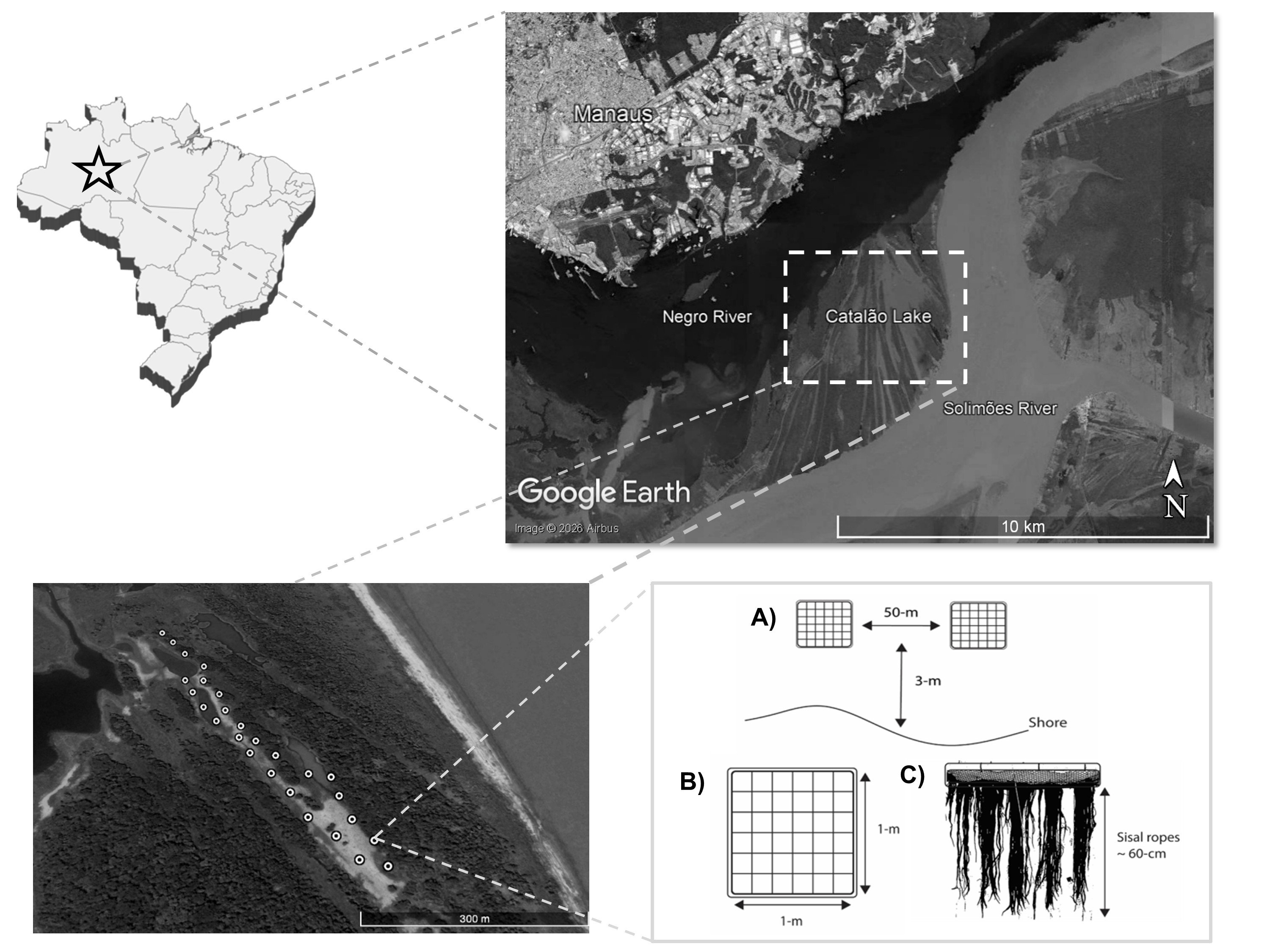
This study was conducted in Catalão Lake (3º10’04”S; 59º54’45”W), located on the floodplain near the confluence between Negro and Solimões rivers, ~10-km from Manaus city (Amazon, Brazil) (Figure 1). Catalão Lake presents an average depth of 10-m, with a variation range of 7-m depending on the season. Aquatic plants are common in the Catalão Lake limits, mostly represented by Lemna valdiviana (Araceae), Paspalum repens (Poaceae), Pistia stratiotes (Araceae) and Salvinia auriculata (Salviniaceae) (Junk & Piedade, 1993; Bleich et al., 2014).
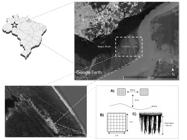
Catalão Lake location showing the distribution of 25 floating artificial islands. (A) The islands were positioned away from the lake shore and spaced apart from each other within the same area; (B) Each island was constructed using PVC pipes and connectors to form a 1-m2 square; (C) 60-cm natural sisal ropes were used to simulate aquatic herbaceous roots.
2.2. Sampling design
The experiment was performed over five days in July 2017 during the receding water level of both rivers, the transition period between the high and low waters. Here, our aim was to conduct the experiment for a week and use this as a proxy for a short timescale. However, due to logistical issues we end up sampling for only five days (six if we count the installation day). Twenty-five artificial “islands” (i.e., floating substrates) were used as substrates to simulate aquatic herbaceous roots (Figure 1). Artificial islands were constructed using four 40-mm diameter PVC pipes and four PVC connectors to form a 1-m2 floating square and coated with a plastic polyethylene screen. To mimic aquatic plants roots, we used 60-cm long sisal ropes (i.e., natural ropes made of Agave sisalana) distributed along the floating square. These same islands were used in a previous study focusing on fish assemblages structure (Rocha et al., 2024) and were initially inspired by the design of Santos et al. (2011).
Artificial islands were placed 3-m from the shore and 50-m from one another to minimize pseudoreplication, and were anchored with heavy rocks. Five experimental treatments were conducted (24, 48, 72, 96, and 120 hours of exposure), with five islands removed per day. Islands were removed randomly using hand nets (1.2-m side; 0.6-m deep; 1-mm mesh). The collected material was washed in a 0.5-mm mesh sieve net and individuals were identified to the family level (mostly) using stereomicroscopes and specialized guides (Hamada et al., 2014). Family-level approaches for studies regarding aquatic insects have been shown to effectively capture multiscale spatial and ecological signals on assemblages, as well as providing similar evidence to genus-level studies (Godoy et al., 2019; Simião-Ferreira et al., 2026).
2.3. Statistical analysis
To test for differences in macroinvertebrate composition among treatments, we performed a multivariate generalized linear model using the manyglm function from the mvabund package (Wang et al., 2012), assuming residuals with negative-binomial distribution. This model approach captures specific effects of location and dispersion without jeopardizing the mean–variance relationship (Warton et al., 2012). To assess the significance of the tests, we used the anova.manyglm function based on Wald's statistic, adjusted PIT-trap method, and p-values from 999 bootstraps (Warton et al., 2017). To visualize possible patterns in macroinvertebrate composition among treatments, we constructed a Non-Metric Multidimensional Scaling (NMDS) ordination plot in the vegan package (Oksanen et al., 2026) through the metaMDS function using a Bray-Curtis distance matrix and 999 permutations. Specific taxa variation along the exposure-time gradient was assessed visually from a direct ordination using the generico function.
To assess if the variation in macroinvertebrate composition among treatments was more related to replacement or nestedness, we performed an extension of Baselga’s incidence-based (presence/absence) dissimilarity (Baselga, 2010) to encompass variations in species composition based on abundance differences using the function beta.multi.abund with Bray-Curtis dissimilarity (Baselga, 2017) from betapart package (Baselga & Orme, 2012). This method is useful for assessing variation in dissimilarity among taxonomic groups, in sets of multiple units (spatial or temporal) (Gómez-Rodríguez, Freijeiro & Baselga 2015; Baselga 2017), and for analyses where occurrence data are redundant. Abundance-based dissimilarity produces two analogous components to incidence-based dissimilarity: balanced variation (βBC.BAL; replacement) and abundance gradients (βBC.GRA; nestedness). Overall dissimilarity is represented by βBC (i.e., βBC = βBC.BAL + βBC.GRA). Component values range from 0, indicating no differentiation, to 1, indicating complete differentiation. We also performed an incidence-based dissimilarity analysis; however, our occurrence data was very redundant and did not capture variation as well as the abundance data. Although the interpretation of the methods was the same. All statistical analyses were performed in the R software version 4.6.0 (R Core Team, 2026).
3. Results
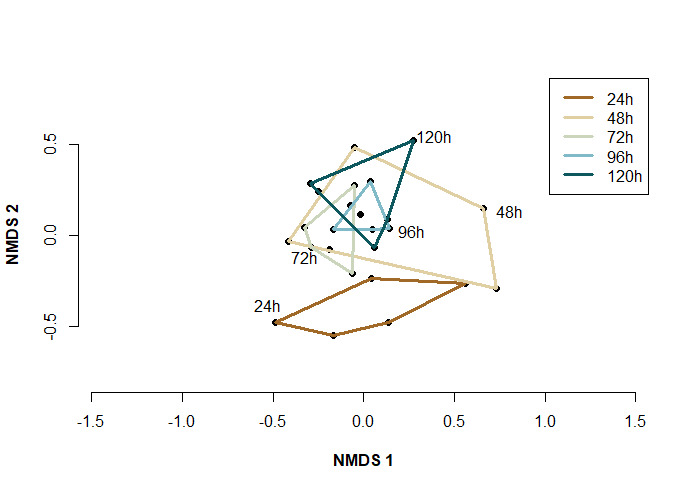
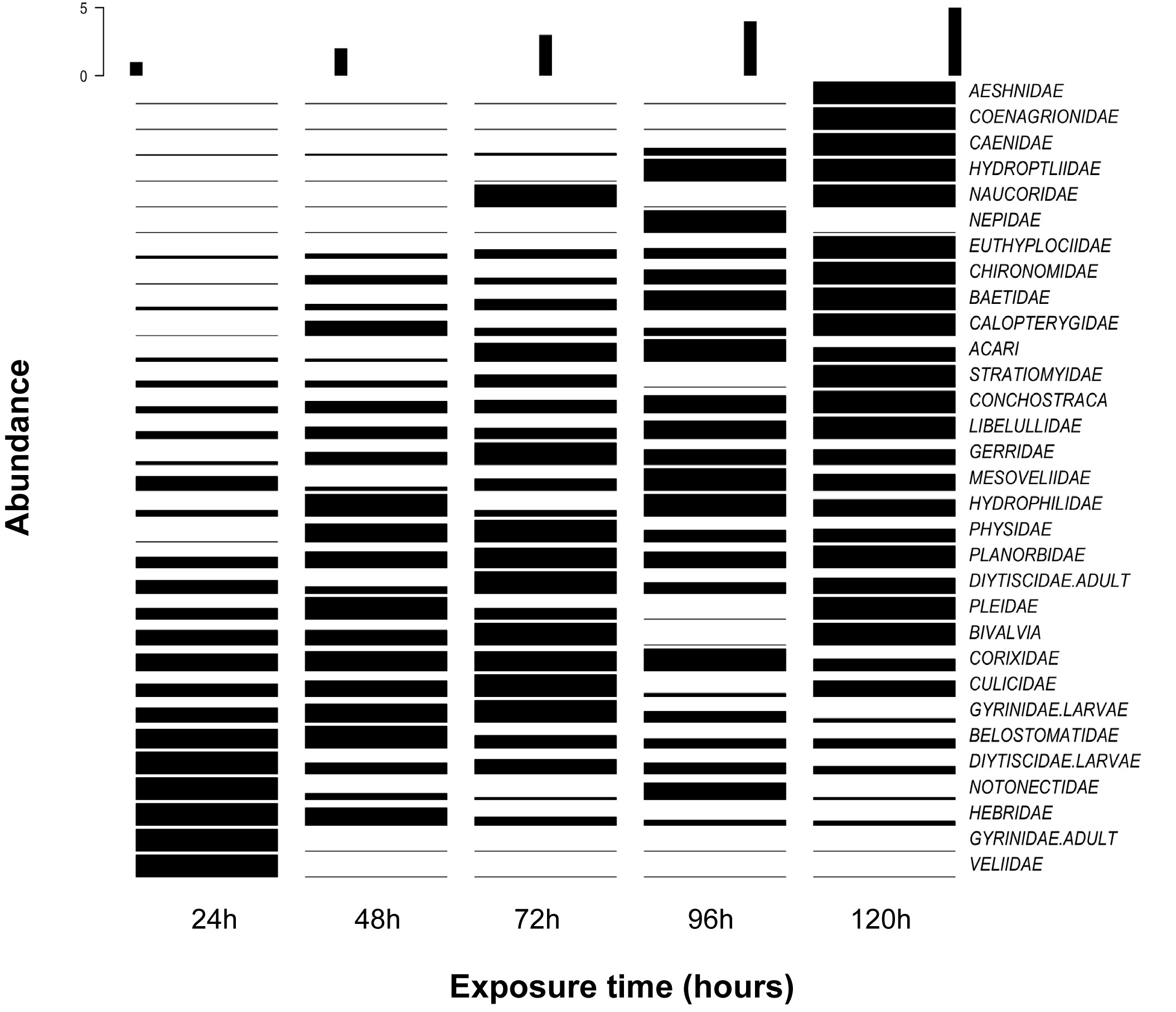
A total of 10,196 macroinvertebrates belonging to 30 taxa were collected (Table 1). Corixidae was the most representative taxon (62.1%), followed by Conchostraca (15.55%) and Planorbidae (10.3%). Macroinvertebrate composition differed significantly among treatments (Wald = 14.21; p = 0.003). Pairwise comparisons indicated that macroinvertebrate composition significantly differed only between the 24h-treatment with treatments 96h and 120h (Table S1, available at data availability). Overall, there was conspicuous overlap in macroinvertebrate composition among treatments, although dissimilarity was particularly observed between the 24h-treatment and the others (Figure 2), which caused most of the variation. Direct ordination of macroinvertebrate composition showed evident taxa variation across the exposure-time gradient, evidenced by a pattern of taxa replacement over time (Figure 3).
Taxa abundance of macroinvertebrates in different hours of exposure in artificial islands in Catalão Lake (Amazonas, Brazil) during July 2017.
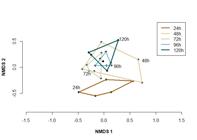
NMDS plot illustrating dissimilarity in macroinvertebrate composition among different exposure times (hours) for macroinvertebrate assemblage of Catalão Lake (Amazonas, Brazil).
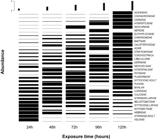
Direct ordination of macroinvertebrate taxa along the exposure-time gradient (hours). Exposure time is presented in ascending order (24h to 120h).
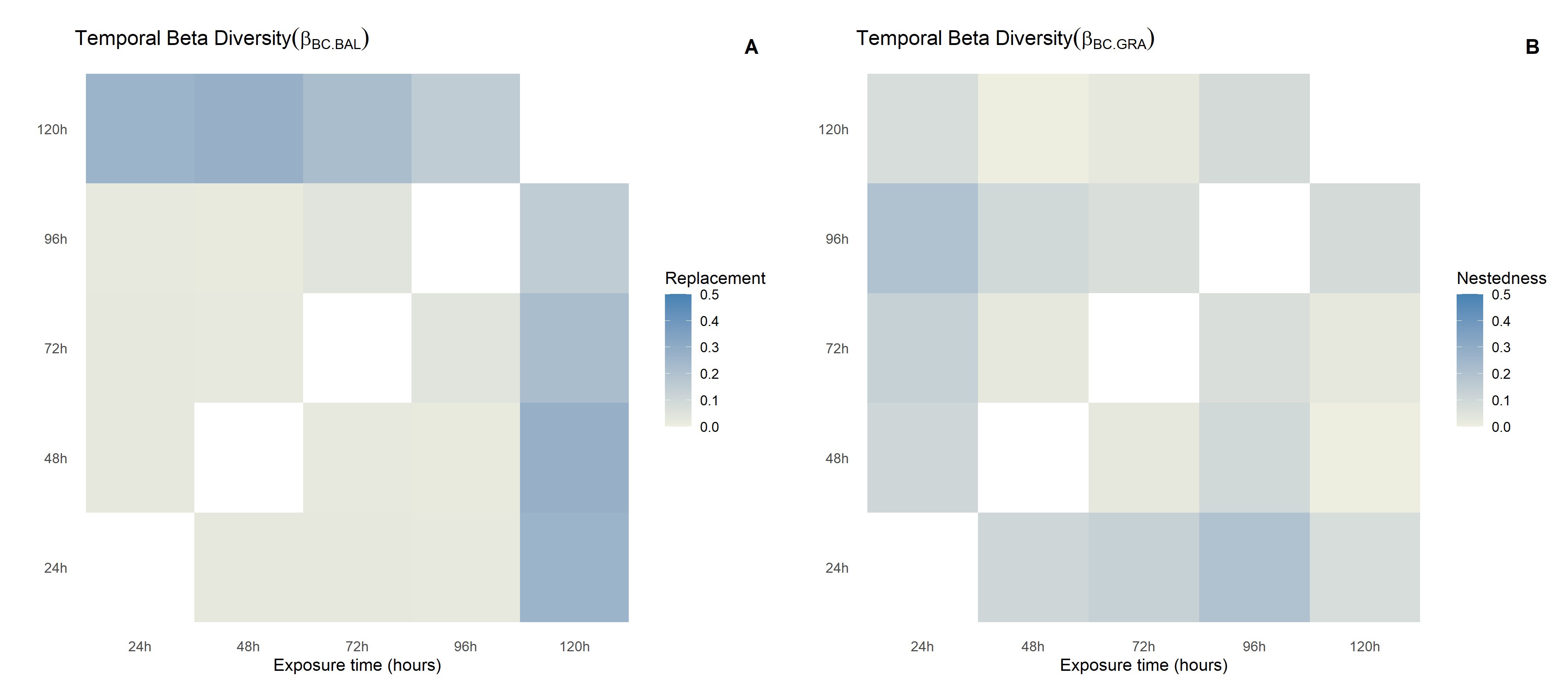
Values for dissimilarity components from balanced variation (βBC.BAL) and abundance gradients (βBC.GRA) were marginally different (βBC.BAL = 0.21; βBC.GRA = 0.12), indicating that taxa replacement, even subtle, contributed more than nestedness to explain macroinvertebrate variation among the treatments, with the differences between the first and the last two days of exposure accumulating most of the variation (Figure 4; Table S2, available at data availability). Although nestedness also had a low relative contribution to taxon variation (Figure 4; Table S3, available at data availability).
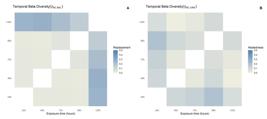
Pairwise comparison for balanced variation component/replacement – βBC.BAL (A) and abundance gradients/nestedness – βBC.GRA (B) between the exposure time periods. Light blue squares indicate low dissimilarity, and dark blue squares indicate high dissimilarity due to taxa replacement or nestedness.
4. Discussion
We demonstrated significant variations in macroinvertebrate composition on artificial substrates over only five days of exposure. The abundance of organisms in a location is mainly dependent on habitat quality (e.g., food availability, predation rates), which influences the likelihood that organisms survive and reproduce in a particular environment (Fonseca & Hart, 2001). Macroinvertebrates rapidly occupied the artificial islands, and changes in the assemblage structure between the first and the last day likely indicate abrupt ecological succession. Moreover, some taxa, such as Corixidae, Planorbidae, and Libellulidae remained present throughout the whole study period. Corixidae encompassed more than 60% of all individuals, and that may be related to its feeding strategies. Unlike most Nepomorpha (i.e., predators), Corixidae species are omnivorous and may feed on algae and plant debris (Hädicke et al., 2017; Schuh & Weirauch, 2020), which our substrate was composed of. On the other hand, Lopes et al. (2011), in their study at the Catalão Lake limits, found dominance of Oligochaeta, Chironomidae, and Hydrophilidae among living aquatic macrophytes, showing that substrate type could influence taxon dominance.
Taxa variation was initiated by individuals from Gyrinidae, Chironomidae, and Corixidae families, which colonized the artificial substrates since the first day, demonstrating that they were pioneers in the colonization process. Chironomidae and Corixidae maintained high dominance throughout the study period, suggesting high tolerance, efficient dispersal, and short life cycles that facilitate rapid colonization (Flory & Milner, 2000; Magossi et al., 2023). Taxa such as Veliidae and Gyrinidae (adult) were present only on the first day, which may be due to their occasional occurrence. By the fifth day of exposure, other taxa, especially predators such as Aeshnidae, Coenagrionidae, and Hidroptilidae, began to colonize, contributing to the gradual change in taxon composition. These taxa would probably not be able to colonize these new substrates before previous organisms arrived (Brower & Zar, 1984; Carvalho & Uieda, 2004), especially as predators, necessitating the presence of prey to establish. It was noticeable that Corixidae and Gyrinidae (larvae) abundance significantly dropped with the arrival of predators, probably in order to avoid predation by them. In the present study, however, the macroinvertebrate assemblage probably had not yet reached equilibrium by the end of the experiment, as its composition was still changing on the last day.
Here, differences in macroinvertebrate composition among days of exposure were more related to taxa replacement than nestedness. This pattern may indicate that habitat heterogeneity (through environmental filtering or species-sorting dynamics) may play a fundamental role in taxa dissimilarity (Leibold et al., 2004; Mittelbach, 2012). However, islands were exposed to similar habitat-resource availability, and taxa replacement may also result from stochasticity (Mateo-Tomás et al., 2019), which may be the case. Moreover, nestedness presented a low relative contribution to taxa dissimilarity, which may be associated with species differential dispersal capacity (Mouquet & Loreau, 2003; Ulrich et al., 2009); although that depends greatly on the scale (e.g., biogeographic, metacommunity) (Gianuca et al., 2017).
Since Catalão Lake did not experience significant environmental variation throughout the experiment and artificial substrates were subject to similar habitat availability, taxa variation was probably caused by sampling and/or random effects, where the method type and period may exert a direct effect on results, as well as stochasticity on species richness and abundance distributions. However, it is difficult to differentiate colonizers exploiting resources from those merely passing by (Benzie, 1984), which could explain the high heterogeneity in the composition of some of the experimental treatments. Nonetheless, the observed variation in taxa composition fits a replacement-biased pattern, showing conspicuous turnover along the time gradient. Although our ecological knowledge at the species level is still lacking, recognizing new patterns for macroinvertebrate fauna at different taxonomic levels can provide crucial information for invertebrate distribution at fine temporal scales for the Amazonia region.
Acknowledgements
We are grateful to Programa de Pós-Graduação em Biologia de Água Doce e Pesca Interior (PPG-BADPI), Programa de Pós-Graduação em Biologia (Ecologia) (PPG-ECO), and Instituto Nacional de Pesquisas da Amazônia (INPA) for logistical and financial support. We would like to thank Jansen Zuanon and Rosseval Leite for participating in data collection and identification, and for their pivotal comments. Special thanks to Neusa Hamada for providing her expertise in structuring this paper. Authors were financially supported with MSc Scholarships by the Coordenação de Aperfeiçoamento Pessoal de Nível Superior (CAPES) and by the Conselho Nacional de Desenvolvimento Científico e Tecnológico (CNPq) during the time of the fieldwork. EPS acknowledges his postdoctoral fellowship funded by PDPG/FAPEAM/CAPES (#88887.234684/2025-00).
Data availability
All data analyzed in the present research is available in the SciELO Dataverse Repository. Access is available in https://doi.org/10.48331/SCIELODATA.0CWCKD.
-
Cite as:
Silva, E.P. et al. Replacement or nestedness: what drives short-scale temporal variation in Amazonian macroinvertebrate assemblage structure? Acta Limnologica Brasiliensia, 2026, vol. 38, e18. https://doi.org/10.1590/S2179-975X7325
References
- Arimoro, F.O., 2013. Colonization and invertebrate succession on mammalian carcasses in Ethiope river, Niger delta, Nigeria. J. Appl. Sci. Res. 1(1), 7-21.
-
Baselga, A., & Orme, C.D.L., 2012. betapart: an R package for the study of beta diversity. Methods Ecol. Evol. 3(5), 808-812. https://doi.org/10.1111/j.2041-210X.2012.00224.x
» https://doi.org/10.1111/j.2041-210X.2012.00224.x -
Baselga, A., 2010. Partitioning the turnover and nestedness components of beta diversity. Glob. Ecol. Biogeogr. 19(1), 134-143. https://doi.org/10.1111/j.1466-8238.2009.00490.x
» https://doi.org/10.1111/j.1466-8238.2009.00490.x -
Baselga, A., 2017. Partitioning abundance-based multiple-site dissimilarity into components: balanced variation in abundance and abundance gradients. Methods Ecol. Evol. 8(7), 799-808. https://doi.org/10.1111/2041-210X.12693
» https://doi.org/10.1111/2041-210X.12693 -
Benzie, J.A.H., 1984. The colonization mechanisms of stream benthos in a tropical river. Hydrobiologia 20, 9-171. https://doi.org/10.1007/BF00007196
» https://doi.org/10.1007/BF00007196 -
Bispo, P.C., Oliveira, L.G., Bini, L.M., & Sousa, K.G., 2006. Ephemeroptera, Plecoptera and Trichoptera from riffles in mountain streams of Central Brazil: environmental factors influencing the distribution e abundance of immatures. Braz. J. Biol. 66(2B), 611-622. PMid:16906293. https://doi.org/10.1590/S1519-69842006000400005
» https://doi.org/10.1590/S1519-69842006000400005 -
Bleich, M.E., Piedade, M.T.F., Knopki, P.B., Castro, N.G.D., Jati, S.R., & Sousa, R.N., 2014. Influência das condições do habitat sobre a estrutura de herbáceas aquáticas na região do Lago Catalão, Manaus, AM. Acta Amazon. 44(4), 481-490. https://doi.org/10.1590/1809-4392201400023
» https://doi.org/10.1590/1809-4392201400023 - Brower, J.E., & Zar, J.H., 1984. Field and laboratory methods for general ecology. Iowa: W.C. Brown Publishers.
-
Carvalho, E.M., & Uieda, V.S., 2004. Colonização por macroinvertebrados bentônicos em substrato artificial e natural em um riacho de serra de Itatinga, São Paulo, Brasil. Revista B. Zoo. 21(1), 287-293. https://doi.org/10.1590/s0101-81752004000200021
» https://doi.org/10.1590/s0101-81752004000200021 -
Castro, D.M.P., do Amaral, P.H.M., van den Berg, E., Hughes, R.M., & Callisto, M., 2025. Spatial and temporal taxonomic and functional beta diversity of macroinvertebrate assemblages along a tropical dammed river. Aquat. Sci. 87(2), 35. https://doi.org/10.1007/s00027-025-01165-3
» https://doi.org/10.1007/s00027-025-01165-3 -
Fisher, R.A., Corbet, A.S., & Williams, C.B., 1943. The relation between the number of species and the number of individuals in a random sample of an animal population. J. Anim. Ecol. 12(1), 42-58. https://doi.org/10.2307/1411
» https://doi.org/10.2307/1411 -
Flory, E.A., & Milner, A.M., 2000. Macroinvertebrate community succession in Wolf Point Creek, Glacier Bay National Park, Alaska. Freshw. Biol. 44(3), 465-480. https://doi.org/10.1046/j.1365-2427.2000.00596.x
» https://doi.org/10.1046/j.1365-2427.2000.00596.x -
Fonseca, D.M., & Hart, D.D., 2001. Colonization history masks habitat preferences in local distributions of stream insects. Ecology 82(10), 2897-2910. https://doi.org/10.1890/0012-9658(2001)082[2897:CHMHPI]2.0.CO;2
» https://doi.org/10.1890/0012-9658(2001)082[2897:CHMHPI]2.0.CO;2 -
Gianuca, A.T., Declerck, S.A., Lemmens, P., & De Meester, L., 2017. Effects of dispersal and environmental heterogeneity onthe replacement and nestedness components of β‐diver-sity. Ecology 98(2), 525-533. PMid:27870011. https://doi.org/10.1002/ecy.1666
» https://doi.org/10.1002/ecy.1666 -
Godoy, B.S., Faria, A.P.J., Juen, L., Sara, L., & Oliveira, L.G., 2019. Taxonomic sufficiency and effects of environmental and spatial drivers on aquatic insect community. Ecol. Indic. 107, 105624. https://doi.org/10.1016/j.ecolind.2019.105624
» https://doi.org/10.1016/j.ecolind.2019.105624 -
Gómez-Rodríguez, C., Freijeiro, A., & Baselga, A., 2015. Dispersal and ecological traits explain differences in beta diversity patterns of European beetles. J. Biogeogr. 42(8), 1526-1537. https://doi.org/10.1111/jbi.12523
» https://doi.org/10.1111/jbi.12523 -
Grimm, N.B., & Fisher, S.G., 1989. Stability of periphyton and macroinvertebrates to disturbance by flash floods in a desert stream. J. N. Am. Benthol. Soc. 8(4), 293-307. https://doi.org/10.2307/1467493
» https://doi.org/10.2307/1467493 -
Hädicke, C.W., Rédei, D., & Kment, P., 2017. The diversity of feeding habits recorded for water boatmen (Heteroptera: Corixoidea) world-wide with implications for evaluating information on the diet of aquatic insects. Eur. J. Entomol. 114, 147-159. https://doi.org/10.14411/eje.2017.020
» https://doi.org/10.14411/eje.2017.020 - Hamada, N., Nessimian, J.L., & Querino, R.B., 2014. Insetos aquáticos na Amazônia brasileira: taxonomia, biologia e ecologia Manaus: Editora INPA.
-
Heino, J., Melo, A.S., & Bini, L.M., 2015a. Reconceptualising the beta diversity-environmental heterogeneity relationship in running water systems. Freshw. Biol. 60(2), 223-235. https://doi.org/10.1111/fwb.12502
» https://doi.org/10.1111/fwb.12502 -
Heino, J., Soininen, J., Alahuhta, J., Lappalainen, J., & Virtanen, R., 2015b. A comparative analysis of metacommunity types in the freshwater realm. Ecol. Evol. 5(7), 1525-1537. PMid:25897391. https://doi.org/10.1002/ece3.1460
» https://doi.org/10.1002/ece3.1460 -
Hepp, L.U., Landeiro, V.L., & Melo, A.S., 2012. Experimental assessment of the effects of environmental factors and longitudinal position on alpha and beta diversities of aquatic insects in a neotropical stream. Int. Rev. Hydrobiol. 97(2), 157-167. https://doi.org/10.1002/iroh.201111405
» https://doi.org/10.1002/iroh.201111405 -
Hepp, L.U., Milesi, S.V., Nava, D., & Restello, R.M., 2021. Nestedness of stream insects in Subtropical region: importance of inter-annual temporal scale. Iheringia Ser. Zool. 111, e2021005. https://doi.org/10.1590/1678-4766e2021005
» https://doi.org/10.1590/1678-4766e2021005 - Junk, W.J., & Piedade, M.T.F., 1993. Herbaceous plants of the Amazon floodplains near Manaus: species diversity and adaptations to the flood pulse. Amazoniana 12(3/4), 467-484.
- Junk, W.J., Bayley, P.B., & Sparks, R.E., 1989. The flood pulse concept in river floodplain systems. Can. Spec. Publ. Fish. Aquat. Sci. 106, 110-127.
-
Korhonen, J.J., Soininen, J., & Hillebrand, H., 2010. A quantitative analysis of temporal turnover in aquatic species assemblages across ecosystems. Ecology 91(2), 508-517. PMid:20392015. https://doi.org/10.1890/09-0392.1
» https://doi.org/10.1890/09-0392.1 -
Leenheer, J.A., 1980. Origin and nature of humic substances in the waters in the Amazon river basin. Acta Amazon. 10(3), 513-526. https://doi.org/10.1590/1809-43921980103513
» https://doi.org/10.1590/1809-43921980103513 -
Leibold, M.A., Holyoak, M., Mouquet, N., Amarasekare, P., Chase, J.M., Hoopes, M.F., Holt, R.D., Shurin, J.B., Law, R., Tilman, D., Loreau, M., & Gonzalez, A., 2004. The metacommunity concept: a framework for multi-scale community ecology. Ecol. Lett. 7(7), 601-613. https://doi.org/10.1111/j.1461-0248.2004.00608.x
» https://doi.org/10.1111/j.1461-0248.2004.00608.x -
Leung, A.S.L., & Dudgeon, D., 2011. Scales of spatiotemporal variability in macroinvertebrate abundance and diversity in monsoonal streams: detecting environmental change. Freshw. Biol. 56(6), 1193-1208. https://doi.org/10.1111/j.1365-2427.2010.02556.x
» https://doi.org/10.1111/j.1365-2427.2010.02556.x -
Lopes, A., Paula, J.D., Mardegan, S.F., Hamada, N., & Piedade, M.T.F., 2011. Influência do habitat na estrutura da comunidade de macroinvertebrados aquáticos associados às raízes de Eichhornia crassipes na região do Lago Catalão, Amazonas, Brasil. Acta Amazon. 41(4), 493-502. https://doi.org/10.1590/S0044-59672011000400007
» https://doi.org/10.1590/S0044-59672011000400007 -
Magossi, I.G., Silva, L.B.L., Milesi, S.V., & Hepp, L.U., 2023. Efeito do substrato sobre a estrutura e composição dos invertebrados aquáticos em um riacho de Cerrado. Rev. Perspect. (Cochambamba) 47(177), 9-19. https://doi.org/10.31512/persp.v.47.n.177.2023.333.p.9-19
» https://doi.org/10.31512/persp.v.47.n.177.2023.333.p.9-19 -
Mateo-Tomás, P., Olea, P.P., Selva, N., & Sánchez-Zapata, J.A., 2019. Species and individual replacements contribute more than nestedness to shape vertebrate scavenger metacommunities. Ecography 42(2), 365-375. https://doi.org/10.1111/ecog.03854
» https://doi.org/10.1111/ecog.03854 -
Melo, A.S., & Froehlich, C.G., 2001. Macroinvertebrates in neotropical streams: richness patterns along a catchment and assemblage structure between 2 seasons. J. N. Am. Benthol. Soc. 20(1), 1-16. https://doi.org/10.2307/1468184
» https://doi.org/10.2307/1468184 -
Milesi, S.V., Biasi, C., Restello, R.M., & Hepp, L.U., 2008. Efeito de metais Cobre (Cu) e Zinco (Zn) sobre a comunidade de macroinvertebrados bentônicos em riachos do sul do Brasil. Acta Sci. Biol. Sci. 30(3), 283-289. https://doi.org/10.4025/actascibiolsci.v30i3.677
» https://doi.org/10.4025/actascibiolsci.v30i3.677 -
Milesi, S.V., Dolédec, S., & Melo, A.S., 2016. Substrate heterogeneity influences the trait composition of stream insect communities: an experimental in situ study. Freshw. Sci. 35(4), 1321-1329. https://doi.org/10.1086/688706
» https://doi.org/10.1086/688706 - Mittelbach, G., 2012. Community ecology. Massachusetts: Sinauer Associates.
-
Monk, W.A., Wood, P.J., Hannah, D.M., & Wilson, D.A., 2008. Macroinvertebrate community response to inter-annual and regional river flow regime dynamics. River Res. Appl. 24(7), 988-1001. https://doi.org/10.1002/rra.1120
» https://doi.org/10.1002/rra.1120 -
Mouquet, N., & Loreau, M., 2003. Community patterns in source-sink metacommunities. Am. Nat. 162(5), 544-557. PMid:14618534. https://doi.org/10.1086/378857
» https://doi.org/10.1086/378857 -
Oksanen, J., Blanchet, F.G., Kindt, R., Legendre, P., Minchin, P.R., O’Hara, R.B., Simpson, G.L., Sólymos, P., Stevens, M.H.H., & Wagner, H., 2026. vegan: Community Ecology Package [online]. Retrieved in 2026, October 10, from http://CRAN.R-project.org/package=vegan
» http://CRAN.R-project.org/package=vegan -
Peralta, R.H.L., & Martin, G.M.T., 2015. Densidad larval de Chironomidae (Insecta: Diptera) em un meandro del río Bogotá (Cajicá, Colombia) durante La niña 2011. Rev. Facul. Cienc. 11(1), 48-67. https://doi.org/10.18359/rfcb.381
» https://doi.org/10.18359/rfcb.381 -
Petrucio, M.M., & Esteves, F.A., 2000. Uptake rates of nitrogen and phosphorus in the water by Eichhornia crassipes and Salvinia auriculata. Rev. Bras. Biol. 60(2), 229-236. PMid:10959106. https://doi.org/10.1590/S0034-71082000000200006
» https://doi.org/10.1590/S0034-71082000000200006 -
Pires, T.H.S., Santorelli Junior, S., Cardoso, G.H.M., Verba, J.T., Florentino, A.C., & Farago, T.L.B., 2023. Macrophyte islands as an experimental model: new perspectives and a step-by-step protocol to access assumptions of Island Biogeography theory and habitat fragmentation. Acta Biol. Parana. 52(1), 1-9. https://doi.org/10.5380/abp.v52i1.88744
» https://doi.org/10.5380/abp.v52i1.88744 -
Preston, F.W., 1960. Time and space and the variation of species. Ecology 41(4), 612-627. https://doi.org/10.2307/1931793
» https://doi.org/10.2307/1931793 -
R Core Team, 2026. A language and environment for statistical computing [online]. R Foundation for Statistical Computing. Retrieved in 2026, October 10, from https://www.R-project.org/
» https://www.R-project.org/ -
Ribas, C.C., Sawakuchi, A.O., de Almeida, R.P., Pupim, F.N., Rego, M.A., Batista, R., & Knowles, L.L., 2025. The role of rivers in the origin and future of Amazonian biodiversity. Nat. Rev. Biodivers. 1(1), 14-31. https://doi.org/10.1038/s44358-024-00001-0
» https://doi.org/10.1038/s44358-024-00001-0 -
Rocha, S.I.B., Pires, T.H.S., Amadio, S.A., Röpke, C., & Deus, C.P., 2024. Fish attractors when resources abound: prevalence of juveniles and lack of assemblage structure in a field experiment in the Amazon floodplain. Biota Neotrop. 24(1), e20231518. https://doi.org/10.1590/1676-0611-BN-2023-1518
» https://doi.org/10.1590/1676-0611-BN-2023-1518 -
Santos, L.N., Agostinho, A.A., Alcaraz, C., Carol, J., Santos, A.G.N., Tedesco, P., & García-Berthou, E., 2011. Artificial macrophytes as fish habitat in a Mediterranean reservoir subjected to seasonal water level disturbances. Aquat. Sci. 73(1), 43-52. https://doi.org/10.1007/s00027-010-0158-3
» https://doi.org/10.1007/s00027-010-0158-3 - Schuh, R.T., & Weirauch, C., 2020. True bugs of the world (Hemiptera: Heteroptera): classification and natural history. 2nd ed. Rochdale: Siri Scientific Press, vol. 8.
-
Simião-Ferreira, J., Almeida, I.M.P., Moreira, V.Y.S., Barbosa, H.O., Silva, D.P., Lodi, S., Albeny-Simões, D., Vieira, M.C., Pereira, H.R., & Godoy, B.S., 2026. Multiscale environmental drivers of aquatic insect assemblages in cerrado streams. Austral Ecol. 51(3), e70203. https://doi.org/10.1111/aec.70203
» https://doi.org/10.1111/aec.70203 - Sioli, H., 1950. Das wasser in Amazonasgebeit. Forsch. Fortschr. 26, 274-280.
-
Tonkin, J.D., Stoll, S., Jähnig, S.C., & Haase, P., 2016. Contrasting metacommunity structure and beta diversity in an aquatic-floodplain system. Oikos 125(5), 686-697. https://doi.org/10.1111/oik.02717
» https://doi.org/10.1111/oik.02717 -
Ulrich, W., Almeida-Neto, M., & Gotelli, N.J., 2009. A consumer’s guide to nestedness analysis. Oikos 118(1), 3-17. https://doi.org/10.1111/j.1600-0706.2008.17053.x
» https://doi.org/10.1111/j.1600-0706.2008.17053.x - Wallace, A.R., 1853. A narrative of travels on the amazon and rio negro: with an account of the native tribes, and observations on the climate, geology, and natural history of the Amazon Valley. London: Reeve and Co.
-
Wang, Y., Naumann, U., Wright, S.T., & Warton, D.I., 2012. mvabund– an R package for model-based analysis of multivariate abundance data. Methods Ecol. Evol. 3(3), 471-474. https://doi.org/10.1111/j.2041-210X.2012.00190.x
» https://doi.org/10.1111/j.2041-210X.2012.00190.x -
Warton, D.I., Thibaut, L., & Wang, Y.A., 2017. The PIT-trap: a “model-free” bootstrap procedure for inference about regression models with discrete, multivariate responses. PLoS One 12(7), e0181790. PMid:28738071. https://doi.org/10.1371/journal.pone.0181790
» https://doi.org/10.1371/journal.pone.0181790 -
Warton, D.I., Wright, S.T., & Wang, Y., 2012. Distance-based multi variate analyses confound location and dispersion effects. Methods Ecol. Evol. 3(1), 89-101. https://doi.org/10.1111/j.2041-210X.2011.00127.x
» https://doi.org/10.1111/j.2041-210X.2011.00127.x - Williams, C.B., 1964. Patterns in the balance of nature and related problems in quantitative ecology. London: Academic Press.
-
Wolters, J., Reitsema, R.E., Verdonschot, R.C.M., Schoelynck, J., Verdonschot, P.F.M., & Meire, P., 2019. Macrophyte‐specific effects on epiphyton quality and quantity and resulting effects on grazing macroinvertebrates. Freshw. Biol. 64(6), 1131-1142. https://doi.org/10.1111/fwb.13290
» https://doi.org/10.1111/fwb.13290
Edited by
-
Associate Editor:
Danielle Katharine Petsch.