
 DESCRIPTION AND ANALYSIS OF ARGUMENTATIVE ASSIMILATION
ABSTRACT
In this work, we present the description of an interactional and argumentative phenomenon that we have named “argumentative assimilation,” which represents the moment when two recalcitrant, antagonistic discourses begin to represent an argumentative alignment, due to the opponent’s adherence to the proponent’s speech. By revisiting rhetorical studies, we question the dichotomy “persuade” vs. “convince” ( Perelman; Olbrechts-Tyteca, 2008 ; Perelman, 1989 , 1999 , 2002 ; Meyer, 2008a, 2008b; Grize, 1995 ; Angenot, 2008 ), to demonstrate four stages of the argumentative assimilation process, via Venn’s Diagram. By using a methodology focused on the study of verbal interactions, and also supported by studies of conversational analysis and the Dialogical Model of Argumentation ( Plantin, 2008 , 2016 ; Plantin; Doury, 2015; Traverso, 2007 ; Kerbrat-Orecchioni, 1992 , 2011 ; Damasceno-Morais, 2021 , 2022 , 2023a , 2023b ), we present an analysis of a case study, from the ‘TRIBUNAL’ database, which illustrates the phenomenon. We conclude that the study of argumentation from an interactional perspective is fruitful in helping us to understand similar phenomena, which would not be possible if we strictly followed studies of argumentation simply from a logical-mathematical and formalist perspective, in a Cartesian ideal.
KEYWORDS:
Persuasion; Conviction; Dialogical Model of Argumentation; Interaction; Moral Damage
RESUMO
Apresentamos, neste trabalho, a descrição de um fenômeno interacional e argumentativo que nomeamos de “assimilação argumentativa”, o qual representa o momento em que dois discursos recalcitrantes, antagônicos, passam a representar um alinhamento argumentativo, a partir da adesão à fala de um proponente por um oponente. A partir de uma revisão dos estudos retóricos, problematizamos a dicotomia “persuadir” vs. “convencer” (Perelman; Olbrechts-Tyteca, 2008; Perelman, 1989, 1999, 2002; Meyer, 2008a, 2008b; Grize, 1995; Angenot, 2008), com o objetivo de mostrar a atuação das quatro etapas do processo de assimilação argumentativa, via Diagrama de Venn. Por meio de metodologia que preconiza o estudo da argumentação com foco na interação verbal e, ainda, com amparo nos estudos da análise conversacional e do Modelo dialogal da argumentação (Plantin, 2008, 2016; Plantin; Doury, 2015; Traverso, 2007; Kerbrat-Orecchioni, 1992, 2011; Damasceno-Morais, 2021, 2022, 2023a, 2023b), apresentamos análise de um estudo de caso, oriundo do banco de dados ‘Tribunal’, e que ilustra o fenômeno. Concluímos que o estudo da argumentação numa perspectiva interacional é profícuo para nos ajudar a enxergar fenômenos afins, o que não seria possível se seguíssemos à letra os estudos da argumentação em perspectiva meramente lógico-matemática e formalista, num ideal cartesiano que deixa de fora o olhar para as idiossincrasias do fio da interação argumentativa.
PALAVRAS-CHAVE:
Persuasão; Convencimento; Modelo dialogal da argumentação; Interação; Dano moral
Neither Persuading nor Convincing
In our attempt to understand how the fields of rhetorical and argumentative studies have dialogued, we are troubled by a certain fragility in the dichotomy between the terms ‘persuade’ and ‘convince’. Beyond a classic dichotomy, we see various epistemological idiosyncrasies there. Broadly speaking, it seems to us that the most notable difference between persuasion and conviction is that the former (persuasion) more easily refers to the idea of intensifying subjectivities, in the realm of emotions. Therefore, persuasive factors in discourse retain a remnant of “irrationality,” sophistry, whereas conviction would be more associated with the “rationalizing” aspect of beings, more linked to the rationalizing dimension of beings, to reason. Thus, persuasion pervades the universe of everyday, ordinary relationships, but would be unwelcome, for example, in the world of exact sciences; while conviction would be more associated with the realm of “reason with scientific airs” or, at least, reason that needs to “seem reasonable,” as in judgments rendered in court verdicts, in the universe of judicial sentences and judgments of moral damage, for example, as we will show in this paper.
The issue is not simple. The highlighted dichotomy has given much to talk about since Plato’s discomfort with the sophists. It is important to clarify that we disagree with some rumors that associated ‘persuasion’ with the idea of ‘manipulation’ ( Nettel, 2011 , p. 1357)1. We do not have time to reconstruct the entire secular quarrel involving the ancient Greeks, who, justly and ironically, have taught us much in matters of rhetoric and dialectic, the latter now placed, nowadays, in the isolated drawer labelled ‘argumentation.’ In this sense, looking at the pair ‘persuasion vs . conviction’ seems important to us, especially because today it is almost automatic to associate conviction with reason and persuasion with emotion , a notion we find lacking a solid explanation. This, in broad terms, is the issue under discussion in this study.
It is quite true that Perelman and Olbrechts-Tyteca’s Treatise (2008, p. 34) has already discussed the conceptual opposition between persuading and convincing, but without making much contribution, precisely because they merely reinforce the existing dichotomy. The Kantian view of persuasion related to the realm of subjectivity, opinion, suggestion, and appearance is clear in the same Treatise (p. 51). Perelman (2002 , p. 37) also emphasizes, in his Rhetorical Empire, that a convincing discourse is one whose premises and arguments are universalized, that is, acceptable, in principle, by all members of a universal audience. For the author, moreover, “demonstrative proof, that of formal logic, is more than persuasive, it is convincing, as long as the truth of the premises is admitted” ( Perelman, 1999 , p. 106).
Clearly, persuasion is situated in the territory of alterity, since no one persuades themselves. However, one can convince oneself (Chaignet, 1888, p. 93 apud Perelman, 2002 , p. 33). The author also believes that persuasion is a matter of a particular audience, while conviction engages a universal audience, that is, “every being of reason” ( Perelman, 2002 , p. 36-37). Following these discussions, the idea of “adherence” resonates with the notion of “communion of minds/spirits,” as highlighted in the initial pages of the Treatise, whereas conviction aligns with “logic” and “abstract truth” ( Perelman, 1989 , p. 79; Martineau, 2010 , p. 5).
In this context, when examining the etymology of the term “persuade,” Plantin (2016 , p. 450) notes that “this family also includes the proper name Peithô, the name of Aphrodite’s companion – perhaps Aphrodite herself - goddess of beauty, seduction, and persuasion.” Not far from this, Danblon (2005 , p. 8) clarifies that the notion of persuasion is close to the image of the femme fatale , describing her as “a destroyer of reason and social bonds, viewed with fear and fascination.” We add to these observations that Aristotle’s rhetorical proofs associate ethos and pathos with the domain of emotions, subjectivity, and imagination, while logos , this would belong to the domain of emerging discourse, reason, and cold argumentation.
Returning to the classic Treatise ( Perelman; Olbrechts-Tyteca, 2008 , p. 35), which brings the dichotomy to the scene, the authors state that “for Rousseau, it is pointless to convince a child if we are not able to persuade him.” The authors say: “a person may even be convinced of the dangers of chewing too quickly, but that does not guarantee that they will change their habits” (Perelman; Olbrechts-Tyteca, p. 36). From these examples, a kind of ambivalent scale is given life, with ‘conviction’ at one end and ‘persuasion’ at the other, through which, depending on the focus, convincing may be more or less valuable than persuading. And that does not simplify this classical debate.
Plantin (2016 , p. 452), further distinguishing between persuading and convincing, explains that, in English, the verb convince is used primarily in situations where beliefs are modified, but without leading to a change of habits (or without passing to action), while the term persuade presupposes the passage to action, the performance of an act. The author shows that persuasion, generating a perlocutionary act, would result from the realization of the speaker’s probable intentions, which aligns with and reinforces the antagonism of the classic dichotomy we dare to question here.
Authors like Grize (1995 , p. 264) draw this distinction when they state: “one may be convinced, but there is no guarantee that one has been persuaded”. In fact, this type of categorical statement is barely evident, because, after all, where are the limits between such concepts? Where/when does ‘persuasion’ begin and where/when does ‘conviction’ end? It is from this intricate opposition that we will try to propose and show another way of seeing the intersection of the idea of ‘persuasion’ with the notion of ‘conviction,’ based on the database we have developed for this research (corpus TRIBUNAL), given our dissatisfaction with the oversimplification of this theme – a theme often treated as self-evident when it is not. For our part, in the analysis presented in this paper, we will use these terms as complementary, that is, in a non-agonistic manner.
Thus, instead of struggling to understand/demonstrate the difference between ‘persuading/convincing’ or attempting to pinpoint the exact moment when someone was (or is said to have been) ‘persuaded/convinced,’ we will examine the strategic value of a word, a phrase, or an intervention in the data we will analyze. We aim to capture the moment when an interlocutor (a magistrate) adheres to an idea, a phrase, or a position during a deliberation in a Second-Instance moral damage judgment. This approach seems more sensible than insisting on the opposition between persuasion or conviction – terms that are often indistinguishable (Meyer, 2008a, p. 34). For Angenot (2008 , p. 93), moreover, one cannot build a science by discussing an ideal form of effectiveness, persuasion, which, according to the author, occurs far less frequently than we might imagine, like he shows in his book “Dialogues de sourds”.
Our interest in this article is to analyze the moments in a legal deliberation where some form of ‘adherence’ to someone’s argumentation occurs, precisely because we lack the means to map the cognitive pathways that lead someone (a magistrate, for instance) to change their mind when judging a case in the context of moral damage (corpus TRIBUNAL). As Posner (2008 , p. 377) observes, “what leads a magistrate to adhere to a decision is often unknown.” Therefore, we will not fall into the trap of trying to guess whether a magistrate was convinced or persuaded at moment z of a deliberation. We leave the task of cognitive studies to linguists specializing in cognition, medical professionals, and psychologists, as they may (maybe) possess the necessary tools to address the mental processes responsible for someone’s actions, particularly because we recognize that “the reasons for an audience’s adherence to a thesis may vary” ( Martineau, 2010 , p. 6).
Since the burden of proof lies with those who challenge doxa, our goal is to demonstrate, based on the analysis we propose below, why it is more profitable to discuss adhesion rather than to keep trying to dissect poorly indigested pieces of presumable persuasion or conviction in another’s speech. But first, we need to contextualize the source of the data we will analyze, which forms part of the ‘ Corpus TRIBUNAL’ database.
The ‘TRIBUNAL’ Database
The immersion in the database we have, named TRIBUNAL2, primarily consists of moral damage trials that took place from 1995 to 2005 in a Brazilian Second Instance court whose identity will not be revealed in this paper3. However, regarding the corpus we present here, it consists of secondary data4from judgments whose trials were all published in the form of rulings and are publicly available on the institution’s website. Regarding the deliberation process and legal ritual, we understand that each trial involves two distinct stages: Stage 1, the moment when the magistrates qualify an act (lawful or unlawful), and Stage 2, when the magistrates define the amount of moral damage (if someone has deemed an action unlawful). Already in the first stage, magistrates must decide whether, based on the criteria of the law and the evidence presented during the First-Instance judgment, the claimant has indeed suffered the alleged moral damage. If the answer is negative, that is, if the magistrates are convinced that there was no illegality in the alleged action, the judgment comes to an end, and the question of the amount will not even be addressed. However, if the answer is affirmative, that is, if the magistrates consider an unlawful act to be present, then the second stage of the judgment begins and the session must determine the amount that will be paid (the moral damage), commonly known as pretium doloris (the price of pain).
For many jurists, the moment of determining the amount to be paid is considered the “Achilles’ heel” of the Judiciary, given the uncertainties and difficulties of quantifying the illegality of an action in this context of moral damage (Teodoro Júnior, 2007, p. 43). This, incidentally, indicates that the study of moral damage has been a topic of interest in the legal world since the promulgation of the 1988 Constitution ( Coelho, 2009 ; Cianci, 2003 ; Oliveira, 2006 ; Reis, 2010 ; Leite, 2002 ), when such cases began to be arbitrated.
In the court, hearings are generally public, except in cases under judicial secrecy (to which we do not have access). Depending on the nature of the case, a deliberation always involves at least three magistrates. At the beginning of each deliberation, the Reporting Magistrate (hereafter Rep) presents their vote (prepared before the session); however, as the debate progresses, nothing prevents him from changing his decision orally. The “product” of the deliberation is called a ruling, a type of sentence. The role of the magistrate acting as the reporter is primarily to examine the case thoroughly and take a position on the facts – either opposing or supporting the decision made by the First-Instance magistrate. They also need to justify their choices, that is, they need to argue to support their position.
After the vote of the Reporting Magistrate (Rep), the First Assessor (A1) will be the second to reveal his vote. In this way, A1 will agree or disagree with the vote cast by Rep. The third judge, or the Second Assessor (A2), who generally does not know the case in detail, will vote based on the debate between Rep and A1, which takes place before his eyes. A2 will then be the last to cast his vote, and the result of the deliberation will be announced by the session’s president (Rep). This is, in a very schematic way, how Second Instance Court judgments take place between Rep, A1, and A2. We will return to this when presenting the analysis through which we will describe how adhesion to a standpoint occurs at a deliberation table.
Marks of the adhesion process
As stated, in describing the data presented here, and for the reasons previously explained, we deem it appropriate to treat the terms persuasion and conviction as equivalent, avoiding the naturalized and confusing dichotomy problematized earlier. Our interest lies in the marks and manifestations of adhesion to a standpoint, a vote, during the moments of interaction between the magistrates, especially in moments of conflict of opinions at a deliberation table. From the perspective of the Dialogical Model of Argumentation ( Plantin, 2008 , 2016 ; Damasceno-Morais, 2023b), henceforth DMA, we will refer to stasis when there is a divergence of standpoints in a heated debate “ à vif et à chaud ” ( Cornu, 2005 , p. 252), that is, “in the heat of the moment,” in the thread of an argumentative interaction.
Our goal is to identify textual marks that indicate the resolution of a stasis ( Plantin, 2016 , p. 548), that is, a conflict of opinions, when one magistrate adheres to the propositions of a deliberating colleague. Thus, based on the construction of dialectical and argumentative reasoning between interactants, we aim not only to highlight the marks of adherence present in moments of stasis but also to go beyond merely cataloging the frequent “I agree!” often repeated by magistrates in the TRIBUNAL corpus. This phrase exemplifies the most automatic way a magistrate aligns with another’s opinion, particularly because “we generally speak to exert influence” (Ducrot; Anscombre, 1983, p. 7).
We will therefore examine excerpts where one speaker’s statements are extended or reappropriated by another speaker as a form of argumentative alignment ( Plantin, 2016 , p. 45). The New Rhetoric has already paved the way for this type of analysis, since, as we know, the objective of Perelman and Olbrechts-Tyteca (2008) was to closely observe the reciprocal influence a speaker exerted over their audience in the dynamics of persuasive discourse. However, we disagree with how these authors endorsed the dichotomy persuasion vs. conviction.
It is important to note that magistrates in Second Instance do not always aim to openly influence their colleagues. However, in our observation of the available database, we noticed that whenever possible, the Second Instance panel seeks unanimity in votes to demonstrate the cohesion of the Chamber. While such moments of judgment lack a “confessed argumentative intent” from each magistrate ( Amossy, 2000 , p. 226), a unanimous vote rather than a majority vote effectively reflects the strength of the final decision by the judging chamber and, consequently, the legal and argumentative alignment of the collegiate body in deliberation.
Nevertheless, if a judgment is concluded by a majority vote (as opposed to unanimity), it means that a conflict of opinions (argumentative stasis) remains unresolved, even if a verdict has been reached, thus characterizing an agonistic situation that generates a stasic situation5(Damasceno-Morais, 2023a, p. 31).
The phenomenon of “argumentative assimilation,” which we will describe and present below, is a form of argumentative adherence among magistrates at a deliberation table. The term “assimilation,” as used in this work to represent the outcome of an adherence process, is a prolific term because it is used in various fields to indicate numerous processes/phenomena in areas such as Physiology, Sociology, and Philosophy6, to name just a few.
Here, “assimilation” is described as a type of positive amalgam being the result of the fusion of two interactants’ speeches, unlike the “amalgam” discussed by Doury (2003) , which is synonymous with “confusion of ideas,” a kind to mixing “apples and oranges” or even a ‘sophism’ – a biased and fallacious mixing of subjects to confuse the interlocutor. However, in the description and analysis presented below, we will show how “assimilation/amalgam” is closer to the irenic (peaceful) side than the agonistic (conflictual) side, in Kerbrat-Orecchioni’s terms (1992, p. 36). This perspective underscores the importance of such a phenomenon in argumentation studies, as proclaimed by the New Rhetoric when authors discuss the “adhesion of spirits “to a thesis ( Perelman; Olbrechts-Tyteca, 2008 , p. 5).
Description of the argumentative assimilation process
In the TRIBUNAL corpus, the principle of adhesion is quite fundamental, as we will outline below. After multiple reviews of recorded Second Instance judgments ( Damasceno-Morais, 2021 ), we noticed that throughout some deliberations, stasis was not resolved by the simple and classic assertion of agreement among interactants, often represented by the expression “I agree!” The exploration of the TRIBUNAL database revealed that assent/alignment, at times, was expressed differently – through a form of reappropriation of arguments by one interlocutor from another, during moments of opinion conflict. This reappropriation acted as a “perlocutionary effect” ( Austin, 1970 , p. 129), resulting from a preceding action and serving as the output of the adherence process . The agreement pronounced by one of the interactants was the result of arguments being appropriated – a form of resumption or even absorption of the other’s words.
The argumentative assimilation process has characteristics of a negotiation process, intertwined with “adjustment mechanisms” ( Kerbrat-Orecchioni, 2011 , p. 92) or “micro-adjustments” ( Plantin, 2016 , p. 207) during overlapping turns of speech. At the deliberation table, we observe a “change in the disposition of the interlocutors” ( Nettel, 2011 , p. 1359), characteristic of the persuasion process, which does not necessarily happen in a negotiation process. During the assimilation process, the interlocutor/magistrate “persuaded/convinced” will end up succumbing to the arguments of whom they previously disagreed with. This type of argumentative relationship is organized into four movements:
In mathematics and logic, one of the most used schemes for representing spatial relationships is the Venn diagram7, which can be employed to organize and visualize relations among events. We draw on this idea to illustrate the moment when the opponent’s speech aligns with the proponent’s. For that, we present some figures, in a schematic presentation, to describe the interactive-argumentative process that represents what we call assimilation in the deliberation table among REP, A1, and A2:
In Figure 1 , the single lines connecting the interactants represent the standard connection among the panel members (REP, A1, A2), where magistrates exchange opinions without significant conflict or sharp opposition of viewpoints. In the TRIBUNAL corpus, some cases feature a wavy line connecting interactants, indicating a more pronounced statistic, with conflicting argumentation and difficulty in adherence among members’ opinions during debate. If two lines connect interactants (not even one), we consider the stasis irreversible, that is, X does not agree with Y at all. It is also important to remember that, in Second Instance trials, the magistrates are reviewing a sentence previously given by a First Instance judge (FIJ) and contested by one of the parties in the process (plaintiff or defendant). For understanding argumentative assimilation as described, we rely on the base scheme represented by Figure 1 .

The adherence process, whose assimilation is a product, only seems to make sense when it occurs in a face-to-face interaction situation. It is precisely due to this characteristic that we do consider assimilation an argumentative and interactive process. Therefore, we will not represent, in Figure 1 , the role of the FIJ (First Instance judge), since this magistrate does not participate in the Second Instance trial, that is, this magistrate is absent from the deliberation table we analyze here. As we will show, in illustrating argumentative assimilation, we are interested only in the face-to-face argumentation process, constructed directly, in the heat of the moment ( à vif et à chaud ), among Rep, A1, A2.
Assimilation only happens in moments of stasis (reversible or irreversible). There wouldn’t be much sense in speaking of argumentative assimilation in the situation depicted here if all the magistrates agreed with each other (argumentative alignment situation), that is, a non-stasis or non-agonal, irenic situation. A minimum level of conflict is necessary for one magistrate to attempt to persuade another to adhere to a thesis. In Figure 2 , we omit the identifiers within each circle to simplify the illustration of the argumentative assimilation process:

During the argumentative and interactive flow at the deliberation table in the Second Instance, as debates, negotiations, and spontaneous adjustment mechanisms occur in face-to-face interaction, magistrate Y ends up yielding (adhering) to the arguments/justifications presented by magistrate X ( Table 1 ). This represents the moment of “absorption” of X’s arguments by Y’s. Figure 3 below seeks to describe the suppression of stasis between magistrate X and magistrate Y, since Y, initially recalcitrant, ends up capitulating and yielding to X’s argumentation. Thus, Y adheres to X’s discourse to such an extent that Y ends up repeating words uttered by X during the debate, which indicates Y’s adherence to X’s arguments. Let’s see this representation in Figure 3:

As we can see in Figure 3 above, we describe the moment of alignment of two antagonistic discourses. The arrow aims to show the direction of such alignment at a table that initially featured the struggle between the proponent’s and the opponent’s speeches (in DMA terms). The idea of movement represented there is important because we have been talking about a deliberation table where, through adjustment mechanisms, everything is very dynamic, with overlaps of speech, interrupted speeches, incomplete speech turns, voice tone changes, which certainly contribute to the interactional effervescence of the moment, typical of face-to-face interactions at deliberation tables. In short, the moving arrow illustrates the moment when one magistrate “moves” toward the argumentative position of another magistrate.
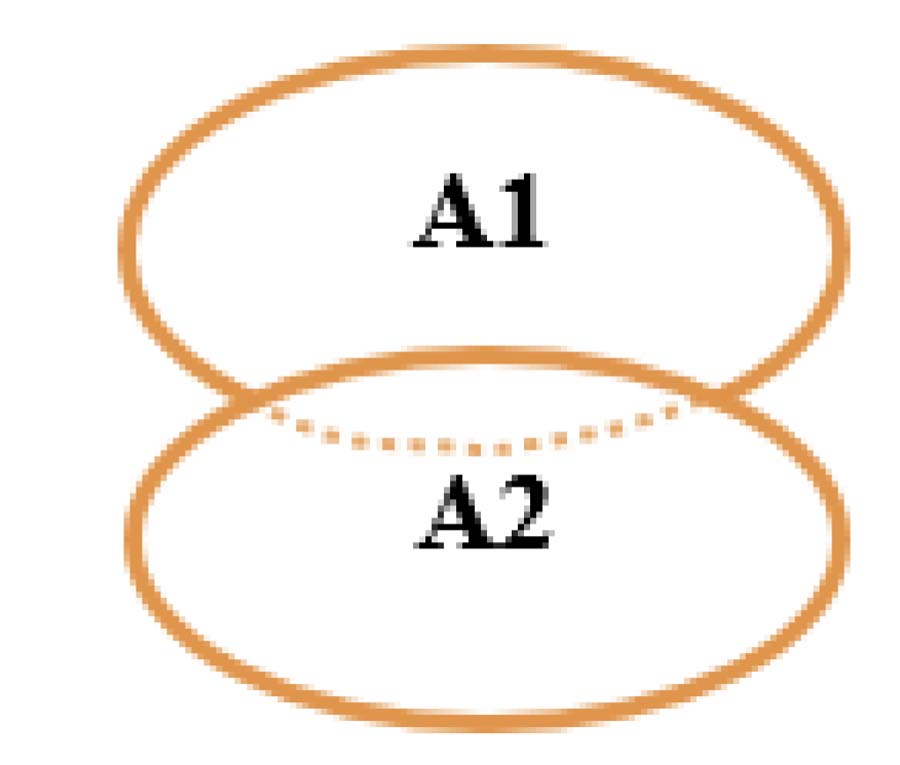
To conclude the description of the argumentative-interactional phenomenon manifested in the TRIBUNAL corpus, we present in Figure 4 the culmination (output) of what we have been calling argumentative assimilation , which represents the moment when two recalcitrant, antagonistic discourses begin to represent an argumentative alignment, resulting from an opponent’s adherence to a proponent’s arguments.

We can observe, in this description of the phenomenon of assimilation, “traces of performativity” ( Austin, 1970 , p. 99), since at the debate table, one magistrate’s speech is always susceptible to the reaction of another colleague. Even though we are not talking about a classic performative action like ‘telling a joke → laughing,’ we frequently observe in the TRIBUNAL database this movement of Y towards X during a deliberation (or vice versa). In this context, the reappropriation of an opponent’s words and arguments by a proponent, marked by argumentative alignment, is an effect of adherence rather than mere resonance – precisely because it is not a matter of a trivial disagreement but rather the construction of a standpoint and a justified and argued position, within the “interactional dynamic” (Plantin; Doury, 2015, p. 10).
Having described what we identify as an interactional and argumentative phenomenon, that is, argumentative assimilation , we proceed to the analysis of a judgment coming from the TRIBUNAL corpus.
The Case of the (non)existence of a retirement contract
The following case study examines a civil judgment in which it was determined that the unilateral alteration of a private pension contract – converting it into a life insurance policy without proper communication to the stakeholders – resulted in moral damages ( Reis, 2010 , p. 9). Although it is a case of contractual breach, which, as a rule, would not generate moral damages according to jurists, the harm caused would have gone beyond mere discomfort or displeasure, since the contracting party paid for a long period what she believed to be a private pension plan and, at the time of retirement, she saw her expectation of receiving financial supplementation of her income frustrated.
In this judgment, which lasted 15 minutes and 55 seconds, there were several persistent disagreements stemming from the argumentative question: Does the insurer’s behavior constitute moral damage? The attitudes and divergent responses to this question give life to the stasis situation illustrated below:
Figure 5 highlights several aspects that can be analyzed from an interactional and agonistic perspective, as well as concerning the personal positioning of the magistrates (FIJ, Rep, A1, A2) in defense of their standpoints. This creates an environment of argumentative interaction, à vif et à chaud , among the magistrates. To begin, it is important to note that FIJ represents the First Instance Judge, who is not present at the deliberation table. For this reason, his representation is shown as a rectangle, rather than an oval shape.

In the composition of the stasis situation presented at the deliberation table ( Figure 5 ), we observe that the double lines indicate an irreversible stasis between FIJ and Rep, as well as between Rep and A1. The wavy line represents a temporary (reversible) stasis followed by a negotiation between the standpoint expressed by A1 (who agrees with FIJ that there was moral damage but disagrees with the amount of R$100,000 sentenced by FIJ, proposing instead a value of R$20,000 as moral damage) and the standpoint that will be expressed by A2 (who has not yet declared to whom he will be aligned with, that is, Rep, A1, or FIJ.
Despite presenting only two excerpts (Excerpt 1 and Excerpt 2) of the judgment regarding the (non)existence of a private retirement contract8, it is important to note that we are proposing a longitudinal cut of the data ( Traverso, 2007 , p. 27), since we will look at an entire interaction, from beginning to end, to better understand the multiple kinds of stasis that compose that interactional framework9. We do not present the complete transcription merely due to space constraints10, even if we present the Portuguese version after the English/translated text. Let us proceed to the first excerpt:
In Excerpt 1 ( Table 2 ), amidst overlapping, interrupted, and fragmented statements at the first moment of the deliberation - that is, the stage of qualifying an act (whether lawful or unlawful) – a more persistent disagreement arises, as represented by the double lines in Figure 5 , between the vote of the Rapporteur (Rep) and the decision of the First Instance Judge (FIJ). According to the Rep, there is no legal support to consider the existence of moral damages in cases of contractual changes (l. 50-52). Rep’s opposing vote was that mere contractual non-compliance, by itself, does not warrant compensation for moral damages, since the compensable moral damage is that capable of causing an abnormal offense to the personality (l. 55-58). Conversely, the FIJ not only recognized the existence of moral damage but also ordered the insurance company to pay R$ 100,000 to the plaintiff. While presenting his vote, Rep agrees with the existence of material damage (lines 55-58) but claims the absence of moral damage, thus disagreeing about the payment proposed by FIJ (R$ 100,000). This is the first, irreversible stasis, as illustrated by the double lines between the FIJ and the Rep ( Figure 5 ).
Next, when presenting his argument, the second magistrate (A1) declares his vote. This judge (A1) shows resistance (stasis) to Rep’s standpoint (l. 21-22, 42, 46-47, 128-129). In this regard, A1 agrees with FIJ based on his argumentation that there was moral damage in the insurance company’s conduct (he disagrees with REL, who does not identify any unlawfulness in the insurance company’s action), but provokes a new stasis by disagreeing with the amount proposed by FIJ, suggesting, then, a reduction in the amount of moral damages from R$ 100,000 (as proposed by FIJ) to R$ 20,000 (l. 27, 29, 31-32).
Thus, from the perspective of the DMA11, Rep initially occupies the actantial role of proponent (suggesting that the case should not be qualified as moral damage). In response to Rep’s proposition, A1 not only assumes the actantial function of opponent (as he disagrees with him) but also assumes the actantial role of proponent, because he presents a new thesis, that is, the payment of R$ 20,000 (instead of R$ 100,000), as we observe in lines 31-32.
Regarding the actantial role of A2, this juge acts as a third arbiter ( Damasceno-Morais, 2022 , p. 19), as he embodies the discourse of one who has a doubt - one who intends to form a judgment to position himself throughout his performance (l. 16–18) - although, as we will see below, this magistrate (A2) ends up adhering to A1’s position. This is the general stasic situation presented in this scenario.
Before analyzing what we are calling the argumentative assimilation , we need to highlight the main argument used by A1 disagreeing with Rep’s standpoint. A1 emphatically repeats that the plaintiff had been paying for a retirement plan during “THIRTY YEARS” (l. 33, 35, 38, 65, 72, 127) without being informed that there was no more contract (l. 33-39, 66-67, 127-129). This constitutes A1’s principal argument against Rep’s standpoint, which considers (Rep) that the case in deliberation table involves only material damage (and not moral damage). For A1’s interpretation about moral damages in Brazil, however, these “thirty years” of undue payment “without prior notice” (l. 34, 35, 66, 67, 71) justify the presence of unlawfulness in the insurance company’s action, thus, for this magistrate, there is the characterization of material damage (l. 51) and also moral damage (l. 42).
Undoubtedly, this is a case that did not achieve unanimity among the judges, since the sentence was decided by a majority vote, that is, a “partial provision” (l. 276), and not unanimously: A1 + A2 vs. Rep’s standpoint.
Analysis of the argumentative assimilation process
From now on, we will not focus on Rep’s position, because this judge presented a non-negotiable standpoint from the moment his vote was proclaimed, given that, as we mentioned, he disagrees that there was moral damage in the insurance company’s attitude. In this sense, Rep turns his back on A1’s arguments and shows no concern with the standpoint that will be presented by A2. For these reasons, our interest lies solely in examining the interaction between A1 and A2, because the process of argumentative assimilation will occur within the interaction between these two judges. To highlight the process of argumentative assimilation, we will erase Rep from the analysis, concentrating on the stasis between A1 and A2, as we try to illustrate in Figure 6 below:

When A2 begins to show signs of tending to agree with A1 and not with Rep, the marks of this alignment/adhesion to the other point of view will occur through what we call here the argumentative assimilation process. The exchanges of turns, overlaps of speech, interrupted speeches through various intersections of turns between these magistrates are not innocuous actions. They are, in fact, integral parts of a negotiation process carried out à vif et à chaud , that is, in the heat and immediacy of the interaction, as we try to illustrate in Table 3 /Excerpt 2 below:
From the moment A2 says he is ready to vote (l.190), we’d like to highlight the speech turns that show the alignment of A1 and A2. In this sense, A1 seizes the opportunity to demonstrate his enthusiasm for the direction A2’s argumentation is taking. By repeating the phrase “it’s an exception” (l. 198), previously stated by A2 just some seconds earlier (l. 196), we witness the beginning of a process of adhesion to another point of view. In fact, A1’s interrupted and peremptory interventions (“uh-huh”) overlapping A2’s speech (l. 221, 223, 225, 227, 230, 232) help us better describe the process of adherence and argumentative alignment, through marks that will be useful for understanding the assimilation process.
The turns of speech highlighted above help us to evidence a process of absorption and “digestion” (by A2) of the arguments used by A1. Indeed, this literal reiteration of A1’s arguments by A2 indicates a “desire for sharing” ( Vignaux, 1995 , p. 199) in a situation of argumentative alignment, which help us to illustrate the argumentative assimilation process. We know, after all, that no one adheres to a standpoint by chance; there are always stages of approaching in the argumentative adherence process. In Excerpt 2, we see that A2 moves closer to A1’s arguments by reiterating interrupted statements and arguments made by that judge, thereby distancing himself from the perspective adopted by Rep.
As mentioned, as the debate progresses, A2 does not miss the opportunity to manifest his adhesion to A1’s speech, which contributes to the process of appropriation of A1’s words by A2. According to Perelman and Olbrechts-Tyteca (2008 , p. 177), “language is not merely a means of communication; it is also an instrument of action on the minds.” Indeed, the exchanges between the interactants A1 and A2 are interspersed with micro-adjustments and/or adjustment mechanisms that generate a perlocutionary effect in A2’s speech (the immediate repetition of words spoken by A1), in the heat of the interaction.
In Excerpt 2, we also observe that, starting from line 195, A2’s hesitations and occasional divergences from A1’s standpoint gradually has been fading away, which illustrates a kind of argumentative footing 12in a process of absorbing another’s words in an argumentative interaction. The wavy line ( Figure 6 ) that represented the “distance” in that “rhetorical relationship” (Meyer, 2008b, p. 9) between these two judges eventually ends up disappearing, as we illustrate in Figure 7 below:
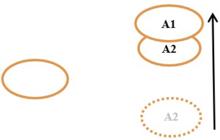
Figure 7 captures the moment when the barriers between standpoints begin to disappear (wavy line/simple stasis), before V2 literally repeats V1’s words, expressing his adherence to the thesis defended by V1. At this moment, the process we have been calling argumentative assimilation (previously described in Table 1 ) effectively takes place, as A2, spontaneously, somewhat impulsively, dynamically, and finally firmly (after hesitation/wavy lines) resumes/digests the words used by A1, that is, the same arguments used moments earlier by A1, indicating that he has “absorbed” the other’s arguments, aligning himself with it and setting aside any possibility of agreeing with REL as we can observe in lines 199-201, 206-207 and 233-236.
From the perspective of the DMA, in the process of aligning with A1, A2 abandons the actantial role of the third party and, at the same time, affirms his position as an opponent to Rep. In the following speech turns, A2 will literally repeat A1’s words, demonstrating total argumentative alignment, the result of adopting another’s arguments (in this case, A1’s standpoint). In Table 4 below, we schematize the textual marks of the process of argumentative assimilation that arises from adjustment mechanisms between two interactants (A1 and A2) during an interaction within a judicial deliberation:
The arguments, represented by the words and expressions repeated by A2 ( Table 4 ), attest the fact that A2’s reaction was a kind adhesion to A1’arguments. In Table 4 , we see that the words in bold are the materialization of the argumentative assimilation process, as each highlighted word/expression represents the repetition, the symbolic “absorption’ of A1’s standpoint by A2. For example, when A2 repeats “ thirty years ” (lines 73, 303, 222, 233), he is showing his adhesion of the main arguments employed by A1, for whom “=someone who had been paying for THIRTY YEARS without being consulted\ I think we have considered moral damages for much less here I think this here is a considerably greater moral damage\ ” (lines 127-129/ Table 2 ). Thus, all the bold marks in Table 4 represent the culmination (output) of the process of argumentative assimilation , that is, the resumption of one interlocutor’s speech (arguments, words, sentences, etc.) by another at deliberation table, as a way of showing total alignment with a standpoint, in an act of adhesion to another’s position.
In summary, we can perceive the implication of the assimilation process in lines 68↔67, where line 68 represents the assimilation marks of the speech expressed in line 67, hence the symbol “↔.” The same process occurs in lines 73↔72, 202↔33, 203↔33, 222↔33, 233↔33, 218↔214, 277↔276 (Table_4). It is important to observe that a similar argumentative assimilation process also is represented in lines 70↔69, 198↔196, 211↔210, where, inversely, A1 repeats words or expressions used by A2, also as a form of adherence (or “communion” in Perelman and Olbrechts-Tyteca’s terms), alignment, assent to another’s standpoint.
The assimilation process we have just described in the analysis presented, which attests to the performative force of that argumentative interaction, is represented in the figure below:

To conclude this analysis, Figure 8 below, which synthesizes the argumentative assimilation process at the deliberation table among three magistrates (Rep, A1, A2) in a Brazilian Second Instance court, from the perspective of the Venn diagram, presents the following representation:

To conclude
The description and analysis of the argumentative assimilation process, as we have tried to describe, reflects a performative manifestation of language in legal matters ( Cornu, 2005 , p. 38). Thus, the meaning there “is not in the statement itself, but in the communication situation” ( Robrieux, 2010 , p. 214), or rather, in the stasis situation presented. There, we tried to evidence the exact moments when A2 effectively adheres to A1’s standpoint by showing what we’ve called the argumentative assimilation process.
Certainly, we do not distance ourselves from the heritage of rhetorical studies, originating in Greco-Latin culture, by setting aside the extravagant dichotomy ‘persuade vs. convince’, in favor of the simple notion of adhesion , which, in its core, carries a classic rhetorical principle: the inescapable “communion of spirits”, repeated by the authors of the New Rhetoric as we have already shown. In this sense, we recall that, for Feteris (1999 , p. 16), a researcher of legal argumentation: “the acceptability of argumentation is tributary to the effectiveness of argumentation by the audience to whom it is addressed.”
To conclude, we hope to have been able to clearly describe the process of argumentative assimilation and, through the analysis of the ‘The case of the (non)existence of a retirement contract,’ we hope to have evidenced the marks of an argumentation process followed by a kind of adhesion or alignment to someone’s ideas at a deliberation table. In this sense, we are not talking about a mere argumentative diptych or a banal eristic situation, because, as we believe, “arguing is not to convince at all costs” ( Breton, 1996 , p. 16); arguing is a process built in the heat of an interaction ( à vif et à chaud ), from a wavering stasis situation.
References
- AMOSSY, R. L'argumentation dans le discours - discours politique, littérature d'idées, fiction. Paris: Nathan Université, 2000.
- ANGENOT, M. Dialogues de sourds - traité de rhétorique antilogique. Paris: Editeur Mille et une Nuits, 2008.
- ASCOMBRE, J.-C.; DUCROT, O. L'argumentation dans la langue. Bruxeles: Philosophie et langage Pierre Mardaga, 1983.
- AUSTIN, J. L. Quand dire, c'est faire. Paris: Éditions du Seuil. 1970.
- BRETON, P. L'argumentation dans la communication . Paris: La Découverte, 1996.
- CIANCI, M. O valor da reparação moral. São Paulo: Saraiva editora, 2003.
- COELHO, F. A. Reparação do dano moral: aspectos que devem ser considerados na fixação da forma ou do valor da reparação. São Paulo: Editora Juarez de Oliveira, 2009.
- CORNU, G. Linguistique juridique. Paris: Éditions Montchrestien, 2005.
- DAMASCENO-MORAIS, R. O carpinteiro e a madeira: a constituição de corpora jurídicos em perspectiva etnometodológica. Revista Estudos da Linguagem - RELIN, v. 29, n. 2, p. 673-709, 2021.
- DAMASCENO-MORAIS, R. Quem é esse tal de Terceiro, afinal? Revista de Letras, v.1, n. 41, 15 de julho de 2022.
- DAMASCENO-MORAIS, R. O modelo dialogal da argumentação e as emoções. Rétor, v. 13, n. 2, p. 25-42, jul./dez. 2023a.
- DAMASCENO-MORAIS, R. A argumentação segundo o modelo dialogal de Christian Plantin. In: PIRIS, E. L.; GRÁCIO, R. A. (org.). Introdução às teorias da argumentação. São Paulo: Pontes, 2023b.
- DANBLON, E. La fonction persuasive - Anthropologie du discours rhétorique: origines et actualité. Paris: Armand Colin, Collection U philosophie, 2005.
- DOURY, M.; PLANTIN, C. Une approche langagière et interactionnelle de l'argumentation. Argumentation et Analyse du Discours , n. 15, 2015.
- DOURY, M. L'évaluation des arguments dans les discours ordinaires - le cas de l'accusation d'amalgame. Langage et société, p. 9-37, 2003.
- FETERIS, E. T. Fundamentals of legal argumentation - a survey theories on the justification judicial decisions. Netherlands: Kluwer Academic Publishers, 1999.
- GOFFMAN, E. Footing. Semiotica, v. 25, n. 1-2, p. 1-30, 1979.
- GRIZE, J.-B. Argumentation et logique naturelle. Hermès - Cognition, Communication, Politique, n. 15, v. I, 1995.
- KERBRAT-ORECCHIONI, C. Les interactions verbales - Tome II . Paris: Armand Colin Éditeur, 1992.
- KERBRAT-ORECCHIONI, C. Le discours en interaction . Paris: Armand Colin. Collection U. Lettres - Linguistique, 2011.
- LEITE, E. de O. (org.). Grandes temas da atualidade: dano moral - aspectos constitucionais, civis, penais e trabalhistas. Rio de Janeiro: Editora Forense, 2002.
- MARTINEAU, F. Petit traité d'argumentation judiciaire. Paris: Praxis Dalloz, 2010.
- MEYER, M. Qu'est-ce que l'argumentation. Paris: Collection Chemins philosophiques, 2008a.
- MEYER, M. Principia Rhetorica: une théorie Générale de l'argumentation. S/l: Librairie Arthème Fayard, 2008b.
- NETTEL, A. L. The enthymeme between persuasion and argumentation. International Society for the Study of Argumentation - ISSA. Amsterdam: Rozenberg Publishers, 2011.
- OLIVEIRA, M. Dano moral. São Paulo: LTR Editora, 2006.
- PERELMAN, C. Rhetoriques . Bélgica: Éditions de l'universite de Bruxelles, 1989.
- PERELMAN, C. Logique juridique - nouvelle rhétorique. Paris: Éditons Dalloz, 1999.
- PERELMAN, C. L'empire rhétorique - rhétorique et argumentation. Paris: Librairie Philosophique J. Vrin, 2002.
- PERELMAN, C.; OLBRECHTS-TYTECA, L. Traité de l'argumentation . Bélgique: Éditions de l'Université de Bruxelles, 2008.
- PLANTIN, C. A argumentação: história, teorias, perspectivas. São Paulo: Parábola Editorial, 2008.
- PLANTIN, C. Dictionnaire de l'argumentation: une introduction aux études d'argumentation. Lyon: ENS Éditions, 2016.
- POSNER, A. Richard. How judges think. England: Harvard University Press, 2008.
- REIS, C. Dano moral. 5. ed. Rio de Janeiro: Editora Forense, 2010.
- ROBRIEUX, J. Jacques. La rhétorique et argumentation. Sous la direction de Daniel Bergez. 3ème édition revue et augmentée. Paris: Armand Colin, Collection Lettres Sup, 2010.
- TEODORO JÚNIOR, H. Dano moral . 5. ed. São Paulo: Editora Juarez de Oliveira, 2007.
- TRAVERSO, V. L'analyse des conversations. Lyon: Armand Colin, 2007.
- VIGNAUX, G. Des arguments aux discours - vers un modèle cognitif des opérations et stratégies argumentatives. Hermès - Cognition, Paris, Communication, Politique, v. I, n. 15, 1995.
-
1
All translations are made by the author of this article.
-
2
We define the ‘TRIBUNAL database’ as the entire collection of documents gathered for this research (sentences, videos, audio, and other materials). The ‘TRIBUNAL corpus’ is a specific subset of this database that we’ve selected for the analysis presented in this paper. In other words, the corpus is a portion of the larger database .”
-
3
We have permission to use the corpus , as long as the data is made anonymous. This means that we will not disclose any personal information (like real names, case numbers, or specific dates). Access to the database has been formally granted to us, in accordance with current ethical procedures.
-
4
This means that the recordings were not made by me, the researcher, but were previously made for the sole purpose of institutional record-keeping, not for academic study. I was merely granted permission to access the database and use the data that were relevant to my research.
-
5
According to Damasceno-Morais, a ‘stasic situation’ go beyond the occurrence of a stasis. Instead of focusing only on the initial moment of the conflict ( stasis ), the analysis of a stasic situation seeks to understand how the reaction to an initial attack can shape the entire conflictual interaction.”
-
6
Michaelis Electronic Dictionary presents four fields that utilize the term “assimilation”: 1) PHYSIOLOGY. Transformation of food into energy or bodily tissue; appropriation of others’ ideas and feelings, grasping their meaning and incorporating them into one’s own knowledge. 2) LINGUISTICS. Alteration of a sound, most often a consonant, to make it identical or more similar to a neighboring sound. 3) SOCIOLOGY. Process of interpenetration and fusion of cultures, that is, of traditions, feelings, attitudes of people and groups who, sharing the same experience and history, are incorporated into a common cultural life. 4) PHILOSOPHY. Operation by which the different is transformed into the similar. May 2024.
-
7
Venn diagrams are used in mathematics to graphically symbolize properties, axioms, and problems related to sets and set theory. Available at https://pt.wikipedia.org/wiki/Diagrama_de_Venn . Accessed on May 29, 2024.
-
8
The title ‘The Case of the (non)existence of a retirement contract’ is fictitious. We coined this term for the sole purpose of easily referring to this specific judgment throughout our analysis.
-
9
As Traverso (2007 , p. 26) states, ‘transversal analysis involves studying a specific phenomenon across different instances (interactions) within the same dataset, with the goal of answering a broader research question [...] longitudinal analysis seeks to account for an interaction in a single sequence, at one moment, considering its beginning, middle, and end.
-
10
Transcription conventions: / upward intonation, \ downward intonation, (.) short pause, (..) medium pause, (...) long pause, (0.6) pause described in seconds, [ ] overlapping speech, xxx inaudible section, ((laughter)) description of situation, ( ) uncertainty in transcription, & no interval between two turns of speech, = continuation of the same turn of speech, XXxx emphasis, : prolonged pronunciation, - interruption, ° ° soft voice, ˂(( )) translator’s comment˃, # # accelerated speech. These conventions are based on those adopted by the ICAR laboratory – Interactions, Corpus, Apprentissages, Représentations, linked to the Université Lumière Lyon 2/France.
-
11
In DMA, an ‘actantial role’ corresponds to the position assumed in an interaction: proponent, opponent, or third party.
-
12
I draw inspiration from Goffman’s concept of footing ( Goffman, 1979) , which roughly means a shift in someone’s position, a change in the attitude we have towards ourselves and others present, as it is expressed in the way we handle the production or reception of an utterance.
-
Data Availability Statement:
All datasets supporting the findings of this study is available in a personal file and can be requested from the author(s).
-
Editor responsible: Gisele Cássia de Sousa
All datasets supporting the findings of this study is available in a personal file and can be requested from the author(s).

 Source: Own elaboration
 Source: Own elaboration
 Source: Own elaboration
 Source: Own elaboration
 Source: Own elaboration
 Source: Own elaboration
 Source: Own elaboration
 Source: Own elaboration
 Source: Own elaboration