 Celebrating 80 Years of the Brazilian Archives of Biology and Technology: from an Institutional Bulletin to an International Open-Access Journal
Abstract
The Brazilian Archives of Biology and Technology (BABT) completes 80 years of continuous publication, an unusual achievement in Brazilian scientific publishing. Founded in 1946 within the Instituto de Biologia e Pesquisas Tecnológicas (IBPT), the journal developed from an institutional bulletin into an international open-access periodical with a well-established multidisciplinary profile and broad scientific reach. This trajectory was defined by a series of decisive editorial advances, including the incorporation of external peer review in the 1960s, the establishment of a formal editorial board in the 1970s, indexation in the Science Citation Index in 1983, the adoption of English as the publication language in 1999, inclusion in SciELO in 2001, and the implementation of continuous publication in 2016. Over time, BABT also strengthened its alignment with open science through its free-to-read and free-to-publish model and the adoption of an open license. More recent performance indicators, including an impact factor above 1.0, reflect a process of sustained consolidation to expand international visibility and indexing. This issue is dedicated to One Health, an integrative framework that recognizes the interdependence of human, animal, and environmental health in the face of challenges such as zoonotic diseases, biodiversity loss, and environmental degradation. The editorial also addresses current opportunities and risks associated with artificial intelligence in research and scholarly publishing by emphasizing the need for responsible use and preservation of academic integrity. Finally, it acknowledges the individuals whose continuous dedication supported the journal through successive phases of institutional and editorial transformation.
Keywords:
Brazilian scientific journal; Challenges and opportunities; Impact factor; One Health; Open science.
HIGHLIGHTS
BABT marks 80 years of continuous publication, progressing from its origins at IBPT to an international open-access journal.
This volume is dedicated to One Health, integrating human, animal, and environmental health.
Free-to-read and free-to-publish policies, together with adoption of a CC BY license, reaffirm the commitment of the journal to open science.
The shared history of BABT and TECPAR reflects a longstanding institutional commitment to innovation, scientific communication, and public service.
EDITORIAL
The Brazilian Archives of Biology and Technology (BABT) reaches 80 years of uninterrupted publication, a landmark in the history of Brazilian science. Founded in 1946 as Arquivos de Biologia e Tecnologia within the Instituto de Biologia e Pesquisas Tecnológicas (IBPT), the journal has progressed from an internal bulletin into an international journal. This volume records that trajectory and reaffirms the role of BABT in disseminating knowledge and advancing scientific and technological innovation.
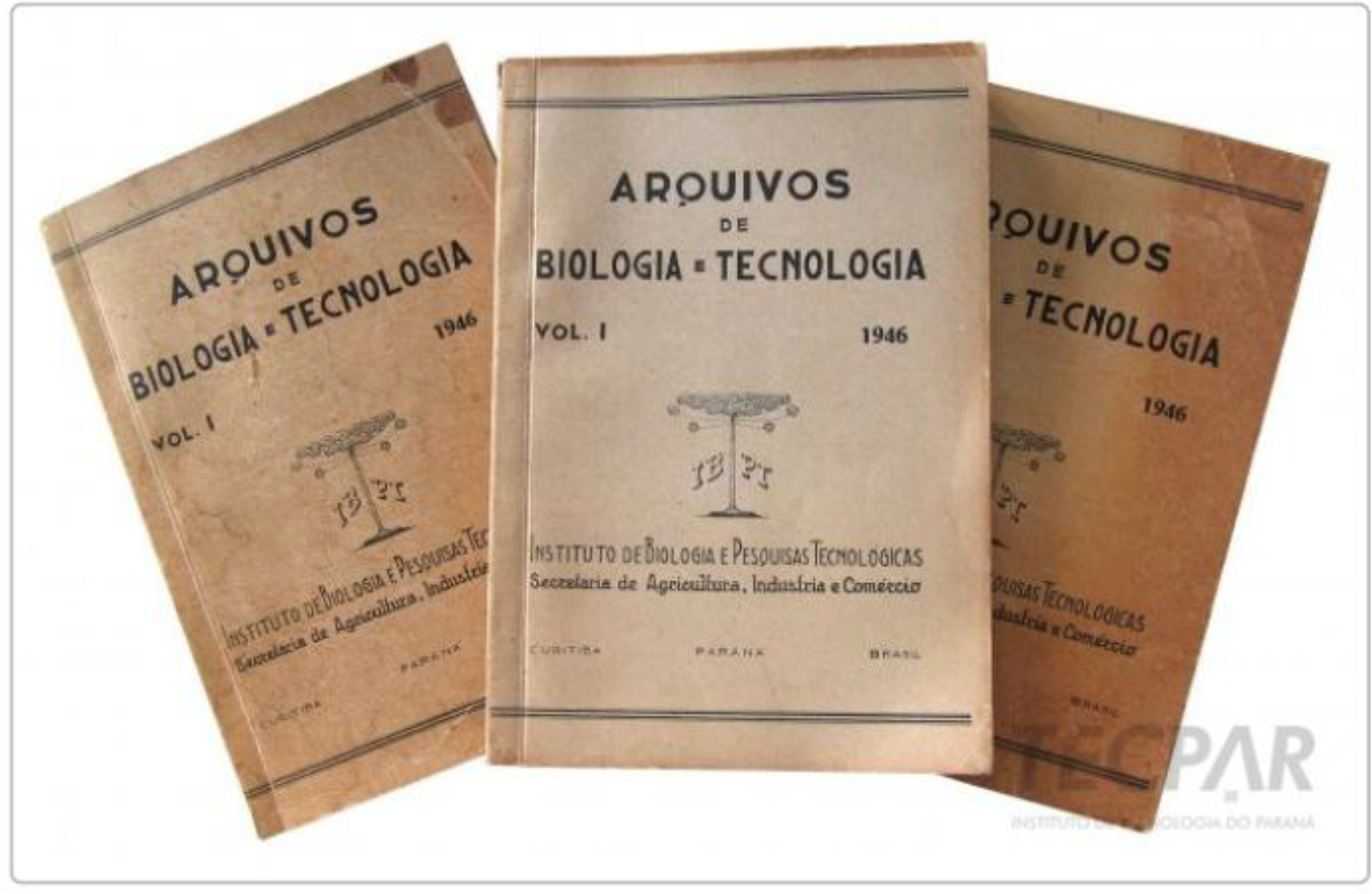
The origin of the journal was associated with the vision of Dr. Marcos Augusto Enrietti, who proposed it as a vehicle for disseminating the scientific studies produced within the Institute. During the 1940s, IBPT supported regional development through applied research. Between 1941 and 1946, the Institute published fourteen internal technical bulletins. As the quality and relevance of these studies increased, the need for a journal with broader circulation became evident. The first issue of Arquivos de Biologia e Tecnologia was therefore published in 1946 (Figure 1). In 1978, IBPT was restructured as the Instituto de Tecnologia do Paraná (TECPAR), whose mission expanded to include technological solutions in health, agriculture, and industry across the state of Paraná, Brazil. BABT aligned with this institutional transformation, broadening its scope in line with the TECPAR mission of innovation, technological research, and public service.
Cover of the first volume of Arquivos de Biologia e Tecnologia, published in 1946 by the Instituto de Biologia e Pesquisas Tecnológicas (IBPT). This inaugural issue marked the formal establishment of the journal and the beginning of the publication now known as the Brazilian Archives of Biology and Technology.
Over the following decades, successive editorial changes and strategic decisions consolidated the journal and expanded its scientific reach. Beginning in the 1960s, a formal peer-review system was introduced, incorporating external reviewers into manuscript evaluation. In the 1970s, the establishment of a formal editorial board composed of members from multiple institutions raised editorial standards and further consolidated the journal within the national scientific community. In 1983, BABT was indexed in the Science Citation Index of the Institute for Scientific Information (ISI), becoming one of the first Brazilian journals to enter that database. This early indexation, supported by editorial quality, created the basis for broader international visibility. In 1999, BABT adopted English as its sole publication language, a decisive step toward higher international reach. Inclusion in the SciELO electronic library in 2001 consolidated the transition to an open-access digital format. Free online access to full-text articles expanded readership and contributed to the democratization of scientific knowledge. Taken together, these advances positioned the journal within both the national and the international scientific publishing landscape.
Within this transformative phase, two contributions deserve particular recognition. Professor Carlos Ricardo Soccol played a central role in the internationalization of BABT, providing the strategic vision and academic leadership that enabled the journal to expand its global reach and achieve broader international recognition. Professor Vanete Thomaz Soccol, in turn, made an essential contribution to the implementation of ScholarOne and to the consolidation of the editorial workflows, decisive steps that greatly enhanced the journal credibility. Their dedication, competence, and sustained commitment remain deeply inscribed in the history of BABT.
This international reorientation was also the subject of a 2001 editorial by Professor Soccol [1], which expressed confidence in the future of the journal and explained the rationale behind the 1999 reform. In that editorial, Soccol emphasized the need for the journal to respond to developments in science and technology and reaffirmed its role as a modern channel of scientific communication. The expansion of foreign reviewers and collaborators further confirmed the transition of BABT to a journal with international reach while preserving its Brazilian institutional roots.
In parallel with these advances, BABT has renewed its alignment with open science practices [2] and with more agile editorial procedures. Since the early 2000s, the journal has provided open access through the SciELO digital library. In 2016, the journal adopted continuous publication, under which accepted articles were published in the current annual volume as soon as they were ready. Under the current editorial leadership, the editorial guidelines were revised to align the journal with contemporary standards in scholarly publishing. Since 2024, all submissions have been required to demonstrate a technological application within one of two core areas: (1) Biological, Medical and Health Technologies, and (2) Agricultural Technologies, Biotechnology and Environment. This policy aligns the scope of the journal with the strategic priority areas of TECPAR. BABT remains free to read and free to publish, with no article processing charges and publication under a Creative Commons CC BY license. This model reflects a sustained commitment to open access and broad dissemination of scientific knowledge.
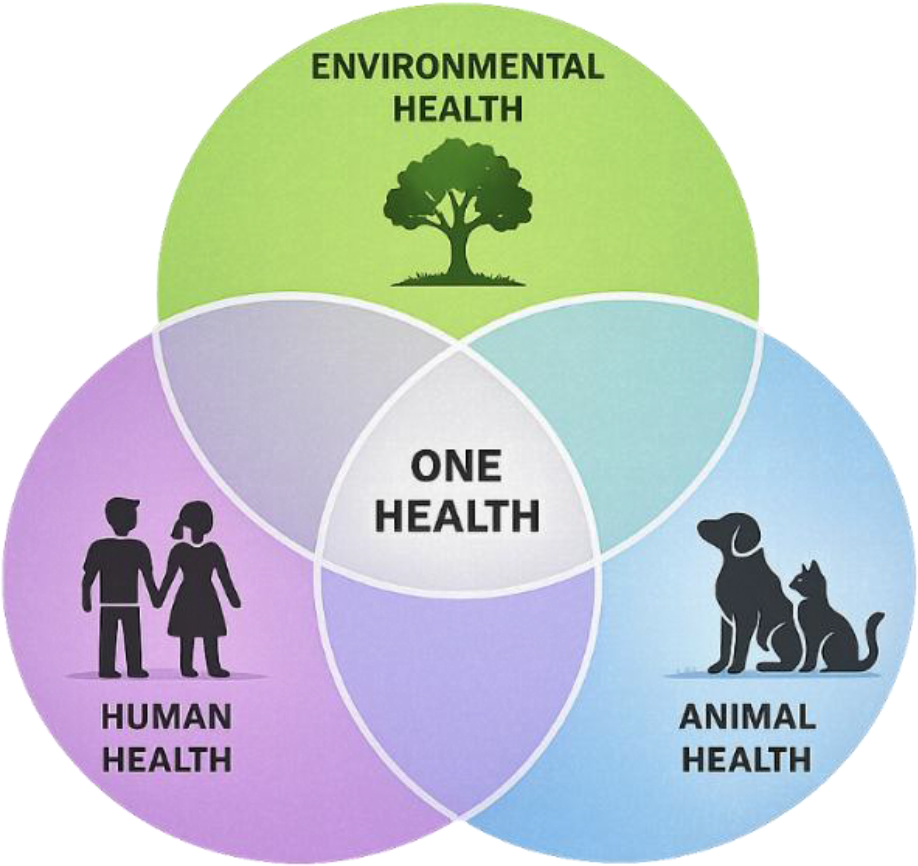
In line with BABT tradition of engaging with emerging scientific topics, the eightieth anniversary issue is devoted to One Health (Figure 2), a theme associated with major contemporary global challenges. One Health recognizes the interdependence of human, animal, and environmental health [3], as the condition of each of these domains influences the others. Zoonotic diseases, antimicrobial resistance, biodiversity loss, and environmental degradation demand integrated and cooperative responses. The One Health framework therefore requires collaborative, multisectoral, and transdisciplinary approaches to improve public health outcomes [4]. By dedicating this volume to One Health, BABT confirms its engagement with research of both scientific relevance and societal consequence. This thematic focus is also consistent with the institutional tradition of TECPAR in integrating advances in human, animal, and environmental health to generate sustainable solutions.
Conceptual illustration of the One Health framework represented as a three-circle Venn diagram. The diagram highlights the interconnection among Environmental Health, Human Health, and Animal Health. The central overlap, designated One Health, represents the shared interface among these domains.
This anniversary also coincides with a period of growing impact for BABT. In recent years, the journal has achieved an impact factor above 1.0 in the Journal Citation Reports, reflecting a higher position within the international scientific community. This result reinforces current efforts to further improve the journal and expand its international visibility. The editorial team continues its efforts to obtain additional indexation and expand the reach and recognition of the journal. At the same time, new technologies bring both opportunities and challenges. Artificial intelligence (AI) offers tools that may support editorial workflows, automate routine tasks, accelerate production processes, and improve content indexing. Research involving AI, including applications in Biology and Biotechnology, is also appearing with increasing frequency among submissions to the journal. In this context, BABT remains committed to the responsible use of AI and to the protection of academic integrity. Editorial quality and scientific ethics remain central to the credibility of the journal. The incorporation of AI, whether in research or in editorial processes, must therefore proceed with caution, critical judgment, and a clear commitment to the principles of scholarly publishing. Technology must remain at the service of science and of the trust on which scientific communication depends.
The achievements of BABT are the result of decades of collective effort by editors, reviewers, authors, and editorial staff who have ensured its regular publication. Beyond strategic decisions and formal policies, the success of the journal has also depended on meticulous daily work, much of it invisible to readers yet decisive for editorial quality. In this context, the present commemorative editorial pays particular tribute to Mrs. Marilene Aparecida Boaron Reis (Figure 3), executive secretary and manager of the journal, whose service since the 1990s has accompanied some of the most transformative phases in the history of BABT. At a time when editorial routines were mainly artisanal and based on printed manuscripts, manual revisions, and postal correspondence, her contribution was fundamental to preserving organization and reliability in the editorial workflow under demanding conditions. Her responsibilities included copyediting, documentation control, correspondence with authors and reviewers, deadline coordination, and other essential editorial functions.

Professional portrait of Mrs. Marilene Aparecida Boaron Reis in the Editorial Office of the Brazilian Archives of Biology and Technology. Mrs. Boaron Reis has served BABT since the 1990s, accompanying critical phases of transition, including the shift from print-based workflows to digital processing and continuous publication.
Moreover, Mrs. Boaron Reis has contributed far beyond operational excellence through her long-standing involvement in editorial governance and her professional, attentive, and technically qualified interactions with authors, editors, and reviewers. This commitment to the quality and credibility of the journal has supported internal modernization through successive revisions of author guidelines, editorial policies, and best-practice routines, as well as through the consolidation of more agile publication models, including continuous publication. The success of the journal reflects not only the scientific merit and rigor of its contributors, but also the professionalism of those responsible for maintaining a robust and ethically grounded editorial process. In this regard, Mrs. Marilene Aparecida Boaron Reis represents the collective dedication of the editorial staff.
Furthermore, this editorial reaffirms the place of BABT within the scientific heritage of Brazil. Few Brazilian scientific journals have achieved comparable longevity. Over eight decades, the journal has provided a suitable platform for the communication of research at the interface between Biology and Technology while reflecting shifts in research priorities in a country marked by continuous social, environmental, and economic transformation. The archives of the journal offer a longitudinal view of Brazilian science from the mid-twentieth century to the present, documenting advances, methodological refinements, emerging themes, and the challenges that have influenced scientific production over time.
In institutional terms, the history of BABT remains closely linked to that of TECPAR. The Institute has provided the conditions needed for the journal to maintain regular publication and to adjust its editorial practices over time. In turn, BABT has increased the visibility of research related to applied innovation, public interest, and technological development. This relationship has supported the publication of scientifically relevant studies while preserving editorial independence. Researchers in Brazil and abroad are invited to submit high-quality studies, provide rigorous peer review, and read and cite articles published in BABT. May this 80-year history be only the beginning of an even more promising contribution to the dissemination of scientific knowledge!
-
Funding:
This editorial received no external funding.
-
Institutional Review Board Statement:
Not applicable.
-
Informed Consent Statement:
Not applicable.
Acknowledgments:
The authors gratefully acknowledge Editor-in-Chief Bill Costa for his valuable contributions to the reading of this editorial.
Use of Generative Artificial Intelligence
The authors declare that large language models and other generative artificial intelligence (AI) or AI-assisted technologies cannot be credited as authors and have not been listed as authors of this paper.
The authors declare that generative artificial intelligence (AI) or AI-assisted tools were used under full human supervision for language revision and grammar correction of this editorial. The tool used was ChatGPT (OpenAI, GPT-5.4 Thinking). No confidential or sensitive data were uploaded to such tool, and all AI-assisted content was checked, corrected and approved by the authors, who take full responsibility for the integrity and originality of the manuscript.
Data Availability Statement:
Research data are available in the body of the manuscript.
REFERENCES
-
1 Soccol CR. Editorial. Braz Arch Biol Technol. 2001;Jubilee. doi:10.1590/S1516-89132001000500001.
» https://doi.org/10.1590/S1516-89132001000500001. -
2 Langham-Putrow A, Bakker C, Riegelman A. Is the open access citation advantage real? A systematic review of the citation of open access and subscription-based articles. PLoS One. 2021;16(6):e0253129. doi:10.1371/journal.pone.0253129.
» https://doi.org/10.1371/journal.pone.0253129. -
3 Häsler B, Cornelsen L, Bennani H, Rushton J. A review of the metrics for One Health benefits. Rev Sci Tech Off Int Epiz. 2014;33(2):453-64. doi:10.20506/rst.33.2.2294.
» https://doi.org/10.20506/rst.33.2.2294. -
4 Lancet. One Health: a call for ecological equity. Lancet. 2023;401(10372):169. doi:10.1016/S0140-6736(23)00090-9.
» https://doi.org/10.1016/S0140-6736(23)00090-9.
-
Editor-in-Chief:
Bill Costa
-
Associate Editor:
Bill Costa