 Encapsulation of Active Ingredients in Pest Insect Control: A Literature Review
Abstract
Global agriculture aims to ensure food security and raw materials for a growing global population. Global warming, driven by anthropogenic activities, may worsen the situation by causing environmental imbalances that directly impact the population dynamics of pest insects, which are responsible for significant agricultural losses. As a result, tools that assist in the management of agricultural pests have become necessary. The application of synthetic, natural, microbiological, and RNAi-based insecticides has been widely studied, with the first three already commercially available. However, these technologies are not without limitations, as they can degrade in the environment or within the insect, and in some cases, may be toxic to the applicator, the ecosystem, and beneficial insects. Encapsulation can overcome these limitations by entrapping the active ingredient (AI), protecting it from degrading agents, preventing direct contact with the applicator, and enabling controlled release. In this way, it can complement existing tools used in integrated pest management, thereby contributing to the maintenance and increase of agricultural production.
Keywords:
Crop protection; carrier agent; controlled release; Integrated Pest Management.
HIGHLIGHTS
• Encapsulation aims to protect and promote the controlled release of active ingredients.
• The technique has been studied for applications in various contexts.
• In pest control, several active ingredients can be encapsulated.
• Further studies are needed to scale up and apply the technique in the field.
INTRODUCTION
Damage caused by pest insects to agriculture
Agriculture faces the crucial challenge of meeting the growing demand for food and raw materials. By 2050, the world population is expected to reach 9 billion, increasing pressure on food security [1]. This scenario is exacerbated by climate change, which imposes the challenge of large-scale production in an increasingly adverse environment. Over the next 30 years, the average global temperature could rise between 2°C and 5°C, reaching historic levels [2, 3]. Global warming affects pest dynamics worldwide. Insects are responsible for significant economic losses and are considered competitors of humans for generated agricultural resources [4]. Although the impacts tend to be less severe in tropical countries, global warming is expected to have more pronounced negative effects in temperate regions. In these areas, the temperature rise will bring the environment closer to ideal reproductive conditions, resulting in increased insect populations and, consequently, greater production losses [3].
According to a study by Savary and coauthors (2019) [5], global yield losses attributed to phytopathogens and pest insects are approximately 21.5% (10.1-28.1%) for wheat, 30.0% (24.6-40.9%) for rice, 22.5% (19.5-41.1%) for maize, 17.2% (8.1-21.0%) for potato, and 21.4% (11.0-32.4%) for soybean. Additionally, the authors state that the greatest losses occur in regions experiencing food supply deficits, rapidly growing populations, and frequent pest emergence or reemergence. Qadri and coauthors (2020) [6] report that annual losses caused by pest insects reach US$ 18 billion. From a broader perspective, Sharma, Kooner, and Arora (2017) [7] state that losses caused by pest arthropods, including organisms other than insects, account for 18% to 20% of global agricultural production, resulting in an estimated annual loss of US$ 470 billion.
Considering these losses, stakeholders, such as the scientific community, producers, private companies, and others, are expected to coordinate their efforts to reduce economic losses and reach new levels of production while aligning with ecological demands. Currently, well-established integrated pest management (IPM) programs exist for several crops, employing various pest control techniques.
Among these techniques, the following stand out: environmental manipulation (cultural method), which involves the deliberate modification of the environment through the cultivation of plants that reduce pest incidence; genetic manipulation, which includes the release of genetically modified individuals to disrupt the reproduction of a pest population; chemical control, which uses synthetic products of either chemical or microbial origin; and biological control, which can be divided into macrobial-using insect predators and parasitoids and microbial, using biopesticides made from living organisms, their genes, or metabolites [6, 8, 9].
Despite widespread adoption, these techniques have limitations. In the case of chemical and biological insecticides, a common disadvantage is their susceptibility to biotic and abiotic factors when applied in the field, due to photolysis, volatility, and microbial degradation [10-17]. Products based on fungi, bacteria, viruses, essential oils, or RNAi tend to lose stability and efficacy when exposed to UV rays and high field temperatures [11-16]. These challenges also affect conventional pesticides due to volatility and photolysis [17]. To overcome this limitation, the encapsulation of biopesticides emerges as a promising solution, enhancing their durability and efficiency in the field.
The use of biological control in agricultural pest management
The challenge of global agriculture extends beyond increasing pest populations, it also involves the growing demand for sustainable solutions that do not compromise human health [1, 2]. In 2015, the United Nations (UN) member countries adopted the Sustainable Development Goals (SDGs), comprising 17 targets to be achieved by 2030. Among these, at least five are closely linked to agriculture and food security: zero hunger, good health and well-being, responsible consumption and production, climate action, and life on land. These goals aim to make agriculture more sustainable by reducing the negative impacts of production systems on humanity [18].
Biological control is closely aligned with these goals, offering an alternative to traditional chemical methods. Using natural agents such as predators, parasitoids, and microorganisms to control pests reduces the need for chemical compounds and preserves the integrity of soil and water ecosystems. Furthermore, it maintains biodiversity and reduces the presence of residues in the environment, posing a lower risk to human health. Reduced reliance on chemical agents also helps manage selection pressure on pests, thereby prolonging the effectiveness of available control technologies [19-23].
Despite the advantages of biological inputs, their effectiveness can be compromised by environmental factors. Products based on fungi, bacteria, viruses, or essential oils tend to lose stability and efficacy when exposed to UV rays and high field temperatures [11-16]. These challenges also affect conventional pesticides due to volatility and photolysis [17]. To overcome this limitation, the encapsulation of biopesticides emerges as a promising solution, enhancing their durability and efficiency in the field.
The encapsulation technique
The encapsulation technique is defined as a physicalchemical process that traps active compounds within a material designed to preserve their physical, chemical, and biological properties, allowing their release under specific conditions [24-27]. The use of encapsulation dates back to the 1950s [24, 28]. However, it was in the 1970s that its use began to be widely explored. During that time, formulations evolved from simple spray applications to more advanced techniques, such as controlled release via membrane immobilization, culminating in nano-, micro-, and macroencapsulation methods. This advancement enabled the application of the technique across various fields, including medicine, pharmaceuticals, the food industry, and agriculture [24-26].
In medicine and the pharmaceutical industry, encapsulation enhances the stability and effectiveness of drugs and cosmetics. For example, Pasqualim (2010) [29] used sodium alginate microcapsules with grape seed oil to create spheres with appropriate shine and thickness for dermal application. Fernandes and coauthors (2020) [30] encapsulated the anti-inflammatory drug dexamethasone in chitosan/montmorillonite hybrids, resulting in a low-cost controlled-release system.
In the food industry, encapsulation aims to protect bioactive compounds from environmental factors that may compromise the aroma, color, and nutritional value of food products [27, 31, 32]. One example is the study by Simplicio and coauthors (2023) [33], which applied ionic gelation to encapsulate protease produced by Aspergillus oryzae (Eurotiales: Trichocomaceae), for cheese production. The technique provided greater stability to the enzyme extract, which efficiently coagulated milk upon application. In another study, Laurenti and Garcia (2013) [34] evaluated different types of gums and mucilages for the encapsulation of probiotic foods to ensure controlled release. They found that okra mucilage was more efficient than commercial gums, protecting the microorganisms from degradation.
α-amylase, used in bread maturation, was encapsulated in beeswax. When compared with non-encapsulated enzymes, the catalysis was twice as slow as that of the encapsulated ones, although they exhibited greater thermal and storage stability [35]. To overcome high thermal sensitivity, Ozaltin and coauthors (2019) [31] encapsulated trypsin and protease in chitosan and sodium alginate. The study concluded that combining these two polysaccharides in appropriate ratios preserved the enzymatic activity of trypsin and protease, improving their applicability in the pharmaceutical industry.
Encapsulation is also widely used in agriculture and livestock. The literature reports its use in veterinary medicine, seed production, fertilizers, herbicides, and insecticides. In this context, the technique offers benefits such as controlled release, reduced dosage, increased stability of active compounds, and improved safety in storage, transport, and handling, in addition to mitigating environmental impacts [36-41]. Furthermore, encapsulation aims to make input handling safer, reduce environmental impacts, prevent toxicity in mammals and plants, and minimize chemical leaching into water bodies [42].
For example, Abdelsattar and coauthors (2019) [43] encapsulated bacteriophages in chitosan to target Escherichia coli (T. Escherich, 1885) (Enterobacteriales: Enterobacteriaceae), which colonize the intestines of cattle and cause economic losses. The results indicated that encapsulation is a promising, reliable, and cost-effective solution for the functional delivery of bacteriophages to control intestinal bacteria in farm animals. Horticulture also benefits from encapsulation techniques. The production of so-called synthetic seeds involves a pre-germinated seed that is subsequently encapsulated in a biopolymer. An example is the work of Pereira and coauthors (2008) [44], who encapsulated long pepper seeds in sodium alginate, supplemented with 75% vitamins and mineral salts. This method achieved a promising conversion rate of 85% for synthetic seeds, demonstrating that the technique favored the propagation of long pepper.
Encapsulation is also applied in fertilizer delivery. In a field study by Pereira, Oliveira, and Fraceto (2019) [45], an increase in tomato seed (Solanum lycopersicum [Solanales: Solanaceae]) productivity was observed due to the nanoencapsulation of gibberellic acid (GA₃) in alginate and chitosan. According to the authors, the encapsulated material gradually released GA₃, prolonging the contact time between the seed and the phytohormone, thus optimizing its utilization.
For loading and releasing biostimulants, techniques such as spray drying, ionic gelation, coacervation, and interfacial polymerization are used to encapsulate plant growth-promoting rhizobacteria (PGPR). These techniques protect rhizobacteria from stressful conditions including nutrient and water deficiency, salinity, improper pH, and predation. Additionally, immobilized inoculants enable the gradual release of rhizobacteria, providing a long-term fertilization effect [38]. Kadmiri and coauthors (2021) [46] obtained results that reinforce the advantages of applying this technique to PGPR by encapsulating Pseudomonas fluorescens (Flügge, 1886) (Pseudomonadales: Pseudomonadaceae) and Azospirillum brasilense (Tarrand, Krieg & Döbereiner, 1978) (Rhodospirillales: Azospirillaceae) in alginate, halloysite, and montmorillonite. The formulations preserved the bacteria at a concentration of 14.8 log CFU g⁻1 even after three months of storage. They also promoted a slow release that lasted up to 15 days after application, resulting in over 100% increase in root and shoot biomass of the wheat plants used in the experiment.
Weed management studies have also explored the potential of encapsulation. In a study on herbicides, Nornberg and coauthors (2019) [47] encapsulated imazethapyr using alginate and a combination of alginate and cellulose. The results showed that, in addition to effectively protecting the herbicide, encapsulation enabled controlled release, as experiments demonstrated that both formulations extended the deposition time of imazethapyr from seven to 30 days.
In pest control, encapsulation plays a crucial role. The objective is similar to its use in other contexts: to optimize input application. In the case of both chemical and biological pesticides, limitations such as volatility at high temperatures, photolysis, and microbial degradation can reduce their performance [17, 48].
However, these limitations can be mitigated through encapsulation. The application of encapsulation in insect pest control is relatively recent compared to other areas. A search in the Web of Science database reveals few articles published before the 1990s. One early study by Raun and Jackson (1966) [49] aimed to evaluate the viability and pathogenicity of encapsulated Bacillus thuringiensis (Berliner, 1915) (Bacillales: Bacillaceae) to control Ostrinia nubilalis (Hübner, 1796) (Lepidoptera: Crambidae). The study demonstrated that encapsulation is a useful technique in the formulation of biological insecticides, achieving 82.1% control effectiveness.
It was only in 2010 that studies on encapsulation began to be published more frequently. These works highlight the technique’s advantages and how new formulations can aid in pest management. Among the cited benefits are the protection of active ingredients against adverse environmental conditions, controlled release that optimizes insecticide application and reduces environmental impact, and extended product shelf life [17, 50, 51].
MATERIAL AND METHODS
This review adopted a strategic two-step approach to map knowledge on encapsulation techniques, combining a multidisciplinary perspective with a focus on entomological applications. The search was conducted on the Web of Science and Google Scholar platforms.
In the first step, the generic term "Encapsulation technique" was used to conduct a broader search across different fields of knowledge. This approach captured applications in the fields of pharmaceuticals, food, and materials engineering, thereby offering a more comprehensive understanding of encapsulation studies.
In the second step, the search was more specific and targeted toward pest insect control using the following terms: "Biological control encapsulation", "Pest management encapsulation", "Chemical insecticide encapsulation", "Entomopathogenic microorganisms encapsulation", "Essential oil insecticide encapsulation", "Insecticide RNAi encapsulation", and "Entomopathogenic nematodes encapsulation".
The inclusion criteria encompassed fundamental encapsulation studies from other fields for technical contextualization, specific articles on entomological applications within the timeframe of 2000-2024, pre-2000 articles for historical context, review articles, technical book chapters, and institutional documents. Course completion papers and gray literature were excluded to maintain focus on peer-reviewed research.
The data were compiled and analyzed using a Microsoft Excel spreadsheet for further analysis, graph elaboration, and data processing.
RESULTS AND DISCUSSION
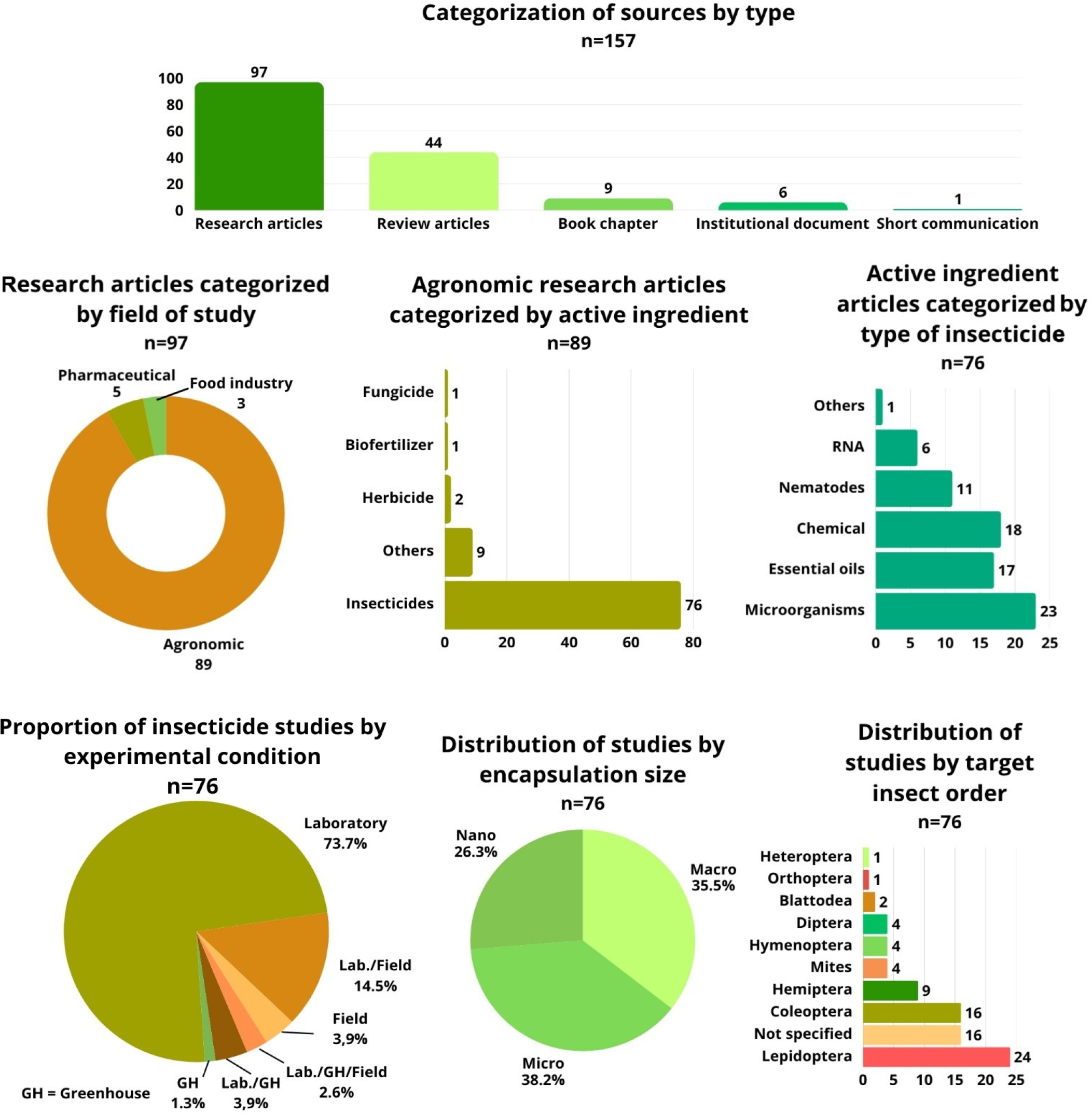
The dashboard shown in Figure 1 provides a comprehensive visualization of the data used in this literature review, highlighting the composition of sources, experimental approaches, and thematic focuses of the analyzed studies. A total of 157 bibliographic sources were consulted for this review. Of these, 97 are original scientific articles, which form the core of the quantitative and qualitative analyses conducted. The remaining sources, including review articles, book chapters, institutional documents, and short communications, were incorporated primarily to provide historical, technical, and conceptual context on encapsulation technology.
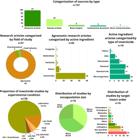
Characterization dashboard of research sources consulted for review. Source: Elaborated by the author (2025).
Among the 97 original articles, 89 focus on agricultural applications, with 76 specifically investigating the encapsulation of insecticides. Among the insecticide formulations studied, those based on microorganisms represent the most frequent category, reflecting significant scientific interest in biological alternatives to conventional chemical control.
Regarding experimental conditions, most studies (73.7%) were conducted exclusively in laboratory settings, while only 21% advanced to field testing. This distribution indicates a significant gap between basic research and applied validation of encapsulation technologies.
The distribution of encapsulation scales was balanced: macroencapsulation (35.5%), microencapsulation (38.2%), and nanoencapsulation (26.3%). This suggests that all scales are actively investigated, with a slight predominance of microencapsulated formulations.
Concerning target insects, Lepidoptera was the most studied order, being the focus of 24 articles. This predominance aligns with the economic importance of caterpillar pests in agricultural systems.
Encapsulation of synthetic chemical insecticides
The World Health Organization (WHO) defines chemical pesticides as compounds used to control pests, such as unwanted plants, fungi, and insects, playing an important role in crop production [52]. Although widely used, chemical insecticides are not without limitations, and encapsulation of these active ingredients can help mitigate some of these shortcomings.
A pioneering study from 1976 evaluated the controlled release of 1,2-dibromo-3-chloropropane encapsulated in a starch matrix. This approach reduced the number of applications and helped prevent harm to non-target organisms, since some chemical insecticides are poorly selective and environmentally toxic [53]. Subsequent studies also sought to achieve the controlled release of compounds while offering protection against environmental conditions. One of the limitations of chemical insecticides is the decreased availability of active ingredients due to evaporation, leaching, and degradation [54-58]. More recent studies continue to pursue this goal of optimizing insecticide use, in line with earlier approaches [17].
For example, the choice of size, macro, micro, or nanoencapsulation [57, 59, 60, 61], is closely related to uniformity of distribution and surface retention. Studies by Liu and coauthors (2008) [62] and Stejskal and coauthors (2009) [63] demonstrated a strong correlation between encapsulated particle size and efficacy. Liu and coauthors (2008) [62] stated that smaller particle sizes provide more uniform distribution on leaf surfaces, which is advantageous for controlling insects that feed on plant foliage. In contrast, Stejskal and coauthors (2009) [63] found that larger particles, even in micro dimensions, tend to adhere better to porous surfaces compared to smaller ones.
Chen and coauthors (2022) [17] encapsulated emamectin benzoate (EB) in DSPE-PEG2000-NH₂ (1,2-distearoyl-sn-glycero-3-phosphoethanolamine-N-[amino(polyethylene glycol)-2000)] for application against Spodoptera frugiperda (J.E. Smith, 1797) (Lepidoptera: Noctuidae). Surface retention, dispersion rate, and insecticidal activity were evaluated. The results showed that encapsulated formulations (DSPE-EB) had greater retention, at 15.85 mg cm⁻2, compared to the free formulation (EB emulsifiable concentrate), which retained 13.52 mg cm⁻2. Moreover, within the first 20 hours after application, 90% of the insecticide in the EB-EC formulation had already dispersed, while only 40% had dispersed from the DSPE-EB formulation.
Ebadollahi and coauthors (2022) [59] studied the nanoencapsulation of acetamiprid in sodium alginate (AL) and polyethylene glycol (PEG) for the control of Xanthogaleruca luteola (Müller, 1766) (Coleoptera: Chrysomelidae). The lethal concentration (LC₅₀) values for AL-acetamiprid, PEG-acetamiprid, and non-encapsulated acetamiprid were 0.048 ppm, 0.081 ppm, and 0.680 ppm, respectively. In other words, encapsulation with these materials increased the toxicity of acetamiprid, making it more lethal to X. luteola larvae.
The literature shows that various classes of insecticides can be encapsulated, including avermectins, carbamates, organophosphates, neonicotinoids, and pyrethroids [63-66]. Pyrethroids are frequently used in encapsulation studies, likely due to their broad-spectrum action, being effective against pests in the orders Coleoptera, Hemiptera, Diptera, Hymenoptera, Lepidoptera, Orthoptera, and Thysanoptera [67].
Encapsulation has also been applied to social insects such as Atta sexdens (Linnaeus, 1758) (Hymenoptera: Formicidae). The study by Gustani and coauthors (2021) [68] demonstrated the encapsulation of sulfluramid in a polymer matrix composed of chitosan, tapioca, and citrus pulp. The results showed that sulfluramid was effectively encapsulated, and the ants were attracted to the capsules, resulting in a mortality rate of 96.57% by the ninth day of evaluation, highlighting the technique as a promising method for applying this insecticide.
The combined application of two active ingredients through encapsulation can ensure efficient delivery and enhance synergistic interactions between them, offering an alternative and promising method of applying the technique. Boff and coauthors (2023) [64] evaluated the effect of encapsulating piperonyl butoxide (PBO) and diethyl maleate (DEM) with the pyrethroids bifenthrin (BFT) and λ-cyhalothrin (LAM) on the mortality of Euschistus heros (Fabricius, 1798) (Hemiptera: Pentatomidae) and Chrysodeixis includens (Walker, 1858) (Lepidoptera: Noctuidae). The results showed that, in E. heros, mortality significantly increased with nanocapsules containing BFT and PBO (68%) and BFT and DEM (72%), while BFT alone resulted in less than 20% mortality. For LAM, although there was no significant difference between the formulations LAM, LAM + PBO, and LAM + DEM, encapsulated forms performed better than non-encapsulated ones, which had lower mortality rates. In C. includens larvae, nanocapsules of BFT + PBO resulted in 70% mortality, while commercial formulations achieved only 37%. Similarly, nanoencapsulated LAM + PBO and LAM + DEM reached 54% and 52% mortality, respectively, compared to 37% with the commercial formulations.
The literature presents consistent evidence of the benefits of encapsulating synthetic chemical insecticides, such as increased retention on leaf surfaces, controlled release, enhanced toxicity against target pests, and reduced environmental impacts. However, there is still a need for research to expand the scale of application of this technology, enabling its large-scale use in agriculture and integrated pest management. Advances in this area could significantly contribute to the development of more sustainable and efficient solutions for pest control, promoting more responsible agriculture with a lower environmental footprint.
Encapsulation of essential oil-based insecticides
Although subject to degradation, synthetic insecticides retain their efficacy for longer periods compared to essential oils. However, their use can lead to the accumulation of toxic compounds that are harmful to ecosystems, beneficial organisms, and human health [69]. Thus, the main reason for encapsulating essential oils is to minimize the loss of these compounds while reducing toxicity to non-target organisms, considering that essential oils are generally less toxic than conventional insecticides [70].
Several plant-derived active compounds have already been encapsulated, including neem oil, extracted from Azadirachta indica A. Juss (Meliaceae) [71], linalool [72, 73], carvacrol [13], Achillea millefolium L. (Asteraceae) [74], Melia azedarach (L.) (Meliaceae) [75], Ocimum basilicum (L.) (Lamiaceae) [76], Piper nigrum (L.) (Piperaceae) [77], Pongamia pinnata (L.) Pierre (Fabaceae) [78], and Cymbopogon nardus (L.) Rendle (Poaceae) [79], and Rosmarinus officinalis L. (Lamiaceae) [80], among others.
In the study conducted by Bezerra and coauthors (2020) [81] with Helicoverpa armigera (Hübner, 1805) (Lepidoptera: Noctuidae), microcapsules made of gum arabic and maltodextrin were used to encapsulate A. indica seed extract. In the group treated with microcapsules containing extracts at a concentration of 576 µg·mL⁻1, larval length ranged from 2.75 mm to 5.39 mm, with an average of 3.93 mm. At 288 µg·mL⁻1, larval length ranged from 2.41 mm to 8.28 mm, with an average of 4.15 mm. In comparison, the control group treated with distilled water, showed lengths ranging from 5.06 mm to 21.85 mm, with an average of 14.24 mm.
Purkait and coauthors (2018) [78] investigated the encapsulation of P. pinnata essential oil for use against Bemisia tabaci (Gennadius, 1889) (Hemiptera: Aleyrodidae), Bombyx mori (Linnaeus, 1758) (Lepidoptera: Bombycidae), and Aphis gossypii (Glover, 1877) (Hemiptera: Aphididae), which are economically significant pests. The P. pinnata extract was encapsulated in polyurea, and larvicidal activity increased with essential oil concentration in the capsules applied to silkworms. Treatments were applied at concentrations ranging from 0.2% to 4.0%. The 4.0% treatment showed the highest larvicidal activity, achieving 77.6% efficacy, followed by the 2.0% treatment with 72.4% efficacy, and the 1.0% treatment with 56.5% efficacy after 96 hours of application.
Rajkumar and coauthors (2020) [77] used P. nigrum essential oil to treat stored grain pests, Sitophilus oryzae (Linnaeus, 1763) (Coleoptera: Curculionidae) and Tribolium castaneum (Herbst, 1797) (Coleoptera: Tenebrionidae). The encapsulated oil achieved 100% mortality in S. oryzae and T. castaneum at a concentration of 75.0 μL·L⁻1 of air, while the non-encapsulated oil reached 100% mortality only at a concentration of 100 μL·L⁻1 of air.
Encapsulation of entomopathogenic nematodes
Entomopathogenic nematodes are obligate parasitic worms of arthropods, with the genera Heterorhabditis and Steinernema being the most relevant. To date, at least 90 species of Steinernematidae and 20 of Heterorhabditidae have been described [82-84]. These nematodes maintain a mutualistic relationship with bacteria of the genera Xenorhabdus and Photorhabdus, which quickly kill the insect host by suppressing its immune system and digesting its tissues, thus providing food for the nematodes. The bacteria, in turn, cannot survive outside the nematodes and rely on them for reproduction, transport from one insect to another, and protection against adverse environmental conditions [83, 84].
In addition to being natural enemies of pest insects, nematodes have interesting ecological attributes, as they are not harmful to humans, non-target organisms, or the environment, which gives them great potential as agricultural bioinsecticides [84, 85]. However, their commercialization is currently restricted to home gardening and small-scale agriculture [86]. This limitation is due to difficulties in applying nematodes, which are known for their short shelf life and low viability after application because of their sensitivity to UV radiation and high temperatures [86, 87]. Nematodes become sluggish at temperatures below 10-15 °C, perform well between 20-30 °C, and are inactivated at temperatures above 30 °C [84].
New formulations are needed [82], and encapsulation emerges as a promising technique to enhance the protection of nematodes against biotic and abiotic factors. This approach can increase self-life and enable controlled release, which is crucial for their efficacy and field application. The issue of nematode escape from encapsulated formulations has been addressed in several studies [86-89]. Patel and Vorlop (1994) [88] found that hollow beads reduced the escape of Heterorhabditis sp., and storage at 6 °C reduced escape to 6%, compared to 100% escape at room temperature. Kagimu and Malan (2019) [87] confirmed these findings, showing that the escape of Steinernema yirgalemense (Rhabditida: Steinernematidae), Steinernema jeffreyense (Rhabditida: Steinernematidae), and Heterorhabditis bacteriophora (Poinar, 1976) (Rhabditida: Heterorhabditidae) increased with temperature.
The encapsulation of entomopathogenic nematodes dates back to the 1980s. Kaya and Nelsen (1985) [90] encapsulated Steinernema feltiae (Filipjev, 1934) (Rhabditida: Steinernematidae) and Heterorhabditis heliothidis (Khan, Brooks & Hirschmann, 1976) (Rhabditida: Heterorhabditidae) in calcium alginate and offered the encapsulated nematodes in an artificial diet to control Spodoptera exigua (Hübner, 1808) (Lepidoptera: Noctuidae). The larvae fed on the capsules, breaking the polymer and releasing the nematodes, resulting in 100% mortality three days after ingestion.
Goud and coauthors (2010) [91] also used calcium alginate beads to encapsulate Heterorhabditis indica (Poinar et al., 1992) and studied shelf life, considering factors such as temperature and nematode population density. The results showed that, under refrigerated conditions (10 °C), nematodes stored at a density of up to 1,000 individuals per capsule exhibited less than 30% mortality, whereas higher densities resulted in significantly different outcomes (p < 0.01) after 90 days of storage. This indicated that storage temperature and nematode density influenced the shelf life of the encapsulated nematodes.
The manufacturing process and the composition of the polymer matrix also play a crucial role. Hiltpold and coauthors (2012) [10] investigated the encapsulation of H. bacteriophora for the control of Diabrotica virgifera virgifera (LeConte, 1868) (Coleoptera: Chrysomelidae). The study varied the crosslinking time of alginate beads, which affected the thickness of the bead walls. Beads with greater thickness demonstrated less nematode escape during storage. When stored at 10 °C, the increased wall thickness proved even more significant in preventing nematode escape. A synthetic blend of attractants (linoleic acid, oleic acid, stearic acid, glucose, fructose, sucrose, and MBOA (6-methoxybenzoxazolinone)) was added to the alginate, which attracted D. virgifera virgifera larvae to the capsules, resulting in significantly better field control compared to sprayed nematodes.
Kim and coauthors (2015) [86] introduced a post-treatment with calcium ions (Ca2⁺) and modified the process temperature, forming harder capsules at 4 °C. However, only the low temperature was effective in retaining the nematodes, while the Ca2⁺ post-treatment increased the permeability of the encapsulated material.
Kagimu and Malan (2019) [87] added diatomaceous earth (DE) to the alginate beads and observed that it did not cause nematode desiccation, suggesting that formulations containing DE could reduce refrigeration costs. Kim and coauthors (2021) [89] tested alginate beads supplemented with 18% glycerol to improve the retention of H. bacteriophora, confirming that glycerol promotes quiescence in nematodes, reducing premature escape.
Kagimu and Malan (2019) [87] also proposed encapsulating nematodes with added diatomaceous earth to evaluate whether it would induce quiescence by decreasing nematode metabolic activity and improving storage prior to field application, or whether it would cause intense desiccation, rendering application unfeasible. The results showed a steady decrease in nematode survival without leading to desiccation, demonstrating potential for reducing refrigeration costs during storage and transportation.
Chen and Glazer (2005) [92] demonstrated that it induces quiescence in nematodes. This observation was confirmed by Kim and coauthors (2021) [89], who introduced solid alginate beads supplemented with 18% glycerol for better retention of H. bacteriophora. The nematodes remained dormant the day after encapsulation. In contrast, those encapsulated without glycerol exhibited significant escape from the beads, compromising storage and transport efficiency.
Encapsulation of RNAi-based insecticides
RNA interference (RNAi) technology has proven to be a promising tool for crop protection, offering an effective method for controlling a variety of pests, including nematodes, viruses, bacteria, fungi, and insects. This approach presents both ecological and economic advantages for agriculture. However, significant challenges remain, primarily related to the low stability and premature degradation of RNA under harsh temperature conditions. In insects, RNA must be ingested by the host and remain intact within it, avoiding degradation by nucleases and pH changes in the digestive tract and hemolymph [93, 94]. Studies indicate that RNAi effectiveness may vary among different insect groups. For example, lepidopterans have shown lower susceptibility, whereas coleopterans have demonstrated a more favorable response [95, 96, 97].
The RNA interference (RNAi) mechanism is a gene-silencing process involving the cleavage or degradation of messenger RNA (mRNA) within the cell by double-stranded RNA (dsRNA), resulting in the silencing of the target gene [97, 98]. In encapsulation studies, the goal is to trap the dsRNA responsible for mRNA cleavage, thus preventing the production of amino acids necessary for protein synthesis. As observed for other molecules and organisms, the choice of encapsulation matrix is crucial. However, for nucleic acids, the range of available options is narrower. Among the materials used, peptides [99, 96] and liposomes [100, 101, 102] stand out. Chitosan is widely reported for nucleic acid delivery [103], as are liposomes, for which there are numerous reports of RNAi encapsulation.
Another relevant aspect is the size of the encapsulated particles. Unlike other active ingredients, there are no reports in the literature of macroencapsulation for RNAi; however, studies on microand nanoencapsulation are frequent [96, 99, 101, 102, 104, 105]. Since RNA functions at the cellular level, the encapsulated particles must be small enough to ensure they are properly ingested and absorbed by the insect.
Encapsulating this active ingredient in carrier formulations has shown positive results for pest control. Taning and coauthors (2016) [101] investigated the functionality of RNAi in the dipteran Drosophila suzukii (Matsumura, 1931) (Diptera: Drosophilidae) and whether oral ingestion could trigger gene silencing, resulting in insecticidal activity. The dsRNAs were encapsulated in liposomes and offered in an artificial diet to facilitate intestinal absorption. Mortality caused by encapsulated RNAi was significantly higher compared to free RNAi.
Liposomes were also used to encapsulate dsRNA in the study by Castellanos and coauthors (2019) [100], applied to Euschistus heros (F.) (Hemiptera: Pentatomidae). The dsRNA was offered in an artificial diet, both encapsulated and free. Encapsulation resulted in an increased mortality rate (42%) compared to the non-encapsulated diet (33%). A similar result was observed in the silencing of the vATPase gene, with mortality increasing from 30% to 45% when the dsRNA was protected by the liposome.
Huang and coauthors (2018) [104] tested oral ingestion of dsRNA in Blattella germanica (Linnaeus, 1767) (Blattodea: Blattellidae). Unlike the previously mentioned studies, liposomes were administered through water droplets pipetted directly into the insect’s mouthparts, rather than through an artificial diet. This method was adopted to minimize variation in the amount of active ingredient ingested by the insects. Even so, the results favored encapsulation, showing that the suppression effect of α-tubulin by dsTub in the midgut increased from 40% on day 9 to 60% on day 17 with continuous administration. Additionally, there was a significant increase in mortality, rising from 10% on day 8 of ingestion to approximately 70% on day 16.
Encapsulation of microorganisms in pest insect control
Microorganisms play various roles in nature, including regulating insect populations. Some act as entomopathogens, causing insect death, and this ability is harnessed by humans for integrated pest management. Among the microorganisms used, which include bacteria, fungi, and viruses, all can be employed in the biological control of insects, often through encapsulation as a delivery tool.
The use of microorganism encapsulation dates back at least to the 1980s, when encapsulated bacteria were already being applied. Dunkle and Shasha (1988) [106] maintained the viability of B. thuringiensis encapsulated in starch for four months. When the spheres were applied in an artificial diet for neonates and second-instar larvae of O. nubilalis, the insects were able to ingest and digest the starch matrix, resulting in 100% mortality at a dosage of 50 µg·g⁻1. In another viability study, McGuire, Streett, and Shasha (1991) [107] encapsulated entomopoxvirus formulations in starch to control Melanoplus sanguinipes (Fabricius, 1798) (Orthoptera: Acrididae). The results showed 80% mortality after 21 days, leading the authors to conclude that the technique was versatile and had broad potential for microbial grasshopper control.
Although the issue of climate change has gained more attention in recent years, the relationship between climate and the performance of microorganism application had already been addressed in earlier studies, such as McGuire and coauthors (1994) [108]. In this study, starch-encapsulated B. thuringiensis was used to control neonates of O. nubilalis, comparing various formulations and the influence of field weather conditions. The results showed that heavy rainfall reduced the efficiency of commercial bacterial formulation compared to the starch-encapsulated ones. The residual activity of the microorganism in the encapsulated formulations (Coax 1% and Coax 10%) during the rainy period was 56.7% and 77.2%, respectively, while the commercial formulation reached only 22.5%.
To date, encapsulation techniques for microorganisms show that macroencapsulation is the most widely used method. Spray drying, a technique later implemented for biological control, contributed to the development of microencapsulation of active ingredients [26]. For instance, Horaczek and Viernstein (2004) [109] encapsulated conidia of the entomopathogenic fungus Beauveria brongniartii (Saccardo, 1892) (Hypocreales: Cordycipitaceae) in skim milk powder and PVP K90 using spray drying. The process resulted in microcapsules with high conidial concentration and 92% viability. The encapsulated particles containing 5% (w/v) milk powder and 1.25% (w/v) PVP K90, exposed to inlet/outlet temperatures of 80/53 ± 2 °C, were considered the most effective for maintaining fungal viability.
Still in the context of different forms of microorganism encapsulation, Rosas-García (2006) [110] compared microand macroencapsulation of B. thuringiensis in modified starch for controlling Diatraea saccharalis (Fabricius, 1794) (Lepidoptera: Pyralidae) in laboratory and field trials. In the field, spray drying proved more efficient, with nearly 100% mortality, compared to the granular formulation, which yielded 84% mortality. This difference was attributed to the difficulty of macrocapsules adhering to leaf surfaces, a common issue in field applications.
Nucleopolyhedroviruses (NPVs) are entomopathogenic viruses that can be used in biological insect control. Camacho and coauthors (2015) [111], unlike previous studies, used anionic polymers [112] to encapsulate NPV via spray drying and applied them for the control of S. frugiperda. The results showed that encapsulation preserved NPV pathogenicity: non-encapsulated viruses lost approximately 69% of their insecticidal activity after six hours of UVB exposure, whereas encapsulated viruses experienced a much smaller loss of around 12%.
Arora and coauthors (2015) [113] used calcium alginate to microencapsulate the transgenic bacterium Pantoea agglomerans (Ewing & Fife, 1972) (Enterobacterales: Erwiniaceae) to prevent horizontal gene transfer to environmental bacteria. The bacterial capsules were administered to the sharpshooter Homalodisca vitripennis (German, 1821) (Hemiptera: Cicadellidae) for paratransgenic control of the pathogen Xylella fastidiosa (Wells et al., 1987).
An interesting approach within encapsulation is the combination of two distinct microorganisms to achieve synergy in control. Although Saccharomyces cerevisiae (Meyen ex E.C. Hansen, 1883) (Saccharomycetales: Saccharomycetaceae) is not an entomopathogenic microorganism, Vemmer and coauthors (2016) [114] found that encapsulating this yeast alongside Beauveria bassiana (Bals.-Criv.) Vuill., 1912 (Hypocreales: Cordycipitaceae) improved the control of D. virgifera larvae. In the study, it was observed that within the first 4 hours, 40% of the larvae migrated to the soil section containing the yeast-containing capsules, in contrast with the control (alginate-only capsules). This suggests that CO₂ production by the yeast may act as an attractant for the larvae.
Silva and coauthors (2020) [115] investigated the encapsulation of Trichoderma harzianum Rifai, 1969 (Hypocreales: Hypocreaceae) varying concentrations of zinc sulfate (ZnSO₄) for the control of Atta sexdens (Forel, 1908) (Hymenoptera: Formicidae), a species of social insect. The study found that, in vitro, a ZnSO₄ concentration of 0.25 g·L⁻1 was sufficient to completely inhibit the development of Leucocoprinus gongylophorus, the mutualistic fungus cultivated by the ants and essential to their survival. In bait acceptance tests, workers transported approximately 55% of the ZnSO₄ and T. harzianum combination, suggesting that encapsulation could be a promising alternative for controlling this pest in future field trials.
Despite the diversity of microorganisms that can be encapsulated, there seems to be a consistent trend in the species that are most frequently used. There is a predominance of the fungi B. bassiana, Metarhizium anisopliae (Metschn.) Sorokīn, 1879 (Hypocreales: Clavicipitaceae), and Metarhizium brunneum Petch, 1935 (Hypocreales: Clavicipitaceae), along with the bacterium B. thuringiensis. However, studies such as that by Muskat and coauthors (2022) [116] go beyond these genera and focus on lesser-known fungi, such as Pandora sp. nov. inédit. (Entomophthorales: Entomophthoraceae) for the control of Cacopsylla picta (Foerster, 1848) and Cacopsylla pyri (Linnaeus, 1758) (Hemiptera: Psyllidae). The results showed mortalities of 48.3% and 75.0%, respectively. This suggests that investigating a broader range of microorganisms for encapsulation may be advantageous and expand the options available for pest insect control.
Key elements of encapsulation
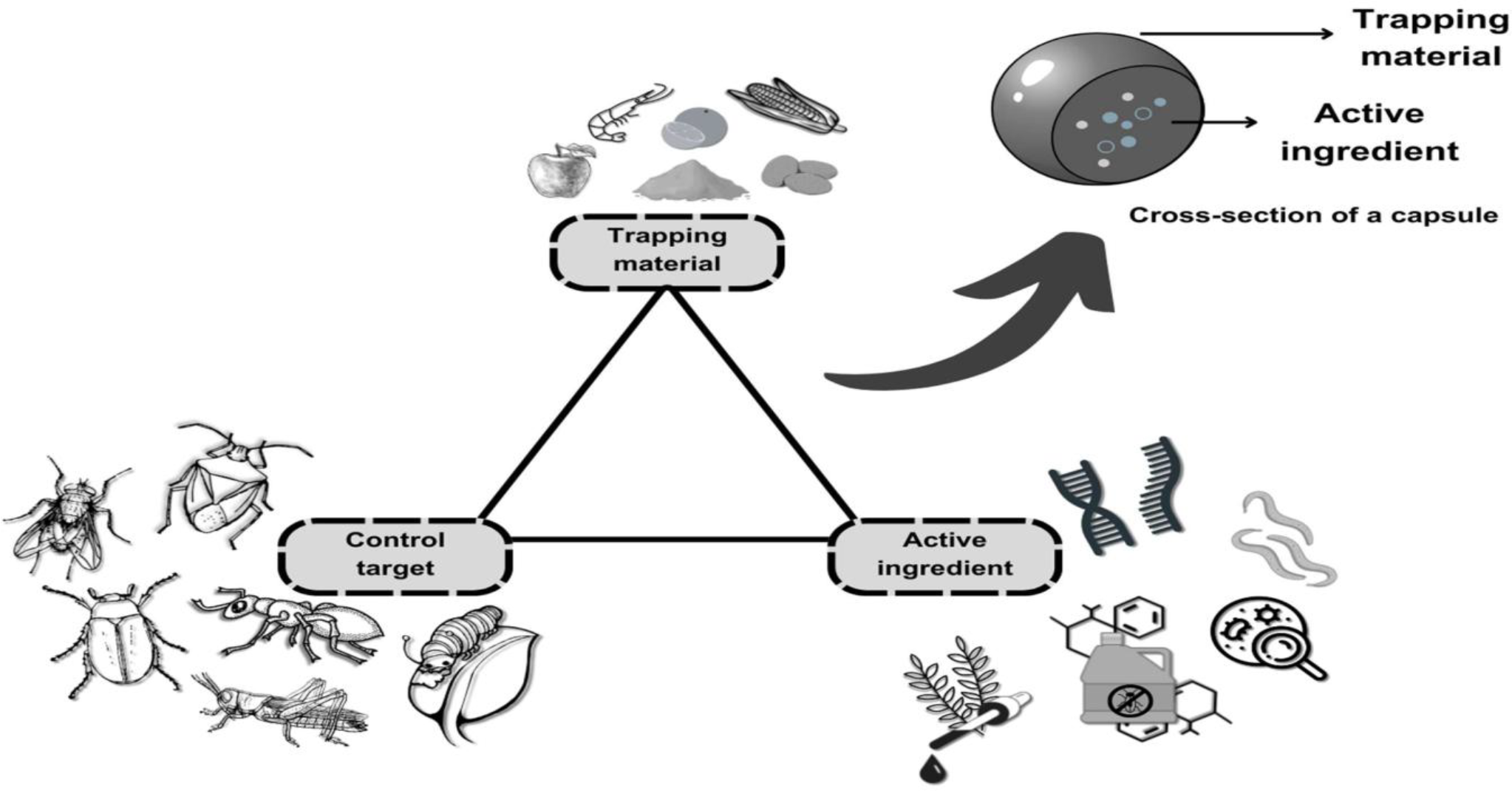
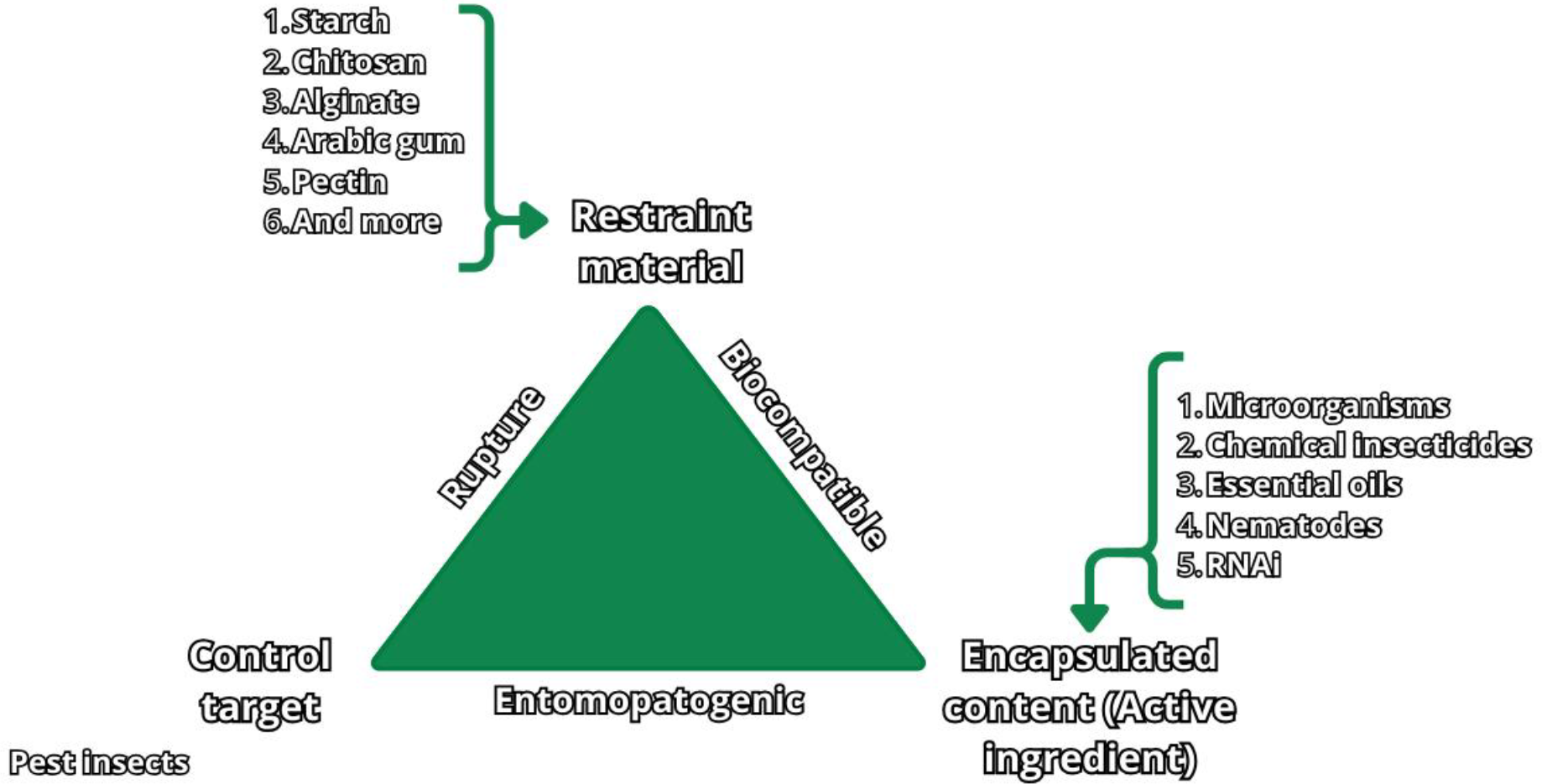
Figure 2 illustrates the key elements of encapsulation in pest control and their interconnections, given that its application is biotechnological and multidisciplinary. This type of approach is not explicitly addressed in the literature, highlighting the importance of these relationships for effective encapsulation.
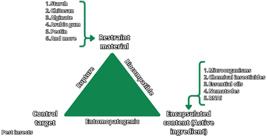
The structure of this illustration is based on the principle that insects are highly diverse organisms with equally varied bioecological characteristics.
Target organisms: insects and encapsulation
Target insects are those intended to be controlled through the use of encapsulated agents. The main challenge in this regard is the assimilation of the encapsulated product. Unlike drug delivery, fertilizers, or food preservation, where rejection is not an issue, insects will not spontaneously feed on an artificial bait such as an encapsulated formulation. Therefore, when developed, encapsulation must include components that attract insects and act as phagostimulants.
Given the immense diversity of agricultural pests and their unique modes of action, encapsulation must be versatile enough to address them. Factors such as feeding habits, mouthpart type, habitat, host crop preference, defense mechanisms, and other insect-specific attributes must be considered.
Materials and polymers used in encapsulation
Another relatively underexplored factor is the interaction between the microorganism and the encapsulating matrix. Besides offering protection, the matrix can play a crucial role in nourishing the fungus while it remains encapsulated. The literature reveals a wide variety of materials used in this technique, including polyvinyl acetate [71], sodium alginate [117-119], calcium alginate and starch [120], gelatin and gum arabic [121], pectin [122-126], chitosan [74], as well as potato starch, carboxymethylcellulose, and yeast [127], and combinations such as chitosan with cellulose [79] and β-cyclodextrin with chitosan [13]. These variations demonstrate the broad range of options available for the effective formulation of encapsulated products.
Starch is a widely used encapsulating matrix composed mainly of two biopolymers: amylose and amylopectin [128]. Naturally present in plants such as corn, potatoes, rice, and other grains, starch is extracted from these sources [129, 130]. It is widely used in several industrial applications due to its functional and beneficial properties. In pharmaceuticals, it is applied in controlled drug delivery; in the food industry, it protects key ingredients such as flavorings [128]; and in agriculture, it plays a crucial role in the delivery and protection of active ingredients.
As an important matrix for encapsulation, starch offers numerous advantages. Its low cost, high availability, ease of extraction, non-toxicity, biodegradability, and biocompatibility make it an attractive option across various sectors [128-131]. These features not only ensure protection and controlled release of encapsulated active ingredients but also minimize environmental impact. Additionally, starch can be modified to improve its encapsulation properties, increasing its versatility for industrial and environmental applications.
In pest control, starch is a versatile and advantageous polymer for encapsulation studies. It has been used to encapsulate various insecticides, including synthetic chemicals, essential oils, and microorganisms [53, 106, 107, 110, 120, 127, 132, 133]. Its applicability spans several insect orders, including Coleoptera [127], Lepidoptera [106, 108, 110, 132], Orthoptera [107], and Diptera [133].
However, the study by Dunkle and Shasha (1988) [106] is one of the few to address the interaction of external microorganisms with the encapsulating matrix. They reported that starch, exposed to high moisture conditions for extended periods, is susceptible to mold and other saprophytic microorganisms, which can compromise the efficacy of the active ingredient, highlighting the need to consider matrix stability under varying conditions. Mohapatra and coauthors (1995) [132] encapsulated neem oil in a starch-borate matrix but found that the feeding inhibition activity of some treatments was lower than expected. This was attributed to the harsh alkaline treatment of the starch-borate matrix, which may have suppressed the neem oil's active component.
Alginate is a water-soluble polysaccharide found mainly in the cell walls of brown algae, where it provides flexibility and strength [134, 135]. Species of Pseudomonas are also a source of this polymer [134, 136].
Alginate has a wide range of applications, including biotechnology, bioengineering, biomedicine, the chemical, textile, pharmaceutical, and food industries [136]. Its desirable features include biodegradability, renewability, biocompatibility, non-toxicity, hydrogel-forming ability, and abundance in nature [136, 137]. However, high rigidity, brittleness, low elasticity, and poor mechanical properties are considered disadvantages. These physical properties can be improved by blending alginate with other substances, including different biopolymers, which increases their versatility [135, 138, 139]. In agriculture, alginate is widely used in integrated pest management. Studies report its application in controlling various insect orders, including Lepidoptera [90, 128], Coleoptera [10, 59, 89, 114], and Hemiptera [113]. Alginate can be combined with several agents, such as linalool [72], neem oil [139], acetamiprid [59], emamectin benzoate [128], and entomopathogenic nematodes [10, 89-92]. Additionally, it is versatile in particle size, being applicable in nano-, micro-, and macroencapsulated forms.
Pectin is a water-soluble polysaccharide and a key component of plant cell walls [140, 141]. Its main sources include apple pomace and citrus peels from lemons, limes, and oranges [142]. Less common sources are beetroot, sunflower, cocoa husk, pumpkin, watermelon, pear, and potato [143].
Pectin is widely studied and applied across various fields. In pharmaceuticals and biomedicine, it is used for glycemic control, controlled drug delivery, and antioxidant properties. In the food industry, it is applied in edible packaging and jelly production [143, 144]. In agronomy, it is used for the delivery of biofertilizers [145]. Its non-toxicity, biocompatibility, biodegradability, and flexibility provide multifunctionality and make pectin attractive for ecological applications in agroecosystems [146].
However, pectin as an encapsulating matrix for pest management is a relatively new and less explored application. Recent studies indicate its use in controlling Lepidoptera and Coleoptera with various encapsulated active ingredients, including entomopathogenic viruses, entomopathogenic nematodes, neem oil, and essential oil from Citrus aurantium (Rutaceae). Pectin has been used in both microand macroencapsulation formats [122-126].
Chitosan is a naturally occurring biopolymer derived from chitin and extracted primarily from the exoskeletons of crustaceans (such as crabs and shrimp), as well as from insects and fungi [129, 147, 148]. Like other biopolymers, chitosan has been studied and applied in various contexts, including biomedicine, cosmetology, food production, and agriculture [130]. Interest in chitosan has grown due to its advantageous properties, biodegradability, non-toxicity, and compatibility with other biopolymers, which make it an eco-friendly and versatile option [129, 148].
In agriculture, especially for pest control, chitosan is used in various formulations, such as pellets, beads, and hydrogels [129]. Its unique properties enable effective application in managing pests from different insect orders, including Lepidoptera [79, 148, 149], Hymenoptera [68], and Orthoptera [148].
For example, in a study by Ahmadi and coauthors (2018) [74], preparing chitosan at a low pH resulted in more efficient encapsulation, with higher amounts of active ingredient retained up to 92.49%, 89.88%, and 84.66% in formulations with pH 3.5, 4.5, and 5.5, respectively. These results show that both the encapsulating material and its preparation directly influence the amount of active ingredients retained.
Challenges and Limitations
Despite the encapsulation technique presenting favorable aspects for its application in pest management, it faces significant limitations that can be organized into five main axes: (1) regulatory and safety barriers; (2) technical and scientific limitations; (3) production and scaling challenges; (4) environmental and safety aspects; and (5) a vicious cycle of interconnected obstacles.
1) Regulatory and Safety Barriers
Addressing the regulatory aspects of encapsulated formulations is crucial for understanding the current context of this technology in agriculture. In Brazil, pesticide regulation is established by Law No. 7.802/1989, which sets rules for all stages of the pesticide life cycle, from research and experimentation to the disposal of residues and packaging [150]. Decree No. 4.074/2002 regulates this law [151]. Although Joint Normative Instruction No. 1/2013 does not specifically address encapsulation, it defines regulatory criteria for safety, health, and environmental aspects concerning changes in registered pesticide formulations. [152]. Act No. 30/2019 officially included the category "CS - capsule suspension" among the formulation types recognized for registration [153].
This milestone represents progress in Brazil as it ensures that encapsulated products are subject to the same physicochemical, toxicological, and ecotoxicological evaluation requirements applicable to conventional formulations, with a tripartite analysis conducted by MAPA (Ministry of Agriculture, Livestock and Supply), ANVISA (Brazilian Health Regulatory Agency), and IBAMA (Brazilian Institute of Environment and Renewable Natural Resources).
However, Li and coauthors (2021) pointed out that the evaluation methods were designed for formulations with free active ingredients and may not adequately capture the specific effects of encapsulation [154]. The numerical concentration of particles, particle size distribution, and the ratio between the active ingredient in its "free" form and that associated with nanoparticles constitute relevant parameters for evaluating the bioavailability and toxicity of pesticides [155], especially at the nanoscale, considering aspects such as hydrophobicity, soil sorption, environmental availability, pesticide dispersion, and foliar spreadability.
Encapsulated formulations containing previously approved active ingredients may therefore be considered distinct pesticide products, requiring specific risk assessments and regulatory authorizations. For example, Slattery and coauthors (2019) demonstrated that capsule size can affect the toxicity of λ-cyhalothrin, with 449 nm capsules being significantly more toxic than 758 nm capsules or the free active ingredient. Consequently, it is necessary to evaluate whether traditional environmental risk assessment methods applied to conventional pesticides adequately address the specificities of controlled-release systems. If not, the development of dedicated experimental protocols, predictive models, and regulatory frameworks becomes imperative [156].
2) Technical and Scientific Limitations
Beyond regulatory gaps, the discrepancy between controlled-environment research and field validation reveals important technical and scientific barriers. Only a limited number of studies have evaluated the environmental impacts of encapsulated formulations under field conditions [155]. Most research demonstrates effectiveness exclusively in laboratory or greenhouse settings and for a restricted number of crops.
As illustrated in Figure 1, 73.7% of studies are conducted solely in the laboratory and only 21% progress to field trials, hindering formulation characterization and reproducibility. This imbalance limits the evaluation of performance under realistic environmental conditions, where factors such as temperature fluctuations, ultraviolet radiation, rainfall, soil properties, and interactions with non-target organisms can substantially influence formulation stability, release dynamics, and biological efficacy. Market validation of these products remains in its early stages [155, 157].
3) Production and Scaling Challenges
Regulatory, environmental, and safety issues are directly related to scalability, which is an essential step towards product commercialization. The use of carrier or entrapment materials often increases manufacturing costs, creating significant obstacles to expansion, development, and market entry.
According to Xu et al. (2024), for controlled-release pesticide formulations to be economically viable, they must be competitive and multifunctional. Future research should prioritize low-cost and environmentally benign materials, simplification of manufacturing techniques to enable large-scale production, maximization of efficiency to offset higher costs, and the design of multifunctional systems that optimize resource use [157].
Furthermore, encapsulated formulations must compete with well-established conventional insecticides in terms of both cost and efficacy. The absence of robust field data demonstrating a clear return on investment, such as a reduction in the number of applications, discourages farmer adoption and industrial investment, constituting a significant economic and market barrier [157]. To address this issue, there is an urgent need for new protocols for characterization, detection, and quantification.
4) Environmental and Safety Concerns
Environmental and safety aspects also represent critical barriers to implementation. The lack of standardized analytical methods for these formulations increases uncertainty regarding the environmental behavior of encapsulated systems, including their persistence and mobility. As a result, predicting their ecotoxicological impacts on both target and non-target organisms remains challenging [154-156].
5) Vicious and Interconnected Cycles
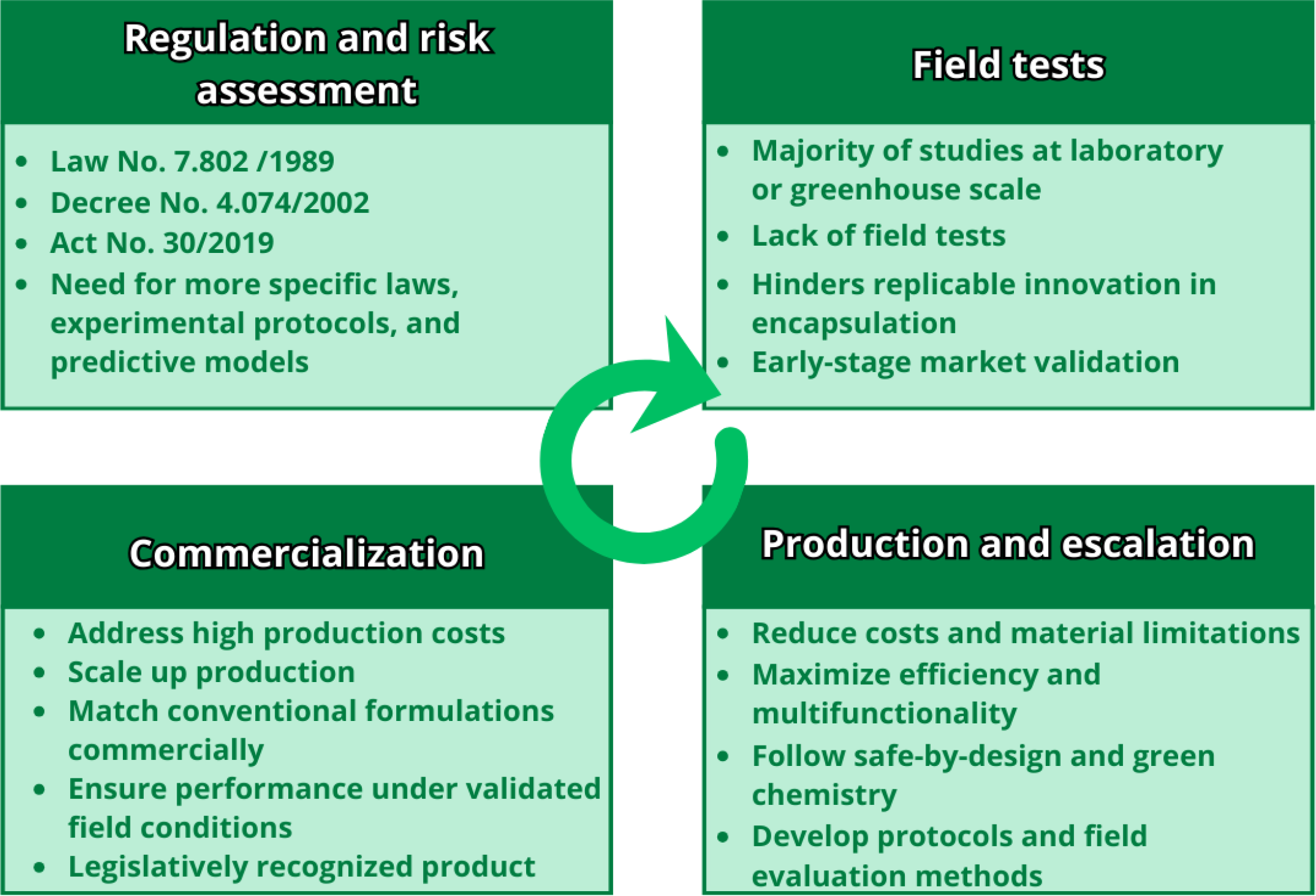
All these challenges and limitations converge into a central issue in the adoption of encapsulation technology for pest control: vicious and interconnected cycles (Figure 3 and Figure 4). The absence of specific regulatory frameworks restricts field testing; the scarcity of field data hampers regulatory refinement and production scaling, and the high costs associated with small-scale production limit the generation of the data necessary to break this cycle [154-157]. Together, these interconnected barriers, ranging from high production costs to regulatory gaps, create a multifaceted obstacle to market advancement.
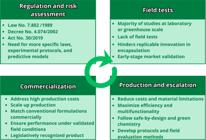
Main interconnected challenges to commercialization of encapsulated formulations: regulatory, environmental, safety, production, and escalation aspects. Source: Elaborated by the author (2025).
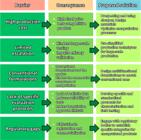
Specific barriers to commercial feasibility of encapsulated formulations, and suggested guidelines to overcome them. Source: Elaborated by the author (2025).
CONCLUSION
Encapsulation is a versatile technique that enables diverse combinations of active ingredients, matrices, particle dimensions, and biological targets. The evaluation of encapsulating materials has improved the preservation of active agents and enhanced pest control efficiency, while particle size can be tailored to overcome limitations associated with specific active ingredients.
Moreover, the characteristics of the target organism and the encapsulated content influence the recommended dimensions of the final product. Technological advancements have enabled precise control over particle size, ranging from macroto microand nanoscale systems. These variables should be strategically selected to overcome intrinsic limitations of the active ingredient, positioning encapsulation as a complementary and enabling technology rather than a standalone solution.
Encapsulation can be applied to a variety of microorganisms, including fungi, bacteria, viruses, and yeasts. As demonstrated in this review, the technique has been explored across multiple insect orders, such as Lepidoptera, Hymenoptera, Coleoptera, Hemiptera, and Orthoptera.
Despite its innovative potential, significant barriers hinder the commercialization of encapsulated formulations. Current legislation generally treats them as equivalent to conventional products and lacks specific protocols to evaluate their behavior under realistic environmental conditions. This regulatory gap constrains production scaling and field validation, limiting data generation and market competitiveness.
Overcoming these challenges will require legislative modernization, the development of specific testing protocols, investment in cost-effective scaling strategies, the adoption of environmentally sustainable and innovative materials, and coordinated efforts to strengthen their competitiveness against conventional pesticides.
-
Funding:
This research was funded by the Coordination for Improvement of Higher Education Personnel - Brazil (Capes) - Financing Code 001, and Center for Agricultural Sciences (CCA) at UFSCar - project FAI RTI-CCA.
-
Institutional Review Board Statement: Not applicable.
-
Informed Consent Statement: Not applicable.
Acknowledgments:
We would like to thank the Coordination for the Improvement of Higher Education Personnel - Brazil (CAPES) - Financing Code 001 for granting the scholarship. We thank the Graduate Program in Agriculture and Environment (PPGAA/UFSCar) for technical and scientific support.
Use of Generative Artificial Intelligence
The authors declare that large language models and other generative artificial intelligence (AI) or AI-assisted technologies cannot be credited as authors and have not been listed as authors of this paper.
The authors declare that generative artificial intelligence (AI) or AI-assisted tools were used under full human supervision. The tool(s) and version(s) used, and their purpose, are described here: Improve text fluency. No confidential or sensitive data were uploaded to such tool(s), and all AI-assisted content was checked, corrected and approved by the authors, who take full responsibility for the integrity and originality of the manuscript.
Data Availability Statement:
Data are available on reasonable request for corresponding author.
REFERENCES
-
1 Rehman A, Farooq M, Lee DJ, Siddique KHM. Sustainable agricultural practices for food security and ecosystem services. Environ Sci Pollut Res. 2022 Dec;29(56):84076-95. doi: 10.1007/s11356-022-23635-z.
» https://doi.org/10.1007/s11356-022-23635-z. -
2 Riegler M. Insect threats to food security. Science. 2018 Aug 31;361(6405):846. doi: 10.1126/science.aau731.
» https://doi.org/10.1126/science.aau731. -
3 Deutsch CA, Tewksbury JJ, Tigchelaar M, Battisti DS, Merrill SC, Huey RB, et al. Increase in crop losses to insect pests in a warming climate. Science. 2018 Aug;361(6405):916-9. doi: 10.1126/science.aat3466.
» https://doi.org/10.1126/science.aat3466. -
4 Oliveira CM, Auad AM, Mendes SM, Frizzas MR. Crop losses and the economic impact of insect pests on Brazilian agriculture. Crop Prot. 2014 Feb;56:50-4. doi: 10.1016/j.cropro.2013.10.022.
» https://doi.org/10.1016/j.cropro.2013.10.022. -
5 Savary S, Willocquet L, Pethybridge SJ, Esker P, McRoberts N, Nelson A. The global burden of pathogens and pests on major food crops. Nat Ecol Evol. 2019 Feb;3(3):430-9. doi: 10.1038/s41559-018-0793-y.
» https://doi.org/10.1038/s41559-018-0793-y. -
6 Qadri M, Short S, Gast K, Hernandez J, Wong ACN. Microbiome innovation in agriculture: Development of microbial based tools for insect pest management. Front Sustain Food Syst. 2020 Oct;4:547751. doi: 10.3389/fsufs.2020.547751.
» https://doi.org/10.3389/fsufs.2020.547751. -
7 Sharma S, Kooner R, Arora R. Insect pests and crop losses. In: Arora R, Sandhu S. Breeding insect resistant crops for sustainable agriculture. Singapore: Springer; 2017. p. 45-66. doi: 10.1007/978-981-10-6056-4_2.
» https://doi.org/10.1007/978-981-10-6056-4_2. -
8 Teem JL, Alphey L, Descamps S, Edgington MP, Edwards O, Gemmell N, et al. Genetic biocontrol for invasive species. Front Bioeng Biotechnol. 2020 May;8:452. doi: 10.3389/fbioe.2020.00452.
» https://doi.org/10.3389/fbioe.2020.00452. -
9 Dara SK. The new integrated pest management paradigm for the modern age. J Integr Pest Manag. 2019 Jan;10(1):12. doi: 10.1093/jipm/pmz010.
» https://doi.org/10.1093/jipm/pmz010. -
10 Hiltpold I, Hibbard BE, French BW, Turlings TCJ. Capsules containing entomopathogenic nematodes as a trojan horse approach to control the western corn rootworm. Plant Soil. 2012 Sep;358(12):11-25. doi: 10.1007/s11104-012-1253-0.
» https://doi.org/10.1007/s11104-012-1253-0. - 11 Villamizar L, Espinel C, Cotes AM. Efecto de la radiación ultravioleta sobre la actividad insecticida de un nucleopoliedrovirus de Spodoptera frugiperda (Lepidoptera: Noctuidae) [Effect of ultraviolet radiation on the insecticidal activity of a Spodoptera frugiperda (Lepidoptera: Noctuidae) nucleopolyhedrovirus]. Colomb J Entomol. 2009 Dec;35(2):116-21.
-
12 Barrera-Cubillos GP, Gómez-Valderrama JA, Rivero LFV. Efficacy of microencapsulated nucleopolyhedroviruses from Colombia as biological insecticides against Spodoptera frugiperda (Lepidoptera: Noctuidae). Acta Agron. 2017 Apr;66(2):267-74. doi: 10.15446/acag.v66n2.54354.
» https://doi.org/10.15446/acag.v66n2.54354. -
13 Campos EVR, Proença PLF, Oliveira JL, Melville CC, Della Vechia JF, De Andrade DJ, et al. Chitosan nanoparticles functionalized with β-cyclodextrin: a promising carrier for botanical pesticides. Sci Rep. 2018 Feb;8(1):2067. doi: 10.1038/s41598-018-20602-y.
» https://doi.org/10.1038/s41598-018-20602-y. -
14 Forim MR, Costa ES, da Silva MFGF, Fernandes JB, Mondego JM, Junior ALB. Development of a new method to prepare nano-/microparticles loaded with extracts of Azadirachta indica, their characterization and use in controlling Plutella xylostella J Agric Food Chem. 2013 Oct;61(39):9131-9. doi: 10.1021/jf403187y.
» https://doi.org/10.1021/jf403187y. -
15 Felizatti AP, Manzano RM, Rodrigues IMW, Da Silva MFDGF, Fernandes JB, Forim MR. Encapsulation of B. bassiana in biopolymers: Improving microbiology of insect pest control. Front Microbiol. 2021 Aug;12:704812. doi:10.3389/fmicb.2021.704812.
» https://doi.org/10.3389/fmicb.2021.704812. -
16 Yaakov N, Kottakota C, Mani KA, Naftali SM, Zelinger E, Davidovitz M, et al. Encapsulation of Bacillus thuringiensis in an inverse pickering emulsion for pest control applications. Colloids Surf B Biointerfaces. 2022 May;213:112427. doi: 10.1016/j.colsurfb.2022.112427.
» https://doi.org/10.1016/j.colsurfb.2022.112427. -
17 Chen X, Qiu L, Liu Q, He Y. Preparation of an environmentally friendly nano-insecticide through encapsulation in polymeric liposomes and its insecticidal activities against the fall armyworm, Spodoptera frugiperda Insects. 2022 Jul;13(7):625. doi: 10.3390/insects13070625.
» https://doi.org/10.3390/insects13070625. -
18 United Nations. Objetivos de Desenvolvimento Sustentável [Sustainable Development Goals] [Internet]. Brasília: United Nations Brazil. 2025 [cited 2025 Feb 5]. Available from: https://brasil.un.org/pt-br/sdgs
» https://brasil.un.org/pt-br/sdgs -
19 Bale JS, Van Lenteren JC, Bigler F. Biological control and sustainable food production. Philos Trans R Soc Lond B Biol Sci. 2008 Feb;363(1492):761-76. doi: 10.1098/rstb.2007.2182.
» https://doi.org/10.1098/rstb.2007.2182. -
20 Sinha KK, Choudhary AKR, Kumari P. Entomopathogenic fungi. In: Omkar. Ecofriendly pest management for security. Elsevier; 2016. p. 475-505. doi: 10.1016/B978-0-12-803265-7.00015-4.
» https://doi.org/10.1016/B978-0-12-803265-7.00015-4. -
21 Guo J, Wu S, Zhang F, Huang C, He K, Babendreier D, et al. Prospects for microbial control of the fall armyworm Spodoptera frugiperda: a review. BioControl. 2020 Dec;65(6):647-62. doi: 10.1007/s10526-020-10031-0.
» https://doi.org/10.1007/s10526-020-10031-0. - 22 Cruz I. Controle biológico de pragas do milho: uma oportunidade para os agricultores [Biological control of corn pests: an opportunity for farmers]. Brasília: Embrapa; 2022. p. 12-22.
-
23 Sharma A, Sharma S, Yadav PK. Entomopathogenic fungi and their relevance in sustainable agriculture: A review. Cogent Food Agric. 2023 Dec;9(1):2180857. doi: 10.1080/23311932.2023.2180857.
» https://doi.org/10.1080/23311932.2023.2180857. -
24 Sonawane SH, Bhanvase BA, Sivakumar M, Potdar SB. Current overview of encapsulation. In: Sonawane SH, Bhanvase BA, Manickam S. Encapsulation of active molecules and their delivery system. Amsterdam: Elsevier; 2020. p. 1-8. doi: 10.1016/B978-0-12-819363-1.00001-6.
» https://doi.org/10.1016/B978-0-12-819363-1.00001-6. -
25 Timilsena YP, Haque MDA, Adhikari B. Encapsulation in the food industry: A brief historical overview to recent developments. Food Nutr Sci. 2020 Jun;11(6):481-508. doi: 10.4236/fns.2020.116035.
» https://doi.org/10.4236/fns.2020.116035. -
26 Bhatia M. A review on application of encapsulation in agricultural processes. In: Sonawane SH, Bhanvase BA, Manickam S. Encapsulation of active molecules and their delivery system. Amsterdam: Elsevier; 2020. p. 131-40. doi: 10.1016/B978-0-12-819363-1.00008-9.
» https://doi.org/10.1016/B978-0-12-819363-1.00008-9. -
27 Assunção L, Ferreira C, Conceição EJL, Nunes I. Estudo prospectivo sobre encapsulamento de compostos bioativos [Prospective study on the encapsulation of bioactive compounds]. J Manag Innov Technol. 2014 Aug;4(4):1382-91. doi: 10.7198/S2237-0722201400040011.
» https://doi.org/10.7198/S2237-0722201400040011. -
28 Vemmer M, Patel AV. Review of encapsulation methods suitable for microbial biological control agents. Biol Control. 2013 Dec;67(3):380-9. doi: 10.1016/j.biocontrol.2013.09.003.
» https://doi.org/10.1016/j.biocontrol.2013.09.003. - 29 Pasqualim P, Culpi T, Kaminski G, Fin M, Sasso D, Costa C, et al. Microcapsules of calcium alginate and vegetable oil by ionic gelation: a study of encapsulation capacity and skin application. Acad Vis. 2010 Jan;11(1):23-37.
- 30 Fernandes IMM, Lima EPN, Santos B, Cartaxo J, Fook M, Silva S. Híbridos de quitosana/argila para encapsulamento e liberação controlada do fármaco dexametasona [Chitosan/clay hybrids for encapsulation and controlled release of the drug dexamethasone]. Electron J Mater Process. 2019 Apr;14(3):130-9.
-
31 Ozaltin K, Postnikov PS, Trusova ME, Sedlarik V, Di Martino A. Polysaccharides based microspheres for multiple encapsulations and simultaneous release of proteases. Int J Biol Macromol. 2019 Jul;132:24-31. doi: 10.1016/j.ijbiomac.2019.03.189.
» https://doi.org/10.1016/j.ijbiomac.2019.03.189. -
32 Neves MT, Santos FRD, Gonçalves DJR, Fernandes JG, Justino HDFM, Júnior BRDCL, et al. Uso da tecnologia de lipossomas no encapsulamento de compostos bioativos - Revisão [Use of liposome technology in the encapsulation of bioactive compounds - Review]. J Eng Exact Sci. 2021 Oct;7(4):13295. doi: 10.18540/jcecvl7iss4pp13295-01-20e.
» https://doi.org/10.18540/jcecvl7iss4pp13295-01-20e. -
33 Simplicio JLF, Sousa BMD, Pereira HODS, Nascimento YMD, Freitas ACD. Produção, pré-purificação e encapsulamento de enzima proteolítica secretada por fungo filamentoso [Production, pre-purification and encapsulation of proteolytic enzyme secreted by filamentous fungi]. J Eng Exact Sci. 2023 May;9(3):e15785. doi: 10.18540/jcecvl9iss3pp15785-01e.
» https://doi.org/10.18540/jcecvl9iss3pp15785-01e. -
34 Laurenti E, Garcia S. Eficiência de materiais encapsulantes naturais e comerciais na liberação controlada de probiótico encapsulado [Efficiency of natural and commercial encapsulating materials in the controlled release of encapsulated probiotics]. Braz J Food Technol. 2013 Jul;16(2):107-15. doi: 10.1590/S1981-67232013005000019.
» https://doi.org/10.1590/S1981-67232013005000019. -
35 Haghighat-Kharazi S, Milani JM, Kasaai MR, Khajeh K. Microencapsulation of α-amylase in beeswax and its application in gluten-free bread as an anti-staling agent. LWT. 2018 Jun;92:73-9. doi: 10.1016/j.lwt.2018.01.049.
» https://doi.org/10.1016/j.lwt.2018.01.049. -
36 Taylor TM, Weiss J, Davidson PM, Bruce BD. Liposomal nanocapsules in food science and agriculture. Crit Rev Food Sci Nutr. 2005 Oct;45(7-8):587-605. doi: 10.1080/10408390591001135.
» https://doi.org/10.1080/10408390591001135. -
37 Puoci F, Iemma F, Spizzirri UG, Cirillo G, Curcio M, Picci N. Polymer in agriculture: a review. Am J Agric Biol Sci. 2008 Jan;3(1):299-314. doi: 10.3844/ajabssp.2008.299.314.
» https://doi.org/10.3844/ajabssp.2008.299.314. -
38 Schoebitz M, López Belchí MD. Encapsulation techniques for plant growth-promoting rhizobacteria. In: Arora NK, Mehnaz S, Balestrini R. Bioformulations: for sustainable agriculture. New Delhi: Springer India; 2016. p. 251-65. doi: 10.1007/978-81-322-2779-3_14.
» https://doi.org/10.1007/978-81-322-2779-3_14. -
39 Sim DHH, Tan IAW, Lim LLP, Hameed BH. Encapsulated biochar-based sustained release fertilizer for precision agriculture: A review. J Clean Prod. 2021 Jun;303:127018. doi: 10.1016/j.jclepro.2021.127018.
» https://doi.org/10.1016/j.jclepro.2021.127018. -
40 Balla A, Silini A, Cherif-Silini H, Chenari Bouket A, Alenezi FN, Belbahri L. Recent advances in encapsulation techniques of plant growth-promoting microorganisms and their prospects in the sustainable agriculture. Appl Sci. 2022 Sep;12(18):9020. doi: 10.3390/app12189020.
» https://doi.org/10.3390/app12189020. -
41 Jíménez-Arias D, Morales-Sierra S, Silva P, Carrêlo H, Gonçalves A, Ganança JFT, et al. Encapsulation with natural polymers to improve the properties of biostimulants in agriculture. Plants. 2022 Dec;12(1):55. doi: 10.3390/plants12010055.
» https://doi.org/10.3390/plants12010055. -
42 Rudzinski WE, Dave AM, Vaishnav UH, Kumbar SG, Kulkarni AR, Aminabhavi TM. Hydrogels as controlled release devices in agriculture. Des Monomer Polym. 2002 Jan;5(1):39-65. doi: 10.1163/156855502760151580.
» https://doi.org/10.1163/156855502760151580. -
43 Abdelsattar AS, Abdelrahman F, Dawoud A, Connerton IF, El-Shibiny A. Encapsulation of E. coli phage ZCEC5 in chitosan-alginate beads as a delivery system in phage therapy. AMB Expr. 2019 Dec;9(1):87. doi: 10.1186/s13568-019-0810-9.
» https://doi.org/10.1186/s13568-019-0810-9. -
44 Pereira JE, Guedes RDS, Costa FHDS, Schmitz GCB. Composição da matriz de encapsulamento na formação e conversão de sementes sintéticas de pimenta-longa [Composition of the encapsulation matrix in the formation and conversion of synthetic long pepper seeds]. Braz Hortic. 2008 Mar;26(1):93-6. doi: 10.1590/S0102-05362008000100018.
» https://doi.org/10.1590/S0102-05362008000100018. -
45 Pereira ADES, Oliveira HC, Fraceto LF. Polymeric nanoparticles as an alternative for application of gibberellic acid in sustainable agriculture: a field study. Sci Rep. 2019 May;9(1):7135. doi: 10.1038/s41598-019-43494-y.
» https://doi.org/10.1038/s41598-019-43494-y. -
46 Kadmiri I, El Mernissi N, Azaroual SE, Mekhzoum MEM, Qaiss AEK, Bouhfid R. Bioformulation of microbial fertilizer based on clay and alginate encapsulation. Curr Microbiol. 2021 Jan;78(1):86-94. doi: 10.1007/s00284-020-02262-2.
» https://doi.org/10.1007/s00284-020-02262-2. -
47 Nörnberg AB, Gehrke VR, Mota HP, Camargo ER, Fajardo AR. Alginate-cellulose biopolymeric beads as efficient vehicles for encapsulation and slow-release of herbicide. Colloids Surf A Physicochem Eng Asp. 2019 Dec;583:123970. doi: 10.1016/j.colsurfa.2019.123970.
» https://doi.org/10.1016/j.colsurfa.2019.123970. -
48 Celestino MF, Oliveira JADS. Métodos de encapsulamento de fungos entomopatogênicos para sua aplicação no controle biológico [Methods for encapsulating entomopathogenic fungi for their application in biological control]. Res Soc Dev. 2022 Dec;11(16):e123111638031. doi: 10.33448/rsd-v11i16.38031.
» https://doi.org/10.33448/rsd-v11i16.38031. -
49 Raun ES, Jackson RD. Encapsulation as a technique for formulating microbial and chemical insecticides1. J Econ Entomol. 1966 Jun;59(3):620-2. doi: 10.1093/jee/59.3.620.
» https://doi.org/10.1093/jee/59.3.620. -
50 Feldbaum R, Yaakov N, Mani KA, Yossef E, Metbeev S, Zelinger E, et al. Single cell encapsulation in a Pickering emulsion stabilized by TiO2 nanoparticles provides protection against UV radiation for a biopesticide. Colloids Surf B Biointerfaces. 2021 Oct;206:111958. doi: 10.1016/j.colsurfb.2021.111958.
» https://doi.org/10.1016/j.colsurfb.2021.111958. -
51 Hammoud Z, Ben Abada M, Greige-Gerges H, Elaissari A, Jemâa JMB. Insecticidal effects of natural products in free and encapsulated forms: an overview. J Nat Pestic Research. 2022 Jun;1:100007. doi: 10.1016/j.napere.2022.100007.
» https://doi.org/10.1016/j.napere.2022.100007. -
52 World Health Organization. Chemical safety: Pesticides [Internet]. Geneva: WHO; 2020 [cited 2024 Jun 28]. Available from: https://www.who.int/news-room/questions-and-answers/item/chemical-safety-pesticides
» https://www.who.int/news-room/questions-and-answers/item/chemical-safety-pesticides -
53 Shasha BS, Doane WM, Russell CR. Starch-encapsulated pesticides for slow release. J Polym Sci B Polym Lett Ed. 1976 Jul;14(7):417-20. doi: 10.1002/pol.1976.130140708.
» https://doi.org/10.1002/pol.1976.130140708. -
54 Berisford CW, Dalusky MJ, Bush PB, Taylor Jr J, Berisford Y. Efficacy, persistence, ground deposition, and human exposure of polymer-encapsulated lindane and chlorpyrifos used for control of the southern pine beetle. Phytoprotection. 1991 Mar;72(1):15-20. doi: 10.7202/705998ar
» https://doi.org/10.7202/705998ar -
55 Doane WM. Encapsulation of pesticides in starch by extrusion. Ind Crop Prod. 1992 Dec;1(2-4):83-7. doi: 10.1016/0926-6690(92)90004-F
» https://doi.org/10.1016/0926-6690(92)90004-F -
56 Trimnell D, Shasha BS, Wing RE, Otey FH. Pesticide encapsulation using a starch-borate complex as wall material. J Appl Polym Sci. 1982 Oct;27(10):3919-28. doi: 10.1002/app.1982.070271025.
» https://doi.org/10.1002/app.1982.070271025. -
57 Weissling TJ, Meinke LJ. Potential of starch encapsulated semiochemical-insecticide formulations for adult corn rootworm (Coleoptera: Chrysomelidae) Control. J Econ Entomol. 1991 Apr;84(2):601-9. doi: 10.1093/jee/84.2.601
» https://doi.org/10.1093/jee/84.2.601 -
58 Pang S, Lin Z, Zhang Y, Zhang W, Alansary N, Mishra S, et al. Insights into the toxicity and degradation mechanisms of imidacloprid via physicochemical and microbial approaches toxics. 2020 Sep;8(3):1-31. doi: 10.3390/toxics8030065.
» https://doi.org/10.3390/toxics8030065. -
59 Ebadollahi A, Valizadeh B, Panahandeh S, Mirhosseini H, Zolfaghari M, Changbunjong T. Nanoencapsulation of acetamiprid by sodium alginate and polyethylene glycol enhanced its insecticidal efficiency. Nanomaterials. 2022 Aug;12(17):2971. doi: 10.3390/nano12172971.
» https://doi.org/10.3390/nano12172971. -
60 Lester PJ, Pree DJ, Thistlewood HMA, Trevisan LM, Harmsen R. Pyrethroid encapsulation for conservation of acarine predators and reduced spider mite (Acari: Tetranychidae) outbreaks in apple orchards. Environ Entomol. 1999 Feb;28(1):72-80. doi: 10.1093/ee/28.1.72.
» https://doi.org/10.1093/ee/28.1.72. -
61 Vandekerkhove B, De Clercq P. Effects of an encapsulated formulation of lambda-cyhalothrin on Nezara viridula and its predator Podisus maculiventris (heteroptera: pentatomidae). Fla Entomol. 2004 Jun;87(2):112-8. doi: 10.1653/0015-4040(2004)087[0112:EOAEFO]2.0.CO;2.
» https://doi.org/10.1653/0015-4040(2004)087[0112:EOAEFO]2.0.CO;2. -
62 Liu Y, Tong Z, Prud’homme RK. Stabilized polymeric nanoparticles for controlled and efficient release of bifenthrin. Pest Manag Sci. 2008 Aug;64(8):808-12. doi: 10.1002/ps.1566.
» https://doi.org/10.1002/ps.1566. -
63 Stejskal V, Aulicky R, Pekar S. Brief exposure of Blattella germanica (Blattodea) to insecticides formulated in various microcapsule sizes and applied on porous and non-porous surfaces. Pest Manag Sci. 2009 Jan;65(1):93-8. doi: 10.1002/ps.1651.
» https://doi.org/10.1002/ps.1651. -
64 Boff JS, Reis AC, De Oliveira JL, Gross RB, Fraceto LF, Melo AA, et al. Development and biological evaluation of nanoencapsulated-based pyrethroids with synergists for resistance management of two soybean pests: insights for new insecticide formulations. Pest Manag Sci. 2023 Mar;79(3):1204-12. doi: 10.1002/ps.7295.
» https://doi.org/10.1002/ps.7295. -
65 Erickson EH, Erickson BH, Flottum PK, Wyman JA, Wedberg JL, Page RE. Effects of selected insecticide formulations, phased application and colony management strategies on honey bee mortality in processing sweetcorn. J Apic Res. 1997 Jan;36(1):3-13. doi: 10.1080/00218839.1997.11100925.
» https://doi.org/10.1080/00218839.1997.11100925. -
66 Yan H, Chen X, Feng Y, Xiang F, Li J, Shi Z, et al. Modification of montmorillonite by ball-milling method for immobilization and delivery of acetamiprid based on alginate/exfoliated montmorillonite nanocomposite. Polym Bull. 2016 Apr;73(4):1185-206. doi: 10.1007/s00289-015-1542-x.
» https://doi.org/10.1007/s00289-015-1542-x. -
67 Gajendiran A, Abraham J. An overview of pyrethroid insecticides. Front Biol. 2018 Apr;13(2):79-90. doi: 10.1007/s11515-018-1489-z.
» https://doi.org/10.1007/s11515-018-1489-z. -
68 Gustani FM, Silva TA, Camargo JR, De Souza Carvalho JH, Janegitz BC, Fujihara RT. Synthesis, attractiveness and effectiveness of chitosan-tapioca encapsulates in Atta sexdens (Hymenoptera: Formicidae). J Polym Environ. 2021 Sep;29(9):2869-80. doi: 10.1007/s10924-021-02084-8.
» https://doi.org/10.1007/s10924-021-02084-8. -
69 Mossa ATH. Green Pesticides: Essential oils as biopesticides in insect-pest management. J Environ Sci Technol. 2016 Aug;9(5):354-78. doi: 10.3923/jest.2016.354.378.
» https://doi.org/10.3923/jest.2016.354.378. -
70 Isman MB. Commercial development of plant essential oils and their constituents as active ingredients in bioinsecticides. Phytochem Rev. 2019 Apr;19(2):235-41. doi: 10.1007/s11101-019-09653-9.
» https://doi.org/10.1007/s11101-019-09653-9. -
71 Riyajan SA, Sakdapipanich JT. Encapsulated neem extract containing Azadiractin-A within hydrolyzed poly(vinyl acetate) for controlling its release and photodegradation stability. Chem Eng J. 2009 Oct;152(2-3):591-7. doi: 10.1016/j.cej.2009.05.017.
» https://doi.org/10.1016/j.cej.2009.05.017. -
72 Lopez MD, Maudhuit A, Pascual-Villalobos MJ, Poncelet D. Development of formulations to improve the controlled-release of linalool to be applied as an insecticide. J Agric Food Chem. 2012 Feb;60(5):1187-92. doi: 10.1021/jf204242x.
» https://doi.org/10.1021/jf204242x. -
73 Campos EVR, Proença PLF, Oliveira JL, Pereira AES, De Morais Ribeiro LN, Fernandes FO, et al. Carvacrol and linalool co-loaded in β-cyclodextrin-grafted chitosan nanoparticles as sustainable biopesticide aiming pest control. Sci Rep. 2018 May;8(1):7623. doi: 10.1038/s41598-018-26043-x.
» https://doi.org/10.1038/s41598-018-26043-x. -
74 Ahmadi Z, Saber M, Bagheri M, Mahdavinia GR. Achillea millefolium essential oil and chitosan nanocapsules with enhanced activity against Tetranychus urticae J Pest Sci. 2017;91(2):837-48. doi: 10.1007/s10340-017-0912-6.
» https://doi.org/10.1007/s10340-017-0912-6. -
75 Khoshraftar Z, Safekordi AA, Shamel A, Zaefizadeh M. Evaluation of insecticidal activity of nanoformulation of Melia azedarach (leaf) extract as a safe environmental insecticide. Int J Environ Sci Technol. 2020 Feb;17(2):1159-70. doi: 10.1007/s13762-019-02448-7.
» https://doi.org/10.1007/s13762-019-02448-7. -
76 Chenni M, El Abed D, Neggaz S, Rakotomanomana N, Fernandez X, Chemat F. Solvent free microwave extraction followed by encapsulation of O. basilicum L. essential oil for insecticide purpose. J Stored Prod Res. 2020 Mar;86:101575. doi: 10.1016/j.jspr.2020.101575.
» https://doi.org/10.1016/j.jspr.2020.101575. -
77 Rajkumar V, Gunasekaran C, Dharmaraj J, Chinnaraj P, Paul CA, Kanithachristy I. Structural characterization of chitosan nanoparticle loaded with Piper nigrum essential oil for biological efficacy against the stored grain pest control. Pestic Biochem Physiol. 2020 Jun;166:104566. doi: 10.1016/j.pestbp.2020.104566.
» https://doi.org/10.1016/j.pestbp.2020.104566. -
78 Purkait A, Mukherjee A, Hazra DK, Roy K, Biswas PK, Kole RK. Encapsulation, release and insecticidal activity of Pongamia pinnata (L.) seed oil. Heliyon. 2021 Mar;7(3):e06557. doi: 10.1016/j.heliyon.2021.e06557.
» https://doi.org/10.1016/j.heliyon.2021.e06557. -
79 Ibrahim SS, Abou-Elseoud WS, Elbehery HH, Hassan ML. Chitosan-cellulose nanoencapsulation systems for enhancing the insecticidal activity of citronella essential oil against the cotton leafworm Spodoptera littoralis Ind Crops Prod. 2022 Sep;184:115089. doi: 10.1016/j.indcrop.2022.115089.
» https://doi.org/10.1016/j.indcrop.2022.115089. -
80 Abada MB, Hamdi SH, Gharib R, Messaoud C, Fourmentin S, Greige-Gerges H, et al. Post-harvest management control of Ectomyelois ceratoniae (Zeller) (Lepidoptera: Pyralidae): new insights through essential oil encapsulation in cyclodextrin. Pest Manag Sci. 2019 Jul;75(7):2000-8. doi: 10.1002/ps.5315.
» https://doi.org/10.1002/ps.5315. -
81 Bezerra DG, Devilla IA, Da Conceição EC, Czepak C, Albernaz Godinho KC, Caramori SS, et al. Microencapsulated extracts from Azadirachta indica seeds: Acquisition, characterization, and use in controlling Helicoverpa armigera Dry Technol. 2021 Jun;39(10):1325-38. doi: 10.1080/07373937.2020.1745823.
» https://doi.org/10.1080/07373937.2020.1745823. -
82 Jaffuel G, Sbaiti I, Turlings TCJ. Encapsulated entomopathogenic nematodes can protect maize plants from Diabrotica balteata larvae. Insects. 2019 Dec;11(1):27. doi: 10.1080/07373937.2020.1745823.
» https://doi.org/10.1080/07373937.2020.1745823. -
83 Shapiro-Ilan D, Hazir S, Glazer I. Basic and applied research. in: Lacey AL. Microbial control of insect and mite pests. Amsterdam: Elsevier; 2017. p. 91-105. doi: 10.1016/B978-0-12-803527-6.00006-8.
» https://doi.org/10.1016/B978-0-12-803527-6.00006-8. -
84 Koppenhöfer AM, Shapiro-Ilan DI, Hiltpold I. Entomopathogenic nematodes in sustainable food production. Front Sustain Food Syst. 2020 Aug;4:125. doi: 10.3389/fsufs.2020.00125.
» https://doi.org/10.3389/fsufs.2020.00125. -
85 Cruz-Martínez H, Ruiz-Vega J, Matadamas-Ortíz PT, Cortés-Martínez CI, Rosas-Diaz J. Formulation of entomopathogenic nematodes for crop pest control - a review. Plant Prot Sci. 2017 Mar;53(1):15-24. doi: 10.17221/35/2016-PPS.
» https://doi.org/10.17221/35/2016-PPS. -
86 Kim J, Jaffuel G, Turlings TCJ. Enhanced alginate capsule properties as a formulation of entomopathogenic nematodes. BioControl. 2015 Aug;60(4):527-35. doi: 10.1007/s10526-014-9638-z.
» https://doi.org/10.1007/s10526-014-9638-z. -
87 Kagimu N, Malan AP. Formulation of South African entomopathogenic nematodes using alginate beads and earth. BioControl. 2019 Aug;64(4):413-22. doi: 10.1007/s10526-019-09945-1.
» https://doi.org/10.1007/s10526-019-09945-1. -
88 Patel AV, Vorlop KD. Entrapment of biological control agents applied to entomopathogenic nematodes. Biotechnol Tech. 1994 Aug;8(8):569-74. doi: 10.1007/BF00152148.
» https://doi.org/10.1007/BF00152148. -
89 Kim J, Hiltpold I, Jaffuel G, Sbaiti I, Hibbard BE, Turlings TCJ. Calcium-alginate beads as a formulation for the application of entomopathogenic nematodes to control rootworms. J Pest Sci. 2021 Sep;94(4):1197-208. doi: 10.1007/s10340-021-01349-4.
» https://doi.org/10.1007/s10340-021-01349-4. -
90 Kaya HK, Nelsen CE. Encapsulation of steinernematid and heterorhabditid nematodes with calcium alginate: A new approach for insect control and other applications. Environ Entomol. 1985 Oct;14(5):572-4. doi: 10.1093/ee/14.5.572
» https://doi.org/10.1093/ee/14.5.572 -
91 Goud S, Hugar P, Prabhuraj A. Effect of temperature, population density and shelf life of EPN Heterorhabditis indica (RCR) in sodium alginate gel formulation. J Biopestic. 2010 Mar;3(3):627-32. doi: 10.57182/jbiopestic.3.3.627-632.
» https://doi.org/10.57182/jbiopestic.3.3.627-632. -
92 Chen S, Glazer I. A novel method for long-term storage of the entomopathogenic nematode Steinernema feltiae at room temperature. Biol Control. 2005 Jan;32(1):104-10. doi: 10.1016/j.biocontrol.2004.08.006.
» https://doi.org/10.1016/j.biocontrol.2004.08.006. -
93 Hernández-Soto A, Chacón-Cerdas R. RNAi crop protection advances. Int J Mol Sci. 2021 Nov;22(22):12148. doi: 10.3390/ijms222212148.
» https://doi.org/10.3390/ijms222212148. -
94 Pugsley CE, Isaac RE, Warren NJ, Cayre OJ. Recent advances in engineered nanoparticles for RNAi-mediated crop protection against insect pests. Front Agron. 2021 Mar;3:652981. doi: 10.3389/fagro.2021.652981.
» https://doi.org/10.3389/fagro.2021.652981. -
95 Guan RB, Li HC, Fan YJ, Hu SR, Christiaens O, Smagghe G, et al. A nuclease specific to lepidopteran insects suppresses RNAi. J Biol Chem. 2018 Apr;293(16):6011-21. doi: 10.1074/jbc.RA117.001553 .
» https://doi.org/10.1074/jbc.RA117.001553 -
96 Gurusamy D, Mogilicherla K, Palli SR. Chitosan nanoparticles help double-stranded RNA escape from endosomes and improve RNA interference in the fall armyworm, Spodoptera frugiperda Arch Insect Biochem Physiol. 2020 Aug;104(4):e21677. doi: 10.1002/arch.21677.
» https://doi.org/10.1002/arch.21677. -
97 Singh IK, Singh S, Mogilicherla K, Shukla JN, Palli SR. Comparative analysis of double-stranded RNA degradation and processing in insects. Sci Rep. 2017 Dec;7(1):17059. doi: 10.1038/s41598-017-17134-2.
» https://doi.org/10.1038/s41598-017-17134-2. -
98 Knorr E, Fishilevich E, Tenbusch L, Vilcinskas A. Gene silencing in Tribolium castaneum as a tool for the targeted identification of candidate RNAi targets in crop pests. Sci Rep. 2018 Feb;8(1):2061. doi: 10.1038/s41598-018-20416-y.
» https://doi.org/10.1038/s41598-018-20416-y. -
99 Avila LA, Chandrasekar R, Wilkinson KE, Balthazor J, Heerman M, Bechard J, et al. Delivery of lethal dsRNAs in insect diets by branched amphiphilic peptide capsules. J Control Release. 2018 Mar;273:139-46. doi: 10.1016/j.jconrel.2018.01.010.
» https://doi.org/10.1016/j.jconrel.2018.01.010. -
100 Castellanos NL, Smagghe G, Sharma R, Oliveira EE, Christiaens O. Liposome encapsulation and EDTA formulation of dsRNA targeting essential genes increase oral RNAi-caused mortality in the neotropical stink bug Euschistus heros Pest Manag Sci. 2019 Feb;75(2):537-48. doi: 10.1002/ps.5167.
» https://doi.org/10.1002/ps.5167. -
101 Taning CNT, Christiaens O, Berkvens N, Casteels H, Maes M, Smagghe G. Oral RNAi to control Drosophila suzukii: laboratory testing against larval and adult stages. J Pest Sci. 2016 Jul;89(3):803-14. doi: 10.1007/s10340-016-0736-9.
» https://doi.org/10.1007/s10340-016-0736-9. -
102 Zhang M, Zhu Z, Yuan S, Wang S, Yang C, Dwivedi P, et al. One-step microencapsulation and spraying of pesticide formulations for improved adhesion and sustained release. J Microencapsul. 2019 Oct;36(7):649-58. doi: 10.1080/02652048.2019.1665118.
» https://doi.org/10.1080/02652048.2019.1665118. -
103 Guţoaia A, Schuster L, Margutti S, Laufer S, Schlosshauer B, Krastev R, et al. Fine-tuned PEGylation of chitosan to maintain optimal siRNA-nanoplex bioactivity. Carbohydr Polym. 2016 Jun;143:25-34. doi: 10.1016/j.carbpol.2016.01.010.
» https://doi.org/10.1016/j.carbpol.2016.01.010. -
104 Huang JH, Liu Y, Lin YH, Belles X, Lee HJ. Practical use of RNA interference: Oral delivery of double-stranded RNA in liposome carriers for cockroaches. J Vis Exp. 2018 May;(135):57385. doi: 10.3791/57385.
» https://doi.org/10.3791/57385. -
105 Whyard S, Singh AD, Wong S. Ingested double-stranded RNAs can act as species-specific insecticides. Insect Biochem Mol Biol. 2009 Nov;39(11):824-32. doi: 10.1016/j.ibmb.2009.09.007.
» https://doi.org/10.1016/j.ibmb.2009.09.007. -
106 Dunkle RL, Shasha BS. Starch-Encapsulated Bacillus thuringiensis: potential new method for increasing environmental stability of entomopathogens1. Environ Entomol. 1988 Feb;17(1):120-6. doi: 10.1093/ee/17.1.120.
» https://doi.org/10.1093/ee/17.1.120. -
107 McGuire MR, Streett DA, Shasha BS. Evaluation of starch encapsulation for formulation of grasshopper (Orthoptera: Acrididae) entomopoxviruses. J Econ Entomol. 1991 Dec;84(6):1652-6. doi: 10.1093/jee/84.6.1652.
» https://doi.org/10.1093/jee/84.6.1652. -
108 McGuire MR, Shasha BS, Lewis LC, Nelsen TC. Residual activity of granular starch-encapsulated Bacillus thuringiensis J Econ Entomol. 1994 Jun;87(3):631-7. doi: 10.1093/jee/87.3.631.
» https://doi.org/10.1093/jee/87.3.631. -
109 Horaczek A, Viernstein H. Beauveria brongniartii subjected to spray-drying in a composite carrier matrix system. J Microencapsul. 2004 May;21(3):317-30. Doi: 10.1080/02652040410001673892.
» https://doi.org/10.1080/02652040410001673892. -
110 Rosas-García NM. Laboratory and field tests of spray-dried and granular formulations of a Bacillus thuringiensis strain with insecticidal activity against the sugarcane borer. Pest Manag Sci. 2006 Sep;62(9):855-61. doi: 10.1002/ps.1245.
» https://doi.org/10.1002/ps.1245. -
111 Camacho JEK, Gómez Álvarez MI, Villamizar Rivero LF. Microencapsulation of a Colombian Spodoptera frugiperda nucleopolyhedrovirus with Eudragit® S100 by spray drying. Braz Arch Biol Technol. 2015 Jun;58(3):468-76. doi: 10.1590/S1516-8913201500453.
» https://doi.org/10.1590/S1516-8913201500453. -
112 Jain D, Panda AK, Majumdar DK. Eudragit S100 entrapped insulin microspheres for oral delivery. AAPS PharmSciTech. 2005 Mar;6(1):100-7. doi: 10.1208/pt060116.
» https://doi.org/10.1208/pt060116. -
113 Arora AK, Forshaw A, Miller TA, Durvasula R. A delivery system for field application of paratransgenic control. BMC Biotechnol. 2015 Jun;15(1):2-11. doi: 10.1186/s12896-015-0175-3.
» https://doi.org/10.1186/s12896-015-0175-3. -
114 Vemmer M, Schumann M, Beitzen-Heineke W, French BW, Vidal S, Patel AV. Development of a CO2 - releasing coformulation based on starch, Saccharomyces cerevisiae and Beauveria bassiana attractive towards western corn rootworm larvae. Pest Manag Sci. 2016 Feb;72(11):2136-45. doi: 10.1002/ps.4245.
» https://doi.org/10.1002/ps.4245. -
115 Silva DG, Lucena Júnior A, Sarmento RDA, Silva CLS, Tenório ACT, De Souza DJ, et al. Encapsulated baits containing zinc sulfate and Trichoderma harzianum reduce fungal garden in Atta sexdens colonies. J Neotrop Agric. 2020 Sep;7(3):46-52. doi: 10.32404/rean.v7i3.5064.
» https://doi.org/10.32404/rean.v7i3.5064. -
116 Muskat LC, Görg LM, Humbert P, Gross J, Eilenberg J, Patel AV. Encapsulation of the psyllid-pathogenic fungus Pandora sp. nov. inedit. and experimental infection of target insects. Pest Manag Sci. 2022 Nov;78(3):991-9. doi: 10.1002/ps.6710.
» https://doi.org/10.1002/ps.6710. -
117 Harikarnpakdee S, Chuchote C. Oviposition deterrent efficacy and characteristics of a botanical natural product, Ocimum gratissimum (L.) oil-alginate beads, against Aedes aegypti (L.). ScientificWorldJournal. 2018 Aug;2018(1):1-9. doi: 10.1155/2018/3127214.
» https://doi.org/10.1155/2018/3127214. -
118 Baldiviezo LV, Nieva LB, Pedrini N, Cardozo RM. Microencapsulation of a native strain of the entomopathogenic fungus Beauveria bassiana and bioinsecticide activity against pyrethroid-resistant triatoma infestans to vector control of chagas disease in the argentine Gran chaco region. Trop Med Infect Dis. 2023 Apr;8(5):245-54. doi: 10.3390/tropicalmed8050245.
» https://doi.org/10.3390/tropicalmed8050245. -
119 Sarma BD, Puzari KC, Dutta P, Pandey AK. An alginate-based encapsulation enhances shelf life and bioactivity of the entomopathogenic fungus, Metarhizium anisopliae Egypt J Biol Pest Control. 2023 Jul;33(1):1-11. doi: 10.1186/s41938-023-00714-y.
» https://doi.org/10.1186/s41938-023-00714-y. -
120 Krell V, Jakobs-Schoenwandt D, Vidal S, Patel AV. Encapsulation of Metarhizium brunneum enhances endophytism in tomato plants. Biol Control. 2018 Jan;116:62-73. doi: 10.1016/j.biocontrol.2017.05.004.
» https://doi.org/10.1016/j.biocontrol.2017.05.004. -
121 Qiu HL, Fox EGP, Qin CS, Zhao DY, Yang H, Xu JZ. Microcapsuled entomopathogenic fungus against fire ants, Solenopsis invicta Biol Control. 2019 Jul;134:141-9. doi: 10.1016/j.biocontrol.2019.03.018.
» https://doi.org/10.1016/j.biocontrol.2019.03.018. - 122 Del Rincón-Castro MC, Ibarra JE. Entomopathogenic viruses. In: Del Rincón-Castro MC, Ibarra JE. Biological control of insect pests. New Delhi: Studium Press; 2011. p. 29-64.
-
123 Luna-Santillana EDJD, Rodríguez-Perez MA, Ali-Mahmoud AM, Morales-Ramos LH, Gopal H, Arevalo-Niño K. Evaluation of potential microencapsulated agents for oral entomopathogens with phagostimulant activity against Spodoptera exigua (Hüber). Southwest Entomol. 2011 Dec;36(4):433-42. doi: 10.3958/059.036.0405.
» https://doi.org/10.3958/059.036.0405. -
124 Bogantes D, Flores L, Castellón E, Uribe L. Encapsulamiento de nematodos entomopatógenos en materiales basados en biopolímeros y su efecto sobre Galleria mellonella [Encapsulation of entomopathogenic nematodes in biopolymer-based materials and their effect on Galleria mellonella]. Costa Rican Agron. 2018 Dec;42(2):9-27. doi: 10.15517/rac.v42i2.33774.
» https://doi.org/10.15517/rac.v42i2.33774. -
125 Michel MR, Aguilar-Zárate M, Rojas R, Martínez-Ávila GCG, Aguilar-Zárate P. The insecticidal activity of Azadirachta indica leaf extract: optimization of the microencapsulation process by complex coacervation. Plants. 2023 Mar;12(6):1318-29. doi: 10.3390/plants12061318.
» https://doi.org/10.3390/plants12061318. -
126 Djebbi T, Soltani A, Chargui H, Yangui I, Teka N, Boushih E, et al. Encapsulated bio-insecticide from Citrus aurantium (rutaceae) essential oil and pectin and potential for the control of the lesser grain borer Rhyzopertha dominica (bostrichidae). Waste biomass valor. 2023 Jan;14(9):2997-3011. doi: 10.1007/s12649-023-02048-0.
» https://doi.org/10.1007/s12649-023-02048-0. -
127 Przyklenk M, Vemmer M, Hanitzsch M, Patel A. A bioencapsulation and drying method increases shelf life and efficacy of Metarhizium brunneum conidia. J Microencapsul. 2017 Jul;34(5):498-512. doi: 10.1080/02652048.2017.1354941.
» https://doi.org/10.1080/02652048.2017.1354941. -
128 Zhu F, Zhang H, Chen C, Long Y, Liao G, Chen M, et al. Controlled-release alginate-bentonite polymer gel granules of emamectin benzoate and control efficacy against Spodoptera frugiperda Pest Manag Sci. 2023 Sep;79(1):324-35. doi: 10.1002/ps.7202.
» https://doi.org/10.1002/ps.7202. -
129 Friuli M, Cafarchia C, Immediata I, Otranto D, Demetriou P, Cantore PL, et al. Materials engineering to help pest control: a narrative overview of biopolymer-based entomopathogenic fungi formulations. J Fungi. 2023 Sep;9(9):918-31. doi: 10.3390/jof9090918.
» https://doi.org/10.3390/jof9090918. -
130 Ali M, Cybulska J, Frąc M, Zdunek A. Application of polysaccharides for the encapsulation of beneficial microorganisms for agricultural purposes: A review. Int J Biol Macromol. 2023 Jun; 244:125366-82. doi: 10.1016/j.ijbiomac.2023.125366.
» https://doi.org/10.1016/j.ijbiomac.2023.125366. -
131 Hoyos-Leyva JD, Bello-Pérez LA, Alvarez-Ramirez J, Garcia HS. Microencapsulation using starch as wall material: A review. Food Rev Int. 2018 Feb;34(2):148-61. doi: 10.1080/87559129.2016.1261298.
» https://doi.org/10.1080/87559129.2016.1261298. -
132 Mohapatra S, Sawarkar SK, Patnaik HP, Senapati B. Antifeedant activity of solvent extracts of neem seed kernel against Spodoptera litura F. and their persistency against sunlight through encapsulation. Int J Pest Manage. 1995 Jan;41(3):154-6. doi: 10.1080/09670879509371941.
» https://doi.org/10.1080/09670879509371941. -
133 Frederiksen HK, Hansen HCB. Starch-encapsulated chlorpyrifos: release rate, insecticidal activity and degradation in soil. J Microencapsul. 2002 Jan;19(3):319-31. doi: 10.1080/02652040110105364.
» https://doi.org/10.1080/02652040110105364. -
134 Gacesa P, Russell NJ. The structure and properties of alginate. In: Gacesa P, Russell NJ. Pseudomonas infection and alginates: biochemistry, genetics and pathology. Dordrecht: Springer; 1990. p. 29-49. doi: 10.1007/978-94-009-1836-8_3.
» https://doi.org/10.1007/978-94-009-1836-8_3. -
135 Raus RA, Wan Nawawi WMF, Nasaruddin RR. Alginate and alginate composites for biomedical applications. Asian J Pharm Sci. 2021 May;16(3):280-306. doi: 10.1016/j.ajps.2020.10.001.
» https://doi.org/10.1016/j.ajps.2020.10.001. -
136 Hurtado A, Aljabali AAA, Mishra V, Tambuwala MM, Serrano-Aroca Á. Alginate: enhancement strategies for advanced applications. Int J Mol Sci. 2022 Apr;23(9):4486-531. doi: 10.3390/ijms23094486.
» https://doi.org/10.3390/ijms23094486. -
137 Lopes M, Abrahim B, Veiga F, Seiça R, Cabral LM, Arnaud P, et al. Preparation methods and applications behind alginate-based particles. Expert Opin Drug Deliv. 2017 Jun;14(6):769-82. doi: 10.1080/17425247.2016.1214564.
» https://doi.org/10.1080/17425247.2016.1214564. -
138 Wang B, Wan Y, Zheng Y, Lee X, Liu T, Yu Z, et al. Alginate-based composites for environmental applications: a critical review. Crit Rev Environ Sci Technol. 2019 Feb;49(4):318-56. doi: 10.1080/10643389.2018.1547621.
» https://doi.org/10.1080/10643389.2018.1547621. -
139 Kulkarni AR, Soppimath KS, Aminabhavi TM, Dave AM, Mehta MH. Glutaraldehyde crosslinked sodium alginate beads containing liquid pesticide for soil application. J Controlled Release. 2000 Jan;63(1-2):97-105. doi: 10.1016/S0168-3659(99)00176-5.
» https://doi.org/10.1016/S0168-3659(99)00176-5. -
140 Hiorth M, Tho I, Sande SA. The formation and permeability of drugs across free pectin and chitosan films prepared by a spraying method. Eur J Pharm Biopharm. 2003 Sep;56(2):175-81. doi: 10.1016/S0939-6411(03)00065-1.
» https://doi.org/10.1016/S0939-6411(03)00065-1. -
141 Valdés A, Burgos N, Jiménez A, Garrigós M. Natural pectin polysaccharides as edible coatings. Coatings. 2015 Nov;5(4):865-86. doi: 10.3390/coatings5040865.
» https://doi.org/10.3390/coatings5040865. -
142 Ciriminna R, Chavarría-Hernández N, Inés Rodríguez Hernández A, Pagliaro M. Pectin: A new perspective from the biorefinery standpoint. Biofuels Bioprod Biorefin. 2015 Apr;9(4):368-77. doi: 10.1002/bbb.1551.
» https://doi.org/10.1002/bbb.1551. -
143 Chandel V, Biswas D, Roy S, Vaidya D, Verma A, Gupta A. Current advancements in pectin: extraction, properties and multifunctional applications. Foods. 2022 Sep;11(17):2683-713. doi: 10.3390/foods11172683.
» https://doi.org/10.3390/foods11172683. -
144 Freitas CMP, Coimbra JSR, Souza VGL, Sousa RCS. Structure and applications of pectin in food, biomedical, and pharmaceutical industry: A review. Coatings. 2021 Aug;11(8):922-44. doi: 10.3390/coatings11080922.
» https://doi.org/10.3390/coatings11080922. -
145 Bettani SR, De Oliveira Ragazzo G, Leal Santos N, Kieckbusch TG, Gaspar Bastos R, Soares MR, et al. Sugarcane vinasse and microalgal biomass in the production of pectin particles as an alternative soil fertilizer. Carbohydr Polym. 2019 Jan;203:322-30. doi: 10.1016/j.carbpol.2018.09.041.
» https://doi.org/10.1016/j.carbpol.2018.09.041. -
146 Martău GA, Mihai M, Vodnar DC. The use of chitosan, alginate, and pectin in the biomedical and food sector-biocompatibility, bioadhesiveness, and biodegradability. Polymers. 2019 Nov;11(11):1837-63. doi: 10.3390/polym11111837.
» https://doi.org/10.3390/polym11111837. -
147 Joshi PP, Van Cleave A, Held DW, Howe JA, Auad ML. Preparation of slow release encapsulated insecticide and fertilizer based on superabsorbent polysaccharide microbeads. J Appl Polym Sci. 2020 Oct;137(39):49177-88. doi: 10.1002/app.49177.
» https://doi.org/10.1002/app.49177. - 148 Alfy H, Ghareeb RY, Soltan E, Farag DA. Impact of chitosan nanoparticles as insecticide and nematicide against Spodoptera littoralis, Locusta migratoria, and Meloidogyne incognita Plant Cell Biotechnol Mol Biol. 2020 Dec;21:126-40.
-
149 Yang L, Wang S, Wang R, Zheng Q, Ma Q, Huang S, et al. Floating chitosan-alginate microspheres loaded with chlorantraniliprole effectively control Chilo suppressalis (Walker) and Sesamia inferens (Walker) in rice fields. Sci Total Environ. 2021 Aug;783:147088-99. doi: 10.1016/j.scitotenv.2021.147088.
» https://doi.org/10.1016/j.scitotenv.2021.147088. - 150 Law No. 7.802, of July 11, 1989, Official Gazette of the Federative Republic of Brazil (1989).
- 151 Decree No. 4.074, of January 4, 2002, Official Gazette of the Federative Republic of Brazil (2002).
- 152 Joint Normative Instruction No. 1, of April 18, 2013, Official Gazette of the Federative Republic of Brazil (2013).
- 153 Act No. 30, of April 29, 2019, Official Gazette of the Federative Republic of Brazil (2019).
-
154 Li N, Sun C, Jiang J, Wang A, Wang C, Shen Y, et al. Advances in controlled-release pesticide formulations with improved efficacy and targetability. J Agric Food Chem. 2021 Oct;69(43):12579-97. doi: 10.1021/acs.jafc.0c05431.
» https://doi.org/10.1021/acs.jafc.0c05431. -
155 Sun C, Zeng Z, Cui H, Verheggen F. Polymer-based nanoinsecticides: current developments, environmental risks and future challenges. A review. Biotechnol Agron Soc Environ. 2020 Jan;24(2):59-69. doi: 10.25518/1780-4507.18497.
» https://doi.org/10.25518/1780-4507.18497. -
156 Slattery M, Harper B, Harper S. Pesticide encapsulation at the nanoscale drives changes to the hydrophobic partitioning and toxicity of an active ingredient. Nanomaterials. 2019 Jan;9(1):81-92. doi: 10.3390/nano9010081.
» https://doi.org/10.3390/nano9010081. -
157 Xu C, Chen H, Shangguan W, Yu M, Zhao P, Cao C, et al. Two birds with one stone: Multifunctional controlled-release formulations of pesticides. New Plant Prot. 2024 Sep;1(1):e13. doi: 10.1002/npp2.13.
» https://doi.org/10.1002/npp2.13.
-
Editor-in-Chief:
Bill Jorge Costa
-
Associate Editor:
Najeh Maissar Khalil