 A summary reconstruction of proto-maweti-guarani segmental phonology
Abstract:
This paper presents a succinct reconstruction of the segmental phonology of Proto-Maweti-Guarani, the hypothetical protolanguage from which modern Mawe, Aweti and the Tupi-Guarani branches of the Tupi linguistic family have evolved. Based on about 300 cognate sets from the authors' field data (for Mawe and Aweti) and from Mello's reconstruction (2000) for Proto-Tupi-Guarani (with additional information from other works; and with a few changes concerning certain doubtful features, such as the status of stem-final lenis consonants *r and *ß, and the distinction of *c and *č ), the consonants and vowels of Proto-Maweti-Guarani were reconstructed with the help of the traditional historical-comparative method. The development of the reconstructed segments is then traced from the protolanguage to each of the modern branches. A comparison with other claims made about Proto-Maweti-Guarani is given in the conclusion.
Key words:
Historical-Comparative Method; Diachronic Linguistics; Linguistic Reconstruction; Tupi Languages; Maweti-Guarani Languages.
Resumo:
Este artigo apresenta uma reconstrução resumida da fonologia segmental do Proto-Maweti-Guarani, a protolíngua hipotética intermediária, dentro da família linguística Tupi, da qual se desenvolveram o Mawé, o Aweti e as línguas Tupi-Guarani atuais. Baseando-se em cerca de 300 conjuntos de cognatos, provenientes dos dados de campo dos autores (Mawé e Aweti) e dos dados lexicais publicados por Mello (2000, Tupi-Guarani), em informações adicionais de outras fontes publicadas (com algumas modificações relativas a certos aspectos duvidosos das reconstruções atuais do Proto-Tupi-Guarani, como o status das consoantes lenes *r e *ß em fim de palavra, e a distinção entre *c e *č), reconstruímos as consoantes e vogais do Proto-Maweti-Guarani com o auxílio do método histórico-comparativo tradicional. Ao fim do artigo, traça-se o desenvolvimento dos segmentos reconstruídos desde a protolíngua até cada um dos três ramos modernos. Na conclusão, oferecemos uma comparação rápida com outras hipóteses sobre o Proto-Maweti-Guarani.
Palavras-chaves:
Método Histórico-Comparativo; Linguística Diacrônica; Reconstrução Diacrônica; Línguas Tupi; Línguas Maweti-Guarani.
INTRODUCTION
Of the ten branches of the Tupi family - one of the largest language families in South America, with about 50 languages spoken in lowland South America, mostly south of the Amazon river (see figure 1) (Rodrigues, 1999, Rodrigues; Cabral, 2012) - three (Mawe, Aweti, Tupi-Guarani) form a single superordinate branch, here called Maweti-Guarani (abbreviated from Mawe-Aweti-Tupi-Guarani) (see figure 2). First proposed by Rodrigues (1984/85), this branch has found further support in the literature (Rodrigues; Dietrich, 1997), Meira (2006), Drude (2006), Corrêa da Silva (2007, 2010), Galucio et al., (2015). Working on these three branches and also in the larger context of the Tupi Comparative Project, we found many confirmations for this hypothesis and take it here for granted as our starting point.

Geographic distribution of the languages of the Tupian family in South America (Tupi-Guarani branch in green, others in red; Mawe and Aweti branches indicated)

The main purpose of this paper is to report on some of the results obtained by the authors in their ongoing efforts to reconstruct the protolanguage of the Maweti-Guarani branch, for which basic reconstructions of segmental phonology have been proposed (Rodrigues; Dietrich, 1997), Rodrigues (2005, 2007), (Rodrigues; Cabral, 2012), and the subordinate Proto-Tupi-Guarani, which has been reconstructed in more detail, including phonology and aspects of morphosyntax in Lemle (1971), Jensen (1998, 1999), Schleicher (1998), Mello (2000), and implicitly in (Rodrigues; Dietrich, 1997). Given space restrictions, the results are here simply presented and illustrated with a few examples, without much attention to exceptions or problematic cases. More detailed arguments and a full list of cognates will be given in Meira; Drude (in prep.).
The reconstruction presented here is based on the traditional 'bottom-up' historical-comparative method (Campbell, 2004). The available lexical data for three independent sub-branches were examined, and approximately 300 cognate sets involving Mawe, Aweti, and Proto-Tupi-Guarani (= PTG) were identified (the Mawe and Aweti lexemes were taken from the authors' field data; the PTG lexemes came mostly from Mello, 2000, with a few items taken from Rodrigues; Dietrich, 1997). By comparing these cognates, regular correspondence sets were established, on the basis of which specific protosegments were reconstructed for Proto-Maweti-Guarani (= PMAG). (Note that in this work, we do not offer comparisons and possible correspondences to Tupi languages outside Maweti-Guarani.) This 'bottom-up' approach differs from the 'top-down' or 'sandwich' approach taken for instance in Corrêa da Silva (2010), in which the probable PMAG reflexes of Proto-Tupi segments as proposed by Rodrigues were investigated on the basis of cognates from the three sub-branches. This approach has its own merits, as well as its own problems: by using Proto-Tupi segments as the starting point, it assumes the correctness of said segments and is thus unable to identify potential flaws in the Proto-Tupi reconstruction. The traditional, bottom-up approach used to obtain the results presented here avoids this difficulty1.
PMAG SEGMENTAL PHONOLOGY
Table 1 below summarizes the segment inventory of the three branches of Maweti-Guarani, as well as the reconstructed PMAG inventory proposed in this paper.
Table 1. Maweti-Guarani segmental inventories (PTG from Rodrigues; Dietrich, 1997).

The vowel inventories are very similar: the three branches have six vowels with contrastive nasality (6x2 = 12 vocalic phonemes). In addition, Mawe also has contrastive vowel length, which increases the size of its vowel system to 24. In contrast, the Mawe consonant system is the poorest: only 12 consonantal segments, while Aweti has 13 and PTG, according to published reconstructions, has around 19. The most important differences are the affricates and fricatives (Mawe has s and h, missing in the other branches; Aweti has z [ʐ], a unique sound in the Tupian family, and c [ʦ], also found in PTG; in addition, PTG, as postulated by Rodrigues; Dietrich (1997), also has *č [ʧ]. Note also the labialized and palatalized consonants in PTG, not found phonemically in Mawe nor Aweti.
The fact that the PTG segmental inventory is reconstructed should not be forgotten. It is here implicitly assumed that the PTG forms are generally correct. There has been, however, criticism of current PTG reconstructions (most notably, in Schleicher (1998)), some of which, in our view, is indeed accurate: we believe that there are problematic points in the current reconstruction of PTG segments in need of careful attention from specialists. Meira; Drude (in prep.), and especially Meira (in prep.), provide further details on these problematic points. Here, however, the current reconstructions (Mello, 2000; Rodrigues; Dietrich, 1997; Jensen, 1998) are assumed to be basically correct, with the following remarks:
(a) we assume that word-final consonants should be reconstructed as fortis (*p, *t), not lenis (*ß, *r), given several fortis reflexes in present-day languages (e.g. Kamayura, optionally in Tupinamba) and the higher likelihood of lenition rather than fortition in this position, especially when followed by vowel-initial words; e.g., PTG 'leaf' was probably phonologically *op, not *oß. Consequently, we adjust the spelling of reconstructed segments, changing the lenis consonants of the original sources to their fortis counterparts. (Note that intervocalic *ß, *r are kept, since they have no fortis reflexes in the modern languages and were thus probably already lenis in PTG.)
(b) following Schleicher, we provisorily assume that PTG *c (= [ʦ]) and *č (= [ʧ]) were not distinct segments (their reflexes are only different in Guarani and its dialects, and different dialects have different reflexes, which makes dialectal mixing a plausible possibility in need of further research). In this case, we do not alter the spelling of the reconstructions, since dialectal mixing in Guarani dialects has not yet been investigated; but the reader should keep in mind that correspondences differing only by a *c vs. *č in PTG in our view are most probably one and the same.
Of course, as the reconstruction of PTG evolves and better solutions for these and other problems are found, the reconstruction of PMAG will also evolve. The reader should bear this in mind while considering the results exposed below.
VOWELS
As was seen in Table 1 above, the vowel systems of Maweti-Guarani languages are quite conservative: the same six vowel qualities are found in all branches in identity correspondences, as can be seen in (1). (Sets are identified with a semantic label in small caps; the cognates are always in the order: Mawe : Aweti : PTG.)

There are also identity correspondences for nasal vowels, as shown in (2) (missing cognates are marked with a "-" dash). In addition to them, there are also correspondences involving vowels that were possibly nasalized by a following nasal consonant (e.g., flea juŋ : tuŋ : *tuŋ, with [ũ], fetid nem : jem : *nem, with [ẽ]) or by nasal harmony (e.g., mosquito in (2) below, reconstructed with a final underlying ũ and with a phonetically nasalized i - [ĩ] - in the second syllable). For a detailed reconstruction of PMAG nasality and nasal harmony, see Drude (2009)2.

Distinctive long vowels in Mawe were found in correspondences with short vowels in the other languages, as shown in (3), where all clear cases are listed. Since there is no clear conditioning factor for the Mawe long vowels, and since some of the examples are basic, monomorphemic vocabulary items, we reconstruct distinctive vowel length to PMAG3. Although in principle every single oral and nasal vowel should have a long counterpart, not all combinations are attested in the available cognate sets. Note the absence of clear cases of long nasal vowels, probably a spurious gap, since long nasal vowels do occur in Mawe (e.g., wẽẽtem 'to exit, to go out').

Note that not all Mawe long vowels derive from PMAG long vowels. In, e.g., blood huu : uwɨk : uwɨ, unlike black, there is an extra w in the Aweti and PTG cognates, which indicates that the long uu in the Mawe cognate results from a *uw sequence (PMAG *tjuwɨ(k) > pre-Mawe *huw(ɨ) > Mawe huu). Similarly, the long uu in come (u)ut : ut : *ut occurs only in the third person (t-uut 's/he comes'), apparently simply the result of the assimilation of the vowel of the prefix to- (cf. to-ket 's/he sleeps') to a stem form ut4.
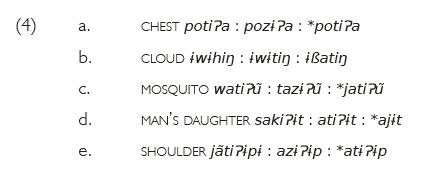
Finally, let us mention here some cases of non-identical vowel correspondences illustrating an interesting combined change. The examples in (4a, c, e) have ɨ consistently only in Aweti; in the other branches, mostly i occurs.

Our hypothesis for of i : ɨ : *i in (4a, c) is that the original PMAG sequence was *ti, which evolved into zɨ in Aweti. Note that, when the sequence ti occurs in Aweti (as in 4b, d), it clearly belongs to other correspondences, i.e., it has a source other than PMAG *ti (see below). Apparently, PMAG *ti became Aweti zɨ, perhaps via *ri or *rj, both of which also yield Aweti z. The *i > ɨ change after z is probably motivated by the phonetic (retroflex) nature of Aweti z [ʐ]: note that the sequence zi is synchronically impossible.
The correspondence in (4e) differs from that in (4a, c) only in PTG, where *ɨ occurs instead of *i. In this case, we propose that the original PMAG *i assimilated to the vowel of the final syllable (also *ɨ) in PTG5.
CONSONANTS
In Maweti-Guarani, consonants (especially apical consonants) often change in unexpected ways, unlike vowels, which are usually quite stable. We will examine these changes in the following sections.
Labial and velar stops
In most Maweti-Guarani languages, morpheme-final stops can phonetically undergo lenition (basically, p > ß or w, t > r, and at least in Aweti also k > ɣ), when a new vowel-initial element (clitic, affix, often even following words) follows. Furthermore, because of nasal harmony, some languages will also (pre)nasalize stops (p > m/[mb], t > n/[nd], k > ŋ/[ŋg], and also j > [ɲ]; see Drude (2006) for details) in nasal environments. This explains why correspondences involving stops will sometimes include also their nasal counterparts6. For PMAG *p, exemplified below in (5), in addition to the (very well attested) identity correspondence p : p : *p, there is also p : p : *m, occurring in nasal environments; they are thus all reflexes of the same protosegment. Phonologically, we assume that (cf. section 'PMAG segmental phonology' above) PTG morpheme-final *ß in reconstructions by others is really *p, and the correspondence is also in these cases p : p : *p.

Likewise, PMAG *k, in (6), also has identity (k : k : k) and nasal (k : k : ŋ) correspondences, the latter again reflecting different phonological analyses. There is in principle no lenis correspondence (reflecting the fact that PTG word-final *k, unlike other stops, was reconstructed as fortis rather than lenis, since it apparently almost never lenites in Tupi-Guarani languages), although one can notice that word-final k in Aweti can be realized as [ɣ] when a vowel-initial clitic or suffix follows (e.g., ok 'house', oɣ-ɨwo 'in the house'). This [ɣ] is analyzed as an allophone of k, though there is some evidence that it may be in the process of becoming an independent phoneme in Aweti.

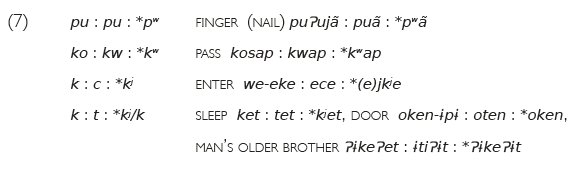
None of the correspondences in (5) or (6) involves PTG labialized or palatalized stops, *pw, *kw, *pj and *kj. For *pj, this is not surprising, since it is a rather marginal segment (it has been proposed only in PTG *epjak 'to see'). For *pw and *kw, the few available cognates in (7) suggest that these 'segments' are or result from sequences. For *kj, it would seem that the source is simply PMAG *k when followed by *e. In PTG, *kj is an extremely rare consonant, only reconstructed before *e (Mello (2000) has only *kjet 'sleep'; Rodrigues (2007) only *kjet 'sleep' and *ejkje 'enter'), without clear contrast with *ke7. For this reason, we propose that k : c : *kj (= *k) and k : t : *kj/k both reflect PMAG *k, the former when preceded by *j.

Palatal and alveolar stops
PMAG *t is more complicated. As shown in (8), one does find the expected identity (t : t : *t), also in morpheme-final position (other reconstructions have PTG *r in this position), and nasal (t : t : *n) in the nasal environment. Curiously, non-morpheme-final t : t : *t is a surprisingly small correspondence, with only 7 attested examples (the three in (8), and buriti (palm) miriti : - : *muriti, traíra (fish) taraɁɨra : - : taraɁɨr-a, village taawa : - : *taßa, and wind ɨwɨtu : ɨwɨt : ɨßɨtu), most of which are missing in Aweti and probable borrowings in Mawe (presumably, from PTG to Mawe via Lingua Geral: buriti (palm), traíra (fish), corn, village, wind; the last three were also considered possible borrowings in Rodrigues; Dietrich (1997)). slap could also be a borrowing (cf. Portuguese peteca 'shuttlecock'); only for ashamed does this seem unlikely (note that, in both cases, an Aweti cognate is missing). Given this suspicious status of t : t : *t, we propose that t : t : *č/c (assuming, as suggested in section 'PMAG segmental phonology', that PTG *č and *c actually were the same) is the basic correspondence for PMAG *t, in non-morpheme-final, non-nasal contexts.

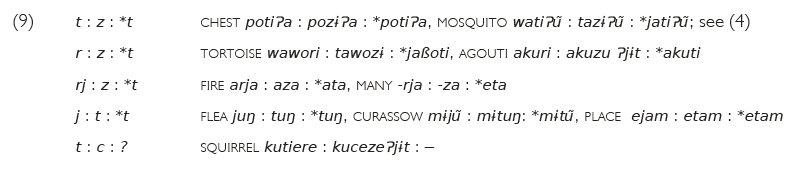
The correspondences below, in (9), are ascribed to *t when followed by *i. Basically, PMAG *ti evolves so that ri : zɨ : *ti (r : z : *t) results word-finally, ti : zɨ : *ti (t : z : *t) non-word-finally (i.e., word-initially or word-medially) if no other vowel follows, rj : z : *t if an oral vowel follows, and j : t : *t if a nasal vowel follows. The final correspondence, t : c : ?8, apparently occurs if *ti is followed by *e; but note that only one example occurs in the available data. It is also possible to account for ashamed, the best cognate set from t : t : *t in (7) above, by re-assigning it to *t : z : t (which is possible because Aweti lacks a cognate in this set). In sum, bringing together the *t correspondences in (8) and (9): PMAG *t# = t : t : *r, PMAG * V[+nas]tV = t : t : n, PMAG *ti# = ri : zɨ : *ti, PMAG *tiC = ti : zɨ : *ti, PMAG *tiV[nas] = rj : z : *t (but *tie = t : c : ?), PMAG *tiV[+nas] = j : t : t; elsewhere, PMAG *t = t : t : *č/c.

In addition to *t, we reconstruct another palatal stop *tj for the correspondences shown in (10) below9. For non-nasal environments, the proposed distribution is: (a) h : t : *t after a preceding *j; (b) h : t : *c after a preceding *i; (c) elsewhere (i.e., without a preceding *j or *i), s : t : *t word-initially in oral environments, j : t : *t word-initially in nasal environments, s : ø : *ø word-internally in oral environments, and j : j : *j word-internally in nasal environments. In sum, schematically: PMAG *jtj = h : t : *t, PMAG *itj = h : t : *c, PMAG *#tjV[-nas] = s : t : *t, PMAG *#tjV[+nas] = j : t : *t, PMAG *X[≠i,j]tjV[-nas] = s : ø: ø, PMAG *X[≠i,j] tjV[+nas] = j : j : *j10. To motivate the distribution proposed for the first two correspondences, it is necessary to examine the person-marking paradigms of *tj-initial stems. In (11), comparing the Mawe forms for set ~ het 'name' (< PMAG *tjet) and tɨ 'mother (< PMAG *tɨ), we see that the h-initial forms of 'name' occur in the same persons in which there is a prefix ending in i- on 'mother'. By internal reconstruction, one can restore this i in the paradigms that no longer have it, yielding, for 'name', PMAG *uj-tjet, *e-tjet, *i-tjet, which provides the environments for h : t : *t, s : ø : ø, and h : t : *c. Similarly, for 'tooth', PMAG *uj-tjãj, *e-tjãj, *i-tjãj produces the environments for h : t : *t, j : j : *j, and h : t : *c (see also fn. 8). For further details on this reconstruction, see Meira and Drude (2013).
(10) s : t: *t armadillo sahu : tatu-pep : *tatu, hunger sɨɨɁat : - : *tɨɁa-ßot
s : ø: *ø pass kosap : kwap : *kwap, head hair asap : Ɂap : *Ɂap
h : t : *t good kahu : katu : *katu, flower i-pohɨɨt : Ɂa-potɨt : *potɨt, swim ɨha : ɨta- : *ɨtap
h : t : *c 'his/her tooth' hãj : tãj : *cãj, 'his/her name' het : tet : *cet; see (9) and fn. 8
j : t : *t11 'non-possessed (generic human) tooth' jãj, (t)ãj, *tãj; see (9) and fn. 8
j : j : *j 'your tooth' e-jãj : e-jãj : *e-(j)ãj (pronounced [eɲãj]); see (9), (16), and fn. 8
(11) Some Maweti-Guarani paradigms (order: first, second, third person)
Mawe Aweti12
Finally, the two exceptional cases of h : t : *č/c in (12) need to be discussed here.

Following rule (b) in the preceding paragraph, one would posit a sequence *i-tj for these words, which seems odd word-internally, though it is not unthinkable that they were at first sequences of nouns the second of which was marked for third person (*po i-tjaŋ, *e i-tja). A more likely explanation, however, is an earlier consonant cluster: a preceding consonant can influence the reflexes of PMAG *tj (e.g., PMAG *Ɂɨp 'tree' + *tjop 'leaf' > Mawe ɨhop 'leaf', with h instead of the s usually found intervocalically; cf. PMAG *Ɂa 'head' + *tjap 'hair' > Mawe asap 'head hair'). In Meira; Drude (2013, p. 15-17), the allomorphic patterns of stems co-occurring with the gerund suffix -aw in Aweti were used to identify the development of *C-tj clusters: the final consonant remained fortis if oral, and added an extra oral 'tail' at the end if nasal (*p-tj > p, *t-tj > t, *k-tj > k, *m-tj > mp, *n-tj > nt, *ŋ-tj > ŋk). Since the Aweti cognates contain t in both eye and medicine, we propose that these result from *t-tj clusters, probably involving morpheme boundaries (i.e., PMAG *pot-tjaŋ, *et-tja)14.
Fricatives and approximants (glides)
Most Maweti-Guarani fricatives and affricates were involved in the stop correspondences reviewed in the previous section. Only PMAG *ß remains, with examples like those in (13).

PMAG *ß contrasts with the correspondences in (14), here reconstructed as PMAG *w. ? : w : *w occurs if the following vowel is *u (assuming *...uwɨ > *...uw(u) > ...uu; note that the sequence wu cannot occur in present-day Mawe); elsewhere, w : w : *w is found.

Contrasting with *ß and *w, there are the correspondences listed in (15), for which we reconstruct PMAG *kw (note that the Aweti reflexes are stops, including k). Their distribution is as follows: (a) w : k : *j occurs before *ɨ; (b) h : t : *j occurs before *u, in the final syllable of a morpheme; (c) ? : t : *j occurs before *u, in a non-final syllable15; (d) elsewhere, w : t : *j occurs.

Finally, there is PMAG *j from the identity j : j : *j in (16), found only syllable-finally. Note that it is different from the j : j : *j (< *tj) in (10) above: the latter, unlike the former, occurs only syllable initially, in nasal contexts.

Rhotics and liquids
PMAG *r could in principle be based on the two correspondences in (17). Since, however, the first one occurs only in probable borrowings (note the uncharacteristic unstressed a in Mawe piira 'fish', suggestive of a borrowing), we only reconstruct the second one as PMAG *r.

The correspondences in (18) involve either PMAG *r in nasal contexts, or PMAG *n; the two sounds are very close, and may have been in variation in some cases already in PMAG. We propose here that r : l : *r reflects PMAG *r in non-word-initial nasal environments, n : l : *r reflects PMAG *r in word-initial nasal environments (i.e., PMAG *rõp), and that n : j : *n/r reflects PMAG *r or *n (perhaps in variation) in nasal environments with a palatal element - the e in fetid (> PMAG *nem ~ *rem), or an extra *i or *j in do. Given, however, that the number of examples in the available data is quite reduced, we consider this reconstruction to be preliminary16.

Nasals
The status of nasal consonants in Maweti-Guarani languages depends on the specifics of nasal harmony: sometimes nasal consonants nasalize surrounding segments, sometimes they are nasalized versions of oral consonants (see the sections 'Labial and velar stops' and 'Palatal and alveolar stops'). The reconstruction of PMAG nasal consonants depends therefore on the reconstruction of PMAG nasal harmony, which will not be discussed here in detail (see Drude 2009; Meira; Drude, in prep.). It must be said, though, that nasal harmony makes the status of nasal consonants easier to ascertain at word boundaries than word-internally.
PMAG *m can be safely reconstructed for the identity correspondence in (19), both word-initially and word-finally. Word-internally, it seems to occur mostly in possible borrowings (beans kumanã : kumanaɁĩ : kumana); the two clearly non-borrowed examples are in (19).

The correspondences in (20) stem from PMAG *n. The first one, n : n : *n, occurs syllable-finally, and syllable-initially if the following vowel is *i (and in a few possible borrowings: e.g., again, beans). The second one, n : j : *n, occurs syllable-initially if the following vowel is not *i (note the similarity with n : j : n/r in (18) above). The third one, j : j : *n, occurs only in one example in the available data; we reconstruct it as *nj or *ni + a vowel, i.e., *anjũ or *aniũ17.

Finally, PMAG *ŋ is also easy to reconstruct on the basis of (21) below, with ŋ : ŋ : *ŋ ocurring word-finally and ŋ : k : k syllable-initially.

Glottals
Finally, there is PMAG *Ɂ, a segment that can be easily reconstructed on the basis of the identity correspondence in (22). There are also examples with non-identity correspondences - usually with the glottal being absent in one of the languages - but it is difficult in these cases to know whether the missing glottal stop is really absent or its absence results from mistranscriptions. We will therefore not consider these cases in detail, for which see Meira; Drude (in prep.).

THE EVOLUTION OF MAWETI-GUARANI SEGMENTAL PHONOLOGY
Except for the PMAG *i > Aweti *ɨ change in *ti > zɨ (see the correspondences in (9), in section 'Palatal and alveolar stops'), vowels remained mostly unchanged in Maweti-Guarani, with only sporadic cases of assimilation (cf. the discussion of 4e) and a few irregularities (most notably u : o / o : u in, e.g., big wato : watu : waču or grandfather h-amũ : amũj : amõj) which remain as objects for future research18. Consonants, however, underwent several complicated changes, as summarized below.
Of all PMAG consonants, only *m, *j and *Ɂ underwent no changes (excluding apparently irregular cases of loss of the former two; see Meira; Drude, in prep.).
PMAG *p, *t ,*k were nasalized (phonemically, though not phonetically) to *m, *n, *ŋ after a nasal vowel in PTG (woman's son *mẽpɨt > *memɨt); in current reconstructions, *p and *t also lenited to *ß and *r word-finally, though it seems more likely that they had not yet lenited in PTG times (die *pap > *pap, not *paß; name *tjet > *(r)et, not *(r)er). The PTG labialized and palatalized stops (*pw, *pj, *kw, *kj, *ŋw, *mw) appear to result from earlier vowel sequences (pass *kotjap > *kwap) or palatalization (sleep *ket > *kjet, *kj having a doubtful status in PTG). Aweti shows an unusual change of *k to t before e and i, and to c in that position after j (enter), probably also via palatalization.
PMAG *ß and *w merged in Mawe and Aweti (tortoise *kwaßoti > wawori, tawozɨ). PMAG *w and *kw merged also in Mawe, both being lost before *u (but *kw > h if the syllable was stressed: salt *kwukɨt > ukɨt, red *kwup > hup); in Aweti, *kw > t (tortoise), except before *ɨ, where *kw > k (cooked *kwɨp > o-kɨp). In PTG *kw > j (tortoise *kwaßoti > *jaßoti).
PMAG *ni (or *nj), when followed by a vowel, changed to j in Mawe and Aweti, and to *n in PTG (anu bird *anjũ, *aniũ > ajũ-nɁi : ajũ : *anũ). In nasal environments, PMAG *ri (or *rj) with a following vowel changed to n in Mawe and to j in Aweti, while in PTG it oscillated between *r and *n (do *riuŋ, *rjuŋ > nuŋ : juŋ : *ruŋ~*roŋ~noŋ); elsewhere, *r in nasal environments changed to Aweti l (navel *pɨrumɁã > pɨlup), and to Mawe n word-initially (bitter *rõp > nop; cf. Aweti lop). In other, non-nasal, environments, *r was conserved in Mawe and PTG but became *z in Aweti (lick *eereep > eereep : ezep : *ereß)19.
PMAG *ti (or *tj) became c before e and z before other vowels in Aweti (squirrel *kutiere, *kutjere > kuceze Ɂjɨt, fire *atia, *atja > t-aza); before consonants and word-finally, it became Aweti zɨ (chest *potiɁa > pozɨɁa, tortoise *kwaßoti > tawozɨ). In Mawe, PMAG *ti (or *tj) became rj before an oral vowel (fire *atia, *atja > arja) and ri word-finally (tortoise *kwaßoti > wawori), and j before a nasal vowel (flea *tiuŋ, *tjuŋ > juŋ); in PTG, it became *t before a vowel (fire *atia, *atja > *ata). Elsewhere, PMAG *t was conserved in Mawe and Aweti. In PTG, it became *r word-finally according to current reconstructions, but this is probably not correct (name *tjet > *er, probably *et); elsewhere (i.e., syllable-initially, before all vowels except i), it became *č/c.
Finally, PMAG *tj was not retained as such in any language. After *i or *j, *tj became h in Mawe, perhaps via an intermediate affricate or fricative phase (in (11) and fn. 5, 'his/her name' *i-tjet > het; 'my name' *uj-tjet > uhet) and t in Aweti (*i-tjet > *tet > t-et 'his/her name', *uj-tjet > *wi-tet > it-et 'my name'); in PTG, *tj became *t after *j (*uj-tjet > *wi-tet > *wit-et 'my name') but *č/c after *i (*i-tjet > *cet 'his/her name'). If no i or j preceded it, *tj became j ([ɲ]) in nasal environments in Mawe (in (11) and fn. 5, 'non-possessed tooth' *tjãj > jãj, 'your tooth' *e-tjãj > e-jãj), thus merging with *tj, *ti + vowel (compare flea *tiuŋ, *tjuŋ > juŋ, place *etiam, *etjam > ejam). In Aweti and PTG, in nasal environments, *tj became j word-internally and t word-initially ('non-possessed tooth' *tjãj > tãj, *tãj, but 'your tooth' *e-tjãj > e-jãi, *e-jãj); in both cases, *tj remained distinct from *tj, *ti + vowel, which became t (compare flea *tiuŋ, *tjuŋ > tuŋ, *tuŋ, place *etiam, *etjam > etam, *etam). After *p, PMAG *tj disappeared in Mawe (leaf *Ɂɨp 'tree' + *tjop 'leaf' > ɨhop); after all consonants, it also disappeared in Aweti, but leaving the final consonant unlenited or even, if nasal, reinforced by an oral 'tail' (*ptj > p, *mtj > mp). Elsewhere, *tj became s in Mawe (armadillo *tjajtju > sahu, pass *kotjap > kosap); in Aweti and PTG, it was conserved as t word-initially (armadillo *tjajtju > tatu-pep, *tatu), and disappeared elsewhere (pass *kotjap > kwap, *kwap).
For the purpose of subclassification, it is important to determine whether any changes occurred in more than one branch, since they are potential shared innovations providing supporting evidence for a common higher-order node. Mawe and PTG apparently share no changes; Mawe and Aweti, on the other hand, share the merge of *ß with *w into w and the change of *ni (or *nj) to j before a following vowel. Since, however, *ß > w is a fairly frequent change20, and *nj > j, besides being frequent typologically (especially, as in this case, in nasal contexts), is also only weakly attested (only one example, anu bird), they do not provide a good argument21. On the other hand, the changes shared by Aweti and PTG - involving the development of PMAG *tj - are rather complex, context-dependent, and not really frequent. They are proposed here (and also in Meira; Drude (2013)), in addition to what Meira (2006); Corrêa da Silva (2007) had already suggested, as further evidence for an Aweti-PTG branch ('Aweti-Guarani' or PAG; see Meira; Drude (in prep.) for further details and a first reconstruction of PAG).

These shared innovations can be better visualized in the schema in figure 3 below, in which we follow the hypothesized development of non-possessed and the first three person-marked possessed forms of *tjet 'name' from PMAG to Mawe and PAG (= Proto-Aweti-Guarani), and from PAG to Aweti and PTG.

The PAG third-person form is reconstructed as either *i-tet or *cet. The Aweti reflex suggests PAG *t, while the PTG reflex shows the influence of the preceding *i-. Either Aweti lost the initial *i- in *i-tet (an irregularity, since the prefix *i- is not lost in Aweti in other consonant-initial stems: tɨ 'mother', i-tɨ 'his/her mother', in female speech), or the PAG form had already lost the initial *i-, and had already changed PMAG *tj to something else, perhaps *c, which Aweti later changed back to *t (word-initially, so that kuceze-Ɂɨt 'squirrel' remained unaffected). It is also possible that PAG had *i-tet phonemically (underlyingly) but *cet phonetically. Later on, more specific Aweti features would have arisen (the reinterpretation of third-person forms as having a prefix t-, with consequent reanalysis of the stem as vowel initial: *ø-tet > t-et; the introduction of a new third-person prefix n(a)- in male speech, restricting i-/t- to the female genderlect)22.
A final comment on PMAG historical phonology is how crowded the palato-alveolar area is with various segments and sequences often having surprisingly different reflexes in the present-day languages. Most of the differences between the reconstruction presented here and what can be inferred from other proposals (see next section) are in the palato-alveolar area. It is also here that we find some surprising developments: PMAG *t palatalizes to PTG *č/c precisely in non-palatal environments (i.e., when the following vowel is not *i) and is conserved or lenited in PTG in other environments. Furthermore, *ti will change in Mawe and Aweti only if another vowel follows (in which case *ti might be better seen as *tj) or word-finally. It is as if PMAG speakers really cared about the distinction beween *tV,*tiV ~ *tjV and *tjV sequences: *ti (*tj) + V is not palatalized so as not to sound like *tjV23. Similarly, *n in nasal environments becomes j ([ɲ]) in Aweti, but not when an *i follows. Noting also how nasalization and lenition also connect palatal segments, it becomes very easy, in the history of Maweti-Guarani (and probably Tupian) languages, for t, tj, c, č, j, n, ɲ and r to change into each other or to influence each other's evolution.
BRIEF COMPARISON WITH OTHER STUDIES
As was mentioned in the introduction, other studies on PMAG phonology (Rodrigues; Dietrich, 1997; Corrêa da Silva, 2007, 2010) utilized a different, 'top-down' or 'sandwich' approach, usually comparing Proto-Tupi reconstructions (from Rodrigues' work, partially published in Rodrigues; Dietrich (1997), and Rodrigues (2005, 2007)) with Mawe and Aweti words, and with PTG reconstructions, from the same source used here (Rodrigues' work, partially published in various articles; and also Mello (2000), presumably also based on Rodrigues' work). On account of that, it is sometimes difficult to ascertain what exactly the studies would claim as reconstructed PMAG protosegments: the developments in the three branches are usually directly derived from Proto-Tupi protoforms (Corrêa da Silva, 2007, p. 227 mentions medicine pohaŋ : potaŋ : *pocaŋ as reflecting Proto-Tupi *cɁ, without it being clear whether the PMAG reflex was also supposed to be glottalized or not). The comparison below, with Corrêa da Silva (2010), is thus based on our understanding of claims often only implicitly made for PMAG.
Some of the differences stem from the different scope of Proto-Tupi and PMAG reconstructions. For instance, Rodrigues reconstructs a series of glottalized obstruents (*pɁ, *pwɁ, *tɁ, *cɁ, *čɁ, *kɁ, *kwɁ) and a series of prenasalized stops (*mp, *nt, *ŋk; in Rodrigues; Cabral (2012) *nt was dropped). Since Rodrigues claims most of these consonants to have merged with their simpler counterparts in Mawe, Aweti and PTG (the evidence for their reconstruction comes from other branches), there is no problem with reconstructing PMAG *p, *t and *k as an intermediate step.
A specific problem, however, arises with Rodrigues' *tɁ: it is based on correspondences that include the ones for which PMAG *tj is proposed here. This would imply that (Rodrigues') Proto-Tupi *tɁ became PMAG *tj, a rather unusual change, even with the observations at the end of the previous section in mind. Furthermore, in other branches, there seems to be no clear reflex of a glottal feature, while reflexes of palatal or fricative features abound (e.g., Munduruku d, Tupari h, Makurap č, Gavião ts, dz, Surui l, Kuruaya l ~ ð, Karitiana s, Karo j). It seems thus rather unlikely that PMAG *tj, or its Proto-Tupi ancestor, had any glottal coarticulation24.
In some cases, Rodrigues; Cabral (2012) and the present work disagree on the assignment of correspondences to protosegments. Rodrigues; Cabral's Proto-Tupi *tj, for instance, is based on t : z : *t and rj : z : *t which are here assigned to PMAG *ti, *tj + vowel. If we assume that Rodrigues; Cabral (and Corrêa da Silva (2010)) meant for this PT *tj to still have this form in PMAG, this would imply the reconstruction of *tji (in, e.g., mosquito, here *kwatiɁũ, in Rodrigues; Cabral's work *watjiɁũ), which seems unnecessary, since, in this position, *tii does not seem to contrast with *ti25. In the absence of this contrast, following Occam's razor, it does not seem necessary to posit an independent PT phoneme *tj to account for cases that can be explained by *t followed by *i or *j and a vowel.
Even for PMAG *t, there are differences: Rodrigues assigns j : t : *t to a simple PT *t, leading presumably to PMAG *t, whereas we prefer to see this correspondence as reflecting PMAG *ti or *tj + vowel. Indeed j : t : *t is in complementary distribution with t : t : *t, but so is t : t : *č/c. (In fact, since t : t : *t is, as we saw above, a 'weak' correspondence, with mostly possible borrowings among its examples - except for ashamed tĩ : - : tĩ, it is basically in complementary distribution with everything else.) Rodrigues sees t : t : *č/c as reflexes of Proto-Tupi *č and *c, or, as we would see it here, of a single *c (since, as we noted in section 'PMAG segmental phonology', the distinction between PTG *č and *c is not universally accepted, it would be at least hasty to assign it to PMAG or to PT solely on the basis of the dialects of Guarani). If, however, t : t : *č/c is assigned to *t, no new proto-segments need to be posited; by Occam's razor, we again prefer this solution to Rodrigues'. As a consequence, PMAG was, in our view, a language without sibilant fricatives or affricates, all of which, in the present-day Maweti-Guarani languages, result from *t or *tj in various contexts.
The last important difference concerns PMAG *kw, which Rodrigues reconstructs for Proto-Tupi as *w. Rodrigues; Cabral (2012, p. 508) explicitly disagree with Moore; Galucio's (1994) reconstruction of *kw for Proto-Tupari (for a kw : w : w : w correspondence), claiming a distinction between PT *kw and *w. But here the question of levels becomes crucial: even if Proto-Tupi had *kw and *w as distinct phonemes, it does not follow that Proto-Tupari (or PMAG) also did. The examples cited by Rodrigues; Cabral (2012) do not allow strict branch-internal comparison: in 'hole' vs. 'go (pl.)', there were no cognates from Tupari languages in 'hole'; in 'village center' vs. 'yams', only Mekens ekwat is cited for 'village center', which could be a synchronic compound of ek 'house' with an element wat. For PMAG, it may be that PTG *kw, at least in some cases, actually resulted from previous vowel sequences (pass kosap : kwap : *kwap) rather than PT *w26. Whatever the case might be for Proto-Tupi, for PMAG, Corrêa da Silva (2007, 2010), and Rodrigues; Dietrich (1997) make claims about the reflexes of Proto-Tupi*kw and *w only in specific branches (Mawe, Aweti, PTG), not in PMAG. We prefer to reconstruct PMAG *kw because there already is a better candidate for *w, namely the correspondence w : w : *w in (14), section 'Fricatives and approximants', and because the Aweti reflexes (k, t) suggest an occlusive element.
Cognate Sets
For ease of reference, we list here the cognates presented as examples in the previous sections. The format is: semantic label (in small caps), reconstructed PMAG form (in bold, with an asterisk; segments in parentheses are doubtful; an entire form in parenthesis indicates that a cognate from one of the branches is missing), and the attested cognates (as before, in the order Mawe, Aweti, PTG; a short '-' dash represents a missing cognate). The initial PTG segment that reflects PMAG *tj is here written as *(r), since it disappears in certain environments. A parenthetical question mark and comment after a reconstructed PMAG form marks a cognate set suspected to involve borrowing. For a full list of cognates, see Meira and Drude (in prep.).
REFERENCES
- CABRAL, A. S.; RODRIGUES, A. D. Dicionário da língua Asuriní do Tocantins. Belém: UFPA; Brasília: UnB. 2003.
- CAMPBELL, L. Historical linguistics: an introduction. Edinburgh: Edinburgh University Press; Cambridge: MIT Press. 2004.
- CORRÊA DA SILVA, B. C. Mais fundamentos para a hipótese de Rodrigues (1984/1985) de um Proto-Aweti-Tupi-Guarani. In: RODRIGUES, A. D.; CABRAL, A. S. (ed.). Línguas e culturas tupi. Brasília: LALI/UnB; Campinas, SP: Curt Nimuendaju. 2007. p. 219-240.
- CORRÊA DA SILVA, B. C. da. Mawe/Aweti/Tupi-Guarani: relações linguísticas e implicações históricas. Ph.D. dissertation, Universidade de Brasília, Brasília, 2010.
- DRUDE, S. On the position of the Aweti language in the Tupi family. In: DIETRICH, W. (ed.). Guarani y 'MAweti-Tupi-Guarani': estudios históricos y descriptivos sobre una familia lingüística de America del Sur. Münster: Lit Verlag. 2006. p. 11-45.
- DRUDE, S. Nasal harmony in Aweti and the Maweti-Guarani family (Tupi). Amerindia, v. 32, p. 239-276, 2009.
- GALUCIO, A. V.; MEIRA, S.; BIRCHALL, J.; MOORE, D.; DRUDE, S.; GABAS Jr, N.; STORTO, L.; PICANÇO, G.; REIS RODRIGUES, C. Genealogical relations and lexical distances within the Tupian linguistic family. Boletim do Museu Paraense Emílio Goeldi. Ciências Humanas, v. 10, n. 2, 2015.
- JENSEN, C. Comparative Tupi-Guarani morphosyntax. In: DERBYSHIRE, D. C.; PULLUM, G. K. (ed.). Handbook of Amazonian languages. Berlin: Mouton de Gruyter, 1998. p. 487-618.
- JENSEN, C. Tupi-Guarani. In: DIXON, R. M. W.; AIKHENVALD, A. Y. (ed.). The Amazonian languages. Cambridge: Cambridge University Press, 1999. p. 125-163.
- KOCH-GRÜNBERG, Th. Wörterlisten " tupý ", maué und purúborá. Journal de la Société des Américanistes, v. 24, n 1, p. 31-50, 1932.
- LEITE, Y. A classificação do Tapirapé na família Tupi-Guarani. Ensaios de lingüística - Cadernos de lingüística e teoria da literatura, Belo Horizonte, v. 4, n. 7, p. 25-32, 1982.
- LEITE, Y. A classificação do Tapirapé na família Tupi-Guarani. In: FRANCHETTO, Bruna; COUTINHO-SILVA, Thiago (ed.). Línguas indígenas: memórias de uma pesquisa infinda. Rio de Janeiro: Viveiros de Castro Editora, 2012. p. 60-68.
- LEMLE, M. Internal classification of the Tupi-Guarani linguistic family. In: BENDOR-SAMUEL, D. (ed.). Tupi studies I. Norman: Summer Institute of Linguistics, 1971. p. 107-129.
- MEIRA, S. Stative verbs vs. nouns in Sateré-Mawe and the Tupian family. In: ROWICKA, G.; CARLIN, E. (ed.). What's in a verb? Studies in the verbal morphology of the languages of the Americas. Utrecht, The Netherlands: LOT, 2006. p. 184-214.
- MEIRA, S. Certain problems with current reconstructions of Proto-Tupi-Guarani phonology. In preparation
- MEIRA, S.; DRUDE, S. A reconstruction of Proto-Maweti-Guarani. In preparation.
-
MEIRA, S.; DRUDE, S. Sobre a origem histórica dos "prefixos relacionais" das línguas Tupi-Guarani. Cadernos de Etnolingüística, v. 5, n. 1, p. 1-31. 2013. Available at: <Available at: http://www.etnolinguistica.org/issue:vol5n1
>. Accessed on: Aug. 8, 2015.
» http://www.etnolinguistica.org/issue:vol5n1 - MELLO, A. A. S. Estudo histórico da família lingüística Tupi-Guarani: aspectos fonológicos e lexicais. Ph.D. dissertation, Universidade Federal de Santa Catarina, Florianópolis, 2000.
- MOORE, D.; GALUCIO, A. V. Reconstruction of Proto-Tupari consonants and vowels. In: LANGDON, M. (Ed.). Proceedings of the Meeting of the Society for the Study of the Indigenous Languages of the Americas, July 2-4, 1993, and the Hokan-Penutian Workshop, July 3, 1993. Berkeley, CA: Survey of California and other Indian languages (Report n. 8), 1994. p. 119-137.
- RODRIGUES, Aryon D. Relações internas na família lingüística Tupí-Guaraní. Revista de Antropologia, São Paulo, v. 27/28, p. 33-53, 1984/85.
- RODRIGUES, A. D. Tupi. In: DIXON, R. M. W.; AIKHENVALD, A. Y. (ed.). The Amazonian languages., Cambridge: Cambridge University Press 1999. p. 107-124.
- RODRIGUES, A. D. As vogais orais do Proto-Tupi. In: CABRAL, A. S. A.; RODRIGUES, A. D. (ed.). Novos estudos sobre línguas indígenas. Brasília: Editora Universidade de Brasília, 2005. p. 35-46.
- RODRIGUES, A. D. As consoantes do Proto-Tupi. In: CABRAL, A. S. A. C.; RODRIGUES, A. D. (ed.). Línguas e culturas tupi.Campinas: Curt Nimuendaju; Brasília: LALI, 2007. p. 167-203.
- RODRIGUES, A. D.; CABRAL, A. S. A. C. Tupían. In: CAMPBELL, L.; GRONDONA, V. (ed.). The indigenous languages of South America: a comprehensive guide. Berlin, Boston: De Gruyter Mouton, 2012. p. 495-574.
- RODRIGUES, A. D.; DIETRICH, W. On the linguistic relationship between Mawe and Tupi-Guarani. Diachronica, v. 14, n. 2, p. 265-304, 1997.
- SCHLEICHER, C. O. Comparative and internal reconstruction of the Tupi-Guarani language family. Ph.D. dissertation, University of Wisconsin, Madison, 1998.
- SEKI, L. Gramática do Kamaiurá, língua Tupi-Guarani do Alto Xingu. Campinas (SP): Editora da UNICAMP. 2000.
- 3sg - *i- i- : i- : *i-
- about - *ete ete : ete : *ece
- agouti - *akuti akuri : akuzu Ɂjɨt27, *akuti
- anu bird - *anjũ, *aniũ ajũ-nɁi : ajũ : *anũ
- armadillo - *tjajtju sahu : tatu-pep : *tatu
- ashamed - (*tĩ) tĩ : - : *tĩ
- at/in - *pe pe : pe : *pe
- ax - *kwɨ ɨwɨ-hap : kɨ : *jɨ
- back - *(Ɂ)ape ape : Ɂape : *ape
- be /live - *eko eko : eko : eko
- beans - *kumana (? - possible borrowing) kumanã : kumanaɁĩ : *kumana
- big - *wat(o/u) wato : watu : waču
- bitter28 - *rõp nop : lop : *rop
- black - *kwuun huun : - : *un
- blood - *tjuwɨ(k) suu : uwɨk : *(r)uwɨ
- blow - *pekwu pehu : petu : *peju
- bone - *kaŋ kaŋ : kaŋ : *kaŋ
- branch - *tjakã jãŋã : akã : *(r)akã
- burn - *apɨ apɨ : apɨ : *apɨ
- buriti (palm) - (*m(u/i)riti) (? - possible borrowing, TG > Mawe) miriti : - : *muriti
- chest - *potiɁa potiɁa : pozɨɁa : *potiɁa
- chief - (*morekwat) (? possible borrowing) morekwat : morekwat : - 29
- call - *enõj h-enoj : ejõj : *enõj
- cloud - *(ɨwɨ)tjiŋ ɨwɨ-hiŋ : ɨwɨ-tiŋ : ɨßa-tiŋ
- com.caus - (= comitative causative) *er(o/e)- er-, ere- : zo- : ero-
- come - *ut (u)ut : ut : *ut
- cooked - *kwɨp wɨp : o-kɨp : *jɨp
- corn - *aßati (? - probable borrowing) awati : awati : *aßati
- currasow - *mɨtiũ(ŋ), *mɨtjũ(ŋ) mɨjũ : mɨtuŋ : mɨtũ
- deer - *(ɨ)tɨɨ- : tɨ-wapat, ɨtɨɨ
- die (pl.) - *pap pap : pap : *pap
- do - *rj(u/o)ŋ, *nj(u/o)ŋ nuŋ : juŋ : *ruŋ ~ *roŋ ~ *noŋ (Rodrigues & Dietrich 1997), *noŋ (Mello 2000)
- door - *oken oken-ɨpɨ : oten : *oken
- earth - (*Ɂɨj) Ɂɨj : - : *Ɂɨj
- eat - *Ɂu uɁu : Ɂu : *Ɂu
- egg - *upiɁa upiɁa : n-upiɁa : *upiɁa
- enter - *ejke we-eke : ece : *(e)jkje
- exit - *tem wẽẽ-tem : tem : *čem
- eye - *et-tja (e)ha : (e)ta : eča (Rodrigues and Dietrich 1997), eca (Mello 2000)
- face - *(e/o)ßa (e)wa : owa : *oßa
- fall - *Ɂat aɁat : Ɂat : *Ɂat
- father - *tjup sup30 : up : *(r)up
- feed - *poj poj : poj : *poj
- fetid - *riem, *rjem, maybe simply *rem nem : jem : *nem ~ *rem
- field - *ko ko : ko : *ko
- finger (nail) - *p(uɁ)u(j)ã puɁujã : puã : *pwã
- fire - *atia, *atja arja : aza : *ata
- flat - *peep peep : ɨwɨ-pep31 : *pep
- flea - *tiuŋ, *tjuŋ juŋ : tuŋ : *tuŋ
- flower - *pojtjɨɨt i-pohɨɨt : Ɂa-potɨt : *potɨt
- foot - *pɨ pɨ : pɨ : *pɨ
- fruit - *Ɂa Ɂa : Ɂa : *Ɂa
- grandfather - *am(õ/ũ)(j) h-amũ : amũj : *amõj
- go - *to to : to : *co
- good - *kajtju kahu : katu : *katu
- hair - *tjap sap : ap : *(r)ap
- hammock - *(Ɂ)(i/ɨ)nĩ Ɂɨni : Ɂinĩ : *inĩ
- hand - *po po : po : *po
- head hair - *Ɂatjap (from *Ɂa 'head' + *tjap 'hair') asap : Ɂap : *Ɂap
- heavy - *potɨj potɨj : potɨj : *pocɨj
- hot - *tjakup sakup : akup : *(r)akup
- house - *(tj)ok sok32 : ok : *(r)ok
- hunger - *tjɨɨɁa(t) sɨɨɁat : : tɨɁa-ßot
- kill - (*kwuka) Ɂa-uka : : *juka
- leaf - *tjop ɨ-hop : op : *(r)op
- lick - *eereep eereep33 : ezep : *erep
- lip - *tjẽpe jẽpe : ẽpe : *(r)eme
- louse - *ŋɨp ŋɨp : Ɂakɨp (from earlier *Ɂa 'head' + *kɨp 'louse') : *kɨp
- manioc - *mani mani : maniɁok : *maniɁok (cf. Aweti, Tupi-Guarani Ɂok 'tuber')
- man's daughter - *tjakwiɁɨt sakiɁɨt : atiɁɨt : *(r)ajɨt
- man's sister - *(i/e)nɨt inɨt : jĩt : *enɨt
- man's older brother - *(Ɂ)ɨkeɁɨt ɁɨkeɁet : ɨtiɁɨt : *ɁɨkeɁɨt
- many - *(e)tia, *(e)tja -rja : -za : *eta
- medicine - *pot-tjaŋ pohaŋ : potaŋ : *pocaŋ
- moon - *kwaatɨ waatɨ : tatɨ : *jačɨ
- mortar - *(wẽ)kuɁa wẽkuɁa : ɁẽkuɁa : *ɨŋuɁa
- mosquito - *kwatiɁũ watiɁũ : tazɨɁũ : *jatiɁũ
- mother - *tɨ tɨ : tɨ : *čɨ
- neck34 - *kwut hut-Ɂɨp [huɁɾɨp] : tur-Ɂɨp [tuɁɾɨp] : *jut
- name - *tjet set : et : *(r)et
- navel - *pɨrupɁã pɨrumɁa : pilup : pɨruɁã (Rodrigues; Dietrich, 1997), pɨruã (Mello, 2000)
- o.nz (= object nominalizer) - *mi- mi- : mi- : *mi-
- pain - *tjatɨ satɨ : atɨ : *(r)ačɨ
- pass - *kotjap kosap : kwap : *kwap
- place - *etiam, *etjam ejam : tam, etam : *etam
- pull - *ekɨj ekɨj : ekɨj : *ekɨj
- rain - *ama(a)n iɁ-ama(a)n : aman : *aman
- red -135 - *kwup hup : tup : *jup
- red -2 - (*pɨraŋ) - : pɨlaŋ : pɨraŋ (perhaps reconstructible only to Proto-Aweti-Guarani)
- rfl (=reflexive) - *kwe- we- : te- : *je-
- root - *tjapo sapo : apo : *(r)apo
- saliva - (*tjẽtɨ) jẽtɨ-hɨ : - : *(r)enɨ
- salt - *kwukɨt ukɨt : tukɨt : *jukɨt
- search - *(i/e)kaat (i)kaat : (j)kat : *ekat
- see/hear - *ẽtup wan-ẽtup : (ẽ)tup : *enup
- seed - *tjaɁĩj jaɁĩj : aɁĩj : *(r)aɁĩj
- seize - *pɨtɨk pɨtɨk : pɨtɨk : *pɨtɨk
- seize -2 - *(j)aat aat : - : *(j)at
- shoot - (*(Ɂ)ɨßõ) - : Ɂɨwõ : ɨßõ
- shoulder - *tj(a/ã)tiɁɨp(i) jãtiɁɨpɨ : azɨɁɨp : *(r)atɨɁɨp
- skin/body - *piit piit : pit : *pit
- slap - (*petek) petek : - : petek
- sleep - *ket ket : tet : *kjet
- smoke - tjiŋ ɨ-hiŋ (probably *Ɂɨp 'tree, wood' + *tjiŋ) : tiŋ : *tiŋ
- snake - *mõj moj : mõj : *moj
- squirrel - (*kutiere, *kutjere) kutiere : kuceze-Ɂjɨt : -
- sweet - *i-tjeɁẽ heɁẽ : teɁẽ : *čeɁẽ (apparently a lexicalized third-person form)
- swim - *ɨjtja(p) ɨha : ɨta-tap : *ɨtap
- termite - *ŋupi ŋupi-Ɂa : kupi-Ɂa, kupi-Ɂĩ : kupi-Ɂi
- tail - *tjuwaj suwaj-po : uwaj : *(r)uwaj
- thick - *anam iɁ-anam : Ɂajam : *anam
- thigh - *Ɂup Ɂup : Ɂup : *Ɂup
- tooth - *tjãj jãj : ãj : *(r)ãj
- tortoise - *kwaßoti wawori : tawozɨ : *jaßoti
- toucan - *tiukan, *tjukan jũkan : tukan : *tukan
- traíra (fish) - (*taraɁɨra) (? - possible borrowing, TG > Mawe) taraɁɨra : - : taraɁɨr-a
- two - (*mokõj) - : mokõj : *mokõj
- village - (*taaßa) (? - possible borrowing, TG > Mawe) taawa : - : *taßa
- vulture - *urußu uruwu : uzuwu : *urußu
- wasp - *ŋap ŋap : kap : *kap
- water - *Ɂɨ ɨɁɨ : Ɂɨ : *Ɂɨ
- wind - *ɨßɨt(u) (? - possible borrowing, TG > Mawe) ɨwɨtu : ɨwɨt : *ɨßɨtu
- woman's son - *mẽpɨt mẽpɨt : mẽpɨt : *memɨt