 Bioethics in information technologies in telehealth: a systematic review
Abstract
The growing use of technology inevitably leads to numerous debates on the ethical and legal issue of its use in healthcare. This research aims to investigate the bioethical aspects involved in information technologies use in telehealth actions via the synthesis of existing evidence so far, seeking a better understanding of this topic. A systematic review of the literature was conducted using on the Latin American and Caribbean Health Sciences Literature, MEDLINE, PubMed, Scientific Electronic Library Online, and Science Direct databases. This review identified several bioethical aspects involved in the use of information technologies, highlighting positive and negative points involving telehealth expansion, especially in developing countries, recognizing telehealth as a complementary method of access to health and not a substitute for traditional in-person consultations, which is even more important for the follow-up and monitoring of patients, mainly from remote areas or those with mobility difficulties.
Keywords
Telemedicine; Bioethics; Information technology; Legislation
Resumo
O uso crescente da tecnologia inevitavelmente leva a inúmeros debates sobre questões ético-legais de seu uso na área da saúde. Esta pesquisa teve como objetivo investigar aspectos bioéticos envolvidos no uso de tecnologias da informação em ações de telessaúde por meio da síntese de evidências existentes até o momento, buscando uma melhor compreensão do tema. Foi realizada uma revisão sistemática da literatura utilizando as bases de dados LILACS, MEDLINE, PubMed, SciELO e Science Direct. Essa revisão identificou vários aspectos bioéticos envolvidos no uso de tecnologias da informação, destacando pontos positivos e negativos na expansão da telessaúde, especialmente em países em desenvolvimento, e reconhecendo a telessaúde como um método complementar de acesso à saúde e não um substituto para consultas presenciais tradicionais. Isso é ainda mais importante para o acompanhamento e monitoramento de pacientes, principalmente aqueles de áreas remotas ou com dificuldades de mobilidade.
Telemedicina; Bioética; Tecnologia da informação; Legislação
Resumen
El uso creciente de la tecnología conduce inevitablemente a numerosos debates sobre cuestiones éticas y legales relativas a su uso en el ámbito de la salud. Esta investigación tuvo como objetivo investigar aspectos bioéticos que implica el uso de tecnologías de la información en acciones de telesalud mediante la síntesis de evidencias existentes hasta el momento, buscando una mejor comprensión del tema. Se realizó una revisión sistemática de la literatura en las bases de datos LILACS, MEDLINE, PubMed, SciELO y Science Direct. Esta revisión identificó varios aspectos bioéticos que implica el uso de las tecnologías de la información, resaltando puntos positivos y negativos en la expansión de la telesalud, especialmente en los países en desarrollo, y reconociendo a la telesalud como un método complementario de acceso a la salud y no un sustituto de las consultas tradicionales presenciales. Esto es aún más importante para el seguimiento y monitoreo de los pacientes, especialmente de aquellos que se encuentran en zonas remotas o con dificultades de movilidad.
Palabras clave
Telemedicina; Bioética; Tecnología de la información; Legislación
Telehealth has experienced exponential growth worldwide via technological inserts that assist the daily lives of health professionals and patients, providing a high capability to solve the population’s health problems. Thus, it reduces financial and human resources with transportation, besides speeding up the appropriate service, also enabling the second opinion of experts 1.
In this context, several issues create clashes and debates to legitimize the use of telehealth as an expanded validation way of the professional practices that contribute to services functioning and health care improvement. Among such problems, this study highlights the bioethical insights that, although focused on emerging circumstances, maintain the same commitment when studying and discussing persistent situations, such as universal access to health and the humanization of care 2.
Bioethics translates the most appropriate way to deal with issues related to biological sciences and health because it discusses such issues and seeks to reflect on them, enabling the construction of consensus on each situation and not only generalized conclusions 3. Vulnerability is an indicator of inequity and social inequality in Brazil and regards the individual. This is neither unitary nor stable and considers the social, cultural, economic, and environmental aspects, as advocated by the Universal Declaration of Bioethics in Human Rights (UDBDH) published by 191 countries in 2005 4. Permeating the study of bioethical issues with theories that are in line with the statement, such as intervention bioethics, provides reflections on health practices based on equity, justice, and social inclusion 5.
The growing use of technology resulted in many discussions on the ethical and legal issues in the health area, such as the dissemination of telehealth centers, which have become a relevant tool in health care especially given the world’s current situation with the COVID-19 pandemic. Thus, telehealth acquires enormous potential by contributing to social distancing, avoiding the unnecessary flow of people in cities, as well as in the intercity and interstate spheres 6.
Given the above, many movements worldwide have begun a process of ethical-legal reassessment of this emerging practice. Considering the advancement of information technologies and the concern with data access, initiatives that to mitigate this frailty with regulatory instruments, such as the General Data Protection Regulation (RGPD) 2016/679 in the European context and the General Personal Data Protection Law (LGPD) in Brazil, which establish historical milestones in terms of the protection of personal data, procedures, and sanctions 7.
The LGPD is a legal norm, the ordinary Federal Law no. 33,709, of August 14th, 2018, which came into force on December 28th, 2018, and is in full force since August 1st, 2021 8. This law establishes that all operations conducted with personal data, such as collection, production, reception, transmission, treatment, storage, deletion, alteration, and extraction must receive adequate treatment and protection.
However, some questions about the use of telehealth and its consequences regarding ethical and bioethical aspects remain conflicting: how to maintain the patient right to respect for privacy, custody, management and transmission of their data outside the traditional physician-patient relationship?
Bioethics used in telehealth becomes a crucial research point, in addition to understanding how the scientific environment is conducting this approach and how it will contribute to guiding decisions and strategies for the use of telehealth. Thus, this study aims to investigate the bioethical aspects that affect the use of Information Technologies in telehealth actions via the synthesis of the evidence found so far to provide a better understanding of the subject in question.
Method
This research applied the systematic review method to answer a question about a specific problem 9. This aims to locate, critically evaluate, and interpret all available studies for a research question, knowledge area, or phenomenon of interest, which coincides with the purpose of this study 10.
The research question was structured by the PICO strategy—Population, Interest, and Context: (P) health professionals; (I) strategies and ethical use in the telehealth practice by health professionals; (CO) comparison between different ethical models or strategies. The following non-clinical question was formulated to guide this study: what bioethical aspects have influence on the use of information technologies in telehealth actions?
This study used indexed descriptors in Portuguese, English, and Spanish to locate relevant studies that answered the research question. The descriptors were obtained from the Medical Subject Headings (MESH) and Descriptors in Health Sciences (DeCS). In this same perspective, Medina and Pailaquilen affirm that the search is a critical step in systematic reviews since the lack of well-defined selection criteria may influence the results, causing bias or an incomplete evidence base 11.
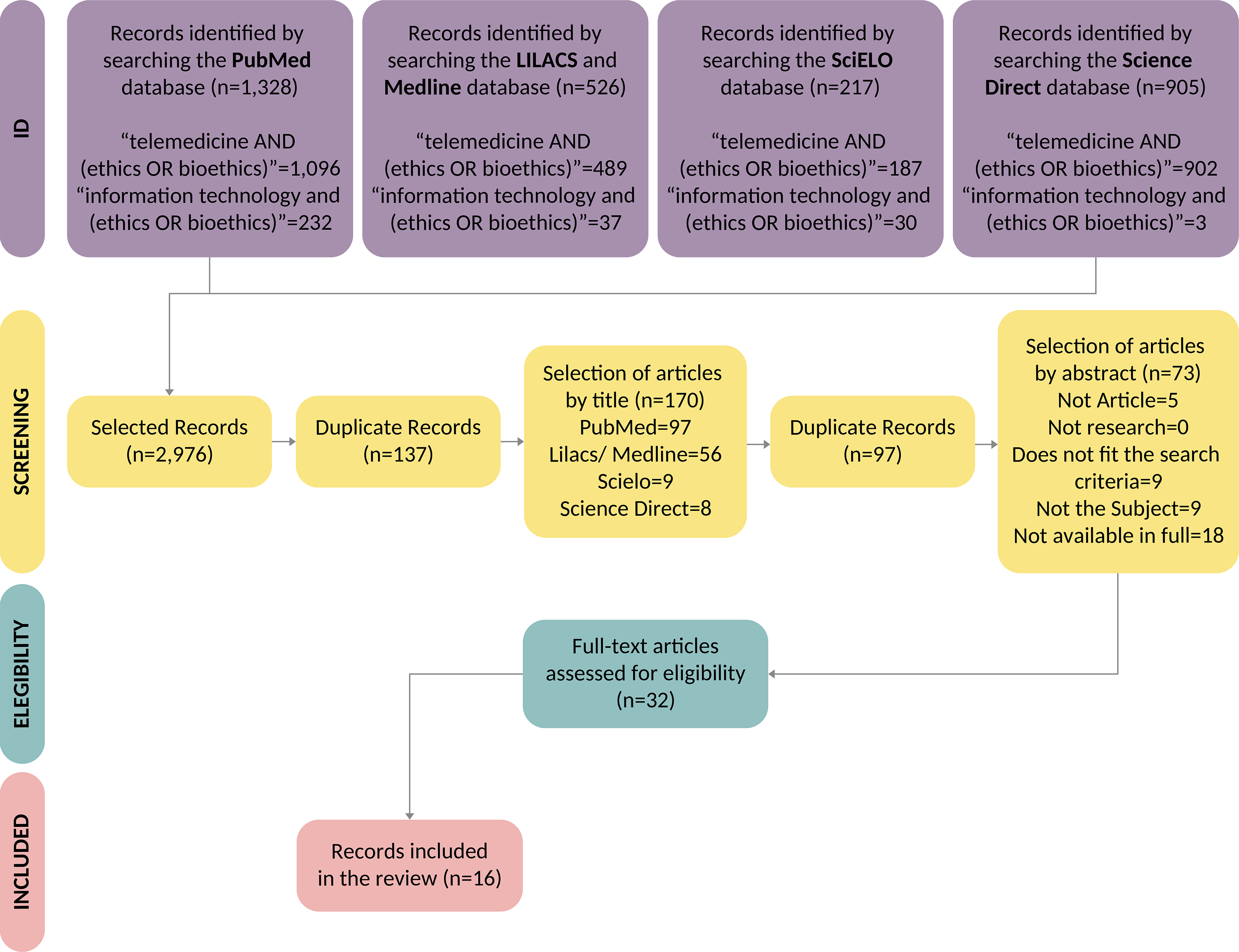
To minimize possible errors, the Preferred Reporting Items for Systematic Reviews and Meta-Analyses (PRISMA) methodology was used to improve the consistency of the reports of this systematic review, as well as its meta-analysis 12. The PRISMA flowchart in Figure 1 illustrates the process of identification, screening, eligibility, and inclusion of studies in the review 13.

The study searched the Latin American and Caribbean Literature in Health Sciences (LILACS), Medical Literature Analysis and Retrieval System Online (MEDLINE), Pubmed (U.S. National Library of Medicine), Scientific Electronic Library Online (SciELO), and Science Direct databases from February to April 2019 to identify the primary studies.
The research used the following inclusion criteria: to be written in English, Portuguese, or Spanish, with text available in full addressing ethical and bioethical aspects concerning the use of information and communication technologies via telehealth. Time clipping was not used to ensure the broad recovery of all available evidence for the research question 13. The exclusion criteria were: literature review articles, theses, and dissertations and documents that were not research studies, did not deal with the theme, and did not correspond to the research question.
Two researchers/reviewers conducted the search and selection of the studies independently and, in case of doubt or disagreement, a third ad hoc researcher was consulted. The first evaluation stage was the reading of the title and abstract, then content analysis, and adherence to the theme.
Discrepancies were measured by Cohen’s Kappa statistics, considering a 0.95 value. According to the classification of Landis and Koch 14 for the different levels of agreement, the value is classified as perfect agreement since the index is between 0.81–1.0, which means a high agreement between the pairs.
Results
The final sample was composed of 16 articles selected according to the inclusion criteria. Chart 1 describes the general profile of the articles included in this review.
Most articles were published in the United States of America (USA) published most articles in telehealth and ethics and is responsible for seven of the 16 selected works. Brazil and Canada published two articles each. The United Kingdom, Italy, Turkey, India, and Argentina had only one publication each. Telemedicine articles are mainly related to ethics. Regarding the USA, 44% of the selected publications were from there, probably because 20% of the population consists of people aged 60 years and over, so, home-based care is growing in demand, especially given the current pandemic scenario and the search for care alternatives.
Other countries, such as Brazil and Canada, which were responsible for 25% of the articles, also share the same concern. The two countries have continental territorial areas; and the two also have geographically distant areas, which leads to great geographical difficulties for access to health services. The bioethical aspect that stood out the most, in 11 (69%) articles, was informed consent, later, the principle of autonomy in nine (56%) articles, and confidentiality/privacy, as well as the principles of beneficence and non-maleficence were in eight (50%) articles (Chart 2).
The least prevalent principles were justice, found in only three articles, respect for human vulnerability and individual integrity, in two, and social responsibility and health, in only one article. According to Chart 3 the articles also address the regulation regarding the use of telehealth for the areas of training of health professionals. Ten articles (62.5%) did not address any standard or law regarding telehealth care. However, six articles (37.5%) addressed the regulation of telehealth according to the reality of each country.
What prevails most in the articles is the concern with data privacy of the individual who receives care via telehealth, assuming that the custody of this information is up to both the professional who will perform the service and the technical team that enables the consultation.
Discussion
Telemedicine is used for healthcare, education, disease prevention, research, and health promotion and can securely exchange information, opening up a range of innovative possibilities. Therefore, the use of electronic medical records, imaging tests, vital signs monitored in real-time, disease diagnoses, drug prescriptions, and professional monitoring has become common, innovating medical and hospital practices 31.
Given the new activities, legal and ethical aspects of telehealth are essential to protect patient rights. According to a study of readiness review, the individuality and uniqueness of individuals must be respected by the confidentiality preservation 32.
The study thus highlights the Brazilian ethical and legal devices that regulate telemedicine and the Tel Aviv Declaration, which deals with the responsibilities and ethical standards in the use of telemedicine, which are: physician-patient relationship; responsibilities of the physician; responsibilities of the patient; consent and confidentiality of the patient; quality of care and safety in telemedicine; quality of information; authorization and competence for the use of telemedicine; data storage, patient history; and training in telemedicine 32.
Ethical, moral, and legal issues mainly concern about protection of the individuals’ data, the confidentiality of teleconsultations, and risks involved in the counseling of pharmacological treatment to patients evaluated only virtually, without having undergone a physical examination. The main objection of regulatory institutions concerns what is expected in every consultation, whether medical, nursing, or other specialty, which is the mandatory physical examination of the patient and, without it, the act cannot be classified as a “an appointment” 33.
Using telehealth in situations in which there is no emergency, and no medical isolation directly affects the integrity and quality of medical practice since not performing any clinical examination is contrary to the very professional ethics 28.
Therefore, telemedicine faces significant challenges, such as the forms of access, data security, and the impossibility of performing the physical examination. Thus, it is necessary to create complementary tools for the professionals 34. Consequently, quality professional performance requires the use of bioethics, requiring better characterization in the virtual service environment, as well as the use of personal information and confidential data in an environment that is still very vulnerable.
Digital security in telehealth must be discussed by technology companies when considering the creation of medical tools for use in virtual environments. The mismatch between the potential of this technology and the ethical and legal aspects often occurs when the norms of conduct, standards, and regulations in the ethical and legal sphere are insufficient, and the implementation of telehealth can be a threat to the physician-patient relationship, therefore becoming an unsafe practice 35.
Telemedicine must cover the ethical principles of privacy, confidentiality, security, informed consent, responsibility, competence, remuneration for services, and technological standards so this tool has good bioethical practices. However, telemedicine use still has complex aspects that must be considered, such as the main ethical problems: insufficient transfer of clinical information, interrupted communication between physician and patient, and personal information kept electronically 15.
From the legal point of view, the problems show the lack of international norms or mediating bodies limiting impulses with well-defined ethical and legal rules, as well as ethical care that should also extend to computer technicians and health managers 19,27.
For the formalization and orientation of ethical precepts, UNESCO employed the Universal Declaration on Bioethics and Human Rights to support a universal response to questions arising from science and technology. In this document, several aspects are recognized, among which is the fact that there are benefits for humanity in the relationship between scientific and technological progress, which must be applied to ensure well-being, respecting human dignity, human rights, and fundamental freedoms 1.
The conduct for the ethical patient and professional safety is contemplated in the Informed Consent, not only concerning the physical intrusion that may occur but also regarding the use of any electronic medical records made via teleconsultation, as well as to define who can access the data. The absence of this document is an infringement of medical ethics, except in life-threatening situations 36.
Based on informed consent and applying it in telehealth practice, patients have the right to receive all information clearly, whether about a proposed treatment for a given clinical picture or the possible risks involved in the process. If the individual can judge the options in a balanced way, they consent or refuse what has been proposed 24.
This consent is also extended to the terms of access and use of patients’ family records and not only to control what information could be disclosed by health professionals. Therefore, this principle has specific control not only over which interventions are conducted, but also over how the records are made 17.
When arguing about this principle in telehealth consultations, it will always be necessary to have informed consent from the beginning of the process because the consultant specialist and the physician will be able to exchange accurate information about the person in care, thus also employing the principle of confidentiality or privacy 28.
Confidentiality exists when an individual reveals information to another—either via speech or physical examination—and the person receiving that information undertakes not to disclose it to a third party, ensuring that the information will be protected and covered against its unauthorized disclosure 37. This principle represents one of the pillars in the relationship between patients of any age and the professional who provides care, also extending to the administrative body of the health unit.
Privacy demands physical inaccessibility or information. Therefore, it represents an access limitation to an individual’s data, as well as the impediment that a professional without proper authorization assists the patient. Thus, thinking about preserving patient privacy, it is necessary to use mechanisms that ensure the safety of transmissions 37.
Final considerations
This review identified several bioethical aspects involved in the use of information technologies in the selected scientific production during the execution of telehealth actions. Positive points are highlighted in the scientific evidence found, such as the reduction of hospital and outpatient costs; capability for a greater offer of specialties; greater access to people with intellectual disability; reduction of geographical, financial, and cultural barriers; agility in emergency care; assistance in self-care; and promotion of continuing education for isolated populations.
Regarding bioethical aspects and the use of new information technologies in telehealth context, this study showed the principles of autonomy, privacy, confidentiality, beneficence, non-maleficence, justice, and the application of informed consent as the ones that emerged most among the studies of this systematic review.
Regarding the bioethical issues that involve the expansion of telehealth, especially in developing countries, the questions raised by regulatory agencies and professional councils, which were based mainly on the confidentiality of teleconsultations, differ concerning the need for pharmacological counseling and in-person physical examination. Telehealth is recognized only as a complementary method of access to health, used for the follow-up and monitoring of patients mainly from remote areas or with difficulty in mobility, not replacing traditional in-person consultations.
References
-
1 Mourão NAL. Telessaúde à luz da bioética: subsídios para a universalidade de acesso à saúde [Internet]. Brasília: Universidade de Brasília; 2016 [acesso 22 jul 2024]. DOI: 10.26512/2016.03.T.20920
» https://doi.org/10.26512/2016.03.T.20920 -
2 Garrafa V, Ferreira S, Oselka G, coordenadores. Iniciação à bioética [Internet]. Brasília: Conselho Federal de Medicina; 1998. Disponível: https://bit.ly/3TfJDQR
» https://bit.ly/3TfJDQR -
3 Fulgêncio CA. A bioética de intervenção e a justiça social [Internet] [dissertação]. Brasília: Universidade de Brasília; 2013 [acesso 22 jul 2024]. Disponível: https://bit.ly/3FNTEle
» https://bit.ly/3FNTEle -
4 Unesco Brasil. Unesco celebra 10 anos da Declaração Internacional sobre Bioética e Direitos Humanos. Facebook [Internet]. 2015 [acesso 22 jul 2024]. Disponível: https://bit.ly/4mTc5Wt
» https://bit.ly/4mTc5Wt -
5 Regina F, Ramos S. O olhar da bioética de intervenção no trabalho do cirurgião-dentista do Programa Saúde da Família (PSF). Rev. bioét. (Impr.) [Internet]. 2010 [acesso 22 jul 2024];18(1):225-39. Disponível: https://bit.ly/43SB1oq
» https://bit.ly/43SB1oq -
6 Faleiros Júnior JLM, Nogaroli R, Cavet CA. Telemedicina e proteção de dados: reflexões sobre a pandemia da covid-19 e os impactos jurídicos da tecnologia aplicada à saúde. Rev Trib [Internet]. 2020 [acesso 22 jul 2024];(1016). Disponível: https://bit.ly/4kEQijU
» https://bit.ly/4kEQijU -
7 União Europeia. Regulamento (UE) 2016/679 do Parlamento Europeu e do Conselho, de 27 de abril de 2016. Relativo à proteção das pessoas singulares no que diz respeito ao tratamento de dados pessoais e à livre circulação desses dados e que revoga a Diretiva 95/46/CE (Regulamento Geral sobre a Proteção de Dados). Jornal Oficial da União Europeia [Internet]. Bruxelas, 4 maio 2016 [acesso 22 jul 2024]. Disponível: https://bit.ly/3HMFKAl
» https://bit.ly/3HMFKAl - 8 Brasil. Lei nº 13.709, de 14 de agosto de 2018. Dispõe sobre a proteção de dados pessoas e altera a Lei nº 12.965, de 23 de abril de 2014. Diário Oficial da União [Internet]. Brasília, p. 59, 15 ago 2018 [acesso 22 jul 2024]. Seção 1.
-
9 Ercole FF, Melo LS, Alcoforado CLGC. Revisão integrativa versus revisão sistemática. REME Rev Min Enferm [Internet]. 2014 [acesso 22 jul 2024];18(1):9-11. DOI: 10.35699/2316-9389.2014.50174
» https://doi.org/10.35699/2316-9389.2014.50174 -
10 Motta LCS, Vidal SV, Siqueira-Batista R. Bioética: afinal, o que é isto? Rev Bras Clin Med [Internet]. 2012 [acesso 22 jul 2024];10(5):431-9. Disponível: https://bit.ly/45P3VYV
» https://bit.ly/45P3VYV -
11 Medina EU, Pailaquilén RMB. A revisão sistemática e a sua relação com a prática baseada na evidência em saúde. Rev Latino-Am Enfermagem [Internet]. 2010 [acesso 22 jul 2024];18(4):824-831. DOI: 10.1590/S0104-11692010000400023
» https://doi.org/10.1590/S0104-11692010000400023 -
12 Galvão TF, Pansani TSA, Harrad D. Principais itens para relatar revisões sistemáticas e meta-análises: a recomendação PRISMA. Epidemiol Serv Saúde [Internet]. 2015 [acesso 22 jul 2024];24(2):335-42. DOI: 10.5123/S1679-49742015000200017
» https://doi.org/10.5123/S1679-49742015000200017 -
13 Brasil. Ministério da Saúde. Diretrizes metodológicas: elaboração de revisão sistemática e metanálise de estudos observacionais comparativos sobre fatores de risco e prognóstico [Internet]. Brasília: Ministério da Saúde; 2014 [acesso 22 jul 2024]. Disponível: https://bit.ly/4liyT0n
» https://bit.ly/4liyT0n -
14 Landis JR, Koch GG. The measurement of observer agreement for categorical data. Biometrics [Internet]. 1977 [acesso 22 jul 2024];33(1):159-74. Disponível: https://bit.ly/4e0NtHo
» https://bit.ly/4e0NtHo -
15 Ataç A, Kurt E, Yurdakul SE. An overview to ethical problems in telemedicine technology. Procedia - Soc Behav Sci [Internet]. 2013 [acesso 22 jul 2024];103:116-21. DOI: 10.1016/j.sbspro.2013.10.315
» https://doi.org/10.1016/j.sbspro.2013.10.315 -
16 Perry J, Beyer S, Holm S. Assistive technology, telecare and people with intellectual disabilities: ethical considerations. J Med Ethics [Internet]. 2009 [acesso 22 jul 2024];35(2):81-6. DOI: 10.1136/jme.2008.024588
» https://doi.org/10.1136/jme.2008.024588 -
17 Kluge EHW. Ethical and legal challenges for health telematics in a global world: telehealth and the technological imperative. Int J Med Inform [Internet]. 2011 [acesso 22 jul 2024];80(2):1-5. DOI: 10.1016/ j.ijmedinf.2010.10.002
» https://doi.org/10.1016/j.ijmedinf.2010.10.002 -
18 Mort M, Roberts C, Pols J, Domenech M, Moser I; EFORTT investigators. Ethical implications of home telecare for older people: a framework derived from a multisited participative study. Health Expect [Internet]. 2013 [acesso 22 jul 2024];18(3):438-49. DOI: 10.1111/hex.12109
» https://doi.org/10.1111/hex.12109 -
19 Rezende EJC, Melo MCB, Tavares EC, Santos AF, Souza C. Ética e telessaúde: reflexões para uma prática segura. Rev Panam Salud Pública [Internet]. 2010 [acesso 22 jul 2024];28(1):58-65. Disponível: https://bit.ly/3Zq9o4F
» https://bit.ly/3Zq9o4F -
20 Bauer KA. Home-based telemedicine: a survey of ethical issues. Camb Q Healthc Ethics [Internet]. 2001 [acesso 22 jul 2024];10(2):137-46. DOI: 10.1017/s0963180101002043
» https://doi.org/10.1017/s0963180101002043 -
21 Ortuzar MG. Igualdad de acceso a la telesanidad en zonas rurales y aisladas: propuesta de un marco ético normativo integral de acceso y distribución. Rev Latinoam Bioet [Internet]. 2009 [acesso 22 jul 2024];9(1):76-93. Disponível: https://bit.ly/45fZfv6
» https://bit.ly/45fZfv6 -
22 Hyler SE, Gangure DP. Legal and ethical challenges in telepsychiatry. J Psychiatr Pract [Internet]. 2004 [acesso 22 jul 2024];10(4):272-6. DOI: 10.1097/00131746-200407000-00011
» https://doi.org/10.1097/00131746-200407000-00011 -
23 Dickens BM, Cook RJ. Legal and ethical issues in telemedicine and robotics. Int J Gynaecol Obstet [Internet]. 2006 [acesso 22 jul 2024];94(1):73-8. DOI: 10.1016/j.ijgo.2006.04.023
» https://doi.org/10.1016/j.ijgo.2006.04.023 -
24 Stanberry B. Legal ethical and risk issues in telemedicine. Comput Methods Programs Biomed [Internet]. 2001 [acesso 22 jul 2024];64(3):225-33. DOI: 10.1016/s0169-2607(00)00142-5
» https://doi.org/10.1016/s0169-2607(00)00142-5 -
25 Derse AR, Miller TE. Net effect: professional and ethical challenges of medicine online. Camb Q Healthc Ethics [Internet]. 2008 [acesso 22 jul 2024];17(4):453-64. DOI: 10.1017/S0963180108080572
» https://doi.org/10.1017/S0963180108080572 -
26 Fleming DA, Edison KE, Pak H. Telehealth ethics. Telemed J E Health [Internet]. 2009 [acesso 22 jul 2024];15(8):797-803. DOI: 10.1089/tmj.2009.0035
» https://doi.org/10.1089/tmj.2009.0035 -
27 França GV. Telemedicina: breves considerações ético-legais. Rev. bioét. (Impr.) [Internet]. 2009 [acesso 22 jul 2024];8(1):107-26. Disponível: https://bit.ly/45fZnL6
» https://bit.ly/45fZnL6 -
28 Sharma LK, Rajput M. Telemedicine: socio-ethical considerations in the Indian milieu. Med Leg J [Internet]. 2009 [acesso 22 jul 2024];77(Pt 2):61-5. DOI: 10.1258/rsmmlj.77.2.61
» https://doi.org/10.1258/rsmmlj.77.2.61 -
29 Torous J, Roberts LW. The ethical use of mobile health technology in clinical psychiatry. J Nerv Ment Dis [Internet]. 2017 [acesso 22 jul 2024];205(1):4-8. DOI: 10.1097/NMD.0000000000000596
» https://doi.org/10.1097/NMD.0000000000000596 -
30 Parimbelli E, Bottalico B, Losiouk E, Tomasi M, Santosuosso A, Lanzola G et al. Trusting telemedicine: a discussion on risks, safety, legal implications and liability of involved stakeholders. Int J Med Inform [Internet]. 2018 [acesso 22 jul 2024];112:90-8. DOI: 10.1016/j.ijmedinf.2018.01.012
» https://doi.org/10.1016/j.ijmedinf.2018.01.012 -
31 Almeida JP, Vieira LTQ, Diniz LTG, Martinelle MFS. Telemedicina e bioética: o futuro é agora. Rev Bioet Cremego [Internet]. 2019 [acesso 22 jul 2024];1(1):41-5. Disponível: https://bit.ly/4dXY7P9
» https://bit.ly/4dXY7P9 -
32 Rosa MSG, Fagundes SL. Olhar diferenciado da bioética e seus comprometimentos sociais em telemedicina. Rev AMRIGS [Internet]. 2013 [acesso 22 jul 2024];57(2):155-9. Disponível: https://bit.ly/4jEaBMP
» https://bit.ly/4jEaBMP -
33 Ferreira D. Teleconsultas: ir ao hospital sem sair de casa implicações na relação médico-doente. Med Interna (Bucur) [Internet]. 2018 [acesso 22 jul 2024];25(1):10-4. DOI: 10.24950/rspmi/Opiniao/1/2018
» https://doi.org/10.24950/rspmi/Opiniao/1/2018 -
34 Cordioli E. Telemedicina nas especialidades: da teoria à prática. In: Santos AO, Lopes LT, editores. Acesso e cuidados especializados [Internet]. Brasília: Conselho Nacional dos Secretários de Saúde; 2021 [acesso 22 jul 2024]. p. 136-47. Disponível: http://bit.ly/4lryTvo
» http://bit.ly/4lryTvo -
35 Maldonado JMSV, Marques AB, Cruz A. Telemedicina: desafios à sua difusão no Brasil. Cad Saúde Pública [Internet]. 2016 [acesso 22 jul 2024];32(supl 1):155615. DOI: 10.1590/0102-311X00155615
» https://doi.org/10.1590/0102-311X00155615 -
36 Santanna RT, Cardoso AK, Santanna JRM. Aspectos éticos e legais da telemedicina aplicados a dispositivos de estimulação cardíaca artificial. REBLAMPA Rev Bras Latinoam Marcapasso Arritmia [Internet]. 2005 [acesso 22 jul 2024];18(3):103-10. Disponível: https://encurtador.com.br/lpE24
» https://encurtador.com.br/lpE24 -
37 Resende EJC, Tavares EC, Souza C, Melo MCB. Telessaúde: confidencialidade e consentimento informado. Rev Med Minas Gerais [Internet]. 2013 [acesso 22 jul 2024];23(3):367-73. Disponível: https://encurtador.com.br/t93rE
» https://encurtador.com.br/t93rE
Edited by
-
Editor in charge:
Dilza Teresinha Ambrós Ribeiro