 Challenges in classifying I- and S-type granites: insights from the Sana and Itaoca plutons
Abstract
The Sana (Sana suite) and Itaoca (Nova Friburgo suite) granites, emplaced in the Oriental Terrane of the Ribeira Belt during the Cambrian–Ordovician, provide key insights into post-collisional magmatism in a Gondwana segment marked by crustal recycling. We present new Sm–Nd and Rb–Sr isotope data for 26 samples from both plutons, combined with petrographic information, to evaluate magma sources and the applicability of I- and S-type classification. The Sana Granite is strongly peraluminous and dominantly S-type, derived mainly from metasedimentary sources of the São Fidélis Group with minor arc-derived input, supported by isotopic evidence and rare titanite (< 1%). In contrast, the Itaoca Granite is metaluminous, titanite-rich, and consistent with I-type, reflecting melting of mafic to high-K orthogneisses of the Rio Negro Magmatic Arc. Mixing models suggest ternary contributions from arc and sedimentary reservoirs but remain exploratory due to limited Sr data for sources. Both plutons share overlapping Nd and Sr isotope fields, with initial 87Sr/86Sr ratios of 0.7008–0.7078 and consistently negative εNd(t) (–11 to –13), highlighting isotopic convergence in the Oriental Terrane. These results show that, despite contrasting S- and I-type traits, both granites reflect hybridization and a shared tectonic framework, emphasizing the limitations of strict isotopic classification and the need for integrated petrographic approaches.
KEYWORDS:
Ribeira Belt; post-collisional magmatism; magma source mixing; Sm-Nd isotopes; Sr-Sr isotopes
1. INTRODUCTION
Granitic rocks are key indicators of crustal evolution, with their chemical and isotopic signatures reflecting the nature and interaction of crustal and mantle sources (Wu et al., 2017; Wang et al., 2019). In the Oriental Terrane of the Central Ribeira Belt, voluminous pre-, syn-, and post-collisional granitic magmatism developed between the Neoproterozoic and Ordovician (Valeriano et al., 2011, 2016). This terrane is interpreted as an arc system that evolved from an intra-oceanic setting to a primitive continental arc, comparable to the modern Japanese arc (Heilbron et al., 2017; Peixoto et al., 2017).
Post-collisional magmatism was emplaced mainly during the Cambrian–Ordovician, producing several granitic suites, including Suruí and Nova Friburgo, classically interpreted as I-type granites with a hybrid origin involving mantle- and crust-derived melts (Valeriano et al., 2011, 2016; Tupinambá et al., 2012a). Recent work, however, demonstrated that this magmatism is not exclusively I-type: Potratz et al. (2021) identified that the Sana Granite was derived primarily from partial melting of metasedimentary sources, making it representative of S-type granites.
Distinguishing metaigneous from metasedimentary sources in these plutons is challenging. Diagnostic minerals such as amphibole, cordierite, or garnet are absent in most bodies (Potratz & Valeriano, 2017; Porto Junior et al., 2018; Bione et al., 2019; Potratz et al., 2021). Additionally, compositional convergence at high SiO2 levels (Gao et al., 2016) and the restriction of post-collisional magmatism to the Oriental Terrane, which is spatially associated with the Rio Negro Magmatic Arc (Tupinambá et al., 2012b; Heilbron et al., 2017), further complicates classification.
The Sana and Itaoca granites, focus of this study, represent contrasting examples of post-collisional magmatism in the Ribeira Belt, corresponding to S- and I-type suites, respectively (Tupinambá et al., 2012b; Potratz et al., 2021). This work aims to: provide a detailed isotopic characterization (Sm–Nd and Rb–Sr) of both plutons; evaluate possible magma sources through two- and three-component isotopic mixing models; and discuss the applicability and limitations of I- and S-type granite classification schemes when based solely on isotopic evidence.
2. GEOLOGICAL SETTING
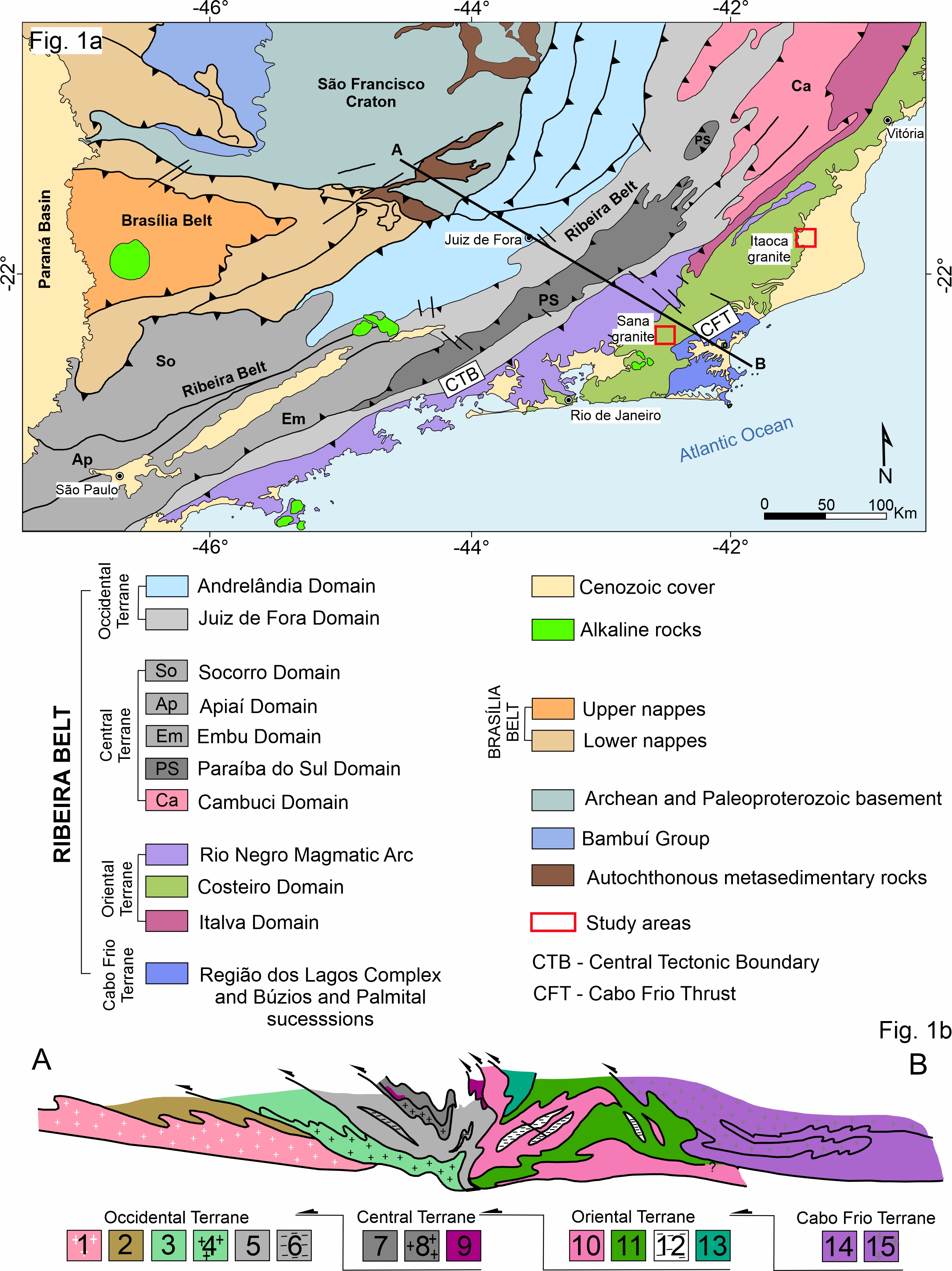
The Ribeira Belt (Figure 1) represents the root of a complex, deeply eroded fold belt that developed in parallel to the border of the São Francisco Craton between the Neoproterozoic to the Ordovician (Heilbron et al., 2004). This belt is commonly divided into four tectonostratigraphic terranes imbricated towards NW/W (Trouw et al., 2000). From base to top, the terranes are:
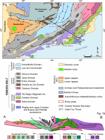
Ribeira Belt tectonic organization and NW-SE cross-section of Central Ribeira Belt showing the tectonic-stratigraphic terranes and sutures zones. Legend: 1 – Autochthonous basement; 2 – Neoproterozoic authochtonous metasedimentary rocks; 3-6) Units of the Occidental terrane; 7) Metassedimentary rocks of the Paraíba do Sul Group; 8) Quirino Complex; Cambuci Domain (Inner Magmatic Arc System);10 – Rio Negro Magmatic Arc (Outer Magmatic Arc System); 11 – Costeiro Domain; 12 – Leucogranites; 13 – Italva Domain (Outer Magmatic Arc System); 14 – Búzios and Palmital successions; 15 –Região dos Lagos Complex. Modified from Trouw et al. (2000), Heilbron et al. (2008, 2020), and Freitas et al. (2021).
-
Occidental Terrane (Figure 1) – Also called the Autochthonous domain, it is composed of the reworked margin of the São Francisco Craton, interspersed with metasedimentary rocks belonging to the Neoproterozoic passive margin (Heilbron et al., 2004).
-
Central Terrane (Figure1) – Comprises a system of arcs resulting from the subduction and collision between the São Francisco and Paranapanema cratons. The Central terrane is considered the internal magmatic arc system of the Ribeira Belt (Trouw et al., 2013; Peixoto et al., 2017; Corrales et al., 2020; Heilbron et al., 2020).
-
Oriental Terrane (Figure 1) – Include the Rio Negro and Serra da Prata Magmatic arcs, also known as the external magmatic arc system (Heilbron et al., 2020), in addition to syn-, late- and post-collisional granites (Valeriano et al., 2011, 2016; Tupinambá et al., 2012a; Potratz & Valeriano, 2017; Potratz et al., 2021) and metasedimentary rocks of the São Fidélis Group. The Sana and Itaoca granites intrude rocks of the Oriental Terrane, especially orthogneisses associated with the Rio Negro Magmatic Arc and paragneisses of the São Fidélis Group.
-
Cabo Frio Terrane (Figure 1) - Represent a Paleoproterozoic basement composed of orthogneisses tectonically intercalated with Neoproterozoic metavolcanosedimentary successions (Schmitt et al., 2004; Machado et al., 2017). This crustal segment is considered part of the Congo Craton (Fernandes et al., 2015).
The Rio Negro Magmatic Arc extends for approximately 600 km, from the northern part of the São Paulo state to the southern part of the Espírito Santo state (Heilbron et al., 2020). This magmatic arc comprises batholiths of tonalitic to trondhjemitic composition and stocks of hornblende-gabbro and quartz diorite (Tupinambá et al., 2012b). The rocks of the Rio Negro Magmatic Arc exhibit distinct geochemical signatures associated with different geographic distributions: the low to medium-K calc-alkaline association extends from the northwestern limit of the arc to the central portion; the high-K calc-alkaline association predominates in the southwestern segment of the arc, also cropping out in the northeastern area; and the shoshonitic association is restricted to the region of Trajano de Moraes (Tupinambá et al., 2012b; Heilbron et al., 2020).
According to Tupinambá et al. (2012b), the low to medium-K calc-alkaline association comprises orthogneisses of quartz dioritic, tonalitic, granodioritic, and trondhjemitic compositions. The high-K calc-alkaline association comprises orthogneisses of granitic, granodioritic and quartz monzonitic, compositions. The shoshonitic association comprises orthogneisses of dioritic and granitic compositions. Finally, gabbro and diorite sills cut the magmatic arc assemblages (Tupinambá et al., 2012b; Heilbron et al., 2020).
The crystallization ages of the orthogneisses of the Rio Negro Magmatic Arc range from 790 to 607 Ma, with a higher occurrence of ages between 635 and 607 Ma (Tupinambá et al., 2012b; Heilbron & Machado, 2003; Peixoto et al., 2017). Tupinambá et al. (2012b) obtained Sr and Nd isotopic data indicating juvenile and more immature signatures, with 87Sr/86Sr ratios varying between 0.700 and 0.715 and εNd(t) values ranging from -14 to +5.
In addition to the orthoderived rocks, paraderived rocks, referred to as the São Fidélis Group, occur within the magmatic arc domain. According to Fernandes et al. (2015), this unit comprises kinzigitic gneisses rich in garnet and sillimanite, impure quartzites, biotite gneisses, amphibolites, and calc-silicate rocks. Heilbron et al. (2020) describe the São Fidélis Group as representative of a back-arc basin and U-Pb ages in zircon grains for two samples of rocks of this group pointed two age peaks at 650 Ma and 690 Ma and an age peak at 1.0 Ga in one of the samples (Fernandes et al., 2015). Regarding Hf isotopic data, Fernandes et al. (2015) observed distinct sources for zircon grains younger than 700 Ma. One source is characterized by εHf(t) varying from +6 to -4 with an Hf model age (TDM) around 1.3 Ga. Another source is characterized by εHf(t) < -4 and a Hf model age (TDM) between 2.2 and 1.8 Ga.
2.1 Cambro/Ordovician magmatism in the Ribeira Belt
In the Ribeira Belt, the igneous bodies of the Cambrian/Ordovician age, located in the Oriental terrane, represent the magmatism that developed in the late- to post-collisional stage. In total, 19 bodies were identified and distributed throughout Rio de Janeiro state, especially in the south and central regions. Brief descriptions or detailed information about these plutons can be found in Mendes et al. (2002), Heilbron & Machado (2003), Eirado et al. (2006, 2007), Valeriano et al. (2011, 2016), Tupinambá et al. (2012a), Potratz & Valeriano (2017), Porto Junior et al. (2018), Bione et al. (2019), Potratz et al. (2021), Coelho et al. (2023) and references therein.
These late- to post-collisional bodies intrude the rocks of the Rio Negro Magmatic Arc and the paragneisses of the São Fidélis Group. These igneous bodies are mainly composed of isotropic granites, generally leucocratic, with varied textures and the presence of centimetric to metric microgranular mafic enclaves (MME). This magmatism developed for about 25 Ma. (510 to 485 Ma.) (Valeriano et al., 2016; Bione et al., 2019; Potratz et al., 2021). They were grouped into three suites based on their compositional, structural, geochronological, and petrogenetic characteristics (Table 1) (Valeriano et al., 2011; Tupinambá et al., 2012a; Potratz et al., 2021): Suruí; Nova Friburgo; and Sana.
3. MATERIALS AND METHODS
This work presents new isotopic data (Sm-Nd and Sr-Sr) for the Itaoca and Sana granites. Preliminary information on the eight samples from the Sana Granite and eighteen samples from the Itaoca Granite were presented in previous studies by Valeriano et al. (2016) and Potratz & Valeriano (2017), respectively.
3.1 Sample preparation
Samples were prepared in the Geological Sample Preparation Laboratory (LGPA) at the State University of Rio de Janeiro (UERJ). All samples were washed and oven dried. The external portions were sawed off, and the samples were manually crushed and milled in tungsten ball mills.
3.2 Isotopic analysis
The isotopic analyses of Sm-Nd and Sr-Sr were carried out at the Laboratory of Geochronology and Radiogenic Isotopes (LAGIR) at UERJ, and the methodology is described in Valeriano et al. (2008, 2009) and Aguiar Neto et al. (2023). The analytical procedure was divided into chemical sample preparation and spectrometric analysis. The chemical preparation of the samples was carried out as follows: cleaning the preparation room with positive air pressure and double air HEPA filtration; separation of an aliquot of 50 mg mixed with a solution of 149Sm and 150Nd tracers in SavillexTM PFA vials in single digestion procedure; chemical digestion of the samples plus tracer with a mixture of HF 48% (6 ml) and HNO3 7M (0.5 ml) for two periods of 3 days followed by 2 days with HCl 6M (3 ml); primary extraction of Sr and rare earth elements (REE) using an ion exchange column filled with BIORAD® AG50W-X8 resin (100-200 mesh); secondary extraction of Nd and Sm from the REE solution using Eichrom® LN-spec resin (50-100 mesh), in a smaller column.
Isotopic analyses were carried out using thermal ionization mass spectrometer (TIMS), model TRITON – Thermo Finnigan® Multicolector. The samples were arranged in Rhenium filaments with a double mount. The analytical procedure was performed in static mode (Faraday collectors), acquiring isotopic ratios of 160 cycles for Nd, 80 for Sm, and 100 for Sr. The absolute standard error was calculated to 2 sigma, and normalization was performed with the value of the natural ratios 146Nd/144Nd = 0.7219, 147Sm/152Sm = 0.5608, and 88Sr/86Sr = 8.3752. The reliability of the data obtained is achieved through reference materials JNdi-1 and NIST SRM 987, with values following the literature cited in Aguiar Neto et al. (2023).
3.3 Data processing
Equations 1 and 2 were used to calculate the initial 87Sr/86Sr ratios. Equation 1 was used for the potential sources, whose 87Rb/86Sr values were obtained by isotope dilution. Equation 2 was applied to calculate the initial 87Sr/86Sr ratios for the Sana and Itaoca samples, as the 87Rb/86Sr ratios were not obtained by isotope dilution. Similarly, equations 3 and 4 were used to calculate the 143Nd/144Nd ratios for the crystallization ages of the Sana and Itaoca granites. Equation 3 was used for the samples whose 147Sm/144Nd ratio was obtained by isotope dilution. Equation 4 was used for the samples where the 147Sm/144Nd ratio was not obtained by isotope dilution. All samples from the Sana Granite and the set of samples from the Itaoca Granite, ranging from samples ITA-01 to ITA-09, do not have 147Sm/144Nd data obtained by isotope dilution. Details on the equations used can be found in Faure & Mensing (2005).
For the mixing tests, Sm-Nd isotopic data from the Rio Negro Magmatic Arc (Tupinambá et al., 2012b), Serra da Prata Magmatic Arc (Peixoto et al., 2017), São Fidélis Group (Fernandes et al., 2015), Buzios-Palmital Sequence (Schmitt et al., 2008), and Juiz de Fora Complex (Araujo et al., 2019) were used. All 143Nd/144Nd ratios were calculated for the Sana and Itaoca granites ages and used for two- and three-component mixing tests. The mixing equations used are present in Faure & Mensing (2005).
4. RESULTS
4.1 Sana granite
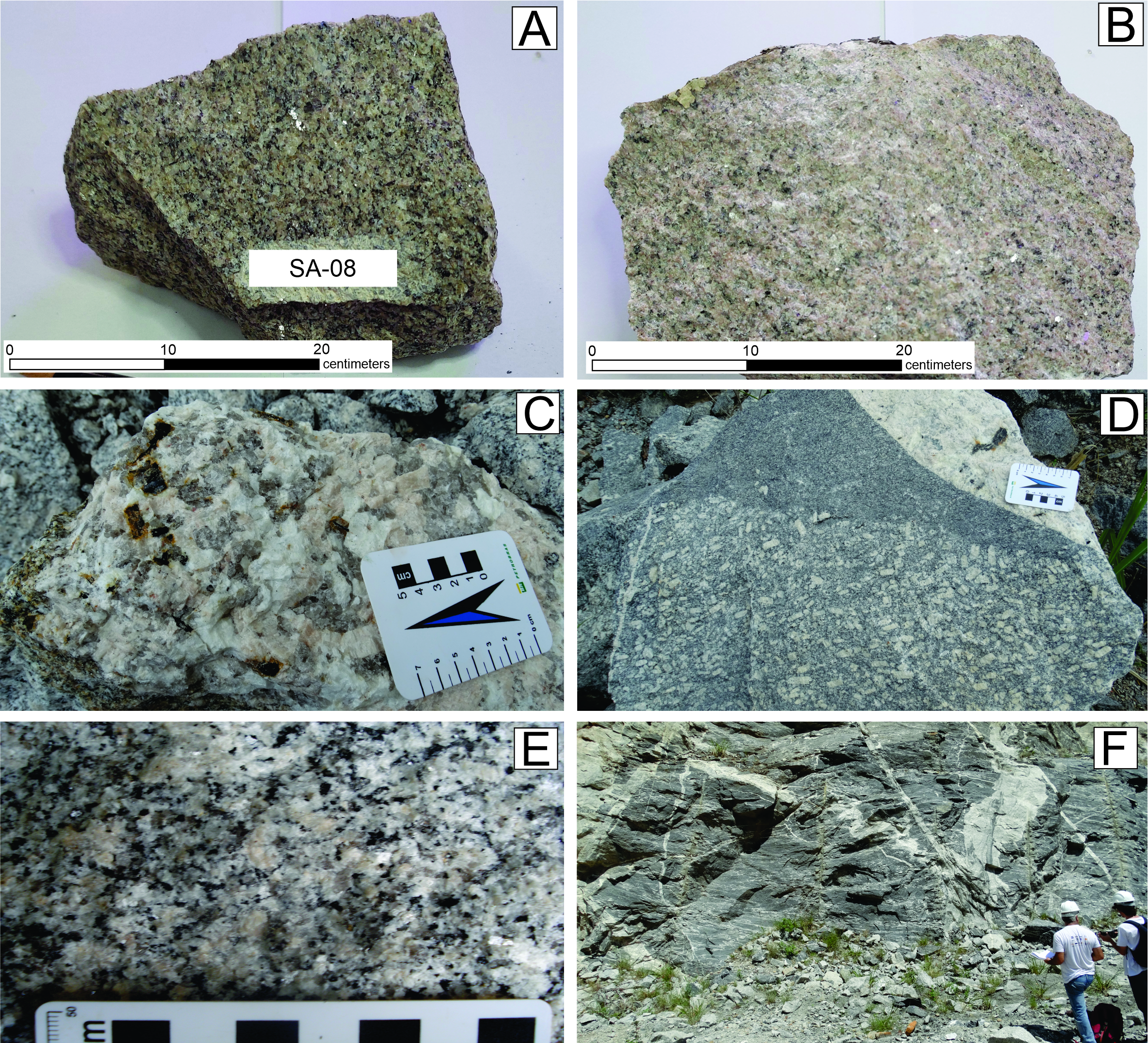
The Sana Granite outcrops in Casimiro de Abreu, Nova Friburgo, Macaé, Silva Jardim, and Trajano de Moraes regions (Figure 1). This granite is intrusive in paragneisses of the São Fidélis Group and in syn-collisional granites. The Sana Granite is represented by: central batholith with approximately 270 km2; and twenty smaller stocks and tabular bodies, which crop out to the southwest and northeast of the main body (Supplementary Material – Figure S2). This unit predominantly comprises isotropic rocks, with a leucocratic to hololeucocratic color index and an inequigranular texture with grain size ranging from fine to coarse (0.1 mm to 3.0 cm) (Figure 2). The lithological variation in the Sana Granite includes alkali-feldspar granite, syenogranite, and monzogranite (Supplementary Material – Figure S3).
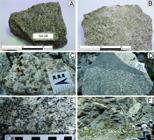
Sana Granite samples of monzogranite (A) and syenogranite (B) compositions with equigranular texture and grain size ranging from fine to medium. (C) Sample of coarse-grained Itaoca Granite with porphyritic texture. (D) Sample with porphyritic monzogranite rocks + mafic micro granular enclave + white pegmatite. (E) Monzogranite sample with inequigranular texture. (F) Xenolith of mafic rock associated to the Rio Negro Magmatic in the Itaoca Granite.
The Sana Granite is a two-mica granite, as biotite and muscovite are primary minerals. Table 2 is a summary of the mineralogical composition and textures/structures of the granite.
4.2 Itaoca granite
The Itaoca Granite crops out in the Campos dos Goytacazes region, intrudes paragneisses of the São Fidélis Group and is partially covered by two types of sediments (alluvials and associated to the Barreiras Group). This granite is represented by a central body, approximately elliptical with a maximum diameter of 5 km (Supplementary Material – Figure S1). The rocks in this unit exhibit concentric textural variation (from the edges to the center of the body), where the rocks at the edges show inequigranular porphyritic texture with phenocrystals of feldspar with 6 cm of size immersed in a medium to coarse-grained matrix, and the rocks at the center of the body have equigranular texture with medium grain size. The transition between the different textures occurs gradually.
This unit comprises monzogranites, quartz-monzonites, and syenogranites (Figure 2). Microcline, plagioclase, quartz and biotite are the main minerals, while allanite, opaques, apatite, titanite, monazite, and zircon as accessory minerals. A summary of the mineralogical composition and textures/structures of the Itaoca Granite is presented in Table 2. Centimeter-sized surmicaceous enclaves, metric-sized leucocratic autoliths, decametric-sized metatonalite xenoliths, fine to medium-grained granite dykes, and pegmatites are frequently observed.
4.3 Isotopic data
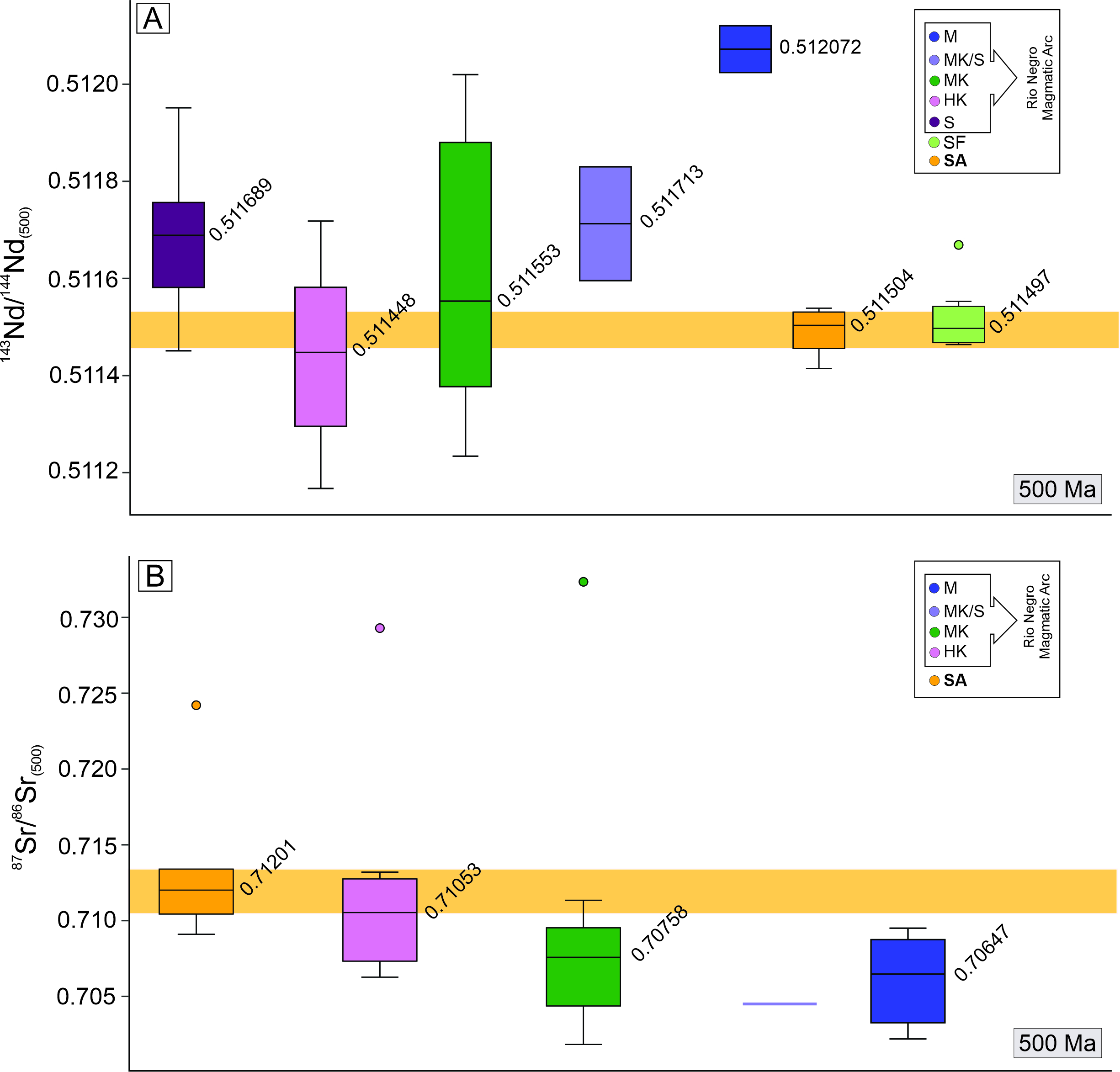
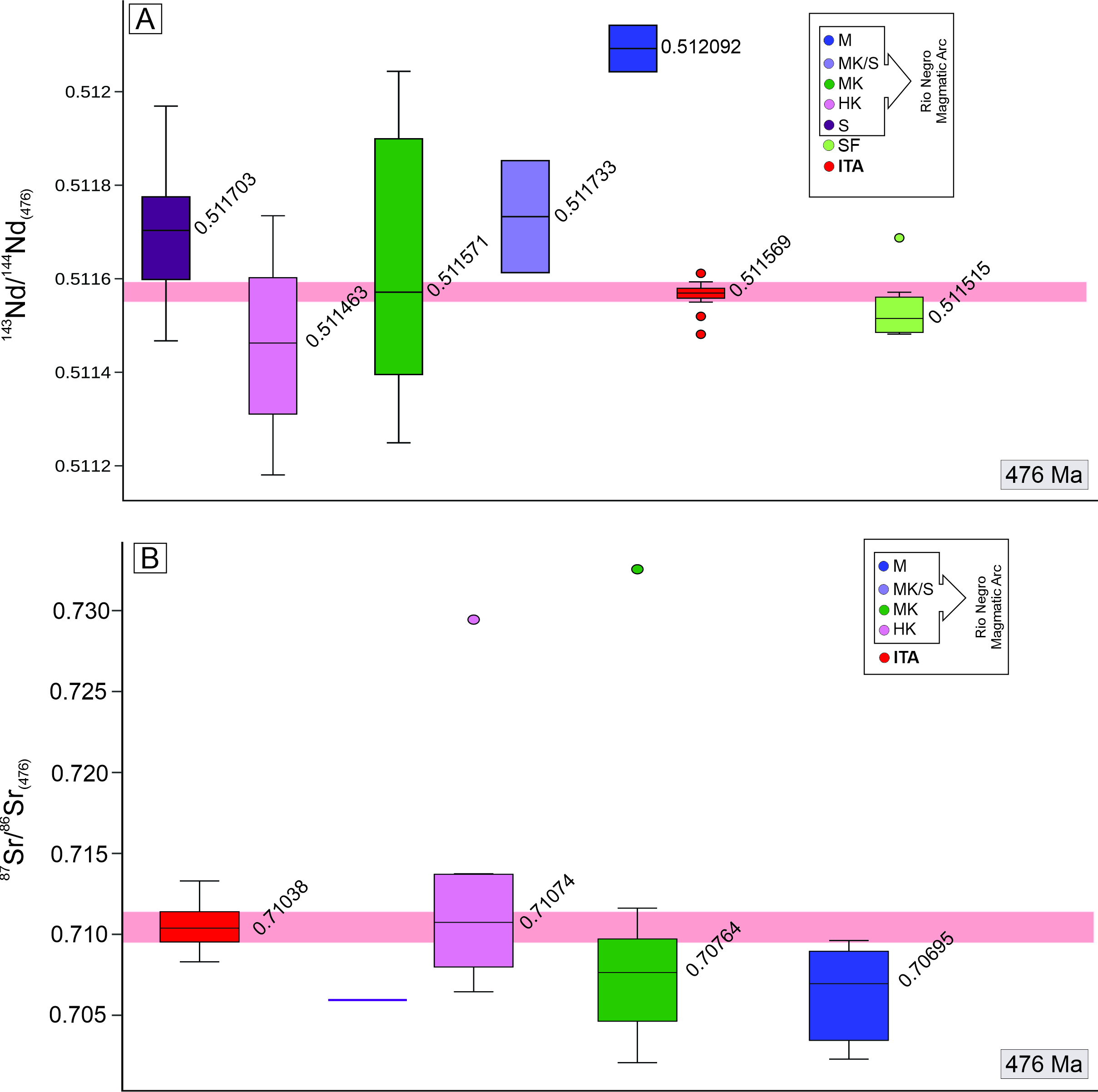
Eight samples of Sana Granite, six to Sm-Nd and eight to Sr-Sr, and eighteen of Itaoca Granite were analyzed. Samples of Itaoca Granite included: fifteen granitic rocks (host rock) and three of leucocratic enclaves. Sm concentrations range from 9.2 to 26.7 ppm in the Sana Granite and from 14.3 to 24.0 ppm in the Itaoca Granite, whereas Nd contents vary between 56.9 and 187 ppm and 98.7 to 173 ppm, respectively. Initial 143Nd/144Nd(t) ratios, calculated at 500 Ma for Sana and 476 Ma for Itaoca, range from 0.50846 to 0.50915 (Figure 3A) and from 0.50871 to 0.50938 (Figure 4A), respectively. Model ages (TDM) cluster between 1.3 and 1.6 Ga for both granites, with consistently negative εNd(t) values ranging from -11.4 to -13.2. The Sm-Nd isotopic data are summarized in Table 3.
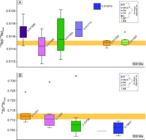
Box plot with the isotopic ratios of 143Nd/144Nd (A) and 87Sr/86Sr (B) for the Sana Granite compared with data from the Rio Negro Magmatic Arc (Tupinambá et al., 2012b) and the São Fidélis Group (Fernandes et al., 2015), calculated for 500 Ma. The yellowish band of each diagram (A and B))) represents the isotopic ratios obtained for the Itaoca Granite. legend: M – Mafic rocks; MS – transition between the shoshonitc and medium-K groups; S – Shoshonitic group; MK – Medium-K group; HK – High-K group; SF – São Fidélis Group; SA – Sana Granite.
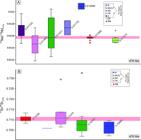
Box plot with the isotopic ratios of 143Nd/144Nd (A) and 87Sr/86Sr (B) for the Itaoca Granite compared with data from the Rio Negro Magmatic Arc (Tupinambá et al., 2012b) and the São Fidélis Group (Fernandes et al., 2015), calculated for 476 Ma. The reddish band of each diagram (A and B))) represents the isotopic ratios obtained for the Itaoca Granite. Legend: M – Mafic rocks; MS – the transition between the shoshonitc and medium-K groups. MK – Medium-K group; HK – High-K group; S – Shoshonitic group; SF – São Fidélis Group; ITA – Itaoca Granite.
Sm-Nd isotopic data for the Sana and Itaoca granites. Concentrations of Sm and Nd are reported in ppm. Initial 143Nd/144Nd(t) ratios were calculated at 500 Ma for the Sana Granite and 476 Ma for the Itaoca Granite. TDM model ages are given in Ga. εNd(0) and εNd(t) values are presented relative to CHUR.
The Rb-Sr dataset complements these results, highlighting significant differences between the two granites. The Sana Granite shows Rb/Sr ratios from 0.9 to 3.8 and 87Sr/86Sr(t) values between 0.7055 and 0.7078 (Figure 3B), indicating a generally radiogenic trend. In contrast, the Itaoca Granite displays greater compositional variability, with Rb/Sr ratios between 0.4 and 2.1 and 87Sr/86Sr(t) values ranging from 0.7008 to 0.7077 (Figure 4B), respectively. The Sr-Sr isotopic data are presented in Table 4.
Rb-Sr isotopic data for the Sana and Itaoca granites. Concentrations of Rb and Sr are reported in ppm. 87Sr/86Sr(t) ratios were calculated at 500 Ma for the Sana Granite and 476 Ma for the Itaoca Granite. 1/Sr values are given in ppm−1. εSr values are calculated relative to CHUR.
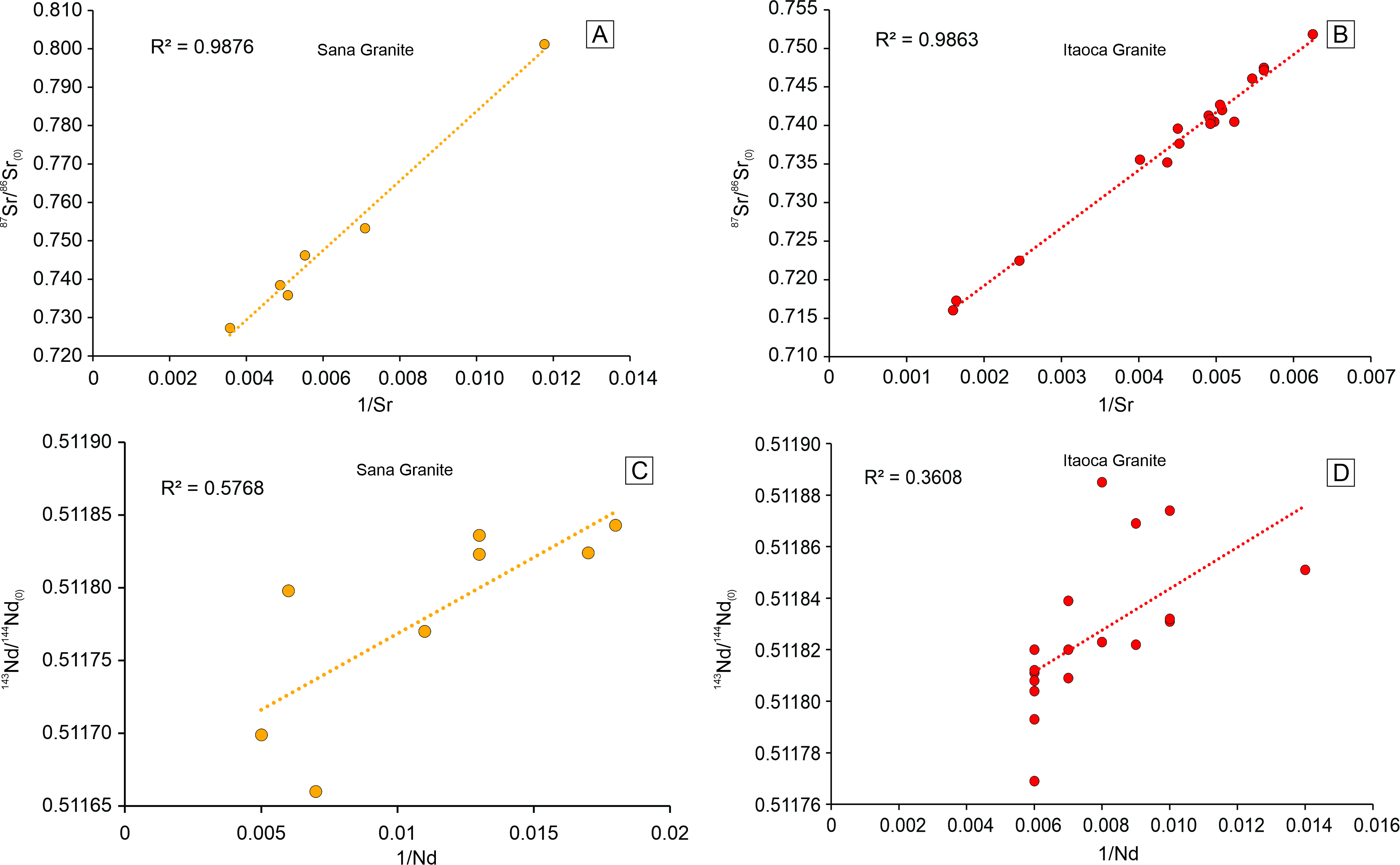
Figure 5 illustrates the variation of 87Sr/86Sr versus 1/Sr and 143Nd/144Nd versus 1/Nd for the Sana and Itaoca granites. Both plutons display strong linear correlations in the Sr system, with coefficients of determination (R2) of 0.9876 for Sana and 0.9863 for Itaoca, indicating robust internal isotopic consistency. In contrast, the Nd system shows moderate dispersion in the Sana Granite (R2 = 0.5766) and a weak linear trend in the Itaoca Granite (R2 = 0.3608), reflecting greater isotopic heterogeneity for this element, particularly in the Itaoca samples. Notably, sample SA-08 from the Sana granite plots as a clear outlier in the Sr diagram, with 87Sr/86Sr(t) of 0.7078 and a Sr content of 319 ppm.
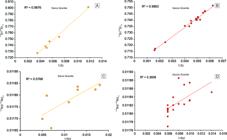
Binary diagrams 87Sr/86Sr ratios vs 1/Sr and 143Nd/144Nd ratios vs 1/Nd for the rocks of Sana and Itaoca granites. A) 87Sr/86Sr ratios vs 1/Sr for the rocks of Sana Granite. B) 87Sr/86Sr ratios vs 1/Sr for the rocks of Itaoca Granite. C) 143Nd/144Nd ratios vs 1/Nd for the rocks of Sana Granite. D) 143Nd/144Nd ratios vs 1/Nd for the rocks of Itaoca Granite. The measured isotopic ratios were used, without recalculation to initial ratios.
4.4 Isotopic mixing models
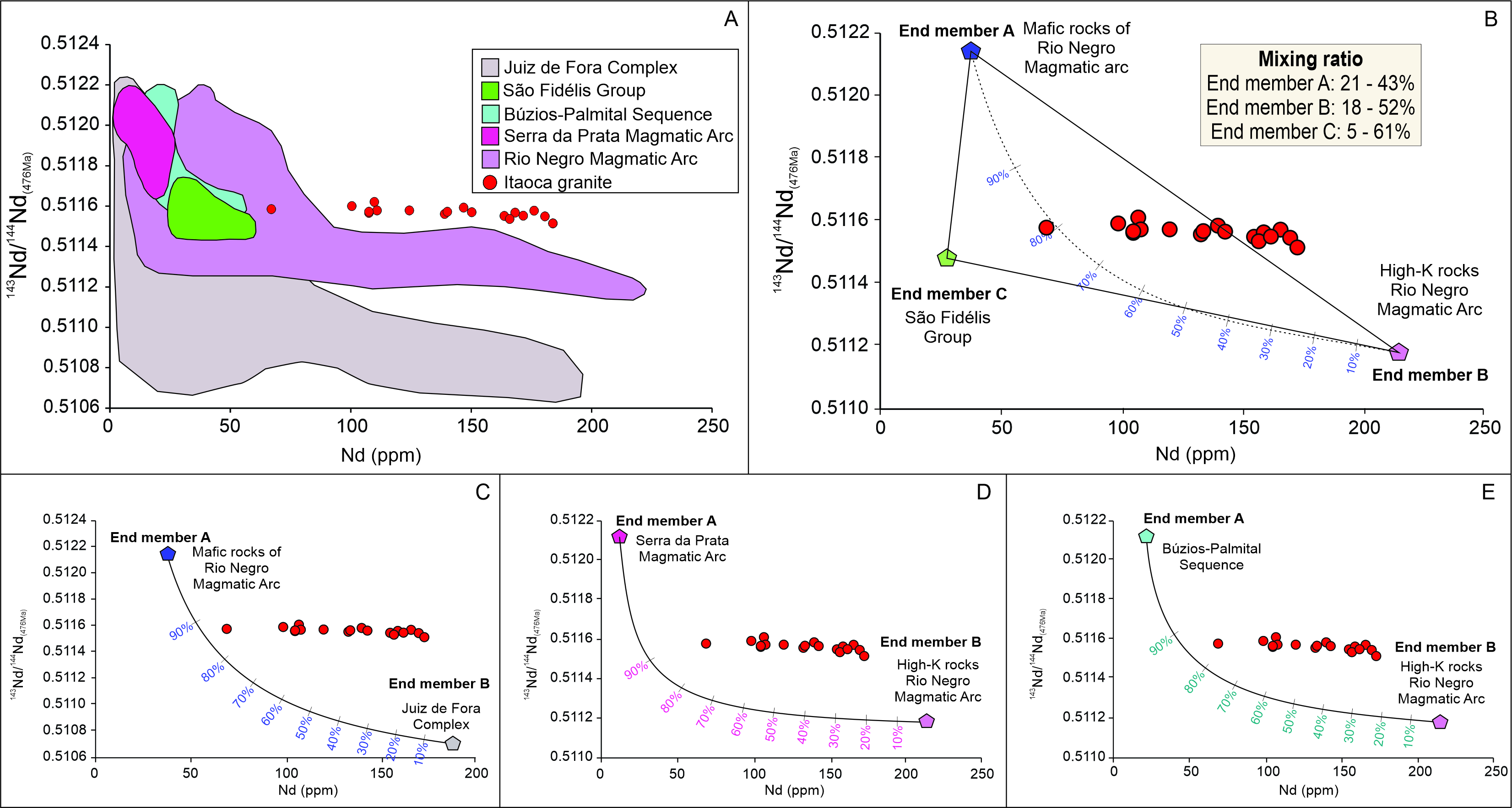
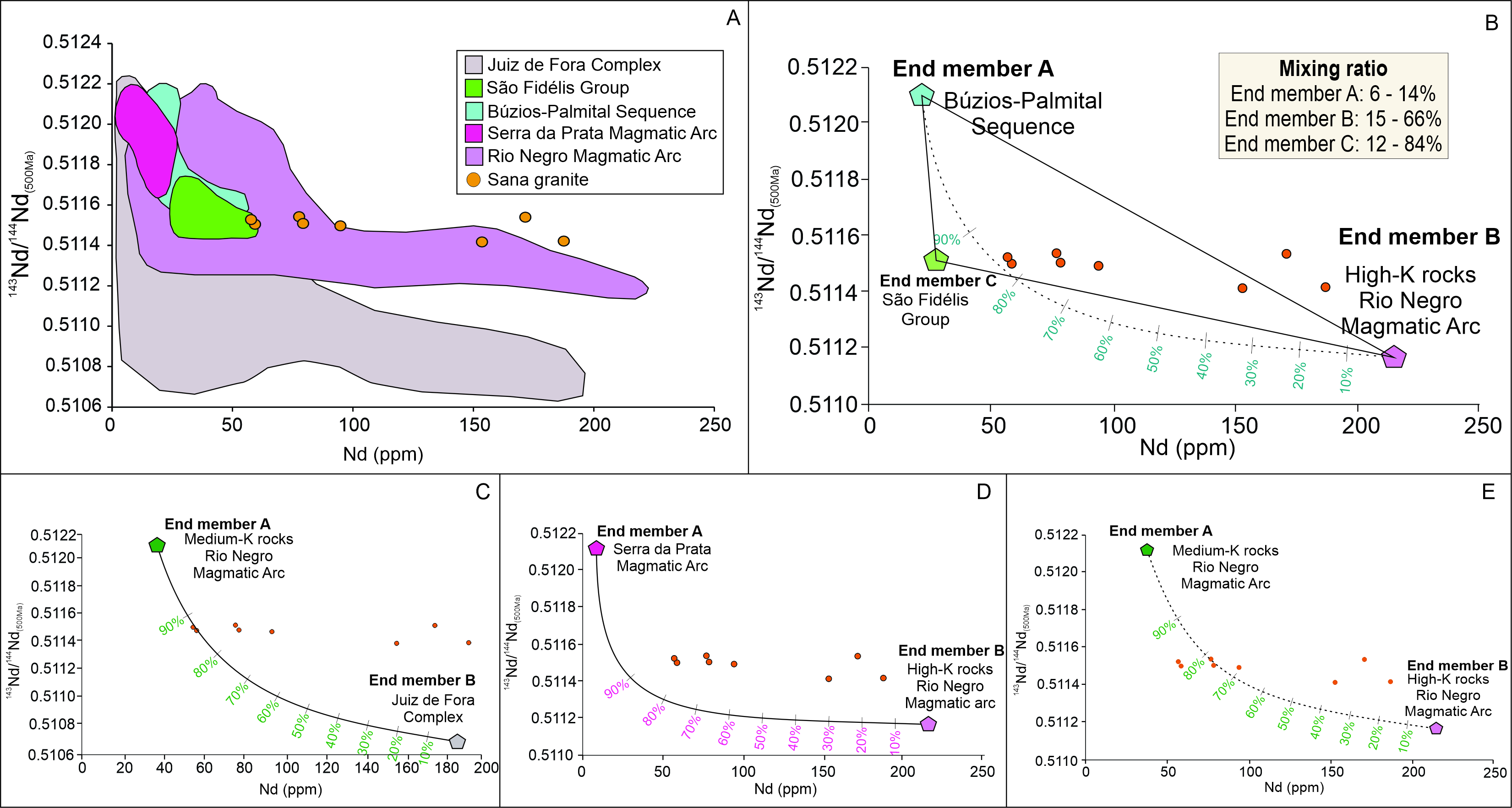
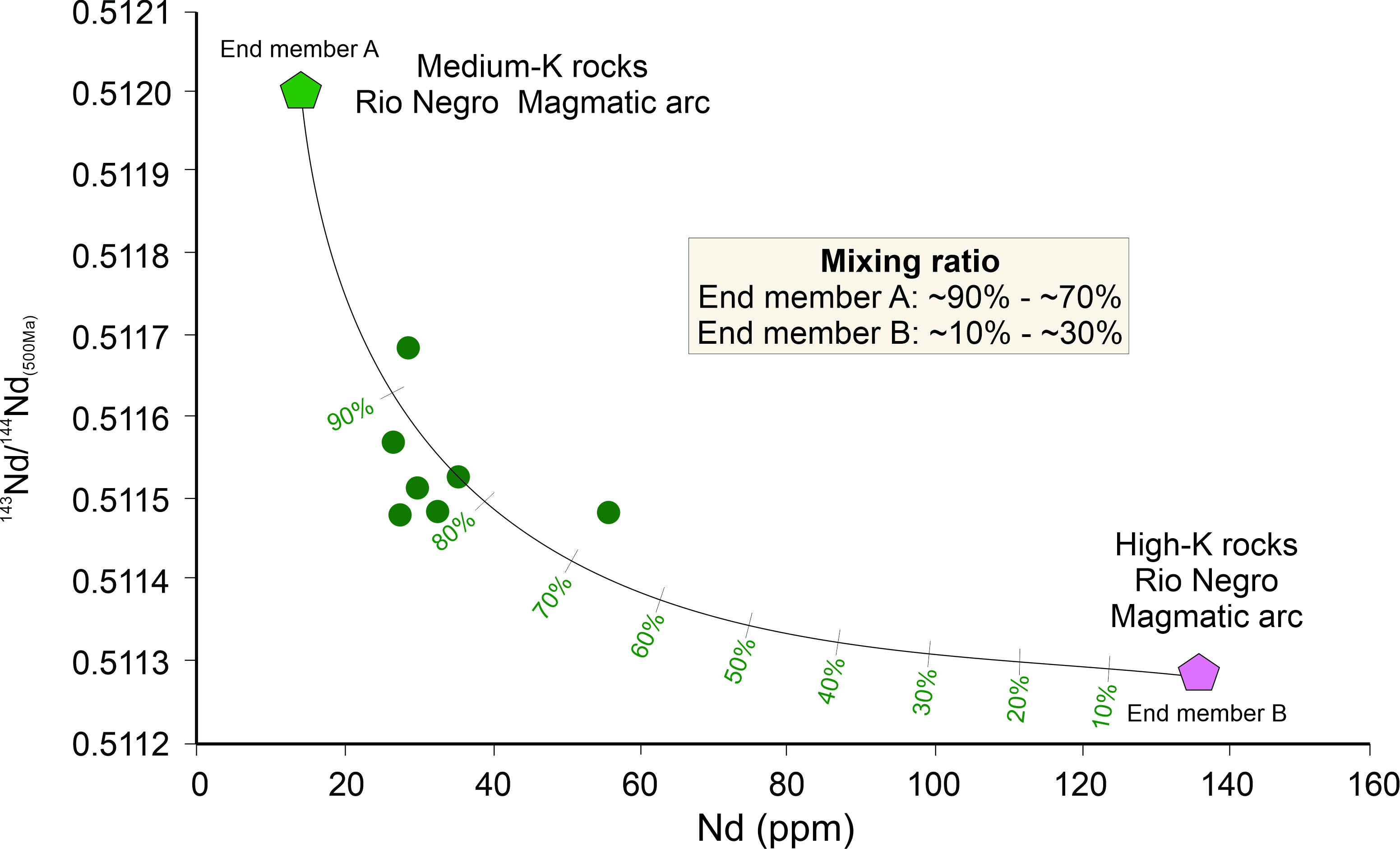
Figures 6 and 7 illustrate Nd isotopic mixing models for the Sana and Itaoca granites and Figure 8 a binary mixing model for the São Fidélis Group. For the Itaoca Granite, the selected end-members are mafic and high-K rocks of the Rio Negro Magmatic Arc and rocks of the São Fidélis Group, with proportions of 21–43%, 18–52%, and 5–61%, respectively. For the Sana Granite, the chosen end-members are the rocks of the Búzios-Palmital Sequence, high-K rocks of the Rio Negro Magmatic Arc, and the rocks of the São Fidélis Group, with estimated proportions of 6–14%, 15–66%, and 12–84%, respectively.
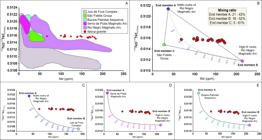
Nd isotopic mixing models for the Itaoca Granite. (A) Reference fields of potential source rocks, including the Rio Negro Magmatic Arc (Tupinambá et al., 2012b), Serra da Prata Magmatic Arc (Peixoto et al., 2017), Búzios-Palmital Sequence (Schmitt et al., 2008), Juiz de Fora Complex (Araujo et al., 2019), and São Fidélis Group (Fernandes et al., 2015). (B–E) Binary mixing tests between: (B) mafic and high-K rocks of the Rio Negro Magmatic Arc; (C) mafic rocks of the Rio Negro Magmatic Arc and Juiz de Fora Complex; (D) Serra da Prata Magmatic Arc and high-K rocks of the Rio Negro Magmatic Arc; and (E) Búzios-Palmital Sequence and high-K rocks of the Rio Negro Magmatic Arc. The three-component mixing model in (B) includes mafic rocks (end-member A), high-K rocks (end-member B) of the Rio Negro Magmatic Arc, and the São Fidélis Group (end-member C), with mixing proportions of 21–43%, 18–52%, and 5–61%, respectively.
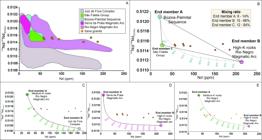
Nd isotopic mixing models for the Sana Granite. (A) Reference fields of potential source rocks as in Figure 6. (B–E) Binary mixing tests between: (B) Búzios-Palmital Sequence and high-K rocks of the Rio Negro Magmatic Arc; (C) medium-K rocks of the Rio Negro Magmatic Arc and Juiz de Fora Complex; (D) Serra da Prata Magmatic Arc and high-K rocks of the Rio Negro Magmatic Arc; and (E) medium-K and high-K rocks of the Rio Negro Magmatic Arc. The three-component model in (B) incorporates the Búzios-Palmital Sequence (end-member A), high-K rocks of the Rio Negro Magmatic Arc (end-member B), and the São Fidélis Group (end-member C), with proportions of 6–14%, 15–66%, and 12–84%, respectively.
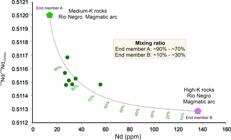
Binary mixing model for rocks of the São Fidélis Group, represented as a mixture of medium-K (70–90%) and high-K (10–30%) rocks of the Rio Negro Magmatic Arc.
5. DISCUSSION
The Sana and Itaoca granites are post-collisional plutons emplaced in the Oriental Terrane of the Ribeira Belt, an orogenic system that records multiple accretionary and collisional events during the Neoproterozoic to Early Paleozoic (Heilbron et al., 2020). Both granites are undeformed, emplaced at ca. 500 Ma (Sana) and ca. 480 Ma (Itaoca), and have been traditionally grouped within the Nova Friburgo Suite (Valeriano et al., 2011, 2016; Tupinambá et al., 2012a). This classification emphasized their shared geochronological and structural context and their granitic and leucocratic character. However, recent detailed studies have highlighted significant petrogenetic differences between these plutons, leading to a re-evaluation of their classification and tectonomagmatic significance (Potratz & Valeriano, 2017; Potratz et al., 2021).
The Itaoca Granite displays all the hallmarks of an I-type granite as originally defined by Chappell and White (1974). It is metaluminous to slightly peraluminous, contains biotite as the sole primary mica, includes abundant surmicaceous enclaves, and hosts accessory minerals such as titanite, allanite, and monazite (Potratz & Valeriano, 2017). In contrast, the Sana Granite is strongly peraluminous and contains both magmatic muscovite and biotite, with mineralogical and isotopic evidence for derivation from metasedimentary protoliths (Potratz et al., 2021), supporting its classification as an S-type granite.
An important observation, however, is the occurrence of titanite in the Sana Granite, albeit in amounts of less than 1%. Titanite (CaTiSiO5) is typically abundant in I-type granites, where its stability reflects the relatively low alumina saturation index (ASI < 1.1) and availability of calcium, favoring incorporation of Ti into titanite rather than into ilmenite, rutile, or biotite (Erdmann et al., 2019; Uher et al., 2019; Chappell & White, 1992). In contrast, strongly peraluminous S-type granites (ASI > 1.1), derived from metasedimentary sources, generally lack titanite because Ti preferentially partitions into Al-rich phases such as ilmenite, rutile, or biotite/muscovite with elevated Al-Ti substitution (Brown, 2013; Broska & Kubis, 2018; Angiboust & Harlov, 2017). The presence of titanite in the Sana Granite, even in trace amounts, therefore, deviates from the expected mineralogical pattern of strongly peraluminous S-type magmas. This feature may indicate a hybrid origin involving a minor contribution from arc-derived or orthogneissic sources, consistent with isotopic mixing models (Figures 6–7), which suggest participation by rocks from the Rio Negro Magmatic Arc.
This observation also aligns with global studies, which show that titanite occurrence is a robust discriminant against source and petrogenetic conditions (Brown, 2013; Broska & Kubis, 2018; Angiboust & Harlov, 2017). The limited occurrence of titanite in the Sana Granite suggests localized zones with lower peraluminosity or Ca enrichment, where titanite crystallization was favored despite the overall sedimentary heritage of the magma. This mineralogical nuance reconciles earlier classifications, such as Tupinambá et al. (2012a), which grouped both Sana and Itaoca granites into the Nova Friburgo Suite and described them as titanite-bearing I-types. By explicitly recognizing titanite in the Sana Granite, this study strengthens the interpretation of a S-type pluton with minor I-type mineralogical contributions (titanite), reinforcing the hybrid nature inferred from isotopic evidence.
5.1 Isotopic patterns and mixing constraints
The Sr and Nd isotopic datasets provide a detailed picture of source mixing and magmatic evolution for the Sana and Itaoca granites. Correlation diagrams of 87Sr/86Sr versus 1/Sr and 143Nd/144Nd versus 1/Nd (Figure 5) show linear relationships in the Sr system (R2 > 0.98 for both plutons), indicating closed-system behavior during crystallization and supporting the use of Sr ratios as robust source tracers. These correlations also imply binary or near-binary mixing between isotopically distinct end-members, a scenario consistent with the Nd-based models (Figures 6–8). In contrast, the Nd isotopic system exhibits greater scatter, particularly in the Itaoca Granite (R2 = 0.3608), reflecting complex isotopic heterogeneity and likely open-system processes, including magma mixing and localized crustal assimilation.
The integration of petrographic and isotopic evidence reinforces the interpretation that both granites record hybrid petrogenetic processes. The Itaoca Granite exhibits metaluminous character, titanite-rich assemblage, and Nd isotopic patterns point to a dominant contribution from arc-related orthogneissic sources, whereas the Sana Granite, though strongly peraluminous and isotopically compatible with partial melting of metasedimentary protoliths, shows mineralogical and isotopic features similar to I-type granites such as the presence of titanite and intermediate εNd(t) values.
5.2 Critical evaluation of model limitations
Although the isotopic mixing models provide a useful framework for interpreting the genesis of the Sana and Itaoca granites, their applicability is constrained by the absence of Sr isotopic data for several key source units, particularly the Búzios-Palmital Sequence and the São Fidélis Group. This limitation prevents joint Sr–Nd modeling and reduces the confidence of interpretations based exclusively on Nd isotopes. Consequently, the mixing diagrams shown in Figures 6 and 7 should be regarded as exploratory models, representing plausible scenarios rather than definitive reconstructions of magma sources.
This uncertainty is critical because Sr isotopes play a central role in distinguishing between I-type, S-type, and hybrid signatures, as well as in quantifying crustal versus mantle contributions. The lack of Sr data for important lithologies forces reliance on partial datasets and literature values, which may not fully capture the isotopic variability of these terranes. However, even within these constraints, the models are consistent with petrographic and mineralogical observations, such as the limited presence of titanite in the Sana Granite and the clear metaluminous character of the Itaoca Granite. These converging lines of evidence underscore that, while exploratory, the isotopic models provide valuable insight into the hybrid petrogenetic nature of these plutons and offer a solid foundation for future targeted geochemical and isotopic studies.
Sample SA-08 from the Sana Granite provides an important case study for understanding the compositional variability within this pluton. This monzogranite sample stands out in the Sr correlation diagram (Figure 5) as an outlier, with a high 87Sr/86Sr(t) ratio of 0.7078 and an elevated Sr content of 319 ppm. Petrographic observations reveal a higher modal abundance of plagioclase, which likely explains the elevated Sr concentrations, as Sr preferentially partitions into plagioclase during crystallization. Its distinctive isotopic signature may also indicate localized assimilation or partial melting of Búzios-Palmital rocks, supporting the ternary mixing models (Figure 7B) that predict a minor but measurable contribution (6–14%) from this unit to the Sana Granite’s source.
5.3 Regional isotopic context
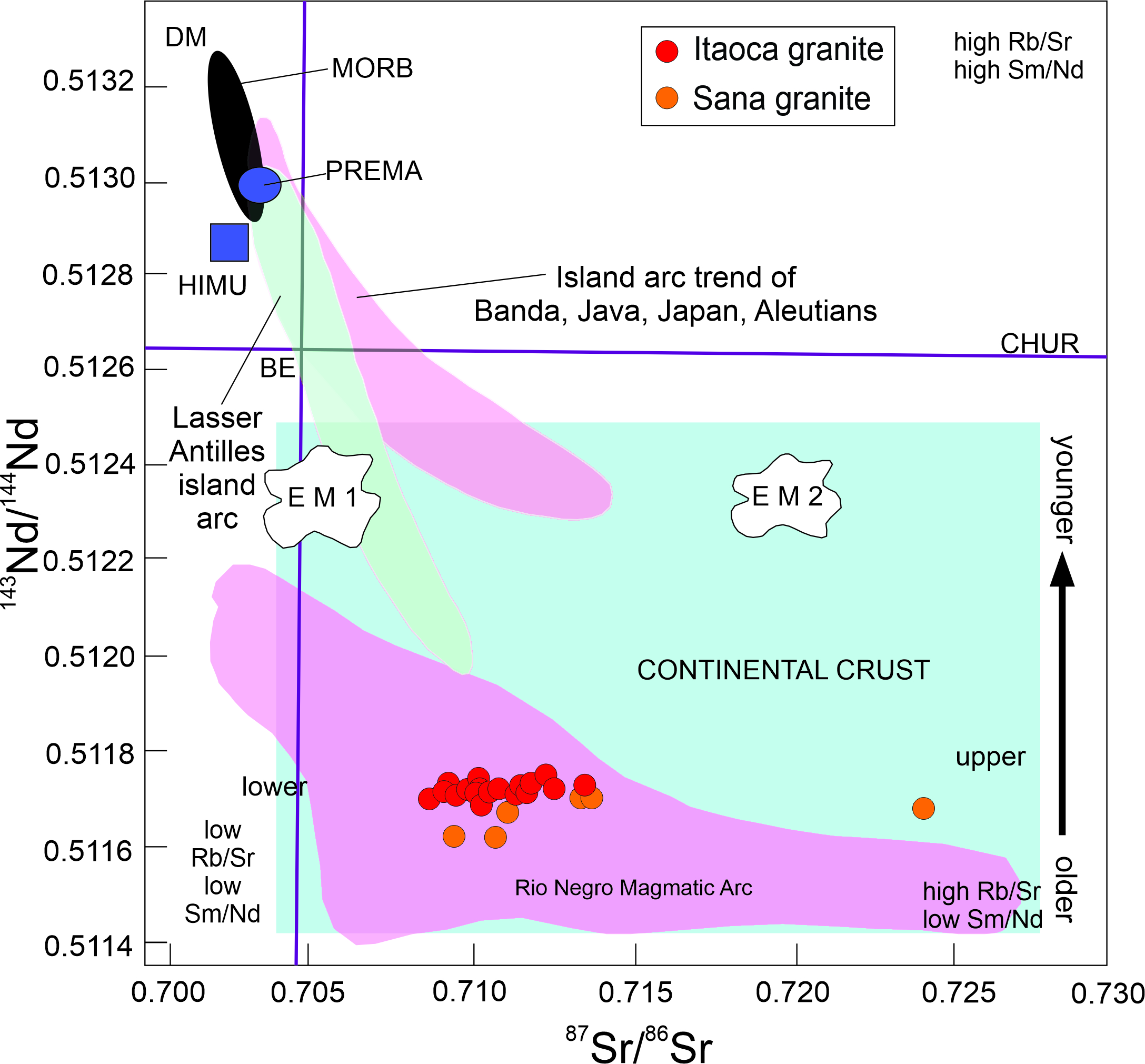
Figure 9 places the Sana and Itaoca granites in a global isotopic framework, comparing their 87Sr/86Sr, 143Nd/144Nd, and εNd signatures with key mantle and crustal reservoirs (Rollinson & Pease, 2021). Both plutons plot near the fields defined for continental crust and overlap significantly with the Rio Negro Magmatic Arc (Tupinambá et al., 2012b) and São Fidélis metasedimentary rocks (Capistrano et al., 2017), highlighting their strong genetic link to lithologies of the Oriental Terrane.
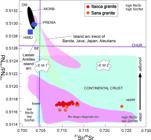
87Sr/86Sr versus 143Nd/144Nd versus εNd diagram showing reservoirs for the Itaoca and Sana granites. Fields: depleted mantle (DM), bulk silicate earth (BE), enriched mantle (EM1, EM2), high-μ (U/Pb) (HIMU), prevalent mantle (PREMA), middle ocean ridge basalts (MORB), some island arc trends, continental crust and the Rio Negro Magmatic Arc. Adapted from Rollinson & Pease (2021) and the field of the rocks of the Rio Negro Magmatic arc was obtained from Tupinambá et al. (2012b).
Similar behaviors for the Rb-Sr and Sm-Nd isotopic systems have been observed in granites in other parts of the world. Initial 87Sr/86Sr ratios around 0.706 were obtained for two S-type granitic suites by Flood & Shaw (1977). Jung et al. (2001) obtained εNd(i) values between -3 and -7 and initial 87Sr/86Sr values around 0.716 for granites generated by partially melting of metasedimentary rocks in a magmatic arc environment.
Wu et al. (2021) presented initial 87Sr/86Sr ratios ranging from 0.704 to 0.729 and εNd(i) values ranging from -3.2 to -6.1 in weakly to strongly peraluminous granites. Gholipour et al. (2022) obtained initial 87Sr/86Sr ratios ranging from 0.705 to 0.720 for rocks generated by partial melting at high temperatures of metagraywackes, psammites, and schists. Finally, McCulloch & Chappell (1982) highlighted that S-type granites exhibit a wide range of 87Sr/86Sr(i) ratios and a narrow range of εNd(i), while I-type granites show opposite behavior regarding 87Sr/86Sr(i) ratios and variable values of εNd(i).
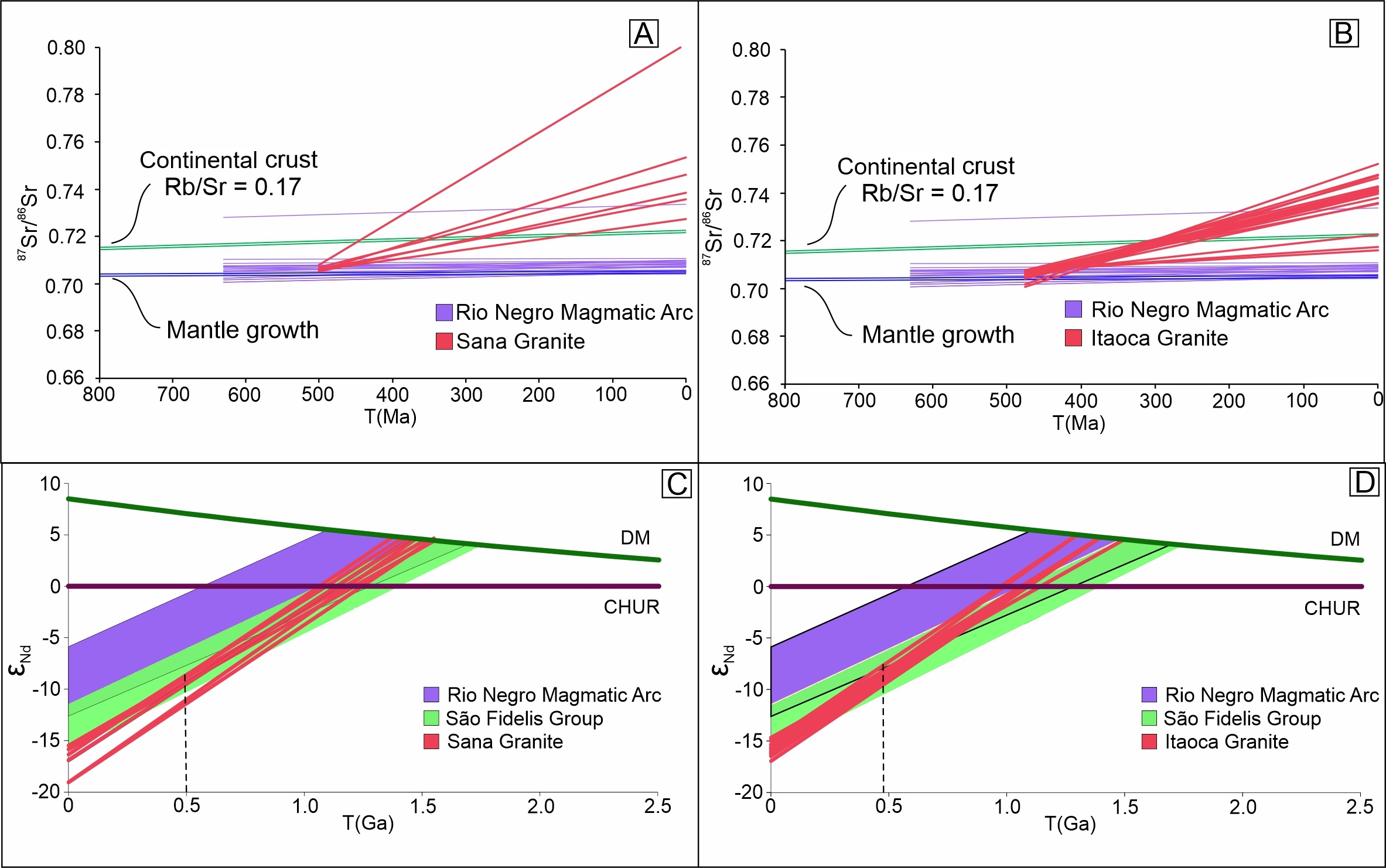
Figure 10 synthesizes the Sr and Nd isotopic evolution of these units, showing that the Sana and Itaoca granites share compositional trends with the rocks of the Rio Negro Magmatic Arc and São Fidélis Group. In the Rb-Sr system, the granites display initial 87Sr/86Sr ratios between 0.7008 and 0.7078, clustering around values typical of the arc-related sources, while the Sm-Nd system reveals consistently negative εNd(t) values, indicating the dominance of evolved crustal material. Boxplots (Figure 10E–F) illustrate that both plutons have similar ranges of εNd(i), despite their contrasting petrographic and geochemical classifications, reinforcing the idea of overlapping isotopic reservoirs within the Oriental Terrane.
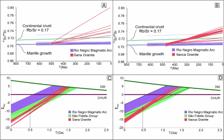
Evolution diagrams for the isotopic systems Rb-Sr and Sm-Nd, where the initial ratios were calculated from the crystallization ages of the respective granites. Figures A to B represent, respectively, the Sana and Itaoca granites, compared with the Rb-Sr data presented by Tupinambá et al. (2012b) for the Rio Negro Magmatic Arc. Figures C and D show the evolution curves of the mantle chondritic (CHUR) and depleted (DM) reservoirs with samples from the Itaoca Granite and its enclaves, based on the evolution of the mantle proposed by De Paolo (1981). Figures C and D plot the Nd data presented by Capistrano et al. (2017) for the São Fidélis Group and by Tupinambá et al. (2012b) for the Rio Negro Magmatic Arc.
Together, Figures 9 and 10 emphasize that the isotopic fields of the granites, arc lithologies, and metasedimentary sequences are tightly grouped, reflecting the restricted tectonic evolution of this portion of the Ribeira Belt, where limited external input and recycling of older crustal material produced isotopic convergence. This integrative view demonstrates that, although the Sana Granite is dominantly derived from metasedimentary protoliths and the Itaoca Granite from arc-related orthogneissic sources, their isotopic compositions reflect a common tectonic heritage rooted in the Rio Negro Magmatic Arc.
6. CONCLUSIONS
-
Distinct classification with hybrid features: The Itaoca Granite is an I-type granite, metaluminous, titanite-rich, and derived largely from partial melting of mafic and high-K orthogneissic of the Rio Negro Magmatic Arc. The Sana Granite is strongly peraluminous and predominantly S-type, derived mainly from metasedimentary sources, though the occurrence of titanite (< 1%) indicates a secondary contribution from arc-derived sources.
-
Inferred magmatic sources: Isotopic mixing models suggest that the Sana Granite originated primarily from partial melting of São Fidélis Group rocks, with a minor contribution from the rocks of Búzios-Palmital Sequence and orthogneisses of the Rio Negro Arc. The Itaoca Granite is interpreted as being derived mostly from partial melting of mafic and high-K orthogneisses of the Rio Negro Magmatic Arc, with variable assimilation of São Fidélis Group metasedimentary rocks.
-
Our data reinforce that the Sana and Itaoca granites should not be grouped within the same magmatic suite, as they originated from distinct source rocks. The Sana Granite is interpreted as a product of partial melting of metasedimentary rocks from the São Fidélis Group, whereas the Itaoca Granite resulted from the partial melting of orthoderived rocks associated with the Rio Negro Magmatic Arc. Consequently, the Itaoca Granite is best classified within the Nova Friburgo Suite, while the Sana Granite belongs to the suite that bears its name, the Sana Suite.
-
Evidence of internal heterogeneity: Sample SA-08, a monzogranite, is an outlier in correlation diagrams, with high Sr content (319 ppm) and 87Sr/86Sr(t)=0.7078. Its elevated Sr is consistent with a higher modal abundance of plagioclase, while its isotopic signature may reflect localized assimilation or mixing with melts from the Búzios-Palmital Sequence, revealing intra-pluton compositional variability in the Sana Granite.
-
Exploratory models and need for new data: The absence of Sr isotopic data for key source units (São Fidélis Group and Búzios-Palmital Sequence) limits the robustness of the models; therefore, the proposed mixing proportions should be treated as exploratory. New Sr isotope determinations for these potential sources are essential for validation.
-
Regional isotopic convergence: Evolution diagrams show significant overlap between the fields of both granites, the Rio Negro Magmatic Arc, and the rocks of São Fidélis Group, reflecting intense crustal recycling and the restricted tectonic evolution of the Oriental Terrane.
-
Tectonic significance: The Sana (S-type) and Itaoca (I-type) Granites represent contrasting products of Cambrian–Ordovician post-collisional magmatism in the Ribeira Belt. Their contrasting origins highlight the complexity of the Oriental Terrane and underscore the need for integrated isotopic, petrographic, and structural data to reconstruct post-collisional magmatism.
Supplementary Material
Supplementary material accompanies this paper.
Figure S1
Figure S2
Figure S3
This material is available as part of the online article from https://doi.org/10.1590/2317-4889e20250041
ACKNOWLEDGEMENTS
The authors would like to thank the funding agencies. Guilherme Loriato Potratz would like to thank Fundação Carlos Chagas Filho de Amparo à Pesquisa do Estado do Rio de Janeiro for his postdoctoral scholarship, process number E26-204.530/2021 and E26-204.531/2021. Claudio de Morisson Valeriano thanks FAPERJ (E-26-200.410-2023) and CNPq (PQ 310585/2021-0) for financial support and scholarships. The authors thank Amanda Lira Porto, Larissa Lago Neves and Gabriel Paravidini for their help in sample collection and petrographic description.
-
Manuscript ID: BJGEO-2024-0048.R3.
-
How to cite:
Potratz, G. L., Valeriano, C. M., & Aguiar Neto, C. C. Challenges in classifying I- and S-type granites: insights from the Sana and Itaoca plutons. Braz. J. Geol. (2026), 56:e20250041. https://doi.org/10.1590/2317-4889e20250041
-
Financial support:
scholarship, process number E26-204.530/2021 and E26-204.531/2021 – FAPERJ.
-
Data availability statement:
Data is available as supplementary material to this manuscript.
REFERENCES
-
Aguiar Neto, C. C., Valeriano, C. M., Passarelli, C. R., Heilbron, M., & Lobato, M. (2014). Monazite ID-TIMS U-Pb geochronology in the LAGIR laboratory, Rio de Janeiro State University: protocols and first applications to the assembly of Gondwana supercontinent in SE-Brazil. Anais da Academia Brasileira de Ciências, 86, 171-186. https://doi.org/10.1590/0001-3765201420120005
» https://doi.org/10.1590/0001-3765201420120005 -
Aguiar Neto, C. C., Valeriano, C. M., Enzweiler, J., Paravidini, G., Carvalho, M., Heilbron, M., Lana, C., & Larizzatti, J. H. (2023). ID-TIMS Sm-Nd and Sr isotope ratios of reference material basalt Ribeirão Preto (BRP -1). Geostandards and Geoanalytical Research, 47(4), 12498. https://doi.org/10.1111/ggr.12498
» https://doi.org/10.1111/ggr.12498 -
Angiboust, S., & Harlov, D. (2017). Ilmenite breakdown and rutile-titanite stability in metagranitoids: natural observations and experimental results. The American Mineralogist, 102(8), 1696-1708. https://doi.org/10.2138/am-2017-6064
» https://doi.org/10.2138/am-2017-6064 -
Araujo, L. E. A. B., Heilbron, M., Valeriano, C. M., Teixeira, W., & Aguiar Neto, C. C. (2019). Lithogeochemical and Nd-Sr isotope data of the orthogranulites of the Juiz de For a complex, SE-Brazil: insights from a hidden Rhyacian Orogen within the Ribeira belt. Brazilian Journal of Geology, 49(3), 1-20. https://doi.org/10.1590/2317-4889201920190007
» https://doi.org/10.1590/2317-4889201920190007 -
Bione, F. R. A., Bongiolo, E. M., Mendes, J. C., & Roland, C. L. (2019). Geochemistry, Sm-Nd isotopes and SHRIMP U-Pb geochronology of the Morro do Coco Granite (RJ, Brazil): another piece of the post-collisional magmatism of the Ribeira Belt. Brazilian Journal of Geology, 49(3), 1-19. https://doi.org/10.1590/2317-4889201920190010
» https://doi.org/10.1590/2317-4889201920190010 -
Broska, I., & Kubis, M. (2018). Accessory minerals and evolution of tin-bearing S-type granites in the western segment of the Gemeric Unit (Western Carpathians). Geologica Carpathica, 69(5), 483-497. https://doi.org/10.1515/geoca-2018-0028
» https://doi.org/10.1515/geoca-2018-0028 -
Brown, M. (2013). Granite: from genesis to emplacement. Geological Society of America Bulletin, 125(7-8), 1079-1113. https://doi.org/10.1130/B30877.1
» https://doi.org/10.1130/B30877.1 -
Capistrano, G. G., Schmitt, R. S., Medeiros, S. R., & Fernandes, G. L. F. (2017). Evidence of a Neoproterozoic active continental margin-Geochemistry and isotope geology of high-grade paragneiss from the Ribeira Orogen, SE Brazil. Journal of South American Earth Sciences, 77, 170-184. https://doi.org/10.1016/j.jsames.2017.05.006
» https://doi.org/10.1016/j.jsames.2017.05.006 -
Chappell, B. W., & White, A. J. R. (1974). Two contrasting granites types. Earth and Environmental Science Transactions of the Royal Society of Edinburgh, 83(1-2), 173-174. https://doi.org/10.1017/S0263593300007720
» https://doi.org/10.1017/S0263593300007720 -
Chappell, B. W., & White, A. J. R. (1992). I-and S-type granites in the Lachlan Fold Belt. Earth and Environmental Science Transactions of the Royal Society of Edinburgh, 83(1-2), 1-26. https://doi.org/10.1017/S0263593300007720
» https://doi.org/10.1017/S0263593300007720 -
Coelho, V. S. A., Mendes, J. C., Ludka, I. P., & Valeriano, C. M. (2023). Age and petrogenetic constraints of the post-collisional Parati Granite, southeast Brazil. Journal of South American Earth Sciences, 132, 104595. https://doi.org/10.1016/j.jsames.2023.104595
» https://doi.org/10.1016/j.jsames.2023.104595 -
Corrales, F. F. P., Dussin, I., Heilbron, M., Bruno, H., Bersan, S., Valeriano, C. M., Pedrosa-Soares, A. C., & Tedeschi, M. (2020). Coeval high Ba-Sr arc-related and OIB Neoproterozoic rocks linking pre-collisional magmatism of the Ribeira and Araçuaí orogenic belts, SE-Brazil. Precambrian Research, 337, 105476. https://doi.org/10.1016/j.precamres.2019.105476
» https://doi.org/10.1016/j.precamres.2019.105476 - De Paolo, D. J. (1981). Implication of correlated Nd and Sr isotopic variations for the chemical evolution of the crust and the mantle. Earth and Planetary Science Letters, 43, 11-201.
-
Eirado, L. G. S., Heilbron, M., & Almeida, J. C. H. (2006). Os terrenos tectônicos da Faixa Ribeira na Serra da Bocaina e na Baía da Ilha Grande, sudeste do Brasil. Revista Brasileira de Geociências, 36(3), 426-436. https://doi.org/10.25249/0375-7536.2006363426436
» https://doi.org/10.25249/0375-7536.2006363426436 - Eirado, L. G. S., Fernandes, G. A., Duarte, B. P., Heilbron, M., Pimentel, R., & Cuellar, A. (2007). Mapa Geológico da Folha Angra dos Reis (SF.23-Z-C-II), escala 1:100.000 Brasilia: PRONAGEO.
-
Erdmann, S., Wang, R., Huang, F., Scaillet, B., Zhao, K., Liu, H., Chen, Y., & Faure, M. (2019). Titanite: A potential solidus barometer for granitic magma systems. Comptes Rendus. Géoscience, 351(8), 551-561. https://doi.org/10.1016/j.crte.2019.09.002
» https://doi.org/10.1016/j.crte.2019.09.002 - Faure, G., & Mensing, T. M. (2005). Isotopes: Principles and applications (897 p.). New Jersey: Wiley-Blackwell.
-
Fernandes, G. L., Schmitt, R. S., Bongiolo, E. M., Basei, M. A. S., & Mendes, J. C. (2015). Unraveling the tectonic evolution of a Neoproterozoic-Cambrian active margin in the Ribeira Orogen (SE Brazil): U-Pb and Lu-Hf provenance data. Precambrian Research, 266, 337-360. https://doi.org/10.1016/j.precamres.2015.05.017
» https://doi.org/10.1016/j.precamres.2015.05.017 -
Flood, R. H., & Shaw, S. E. (1977). Two “S-Type” granite suites with low initial 87Sr/86Sr ratios from the New England Batholith, Australia. Contributions to Mineralogy and Petrology, 61(2), 163-173. https://doi.org/10.1007/BF00374365
» https://doi.org/10.1007/BF00374365 -
Freitas, N. C., Almeida, J., Heilbron, M., Cutts, K., & Dussin, I. (2021). The Cabo Frio thrust: a folded suture zone, Ribeira belt, SE Brazil. Journal of Structural Geology, 149, 104379. https://doi.org/10.1016/j.jsg.2021.104379
» https://doi.org/10.1016/j.jsg.2021.104379 -
Gao, P., Zheng, Y. F., & Zhao, Z. F. (2016). Distinction between S-type and peraluminous I-type granites: zircon versus whole-rock geochemistry. Lithos, 258-259, 77-91. https://doi.org/10.1016/j.lithos.2016.04.019
» https://doi.org/10.1016/j.lithos.2016.04.019 -
Gholipour, S., Azizi, H., Masoudi, F., Asahara, Y., & Minami, M. (2022). S-type like granites and felsic volcanic rocks in the Mahabad area, NW Iran: late Neoproterozoic extensional tectonics follow collision on the northern boundary of Gondwana. Lithos, 416-417, 106658. https://doi.org/10.1016/j.lithos.2022.106658
» https://doi.org/10.1016/j.lithos.2022.106658 -
Heilbron, M., & Machado, N. (2003). Timing of terrane accretion in the Neoproterozoic-Eopaleozoic Ribeira Orogen (SE, Brazil). Precambrian Research, 125(1-2), 87-112. https://doi.org/10.1016/S0301-9268(03)00082-2
» https://doi.org/10.1016/S0301-9268(03)00082-2 - Heilbron, M., Pedrosa-Soares, A. C., Campos Neto, M. C., Silva, L. C., Truow, R. A. J., & Janasi, V. A. (2004). Província Mantiqueira. In V Mantesso-Neto, A. Bartoreli, C.D.R. Carneiro, & B.B. Brito-Neves (Eds.), Geologia do Continente Sul-Americano: evolução da obra de Fernando Flávio Marques de Almeida (pp. 203-234). Beca.
-
Heilbron, M., Valeriano, C. M., Tassinari, C. C. G., Almeida, J., Tupinambá, M., Siga Junior, O., & Trouw, R. A. J. (2008). Correlation of Neoproterozoic terranes between the Ribeira Belt, SE Brazil and its African counterpart: comparative tectonic evolution and open questions. In R.J. Pankhurst, R.A.J. Truow, B.B. Brito Neves, & M.J. De Wit (Eds), West Gondwana: Pre-Cenozoic Correlations Across the South Atlantic Region (Special Publications, No. 294, pp. 211-237). Geological Society. https://doi.org/10.1144/SP294.12
» https://doi.org/10.1144/SP294.12 -
Heilbron, M., Ribeiro, A., Valeriano, C. M., Paciullo, F. V., Almeida, J. C. H., Trouw, R. J. A., Tupinambá, M., & Silva, L. G. E. (2017). The Ribeira Belt. In M. Heilbron, U. Cordani, & F. Alkmim (Eds.), São Francisco Craton, Eastern Brazil. Regional Geology Reviews Springer. https://doi.org/10.1007/978-3-319-01715-0_15
» https://doi.org/10.1007/978-3-319-01715-0_15 -
Heilbron, M., Silva, L. G. D. E., Almeida, J. C. H. D., Tupinambá, M., Peixoto, C., Valeriano, C. D. M., Lobato, M., Rodrigues, S. W. O., Ragatky, C. D., Silva, M. A., Monteiro, T., Freitas, N. C., Miguens, D., & Girão, R. (2020). Proterozoic to Ordovician geology and tectonic evolution of Rio de Janeiro State, SE-Brazil: insights on the central Ribeira Orogen from the new 1: 400,000 scale geologic map. Brazilian Journal of Geology, 50(2), e20190099. https://doi.org/10.1590/2317-4889202020190099
» https://doi.org/10.1590/2317-4889202020190099 -
Jung, S., Mezger, K., & Hoernes, S. (2001). Trace element and isotopic (Sr, Nd, Pb, O) arguments for a mid-crustal origin of Pan-African garnet-bearing S-type granites from the Damara orogen (Namibia). Precambrian Research, 110(1-4), 325-355. https://doi.org/10.1016/S0301-9268(01)00175-9
» https://doi.org/10.1016/S0301-9268(01)00175-9 -
Machado, N., Valladares, C., Heilbron, M., & Valeriano, C. (1996). U-Pb geochronology of the central Ribeira belt (Brazil) and implications for the evolution of the Brazilian Orogeny. Precambrian Research, 79(3-4), 347-361. https://doi.org/10.1016/0301-9268(95)00103-4
» https://doi.org/10.1016/0301-9268(95)00103-4 -
Machado, M. S., Potratz, G. L., Alves, M. I., Almeida, B. S., Tavares Junior, A. D., Nummer, A. R., Nogueira, C. C., Santos, A. C., & Geraldes, M. C. (2017). SHRIMP U-Pb data of the Paleoproterozoic, Região dos Lagos Complex, Rio de Janeiro, Brazil: Implications to Ribeira Belt evolution. Journal of Sedimentary Environments, 2(4), 301-318. https://doi.org/10.12957/jse.2017.32650
» https://doi.org/10.12957/jse.2017.32650 -
McCulloch, M. T., & Chappell, B. W. (1982). Nd isotopic characteristics of S- and I-type granites. Earth and Planetary Science Letters, 58(1), 51-64. https://doi.org/10.1016/0012-821X(82)90102-9
» https://doi.org/10.1016/0012-821X(82)90102-9 -
Mendes, J. C., Wiedemann, C. M., & McReath, I. (2002). Norito e charnoenderbitos da borda do maciço intrusivo de Venda Nova, Espírito Santo. Anuário do Instituto de Geociências, 25, 99-124. https://doi.org/10.11137/2002_0_99-124
» https://doi.org/10.11137/2002_0_99-124 -
Moterani, A. C. M., Porto-Júnior, R., Geraldes, M. C., & Martins, M. V. A. (2020). Magmatismo pós-tectônico investigado por meio dos métodos geocronológicos U-Pb e Lu-Hf, Complexo Pedra Branca, Rio de Janeiro – RJ. Geociências, 39(4), 903-923. https://doi.org/10.5016/geociencias.v39i04.14283
» https://doi.org/10.5016/geociencias.v39i04.14283 -
Peixoto, C. A., Heilbron, M., Ragatky, D., Armstrong, R., Dantas, E., Valeriano, C. M., & Simonetti, A. (2017). Tectonic evolution of the Juvenile Tonian Serra da Prata magmatic arc in the Ribeira belt, SE Brazil: implications for early west Gondwana amalgamation. Precambrian Research, 302, 221-254. https://doi.org/10.1016/j.precamres.2017.09.017
» https://doi.org/10.1016/j.precamres.2017.09.017 -
Porto Junior, R., Tesser, L. R., & Duarte, B. P. (2018). A origem do acamamento magmático no granito Pedra Branca, Maciço Pedra Branca, Rio de Janeiro, Brasil. Geociências UNESP, 37(2), 237-251. https://doi.org/10.5016/geociencias.v37i2.12235
» https://doi.org/10.5016/geociencias.v37i2.12235 -
Potratz, G. L., & Valeriano, C. M. (2017). Petrografia e litogeoquímica do granito Itaoca, município de Campos dos Goytacazes, RJ: o representante mais jovem do magmatismo pós-colisional da Faixa Ribeira. Geonomus, 25(1), 1-13. https://doi.org/10.18285/geonomos.v25i1.908
» https://doi.org/10.18285/geonomos.v25i1.908 -
Potratz, G. L., Geraldes, M. C., Martins, M. V. A., & Almeida, B. S. (2021). Sana Granite, a post-collisional S-type magmatic suite of the Ribeira Belt (Rio de Janeiro, SE Brazil). Lithos, 388-389, 106077. https://doi.org/10.1016/j.lithos.2021.106077
» https://doi.org/10.1016/j.lithos.2021.106077 -
Rollinson, H., & Pease, V. (2021). Using geochemical data: to understand geological processes (2nd ed., 346 p.). Cambridge University Press. https://doi.org/10.1017/9781108777834
» https://doi.org/10.1017/9781108777834 -
Schmitt, R. S., Trouw, R. A. J., Van Schmus, W. R., & Pimentel, M. M. (2004). Late amalgamation in the central part of West Gondwana: new geochronological data and the characterization of a Cambrian collisional orogeny in the Ribeira Belt (SE Brazil). Precambrian Research, 133(1-2), 29-61. https://doi.org/10.1016/j.precamres.2004.03.010
» https://doi.org/10.1016/j.precamres.2004.03.010 -
Schmitt, R. S., Trouw, R. A. J., Medeiros, S. R., & Dantas, E. L. (2008). Age and geotectonic setting of Late-Neoproterozoic juvenile mafic gneisses and associated paragneisses from the Ribeira Belt (SE Brazil): geochemistry and Sm-Nd data - implications on Gondwana assembly. Gondwana Research, 13(4), 502-515. https://doi.org/10.1016/j.gr.2007.05.015
» https://doi.org/10.1016/j.gr.2007.05.015 - Trouw, R. A. J., Heilbron, M., Ribeiro, A., Paciullo, F., Valeriano, C., Almeida, J. C. H., Tupinambá, M., & Andreis, R. R. (2000). The central segment of the Ribeira belt. In U.G. Cordani, E.J. Milani, A. Thomaz-Filho, & D.A. Campos (Eds.), Tectonic Evolution of South America (pp. 287-310). 31st International Geological Congress.
-
Trouw, R. A. J., Peternel, R., Ribeiro, A., Heilbron, M., Vinagre, R., Duffles, P., Trouw, C. C., Fontainha, M., & Kussama, H. H. (2013). A new interpretation for the interference zone between the southern Brasília belt and the central Ribeira belt, SE Brazil. Journal of South American Earth Sciences, 48, 43-57. https://doi.org/10.1016/j.jsames.2013.07.012
» https://doi.org/10.1016/j.jsames.2013.07.012 -
Tupinambá, M., Teixeira, W., & Heilbron, M. (2012a). Evolução tectônica e magmática da Faixa Ribeira entre o Neoproterozóico e Paleozóico inferior na Região Serrana do Estado do Rio de Janeiro, Brasil. Anuário do Instituto de Geociências, 35(2), 140-151. https://doi.org/10.11137/2012_2_140_151
» https://doi.org/10.11137/2012_2_140_151 -
Tupinambá, M., Heilbron, M., Valeriano, C. M., Porto Junior, R., Dios, F. B., Machado, N., Silva, L. G. E., & Almeida, J. C. H. (2012b). Juvenile contribution of the Neoproterozoic Rio Negro Magmatic Arc (Ribeira Belt, Brazil): Implications for Western Gondwana amalgamation. Gondwana Research, 21(2-3), 422-438. https://doi.org/10.1016/j.gr.2011.05.012
» https://doi.org/10.1016/j.gr.2011.05.012 -
Uher, P., Broska, I., Krzeminska, E., Ondrejka, M., Mikus, T., & Vaculovic, T. (2019). Titanite composition and SHRIMP U–Pb dating as indicators of post-magmatic tectono-thermal activity: Variscan I-type tonalites to granodiorites, the Western Carpathians. Geologica Carpathica, 70(6), 449-470. https://doi.org/10.2478/geoca-2019-0026
» https://doi.org/10.2478/geoca-2019-0026 - Valeriano, C. M., Vaz, G. S., Medeiros, S. R., Neto, C. C. A., Ragatky, C. D., & Geraldes, M. C. (2008). The Neodymium isotope composition of the JNdi-1 oxide reference material: results from the LAGIR Laboratory, Rio de Janeiro. South American Symposium on Isotope Geology, 6, 1-2.
- Valeriano, C. D. M., Medeiros, S. R., Vaz, G. S., & Neto, C. C. (2009). Sm-Nd isotope dilution TIMS analyses of BCR-1, AGV-1 and G-2 USGS rock reference materials: first results from the LAGIR Laboratory at UERJ, Rio de Janeiro.IGc/USP,45, 146-148.
-
Valeriano, C. M., Tupinambá, M., Simonetti, A., Heilbron, M., Almeida, J. C. H., & Eiraldo, L. G. (2011). U-Pb LA-MC-ICPMS geochronology of Cambro-Ordovician post-collisional granites of the Ribeira belt, southeast Brazil: Terminal Brasiliano magmatism in central Gondwana supercontinent. Journal of South American Earth Sciences, 32(4), 416-428. https://doi.org/10.1016/j.jsames.2011.03.003
» https://doi.org/10.1016/j.jsames.2011.03.003 -
Valeriano, C. M., Mendes, J. C., Tupinambá, M., Bongiolo, E., Heilbron, M., & Junho, M. C. B. (2016). Cambro-Ordovician post-collisional granites of the Ribeira Belt, SE-Brazil: A case of terminal magmatism of a hot orogen. Journal of South American Earth Sciences, 68, 416-428. https://doi.org/10.1016/j.jsames.2015.12.014
» https://doi.org/10.1016/j.jsames.2015.12.014 -
Wang, T., Li, G., Wang, Q., Santosh, M., Zhang, Q., & Deng, J. (2019). Petrogenesis and metallogenic implications of Late Cretaceous I- and S-type granites in Dachang–Kunlunguan ore belt, southwestern South China Block. Ore Geology Reviews, 113, 103079. https://doi.org/10.1016/j.oregeorev.2019.103079
» https://doi.org/10.1016/j.oregeorev.2019.103079 -
Wu, F. Y., Liu, X. C., Ji, W. Q., Wang, J. M., & Yang, L. (2017). Highly fractionated granites: recognition and research. Science China. Earth Sciences, 60(7), 1201-1219. https://doi.org/10.1007/s11430-016-5139-1
» https://doi.org/10.1007/s11430-016-5139-1 -
Wu, P., Wu, Y. N., Zhou, G. Y., Zhang, W. X., & He, Y. (2021). Geochronology, geochemistry, and isotope compositions of “Grenvillian” S-type granites in the North Qinling unit, central China: petrogenesis and tectonic significance. Precambrian Research, 360, 106247. https://doi.org/10.1016/j.precamres.2021.106247
» https://doi.org/10.1016/j.precamres.2021.106247
Edited by
-
SCIENTIFIC EDITOR:
Carlos H. Grohmann https://orcid.org/0000-0001-5073-5572
-
ASSOCIATE EDITOR:
Valderez Pinto Ferreira https://orcid.org/0000-0003-3220-7113
Data is available as supplementary material to this manuscript.