
 Unveiling network learning as a strategy for interorganizational network change
Abstract
In response to shifts in the parcel logistics market during the 1990s, the global Express Mail Service (EMS) network underwent a decade-long transformative learning process that reshaped its procedures, structure, and network interpretations. Based on a retrospective qualitative case study, this research analyzes how a multilevel learning process contributed to the transformation of the EMS Network. The findings show that the EMS network, comprising over one hundred organizations, spontaneously split into two sub-networks (strategic and wide), facilitating a more efficient and systematic learning process. This division also underscores asymmetries in the extension and interaction dynamics of the two sub-networks. Coordination dynamics were central, embodied in the EMS Unit (EMSU), a hub that emerged from the learning process to become the network’s governance structure. This study contributes to network learning theory by advancing an asymmetric model, demonstrating that systemic transformation is possible without equal participation from all members when supported by effective governance. It also offers practical guidelines for service networks seeking to improve their performance through strategic learning and network coordination.
Keywords:
Network learning; Multilevel learning; Change strategy; Postal Sector; Network Governance
Resumo
Em resposta às mudanças no mercado de logística de encomendas durante a década de 1990, a rede global Express Mail Service (EMS) passou por um processo de aprendizagem transformador que durou cerca de uma década e remodelou seus procedimentos, estrutura e interpretações de rede. Com base em um estudo de caso qualitativo retrospectivo, esta pesquisa tem como objetivo analisar como o processo de aprendizagem multinível contribuiu para a transformação de uma rede interrganizacional, a rede EMS. Os resultados mostram que a rede EMS, composta por mais de cem organizações, dividiu-se espontaneamente em duas sub-redes (estratégica e ampla), facilitando um processo de aprendizagem mais eficiente e sistemático. Essa divisão também evidencia assimetrias nas dinâmicas de extensão e de interação das duas sub-redes. A dinâmica de coordenação foi fundamental, incorporada na Unidade EMS (EMSU), um núcleo que surgiu do processo de aprendizagem para se tornar a estrutura de governança da rede. Este estudo contribui para a teoria da aprendizagem de redes ao apresentar um modelo assimétrico, demonstrando que a transformação sistêmica é possível sem a participação igualitária de todos os membros, desde que seja apoiada por uma governança eficaz. Ele também oferece diretrizes práticas para redes de serviços que buscam melhorar seu desempenho por meio da aprendizagem estratégica e da coordenação da rede.
Palavras-chave:
Aprendizagem da rede; Aprendizagem multinível; Estratégia de mudança; Rede postal SEM; Governança de rede
Resumen
En respuesta a los cambios en el mercado de la logística de paquetería durante la década de 1990, la red global Express Mail Service (EMS) pasó por un proceso de aprendizaje transformador que duró aproximadamente una década y remodeló sus procedimientos, estructura e interpretaciones de red. A partir de un estudio de caso cualitativo retrospectivo, esta investigación tiene como objetivo analizar cómo el proceso de aprendizaje multinivel contribuyó a la transformación de una red interorganizacional, la red EMS. Los resultados muestran que la red EMS, compuesta por más de cien organizaciones, se dividió espontáneamente en dos subredes (estratégica y amplia), lo que facilitó un proceso de aprendizaje más eficiente y sistemático. Esta división también pone de manifiesto asimetrías en las dinámicas de extensión e interacción de las dos subredes. La dinámica de coordinación fue fundamental, incorporada en la Unidad EMS (EMSU), un núcleo que surgió del proceso de aprendizaje para convertirse en la estructura de gobernanza de la red. Este estudio contribuye a la teoría del aprendizaje en redes al presentar un modelo asimétrico, demostrando que la transformación sistémica es posible sin la participación igualitaria de todos los miembros, siempre que cuente con el respaldo de una gobernanza eficaz. También ofrece directrices prácticas para las redes de servicios que buscan mejorar su rendimiento mediante el aprendizaje estratégico y la coordinación de la red.
Palabras clave:
Aprendizaje de red; Aprendizaje multinivel; Estrategia de transformación; Red postal EMS; Gobernanza de red
INTRODUCTION
Interorganizational networks formed by Toyota and suppliers (Dyer & Nobeoka, 2000), the National Health System in the UK (Knight & Pye, 2004, 2005), and a coalition of heat companies in Denmark (Dietrichson & Bukh, 2021) show evidence of how collective learning may transform organizations and public policies. These examples illustrate how the learning processes within a network of organizations can mimic a single entity, leading to changes at the network level.
They are notable and complex, as they reveal the inherent challenge in the ability of a set of autonomous organizations to learn collectively to the point of implementing changes in a synchronized manner, thereby transforming the network as a whole. This phenomenon was coined by Knight (2002) as “network learning,” which describes a process in which a network of organizations learns collectively as one entity, resulting in transformations encompassing the entire network rather than just individual organizations (Westman et al., 2023).
However, empirical research on network learning in organizational studies remains limited. Watanabe-Wilbert et al. (2022) identified only nine empirical studies providing evidence of network learning. Knight (2002) suggests that the network learning process can be time-consuming, which may contribute to the scarcity of case studies. This represents a critical gap, as current models fail to capture how change is orchestrated in interorganizational networks, where vertical and horizontal dynamics are intrinsically intertwined in the process.
Previous empirical studies have contributed to the field of network learning, particularly regarding its impact on strategic decisions within networks (Coghlan & Coughlan, 2015; Gibb et al., 2017; Van Herk et al., 2015; Wegner & Mozzato, 2019) and innovation at the network level (Yström et al., 2019). For example, Dietrichson and Bukh (2021) examined the characteristics of networks that foster successful network learning, highlighting the importance of trust among members.
Some studies suggest that the network learning process is a multilevel phenomenon that includes both organizational and network levels (Costa et al., 2022; Gibb et al., 2017; Knight & Pye, 2004, 2005; Van Herk et al., 2015). However, the authors have largely focused on the vertical and horizontal dynamics of learning in networks separately. Vertical dynamics (Holmqvist, 2003; Jones & Macpherson, 2006) refer to the learning interactions that occur between the organizational and network levels, while horizontal dynamics examine the interactions among network organizations at the network level (Knight & Pye, 2004, 2005). While empirical studies have provided evidence of network learning (e.g., Coghlan & Coughlan, 2015; Costa et al., 2022; Dietrichson & Bukh, 2021; Dyer & Nobeoka, 2000; Gibb et al., 2017; Knight & Pye, 2004, 2005; Van Herk et al., 2015; Yström et al., 2019), they primarily focus on horizontal network learning processes. Mozzato and Bitencourt (2014) provide a combined representation that highlights the two-dimensional nature of network learning; however, they primarily concentrate on interorganizational cooperation at the network level. Watanabe-Wilbert et al. (2022) build on the work of previous authors to present a theoretical framework for the multilevel network learning process, focusing on its sub-processes and dynamics at both organizational and network levels. Notwithstanding, there is still a research gap concerning empirical evidence for a combination of horizontal and vertical processes, using a “global value perspective” (Gibb et al., 2017, p. 23) in network learning. Additionally, existing studies point out the lack of empirical research on networks in various contexts and configurations (e.g., Costa et al., 2022; Dietrichson & Bukh, 2021) and on network learning as a multilevel process (Watanabe-Wilbert et al., 2022). To address these gaps, this study aims to analyze how a multilevel learning process contributes to the transformation of an interorganizational network. A qualitative case study was conducted on the EMS Network’s learning process. The network is particularly suitable for research purposes due to its long-term, gradual, and significant transformation on a global scale through this learning process. Furthermore, with over a hundred organizations involved, the EMS Network presents a unique configuration for analysis.
To understand network learning, its process was broken down into its sub-processes and dynamics at both the organizational and network levels, applying this multilevel approach to a case study of a global service network with more than 100 organizations. From an organizational standpoint, identifying network learning process at both the organizational and network levels enables managers to intentionally set guidelines for utilizing network learning as a strategy to foster network change.
THEORETICAL BACKGROUND
This paper is grounded in several key concepts. An interorganizational network is defined as a collaboration of three or more independent organizations that work together to achieve shared goals while preserving their legal autonomy (Azeredo et al., 2024; Winkler et al., 2023). Learning is defined as a process that changes learner’s cognition, behavior or both of them (Scott, 2011). Organizational learning is a multilevel process within the organization, occurring at the individual, group, and organizational level (Crossan et al., 1999; Knight, 2002; Vera & Crossan, 2000), which results in changes in the organization. When an organization learns with its peers beyond its borders at the network level, the organizational learning process is known as interorganizational learning (Holmqvist, 2003; Jones & Macpherson, 2006; Mozzato & Bitencourt, 2014). Despite some authors have named this phenomenon network learning (e.g., Beckman & Haunschild, 2002; Chang et al., 2004; Peters et al., 2016), Knight (2002) distinguishes network learning from interorganizational learning, arguing that organizations can learn collectively as a single entity, thereby modifying network properties rather than only their own. The present study adopts Knight’s terminology for network learning, following some previous authors (e.g., Anand et al., 2021; Costa et al., 2022; Watanabe-Wilbert et al., 2022; Westman et al., 2023).
Network learning is defined as a process in which a group of organizations learns together as a single entity (Knight, 2002; Westman et al., 2023). This collective learning leads to changes in the network’s properties, such as its processes, structures, and shared narratives (Gibb et al., 2017; Knight, 2002; Knight & Pye, 2004, 2005). For network learning to occur, organizations must achieve changes jointly and in synchronization with their peers to transform the entire network (Watanabe-Wilbert et al., 2022).
The literature on network learning posits three defining factors: context, content, and process (Knight & Pye, 2005). Content represents the desired goals of the learning process (Knight & Pye, 2005; Pettigrew, 1987; Wegner & Mozzato, 2019). These network goals, or content , are established at the beginning of the learning process to achieve outcomes at the network level, rather than just at the individual organizational level (Watanabe-Wilbert et al., 2022). Additionally, external factors, referred to as context , influence the learning process (Knight & Pye, 2005; Pettigrew, 1987). This emphasizes that network learning is a context-dependent phenomenon (Knight & Pye, 2005; Wegner & Mozzato, 2019). Therefore, network learning can be understood as a process focused on content that is embedded within a context (Knight & Pye, 2005; Watanabe-Wilbert et al., 2022; Wegner & Mozzato, 2019).
Among the three factors, the process is the main focus of management intervention to ensure achieving the content that is suited to a specific context.1 Therefore, despite the core of this study being the process, and focusing on how the network learns (Wegner & Mozzato, 2019), content and context are also described in this paper to support the analysis of the empirical study, as detailed in the following section.
This study examines the interplay between organizational and network levels in the context of network learning, deliberately excluding individual and group levels from its scope, as these dimensions are extensively addressed within the domain of organizational learning.
NETWORK LEARNING: A BI-DIMENSIONAL PROCESS WITH VERTICAL AND HORIZONTAL DYNAMICS
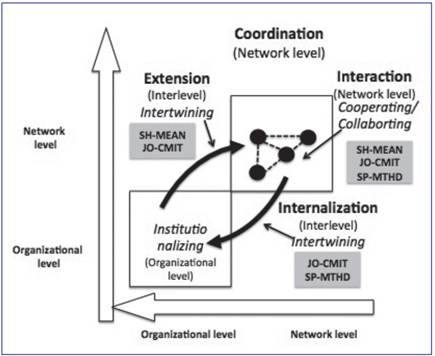
In the multilevel network learning process, vertical and horizontal dynamics can be divided (for didactic purposes) into three sub-processes (Figure 1) that facilitate network learning: the development of shared meaning (SH-MEAN), establishment of joint commitment (JO-CMIT), and creation of specific methods (SP-MTHD) that align with the network’s purposes (Knight & Pye, 2005).
The vertical dimension is initially recognized when organizations join a network, highlighting the dynamics of extension (Holmqvist, 2003). During extension dynamics, organizations begin to prepare for network entry by building shared meanings, establishing common goals, and identifying desired changes (referred to as SH-MEAN). Additionally, they foster joint commitment (JO-CMIT) among peers. Interaction dynamics in the horizontal dimension emerge at the network level through two types of interorganizational relationships: cooperation (passive participation) and collaboration (active participation) (Kozar, 2010). In terms of interaction dynamics, organizations share their knowledge and collaboratively create new insights at the network level (Watanabe-Wilbert et al., 2022). The latest knowledge generated by the network is then adopted by each organization during the internalization stage (Holmqvist, 2003). In this stage, organizations may implement changes in methods and procedures (referred to as SP-MTHD) to align with network goals.
Previous authors have tackled the existence of a multilevel force that coordinates network dynamics at both the organizational and network levels (Coghlan & Coughlan, 2015; Dyer & Nobeoka, 2000; Knight & Pye, 2004, 2005; Yström et al., 2019). Multilevel coordination dynamics serve as a catalyst for learning processes within organizations, helping to achieve network goals. In the context of network learning, coordination dynamics extend beyond simple administrative tasks; they orchestrate activities at both the network and organizational levels to enhance learning (Watanabe-Wilbert et al., 2022). Typically, the network coordinator can be one of the organizations within the network (e.g., Coghlan & Coughlan, 2015; Dietrichson & Bukh, 2021; Dyer & Nobeoka, 2000), an external consulting institution (Gibb et al., 2017; Yström et al., 2019), or an administrative body (Knight & Pye, 2004, 2005).
The coordinator for multilevel network learning supports organizational extension and interaction and may directly influence the internalization processes within organizations. Therefore, they should function in a way that does not lead these organizations to view them as outsiders or intruders (Watanabe-Wilbert et al., 2022).
In summary, the network learning process begins with extension dynamics, which occur through the intertwining of organizational and network levels via the sub-processes of SH-MEAN and JO-CMIT. As organizations mutually engage, interaction dynamics emerge, further reinforcing SH-MEAN and JO-CMIT. During this phase, new knowledge may be developed, including new procedures and methods that align with the network’s goals (referred to as SP-MTHD). This knowledge then flows back to individual organizations during internalization dynamics. At this stage, it is crucial that SH-MEAN and JO-CMIT are strongly present at the organizational level to ensure that network knowledge, often leading to changes within the organization, is accepted. Additionally, coordination dynamics play a vital role as facilitators at both levels of the network learning process (Watanabe-Wilbert et al., 2022).
Coordination dynamics, in particular, are intrinsically linked to the broader concept of network governance. Governance can be understood as the set of formal and informal mechanisms that guide and orchestrate the interactions among the network’s autonomous organizations (Jones et al., 1997; Ratajczak-Mrozek et al., 2024). In the context of learning, governance transcends simple administrative management; it is the framework that enables resource allocation and sustains the dynamics of extension, interaction, and, crucially, the internalization of knowledge for the network to achieve its collective goals (Provan & Kenis, 2008). The network coordinator, as previously mentioned, acts as the central agent of this governance structure, facilitating the process so that the network can learn and transform collectively (Azeredo et al., 2024; Krystallis et al., 2025).
Adopting the multilevel network learning dynamics approach (Figure 1), the research focuses on the Express Mail Service (EMS) network (hereafter, EMS Network).
METHODS
This study focuses on the EMS Network, a worldwide system comprising more than a hundred national postal administrations. These government-run entities oversee the international logistics of EMS, a courier service dedicated to the global delivery of documents and goods (Universal Postal Union [UPU], n.d.).
The first step in validating the need to investigate network learning within the EMS Network was to confirm that learning had taken place. Preliminary information indicated that the EMS Network experienced significant changes in its business processes, organizational structures, postal culture, and shared narratives at the network level. The most visible evidence of change was the creation of a cooperative that replaced the public service mindset with market-oriented management. The changes in the EMS Network, as detailed in the “Content” section of this paper, support the assertion of network learning observed by authors such as Dyer and Nobeoka (2000), Gibb et al. (2017), and Knight and Pye (2004, 2005).
A retrospective case study (Flick, 2009) was conducted using a qualitative approach (Yin, 2016) in this study. Primary data were collected through semi-structured interviews conducted between 2018 and 2019. Additionally, secondary data were obtained from the UPU.int and EMS.post websites to verify or enhance institutional information.
The primary data collection began with an interview with a key actor involved at the start of the change process. The snowball sampling strategy (Goodman, 1961) was employed to identify 16 international postal actors who have experienced the transformation of the EMS Network over time. In total, 17 people involved in different stages of the EMS Network transformation were interviewed. The group comprised individuals from six different nationalities: two from Europe, twelve from Latin America, one from North America, one from Africa, and one from Asia. At the time of the interviews, they held the following positions: seven were retired experts from their national postal administrations or the Universal Postal Union (UPU), six were active experts in their national post offices or the UPU, and four were active experts from the EMS Unit (EMSU). One of the authors conducted interviews in Portuguese, English, German, and French. To protect the identities of the informants, identifiers were assigned: I1 (Interviewee 1) through I17. Most interviewees were acknowledged experts in the postal business in their home countries. They played a key role in engineering the network change process from conception to implementation in several postal administrations. Costa et al. (2022) emphasized that understanding the relationship between context, content, and process necessitates long-term observation, followed by retrospective analysis.
An iterative interview strategy was adopted to capture the decade-long evolution of the process. The initial 14-question script targeted learning dynamics and the context of change among stakeholders active in the 1990s. Building on these insights, two subsequent 8-question scripts were developed: one to deepen the understanding of internalization dynamics and another to examine the evolving management strategies that supported long-term change. Three additional participants were interviewed to triangulate the data and enrich the adopted perspective. They were involved in EMS Network-related initiatives outside the network (e.g., the UPU training department), which directly contributed to network learning. To reduce bias and enhance the reliability of recollections, semi-structured interviews were conducted until data saturation was reached. The most significant part of this process occurred in the 1990s. The authors of this paper had access to seven professionals from that time period, some of whom had recently retired.
All interview participants provided their individual formal consent to participate in the research by signing a letter of consent released by the research institution to which the authors belong. The UPU also formally approved the participation of the selected active experts through a document sent by e-mail. The interviews were conducted as informal conversations lasting between 45 and 90 min. The road-maps helped avoid deviation from the desired answers to the research questions. The sets of the three road-maps are available upon request from the corresponding author of this paper.
Owing to the informants’ geographical dispersion, the interviews were conducted using technology (Flick, 2009; Merriam & Tisdell, 2016). A total of 12 participants were interviewed via video-conference platforms such as Whats App and Skype. Three participants chose to be interviewed using audio only, while two others requested the interview questions in written form to respond to them. The verbatim transcription of the interviews was checked by a native European polyglot, and each interviewee received their transcribed interview for validation to ensure data reliability (Creswell, 1998). The data corpus text resulted in 150 pages of A4 format and 116.500 words.
Data entry was performed manually using Excel sheets prepared following 53 deductive codes generated by the literature review. The data were then analyzed in two stages following Braun and Clarke (2012). In the first stage, 53 deductive codes were assessed to extract data for categorization (Saldaña, 2009). Recalling the process rationale outlined by Pettigrew (1985), the three factors of network learning identified by Knight and Pye (2005 formed the basis of the deductive coding process: Context (the trigger for change); Content (the transformation goals of the network, which are achieved after the change process, providing evidence that network learning has taken place), and Process (the dynamics and sub-processes through which the network change is implemented).
The second stage involved categorizing the empirical data, as described by Saldaña (2009). During this process, 21 new inductive codes emerged from the data. Subsequently, 74 codes were classified into five categories and three main themes: the history of the EMS Network, the learning process within the EMS Network, and the factors that influenced this learning. Table 1 presents a sample of the coding rationale from this study (the complete coding process is available from the corresponding author, upon request).
In addition, one of the authors recorded descriptive and reflective notes (Creswell, 1998), and relevant information from the UPU website was incorporated into the analysis.
RESULTS
In this study, the first two themes are displayed. The third theme, which examines the factors that influence network learning in the EMS Network, will be addressed in a future paper.
The EMS Network operates under the Universal Postal Union (UPU), a specialized United Nations agency dedicated to postal services. Established in 1874, the UPU comprises governmental entities from each member country that oversee national postal operations, commonly referred to as national postal administrations. As public service providers, these administrations collaborate through the UPU to ensure the global availability of essential postal services and set international postal standards, all governed by a constitution ratified by member states (UPU, n.d.). This affiliation means that the EMS Network adheres to the management guidelines set by the UPU, including the principle of ‘one country, one vote’ in decision-making forums, where each member country’s vote holds equal weight.
The EMS Network was established in 1970 by Great Britain and the United States to initiate the international Express Mail Service. Shortly thereafter, Brazil, Hong Kong, and the Netherlands joined this network. Initially, the postal administrations coordinated the service on an ad hoc basis until 1984, when the UPU International Bureau in Bern assumed this responsibility. In 1999, following a transformation process, the network officially became cooperative. Since then, it has been known as the EMSC. Consequently, the interviewees referred to the EMS Network prior to 1999 and the EMSC after 1999, reflecting the evolution of the network through a learning process. Based on the findings of the thematic analysis, the network learning process following the three factors, context, content, and process, is presented.
CONTEXT: THE TRIGGER FOR EMS NETWORK LEARNING
External factors can compel networks to seek alternatives to address new challenges (Halachmi & Woron, 2013), as was the case with the EMS Network, which was formed by independent national postal administrations. However, international postal services are process interdependent because the sender is from one country and the receiver is in another. In the mid-1980s, Express Mail Service (later known as EMS) was coordinated by the Universal Postal Union (UPU) as a regular offering within the postal portfolio, which included services such as letters, telegrams, banking, and parcel deliveries. The emergence of private competitors in the parcel segment, such as TNT, DHL, and FedEx, has created concerns among postal experts from various countries. In response, a working group of national postal experts, supported by the UPU, began exploring ways to enhance EMS competitiveness in this new market environment. One significant challenge identified by the working group was the lack of standardization in procedures
And [...] there was no kind of ... let’s say, regulatory intervention by the UPU, establishing any type of rule, of ... or obligation, a form of payment, or value limit, this was dealt with between the signatories of the bilateral agreement […] it was very open […] (I1, personal interview, 2018)2.
Another concern was the lack of a single global brand, which made it challenging for international consumers to recognize the worldwide nature of the service: “[...] EMS was not used as an acronym, it was used in full, Express Mail Service” (I2, personal interview, 2018). The name was created at the service origin: “As far as I recollect, the first international Express Mail Service was initiated by the U.S. Postal Service and Royal Mail (U.S.-Great Britain) in 1971” (I4, personal interview, 2018). In other countries, the service’s names were different: “Ours [in Brazil] was Serca International” (I2, personal interview, 2018)3. “[...] And they [the French] called CAI - Courrier Acceleré International - and [for] the Italians was Posta Celere Internazionale [...]” (I6, personal interview, 2018)4. These facts generated non-uniform delivery procedures and delays across the globalized service network, endangering the service’s reputation in many countries (I1, I4, I6).
Summarizing the perspectives of interviewees, the EMS Network faced environmental challenges both externally and internally, prompting the need for changes. The main triggers for this transformation included: 1) an increased demand for e-commerce in society; 2) the entry of private competitors into the global express market in which the EMS Service operates; 3) external political influences; and 4) economic constraints on the UPU network. Internally, the network encountered various challenges, such as the diversity of national cultures, differing levels of technological advancement among national postal administrations, a UPU culture based on a ‘one country, one vote’ principle, and the impact of national political factors on network decisions. However, there were also facilitators for implementing changes, including a sense of belonging and territorial defense by postal organizations against private couriers, a spirit of cooperation and mutual support among postal administrations, the presence of innovative and proactive individuals from various countries, and the commitment of postal administration representatives to the objectives of the EMS Network.
CONTENT: A TRANSFORMED EMS NETWORK
In this section, we identify the changes that took place within the EMS Network as a result of the learning process. The first significant change implemented by the group of experts was standardizing the service brand. The service was officially named “EMS,” and a logo was developed collaboratively by the working group, which included contributions from all the network members. This new branding was adopted by postal administrations worldwide.
One of the most noticeable changes in the EMS Network was the establishment of a new structure within the Universal Postal Union (UPU): the EMS Cooperative (EMSC). This significant outcome emerged from the learning process of the network. The EMSC was officially formed in 1999 during the Beijing Congress, leading to the creation of a new organizational structure. Within this structure, the EMS Unit (EMSU) was established as an executive and operational unit located in Bern, Switzerland, adjacent to the UPU headquarters. This setup reflected the model of a global company with headquarters that ensure the implementation of globally standardized processes monitored by performance indicators. At the time, this structure and managerial perspective within the UPU were considered to be innovative. The creation of the EMSC stemmed from a shift in interpretations, driven by the emergence of competing operators in the global market, which prompted some network members to question the established paradigms in the postal sector. Network members began to recognize that the “prevalence of market values was essential for the success of the initiative [of the network]” within the public sector’s mindset.
A significant milestone in the changing interpretations within the network was the modification of voting weights in the decision-making forums of the EMS Network. The previous “one country, one vote” paradigm (I1, I2, I4, I9) was replaced by a new system in which votes are weighted proportionally based on each country’s financial contribution after the official establishment of the EMSC (I1, I4). This change was implemented in response to the scarcity of financial resources needed to support the necessary transformations within the network. Consequently, a voluntary membership model was introduced, requiring a fee that was categorized according to the development level of each country. Once a postal administration decided to join the EMSC, it gained access to exclusive technologies and project developments funded by its members’ contributions (I5).
The EMS Network implemented innovative management practices that were uncommon in the public sector at that time. These practices included: 1) Conducting quality and performance audits on network members by the EMSU. 2) Offering incentives for good performance through pay-for-performance mechanisms. 3) Presenting Customer Care Awards to top performers. 4) Using technology to collect operational performance data from the members. 5) Establishing a cooperative financial fund through membership fees to invest in the technical and managerial improvements of members.
In the next section, the key aspects of the EMS Network learning process are discussed, and the manageable parts of the process are highlighted.
PROCESS: HOW THE EMS NETWORK LEARNING CHANGED THE NETWORK
The analysis of the first two interviews revealed that the learning process of the EMS Network spanned nearly a decade. This process began in the 1980s and reached the consolidation stage by the late 1990s. This time frame supports Knight’s (2002) assertion that the results of network learning can take a significant amount of time to materialize.
The data highlighted varying levels of active engagement among network members in pursuing the network’s goals. For clarity, this paper refers to the broad group of all administrations that are part of the EMS Network (which includes over a hundred entities) as the “wide network.” This terminology aligns with the definitions offered by some authors (e.g., Knight, 2002; Peters et al., 2016), who describe a wide network as a collection of organizations with loosely connected members.
From this wide network, approximately a dozen administrations began to proactively interact, collaborate, discuss, and propose strategies to address the aforementioned challenges. They spontaneously formed a subgroup, which is referred to as the “strategic sub-network” in this study (Coghlan & Coughlan, 2015; Knight, 2002). This strategic sub-network plays a key role in the change process within a wide network. While it is typically embedded within the larger network (as noted by Knight, 2002), for the purposes of analysis in this study, the strategic sub-network is treated as if it were separate from the wider network to better distinguish the learning dynamics involved.
The strategic sub-network was observed to function as a ‘hub’ within the larger network. In the following sections, the multilevel learning dynamics of the EMS Network are described, including the processes of extension, interaction, internalization, and coordination, along with their respective sub-processes.
EXTENSION DYNAMICS: THE EMERGENCE OF A STRATEGIC SUB-NETWORK
The extension dynamics in the EMS Network were identified in the spontaneous and proactive movement of building the strategic sub-network within the informal discussions among the experts, which were later validated by UPU through the creation of an expert working group. “So in front of this picture that until then, [...] about in ‘98, in a meeting, [...] some ideas were already being exchanged by email, correspondence, etc ... that something more would need to be done, [...].” (I1, personal interview, 2018)5. A strong motivation to tackle challenges collaboratively, known as JO-CMIT, arose naturally from informal interactions among experts within the strategic sub-network (I2, I3, I4, I14, I15). This motivation stemmed from the shared objective of maintaining the EMS Service’s market share in an increasingly competitive environment (SH-MEAN).
According to the literature review, during extension dynamics, organizations establish common goals, build shared meanings, and define desired changes. However, the wide network did not leap directly into the network level to develop SH-MEAN and strategies to promote JO-CMIT. During this stage of the process, the wide network provided insights specific to national postal administrations (I1, I2, I4, I6) to feed the interaction dynamics of the strategic sub-network.
INTERACTION DYNAMICS: DIFFERENCES IN THE STRATEGIC SUB-NETWORK AND THE WIDE NETWORK
Organizations exchange and generate knowledge through the interaction dynamics. The large size of the EMS Network led to two distinct forms of interaction during the network learning process: cooperation (passive) and collaboration (active) (Kozar, 2010). Members of the strategic sub-network worked together to establish new standards for the EMS Network. The wide network cooperated by validating its proposals during the global postal forum, the Beijing Congress in 1999, but the postal administrations of the wide network did not participate in discussions during the interaction dynamics. The actions of the wide network at the Beijing Congress were considered administrative acts rather than part of the ongoing and lasting interaction dynamics of the network learning process.
Participants (I1, I6, I15) noted that the strategic sub-network needed to convince the wide network to change, as the latter was not directly involved in developing the upcoming procedures aimed at these changes. Therefore, establishing a shared understanding (SH-MEAN) and fostering joint commitment (JO-CMIT) within the wide network were essential steps during the voting process at the Beijing Congress. For instance, due to different postal realities concerning contextual scenery (e.g., political situation, national market, etc.), infrastructure to technical conditions, and resources (I15), the strategic sub-network strove to validate the shared meaning within the wide network. Moreover, technological modernization was a relevant issue when seeking changes.
There are countries that have everything automated, […] [where] the client enters the internet, fills in all the data, and then when he arrives at the agency, the agency retrieves the data through the internet and completes the post. [...] But there are countries, which [...] will have to fill a form [...] paper form6 (I16, personal interview, 2019).
Another issue regarding SH-MEAN in the interaction dynamics was the change in the “EMS Network stand-alone clause” (I1), which pertains to the equity rule for all members during decision-making sessions, following the “one country, one vote” principle (I1, I2, I4, I6). For most interviewees, this was the most significant issue that challenged the established mindset within the EMS Network. A new concept emerged: “the value of proportional voting based on financial contributions to the network” (I1, I4, I6, I10). This idea was initially perceived as polemic when proposed by the strategic sub-network. However, once the implications of the changes were clearly communicated to everyone, the wide network embraced the adoption of the new paradigm of the EMS Network.
The new cooperative structure introduced new business procedures and methods at the network level (SP-MTHD). As a cooperative, the network was able to overcome the financial constraints associated with the zero-nominal growth policy set by the United Nations (I4). In this structure, network members financed investments in technology, operations, and human resource development to assist postal administrations in need. Changes to the network structure were implemented alongside the new operational procedures for EMS services. According to I4, experts from the strategic sub-network were recognized by network members for their high credibility and technical competencies. Additionally, I6 and I13 emphasized the mutual trust among members, which likely facilitated the interaction dynamics in the network.
INTERNALIZATION DYNAMICS: LEARNING OUTCOMES FLOW FROM THE NETWORK HUB (EMSU) TO THE ORGANIZATIONS
Regarding internalization dynamics, the case study shows that knowledge flows from the network level to the organizational level. The primary sub-processes involved the development of specific methods (SP-MTHD) within some organizations to adapt or implement new routines, procedures, and technologies to meet the latest network standards. Although some members of the wide network were initially resistant to novelties (I1, I5, I9), there was a general consensus on the need to invest in EMS as a global product (I5).
Because of competition from private-sector rivals, members of the wide network began accepting changes in the EMS configuration (I1, I2, I4, I7). For example, some national postal administrations have implemented procedural modifications to meet new requirements, including the quality standards recommended by the network hub. This change process took over a decade to be fully implemented, with multiple projects carried out by the EMSU, which acted as a facilitating agent to achieve the new global EMS standards. One common practice identified in the internalization dynamics was a worldwide systematic training process conducted by the hub in partnership with the UPU Training Department.
The adoption of new technologies impacted significantly the shop floor for many members of the EMS Cooperative (I1). However, the network’s heterogeneity, such as deficiencies in technological infrastructure and a lack of skilled personnel to assimilate network knowledge (I14) in some postal administrations, it hindered the prompt implementation of these innovations. To address these challenges, the EMSU provided continuous support to organizations since its inception, offering training and internal consultancy tailored to each organization’s rate of change. The EMSU facilitated ongoing adjustments and improvements within network organizations (I11). Internal consultations conducted by recognized experts within the EMS Cooperative ensured that national postal administrations receive the necessary support to meet the required quality standards for EMS over the years. The on-site consulting provided by experts from the EMSU played a crucial role in facilitating internalization (I5, I6). Interviewees highlighted the importance of the network coordination structure - the EMS Cooperative, along with its EMSU - as a key factor in the successful transformation of the EMS Network.
THE MULTILEVEL COORDINATION DYNAMICS: SYNCHRONIZING ORGANIZATIONS’ DYNAMICS FOR THE NETWORK TRANSFORMATION
Most interviewees agreed that the EMSC has been instrumental in driving change since it began as a group of experts and evolved into a formal coordination structure. The EMS Cooperative allowed the network organizations to function as a single entity. An elected board of seven members oversees the network, operating according to a business plan similar to those used by private sector companies, which was innovative at the time. The EMS Cooperative has established and promoted new standards in EMS services, effectively preventing a decline in quality to the pre-1980s level.
Most interviewees noted that EMS improvements were only possible because of the Cooperative. Its performance, as a change manager through the EMSU, has been evident over the years, continuing to this day: “[...] the constitution of the EMS [cooperative] network took several countries out of a very weak, very bad, even incipient performance situation within that métier as a postal service and put them into that network at a different performance level. That effect has clearly taken place” (I8, personal interview, 2018)7.
The EMSU has been conducting members’ interactions and internalization in network organizations since its creation. To date, the EMSU has been conducted by five formal coordinators supporting the Americas, Europe, Asia, the Middle East, and Africa. The coordinators’ assignments are as follows: a) to support the implementation of network guidelines among members. They perform their tasks through remote online assistance and on-site consultations (I11, I13, I14); b) to work as a bridge for the EMS Cooperative members (the EMSU is the EMS Cooperative permanent hub that connects national postal administrations for EMS) (I6, I10, I13); c) to work as the EMS global quality standard guardian. The EMSU tracks key performance indicators and audits EMS operational processes at the organizational level. It applies pay-for-performance mechanisms and carries out the Customer Care Awards for organizations that deliver excellent performances (I10, I11, I13, I14); d) to be the EMS Cooperative driving force for a strong network (I6, I8, I10); and e) to enable knowledge institutionalization in the whole network by implementing a knowledge repository at the network level (I6, I17). The EMSU’s actions have enhanced the national post office to improve operational, managerial, and technological issues, ensuring the competitiveness of EMS in the global market.
Table 2 summarizes the network learning process at both the network and organizational levels.
In the next section, we discuss the main points of the EMS Network learning process and shed light on the manageable part of the process.
DISCUSSION
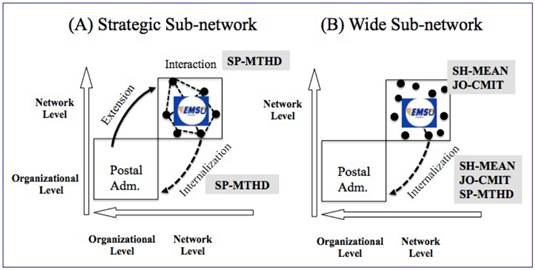
In this section, the EMS Network learning process is examined through the lens of the network’s multilevel dynamics, as illustrated in Figure 1. The empirical data illustrate two configurations for the strategic sub-network and the wide sub-network concerning extension and interaction dynamics (Figure 2).
In the strategic sub-network (Figure 2A), the arrows connecting its members to the network hub (EMSU) indicate two types of interactions: extension and internalization. The solid arrows represent the extension of organizations towards the network, while the dotted arrows illustrate the internalization process from the network back to the organizations. In the wide network (Figure 2B), the arrows flow in one direction, as depicted by a dotted line, which illustrates the internalization dynamics within the NL process.
The theoretical framework proposed in Figure 1 suggests that extension dynamics always occur during network learning. However, this is only valid when all network members actively engage in the interaction dynamics. In networks with many members, such as those in the present case study, the participation of all members may not be feasible. This characteristic of the EMS Network reveals that multilevel network learning can occur even with a partial lack of extension dynamics and interactions among some organizations, specifically those within the wide network.
In this context, the wide network depended on a strategic sub-network throughout the conception and implementation of changes at the network level. This highlights the significant commitment of all members to the network’s goals and the deep trust among them (I2, I4, I6, I7), reinforcing the vital role of trust in the process advocated by Dietrichson and Bukh (2021).
Figure 2 (A, B) illustrates that internalization dynamics occur across all organizations in the network. This indicates that effective network learning relies on coordinated internalization efforts, allowing individual organizational changes to affect network evolution. This aligns with Watanabe-Wilbert et al. (2022), who emphasized that internalization dynamics are essential for network learning.
The sub-processes for developing shared meaning, joint commitment, and specific methods (SH-MEAN, JO-CMIT, and SP-MTHD) do not apply to all the dynamics. While the literature discusses practices for fostering SH-MEAN and JO-CMIT in extension dynamics, such as network coordinators facilitating a common understanding through meetings (e.g., Dyer & Nobeoka, 2000; Coghlan & Coughlan, 2015), this case study showed a lack of these practices. This may be attributed to the previous relationships among EMS Network members, which made these steps unnecessary. Experts in international postal services, who have collaborated for years, already share meanings cultivated within their cultures. Additionally, these established relationships fostered trust from the beginning, highlighting the significant role of context in enhancing network learning.
The most significant outcome of the EMS Network’s learning process is the establishment of the EMS Unit (EMSU), which functions as the executive and operational arm of the EMS Cooperative. This coordination hub, formed spontaneously as a working group, has proven essential for the success of the collective learning process. This stands out as a central theme in the narratives of the participants.
All interviewees unequivocally identified the EMS Unit (EMSU) as the central driving force behind the EMS Network’s transformation. The EMS Unit has effectively guided and supported administrative bodies at the organizational level, facilitating significant changes within the network. This clearly demonstrates that the coordination dynamics identified in the EMSU align with the established concept of network governance: a comprehensive set of formal and informal mechanisms and processes that proficiently guide interactions among organizations (Azeredo et al., 2024; Krystallis et al., 2025). These mechanisms not only coordinate and allocate resources among network members (Azeredo et al., 2024) but also serve as orchestrators, synchronizing network dynamics at both the organizational and network levels (Krystallis et al., 2025; Ratajczak-Mrozek et al., 2024), thereby enhancing the network’s competitive position in the market (Wegner & Verschoore, 2022).
The findings clearly indicate that an organically developed network governance structure within the EMS Network led to the establishment of a formal governance body. This substantiates prior research that confirms the existence of a network coordination body (e.g., Coghlan & Coughlan, 2015; Costa et al., 2022; Dietrichson & Bukh, 2021; Gibb et al., 2017; Knight & Pye, 2005; Van Herk et al., 2015). The reputation and authority of the coordination body are crucial for the success of internalization (Gibb et al., 2017; Yström et al., 2019). It should be seen as a trustworthy entity rather than an outside intruder (Watanabe-Wilbert et al., 2022), as demonstrated by the EMS Network. Additionally, at the organizational level, the EMSU engaged in processes to achieve results at the network level. This reaffirms a widely recognized prerequisite for learning processes: the establishment of trust among network participants (Dietrichson & Bukh, 2021; Mozzato & Bitencourt, 2018; Wegner & Mozzato, 2019).
Another observation relates to the changes occurring within the strategic sub-network, which can be viewed as bottom-up movements. In contrast, changes in the wide network were a mandatory top-down process. In the EMS Network, the process of conceptualizing change was participatory in the strategic sub-network, while implementation was compulsory for all members of the network. Despite this top-down approach to internalization dynamics, the mandatory changes were embraced positively because the network fostered a strong sense of shared meaning and collective commitment among all its members.
Table 3 underscores the critical insights from the case study, illustrating effective strategies for driving successful network transformation within the EMS Network context.
Theoretical implications
This research presents two main theoretical implications. First, the findings challenge the theoretical framework illustrated in Figure 1, which presumes that all dynamics occur within network learning. Prior investigations into network learning suggest, for example, that the dynamics of extension and interaction engage most network participants (e.g., Costa et al., 2022; Dietrichson & Bukh, 2021; Dyer & Nobeoka, 2000; Gibb et al., 2017; Van Herk et al., 2015) to facilitate the generation of new knowledge at the network level. Nevertheless, the EMS Network learning process revealed that it may exhibit the asymmetry illustrated in Figure 2. It shows that extension and interaction may not uniformly manifest across the entire network, attributable to the considerable number of participants involved. This observation underscores that synchronized internalization by all network members constitute the fundamental dynamics requisite for the attainment of network learning, as mentioned by Watanabe-Wilbert (2022).
The second implication concerns mechanisms to ensure such synchronized internalization. Effective coordination of network dynamics is indispensable for effecting changes in network properties. Its significance becomes increasingly pronounced in internalization to engage members who did not directly participate in the dynamics of extension and interaction processes.
In this context, the case study underscores the vital role of the network coordinator, a trusted figure who serves as the essential “glue” that unites various organizations in pursuit of a common objective. This insight aligns with prior research on network learning (e.g., Dyer & Nobeoka, 2000; Gibb et al., 2017; Knight & Pye, 2004, 2005; Watanabe-Wilbert et al., 2022), which demonstrates that effective coordination fosters collaborative success. The large-sized EMS Network was able to facilitate extension and interaction dynamics among most of its members thanks to long-term relationships, where partnerships and trust had already been established.
Practical implications
The results indicate that efforts and resources should be focused on establishing a consistent multilevel coordination body and effective organizational learning processes to ensure successful internalization. In large networks with a global reach, the coordinator’s role in multilevel network learning requires careful implementation of governance to effectively manage the asymmetrical learning process described in this case.
It should be noted that, despite the mandatory internalization at the EMS Network for all its members, network governance was implemented using a participatory approach. For instance, the EMS Cooperative Board has adopted a rotating management system that allows professionals from various countries to participate in network management. This system has remained consistent over time, fostering trust and a sense of belonging among network organizations.
FINAL CONSIDERATIONS
As Knight (2002) states, network learning is a time-intensive process, and identifying an appropriate case study to examine this phenomenon is challenging. This study extends the literature by analyzing an EMS Network comprising over 100 organizations. It analyzes the development of network learning within this network by decomposing it into specific dynamics and sub-processes. The findings provide both theoretical and practical contributions.
Theoretical contributions
This study advances the understanding of network learning by emphasizing its multilevel nature and highlighting the interplay between organizational and network levels. It integrates vertical (organization-to-network-to-organization) and horizontal (organization-to-organization) learning dynamics, offering a systemic perspective of the process. This study also challenges the assumption that all network members must participate equally in all dynamics for network learning to occur, showing that in the EMS Network, only the members of the strategic sub-network actively participated in extension and interaction dynamics. It also highlights the role of trustworthy multilevel network coordination in orchestrating internalization dynamics, contributing to the literature on network governance by illustrating how an organically developed coordination structure evolved into a formal governance body to sustain learning and effect lasting change. Finally, this study adds a unique empirical setting by incorporating a case study of a large-sized global public service network into the literature, which often focuses on private-sector or regional networks.
Practical contributions
This research offers key insights for practitioners aiming to foster an effective network learning process: a) to establish a coordination body with clearly defined responsibilities to guide multilevel network learning ; b) to promote a culture of trust, shared meaning, and collective commitment at both the organizational and network levels; c) to implement participatory governance structures to support internalization dynamics and collaborative decision-making; and d) to encourage member engagement by introducing performance-based incentives and recognition mechanisms.
Limitations
Although this case study provides valuable insights, several limitations are present. Focusing solely on the EMS Network means that the findings may not be generalizable. The asymmetry of the network learning process might pertain to specific contextual factors associated with the network. For instance, the EMS Network is a large global entity, with historical ties as UPU members, operating under a governance structure. Additionally, at the time of the studied episode, the EMS Network operated under a public mandate.
Another limitation involves the retrospective interviews, which may have introduced memory bias (Rodríguez Goyes & Sandberg, 2025), as each participant described their learning process over a unique time span. While triangulation added depth and the number of interviews was conducted until data saturation, selective recall and reconstruction of past events (Sosniak, 2006) must be considered in this research.
The study also did not explore the perspectives of the wide network organizations, which could have enriched the understanding of internalization and coordination dynamics. Finally, transnational and contextual factors that shape network learning were beyond the scope of this study.
Future studies
As future research, comparative case studies to explore network learning across diverse sectors and cultural settings is an issue to deepen the subject. This could shed light on how context influences learning dynamics within interorganizational networks. Transnational governance deserves closer attention as a key factor in future research on network learning.
As digital transformation continues to reshape organizational processes, there is a compelling opportunity for further studies to delve into the impact of technology - particularly digital communication, collaboration tools, and artificial intelligence - on network learning. Embracing network learning is a management strategy for business sectors striving to thrive in an era of constant evolution and change.
In conclusion, conducting quantitative studies that assess the outcomes of network changes resulting from the network learning process would enhance the field of the organizational change management.
ACKNOWLEDGEMENTS
The authors extend their gratitude to the professionals and institutions within the international postal sector whose contributions made this research possible and enhanced the understanding of the network learning phenomenon. The authors also sincerely appreciate the valuable feedback from the anonymous reviewers, whose contributions were instrumental in shaping the final version of this manuscript.
REFERENCES
-
Anand, A., Kringelum, L. B., Madsen, C. O., & Selivanovskikh, L. (2021). Interorganizational learning: a bibliometric review and research agenda.The Learning Organization,28(2), 111-136. https://doi.org/10.1108/TLO-02-2020-0023
» https://doi.org/10.1108/TLO-02-2020-0023 -
Azeredo, G., Burcharth, A., & Wegner, D. (2024). The impact of governance tensions on disaffiliation from interorganizational networks. Administrative Sciences, 14(6), 113. https://doi.org/10.3390/admsci14060113
» https://doi.org/10.3390/admsci14060113 - Beckman, C. M., & Haunschild, P. R. (2002). Network learning: The effects of partners’ heterogeneity of experience on corporate acquisitions. Administrative Science Quarterly, 47, 92-124.
- Braun, V., & Clarke, V. (2012). Thematic analysis. In P. M. Camic, H. Cooper, D. L. Sher, A. T. Panter, & D. Rindskopf (Eds.), APA handbook of research methods in psychology (pp. 57-71). American Psychological Association.
-
Chang, L.-J., Chou, C.-Y., Chen, Z.-H., & Chan, T.-W. (2004). An approach to assisting teachers in building physical and network hybrid community-based learning environments: The Taiwanese experience. International Journal of Educational Development, 24(4), 383-396. https://doi.org/10.1016/j.ijedudev.2004.02.001
» https://doi.org/10.1016/j.ijedudev.2004.02.001 -
Coghlan, D., & Coughlan, P. (2015). Effecting change and learning in networks through network action learning. The Journal of Applied Behavioral Science, 51(4), 375-400. https://doi.org/10.1177/0021886315601133
» https://doi.org/10.1177/0021886315601133 -
Costa, I., Bui, S., De Schutter, O., & Dedeurwaerdere, T. (2022). A network perspective to niche-regime interactions and learning at the regime level. Environmental Innovation and Societal Transitions, 43, 62-79. https://doi.org/10.1016/j.eist.2022.03.001
» https://doi.org/10.1016/j.eist.2022.03.001 - Crossan, M. M., Lane, H. W., White, R. E., & Djurfeldt, L. (1995). Organizational learning: dimensions for a theory. The International Journal of Organizational Analysis, 3(4), 337-360.
- Creswell, J. W. (1998). Qualitative inquiry and research design: Choosing among five traditions SAGE Publications.
-
Dietrichson, L. G., & Bukh, P. N. (2021). Network learning and trust: A case study of a benchmarking network. Financial Accountability & Management, 37(1), 75-87. https://doi.org/10.1111/faam.12239
» https://doi.org/10.1111/faam.12239 -
Dyer, J. H., & Nobeoka, K. (2000). Creating and managing a high-performance knowledge-sharing network: The Toyota case. Strategic Management Journal, 21(3), 345-367. https://doi.org/10.1002/(SICI)1097-0266(200003)21:3<345::AID-SMJ96>3.0.CO;2-N
» https://doi.org/10.1002/(SICI)1097-0266(200003)21:3<345::AID-SMJ96>3.0.CO;2-N - Flick, U. (2009). An introduction to qualitative research (4th ed.). SAGE Publications.
-
Gibb, J., Sune, A., & Albers, S. (2017). Network learning: Episodes of interorganizational learning towards a collective performance goal. European Management Journal, 35(1), 15-25. https://doi.org/10.1016/j.emj.2016.09.001
» https://doi.org/10.1016/j.emj.2016.09.001 - Goodman, L. A. (1961). Snowball sampling. The Annals of Mathematical Statistics, 32(1), 148-170.
- Halachmi, A., & Woron, A. M. (2013). Spontaneous inter-organizational learning. International Journal of Organization Theory and Behavior, 16(2), 135-164.
-
Holmqvist, M. (2003). A dynamic model of intra- and interorganisational learning. Organization Studies, 24(1), 95-123. https://doi.org/10.1177/0170840603024001684
» https://doi.org/10.1177/0170840603024001684 -
Jones, C., Hesterly, W. S., & Borgatti, S. P. (1997). A general theory of network governance: Exchange, social capital, and learning. Academy of Management Review, 22(4), 911-945. https://doi.org/10.5465/amr.1997.9711022109
» https://doi.org/10.5465/amr.1997.9711022109 -
Jones, O., & Macpherson, A. (2006). Interorganizational learning and strategic renewal in SMEs: Extending the 4I framework. Long Range Planning, 39(2), 155-175. https://doi.org/10.1016/j.lrp.2005.02.012
» https://doi.org/10.1016/j.lrp.2005.02.012 -
Knight, L. (2002). Network learning: Exploring learning by interorganizational networks. Human Relations, 55(4), 427-454. https://doi.org/10.1177/0018726702554003
» https://doi.org/10.1177/0018726702554003 -
Knight, L., & Pye, A. (2004). Exploring the relationships between network change and network learning. Management Learning, 35(4), 473-490. https://doi.org/10.1177/1350507604048274
» https://doi.org/10.1177/1350507604048274 -
Knight, L., & Pye, A. (2005). Network learning: An empirically derived model of learning by groups of organizations. Human Relations, 58(3), 369-392. https://doi.org/10.1177/0018726705053427
» https://doi.org/10.1177/0018726705053427 - Kozar, O. (2010). Towards better group work: Seeing the difference between cooperation and collaboration. English Teaching Forum, 48(2), 16-23.
-
Krystallis, I., Kalra, J., & Locatelli, G. (2025). Orchestrating governance reconfiguration of inter-organizational project networks to address coordination failures. International Journal of Production Economics, 285, 109637. https://doi.org/10.1016/j.ijpe.2025.109637
» https://doi.org/10.1016/j.ijpe.2025.109637 - Merriam, S. B., & Tisdell, E. J. (2016). Qualitative research: A guide to design and implementation (4th ed.). Jossey-Bass.
-
Mozzato, A. R., & Bitencourt, C. C. (2014). Understanding interorganizational learning based on social spaces and learning episodes. Brazilian Administration Review, 11(3), 284-301. https://doi.org/10.1590/1807-7692bar2014370
» https://doi.org/10.1590/1807-7692bar2014370 -
Mozzato, A. R., & Bitencourt, C. C. (2018). The process of interorganisational learning in the context of spatial agglomeration. International Journal of Innovation and Learning, 24(2), 176-199. https://doi.org/10.1504/IJIL.2018.094070
» https://doi.org/10.1504/IJIL.2018.094070 -
Peters, L. D., Pressey, A. D., & Johnston, W. J. (2016). Contingent factors affecting network learning. Journal of Business Research, 69, 2507-2515. https://doi.org/10.1016/j.jbusres.2016.02.020
» https://doi.org/10.1016/j.jbusres.2016.02.020 - Pettigrew, A. M. (1987). Context and action in the transformation of the firm. Journal of Management Studies, 24(6), 649-670.
-
Provan, K. G., & Kenis, P. (2008). Modes of network governance: Structure, management, and effectiveness. Journal of Public Administration Research and Theory, 18(2), 229-252. https://doi.org/10.1093/jopart/mum015
» https://doi.org/10.1093/jopart/mum015 -
Ratajczak-Mrozek, M., Hauke-Lopes, A., & Harrison, D. (2024). The evolution of contractual and relational governance mechanisms when platforms are actors in networks. Industrial Marketing Management, 114, 198-212. https://doi.org/10.1016/j.indmarman.2024.07.013
» https://doi.org/10.1016/j.indmarman.2024.07.013 -
Rodríguez Goyes, D., & Sandberg, S. (2025). Trust, nuance, and care: Advantages and challenges of repeat qualitative interviews. Qualitative Research, 25(2), 330-349. https://doi.org/10.1177/14687941241246159
» https://doi.org/10.1177/14687941241246159 - Saldaña, J. (2009). The coding manual for qualitative researchers SAGE Publications.
- Scott, B. B. (2011) Organizational learning: A literature review. Discussion Paper #2011-02, Queen’s University, 1-24.
-
Sosniak, L. A. (2006). Retrospective interviews in the study of expertise and expert performance. In K. A. Ericsson, N. Charness, P. J. Feltovich, & R. R. Hoffman (Eds.), The Cambridge handbook of expertise and expert performance (pp. 287-301). Cambridge University Press. https://doi.org/10.1017/CBO9780511816796
» https://doi.org/10.1017/CBO9780511816796 -
Universal Postal Union. (n.d.). UPU website. https://www.upu.int
» https://www.upu.int - Vera, D., & Crossan, M. (2000). Organizational learning, knowledge management, and intellectual capital: An integrative conceptual model [Working paper]. Richard Ivey School of Business, University of Western Ontario.
-
Watanabe-Wilbert, J. K., Steil, A. V., & Dandolini, G. A. (2022). Network learning and interorganizational learning: A theoretical framework of relationship and interdependence. Cadernos EBAPE.BR, 20(6), 863-881. https://doi.org/10.1590/1679-395120210251x
» https://doi.org/10.1590/1679-395120210251x -
Wegner, D., & Mozzato, A. R. (2019). Shall we cooperate, or shall we compete? How network learning episodes influence strategic decisions in strategic networks. International Journal of Management and Enterprise Development, 18(3), 171-188. https://doi.org/10.1504/IJMED.2019.100662
» https://doi.org/10.1504/IJMED.2019.100662 -
Wegner, D., & Verschoore, J. (2022). Network governance in action: Functions and practices to foster collaborative environments. Administration & Society, 54(3), 479-499. https://doi.org/10.1177/00953997211024580
» https://doi.org/10.1177/00953997211024580 -
Westman, L., Luederitz, C., Kundurpi, A., Mercado, A. J., & Burch, S. L. (2023). Market transformations as collaborative change: Institutional co-evolution through small business entrepreneurship. Business Strategy and the Environment, 32, 936-957. https://doi.org/10.1002/bse.3083
» https://doi.org/10.1002/bse.3083 -
Winkler, M., Wegner, D., & Macagnan, C. B. (2023). The maturity of strategic networks’ governance: Proposal of an analysis model. Administrative Sciences, 13(5), 134. https://doi.org/10.3390/admsci13050134
» https://doi.org/10.3390/admsci13050134 - Yin, R. K. (2016). Qualitative research from start to finish (2nd ed.). The Guilford Press.
-
Yström, A., Ollila, S., Agogué, M., & Coghlan, D. (2019). The role of a learning approach in building an interorganizational network aiming for collaborative innovation. The Journal of Applied Behavioral Science, 55(1), 27-49. https://doi.org/10.1177/0021886318793383
» https://doi.org/10.1177/0021886318793383
-
1
For detailed information, please see Watanabe-Wilbert et al. (2022).
-
2
Original transcription: “E [...] não havia nenhum tipo de, éhhh [...] digamos, de intervenção regulatória da UPU, estabelecendo qualquer tipo de regra, de [...] ou de obrigação, de forma de pagamento, ou de limite de valor, isso era tratado entre os signatários do acordo bilateral […] Então [...] era bem aberto, entendeu?” (I1).
-
3
Original transcription: “Nosso era o Serca Internacional” (I2).
-
4
Original transcription: “E eles chamavam de CAI - Courrier Acceleré International - e os italianos era Poste Celere Internazionale [...]”(I6).
-
5
Original transcription: “Então diante desse quadro que até então se vivia, […] lá pelos idos de 98, numa reunião, […] se não estou enganado foi numa reunião em Tóquio […] algumas ideias já se estavam trocando por e-mail, por correspondência, etc...de que alguma coisa a mais precisaria ser feita” (I1).
-
6
Original transcription: “Tem país que tem tudo automatizado, por exemplo, o Peru. No Peru o cliente entra na internet, ele preenche todos os dados e depois, quando ele chega na agência, a agência recupera pela internet os dados e completa a postagem. […] Mas tem países, que […] vai ter que preencher um formulário, […] formulário papel” (I16).
-
7
Original transcription: “[...] a constituição da rede [cooperativa] EMS tirou vários países de uma situação de desempenho muito fraco, muito ruim, incipiente mesmo, dentro daquele métier como serviço postal, e colocou para dentro dessa rede pro patamar de desempenho diferente. Esse efeito claramente se verificou” (I8).
-
8
[Original version]
-
DATA AVAILABILITY
The coding dataset that supports the results of this study is available upon request from the corresponding author, Dr. Julieta Watanabe-Wilbert. The dataset is not publicly available due to information that could compromise the privacy of the research participants.
-
REVIEWERS
The reviewers did not authorize the disclosure of their identities.
-
PEER REVIEW REPORT
The peer review report is available at this link:https://periodicos.fgv.br/cadernosebape/article/view/97420
Edited by
-
EDITOR-IN-CHIEF
Hélio Arthur Reis Irigaray (Fundação Getulio Vargas, Rio de Janeiro / RJ - Brazil). ORCID: https://orcid.org/0000-0001-9580-7859
-
ASSOCIATE EDITOR
Fabricio Stocker (Fundação Getulio Vargas, Rio de Janeiro / RJ - Brazil). ORCID: https://orcid.org/0000-0001-6340-9127
The coding dataset that supports the results of this study is available upon request from the corresponding author, Dr. Julieta Watanabe-Wilbert. The dataset is not publicly available due to information that could compromise the privacy of the research participants.

 Source: Elaborated by the authors based on
  Source: Elaborated by the authors.