
 EDUCATIONAL TECHNOLOGIES FOR THE SELF-CARE OF CHILDREN WITH SICKLE CELL ANEMIA: AN INTEGRATIVE REVIEW
ABSTRACT
Objective: To identify the educational technologies used to help children with sickle cell anemia in their self-care.
Method: an integrative review carried out in six consecutive phases, between June and July 2023, with no time frame, in the following information resources: Public/published Medline, Virtual Health Library, Scientific Electronic Library Online, and Web of Science and Cumulative Index to Nursing and Allied Health Literature.
Results: Five studies were found, of which the following stood out: a game, two electronic applications, a coloring book, and a guided image for pain relief. All the educational technologies reflect the child’s better understanding of self-care.
Conclusion: The selected studies allowed us to understand that educational technologies help children with sickle cell anemia to understand the disease and take actions that improve its signs and symptoms, favoring self-care, but it is essential to create new educational technologies since most of the findings are old and do not match the current reality.
KEYWORDS:
Anemia; Sickle Cell; Children; Self Care; Educational Technology; Nursing.
HIGHLIGHTS
Nurses should create educational technologies for children.
Educational technologies help with self-care in sickle cell anemia.
Understanding the disease helps promote self-care in children.
The following were found: a game, two apps, a book, and a diary.
RESUMO
Objetivo: identificar as tecnologias educacionais utilizadas para auxiliar crianças com anemia falciforme no seu autocuidado.
Método: revisão integrativa realizada em seis fases consecutivas, entre os meses de junho a julho de 2023, sem recorte temporal, nos recursos informacionais: Public/Publish Medline, Biblioteca Virtual em Saúde, Scientific Electronic Library Online e Web of Science e Cumulative Index to Nursing and Allied Health Literature.
Resultados: foram encontrados cinco estudos, dos quais se destacaram: jogo, dois aplicativos eletrônicos, livro para colorir e imagem guiada para alívio da dor. Todas as tecnologias educacionais refletiram na melhor compreensão da criança sobre o autocuidado.
Conclusão: os estudos selecionados permitiram compreender que as tecnologias educacionais auxiliam o público infantil com anemia falciforme na compreensão da doença e em ações que melhorem seus sinais e sintomas, favorecendo o autocuidado, porém, é imprescindível a criação de novas tecnologias educacionais, já que a maioria dos achados é antiga e não condiz com a realidade atual.iliar; Transtorno do espectro autista; Infecções por coronavírus; Emergências; Criança.
DESCRITORES:
Anemia falciforme; Crianças; Autocuidado; Tecnologia educacional; Enfermagem.
HIGHLIGHTS
Enfermeiros devem criar tecnologias educacionais para crianças.
Tecnologias Educacionais auxiliam no autocuidado na anemia falciforme.
Entender a doença auxilia na promoção do autocuidado infantil.
Foram encontrados: um jogo, dois aplicativos, um livro e um diário.
RESUMEN
Objetivo: identificar las tecnologías educativas utilizadas para ayudar a los niños con anemia falciforme en su autocuidado.
Método: revisión integradora realizada en seis fases consecutivas, entre junio y julio de 2023, sin marco temporal, en los siguientes recursos de información: Public/Publish Medline, Virtual Health Library, Scientific Electronic Library Online y Web of Science y Cumulative Index to Nursing and Allied Health Literature.
Resultados: Se encontraron cinco estudios, de los que destacaron los siguientes: un juego, dos aplicaciones electrónicas, un libro para colorear y una imagen guiada para el alivio del dolor. Todas las tecnologías educativas se reflejaron en una mejor comprensión del autocuidado por parte del niño.
Conclusión: Los estudios seleccionados permitieron comprender que las tecnologías educativas ayudan a los niños con anemia falciforme a comprender la enfermedad y a realizar acciones que mejoren sus signos y síntomas, favoreciendo el autocuidado. Sin embargo, es fundamental crear nuevas tecnologías educativas, ya que la mayoría de los hallazgos son antiguos y no se ajustan a la realidad actual.
DESCRIPTORES:
Anemia de Células Falciformes; Niño; Autocuidado; Tecnología Educacional; Enfermería.
HIGHLIGHTS
Enfermeros deben crear tecnologías educativas para los niños.
Las tecnologías educativas ayudan al autocuidado en la anemia falciforme.
Entender la enfermedad ayuda a promover el autocuidado en los niños.
Se encontraron: un juego, dos apps, un libro y un diario.
INTRODUCTION
Sickle cell Anemia (SCA) is a hemoglobinopathy that originated on the African continent, where the S gene originated and spread to many countries, reaching a higher prevalence in countries where slavery took place1. In Brazil, the distribution of Hemoglobin S (Hb S) is more frequent in the Southeast and Northeast regions due to greater miscegenation in these areas2.
It is a genetic, hereditary, chronic pathology with rare chances of cure which, in situations where oxygen is absent or reduced, alters the shape of the red blood cell, which acquires a sickle shape1,2. With this shape, HbS prevents oxygen from binding, triggering episodes of vaso-occlusion. If left untreated, over time it causes tissue ischemia which can trigger acute pain and dysfunction in organs such as the spleen, brain, lungs, and kidneys1.
In Brazil, SCA has a higher prevalence and high incidence. Data from the Ministry of Health show that between 2014 and 2020, there were an estimated 1,087 new cases of the disease, with an incidence of 3.78 per 10,000 live births. The death rate between 2014 and 2019 was higher in people aged 20 to 29 and it is estimated that PA causes one death per week in children aged 0 to 53.
Family members and caregivers of children with PA should know the signs and symptoms to provide adequate care, as well as be instructed to identify possible signs of illness 4. At school age, children have a greater understanding of the disease and should be instructed by health professionals on how to identify and control signs and symptoms, as well as medication schedules and doses, thus introducing children to self-care5.
Self-care is the ability of individuals to apply attitudes and actions in their daily lives that help to improve their quality of life, which has an impact on their perception of the disease. It is understood that this practice needs to be taught from an early age so that children are familiarized with the actions necessary for their well-being. With the assistance of specialized staff and caregivers, children’s self-care will be promoted in an integral way6.
Due to the chronicity and high mortality rate of SCA, children, and their caregivers should receive guidance on how to properly manage the disease and the necessary knowledge about the disease’s pathophysiology, preventive aspects, proper nutrition, and drug treatment. It is notorious that a lot of information is directed only at caregivers, but the child is a fundamental element of their self-care and by understanding the disease, they will be able to learn what to do daily and this is a gradual and sometimes slow process5.
Nurses must therefore create ways to encourage self-care during childhood5 using educational technologies, which are currently widely used to help people understand their illness. Educational technologies come in various formats: booklets, posters, almanacs, games, apps, and videos7 and their use improves the professional’s bond and dialog with the child and caregiver5-8.
Currently, educational technologies can be used widely and shared through various means of communication8, and it is up to nurses to look for materials that can be used and help promote self-care for children with SCA. The study is therefore justified by the importance of using educational technologies to help children with SCA, as they are playful, didactic tools that help disseminate information and understanding of self-care to children who are still developing their concrete knowledge5,8,9.
The objective of this study was to identify the educational technologies used to help children with SCA with their self-care.
METHOD
This is an Integrative Review (IR), one of the methods used in Evidence-Based Practice to synthesize and analyze published works on the subject studied to obtain the expected result from the research. To carry out the IR, six stages were developed: formulation of the guiding question; literature search; data collection; critical analysis of the studies included discussion of the results; and presentation of the integrative review10.
The guiding question was formulated using the mnemonic construction strategy indicated by the acronym PICo (Population, Interest, Context)11, in which P is children with sickle cell anemia, I is educational technologies and Co is self-care. Thus, the following guiding question arose: what are the educational technologies aimed at the self-care of children with sickle cell anemia?
The selection of articles began in June and July 2023 by two reviewers, independently, in the following information resources: Pubmed (Public/Publish Medline), BVS (Virtual Health Library), SciELO (Scientific Electronic Library Online), and CINAHL (Web of Science and Cumulative Index to Nursing and Allied Health Literature). The following descriptors were used: Health Sciences Descriptors (DeCS) from the VHL and SciELO databases; Medical Subject Headings (MeSH) from the PubMed database and CINAHL Headings from the CINAHL database. The descriptors were chosen in English to capture as many of the studies available in the databases as possible. The search terms used, combined with the Boolean operators AND and OR, are shown in Chart 1 below.
Search strategies for studies, in information resources, through the association of descriptors. Niterói, RJ, Brazil, 2023
The inclusion criteria were complete original research articles, without language limitations, which addressed educational technologies for children with SCA It should be noted that studies conducted with children and adolescents were maintained. The exclusion criteria were studies aimed only at adolescents with SCA, caregivers, and other audiences; theses; dissertations; abstracts; incomplete articles; editorials; and duplicate articles. Concerning the period of publication, it was decided not to make a time cut.
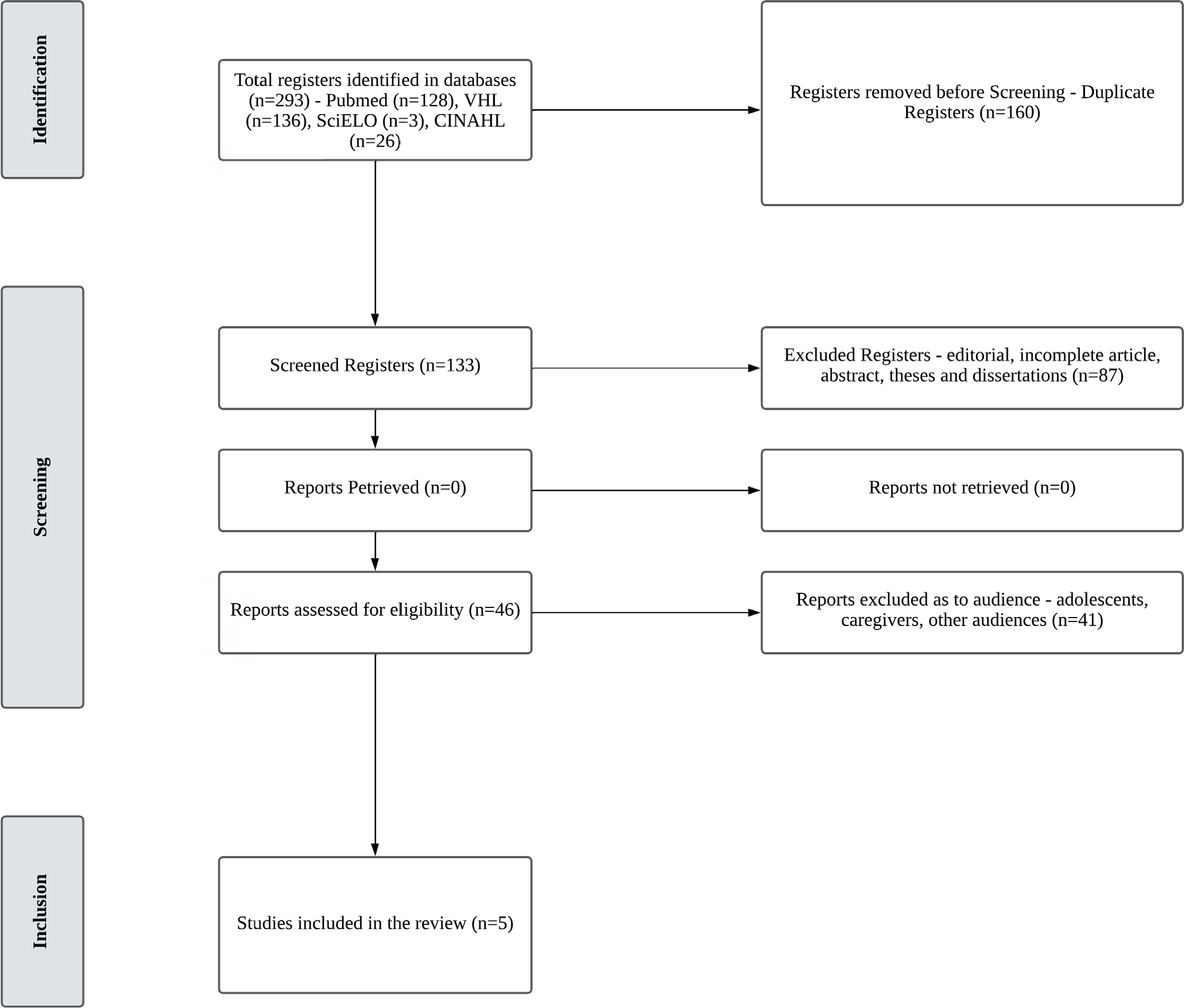
To clarify the process used to include the studies, an adaptation of the PRISMA 2020 Flowchart (Figure 1), used in Systematic Reviews and Meta-Analyses, was drawn up to help the author write the final report12.

Flowchart of the process of identifying, selecting and including studies. Adapted from the PRISMA recommendation. Niterói, RJ, Brazil, 2023
In the end, five studies were selected, and a specific instrument was drawn up in which each article was numbered and presented with the following information: title, authors, year, country, objectives, educational technology, and level of evidence.
The articles were read by two reviewers, a master’s student and a doctoral student, who research children’s health. A third reviewer, a doctoral student in nursing, was consulted in case of disagreements or doubts, minimizing the risk of bias in the study. The findings were grouped at the end into categories to better exemplify the analysis of the results found in the selected studies.
The level of evidence for the studies included in the qualitative synthesis was based on the categorization of the Agency for Healthcare Research and Quality (AHRQ) in the United States. The quality of the evidence is classified into six levels: I-they come from meta-analyses and randomized controlled studies; II-experimental studies; III-quasi-experimental studies; IV-descriptive, non-experimental or qualitative studies; V-experience reports and VI-authoritative opinion reports and/or expert committee reports13.
RESULTS
Five studies were selected (Chart 2) focused on the self-care of children with PA, which highlighted the lack of current, national educational technologies to help with self-care.
The search had a high number of duplicate studies between the Pubmed and VHL databases, with a total of 131 studies (82%) and few results: in CINAHL, with 26 studies (16%), in SciELO only three studies were found (2%), but they were not related to the research. Thus, the five studies selected were found in the Pubmed and VHL databases, with three studies (60%) and CINAHL, with two studies (40%), only in international journals (100%).
The five articles were published between 2007 and 2022 and are predominantly from the United States, with three studies (80%); Jamaica, with one study (10%); and France, with one study (10%). Four studies were published more than five years ago (90%) and there was a predominance of the level of evidence III studies: three quasi-experimental (80%), one randomized clinical trial (10%), and one non-experimental (10%).
The educational technologies evaluated were diverse, with the Mobile being the most used technology, with two studies (n=70%), a game (n=10%), a diary (n=10=%), and a book (n=10%). The authors showed degrees of interventions examining children’s level of understanding of self-care with the disease and understanding of SCA and obtained favorable results on children’s understanding of self-care after applying the technologies. However, according to most authors, more research is needed to validate the technologies found. Chart 3 summarizes the educational technologies analyzed, their interventions, and results.
Thus, the educational technologies for health approaches in children with SCA in the five selected articles were organized into three thematic categories: games, electronic applications, and printed products.
CATEGORY 1 - GAMES
Study A114 created an educational game in CD-ROM format to help children with PA obtain and improve knowledge about the disease, using seven questions in each stage of the game, which were three stages, divided into: facts about the disease; taking care of your health, and pain control. The answers had two or three options and the program indicated which was the correct answer.
The research, carried out in the United States, involved 22 children and adolescents, aged between six and 14, who took a pre-test to determine their levels of knowledge and confidence about the disease; and played the game entitled “The Sickle Cell SlimeO-Rama Game®” on the CD-ROM, and then took a post-test to determine the degree of knowledge they had acquired from the game. However, after playing the game, the researchers observed that it would be difficult to analyze the children and adolescents’ level of understanding with the aid of the application alone. They therefore developed a questionnaire with 15 questions about the content of the game in each round and were able to assess the response rate of the research audience.
The study had a positive outcome, as there was an increase in the children’s knowledge levels after using the game. However, the study suffers from limitations, as according to the researchers, there is a need for further development of educational technologies with people with SCA and a larger and longer clinical trial.
CATEGORY 2 - ELECTRONIC APPLICATIONS
Articles A215 and A518 are educational technologies created and analyzed in terms of children’s adherence to educational programs that help them learn about and subsequently self-care for the disease.
The A215 study carried out in the United States, involved 19 patients aged between nine and 20 and aimed to evaluate the use of an application on a portable electronic wireless device (mobile) to implement a pain management protocol. To do this, it used a “pain diary” in which the children were asked to describe the level of pain that day, how they slept, their participation in activities, and whether they took medication. The records sent via mobile were analyzed for two months and the participants’ adherence to the pain assessment protocol was notable. The study had high rates of participation, daily completion, and satisfaction among the children in using their mobiles to implement the pain protocol, with a positive and encouraging result for the researchers.
The A518 study carried out in France, compared the degree of care for children with SCA during the COVID-19 pandemic using the online therapeutic education program, which was previously only face-to-face. The study compared TEP before and after the start of the pandemic, discussing the differences in participation in the sessions according to the seven departments of Paris, where they were evaluated in groups of six to 10 years, 11 to 14 years, and 15 to 20 years. The six to 10-year-old group had the highest participation in online therapy, with a 45% rate.
During the lockdown, no face-to-face therapeutic education was offered; the sessions could be group or individual via videoconference, according to the parents’ wishes. Adherence to online therapy was well accepted by the children and their parents. According to the researchers, this study was not designed to assess the level of effectiveness in children with SCA but to assess the feasibility of online TEP in the post-pandemic period. In addition, the study points out that the children, aged between six and 10, adapted very well to the use of videoconferencing throughout the study.
CATEGORY 3 - PRINTED PRODUCTS
The A316 study carried out in the United States, used a sample of 20 children aged between six and 11 and created a “pain diary”, which was used extensively by the children during the two months of testing. In the first four weeks, the children were trained on how to use the guided imagery at home individually, except for two siblings who were trained together. All the children were instructed to start testing with the guided imagery for a daily period of five to ten minutes, three times a day. After training in the use of guided imagery, the participants reported significant increases in self-efficacy and reductions in pain intensity, and the use of painkillers also decreased.
The A417 study carried out in Jamaica highlights how a coloring book can improve a child’s level of knowledge about their illness. The coloring book, called “MeToo”, was a material created by a doctor and nurses from the University of the East Indies’ Sickle Cell Unit. The book had 24 pages, with a short text on each page and simple images over the text. They cost very little to produce, around one US dollar each.
In the study, 56 children between the ages of six and 10 were given the book and another 60 were not. An increase in the level of knowledge about SCA was observed in the older children, with no difference between the sexes. However, the researchers concluded that the study design was a limitation, as there was no pre-test knowledge score before the child had the book in hand. However, they stress that the study was satisfactory in demonstrating that a simple book is a playful and easily accessible form of intervention for children with SCA.
DISCUSSION
Based on the analysis of the articles selected for this study, the main educational technologies used to help children with SCA better understand the disease and apply daily care were identified, with printed products and electronic applications being the most widely used.
The results of this review show how important the use of educational technologies is for child development, encouraging self-care and knowledge of SCA These children need continuous care which must be carried out by health professionals, caregivers, and the individuals themselves, initially in a supervised and assisted manner and then autonomously as they develop, acquiring cognitive and motor skills19,20.
Self-care, which is the fundamental component in improving the signs and symptoms of SCA, will be acquired by the child over time and with the help of caregivers and health professionals. In addition, by understanding the disease, children become more active in their self-care20. Studies have shown that a better understanding of the disease begins at school when the knowledge acquired from an early age is put into practice through caregivers and health professionals19. Therefore, for self-care to become effective, it is important to continually develop the individual’s competence in looking after themselves6,19,20.
The five studies corroborate the fact that the use of educational technologies in various forms helps children to take care of themselves, by providing knowledge and strategies to avoid pain crises, as in the study that used a “pain diary”. However, the lack of maturity combined with the child’s unpreparedness can leave them more confused and performing self-care inadequately6,9,21.
Thus, the use of play with children is important and, if done correctly, can have excellent results. Children have a keen intelligence and an easy understanding of subjects that interest them and, with the help of games, electronic applications, and printed materials, this level of knowledge about the disease and self-care will be more present in their daily lives.
Playfulness is an effective way of entertaining the people involved, it is closely linked to the act of playing and is important for children’s learning. They understand that learning can also be fun and get involved in the action22. As we are in a technological age, the use of educational technology by health professionals can be an interactive means of helping children with their self-care, but we must always think about how easy it is to integrate this technology into the child’s day-to-day life6.
Health professionals, especially nurses, must know how to empower children to self-care and, above all, help them to find meaning in the care they receive20. However, it is important to pay attention to what is taught, as well as what is taken to children with chronic illnesses in the form of information. They are still at the beginning of their conception of life in society and the disease itself, so some information can be taken out of context and hinder the progress of treatment21.
It’s important to note that when it comes to people, each one has their individuality and something used for one child won’t always help another23. Thus, children of the same age group will acquire different self-care habits depending on the environment in which they live, which is why nurses need to know how to find the right ways to educate children with their individuality in mind6. The selected studies show that the children accepted the educational technologies imposed on them for the research and had a high level of enjoyment and a better understanding of the disease.
However, most of the educational technologies used come up against the viability of these products for all the children who took part in the studies. The CD-ROM game, for example, was very well received by the public, but it is based on the premise: how could children introduce this game to improve the signs and symptoms of SCA in their daily lives if people had limited access to computers at the time the study was carried out. As well as the other electronic applications used, such as cell phones in 2009.
Even the 2022 study points out that adherence to online therapeutic education was lower in socioeconomically fragile groups18. Despite being in the technological age, the less well-off still don’t have access to technology on a large scale24, which harms studies using electronic technologies.
On the other hand, products created as printed educational technology have greater adherence and better access for children with SCA, but require resources to keep up with demand, which can be overcome by managing health services.
One of the studies pointed out that few articles are developed thinking only about children with SCA18 and the process of identifying, selecting, and including the studies in this IR showed that many researchers prefer to carry out studies with adolescents, caregivers, and other audiences. It is therefore important to also carry out research with children, who will grow up and become stronger in their knowledge of self-care.
For an educational technology to be effective for the target audience, it needs to be methodologically rigorous. When it is implemented in the service, it will serve to improve health education, which is important for maintaining the self-care of the patient for whom it is intended5.
The main limitation of the review was the risk of bias because even with three reviewers, any study runs the risk of distortions throughout the research process.
CONCLUSION
The results of this IR highlight the importance and relevance of creating educational technologies for children with SCA. With technologies, children learn more and take better care of themselves, helping parents and caregivers with issues that improve their health, as they begin to have an active voice and understanding about their illness.
In Brazil, no study using educational technologies for children with SCA was found in the databases searched. This fact increases the relevance of the study and shows the importance of investments around educational technology in health.
This review brings contributions to nursing and other members of the multidisciplinary team who care for children with SCA and need new methods to help them. It also has important implications for the field, as it opens space for new studies on educational technologies for treating children with chronic diseases and helps to create up-to-date practices for future research.
-
HOW TO REFERENCE THIS ARTICLE:Santana RC, Silva LF da, Gama P da SM da, Nascimento L de CN, Silveira ALD da, Moraes JRMM de. Educational technologies for the self-care of children with sickle cell anemia: an integrative review. Cogitare Enferm. [Internet]. 2024 [cited “insert year, month and day”]; 29. Available from: https://doi.org/10.1590/ce.v29i0.96369.
-
*
Article extracted from the master’s thesis: “ELABORAÇÃO E VALIDAÇÃO DE VÍDEO EDUCATIVO PARA O AUTOCUIDADO DE CRIANÇAS ESCOLARES COM ANEMIA FALCIFORME”, Universidade Federal Fluminense, Niterói, RJ, Brasil.
ACKNOWLEDGEMENTS
This study received educational support from the Regional Nursing Council of Minas Gerais (Coren-MG).
This study received financial support from the Minas Gerais State Research Support Foundation (FAPEMIG). Published in the Official Gazette of the State of Minas Gerais: YEAR 132, no. 124, June 28, 2024, p. 37.
References
-
1 Bender MA, Carlberg K. Sickle Cell Disease. GeneReviews® [Internet]. Seattle (WA): [Internet]. University of Washington, Seattle; 1993 [cited 2023 Jun. 12]. Available from: https://www.ncbi.nlm.nih.gov/books/NBK1377/
» https://www.ncbi.nlm.nih.gov/books/NBK1377/ -
2 Ministério da Saúde (BR). Secretaria de Atenção à Saúde. Secretaria de Ciência, Tecnologia e Insumos Estratégicos. Portaria Conjunta Nº 05, de 19 de fevereiro de 2018: aprova o protocolo clínico e diretrizes terapêuticas da doença falciforme. [Internet]. Ministério da Saúde: 2018 [cited 2023 Jun. 12]. Available from: https://bvsms.saude.gov.br/bvs/saudelegis/sas/2018/poc0005_22_02_2018.html
» https://bvsms.saude.gov.br/bvs/saudelegis/sas/2018/poc0005_22_02_2018.html -
3 Ministério da Saúde (BR). Governo federal reforça necessidade do diagnóstico precoce da doença Falciforme. [Internet]. 2022 [cited 2023 Jun. 12]. Available from: https://aps.saude.gov.br/noticia/17715
» https://aps.saude.gov.br/noticia/17715 -
4 Marchese V, Rock K, Harpold A, Salazar A, Williams M, Shipper AG. Physical impairment and function in children and adolescents with sickle cell disease: a systematic review. Arch Phys Med Rehabil. [Internet]. 2022 [cited 2023 Jun. 12]; 103(6):1144-67. Available from: https://doi.org/10.1016/j.apmr.2021.08.022
» https://doi.org/10.1016/j.apmr.2021.08.022 -
5 Oliveira PP, Gesteira ECR, Souza RL, Paula NCP, Santos LC, Santos WJ, et al. Educational technology on COVID-19 for families of children and adolescents with sickle cell disease. Rev. Bras. Enferm. [Internet]. 2021 [cited 2023 Jun. 12]; 74: e20201045. Available from: http://dx.doi.org/10.1590/0034-7167-2020-1045
» http://dx.doi.org/10.1590/0034-7167-2020-1045 -
6 Paiva GS, Morais RCM, Martins G, Nascimento LCN. The knowledge of children and adolescents with sickle cell anemia about their self-care. Res. Soc. Dev. [Internet]. 2022. [cited 2023 Jun. 16]; 11(7): e27311729934, 2022. Available from: http://dx.doi.org/10.33448/rsd-v11i7.29934
» http://dx.doi.org/10.33448/rsd-v11i7.29934 -
7 Ferreira, DP; Gomes Junior, SCS. Mobile applications developed for children and adolescents experiencing chronic health conditions: an integrative review. Interface. [Internet]. 2021. [cited 2023 Jun. 12]; 25: e200648. Available from: https://doi.org/10.1590/interface.200648
» https://doi.org/10.1590/interface.200648 -
8 Mangla A, Ehsan M, Agarwal N, Maruvada S, Doerr C. Sickle cell anemia (Nursing). StatPearls Publishing. [Internet]. Treasure Island (FL); 2022. [cited 2023 Jun. 12]. Available from: https://www.ncbi.nlm.nih.gov/books/NBK568706/
» https://www.ncbi.nlm.nih.gov/books/NBK568706/ -
9 Nascimento LCN, Souza TV, Oliveira ICS, Morais RCM, Andrade MAC. Internalization of care: a qualitative study with schoolchildren living with sickle cell disease. Esc. Anna Nery [Internet]. 2021. [cited 2023 Jun. 20]; 25(21): e20190337. Available from: http://dx.doi.org/10.1590/2177-9465-ean-2019-0337
» http://dx.doi.org/10.1590/2177-9465-ean-2019-0337 -
10 Sousa MNA, Bezerra ALD, Egypto IAS. Navigating the path of knowledge: the integrative review methodfor analysis ans synthesis of scientific literature. Obs. econ. latinoam. [Internet]. 2023. [cited 2023 Jun. 12]; 21(10):18448-83. Available from: https://doi.org/10.55905/oelv21n10-212
» https://doi.org/10.55905/oelv21n10-212 - 11 Polit DF, Beck CT. Fundamentos de pesquisa em enfermagem 7. ed. Porto Alegre: Artmed;2019.
-
12 Page MJ, McKenzie JE, Bossuyt PM, Boutron I, Hoffmann TC, Mulrow CD, et al The Prisma 2020 statement: an updated guideline for reporting systematic reviews. Rev Panam Salud Publica. [Internet]. 2022. [cited 2023 Jun. 12]; 30(46): e112. Available from: https://doi.org/10.26633/RPSP.2022.112
» https://doi.org/10.26633/RPSP.2022.112 - 13 Melnyk BM, Fineout-Overholt E. Evidence-based practice in nursing & healthcare. A guide to best practice. Philadelphia: Lippincot Williams & Wilkins; 2019.
-
14 Yoon SL, Godwin A. Enhancing self-management in children with sickle cell disease through playing a CD-ROM educational game: a pilot study. Pediatr Nurs. [Internet]. 2007. [cited 2023 Jun. 12]; 33(1):60-63. Available from: https://pubmed.ncbi.nlm.nih.gov/17411004/
» https://pubmed.ncbi.nlm.nih.gov/17411004/ -
15 McClellan CB, Schatz JC, Puffer E, Sanchez CE, Stancil MT, Roberts CW. Use of handheld wireless technology for a home-based sickle cell pain management protocol. J Pediatr Psychol. [Internet]. 2009. [cited 2023 Jun. 12]; 34(5):564-73. Available from: https://doi.org/10.1093/jpepsy/jsn121
» https://doi.org/10.1093/jpepsy/jsn121 -
16 Dobson CE, Byrne MW. Original research: using guided imagery to manage pain in young children with sickle cell disease. Am J Nurs. [Internet]. 2014. [cited 2023 Jun. 12]; 114(4):26-36. Available from: https://doi.org/10.1097/01.NAJ.0000445680.06812.6a
» https://doi.org/10.1097/01.NAJ.0000445680.06812.6a -
17 Morrison-Levy N, Knight-Madden J, Royal-Thomas T, King L, Asnani M. Improving disease knowledge in 6- to 10-year-olds with sickle cell disease: a quasi-experimental study. Child Care Health Dev. [Internet]. 2018. [cited 2023 Jun. 12]; 44(3):501-6. Available from: https://doi.org/10.1111/cch.12559
» https://doi.org/10.1111/cch.12559 -
18 Sterlin A, Montalembert M de, Taylor M, Mensah S, Vandaele M, Lanzeray A, et al Impact of COVID-19 pandemic on access to online therapeutic education programs for children with sickle cell disease. J Pediatr Nurs. [Internet]. 2022. [cited 2023 Jun. 12]; 66:179-183. Available from: https://doi.org/10.1016/j.pedn.2022.06.014
» https://doi.org/10.1016/j.pedn.2022.06.014 -
19 Dias JGR, Nogueira RMTBL, Esteves GGL. Sickle cell anemia and the consequences in executive functions: evaluation in children of 6-11 years. Psico. [Internet]. 2021. [cited 2023 Jun. 20]; 52(2): e35786. Available from: https://doi.org/10.15448/1980-8623.2021.2.35786
» https://doi.org/10.15448/1980-8623.2021.2.35786 -
20 Fernandes LTB, Nóbrega VM, Silva MEA, Machado AN, Collet N. Supported self-care for children and adolescents with chronic disease and their families. Rev Bras Enferm [Internet]. 2017. [cited 2023 Jun. 20]; 70(6):1318-29. Available from: https://doi.org/10.1590/0034-7167-2016-0553
» https://doi.org/10.1590/0034-7167-2016-0553 -
21 Lima DS de, Figueiredo SV, Silva ACA da, Rodrigues MENG, Vasconcelos SS, Menezes CP da SR et al Challenges faced by people with sickle cell disease in crisis situations: barriers to emergency. Res. Soc. Dev. [Internet]. 2021. [cited 2023 Jun. 22]; 10(5): e45410515078. Available from: https://doi.org/10.33448/rsd-v10i5.15078
» https://doi.org/10.33448/rsd-v10i5.15078 -
22 Ranyere J, Matias NCF. The relationship with knowledge in school recreational activities. Psicol. ciênc. Prof. [Internet]. 2023. [cited 2023 Jun. 24]; 43: e252545. Available from: https://doi.org/10.1590/1982-3703003252545
» https://doi.org/10.1590/1982-3703003252545 -
23 Teixeira JBC, Morais AC, Santos VEP, Santos DVD, Carvalho ESS, Miranda JOF, et al Nursing protocol for children with sickle cell disease in emergency room: a convergent-care approach. Rev Bras Enferm. [Internet]. 2022. [cited 2023 Jun. 24]; 18(Suppl 2): e20210908. Available from: https://doi.org/10.1590/0034-7167-2021-0908
» https://doi.org/10.1590/0034-7167-2021-0908 -
24 Gomes CPB. Digital exclusion as a form of human rights violation. Rev. Sapiência [Internet]. 2023. [cited 2023 Jun. 24]; 12(4): 337-50. Available from: https://doi.org/10.31668/revsap.v12i4.14682
» https://doi.org/10.31668/revsap.v12i4.14682
-
Associate editor:
Dra. Luciana Kalinke

 Source: The authors (2023), research data.