
 Belo Horizonte 4.0: Airbnb and the regionalization of the lived space
Abstract
In recent decades, the restructuring of the capitalist system has driven the development of communication technologies, defining the digital revolution. Within this context, platforms like Airbnb emerged and have been reshaping markets and social life. This article analyzes Airbnb's impact on the regionalization of the lived space in Belo Horizonte, based on user reviews. The research employs an innovative approach that combines digital data extraction, qualitative analysis, and geoprocessing techniques. Results show that users' perceptions reinforce existing urban centralities while redefining regionalization and the territorial experience in the cities, reflecting symbolic and functional transformations in the contemporary urban landscape.
Keywords:
Airbnb; platform urbanism; regionalization; lived space; Belo Horizonte
Resumo
Nas últimas décadas, a reestruturação do capitalismo impulsionou o avanço das tecnologias de comunicação, marcando a revolução digital. Nesse contexto, surgiram plataformas como o Airbnb, que transformaram mercados e aspectos da vida social. Este artigo investiga o impacto do Airbnb na regionalização do espaço vivido em Belo Horizonte, com base nas avaliações de usuários. Utiliza-se uma abordagem inovadora que combina extração de dados digitais, análise qualitativa e geoprocessamento. Os resultados mostram que as percepções dos usuários reforçam centralidades urbanas já existentes, ao mesmo tempo que ressignificam a regionalização e a experiência territorial nas cidades, indicando transformações simbólicas e funcionais no espaço urbano contemporâneo.
Palavras-chave:
Airbnb; urbanismo de plataforma; regionalização; espaço vivido; Belo Horizonte
Introduction
The capitalist mode of production underwent profound transformations in the closing decades of the twentieth century, entering a sustained period of crisis in its accumulation process (Harvey, 1989). These transformations are manifested in the deregulation of capital flows, the pursuit of outsourcing and cost-cutting strategies, the adoption of flexible production systems, the deterioration of labor conditions, and a marked decline in workers' bargaining power relative to capital. Central to this reconfiguration was a growing investment in data processing and communication technologies, culminating in what has been termed the “digital revolution.” Its most distinctive feature was the widespread adoption of the Internet, coupled with the rapid expansion of mobile telecommunications and the mass diffusion of digital applications across global populations. As a result of capital's drive to accelerate its circulation, the digital revolution ushered in novel business models, most notably the emergence of massive corporate conglomerates that established themselves as monopolistic platforms in newly created arenas of value production. These platform-based enterprises not only restructured existing markets but also catalyzed the creation of entirely new ones, thereby reshaping multiple dimensions of social life (Van Dijck et al., 2018). In the context of urban transformation and the contemporary cityscape, two platforms in particular – Uber and Airbnb – have fundamentally redefined the transportation and accommodation sectors, respectively, and continue to reconfigure the ways in which urban space is navigated, experienced, and imagined (Barns, 2020).
This article examines the impact of Airbnb's diffusion on the spatial configuration of the city of Belo Horizonte, the capital of the state of Minas Gerais, Brazil. We aim to understand how the platform’s sustained use contributes to internal differentiation within the city, through a process of regionalization of lived space (Lefebvre, 1991), mediated by user interactions facilitated by and through the platform. Specifically, we explore how user-generated reviews of accommodations help characterize the neighborhoods in which they are located, either reinforcing or reshaping existing socio-spatial attributes that inform collective perceptions and classifications of urban areas. Our analysis proceeds from the premise that such reviews influence the behavior of other users and contribute to the symbolic construction of place by continually reaffirming or altering its perceived characteristics.
To address this inquiry, we employed an innovative methodological approach that integrates digital data extraction, qualitative content analysis, and geospatial techniques. Our goal was to spatialize (geo) the qualitative perceptions (quali) expressed by Airbnb users, derived from the full set of accommodation reviews posted in Belo Horizonte during the year 2024. The Internet enables novel possibilities for social research, particularly through the large-scale collection of digital traces left by users. When harvested through data extraction techniques such as web scraping, these traces yield datasets (big data) that can be interpreted as spatial and behavioral indicators embedded in platform activity. This approach grants access to domains of analysis previously accessible only through extensive surveys, and allows for the identification of spatial patterns of regionalization within the city, grounded in the subjective experiences and evaluations shared by platform users.
The findings of this investigation suggest that, while user perceptions recorded on Airbnb tend to reinforce pre-existing urban centralities, they also reveal significant dichotomies in the interpretation of lived space. Moreover, the data point to a redefinition of the scales of urban spatial regionalization, indicating more complex dynamics and nuanced understandings of how territories are perceived and organized. These shifts reflect the symbolic power of digital platforms to reconfigure urban space, promoting interpretations that challenge traditional notions of centrality and ascribing new meanings to urban areas within the contemporary context.
In addition to offering insights into the urban dynamics of the selected municipality, this article advances a methodological innovation that emerges organically from the very phenomena under examination. The pervasive use of Airbnb facilitates access to spatialized user-generated data that spans nearly the entire municipal territory. Crucially, the platform allows guests to leave detailed reviews of their accommodations – narratives that frequently extend beyond the properties themselves to include subjective impressions of the surrounding neighborhoods. By employing qualitative data analysis techniques, these reviews can be systematically coded to uncover embedded spatial patterns and interpretive frames. When coupled with geospatial analysis methods, this approach yields the regionalization of perceptual attributes and offers a nuanced understanding of how different parts of the city are experienced and represented by those who move through them. Such an integrative framework captures not only the material dimensions of urban space, but also its symbolic and affective geographies.
This methodological innovation holds considerable academic potential, as the approach can be readily replicated in any municipality where the platform operates – which, as of today, includes nearly half of all municipalities in Brazil. As such, it opens new avenues for scalable, data-driven research into urban perception and socio-spatial dynamics mediated by digital platforms.
Transformations in capitalism and platforms
The transformations in the capitalist accumulation regime witnessed in the early decades of the 21st century represent the continuation and intensification of structural trends already emerging in the final two decades of the 20th century. As Castells (1999) argues, these developments culminated in the formation of a new social structure – the “Network Society” – defined by the reorganization of all core dimensions of social life around dynamic, interconnected networks. Although network- -based forms of organization have long existed in human history, what distinguishes this new era is the scale and complexity enabled by digital technologies. These technologies have facilitated an unprecedented expansion and reconfiguration of networks, surpassing the spatial, temporal, and organizational constraints of earlier models. According to Castells, this structural transformation was driven by the imperatives of an increasingly globalized financial market and profound shifts in the production and distribution of goods and services. As a result, new strategic nodes emerged – alongside the reconfiguration of existing ones – through which global capital flows are coordinated and controlled, fundamentally reshaping the spatial and functional architecture of contemporary capitalism.
The information technology revolution played a pivotal role in facilitating a major restructuring of the capitalist system beginning in the 1980s. This transformation replaced the Keynesian model of capitalist growth, which had underpinned the prosperity of the post--war economic order. That Keynesian period, which spanned nearly three decades after World War II, began to reach its structural limits in the early 1970s. Mounting inflationary pressures and systemic overproduction – emerging from internal contradictions within the capitalist system – sparked a decisive turn toward deregulation, privatization, and the dismantling of the social contract between capital and labor, both institutionally and at the level of corporate governance.
Technological innovation and organizational transformation – centered on flexibility and adaptability – were absolutely vital in accelerating and sustaining this capitalist restructuring (Castells, 1999). According to Castells, the informational era marked the rejuvenation of the capitalist system, distinguishing the contemporary period from the earlier industrialist era. On the financial front, the radical dominance of accumulation driven by capital valorization in its financial form has led some scholars to argue that we now live under a form of “Techno-feudalism,” rooted in the dominance of fictitious capital (Duran, 2024). On the production and service delivery side, emerging technologies can be seen both as extensions of deeper capitalist imperatives and as harbingers of a new regime of accumulation. A defining trait of capitalism is its inherent demand for continual technological transformation.
In this context, the so-called “Fordist” model began to unravel during the 1970s as global production reached a saturation point marked by overcapacity and overproduction, driving down the prices of manufactured goods. This profitability crisis – fueled by persistent international competition, excess productive capacity, and downward pressure on prices – was a catalyst for the development of information and communication technologies (ICTs). These technologies enabled the relocation of numerous services and accelerated the trend toward outsourcing, which had already begun in the 1970s. As coordination costs fell sharply with the advent of global communications and increasingly efficient supply chains, it became far easier to construct and manage complex global production networks.
Capitalism, when faced with crisis, tends to restructure itself. New technologies, organizational forms, modes of exploitation, types of employment, and markets emerge as mechanisms to enable renewed capital accumulation. In response to the overcapacity crisis of the 1970s, the manufacturing industry sought recovery by attacking labor protections and embracing increasingly lean business models. Following the crisis of the 1990s, internet-based companies pivoted toward business models that monetized freely available resources. The subsequent decade saw tech firms amass unprecedented levels of power and capital, reshaping the global economic landscape.
The convergence of transformations in the accumulation regime with the widespread adoption of digital technologies gave rise to a radically new model of business and labor management. According to Srnicek (2016), after a prolonged decline in manufacturing profitability, capitalism turned to data as a means of sustaining economic growth and systemic vitality. In the 21st century, amid sweeping digital transformations, data became increasingly central to corporate strategies and to relationships between firms, workers, customers, and other capitalists. It is within this context that “platform enterprises” emerged as a defining business model.
Because the internet constitutes a general-purpose technology (Perez, 2002), it permeates all spheres of human activity, transforming fundamental experiences of time and space. In Platform Capitalism, Srnicek (2016) employs the concept of the “platform” to describe a new form of economic and corporate organization in which the business model revolves around creating and managing digital infrastructures that facilitate interactions between distinct user groups – such as producers and consumers. These platforms act as intermediaries, optimizing transactions and value generation through the collection and analysis of vast amounts of data.
Building on this framework, Van Dijck et al. (2018) extend the notion of a “platform economy” to a broader conceptualization of a platformized society. Drawing from Castells’ concept of the “Internet Galaxy,” they argue that the evolution of this phase of capitalism has led to such a deep entanglement between the digital and the analog that even the boundaries between the public and private spheres are increasingly blurred. This convergence has produced a new amalgam of goods, flows, and social relations, shaping the trajectory of a platformized economy as a central mediator of attention, connectivity, and sharing among individuals and communities. The outcome is the consolidation of a global society governed by a platform ecosystem, featuring a distributed organizational hierarchy across market actors, state institutions, and civil society, as well as various spheres of production and consumption that reproduce social identities and community life.
Within this platform ecosystem, each “corporate unit” is embedded in the global system’s hierarchy – both through transactional flows with other platforms and institutional actors, and through the analog--digital integration that occurs across macro and micro-social dimensions. This dynamic reinforces the reproduction of individual and collective identities. In this context, scholars have identified the emergence of a post- -materialist society of connected individualism (Lee & Wellman, 2012; Papacharissi, 2010; Couldry; Hepp, 2016). Here, a new “social operating system” (Lee; Wellman, 2012, p, p. 7) enables digitally mediated, continuous, and territorially expansive social engagement – both virtually and materially. Srnicek (2016) classifies platforms according to their modes of operation, while Van Dijck et al. (2018) highlight how the platform economy has reshaped the attention economy, influencing the business models underpinning sharing practices and digital interaction.
Digital platforms like Airbnb, as discussed by Srnicek (2016) and Van Dijck et al. (2018), exert a profound influence not only on economic structures and labor dynamics but also on how we perceive and interact with both physical and digital spaces. These platforms operate at the intersection of a deeply mediatized social life – where digital technologies enable a phenomenologically intense and expansive engagement with the world. As Couldry and Hepp (2016) argue, we now construct transmaterial categories of social understanding – representations that emerge between the digital and the analog, the virtual and the real, the online and the offline (Cubitt, 2006). This blending facilitates a cognitive, experiential, and affective amalgam of space-time perception, in which social interactions unfold – whether through face-to-face encounters or through simultaneous analog and digital co-presence.
This digital-physical intersection refers to the increasing entanglement and mutual influence between these realms, as their boundaries become progressively porous and fluid, fundamentally reshaping our experience of proximity, spatiality, and everyday life. From an interactionist and cognitivist perspective, transactions between online and offline domains – mediated by platform ecosystems – contribute to the construction of an interconnected Self, one that is continuously quantified through big data and monitored by algorithmic systems. This mediated Self is central to understanding the dynamics of platform society and its implications for the attention and sharing economy, exemplified by business models such as Airbnb.
Within the digitally mediated sociabilities of contemporary urbanism, individuals and groups – whose identities are phenomenologically and transmaterially interconnected – continuously reinterpret and negotiate representations of lived and perceived space. These shifting representations contribute to a renewed social logic of regionalization, one that fuses localized, face-to-face interactions with virtualized, mediatized spatial experiences.
In the context of what Sassen (1991) called financial-informational domination, capital and information flows penetrate all aspects of social life, transforming urban spaces into financial assets and driving the financialization of territory. This transboundary dynamic reshapes urban space and conditions everyday life within cities, resulting in what Barns (2020) terms platform urbanism – a model wherein cities are increasingly structured and governed by digital platforms that orchestrate flows of data, capital, and services. These platforms, acting as urban intermediaries, intensify the commodification of space and social practices, embedding financial logics into the very fabric of urban life.
The concept of the “City 4.0” fits within the broader framework of the Fourth Industrial Revolution, a convergence of digital technologies, artificial intelligence, big data, the Internet of Things (IoT), and automation that is reshaping economic, social, and urban organization (Schwab, 2019; Ratti & Claudel, 2016). In the urban context, this project materializes through the intensification of data--driven, managerial approaches associated with smart cities—now rearticulated through the principles of platformization and surveillance capitalism (Zuboff, 2019; Van Dijck et al., 2018). The City 4.0 is not simply about integrating innovative technologies into urban governance; it represents a new political-economic rationality grounded in data extraction, on-demand services, and algorithmic intermediation. These transformations directly affect patterns of circulation, consumption, housing, and territorial control (Sadowski, 2020; Morozov & Bria, 2018). In this scenario, digital platforms function as sociotechnical infrastructures that mediate urban relationships through corporate digital systems, becoming central agents in the contemporary production of urban space (Barns, 2020). By intermediating services such as mobility, accommodation, delivery, and security, these platforms reconfigure socio- -spatial dynamics, entrenching specific modes of accumulation and exacerbating urban inequalities—fully aligned with the broader principles of digital capitalism (Srnicek, 2016; Graham, 2005).
Airbnb and the production of urban space
The expansion of digital platforms has significantly intensified the commodification of urban space by promoting the commercialization of goods and services. Platforms such as Airbnb facilitate a wide range of short-term rentals, attracting tourists in search of more "authentic" and less commercialized experiences than those typically offered by the traditional hotel industry (Hamari, Sjöklint & Ukkonen, 2015). However, Airbnb’s operations have had a substantial impact on real estate markets, driving up housing prices and accelerating processes of gentrification in strategically located urban neighborhoods – a phenomenon scholars have termed “digital gentrification” (Wachsmuth & Weisler, 2018). In cities such as Barcelona and Lisbon, Airbnb has played a central role in reshaping traditional neighborhoods, often displacing long-time residents to peripheral zones (Cocola-Gant & Gago, 2019). In Paris, Cerqueira (2021) analyzes the platform’s expansion, noting how its early concentration in already gentrified areas has gradually extended into the periphery, reinforcing broader urban transformation dynamics. These developments have sparked growing debate around the need for regulatory frameworks to mitigate the negative effects of short-term rentals (Falk & Scaglione, 2024).
While Brazil represents the most significant market for short-term rental platforms in Latin America, research on the socio-spatial impacts of Airbnb remains relatively scarce. One major obstacle is the limited availability of granular data, as platforms like Inside Airbnb tend to offer open-access datasets predominantly for tourist-heavy cities in the Global North. Among the limited but growing body of Brazilian literature, a few key studies stand out for examining Airbnb’s influence on urban dynamics in major metropolitan areas. Lima et al. (2023), for instance, show that Airbnb prices in Rio de Janeiro are closely linked to proximity to tourist attractions, income levels, and the appeal of unique experiences in favelas – all of which contribute to reshaping urban development and housing availability. Similarly, López-Gay et al. (2019) observe that in São Paulo, Airbnb has become particularly prevalent in highly elitized zones, already subject to prior waves of urban improvement and renewal.
Recent investigations have underscored how the expansion of Airbnb reinforces neoliberal logics in the production of urban space, a pattern observable across various global contexts (Santos et al., 2021). In addition to the studies mentioned, Tambelli (2020) reports that as of 2020, approximately 14% of Airbnb hosts in São Paulo – those with multiple listings – accounted for nearly one-third of the city’s bookings, highlighting the growing market concentration and professionalization of hosting. Beyond Brazil’s major metropolises, scholars such as De Souza (2021) and Martoni et al. (2023) have analyzed Airbnb’s role in smaller tourist destinations like Ouro Preto, Gramado, and Capitólio, raising critical questions about the need for tailored regulation in these contexts as well.
Yet, to date, no study has systematically explored Airbnb in Brazil from the perspective of spatial perception as expressed through user reviews. This analytical lens is especially valuable, as reviews are not merely individual accounts of personal experience; they constitute a form of collective discourse that both shapes and reflects how urban spaces are perceived, represented, and valued in the digital environment. By examining these digital narratives, scholars can gain deeper insight into how platform users interpret, co-construct, and ultimately influence the symbolic and material dimensions of urban space.
Spatial regionalization and cognitive sociology
Region is one of the most widely disseminated and longstanding concepts in both Geography and related disciplines that deal with processes of regionalization. A compelling feature of this concept is its resilience and adaptability: despite recurring claims of its obsolescence, the notion of region continually resurfaces in new forms, evolving alongside transformations in the social space it seeks to explain. At its core, regionalization reflects a cognitive process of spatial differentiation, whereby certain areas of geographic space are distinguished based on particular criteria. As an intellectual method, regionalization may be conducted in various ways, depending on the analytic scale and criteriaadopted. In some scientific approaches, the region is seen as a heuristic construct – a tool used by researchers for analytical purposes. In others, it is treated as an empirical fact, a clearly discernible reality in the field that demands recognition and interpretation (Haesbaert, 2004).
Regionalization can also be understood beyond academic frameworks – as a widespread human practice rooted in everyday life and common sense. In popular understanding, a region is typically regarded as a bounded portion of spacecharacterized by certain shared features. From this perspective, regionalization can be pursued inductively, drawing from lived experience and the way individuals perceive and segment the space they inhabit. Aligned with what Haesbaert (2004) refers to as a phenomenological cultural matrix, the region in lived space emerges in association with regional identities, subjective experiences, and interpretations of place. In this sense, regionalization stems from the concrete actions of social actors who actively construct regional articulations and segment the social space they inhabit through cognitive and practical engagement.
This analytical framework underpins the approach taken in the present article. The uneven spatial organization of post- -Fordist capitalism has rendered the process of regionalization increasingly complex, as formerly stable territorial boundaries become fluid and contested (Massey, 2005). Within this context, new forms of regionalization are emerging – facilitated in part by digital technologies that allow researchers to capture previously inaccessible dimensions of spatial experience. One such dimension is the perception of lived space and the new modes of spatialization of the urban environment made possible through digital platforms.
A key point in understanding this cognitive perception of regionalization is the distinction between how urban space was experienced and conceptualized in the pre- -digital era, and how these processes unfold in the platform society. One key hypothesis is that the rise of “Networked Individualism” (Lee & Wellman, 2012), driven by digital technologies, has given rise to new forms of social interaction that operate across integrated space-time vectors, linking the online and offline worlds. These interactions reshape the material and virtual dimensions of reality into a dialectical synthesis of individual and collective actions, no longer confined to fixed, disconnected, or immutable space-time units. Instead, they contribute to a reconfiguration of urban categories, bridging the phenomenological gap between the hyperlocal and the global (Couldry & Hepp, 2016).
In this sense, the emergence of platform society coincides with the factual existence of the hyperconnected Self – a subject monitored, quantified, and embedded within multiple space-time dimensions (Papacharissi, 2010; Chayko, 2017; Lupton, 2016). In platform society, community life and identity formation are deeply anchored in the attention economy, which stimulates reflective engagement with reality. As individuals and groups interact through media on multiple scales, they cultivate new ways of knowing and perceiving urban space. These mediated experiences foster alternative representations of place, grounded in both the material environment and its digital reconfigurations.
Thus, the sector-specific platform economy exemplified by Airbnb (Srnicek, 2016; Guttentag, 2019) reinforces its logic of production and consumption through the cognitive distribution of mental states – such as intentionality and affect – and social mirroring among individuals integrated into diverse reference groups. These dynamics converge in phenomenological experiences of place, generating identification with lived space and shaping spatial and relational parameters that constitute urban landscapes. Through the digital mediation of space, social actors experience places phenomenologically and connect to collective narratives or representations expressed in platform-generated reviews.
As Wellman et al. (2006) argue, the technological expansion of communication via the Internet has enabled greater integration of social ties across multiple scales, connecting local neighborhoods to global networks. Thus, Airbnb should be understood as a sociotechnical device embedded in the platformized social system, operating according to the logic of the attention economy. The empirical effects of platformization in the hospitality sector are deeply tied to the practical logic of how individuals experience and perceive space – processes that are mediated through the platform and that produce transformative impacts on environments and landscapes. This perspective helps understanding why previous studies have found that Airbnb reviews tend to exhibit a general positivity bias (cavique et al., 2022). The literature suggests that reviews on sharing economy platforms are often more positive than those in traditional sectors, partly because guests’ expectations are more realistic when it comes to peer-to-peer accommodations, where property descriptions are provided by hosts rather than corporate marketing (Santos et al., 2020; Melián- -González, 2020).
Methodological strategy
This article investigates the impact of Airbnb’s proliferation on the configuration of urban space in Belo Horizonte, the capital city of Minas Gerais, Brazil. It aims to understand how the continuous use of this platform contributes to the differentiation of intra- -urban spaces through a user-driven process of spatial regionalization. This process unfolds as users interact with the platform and with each other, shaping representations of place. The study shows how user-generated reviews not only characterize the accommodations but also reinforce – or in some cases subvert – the symbolic attributes historically used to classify urban areas. We begin from the premise that these reviews guide the decisions of future users and reify place-based characteristics by reiterating them over time.
The analytical strategy for this case study involves a novel research approach that combines digital data extraction, qualitative analysis, and geospatial techniques. Our goal was to geolocate (geo) the subjective perceptions (quali) of platform users by scraping reviews of all Airbnb listings in Belo Horizonte in the year 2024. The internet has enabled new forms of social research by allowing for the large-scale collection of “digital traces” left by users online. Once extracted through web scraping, these traces generate datasets (big data) that can be analyzed as spatial and behavioral attributes embedded within the platform. This approach grants access to insights that were previously only possible through large-scale surveys, enabling us to identify emergent patterns of urban regionalization grounded in users’ lived experiences and perceptions.
Digital platforms such as social media, mobility apps, and geolocation systems make it possible to map behavioral patterns and trace social networks, shedding light on how individuals and groups interact with urban space. These new data sources and analytical tools overcome traditional methodological barriers and enable the exploration of dynamic processes such as spatial segregation, gentrification, and population flows in real time. The spatial analysis of cities gains new depth and complexity with the integration of digital traces, facilitating real-time understanding of urban dynamics across multiple scales. Cities are no longer just collections of physical infrastructure; they are evolving ecosystems of data production. Everyday interactions, mobility patterns, consumption behaviors, and information flows are constantly captured by sensors, apps, and digital networks.
The ability to analyze real-time spatial data profoundly transforms the concept of lived space, as theorized by Lefebvre (1991) – a subjective and experiential dimension of space that emerges from everyday practices and social interactions. In this context, Lee and Kang (2015) argue that digital technologies foster new forms of regionalization and sociability, pushing the boundaries of conventional spatial analysis. By incorporating real-time data, we are able to uncover symbolic and relational dimensions of urban space that were previously invisible. This perspective highlights how digitally mediated practices shape spatial perceptions and representations, contributing to a continuously reconfigured lived space, co--produced by human and technological agents. From this standpoint, digital technologies do not merely measure space – they actively mediate and redefine the meanings and uses of urban environments, offering a more nuanced understanding of contemporary processes of regionalization and sociability.
For this study, we collected georeferenced data from Airbnb using the web scraping platform Apify. The resulting database, which includes approximately 3,500 listings, provides a rich array of information such as geographic location, price, property type, ratings, and user reviews. Our primary methodological contribution lies in the qualitative analysis of 17,163 guest reviews. Due to platform constraints, data collection was limited to the first ten reviews per listing. Initial coding was performed automatically in R using a set of keywords and phrases related to urban space and accommodation features.
Subsequent manual coding followed the methodology proposed by Adu (2019), identifying empirical indicators – text segments (sentences) whose content relates to the characterization of the surrounding neighborhood. These indicators were then labeled using open coding (Saldana, 2009), a technique that assigns concise, meaningful textual tags to segments of qualitative data.
The analysis yielded two main categories. The first concerns location, including proximity to daily services, nightlife (bars and restaurants), tourist attractions, and accessibility via walking, public transit, or Uber. The second focuses on binary perceptions of the surrounding environment, specifically safety vs. insecurity and tranquility vs. noise.
To explore these categories spatially, we used two geovisualization strategies. For location-based characteristics, a point distribution map was created, where each review was georeferenced to the corresponding accommodation, and specific traits (e.g., proximity to services) were visualized using distinct colors. For dichotomous perceptions, we applied a dasymetric grid of 200x200 meters across the city. Each cell received a binary classification: 1 if at least one review within that cell mentioned a given characteristic (e.g., safety), and 0 if not. We also flagged cells that contained contradictory perceptions (e.g., mentions of both safety and insecurity). The resulting maps classify zones as “safe,” “unsafe,” or “contradictory,” based on user-generated reviews. By leveraging user-generated data, our study illustrates how the digital mediation of urban experience contributes to the symbolic production of space. It reveals how platforms like Airbnb not only facilitate the circulation of people and capital but also play an active role in shaping the sociospatial imaginary of cities.
Results
According to the website Airdna.com, the number of Airbnb units in Belo Horizonte totaled 4,803 accommodations as of December 2024. Of these, approximately 65% were entire apartments, while 33% were individual rooms. The spatial distribution of these accommodations is illustrated in Figure 1, using a Kernel density map. This technique is widely used in spatial analysis to identify patterns of concentration. The Kernel method generates a continuous surface that represents point density across an area by calculating the intensity of occurrences (in this case, accommodations) at each location. A bandwidth of 750 meters was applied, which defines the radius of influence around each point used in the density calculation. In other words, each listing contributes to the density within a 750-meter radius, with its influence decreasing as distance increases.

The map illustrates that listings are concentrated in areas characterized by a strong presence of services and urban centralities related to leisure and business. The highest concentration of accommodations is found in the central region and the Savassi area—a bustling and vibrant district renowned for its cultural, gastronomic, and nightlife offerings. Additional clusters of listings are located in the Pampulha area, a key tourist destination and home to the state’s largest university, as well as around the neighborhoods of Buritis and Belvedere, affluent and upscale areas with luxury commerce and services.
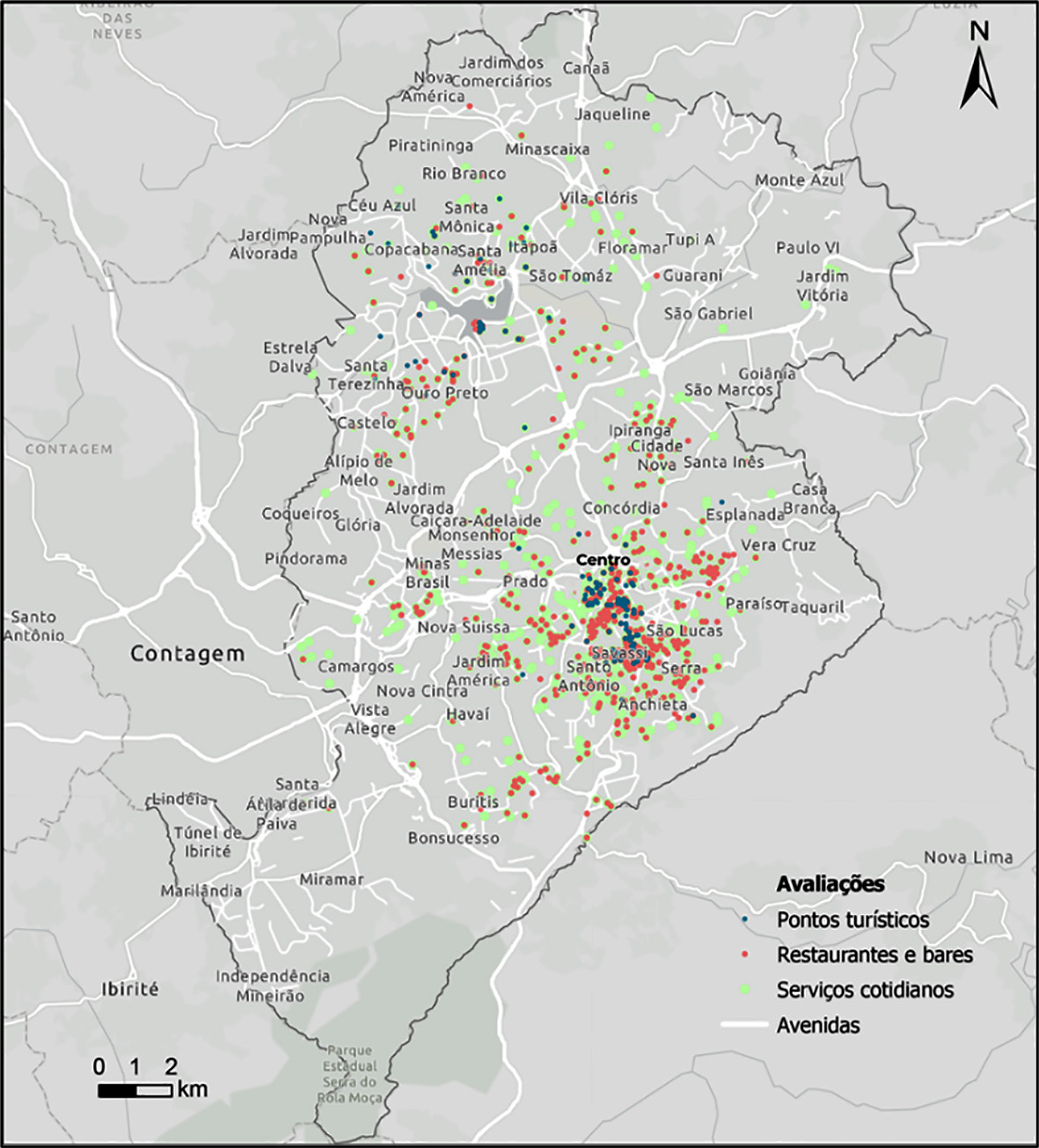
User reviews indicate that location is one of the most valued aspects when choosing a place to stay and is often central to how guests describe their overall experience. To better understand how this is conveyed, reviews that emphasized location were categorized into three groups: proximity to everyday services (e.g., bakeries, supermarkets, pharmacies), proximity to nightlife (e.g., bars and restaurants), and proximity to tourist attractions. Figure 2 presents the breakdown of these categories, showing that a significant portion of user comments focuses on access to everyday amenities, especially in the central and pericentral areas of the city. These essential services enhance the attractiveness of these regions by meeting practical needs of both residents and visitors.

The reviews further suggest that social interaction and access to nightlife services are key factors in the choice of accommodation. Neighborhoods with a vibrant nightlife and a diverse gastronomic scene emerge as centralities constructed through tourists’ pursuit of cultural and leisure experiences. Regarding proximity to tourist attractions, the concentration of positive comments is again centered in the downtown area – particularly where urban infrastructure is consolidated and cultural sites are abundant. These neighborhoods are frequently visited by tourists eager to explore the city’s highlights, reinforcing the role of the central-southern region as a tourist convergence zone.
The analysis of these three dimensions reveals an overlap of urban centralities in the south-central part of Belo Horizonte, suggesting a multifunctional space that integrates everyday services, leisure, and tourism. In contrast, peripheral areas receive few or no reviews, highlighting the unequal distribution of urban attractiveness and use of space.
Thus, visitors' positive assessments of location appear to be heavily influenced by already consolidated urban centralities, which structure the dynamics of space. The concept of centrality refers to areas that play a crucial role in urban organization by concentrating economic, cultural, institutional, or leisure activities and offering greater accessibility and infrastructure (Christaller, 1966; Merlin & Choay, 1988). While Belo Horizonte has historically been characterized by a monocentric structure, Airbnb reviews also reflect the emergence of secondary centralities of interest within the urban space. These new nodes – often tied to the expansion of services and the strengthening of cultural or gastronomic hubs – are beginning to attract visitors and compete with the traditional city center, signaling contemporary shifts in the use and value of urban territory. Therefore, the reviews do not merely reflect visitor perceptions – they also reaffirm and strengthen pre-existing urban centralities. As guests recount their experiences, they recognize and emphasize traits that are historically and functionally tied to those regions. Phrases like “excellent location” or “close to everything” are frequently repeated, reinforcing the role of centralities in shaping visitor choices.
Additionally, a second layer of analysis was developed, focusing on transportation and accessibility – factors frequently mentioned in Airbnb guest reviews (Figure 3). A dominant theme in the comments is the ease of accessing services via specific modes of transportation, which guests deem important when selecting their stay. Walking access to everyday services and tourist attractions is particularly highlighted. In contrast, references to other modes – such as public transit and app-based transportation (e.g., Uber) – are less frequent and appear more geographically dispersed.

The content of the reviews allows for a deeper exploration of users’ perceptions, highlighting more subjective aspects of the experience in the area where the accommodation was located – going beyond practical considerations such as access and location. In this regard, it becomes possible to understand how guests evaluated the region in terms of safety, peacefulness, and noise levels. To map the reviews that mentioned these characteristics, the territory of Belo Horizonte was divided into a dasymetric grid of 200x200 meters, identifying the presence (or absence) of at least one of the evaluated aspects (Figures 4 and 5).
Since the spatial distribution of these attributes was relatively similar – although the frequency of reviews referencing each varied significantly – we opted to plot, in a single figure, the points corresponding to reviews that stated the accommodation was located in either a quiet or noisy area. As many locations received both types of evaluations, we also plotted the points that were described by multiple users as both noisy and quiet (Figure 4). While this may seem paradoxical, such situations are common in qualitative data, where the evaluation involves a high degree of subjectivity based on individual user experience. Contingent aspects of the stay may also lead to differing assessments of the same location: a place that was quiet on one day might be perceived as noisy by another guest staying there at a different time. This can be due to construction work, cultural events, or simply the variation in accommodation use across days of the week or seasons of the year.

Tranquility is valued across a wide range of locations, including central, pericentral areas and the Pampulha region, indicating the importance of quiet environments for guest comfort. Purves and Wartmann (2023) show that, in geographic studies, the notion of tranquility is complex and multifaceted, involving the interplay between the physical environment and individual perception, and is considered an example of a cultural ecosystem service. According to the authors, tranquility can be defined as a state of peace and contemplation, promoted by visual and auditory stimuli and the absence of disruptive factors such as mechanical noise and large crowds.
Conversely, many visitors describe the central region as noisy, particularly due to heavy traffic, active commerce, and nightlife, suggesting an ambivalent perception of centrality: simultaneously functional and uncomfortable. This tension reveals nuances in the urban experience mediated by Airbnb, in which guests assess not only accessibility but also the sensory and emotional impact of the space. While tranquility appears to be a desirable attribute in residential or leisure areas, noise is often associated with vibrant environments that may be less suitable for longer stays. Thus, the dichotomy between tranquility and noise also reflects the social and symbolic uses of space, as well as the expectations and needs of different user profiles.
The analysis of perceptions of safety/unsafety indicates a decentralized pattern of locations evaluated exclusively as unsafe (Figure 5). In contrast, mentions of safety are found throughout the city, including in the central region. It is noteworthy that safety and unsafety overlap in a concentrated area in the city center. Reviews particularly highlight the nighttime as the most critical period, associated with poorly lit and less busy streets. Furthermore, a frequently mentioned element in this context is the presence of people experiencing homelessness, which in some reviews is linked to negative perceptions of safety. Additionally, the feeling of insecurity aligns with the concept of fearscapes (Tuan, 2006), in which the perception of insecurity is shaped by both physical and social elements of the space, such as the quality of infrastructure and the socioeconomic profile of those who occupy it.

The distribution of attributes is complex and challenges the common-sense characterizations of different parts of the city. There are quiet central locations and low- -density areas perceived as noisy. Even more analytically interesting is the overlap of places described as both quiet and noisy. Although these are scattered throughout the municipality, they are concentrated around the central areas—similarly to areas evaluated as both safe and unsafe. These overlapping zones point to the need to understand evaluations on a smaller spatial scale than those typically used to characterize the city through labels like “quiet,” “noisy,” or “safe” neighborhoods or streets. Users' perceptions even indicate that a single point can shift between these two states. This suggests that processes of regionalization are dynamic and follow the rhythm and temporal shifts of an ever-changing urban space.
Discussion
The results highlight how economic dynamics driven by digital platforms intertwine with daily perceptions and experiences, reshaping territories and urban centralities. This approach has made it possible to understand how urban space is reorganized both materially and symbolically. The regionalization of space – understood here as a process through which urban areas acquire specific characteristics based on practices, flows, and narratives – was observed not only through the concentration of Airbnb units in strategic locations but also through the collective perception of those places. Visitors’ perceptions reveal how lived space is affected by tensions between everyday appropriation and the economic interests that shape the space as conceived by investors and digital platforms. These perceptions are key to understanding how certain spaces come to be seen as “global destinations” or status symbols, while others remain marginalized and stigmatized. In this sense, regionalization is not only a geographical phenomenon but also a symbolic one, guided by the interaction between global and local narratives.
Access to Airbnb review data enables the observation of spontaneous regionalization processes (perceptions of lived space) in an innovative way. The analyses show, at a first level, that the location of listings confirms and reinforces urban centralities. However, the details of users’ impressions on the platform indicate that their assessment of urban space reveals overlapping dichotomies in coinciding or neighboring spaces, alongside spaces exclusively characterized by attributes such as tranquility or safety. This exercise challenges crystallized perceptions of urban space present in the social imagination. It also indicates that the traditional scale of thinking about the city (neighborhoods, regions) needs to be reconsidered, as individuals also regionalize space at a smaller, perceptual (micro) and temporally dynamic scale.
The restructuring processes of the capitalist accumulation regime, deeply anchored in the sociotechnical structure of the digital revolution, have led to a fragmentation of urban space, in line with the arguments of Graham and Marvin (2001). According to the authors, the powers of new information technologies support the complex restructuring of urban forms, lifestyles, and landscapes. This restructuring is based on parallel processes of fragmentation and recombination of urban uses and functions. Information technologies support the renucleation of spaces and activities that had been separated into zones of single use during the development of the industrial, functional city.
Graham (2005) highlights the role that software and its algorithms play in this process, as technologized environments based on code continuously and invisibly classify, normalize, and demarcate vast and distant domains. According to him, new technologies are deeply involved in the subtle and fine- -grained transformations of place- and space--based social worlds. With their tendency to exaggerate and reify homogeneously constructed “ideal type” neighborhood profiles – and thus ossify spatial and social classifications – these technologies have shown themselves to be deeply embedded in the redesign of spatial location.
Finally, regarding the academic contribution of this article, the research reinforces the relevance of adopting hybrid methodological approaches to better understand the complex relationships between urban transformations, digital platforms, and socio-spatial experiences. The proposed methodology articulates data from digital platforms such as Airbnb, which allow for large-scale quantitative analysis, with the perception of lived space, offering a multifaceted perspective on the impacts of these platforms on the urban environment. The methodological model developed is replicable in other urban contexts, providing tools for comparative studies that combine big data analysis and qualitative methodologies. This replicability is particularly important in contexts marked by the growing influence of digital platforms on urban spaces and ways of life, strengthening the connection between large-scale analyses and the richness of local experiences – essential for the formulation of public policies that foster more inclusive and balanced cities.
Acknowledgments
This research was funded by the Research Support Foundation of the State of Minas Gerais (Fundação de Amparo à Pesquisa do Estado de Minas Gerais – Fapemig), under grant number APQ-01640-24.
References
- ADU, P. (2019). A step-by-step guide to qualitative data coding Londres, Routledge.
- ANDRADE, J. N.; ARAÚJO, C. P. DE; CRISTINO, C. T. (2024). Incidência e repercussões do Airbnb: o caso do Rio de Janeiro. Oculum Ensaios, v. 21, pp. 1-20.
- BARNS, S. (2020). Platform urbanism. Negotiating platform ecosystems in connected cities Singapore, Palgrave MacMillan.
- BRIA, F.; MOROZOV, E. (2020). A cidade inteligente: tecnologias urbanas e democracia. São Paulo, Ubu Editora.
- BULCHAND-GIDUMAL, J.; MELIÁN-GONZÁLEZ, S. (2020). Why are ratings so high in the sharing economy? Evidence based on guest perspectives. C urrent Issues in Tourism, v. 23, n. 10, pp. 1248-1260.
- CASTELLS, M. (1999). A sociedade em rede São Paulo, Paz & Terra.
- CAVIQUE, M. et al. (2022). Examining Airbnb guest satisfaction tendencies: a text mining approach. Current Issues in Tourism, v. 25, n. 22, pp. 3607-3622.
- CERQUEIRA, E. D. V. (2021). A oferta de Airbnb como expressão da gentrificação e da turistificação em Paris. GEOUSP Espaço e Tempo (online), v. 25, n. 3.
- CHAYKO, M. (2017). Superconnected: the Internet, digital media, and techno-social life. Thousand Oaks, Sage Publications.
- CHRISTALLER, W. (1966). Central places in Southern Germany Englewood Cliffs, Prentice-Hall.
- COCOLA-GANT, A.; GAGO, A. (2019). Airbnb, buy-to-let investment and tourism-driven displacement: A case study in Lisbon. Environment and Planning A: Economy and Space, p. 0308518X19869012.
- COULDRY, N.; HEPP, A. (2016). The mediated construction of reality Cambridge, Polity Press.
-
CUBITT, S. (2006). Analogue and Digital. Theory, Culture & Society, v. 23, n. 2-3, pp. 250-251. DOI: https://doi.org/10.1177/0263276406023002151
» https://doi.org/10.1177/0263276406023002151 - DE SOUZA, R. B. (2021). Territorialização do Airbnb em cidades pequenas turísticas brasileiras: regular é preciso? Dissertação de mestrado. Campinas, Universidade Estadual de Campinas.
- DURAN, C. (2024). How silicon valley unleashed techno-feudalism: the making of the digital economy Londres, Verso.
- FALK, M.; SCAGLIONE, M. (2024). Effects of regulations on the Airbnb market in Geneva. Tourism Economics, v. 30, n. 3, pp. 615-632.
- FERREIRA, P. H. C. (2021). As plataformas digitais na produção da cidade contemporânea: uma análise urbanística do Airbnb em cidades brasileiras. Dissertação de mestrado. Belo Horizonte, Universidade Federal de Minas Gerais.
- GRAHAM, S. (2005). Software-sorted geographies. Progress in Human Geography, v. 29, n. 5, pp. 562-580.
- GRAHAM, S.; MARVIN, S. (2001). Splintering urbanism: networked infrastructures, technological mobilities and the urban condition Nova York, Routledge.
-
GUTTENTAG, D. (2019). Progress on Airbnb: a literature review. June. Journal of Hospitality and Tourism Technology, v. 10, n. 1. DOI: 10.1108/JHTT-08-2018-0075.
» https://doi.org/10.1108/JHTT-08-2018-0075 - HAESBAERT, R. (2004). O mito da desterritorialização: do "fim dos territórios" à multiterritorialidade Rio de Janeiro, Bertrand Brasil.
- HAMARI, J.; SJÖKLINT, M.; UKKONEN, A. (2015). The sharing economy: Why people participate in collaborative consumption. Journal of the Association for Information Science and Technology, v. 67, n. 9, pp. 2047-2059.
- HARVEY, D. (1989). The condition of postmodernity: an enquiry into the origins of cultural change Oxford, Blackwell.
- LEE, J.-G.; KANG, M. (2015). Geospatial Big Data: Challenges and Opportunities. Big Data Researc h, v. 2, n. 2, pp. 74-81.
- LEE, R.; WELLMAN, B. (2012). Networked: the new social operating system Cambridge, MIT Press.
- LEFEBVRE, H. (1991). The production of space Oxford, Basil Blackwell.
- LI, S. et al. (2016). Geospatial big data handling theory and methods: A review and research challenges. ISPRS Journal of Photogrammetry and Remote Sensing, v. 115, pp. 119-133.
- LIMA, G. V. B.; CARVALHO, A. C. G.; KATO, R. B. (2023). Price determinants of shared accommodation properties in Rio de Janeiro: how Airbnb reflects city transformations. Journal of Urban Planning and Development, v. 149, n. 4, p. 05023042.
- LÓPEZ-GAY, A., DE OCA, A. M-M., SALES-FAVÀ, J.; DA CUNHA, J. M. P. (2019). Apartamentos turísticos, ciudad y población en América Latina. Los casos de Ciudad de México y São Paulo. RELAP - Revista Latinoamericana de Población, Cuernavaca, v. 13, n. 25.
- LUPTON, D. (2016). The quantified self: a sociology of self-tracking Malden/MA, Polity Press.
- MARTONI, R. M. et al. (2023). A produção do turismo mediada pela plataforma Airbnb: proposição de um instrumental/software para o levantamento de dados empíricos e teorizações introdutórias. Revista Brasileira de Pesquisa em Turismo, v. 17, pp. 2792-2792.
- MASSEY, D. (2005). For space Thousand Oaks, Sage.
- MERLIN, P.; CHOAY, F. (1988). Dictionnaire de l'urbanisme et de l'aménagement Paris, Presses Universitaires de France.
- MOROZOV, E.; BRIA, F. (2018). Rethinking the smart city Nova York, Rosa Luxemburg Stiftung.
- PAPACHARISSI, Z. (2010). A private sphere: democracy in a digital age Malden/MA, Polity Press.
- PEREZ, C. (2002). Technological revolutions and financial capital: the dynamics of bubbles and golden ages Cheltenham, Edward Elgar Publishing.
- PURVES, R. S.; WARTMANN, F. M. (2023). Characterising and mapping potential and experienced tranquillity: From a state of mind to a cultural ecosystem service. Geography Compass, v. 17, n. 11, p. e12726.
- RATTI, C.; CLAUDEL, M. (2016). The city of tomorrow: sensors, networks, hackers, and the future of urban lif e. [S.l.], Yale University Press.
- SADOWSKI, J. (2020). Cyberspace and cityscapes: on the emergence of platform urbanism. Urban Geography, v. 41, n. 3, pp. 448-452.
- SALDANHA, J. (2009). The coding manual for qualitative researchers Londres, Sage Publications.
- SANTOS, G. et al. (2020). Neutrality may matter: sentiment analysis in reviews of Airbnb, Booking, and Couchsurfing in Brazil and USA. Social Network Analysis and Mining, v. 10, n. 1, p. 45.
- SANTOS, M. E. P. DOS et al. (2021). Estratégias de produção da cidade no contexto da neoliberalização: Salvador como exemplo. Organizações & Sociedade, v. 28, pp. 627-651.
- SASSEN, S. (1991). The global city: New York, London, Tokyo Princeton, Princeton University Press.
- SCHWAB, K. (2019). A Quarta Revolução Industrial São Paulo, Edipro.
-
SHIELDS, R. (2006). Virtualities. Theory, Culture & Society, v. 23, n. 2-3, pp. 284-286. DOI: https://doi.org/10.1177/026327640602300239
» https://doi.org/10.1177/026327640602300239 - SNIRCEK, N. (2016). Capitalismo de plataforma São Paulo, Autonomia Literária.
- TAMBELLI, C. (2020). Aluga-se para temporada: o Airbnb e a cidade como negócio. Dissertação de mestrado. São Paulo, Universidade de São Paulo.
- TUAN, Y. (2006). Paisagens do medo São Paulo, Unesp.
- VAN DIJCK, J.; POELL, T.; DE WAAL, M. (2018). The platform society: public values in a connective world Oxford, Oxford University Press.
-
VERTESI, J. (2019). From affordances to accomplishments: PowerPoint and Excel at NASA. digitalSTS: A Field Guide for Science & Technology Studies, Princeton, Princeton University Press, pp. 369-392. DOI: https://doi.org/10.1515/9780691190600-026
» https://doi.org/10.1515/9780691190600-026 - WACHSMUTH, D.; WEISLER, A. (2024). Airbnb and the rent gap: Gentrification through the sharing economy. Environment and Planning A: Economy and Space, v. 50, n. 6, pp. 1147-1170.
-
WELLMAN, B.; QUAN-HAASE, A.; BOASE, J.; CHEN, W.; HAMPTON, K.; DÍAZ, I.; MIYATA, K. (2003). The social affordances of the internet for networked individualism. Journal of Computer-Mediated Communication, v. 8, Issue 3, JCMC834, DOI: https://doi.org/10.1111/j.1083-6101.2003.tb00216.x
» https://doi.org/10.1111/j.1083-6101.2003.tb00216.x
-
Editors:
Lucia Bógus e Luiz César de Queiroz Ribeiro

 Source: authors, Airbnb data.
 Source: authors, Airbnb data.
 Source: authors, Airbnb data.
 Source: authors, Airbnb data.
 Source: authors, Airbnb data.