
 Resistances in the transformation of industrial spaces in Barcelona
Abstract
The article addresses some effects of the transformation of industrial spaces in Barcelona since the second half of the 1980s. It describes the phases of industrial heritage management in the city since the beginning of democracy and analyzes citizen resistances and actions arising in the context of the contradictions between collective identity, local development, and the global projection of the city that the transformation of industrial space generates. To illustrate these processes, two cases of factory complexes located in two of the city’s main industrial complexes are studied: Can Ricart (District X, Sant Martí) and Can Batlló (District III, Sants-Montjuïc).
repurposing; industrial heritage; citizen resistances; Barcelona
Resumen
El artículo desgrana algunos de los efectos de la transformación de los espacios industriales en Barcelona desde la segunda mitad de los años ochenta del siglo XX. Describe las fases de la gestión del patrimonio industrial en la ciudad condal desde los inicios de la democracia y analiza las resistencias y acciones ciudadanas que se originan en el contexto de las contradicciones entre la identidad colectiva, el desarrollo local y la proyección global de ciudad que la transformación del espacio industrial genera. Para ilustrar estos procesos se estudian dos casos de complejos fabriles situados en dos de los principales conjuntos industriales de la ciudad: Can Ricart (Distrito X, Sant Martí) y Can Batlló (Distrito III, Sants-Montjuïc).
refuncionalización; patrimonio industrial; resistencias ciudadanas; Barcelona
Introduction
The repurposing of a city's disused industrial spaces is a way to infuse new values into local heritage, helping to foster a shared sense of identity and collective memory among the local population. As a resource, industrial heritage offers major potential for incorporation into urban revitalisation processes. The refunctionalisation of these spaces for preservation purposes, and the way this contributes to local development and recovers legacy, is closely tied to the sustainable development of regions as recommended by the 2021 Agenda and made even more explicit by the 2030 Agenda (Cañizares et al., 2020). The conservation and reuse of manufacturing infrastructures are inherently sustainable actions. The (re)signification of the remnants of an industrial past boosts identity and promotes social cohesion, supporting the generation of a sustainable, inclusive and resilient environment (Castañeda, 2019). However, the recovery of industrial heritage is fraught with tensions between local residents, authorities and private capital (Anguiano Aldama & Pancorbo Sandoval, 2008). Projects that assign new uses to industrial heritage often spark disputes around the right to the city, while the revaluation of real estate in a context of liberal urbanism subordinates such plans to private capital (Brenner & Theodore, 2005) and excludes local residents, especially those from more working class backgrounds (Coffee, 2024).
This study presents the phases of industrial heritage management in the city of Barcelona since the beginning of democracy following the dictatorship. It analyses the public resistance and activism around the recovery of heritage and to counter the threats that changes in use and resignification of historic sites entail. The article explores the contradictions between collective identity, local development and global projection through the study of two examples of public resistance to policies aimed at repurposing industrial heritage, and which imply both physical dispossession of space and symbolic dispossession of collective memory. These cases are Can Ricart in the neighbourhood of Poblenou (district of Sant Martí) and Can Batlló in the neighbourhood of La Bordeta (district of Sants), both of which were once major industrial areas.
Barcelona’s Industrial Revolution began in the 18th century with the appearance of its first industrial buildings, which were primarily used for the manufacture of indianas.1 In the 19th century, major economic and industrial growth meant that the population could no longer be contained within the walled city, and important manufacturing centres sprang up outside on the so-called Pla de Barcelona, in what have since become districts of the city itself (Tatjer, M. 2006; Oliveras Samitier, 2013). There were particularly heavy concentrations of mainly textile factories in Sant Martí and Sants, with the former earning the monicker of ‘the Catalan Manchester”.2 Barcelona became the industrial powerhouse of Catalonia, which together with the Basque Country spearheaded the Spanish Industrial Revolution, with the country soon rivalling other leading industrial centres of Europe.
The shift from an industrial city to a post-industrial and post-Fordist one brought with it the decline of manufacturing activity. In the last quarter of the 20th century, production processes and spatial use underwent profound change. Some of the old industrial sites were repurposed for other ancillary economic activities such as workshops, warehouses or transportation, while other buildings were left abandoned.



Barcelona is especially notable for the outstanding architecture of its industrial heritage, a direct consequence of its industrial boom coinciding with the rise of modernism. Indeed, when the city made its first forays into the tourism industry in the early 20th century, the Society for the Attraction of Foreigners (an early form of tourist board) was already promoting its industrial heritage and encouraging victors to come and admire it (Palou Rubio, 2019). This interest in the recovery of manufacturing heritage has continued to this day, and there is no questioning the current and future importance of its inclusion on local urban planning agendas (Gómez et al., 2020; Crespi Vallbona, 2021).
Industrial heritage and urban revitalisation
The protection and refunctionalisation of industrial heritage in large cities lie at the crossroads between preserving collective identity, fostering local development and projecting a global image.
Firstly, cultural heritage encompasses movable, immovable and intangible assets inherited from the past and that are a symbolic part of any community’s social and historical identity (Querol, 2010; Crespi Vallbona & Planells Costa, 2003). Meanwhile, industrial heritage alludes to elements of the material culture of capitalist industrial society, the historical remnants of human productive and extractive activities (Carta Nizhny Tagil, 2003). People identify with these heirlooms of the past (Gómez et al., 2020). More than mere structures, they play a crucial role in anchoring people’s lives and identities to specific socio-spatial spaces (Preece, 2020), which generates cohesion and fosters a sense of belonging (Gómez et al., 2020; Bennett, 2012; Crespi Vallbona, 2003). As Benito del Pozo (2002) asserts, the ruined vestiges of the reorganisation of traditional industrial sectors influence collective identity, memory and attachment (Marcos Arévalo, 2004). Indeed, the preservation of industrial heritage appeals to any society because it offers a way to rediscover, through both created and projected images, its identity and its past. And it also means people can still share and enjoy these spaces, albeit for every different purposes than before.
Secondly, in the context of the post-industrial city, old manufacturing structures have a fundamental role to play in urban transformation. The assignation of new uses for these buildings makes them key factors for regional organisation, planning and economic development (Capel, 1996; Álvarez, 2010), not to mention their global projection and status. This process involves the conservation, adaptation and reuse of former industrial spaces for contemporary purposes, such as cultural, commercial or residential facilities, thereby boosting the local economy. Thus, industrial heritage plays a crucial role in the promotion of cultural policies as a local economic development strategy. Since the early 1980s, European cities have been developing cultural policies to drive urban regeneration (Dot Jutglà & Pallarès-Barberà, 2015), including the symbolic revitalisation of industrial heritage into a ‘brand’ that can be projected globally to serve as a unique tourist attraction that takes local history and culture to an international audience.
This threefold nature of industrial heritage – as a symbol of identity and collective memory, as a local development strategy and a ‘brand’ to attract a new economy and position the city globally – has generated considerable tension, (im)balances and (dis)agreements among local residents, administrations and private investors, especially from the real estate sector. Urban transformation operations to revitalise degraded, underused or abandoned industrial areas often imply changes to the existing demographic and socioeconomic composition, leading to elitisation and gentrification. In a context of major real estate speculation, industrial land is highly coveted and competitive, and production logic is subordinated to capital. Competitiveness and the hunger for profits have engendered a form of neoliberal urbanism (Theodore, Peck & Brenner, 2009; Díaz Oureta & Lourés, 2013) aimed at the production of surplus value to sustain the circuits of accumulation (Harvey, 2007).
Within this framework, social resistance movements have emerged that have managed to curb the disappearance of heritage and which support their use for other purposes (Paül & Agustí; Casals Alsina, 2023). This article analyses two such cases: Can Ricart and Can Batlló.
Phases of industrial heritage management
In order to contextualise the two case studies, it is useful to understand how industrial heritage has been managed in Barcelona since the beginning of democracy.
The announcement of Barcelona as the host city of the 1992 Olympic Games was a major incentive for its economic and urban revitalisation, and the associated need for housing, hotel accommodation, urban infrastructures and services certainly marked a huge turning point in its urban regeneration. However, before this date there had already been several cases of recovery of the city’s industrial heritage.
Checa-Artasu (2007; 2015) establishes four phases in the recovery and management of the city’s industrial heritage, to which we could now add a final post-Covid phase:
a) The first stage covers the period from the arrival of the first democratic councils until the proclamation of Barcelona as the venue for the Olympics (1979-1986). From the late 1970s (and sometimes even earlier), the first neighbourhood movements and the first left-wing political groups instigated public protests in a context of savage urban planning that had generated major shortages (Recio & Naya, 2004). The actions that followed on from these protests involved demands for the rehabilitation and reuse of old industrial buildings for public use.
The fervent nature of the intense campaigning in the neighbourhood during the transition to democracy demanded, among other matters, spaces for community leisure and cultural gatherings. Barcelona City Council took up these popular demands and initiated a programme of cultural policy based on the creation of decentralised cultural facilities (Alabart et al., 2008) and equipped the city’s neighbourhoods with so-called Centros Cívicos.3 This implied engagement by the local administration in the city’s industrial heritage.
Examples of this first stage are the creation of civic and cultural centres using industrial infrastructure or obsolete facilities. There are many examples of this in the city, such as the Centre Cívic Les Cotxeres de Sants, opened in 1984 in an old tram depot; the Centre Cívic Casinet d’Hostafrancs, opened in 1982 in the former canteens and event rooms of La España Industrial factory; the Centre Cívic Can Felipa, opened in Sant Martí in 1984 in the old Central de Acabados textile factory; the Centre Cívic de Sant Andreu, opened in 1982 in the old Balcells i Cia tram depot and workshop; and the Centre Cívic la Sedeta opened in 1983 in the old Salvador Casacuberta factory in the district of Gràcia. The creation of these community centres was part of an urban regeneration policy focused on repurposing old industrial buildings for use as cultural facilities, reflecting the general tendency for contemporary cities to use culture as the cornerstone of urban development (Sánchez-Belando, 2015).
b) The second phase was sparked by the nomination of Barcelona as the venue for the 1992 Olympic Games and was characterised by private investment in major redevelopments of the urban infrastructure (1986-1999).
These large-scale improvements led to considerable revaluation of land in Barcelona, which proved highly attractive to investors seeking lucrative real estate development opportunities, who would go on to be key players in the transformation of what had been an industrial city into a post-Fordist (Tatjer, 1988) and consumer one (Tello, 1993).
A large number of the new facilities built for the Olympic Games were located in the Icària neighbourhood of Sant Martí. However, although the local government acquired the land, the participation of private shareholders in the municipal company created in 1986 to undertake the Vila Olímpica project (Villa Olímpica S.A.) meant it was effectively in the hands of private property groups (Navas Perrone, 2018) and was designed based on the criteria of real estate profitability and aimed at upper-middle class families. The old working-class neighbourhood was razed to the ground, and all that remains today of its industrial heritage is the Can Folch chimney.
Hence, recovery of industrial heritage in Icària, if there was any at all, was driven by economic and real estate speculation. During this stage, the reuse of old industrial spaces went beyond public action. However, elsewhere in the city, this phase also featured contrasting examples in which industrial buildings were redeveloped for cultural, creative and information technology activities and professions. A prime example of this is Palo Alto in Poblenou, which was originally a textile factory, was then used to process food products, and since 1989 has housed a series of photography, architectural and other arts-related companies. Another example of recovery of heritage from the private sector is the Casarramona factory in Sants-Montjuïc, which was purchased by a bank and converted into the headquarters of CaixaForum, a cultural organisation that mainly promotes contemporary art. Finally, a very different example is the Manufacturas Serra Balet factory, also in Sants Montjuïc, which ceased its manufacturing operations in 1982 and is now the home of the Club Esportiu Mediterrani. Given the need for sports facilities in the neighbourhood and widespread opposition to property speculators, the local residents pressured the sports club into beating them to it by agreeing to purchase the site and set up office there.
c) The third phase was marked by local tension around the use of industrial heritage and market competition. Checa Artasu (2015) places this one between the draft of the Strategic Plan for Barcelona's Cultural Sector in 1999 and the outbreak of the financial and real estate crisis in 2007, which also happened to be a period of major economic prosperity.
This was an era when, in response to the scarcity of municipal resources, cultural facilities were driven into seeking private investors. Increasing economic revaluation of land in Barcelona generated intense real estate pressure, which was highly incompatible with the mission of safeguarding the large sites occupied by old industrial buildings from the intentions of major property investors. The local administration was unable to compete with the private market and ended up selling assets and promoting the organisation of international events that involved major development projects. Two examples of this were the 2004 Forum of Cultures (approved in 1997) and District 22@ (approved in 1999), both in the same industrial district of Sant Martí.
The District 22@ project4 is an example of the regeneration of large industrial areas, in this case for reconversion into a new business hub based around knowledge, innovation and technology (Martín-Gómez & Valencia, 2022).
However, in the same period several other industrial buildings in Sant Martí were recovered by initiative of public institutions. Examples include the rehabilitation of the old Can Canela textile machinery factory that was acquired by the Catalan Institute of Technology; the old Can Jaumendreu wool textiles factory that was acquired by Barcelona City Council and is now used by the Open University of Catalonia (UOC); Can’ Aranyó that is now used by Pompeu Fabra University; the Can Munné textiles warehouse that is now home to the BAU design school and the Can Framis textiles factory that today houses the Contemporary Painting Museum run by the Vila Casas Foundation.
Other sites are now used as corporate headquarters, such as the old Ametller food factory that is now home to the Teuve communications company, and the Ribera silverware and cutlery factory used by ICT company T. Systems.
This phase was generally characterised by a tense relationship between the public demand for facilities and the preservation of heritage, and pressure from property investors attracted by the revaluation of these areas.
d) The final phase described by Checa-Artasu (from 2008 to 2020) was all about the management of industrial heritage during the economic crisis, which stagnated mortgages and major real estate investments in the purchase and rehabilitation of these former factory buildings. Public administrations were facing serious credit shortages.
This period includes two particularly noteworthy cases of community activism. In Sants, campaigning among local residents managed to prevent the speculative activity around the Can Batlló manufacturing complex, while at the time, the real estate crisis impeded plans for its conversion into private homes. Instead, the outcome of the situation was that the local residents got to make use of this industrial complex as a self-managed public community centre. Meanwhile, over in Sant Martí, there was the case of the Can Ricart factory where public outcry to protect symbolic buildings was able to ensure that they were used for cultural purposes. Two initiatives with different outcomes, as we shall see.
e) The final phase has been happening since 2020. After Covid, there seems to have been a shift back to collaboration between public administration and private capital. An example of this is the transformation of Barcelona’s old port (Port Vell) in preparation to host the 37th edition of sailing’s America’s Cup5 in August 2024. To date, a number of projects have been planned (for the boat sheds in the harbour, the fishmarket, etc.), some of which are intended to give the port back to the people.
Community resistance
The two case studies reveal different evolutions in the refunctionalisation of industrial heritage. Both manufacturing complexes have played important roles in urban renewal and have led to tension between the local populace, administration and private capital. Can Ricart is located in a neighbourhood that is undergoing major urban transformation, and where private investment has eclipsed public investment, with the latter unable to see out the rehabilitation and execution of its projects. In contrast, Can Batlló is an example where social movements have managed to subvert such inaction by the administration, thus counteracting the trend of market rationality (Sánchez-Belando, 2017), for by means of a self-managed project the factory has been ‘returned’ to the neighbourhood.
Can Ricart: when private investment stifles social movements
Can Ricart is an industrial site languishing in the midst of a wholescale urban and real estate transformation in the so-called District 22@ in the neighbourhood of Poblenou.
Can Ricart was one of the first mechanical printing factories for cotton fabrics in Catalonia, a pivotal moment in the industrialisation of the city of Barcelona. Situated in the old industrial estate in C/Pere IV, along with other old factories, such as Oliva Artés, Ca l’Alier, l’Escocesa and Ca l’Illa, these historic buildings were named Cultural Assets of National Interest (BCIN) by the Government of Catalonia in 2008,6 the country’s highest level of heritage protection. This classification was achieved after expert studies like the one by Mercè Tatjer and Marta Urbiola (2005) showcased Can Ricart’s major historic and architectural value. But an important role was also played by the activism of such organisations as the Ribera del Besòs Forum, the Poblenou Neighbourhood Association and others to prevent the demolition of the industrial site, which became the main symbol of the campaign to preserve the heritage and legacy of the district’s industrial past.
From its origins in the mid 19th century (1853), Can Ricart (which is named after the factory owner, Jaume Ricart i Guitart) initially specialised the production of printed textiles, like the other industrial buildings in Poblenou. Architecturally, it consists of a system of warehouses, squares and small corridors leading into a wide variety of constructed volumes. There is a wide variety of buildings that are very simple in form, but which are distributed at different heights, ranging from a single floor to a ground floor and two upper floors, all made of brick with stucco lining. There are two especially prominent features, namely the somewhat neo--Romanesque square-shaped clock tower and the chimney with its exposed brickwork. It is the work of the architect Josep Oriol Bernadet and stands out for being an important example of the neoclassical stylistic tradition of Barcelona’s industrial heritage, with its clearly symmetrical composition, albeit lacking in ornamental elements. The interest lies in the fact that the Can Ricart factory was one of the first designed by an academic architect and not by a master builder, based on a neoclassical aesthetic formalisation, as opposed to the Manchester model of exposed brickwork that is so common in industrial architecture.
Originally, the Can Ricart factory was used for bleaching, dyeing and printing cotton fabrics with metal steam-powered rollers. Around 1913, Can Ricart became part of the textile group owned by the Bertrand and Serra family, which for a few years conducted operations as Filatures Ricart S.A. until it was definitively absorbed in 1925. From 1922, the large site at Poblenou became an industrial estate with different premises available for hire, bringing the arrival of the Compañía Hispano Filipina, which produced coconut oil and soap. Shortly after, the industrial chemicals enterprise Sociedad Ibérica de Industrias Químicas, created in 1923, took over various buildings and remained until 2005. Textile activities also continued at the site through a printing company that was taken over in 1931 by J. Font and that until just a few years ago was still operating as a dye factory. Following the Spanish Civil War, part of the estate was used by the Fundición Dalia foundry, to be later joined by Arnella from the paper and graphic arts sector, along with several mechanical-metallurgical workshops. The fact that such a wide variety of industries were able to move in without the need for structural changes goes to show how extraordinarily versatile the original buildings were.
But as well as this tangible legacy, Can Ricart and the rest of the ‘Catalan Manchester’ also offered major intangible heritage. It was the epicentre of a dense network of associations and pressure groups, which typically exploited trade unionism as a potential force for revolutionary change, creating the ideal conditions to forge a strong cooperative tradition that still resonates in the neighbourhood today (Martí-Costa & Bonet-Martí, 2009).
The arrival of post-Fordism in Barcelona in the late 20th century led to the continued closure of factories and the consequent abandonment of the neighbourhood, with large empty buildings and warehouses full of rubble. Can Ricart was definitively closed in 2005 (with the loss of 250 jobs), leading to a process of degradation and deterioration of its facilities and land. However, the low rental prices and large empty spaces attracted new interest from the creativity, art and design sectors, as in the rest of the neighbourhood (Martí-Costa & Bonet-Martí, 2009).
Only a small part of Can Ricart, a publicly owned set of buildings, passages and squares, has been rehabilitated to date. These are the Hangar, an arts production and research centre, the Casal de Joves that has been run since 2016 by the coordinator of youth organisations in Poblenou, and the Plataforma Eix Pere IV in the chimney. In 2021, the local council embarked on a project to restore the Nau Annexa, which local entities had been campaigning for and was one of the projects selected by the Decidim BCN ‘participatory budget’ scheme, allocated a budget of a million euros.
The annexed two-storey building was the factory supervisor's lodgings and for many years also housed the canteen. The work to stabilise the building uncovered the floors, structures and pipes from the factory's early days. A project is currently being drafted to convert the 200 m2 building into multi-purpose rooms for use by the community.
For their part, real estate developers have exerted strong pressure to get the land reclassified for urban and housing uses. The municipal corporation, which prioritised revitalisation of the area as a productive district, focused around the ‘knowledge society’ (Trullen, 2011), succumbed to the need for private capital. This situation was met with considerable opposition among the local populace. There was widespread activism among such entities as the Fòrum Ribera del Besòs and the Poblenou Neighbourhood Association with its Salvem Can Ricart? (‘Can we save Can Ricart?) campaign, among others, to prevent the demolition of the industrial complex. Can Ricart became the main symbol of the campaign for the preservation of industrial heritage and the memory of the urban working class past. One of the actions of the citizen platforms consisted of the occupation of Can Ricart and resulted in the protection of the factory complex as a BCIN.
Since 2008, the Can Ricart neighbourhood association has been visually documenting the deterioration of the site in defence of the interests of the inhabitants of District X (Sant Martí), promoting the right to public amenities and condemning acts of potential urban corruption or real estate exploitation.
Barcelona City Council owns most of the protected buildings. In 2013, it officially transferred 6,800 m2 of space to the University of Barcelona (UB), which unveiled its ambitious Campus de les Arts programme in 2015, although at the time of writing there was still nothing to show of the project. The rest of the land was sold off to private enterprises (Figure 4). The stagnation of the public project is in stark contrast to the dynamism of those involving the private sector, with more than 400 million euros having been invested in the construction of more than 70,000 m2 of office space, and more than 600 accommodations, including a hotel, a student residence and two loft promotions.

The Campus de les Arts is an ambitious project that has yet to be financed. It is a platform that brings together the 19 higher artistic education centres in Catalonia (teaching around 8,000 students of fine arts, design, music, dance, film and conservation/restoration) and six universities. A team of architects is currently drafting the basic and executive projects, funded by the Conselleria de Recerca i Universitats (Department of Research and Universities). However, more than €16,500,00 will be needed to launch the Campus. For some time now, the UB has been applying to the European Regional Development Fund (ERDF), Spain's Public Buildings Rehabilitation Programme (PIREP) (PIREP), Next Generation EU, and other funds, but until now without success. However, at an institutional level, the Campus de les Arts has already been launched, with several academic activities having been implemented.
In contrast, things are moving faster among the four private developers of protected properties at Can Ricart. One of these companies, Bonavista, has invested 14 million euros in the conversion of four buildings totalling 2,500 m2 into housing under the name of Can Ricart Lofts (Figure 5). They plan to have them ready by 2024, including efforts to restore the facades, doors, windows, roofs and beams back to their original 19th century appearance. Right next door, work is progressing fast on the construction of a new 250-room student residence with the capacity for 265 people in two connected buildings. If everything goes to plan, it will be ready in September 2024.

Another private initiative at Can Ricart is focused on luxury office buildings. The first to be completed, called One Parc Central, designed by the Batlle i Roig architectural studio, consists of twelve 2,000 m2 floors, each with a terrace facing Poblenou's central park. Two floors have already been rented to technological and also conventional companies. The developer, Dos Puntos Asset Management, which sold the building to an international investment fund, is now working on the construction of a second building, called Two. In total, they are investing around 150 million euros.
In the same sector, another large complex is taking shape. Urbit is also owned by an international investment fund, with a total of 60,000 m2 in which there will be two connected 25,700 m2 office buildings, with large garden roofs and where energy efficiency is a priority (Figures 6 & 7). There is also to be a 52 m tall Marriott hotel with 185 rooms for up to 350 guests. Designed by Artur Fuster of QID Studio Arquitectes, Urbit also includes the conversions of the main building of the old Frigo ice cream factory into 3,500 m2 of lofts (Figure 8).

– Virtual image of the Two Parc Central and Urbit projects next to the old Can Ricart industrial buildings


As far as the public administration is concerned, the Barcelona Institute of Culture has a pending project for the rehabilitation of two buildings on the old industrial estate that were originally boiler rooms used to generate steam (Figure 9). The main engine was housed in a square building and was the very first to be installed in the newly industrialised Poblenou neighbourhood, and was used to power all of the machines at Can Ricart. The adjacent building housed the boilers, and was divided into two sections with gabled roofs, right next to the factory chimney. These are the only mid-19th century boiler rooms that are still standing in Poblenou, and once they have been restored, the idea is to convert them into a museum.

Although public opposition was able to prevent the deterioration and even total disappearance of the Can Ricart factory complex, and some of the buildings and spaces are municipally owned and there are consolidated projects to convert them into public amenities, a large number of other buildings are in private hands. The city council is overseeing the development of the public space around Can Ricart, negotiating with the developers to ensure that everything blends into its surroundings and that free spaces are left on the ground floors. The idea is to prevent the concentration of modern constructions that has been allowed on the perimeter of the complex from drowning out the historic buildings in the centre. But it is not easy to strike the right balance. It would seem that Can Ricart's industrial heritage is at risk of being lost and forgotten. On top of this, there is the dismay at the extremely slow progress with the rehabilitation of the factory sites for the University of Barcelona, while other public projects, such as the Casa de les Llengües and the Parc de les Ciències i les Humanitats ultimately failed.
As Martí-Costa and Bonet-Martí (2009) note, the recovery of Can Ricart is the outcome of a top-down planning model. Consequently, it has not taken into account the initial synergies between traditional industrial and artisan activities and the new creative centres. Private developers have come to the forefront, and their housing and office projects are focused on attracting new economic activities, and hence gentrification.
We shall conclude by highlighting three key aspects of this urban transformation. First, the city council's top-down logic has attempted to promote an artificial mix of uses that has ultimately generated higher opportunity costs than would have resulted from true integration between the practiced and planned city. Secondly, the emergence of a strong and diverse network of opposition, with creative practices and the capacity to propose alternative solutions, can, at least in part, modify municipal plans. However, in this case, real estate and property interests, along with a council that is reliant on them for the development of 22@bcn, prevailed over the demands of local movements. Finally, our analysis of the Can Ricart conflict shows that the defence of industrial heritage can be an important catalyst for urban mobilisation. However, if recognition of the value of heritage does not take into account the associated uses and ways of life, the potential for mobilisation will always run the risk of being institutionally compromised.
The case of Can Batlló: when community action transforms the public space
Can Batlló is an industrial complex located in the Bordeta neighbourhood of Sants district (another of the hubs for the industrialisation of Barcelona in the 19th and early 20th centuries). Today it is a prime example of how the recovery and refunctionalisation of industrial heritage can be self-managed by the local community.
It started out as a textile factory producing cotton yarns and fabrics, and used for bleaching, printing and finishing (Figure 10), being one of the so-called 'Three Steams' (along with Vapor Vell and La España Industrial) that drove the district’s intense industrial activity. The site has been protected as a Cultural Asset of Local Interest (BCIL) since 2000.7

Designed in an eclectic style by the engineer Juan Antonio Molinero, the factory was owned by Juan Batlló when it opened in 1878, at a time when Sants was about to be annexed to Barcelona. His descendants continued the business, with the parenthesis of the Civil War, when part of the factory was collectivised to produce explosives for the Republican army (Rigola, 2020), through to 1943, when it was taken over by an entrepreneur named Julio Muñoz Ramonet. The business grew and new buildings were added until it covered more than 13 hectares, one of the largest such sites in the city. During the crisis of the textile sector in 1964, the new owner compartmentalised the site into smaller spaces that were re-leased to more than 200 small companies, workshops and warehouses that employed more than 1,500 people (Baiges, 2015).
During the 1970s, underground protests and campaigns emerged or resumed around Can Batlló (as in many other places) with the aim of recovering green areas in an increasingly crowded area and demanding better services and amenities for the local residents. Due to the neighbourhood's industrial and working--class past, it already had a dense network of associations (Dalmau & Miró, 2010) and consumer cooperatives that were used to fighting together for better labour conditions, and these formed the basis for the organised resistance against the decline of the industrial city and the real estate boom (López-Villanueva & Crespi Vallbona, 2021).
The local residents proposed that Can Batlló should be redeveloped to provide the much-needed school, health, sporting and social facilities, as well as green spaces, that the neighbourhood was lacking. This pressure played a key role in the groundwork for the General Metropolitan Plan (PGM) of 1976 that designated the site for green land and community buildings, in opposition to the council’s proposal to build new roads that would have ripped through the urban fabric and dramatically changed the morphology of the area.
Despite major local support for the plan and the socialist government’s pledge in 1981 to initiate procedures to carry out the work, nothing actually happened until 2011, a full 35 years after the plan had originally been drafted. According to Dalmau (2014), this delay was a deliberate ploy to get the land devalued in order to facilitate a future increase in its value once redeveloped (Smith, 1979). Lack of investment or upkeep in a context of deindustrialisation meant the site gradually deteriorated, and the small companies based there either disappeared or moved away.
In the late 1990s, the real estate boom generated new expectations for the owners (the descendants of Julio Muñoz Ramonet, now established as a property company called Grupo Gaudir, S.L.) who decided they could make money by developing 60.000 m2 of the industrial site. They issued plans to build luxury apartments on Gran Vía, with the remaining land being transferred for public use (Castro et al., 2011). The council initially refused to endorse this private initiative, but remained open to the possibility of the PGM being modified through land exchange agreements. The property company was eventually allowed to build 600 apartments, and the council was able to finance its urban redevelopment programme, but the owners preferred to push for better economic returns and the project was stalled.
The ongoing interruptions to the project led to repeated protests among the local residents, which reached their peak with a sit-in at the adjacent Sant Medir church in June 2005. In order to get the process moving again, the council renegotiated with the owners, leading to a Modification of the General Metropolitan Plan (MPGM) in 2006, whereby Can Batlló was attached to the neighbouring La Magòria site, thus raising the potential number of unsubsidised dwellings by 1,300 apartments (Castro et al., 2011).
When everything seemed to be back on track, 2007 brought the financial and real estate crisis, which again stalled the execution of the project, causing significant social unrest. The economic recession underscored how urban planning and social causes were subordinated to the market-oriented priorities of the real estate sector. The fragility of the governance model was made only too apparent, which in some cases opened a window of opportunity for innovation in territorial management.
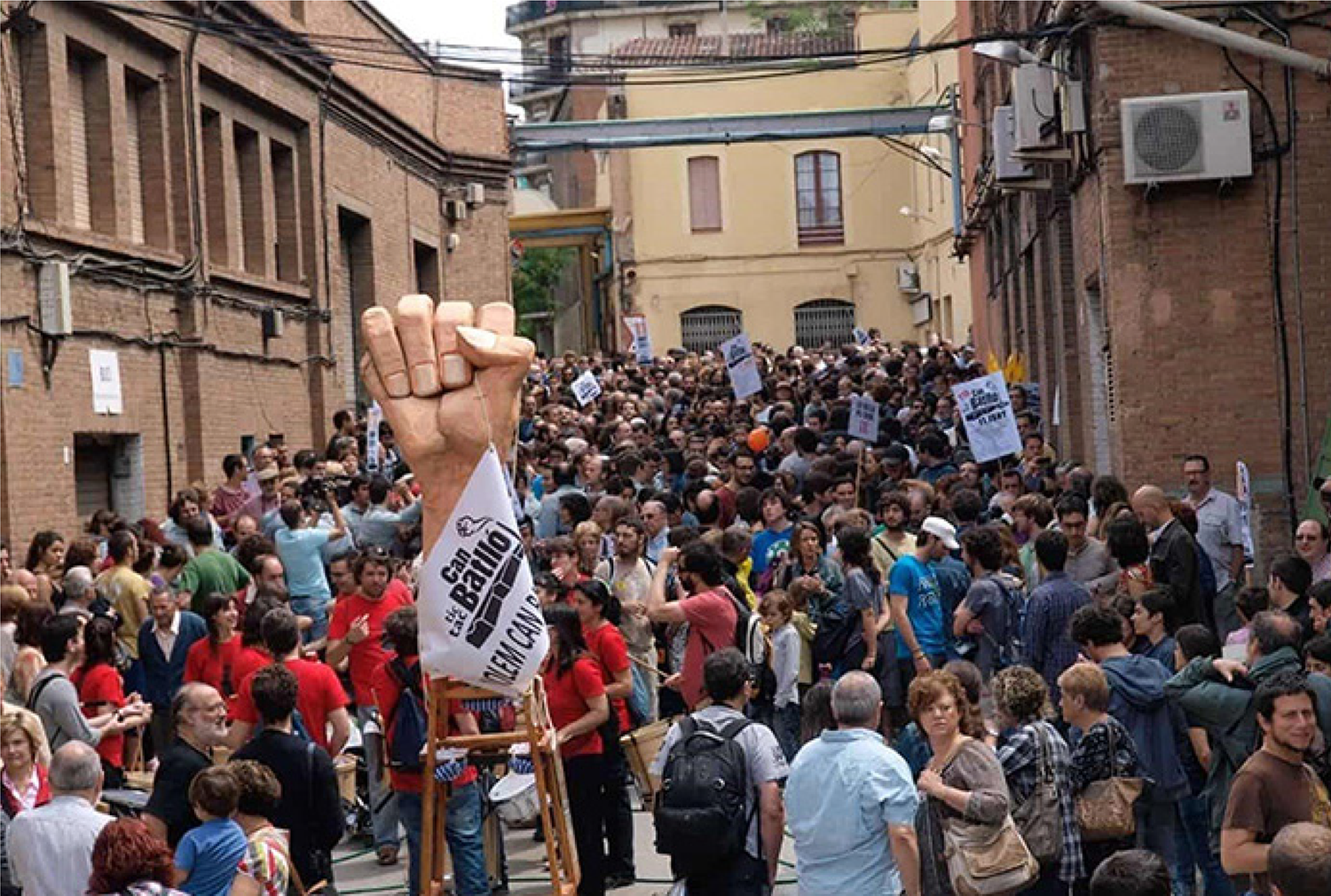
Given the stalemate over the approved plan, discontent intensified among the local populace, who organised as the Can Batlló és pel Barri8 campaign, which unleashed heavy pressure for the work to begin. In 2009, they set a date (11 June 2011), saying that if the project had not started by then, they would invade the premises and manage it themselves. A matter of days before the deadline, given the strength and insistence of the civil campaign, which was very much in the media and bolstered by the 15M movement,9 the council struck a deal with the residents, who following the handover of the keys to one of the buildings (Bloc 11),10 marched symbolically inside (Figure 11)

In 2019, an unprecedented agreement was signed, whereby the buildings were transferred to the citizen platform for a 50-year period (30 years plus two 10-year extensions). Can Batlló is currently constituted as a ‘Self-Managed Community and Neighbourhood Space’, run by around 500 volunteers who provide a service to over 48,000 users (Rigola, 2024).
The transformation of the premises began in 2011 with Bloc 11. It started with the creation of the self-managed Josep Pons public library11 (Figure 12) funded with donations, together with a bar, meeting area, auditorium and several multi-purpose rooms for different activities.

The rise in activity has led to the allocation of further spaces for additional purposes, such as a documentation centre that specialises in grassroots social movements (Figure 13), a family area, a space for circus activities and other performing arts, a community printing studio and a publishing house, and a cooperative restaurant.

The site has been used for other projects managed by the Plataforma, including La Borda housing cooperative, consisting of 28 dwellings that are self-managed by their tenants (Figure 14). In operation since 2018, the homes are built on Publicly Protected Housing (VPO) land granted by the council for 75 years.

Another of these projects is the Arcadia School, promoted by a group of teachers in 2009 for girls and boys from 0 to 16 years of age. The third major project is the Ateneo Cooperativo de Barcelona Coopolis, a cooperative incubator that promotes the social solidarity economy. Set up in March 2024 in the newly rehabilitated Bloc 4BCN, today it is considered the largest cooperative promotion centre in Europe (Figure 15). The Bloc 4BCN facility is a public-cooperative project co-financed by Barcelona City Council and the Government of Catalonia

Can Batlló also accommodates other city services and amenities. Since 2019, one of its renovated buildings has housed the Barcelona School of Audiovisual Media (EMAV) (Figure 16), a public centre that is part of the Barcelona Education Consortium.

There were also plans to convert Building 8 into the Historical Archive of the City of Barcelona and other municipal offices that should have opened their doors in 2022. However, the council ended up cancelling the project due to budgetary constraints (Garcia, 2021).
The neighbourhood platform has played an active role in promoting a vibrant connection between Can Batlló and the surrounding streets. This has been achieved in a number of ways. One was the symbolic demolition of the perimeter wall around the factory to integrate the building into the neighbourhood. The structure of another block was partially demolished to create a public space attached to a large park (Figure 17) with more than 1,000 m2 of playground, which was completed in May 2023.

In 2024, local organisations signed a manifesto arguing that the Can Batlló complex is still in a precarious state of conservation and criticising the council for failing to make the required investments. Although they acknowledge the investment in Bloc4BCN and the children's playground, they are demanding further funds to continue the rehabilitation work in accordance with the original schedule (Tot Barcelona, 2024).
Can Batlló is an example of the importance of engaging the social fabric in the neighbourhood, and how it has managed to reverse the abandonment of industrial heritage and instead develop new, more community focused uses of the space. However, unless the investments continue, there is still the looming threat of the industrial complex falling into deterioration.
Conclusions
The refunctionalisation of old industrial spaces is an important aspect of urban regeneration, and involves different phases ranging from absolute demolition to protection, intervention, recovery and reconstruction.
At a time when industrial heritage is so integral to urban transformation, its management is at the crossroads between the preservation of a symbolic element of the local identity; the opportunity for local development and the strategic generation of a 'brand' to enhance the city's global profile.
However, there are tensions and (im)balances between these three dimensions, and a clash of interests between the main urban agents: citizens, landowners, local authorities and private developers. This article has shown how the governance of industrial heritage in the city of Barcelona since the advent of democracy has entailed contrasting forms of management, from fully public initiatives (which are so uncommon these days) to fully private ones or public-private collaborations. The fact that industrial heritage plays such a key role in urban development and planning does not make it immune to market forces, capital interests and speculation.
In a context of economic recession, financial constraints have evidently impeded the authorities from undertaking urban regeneration projects, not helped by the subordination of urban planning to the real estate market. In such a challenging situation, with public funding hindered by the threat of economic collapse and with investors dissuaded by the limited prospects for financial gain, grassroots and citizen movements have again risen in resistance to the appropriation of land.
From the analysis of the very different outcomes of the two case studies, it is confirmed that citizen movements have developed new ways to use urban spaces and manage facilities. Can Batlló is a poignant example of how such initiatives have been able to 'conquer' the space and employ innovative self-management methods for their governance.
However, although community resistance has managed to break the deadlock and set in motion major projects to transform industrial spaces, their complete fulfilment seems to be fading. Can Ricart illustrates how property developers are burying protected industrial heritage, while plans to build public facilities are stalled due to the lack of funds. Likewise, efforts to restore the buildings at Can Batlló for self-managed community use have not been executed in their entirety. The deterioration of the protected buildings is in stark contrast to the gleaming glass of the luxurious new buildings that stand beside them. The old industrial sites are once again at risk of becoming the victims of deliberate obsolescence and being reduced to nothing but rubble.
References
- ALABART, A. et al. (2008). La Barcelona dels barris Barcelona, Federació de l'Associació de Veïns de Barcelona, Editorial Mediterrània.
- ÁLVAREZ ARECES, M. A. (2010). Patrimonio industrial, paisaje y desarrollo territorial. AREAS. Revista Internacional de Ciencias Sociales, n. 29, pp. 21-29.
- ANGUIANO ALDAMA, R.; PANCORBO SANDOVAL, C. (2008). El marketing urbano como herramienta de apoyo a la gestión del turismo de ciudad, estudio de un caso; el patrimonio industrial. ACE: architecture, city and environment n. 6, pp. 739-748.
- BAIGES CAMPRUBÍ, C. (2015). "Can Batlló: cuando la ciudadanía reutiliza el patrimonio industrial". In: ÁLVAREZ ARCES, M. A. (dir.). Espacios industriales abandonados. Gestión del patrimonio y medio ambiente Gijón, Centro de Iniciativas Culturales y Sociales (Cicees), pp. 101-110.
- BENITO DEL POZO, P. (2002). Patrimonio industrial y cultura del territorio. Boletín de la Asociación de Geógrafos Españoles, n. 34, pp. 213-227.
- BENITO DEL POZO, P.; CALDERÓN CALDERÓN, B.; RUIZ-VALDEPEÑAS, H. P. (2016). La gestión territorial del patrimonio industrial en Castilla y León (España): fábricas y paisajes. Investigaciones geográficas, n. 90, pp. 136-154.
- BENNETT, J. M. (2012). Doing belonging: a sociological study of belonging in place as the outcome of social practices, Tesis de doctorado. Manchester, Universidad de Manchester.
-
BRENNER, N.; THEODORE, N. (2005). Neoliberalism and the urban condition. City, v. 9, n. 1, pp. 101-107, DOI: 10.1080/13604810500092106.
» https://doi.org/10.1080/13604810500092106 -
CAÑIZARES RUIZ, M. C.; BENITO DEL POZO, P.; LÓPEZ PATIÑO, G. (2020). El patrimonio industrial en el contexto de los Objetivos de Desarrollo Sostenible (ODS) y la resiliencia territorial: de la teoría a la práctica. GEOGRAFÍA DE LA UNIVERSIDAD COMPLUTENSE. Anales, v. 40, n. 2, pp. 323-344. DOI: org/10.5209/aguc.72977
» org/10.5209/aguc.72977 - CAPEL, H. (1996). La rehabilitación y uso del patrimonio histórico industrial. Documents d'Anàlisi Geogràfica, n. 29, pp. 19-50.
-
CASTAÑEDA, C. (2019). 2030: El papel del patrimonio industrial en los Objetivos del Desarrollo Sostenible. Arquitectura y Sociedad Disponible en: https://blogfundacion.arquia.es/2019/02/2030-el-papel-del-patrimonio-industrial-en-los-objetivos-de-desarrollo-sostenible/ Acceso en: 15 Jul 2024.
» https://blogfundacion.arquia.es/2019/02/2030-el-papel-del-patrimonio-industrial-en-los-objetivos-de-desarrollo-sostenible/ - CASTRO, M.; MARTÍ-COSTA, M.; GUAL, J. M.; MARTÍNEZ MORENO, R. (2011). Can Batlló: construir comunidades en las ruinas de la crisis. In: JORNADAS CONTRA LA DEPREDACIÓN DE LOS BIENES COMUNES. Madrid 10-12/2011.
- CHECA-ARTASU, M. M. (2007). Geografías para el patrimonio industrial en España. El caso de Barcelona. Scripta Nova, v. XI, n. 245(32).
- CHECA-ARTASU, M. M. (2015). "La rehabilitación del patrimonio industrial en Barcelona (España). Entre el contenedor útil y la desmemoria fabril". In: CONTRERARS, C. (ed.). Ladrillos, fierros y memoria. Teoría y gestión del patrimonio cultural Monterrey, Colegio de la Frontera Norte.
- COFFEE, K. (2024). "The gentrification of working-class heritage in Lowell, Massachusetts". In: BOZOGLU, G. et al. (ed.). The Routledge International Handbook of Heritage and Politics New York, Routledge.
- CRESPI-VALLBONA, M. (2003). L'activitat festiva popular en l'era de la mundialització: el cas de Catalunya Tesis de doctorado. Barcelona, Universitat de Barcelona.
-
CRESPI-VALLBONA, M. (2021). La "metropolitanización" del turismo. El caso del Área Metropolitana de Barcelona. Ciudad y Territorio. Estudios Territoriales, v. 53, n. 209, pp. 685-700. Disponible en: https://doi.org/10.37230/CyTET.2021.209.05
» https://doi.org/10.37230/CyTET.2021.209.05 - CRESPI-VALLBONA, M.; PLANELLS COSTA, M. (2003). Patrimonio cultural Madrid, Síntesis.
- DALMAU I TORVÀ, M. (2014). Can Batlló: de la degradación planificada a la construcción comunitaria. Quaderns de l'Institut Català d'Antropologia, v. 19, n. 1, pp. 143-159.
- DALMAU, M.; MIRO, I. (2010). Les cooperatives obreres de Sants Barcelona, Traficantes de Sueños.
- DÍAZ ORUETA, F.; LOURÉS SEOANE, M. L. (2013). Neoliberalismo, políticas urbanas y reconfiguración socio-espacial. Quid 16. Revista del Área de Estudios Urbanos, n. 3, pp. 7-16.
- DOT JUTGLA, E.; PALLARES-BARBERA, M. (2015). Patrimonio industrial, revitalización económica y compacidad urbana en el Poblenou22@ Barcelona ¿un nuevo modelo Barcelona?. Boletín de la Asociación de Geógrafos Españoles, n. 69, pp. 9-35.
-
GARCIA, M. (2021). Barcelona reuncia a ubicar l'Arxiu de la Ciutat a la nau central de Can Batlló. Betevé, 19 mayo. Disponible en: https://beteve.cat/politica/barcelona-renuncia-arxiu-ciutat-can-batllo-pressupost/
» https://beteve.cat/politica/barcelona-renuncia-arxiu-ciutat-can-batllo-pressupost/ - GÓMEZ, M.; CRESPI-VALLBONA, M.; DOMÍNGUEZ, M. (2020). "El patrimonio urbano como intersección de espacio y sociedad. Una oportunidad para el replanteamiento del rol del patrimonio en la Agenda Urbana". In: ALONSO IBÁNEZ, M. R.; DE GREGORIO HURTADO, S.; GONZÁLEZ MEDINA, M. (eds.). Las agendas urbanas y el gobierno de las ciudades: transformaciones, desafíos e instrumentos. Editorial Reus.
- HARVEY, D. (2007). Espacios del capital. Hacia una geografía crítica Madrid, Akal.
- LÓPEZ-VILLANUEVA, C.; CRESPI-VALLBONA, M. (2021). Gentrificación y turistificación: dinámicas y estrategias en Barcelona. Encrucijadas. Revista Crítica de Ciencias Sociales, v. 21, n. 1.
- MARCOS ARÉVALO, J. (2004). La tradición, el patrimonio y la identidad. Revista de estudios extremeños, v. 60, n. 3, pp. 925-956.
- MARTÍ-COSTA, M.; BONET-MARTÍ, J. (2009). "Planning from below in Barcelona". In: PORTER, L.; SHAW, K. Whose Urban Renaissance? New York, Routledge.
- MARTÍN-GÓMEZ, A.; VALÈNCIA LÓPEZ, A. (2022). La crisi de l'urbanisme de ciutats globals: reavaluar 20 anys de transformació del sòl i activitat econòmica del 22@ Barcelona. Documents d'anàlisi geogràfica, v. 68, n. 1, pp. 81-105.
- OLIVERAS I SAMITIER, J. (2013). La consolidació d'una ciutat industrial. Barcelona, 1881-1935 Barcelona quaderns d'història, n. 19, pp. 229-260.
- PALOU RUBIO, S. (2019). Discursos turístics sobre el paisatge i el patrimoni cultural de Barcelona. Imatges contra la ciutat. Papers, n. 62, pp. 48-58.
-
PAÜL i AGUSTÍ, D.; CASALS ALSINA, È. (2023). La protecció del patrimonial industrial en àrees de transformació urbana: una revisió a partir del projecte 22@ Barcelona. Documents d'Anàlisi Geogràfica, v. 69, n. 2, pp. 285-308. DOI: https://doi.org/10.5565/rev/dag.766
» https://doi.org/10.5565/rev/dag.766 - PERRONE, M. G. N. (2018). Viatge al barri d'Icària. Revista d'etnologia de Catalunya, n. 43, pp. 258-271.
-
PREECE, J. (2020). Belonging in working-class neighbourhoods: dis-identification, territorialisation and biographies of people and place. Urban Studies, v. 57, n. 4, pp. 827-843. DOI: https://doi.org/10.1177/0042098019868087
» https://doi.org/10.1177/0042098019868087 - QUEROL, M. A. (2010). Manual de Gestión de Patrimonio Cultural Madrid.
- RECIO, A.; NAYA, A. (2004). Movimiento vecinal: claroscuros de una lucha necesaria. Mientras Tanto, n. 91/92, pp. 63-81.
-
RIGOLA, O. (2020). De fábrica impulsada por vapor a impulsar la autogestión. Penso. Recull de Pensaments Disponible en: https://penso.cat/2020/04/de-fabrica-impulsada-por-vapor-a-impulsar-la-autogestion Acceso en: 15 mayo 2024.
» https://penso.cat/2020/04/de-fabrica-impulsada-por-vapor-a-impulsar-la-autogestion - SÁNCHEZ-BELANDO, M. V. (2015). Las políticas culturales de proximidad en el paradigma de la ciudad creativa: el caso del programa de centros cívicos en la ciudad de Barcelona. Política y Sociedad, v. 52, n. 1, pp. 125-152.
- SÁNCHEZ-BELANDO, M. V. (2017). Building alternatives to the creative turn in Barcelona: the case of the socio-cultural centre Can Batllo. City, culture and society, n. 8, pp. 35-42.
- SMITH, N. (1979). Toward a theory of gentrification a back to the city movement by capital, not people. Journal of the American planning association, v. 45, n. 4, pp. 538-548.
- TATJER, M. (1988). Burgueses, inquilinos y rentistas. Mercado inmobiliario, propiedad y morfología en el centro histórico de Barcelona: la Barceloneta (1753-1982). Madrid,Consejo Superior de Investigaciones Científicas.
- TATJER, M. (2006). La industria en Barcelona (1832-1992). Factores de localización y transformación en las áreas fabriles: del centro histórico a la región metropolitana. Scripta Nova: revista electrónica de geografía y ciencias sociales, n. 10.
- TATJER, M. (2008). El patrimonio industrial de Barcelona entre la destrucción y la conservación, 1999-2008. Scripta Nova: Revista electrónica de geografía y ciencias sociales, v. XII, n. 270 (140).
- TATJER, M.; URDIOLA, M. (2005). Can Ricart. Estudi Patrimonial. Revista bibliográfica de Geografía y Ciencias Sociales Biblio 3w, v. 10, n. 598.
- TELLO, R. (1993). Barcelona post-olímpica: de ciudad industrial a escenario de consumo. Estudios Geográficos, v. 54, n. 212, pp. 507-522.
- THEODORE, N.; PECK, J.; BRENNER, N. (2009). Urbanismo neoliberal: la ciudad y el imperio de los mercados. Temas sociales, v. 66, n. 10, pp. 1-12.
-
TOT BARCELONA (2024). Entidades de La Bordeta culpan al Ayuntamiento de la "degradación" de Can Batlló. Disponible en: https://www.totbarcelona.cat/es/cultura-ocio/patrimonio/degradacion-can-batllo-duras-criticas-entidades-ayuntamiento-barcelona-477111/ Acceso en: 17 mar 2024.
» https://www.totbarcelona.cat/es/cultura-ocio/patrimonio/degradacion-can-batllo-duras-criticas-entidades-ayuntamiento-barcelona-477111/ - TRULLÉN, J. (2011). El projecte Barcelona Ciutat del Coneixement i el 22@ barcelona. Revista Econòmica de Catalunya, n. 64, pp. 22-30.
Notes
-
1
Indianas were a kind of printing on cotton or linen for both domestic sale and for export abroad, mainly to the Spanish colonies in the Americas and Indies. Production was originally done from the ground floors of home, and later came the first factories in the heavily populated city of Barcelona in the 19th century.
-
2
In 1888, there were 243 factories registered in Sant Martí de Provençals (Dot Juglà & Pallarés Barberà, 2015).
-
3
These spaces are open to the public and are used for sociocultural and community activities.
-
4
District 22@ is a scheme run by Barcelona City Council since 2000 aimed at transforming 200 hectares of industrial land in Poblenou into an innovative production district.
-
5
This is the most important competition in sailing, and is considered to be the third most important in terms of economic impact on the host venue after the Olympic Games and the FIFA World Cup.
- 6
- 7
-
8
Can Batlló is for the neighbourhood.
-
9
Popular uprising that gets its name from the demonstration on 15 May 2011 that was organised by different groups to demand a more participative democracy. This collective resistance movement mainly consisted of occupying the main squares of different cities of Spain.
-
10
It is named Block 11 after the date when the local residents moved into the premises.
-
11
Named after Josep Pons, an activist who fought long and hard for Can Batlló to become a space for use by the local community.

 Source: Eurostat.
 Source: the authors.
 Source: the authors.
 Source: (A. Carnicer / S. Grimal).
 Source: (Bonavista Developments).
 Source: Dos Puntos Asset Management.
 Source: QID Studio Arquitectes.
 Fuente: A. Carnicer / S. Grimal.
 Fuente: A. Carnicer / S. Grimal.
 Source: taken from
  Source: Can Batlló des del temps de fabriques a l’actualitat. https://canbatllo.org/can-batllo/.
 Fuente: Can Batlló https://canbatllo.org/can-batllo/.
 Fuente: Can Batlló https://canbatllo.org/can-batllo/.
 Source: Lacol Arquitectura, Cooperativa La Borda 28 en Barcelona © Lluc Miralles.
 Source: Ayuntamiento de Barcelona. https://ajuntament.barcelona.cat/premsa/2024/01/10/acaben-les-obres-de-bloc4bcn-el-major-pol-del-cooperativisme-deuropa-ubicat-a-can-batllo/.
 Source: Consorci Educació Barcelona. https://www.edubcn.cat/es/noticias/detalle?51697
 Source: Ayuntamiento de Barcelona. https://www.barcelona.cat/infobarcelona/es/tema/urbanismo-e-infraestructuras/juegos-bordeta-torre-toboganes-balancines-giratorios-columpios_1289151.html