
 The decline of adolescent fertility in Brazil: empirical evidence and questions
Abstract
Adolescent fertility in Brazil is influenced by sociodemographic and economic factors, making it necessary to stratify and monitor this indicator to assess the inclusion of adolescents in health, education, and social assistance programs. Using data from the Live Birth Information System (SINASC), we calculated Age-Specific Fertility Rates by age group (10 to 14 years and 15 to 19 years), years of education (0 to 7 years, 8 to 11 years, and 12 or more), and Brazilian macroregions (North, Northeast, Midwest, Southeast, and South) for the period between 2010 and 2023, during which the country faced structural changes, including public health crises, economic crises, an increase in female education, and the rise of a conservative political wave. The results reveal an increase in adolescent fertility in the first half of the analyzed period (up to 2014/2015), followed by a decline in the second half, reaching 41.6 births per thousand women (15-19) and 2.1 births per thousand women (10-14) in 2023. There is significant regional diversity, with the North presenting higher rates despite the decline. Differences by educational level stand out, with a greater proportional decline among the less educated group.
Key words:
Age-Specific Fertility Rate; Adolescent Pregnancies; Below Replacement Fertility; Child Abuse; Sexual and Reproductive Health
Resumo
A fecundidade adolescente no Brasil sofre influência de fatores sociodemográficos e econômicos, o que exige que esse indicador seja estratificado e acompanhado para se avaliar a inclusão das adolescentes nos programas de saúde, educação e assistência social. Utilizando dados do Sistema de Informação do Nascido Vivo (SINASC), calculamos Taxas Específicas de Fecundidade por grupo etário (10 a 14 anos e 15 a 19 anos), anos de estudo (0 a 7 anos, 8 a 11 anos e 12 e mais) e macrorregião brasileira (Norte, Nordeste, Centro-Oeste, Sudeste e Sul) para o período entre 2010 e 2023, quando o país enfrentou mudanças estruturais, como crises de saúde pública, crises econômicas, ampliação da escolarização feminina e crescimento da onda política conservadora. Os resultados revelam aumento da fecundidade adolescente na primeira metade do período analisado (até 2014/2015), seguido de queda na segunda metade, chegando a 41.6 nascimentos/mil mulheres (15-19) e 2.1 nascimentos/mil mulheres (10-14) em 2023. Há intensa diversidade regional, com o Norte apresentando taxas mais elevadas, apesar da queda. Destacam-se diferenças por escolaridade, com maior queda proporcional no grupo menos escolarizado.
Palavras-chave:
Taxa Específica de Fecundidade; Gravidez Adolescente; Fecundidade Abaixo da Reposição; Abuso Infantil; Saúde Sexual e Reprodutiva
Resumen
La fecundidad adolescente en Brasil está influenciada por factores sociodemográficos y económicos, lo que exige que este indicador sea estratificado y monitoreado para evaluar la inclusión de las adolescentes en los programas de salud, educación y asistencia social. Utilizando datos del Sistema de Información sobre Nacidos Vivos (SINASC), calculamos Tasas Específicas de Fecundidad por grupo etario (10 a 14 años y 15 a 19 años), años de estudio (0 a 7 años, 8 a 11 años y 12 o más) y macrorregión brasileña (Norte, Nordeste, Centro-Oeste, Sudeste y Sur) para el período entre 2010 y 2023, cuando el país enfrentó cambios estructurales como crisis de salud pública, crisis económicas, ampliación de la escolarización femenina y el crecimiento de una ola política conservadora. Los resultados revelan un aumento de la fecundidad adolescente en la primera mitad del período analizado (hasta 2014/2015), seguido de una caída en la segunda mitad, alcanzando 41,6 nacimientos por mil mujeres (15-19) y 2,1 nacimientos por mil mujeres (10-14) en 2023. Existe una gran diversidad regional, con el Norte presentando las tasas más elevadas, a pesar del descenso. Se destacan diferencias por nivel educativo, con una mayor disminución proporcional en el grupo con menor escolaridad.
Palabras clave:
Tasa Específica de Fecundidad; Embarazo Adolescente; Fecundidad por Debajo del Nivel de Reposición; Abuso Infantil; Salud Sexual y Reproductiva
Introduction
At the same time that the Total Fertility Rate (TFR) declined at the end of the millennium, Brazil also observed an increase in adolescent fertility1-5. The reported Age Specific Fertility Rate (ASFR) for adolescents (15-19 years of age), which was 65-87 children per woman in 1991, rose to 71-93 in 20003,4,6. Proportionally, this rate rose from 9.1% in 1980 to 15.3% in 1991, 19.4% in 2000, and 17.7% in 20107. During this period, the phenomenon of adolescent pregnancy, combined with the phenomenon of a reduction in high-order births, caused a “fertility rejuvenation” in the country.
By 2010, the adolescent fertility rate had already returned to 49-714,5, but remained twice that recorded for developed countries when they reached the same total fertility level8,9. Furthermore, in urban areas of the most developed regions, while the fertility rate for 15-19-year-olds was around 50 births per thousand women in 2010, in less developed urban areas, fertility reached 150 births per thousand women, equivalent to African countries with high fertility rates1.
Researchers attribute the phenomenon of adolescent pregnancy to a complex array of proximate and distal factors1,10-18. Proximate factors include early sexual initiation combined with the lack of correct and consistent use of modern contraceptive methods. Distal factors include inequalities based on race, income, and education, including the poor quality of schools combined with a culture of school dropout. These characteristics are associated with misinformation about the reproductive system and the lack of contraceptive methods, as well as low educational and professional aspirations, which, combined with gender inequalities, hinder the negotiation of sexual relations and contraceptive protection. The analysis of teenage pregnancy commonly presents it as a social or public health problem. It is no surprise that it reflects the country’s existing social inequalities and requires specific policy responses20.
Monitoring adolescent ASFR over time is essential to assess the extent to which adolescents, especially girls, are being included in existing health policies and fertility planning programs17. Furthermore, declining or postponing fertility may signal greater social and educational inclusion, providing girls and women with opportunities for personal development that lead them to increasingly distance themselves from domestic and family roles, deferring these achievements to the second half of the reproductive age range, if they occur at all15,19,21. Nevertheless, there is concern that the decline in adolescent fertility observed since the second half of the 2000s signals a growing gap between the lower and upper classes17. Therefore, studies that allow for socioeconomic stratification are needed.
It is also necessary to monitor adolescent fertility rates among younger adolescents, aged 10 to 14 years, for whom the determinants of fertility are not always the same as those of their older peers22, but whose consequences are more drastic23. Early pregnancies are often indicators of a silent and pervasive gender-based violence that victimizes girls, first through the violence itself and second through the government’s negligence in providing them with legal-based abortions.
This study uses data from the Live Birth Information System (SINASC/Ministry of Health) and population-by-age data from the 2010 and 2022 Demographic Censuses (IBGE) to investigate the trajectory of adolescent fertility by calculating Adolescent ASFRs by age group (10 to 14 and 15 to 19). For women, aged 15 to 19 years, results are also presented by level of education (0-7, 8-11, and 12+ years of education). The analysis is conducted by macroregion for the period of 2010 to 2023.
Empirical evidence of changes in adolescent fertility rates and their sociodemographic differences
The overall decline in Brazil’s TFR, which currently stands at around 1.63 child per woman, hides significant sociodemographic variations, such as differences by income level, race/skin color, and rural/urban status. Educational level shows the greatest discrepancy4,6,24,25. In 2000, while the TFR for women with low educational levels was 3.7, among those with higher education, it was already below the replacement level (1.1). In 2010, it reached 3 and 1.2 children per woman, respectively3,6.
Significant differences by education levels were also observed by mother’s age at birth, reflecting a bimodal pattern, with women with low educational levels having their first children, on average, at 18-21 years of age, while women with high educational having their first baby at around 31-33 years of age3,6,8,26.
It is within this context of inequality that teen pregnancy occurs. The percentage of adolescents who have had at least one child is 12% for Brazil, but this can vary from 7.6% to 26.6%, depending on the region1.
Although there are many studies on adolescent pregnancy in various fields, demographic studies analyzing fertility rates are fewer. In general, studies in the literature tend to analyze changes in rates over time or investigate sociodemographic and economic differences in adolescent fertility rates, and may or may not include more than one period of analysis. In recent years, studies are even rarer, mainly due to the lack of new data: at the time of writing, for example, microdata from the 2022 Census and the 2023 PNDS were not available. These data allow for the calculation of fertility rates by age, broken down by social group, such as race/skin color, income, education, among others, as well as the analysis of proximate determinants.
In 2010, the adolescent ASFRs by microregion, calculated in the 2010 Census, per thousand women, were: Brazil (49.7), North (76.7), Northeast (57.3), Midwest (53.4), South (42.0), and Southeast (39.2)5. These values are about 30% lower than those recorded in the previous Census, in 2000 (smaller declines were observed in the North and Northeast), given that, for the previous years (2000 and 1991), the values, for the most part, had been increasing. The highest value in the historical series had been 71.1 per thousand women in Brazil in 2000, reaching 79.2 in the Northeast that year5.
It is important to note that although the Census only recorded the decline in adolescent fertility in 2010, the 2006 PNDS had already captured the beginning of the decline in adolescent fertility. The ASFR was already around 50 per thousand (2004 to 2007), instead of 80-90 as recorded at the time of the 1996 and 1986 DHS17.
One study1 reported slightly different figures, with urban Brazil differing greatly from rural Brazil (64.2 vs. 103.6 in 2010, having fallen from 87.2 and 125.9 in 2000, per thousand women, respectively). In terms of region, per thousand women, in 2010, the values were North (111.8), Northeast (81.9), Midwest (74.6), South (57.7), and Southeast (54.5), with negative variations between 30.2% and 22.9%, when compared to the year 2000, having reached 145 in the North in 2000 (the highest value in the historical series). For the whole country, the ASFR was 69.9 in 2010. The regions with the smallest declines were, in general, those that were less developed, because, as the process of economic and social development in Brazil occurred in an uneven manner, the same was true for adolescent fertility. Some highly populated regions, such as urban areas, are also very heterogeneous with considerable economic and educational diversity1.
The intersection of income, place of residence, and education reveals groups whose fertility rates were still extremely high in 2010, even within large cities. While in rural areas, for those with incomes up to 1/4 minimum wage, with no education or complete elementary school, the rate was 180.5 in 2010. In urban areas, this same group showed an ASFR of 183.9 per thousand women1. Adolescents with high incomes (>5 minimum wages) and either complete high school or incomplete higher education showed a rate of 11.4 in rural areas and 7.9 in urban areas per thousand women.
Comparing 1991 and 2000, adolescents with up to three years of schooling increased their ASFRs between 1991 and 2000, followed by a sharp decline in 2010, when there were approximately 153 births per thousand women. The ASFR for those with 4 to 8 years of schooling increased in the period, while those with 9 to 11 and 12 or more years of schooling remained unchanged1.
Another study3, analyzing the 2000 and 2010 Demographic Censuses, shows that the adolescent ASFRs in Brazil continued to vary greatly by educational level group, regardless of estimation technique was used (Brass P/F ratio and Gompertz relational method). In 2000, for example, among women with 0 to 3 years of schooling, the ASFR was 180 per thousand, while for those with 4 to 8 years of schooling, it was 120 per thousand. Among women with 9 to 11 years of schooling, the ASFR was 40 per thousand. Finally, among women with 12 or more years of schooling, the ASFR was less than 20 per thousand. By 2010, the rates had already changed, respectively, to around 150, 130, 60, and 10 per thousand. Despite the decline in fertility among adolescents between 2000 and 2010, the chance of becoming a mother according to educational level did not decrease among the groups, except for those with low level of education (0 to 3 years of schooling), having increased for those with 4 to 8 years of schooling, which can be explained by the changes in the educational composition that the country experienced in the first decade of the 2000s due to the increase in female education7.
Among the poorest social strata, the rate for women, aged 15-19 years, remained almost as high as that for the 20-24 age group (153 live births vs. 174 live births per thousand women)4.
During the gap between population censuses, studies exploring differences in adolescent fertility rates had to use data from the Live Birth Information System (Sistema de Informações sobre Nascidos Vivos - SINASC), for which the denominator of the rates, generally using a population projection, has many limitations and assumptions. In one study27, the ASFR (15-19) calculated for Brazil fell from 67.3 to 54.4 between 2008 and 2017. Although it declined across regions, the values remained high for the North and Northeast, falling from 103.2 and 76.3, to 80.9 and 61.8, respectively, in 2017. Some studies have been able to examine and track the evolution of this indicator over time28-30.
Finally, another group of studies investigates factors associated with ASFR calculated at the municipal level or other aggregated measure. These studies reveal that the unit of analysis can mask internal variations. In reality, the differences in rates observed for aggregates are the result of local averages, and by allowing for more detailed analyses, it is possible to identify intra-regional inequalities, such as those reported in intra-state or municipal studies that were able to capture the association between pregnancies and the level of local development. Thus, there are a number of studies that seek to analyze the spatial association of the proportion of adolescent pregnancies with other sociodemographic and economic indicators22,26,31-35. In general, adolescent pregnancy rates or the proportion of adolescent mothers are higher in regions with a higher incidence of poverty, lower GDP per capita, higher Social Vulnerability Index (SVI), lower Human Development Index (HDI), lower average educational level, lower average per capita family income, and lower Family Health Strategy (FHS) coverage, among other measures. In the study by Martinez et al.32, among the HDI components, education appears to be the most commonly associated, highlighting the relationship between adolescent pregnancy and school dropout rates, although the direction of causality remains undefined.
Early motherhood (10-14 years)
Detailed studies of adolescent fertility in the youngest age group (10-14 years) suffer even greater limitations than those in the 15-19-year-old age group due to the inaccuracy of the denominator of projections for this age group and the group’s non-inclusion among those interviewed in the PNDS surveys conducted in Brazil. Furthermore, there is, in fact, a lack of studies published on this population group. A systematic literature review with articles published between 2000 and 2018 found that, of the 442 articles selected on adolescent pregnancy, only 2.7% (12) addressed the age group under 14 years of age36.
Thus, of the few studies found, most use absolute numbers of live births. One of these37 shows that, despite the decline in the number of live births among those aged 15-19 years (which fell between 15% and 27.9% over a decade), stagnation was found in births among girls aged 10-14 years. Comparing 2000 to 2011, the number grew 5% nationwide, reaching 12.5% and 13.4% in the North and Northeast regions, respectively. In the North, it has already exceeded 1.5% of total births.
In another study27, the ASFR (10-14 years) calculated for Brazil varied between 3.4 and 2.8 between 2008 and 2017, but in the North, it remained at or above 5 throughout the period, reaching more than double that of the South and Southeast regions in selected periods.
In another study22, the ASFR (10-14 years) remained stable between 2000 and 2012, at 3.38 and 3.29 per thousand women, respectively. Among the regions, the highest value for the period was in the North (5.46 to 5.85 over the period), followed by the Midwest (4.26 to 3.41), Northeast (3.72 to 4.07), South (3.15 to 2.45), and Southeast (2.54 to 2.24) regions. In addition to mapping the rates, the authors22 also found a positive association between the rates for the the10-14-year-old and 15-19-year-old age groups. According to the authors, the increase in the rate of the 10-14-year-old age group in Amazon regions raised concerns. Apart from a cultural habit, higher rates detected in international border regions may reflect a greater victimization of girls in contexts of social vulnerability.
The literature on this phenomenon in the 10-14-year-old age group almost always classifies it as a “social problem” and a “public health issue”36. According to a report38 cited in the paper, even when young women indicate that sexual relations were consensual, they lack the cognitive maturity to understand the consequences of the act. The report argues that this reinforces the role of education in preventing violence; however, the justification for the lack of maturity fails to consider social and intersectional aspects of adolescents’ social construction and ignores their autonomy over their own bodies36. Detailed studies on sexual and reproductive behavior specific to this age group are needed, but these studies are beyond the scope of this article.
Data and methods
For this study, we used birth data obtained from the microdata of SINASC/Ministry of Health for the period of 2010 to 2023. Although there are issues with the quality of some fields, SINASC has good coverage for most Brazilian municipalities39. Births comprised the numerators of the ASFRs. SINASC data enable to gather data on births according to a series of attributes, such as region, education level, and maternal age.
For the denominators, we used information on the female population by age, obtained from the 2010 and 2023 Demographic Censuses, interpolated by age for the intercensal years, according to an exponential growth rate. For fertility rates by education, women were grouped according to their educational level, using as a reference their education structure distribution recorded in multiple surveys: for the year 2010, the 2010 Census was used. For the years between 2015 and 2022, we used the education distribution recorded at the Pesquisa Nacional por Amostra de Domicílios Contínua (PNADc); we linearly interpolated from the values observed in 2010 and 2015, for the years 2011 to 2014. Three education groups were used: 0 to 7 years of study, 8 to 11 years of study, and 12 or more years of study.
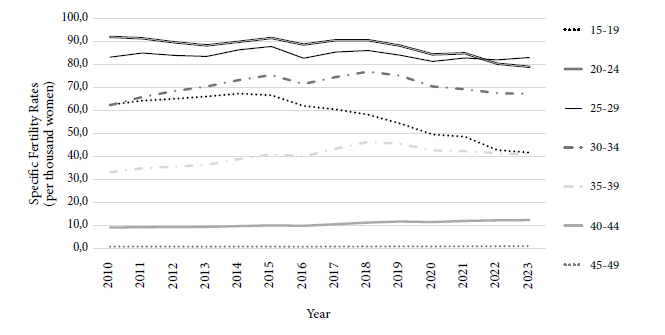
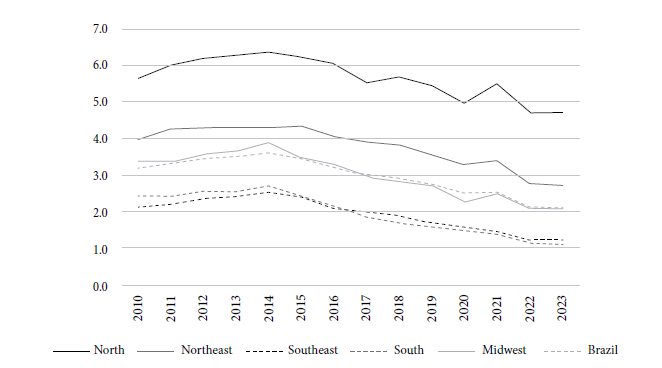
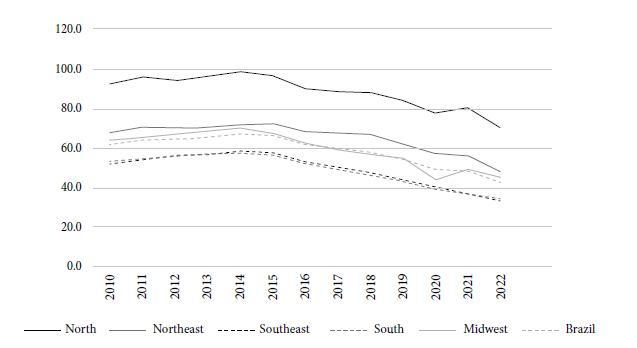
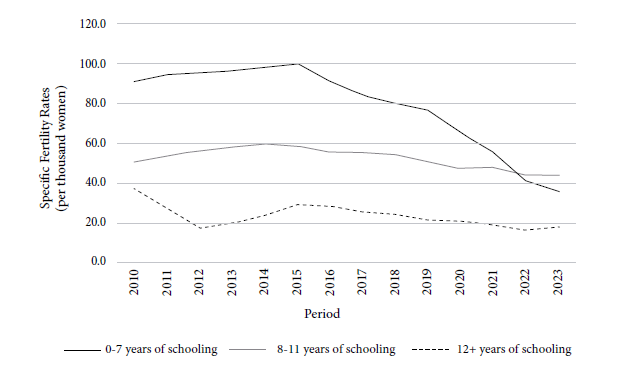
ASFRs were calculated as the ratio of births by maternal age to the total number of women by age. Four data sets will be presented: (i) ASFRs for women aged 15 to 49 years, for Brazil and its Regions, for the period of 2010-2023 (Figure 1 and Figures A-F of the Supplementary Material); (ii) ASFRs for the 10-14-year-old age group, for Brazil and its Regions, for the period of 2010-2023 (Figure 2); (iii) ASFRs for the 15-19-year-old age group, for Brazil and regions, for the period of 2010-2023 (Figure 3); (iv) age-specific rates for the 15-19-year-old age group by educational level (Figure 4 and Figures G, H and I in the Supplementary Material).
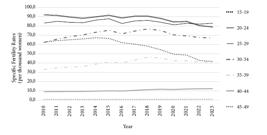
Specific Fertility Rates (ASFR) per thousand women, by woman's age group and period. Brazil, 2010-2023.
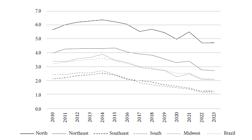
Specific Fertility Rates (ASFR) per thousand women, aged 10-14 years, by period. Brazil and regions, 2010-2023.
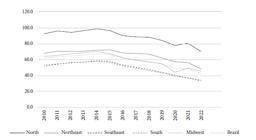
Specific Fertility Rates (ASFR) per thousand women, aged 15-19 years, by period. Brazil and regions, 2010-2023.
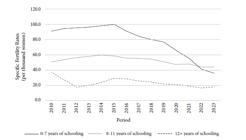
Specific Fertility Rates (ASFR) per thousand women, aged 15 to 19, according to level of education, by period. Brazil, 2010-2023.
To determine if in fact there was a change in the observed trends, all age-specific fertility rates for the target age groups (10-14 years and 15-19 years) by sociodemographic factors (educational level and/or microregion) were subjected to a Joinpoint Regression Model40, which allows for the location of statistically significant breaks in time. The software automatically selects the number and location of the breaks, selecting the smallest possible number of joinpoints, given the Bayesian Information Criterion results. A table with the Annual Percent Change (APC) values and significance levels is available in Table 1 of the Supplementary Material. Graphs showing the breaks are available upon request.
Results
Figure 1 and Figure A of the Supplementary Material present the ASFRs for women of reproductive age (15-49 years) for the period between 2010-2023. In general, a decline in fertility levels was observed over the period for younger women, especially those in the 15-19-year-old age group. With some fluctuations during the period, fertility for this group declined from 62 births in 2010 to 42 births per thousand women in 2023. Although less pronounced, the decline can also be observed among women aged 20-24 years. In contrast, fertility among women aged 30-44 years increased during the period. These two trends indicate the aging of the fertility curve over the period. The aging of fertility is corroborated by the shift in the peak of the curve in 2022, which shows that the 25-29-year-old age group had the highest childbearing rate (in previous periods, this was the case for the 20-24-year-old age group). Regarding the TFR, there is a trend of decline over the period, from 1.71 in 2010 to 1.62 in 2023, with higher values in the middle of the period.
In the North region (Figure B, Supplementary Material), although fertility levels are higher than those in Brazil, the results show a decline in fertility among younger women. For the 15-19-year-old age group, fertility declined from 93 to 69 children per thousand women between 2010 and 2023. In the 20-24-year-old age group, fertility fell from 124 to 104 children per thousand women over the same period. Despite this decline, this group continued to be the one with the highest childbearing rate throughout the period, indicating a younger fertility rate than Brazil. Although fertility in the North region has a younger structure than Brazil’s, the ASFRs for women over 30 years of age also increased during this period.
Figure C (Supplementary Material) shows that, in the Northeast region, birth rates in 2023 are very similar for the 20-24-year-old and 25-29-year-old age groups (just over 80 children per thousand women), indicating that the fertility aging process is more advanced than in the North region, but it is more delayed than in Brazil. A decline in fertility was observed in the 15-19-year-old age group during this period, from 68 to 47 children per thousand women, and an increase in fertility for women aged 30 to 44 years.
Figures D, E, and F (Supplementary Material) show the ASFRs for the Southeast, South, and Midwest regions, respectively. The South and Southeast regions (Figures D and E) have the oldest fertility curve, with a peak in the 25-29-year-old age group for much of the analyzed period. Furthermore, they are the regions with the lowest fertility rate in the 15-19-year-old age group at the end of the period, with approximately 32 births per thousand women in this age group. In the Midwest region (Figure F), throughout the period, there was an increase in fertility among women over 30 years of age and a decline in adolescent fertility, although at higher levels than in the Southeast and South regions.
Focusing the analysis on the age groups of interest (10 to 14 years and 15 to 19 years) and, now, with sociodemographic breakdowns (education and/or microregion), the explanation of the decline in adolescent fertility begins to take shape. Figures 2 and 3 present the historical series of specific fertility rates for women, aged 10-14 years and 15-19 years, respectively, for Brazil and its regions. Figure 4 and Figures G, H, and I of the Supplementary Material show the fertility behavior of young women aged 15-19 years according to educational level. The breakdown by educational level is not presented for adolescents aged 10-14 years. The beginning and end of the Joinpoints Regression segments, as well as the APC values and their significance tests, are available in Table 1 of the Supplemental Material.
Figure 2 shows that fertility among younger women (10-14 years) declined slightly over the period, consistently in Brazil and across all regions, beginning in 2015 in the Northeast region and in 2014 in the other regions and throughout Brazil. Before the decline began, however, a slight increase in fertility among younger adolescents was observed; that is, there was a significant trend change in these two years, as indicated by Joinpoint Regressions (Table 1, Supplementary Material). Despite the variations, regional differences remained unchanged. For Brazil, at the beginning of the period, there were approximately three births per thousand young adolescents; until 2014, there was a slight increase, followed by a decline. By 2023, approximately two births per thousand adolescents, aged 10-14 years, were be observed in the country. The North region has the highest fertility among those girls, aged 10-14 years. At the beginning of the period, just under six births per thousand adolescents were observed in the region; this average increased, peaking in 2014, with more than six births per woman, reaching an average of less than five births in 2023. In the Northeast region, fertility among young adolescents is lower, with a difference of around two children on average, compared to that observed in the North region. Until 2015, there were approximately four births per thousand women in this age group; from then on, a decline began, and by the end of the period, the average number of children per thousand women, aged 10-14 years, in the Northeast region was just under three. The Southeast and South regions presented the lowest fertility levels among young people aged 10-14 years, showing similar behavior during the period, although levels in the South region were slightly higher up to 2014. In these two regions, there were fewer than three births, on average, for every 1,000 young people, aged 10-14 years, throughout the period; since 2017, the average number of births has fallen below two. In 2023, the average number of births for every thousand young adolescents was already close to one. The fertility behavior of young women in the Midwest region is practically the same as that of Brazil, with a small difference in the highest level of the period, observed in 2014, which came closest to four births for every thousand young people.
Figure 3 shows the decline in fertility among young women, aged 15-19 years, in Brazil and across all regions. In general, as among younger adolescents, fertility increased until the mid-2014s and then declined. In Brazil, in 2010, approximately 60 births per thousand adolescents, aged 15-19 years, were observed. This average rose to nearly 68 births in 2014, before declining. In 2023, just over 41 births per thousand women in this age group were observed in the country. The North region has the highest fertility levels among adolescents, aged 15-19 years, almost double the levels observed in the Southeast and South regions throughout the analyzed period. Until 2015, there were nearly 100 births per thousand women. Between 2015 and 2023, fertility declined in this age group, reaching approximately 70 births per thousand women by the end of the period. Although fertility levels remain high among adolescents, aged 15-19 years, the results for the Northeast region indicate a significant difference when compared to the North region, bringing the region closer to the Brazilian average than that observed for the 10-14-year-old age group. At the beginning of the period and until the middle of the decade, the rate was approximately 70 per thousand (15-19 years); by the end of the period, the number was approximately 47. For the Southeast and South regions, the trend is very similar. An increase was observed between 2010 and 2015, when there were almost 60 births per thousand women, aged 15-19 years, and a steady decline thereafter, reaching approximately 33 births per thousand women by 2023. In the Midwest region, fertility in the 15-19-year-old age group showed a similar behavior to that of the country.
The results in Figure 4 and Figures G, H, and I in the Supplementary Material show that fertility among adolescents, aged 15-19 years, varies greatly according to educational level: the higher the educational level, the lower the fertility rate. At the beginning and end of the period, a decline in adolescent fertility was observed for all three educational levels. Among the least educated (0-7 years of schooling), the decline, starting in 2015, was the steepest, going from levels close to 100 births to approximately 36 births per thousand women in 2023. Among adolescents with medium-level education (8-11 years of schooling), fertility variation was lower, with a slight increase in the first half of the 2010s, reaching 60 births, and a decline starting in 2015, reaching levels just above 40. The fluctuations observed for the group with the highest educational level (12 or more years of schooling) can, in part, be explained by the low representation within this group, since the proportion of adolescents who completed at least high school and became mothers is low. Nonetheless, Figure 4 indicates that the number of births per thousand women among the highest level of education declined by half between 2010 and 2023.
The results in Figure G (Supplementary Material) show that, among less educated women, aged 15-19 years (0-7 years of schooling), fertility, which had been increasing since 2010, declined in all regions, starting in the mid-2010s. Joinpoint analyses indicate that the change in trend occurred in different years for each region, beginning earlier in the South (2014), followed by Southeast and Northeast (2015), Midwest (2016), and North (2017). The North region stands out with the highest rates, exceeding 130 births per thousand women in 2015; even with the decline, in 2023, births exceeded 70 per thousand women. The Southeast region had the lowest rates throughout practically the entire period, followed by the South region at the end of the period. In these two regions, fertility rates reached 23 births per thousand women, aged 15 to 19 years in 2023. Along with the Northeast, these two regions also experienced a third decline during the period, but this indicated an intensification of the downward trend in the last three-year period analyzed.
For women with 8 to 11 years of schooling (Figure H, Supplementary Material), the results are more consistent across regions, although the North region remains prominent, with higher rates throughout the period, exceeding 70 births per thousand women in the 15-19-year-old age group. An upward trend in fertility was observed in the first three years, but the subsequent decline indicates a reversal in the trend (declining adolescent fertility), are less consistent across regions. In the North and Midwest, for example, this occurred in 2013, followed by the Southeast in 2014, the South in 2016, and the Northeast in 2017. At the end of the period, the lowest rates were observed in the Southeast and South regions (below 36 births per thousand women), while in the Northeast and Midwest regions the rates reveal greater intensity, around 50 births per thousand women (15 to 19).
The group of women aged 15-19 years with higher educational levels was smaller, which may explain the fluctuating results, especially the increase at the beginning of the analyzed period, which may be due to composition effects (Figure I, Supplementary Material), and the existence of more indications of trend breaks (Table 1 of the Supplementary Material). For this group, specific fertility rates are lower than for the other two educational level groups, peaking at 50 births per thousand women, aged 15-19 years, in the North region in 2016. Starting in 2015, there was a slight downward trend in rates, ending the period below 16 births in the Southeast and South regions, and between 26 and 34 births per thousand women in the North, Northeast, and Midwest regions.
Discussion
Expanding on the findings of previous studies1,3-5,7,22,27, this work describes the downward trajectory of adolescent fertility in Brazil, extending until 2023. Currently, the ASFR (15-19-year-old) is at 41.6 births per thousand women, a 30% drop in 12 years. This decline, however, has some important characteristics, including the slight increase in rates in the middle of the period, as happened with the TFR, highlighted in other studies, but which requires investigation in relation to the immediate determinants41. Given that the current decline has already lasted for at least seven years, it is increasingly unlikely that fertility levels will return to high values, especially for the 15-19-year-old age group.
The fertility decline shown by this study is also characterized by intense regional diversity, with the North region standing out for presenting, as indicated in previous literature1,5, the highest rates, followed by the Northeast region, which converges to the levels found in the Midwest. The Southeast and South are regions with lower levels of adolescent fertility, as already observed by the same authors.
The differences in adolescent fertility by educational level help explain the bimodal pattern observed in Brazilian fertility, with women with low educational levels having higher birth rates than their peers with high educational levels, which is then reflected in a pattern of young fertility3,6,8,26.
This work also updates the country’s total fertility rates, which also fluctuated during the period but have been on a downward trend since 2015. For the first time in history, Brazil’s TFR reached a level below 1.7, while simultaneously aligning with an increasingly aging fertility pattern, as can already be seen in the fertility structure of the South and Southeast regions, with a high concentration of ASFRs in the second half of the reproductive interval. Even regions with younger fertility rates, such as the North and Northeast, are also beginning to observe an increase in ASFRs at older ages, suggesting adherence to fertility postponement42.
The study of ASFRs by educational level also highlights the relevance of this distal determinant for reproductive patterns. As expected, the largest decline is in the group with 0 to 7 years of schooling, as it showed the greatest potential for decline1. Despite the large regional disparity in educational levels, the regions converge at levels close to 30 per thousand births, still above the rate for highly educated women in the South and Southeast regions. As female education increases, greater declines can be expected, especially among the group with 8 to 11 years of schooling, which is in the middle of the educational transition.
Due to the lack of data that would allow the investigation of fertility mechanisms, especially the effects on the so-called proximate determinants of fertility, it is not possible to discern whether the observed decline in adolescent fertility is due to a reduction in desired fertility and an intensification of fertility postponement, which may be the result of increased individual aspirations or ideational changes regarding motherhood42,43 or a decrease in unplanned fertility, which could be reflected in better contraceptive control, whether through improved access to health services and/or safe abortion, changes in sexual behavior, or gender relations1,7,17. Among those enrolled in school, the PeNSE survey results show a reduction in the percentage of students who reported using a condom during their last sexual encounter, as compared to the 2009 and 2015 surveys44. This result persists in 2019 for both sexes, including the use of other methods45. The proportion of female 9th-grade students who initiated their sexual life fell from 16% in 2009 to 22.6%, with significant variations between capital cities.
Unfortunately, the latest version of the National Health Survey (Pesquisa Nacional de Saúde - PNS), which dates back to 2019, did not provide data on the mechanisms of the decline in fertility. Data from the National Demographic and Health Survey (2023/2024) is expected to be available in 2025, allowing for more robust analyses of the mechanisms of sexual and reproductive behavior and comparisons with previous periods.
Furthermore, it is important to highlight that various factors may have contributed to the decline in fertility in the country, including among adolescents. In the last decade, Brazil experienced the health crises of Zika in 2015/2016 and COVID-19 in 2020/202146,47, in addition to a significant period of recession, economic crisis, and structural reforms with profound consequences for the labor market and economic development48. Furthermore, the country underwent profound political, ideological, and religious transformations, such as the growth of evangelical churches and the proportion of evangelicals in the total population, as well as the greater political inclusion of conservative groups, with effects on the reproductive outcomes of young women are still poorly understood13,18. Added to this are: advances in female education, with the strengthening of affirmative action policies in universities, which can be an important mechanism for increasing youth aspirations and postponing fertility7,49; new communication technologies, such as social networks on smartphones, which not only transform life plans but may have been an important mechanism for disseminating information about contraception50; and, finally, changes in interpersonal relationships, including the increase in sexual and gender diversity that has already been discussed in other studies51 and the challenges these young people face in experiencing their sexuality13. These new characteristics have the potential to have direct and indirect impacts on fertility, particularly for adolescents, and need to be included in the Public Health and Applied Social Sciences research agenda in the coming years.
Finally, despite observing a decline, with some fluctuations, this study highlights the persistent fertility rate for girls aged 10-14 years, especially in the North region, as highlighted in the literature22,37. Beyond the historical, cultural, and social configurations that view this pregnancy as associated with adolescent fertility (which in turn is declining), this phenomenon highlights the alarming situation whereby every year thousands of girls transition into adult social roles at an early age, which deepens socioeconomic inequalities and limits their connection to school52. In addition to having greater health risks with early pregnancies and social risks arising from interrupted education and early marital unions, the fertility rate for girls aged 10-14 years is commonly caused by acts of sexual violence53. This indicates that there have been violations of human and childhood rights, and that Brazilian society has failed to protect young women. Recently, a bill attempted to include prison sentences for women who abort after 22 weeks of pregnancy54. Given that young women account for the majority of cases of sexual violence and often delay recognizing the pregnancy and seeking help due to fear of being blamed53 and given the fact that any sexual act with a minor under 14 years of age is considered rape, these adolescents would, by law, have the right to terminate the pregnancy regardless of the gestational age. It is necessary to examine each of these examples, which constitute gender-based violence that needs to be investigated and tackled by all entities responsible for the comprehensive well-being of children and adolescents, such as the health system, schools, and social services.
Acknowledgments
Raquel Zanatta Coutinho is a CNPq Research Productivity Fellow - Level 2 (306228/2025-4) and coordinator of the Project “Sexual and Reproductive Health, Gender, and Marriage in Minas Gerais in the Time of Covid-19,” under CNPq/MCTI/FNDCT universal call for proposals no. 18/2021 (409964/2021-2). Adriana Miranda-Ribeiro is a CNPq Research Productivity scholarship holder - level 2 (303568/2025-9), leader of the CNPq Research Group “Ycamiabas - Research Group on Fertility and Sexual and Reproductive Health” and coordinator of the project “School Factors Determining the High Quality of Public Secondary Education: An Analysis for Brazil, States, and Capitals”, universal notice CNPq/MCTI/FNDCT No. 18/21 (409499/2021-8).
References
- 1 Cavenaghi S. Fecundidade de jovens e acesso à saúde sexual e reprodutiva no Brasil: desigualdades territoriais. In: População, espaço e sustentabilidade. Rio de Janeiro: IBGE; 2015. p. 231-274.
-
2 Vignoli R. Deseabilidad y Planificación de La Fecundidad Adolescente En América Latina y El Caribe: Tendencias y Patrones Emergentes [Internet]. 2017 [acessado 2024 jun 15]. Disponible en: https://hdl.handle.net/11362/41963
» https://hdl.handle.net/11362/41963 - 3 Berquó ES, Cavenaghi SM. Notas sobre os diferenciais educacionais e econômicos da fecundidade no Brasil. Rev Bras Estud Popul 2014; 31:471-482.
- 4 Cavenaghi S, Berquó E. Perfil socioeconômico e demográfico da fecundidade no Brasil de 2000 a 2010. In: Comportamiento reproductivo y fecundidad en América Latina: una agenda inconclusa. Rio de Janeiro: ALAP; 2014.
- 5 Carvalho JAM, Gonçalves GQ, Silva LGC. Application of P/F Brass ratio method in the context of fast-paced adolescent fertility decline. Rev Bras Estud Popul 2018; 35:e0052.
- 6 Rios-Neto ELG, Miranda-Ribeiro A, Miranda-Ribeiro P. Fertility Differentials by Education in Brazil: From the Conclusion of Fertility to the Onset of Postponement Transition. Popul Dev Rev 2018; 44:489-517.
- 7 Martins PHV. Mudanças Recentes na Fecundidade Adolescente no Brasil: a Associação com a Escolaridade Continua a Mesma? Belo Horizonte: Universidade Federal de Minas Gerais; 2016.
- 8 Rosero-Bixby L, Martín TC, García TM. Is Latin America starting to retreat from early and universal childbearing? Demogr Res 2009; 20:169-194.
- 9 Cabella W, Pardo I. Hacia un régimen de baja fecundidad en América Latina y el Caribe, 1990-2015. in Comportamiento reproductivo y fecundidad en América Latina: una agenda inconclusa. Rio de Janeiro: ALAP; 2014. p. 13-31.
-
10 Wong LLR, Perpétuo IO. La Transicion de La Salud Sexual y Reproductiva En America Latina 15 Anos Despues de El Cairo [Internet]. 2011 [acessado 2024 jun 15]. Disponible em: https://repositorio.cepal.org/server/api/core/bitstreams/08d0107a-5848-4101-9678-7c45540c9e94/content
» https://repositorio.cepal.org/server/api/core/bitstreams/08d0107a-5848-4101-9678-7c45540c9e94/content - 11 Cesare M, Vignoli JR. Análisis micro de los determinantes de la fecundidad adolescente en Brasil y Colombia. Papeles Poblac 2006; 12:107-140.
- 12 Dias ACG, Teixeira MAP. Gravidez na adolescência: um olhar sobre um fenômeno complexo. Paid Ribeirão Preto 2010; 20:123-131.
- 13 Cabral CS. Articulações entre contracepção, sexualidade e relações de gênero. Saude Soc 2017; 26:1093-1104.
- 14 Cabral CS. Contracepção e gravidez na adolescência na perspectiva de jovens pais de uma comunidade favelada do Rio de Janeiro. Cad Saude Publica 2003; 19:S283-S292.
- 15 Vieira EM, Bousquat A, Barros CRS, Alves MCGP. Gravidez na adolescência e transição para a vida adulta em jovens usuárias do SUS. Rev Saude Publica 2017; 51:25.
- 16 Garcia SM, Koyama M. Longevidade sexual e práticas sexuais desprotegidas: desafios para a promoção da saúde sexual e reprodutiva das mulheres no Brasil. In: Brasil. Ministério da Saúde (MS). PNDS 2006: dimensões do processo reprodutivo e da saúde da criança. Brasília: MS; 2009.
- 17 Wong LLR, Bonifácio GM. Retomada da queda da fecundidade na América Latina. Evidências para a primeira década do século XXI. Rev Latinoam Poblac 2009; 3:93-121.
- 18 Cabral CS, Brandão ER. Gravidez na adolescência, iniciação sexual e gênero: perspectivas em disputa. Cad Saude Publica 2020; 36:e00029420.
- 19 Heilborn ML. Por uma agenda positiva dos direitos sexuais da adolescência. Psicol Clínica 2012; 24:57-68.
- 20 Brandão ER. Gravidez na adolescência: um balanço bibliográfico. In: O aprendizado da sexualidade: reprodução e trajetórias sociais de jovens brasileiros. Rio de Janeiro: Heilborn; 2006. p. 61-95.
- 21 Pan American Health Organization (PAHO). Accelerating progress toward the reduction of adolescent pregnancy in Latin America and the Caribbean. Washington, D.C.: PAHO; 2017.
- 22 Borges ALV, Chofakian CB, Sato AP, Fujimori E, Duarte LS, Gomes MN. Fertility rates among very young adolescent women: temporal and spatial trends in Brazil. BMC Pregnancy Childbirth 2016; 16:57.
- 23 Conde-Agudelo A, Belizán JM, Lammers C. Maternal-perinatal morbidity and mortality associated with adolescent pregnancy in Latin America: Cross-sectional study. Am J Obstet Gynecol 2005; 192:342-349.
- 24 Gonçalves GQ, Carvalho JAM, Wong LLR, Turra CM. A transição da fecundidade no Brasil ao longo do século XX - uma perspectiva regional. Rev Bras Estud Popul 2019; 36:e0098.
- 25 Coutinho RZ, Golgher AB. Modelling the proximate determinants of fertility for Brazil: the advent of competing preferences. Rev Bras Estud Popul 2018; 35:1-28.
- 26 Lima EEC, Zeman K, Sobotka T, Nathan M, Castro R. The Emergence of Bimodal Fertility Profiles in Latin America. Popul Dev Rev 2018; 44:723-743.
- 27 Dechandt MJ, Kluthcovsky ACGC, Pereira BLR, Wosniak EJM. Gravidez na adolescência: taxas específicas de fecundidade e tendência temporal, Brasil, (2008 a 2017). Res Soc Dev 2021; 10:e19710615664.
- 28 Lopes MCL, Oliveira RR, Silva MAPD, Padovani C, Oliveira NLB, Higarashi IH. Tendência temporal e fatores associados à gravidez na adolescência. Rev Esc Enferm USP 2020; 54:e03639.
- 29 Sodré NS, Schröder NT, Silveira EF. Gravidez na adolescência: aspectos epidemiológicos da maternidade precoce no Estado do Pará, Brasil. Saude Pesqu 2023; 16:1-15.
- 30 Ferreira RA, Ferriani Md, Mello DF, Carvalho IP, Cano MA, Oliveira LA. Análise espacial da vulnerabilidade social da gravidez na adolescência. Cad Saude Publica 2012; 28(2):313-323.
- 31 Nogueira MJ, Silva BFA, Barcelos SM, Schall VT. Análise da distribuição espacial da gravidez adolescente no Município de Belo Horizonte-MG. Rev Bras Epidemiol 2009; 12:297-312.
- 32 Martinez EZ, Roza DL, Caccia-Bava MCGG, Achcar JÁ, Dal-Fabbro AL. Gravidez na adolescência e características socioeconômicas dos municípios do Estado de São Paulo, Brasil: análise espacial. Cad. Saude Publica 2011; 27:855-867.
- 33 Roza DL, Martinez EZ. Spatial distribution of pregnancy in adolescence and associations with socioeconomic and social responsibility indicators: State of Minas Gerais, Southeast of Brazil. Rev Bras Ginecol Obstetrícia 2015; 37:366-373.
- 34 Brito SR, Silva AS, Cruz AG, Barroso RFF, Monteiro MA, Costa JCWA, Francês CRL. Gravidez na adolescência e associação com indicadores de renda, educação e acesso às Tecnologias de Informação e Comunicação no Brasil e na Amazônia Legal Brasileira. Saude Desenvolv Hum 2016; 4(2):21-33.
- 35 Chiavegatto Filho AD, Kawachi I. Income inequality is associated with adolescent fertility in Brazil: a longitudinal multilevel analysis of 5,565 municipalities. BMC Public Health 2015; 15:103.
- 36 Costa MG. Maternal-perinatal morbidity and mortality associated with adolescent pregnancy in Latin America: cross-sectional study. Rio de Janeiro: Universidade Federal do Rio de Janeiro, Instituto de Estudos em Saúde Coletiva; 2019.
- 37 Vaz RF, Monteiro DLM, Rodrigues NCP. Trends of teenage pregnancy in Brazil, 2000-2011. Rev Assoc Med Bras 2016; 62:330-335.
-
38 Fundo de População das Nações Unidas (UNFPA/LACRO). Estratégia Regional Para Prevenção e Redução Da Gravidez Não Intencional Na Adolescência. Uma Aliança Sub-Regional Para Avançar Com a Implementação Das Políticas No Cone Sul [Internet]. 2017 [acessado 2024 jun 15]. Disponível em: https://brazil.unfpa.org/sites/default/files/pub-pdf/Marco_Estrat%C3%A9gico_portugu%C3%A9s_FINALaj.pdf
» https://brazil.unfpa.org/sites/default/files/pub-pdf/Marco_Estrat%C3%A9gico_portugu%C3%A9s_FINALaj.pdf - 39 Szwarcwald CL, Leal MC, Esteves-Pereira AP, Almeida WS, Frias PG, Damacena GN, Souza Junior PRB, Rocha NM, Mullachery PMH. Avaliação das informações do Sistema de Informações sobre Nascidos Vivos (SINASC), Brasil. Cad Saude Publica 2019; 35:e00214918.
-
40 Surveillance Research Program. National Cancer Institute. Joinpoint Regression Software, Version 5.4.0 - April 2025 [Internet]. Available from: https://surveillance.cancer.gov/joinpoint
» https://surveillance.cancer.gov/joinpoint - 41 Coutinho RZ, Souza IVM. A transição da fecundidade no Brasil: investigação sobre os efeitos das crises exógenas nas tendências recentes de queda do número de nascidos vivos. Rev Bras Estud Popul 2024; 41:1-33.
- 42 Miranda-Ribeiro A, Garcia RA, Faria TCAB. Baixa fecundidade e adiamento do primeiro filho no Brasil. Rev Bras Estud Popul 2019; 36:e0080.
- 43 Simão AB, Coutinho RZ, Guedes GR. Desejo por filhos entre mulheres de alta escolaridade: conflitos, mudanças e permanências. Rev Bras Estud Popul 2020; 37:e0123.
- 44 Reis AAC, Malta DC, Furtado LAC. Desafios para as políticas públicas voltadas à adolescência e juventude a partir da Pesquisa Nacional de Saúde do Escolar (PeNSE). Cien Saude Colet 2018; 23(9):2879-2890.
-
45 Instituto Brasileiro de Geografia e Estatistica (IBGE). Pesquisa Nacional do Escolar (Pense). Tabela 11.2 - Percentual de escolares do 9o ano do Ensino Fundamental, dentre os que tiveram relação sexual alguma vez, que tiveram a primeira relação sexual com menos de 13 anos, por sexo e dependência administrativa da escola, com indicação do intervalo de confiança de 95%, segundo os Municípios das Capitais - 2009/2019 [Internet]. [acessado 2024 ago 15]. Disponível em: https://www.ibge.gov.br/estatisticas/sociais/educacao/9134-pesquisa-nacional-de-saude-do-escolar.html
» https://www.ibge.gov.br/estatisticas/sociais/educacao/9134-pesquisa-nacional-de-saude-do-escolar.html - 46 Marteleto LJ, et al. Fertility trends during successive novel infectious disease outbreaks: Zika and COVID-19 in Brazil. Cad Saude Publica 2022; 38:EN230621.
- 47 Coutinho RZ, Lima LC, Leocádio VA, Bernardes T. Considerações sobre a pandemia de Covid-19 e seus efeitos sobre a fecundidade e a saúde sexual e reprodutiva das brasileiras. Rev Bras Estud Popul 2020; 37:e0130.
- 48 Resende MFC, Terra FHB. Ciclo, crise e retomada da economia brasileira: avaliação macroeconômica do período 2004-2016. Econ Soc 2020; 29:469-496.
- 49 Firmino BDR. Mobilidade educacional e fecundidade: uma análise pautada no status socioeconômico de origem [tese]. Belo Horizonte: Universidade Federal de Minas Gerais; 2023.
- 50 Silva NG, Sanchez MPC, Figueiredo R, Borges ALV. Internet como instrumento de disseminação de informações e esclarecimento de dúvidas sobre contracepção de emergência. Panor Contracep Emerg Bras 2016; [205]-249.
- 51 Watson RJ, Wheldon CW, Puhl RM. Evidence of Diverse Identities in a Large National Sample of Sexual and Gender Minority Adolescents. J Res Adolesc Off J Soc Res Adolesc 2020; 30(Supl. 2):431-442.
- 52 Cardoso AS, Valério ID, Ramos CI, Machado KP. Casamento infantil no Brasil: uma análise da Pesquisa Nacional de Saúde. Cien Saude Colet 2022; 27(2):417-426.
- 53 Souto RMCV, Porto DL, Pinto IV, Vidotti CCF, Barufaldi LA, Freitas MG, Silva MMAD, Lima CM. Estupro e gravidez de meninas de até 13 anos no Brasil: características e implicações na saúde gestacional, parto e nascimento. Cien Saude Colet 2017; 22(9):2909-2918.
-
54 Cavalcante S. Projeto de Lei nº 1904/2024. Acresce dois parágrafos ao art. 124, um parágrafo único ao artigo 125, um segundo parágrafo ao artigo 126 e um parágrafo único ao artigo 128, todos do Código Penal Brasileiro, e dá outras providências [Internet]. Disponível em: https://www.camara.leg.br/proposicoesWeb/fichadetramitacao?idProposicao=2434493
» https://www.camara.leg.br/proposicoesWeb/fichadetramitacao?idProposicao=2434493
-
Data availability statement
The data sources adopted in the research are indicated in the article’s body.The Supplementary Material is available at https://data.scielo.org/dataset.xhtml?persistentId=doi:10.48331/SCIELODATA.OQVMUZ.
The data sources adopted in the research are indicated in the article’s body.
The Supplementary Material is available at https://data.scielo.org/dataset.xhtml?persistentId=doi:10.48331/SCIELODATA.OQVMUZ.

 Source: Authors, based on data from SINASC (Ministry of Health, 2024) and data from the 2010 and 2022 Demographic Censuses (IBGE, 2024).
 Source: Authors, based on data from SINASC (Ministry of Health, 2024) and data from the 2010 and 2022 Demographic Censuses (IBGE, 2024).
 Source: Authors, based on data from SINASC (Ministry of Health, 2024) and data from the 2010 and 2022 Demographic Censuses (IBGE, 2024).
 Source: Authors, based on data from SINASC (Ministry of Health, 2024) and data from the 2010 and 2022 Demographic Censuses (IBGE, 2024).