
 Analysis of a national intervention to strengthen the management of the maternal and neonatal health care network
Abstract
Improving healthcare for women and children remains a priority in Brazilian public policy, with actions by the Ministry of Health aimed at strengthening management and planning to reduce maternal and neonatal mortality. This article analyzes the relevance and adequacy of the intervention in 20 state health departments. This is an evaluative study with a strategic analysis of the consistency between the intervention’s objectives and the problems faced, including: (1) description of the intervention and logical model; (2) validation of the model; (3) analysis of the relevance of the intervention; (4) evaluation by technicians and managers of the secretariats. The intervention was well evaluated, with agreement that strengthening planning and management is essential to reduce maternal and neonatal mortality. Analysis of the responses from technicians and managers (n=143) indicated a favorable assessment of the intervention’s contribution in the territories, the relevance of the topics addressed, the usefulness of the materials, and the profile of the consultants, including their ability to adapt SUS guidelines to local realities. The study contributes to improving future national interventions focused on women’s and children’s health.
Key words:
Health evaluation; Women’s health; Child health; Health management; National health strategies
Resumo
A melhoria da atenção à saúde de mulheres e crianças permanece prioridade nas políticas públicas brasileiras, com ações do Ministério da Saúde voltadas ao fortalecimento da gestão e do planejamento para reduzir a mortalidade materna e neonatal. Este artigo analisa a pertinência e adequação da intervenção junto a 20 secretarias estaduais de saúde. Trata-se de uma pesquisa avaliativa com análise estratégica da coerência entre os objetivos da intervenção e os problemas enfrentados, incluindo: (1) descrição da intervenção e modelo lógico; (2) validação do modelo; (3) análise da pertinência da intervenção; (4) avaliação por técnicos e gestores das secretarias. A intervenção foi bem avaliada, em acordo de que fortalecer o planejamento e a gestão é essencial para reduzir a mortalidade materna e neonatal. A análise das respostas de técnicos e gestores (n=143), indicou avaliação favorável quanto à contribuição da intervenção nos territórios, à pertinência dos temas trabalhados, à utilidade dos materiais e ao perfil dos consultores, incluindo sua capacidade de adaptar as diretrizes do SUS às realidades locais. O estudo contribui para aprimorar futuras intervenções nacionais voltadas à saúde de mulheres e crianças.
Palavras-chave:
Avaliação em saúde; Saúde da mulher; Saúde da criança; Gestão em saúde; Estratégias de saúde nacionais
Resumen
La mejora de la atención sanitaria de las mujeres y los niños sigue siendo una prioridad en las políticas públicas brasileñas, con acciones del Ministerio de Salud orientadas a fortalecer la gestión y la planificación para reducir la mortalidad materna y neonatal. Este artículo analiza la pertinencia y la adecuación de la intervención en 20 secretarías estatales de salud. Se trata de una investigación evaluativa con análisis estratégico de la coherencia entre los objetivos de la intervención y los problemas enfrentados, incluyendo: (1) descripción de la intervención y modelo lógico; (2) validación del modelo; (3) análisis de la pertinencia de la intervención; (4) evaluación por parte de técnicos y gestores de las secretarías. La intervención fue bien evaluada, en el sentido de que fortalecer la planificación y la gestión es esencial para reducir la mortalidad materna y neonatal. El análisis de las respuestas de los técnicos y gestores (n=143) indicó una evaluación favorable en cuanto a la contribución de la intervención en los territorios, la pertinencia de los temas tratados, la utilidad de los materiales y el perfil de los consultores, incluida su capacidad para adaptar las directrices del SUS a las realidades locales. El estudio contribuye a mejorar futuras intervenciones nacionales dirigidas a la salud de las mujeres y los niños.
Palabras clave:
Evaluación en salud; Salud de la mujer; Salud infantil; Gestión en salud; Estrategias de salud nacionales
Introduction
Efforts to improve health care for women and children through the qualification of practices within the SUS, in a country marked by the scale and regional inequalities that characterize Brazil, remain on the public policy priority agenda. The Ministry of Health has sought to develop strategies to improve management and care related to pregnancy, childbirth, and the postpartum period, and newborns, based on the literature, on national and international experiences, and on listening to social movements, especially women’s movements1.
Despite advances in the organization of the care network for pregnancy, childbirth, the postpartum period, and newborns, as well as reductions in maternal and child morbidity and mortality (CMM) in Brazil over recent decades, the current outlook is still far from ideal and from what would be compatible with the country’s level of economic development2, and it remains a relevant Public Health problem. In 2022, Brazil’s maternal mortality ratio (MMR) was 57.7 deaths per 100,000 live births, and the neonatal mortality rate reached 8.7 per 1,000 live births, accounting for more than 50% of deaths in childhood. In the same year, the mortality rate for children under five years of age was 15.5 per 1,000 live births. These figures remain far from the targets proposed by the Sustainable Development Goals of the 2030 Agenda3.
The persistence of shortcomings in the structure and processes of care has been highlighted as a factor responsible for Brazil’s high MMR4. Another aspect that marks the country’s perinatal care context is the marked regional inequalities among users of the public health system, both in access to prenatal care and childbirth, and in the quality of care provided2.
Given this scenario, numerous new and recurring challenges become evident for the quality and safety of care for women and children. Issues related to local and regional governance within the Unified Health System (SUS) persist5. These include fragmentation between PHC and specialized outpatient and hospital care-both across points of care and across the technical and management bodies of State Health Secretariats (SES) and Municipal Health Secretariats (SMS)-, besides the insufficient technical and managerial performance of states and municipalities with respect to the hospital network6.
The Fernandes Figueira National Institute of Women’s, Children’s, and Adolescents’ Health (IFF/Fiocruz), defined as an auxiliary body of the MoH for the development, coordination, and evaluation of integrated actions for women’s, children’s, and adolescents’ health in Brazil, has been active in different national-level policies and initiatives7.
As the implementing institution, it has worked in initiatives such as the Qualification Plan for Maternity Hospitals and Perinatal Networks (PQM, 2009), which aimed to improve obstetric and neonatal care, focusing on humanized childbirth and on reducing maternal and child mortality, especially in the Legal Amazon and Northeast regions. It also participated in the implementation of Rede Cegonha (2011), defined as one of the five priority Health Care Networks (RAS) within the SUS. Still within the Rede Cegonha context, two initiatives were implemented: the Qualineo Strategy (2017), emphasizing on improving neonatal care, and the Project for Improvement and Innovation in Obstetric and Neonatal Care and Education (APICE-ON, 2017), focused on teaching and university hospitals.
Beginning in 2021, it led a new cycle of the Qualineo Strategy and the Maternal Mortality Reduction Strategy. Both strategies are national and were defined in coordination with the current General Coordination of Health Care for Children, Adolescents, and Youth (CGCRIAJ) and the General Coordination of Women’s Health (CGESMU), both within the Department of Comprehensive Care Management, Secretariat of Primary Health Care (DGCI/SAPS/MS).
This work is grounded in conceptual foundations of SUS planning and management, national and international experiences, and methodologies based on the National Humanization Policy (PNH, 2011), which understands clinical care and network management as inseparable. It also draws on concepts from the field of planning and management of health care networks8, institutional support9, and improved clinical processes, especially in obstetric and neonatal care10, including the importance of monitoring in improving management and care11.
This work is guided by three structuring axes: (i) Strengthening the planning and management capacity of the Maternal and Child Health Care Network (RAS MI); (ii) Improving Clinical Practices; and (iii) Monitoring obstetric and neonatal care indicators. This study aims to evaluate the first axis-strengthening the planning and management capacity of the RAS MI-addressing its adequacy and relevance in the Brazilian context.
Actions are developed as part of an articulated intervention that includes technical-institutional support for the organization of actions within local networks and perinatal care services, seeking to align them more closely with the population needs of each territory through the structuring and hierarchical organization of an RAS MI. To this end, the work was implemented by network supporters (Territorial Technical Reference - TTR) and by specialists with academic production and/or experience in the areas of network planning and management, epidemiology, obstetric and neonatal care, among others.
The intervention actions targeted SES and SMS capital-city technicians and managers to strengthen and support governance processes to improve RAS management. The work process with the secretariats was organized through: regional meetings with specialists to discuss strategic themes; work agendas with specialists and the TTR, aimed at unfolding and systematizing the expected outputs for priority themes defined with the secretariats; and in-person work agendas with the TTR and strategic stakeholders in each state, aimed at deepening the themes discussed in regional meetings, applying the conceptual framework according to local and regional realities, and analyzing management and clinical obstetric and neonatal care indicators.
Although different national initiatives aimed at qualifying maternal and neonatal care in the SUS already exist12,13, interventions specifically focused on strengthening the planning and management capacity of care networks remain limited. Studies exploring the relevance and strategic coherence of such interventions, considering their implementation across multiple territories and the perceptions of managers and technical teams, are even scarcer. By analyzing a national intervention, this study offers an original contribution to advancing knowledge on strategies to strengthen management of the Brazilian Maternal and Child Health Care Network.
This evaluative study was motivated by the recent implementation of the intervention under analysis and by the need to understand its coherence and adequacy in light of the challenges involved in organizing the Maternal and Child Health Care Network in the country. Given the territorial breadth of the initiative and the diversity of institutional contexts involved, it became relevant to systematically analyze its assumptions, strategies, and initial results, with a view to supporting the improvement of the actions undertaken.
Methods
This evaluative study focused on strategic analysis and aimed to determine the relevance of the intervention by analyzing the adequacy and coherence of its objectives and the problems to be addressed14.
The relevance of an intervention is based on several contextual elements, and its evaluation may consider three questions: choosing the problem (whether the problem on which the intervention acts is in fact its focus); choosing the intervention objectives (among all the possible causes of the problem to be solved, the one on which action is intended); and the relevance of the strategic partnership (partnerships identified, considering the strategic, political, and institutional environment of the intervention)14. This study analyzed the relevance of the choice of the problem and the intervention objectives. The relevance of partnerships was not analyzed, since the two interventions under study are already part of IFF/Fiocruz role as a national MoH institute, supporting states and municipalities in the implementation of public policies.
The methodological path described below was adopted because the intervention was already under way and it was necessary to describe its organizational format so that the evaluation could be performed: (1) Description of the intervention and preliminary assembly of the logical model; (2) Validation of the logical model; (3) Analysis of the relevance of the choice of problems and of the causes on which the intervention seeks to act; (4) Development, validation, and application of a survey; and (5) Analysis of survey results.
The intervention was described through documentary analysis based on the collection of presentations on the work methodology for the states provided by the intervention coordination and formal instruments agreed upon with the MoH (Decentralized Execution Terms - TED). Robério Costa Silva’s key-question guide15 was used for data extraction and organization. The information collected served as the basis for the preliminary assembly of the logical model, including the following items: inputs, activities, products, outcomes, and impacts16,17.
The logical model was validated in November 2022 during an online meeting with five specialists who acted as consultants in the intervention. The traditional committee technique18 was used, involving open discussion among specialists. Before the meeting, each specialist received by email a document containing an introductory text on the study objectives, the intervention’s logical model, information on program modeling, and the Informed Consent Form.
The relevance of the choice of problems and of the causes on which the intervention seeks to act was analyzed in two virtual meetings, held in January and April 2024, respectively. Five specialists participated in this stage, selected according to the following criteria: experience in the management of care networks and/or hospital management in maternal and child health, and in the field of evaluation of Public Health programs and policies. At this stage as well, the specialists received beforehand by email the following documents: executive summary of the study, intervention logical model, descriptive document of the problems listed, causes addressed by the intervention (Insufficient planning and management capacity within the care network for pregnancy, childbirth, the postpartum period, and newborns; Insufficient quality of evidence-based clinical obstetric and neonatal care; and Insufficient capacity to analyze and use management and clinical obstetric and neonatal care indicators and clinical outcomes - Appendix 1), as well as the Informed Consent Form.
A questionnaire was developed and administered via Google Forms to all professionals on the teams of the State and the Municipal Health Secretariats of the capitals of the North, Northeast, and Midwest who had participated in three or more activities developed locally, as identified through attendance lists. The decision to include these three regions stemmed from the longer implementation time of the actions developed in these territories.
The questionnaire was sent by email in two rounds: between November 2022 and January 2023, and between August and September 2024. The aim of the second round was to reach a larger number of respondents. Given the time interval between rounds, responses from the same respondent were addressed as two distinct analyses. Professionals who did not answer the questionnaire in either round were not scored and were treated as refusals or unknowns. The data were exported to Excel spreadsheets, organized into graphs, and analyzed using descriptive statistics.
Some of the authors participated in the conception, coordination, and follow-up of the intervention analyzed. In addition, the team responsible for the evaluative research also included researchers who do not work within the strategy and who have experience in the field of health evaluation, thereby contributing greater analytical distance to the investigative process. Additionally, validation stages with external specialists were incorporated in order to strengthen analytical consistency and reduce possible biases arising from proximity to the intervention.
The Human Research Ethics Committee of the Fernandes Figueira Institute (IFF/Fiocruz) approved the study under CAAE No. 60878422.1.0000.5269.
Results
This section first presents the intervention’s logical model, validated by specialists. It then presents the results related to the analysis of the relevance of the problems and causes on which the intervention seeks to act. Finally, the results obtained from the questionnaire answered by health secretariat teams are described.
Logical model
The documentary analysis conducted for the description of the intervention made it possible to identify its objectives, methodology, scope of action, and stakeholders involved based on the dimension “Support for planning, implementation, and management of Health Care Networks (RAS).”
The logical model identified inputs, activities, products, outcomes, and impacts: (i) Reduction in maternal and child mortality; (ii) Improvement of indicators related to access and quality of maternal and child care; and (iii) Strengthening of network management in maternal and child health care (Figure 1).

The specialists validated the structure presented and added one activity-Stimulate/Strengthen State and Capital Committees for the Investigation and Analysis of Maternal, Fetal, and Child Mortality-and its corresponding outcome: Strengthened/active state and capital committees. In addition, links were added between products and their respective outcomes, represented in the model by means of arrows.
Analysis of the relevance of the problems selected and of the causes on which the intervention seeks to act
All specialists considered the problem of Insufficient capacity for planning and management of the care network to be “highly relevant” to the reduction of maternal and neonatal mortality, and 80% of respondents identified it as a priority. In addition, the problem’s relevance was rated as “highly relevant” or “relevant” by 75%, and as neither irrelevant nor relevant by 25%.
The adequacy of the methodology used to support planning, implementation, and management of Health Care Networks was assessed by specialists in three respects: their perception of predominantly virtual work agendas; the relevance of having one technical reference in each state; and the relevance of the themes addressed.
Regarding aspects related to the predominance of virtual work agendas, scope (national reach), and financial feasibility were rated as “highly adequate” or “adequate” by 75%. As for continuity (biweekly work agendas), 50% rated it at the midpoint of the scale.
Issues such as local team adherence and the ability to generate reflection were not rated as “highly relevant” by any of the specialists; half rated them as “adequate” and the other half as “neither inadequate nor adequate.” In turn, the points related to predominantly virtual support agendas inducing change and gains in skills and competencies among teams received fewer positive ratings, with 25% of responses indicating “low adequacy.” By contrast, the relevance of having a technical reference in each state was rated by 75% of specialists as “highly relevant,” which may indicate that territorial presence, combined with virtual activities, contributes to strengthening and sustaining the actions developed.
Regarding the relevance of the themes addressed, the themes of service coverage for network design, obstetric and neonatal regulation, monitoring and evaluation of care network management, and monitoring and evaluation of clinical practices stood out as “highly adequate” for 75% of respondents. Themes such as levels of obstetric and neonatal care, the role of the SES in network management, pregnant woman linkage, and obstetric and neonatal transport were rated by 50% of specialists as “highly adequate.” The other half rated them as “adequate” or “neither inadequate nor adequate” (Figure 2).

Relevance of the choice of problems and causes on which the interventions seek to act (Expert panel - stage 3).
During the virtual meeting, one specialist pointed out the lack of a specific approach focused on ethnic-racial issues in the intervention’s conception or in the themes discussed, identifying this as a gap.
Analysis of questionnaire results from health secretariat teams
Characterization of participants: A total of 143 professionals from State Health and Municipal Health Secretariat teams of capital cities participated in the study, 81.4% of whom reported being affiliated with their territory’s State Health Secretariat. Regarding the characterization of Health Secretariat team professionals, age ranged from 26 to 74 years; 58.3% were nursing professionals, 13.2% doctors, and 8.6% social workers, with the remainder from other fields. Of these, 68.2% held graduate-level qualifications in Public Health. As for the highest academic degree, more than half, 53.6%, reported a specialist degree, followed by a master’s degree (25.8%) and residency training (10.5%). With respect to the area of the Secretariat in which they work, the majority, 58.2%, reported working in Women’s Health and/or Children’s Health and/or Care Management and/or Life Cycle.
Evaluation of the intervention by Health Secretariat teams
Twenty-nine items were analyzed, of which 14 received 70% or more of responses in the categories “highly adequate” or “adequate.” The highest-rated items were those referring to the approach to service coverage for network design (82%) and levels of obstetric and neonatal care for network design (81%); the provision of an Excel spreadsheet for network design (81%); and conceptual presentations (80%)-the latter two referring to the usefulness of the materials provided.
Another 13 items received between 60% and 69% approval, indicating a predominantly positive perception of the aspects addressed by the intervention. Only two items were rated as “low adequacy” or “inadequate.” The highest concentration of “low adequacy” responses (16%) was observed for the item on obstetric risk stratification-in terms of the contribution of the themes addressed to the work of the manager/technical team of the Secretariat-followed by obstetric and neonatal transport, with respect to the relevance of the themes addressed, which received 14% of ratings as “low adequacy” or “inadequate.” All other items had a low proportion of negative evaluations, ranging from 0.7% to 12%.
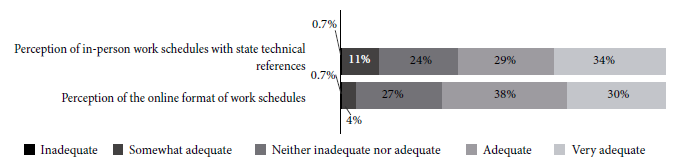
With respect to the analysis of work agendas, the in-person agendas with the state technical references were considered “highly adequate” or “adequate” by 63% of respondents. On the other hand, 24% rated them at the midpoint of the scale and nearly 12% as “low adequacy” or “inadequate.”
As for the online format of the work agendas, 38% rated it as “adequate” and 30% as “highly adequate,” totaling 68% positive perceptions. In addition, 27% took an intermediate position on the scale and fewer than 5% rated it as “low adequacy” or “inadequate” (Figure 3).

The analysis of perceptions about the themes and contents addressed revealed a predominance of evaluations classified as “highly adequate” and “adequate” in the domains of usefulness, relevance, and contribution of the themes addressed to the work of managers/technical teams of the Secretariat (Figure 4).

The theme of pregnant woman linkage was evaluated in three aspects-usefulness, relevance, and contribution to the work of managers/technical teams of the Secretariat-obtaining 68%, 71%, and 65% of responses as “highly adequate” or “adequate,” respectively.
The themes service coverage for network design, levels of obstetric and neonatal care for network design, and the role of state Health Secretariats in network management and the promotion of good practices were among the highest-rated themes in terms of relevance. The first received 82% of responses between “adequate” and “highly adequate”; the second, 81%; and the third reached 77% of ratings as “highly adequate” or “adequate,” respectively. However, these same items, when assessed in terms of their contribution, showed a lower proportion of responses rated as highly adequate or adequate, specifically 69%, 72%, and 65%, respectively.
Additionally, some themes, such as qualification of neonatal care, obstetric risk stratification, and proposal of a design for care during childbirth, the postpartum period, and newborn care (items included in the second survey question) received less expressive positive evaluations regarding their contribution to the work of managers/technical teams of the Secretariat. In these cases, the highest proportion of responses fell in the category “neither inadequate nor adequate” (31%, 24%, and 22%, respectively). Obstetric risk stratification stood out for receiving 16% of evaluations as “low adequacy.” Qualification of neonatal care, in turn, received 9% of ratings as “inadequate” or “low adequacy.”
Regarding the relevance of conceptual discussions with groups of states (an item included in the second survey), the results indicate a predominantly positive perception among respondents. A total of 76% rated the discussions as “relevant” (38%) or “highly relevant” (38%). Only a small proportion classified the discussions as “irrelevant” (2%).
This finding becomes even more relevant when correlated with perceptions concerning whether doubts/needs were addressed in those discussions (an item included in the second questionnaire). Although most of the respondents also evaluated this aspect positively, with 64% indicating that their doubts had been addressed very well or addressed, one-third of respondents rated this item neutrally.
Finally, Figure 5 presents Health Secretariat teams’ perceptions regarding adherence to and use of the discussions by states and municipalities, with respect to the adherence of key stakeholders to the work agendas and their follow-up activities, as well as the usefulness of the materials provided. The results reveal important nuances regarding the degree of appropriation and application of the proposed practices.

Perception of health secretariats' teams regarding adherence to and use of discussions by states and municipalities.
With regard to key stakeholders’ adherence to the work agendas and their follow-up activities, nearly 60% considered adherence “adequate” or “highly adequate.” However, a considerable number of participants rated it at the midpoint of the scale (31%), and 10% classified it as “low adequacy.”
As for the usefulness of the materials provided, the evaluation was broadly positive, although it varied according to the type of material. Conceptual presentations were rated by 80% as “highly adequate” or “adequate.” Structured network-design models obtained similar results, with 79% positive evaluations. The Excel spreadsheet for network design, in turn, received 71% of evaluations as “highly adequate” or “adequate.”
Open-ended question
Mentions of respondents to the request to cite practices or processes that may have been improved through the intervention design totaled 327 citations from 140 professionals. Analysis of these citations was organized into nine categories: Improvements in perinatal care aspects (18.35%); Network design (17.74%); Qualification of Health Secretariat teams (16.51%); Analysis of monitoring indicators (13.46%); Expansion of the management collegial body (8.87%); Pregnant woman linkage (8.26%); Death review/strengthening of committee (6.12%); Planning/Integrated Regional Planning - PRI (5.50%); and Regulation (1.83%).
Discussion
The results reinforce the relevance of evaluative research within the SUS, insofar as it allowed us to detail and analyze multiple aspects of a nationwide intervention. The decision to conduct a strategic analysis proved coherent with the study’s objectives, since the methodology adopted allowed not only for making explicit the concepts guiding the construction of the intervention, but also for detailing the processes that comprise it and their relations, through the logical model. Furthermore, it enabled the incorporation of the perceptions of the stakeholders directly involved-managers and technical staff from Health Secretariats-thus broadening understanding of its scope and challenges.
The intervention aimed at providing technical support for the planning, implementation, and management of maternal and neonatal Health Care Networks and showed agreement among specialists regarding its relevance in terms of the adequacy of the problems it seeks to address. Insufficient planning and management capacity in Health Care Networks was identified as a critical and priority problem for reducing maternal and neonatal mortality, corroborating previous findings on structural weaknesses in health management in Brazil19.
Regarding the methodology employed by the intervention, specialists viewed the predominance of virtual work agendas less positively, but highlighted the relevance of having technical references present in the states, understood as a strategy consistent with the literature in showing the importance of territorially grounded institutional support in promoting sustainable organizational change in health systems20. Finally, the specialist panel agreed with the understanding adopted both by the intervention and by other authors that effective strategies in obstetric and neonatal care require intersectoral approaches and robust governance devices21, which in this case includes the working methodology adopted.
One issue raised during validation of the problems was the lack of a specific ethnic-racial approach in the intervention, whether in its conception, organization, or as a topic discussed, indicating a gap. Racial and gender inequalities are foundational structures of Brazilian society. From this perspective, we should consider that White and Black/Brown people experience unequal conditions of access to the health system, since access and health-care-related behavior vary according to color or race. Racial inequalities directly affect opportunities for prevention, exposure to risk, and the quality of care received, reflecting historical and social processes of exclusion. Thus, analyzing the effects of structural and institutional racism in society is essential to understanding the factors that determine access to and use of health services22. Notably, in 2024, addressing maternal mortality among Black and Indigenous women was presented as a central theme of the new maternal-neonatal care network, called Rede Alyne23.
We identified a broad approval regarding the evaluation of the intervention by the Secretariat teams. As for the relevance of the themes addressed, those related to monitoring and evaluation of care network management, as well as clinical practices, stood out. This finding reinforces the understanding that strengthening networks is not restricted to planning but requires the implementation of continuous evaluation cycles, encompassing everything from protocol standardization and training of multiprofessional teams to the strengthening of health education actions. Such strategies contribute directly to improving clinical practice, management, and surveillance in the maternal and child field. This finding also aligns with the guideline of the National Humanization Policy, which advocates support and the inseparability of clinical care and management by showing that strengthening networks requires integrating clinical practices and management processes as complementary and inseparable dimensions of health care production24.
Concerning perceptions of the themes and content addressed, pregnant woman linkage stood out and was widely well rated in terms of relevance, usefulness, and contribution to the work of managers/technical teams of the Secretariat. Research analyzing factors associated with the linkage of pregnant women using the SUS to health services found that only 21.8% received an adequate number of prenatal visits and guidance on childbirth and the postpartum period. Linkage was lower among Brown women and higher among those with more schooling, paid employment, and satisfaction with prenatal care. These findings reinforce the relevance of the linkage theme and the need to consider social inequalities in the implementation of health interventions25.
These results show recognition of the importance of regionalization and the organization of care networks, although the lower proportion of positive responses regarding the practical contribution of these themes indicates challenges in translating knowledge into effective management actions. The relevance attributed to conceptual discussions among groups of states reinforces the role of training and alignment of technical cadres in strengthening regional governance.
To this end, the literature indicates that the consolidation of the SUS requires consideration of territory as the basis for integrating actions and services, since health needs are expressed and care flows are coordinated in it26. Thus, to support the strengthening of regionalization and network organization, we should recognize the centrality of teams in territories for the effectiveness of care and for the construction of linkages among points of care and among clinical care, management, and care delivery.
Addressing SUS structural fragmentation and effectively building care networks requires qualified and territorially articulated training of managers and professionals. Although guidelines and programs (PNAN, ETSUS, Ordinance No. 1,248/2013) point to promising advances in integrating teaching-service relationships, regional governance, and continuing education, the materialization of these gains still runs up against regional inequalities, technological insufficiencies, and institutional weaknesses that must be overcome in order to consolidate the SUS’s technical capacity27.
According to the results, the evaluation of themes such as levels of obstetric and neonatal care, the role of the SES in network management, pregnant woman linkage, and obstetric and neonatal transport was less favorable. One possible reason for this may be the persistent difficulties in coordinating care levels, defining institutional roles, and operationalizing network-based care. Such weaknesses recur in the literature and point to the historical difficulty of operationalizing comprehensive obstetric and neonatal care, especially regarding coordination among network points and timely regulation of access28.
Both work agenda formats, in-person and online, were well evaluated by the Secretariat teams, indicating a perception of flexibility and adaptability regarding the ways of conducting the processes. We should consider the feasibility of holding in-person work agendas given the country’s geographic dimensions, which reinforces the methodological choice of integrating in-person and online work agendas. The specialists’ positive evaluation of scope (national coverage) and financial feasibility with respect to the predominantly virtual work agendas can be considered further support for the advantages of the virtual format, reducing geographic barriers and travel costs.
Considering the difficulties of systematically maintaining the in-person modality for the development of continuing education actions and joint work with Health Secretariats and services (work agendas, technical visits, seminars, workshops, consultancies, and so forth), along with important operational and financial limitations due to the size of the country and of the SUS, the use of virtual platforms becomes strategic. According to Vinícius de Araújo Oliveira et al. 29, “investing in traditional learning (based on physical presence and tutored education) is impracticable, expensive, and inefficient for reaching the large number of health professionals distributed throughout a country the size of Brazil”29 (p.5).
The potential of online training shown in another study, albeit asynchronously, was evidenced among health professionals from different Brazilian regions as capable of driving learning processes both for technical-professional development and in terms of effective inclusion in the digital context30. Likewise, increased satisfaction and reduced costs have been observed in online learning interventions for the teaching of clinical skills31.
However, the literature offers counterarguments that, although virtual tools expand reach and streamline resources, their capacity to induce practical changes in local routines is limited, especially in contexts with low installed capacity32. The literature has underscored the importance of hybrid strategies for qualifying technical support processes, enabling greater contextualization of proposals and stronger ties with territories33.
Still, concerning work agendas, Secretariat professionals gave somewhat more restrained positive evaluations regarding local team adherence and the ability to generate reflection. In this regard, one may infer the need to review the methodological strategies used, aiming both at greater participant engagement and better adaptation to the virtual format, thus corroborating findings in the literature31.
Analyses of the Care Network for Pregnancy, Childbirth and Birth, the Newborn, the Postpartum Period, and the Child up to Two Years of Age, launched in 2011 under the name Rede Cegonha and updated in 2024 under the name Rede Alyne, have revealed important challenges and gaps in its implementation and in its coverage and quality indicators34-36. These challenges and gaps are not homogeneous across the country’s territory. Advancing care networks that ensure timely and continuous care, quality, and safety across the different points of care of Rede Alyne depends on strengthening technical and political capacity for its planning and management.
By analyzing its implementation and the perceptions of the managers and technicians involved, the study contributes elements for improving this and other national strategies aimed at organizing care networks and reducing maternal and neonatal mortality in the country, while also contributing to the sustainability of management-qualification strategies within the SUS.
References
- 1 Gomes MAM, Magluta C, Nakano AR. Olhares para a saúde de mulheres e crianças: reflexões no contexto da incorporação de boas práticas de cuidado e gestão. 1ª ed. São Paulo: Hucitec; 2020.
- 2 Leal MDC, Bittencourt AS, Esteves-Pereira AP, Ayres BVS, Silva LBRAA, Thomaz EBAF, Lamy ZC, Nakamura-Pereira M, Torres JA, Gama SGN, Domingues RMSM, Vilela MEA. Avanços na assistência ao parto no Brasil: resultados preliminares de dois estudos avaliativos. Cad Saude Publica 2019; 35:e00223018.
- 3 Motta CT, Moreira MR. O Brasil cumprirá o ODS 3.1 da Agenda 2030? Uma análise sobre a mortalidade materna, de 1996 a 2018. Cien Saude Colet 2021; 26(10):4397-4409.
- 4 Pacagnella RC, Nakamura-Pereira M, Gomes-Sponholz F, Aguiar RALP, Guerra CVQL, Diniz CSG, Campos BBNS, Amaral EM, Moraes Filho OB. Mortalidade materna no Brasil: propostas e estratégias para sua redução. Rev Bras Ginecol Obstet 2019; 40(9):501-506.
- 5 Lima LD, Albuquerque MV, Scatena JHG, Melo ECP, Oliveira EXG, Carvalho MS, Pereira AMM, Oliveira RAD, Martinelli NL, Oliveira CF. Arranjos regionais de governança do Sistema Único de Saúde: diversidade de prestadores e desigualdade espacial na provisão de serviços. Cad Saude Publica 2019; 35(Supl. 2):e00094618.
- 6 Gomes MASM. As políticas públicas e a saúde da criança. Cien Saude Colet 2010; 15(2):329-330.
- 7 Brasil. Ministério da Saúde (MS). Portaria nº 4.159, de 21 de dezembro de 2010. Define o Instituto Fernandes Figueira da Fundação Oswaldo Cruz (Fiocruz) como Instituto Nacional de Saúde da Mulher, da Criança e do Adolescente Fernandes Figueira da Fiocruz, para atuar como órgão auxiliar do Ministério da Saúde no desenvolvimento, coordenação e avaliação das ações integradas para a saúde da mulher, da criança e do adolescente no Brasil. Diário Oficial da União 2010; 21 dez.
- 8 Mendes EV. As redes de atenção à saúde. 2ª ed. Brasília: OPAS; 2001.
- 9 Pasche DF, Passos E. Inclusão como método de apoio para a produção de mudanças na saúde-aposta da Política de Humanização da Saúde. Saude Debate 2010; 34(86):423-432.
- 10 Ellsbury DL, Clark RH. Does quality improvement work in neonatology improve clinical outcomes? Curr Opin Pediatr 2017; 29(2):129-134.
- 11 Edwards EM, Ehret DEY, Soll RF, Horbar JD. Vermont Oxford Network: a worldwide learning community. Transl Pediatr 2019; 8(3):182-192.
- 12 Bittencourt SDA, Vilela MEA, Marques MCO, Santos AMD, Silva CKRTD, Domingues RMSM, Reis AC, Santos GLD. Atenção ao parto e nascimento em maternidades da Rede Cegonha/Brasil: avaliação do grau de implantação das ações. Cien Saude Colet 2021; 26(3):801-821.
- 13 Cavalcanti PCS, Gurgel Junior GD, Vasconcelos ALR, Guerrero AVP. Um modelo lógico da Rede Cegonha. Physis 2013; 23(4):1297-1316.
- 14 Champagne F, Brousselle A, Contandriopoulos AP, Hartz ZMA. A análise estratégica. In: Brousselle A, Champagne F, Contandriopoulos AP, Hartz ZMA, organizadores. Avaliação: conceitos e métodos. Rio de Janeiro: Fiocruz; 2011. p. 95-104.
- 15 Silva RC. A avaliabilidade do Programa SESI de prevenção de quedas na indústria da construção civil na Bahia [dissertação]. Salvador: Universidade Federal da Bahia, Escola Politécnica; 2007.
- 16 W.K. Kellogg Foundation. Using logic models to bring together planning, evaluation, & action: logic model development guide. Battle Creek (MI): W.K. Kellogg Foundation; 2001.
- 17 Cassiolato M, Gueresi S. Como elaborar modelo lógico: roteiro para formular programas e organizar avaliação. Brasília: Ipea; 2010.
- 18 Souza LEPF, Silva LMV, Hartz ZMA. Conferência de consenso sobre a imagem-objetivo da descentralização da atenção à saúde no Brasil. In: Hartz ZMA, Silva LMV, organizadores. Avaliação em saúde: dos modelos teóricos à prática na avaliação de programas e sistemas de saúde. Salvador, Rio de Janeiro: EDUFBA, Fiocruz; 2005. p. 65-102.
- 19 Viana AL d'A, Bousquat AEM, Melo GA, Negri Filho A, Medina MG. Regionalização e Redes de Saúde. Cien Saude Colet 2018; 23(6):1791-1798.
- 20 Magalhães Júnior HM, Pinto HA, Mendonça MHM. Apoio institucional: uma abordagem analítica da produção do cuidado e da gestão. Saude Soc 2020; 29(1):e180947.
- 21 Domingues RMSM, Dias MAB, Nakamura-Pereira M, Pacagnella RC, Lansky S, Gama SGN, Esteves-Pereira AP, Bittencourt SA, Theme Filha MM, Ayres BVS, Baldisserotto ML, Leite TH, Leal MC. Mortalidade perinatal, morbidade materna grave e near miss materno: protocolo de um estudo integrado à pesquisa Nascer no Brasil II. Cad Saude Publica 2024; 40(4):e00248222.
- 22 Cobo B, Cruz C, Dick PC. Desigualdades de gênero e raciais no acesso e uso dos serviços de atenção primária à saúde no Brasil. Cien Saude Colet 2021; 26:4021-4032.
- 23 Brasil. Portaria GM/MS nº 5.350, de 12 de setembro de 2024. Altera a Portaria de Consolidação GM/MS nº 3, de 28 de setembro de 2017, para dispor sobre a Rede Alyne. Diário Oficial da União 2024; 13 set.
- 24 Moller AB, Patten JH, Hanson C, Morgan A, Say L, Diaz T, Moran AC. Monitoring maternal and newborn health outcomes globally: a brief history of key events and initiatives. Trop Med Int Health 2019; 24(12):1342-1368.
- 25 Sales DDSO, Dias BAS. Fatores associados à vinculação de gestantes aos serviços de saúde em Boa Vista, Roraima. Rev Baiana Saude Publica 2024; 48(3):71-84.
- 26 Faria R. O território e as redes de atenção à saúde: intercambiamentos necessários para a integração das ações do Sistema Único de Saúde (SUS) no Brasil. Bol Geogr 2014; 32(2):173-191.
- 27 Shimizu HE. Percepção dos gestores do Sistema Único de Saúde acerca dos desafios da formação das Redes de Atenção à Saúde no Brasil. Physis 2013; 23(4):1101-1122.
- 28 Leal MC, Esteves-Pereira AP, Viellas EF, Domingues RMSM, Gama SGN. Assistência pré-natal na rede pública do Brasil. Rev Saude Publica 2020; 54:8.
- 29 Oliveira VA, Savassi LCM, Lemos AF, Campos FE. eLearning for Health in Brazil - UNA-SUS in Numbers. J Int Soc Telemed e Health 2016; 4:1-7.
- 30 Bussotti EA, Leite MTM, Alves ACC, Cristensen K. Online training for health professionals in three regions of Brazil. Rev Bras Enferm 2016; 69(5):924-928.
- 31 McGee RG, Wark S, Mwangi F, Drovandi A, Alele F, Malau Aduli BS; ACHIEVE Collaboration. Digital learning of clinical skills and its impact on medical students' academic performance: a systematic review. BMC Med Educ 2024; 24:1477.
- 32 Lima ACB, Santos DCM, Almeida SL, Silva EL, Pereira EBF. Ensino híbrido na formação em saúde: uma revisão sistemática. Rev Cuidarte 2022; 13(1):e2051.
- 33 Almeida PF, Medina MG, Fausto MCR, Giovanella L, Bousquat A, Mendonça MHM. Coordenação do cuidado e Atenção Primária à Saúde no Sistema Único de Saúde. Saude Debate 2018; 42(n. esp. 1):244-260.
- 34 Boing AF, Lacerda JT, Boing AC, Calvo MCM, Saraiva S, Tomasi YT, Natal S, Pudla KJ, Danielewicz AL, Silva VR, Nicolotti CA, Machado PMO, Baratieri T. Métodos e aspectos operacionais de um estudo epidemiológico e de avaliação da Rede Cegonha. Rev Bras Epidemiol 2021; 24:e210010.
- 35 Pasche DF, Pessatti MP, Silva LBRAA, Matão MEL, Soares DB, Caramachi APDC. Transição do modelo de ambiência em hospitais que realizam partos na Rede Cegonha. Cien Saude Colet 2021; 26(3):887-896.
- 36 Gomes MASM, Esteves-Pereira AP, Bittencourt SDA, Augusto LCR, Lamy-Filho F, Lamy ZC, Magluta C, Moreira ME. Atenção hospitalar ao recém-nascido saudável no Brasil: estamos avançando na garantia das boas práticas? Cien Saude Colet 2021; 26(3):859-874.
The data sources adopted in the research are indicated in the article’s body.

 Source: Authors.

 Source: Authors.
 Source: Authors.

 Source: Authors.
 Source: Authors.