
 Men who have sex with men (MSM): representations and practices for the prevention of sexually transmitted infections
Abstract
This is a descriptive, qualitative study, supported by the Theory of Social Representations, in the structural approach. The objective of this study was to analyze the social representations of sexually transmitted infection (STI) prevention practices in the group of men who have sex with men (MSM). One hundred homosexual men, aged 18 to 29 years, participated in the study, who answered a questionnaire for social and practice characterization, and a free evocation form, according to the inducing term “STD prevention”. Free evocations were analyzed with prototypical and similarity analysis techniques. The group investigated in this study was between 26 and 29 years of age (65%), reported the presence of a fixed sexual partner (67%), and 45% had used condoms inconsistently or sporadically in the last 12 months. In the prototypical analysis, the elements that constitute the probable central nucleus were condoms, PrEP, and care, which was reinforced by the similarity analysis. The social representation of the prevention of STIs of MSM is anchored in self-care; however, the type of sexual partnership and trust in the partner are defining factors for adherence or not to infection prevention practices.
Key words:
Sexually Transmitted Infections; Men’s Health; Sexuality; Social representation
Resumo
Estudo descritivo, qualitativo, apoiado na Teoria das Representações Sociais, na abordagem estrutural. Objetivou analisar as representações sociais das práticas de prevenção das infecções sexualmente transmissíveis no grupo de homens que fazem sexo com homens (HSH). Participaram cem homens homossexuais, na faixa etária de 18 a 29 anos, que responderam a um questionário para caracterização social e de práticas, e a um formulário de evocações livres, ao termo indutor “prevenção de DST”. As evocações livres foram analisadas com as técnicas de análise prototípica e de similitude. O grupo investigado tinha idades entre 26-29 anos, (65%); informou presença de parceria sexual fixa (67%) e 45% utilizaram, nos últimos 12 meses, o preservativo de forma inconsistente ou esporádica. Na análise prototípica, os elementos que constituem o provável núcleo central foram preservativos, PrEP e cuidado, o que foi reforçado pela análise de similitude. A representação social sobre a prevenção das infecções de transmissão sexual de HSH está ancorada no cuidado de si, contudo o tipo de parceria sexual e a confiança no parceiro são fatores definidores para a adesão ou não às práticas de prevenção das infecções.
Palavras-chave:
Infecções Sexualmente Transmissíveis; Saúde do Homem; Sexualidade; Representação social
Resumen
Estudio descriptivo, cualitativo, apoyado en la Teoría de las Representaciones Sociales, en el enfoque estructural. Se objetivó analizar las representaciones sociales de las prácticas de prevención de las infecciones de transmisión sexual en el grupo de hombres que tienen sexo con hombres (HSH). Participaron cien hombres homosexuales, en el rango de edad de 18 a 29 años, que respondieron a un cuestionario para la caracterización social y de prácticas, y a un formulario de evocaciones libres, al término inductivo “prevención de ETS”. Las evocaciones libres fueron analizadas con las técnicas de análisis prototípico y de similitud. El grupo investigado tenía edades entre 26-29 años (65%); informó tener una pareja sexual fija (67%) y el 45% utilizó, en los últimos 12 meses, el preservativo de manera inconsistente o esporádica. En el análisis prototípico, los elementos que constituyen el probable núcleo central fueron preservativos, PrEP y cuidado, lo que fue reforzado por el análisis de similitud. La representación social sobre la prevención de las infecciones de transmisión sexual de HSH está anclada en el cuidado de uno mismo, sin embargo, el tipo de pareja sexual y la confianza en el compañero son factores determinantes para la adherencia o no a las prácticas de prevención de las infecciones.
Palabras clave:
Infecciones de Transmisión Sexual; Salud del Hombre; Sexualidad; Representación social
Introduction
Sexually transmitted infections (STIs) are considered a global public health problem, and eight pathogens, including viruses and bacteria, are responsible: chlamydia, gonorrhea, syphilis, Human Immunodeficiency Virus (HIV), Herpes Simplex Virus (HSV), hepatitis B, hepatitis C, and Human Papillomavirus (HPV), which are considered the most common1.
The adoption of unsafe sexual practices makes young people vulnerable to these pathologies. A number of factors contribute to this scenario, such as the socio-environmental conditions of individuals, as well as the inherent characteristics of young people, whether physical or psychological. These, combined with the use of Psychoactive Substances (PS), can lead to the adoption of Risky Sexual Behaviors (RSB)1-3.
Regarding gender relations, males are more exposed to STIs, such as HIV/AIDS, seeking testing at healthcare facilities after unprotected sex. They thus assume the risk and increase their chances of exposure to STIs, making them a more vulnerable group4.
The concept of vulnerability demonstrates that people’s likelihood of exposure to health problems is not only associated with a set of individual attitudes, but also with collective ones, which make individuals more susceptible to infections and illness5. Vulnerability can be classified according to the following dimensions: 1) Individual - assesses people’s personal aspects and lifestyles, which can contribute to exposure to health problems; 2) Social - analyzes the contextual factors that define individual vulnerability, including material, cultural, political, and moral aspects of daily life in society; and 3) Programmatic - assesses how healthcare, education, social welfare, and cultural institutions respond to social conditions of vulnerability5.
Male vulnerability to STIs is associated with both the individual and collective levels. The first level is related to low-risk perception. In the collective aspect, it is directly related to social gender issues, with a fanciful vision of invulnerability, and directly influences men’s participation in preventive campaigns4. It should be added that the ways of thinking and representing the world constitute factors of individual and social vulnerability, defining practices.
In STI prevention practices for young men, the type of partnership is a determining factor. The idea of introducing contraceptive methods into a committed relationship can be synonymous with infidelity and a lack of trust in the partner. They report that using condoms can be awkward and uncomfortable, and can reduce erections, even though they recognize the importance of using them during sexual relations. Self-perception of the possibility of acquiring an STI seems distant for these individuals, even when condom use is inconsistent4,6.
Inequality in gender relations contributes to the increased male vulnerability to STIs. Condom use is seen as a priority contraceptive method, and they rarely refer to it as a protective factor against STIs. The length of the relationship between partners, decreased pleasure, and the type of emotional-sexual relationship were identified as factors that hinder condom use7.
A study of men who have sex with men (MSM) showed that they are more vulnerable to STIs, as they were more likely to not use male condoms compared to men of other sexual categories. Individuals who had sexual intercourse with regular partners, engaged in insertive anal intercourse, consumed alcoholic beverages, and had previously been diagnosed with an STI rarely used condoms8.
To assess the influence of social, behavioral, and consumer characteristics on unprotected anal sex among MSM, factors that increase this population’s vulnerability to STIs were observed, i.e. factors that increase the likelihood of engaging in anal sex without using a condom. These factors include: having had three or more partners in the last 30 days; adopting the bareback practice as a fetish; preferring explicit sexual media, with bareback scenes, or condomless anal sex among MSM; having a casual sexual partner; and being aware of their partner’s HIV-negative status9.
A study conducted with Chinese MSM demonstrated factors that may support positive condom use in this group, with a direct relationship to educational level. Contributing factors to non-use of the method were related to mental health problems, such as depression and experiences of sexual violence between intimate partners10.
Additionally, STI prevention practices include other complementary strategies, in addition to condom use, such as HPV prevention through vaccination; pre-exposure prophylaxis (PrEP), when indicated; post-exposure prophylaxis (PEP); and regular testing11.
The development of prevention practices presupposes the construction of social thinking about the object. Thus, the adoption of the Theory of Social Representations (TSR) in this study is based on the need to understand these ways of thinking that support (or not) the practices. Representation corresponds to an act of thought through which the subject relates to an object. This can be a person, a thing, a material or psychological event, a natural phenomenon, an idea, or a theory12. Social Representations (SRs) are defined as a “form of knowledge, socially elaborated and shared, with a practical objective, and which contributes to the construction of a common reality for a social group”12 (p.36).
The importance of using TSR in this study is based on the relationships between representations and practices, that is, between ways of thinking and acting in health. In certain circumstances, practices exercised by the social group are observed that are at odds with the representation of the object, as observed in various studies on STI prevention. The introduction of elements that are foreign to the context of representation can cause irreversible changes in the subjects’ practices and, consequently, lead to the transformation of representation13. Therefore, our study is based on the hypothesis that representations are a condition of practices and practices function as determinants of representation, as proposed by Rouquette14.
From this perspective, this research aims to analyze the social representations of STI prevention practices among men who have sex with men (MSM). We believe this research is relevant and can contribute to the reflection of healthcare professionals in caring for this population, as it discusses sexual practices, STI prevention among MSM, and the social representations of this group regarding their sexual behaviors, as well as the practical dimension of these social representations. It addresses specific aspects that can help professionals understand this population individually and offer educational practices that favor the reduction of STI incidence in this group.
The unique nature of this research is limited to the representational constructs presented about STIs from the perspective of MSM. The results allow us to understand this group’s perception of the representational object and how it shapes behaviors, distinguishing them from other results presented in the national and international scientific literature.
Methodology
This is a descriptive, qualitative study, based on the TSR, employing a structural approach. The structural approach considers a central core around which the SR is structured, which includes value systems and social norms that make up the current ideological environment. Peripheral elements, on the other hand, are the most accessible, dynamic, and concrete components of representation. They integrate everyday experiences and are the most individualized and localized15.
Data collection took place from September to November 2022, in the city of Rio de Janeiro. Participants were contacted in advance through social networking sites, and they were also asked to recommend other individuals who met the inclusion criteria. A date and time for data collection were scheduled; all ethical research procedures were followed; the study was reviewed by a Research Ethics Committee; and all participants signed an Informed Consent Form.
One hundred male individuals who met the inclusion criteria participated in the study: being homosexual, sexually active, and between 18 and 29 years of age. Men who identified as bisexual were not included in the sample to avoid confounding factors.
Two data collection instruments were used: a social profile questionnaire and a form to capture free responses. The questionnaire consisted of 30 questions, including sociodemographic variables, knowledge, attitudes, sexual practices, and STI prevention. Free responses, or free word associations, were captured by administering the form, using the expression “STD Prevention” as the trigger term. The acronym “STD” was used to capture responses because it is more recognizable to the general public.
The social characterization and practice data were organized in an Excel spreadsheet and analyzed using descriptive statistics, highlighting absolute and relative frequencies. In the prototypical analysis, the words evoked by the participants initially underwent a procedure to reduce the dispersion of the corpus, standardizing words that had the same meaning. Data analysis was performed using the Ensemble de Programmes Permettant L’analyse des Évocations (EVOC) software, which enabled the construction of a four-box table. In the analysis of the evocations, the criteria of frequency and importance were considered by the order of appearance of the terms produced15-17.
Based on a dictionary of produced words, the EVOC software calculated and reported the simple frequency of occurrence of each word, the weighted average of occurrence, and the average of the weighted average orders of the set of evoked terms. Therefore, a cutoff point for the minimum frequency was defined, and the average frequency was calculated according to Zipf’s Law. From this information, the “four-house chart” was constructed, in which the elements of the possible central core, the contrasting elements, and the peripheral elements of the SR were demonstrated15-17.
Prototypical analysis does not guarantee the centrality of the core elements of the representation, but it does highlight probable indications18. Considering this limitation of the technique, a second technique for indicating the centrality of the group’s social representation was used, developing similarity analysis by co-occurrence. The similarity index was calculated according to the technique proposed by Pecora and Sá19, initially identifying the co-occurrences of the words that appeared in the four-box table. Our study returned to the corpus of evocations, and co-occurrences (words that appeared together) were observed among the five words uttered by each individual who evoked at least two words that appeared in the four-box table, given that a connected relationship can only exist between one term and another. Once all existing co-occurrences had been identified, the similarity index between the word pairs was calculated by dividing the number of co-occurrences observed in the corpus by the number of participants involved. Once the calculations had been completed, the similarity matrix was created and the similarity graph was constructed. In this type of analysis, the aim is to obtain the linking relationships between the terms produced and the distance analysis between them, thus constructing the similarity graph19.
Results
The study participants were one hundred homosexual men with the following characteristics: 65% were between 26 and 29 years of age; 49% self-identified as white; 66% did not have a partner; 76% had paid employment; 38% reported regular condom use; 81% reported having had sexual relations with more than one partner in the same period. In the last 12 months, 67% had a steady partner and 45% used condoms inconsistently; 79% reported casual partnerships, and of these, 59% used condoms in all relationships.
Regarding the representational content identified from free evocations of the inducing term “STD Prevention,” the EVOC software revealed that participants (n=100) produced 497 words or expressions, of which 89 were different. To organize the four-house table, the minimum frequency was 8, the average frequency was 20, and the mean order of evocation (MOE) was 3.00. Considering the procedures and parameters stated, with the help of the EVOC software, the four-house table presented in Chart 1 was prepared.
The cognates that constitute the likely central core of the social representation, the most important in terms of salience and located in the upper left quadrant, were: condoms, PrEP, and care.
These elements constitute the most stable part of the representation, therefore, the one that resists change20,21. According to the Central Core Theory (CNT), the core is determined by the nature of the represented object, the types of relationships the social group maintains with this object, and the system of values and social norms that constitute the ideological environment of the moment and the group20,22.
The potentially central elements analyzed seem to indicate that, for MSM, STI prevention is a phenomenon defined by condom use and HIV pre-exposure prophylaxis, and translates as self-care. The term condoms had the highest frequency (80), being the most evoked by young people and, at the same time, had the lowest average MOE, which was 1.700, meaning that it was the most readily evoked, that is, remembered first with more spontaneity by participants.
Still regarding the organization of the four-quadrant chart, Abric20 states that the remaining cognates, also obeying hierarchy and frequency, make up the quadrants of representation: contrast zone and peripheral elements, which correspond to the lower left quadrant and the upper and lower right quadrants, respectively.
Thus, the upper right quadrant, the first periphery, contains cognates whose frequency is equal to or greater than the average frequency, but which were not as readily recalled: information and treatment. These contents are related to knowledge/information as necessary for prevention, the modes of transmission of STIs, and some practices that should be adopted to avoid or control transmission.
The lower right quadrant contains cognates that had low frequency and were recalled later, characterizing the second periphery. These are: STD testing, prevention, education, sex, SUS, sexual partnership, PEP, hygiene, and knowledge. These cognomens are linked to the most immediate context of participants’ lives and daily practices, and refer to the educational/knowledge dimensions as support for prevention practices and the use of technologies for prevention in the context of Unified Health System (SUS).
The lower-left quadrant, or contrast zone, contains cognates whose frequency is lower than average but which were readily mentioned by some participants: health, exams, and responsibility. In the context of TNC, this quadrant may highlight a subgroup that thinks differently from the other participants or even reinforces the central core or peripheral elements. In this study, a new attribute related to prevention appears to be observed: individual accountability for its practice. This attribute was not observed in the central core or in the peripheral.
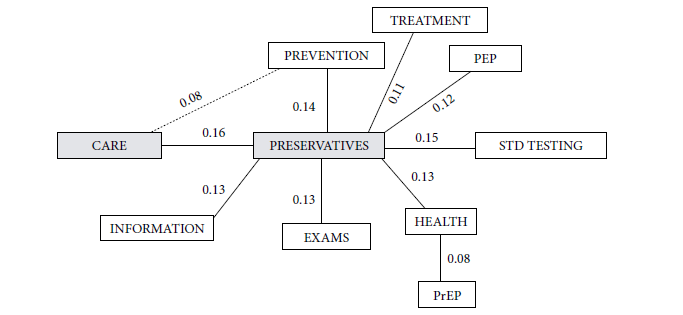
Next, the similarity graph will be presented, showing the cognates that established the greatest number of connections, providing a second indication of the centrality of the representation. Thus, 90 participants were identified who evoked at least two cognomens present in the four-quadrant chart (Figure 1). The result is a similarity graph, in which the interconnected cognomens (graph vertices) can be observed, expressing the strength of the connection between the representational contents16.
The similarity graph shows that the cognomens present are: condoms, care, STD testing, prevention, information, examination, health, PEP, PrEP, and treatment, totaling ten evoked elements. The cognomen that established the highest number of connections (eight) was condoms, in addition to establishing the strongest connections with the others. These indicators reinforce the possibility of its centrality in the analyzed SR. The strongest connections presented are with care (0.16), STD testing (0.15), and prevention (0.14); however, the other connections are equally strong, ranging from 0.11 to 0.13. The centrality of the elements PrEP and care does not appear to be confirmed in this analysis, since they do not appear to irradiate co-occurrences with other terms.
Discussion
Regarding the characterization of the MSM group, the prevalent age range was 26 to 29 years of age. Other studies with the young population have found divergent results regarding the age range, with records ranging from 18 to 25 years of age9,23. Regarding skin color, half of the group identified themselves as white and working for financial gain, which demonstrates a factor of social privilege within this group.
Research conducted with the MSM population demonstrated that social markers are important when it comes to differences in opportunity. Thus, white people have greater opportunities for better social standing, even those from the lower middle class. For other participants, however, being Black and gay is a factor of social difficulty24. Other studies with the MSM population showed that the majority of participants are Black or Brown24,25.
Among the participants, 66% did not have a partner, and 81% reported having more than one sexual partner during the same period. Research with the MSM population demonstrated a high turnover of sexual partners and the practice of group sex, which are factors in the individual vulnerability of these individuals to STIs9.
In the study group, 38% reported continuous condom use during sexual intercourse. Research has found that the motivation for MSM not to use condoms is related to factors such as knowledge, trust in their partner, “arousal” during sexual intercourse, the effects of alcohol and other drugs, and not having a condom at the time26. The chances of an individual in the MSM group engaging in sexual intercourse without using a condom may be increased by the number of partners, the type of sexual partnership, the protective strategies adopted, and the fetishization of bareback sex, which may be exacerbated by the preference for watching sexually explicit media, in which condomless sex has been common9.
In Colombia, it was found that this method is seen as an effective method only in penetrative sexual practices. In practices with multiple partners, the use of a single condom is considered sufficient for multiple penetrations and antiretroviral therapy, both pre- and post-exposure, is seen as authorizing the non-use of condoms27.
Among the participants, there was a greater adherence of MSM to the use of this resource with casual partners (19% in relationships with steady partners and 59% in relationships with casual partners). Research carried out in Switzerland to investigate condom use in the local population found that, between 2012 and 2017, condom use was higher with casual partners (74% and 83%), when compared to stable partners, with records of 23% and 33%, respectively28. Condom use with steady partners tends to be lower than with casual partners due to some factors, such as trust in the partner, believing that they know the person and, consequently, can relax protective measures against STIs. This data is present in other studies involving young men, including MSM6,26,29.
Regarding the analysis of the social representation of STI prevention, it is found to be made up of elements that express ideas, information, images, attitudes, and practices within the context of a structure, corresponding to the concept attributed by Abric20 when he states that “a social representation is an organized and structured set of information, beliefs, opinions, and attitudes; it is a particular sociocognitive system [...]”20 (p.38).
Although this composition cannot precisely define the representational dimensions present, it can be considered that, as proposed by Moscovici, the dimensions of information or concept, imagery, attitude, and practice are contemplated22,30.
Thus, it can be observed that the cognomen “condoms” represents the imagery dimension, as it reflects a widespread image in society that is conducive to prevention. However, this cognomen also highlights the knowledge/information that the group possesses or a practice to be followed regarding STI prevention. The information dimension is observed in the cognomens that reveal other forms of prevention or control of infections affected by more recent technologies, such as PrEP, treatment, exams, STD testing, PEP, and sexual partnership. The attitudinal dimension, which refers to how individuals position themselves in relation to the object of representation, is contemplated in the cognomens of “care” and “responsibility.”
The prototypical analysis highlighted the cognomens of “condoms,” “PrEP,” and “care” as components of the possible central core. However, a second indication of centrality was sought using the similarity analysis technique, in which the cognomen “condoms” stood out due to its greater number of connections with other evoked cognates, reinforcing the hypothesis of the possible centrality of this element of representation.
A core meaning is found to be formed by the cognomen “condoms”, with a strong indication of centrality and, therefore, giving meaning to the representation and organizing the other contents. Thus, it was assessed that, in the group’s thinking, STI prevention has condoms as a central element, whether in a cognitive dimension, that is, as part of the group’s knowledge, or in a practical dimension, as a prevention practice that acts as a barrier to the transmission of infectious agents.
It is important to consider that STI prevention involves other aspects as well. It demonstrates self-care and care for others, but it also requires information to be practiced. By contrast, despite the importance attributed to condoms, other actions or behaviors encompass the set of measures that can be employed to prevent or control infections, such as PEP, PrEP, and STD testing. These cognomens demonstrate that the group considers information to be an important component of prevention and that treatment is also a form of prevention, preventing the spread of infections.
It is estimated that a portion of the group considers three important aspects for the prevention of STIs: prevention promotes or maintains health; carrying out periodic exams is characterized as preventive care, as it can provide an early detection of an infection; and the individual’s responsibility for adopting these healthcare measures.
Given the above, and triangulating the results, it is understood that the young MSMs from the present study see condoms as the primary form of STI prevention, even though they do not use this resource consistently in all sexual relations. The rational approach to the existence of a causal relationship between knowledge and the adoption of certain practices may not be effective, and may present discrepancies with life experiences, belief systems, culture, and values, deviating from parameters that are considered rational31. On the other hand, the presence of PrEP in the central core highlights the transfer of responsibility for prevention to a pharmaceutical technology.
Important findings were also found in the first and second peripheries, demonstrating meanings resulting from an activity that makes representation a “construction” and an “expression” of the subject, implying that, if the subject undergoes routine testing, HIV testing, and uses resources such as PrEP and PEP, they will prevent STIs. In this sense, condom use can be seen as optional, since other technologies could replace the need for a barrier method, which is considered unpleasant and inconvenient in several ways. It should be emphasized that the group considers information to be an important component of prevention, and treatment is also a form of prevention, hindering the spread of infections.
However, the process of objectifying the prevention SR can be observed in the condom, PrEP, and PEP terms, as discussed. HIV PrEP consists of the use of oral antiretrovirals to reduce the risk of HIV infection. Eligibility criteria for PrEP are concentrated in a few key populations, which account for the majority of new cases of infection, such as gay men and other MSM, transgender people, and sex workers11.
One study conducted with gay men and MSM found that the main factors for awareness and motivation to use prophylaxis are associated with prior knowledge (virtual social networks, friends, health professionals, experience with health services, and previous use of PEP); the quantity and quality of sexual relations (more or less frequent condom use and high or low frequency of sexual relations); and risk perceptions related to the perceived degree of exposure during sexual relations24.
The social characteristics of the study group - white men, active in the workforce, and knowledgeable about PrEP and PEP - reinforce the notion that this group is considered socially privileged, as they have access to information in different ways and, possibly, better access to health services. However, these conditions do not appear to promote changes in behaviors and practices, as most of those surveyed reported not regularly using condoms during sexual relations.
When analyzing the relationships between representations and practices, there is a tendency in society to view them as linear, meaning there would be a direct correspondence between what the group thinks/knows about the object and the practices adopted. However, as other authors have pointed out14,20,22,32, these relationships are not symmetrical, since representations present themselves as a condition of practices, but new practices effectively modify these representations, as seen in the presence of PrEP at the core of the prevention SR. In this sense, the availability of drug technologies that enable the interruption of HIV infection may be impacting more general prevention practices. However, this is a hypothesis that deserves further investigation.
By contrast, within the context of TSR, this situation can also be explained by the concept of a system of representations in which some social objects are organized into a network, establishing a relationship between different representations within the same group33. Thus, the group’s social representations about condoms impose themselves, influencing practices regarding the non-use of this resource for prevention. Although the group is aware that condoms are recommended for the prevention of STIs, in the representations, they are perceived as something uncomfortable, which comes between partners, generates distrust, and interferes in the practice of using this device effectively.
Study limitations
The study is limited by the number of participants and the fact that it was carried out in only one municipality in Rio de Janeiro. However, the results are consistent with other investigations with MSM and denote a representational change in STI prevention with the incorporation of new technologies for care.
Conclusion
It is well-known that STIs have a significant impact on individuals’ sexual and reproductive lives, and that some people, such as MSM, are more vulnerable to these health problems. This study, using TSR, allowed us to identify the structured representational content surrounding STI prevention from the perspective of young MSM.
The group’s SR is structured around condoms, PrEP, and self-care, but only condoms emerged as a potential central element according to the four-square chart and the similarity graph. It can be inferred that condoms, as an older technology and extensively addressed in educational campaigns over time, are the primary form of prevention for these infections, even when accompanied by more recent elements, such as PrEP, which does not yet play a central role in the SR analyzed in this study.
The study’s quantitative data, however, demonstrate that there is no symmetry between this finding and the protective practices developed, since the MSM studied do not use this method in all sexual relations, especially with regular partners. Therefore, other factors influence the determination of protective practices in addition to the knowledge of the subject and scientific recommendations.
Thus, an asymmetry is observed between representations and practices of STI prevention, as has already been pointed out for other groups of young people and adults. PrEP and PEP, in turn, were incorporated into the social representation of STI prevention and denote a representational shift associated with the emergence of new AIDS prevention practices, which have more generally imposed themselves on the social representation of prevention, even though they do not specifically address STIs, but rather HIV. It is possible to hypothesize a decrease in the importance and use of condoms in sexual relationships due to the incorporation of new technologies for sexual health care and disease prevention.
The results of this investigation corroborate new evidence capable of impacting the development and implementation of public health policies targeted at this social group, in such a way that healthcare practices, regarding STI prevention and control, can be remodeled to encompass the peculiarities and representational constructs of MSM. It is important to emphasize that ongoing educational initiatives, carried out both within and outside educational and healthcare institutions, that is, those that encompass society as a whole, are imperative and should encompass new communication channels, such as social media and dating and casual dating apps. In this context, future research on this topic is recommended in other sociocultural contexts and regions of Brazil and the rest of the world.
References
- 1 World Health Organization (WHO). Organização Pan-Americana de Saúde (OPAS). Plano de ação para a prevenção e o controle do HIV e de infecções sexualmente transmissíveis 2016-2021. Washington D.C.: WHO; 2017.
- 2 Spindola T, Santana RSC, Antunes RF, Machado YY, Moraes PC. A prevenção das infecções sexualmente transmissíveis nos roteiros sexuais de jovens: diferenças segundo o gênero: Cien Saude Colet 2021; 26(7):2683-2692.
- 3 Sodré CP, Spindola T, Brito LT, Sousa FDM, Frutuoso R, Ramos WR. Conhecimentos e crenças de universitários do curso de engenharia sobre as infecções sexualmente transmissíveis. R Pesq Cuid Fundam Online 2021; 13:1089-1094.
- 4 Martins ER, Medeiros AS, Oliveira KL, Fassarella LG, Moraes PC, Spindola T. Vulnerabilidade de homens jovens e suas necessidades de saúde. Esc Anna Nery 2020; 24(1):e20190203.
- 5 Ayres JRCM. Risco, vulnerabilidade e práticas de prevenção e promoção da saúde. In: Campos GWS, Minayo MCS, Akerman M, Drumont Júnior M, Carvalho YM, organizadores. Tratado de saúde coletiva. 2ª ed. São Paulo: Hucitec; 2012. p. 375-417.
- 6 Spindola T, Fonte VRF, Francisco MTR, Martins ERC, Moraes PC, Melo LD. Práticas sexuais e comportamentos de risco para infecções sexualmente transmissíveis entre jovens universitários. Rev Enferm UERJ 2021; 29:e63117.
- 7 Guimarães DA, Oliveira VCP, Silva LC; Oliveira CAM, Lima RA, Gama CAP. Dificuldades de utilização do preservativo masculino entre homens e mulheres: uma experiência de rodas de conversa. Estud Psicol (Natal) 2019; 24 (1):21-31.
- 8 Sousa LRM, Elias HC, Caliari JS, Oliveira AC, Gir E, Reis RK. Uso inconsistente do preservativo masculino entre homens HIV negativos que fazem sexo com homens. Rev Latino Am Enferm 2023; 31:e3892.
- 9 Martins AA; Queiroz AAFLN, Frota OP, Araújo TME, Mendes IAC, Fronteira I, Sousa AFL. Consumo de mídias sexualmente explícitas e sexo anal desprotegido em homens que fazem sexo com homens. Cien Saude Colet 2021; 26(11):5841-5849.
- 10 Jiang H, Chen X, Li J, Tan Z, Cheng W, Yang Y. Predictors of condom use behavior among men who have sex with men in China using a modified information-motivation-behavioral skills (IMB) model. BMC Public Health 2019; 19:261.
- 11 Brasil. Ministério da Saúde (MS). Protocolo Clínico e Diretrizes Terapêuticas para Profilaxia Pós-Exposição (PEP) de Risco à Infecção pelo HIV, IST e Hepatites Virais. Brasília: MS; 2022.
- 12 Jodelet D. Representações sociais: um domínio em expansão. In: Jodelet D, organizadora. As representações sociais. Rio de Janeiro: EdUerj; 2001. p.17-44.
- 13 Flament C. Estructura, dinâmica y transformación de las representaciones sociales. In: Abric JC. Prácticas sociales y representaciones. México: Ediciones Coyoacán S.A. C.V.; 2001. p. 33-52.
- 14 Rouquette ML. Representações e práticas sociais: alguns elementos teóricos. In: Moreira ASP, Oliveira DC, organizadores. Estudos interdisciplinares de representação social. 2ª ed. Goiânia: AB; 2000. p. 39-48.
- 15 Abric JC. A abordagem estrutural das representações sociais. In: Moreira AS, Oliveira DC, organizadores. Estudos interdisciplinares de representação social. Goiânia: AB; 1998. p.27-38.
- 16 Oliveira DC. Análise das evocações livres: uma técnica de análise estrutural das representações sociais. In: Paredes AS. Perspectivas Teórico-Metodológicas em representações sociais. João Pessoa: Editora Universitária UFPB; 2005. p.573-603.
- 17 Wachelke JFR. Índice de Centralidade de Representações Sociais a partir das evocações (INCEV): Exemplo de Aplicação no Estudo da Representação Social sobre Envelhecimento. Psicol Reflexão Crítica 2009; 22(1):102-110.
- 18 Wachelke J, Wolter R. Critérios de construção e relato da análise prototípica para representações sociais. Psic Teor Pesq 2011; 27(4):521-526.
- 19 Pecora ARP, Sá CP. Memórias e representações sociais da cidade de Cuiabá ao longo de três gerações. Psicol Reflexão Crítica 2008; 21(2):319-325.
- 20 Abric JC. A abordagem estrutural das representações sociais: desenvolvimentos recentes. In: Campos PHF, Loureiro MCS, organizadores. Representações sociais e práticas educativas. Ed. UCG; 2003. p. 37-57.
- 21 Sá CP. Estudo de Representações sociais o fenômeno, o conceito e a teoria geral. In: Sá CP. Estudos de Psicologia Social: história, comportamento, representações e memória. Rio de Janeiro: EdUerj; 2015. p. 183-208.
- 22 Sá CP. A teoria do núcleo central das representações sociais. In: Sá CP. Núcleo central das representações sociais. Petrópolis: Vozes; 2002. p. 51-98.
- 23 Oliveira MVB, Oliveira FBM, Silva WC, Mallet JRS, Ferreira NS, Alves FR, Rodrigues RPS, Silva ABS, Moura LS, Araujo JR, FCA. Fatores preditivos ao medo de infecção HIV/AIDS entre homens por meio de aplicativos de relacionamento. Rev Enferm 2020; 92(30):97-108.
- 24 Santos LAD, Unsain RF, Brasil SA, Silva LAVD, Duarte FM, Couto MT. PrEP perception and experiences of adolescent and young gay and bisexual men: an intersectional analysis. Cad Saude Publica 2023; 39(Supl. 1):e00134421.
- 25 Magno L, Silva LAV, Guimarães MDC, Veras MASM, Deus LSA, Leal AF, Knaut DR, Brito AM, Rocha GM, Lima LNGC, Kendall C, Motta-Castro ARC, Kerr LRFS, Mota RMS, Merchan-Hamann E, Dourado IC. Discriminação por orientação sexual entre HSH no Brasil: uma análise de classes latentes. Rev Bras Epidemiol 2019; 22(Supl. 1):e190003.
- 26 Rios LF, Adrião KG, Albuquerque A, Pereira AF. 'Couro no couro': homens com práticas homossexuais e prevenção do HIV na região metropolitana do Recife. Saude Debate 2022; 46(7):85-102.
- 27 Moncayo JE, Pérez-Arizabaleta MM. Discursos identificados sobre el uso y no uso del condón en hombres gays, bisexuales y otros hombres que tienen sexo com hombres en dos ciudades de Colombia. Rev Esp Salud Publica 2023; 97:e202306054.
- 28 Buitrago-Garcia D, Salanti G, Low N. Condom use and HIV testing among adults in Switzerland: repeated national cross-sectional surveys 2007, 2012, and 2017. BMC Public Health 2023; 23:2158.
- 29 Melo LD, Sodré CP, Spindola T, Martins ERC, André NLNO, Motta CVV. A prevenção das infecções sexualmente transmissíveis entre jovens e a importância da educação em saúde. Enferm Global 2022; 65:88-101.
- 30 Moscovici S. A psicanálise, sua imagem e seu público. Petrópolis:Vozes; 2012.
- 31 Melo LD, Spindola T, Brandão JL Arreguy-Sena C. Políticas de prevenção de infecções sexualmente transmissíveis e universidades promotoras da saúde: reflexão teórica à luz da Teoria Transcultural. Rev Enferm UERJ 2022; 30:e64543.
- 32 Wolter RMCP, Sá CP. As relações entre representações e práticas: o caminho esquecido. Rev Int Cien Soc Humanidades 2013; 23(1-2):87-105.
- 33 Brandão CT, Benevides AS, Campos PHF. Sistemas de representação social: contribuições para a pesquisa em educação. Rev Teias 2020; 21(n. esp.):167-182.
-
Funding
This work was carried out with the support of the Fundação de Amparo à Pesquisa do Estado do Rio de Janeiro- Brazil (FAPERJ), Notice E_26/2021 - basic research assistance (APQ1) in state ICTs UERJ and UEZO -2021/SEI-260003/015578/2021-APQ1.
-
Data availability statement
The data sources adopted in the research are indicated in the article’s body.
The data sources adopted in the research are indicated in the article’s body.

 Source: Authors. 2023.