 Respiratory profile of patients with neuromuscular disease and adherence to the use of noninvasive ventilation
Neuromuscular diseases (NMD) are characterized by progressive loss of respiratory muscle strength, which alters pulmonary compliance and reduces bronchial hygiene. The objective of this study was to evaluate the clinical-functional respiratory profile of children, adolescents, and young adults with NMD who adhered or did not adhere to the use of noninvasive ventilation (NIV). This is a retrospective cohort study of patients with an indication for NIV use. A reduction in symptoms was observed (dyspnea, p<0.02), along with an association between the difference in peak expiratory flow and peak cough flow (r=0.503; p<0.02); an inverse relationship between peak cough flow and the number of hours of NIV use (r=−0.33; p<0.05); a linear relationship between maximal inspiratory pressure and age (r=0.413; p<0.01); and an inverse relationship between maximal expiratory pressure and the number of hours of NIV use (r=−0.34; p<0.04). The number of hospitalizations requiring intubation was zero. Among the benefits of NIV are a trend toward symptom reduction and a decrease in the rate of respiratory failure requiring hospitalization. There was an increase in maximal inspiratory pressures despite the decline in pulmonary function, which was not associated with the number of hours of NIV use.
Keywords:
Noninvasive Ventilation; Duchenne Muscular Dystrophy; Spinal Muscular Atrophy; Neuromuscular Diseases
 Thumbnail
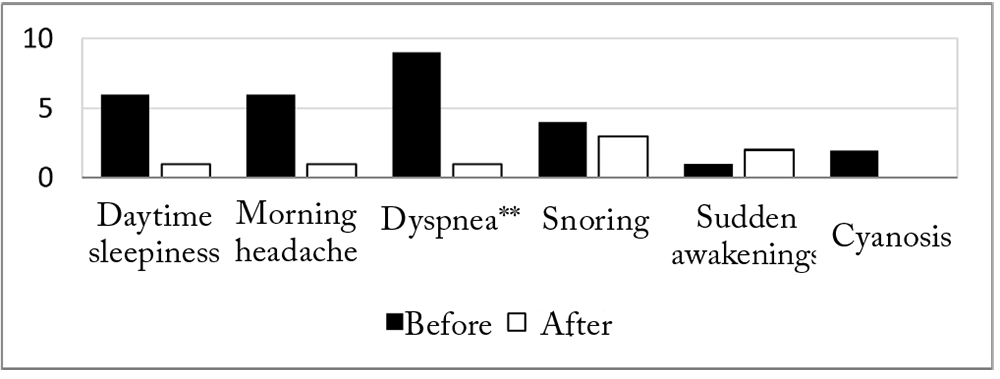 **Statistically significant difference (p<0.02)