
 Alienation, technicity and raciality: towards a dialogue between Frantz Fanon and Gilbert Simondon
Abstract
In the face of the expansion of studies on race and racism in the area of Science, Technology, and Society (STS), in addition to the theme’s relevance for antiracist activism, this work proposes an intervention and a contribution to this field of study reconstructing its theoretical and methodological roots. Without intending to exhaust the available research on this subject, the article emphasizes the anthropological and sociological ramifications within STS studies on race. It then demonstrates its roots in Frantz Fanon’s work. Finally, it suggests that Fanon’s approach to the intersection of racism and technology, grounded in the context of the anti-colonial struggle, can be reworked vis-à-vis the transformations presented by the technical relations of the digital world. As a critical synthesis, the study proposes new dialogues with the Philosophy of Technology, especially in light of the renewed interest in Gilbert Simondon’s work, offering opportunities for exploration and reflection.
Keywords
alienation; technology; race and racism; Frantz Fanon; Gilbert Simondon
Resumo
Diante do crescimento nos últimos anos dos estudos sobre raça e racismo na área de Ciência, Tecnologia e Sociedade (CTS), além da relevância do tema para o ativismo antirracista, este trabalho visa intervir e contribuir com o campo reconstruindo suas filiações teóricas e metodológicas. Sem pretender exaurir as pesquisas disponíveis nesse recorte, enfatizamos as ramificações antropológicas e sociológicas nos estudos em CTS sobre raça. A partir disso, demonstramos suas matrizes na obra de Frantz Fanon. Por fim, sugerimos que a abordagem fanoniana da intersecção entre raça e tecnologia, fundada no contexto histórico das lutas anticoloniais, pode ser reelaborada diante das transformações apresentadas pelas relações técnicas do digital. Como síntese deste estudo, propomos que novos diálogos com a Filosofia da Técnica, em especial pelo renovado interesse na obra de Gilbert Simondon, oferecem oportunidades de trabalho e reflexão.
Palavras-chave
alienação; tecnologia; raça e racismo; Frantz Fanon; Gilbert Simondon
Introduction
The machine is only a means; the end is the conquest of nature, the domestication of natural forces by means of a first act of enslavement: the machine is a slave whose purpose is to make other slaves.
Gilbert Simondon (2017, p. 141)
I am fixed. Having adjusted their microtomes, they objectively cut away slices of my reality…
Frantz Fanon (1986, p. 87)
The colonial enslaved person is also kept in an alien relationship to the world. Hold politics represents this line that is drawn between human beings and denies some the same qualities as others, that excludes some from the dignity of an existence where a scene, an Earth, a world are shared.
Malcom Ferdinand (2021, p. 52)
Are we living through a new phase of racism, this time marked by the globalization of technology, digitality and the expansion in regimes of racialization? What is the best way to refer to this phenomenon—digital racialization (Faustino & Lippold, 2022), or algorithmic racism (Silva, T., 2022)? Above all, immersed in an advanced racial sociotechnical regime, shaped by cybernetics, machine learning and artificial intelligences (AIs), how might we conceive of an antiracist project? These questions permeate various voices exploring the intersection between technology and racism.
Looking to contribute to this debate, in this article I propose a dialogue between the Philosophy of Technology and studies on race and technology, setting out from the ontogenetics of technical individuation developed by Gilbert Simondon (2020, 2017) and the racial sociogenesis of Frantz Fanon (1986). I highlight a path that has been taking shape in research and activism against racial bias in the field of Science, Technology and Society (STS). Next, I outline some theoretical conclusions regarding the ontological status of the machine and its relationship with racialization. From there, I draw upon (in the sense of being inspired by) arguments presented by Afrofuturism (Amaro, 2018; Eshun, 2003, 1998; Nelson, 2002; Neyrat, 2020) and the proposition of cosmotechnics (Hui, 2016, 2020), advocating the need to imagine new histories of modern technology. These histories embrace the perspective of technical invention.
Thus, I construct my argument in two phases: first, I provide an overview of the different perspectives from which the relationship between racism and digital technology is addressed within the STS field; second, I establish a connection between sociogenic racialization and ontogenetic technical individuation – these terms will be duly explained later through a discussion of the works of Fanon and Simondon. This connection triangulates the concepts of raciality, technicity and alienation in these authors in order to propose the ontogenesis of the slave-machine; by this, I mean the region within which a symmetrical approach between technicity and raciality can emerge.
By way of conclusion, I return to the critique of studies of race and racism within STS, calling attention to the technical individual, thereby highlighting the importance of technicity for an antiracist approach to technology. I leave a path open for future exploration that is inspired by Simondon’s concept of invention in dialogue with Fanon.
Race, racism and technology
The purpose of this section is to delineate the field in which my hypothesis, experimentation and speculation are individuating and operating. This field has recently entered a phase of acceleration driven by the dissemination of personal computers, the expansion of internet access, and the platformization of capitalism (Beiguelman, 2021), or what has also been called surveillance capitalism (Zuboff, 2019). Among the political consequences, racial aggressions have migrated en masse to the internet and the global far right has begun to use technology as part of its project of civilizational warfare (Gilroy, 2018; Trindade, 2022). This scenario has offered up the two main objects of STS studies on race: the ideology of digital technology’s neutrality, propagated by Silicon Valley, and the affirmative response of technical knowledge rejected by the Eurocentric vision of progress. It has also fuelled the boom in studies and activism against the racist biases of digital technology, which form the bibliography I intend to highlight in this article.2
For clarity’s sake, following a non-exhaustive review of the literature, I will categorize the works on race in STS into two general theses:3 the sociological, which critically focuses on algorithmic biases and sociotechnical regimes, and the anthropological, which examines the appropriation of technology by local black cultures. Both ethnological studies and historical research can be grouped under the anthropological approach since both ethnology and historiography can be encompassed by the affirmative response to racism: in general, these works argue that black people also possess technical knowledge or creatively appropriate modern technologies.4 The Nigerian cultural critic Louis Chude-Sokei (2016) terms this technical (re)invention in the diasporic context a black techno-poetics.
In his wide-ranging analysis, Chude-Sokei (2016) highlights the presence of racial signifiers in the tradition of science fiction and the history of technology, including the development of the automaton in cybernetics. Chude-Sokei can be seen to rework the operations of the Black Atlantic – a concept proposed by the Afro-British historian Paul Gilroy (1993) to think about black history in transnational or non-national contexts – in a “post-humanist” direction. Following Gilroy’s theses on black music and its relationship to Western modernity, Chude-Sokei (2016, p. 5) addresses sound as the environment in which black culture intersects with information and technology. African diasporic cultures and the various aesthetic currents of the Black Atlantic animate these affirmations concerning the inventive power of the descendants of enslaved Africans.
Pursuing the anthropological thesis, the African American sociologist Andre Brock (2020a, 2020b) and the African American historian Simone Browne (2015) also affirm the technical creativity of black cultures. Brock focuses his analysis on both online and offline dimensions. This aim in mind, he formulates a heuristic method: Critical Technocultural Discourse Analysis (CTDA). In his words (Brock, 2020b), CTDA addresses culture as technology and the culture of technology. Brock’s interest here centres on social networks, particularly Twitter, and the way black identity (blackness) is constructed online. According to Brock (2020a, p. 15), “Black folk have made the internet a ‘Black space’ whose contours have become visible through sociality and distributed digital practice while also decentring whiteness as the default internet identity.” Brock analysed the importance of design in the practice of local cultures surrounding the electronic device—in the case of Twitter, mobile phones. For the sociologist, it is essential to pay attention to the algorithmic dimensions and people’s everyday relationship with these devices.
Brock (2020b) asserts that Black cultures possess a “natural” affinity with the internet and digital objects. However, the author wishes to avoid adopting an essentialist view and thus advocates for a historical perspective. Simone Browne (2015, 2020) supports this argument in her study of African American black practices of resistance to policies controlling blackness in the post-abolition period. Here, Browne (2015) develops a profound critique of studies on surveillance, which generally focus on the figure of the panopticon analysed by Michel Foucault. Her philosophical approach can be situated as part of the African diasporic tradition: Browne (2015) argues that surveillance must be considered through the analysis of other archives, calling attention specifically to slavery and the technologies used to objectify African bodies. Extending Foucault’s approach, Browne provides an analysis of the Brooks, a ship used in the transatlantic slave trade in the eighteenth century. The arrangement of bodies and the organization of the hold in which these people were transported illustrate her argument that the ship is a surveillance technology.
What this visual representation of the slave ship points to is the primacy given in these abolitionist texts to white gazes and vantage points to the trauma of slavery, where the tiny black figures are made to seem androgynous, interchangeable, and replicable. This is the ‘god-trick of seeing everything from nowhere,’ and, as [Donna] Haraway warns, ‘this eye fucks the world.’
(Browne, 2015, p. 49)
The author highlights the production of black bodies within the relations of the triangular slave trade through technical operations that inform modern technologies. This attention to continuities, which is forever resurfacing in diasporic narratives and critiques, resonates in analyses of black people’s everyday experiences. For example, in the chapter of her book Dark Matters (Browne, 2015) on airports in the post-9/11, context, Browne examines the spread of biometrics as a consequence of the attacks. In another moment, she argues that this event accelerated the process of “digital epidermalization” (Browne, 2010). We will return to the concept of epidermalization when I discuss the work of Frantz Fanon in more detail.
Although no rigid boundary exists between this first anthropological affirmation and what I have categorized as the sociological thesis, it is possible to distinguish another group of works focused on responding to the advance of digital technologies. This literature seeks to deepen the discussion on algorithmic biases through research that describes the intersection between technical objects and racial scientific thought, situated within cultural media studies and the history of science (Braun, 2014; Chinn, 2000). More recently, the sociological thesis has turned to formulating explicit critiques of Big Tech. In this group, I pick out information scientists Ruha Benjamin (2019) and Safiya Noble (2018), who have helped sediment an emergent field of study and activism.
Noble (2018) conducted pioneering research on the reproduction of racism in Google’s search engines. The author’s contribution has been crucial to expanding the agenda around data control in the fight against racial and gender-based discrimination and aggression. Noble (2018) develops two main arguments: artificial intelligence decisions must not override human decisions, countering the technocracy of neoliberalism; and algorithms operate by reproducing and expanding offline relations of oppression. She emphasizes the importance of increasing awareness in relation to data management and the need for public policies in this economic sector. In the early 2000s, Big Tech companies were characterized by legal deregulation and even today they continue to evade state and social control.
Ruha Benjamin (2019) also advocates for the non-neutrality of technical decisions, pushing this argument further towards a renewed materialist conception of race and racism. Benjamin (2019) emphasizes how cultural representations of technology have analogized the positions of machine and slave. This has made sociotechnical regimes, including their architecture and design, models of racial exclusion. According to the author, digital technology operates in two phases vis-à-vis the codifying of blackness: invisibility and hypervisibility. Benjamin (2019) shows that technology updates old models of racialization. This, in turn, prompts the need for us to revise our conceptual tools. In Race After Technology, Benjamin (2019, p. 142) introduces this paradigm of updating/modulating through the concept of the New Jim Code, which draws from the North American segregation policies of the past: “This is not simply a story of ‘then’ versus ‘now.’ It is about how historical processes make the present possible; it is about the continuity between Jim Crow and the New Jim Code.”
In this recursive historicity,5 where the author considers the past as outputs transformed into inputs for contemporary racism, machines and artificial intelligences are crucial. This process enables the coexistence of neoliberal multiculturalism with racialization, especially the Prison-Industrial Complex, controlled by private companies and widely debated by the Black Lives Matter movement in the United States (Benjamin, 2020). In the author’s view, programming codes contribute to the construction of unjust infrastructures, enabling the convergence (within raciality) of linguistic practices and concrete modulations.
This set of works supports the concept of algorithmic racism put forward by the Afro-Brazilian sociologist Tarcízio Silva (2022). In general terms, Silva argues for a complement to the idea of structural racism (Almeida, 2019) while simultaneously advocating the need to move beyond racism as discourse (in the more ordinary sense of the term, which he views as an abstraction). On the subject of technology, Tarcízio Silva (2022) speaks of a “double opacity” that refers to the constant concealment of racialized people and their exploitation. In other words, here the author addresses the implications of racial operations of invisibility and hypervisibility. Algorithmic racism encompasses hate speech on social networks (which, as Trindade [2022] and Noble [2018] argue, are monetized by digital platforms), the extension of racialized relations through machine learning and deep learning, algorithmic visibility policies (computational vision: Amaro, 2022), digital necropolitics (which includes the practice of “letting die”), and the racialization of technological devices and their representations.
Deivison Faustino and Walter Lippold (2022) update historical-dialectical materialism to discuss the imbrications between digital technology and racism, questioning the consequences of the concept of algorithmic racism: “[…] would it not tend to obscure the authorship of racism, transferring it to the codes while concealing their programmers?” (Faustino & Lippold, 2022, p. 198). The alternative proposed by the authors is to conceive of a “encoded racialization” or “digital racialization” to consider the material contexts in the technical labour market, as well as the naturalization of the coding of stereotypes. Giselle Beiguelman (2021), not necessarily in dialogue with Tarcízio Silva (2022), Faustino and Lippold (2022), also formulates an explanation. For Beiguelman, speaking of algorithmic racism is interesting “[…] because the data universe that built it reflects the presence of structural racism in the industry and society to which it belongs, expanding it in new directions” (Beiguelman, 2021, p. 125).
This bibliographic survey outlines the field in which I wish to explore a conceptual dimension. Most of the authors discussed above contend that the machine is not neutral, it is created by humans, while also offering a racial understanding of the world for distinct groups. No one is necessarily wrong, in my view. However, the question of how to move forward remains. Since the two theses presented here are antagonistic, it is likely that we are caught in a paradox, as pointed out by Beiguelman (2021, p. 135) when she says that “we are living the paradoxical situation of potentially creating the richest and most plural visual culture in history, through the democratization of media, while plunging into the limbo of a homogenized gaze.” The situation described by Beiguelman (2021) is explicit in several of the studies with which I engage and which, in turn, render it visible through diverse syntheses.
In the next section, I aim to contribute to this debate by following, as Letícia Cesarino (2022, p. 19) puts it, the maxim of cybernetic explanation: “when we encounter a paradox, what we frequently need to do is change the analytical level.” To this end, I introduce a dialogue between Gilbert Simondon and Frantz Fanon to suggest ontogenesis, the dimension of technical individuation, as the approach through which we can begin to dissolve this paradoxical situation.
Although the intersection between racism and technology has been extensively explored, including the examination of race as a form of technology (Chun, 2012), my argument is that the emphasis on sociogenesis, as advocated by Fanon, has reached a limit. By integrating ontogenesis into this problematic, I hope to contribute by calling attention to the (co)individuation of technical and human individuals, arguing that our thinking about racialization should not involve only white and non-white subjectivities constituted independently of technical relations. I propose reconciling the alienation of technicity in an approach that explores its intersection with raciality. I call this experimentation the ontogenesis of the slave-machine.
Ontogenesis of the slave-machine: technicity and raciality
In this section, we shift analytical level. My aim here is to adapt Fanon’s sociogenesis through “changes of scale,” a movement already proposed by Paul Gilroy (2001) and Ramon Amaro (2019, 2020, 2022). I start from the premise that, in the dimension of ontogenesis, the question of the raciality of technology resides in the individuation of the figure of the machine as a slave and the slave as a machine.6 Or, using the grammar of Hortense Spillers (1987), we can say that slave flesh is the (racial) substance in which the racialized body and modern technology become individuated. In pursuing this line of experimentation, I make use of what Simondon (2020) calls analogical action: the connection between two operations—racialization and technical individuation. In general terms, I propose that the raciality of technology and the technology of raciality are analogous since they share the same ontogenetic genesis.
Race, racialization and raciality are not used as synonyms in this work. They are “transductive” terms, expressing the repetition of an operative principle in proximate regions of the same structured reality, which (re)structures itself along with the operation.7 For race and racialization, I retain what I intend to map out below through the sociogenesis of Frantz Fanon (2012, 1986). For raciality, as the prolongation of a principle, I draw on the definition proposed by philosopher Denise Ferreira da Silva (2019, p. 116): “[…] an arsenal, a set of productive knowledge devices. Supported by separability, determinability and sequentiality, raciality operates like any arsenal, in accordance with the rules of modern knowledge discourse.” Put more simply, raciality is the production of the modern onto-epistemological field of racial explanation and signification, which emerges after the ontological closure performed by Fanon (1986) For Denise Silva (2007, 2019), raciality combines the tools used in the production of global space.
The main difficulty for Simondon’s philosophy in the face of raciality is a question of orientation. Denise Silva (2007, p. xxiv) claims that the racial has become the signifier of cultural difference in modern productive knowledge. Thus, it is not enough to say that a given machine reproduces or prolongs the individuation of the black/colonized person simply because it is culturally situated or due to the intentions of its operators, as is argued in STS studies. My proposal is to interpret raciality as that which marks the technicity of the ontogenesis of the slave-machine, redirecting the reading of the examples provided of investigations into the extension of the racial in technical relations.
I understand technicity in Simondon’s work (2017) primarily via the discussion on the essence of technicity in the mediation between the human and nature. Technicity precedes the concretization of technical objects, preserved throughout their evolution in the formation of assemblages and networks. Reticularization (the constitution of networks) reestablishes technology’s relationship to the key points of an outdated magical reality—for instance, Simondon (2017, p. 422-423) refers to mountains as “technical places” during an interview with Jean Le Moyne. Through my transductive argument, the analogy between raciality and technicity introduces into the mediation between human and nature a topography that divides spatiality (or the milieu) into zones of being and non-being. Conversely, this topography and the racial fragmentation of the body are operationalized and function as a conservation principle in technical objects. Some cases cited in the first part of this text include: the slave ship (Browne, 2015); the spirometer (Braun, 2014); Twitter (Brock, 2020b); and machine learning (Amaro, 2022; Silva, T., 2022).
Unfortunately, my speculative exercise here will be limited to outlining a few concepts that, through an analogical process and the individuation of an analytics (to be proposed and developed with the necessary philosophical rigor), can communicate with the sociogenic foundation of race studies in the STS field. To this end, I also explore the critical, theoretical and philosophical evolution of the literature that has developed along the path opened by Fanon’s work and expanded it in various directions. In this text, I slip between “Fanonisms” and “Simondonisms” without committing to any particular group of commentators (more due to space constraints than criticisms of them). I recognize that the ontogenesis of the slave-machine needs to incorporate a reverse engineering of machines, describing their individualities (whether open or closed; their margins of indeterminacy; their critical periods and points), while considering the conservation of raciality in their evolutionary lines up to the highest degree of internal resonance.
I delineate a position that aims to observe how technical objects symmetrically communicate with individuals, bodies and subjects, even as they defer and differentiate them, (re)introducing these objects into the modern onto-epistemological context where the transparent self and its racial others emerge. I believe that the conjunction between Simondon and Fanon is able to demarcate this position.
Simondon (1924–1989) and Fanon (1925–1961) studied philosophy and psychology in France during the Second World War, an era marked by the prominence of existentialism—represented by Jean-Paul Sartre, Karl Jaspers and Martin Heidegger—Marxism, and psychosociology, influenced by Maurice Merleau-Ponty.8 While Simondon dedicated himself to developing a Philosophy of Technology aimed (in his terms) at the integration of technical objects into culture, Fanon became recognized for engaging his philosophical and clinical work on the frontline of the Algerian struggle for independence. Later, this body of work was appropriated by postcolonial, decolonial, anticolonial, Afropessimist and other critical theories—“Fanonisms,” as Faustino (2022) refers to them. A basis exists for contrasting the investigations of Fanon and Simondon, especially in their publications from the 1950s and 1960s. This research, which extends far beyond the scope of the study behind this article, can complement my speculation and hypothesis as long as it does not limit itself to an exegesis of the authors.9 The communication between these authors should enable a similar communication between the debates constructed around Fanonian sociogenesis and Simondonian ontogenesis—an exchange of terms capable of individuating a conceptual approach to the nexus between technical and racialized realities.
The sociogeny developed by Frantz Fanon (1986) responds to two categories of psychoanalysis: phylogeny, which concerns universal characteristics of human behaviour related to morphology and physiology, and ontogeny, which prioritizes the individual’s experience in the constitution of the psyche. For Fanon (1986), influenced by historical materialism, it is necessary to consider the individual’s relations with the concrete historical and social context. Deivison Faustino (2022, p. 48) explains that “[…] the sociogenic perspective presents itself as a dialectical mediation that negates neither individual experience nor that which is more general, from the viewpoint of human capacities or psychic processes.” It is a question, therefore, of introducing another level of relations that integrates social groups, culture, technical knowledge, media and technologies.
Here we need to explore the analysis of sociogeny and justify the tilt towards ontogenesis. On this point, I demonstrate the centrality of the concept of alienation and its positive and negative aspects. Racialization is the product of this operation of alienation. I take one of the central theoretical objects in Fanon’s work: the racialized body.10 “Race,” as I understand it, is a term that encompasses complex power relations, alienation among them.11 According to Fanon (1986), colonization makes an ontology of the colonized/black person impossible. The body of the colonized/black person is fragmented, deprived of wholeness, in the relationship with the colonizer/white person. Through this conceptualization, alienation disrupts a coherent (or originary) body-world relationship and introduces a supplement, what the author calls a “historico-racial schema” (Fanon, 1986). This schema introduces a temporal operation, historicity, that (re)modulates the body mediated by the figure of the slave. In this sense, the colonized/black person is (re)transformed into an instrument12 that (re)enacts the social and technical reality of the slave regime.13
Fanon describes the operation of fragmentation and (re)modulation of the body, mediated by a supplement—a historico-racial schema—of epidermalization.14 Technical objects process epidermalization through operative images (Beiguelman, 2021). For Ramon Amaro (2022, p. 49), investigating the advancements made by machine learning, the raciality of the machine articulates computational vision by recognizing the racialized subject only through criteria pre-established by the racial hierarchy: “Put another way, research in computation is an adaptation of the fictive and compulsive ordering of human attributes into a single coherent image of species.” In machine learning and algorithmic operations, this ordering is an a priori in the fabrication of big data, in the interpellation, fragmentation and organization of the body—what Ezequiel Dixon-Román (2016) calls the “disciplinarization of the flesh.” However, it is also an a posteriori when the algorithm operates with the priority of cohesion.
Alienation, raciality, and technicity form a triangle when the coherence of a (racial) human nature is present within a closed machine, an automaton, with little margin for indeterminacy: “In these instances, the process of computer vision begins at the presupposition by the human perceiver that the machine has already attained a state of objectification independent of the variability of human experience and knowledge” (Amaro, 2022, p. 55-56). Understanding the concept of alienation, in both the technical object and the racialized body, introduces the effects of a hylomorphic metaphysics, as Amaro (2022, p. 57) puts it, which is invalidated by Simondon (2020).
Alienation in Fanon (1986) is the production of the human through operations of epidermalization.15 Beginning with ontological closure, alienation attacks the phylogenetic level. Fanon (1986) demonstrates this phase with the fractured image of his own body. For Fanon (1986), disalienation means becoming conscious of the problem created by the colonial system. Alienation and disalienation are in tension when the body struggles to challenge desire, which updates the productive operation of the human.
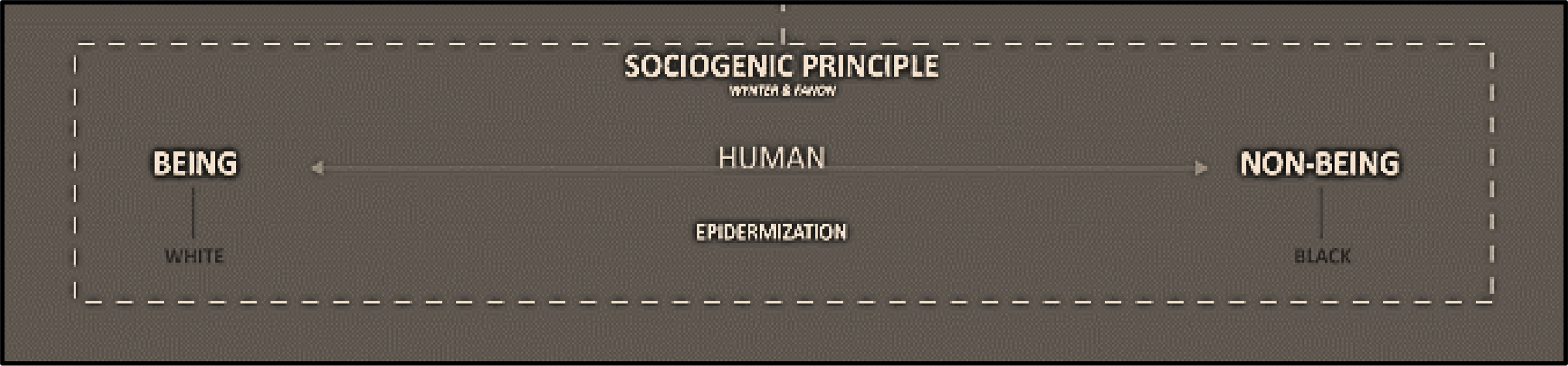
The diagram16 below represents the sociogenic system constructed at the intersection between Frantz Fanon’s (1986) vision of the colonial world and Sylvia Wynter’s (2013) epistemological critique. Wynter conceived sociogenesis as a totality of (transductive) relations encompassing both ontogeny and phylogeny. For Wynter (2013), the key point is the production of the human through a process of alienation. In other words, the sociogenic principle constructs the dimension in which it is possible to contest the system of alienation that gestates the social world (of social death) and racial reality.

In his essay “This is the Voice of Algeria,” part of the compilation A Dying Collection (Fanon, 1965), Fanon explores a particular object in the historical context of colonialism in Algeria: the radio. This text, along with the others in the volume, expresses a sociogenic view of the technical object, as demonstrated by Ivo Pereira Queiroz’s study (2013) in the STS field. Extrapolating from this point, we can experiment, within our analogy, by contrasting Gilbert Simondon’s (2020, 2017) conceptual approach to transindividuality with Fanon’s (1965) revolutionary approach. Both authors problematize alienation and the technical object as advantageous sites for action and the process of disalienation. In the essay, Fanon (1965) asks: why was the radio initially rejected by Algerians? The reason, he argued, was the configuration of the Algerian family, which was resistant to Western technologies. Fanon (1965) experiments with two different explanations concerning the radio: first, as a simple technical instrument; second, as a networked information system. For Fanon (1965), the radio is a medium of language involved in operations of coding, decoding and expansion. In other words, the radio encodes the sociogenic principle of the colonized society and prolongs it.
In Fanon’s (1965) narrative, the role of the radio in the revolution is central—an example of the role of language and technical objects. At first, the radio affected both the collective and individual psyche, effects identified in reports from the psychiatric clinic, which associated the electronic device with the French colonizers. Revolutionary movements appropriated the radio and created “The Voice of Free Algeria,” a program targeted at the colonized Algerian population. This changed the relationship between the Algerians and the object. The radio was transformed into a medium for materializing the voice of the nation, Fanon (1965) argues. Put otherwise, it materialized a collective.
Based on this case, we can consider the analogy with Simondon’s (2020) concepts of technicity and transindividuality. Through this process, both a strong point and a weak point emerge in Fanon’s (1986, 2018) sociogeny.
We should note that Simondon (2020, 2017) begins with a critique of metaphysics and the separation between form and matter, called hylomorphism. For the French philosopher, we need to speak of individuation rather than merely the individual. To this end, Simondon (2020) introduces the concept of metastability.17 Lucas Vilalta (2021) explains that Simondon conceives of being and becoming, working in ontogenesis with the phases of being and its transduction processes. At each stage of individuation, there is an unutilized pre-individual element, which corresponds to an excess. Technique, for Simondon (2017), occupies the zones of mediation between the concretization of the individual and its associated milieu, located between subject and object, and relates directly to the pre-individual dimension of individuation.18
In On the Mode of Existence of Technical Objects (METO), Simondon (2017) asserts that objects possess relative autonomy from humans. He primarily describes the functions involved in the orientation of technique, its spatial and temporal ordering. In this sense, as previously anticipated, we can speculate that technicity (understood as the essence of technique, which precedes and surpasses the object) is analogous to the problem of historicity (of the historical schema that mediates the process of racialization in Fanon). Ontogenesis aims to capture the becoming—processes of transduction and evolution—in the concretization of technical objects (individuals, ensembles, and networks) and their associated milieus. This concretization occurs through operations of alienation, which, according to Vilalta (2021, p. 131), correspond to regimes of metastability.
Simondon (2017, p. 16) considered a lack of awareness of the machine to be “the most powerful cause of alienation in the contemporary world,” which, in his terms, led to a disconnection between culture and technique. More precisely, Simondon (2017, p. 62) described alienation as a detachment between figures and ground:19 “the associated milieu no longer regulates the dynamism of forms.” Ontogenesis responds to alienation by pursuing a study of technicity, sought in essence in the final part of METO. Simondon (2017) believed that the disalienation of the machine would individuate a new understanding of technique that would aim to recover its essence and the value of the milieu. Along these lines, he outlined a program called “mechanology,” a politics of machines, or the representation of technical objects within the polis.
A humanist parallel exists between Fanon (1965, 1986) and Simondon (2017), revealed when we extend our analogy to the transindividual and the concept of revolution in the history of Algerian radio. The transindividual relationship is given two explanations in Simondon (2020, 2017): first, it is understood as a metastable system in which individuals interact with one another; second, it appears as an exchange of information between individuals. While true that transindividuality concretizes collectivity—a parallel with Fanon’s (1965) notion of the national community—it depends on technical objects, like the Algerian media. This concretization is transductive: each individual carries within them the principle preserved in the collective, thus enabling its modulation. This principle integrates, operates and is extended within the machine.
It is important for us to understand this transoperative sense of transindividuality. Vilalta (2021, p. 296) explains that it is not another phase of being but another signification, in which individuals relate to each other through the excesses of individuation, of pre-individuality. The transindividual is thus a new relational synthesis. According to Simondon (2017), technical objects provide the support for transindividual relationships, such that the machine can be perceived as an invention and a bearer of information. I return to Simondon’s (2017) concept of invention in the conclusion to this article. Around this concept, I believe there is a certain reversibility of the (racial) alienation of technicity. My speculation pauses at this point.
Gilbert Simondon’s political perspective also includes a politics of technical objects that positions them in symmetry with humans. For the author, machines have been used as slaves to create other slaves. Through the metastable state of alienation, the machine possesses a central role in the individuation process, in the social milieu, in its relationship with other species and with nature. In particular, Simondon (2017) opposes the instrumentalist view of technical objects. His humanist argument focuses on the transversal (or transindividual) relationship between humans, machines and nature. For the philosopher, these elements must be treated as a unity within the essence of technicity.
There are differences and similarities between Fanon (1965, 1986) and Simondon (2017): Fanon’s sociogeny largely depends on the separation between individuals and technical objects, while Simondon explores a unity prior to this separation in technicity, which establishes the bases of ontogenesis. The disalienation of the techno-human relationship recovers the technicity (ground) previously detached by the concretization of objects (figures).
In another sense, Simondon (2017) and Fanon (1965) converge in their evaluation that culture must perform its role with respect to technique, exercising its functions of signification, invention and regulation. In this case, ontogenesis is both opposed and complementary: it introduces an anthropotechnological alternative, although it individuates a knowledge (or concept) antagonistic to sociogeny.
Further extending this communication between the authors, I return to the figure of the slave. In the supplementary notes to his main thesis, Simondon (2020, p. 417) described the slave as the first model of the motor:
…the slave is the primordial model for every motor; the slave is a being who contains his complete organization and his organic autonomy within himself, even when his action is subjugated by an accidental domination; the domesticated animal is also an organism. Even with the degradation of the state of domestication or slavery, the organic and living motor conserves an inalienable individuality due to its natural spontaneity.
What stands out in this excerpt is how Simondon considers the slave to be a technical being. In this case, we might ask: how should we understand the concretization of technical individuals when it operates alongside enslaved human beings, perceived as instruments? We can speculate that the historico-racial schema of slavery, which mediates the individuation of the colonized/black person in Frantz Fanon (1986), resonates (internally) in Simondon’s formulation of the motor. In light of this, we could investigate the possibility that the epidermal schema of racialization repeats the axiomatics of the motor, such that the enslaved individual and the black subject remain captive to the technical object (the ensemble or assemblage)20 designed to extract energy from the environment (Yusoff, 2018).
The third part of METO is devoted to philosophical speculation. In this systematization, technicity is the result of the unfolding of an originary unity, of the magical world. As a phase, technicity is opposed to religiosity, concentrating within itself the figures of the outdated magical world, while religiosity retains its grounds. As mentioned previously, technical objects, according to Simondon (2017, p. 176), are produced through the objectification of technicity, thereby repeating the key access points of the primitive magical world. This systematization supports Simondon’s (2017) critique of technological modernity but does not uncover the relationship between technicity and raciality. In a transductive effort, we need to consider racialization within sociogenesis and, consequently, its effects on ontogenesis, particularly in technicity. The effects of the production of the human on racial alienation, I hypothesize, should position raciality (the axiomatics, the knowledge, that operationalizes the individual and racial reality) in a manner analogous to technicity.
Conversely, methodologically guided by Fanon’s (1986) sociogenesis, critical studies in STS do not consider schemas of raciality to extend to machines too, even if they are prolonged by them. The example of machine learning provided by Ramon Amaro (2022) demonstrates that racial alienation also largely depends on an alienation of technicity, sustaining a hylomorphic schema in the machine that imprisons it. Visions of automation and closed regimes remain in algorithms, artificial intelligence, robotics or the techno-human relationship more generally. For this reason, I believe that a field of relations needs to be reestablished, based on technicity, between technical individuals and racialized others, conceiving alienation as the nexus.
In concluding our exploration of this analogy, we can consider a principal hypothesis concerning alienation: machines and technical objects extend an axiom (a structure of operations) of racialization (the historico-racial schema) in the constitution of the colonial/anti-black world.21 Ontogenesis can be positioned as complementary to sociogeny, while investigating the nexus between technical and racial operations (technicity and raciality), which also interposes a relationship between humans and nature (Ferdinand, 2021; Yusoff, 2018). This relationship is inscribed in the image of the racialized body (interpellated and fragmented by big data and surveillance systems) and mediated by technology. The effect of this is what I call the ontogenesis of the slave-machine, a (conceptual) knowledge still to be individuated.
Fanon’s (1986) insistence on a new humanism leads, in this work, to the politicization of Simondon’s (2017) philosophy. The disalienation of the human involves machines because racialization is also defined by the way in which humans and nature interrelate through technical operations. Following this transoperative raciality, it is possible to seek a response within the same transindividual dimension, aiming for the disappearance of the figure of the slave and the schemas of enslavement that currently affect individuals, machines and nature. Simondon (2020, p. 431) summarizes this humanist interpretation:
Under the influence of a humanist preoccupation, man must not revolt against the machine; man is only enslaved to the machine when the machine itself is already enslaved by the community. And since there is an internal coherence of the world of technical objects, humanism must seek to free this world of technical objects, which are called upon to become the mediators of man’s relation to the world. Until now, humanism has hardly been able to incorporate the relation of humanity to the world; this will that defines humanism – i.e. the will to give back to the human being everything that the various paths of alienation have deprived him of by decentering him – will remain powerless insofar as it will have not understood that the relation of man to the world and of the individual to the community passes through the machine.
In this case, the response to racialization and the subjugation of the machine must be sought in the analogical nexus between both these complementary forms of alienation.
Conclusion
Returning to the earlier question concerning the analogy between Frantz Fanon and Gilbert Simondon with regard to studies of race and racism in STS, it can be asserted that Fanon’s (1986) sociogenesis helped advance the understanding of the non-neutrality of machines and their political potential for antiracism. However, the Fanonian approach led to a ramification of sociological and anthropological theses that subdivide into optimistic and pessimistic views of the role of digital technologies in racialization. I believe that the current paradoxical situation of these two lines stems from the loss of a unity between the human and technique, or the relational symmetry explored by Simondon (2017) in his investigation of technicity. Integrating the problematics of the individuation of technical objects into the broader framework of what we call racialization also introduces a pre-individual dimension in which the concepts of invention and the transindividual perform a crucial role. I conclude this work around these concepts, seeking to leave a path open for future analysis, research and reflection. My argument revolves around the possibility of the reversibility of a world in which raciality and technicity are so intertwined that technical objects operate by expanding schemas of enslavement.
For Ramon Amaro (2022, p. 219), who cites Simondon extensively, STS studies run the serious risk of reintroducing the individual into a racialized reality when they limit themselves to working within an epistemology that only understands and explains the sociogenic components:
Although the predominant studies on race and technologies are aware of the social constructions of race, technology and the body, they run the risk of “placing the individual within the system of reality,” as Gilbert Simondon describes, while “explaining the characteristics of the individual without a necessary relationship to other aspects of Being that may be correlative to the emergence of an individuated reality.”
Following Amaro, Simondon and the cybernetic premise, I believe that we need to switch analytical level and capture the individuation between thought (concept) and reality in the practice of a transindividual ethics (Combes, 2022; Vilalta, 2021). As mentioned previously, transindividuality is supported by technical objects. Simondon (2017, p. 253) stated that it is a relationship between individuals based on a pre-individual weight (in French: charge) of reality, “this weight of nature that is preserved with the individual being, and which contains potentials and virtualities.” For Simondon (2017, p. 253), invention arises from this excess, involving more than just individual action: “…it is not the individual who invents, it is the subject, vaster than the individual, richer than it, and having, in addition to the individuality of the individuated being, a certain weight of nature, of non-individuated being.” Thus, technical invention occurs through the transindividual relationship. Furthermore, according to Simondon (2017, p. 253), no anthropology that sets out from the human as an individual being can account for the transindividual. When STS studies od race and racism begin with the individual, even when differentiated between humans and non-humans, and the machine, both of them individuated, they overlook the enslavement schemas (of raciality) that operate before the concretization of the technical individual (in technicity).
As I have demonstrated, the racialized individual and the machine are analogous since both are perceived as slaves/motors. The work of invention seeks to reverse these schemas. Ramon Amaro (2022) proposes the formulation of a Black Technical Object, a methodological project that operates in the pre-individual dimension without prefiguring any kind of “white prototype”: “Within this domain, Black existence is not presupposed by oppression or the gaze of whiteness. It is a relation itself, to be manifested in the domain after it has self-actualized” (Amaro, 2022, pp. 221-222). The Black Technical Object is a prior unity that aims to reverse the processes of racialization in which individuals and machines are entangled. For Maria Fernanda Novo (2022), this involves understanding society as an operation, expanding the notion of the individual. In this sense, social reality is a phase opposed to the phase of individuation. Another individuation is possible, as emphasized by Bernardo Oliveira and Frederico Coelho (2024) in their exploration of African American technical culture in Brazil.
These works, following in the wake of a renewed interest in Simondon’s oeuvre, display both similarities and divergences with Yuk Hui’s (2016, 2020) proposition of cosmotechnics, a popular reference in the debate on technology in the humanities. For Hui, the inflection in contemporary anthropology that seeks to disperse the fixed concept of nature—multinaturalism—only makes sense if this is also viable for technique. I wish to leave this path open for exploration.
By focusing on individuation in ontogenesis, I call attention to an assemblage that precedes the relations of alienation in raciality and technicity. This ground on which both forms of alienation become analogous is probably the original alienation from the Earth in the politics of the slave ship’s hold, as Malcom Ferdinand (2021) writes, still peripheral in the debates on climate change in the Anthropocene, according to Kathryn Yusoff’s (2018) critique. This alienation described by Ferdinand is both technical and racial. However, it cannot be fully understood through Simondon’s critique of modernity. Hence the need to think of other histories (in Afrofuturism, for example) and new beginnings (cosmotechnics) for technicity.
The technical and conceptual invention that reverses raciality is only possible if it can overcome the underlying schemas of enslavement, affecting the essence of technicity. Ultimately, this is a path opened by the sociological and anthropological approaches reviewed earlier and goes further, calling for black, diasporic and antiracist radical thought to disperse in operative schemas until its concretization (transduction) in technical individuals.
I reaffirm the need for a symmetrical understanding in the antiracism oof the relationship between humans and technical objects. Above all, this approach aims to recover a lost totality in the nexus between the alienations of raciality and technicity. To intervene in this nexus is, I believe, to work towards the individuation of a new concept of humanism.
-
2
This perspective overlooks other approaches, particularly those included within the Digital Humanities. Many researchers have been making creative use of programming to develop research and teaching tools for exploring ethnic and racial relations. I cite, as one example, the collection inspired by the concept of the Black Atlantic, The Digital Black Atlantic, edited by Roopika Risam and Kelly Josephs Barker (2021).
-
3
The Black Network in Technology and Society (Kremer et al., 2021) conducted a survey on the research priorities of black specialists in STS, exploring a variety of themes, particularly epistemicide and the lack of diversity in technology management sectors. I will show that these themes can be included in the two hypotheses discussed in this text.
-
4
A didactic presentation of this position is Rayvon Fouché’s concept of “Black technological vernacular creativity” (Black [...], 2008).
-
5
In the sense attributed by Yuk Hui (2019), recursion (or recursivity) is a cybernetic looping operation that constantly updates and modulates a structure.
-
6
This duplicity – or, as I prefer, the transductivity between two operations in distinct regions, technical and social – is highlighted by Luciana Parisi and Denise Ferreira da Silva (2021) as the preservation of the consequences of global colonialism within technical reality. Parisi anticipates my hypothesis by questioning the relevance of returning to the question of being in philosophical investigations of technology. This issue, as we shall see, is similar to the problem presented by Fanon.
-
7
In Simondon’s definition (2020, p. 14): “Transduction corresponds to this existence of rapports that takes hold when pre-individual being individuates; it expresses individuation and allows for individuation to be thought; it is therefore a notion that is both metaphysical and logical; it applies to ontogenesis and is ontogenesis itself.”
-
8
For a comprehensive reading of Frantz Fanon’s work that integrates biographical elements of the Martinican author, I refer readers to Deivison Faustino (2022). Vincent Bontems (2017), for his part, connects biography with Gilbert Simondon’s theses to understand his predilection for the study of technical objects. A more complete overview can be found on the website dedicated to his memory (Simondon, [2024]).
-
9
We can, for example, compare the two authors’ works in psychosociology—the psychosociology of technicity (Simondon, 2017) and the clinical experiences in Algeria (Fanon, 2018).
-
10
For this reason, we should not understand Fanon’s approach (2020, 1986) as totalizing or generalizing. Sociogeny is operative and transductive. The racialized body describes the operation of the individual’s fragmentation, denying an ontological (pre)existence for the black/colonized person. Put succinctly, this operation installs colonial segregation within the regime of individuation, as the colonized/black person cannot find a centre of reference within the colonial world. The regime of economic domination becomes a primarily existential issue—or an inferiority complex.
-
11
Alienation is the central concept in Fanon’s early writings. The classic Black Skin, White Masks (Fanon, 1986) was originally presented as a monograph for his psychiatry degree, entitled Essay on the Disalienation of the Black Person. For more information and discussions on alienation, see Faustino (2022) and Mattin (2022).
-
12
For Simondon (2017, p. 130), a crucial difference exists between a tool and an instrument. The tool prepares the body for the technical gesture. The instrument extends and adapts the body to obtain a perception. Some tools are also instruments.
-
13
In a canonical study, Orlando Patterson (1985, p. 38) describes the production of the slave as a kind of “social death.” In a perceptual sense, social death ensures the conception and coherence of social life in slave societies.
-
14
Epidermalization is a euphemism used by Fanon (1986, p. 13) for the internalization of an “inferiority complex.” Epidermalization is processed in culture through language.
-
15
In this approach, alienation is understood differently from falsification, distancing or oppression. In his study on the use of this concept, Mattin (2022) argues that alienation is not something from which we should escape; rather, it is a constitutive part of subjective and intersubjective reality. According to Mattin (2022), alienation encompasses dimensions both higher and lower than the individual. At the level of sociogeny, alienation is understood as the production of the collective subject.
-
16
This diagram was created in collaboration with Denise Luna for the seminar From Alienation from Above to Alienation from Below held at the New Centre for Research and Practice in October 2021. To consult the seminar archive, see: https://thenewcentre.org/archive/from-alienation-from-above-to-alienation-from-below/.
-
17
Metastability comprises an equilibrium between form and matter that contains potentials from previous states. Simondon (2020) utilizes the notion of metastability to replace the concept of form with that of information. Information is what triggers the transduction from one metastable equilibrium to another.
-
18
According to Lucas Vilalta (2021, p. 71-72), a metaphysics may exist in Simondon’s philosophy in its assumption of a reality prior to individuation.
-
19
Figure and ground are two concepts in the Gestalt theory of perception (Barthélémy, 2012).
-
20
Dixon-Román (2016, p. 484) draws on Alexander Weheliye and Deleuze and Guattari to define assemblages as a system of organization, arrangement, relationships and connections of actualities, objects or organisms that appear to operate as a totality. The assemblage is a constellation of multiple forces that work in the production of an event, a composite, or even the body. In my view, it resembles the definition of Gestell in Heideggerian ontology.
-
21
The theses of an anti-black world/climate are articulated by Afropessimism and the critique made by black women’s thought. I invite readers to explore Christina Sharpe’s (2016) theories on antiblackness and Frank Wilderson III’s (2020) Afropessimist manifesto.
References
- ALMEIDA, Silvio. Racismo estrutural São Paulo: Jandaíra, 2019.
- AMARO, Ramon. Afrofuturism. In: BRAIDOTTI, Rosi; HLAVAJOVA, Maria (org.). Posthuman glossary London: Bloomsbury Academic, 2018. p. 17-19.
-
AMARO, Ramon. Machine learning, sociogeny, and the substance of race 2019. Tese (Doutorado em Filosofia) – University of London, London, 2019. DOI: https://doi.org/10.25602/GOLD.00026850.
» https://doi.org/10.25602/GOLD.00026850 - AMARO, Ramon. The black technical object: on machine learning and the aspiration of black being. London: Sternberg Press, 2022.
-
AMARO, Ramon; KHAN, Murad. Towards black individuation and a calculus of variations. E-flux Journal, New York, v. 109, p. 1-14, 2020. Disponível em: https://www.e-flux.com/journal/109/330246/towards-black-individuation-and-a-calculus-of-variations/ Acesso em: 15 mar. 2024.
» https://www.e-flux.com/journal/109/330246/towards-black-individuation-and-a-calculus-of-variations/ - BARTHÉLÉMY, Jean-Hugues. Fifty key terms in the works of Gilbert Simondon. In: BOEVER, Arne de; MURRAY, Alex; ROFFE, Jon; WOODWARD, Ashley (org.). Gilbert Simondon: being and technology. Edinburgh: Edinburgh University Press, 2012. p. 203-231.
- BEIGUELMAN, Giselle. Políticas da imagem: vigilância e resistência na dadosfera. São Paulo: Ubu Editora, 2021.
- BENJAMIN, Ruha. Race after technology: abolitionist tools for the new Jim code. Cambridge: Polity Press, 2019.
- BENJAMIN, Ruha. Retomando nosso fôlego: estudos de ciência e tecnologia, teoria racial crítica e a imaginação carcerária. In: SILVA, Tarcízio (org.). Comunidades, algoritmos e ativismos digitais: olhares afrodiaspóricos. São Paulo: Editora LiteraRUA, 2020. p. 13-26.
-
BLACK vernacular technological creativity. Normal: University of Illinois Urbana-Champaign, 2008. 1 vídeo (2min 41s). Publicado pelo canal Illinoisfoundry. Disponível em: https://www.youtube.com/watch?v=kLoPSzhz1G0 Acesso em: 15 mar. 2024.
» https://www.youtube.com/watch?v=kLoPSzhz1G0 -
BONTEMS, Vincent. Por que Simondon?: a trajetória e a obra de Gilbert Simondon. Eco-Pós, Rio de Janeiro, v. 20, n. 1, p. 31-46, 2017. DOI: https://doi.org/10.29146/eco-pos.v20i1.10402
» https://doi.org/10.29146/eco-pos.v20i1.10402 - BRAUN, Lundy. Breathing race into the machine: the surprising career of the spirometer from plantation to genetics. Minneapolis: University of Minnesota Press, 2014.
- BROCK, André L. Análise crítica tecnocultural do discurso. In: SILVA, Tarcízio (org.). Comunidades, algoritmos e ativismos digitais: olhares afrodiaspóricos. São Paulo: LiteraRUA, 2020a. p. 67-90.
- BROCK, André L. Distributed blackness: African American cybercultures. New York: New York University Press, 2020b.
- BROWNE, Simone. Dark matters: on the surveillance of blackness. Durham: Duke University Press, 2015.
-
BROWNE, Simone. Digital epidermalization: race, identity and biometrics. Critical Sociology, Washington, D.C, v. 36, n. 1, p. 131-150, 2010. DOI: https://doi.org/10.1177/0896920509347144.
» https://doi.org/10.1177/0896920509347144 -
BROWNE, Simone. The feds are watching: a history of resisting anti-black surveillance. Medium, [s.l], 6 out. 2020. Disponível em: https://level.medium.com/the-feds-are-watching-a-history-of-resisting-anti-black-surveillance-b2242d6ceaad Acesso em: 9 mar. 2024.
» https://level.medium.com/the-feds-are-watching-a-history-of-resisting-anti-black-surveillance-b2242d6ceaad - CESARINO, Letícia. O mundo do avesso: verdade e política na era digital. São Paulo: Ubu Editora, 2022.
- CHINN, Sarah E. Technology and the logic of American racism: a cultural history of the body as evidence. London: Continuum, 2000.
- CHUDE-SOKEI, Louis. The sound of culture: diaspora and black technopoetics. Middletown: Wesleyan University Press, 2016.
- CHUN, Wendy Hui Kyong. Race and/as technology, or how to do things to race. In: NAKAMURA, Lisa; CHOW-WHITE, Peter A. (org.). Race after the Internet New York: Routledge, 2012. p. 38-60.
- COMBES, Muriel. Do transindividual, do inseparável. In: NOVAES, Thiago; VILALTA, Lucas Paolo; SMARIERI, Evandro (org.). Máquina aberta: a mentalidade técnica de Gilbert Simondon. São Paulo: Dialética, 2022. p. 230-256.
-
DIXON-ROMÁN, Ezekiel. Algo-ritmo: more-than-human performative acts and the racializing assemblages of algorithmic architectures. Cultural Studies Critical Methodologies, Thousand Oaks, v. 16, n. 5, p. 482-490, 2016. DOI: https://doi.org/10.1177/1532708616655.
» https://doi.org/10.1177/1532708616655 -
ESHUN, Kodwo. Further considerations of afrofuturism. The New Centennial Review, East Lansing, v. 3, n. 2, p. 287-302, 2003. DOI 10.1353/ncr.2003.0021.
» https://doi.org/10.1353/ncr.2003.0021 - ESHUN, Kodwo. More brilliant than the sun: adventures in sonic fiction. London: Quartet Books, 1998.
- FANON, Frantz. Alienação e liberdade: escritos psiquiátricos. São Paulo: Ubu Editora, 2020a.
- FANON, Frantz. Aquí la voz de Argelia. In: FANON, Frantz. Sociología de una revolución Gualeguaychú: Tolemia, 2012. p. 44-71.
- FANON, Frantz. Pele negra, máscaras brancas São Paulo: Ubu Editora, 2020b.
- FAUSTINO, Deivison. Frantz Fanon e as encruzilhadas: teoria, política e subjetividade, um guia para compreender Fanon. São Paulo: Ubu Editora, 2022.
- FERDINAND, Malcom. Uma ecologia decolonial: pensar a partir do mundo caribenho. São Paulo: Ubu Editora, 2022.
-
FOUCHÉ, Rayvon. The wretched of the gulf: racism, technological dramas, and black politics of technology. The Black Scholar, San Francisco, v. 36, n. 4, p. 7-12, 2006. DOI: https://doi.org/10.1080/00064246.2006.11413365.
» https://doi.org/10.1080/00064246.2006.11413365 -
GILROY, Paul. Civilizacionismo, a “alt-right” e o futuro da política antirracista: um informe da Grã-Bretanha. Eco-Pós, Rio de Janeiro, v. 21, n. 3, p. 17-34, 2018. DOI: https://doi.org/10.29146/eco-pos.v21i3.22525
» https://doi.org/10.29146/eco-pos.v21i3.22525 - GILROY, Paul. Entre campos: nações, culturas e o fascínio da raça. São Paulo: Annablume, 2007.
- GILROY, Paul. O Atlântico negro: modernidade e dupla consciência. 2. ed. São Paulo; Rio de Janeiro: Editora 34; Universidade Cândido Mendes; Centro de Estudos Afro-Asiáticos, 2012.
- HUI, Yuk. Recursivity and contingency London; New York: Rowman & Littlefield International, 2019.
- HUI, Yuk. Tecnodiversidade São Paulo: Ubu Editora, 2020.
- HUI, Yuk. The question concerning technology in China: an essay in cosmotechnics. London: Urbanomic, 2016.
- KREMER, Bianca; VIEIRA, Carla; ALMEIDA, Gabriela; DANTAS, Glenda; SOUZA, Gustavo; SENA, Isabela; CINTRA, Juliane; SANTIAGO, Larissa; GOMES, Mariana; HORA, Nina da; NUNES, Pablo; MONTEIRO, Pedro; SILVA, Tarcizio; NEVES, Thiane; GOMES, Vanessa. Prioridades antirracistas sobre tecnologia e sociedade: pesquisa com especialistas negras/os. São Paulo: Rede Negra em Tecnologia e Sociedade; Ação Educativa, 2021.
- MATTIN. Social dissonance Falmouth: Urbanomic, 2022.
-
NELSON, Alondra. Introduction: future texts. Social Text, Durham, v. 20, n. 2, p. 1-15, 2002. Disponível em: https://www.muse.jhu.edu/article/31931 Acesso em: 15 mar. 2024.
» https://www.muse.jhu.edu/article/31931 -
NEYRAT, Frédéric. The black angel of history. Angelaki, London, v. 25, n. 4, p. 120-134, 2020. DOI: https://doi.org/10.1080/0969725X.2020.1790841
» https://doi.org/10.1080/0969725X.2020.1790841 - NOBLE, Safiya Umoja. Algoritmos da opressão: como os mecanismos de busca reforçam o racismo. Santo André: Rua do Sabão, 2021.
- NOVO, Maria Fernanda. Transindividual e autodeterminação numa investigação sobre raça e identidade. In: NOVAES, Thiago; VILALTA, Lucas P.; SMARIERI, Evandro (org.). Máquina aberta: a mentalidade técnica de Gilbert Simondon. São Paulo: Dialética, 2022. p. 139-165.
-
OLIVEIRA, Bernardo; COELHO, Frederico. O afropolimatismo: cultura técnica africano-brasileira como ferramenta para a individuação. Améfrica, [s.l], v. 1, n. 1, p. 1-31, 2024. Disponível em: https://independent.academia.edu/RevistaAm%C3%A9frica Acesso em: 14 mar. 2024.
» https://independent.academia.edu/RevistaAm%C3%A9frica - PATTERSON, Orlando. Escravidão e morte social: um estudo comparativo. Tradução de Fábio Duarte Joly. São Paulo, Editora da Universidade de São Paulo, 2008.
-
PARISI, Luciana; SILVA, Denise Ferreira da. Black feminist tools, critique, and techno- poetics. E-flux Journal, New York, v. 123, p. 4-14, 2021. Disponível em: https://www.e-flux.com/journal/123/436929/black-feminist-tools-critique-and-techno-poethics/ Acesso em: 15 mar. 2024.
» https://www.e-flux.com/journal/123/436929/black-feminist-tools-critique-and-techno-poethics/ -
QUEIROZ, Ivo Pereira De. Fanon, o reconhecimento do negro e o novo humanismo: horizonte descoloniais da tecnologia. 2013. Tese (Doutorado em Tecnologia) — Universidade Tecnológica Federal do Paraná, Curitiba, 2013. Disponível em: http://repositorio.utfpr.edu.br/jspui/handle/1/492 Acesso em: 15 mar. 2024.
» http://repositorio.utfpr.edu.br/jspui/handle/1/492 - RISAM, Roopika; JOSEPHS, Kelly Baker (org.). The digital black Atlantic Minneapolis: University of Minnesota Press, 2021.
- ROBINSON, Cedric. Black Marxism: the making of the black radical tradition. Chapel Hill: The University of North Carolina Press, 2000.
- SHARPE, Christina. No vestígio: negridade e existência. São Paulo: Ubu Editora, 2023.
- SILVA, Denise Ferreira da. Homo modernus: para uma ideia global de raça. Rio de Janeiro: Cobogó, 2022a.
- SILVA, Denise Ferreira. A dívida impagável São Paulo: Oficina de Imaginação Política, 2019.
- SILVA, Tarcízio. Racismo algorítmico São Paulo: Edições Sesc, 2022b.
- SIMONDON, Gilbert. A individuação à luz das noções de forma e de informação São Paulo: Editora 34, 2020a.
- SIMONDON, Gilbert. Do modo de existência dos objetos técnicos Rio de Janeiro: Contraponto, 2020b.
- SIMONDON, Gilbert. Sobre la técnica: (1953–1983). Buenos Aires: Cactus, 2017.
-
SIMONDON, Nathalie. Biography: Gilbert Simondon. Site d’information sur l’ouvre et les publications, Palaiseau, [2024]. Disponível em: https://gilbert.simondon.fr/content/contact Acesso em: 15 mar. 2024.
» https://gilbert.simondon.fr/content/contact - SPILLERS, Hortense. Bebê da mamãe, talvez do papai: uma gramática estadunidense. In: BARZAGHI, Clara; PATERNIANI, Stella Z.; ARIAS, André (org.). Pensamento negro radical: antologia de ensaios. São Paulo: Crocodilo; N-1 Edições, 2021. p. 29-70.
- TRINDADE, Luiz Valério. Discurso de ódio nas redes sociais São Paulo: Jandaíra, 2022.
- VILALTA, Lucas Paolo. Simondon: uma introdução em devir. São Paulo: Alameda, 2021.
- WILDERSON III, Frank. Afropessimismo São Paulo: Todavia, 2020.
- WYNTER, Sylvia. Towards the sociogenic principle: Fanon, the puzzle of conscious experience of “identity” and what it’s like to be “black”. In: GOMEZ-MORIANA, Antonio; DURAN-COGAN, Mercedes. National identities and social-political changes in Latin America New York: Routledge, 2013. p. 51-94.
- YUSOFF, Kathryn. A billion black Anthropocenes or none Minneapolis: University of Minnesota Press, 2018.
- ZUBOFF, Shoshana. A era do capitalismo de vigilância: a luta por um futuro humano na nova fronteira do poder. Rio de Janeiro: Intrínseca, 2021.
Edited by
-
Section Editors:
Henrique Zoqui Martins Parra, https://orcid.org/0000-0001-8545-1975; Alana Moraes de Souza, https://orcid.org/0000-0003-4072-0320

 Source: Author.