Geographic variation in the acoustic signals of lesser treefrogs Dendropsophus minutus (Anura, Hylidae)
Abstract
Biological sound archives are a major source to investigate geographic variation in animal acoustic signals and their evolutionary drivers. The acoustic signals of anuran species with wide distribution ranges often vary geographically as a result of isolation by distance and climate amongst other factors. We examined whether the acoustic structure of call notes would vary geographically in lesser treefrogs Dendropsophus minutus using recordings from bioacoustics repositories. We also tested whether climate (mean annual temperature and annual precipitation) drive geographic variation in those signals. The acoustic distance was unrelated to geographic distance, suggesting that isolation by distance solely cannot explain geographic variation in call structure. Overall, lesser treefrogs uttered call notes with lower frequencies and bandwidths in the west of their range. In addition, frogs produced shorter call notes in hotter, wetter sites and narrow-bandwidth notes in hotter environments. We suggest that frogs produce more calls (not measured here) of shorter durations to maximize transmission and minimize the metabolic costs of calling at high air temperatures. We also suggest that hotter environments favor the propagation of lower-bandwidth calls. This study reinforces the feasibility and power of citizen science and acoustic data repositories for understanding the evolution of anuran acoustic signals.
Keywords
Amphibians; Anurans; Bioacoustics; Vocal behavior; Vocal repertoire
INTRODUCTION
Biological collections have provided several scientific discoveries that help us to understand aspects of life and the environment (Funk, 2018). Audiovisual archival libraries are collections that have been gaining ground in the scientific community. They provide additional information (e.g., behavioral, acoustic) that cannot be found in museum specimen collections or DNA databases (Toledo et al., 2015b). Through sound archives, it is possible to monitor populations, study taxonomic and evolutionary aspects, and understand the ecological relationships that species have established throughout their life histories (Dena et al., 2020). Notably, bioacoustics is a historical and valuable tool for amphibian taxonomy (Bogert, 1960; Blair, 1963, 1968; review in Köhler et al., 2017), since vocalizations, and consequently acoustic characteristics, vary among different species (Carvalho & Giaretta, 2013; Röhr et al., 2020).
The animal taxa with the highest representation in acoustic libraries are birds, followed by amphibians (Dena et al., 2020). Amphibian anurans emit acoustic signals with different defined social functions, which include species recognition, reproduction, territory defense, and predation avoidance (Haddad, 1995; Wells, 2010; Lemes et al., 2012; Vieira et al., 2016; Guerra et al., 2018). Acoustic signals are of fundamental importance in the life history of these animals, the main form of communication of the species in the group (Wells, 2010; Köhler et al., 2017). Acoustic signals are classified into three categories, according to their social context: reproductive calls, aggressive calls, and defensive calls (against predators) (Toledo et al., 2015a). It is common for the same species to emit three to four variations of calls, presenting different communication strategies, depending on the ecological and social contexts (Guerra et al., 2018). Therefore, it is necessary to use experimental approaches to elucidate the function of each signal type (Guerra et al., 2018).
The lesser treefrog, Dendropsophus minutus (Peters, 1872), is a small hylid with a wide distribution throughout South America, from the plains east of the Andes of Colombia to Argentina, and is one of the most common species in the region (Faivovich et al., 2005; Leivas et al., 2018a; Frost, 2023). Males of the species vocalize in open habitats throughout the year (Vaz-Silva et al., 2020). However, vocal activity peaks during more suitable climatic conditions and increased resource availability (Oliveira et al., 2007; Leivas et al., 2018b; Vaz-Silva et al., 2020). This happens from February to August in Cwa climates (Oliveira et al., 2007), from August to January in Cfb climates (Leivas et al., 2018a), and from December to April in Aw climates (Santos & Oliveira, 2007; Santos et al., 2012; climate classification following Alvares et al., 2013).
The vocal repertoire of lesser treefrogs has three types of notes, designated A, B, and C (Cardoso & Haddad, 1984). These notes can be combined in 16 different ways and their use is influenced by the vocal activity of other males that are nearby and vocalizing (Morais et al., 2012). Note A and note C are usually emitted during reproductive calls of the species, while note B is the main note emitted during aggressive calls (Cardoso & Haddad, 1984; Haddad & Cardoso, 1992; Guerra et al., 2018; Foratto et al., 2021; Hernández-Herrera & Pérez-Mendoza, 2021). Note A is the most produced by lesser treefrogs, both combined with other notes or alone, in different social contexts (Cardoso & Haddad, 1984; Haddad & Cardoso, 1992; Morais et al., 2012). However, because it is a species with complex calls and exhibits a substantial acoustic variation among different populations throughout its geographic distribution, some studies have suggested that D. minutus may be a cryptic species complex (e.g.,Kaplan, 1994; Köhler, 2000; Gehara et al., 2014).
Acoustic signals play a key role in speciation in highly vocal taxa, such as anurans. These signals are related with the recognition between individuals of the same species and serve as a mechanism for prezygotic isolation (Wells, 2010; Wilkins et al., 2013). It is common to observe, in anuran species with a wide geographic distribution, variations in the acoustic patterns of calls due to the isolation of populations and the effect of local selective pressures (Castellano et al., 2000; Bernal et al., 2005; Tessarolo et al., 2016). One of the patterns of geographical variation is isolation by distance, where geographical distance exerts a strong influence on the variation of acoustic parameters of calls, such as in pulse rate and fundamental frequency (Castellano et al., 2000). Another known pattern is clinal, where acoustic parameters exhibit geographic variation that coincides with a climatic gradient, accompanying, for example, a humidity gradient and seasonality (Bernal et al., 2005). There is also a discrete pattern, where geographic barriers produce divergence among populations. The study by Bernal et al. (2005), for example, identified that two populations of the dendrobatid Rheobates palmatus (Werner, 1899) living on opposite sides of the Andes showed acoustic differences.
Geographic variation in acoustic characteristics can also be explained by differences in environmental conditions, demographics (e.g., sex ratio), and social context (Cardoso & Haddad, 1984; Guerra et al., 2018; Foratto et al., 2021; Hernández-Herrera & Pérez-Mendoza, 2021). For example, air temperature is an important environmental variable that can determine geographic variations in calls. In many anuran species, the air temperature has already been documented to affect the temporal parameters of acoustic signals (Morais et al., 2012; Shen et al., 2015). In addition, acoustic parameters that are more temperature-dependent should vary more over short periods and within the same individual (Röhr et al., 2020).
Here, we investigated geographic variation in the acoustic structure of call notes in lesser treefrogs using recordings available in acoustic repositories. We analyzed whether geographic variation in acoustic signals correlates with spatial distance, longitude, latitude, and weather. The wide distribution of this species, the available information about its vocal repertoire, and a relevant number of available recordings are factors that make the species a good model for studying geographical and environmental variations in acoustic signals. This is one of the first studies that evaluates variation in acoustic parameters in notes of the vocal repertoire of anurans using recordings available in acoustic libraries (see also Andreani et al., 2020).
MATERIAL AND METHODS
File sorting and call notes selection
The recordings used in this work were made available by the following repositories: (1) Fonoteca Neotropical Jacques Vielliard (FNJV) of the Museu de Zoologia Professor Adão José Cardoso, Universidade Estadual de Campinas (Unicamp), Campinas, Brazil (https://www2.ib.unicamp.br/fnjv); (2) herpetological collection of the Museu Nacional of the Universidade Federal do Rio de Janeiro (MNRJ); (3) Coleção de Arquivos Sonoros de Anuros Neotropicais (IF Goiano) (CASAN); and (4) Fonoteca Biológica da Universidade Federal de Pernambuco (FBIOUFPE). The filters used to search the files in FNJV were as follows: Class Amphibia, Order Anura, Family Hylidae, Genus Dendropsophus, Species minutus, Quality 4 and 5. We performed the search in FNJV on 13 October 2021, which resulted in 73 recordings. We also acquired 10 recordings from MNRJ on 06 June 2023, 5 from CASAN on 25 May 2023, and 1 from FBIOUFPE on 01 June 2023. In total, we obtained 89 recordings from these repositories (Appendix 1: Table S1).
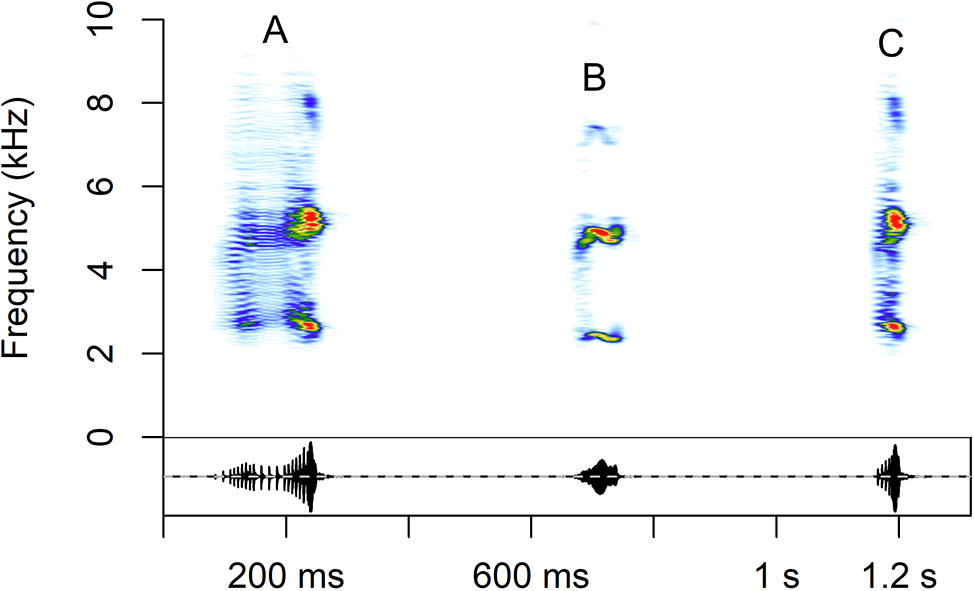
The audio files were made available in .wav format, and we used Adobe Audition CC 2015.0 (Adobe Systems, San Diego, CA, USA) to normalize them to 44.1 kHz (sampling rate) and 16 bit resolution. We use Raven Pro 1.6.1 (K. Lisa Yang Center for Conservation Bioacoustics, 2019) to select, when available, three notes of type A, B, and C (Cardoso & Haddad, 1984), from each recording (Fig. 1). These notes are components of reproductive calls (types A and C) or aggressive calls (type B) (Cardoso & Haddad, 1984), as detailed in the Introduction. We argue that measuring three samples of each note type is sufficient to establish a reliable representation of between-individual acoustic variation (Morais et al., 2012). The note selections were independent of the call type (reproductive, aggressive, or defensive) since most recordings did not have the call type specified in the metadata. The selections were made by only one researcher, and all recordings were standardized before each selection (Hann window type, size 256 samples; Overlap 89.9%; View axes: time scale 2.000 seconds/line, amplitude scale 60000.0 units/line). The 89 audio files resulted in 619 selections of vocalizations, with 250 selections of type A notes (85 recordings), 181 of type B notes (68 recordings), and 188 of type C notes (66 recordings). We could not select any calls from two recordings of lower quality (MNVOC 031_10, MNVOC 046_6). The recordings had a focal individual, so we considered the selections from each recording to come from a single individual.
Spectrogram (above) and oscillogram (below) showing the acoustic characteristics of examples of the three note types of the vocal repertoire of Dendropsophus minutus. Recording identity: FNJV_13108 (Table S1). Recordist: Célio Haddad. Coordinates: -47.0697 (longitude), -22.8194 (latitude).
Variable extraction
All extractions were performed in the R program Version 4.1.1 (R Core Team, 2021). We used the ‘Rraven’ package (Araya-Salas, 2017) to import the note selections performed previously in the Raven program. We used the ‘warbleR’ package (Araya-Salas & Smith-Vidaurre, 2017) to extract the acoustic metrics from the selections (bandwidth 2-18 kHz, window length 256, frequency window length 1024, overlap 90%). We selected six acoustic metrics: note duration (seconds), 25% frequency (kHz; frequency at which the signal is split into two frequency intervals of 25% and 75% energy, respectively), 75% frequency (kHz; frequency at which the signal is split into two frequency intervals of 75% and 25% energy, respectively), bandwidth (kHz; 75% frequency minus the 25% frequency), mean dominant frequency (kHz; mean of the dominant frequency measured across the acoustic signal), and mean peak frequency (kHz; frequency with the highest energy in the mean frequency spectrum). These measurements surpass the requisite criteria for characterizing the acoustic structure of calls from lesser treefrogs (Morais et al., 2012).
After extraction, we took the average of each acoustic metric per recording (individual), as a function of note type. So, the 87 recordings generated 219 data points, 85 for type A notes, 68 for type B, and 66 for type C (Appendix 1: Table S2). All three note types were not always present in the recordings, hence the difference in sample size corresponds to unbalanced renditions of each note type.
The metadata provided by the FNJV and MNRJ did not have the geographic coordinates for all the audio files. Thus, we used the country, state, city, and locality information to estimate the longitude and latitude (decimal degrees) for each recording. The coordinates were least precise when referenced to the municipal seat. This level of precision has been adequate for macroecological studies of acoustic signal variation (García et al., 2018; Lopes & Schunck, 2022). Next, we used the ‘raster’ (Hijmans, 2020) and ‘sp’ (Pebesma & Bivand, 2005) packages to download and extract the bioclimatic data from WorldClim (Fick & Hijmans, 2017). Using the coordinates, we extracted the mean annual temperature and annual precipitation for each location for the years 1970-2000. In addition, we used the spatial data made available by the International Union for Conservation of Nature (IUCN, 2021) to create a distribution map of the study species.
Statistical analysis
All statistical analyses were performed in R Version 4.1.1 (R Core Team, 2021). We used the package ‘psych’ (Revelle, 2021) to perform Principal Component Analysis (PCA, correlation matrix, varimax rotation) of the acoustic metrics. One data point with extreme acoustic values (mean peak frequency > 13 kHz) was removed before the analysis. The variables Note Duration, 25% frequency, and 75% frequency were transformed to natural logarithms before the PCA to make the distribution of these variables closer to a normal distribution. Two components (PC1 and PC2) were retained (eigenvalues > 1, explained variance > 75%) and explained all the acoustic metrics well, except for Note Duration (Table 1). For this reason, we used PC1, PC2, and Note Duration as dependent variables in subsequent analyses. High values of PC1 represent calls with higher frequencies, while high values of PC2 represent calls with lower minimum frequencies and wider bandwidths. We performed a Kruskal-Wallis test to check whether the dependent variables differ as a function of note type since the distributions of the ANOVA residuals did not show normality. If the Kruskal-Wallis test resulted in a P < 0.05, we performed Dunn’s a posteriori test (P values adjusted by false discovery rates: Benjamini & Hochberg, 1995) to check how note types differed from each other with respect to acoustic parameters.
Principal Component Analysis (PCA) summarizing the variance in the acoustic metrics of the call notes (n = 184). Eigenvectors (loadings, values > |0.5| highlighted in bold), eigenvalues, and the proportion of variance explained are shown.
We used the package ‘ade4’ (Dray & Dufour, 2007) to perform a Mantel test and check for spatial autocorrelation between acoustic distances of the dependent variables and geographic distance. The Mantel test was performed for each type of note separately. The significance P values of the Mantel tests were adjusted by the number of tests performed (n = 9) using the method of false discovery rates (Benjamini & Hochberg, 1995). We also performed Linear Mixed Models (LMMs) using ‘glmmTMB’ package to examine if the call traits were related to longitude and latitude (1st model set: dependent variable ~ longitude + latitude) and to mean annual temperature and annual precipitation (2nd model set: dependent variable ~ temperature + precipitation). Note Duration was transformed to natural logarithm for inclusion in the models. Note type and recording identity were included as random intercepts in all models. We opted not to construct individual models to assess the impact of geographic coordinates and weather on the acoustic traits of each note type. This approach avoids decreasing power of our analysis by reducing the sample size by over half for each model, which could potentially yield misleading non-significant results.
RESULTS
The geographic scope of the analyzed recordings was only a subset of the lesser treefrog’s distribution range. Most of the analyzed recordings were from Brazil, particularly the southeast (n = 63), followed by the south (n = 9), central (n = 8), northeast (n = 3), and northern regions of the country (n = 1) (Fig. 2). There was only one analyzed recording from each of the following countries: Venezuela, Bolivia, and Argentina.
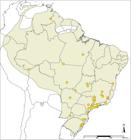
Geographical scope of the sound recordings samples (n = 87) of the species Dendropsophus minutus in South America. Polygon (beige) represents the entire distribution, according to the spatial data made available by the International Union for Conservation of Nature (IUCN). Dots (yellow) represent the locations where the recordings were made. It is noteworthy that some recordings were made at the same geographical point, but with different individuals.
Lesser treefrog’s note types differed in duration (Kruskal-Wallis: χ2 = 164.53, P < 0.0001) and some frequency parameters (PC1: χ2 = 2.30, P = 0.32, PC2: χ2 = 56.82, P < 0.0001). Type C note had higher values of PC2 than types A (Teste de Dunn: Z = 6.14, P < 0.0001) and B (Z = 6.97, P < 0.0001), whereas types A and B had similar PC2 values (Z = -1.23, P = 0.22). High PC1 values indicate higher frequency calls, while high PC2 values suggest lower minimum frequencies and wider bandwidths (Table 1). Thus, these results suggest that type C note had wider frequency bandwidth and lower minimum frequency compared with types A and B notes. Type A note was longer than types B (Z = 6.83, P < 0.0001) and C (Z = 12.75, P < 0.0001), whereas type C note was shorter than type B note (Z = -5.63, P < 0.0001).
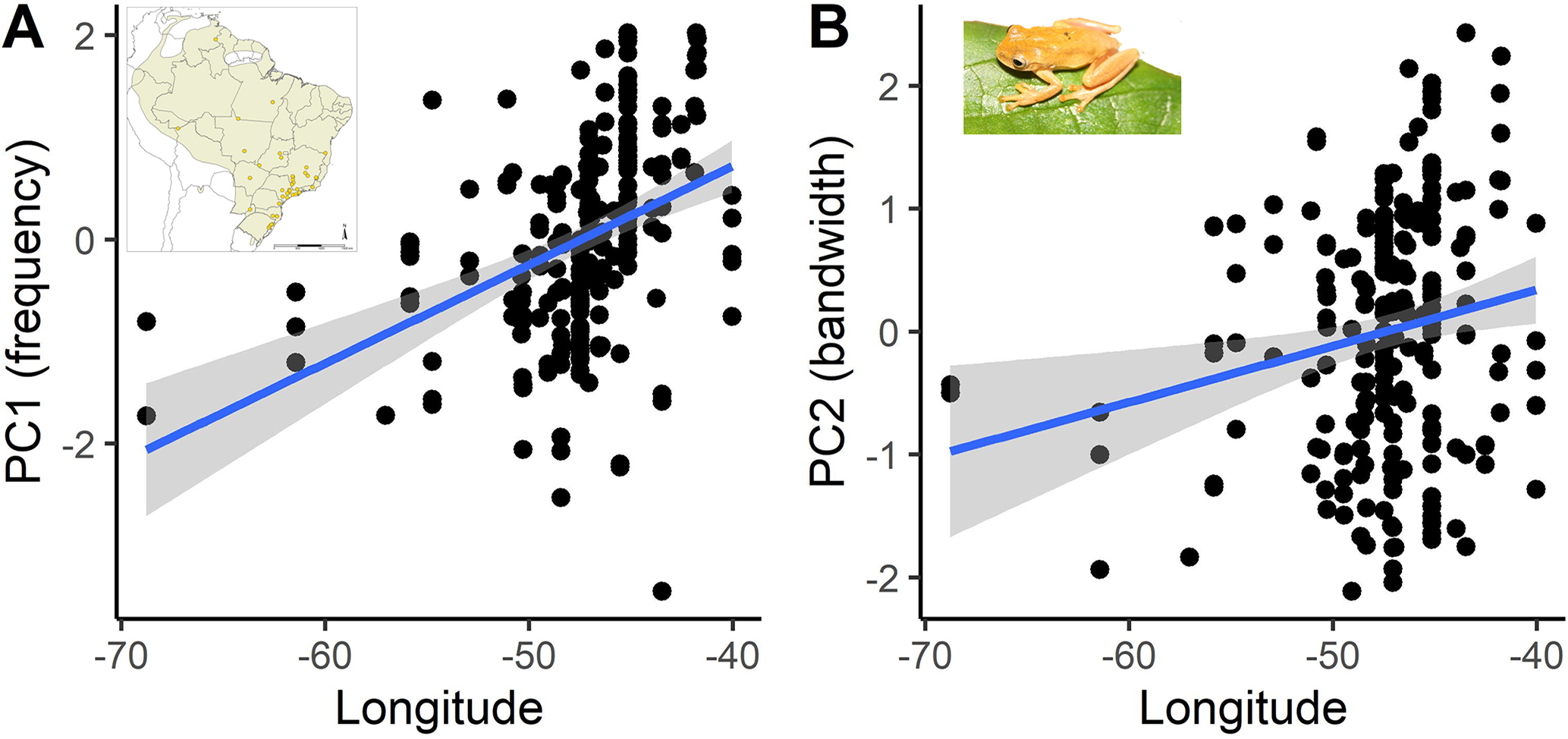
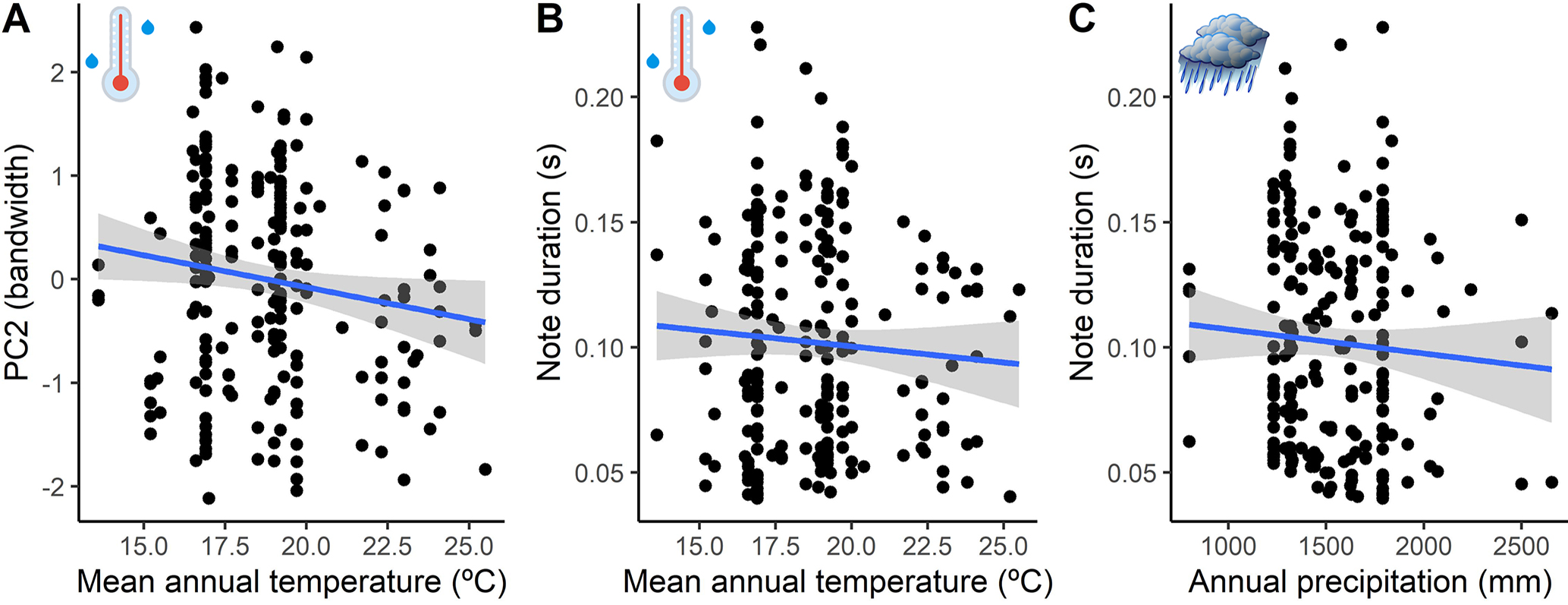
There was no correlation between acoustic and geographic distances regardless of note type (Mantel tests: Table 2), suggesting that isolation by distance cannot solely explain geographic variation in note acoustics in lesser treefrogs. Linear mixed models showed that frequency (PC1) and bandwidth (PC2) increase with longitude (Table 3, Fig. 3). This suggests that eastern treefrogs produce higher-pitched and wider-bandwidth notes. Moreover, lesser treefrogs uttered notes with wider bandwidths (PC2) in colder sites (Fig. 4A). These anurans also produced longer notes in colder (Fig. 4B) and dryer sites (Fig. 4C). The acoustic features of notes were not related to latitude (P > 0.10) (Table 3).
Mantel test (9999 repetitions) summarizing the autocorrelations between geographic distance and acoustic distances (n = 85A, 67B, 66C). Correlation coefficient (r) values and significance (P) values are shown. The p values were adjusted for multiple testing considering the false discovery rates method.
Linear mixed models to evaluate the effect of coordinates (latitude and longitude) and climate variables (mean annual temperature [temp] and annual precipitation [prec]) on the acoustic structure of Dendropsophus minutus call notes. Note type and recording identity were included as random intercepts in all models. Duration: note duration (log). Significant effects highlighted in bold.
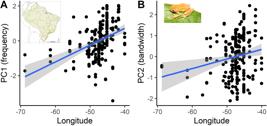
Variation in frequency (PC1) and bandwidth (PC2) of Dendropsophus minutus calls as a function of longitude. Mean trend lines and confidence intervals (95%) are shown. Each point represents the average acoustic parameter for each note type on each recording (i.e., individual).

Variation in frequency bandwidth (PC2) and note duration (s) of Dendropsophus minutus calls as a function of mean annual temperature and annual precipitation. Mean trend lines and confidence intervals (95%) are shown. Each point represents the average acoustic parameter for each note type on each recording (i.e., individual).
DISCUSSION
Our results suggest that the analyzed acoustic properties of lesser treefrogs’ notes, which compose their calls, vary with longitude, mean annual temperature, and annual precipitation. Notes appear to have a higher pitch and wider bandwidth east of the species’ range. Notes also seem to have a lower bandwidth at hotter sites and a shorter duration at hotter sites and wetter sites. Conversely, we found no significant correlation between acoustic metrics of notes and latitude.
Previous studies found that air temperature is an important driver of variation in anuran calls (Prestwich, 1994). A previous study on geographic variation in call acoustics in the congeneric dwarf treefrog (Dendropsophus nanus) (Boulenger, 1889) also found a decrease in advertisement call duration with increasing temperature (Annibale et al., 2020). Call duration in lesser treefrogs living in a temporary pond in central Brazil also decreases with temporal increases in air temperature (Morais et al., 2012). These studies suggest that higher temperatures tend to reduce the duration of calls and their notes in anurans. However, it is important to note that these previous studies relied on temperature measurements obtained at the time of recordings, whereas our study employed average temperature values across several years. Therefore, our study suggests that call traits (e.g., note rate and duration) might be influenced by climate-based selection extending beyond the individual plasticity in response to fluctuations in air temperature, as proposed in earlier research (Prestwich, 1994; Wells, 2010; Morais et al., 2012; Llusia et al., 2013a; Annibale et al., 2020).
Call rate often increases with increasing air temperature in anurans as a result of higher metabolic rate and energy expenditure (Wells, 2010). For example, in chaco treefrogs (Boana raniceps) (Cope, 1862), males produce shorter calls, but in greater numbers, as the air temperature increases (Guimarães & Bastos, 2003). Given the recording’s limited duration, we could not measure call rates. Yet, we speculate that in warmer temperatures, lesser treefrogs produce shorter notes at a higher rate, optimizing call transmission while conserving energy (Lingnau & Bastos, 2007).
Here, in addition to note duration, note bandwidth (represented by PC2, Table 1), but not note pitch (PC1), decreased with increasing temperature (Fig. 4A). As shown above, air temperature strongly affects the acoustics of anuran calls at short (Morais et al., 2012; Llusia et al., 2013a) and possibly at longer time scales (this study). High-pitched sounds attenuate more quickly than low-pitched sounds, i.e., high-pitched sounds lose energy faster as they propagate away from the sound source (Brown & Riede, 2017). Additionally, high temperatures and low humidity favor sound absorption (Snell-Rood, 2012), which impairs sound propagation. We suggest that male lesser treefrogs modulate call bandwidth to optimize signal propagation depending on the air temperature.
The call notes of D. minutus were shorter in sites with accumulated annual rainfall greater than 2000mm (Fig. 4D). We already expected that these acoustic signals would vary with precipitation since relative humidity modulates the reproduction of many amphibian species (Aichinger, 1987; Llusia et al., 2013b). Rain noise can mask anuran calls, reduce their acoustic activity (Ospina et al., 2013), and may thus explain the shorter lesser treefrogs’ call notes in wetter sites (Brumm & Slabbekoorn, 2005). Intense solar radiation in the rainy season in southeast Brazil, which covers most of the recording locations (Madruga et al., 2014), increases evaporation and, consequently, heat fluxes. Thus, seasonal matching of hotter temperatures and heavier rainfall may have a combined effect on the occurrence of short call notes in hot and wet environments.
Combined evidence from this and previous studies suggest that individual morphology may also explain geographic variation in calls of D. minutus. First, larger males call at a lower pitch in several species from different anuran clades (Gingras et al., 2012). Second, a previous study showed that larger males call at a lower pitch in lesser treefrogs (Morais et al., 2012). Finally, lesser treefrogs are larger in drier regions along a geographic gradient of rainfall seasonality and habitat type, which may be possibly a mechanism to avoid desiccation (Oyamaguchi et al., 2017). These patterns suggest that this species may be smaller and call at a higher pitch in the east of their distribution, where rainfall seasonality is lower than in central Brazil, pending further studies.
We showed that type C notes had a lower pitch than types A and B notes. Males lesser treefrogs utter advertisement calls composed by types A and C notes during the breeding season (Cardoso & Haddad, 1984; Guerra et al., 2018; Foratto et al., 2021). Changes in the production of these acoustic signals such as lowering pitch probably increase male attractiveness to females (Foratto et al., 2021). In contrast, calls including type B note mediates territorial and aggressive interactions. Lesser treefrogs may use the harmonic structure of type B note to assess rivals’ fighting ability and aggressive intent, adjusting territorial and aggressive behavior accordingly (Foratto et al., 2021). Further studies could test whether acoustic variation led by geography and bioclimate may result in changes in signaling function within populations. For example, how does call bandwidth mediate aggressive interactions in hot sites, in which call note bandwidths are lower, in comparison with colder sites?
Although there are 14 acoustic libraries containing recordings of amphibians (Köhler et al., 2017), Fonoteca Neotropical Jacques Vielliard (FNJV) has the highest number of recordings of lesser treefrogs at high quality and easy access compared to other libraries. We also obtained additional recordings from three other repositories. Nevertheless, recording availability is strongly biased to southeastern Brazil (Fig. 2) (Toledo et al., 2015b), limiting the representativeness of our results for understanding the geographic variation of lesser treefrog calls. Southeastern Brazil has a diverse climate driven by variations in topography, location, and dynamic aspects of the atmosphere (Minuzzi et al., 2007), which proved to be enough gradient to find a positive correlation between call note acoustics and longitude (Fig. 3). Further studies are needed to evaluate if this pattern holds for a broader geographic range.
We could not assess geographic and contextual variation in note type syntax due to the short recording duration and lack of information about the social context in which frogs were recorded. Lesser treefrogs have a complex vocal repertoire with calls varying in number, frequency, duration, and note type syntax, depending on the social context (Toledo et al., 2015a; Foratto et al., 2021). We urge further recordists to add information on ecology and social context along with the call recordings. This would be the foundation of further studies on geographic variation in call syntax in lesser treefrogs (e.g.,Kershenbaum et al., 2012) and shed light on the function of these signals. Finally, the present study highlights the feasibility and importance of citizen science and audiovisual databases to understand the evolution of acoustic signals in anurans.
ACKNOWLEDGEMENTS:
M.V.C. and P.D. received MSc scholarship and Postdoctoral fellowship grants from Coordenação de Aperfeiçoamento de Pessoal de Nível Superior (CAPES) (Finance Code 001, 88887.469218/2019-00), respectively. We thank Edvaldo Ferreira da Silva Júnior for his support in WorldClim data extraction. We thank Fonoteca Neotropical Jacques Vielliard (FNJV), herpetological collection of the Museu Nacional of the Universidade Federal do Rio de Janeiro (MNRJ), Coleção de Arquivos Sonoros de Anuros Neotropicais (IF Goiano) (CASAN), and Fonoteca Biológica da Universidade Federal de Pernambuco (FBIOUFPE), for making the recordings available. We also acknowledge all field recordists: Adão José Cardoso, Alexandre Bertolazzi, Camila Zornosa-Torres, Célio Haddad, Fabio Hepp, Gilda Vasconcellos de Andrade, Ivan Sazima, Jacques Vielliard, José P. Pombal Jr., Lucas Forti, Luis Felipe Toledo, Manoela Woitovicz Cardoso, Marcos Bilate, Matheus Moroti, Rogério Bastos, Roseli Foratto, Victor Favaro Augusto, and Werner Bokermann.
-
Published with the financial support of the “Programa de Apoio às Publicações Científicas Periódicas da Universidade de São Paulo”
APPENDIX 1
Acoustic recordings (n = 89) of lesser treefrogs (Dendropsophus minutus) obtained from acoustic data repositories. Recordings highlighted in bold were not analyzed. The recording underlined was deleted because it exhibits very extreme measurements (e.g., mean peak frequency > 13 kHz). Repositories: Fonoteca Neotropical Jacques Vielliard (FNJV); herpetological collection of the Museu Nacional of the Universidade Federal do Rio de Janeiro (MNRJ); Coleção de Arquivos Sonoros de Anuros Neotropicais (IF Goiano) (CASAN); and Fonoteca Biológica da Universidade Federal de Pernambuco (FBIOUFPE).
Average acoustic measurements of calls from lesser treefrogs (Dendropsophus minutus) computed for each note type within each recording (i.e., individual frogs) (n = 88 recordings). The note types were categorized as A, B, or C. The acoustic measurements included the duration of each note (measured in seconds), the 25th percentile frequency (measured in kHz; the frequency at which the signal’s energy is divided into two intervals containing 25% and 75% of the energy, respectively), the 75th percentile frequency (measured in kHz; the frequency at which the signal’s energy is divided into two intervals containing 75% and 25% of the energy, respectively), the bandwidth (measured in kHz; calculated as the difference between the 75th percentile frequency and the 25th percentile frequency), the mean dominant frequency (measured in kHz; the average of the dominant frequencies across the acoustic signal), and the mean peak frequency (measured in kHz; the frequency with the highest energy in the mean frequency spectrum). The recording in bold was deleted because it exhibits very extreme measurements (e.g., mean peak frequency > 13 kHz).
-
FUNDING INFORMATION: This project was completed without relying on any external financial support.
REFERENCES
-
Aichinger, M. 1987. Annual activity patterns of anurans in a seasonal neotropical environment. Oecologia, 71(4): 583-592. https://doi.org/10.1007/BF00379302
» https://doi.org/10.1007/BF00379302 -
Alvares, C.A.; Stape, J.L.; Sentelhas, P.C.; Gonçalves, J.L.M. & Sparovek, G. 2013. Köppen’s climate classification map for Brazil. Meteorologische Zeitschrif, 22(6): 711-728. https://doi.org/10.1127/0941-2948/2013/0507
» https://doi.org/10.1127/0941-2948/2013/0507 -
Andreani, T.L.; Bastos, R.P.; Dias, T.M.; Prado, C.P.A. & Morais, A.R. 2020. Acoustic variability among male gladiator frogs, Boana goiana (Lutz, 1968) (Anura: Hylidae): an 18 year analysis across several reproductive seasons. Amphibia-Reptilia, 42: 43-57. https://doi.org/10.1163/15685381-bja10029
» https://doi.org/10.1163/15685381-bja10029 -
Annibale, F.S.; De Sousa, V.T.T.; Da Silva, F.R. & Murphy, C.G. 2020. Geographic variation in the acoustic signals of Dendropsophus nanus (Boulenger 1889) (Anura: Hylidae). Herpetologica, 76(3): 267-277. https://doi.org/10.1655/Herpetologica-D-19-00046.1
» https://doi.org/10.1655/Herpetologica-D-19-00046.1 -
Araya-Salas, M. 2017. Rraven: connecting R and Raven bioacoustic software, R package. Available: https://cran.r-project.org/web/packages/Rraven/index.html
» https://cran.r-project.org/web/packages/Rraven/index.html -
Araya-Salas, M. & Smith-Vidaurre, G. 2017. warbleR: an R package to streamline analysis of animal acoustic signals. Methods in Ecology and Evolution, 8(2): 184-191. https://doi.org/10.1111/2041-210X.12624
» https://doi.org/10.1111/2041-210X.12624 -
Benjamini, Y. & Hochberg, Y. 1995. Controlling the false discovery rate: a practical and powerful approach to multiple testing. Journal of the Royal Statistical Society: Series B, 57(1): 289-300. https://doi.org/10.1111/j.2517-6161.1995.tb02031.x
» https://doi.org/10.1111/j.2517-6161.1995.tb02031.x -
Bernal, X.E.; Guarnizo, C. & Lüddecke, H. 2005. Geographic variation in advertisement call and genetic structure of Colostethus palmatus (Anura, Dendrobatidae) from the Colombian Andes. Herpetologica, 61(4): 395-408. https://doi.org/10.1655/04-87.1
» https://doi.org/10.1655/04-87.1 - Blair, W.F. 1963. Acoustic behaviour of Amphibia. In: Busnel, R.G. Acoustic behaviour of animals. New York, Elsevier. p. 694-708.
- Blair, W.F. 1968. Amphibians and reptiles. In: Sebeok, T.A. Animal communication. Bloomington, Indiana University Press. p. 289-310.
- Bogert, C.M. 1960. The influence of sound on the behavior of amphibians and reptiles. In: Lanyon, W.E. & Tavolga, W.N. Animal sounds and communication. Washington, DC, AIBS. p. 137-320.
-
Brown, C. & Riede, T. 2017. Comparative bioacoustics: an overview. Sharjah, Bentham Science Publishers. https://doi.org/10.2174/97816810831791170101
» https://doi.org/10.2174/97816810831791170101 -
Brumm, H. & Slabbekoorn, H. 2005. Acoustic communication in noise. Advances in the Study of Behavior, 35: 151-209. https://doi.org/10.1016/S0065-3454(05)35004-2
» https://doi.org/10.1016/S0065-3454(05)35004-2 - Cardoso, A.J. & Haddad, C.F.B. 1984. Variabilidade acústica em diferentes populações e interações agressivas de Hyla minuta (Amphibia, Anura). Ciência e Cultura, 36(8): 1393-1399.
-
Carvalho, T.R. & Giaretta, A.A. 2013. Bioacoustics reveals two new syntopic species of Adenomera Steindachner (Anura: Leptodactylidae: Leptodactylinae) in the Cerrado of central Brazil. Zootaxa, 3731: 533-551. https://doi.org/10.11646/zootaxa.3731.4.6
» https://doi.org/10.11646/zootaxa.3731.4.6 -
Castellano, S.; Giacoma, C. & Dujsebayeva, T. 2000. Morphometric and advertisement call geographic variation in polyploid green toads. Biological Journal of the Linnean Society, 70(2): 341-360. https://doi.org/10.1111/j.1095-8312.2000.tb00214.x
» https://doi.org/10.1111/j.1095-8312.2000.tb00214.x -
Dena, S.; Rebouças, R.; Augusto-Alves, G.; Zornosa-Torres, C.; Pontes, M.R. & Toledo, L.F. 2020. How much are we losing in not depositing anuran sound recordings in scientific collections? Bioacoustics, 29(5): 590-601. https://doi.org/10.1080/09524622.2019.1633567
» https://doi.org/10.1080/09524622.2019.1633567 -
Dray, S. & Dufour, A. B. 2007. The ade4 Package: implementing the duality diagram for ecologists. Journal of Statistical Software, 22: 1-20. https://doi.org/10.18637/jss.v022.i04
» https://doi.org/10.18637/jss.v022.i04 -
Faivovich, J.; Haddad, C.F.B.; Garcia, P.C.A.; Frost, D.R.; Campbell, J.A. & Wheeler, W.C. 2005. Systematic review of the frog family Hylidae, with special reference to Hylinae: Phylogenetic analysis and taxonomic revision. Bulletin of the American Museum of Natural History, 294: 1-240. https://doi.org/10.1206/0003-0090(2005)294[0001:srotff]2.0.co;2
» https://doi.org/10.1206/0003-0090(2005)294[0001:srotff]2.0.co;2 -
Fick, S.E. & Hijmans, R.J. 2017. WorldClim 2: new 1 km spatial resolution climate surfaces for global land areas. International Journal of Climatology, 37(12): 4302-4315. https://doi.org/10.1002/joc.5086
» https://doi.org/10.1002/joc.5086 -
Foratto, R.M.; Llusia, D.; Toledo, L.F. & Forti, L.R. 2021. Treefrogs adjust their acoustic signals in response to harmonics structure of intruder calls. Behavioral Ecology, 32(3): 416-427. https://doi.org/10.1093/beheco/araa135
» https://doi.org/10.1093/beheco/araa135 -
Frost, D.R. 2023. Amphibian species of the world: an Online Reference. Version 6.2 (28 August 2023). Electronic Database accessible at https://amphibiansoftheworld.amnh.org New York, American Museum of Natural History. https://doi.org/10.5531/db.vz.0001
» https://amphibiansoftheworld.amnh.org» https://doi.org/10.5531/db.vz.0001 -
Funk, V.A. 2018. Collections-based science in the 21st Century. Journal of Systematics and Evolution, 56(3): 175-193. https://doi.org/10.1111/jse.12315
» https://doi.org/10.1111/jse.12315 -
García, N.C.; Naka, L.N. & Cabanne, G.S. 2018. Vocal variation in relation to genetic structure in an Atlantic Forest woodcreeper (Xiphorhynchus fuscus): evolutionary and taxonomic implications. Journal of Ornithology, 159(2): 379-388. https://doi.org/10.1007/s10336-017-1509-9
» https://doi.org/10.1007/s10336-017-1509-9 -
Gehara, M.; Crawford, A.J.; Orrico, V.G.D.; Rodríguez, A.; Lötters, S.; Fouquet, A.; Barrientos, L.S.; Brusquetti, F.; de la Riva, I.; Ernst, R.; Urrutia, G.G.; Glaw, F.; Guayasamin, J.M.; Hölting, M.; Jansen, M.; Kok, P.J.R.; Kwet, A.; Lingnau, R.; Lyra, M.; Moravec, J.; Pombal Jr., J.P.; Rojas-Runjaic, F.J.M.; Schulze, A.; Señaris, J.C.; Solé, M.; Rodrigues, M.T.; Twomey, E.; Haddad, C.F.B.; Vences, M. & Köhler, J. 2014. High Levels of Diversity Uncovered in a Widespread Nominal Taxon: Continental Phylogeography of the Neotropical Tree Frog Dendropsophus minutus PLoS One, 9: e103958. https://doi.org/10.1371/journal.pone.0103958
» https://doi.org/10.1371/journal.pone.0103958 -
Gingras, B.; Boeckle, M.; Herbst, C.T. & Fitch, W.T. 2012. Call acoustics reflect body size across four clades of anurans. Journal of Zoology, 289(2): 143-150. https://doi.org/10.1111/j.1469-7998.2012.00973.x
» https://doi.org/10.1111/j.1469-7998.2012.00973.x -
Guerra, V.; Llusia, D.; Gambale, P.G.; De-Morais, A.R.; Márquez, R. & Bastos, R.P. 2018. The advertisement calls of Brazilian anurans: Historical review, current knowledge and future directions. PLoS One, 13: e0191691. https://doi.org/10.1371/journal.pone.0191691
» https://doi.org/10.1371/journal.pone.0191691 -
Guimarães, L.D. & Bastos R.P. 2003. Vocalizações e interações acústicas em Hyla raniceps (Anura, Hylidae) durante a atividade reprodutiva. Iheringia. Série Zoológica, 93(2): 149-158. https://doi.org/10.1590/S0073-47212003000200005
» https://doi.org/10.1590/S0073-47212003000200005 - Haddad, C.F.B. 1995. Comunicação em Anuros (Amphibia). Anais de Etologia, 13: 116-132.
- Haddad, C.F.B. & Cardoso, A.J. 1992. Eleccion del macho por la hembra de Hyla minuta (Amhpibia: Anura). Acta Zoológica Lilloana, 41: 81-91.
-
Hernández-Herrera, C.I. & Pérez-Mendoza, H.A. 2021. Acoustic and morphological variation on two populations of Dryophytes arenicolor in central México. Bioacoustics, 30(3): 366-377. https://doi.org/10.1080/09524622.2020.1760937
» https://doi.org/10.1080/09524622.2020.1760937 -
Hijmans, R.J. 2020. raster: Geographic Data Analysis and Modeling, R package. Available: https://cran.r-project.org/web/packages/raster/index.html
» https://cran.r-project.org/web/packages/raster/index.html -
International Union for Conservation of Nature and Natural Resources (IUCN). 2021. Dendropsophus minutus (spatial data) The IUCN Red List of Threatened Species. Version 2021-3. Available: https://www.iucnredlist.org
» https://www.iucnredlist.org -
K. Lisa Yang Center for Conservation Bioacoustics. 2019. Raven Pro: Interactive sound analysis software (Version 1.6.1). Ithaca, NY Cornell Lab Ornithol. Available: https://ravensoundsoftware.com/raven-downloads
» https://ravensoundsoftware.com/raven-downloads -
Kaplan, M. 1994. A New Species of Frog of the Genus Hyla from the Cordillera Oriental in Northern Colombia with Comments on the Taxonomy of Hyla minuta Journal of Herpetology, 28: 79-87. https://doi.org/10.2307/1564684
» https://doi.org/10.2307/1564684 -
Kershenbaum, A.; Ilany, A.; Blaustein, L. & Geffen, E. 2012. Syntactic structure and geographical dialects in the songs of male rock hyraxes. Proceedings of the Royal Society B: Biological Sciences, 279(1740): 2974-2981. https://doi.org/10.1098/rspb.2012.0322
» https://doi.org/10.1098/rspb.2012.0322 - Köhler, J. 2000. Amphibian diversity in Bolivia: a study with special reference to montane forest regions. Bonner Zoologische Monographien, 48: 1-243.
-
Köhler, J.; Jansen, M.; Rodríguez, A.; Kok, P.J.R.; Toledo, L.F.; Emmrich, M.; Glaw, F.; Haddad, C.F.B.; Rödel, M. O. & Vences, M. 2017. The use of bioacoustics in anuran taxonomy: Theory, terminology, methods and recommendations for best practice. Zootaxa, 4251: 1-124. https://doi.org/10.11646/zootaxa.4251.1.1
» https://doi.org/10.11646/zootaxa.4251.1.1 - Leivas, P.T.; Mayer, T.B. & Fávaro, L.F. 2018a. The reproductive biology of Dendropsophus minutus (Amphibia: Anura) in South of Brazil. Herpetology Notes, 11: 395-403.
-
Leivas, P.T.; Mayer, T.B.; Leivas, F.W.T. & Fávaro, L.F. 2018b. Trophic niche of Dendropsophus minutus (Anura: Hylidae) in southern Brazil. Phyllomedusa: Journal of Herpetology, 17(2): 267-272. https://doi.org/10.11606/issn.2316-9079.v17i2p267-272
» https://doi.org/10.11606/issn.2316-9079.v17i2p267-272 -
Lemes, P.; Tessarolo, G.; Morais, A.R. & Bastos, R.P. 2012. Acoustic repertoire of Barycholos ternetzi (Anura: Strabomantidae) in Central Brazil. South American Journal of Herpetology, 7(2): 157-164. https://doi.org/10.2994/057.007.0205
» https://doi.org/10.2994/057.007.0205 -
Lingnau, R. & Bastos, R.P. 2007. Vocalizations of the Brazilian torrent frog Hylodes heyeri (Anura: Hylodidae): Repertoire and influence of air temperature on advertisement call variation. Journal of Natural History, 41(17-20): 1227-1235. https://doi.org/10.1080/00222930701395626
» https://doi.org/10.1080/00222930701395626 -
Llusia, D.; Márquez, R.; Beltrán, J.F.; Benítez, M. & Do-Amaral, J.P. 2013a. Calling behaviour under climate change: geographical and seasonal variation of calling temperatures in ectotherms. Global Change Biology, 19(9): 2655-2674. https://doi.org/10.1111/gcb.12267
» https://doi.org/10.1111/gcb.12267 -
Llusia, D.; Márquez, R.; Beltrán, J.F.; Moreira, C. & Do-Amaral, J.P. 2013b. Environmental and social determinants of anuran lekking behavior: intraspecific variation in populations at thermal extremes. Behavioral Ecology and Sociobiology, 67(3): 493-511. https://doi.org/10.1007/s00265-012-1469-2
» https://doi.org/10.1007/s00265-012-1469-2 -
Lopes, L.E. & Schunck, F. 2022. Unravelling the migratory patterns of the rufous-tailed attila within the Neotropics using citizen science and traditional data sources. Ornithology Research, 30: 87-98. https://doi.org/10.1007/s43388-022-00087-0
» https://doi.org/10.1007/s43388-022-00087-0 -
Madruga, J.; Rao, V.B. & Hada, K. 2014. Relações entre temperatura e precipitação no Brasil. Instituto Nacional de Pesquisas Espaciais. Available: http://bibdigital.sid.inpe.br/rep-/cptec.inpe.br/walmeida/2004/07.06.11.06
» http://bibdigital.sid.inpe.br/rep-/cptec.inpe.br/walmeida/2004/07.06.11.06 -
Minuzzi, R.B.; Sediyama, G.C.; Barbosam, E. da M. & de-Melo-Júnior, J.C.F. 2007. Climatologia do comportamento do período chuvoso da região sudeste do Brasil. Revista Brasileira de Meteorologia, 22(3): 338-344. https://doi.org/10.1590/S0102-77862007000300007
» https://doi.org/10.1590/S0102-77862007000300007 - Morais, A.R.; Batista, V.G.; Gambale, P.G.; Signorelli, L. & Bastos, R.P. 2012. Acoustic communication in a Neotropical frog (Dendropsophus minutus): Vocal repertoire, variability and individual discrimination. The Herpetological Journal, 22(4): 249-257.
- Oliveira, E.F.; Feio, R.N. & da Matta, S.L.P. 2007. Aspectos reprodutivos de Dendropsophus minutus (Peters, 1872) no município de Viçosa, Minas Gerais. Revista Ceres, 54(313): 231-239.
-
Ospina, O.E.; Villanueva-Rivera, L.J.; Corrada-Bravo, C.J. & Aide, T.M. 2013. Variable response of anuran calling activity to daily precipitation and temperature: implications for climate change. Ecosphere, 4: 1-12. https://doi.org/10.1890/ES12-00258.1
» https://doi.org/10.1890/ES12-00258.1 -
Oyamaguchi, H.M.; Oliveira, E. & Smith, T.B. 2017. Environmental drivers of body size variation in the lesser treefrog (Dendropsophus minutus) across the Amazon-Cerrado gradient. Biological Journal of the Linnean Society, 120(2): 363-370. https://doi.org/10.1111/bij.12879
» https://doi.org/10.1111/bij.12879 -
Pebesma, E.J. & Bivand, R.S. 2005. sp: Classes and Methods for Spatial Data, R package. Available: https://cran.r-project.org/web/packages/sp
» https://cran.r-project.org/web/packages/sp -
Prestwich, K.N. 1994. The energetics of acoustic signaling in anurans and insects. American Zoologist, 34(6): 625-643. https://doi.org/10.1093/icb/34.6.625
» https://doi.org/10.1093/icb/34.6.625 -
R Core Team. 2021. R: A Language and Environment for Statistical Computing. Version 4.0.5. Available: https://www.r-project.org
» https://www.r-project.org -
Revelle, W. 2021. psych: Procedures for Psychological, Psychometric, and Personality Research, R package. Available: https://cran.r-project.org/web/packages/psych/index.html
» https://cran.r-project.org/web/packages/psych/index.html -
Röhr, D.L.; Camurugi, F.; Paterno, G.B.; Gehara, M.; Juncá, F.A.; Álvares, G.F.R.; Brandão, R.A. & Garda, A.A. 2020. Variability in anuran advertisement call: a multi-level study with 15 species of monkey tree frogs (Anura, Phyllomedusidae). Canadian Journal of Zoology, 98(8): 495-504. https://doi.org/10.1139/cjz-2020-0018
» https://doi.org/10.1139/cjz-2020-0018 -
Santos, L.R.S. & Oliveira, C.D. 2007. Morfometria testicular durante o ciclo reprodutivo de Dendropsophus minutus (Peters) (Anura, Hylidae). Revista Brasileira de Zoologia, 24: 64-70. https://doi.org/10.1590/S0101-81752007000100008
» https://doi.org/10.1590/S0101-81752007000100008 -
Santos, L.R.S.; Franco-Belussi, L. & Oliveira, C.D. 2012. Germ cell dynamics during the annual reproductive cycle of Dendropsophus minutus (Anura: Hylidae). Zoological Science, 2(11): 840-844. https://doi.org/10.2108/zsj.28.840
» https://doi.org/10.2108/zsj.28.840 -
Shen, B.; Chen, P.; Zheng, R.Q.; Min, J.J.; Dong, B.J. & Zhao, M.M. 2015. Geographic variation in the advertisement calls of the giant spiny frog (Paa spinosa). Acta Ecologica Sinica, 35: 39-45. https://doi.org/10.1016/j.chnaes.2015.01.001
» https://doi.org/10.1016/j.chnaes.2015.01.001 -
Snell-Rood, E.C. 2012. The effect of climate on acoustic signals: Does atmospheric sound absorption matter for bird song and bat echolocation? The Journal of the Acoustical Society of America, 131(2): 1650-1658. https://doi.org/10.1121/1.3672695
» https://doi.org/10.1121/1.3672695 - Tessarolo, G.; Maciel, N.M.; Morais, A.R. & Bastos, R.P. 2016. Geographic variation in advertisement calls among populations of Dendropsophus cruzi (Anura: Hylidae). The Herpetological Journal, 26(3): 219-224.
-
Toledo, L.F.; Martins, I.A.; Bruschi, D.P.; Passos, M.A.; Alexandre, C. & Haddad, C.F.B. 2015a. The anuran calling repertoire in the light of social context. Acta Ethologica, 18: 87-99. https://doi.org/10.1007/s10211-014-0194-4
» https://doi.org/10.1007/s10211-014-0194-4 -
Toledo, L.F.; Tipp, C. & Márquez, R. 2015b. The value of audiovisual archives. Science, 347(6221): 484. https://doi.org/10.1126/science.347.6221.484-b
» https://doi.org/10.1126/science.347.6221.484-b -
Vaz-Silva, W.; Maciel, N.M.; Nomura, F.; Morais, A.R.; Batista, V.G.; Santos, D.L.; Andrade, S.P.; Oliveira, A.Â.B.; Brandão, R.A. & Bastos, R.P. 2020. Guia de identificação das espécies de anfíbios (Anura e Gymnophiona) do estado de Goiás e do Distrito Federal, Brasil Central. Curitiba, Sociedade Brasileira de Zoologia. https://doi.org/10.7476/9786587590011
» https://doi.org/10.7476/9786587590011 -
Vieira, R.R.S.; Batista, V.G. & Bastos, R.P. 2016. Acoustic communication in two species of the Hypsiboas albopunctatus group (Anura: Hylidae) in sympatry and allopatry. Zoologia, 33(2): 1-10, e20150037. https://doi.org/10.1590/S1984-4689zool-20150037
» https://doi.org/10.1590/S1984-4689zool-20150037 - Wells, K.D. 2010. The Ecology and behavior of amphibians. Chicago, Chicago University Press.
-
Wilkins, M.R.; Seddon, N. & Safran, R.J. 2013. Evolutionary divergence in acoustic signals: causes and consequences. Trends in Ecology and Evolution, 28(3): 156-166. https://doi.org/10.1016/j.tree.2012.10.002
» https://doi.org/10.1016/j.tree.2012.10.002
Edited by
-
Edited by:
Pedro Murilo Sales Nunes